
From Reluctance to Engagement: Aligning Institutional Policy with “Human-in-the-Loop” Pedagogy



Abstract
1. Introduction
2. Materials and Methods
2.1. Institutional Case Study Context and Setting
2.2. Campus-Wide Attitude Surveys
2.3. Longitudinal Syllabus Analysis
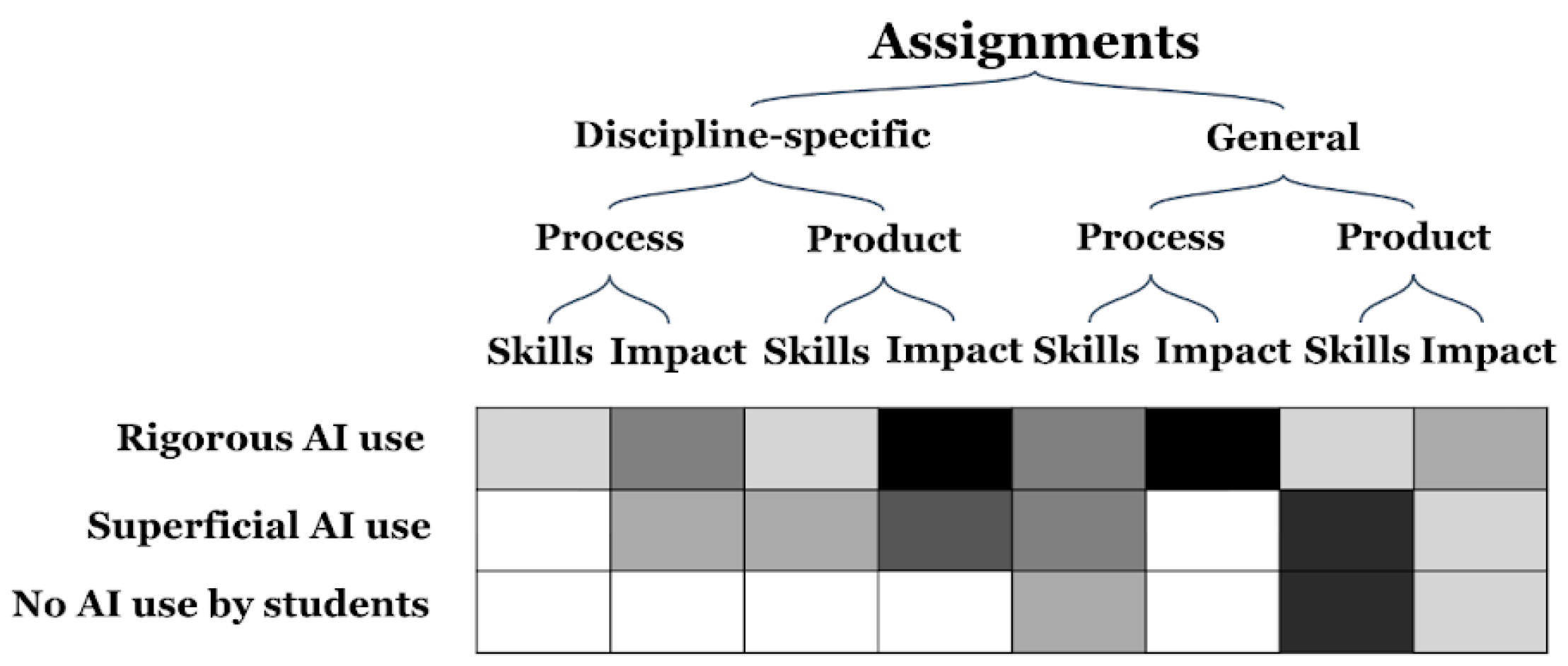
2.4. AI Assignment Analysis Framework and Analysis of AI-Themed Assignments
3. Results
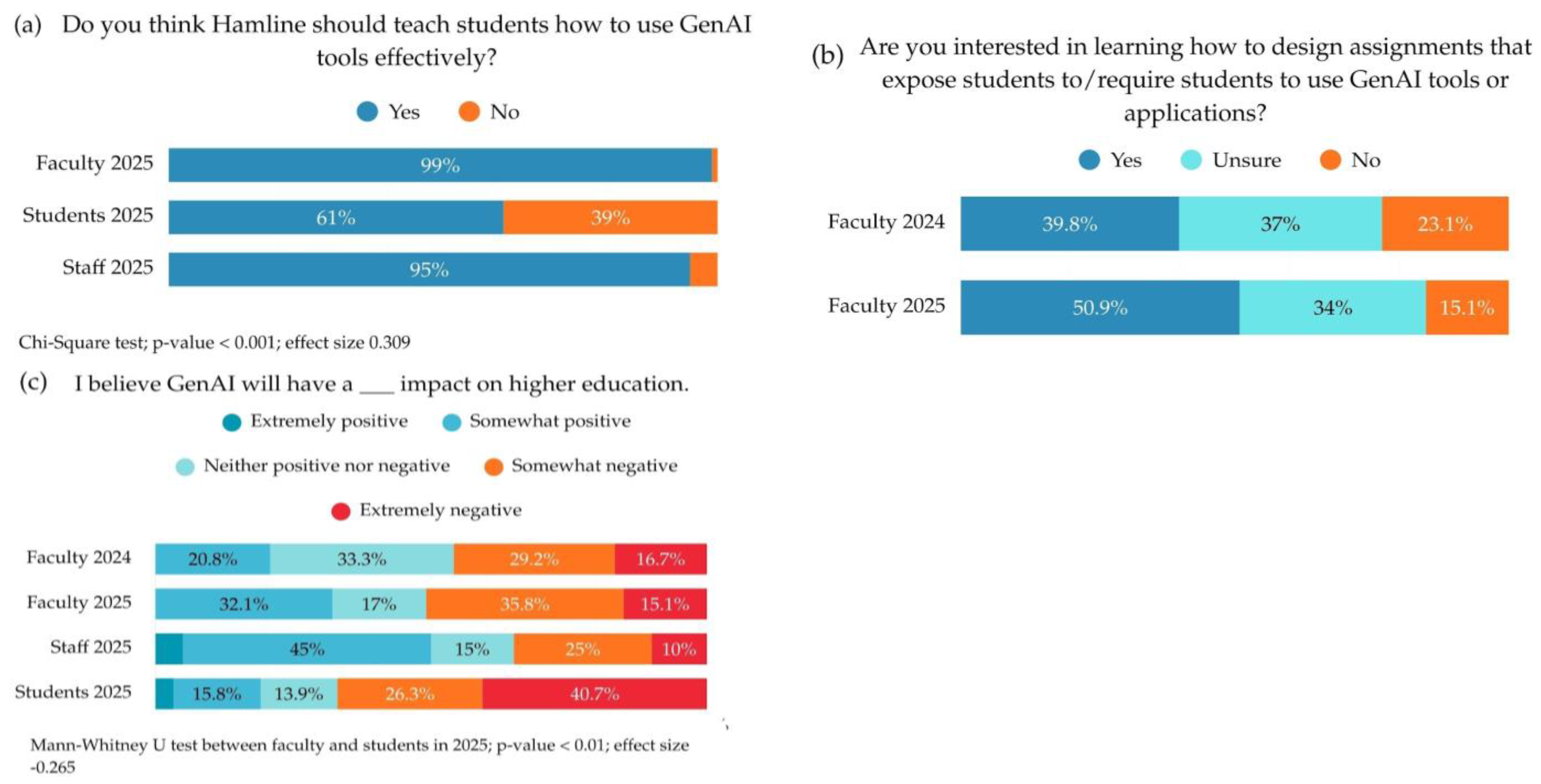
3.1. Divergent Perspectives on the Need for GenAI Education
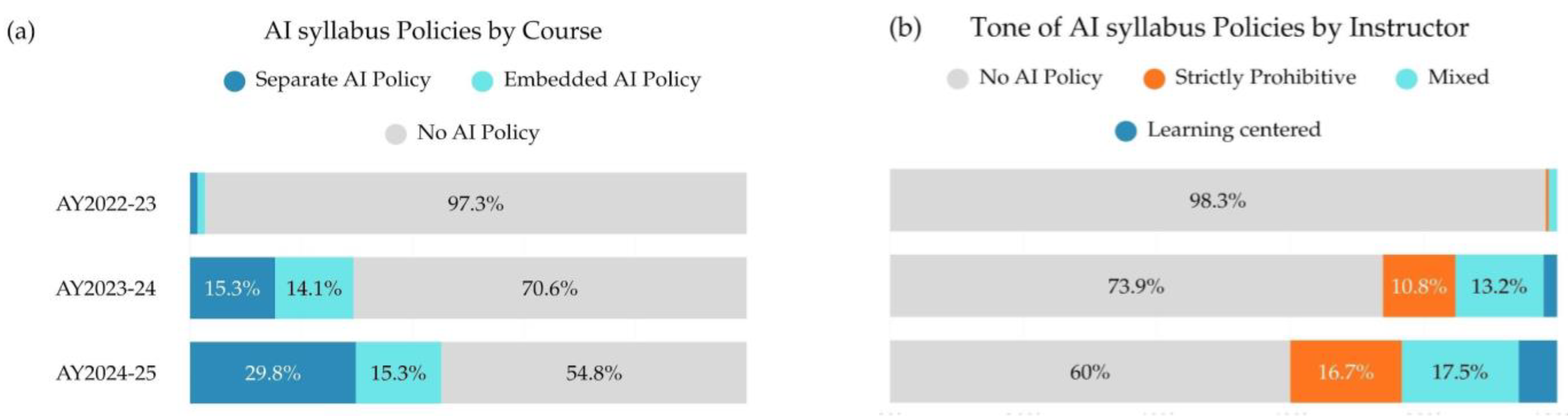
3.2. Syllabus Policies: Hesitation, Inconsistency, and Punitive Framing
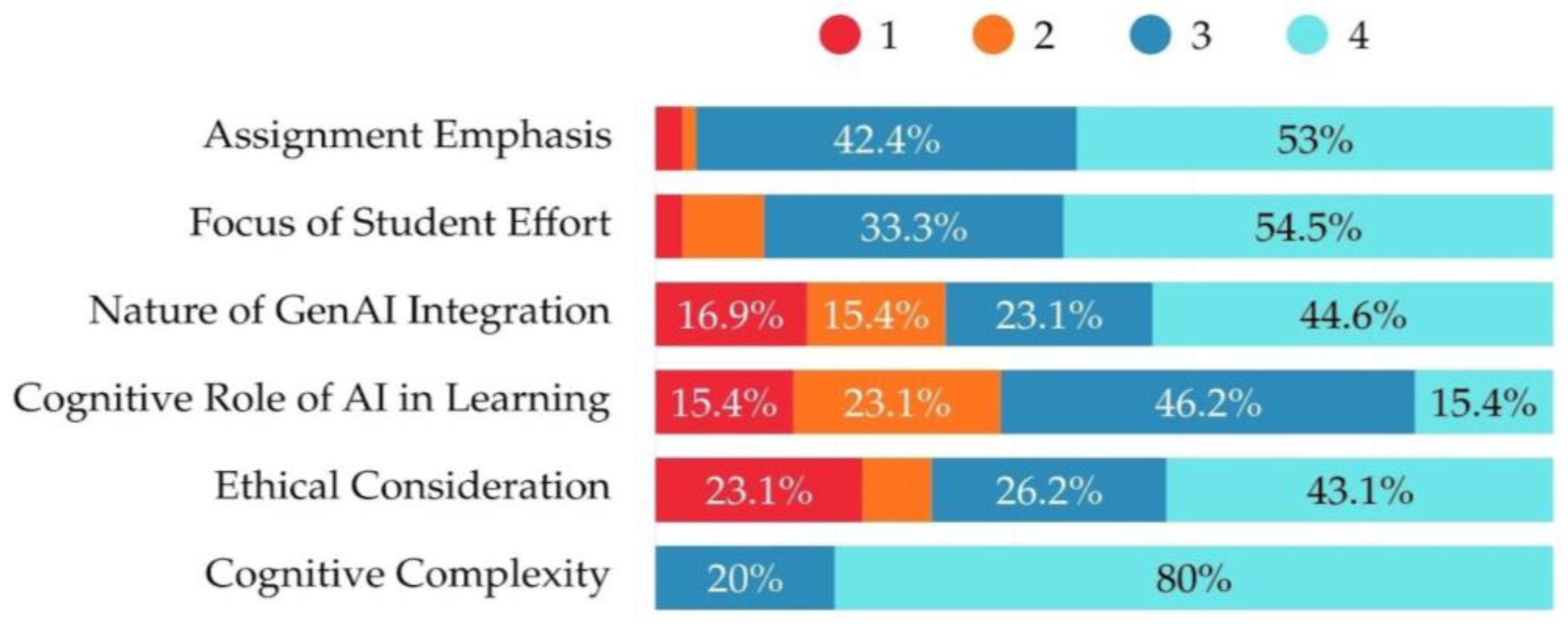
3.3. Assignment Analysis: Multiple Entry Points for Integration
4. Discussion
5. Conclusions
Supplementary Materials
Author Contributions
Funding
Institutional Review Board Statement
Informed Consent Statement
Data Availability Statement
Acknowledgments
Conflicts of Interest
Abbreviations
| GenAI | Generative Artificial Intelligence |
References
- Freeman, J. Student Generative AI Survey; Higher Education Policy Institute Report 2025 HEPI Report; Higher Education Policy Institute: Oxford, UK, 2025; Available online: https://www.hepi.ac.uk/reports/student-generative-ai-survey-2025/ (accessed on 15 December 2025).
- Pallant, J.L.; Blijlevens, J.; Campbell, A.; Jopp, R. Mastering knowledge: The impact of generative AI on student learning outcomes. Stud. High. Educ. 2025, 1–22. [Google Scholar] [CrossRef] [Scilit]
- Iqbal, J.; Hashmi, Z.F.; Asghar, M.Z.; Abid, M.N. Generative AI tool use enhances academic achievement in sustainable education through shared metacognition and cognitive offloading among preservice teachers. Sci. Rep. 2025, 15, 16610. [Google Scholar] [CrossRef] [Scilit] [PubMed]
- Tu, Y.-F. Roles and functionalities of ChatGPT for students with different growth mindsets: Findings of drawing analysis. Educ. Technol. Soc. 2025, 27, 198–214. [Google Scholar]
- Bittle, K.; El-Gayar, O. Generative AI and academic integrity in higher education: A systematic review and research agenda. Information 2025, 16, 296. [Google Scholar] [CrossRef] [Scilit]
- Wang, J.; Fan, W. The effect of ChatGPT on students’ learning performance, learning perception, and higher-order thinking: Insights from a meta-analysis. Int. J. Educ. Technol. High. Educ. 2024, 21, 35. [Google Scholar] [CrossRef] [Scilit]
- Bai, Y.; Wang, S. Impact of generative AI interaction and output quality on university students’ learning outcomes: A technology-mediated and motivation-driven approach. Sci. Rep. 2025, 15, 24054. [Google Scholar] [CrossRef] [Scilit]
- Dergaa, I.; Saad, H.B.; Glenn, J.M.; Amamou, B.; Aissa, M.B.; Guelmami, N.; Fekih-Romdhane, F.; Chamari, K. From tools to threats: A reflection on the impact of artificial-intelligence chatbots on cognitive health. Front. Psychol. 2024, 15, 1259845. [Google Scholar] [CrossRef] [Scilit]
- Zhai, C.; Wibowo, S.; Li, L.D. The effects of over-reliance on AI dialogue systems on students’ cognitive abilities: A systematic review. Smart Learn. Environ. 2024, 11, 28. [Google Scholar] [CrossRef] [Scilit]
- Nasr, N.R.; Tu, C.-H.; Werner, J.; Bauer, T.; Yen, C.-J.; Sujo-Montes, L. Exploring the impact of generative AI ChatGPT on critical thinking in higher education: Passive AI-directed use or human–AI supported collaboration? Educ. Sci. 2025, 15, 1198. [Google Scholar] [CrossRef] [Scilit]
- Hassen, M.Z. The impact of AI on students’ reading, critical thinking, and problem-solving skills. Am. J. Educ. Inf. Technol. 2025, 9, 82–90. [Google Scholar] [CrossRef] [Scilit]
- Shin, Y. Toward human-centered artificial intelligence for users’ digital well-being: Systematic review, synthesis, and future directions. JMIR Hum. Factors 2025, 12, e69533. [Google Scholar] [CrossRef] [Scilit]
- Chang, J.P.-C.; Cheng, S.-W.; Chang, S.M.-J.; Su, K.-P. Navigating the digital maze: A review of AI bias, social media, and mental health in Generation Z. AI 2025, 6, 118. [Google Scholar] [CrossRef] [Scilit]
- Storey, V.C.; Yue, W.T.; Zhao, J.L.; Lukyanenko, R. Generative artificial intelligence: Evolving technology, growing societal impact, and opportunities for information systems research. Inf. Syst. Front. 2025, 27, 2081–2102. [Google Scholar] [CrossRef] [Scilit]
- Wang, H.; Dang, A.; Wu, Z.; Mac, S. Generative AI in higher education: Seeing ChatGPT through universities’ policies, resources, and guidelines. Comput. Educ. Artif. Intell. 2024, 7, 100326. [Google Scholar] [CrossRef] [Scilit]
- Ravšelj, D.; Keržič, D.; Tomaževič, N.; Umek, L.; Brezovar, N.; Iahad, N.A.; Abdulla, A.A.; Akopyan, A.; Segura, M.W.A.; AlHumaid, J.; et al. Higher education students’ perceptions of ChatGPT: A global study of early reactions. PLoS ONE 2025, 20, e0315011. [Google Scholar] [CrossRef] [Scilit]
- Lee, V.R.; Pope, D.; Miles, S.; Zárate, R.C. Cheating in the age of generative AI: A high-school survey study of cheating behaviours before and after the release of ChatGPT. Comput. Educ. Artif. Intell. 2024, 7, 100253. [Google Scholar] [CrossRef] [Scilit]
- Johnston, H.; Wells, R.F.; Shanks, E.M.; Boey, T.; Parsons, B.N. Student perspectives on the use of generative artificial intelligence technologies in higher education. Int. J. Educ. Integr. 2024, 20, 2. [Google Scholar] [CrossRef] [Scilit]
- Blahopoulou, J.; Ortiz-Bonnin, S. Student perceptions of ChatGPT: Benefits, costs, and attitudinal differences between users and non-users toward AI integration in higher education. Educ. Inf. Technol. 2025, 30, 19741–19764. [Google Scholar] [CrossRef] [Scilit]
- Chan, C.K.Y.; Hu, W. Students’ voices on generative AI: Perceptions, benefits, and challenges in higher education. Int. J. Educ. Technol. High. Educ. 2023, 20, 43. [Google Scholar] [CrossRef] [Scilit]
- Ayyoub, A.M.; Khlaif, Z.N.; Shamali, M.; Abu Eideh, B.; Assali, A.; Hattab, M.K.; Barham, K.A.; Tahani, R.K. Advancing higher education with GenAI: Factors influencing educator AI literacy. Front. Educ. 2025, 10, 1530721. [Google Scholar] [CrossRef] [Scilit]
- Almisad, B.; Aleidan, A. Faculty perspectives on generative artificial intelligence: Insights into awareness, benefits, concerns, and uses. Front. Educ. 2025, 10, 1632742. [Google Scholar] [CrossRef] [Scilit]
- Khlaif, Z.N.; Alkouk, W.A.; Salama, N.; Abu Eideh, B. Redesigning assessments for AI-enhanced learning: A framework for educators in the generative AI era. Educ. Sci. 2025, 15, 174. [Google Scholar] [CrossRef] [Scilit]
- Shailendra, S.; Kadel, R.; Sharma, A. Framework for adoption of generative artificial intelligence (GenAI) in education. IEEE Trans. Educ. 2024, 67, 777–785. [Google Scholar] [CrossRef] [Scilit]
- Jin, Y.; Yan, L.; Echeverria, V.; Gašević, D.; Martinez-Maldonado, R. Generative AI in higher education: A global perspective of institutional adoption policies and guidelines. Comput. Educ. Artif. Intell. 2025, 8, 100348. [Google Scholar] [CrossRef] [Scilit]
- Sutedjo, A.; Liu, S.P.; Chowdhury, M. Generative AI in higher education: A cross-institutional study on faculty preparation and resources. Stud. Technol. Enhanc. Learn. 2025, 4. [Google Scholar] [CrossRef] [Scilit]
- Wu, F.; Dang, Y.; Li, M. A systematic review of responses, attitudes, and utilization behaviors on generative AI for teaching and learning in higher education. Behav. Sci. 2025, 15, 467. [Google Scholar] [CrossRef] [Scilit]
- Kizilcec, R.F.; Huber, E.; Papanastasiou, E.C.; Cram, A.; Makridis, C.A.; Smolansky, A.; Zeivots, S.; Raduescu, C. Perceived impact of generative AI on assessments: Comparing educator and student perspectives in Australia, Cyprus, and the United States. Comput. Educ. Artif. Intell. 2024, 7, 100269. [Google Scholar] [CrossRef] [Scilit]
- Perkins, M.; Furze, L.; Roe, J.; MacVaugh, J. The Artificial Intelligence Assessment Scale (AIAS): A framework for ethical integration of generative AI in educational assessment. J. Univ. Teach. Learn. Pract. 2024, 21, 49–66. [Google Scholar] [CrossRef] [Scilit]
- Chan, C.K.Y. A comprehensive AI policy education framework for university teaching and learning. Int. J. Educ. Technol. High. Educ. 2023, 20, 38. [Google Scholar] [CrossRef] [Scilit]
- Rhodes, T.L.; Finley, A. Using the VALUE Rubrics for Improvement of Learning and Authentic Assessment; Association of American Colleges and Universities: Washington, DC, USA, 2013. [Google Scholar]
- Zhao, G.; Sheng, H.; Wang, Y.; Cai, X.; Long, T. Generative Artificial Intelligence amplifies the role of critical thinking skills and reduces reliance on prior knowledge while promoting in-depth learning. Educ. Sci. 2025, 15, 554. [Google Scholar] [CrossRef] [Scilit]
- Qian, Y. Pedagogical applications of Generative AI in Higher Education: A systematic review of the field. TechTrends 2025, 69, 1105–1120. [Google Scholar] [CrossRef] [Scilit]
- Gerlich, M. AI tools in society: Impacts on cognitive offloading and the future of critical thinking. Societies 2025, 15, 6. [Google Scholar] [CrossRef] [Scilit]
- Hua, W.; Wang, J.; Wang, Y. The effects of over-reliance on AI dialogue systems on students’ critical thinking, analytical thinking, and ethical concerns. Smart Learn. Environ. 2024, 11, 16. [Google Scholar]
- Fan, Y.; Tang, L.; Le, H.; Shen, K.; Tan, S.; Zhao, Y.; Shen, Y.; Li, X.; Gašević, D. Beware of metacognitive laziness: Effects of generative artificial intelligence on learning motivation, processes, and performance. Br. J. Educ. Technol. 2024, 56, 489–530. [Google Scholar] [CrossRef] [Scilit]
- Lyu, W.; Zhang, S.; Chung, T.R.; Sun, Y.; Zhang, Y. Understanding the practices, perceptions, and (dis)trust of generative AI among instructors: A mixed-methods study in the U.S. higher education. Comput. Educ. Artif. Intell. 2025, 8, 100383. [Google Scholar] [CrossRef] [Scilit]
- Digital Education Council. Digital Education Council Global AI Faculty Survey 2025: AI meets Academia—What Faculty Think. 2025. Available online: https://www.digitaleducationcouncil.com/post/digital-education-council-global-ai-faculty-survey (accessed on 15 December 2025).
- Corbin, T.; Bearman, M.; Boud, D.; Dawson, P. The wicked problem of AI and assessment. Assess. Eval. High. Educ. 2025, 1–17. [Google Scholar] [CrossRef] [Scilit]
- Stone, B.W. Generative AI in higher education: Uncertain students, ambiguous use cases, and mercenary perspectives. Teach. Psychol. 2025, 52, 347–356. [Google Scholar] [CrossRef] [Scilit]
- Strzelecki, A. To use or not to use ChatGPT in higher education? A study of students’ acceptance and use of technology. Interact. Learn. Environ. 2023, 32, 5142–5155. [Google Scholar] [CrossRef] [Scilit]
- Kirsanov, O.; Kushwah, L.; Selvaretnam, G. Beyond Detection: How Students Use—And Hide—AI in Online Assessments and What Authentic Tasks Can Do About It. J. Acad. Ethics 2026, 24, 14. [Google Scholar] [CrossRef] [Scilit]
- Lelescu, A.; Sava, S.; Grosseck, G.; Malita, L. Exploring trust in generative AI for higher education institutions: A systematic literature review focused on educators. Humanit. Soc. Sci. Commun. 2025, 12, 1961. [Google Scholar] [CrossRef] [Scilit]
- Shata, A.; Hartley, K. Artificial intelligence and communication technologies in academia: Faculty perceptions and the adoption of generative AI. Int. J. Educ. Technol. High Educ. 2025, 22, 14. [Google Scholar] [CrossRef] [Scilit]



| Dimension | Level A | Level B | Level C |
|---|---|---|---|
| Presence of AI policy | No AI policy | Brief/embedded mention of GenAI with few details | Clearly labeled section summarizing GenAI policy for the course |
| Policy alignment with course goals | No rationale | General rationale not tied to specific course goals | Rationale for the policy is described and explicitly tied to course goals |
| AI use disclosure | Documenting AI use is not required | AI use disclosure is required | Disclosure of AI use is required, providing guidelines for AI use citations. |
| AI literacy as explicit learning outcome (LO) | No mention of learning to use GenAI | Vague language about learning how to use GenAI, no specific AI-literacy LOs | Lists specific AI-literacy Learning Outcomes |
| Learning climate related to GenAI use | Explicitly punitive/deterrent framing | Mixed tone; GenAI use mostly forbidden | Language is aligned with course values, encourages curiosity and invites questions and dialogue |
| Dimension | Level 1 | Level 2 | Level 3 | Level 4 |
|---|---|---|---|---|
| Assignment Emphasis | Focused exclusively on product | Product- oriented | Balanced between product and process | Process-driven |
| Focus of Student Effort | Metacognition is absent | Metacognition as an add-on | Metacognition as a component | Metacognition as a core of the assignment |
| Nature of GenAI Integration | GenAI exclusively is an object of study, not a tool | GenAI use is supplemental | GenAI collaboration is required for a part of the project | AI collaboration is at the core of the assignment |
| Cognitive Role of GenAI in Learning | GenAI as an object of study, not a tool | GenAI as an assistant | GenAI as a thinking partner | GenAI as a guide for learning |
| Ethical Consideration | No consideration | Implicit expectation | Explicit requirement | Critical engagement |
| Cognitive Complexity | Understand/Remember | Analyze | Apply | Create/Evaluate |
| Question | Faculty | Students |
|---|---|---|
| How do you perceive the future role of AI in your chosen field of study or career? 1 | ||
| 14% | 9% |
| 6% | 47% |
| 80% | 44% |
| I believe generative AI tools will have a ___ impact on my day-to-day work 2 | ||
| 8% | 34% |
| 11% | 19% |
| 32% | 23% |
| 40% | 19% |
| 9% | 5% |
| Theme | Faculty | Students |
|---|---|---|
| Erosion of Critical Thinking and Skill Loss | ||
| Students won’t actually learn how to learn, think, and | 54% | 31% |
| write for themselves. | ||
| Institutional Support and Implementation | ||
| Lack of training and professional development to master | 34% | 1% |
| AI tools and lack of time to become proficient. | ||
| Environmental and Ethical Values | ||
| Between the electricity, water use, and carbon emissions, | 16% | 12% |
| GenAI could have really harmful consequences. | ||
| Career Impact | ||
| It’s replacing jobs in my field. | 6% | 18% |
| Academic Integrity and Trust | ||
| It will normalize cheating. | 11% | 7% |
| Theme | Frequency (% of LOs) | Key Words |
|---|---|---|
| Creation and Generation | 38% | Create, Develop, Design, Build, Draft |
| Application and Practice | 36% | Apply, Demonstrate, Use, Practice, Implement |
| Critical Analysis and Evaluation | 32% | Critically Evaluate, Analyze, Critique, Assess |
| AI Literacy and Technical Proficiency | 28% | Prompt, Iterate, Refine, Navigate, Tools |
| Reflection and Metacognition | 20% | Reflect, Self-Assess, Process, Insight |
| Information | ||
| Information Literacy and Verification | 20% | Verify, Fact-Check, Sources, Accuracy, Validity |
| Understand, Recognize, Identify, Define | ||
| Understanding and Comprehension | 20% | |
| Ethical Reasoning and Responsibility | 15% | Ethics, Bias, Privacy, Intellectual Property |
| Collaboration (Human–AI) | 14% | Collaborate, Co-Create, Partner, Dialogue |
| Communication and Argumentation | 9% | Articulate, Discuss, Argue, Explain |
Disclaimer/Publisher’s Note: The statements, opinions and data contained in all publications are solely those of the individual author(s) and contributor(s) and not of MDPI and/or the editor(s). MDPI and/or the editor(s) disclaim responsibility for any injury to people or property resulting from any ideas, methods, instructions or products referred to in the content. |
© 2026 by the authors. Licensee MDPI, Basel, Switzerland. This article is an open access article distributed under the terms and conditions of the Creative Commons Attribution (CC BY) license.
Share and Cite
Makarevitch, I.; Kostihova, M.; Hilk, C.; Gumiela, J. From Reluctance to Engagement: Aligning Institutional Policy with “Human-in-the-Loop” Pedagogy. Trends High. Educ. 2026, 5, 30. https://doi.org/10.3390/higheredu5020030
Makarevitch I, Kostihova M, Hilk C, Gumiela J. From Reluctance to Engagement: Aligning Institutional Policy with “Human-in-the-Loop” Pedagogy. Trends in Higher Education. 2026; 5(2):30. https://doi.org/10.3390/higheredu5020030
Chicago/Turabian StyleMakarevitch, Irina, Marcela Kostihova, Caroline Hilk, and Josh Gumiela. 2026. "From Reluctance to Engagement: Aligning Institutional Policy with “Human-in-the-Loop” Pedagogy" Trends in Higher Education 5, no. 2: 30. https://doi.org/10.3390/higheredu5020030
APA StyleMakarevitch, I., Kostihova, M., Hilk, C., & Gumiela, J. (2026). From Reluctance to Engagement: Aligning Institutional Policy with “Human-in-the-Loop” Pedagogy. Trends in Higher Education, 5(2), 30. https://doi.org/10.3390/higheredu5020030