


Highlights
What are the main findings?
- The most significant accumulation of dry matter and the highest light interception for Amelichloa clandestina occurred during the summer and autumn seasons, peaking at a 90-day regrowth interval.
- Plant height demonstrated a strong, statistically significant correlation with both dry matter yield and the percentage of intercepted light.
What are the implications of the main findings?
- Aligning high-density, non-selective grazing with seasonal precipitation peaks allows A. clandestina to be utilized sustainably as a predictable forage resource, rather than treating it merely as an invasive species.
- Rangeland managers can utilize simple, non-destructive measurements like plant height as a reliable predictive indicator to estimate biomass production and optimize grazing rotations.
Abstract
The objective of this study was to evaluate the regrowth capacity of Amelichloa clandestina at different regrowth intervals after non-selective grazing in different seasons of the year. The study was carried out on a 2.23 ha−1 site in northeastern Mexico. Plots of 600 m2 were used, with three replications, and were subjected to grazing at 333 LU ha−1 at the beginning of every season, with biweekly evaluations. Dry matter yield (DMY) was determined by harvesting 1 m2 per plot and extrapolating it to kg ha−1. Morphological composition was evaluated from a 10% subsample of the total biomass. The height of 12 plants and light interception were measured with a ruler and a Quantum meter, respectively. The data were analysed using a randomized complete block design (RCBD) with a split-plot in time structure, evaluating Season (S), Days After Regrowth (DAR), and their interaction (S × DAR). Means were compared using the Tukey test in JMP 14 Pro. In autumn, DMY peaked at 535.0 kg ha−1 at 90 DAR (p ≤ 0.05), accompanied by a maximum canopy height of 28.7 cm and a light interception of 30.3% at the same interval. Leaf biomass was highest in autumn, with a seasonal mean of 220.8 kg ha−1 across all regrowth intervals. A significant correlation was found between plant height and light interception (r = 0.67, p ≤ 0.001). Autumn favoured A. clandestina productivity under a high stocking rate.
1. Introduction
Grasslands represent 40% of the global land surface and are essential for biodiversity conservation, the livelihoods of more than one billion people, and the provision of ecosystem services such as carbon sequestration and hydrological regulation [1]. In arid and semi-arid regions, these ecosystems undergo degradation processes due to overgrazing and inadequate management, which compromises their resilience and productive stability [2]. The dynamics of these systems are conditioned by the regrowth capacity of grasses, which is modulated by the interaction between grazing frequency, intensity, and seasonal climate variability [3].
Despite their importance, there is a critical knowledge gap regarding the post-grazing recovery mechanisms of native species that colonise disturbed areas. A relevant case in northeastern Mexico is Amelichloa clandestina. This grass, which utilizes the C3 photosynthetic pathway, is distributed at altitudes of 800 to 2100 metres above sea level, ranging from calcareous soils to pine forests [2], establishing in topographically diverse landscapes that include intermontane valleys, middle mountains, and low hills within arid and semi-arid climates. Although its ruderal strategy and presence in degraded areas are recognized [2], current literature lacks quantitative studies on the post-defoliation resilience of A. clandestina under animal grazing [4]. Most regional studies have focused on the seasonal dynamics of traditional cultivated forages, leaving a critical, realistic knowledge gap regarding how native ruderal grasses recover from short-duration, high-density non-selective grazing across different climatic seasons. The implications of this specific gap are significant: without empirical data on its seasonal regeneration dynamics, it is difficult to design effective high-density grazing rotations or calculate accurate carrying capacities to restore degraded soils [5]. Consequently, its precise morphological responses under high stocking rates remain undocumented.
To establish these effective grazing rotations, it is imperative to understand the plant’s physiological limits. Specifically, biomass regeneration in native grasses is not a uniform process; it depends on non-structural carbohydrate reserves and meristematic activity, which vary according to phenological status and seasonal environmental conditions [6]. Inadequate management of grazing pressure and critical periods of phenological recovery can result in persistent morphological changes or loss of ecosystem productivity stability [7]. Therefore, it is essential to determine whether A. clandestina exhibits a constant regrowth capacity or whether it has phenological sensitivity that compromises its productivity under severe and frequent defoliation regimes. Addressing these physiological thresholds provides a novel framework for utilizing this species in targeted rangeland management, answering the critical question of how to leverage its regrowth potential rather than treating it merely as an invasive weed, establishing its potential as a valuable and predictable forage species [8].
This study aims to address this specific knowledge gap by quantitatively characterizing the seasonal periods of biomass recovery and light interception of A. clandestina under a non-selective grazing regime in northeastern Mexico, a region that currently lacks such empirical data. Unlike previous research that predominantly evaluates continuous grazing on traditional forages, this study provides a new perspective by explicitly mapping the specific seasonal windows of biomass recovery and light interception under a non-selective grazing regime. Based on the annual variability of precipitation and temperature in the region, it was hypothesised that the regrowth capacity of A. clandestina is significantly higher during the active growing season (summer-autumn) compared to the dormant period, due to greater efficiency in the translocation of non-structural carbohydrates and favourable environmental conditions for meristematic activation. Furthermore, it is hypothesized that the optimal grazing timing to maximize dry matter yield and light interception will align with a 90-day regrowth interval during these active seasons. Consequently, the main objective was to evaluate the regrowth capacity of A. clandestina at different regrowth intervals, under a non-selective grazing regime, throughout the different seasons of the year, to define the precise timing for its sustainable agronomic use.
2. Materials and Methods
2.1. Study Area
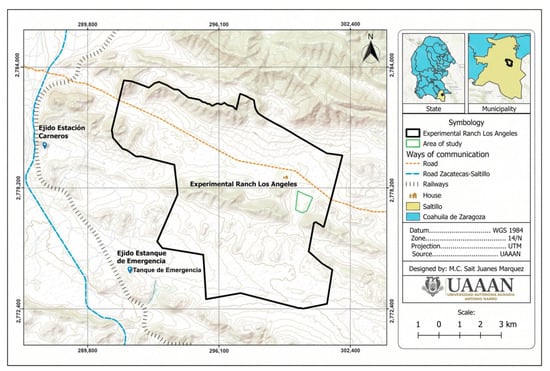
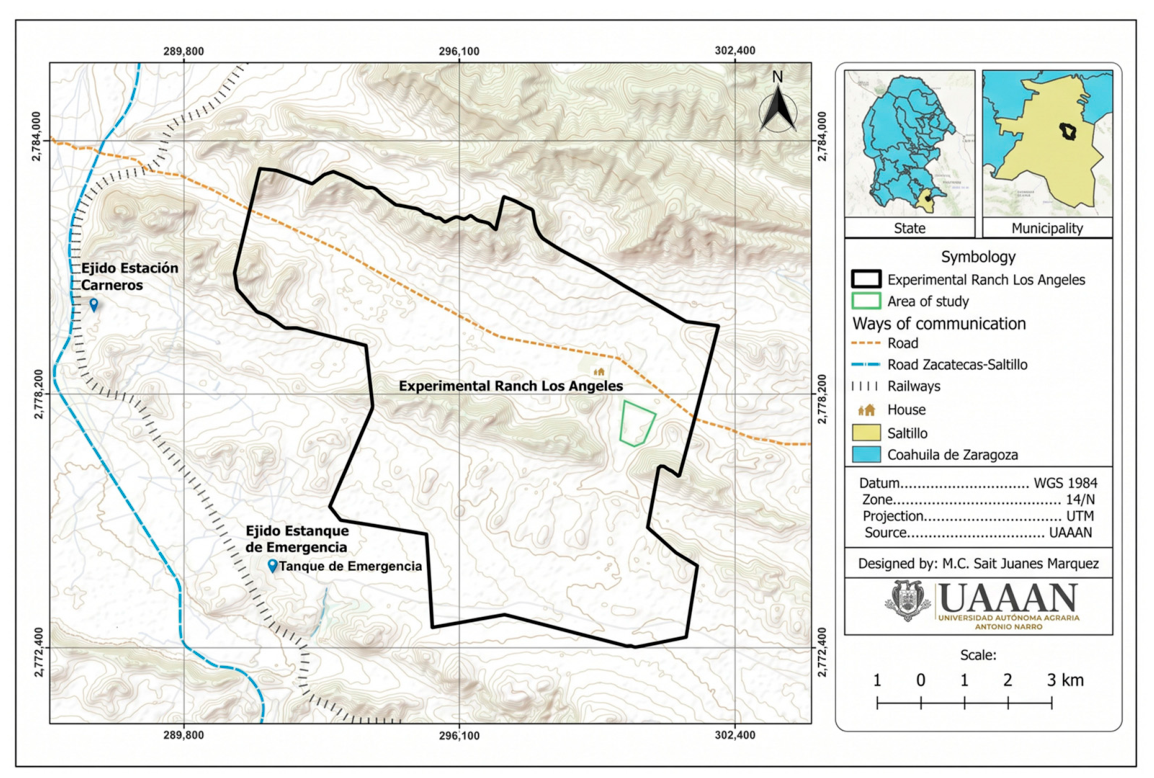
The study was carried out on a grassland dominated by Mexican needlegrass (A. clandestina), which acts as the absolute dominant species in the canopy. In this plant community, it coexists with a lower proportion of associated native flora, primarily composed of grasses such as Bouteloua curtipendula, Bouteloua gracilis, Disakisperma dubium, and Eragrostis spp., which are characteristic of the semi-arid rangelands in this region. A specific experimental area of 2.23 ha was selected within a larger site of approximately 32 ha in northeastern Mexico (25°06′30″ N, 100°59′18″ W; within the “Los Ángeles” experimental ranch of the Universidad Autónoma Agraria Antonio Narro (UAAAN), in Saltillo, Coahuila (Figure 1), at an altitude between 2100 and 2400 m, and with a topography that includes valleys, middle mountains, and low hills. The soils in this experimental field present representative conditions for the region, where baseline parameters such as soil infiltration and compaction dynamics play a critical role in evaluating post-grazing ecological recovery.
Figure 1.
Geographic location of the study area in northeastern Mexico. Prepared by the author using QGIS 3.36.3 (Sait Juanes-Márquez).
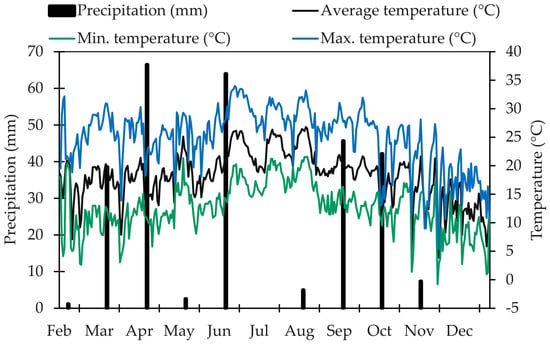
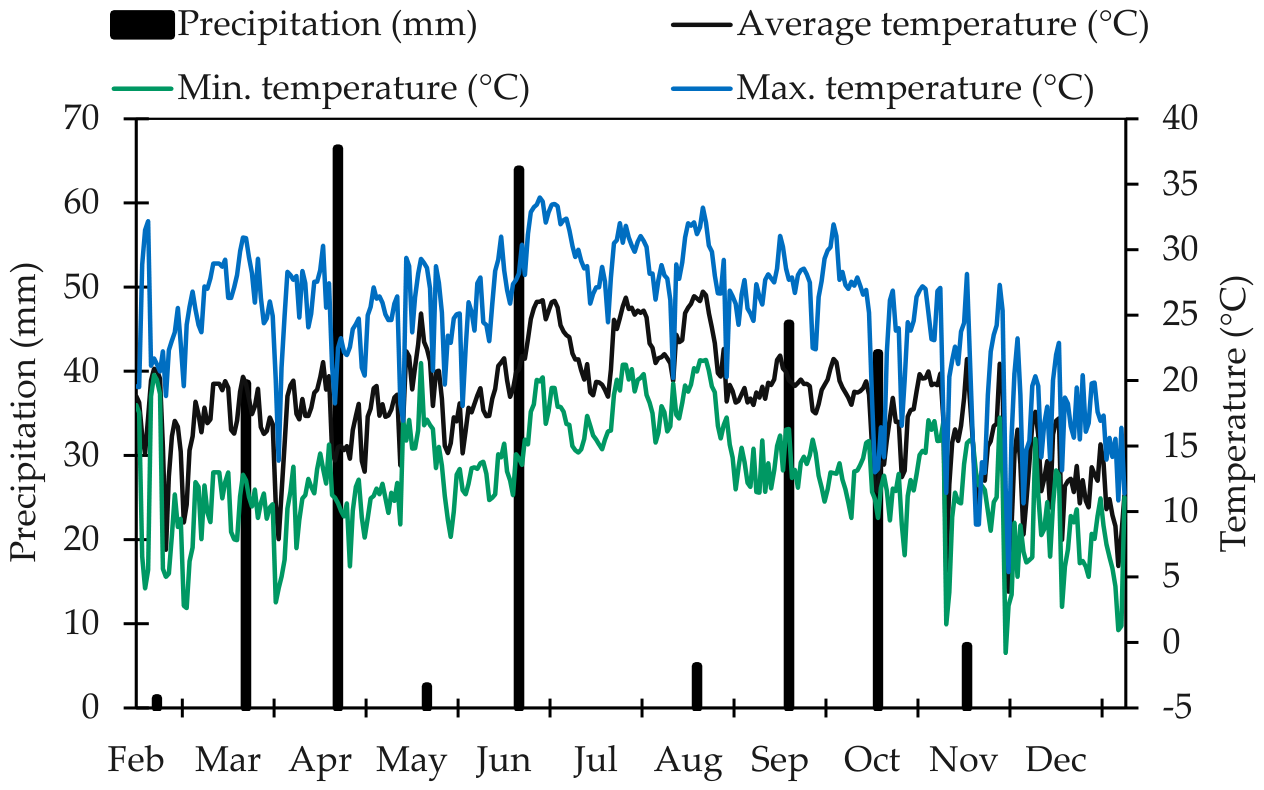
The study site has a Köppen-García climate (dry with warm summers) [9]. It is characterized by a total annual precipitation of 350 mm, with a bimodal distribution where the highest rainfall occurs between May and October (86.7%). The average annual temperature is 13.4 °C. The water balance is determined by a precipitation/temperature ratio of 22.9, placing the ecosystem in a state of moderate aridity with marked intra-annual variability (Figure 2).
Figure 2.
Average maximum, average, and minimum daily temperature and accumulated precipitation from February to December 2023 (study period).
2.2. Experimental Methodology
The assessments were conducted from February to December 2023, covering all four seasons (winter, spring, summer, autumn). The experiment was established as a randomized complete block design (RCBD) with three blocks (R1, R2, and R3), each containing the four seasonal treatments. The experimental units (plots) were randomly allocated. Each seasonal treatment consisted of an independent 600 m2 plot (10 × 60 m), resulting in 12 experimental plots (3 blocks × 4 seasons).
These plots were subjected to non-selective grazing at the beginning of each season using a heavy stocking rate [10], with a stocking rate of 333 livestock units (LU ha−1) (calculated using bovine cattle with an average live weight of 450 kg), with an approximate occupation time of two days until depletion of available forage [11,12]. The treatments were administered during specific seasons and days after regrowth. Therefore, the research was oriented to evaluate the post-grazing recovery dynamics of the grassland, considering the Season (S: spring, summer, autumn, and winter), Days After Regrowth (DAR: 15, 30, 45, 60, 75, and 90), and their interaction S × DAR.
2.3. Variables Evaluated
2.3.1. Biomass Accumulation and Morphological Composition
The biomass yield of A. clandestina was estimated in each experimental plot by harvesting the average regrowth present in 1 m2, above the harvesting height of grazing. A subsample of approximately 10% of the previously homogenised forage from the harvested forage was separated for subsequent separation into leaves, stems and dead material (standing dead biomass). The harvested forage was placed in labelled paper bags and dried in a forced-air oven at 60 °C for 48 h, or until a constant weight was reached, to determine the dry matter yield and establish the kg DM ha−1 [13].
2.3.2. Height
To estimate the average height of the disturbed meadow, 12 random measurements per replicate plot were taken at each regrowth age, using a 100 cm graduated ruler [14].
2.3.3. Intercepted Light
In each treatment, three readings of randomly intercepted solar radiation were taken with the Quantum meter model MQ-301, per replicate plot. The readings were taken between 12:00 and 1:00 p.m., during which the Quantum meter was placed on the ground surface under the canopy and on the surface with a south–north orientation, and the light received and transmitted was quantified [15].
2.4. Statistical Analysis
Data were analysed using a randomized complete block design (RCBD) with a split-plot in time structure. The experiment consisted of three blocks (R1, R2, and R3), each containing the four seasonal treatments (winter, spring, summer, and autumn). Each 600 m2 plot was considered an experimental unit. Season (S) was analysed as the main-plot factor, whereas Days After Regrowth (DAR: 15, 30, 45, 60, 75, and 90 days) was analysed as a repeated subplot factor within each plot.
The model included Block, Season, Block × Season (Error a), DAR, Season × DAR interaction, and the residual error (Error b). Season was tested against Block × Season, while DAR and the Season × DAR interaction were tested against the residual error. Mean comparisons were performed using Tukey’s test (α = 0.05), and Pearson’s correlation coefficient was used to evaluate relationships among variables. Statistical analyses were conducted using JMP Pro 14.
3. Results
The analysis revealed that the effects of the experimental factors varied according to the response variable evaluated (Table 1). Season (S), Days After Regrowth (DAR), and their interaction (S × DAR) significantly affected dry matter yield and light interception, whereas plant height was mainly influenced by DAR and the S × DAR interaction. The block effect was not significant for any evaluated variable but was retained in the model as part of the experimental design.
Table 1.
F-ratios and p-values from the seasonal evaluation of Amelichloa clandestina at different days after regrowth (DAR) in northeastern Mexico.
3.1. Productive Factors
Season, Days After Regrowth (DAR), and their interaction significantly affected DMY (Table 1). Block had no significant effect on any response variable (p > 0.29), but it was retained in the model because it represented the experimental blocking structure. DMY in summer and autumn was significantly greater than in winter and spring, registering 242.2 and 268.8 kg ha−1, respectively, compared to minimum yields of 4.6 and 25.9 kg ha−1 in the colder seasons. Plant height showed no significant differences among seasons (F = 2.1, df = 3, 6; p = 0.205), averaging 16.8 cm across the study period. Light interception was highest in autumn (16.4%), which differed significantly from spring (7.3%), while summer (10.8%) and winter (7.8%) occupied intermediate positions not significantly different from either extreme. Regarding DAR, the 90-day interval yielded the highest values across all variables: 233.2 kg ha−1 for DMY, 22.7 cm for plant height, and 17.2% for intercepted light, whereas the 15 DAR interval consistently recorded the lowest values, reflecting the initially limited canopy recovery following grazing disturbance (Table 2).
Table 2.
Comparison of means of Amelichloa clandestina according to grazing season and different days after regrowth (DAR) in northeastern Mexico.
3.2. Dry Matter
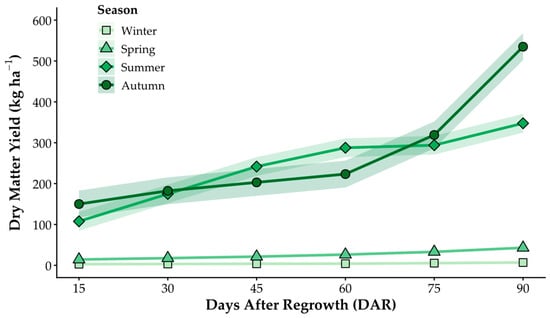
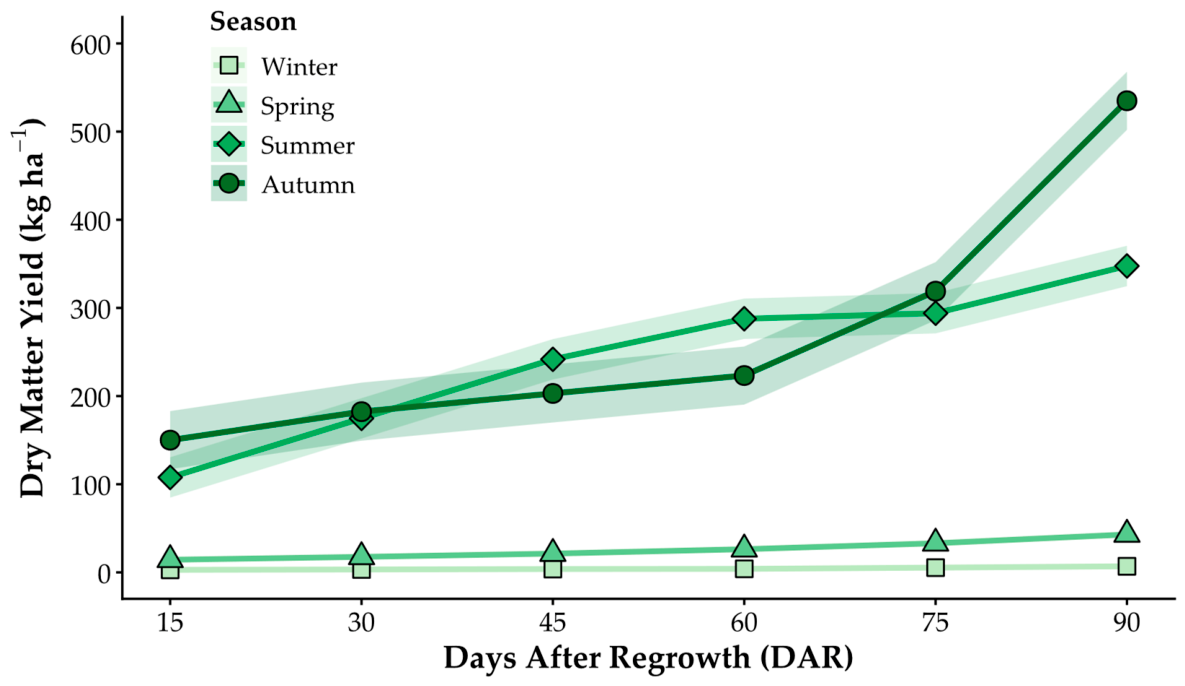
Dry matter accumulation of Amelichloa clandestina varied significantly (p ≤ 0.0001) across both seasons and days of regrowth (Figure 3), demonstrating clear temporal fluctuations in forage availability. Summer and autumn, and between 75 and 90 DAR, were the most productive periods. These results suggest that the specific precipitation patterns observed during the study year, characterized by heavy rainfall in September and October (autumn) and drier conditions in July and August (summer), drove the most significant accumulation of dry matter in this grass. Therefore, rather than a strict seasonal trait, biomass production in A. clandestina appears highly dependent on the intra-annual rainfall distribution. In contrast, dry matter yields during winter and spring were much lower compared to the wetter seasons. Specifically, during the winter season, there were no statistical differences in biomass accumulation across the different days of regrowth (p ≥ 0.05). This low dry matter production during the colder months is likely related to the unfavourable environmental conditions of winter, such as lower temperatures and limited moisture, which restrict plant growth.
Figure 3.
Seasonal dry matter yield (kg ha−1) trajectories of Amelichloa clandestina evaluated at different days after regrowth (DAR) in northeastern Mexico. Shaded areas represent the standard error of the mean.
Likewise, while spring showed a significant increase (p ≤ 0.05) in forage production at 75 and 90 DAR, these values did not exceed the peaks observed in summer and autumn. Overall, the global trend in seasonal dry matter production followed the hierarchy: autumn > summer > spring > winter (p ≤ 0.05), highlighting the profound impact of seasonal conditions on forage productivity. Specifically, DMY reached its maximum value of 535.0 kg ha−1 at 90 DAR during autumn.
3.3. Morphological Components
Based on the main study factors (Table 3), the evaluation of the morphological components revealed significant differences (p ≤ 0.05) in biomass allocation among seasons. Specifically, the leaf and dead material components made their highest contributions to total biomass during autumn, whereas stem biomass was highest in summer, with a substantially lower contribution in winter and spring. Similarly, DM was significantly higher (p ≤ 0.05) in summer and autumn than in winter and spring, indicating that the dynamics of dead biomass accumulation are heavily influenced by temperature and water availability. Regarding the time elapsed since grazing (DAR), no significant patterns (p ≥ 0.05) were identified in the proportional biomass production of the different vegetative components, although absolute leaf biomass reached its maximum at 90 DAR, while stem biomass peaked at 60 DAR. This reflects an overall increase in forage accumulation with more extended regrowth periods, even though the accumulation of dead material remained stable across all DAR intervals (p ≥ 0.05).
Table 3.
Mean comparison of evaluated factors in morphological components (kg ha−1) of Amelichloa clandestina, by season and days after regrowth (DAR) in northeastern Mexico.
3.4. Plant Height
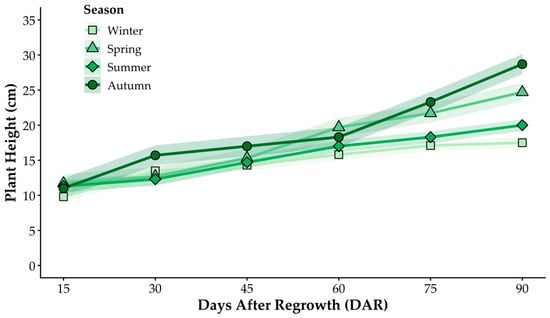
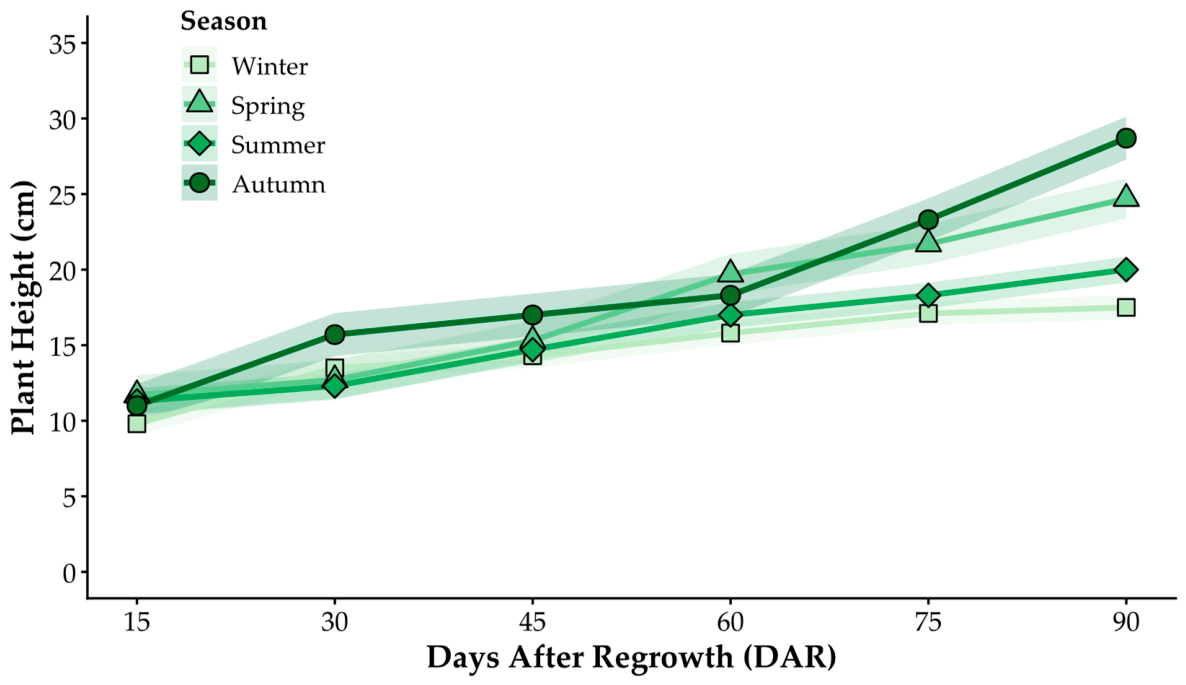
Although plant height did not differ significantly among seasons (F = 2.1, p = 0.205), the S × DAR interaction was significant (F = 4.7, p < 0.001; Figure 4), indicating that seasonal conditions modulated the trajectory of height recovery over time rather than determining its average level. Consistently across all seasons, the maximum heights were recorded at 90 DAR, following the seasonal trend: autumn > spring > summer > winter. The absolute maximum canopy height recorded was 28.7 cm, corresponding to autumn at 90 DAR. Conversely, the smallest values were observed at the beginning of the regrowth period (15 DAR), a morphological response that closely aligns with the trends observed in total DMY and component accumulation.
Figure 4.
Seasonal plant height (cm) trajectories of Amelichloa clandestina evaluated at different days after regrowth (DAR) in northeastern Mexico. Shaded areas represent the standard error of the mean.
3.5. Light Interception
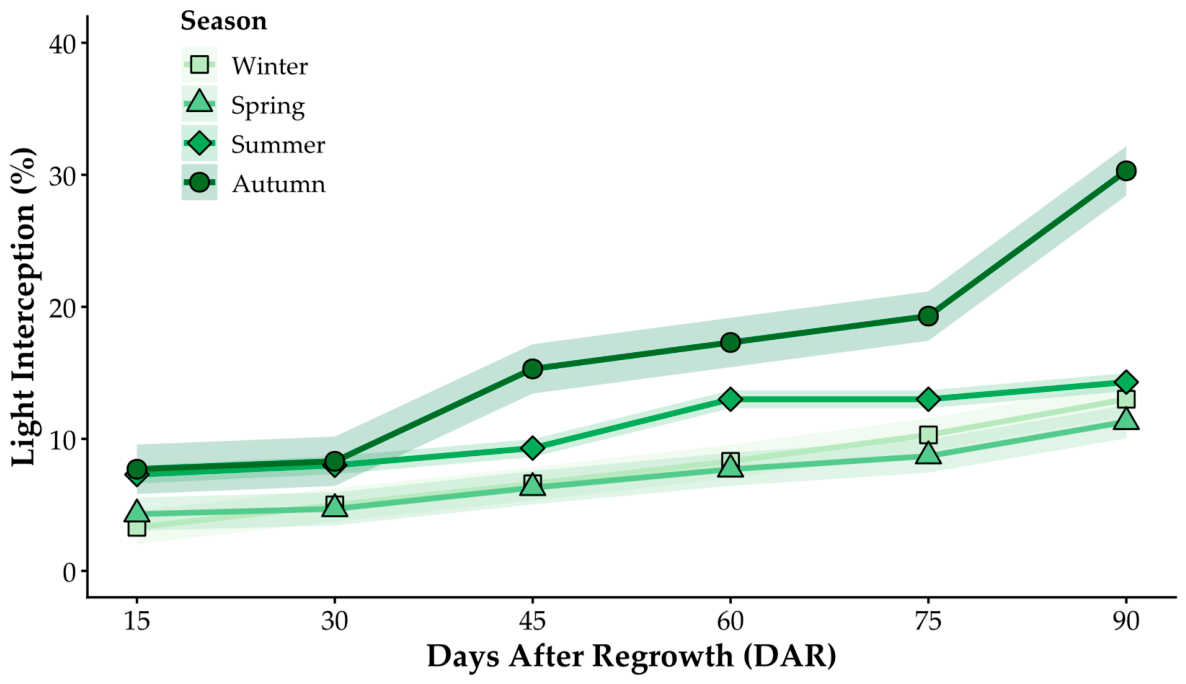
Light interception showed significant effects of season (F = 5.2, p = 0.041), DAR (F = 42.9, p < 0.001), and their interaction (F = 4.5, p < 0.001; Figure 5), confirming that the seasonal context shaped not only the average interception capacity but also the rate at which the canopy recovered it across the regrowth period. The highest LI levels occurred during autumn, reaching an average of 16.4% and peaking at 30.3%. This seasonal peak is directly correlated with increased leaf production, DMY, and PH (Table 3 and Figure 4). Summer followed with an average of 10.8%, reflecting considerable leaf production, while winter and spring presented the lowest interception capacities. In addition, there were no significant differences (p ≥ 0.05) between the specific DAR intervals within these broader seasonal trends.
Figure 5.
Percentage of light intercepted by Amelichloa clandestina evaluated seasonally at different days after regrowth (DAR) in northeastern Mexico. Shaded areas represent the standard error of the mean.
3.6. Correlation
Statistically significant relationships (p ≤ 0.05) were found between key variables in the study (Table 4). A high correlation was identified between DMY and the percentage of intercepted light (%). PH showed a moderate correlation with DMY, indicating a relationship between plant height and forage production; however, other environmental and seasonal factors also contributed to biomass variation.
Table 4.
Correlation matrix between key variables in the study of seasonal dry matter yield of an Amelichloa clandestina grassland in northeastern Mexico.
4. Discussion
4.1. Productive Factors
Seasonality fundamentally drives the physiology, plant morphology, and community dynamics of semi-arid grasslands. Furthermore, moderate grazing has been shown to improve the nutritional contribution by increasing the photosynthetic rate in new leaves [16]. Furthermore, plant diversity in grasslands responds well to grazing patterns, especially within each season. For their part, Ma et al. [17] demonstrated that seasonal grazing increases aboveground plant biomass compared to continuous grazing, emphasizing the importance of synchronizing grazing management with seasonal cycles to enhance the biodiversity and functionality of these ecosystems. Although our study did not evaluate continuous grazing, these literature findings reinforce our core premise: the successful recovery of a grassland depends heavily on the seasonal timing of the grazing event and the duration of the subsequent rest period. These results align with natural plant growth cycles, which favour regeneration and stress resistance in species such as Leymus chinensis in Mongolian grasslands [18]. The consistency of our findings with these global studies verifies the ecological theory that episodic defoliation, unlike continuous grazing, reliably stimulates compensatory growth across diverse semi-arid environments. To build upon this, future research should evaluate how varying the livestock density (LU ha−1) within these specific seasonal windows might further optimize this compensatory response. Likewise, physiological adaptation highlights the sustainability of strategically timed seasonal grazing interventions, promoting the regeneration and productivity of grasslands. Therefore, understanding how seasonality affects dry matter yield and plant height during the post-grazing recovery phase is crucial. Pornaro et al. [19] examined the influence of morphoclimatic factors on the seasonal variability of DMY in grasslands, concluding that local environmental conditions, such as soil type and climate, are essential for grassland productivity.
This finding underscores the importance of tailoring management practices to specific conditions to enhance productivity. Perotti et al. [20] investigated the factors that affect forage yield and quality in permanently managed grasslands, finding that temperature, precipitation, and vegetation composition significantly impact forage yield. Therefore, this study highlights the need to adjust management practices to climatic variations, specifically, by shifting from fixed calendar-based grazing to dynamic rotations that defer grazing during cold, dry months and capitalize on rainfall peaks to maximize forage yield and quality. This approach underlines the complexity of seasonal interactions and the importance of evidence-based adaptive approaches to improve the sustainability and productivity of grasslands, optimizing the use of water and nutrients during critical growth phases to increase light capture and biomass [21]. These findings directly address the central research question by confirming that A. clandestina can be sustainably managed if grazing intervals are synchronized with its seasonal peaks. Specifically, the initial hypothesis is accepted: the optimal grazing time occurs during the active growing season (autumn and summer) after a 90-day rest period, which maximizes light interception and dry matter yield, thereby shifting the management focus from eradicating a potentially invasive grass to utilizing it as a predictable forage resource.
4.2. Dry Matter
Previous evaluations of this species under different defoliation methods demonstrate distinct physiological responses. Juanes-Márquez et al. [4] reported different trends when applying manual cutting in grassland dominated by Amelichloa clandestina: winter > spring > autumn > summer, with 911, 897, 791, and 249 kg ha−1, respectively, due to the different rest times between cuts, as compared to the present study. This discrepancy highlights a critical implication: animal trampling, nutrient recycling via manure, and non-selective grazing induce a completely different physiological recovery compared to mechanical harvesting. Therefore, recommendations based on mechanical cutting cannot be directly extrapolated to grazing management for this species; instead, stocking rates must be dynamically adjusted to leverage the summer and autumn rainfall peaks demonstrated in our findings. On the other hand, Liu et al. [22] used satellite images to document an annual forage production of 2940 ± 934 kg ha−1 in California, USA, with rainfall ranging from 160 to 2290 mm year−1. This variation in forage production highlights the impact of precipitation on native vegetation, including A. clandestina, particularly in northern Mexico, which is characterized by its aridity.
The ability of A. clandestina to survive and develop under water scarcity conditions highlights its physiological and ecological adaptations in these ecosystems. Based on these findings, the present study confirmed that the periods of highest forage production for A. clandestina (summer and autumn) coincided with the months of the most significant precipitation (May to October). This pattern highlights the crucial dependence of vegetative growth and biomass production on water availability, consistent with observations in other semi-arid regions, where precipitation is the primary determinant of grassland productivity [23].
4.3. Morphological Components
In other species of grasslands in northeastern Mexico, the older the age of regrowth, the greater the dry matter (DM) accumulation, which affects forage quality [24]. These findings highlight the complex interaction between plant morphological components, environmental and temporal factors, thus underlining the importance of considering these dynamics in the study of biomass production. Mendoza et al. [25] suggest that the increase in leaf and stem biomass during autumn may be attributed to increased precipitation, which stimulates plant growth. Likewise, the morphology and physiological function of leaves, particularly photosynthesis, are fundamental aspects that are directly affected by grazing, as morphological changes induced by grazing can alter crucial physiological processes, thereby reflecting the plant’s adaptation to external conditions [26]. The present study observed that the impact of grazing on photosynthetic capacity varied with season, being less pronounced in winter and spring compared to summer and autumn, possibly due to higher precipitation in the latter seasons [27].
In this context, Zhang et al. [28] suggest that moderate grazing could increase plant resistance to drought, maintaining high photosynthetic activity of A. clandestina even during water scarcity. Furthermore, grazing facilitates light penetration by promoting the growth of new leaves in areas previously shaded by the canopy [7]. Biomass distribution in grasslands is influenced by seasonal factors, including ambient temperature and precipitation, as well as management practices such as grazing [23]. The interaction between grazing intensity and precipitation patterns affects plant community structure and biomass distribution, emphasizing the importance of herbivore feeding preferences in grassland management [29]. The findings of the present study reveal an increase in leaf and stem productivity over time. Initially, in all seasons, low leaf yields were noted, possibly due to the early stage of vegetative development and consequent limited biomass accumulation. These low yields at the beginning of the study may also be related to the initial phase of stem growth and the region’s low humidity. These observations are consistent with those reported by Brendel [30], who noted that plant growth dynamics vary throughout the year and are influenced by the precipitation regime.
4.4. Plant Height
The growth of A. clandestina shows marked seasonal variability, as documented by Juanes-Márquez et al. [4], who observed the highest heights during autumn, at 40.7 cm, followed by summer at 35 cm, then winter at 25 cm, and spring at 19 cm. While our study validates this same seasonal phenological pattern, the absolute maximum height recorded under our non-selective grazing regime was notably lower (28.7 cm). This discrepancy is directly attributed to the physical impact of animal trampling and soil compaction inherent to short-duration, high-density grazing, variables that are completely absent in mechanical cutting scenarios. Therefore, future studies must investigate the interaction between hoof action, soil infiltration rates, and canopy architecture to refine predictive grazing models for this species. Song et al. [18] in Leymus chinensis described that this species has a reduced height under conditions of continuous grazing, with an average height of 19 cm, compared to the grazing season, where the average heights are 24 cm in spring, 23 cm in summer, and 25 cm in autumn. This phenomenon highlights the negative impact of constant grazing on plants’ resistance and resprouting capacity, raising concerns about the degradation of grasslands due to inadequate management practices. Strategically initiating autumn grazing on this grassland promotes a more vigorous regrowth of A. clandestina, underscoring the importance of aligning pasture management and grazing practices with the species’ growth to maintain the grassland’s health.
4.5. Light Interception
The lowest percentage of light interception in our study was observed at 15 DAR, reflecting the initial sparse canopy immediately after grazing. When evaluating this species under a different defoliation method, Juanes-Márquez et al. [4] focused on a grassland dominated by A. clandestina and observed a seasonal pattern in light interception after applying manual cuts; the results showed a high percentage during the autumn, with an average of 49.2%, followed by winter with 45%, and then spring and summer with 28% and 21%, respectively. The study, initiated in the spring, suggests that the progressive increase in plant biomass throughout the year plays a crucial role in enhancing light interception. This behaviour in light interception correlates with findings from the present investigation, which also observed the highest values in autumn. The resulting leaf density enhances the canopy’s ability to intercept sunlight, thereby increasing the percentage of light that is intercepted. Previous research by Da Silva and Hernández [31] indicates that the optimal harvest time coincides with 95% LI, related to a higher foliar proportion in the yield, since LI is a precise indicator of changes in the structure of the crop canopy and ecosystem productivity, reflecting plant adaptation to environmental variations; therefore, understanding the dynamics of the percentage of light intercepted, through seasons and DAR, is vital for the development of management practices that optimize photosynthetic efficiency and grassland performance [32].
4.6. Correlation
Mills et al. [33] observed a high correlation between DMY and PH, suggesting that pre-grazing height predicts DMY. This association implies that PH management could optimize biomass production in grasslands. Additionally, the percentage of light intercepted showed a higher correlation with PH, so as the plant grows, the amount of light intercepted increases. The practical implication of these combined correlations is highly relevant for rangeland managers: monitoring simple, non-destructive metrics like plant height can serve as a direct proxy for light interception and total dry matter yield, allowing for rapid, in-field decision-making regarding when to rotate cattle. Cimbelli and Vitale [34] identified a linear correlation between biomass and plant height, suggesting that physical dimensions are reliable indicators of forage productivity. The ability to intercept light, essential for photosynthesis, is linked to canopy structure and forage accumulation, underscoring the critical role of plant architecture in enhancing light capture efficiency and improving grassland productivity [35]. Álvarez-Vázquez et al. [36] investigated the relationship between forage production and seasonality, applying various mathematical models to analyze this dynamic in spring, summer, winter, and throughout the year. Their results showed that the best fit was obtained with an exponential model for spring and a quadratic model for summer and winter, with an r2 of 0.99. This correlation suggests that these models can explain forage production variability with high precision, depending on the season, and estimate forage height using the rule method, thereby evidencing the usefulness of non-destructive methods that are easily applicable to grassland management.
5. Conclusions
The regeneration of a grassland dominated by Mexican needlegrass (Amelichloa clandestina), subjected to a high stocking rate, is influenced by seasonality and environmental factors, and has a significant impact on biomass accumulation. Seasons with higher precipitation, such as summer and autumn, favour an increase in forage production, while seasons with lower precipitation, such as winter and spring, decrease forage production. Likewise, the increase in regrowth days contributes to an increase in forage production and plant height, although this implies a redistribution of biomass among its morphological components. This study emphasizes the significance of the leaf component in determining dry matter yield. It highlights significant relationships between evaluated variables, suggesting that under similar semi-arid grazing conditions, these variables may serve as useful indicators for grassland management.
Author Contributions
Conceptualization, S.J.M. and P.Á.V.; methodology, S.J.M. and J.E.G.M.; software, S.J.M. and M.C.Z.; validation, P.Á.V., J.A.E.D., J.I.G.-L., M.C.Z., A.R.R.G. and A.F.-N.; formal analysis, S.J.M. and M.C.Z.; investigation, S.J.M., J.A.E.D. and J.E.G.M.; resources, P.Á.V.; data curation, S.J.M.; writing—original draft preparation, S.J.M.; writing—review and editing, P.Á.V.; visualization, J.E.G.M. and A.R.R.G.; supervision, P.Á.V., J.A.E.D., J.I.G.-L. A.R.R.G. and A.F.-N.; project administration, J.I.G.-L. and A.F.-N.; funding acquisition, P.Á.V. All authors have read and agreed to the published version of the manuscript.
Funding
This research was funded by the “Programa de Apoyo a la Investigación Científica” of the Research Direction at the Universidad Autónoma Agraria Antonio Narro (UAAAN), project 2201, awarded to Perpetuo Alvarez Vazquez; and Terra Habitus, A.C., project 30-32400-425202001-7519, “Use of regenerative livestock farming in the exploitation of Amelichloa clandestina pasture on the Los Ángeles experimental livestock ranch”.
Data Availability Statement
The original contributions presented in this study are included in the article. Further inquiries can be directed to the corresponding author.
Acknowledgments
We would like to thank the thesis students and social service students for their invaluable technical support in the development of this project. During the preparation of this manuscript, the authors used Canva (https://www.canva.com/education/, accessed on 29 September 2026) for the purposes of creating the graphical abstract. The authors have reviewed and edited the output and take full responsibility for the content of this publication.
Conflicts of Interest
The authors declare no conflicts of interest.
References
- Villaseñor, J.L. Checklist of the native vascular plants of Mexico. Rev. Mex. Biodivers. 2016, 87, 559–902. [Google Scholar] [CrossRef] [Scilit]
- Russell, M.L.; Landers, R., Jr. Mexican needlegrass. Texas A&M AgriLife Extension Service; Tamu: College Station, TX, USA, 2017; pp. 1–4. [Google Scholar]
- Domínguez-Escudero, J.M.A.; Iglesias-Gómez, J.M.; Olivera-Castro, Y.; Milera-Rodríguez, M.d.C.; Pérez, O.C.T.; Wencomo-Cárdenas, H.B. Caracterización del Pastizal y su Manejo en un Sistema de Pastoreo Racional Voisin, en Panamá. Pastos y Forrajes 2021, 44, eE19. Available online: https://www.redalyc.org/articulo.oa?id=269169781019 (accessed on 29 September 2026).
- Juanes-Márquez, S.; Alvarez-Vazquez, P.; Encina-Dominguez, J.A.; Mellado-Bosque, M.; Garcia-Martinez, J.E.; Flores-Naveda, A. Response to cutting and herbicide treatment of Mexican needlegrass (Amelichloa clandestina) in northeastern Mexico. Fresen. Environ. Bull. 2022, 31, 8663–8672. [Google Scholar]
- Grossman, J.J. Phenological physiology: Seasonal patterns of plant stress tolerance in a changing climate. New Phytol. 2023, 237, 1508–1524. [Google Scholar] [CrossRef] [Scilit] [PubMed]
- Sparks, M.L.; Maciel, I.C.; Araújo, E.M.; Congio, G.F.; Oliver, E.E.; Chi, M.H. Grassland Vegetation Responses to Rotational Stocking in the US Southern Great Plains. Rangel. Ecol. Manag. 2026, 106, 9–23, Corrigendum in Rangel. Ecol. Manag. 2026, 107, 1.. [Google Scholar] [CrossRef] [Scilit]
- Li, R.; Zhou, X.; Liu, D.; Feng, W. Enhancing the activity and stability of Mn-superoxide dismutase by one-by-one ligation to catalase. Free Radic. Biol. Med. 2018, 129, 138–145. [Google Scholar] [CrossRef] [Scilit] [PubMed]
- Bailey, D.W.; Mosley, J.C.; Estell, R.E.; Cibils, A.F.; Horney, M.; Hendrickson, J.R.; Burritt, E.A. Synthesis paper: Targeted livestock grazing: Prescription for healthy rangelands. Rangel. Ecol. Manag. 2019, 72, 865–877. [Google Scholar] [CrossRef] [Scilit]
- García, E. Modificaciones al Sistema de Clasificación Climática de Köppen, 5th ed.; Instituto de Geografía-UNAM: Ciudad de México, Mexico, 2004; p. 97. [Google Scholar]
- Acocks, J.P.H. Non-selective grazing as a means of veld reclamation. Proc. Annu. Congr. Grassl. Soc. South. Afr. 1966, 1, 33–39. [Google Scholar] [CrossRef] [Scilit]
- Urón, C.; Bastos, C. Análisis de la Implementación de Pastoreo de Ultra-Alta Densidad con Bovinos Blanco Orejinegro en la Granja Experimental de la UFPSO. Rev. Colomb. Zootec. 2021, 7, 24–31. Available online: https://anzoo.org/publicaciones/index.php/anzoo/article/view/100 (accessed on 29 September 2026).
- Aranda, M.J.; Tognetti, P.M.; Mochi, L.S.; Mazía, N. Intensive rotational grazing in pastures reduces the early establishment of an invasive tree species. Biol. Invasions 2023, 25, 3137–3150. [Google Scholar] [CrossRef] [Scilit]
- Muñoz-García, C.; Cortes-Díaz, E.; Cuicas-Huerta, R.; Vaquera-Huerta, H.; Ventura-Ríos, J.; Hernández-Flores, E.; Hernández-Martínez, P.A. El efecto del pastoreo mixto y de mono-especie en dos tipos de pradera sobre la calidad, desarrollo y rendimiento de forraje. Tecnociencia Chihuah. 2020, 14, 623. [Google Scholar] [CrossRef] [Scilit]
- Arévalo, J.R.; Encina-Domínguez, J.A.; Juanes-Márquez, S.; Álvarez-Vázquez, P.; Nuñez-Colima, J.A.; Mellado, M. Restoration of Rangelands Invaded by Amelichloa clandestina (Hack.) Arriaga & Barkworth after 12 Years of Agriculture Abandonment (Coahuila, Mexico). Agriculture 2021, 11, 886. [Google Scholar] [CrossRef] [Scilit]
- Mendoza, P.S.I.; Álvarez, V.P. Método de la Regla para Estimar Porcentaje de Radiación Interceptada en Especies Forrajeras Templadas. Agro. Divulg. 2022, 2, 1–3. Available online: https://agrodivulgacion-colpos.org/index.php/1agrodivulgacion1/article/view/115/108 (accessed on 29 September 2026).
- Shen, H.; Dong, S.; Li, S.; Xiao, J.; Han, Y.; Yang, M.; Yeomans, J.C. Grazing enhances plant photosynthetic capacity by altering soil nitrogen in alpine grasslands on the Qinghai-Tibetan plateau. Agric. Ecosyst. Environ. 2019, 280, 161–168. [Google Scholar] [CrossRef] [Scilit]
- Ma, C.; Hao, X.; He, F.; Baoyin, T.G.; Yang, J.; Dong, S. Effects of seasonal grazing on plant and soil microbial diversity of typical temperate grassland. Front. Plant Sci. 2022, 13, 1040377. [Google Scholar] [CrossRef] [Scilit] [PubMed]
- Song, L.; Pan, Y.; Gong, J.; Li, X.; Liu, M.; Yang, B.; Zhang, Z.; Baoyin, T. Physiology of Leymus chinensis under seasonal grazing: Implications for the development of sustainable grazing in a temperate grassland of Inner Mongolia. J. Environ. Manag. 2020, 271, 110984. [Google Scholar] [CrossRef] [Scilit] [PubMed]
- Pornaro, C.; Vincenzi, V.; Furin, S.; Fazzini, M.; Minarelli, L.; Macolino, S. Seasonal changes in dry matter yield from Karst pastures as influenced by morphoclimatic features. PLoS ONE 2018, 13, e0204092. [Google Scholar] [CrossRef] [Scilit] [PubMed]
- Perotti, E.; Huguenin-Elie, O.; Meisser, M.; Dubois, S.; Probo, M.; Mariotte, P. Climatic, soil, and vegetation drivers of forage yield and quality differ across the first three growth cycles of intensively managed permanent grasslands. Eur. J. Agron. 2021, 122, 126194. [Google Scholar] [CrossRef] [Scilit]
- Mandal, K.G.; Sinha, A.C. Nutrient management effects on light interception, photosynthesis, growth, dry-matter production and yield of Indian mustard (Brassica juncea). J. Agron. Crop Sci. 2004, 190, 119–129. [Google Scholar] [CrossRef] [Scilit]
- Liu, H.; Jin, Y.; Roche, L.M.; O’Geen, A.T.; Dahlgren, R.A. Understanding spatial variability of forage production in California grasslands: Delineating climate, topography and soil controls. Environ. Res. Lett. 2021, 16, 014043. [Google Scholar] [CrossRef] [Scilit]
- Kramberger, B.; Gselman, A.; Podvršnik, M.; Lešnik, M.; Škorjanc, D. Effects of low precipitation periods on the herbage yield of mesic semi-natural grasslands under different cutting regimes. Zemdirbyste-Agric. 2014, 101, 11–18. [Google Scholar] [CrossRef] [Scilit]
- Soto-Rojas, S.A.; Álvarez-Vázquez, P.; Mellado-Bosque, M.A.; García-Martínez, J.E.; Encina-Domínguez, J.A.; Wilson-García, C.Y. Dry matter distribution of banderita grass [Bouteloua curtipendula (Michx.) Torr.] at different plant strata. Agro Product. 2023, 16, 95–104. [Google Scholar] [CrossRef] [Scilit]
- Mendoza, S.I.; Hernández, A.; Pérez, J.; Quero, A.R.; Escalante, J.A.S.; Zaragoza, J.L.; Ramírez, O. Respuesta Productiva de la Alfalfa a Diferentes Frecuencias de Corte. Rev. Mex. Cienc. Pecu. 2010, 1, 287–296. Available online: https://cienciaspecuarias.inifap.gob.mx/index.php/Pecuarias/article/view/1503 (accessed on 29 September 2026).
- Centritto, M.; Loreto, F. Photosynthesis in a changing world: Photosynthesis and abiotic stresses. Agric. Ecosyst. Environ. 2005, 106, 115–117. [Google Scholar] [CrossRef] [Scilit]
- Lawson, T.; Vialet-Chabrand, S. Speedy stomata, photosynthesis and plant water use efficiency. New Phytol. 2019, 221, 93–98. [Google Scholar] [CrossRef] [Scilit] [PubMed]
- Zhang, Z.; Zhou, H.; Zhao, X.; Yao, B.; Ma, Z.; Dong, Q. Relationship between biodiversity and ecosystem functioning in alpine meadows of the Qinghai-Tibet plateau. Biodivers. Sci. 2018, 26, 111–129. [Google Scholar] [CrossRef] [Scilit]
- Wan, H.; Bai, Y.; Hooper, D.U.; Schönbach, P.; Gierus, M.; Schiborra, A.; Taube, F. Selective grazing and seasonal precipitation play key roles in shaping plant community structure of semi-arid grasslands. Landsc. Ecol. 2015, 30, 1767–1782. [Google Scholar] [CrossRef] [Scilit]
- Brendel, O. The relationship between plant growth and water consumption: A history from the classical four elements to modern stable isotopes. Ann. For. Sci. 2021, 78, 47, Correction in Ann. For. Sci. 2021, 78, 56.. [Google Scholar] [CrossRef] [Scilit]
- Da Silva, S.C.; Hernández, G.A. Manejo del pastoreo en praderas tropicales. In Los Forrajes y su Impacto en el Trópico, 1st ed.; Universidad Autónoma de Chiapas: Chiapas, México, 2010; pp. 63–95. [Google Scholar]
- Husse, S.; Huguenin-Elie, O.; Buchmann, N.; Lüscher, A. Larger yields of mixtures than monocultures of cultivated grassland species match with asynchrony in shoot growth among species but not with increased light interception. Field Crop. Res. 2016, 194, 1–11. [Google Scholar] [CrossRef] [Scilit]
- Mills, A.; Smith, M.; Moot, D. Relationships between dry matter yield and height of rotationally grazed dryland lucerne. J. N. Z. Grassl. 2016, 78, 185–196. [Google Scholar] [CrossRef] [Scilit]
- Cimbelli, A.; Vitale, V. Grassland height assessment by satellite images. Adv. Remote Sens. 2017, 6, 40. [Google Scholar] [CrossRef]
- Cruz, P.J.R.; Bretas, I.L.; Trumpp, K.R.; Acuna, J.P.; Ruiz-Moreno, M.; Mendes, C.T.E.; Queiroz, L.M.D.; Oduor, K.T.; Valentini, A.; Dubeux, J.C.B., Jr. Grazing Behaiour and Preferences of Cattle Grazing Pastures Under Contrasting Management Practices and Canopy Characteristics. Grass Forage Sci. 2025, 80, e70017. [Google Scholar] [CrossRef] [Scilit]
- Álvarez-Vázquez, P.; Peña-Ramos, F.M.; García-López, J.I.; Hernández-Guzmán, F.J.; Camposeco-Montejo, N.; Martínez-Martínez, R.; Juanes-Márquez, S. Rendimiento de forraje estacional de alfalfa a diferentes edades de rebrote en el sureste de Coahuila. Rev. Fitotec. Mex. 2023, 46, 505. [Google Scholar] [CrossRef] [Scilit]

Disclaimer/Publisher’s Note: The statements, opinions and data contained in all publications are solely those of the individual author(s) and contributor(s) and not of MDPI and/or the editor(s). MDPI and/or the editor(s) disclaim responsibility for any injury to people or property resulting from any ideas, methods, instructions or products referred to in the content. |
© 2026 by the authors. Licensee MDPI, Basel, Switzerland. This article is an open access article distributed under the terms and conditions of the Creative Commons Attribution (CC BY) license.