


Highlights
What are the main findings?
- Model identity analysis successfully distinguished tropical forage grasses with different nitrogen requirements.
- The Mulato II grass exhibited a nitrogen response pattern more similar to Urochloa brizantha than to Urochloa decumbens.
What are the implications of the main findings?
- Model identity analysis provides a rapid and objective approach for generating preliminary nutrient recommendations for newly released forage cultivars.
- This approach may substantially reduce the time and resources required to develop preliminary fertilization recommendations before long-term field validation.
Abstract
Methods capable of inferring the nutritional requirements of forage cultivars from related genotypes may help generate preliminary fertilization recommendations when experimental information is limited. This study evaluated whether model identity analysis can be used to infer the nitrogen requirement of Mulato II hybrid grass from the response patterns of its progenitor species, Urochloa brizantha cv. Marandu and Urochloa decumbens cv. Basilisk. A greenhouse experiment using pots filled with an Oxisol was conducted using a completely randomized design in a 3 × 5 factorial arrangement, with three grasses and five nitrogen doses (0, 100, 200, 300, and 400 mg dm−3). Forage production, tiller density, and nutritive value were evaluated during establishment and regrowth phases. Linear and quadratic regressions were fitted, and significant models were compared using model identity tests. When model differences were detected, intercepts and parameters were further compared using F-tests. In both establishment and regrowth phases, Mulato II showed response patterns similar to Urochloa brizantha for most evaluated variables, with model identity observed except for tiller number and crude protein concentration. In contrast, Mulato II differed from Urochloa decumbens for all measured traits. Therefore, under the greenhouse conditions evaluated, the nitrogen requirement of Mulato II is more closely related to that of Urochloa brizantha, demonstrating the potential of model identity analysis as a tool for generating preliminary fertilization recommendations for forage cultivars from related genotypes before field validation.
1. Introduction
Nitrogen is the nutrient that most strongly influences forage production in tropical grasses because it stimulates leaf elongation, tillering, canopy development, and forage accumulation, resulting in greater pasture productivity and improved soil cover [1,2,3]. Adequate nitrogen fertilization is therefore essential to sustain forage production and prevent pasture degradation, particularly because nitrogen is one of the nutrients most intensively removed from pasture systems [4,5]. In addition to increasing forage production, appropriate nitrogen management can improve fertilizer use efficiency and reduce nutrient losses through volatilization and leaching [6,7,8].
Despite its importance, defining appropriate nitrogen fertilization rates remains challenging because plant responses are influenced by genotype, environmental conditions, soil fertility, water availability, management practices, and interactions with other nutrients [9,10]. Consequently, establishing nitrogen requirements requires extensive experimentation across different conditions, demanding substantial time and financial investment. In addition, the limited understanding of how soil and climatic factors affect nitrogen mineralization, immobilization, and plant nitrogen demand still restricts the development of optimal fertilization strategies and robust management recommendations for tropical forage systems [10].
This challenge becomes even greater when new forage cultivars are released. In many cases, specific fertilization recommendations are unavailable because the studies required to determine nutrient requirements have not yet been completed. The situation is particularly complex for hybrid cultivars, whose responses may differ from those of their parental species due to the combination of distinct genetic backgrounds [11,12].
Methods capable of inferring the nutritional requirements of forage cultivars from related genotypes may help generate preliminary fertilization recommendations when experimental information is limited. Among these methods, model identity analysis provides a statistical framework for comparing regression equations and determining whether different genotypes exhibit similar responses to a given factor [13,14,15]. When response models are statistically identical, management recommendations established for one genotype may potentially be extended to another.
Model identity analysis has been successfully applied in forestry, animal science, and agricultural research to compare response curves, reduce the number of equations required to represent biological processes, and identify similarities among models [15,16,17,18,19]. Such applications are particularly relevant to forage science because the response of tropical grasses to nitrogen fertilization is strongly influenced by genetic and management factors, resulting in considerable variation in forage production and nutritive value among genotypes and environmental conditions [20]. However, the application of model identity analysis in forage science remains limited. Evidence from a previous study suggests that this approach may be useful for comparing fertility responses among tropical forage cultivars and for inferring nutrient requirements when direct information is unavailable [11].
Model identity analysis may be particularly useful for newly released forage cultivars and hybrid grasses whose nutritional requirements have not yet been established. This approach is especially relevant when hybrids are derived from parental species with contrasting fertility requirements, as similarities in their response patterns may provide a basis for preliminary fertilization recommendations.
Mulato II is a tropical forage hybrid developed from Urochloa brizantha and Urochloa decumbens. These are two of the most widely cultivated tropical forage species because of their high forage production, persistence, and adaptation to grazing systems [21]. However, they differ in their adaptation to soil fertility and responsiveness to nitrogen fertilization, with U. brizantha generally requiring higher soil fertility than U. decumbens [22].
Therefore, identifying which parental species exhibits a response pattern most similar to that of Mulato II may provide a basis for inferring its nitrogen requirement. We hypothesized that the nitrogen response of Mulato II would be statistically similar to that of one of its progenitor species, allowing its nutritional requirement to be inferred through model identity analysis. The objective of this study was to determine whether the nitrogen requirement of Mulato II hybrid grass is more similar to that of Urochloa brizantha or Urochloa decumbens using model identity analysis.
2. Materials and Methods
2.1. Experimental Site and Design
The experiment was conducted over 102 days, from 5 January to 17 April 2011, in a greenhouse at the Federal University of Rondonópolis, Brazil, using a completely randomized design in a 3 × 5 factorial arrangement comprising three forage grasses and five nitrogen rates, totaling 15 treatments with four replications. The grasses evaluated were Urochloa brizantha cv. Marandu, Urochloa decumbens cv. Basilisk, and Mulato II (Urochloa ruziziensis × Urochloa decumbens × Urochloa brizantha). Nitrogen was supplied at rates of 0, 100, 200, 300, and 400 mg dm−3.
2.2. Soil Preparation and Crop Establishment
Experimental units consisted of 5-dm3 pots containing five plants each. The soil was classified as a medium-textured Oxisol (Table 1), collected from the 0–20 cm layer under native Cerrado vegetation, and subjected to initial chemical and particle-size analyses [23] before liming and establishment fertilization to determine soil amendment and fertilizer requirements.
Table 1.
Particle size and chemical characterization of the Oxisol before liming and establishment fertilization.
After collection, the soil was sieved through a 4 mm mesh and placed in the pots. Base saturation was increased to 50% using dolomitic limestone (RTNP = 86%), according to the recommendations for tropical forage grasses [24,25], providing an adequate fertility condition for both Urochloa brizantha and Urochloa decumbens. This was followed by a 30-day incubation period under moisture conditions close to maximum water retention capacity. Briefly, pots were filled with air-dried soil, weighed, and placed in trays with water up to two-thirds their height. Soil became saturated by capillary action to remove oxygen. After saturation, pots were drained, weighed again, and the water retention capacity was calculated from the weight difference.
At the end of the incubation period, establishment fertilization was applied with phosphorus, potassium, and sulfur at rates of 200, 150, and 40 mg dm−3, respectively. Micronutrients were supplied using boric acid, copper chloride, zinc chloride, and sodium molybdate at rates of 1.5, 2.5, 2.0, and 0.25 mg dm−3, respectively [26]. All fertilizers were applied in solution.
Seeds were initially sown in trays containing washed sand. Seven days after emergence, ten seedlings were transplanted into each pot. Five days later, plants were thinned to five seedlings per pot, and nitrogen treatments were applied using urea as the nitrogen source. Nitrogen was applied as an aqueous urea solution to facilitate its incorporation into the soil, thereby reducing the potential for ammonia volatilization. During the establishment phase, nitrogen fertilization was split into five equal applications at 3-day intervals after transplanting to avoid excessive osmotic effects [27] and ensure a gradual nitrogen supply throughout plant establishment.
During the incubation period, soil moisture was maintained at 60% of maximum water retention capacity using the gravimetric method. After transplanting, soil moisture was monitored daily using tensiometers, and pots were irrigated whenever necessary to maintain soil moisture close to the maximum water retention capacity throughout the experimental period.
2.3. Measurements and Sampling
Thirty days after thinning, the first measurements were performed. Chlorophyll index was assessed on the middle portion of three recently fully expanded leaves using a chlorophyll meter (ClorofiLOG/CFL 1030; Falker, Porto Alegre, Brazil). Tillers and leaves were manually counted in each pot, and then the plants were harvested at 10 cm above the soil surface and placed in paper bags. For Urochloa decumbens, plants were positioned vertically because of their prostrate growth habit. After harvest, the forage mass was dried in a forced-air oven at 55 °C for 72 h and weighed. The number of leaves per tiller was estimated as the ratio between the number of leaves and the number of tillers. Leaf appearance rate was calculated by dividing the number of leaves per tiller by the regrowth interval between harvests. The inverse of leaf appearance rate was defined as the phyllochron, representing the time interval (days) required for the appearance of successive leaves. This harvest was considered the establishment phase.
Following the first harvest, nitrogen treatments were reapplied twice at 30-day intervals. Potassium was also supplied after each harvest at 200 mg dm−3 as potassium chloride. The same measurements were performed during both regrowth cycles. The mean of the two regrowth evaluations was considered the regrowth phase. Dried forage samples were ground using a knife mill (Wiley type) and analyzed for nitrogen concentration [28].
At the final harvest, roots were collected, washed under running water on 4 mm mesh sieves, dried at 55 °C for 72 h, and weighed. Root biomass was evaluated only at the final harvest because root sampling during the establishment phase would have destroyed the experimental units and prevented the subsequent regrowth evaluations.
2.4. Statistical Analysis
Data from the establishment and regrowth phases were analyzed separately. Linear and quadratic regression models were fitted as a function of nitrogen rate for each forage grass, and the model providing the best fit and biological interpretation was selected. For significant quadratic regressions, the nitrogen rate associated with the maximum or minimum response was estimated from the first derivative of the regression equation, whereas for significant linear responses, the highest nitrogen rate evaluated (400 mg dm−3) was considered the optimum value within the experimental range.
Whenever significant regression responses were detected, model identity analysis was performed according to the methodology proposed by Regazzi [15,29]. The procedure consisted of comparing complete and reduced regression models through the likelihood ratio test to determine whether a common equation could adequately describe the responses of different grasses to nitrogen fertilization.
Model identity tests were performed for all pairwise comparisons among grasses (Urochloa brizatha × Urochloa decumbens, Urochloa brizatha × Mulato II, and Urochloa decumbens × Mulato II). The comparison between Urochloa brizantha and Urochloa decumbens was included as a biological reference because these species differ in their adaptation to soil fertility conditions and nitrogen requirements. Thus, the ability of the model identity test to distinguish between these contrasting grasses provided additional support for its application in evaluating the nitrogen requirement of Mulato II.
When model identity was confirmed, a single equation was considered sufficient to represent the response of both grasses. When the null hypothesis was rejected, indicating a lack of model identity, additional tests were conducted to compare intercepts and regression coefficients in order to identify the source of divergence between equations. All statistical analyses were performed at the 5% significance level.
Principal component analysis (PCA) was performed separately for the establishment and regrowth phases using the correlation matrix of forage mass, leaf number, tiller number, chlorophyll index, phyllochron, and nitrogen concentration. Variables were standardized, and the first two principal components were used for graphical interpretation. Confidence ellipses (95%) were added to visualize group separation and similarity among grasses. All statistical analyses were performed using R software (version 4.6.0; R Foundation for Statistical Computing, Vienna, Austria) [30].
3. Results
3.1. Establishment Phase
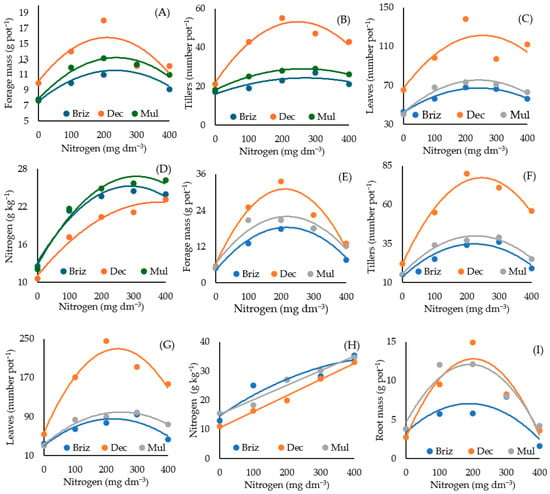
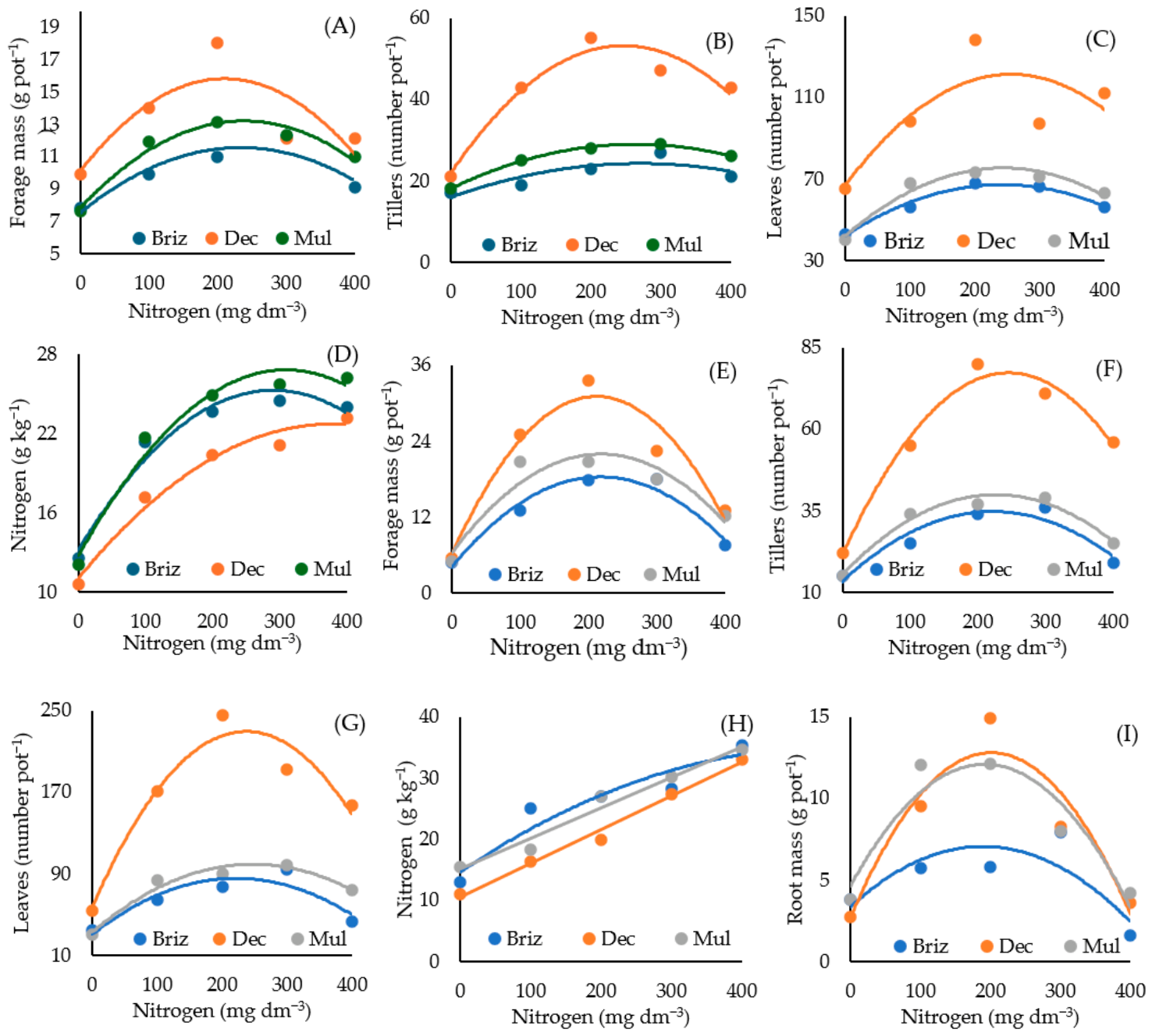
The fitted regression curves (Figure 1) visually illustrate the response patterns that were subsequently evaluated by model identity analysis. All evaluated variables were described by quadratic regression models (p < 0.05), except tiller number in Urochloa brizantha, which exhibited a linear response to nitrogen fertilization (Table 2). Maximum forage mass, leaf number, and tiller number were generally obtained at nitrogen rates between 200 and 300 mg dm−3, whereas maximum chlorophyll index occurred between 253 and 355 mg dm−3, depending on the grass species (Table 2). The lowest coefficients of determination (R2) were observed for forage mass and leaf number in Urochloa decumbens and for phyllochron in Urochloa brizantha (Table 2).
Figure 1.
Regression curves for forage mass (A,E), tiller number (B,F), leaf number (C,G), nitrogen concentration in forage (D,H), and root mass (I) of Urochloa brizantha (Briz), Urochloa decumbens (Dec), and Mulato II (Mul) during establishment (A–D) and regrowth (E–H), with root mass evaluated at the final harvest (I).
Table 2.
Means, linear (L) and quadratic (Q) responses, regression models, and nitrogen rates associated with maximum or minimum predicted responses for forage mass, leaf number, tiller number, chlorophyll index, phyllochron, and nitrogen concentration of Urochloa brizantha (Briz), Urochloa decumbens (Dec), and Mulato II (Mul) grasses subjected to nitrogen fertilization during the establishment phase.
Model identity analysis revealed significant differences between Urochloa brizantha and Urochloa decumbens for all evaluated traits (Table 3). The only similarities detected were the regression parameters for leaf number and the intercepts of the chlorophyll index equations.
Table 3.
Model identity, intercept, and parameter tests for forage mass, root mass, leaf number, tiller number, chlorophyll index, phyllochron, and nitrogen concentration of Urochloa brizantha, Urochloa decumbens, and Mulato II grasses subjected to nitrogen fertilization during the establishment phase.
Mulato II exhibited model identity with Urochloa brizantha for forage mass, leaf number, phyllochron, and nitrogen concentration (Table 3). The lack of identity for tiller number was associated with the linear response observed in Urochloa brizantha and the quadratic response observed in Mulato II. For chlorophyll index, model identity was rejected; however, regression parameters were similar, with differences occurring only in the intercepts (Table 3).
Model identity analysis revealed significant differences between Urochloa brizantha and Urochloa decumbens for all evaluated traits (Table 3). Among the individual model components, similarity was observed only for the regression parameters of leaf number and the intercept of the chlorophyll index equation. Similarly, Mulato II differed from Urochloa decumbens for all evaluated variables (Table 3). For forage mass, leaf number, tiller number, and nitrogen concentration, Mulato II presented lower intercept values than Urochloa decumbens, whereas a higher intercept was observed for phyllochron. The only similarity detected between Mulato II and Urochloa decumbens was the intercept of the chlorophyll index equation.
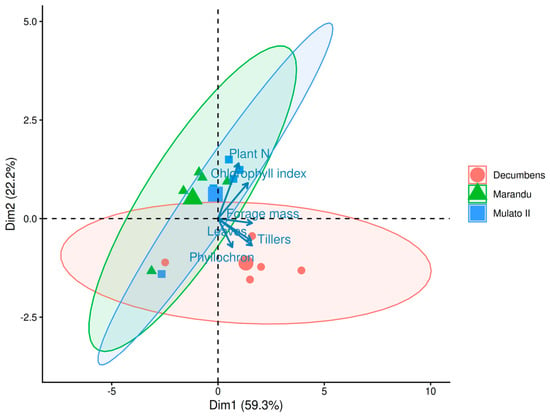
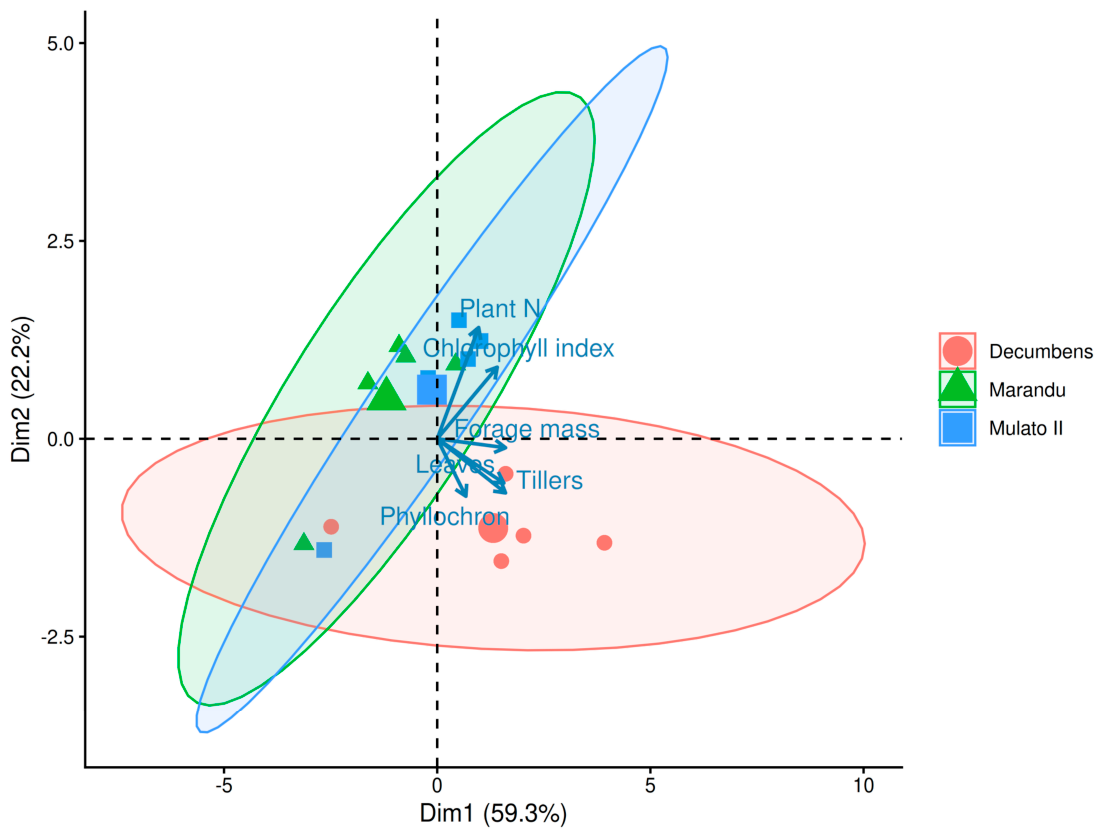
In the establishment phase, the first two principal components explained 81.5% of the total variation, with PC1 and PC2 accounting for 59.3% and 22.2%, respectively (Figure 2). Forage mass, leaf number, tiller number, chlorophyll index, and nitrogen concentration were positively associated with PC1, whereas phyllochron was negatively associated with this axis. Urochloa decumbens was separated from the other grasses along PC1, while Mulato II and Urochloa brizantha showed substantial overlap of their confidence ellipses (Figure 2).
Figure 2.
Principal component analysis (PCA) biplot of Urochloa brizantha, Urochloa decumbens, and Mulato II grasses subjected to nitrogen fertilization during the establishment phase. The first two principal components explained 81.5% of the total variation (PC1 = 59.3%; PC2 = 22.2%). Ellipses represent the 95% confidence interval for each grass.
3.2. Regrowth Phase
During regrowth, all variables were described by quadratic regression models, except nitrogen concentration in Urochloa decumbens and Mulato II, which exhibited linear responses, and phyllochron in Urochloa brizantha, for which no significant regression model was detected, resulting in an average value of 8.4 days leaf−1 (Table 4).
Table 4.
Means, linear (L) and quadratic (Q) responses, regression models, and nitrogen rates associated with maximum or minimum predicted responses for forage mass, root mass, leaf number, tiller number, chlorophyll index, phyllochron, and nitrogen concentration of Urochloa brizantha (Briz), Urochloa decumbens (Dec), and Mulato II (Mul) grasses subjected to nitrogen fertilization during the regrowth phase.
Maximum forage mass, leaf number, and tiller number were obtained at nitrogen rates ranging from approximately 190 to 250 mg dm−3, while maximum root mass occurred between 188 and 201 mg dm−3 (Table 4). The lowest coefficients of determination were observed for root mass in Urochloa brizantha and phyllochron in Urochloa decumbens (Table 4).
Model identity analysis revealed significant differences between Urochloa brizantha and Urochloa decumbens for all evaluated variables (Table 5). Similarity was observed only for the regression parameters of the chlorophyll index and root mass. Mulato II differed from Urochloa decumbens for all shoot-related traits evaluated (Table 5). However, root mass exhibited model identity between these grasses, indicating a similar root response pattern to nitrogen fertilization. For forage mass, leaf number, tiller number, and nitrogen concentration, Mulato II showed lower intercept values than Urochloa decumbens, whereas phyllochron presented a higher intercept.
Table 5.
Model identity, intercept, and parameter tests for forage mass, root mass, leaf number, tiller number, chlorophyll index, phyllochron, and nitrogen concentration of Urochloa brizantha, Urochloa decumbens, and Mulato II grasses subjected to nitrogen fertilization during the regrowth phase.
Mulato II exhibited model identity with Urochloa brizantha for forage mass, root mass, leaf number, chlorophyll index, and phyllochron (Table 5). Differences were detected only for tiller number and nitrogen concentration, and in both cases the divergence was associated exclusively with differences in intercepts, whereas regression parameters remained similar.
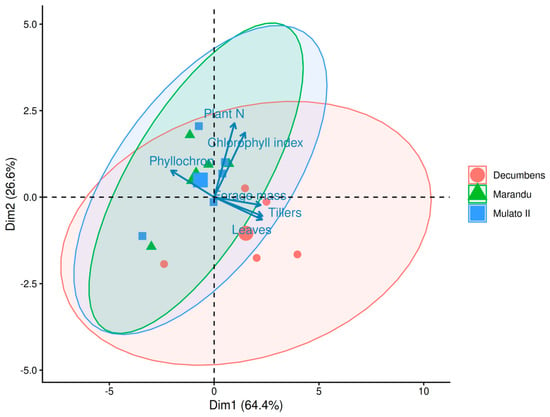
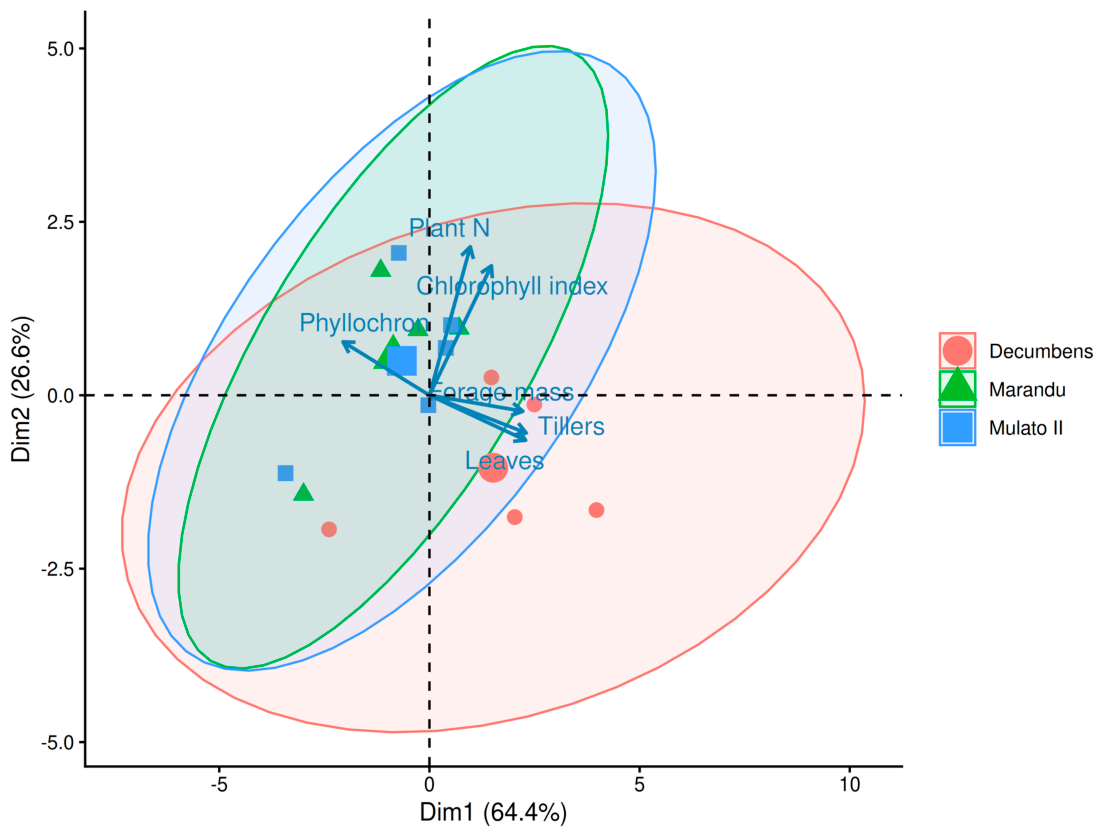
During the regrowth phase, the first two principal components explained 91.0% of the total variation, with PC1 accounting for 64.4% and PC2 for 26.6% (Figure 3). As observed during establishment, forage mass, tiller number, chlorophyll index, crude protein concentration, and nitrogen concentration were positively associated with PC1, whereas phyllochron exhibited an opposite relationship. Urochloa decumbens remained clearly separated from the other grasses, while Mulato II and Urochloa brizantha continued to exhibit substantial overlap.
Figure 3.
Principal component analysis (PCA) biplot of forage mass, root mass, leaf number, tiller number, chlorophyll index, phyllochron, and nitrogen concentration in Urochloa brizantha, Urochloa decumbens, and Mulato II grasses subjected to nitrogen fertilization during the regrowth phase. The first two principal components explained 91.0% of the total variation (PC1 = 64.4%; PC2 = 26.6%). Confidence ellipses represent the 95% confidence interval for each grass.
4. Discussion
The clear differences observed between Urochloa brizantha and Urochloa decumbens during both establishment and regrowth support the ability of model identity analysis to distinguish grasses with contrasting nitrogen responses. These species are widely recognized as differing in their adaptation to soil fertility, nutrient use efficiency, and responsiveness to fertilization [31]. Therefore, the rejection of model identity between these grasses demonstrates that the method was sufficiently sensitive to detect biologically meaningful differences in nutritional requirements. This conclusion was independently supported by PCA (Figure 2 and Figure 3), which consistently separated Urochloa decumbens from the other grasses in both growth phases.
The similarity observed between Mulato II and Urochloa brizantha for most productive, morphogenic, and nutritional traits indicates that the nitrogen requirement of the hybrid is more closely associated with Urochloa brizantha than with Urochloa decumbens. This result is consistent with the breeding history of Mulato II, which originated from interspecific hybridization involving Urochloa ruziziensis, Urochloa decumbens, and Urochloa brizantha [31,32]. Previous studies have classified Mulato II as a grass of intermediate to high productive potential and moderate fertility requirement [33], which agrees with the response patterns observed in the present study. The overlap between Mulato II and Urochloa brizantha in the PCA further reinforces this similarity (Figure 2 and Figure 3), suggesting that both grasses share comparable responses to nitrogen fertilization and, consequently, similar responses to nitrogen fertilization, suggesting comparable nitrogen requirements under the evaluated experimental conditions (Figure 1).
In contrast, Mulato II differed from Urochloa decumbens for most evaluated traits during both establishment and regrowth. The lower intercepts observed for forage mass, leaf number, tiller number, and nitrogen concentration indicate reduced performance of the hybrid under nitrogen deficiency. This result suggests a greater dependence on nitrogen fertilization to express its productive potential. Under low nitrogen availability, reduced tillering may compromise canopy density, leaf area development, and pasture recovery after defoliation, ultimately increasing the risk of pasture degradation [1,2,3,4].
However, greater nitrogen dependence should not be interpreted as a requirement for excessive fertilizer inputs. Studies conducted under grazing conditions have shown that increasing nitrogen rates does not necessarily result in proportional gains in forage production and may even reduce nitrogen use efficiency [34,35]. Therefore, nitrogen fertilization strategies should be adjusted according to the nutritional requirements of each forage species and soil nutrient supply in order to maximize productivity while minimizing nutrient losses and environmental impacts. Such an approach is particularly important for cultivars with greater nitrogen responsiveness, such as Mulato II, because adequate fertilization is required to sustain productivity and pasture persistence without compromising resource-use efficiency [36].
Therefore, nitrogen fertilization is decisive not only for sustaining pasture productivity but also for maintaining pasture persistence and reducing the risk of degradation over time [37,38]. Furthermore, long-term evidence has shown that increased nitrogen fertilization can enhance forage production and support higher stocking rates without causing significant deterioration of soil physical quality, thereby enabling sustainable grazing intensification [39]. Consequently, although Mulato II may offer greater productive potential than Urochloa decumbens, its successful use is likely to depend on more intensive fertility management.
Root mass exhibited a distinct response pattern. Although model identity was observed with both parental species for root mass, the evidence supporting identity was stronger for the comparison with Urochloa decumbens (p = 0.9185) than for Urochloa brizantha (p = 0.0852). This result suggests that root responses of Mulato II may be more closely associated with Urochloa decumbens, as illustrated by the fitted regression curves (Figure 1), although this interpretation should be viewed cautiously because both comparisons satisfied the model identity criterion at the adopted significance level.
This finding may be agronomically relevant because Urochloa decumbens is commonly associated with a vigorous root system and adaptation to stressful environments [40]. Greater root biomass has been associated with improved water and nutrient acquisition, reserve accumulation, and greater tolerance to drought and grazing stress [41,42,43]. Accordingly, the results suggest that Mulato II may combine shoot responses more similar to Urochloa brizantha with a root biomass response more similar to Urochloa decumbens. However, because only root dry mass was evaluated, this inference is limited to root biomass and should not be extrapolated to root morphology or other functional root traits.
The agreement between PCA and model identity analysis strengthens the reliability of the conclusions. While PCA efficiently summarized multivariate relationships and visually demonstrated the clustering pattern among grasses, it does not quantify whether response equations are statistically equivalent. In contrast, model identity analysis directly evaluates similarities among regression models through comparisons of intercepts and parameters. Thus, PCA should be viewed as a complementary exploratory tool, whereas model identity analysis provides the statistical basis for inferring similarities in nutritional requirements.
The practical implications of this methodology extend beyond nitrogen fertilization. Newly released cultivars often lack information regarding nutrient requirements, grazing management targets, defoliation frequencies, and optimal canopy heights. Because model identity analysis compares overall biological response patterns rather than isolated measurements, the approach may also be applied to infer recommendations related to grazing management, cutting height, canopy structure, forage accumulation, and responses to other nutrients. An additional advantage is that all genotypes are evaluated under identical environmental and management conditions, allowing differences in response to be attributed primarily to genotype rather than environmental variation. When model identity is rejected, comparisons of intercepts and regression parameters help identify the source of divergence, distinguishing differences in performance under nutrient deficiency (intercepts) from differences in responsiveness to management or fertilization (regression parameters). Therefore, the method represents a rapid, low-cost, and accessible strategy for generating preliminary management recommendations that should subsequently be validated under field conditions.
The applicability of this approach depends on the availability of reference genotypes with well-characterized response patterns. Importantly, these reference genotypes do not necessarily need to be the parental species, as model identity analysis can also be applied using biologically relevant cultivars with experimentally characterized response patterns, as previously demonstrated for the Brachiaria hybrid cv. Ipyporã [11].
Although field validation remains essential, this approach may substantially reduce the time required to generate useful recommendations for forage producers and researchers. It should be noted, however, that the present study was conducted under greenhouse conditions, where environmental variability, grazing effects, and soil heterogeneity are substantially reduced. Moreover, although all treatments received the same liming and basal fertilization according to established recommendations for tropical forage grasses, soil chemical properties were not determined after fertilization to confirm that the target fertility levels for nutrients other than nitrogen had been achieved.
Nevertheless, the predominantly quadratic responses observed for most variables indicate that nitrogen was the primary limiting nutrient under experimental conditions. Furthermore, the restricted rooting volume of pots, together with the absence of nutrient leaching and grazing, may also have influenced plant responses compared with field conditions. Consequently, the magnitude of the responses observed may differ under practical production conditions. Despite these limitations, the relative similarities and differences identified among grasses are expected to remain biologically relevant because they are consistent with the contrasting nutritional requirements previously reported for Urochloa brizantha and Urochloa decumbens. Therefore, model identity analysis provides a promising framework for generating preliminary management recommendations that can subsequently be refined through long-term field experimentation.
5. Conclusions
Model identity analysis proved to be an effective statistical approach for distinguishing forage grasses with contrasting nitrogen requirements and for identifying similarities in nitrogen response patterns among related genotypes. The method indicated that the nitrogen fertilization response of Mulato II is more similar to that of Urochloa brizantha than to Urochloa decumbens, suggesting comparable nitrogen requirements between the hybrid and Urochloa brizantha. The agreement between model identity analysis and principal component analysis further reinforces the robustness of this conclusion.
Beyond nitrogen fertilization, the results demonstrate the potential of model identity analysis as a rapid, low-cost, and accessible tool for generating preliminary management recommendations for newly released forage cultivars and hybrids when specific information is unavailable. This approach may contribute to accelerating the development of fertilization and grazing management recommendations while long-term field validation studies are still being conducted, supporting the use of model identity analysis as a complementary strategy for developing preliminary recommendations before extensive field information becomes available.
Author Contributions
Conceptualization: C.E.A.C. and F.G.d.S. Methodology: C.E.A.C. and F.G.d.S. Validation: M.V.d.F.S., L.G.M. and E.S.d.O.S. Formal analysis: C.E.A.C. and F.G.d.S. Investigation. C.E.A.C., M.V.d.F.S. and E.S.d.O.S. Resources: C.H.A.C. Data curation. M.V.d.F.S., L.G.M. and S.d.S.S. Writing—original draft preparation: C.E.A.C. and M.V.d.F.S. Writing—review and editing: C.E.A.C., L.G.M., S.d.S.S. and C.H.A.C. Visualization: L.G.M. and S.d.S.S. Supervision: C.H.A.C. Project administration: C.H.A.C. All authors have read and agreed to the published version of the manuscript.
Funding
This research received no external funding.
Data Availability Statement
The raw data supporting the conclusions of this article will be made available by the authors on request.
Acknowledgments
During the preparation of this manuscript/study, the only AI tool used during the preparation of this manuscript was ChatGPT (OpenAI, GPT-5.5), exclusively for language editing to improve grammar, clarity, coherence, readability, and overall English style. No AI tools were used for scientific text generation, data analysis, interpretation of results, literature review, image generation, image processing, or preparation of the Graphical Abstract. The authors have reviewed and edited the output and take full responsibility for the content of this publication.
Conflicts of Interest
The authors declare no conflicts of interest.
References
- Pinheiro, V.L.; Mendonça, A.S.; Cruz, D.H.G.; Araújo, L.C.; Andrade, K.S.P.; Rocha, T.C.; Rodrigues, W.P. Structural traits, production, biomass allocation, and changes in leaf investment in Megathyrsus maximus cv. MG12 Paredão under nitrogen fertilization and cutting intervals. Nitrogen 2025, 6, 12. [Google Scholar] [CrossRef] [Scilit]
- Oliveira, J.K.S.d.; Corrêa, D.C.d.C.; Cunha, A.M.Q.; Rêgo, A.C.d.; Faturi, C.; Silva, W.L.d.; Domingues, F.N. Effect of nitrogen fertilization on production, chemical composition and morphogenesis of Guinea grass in the humid tropics. Agronomy 2020, 10, 1840. [Google Scholar] [CrossRef] [Scilit]
- Paimel, A.C.C.; Araújo, E.G.N.N.; Matos, A.L.; Gomes, M.N.; Rodrigues, N.S.; Sousa, A.S.; Cabral, C.E.A. Adubação nitrogenada em híbridos de Brachiaria spp. Rev. Observ. Econ. Lat. 2025, 23, 140. [Google Scholar] [CrossRef]
- Moura, A.B.O.; Mota, L.G.; Borges, L.C.O.; Cuff, E.C.K.; Silva, S.d.S.; Duarte, C.F.D.; Cabral, C.H.A.; Cabral, C.E.A. What is the maximum nitrogen dose for the fertilization of BRS Tamani? Nitrogen 2025, 6, 53. [Google Scholar] [CrossRef] [Scilit]
- Batista, K.; Sarti, M.B.; Vilela, L.A.F.; Venegas, R.A.P.; Ojeda, G. Impact of the nitrogen on nutrient dynamics in soybean–grass intercropping in a degraded pasture area. Plants 2025, 14, 3372. [Google Scholar] [CrossRef] [Scilit] [PubMed]
- Motta, A.M.; Motta, L.J.M.; Mota, L.G.; Assis, L.M.B.; Moura, A.B.O.; Borges, L.C.O.; Silva, G.B.A.; Duarte, C.F.D.; Cabral, C.H.A.; Cabral, C.E.A. Effect of time of nitrogen fertilization on use of root reserves in Megathyrsus maximus cultivars. Nitrogen 2024, 5, 702–711. [Google Scholar] [CrossRef] [Scilit]
- Monteiro, R.C.; Santos, C.A.; Rezende, C.P.; Pereira, J.M.; Macedo, R.O.; Alves, B.J.R.; Homem, B.G.C.; Urquiaga, S.; Zaman, M.; Boddey, R.M. Impact of a forage legume or nitrogen fertilizer application on ammonia volatilization and nitrous oxide emissions in Brachiaria pastures. Rev. Bras. Ciência Solo 2024, 48, e0240012. [Google Scholar] [CrossRef] [Scilit]
- Martínez-Dalmau, J.; Berbel, J.; Ordóñez-Fernández, R. Nitrogen fertilization. A review of the risks associated with the inefficiency of its use and policy responses. Sustainability 2021, 13, 5625. [Google Scholar] [CrossRef] [Scilit]
- Bernardi, A.; Silva, A.W.L.; Baretta, D. Estudo metanalítico da resposta de gramíneas perenes de verão à adubação nitrogenada. Arq. Bras. Med. Vet. Zootec. 2018, 70, 545–553. [Google Scholar] [CrossRef] [Scilit]
- Pereira, L.E.T.; Herling, V.R.; Tech, A.R.B. Current scenario and perspectives for nitrogen fertilization strategies on tropical perennial grass pastures: A Review. Agronomy 2022, 12, 2079. [Google Scholar] [CrossRef] [Scilit]
- Cabral, C.E.A.; Cabral, C.H.A.; Tesk, C.R.M.; Mota, L.G.; Groto, G.C.; Motta, L.J.M.; Lourenço, P.E.C.; Motta, A.M.; Barros, L.V.; Silva, F.G.; et al. Nitrogen requirement of Brachiaria hybrid cv. Ipyporã. Bol. Ind. Anim. 2020, 77, e1467. [Google Scholar] [CrossRef] [Scilit]
- Cabral, C.E.A.; Mota, L.G.; Gomes, L.D.; Silva, P.H.G.; Duarte, C.F.D.; Cabral, C.H.A. Quantos dias após a desfolha deve-se adubar com nitrogênio o capim BRS Ipyporã? Nativa 2023, 11, 448–453. [Google Scholar] [CrossRef] [Scilit]
- Regazzi, A.J. Teste para verificar a identidade de modelos de regressão e a igualdade de alguns parâmetros num modelo polinomial ortogonal. Rev. Ceres 1993, 40, 176–195. [Google Scholar]
- Regazzi, A.J. Teste para verificar a identidade de modelos de regressão e a igualdade de parâmetros no caso de dados de delineamentos experimentais. Rev. Ceres 1999, 46, 383–409. [Google Scholar]
- Regazzi, A.J. Teste para verificar a identidade de modelos de regressão. Pesqui. Agropecu. Bras. 1996, 31, 1–17. [Google Scholar]
- Carneiro, A.P.S.; Muniz, J.A.; Carneiro, P.L.S.; Malhado, C.H.M.; Martins Filho, R.; Silva, F.F. Identidade de modelos não lineares para comparar curvas de crescimento de bovinos da raça Tabapuã. Pesqui. Agropecu. Bras. 2014, 49, 57–62. [Google Scholar] [CrossRef] [Scilit]
- Vendruscolo, D.G.S.; Chaves, A.G.S.; Silva, R.S.; Souza, H.S.; Medeiros, R.A.; Motta, A.S.; Silva, F.T. Identidade em modelos hipsométricos para Tectona grandis com diferentes espaçamentos em Cáceres-MT. Nativa 2015, 3, 44–49. [Google Scholar] [CrossRef] [Scilit]
- Roveda, M.; Dias, A.N.; Filho, A.F.; Scavinski, V.; Castro, R.R. Testes de identidade de modelos aplicados na construção de curvas de índices de local e na produção de povoamentos de Eucalyptus grandis. Sci. For. 2016, 44, 115–127. [Google Scholar] [CrossRef] [Scilit]
- Borges, I.B.; Rocha, O.C.; Malaquias, J.V.; Fagioli, M.; Sá, M.A.C.; Guerra, A.F. Models Identity generated in neutron probe calibration in Latosol cultivated with Coffee and Signalgrass. Coffee Sci. 2018, 13, 519–529. [Google Scholar] [CrossRef] [Scilit]
- Freitas, F.P.; Fonseca, D.M.; Braz, T.G.S.; Martuscello, J.A.; Santos, M.E.R. Forage yield and nutritive value of Tanzania Grass under nitrogen supplies and plant densities. Rev. Bras. Zootec. 2012, 41, 864–872. [Google Scholar] [CrossRef] [Scilit]
- Rao, I.M.; Kerridge, P.C.; Macedo, M.C.M. Nutritional Requirements of Brachiaria and Adaptation to Acid Soils. In Brachiaria: Biology, Agronomy, and Improvement; Miles, J.W., Maass, B.L., Valle, C.B., Eds.; CIAT: Cali, Colombia; EMBRAPA-CNPGC: Campo Grande, Brazil, 1996; pp. 53–71. [Google Scholar]
- Nakamura, T.; Miranda, C.H.B.; Ohwaki, Y.; Valério, J.R.; Kim, Y.; Macedo, M.C.M. Characterization of Nitrogen Utilization by Brachiaria Grasses in Brazilian Savannas (Cerrados). Soil Sci. Plant Nutr. 2005, 51, 973–979. [Google Scholar] [CrossRef] [Scilit]
- Teixeira, P.C.; Donagemma, G.K.; Fontana, A.; Teixeira, W.G. (Eds.) Manual de Métodos de Análise de Solo, 3rd ed.; Embrapa: Brasília, Brazil, 2017. [Google Scholar]
- Vilela, L.; Sousa, D.M.G.; Martha, G.B., Jr. Calagem. In Cerrado: Uso Eficiente de Corretivos e Fertilizantes em Pastagens; Martha Júnior, G.B., Vilela, L., Sousa, D.M.G., Eds.; Embrapa Cerrados: Planaltina, Brazil, 2007; pp. 93–106. [Google Scholar]
- Cantarutti, R.B.; Martins, C.E.; Carvalho, M.M.; Fonseca, D.M.; Arruda, M.L.; Vilela, H.; Oliveira, F.T.T. Pastagens. In Fertilidade do Solo; Novais, R.F., Alvarez Venegas, V.H., Barros, N.F., Fontes, R.L.F., Cantarutti, R.B., Neves, J.C.L., Eds.; Sociedade Brasileira de Ciência do Solo: Viçosa, Brazil, 2007; pp. 851–879. [Google Scholar]
- Bonfim-Silva, E.M.; Monteiro, F.A.; Silva, T.J.A. Nitrogênio e enxofre na produção e no uso de água pelo capim-braquiária em degradação. Rev. Bras. Ciênc. Solo 2007, 31, 309–317. [Google Scholar] [CrossRef] [Scilit]
- Batista, K.; Monteiro, F.A. Nitrogênio e enxofre nas características morfogênicas do capim-marandu em substituição ao capim-braquiária em degradação em solo com baixo teor de matéria orgânica. Rev. Bras. Zootec. 2008, 37, 1151–1160. [Google Scholar] [CrossRef] [Scilit]
- Detmann, E.; Silva, L.F.C.; Rocha, G.C.; Palma, M.N.N.; Rodrigues, J.P.P. (Eds.) Métodos Para Análise de Alimentos, 2nd ed.; Suprema: Visconde do Rio Branco, Brazil, 2021. [Google Scholar]
- Regazzi, A.J. Teste para Verificar a Igualdade de Parâmetros e a Identidade de Modelos de Regressão Não-Linear. Rev. Ceres 2003, 50, 9–26. [Google Scholar]
- R Core Team. R: A Language and Environment for Statistical Computing; R Foundation for Statistical Computing; R Core Team: Vienna, Austria, 2025; Available online: https://www.r-project.org/ (accessed on 10 May 2026).
- Ferreira, R.C.U.; Moraes, A.C.L.; Chiari, L.; Simeão, R.M.; Vigna, B.B.Z.; Souza, A.P. An Overview of the Genetics and Genomics of the Urochloa Species Most Commonly Used in Pastures. Front. Plant Sci. 2021, 12, 770461. [Google Scholar] [CrossRef] [Scilit] [PubMed]
- Argel, P.J.; Miles, J.W.; Guiot, J.D.; Cuadrado, H.; Lascano, C.E. Cultivar Mulato II (Brachiaria híbrida CIAT 36087): Gramínea de Alta Qualidade e Produção Forrageira, Resistente às Cigarrinhas e Adaptada a Solos Tropicais Ácidos; Centro Internacional de Agricultura Tropical (CIAT): Cali, Colombia, 2007; 22p. [Google Scholar]
- Vendramini, J.; Sellers, B.; Sollenberger, L.E.; Silveira, M. Mulato II (Brachiaria sp.): SS AGR 303 AG310, Rev. 3 2011. EDIS 2011, 1–4. [Google Scholar] [CrossRef] [Scilit]
- Euclides, V.P.B.; Montagner, D.B.; Araújo, A.R.; Pereira, M.A.; Difante, G.S.; Araújo, I.M.M.; Barbosa, L.F.; Barbosa, R.A.; Gurgel, A.L.C. Biological and Economic Responses to Increasing Nitrogen Rates in Mombaça Guinea Grass Pastures. Sci. Rep. 2022, 12, 1937. [Google Scholar] [CrossRef] [Scilit] [PubMed]
- Delevatti, L.M.; Cardoso, A.S.; Barbero, R.P.; Leite, R.G.; Romanzini, E.P.; Ruggieri, A.C.; Reis, R.A. Effect of Nitrogen Application Rate on Yield, Forage Quality, and Animal Performance in a Tropical Pasture. Sci. Rep. 2019, 9, 7596. [Google Scholar] [CrossRef] [Scilit] [PubMed]
- Alves, W.S.; Anjos, A.J.d.; Coutinho, D.N.; Neto, P.F.; da Silveira, T.C.; Ribeiro, K.G. Technological Innovations in Pasture Fertilization in Brazil—Pathways to Sustainability and High Productivity. Grasses 2025, 4, 43. [Google Scholar] [CrossRef] [Scilit]
- Phohlo, M.P.; Swanepoel, P.A.; Hinck, S. Excessive Nitrogen Fertilization Is a Limitation to Herbage Yield and Nitrogen Use Efficiency of Dairy Pastures in South Africa. Sustainability 2022, 14, 4322. [Google Scholar] [CrossRef] [Scilit]
- Boddey, R.M.; Macedo, R.; Tarré, R.; Ferreira, E.; Oliveira, O.C.; Rezende, C.P.; Cantarutti, R.B.; Pereira, J.M.; Alves, B.J.R.; Urquiaga, S. Nitrogen cycling in Brachiaria pastures: The key to understanding the process of pasture decline. Agric. Ecosyst. Environ. 2004, 103, 389–403. [Google Scholar] [CrossRef] [Scilit]
- Cagna, C.P.; Tormena, C.A.; Guimarães, R.; Lugão, S.M.B.; Costa, M.A.T.; Batista, M.A.; Figueiredo, G.C.; Nunes, M.R. Nitrogen fertilization allows grazing intensification without degrading soil physical quality. Soil Tillage Res. 2025, 247, 106344. [Google Scholar] [CrossRef] [Scilit]
- Ramos, F.T.; França, M.G.C.; Alvim, M.N.; Rossiello, R.O.P.; Zonta, E. Aluminum tolerance measured by root growth and mucilage protection in Urochloa brizantha and Urochloa decumbens. J. Plant Interact. 2012, 7, 225–229. [Google Scholar] [CrossRef] [Scilit]
- Kalra, A.; Goel, S.; Elias, A.A. Understanding role of roots in plant response to drought: Way forward to climate-resilient crops. Plant Genome 2024, 17, e20395. [Google Scholar] [CrossRef] [Scilit] [PubMed]
- Gomes, L.D.; Lima, K.L.L.; Silva, G.B.A.; Borges, L.C.O.; Righi, R.S.M.; Duarte, C.F.D.; Cabral, C.H.A.; Cabral, C.E.A. Tolerance of Brachiaria hybrids to water stress. Sci. Electron. Arch. 2023, 16, 1–7. [Google Scholar] [CrossRef] [Scilit]
- Righi, R.S.M.; Gomes, L.D.; Mota, L.G.; Duarte, C.F.D.; Cabral, C.H.A.; Cabral, C.E.A. Tolerance of Megathyrsus maximus cultivars to water stress. Nativa 2024, 12, 249–254. [Google Scholar] [CrossRef] [Scilit]

Disclaimer/Publisher’s Note: The statements, opinions and data contained in all publications are solely those of the individual author(s) and contributor(s) and not of MDPI and/or the editor(s). MDPI and/or the editor(s) disclaim responsibility for any injury to people or property resulting from any ideas, methods, instructions or products referred to in the content. |
© 2026 by the authors. Licensee MDPI, Basel, Switzerland. This article is an open access article distributed under the terms and conditions of the Creative Commons Attribution (CC BY) license.