


Abstract
Effective weed management is critical to sustaining rice productivity and profitability, particularly under conservation-oriented production systems, where weed dynamics may differ from conventional puddled cultivation. A two-year field experiment was conducted to evaluate weed management practices under puddled transplanted rice (PTR) and zero-till non-puddled transplanted rice (ZT NPTR) production systems during the boro seasons of 2020 and 2021. Six weed management practices, comprising season-long weed-free, season-long weedy, Pretilachlor, Acetachlor (14%) + Bensulfuron methyl (4%), Pyrazosulfuron-ethyl, and Penoxsulam treatments, were evaluated. Weed density and dry biomass were significantly influenced by production system and weed management practice. Compared with 2020, weed density in 2021 decreased by approximately 74% at both 30 and 60 days after transplanting (DAT) under PTR and by 91% and 86%, respectively, under ZT NPTR. Similarly, weed dry biomass decreased by 90% and 86% under PTR and by 81% and 77% under ZT NPTR at 30 and 60 DAT, respectively. Pyrazosulfuron-ethyl and Penoxsulam achieved 100% weed control efficiency, comparable to the season-long weed-free treatment, whereas Pretilachlor, and Acetachlor (14%) + Bensulfuron methyl (4%) provided comparatively lower weed suppression. The ZT NPTR system increased grain yield by approximately 5% in 2020 and 35% in 2021 relative to the PTR system. Among weed management practices, Penoxsulam produced the highest or a statistically comparable grain yield and increased yield by approximately 105% and 80% over the season-long weedy treatment in 2020 and 2021, respectively. Economic analysis showed that Pyrazosulfuron-ethyl was the most profitable treatment under PTR in both years and under ZT NPTR in 2021, whereas Penoxsulam provided the greatest economic return under ZT NPTR in 2020. Overall, effective post-emergence weed management with Pyrazosulfuron-ethyl or Penoxsulam within the ZT NPTR production system provided effective weed suppression, high rice productivity, and favourable economic returns. However, because pre-plant glyphosate application was an integral component of the ZT NPTR system, the differences between the PTR and ZT NPTR systems should be interpreted as responses to the overall production systems rather than to tillage alone.
1. Introduction
Rice (Oryza sativa L.) underpins food supply and rural livelihoods across much of South Asia. In Bangladesh, crop establishment still relies predominantly on puddled transplanted rice (PTR), although non-puddled transplanting and dry direct seeding are increasingly considered where labour, water, and energy are limited. Repeated puddling requires substantial water, time and energy [1] and disrupts soil aggregates, contributing to the development of a shallow plough pan and deterioration of topsoil structure [2]. At the same time, movement of agricultural workers to non-farm sectors and overseas employment have intensified seasonal labour shortages, which can delay transplanting and reduce grain production [3]. These constraints have encouraged greater interest in dry direct-seeded rice (DDSR) in several Asian countries [4,5]. DDSR implementation can facilitate mechanization and timely crop establishment while reducing labour and water requirements and methane emissions [4]. Its wider adoption, however, is constrained by severe weed pressure because rice and weeds emerge simultaneously and the absence of standing water during crop establishment removes an important mechanism of weed suppression [6]. Land preparation under DDSR can also alter the vertical distribution of weed seeds and, consequently, the relative abundance of weed species.
Zero-till non-puddled transplanted rice (ZT NPTR) provides another establishment option that combines transplanting with reduced soil disturbance. In non-puddled systems, seedlings can be established after limited soil preparation using shallow or strip tillage, bed formation, or related reduced-tillage operations, with transplanting performed mechanically or manually [7,8]. Such approaches can lower tillage costs and water use by avoiding puddling and may improve energy-use efficiency and profitability without sacrificing yield [2,8,9,10]. The ZT NPTR system further minimizes preparatory tillage, thereby reducing the labour and energy required for land preparation. Nevertheless, information remains limited on how this establishment system modifies weed communities, the effectiveness of weed control practices, and crop productivity. Changes in land preparation and crop establishment are expected to influence weed flora, weed competitiveness, and susceptibility to control measures. Therefore, reliable weed management strategies are essential to the sustained use of ZT NPTR. Previous studies indicate that yields under non-puddled transplanting can equal or exceed those under PTR systems when weeds are adequately controlled, whereas inadequate weed control can cause substantial yield loss [8,11]. Conventional puddling suppresses many existing weeds and redistributes weed seeds within saturated soil [12,13], while reduced tillage can alter weed species composition and diversity [14,15].
Chemical weed control remains widely used in rice because manual weeding is increasingly constrained by labour scarcity, despite recognized concerns associated with herbicide use [3,16,17,18]. Effective programmes may require herbicides with complementary modes of action to control a broad spectrum of weeds. In ZT NPTR, existing vegetation must first be removed before transplanting, and subsequent pre- or post-emergence control is needed because viable weed seeds remain near the undisturbed soil surface and can emerge during early crop growth [19,20,21]. Failure to control these weeds can limit the agronomic benefits of reduced tillage establishment [6,22]. Despite the potential advantages of ZT NPTR, comparative evidence on weed suppression, crop performance, and the economic returns from herbicide-based management under PTR and ZT NPTR remains limited. Therefore, this study evaluated six weed-management practices under the two rice production systems during two consecutive boro seasons, with an emphasis on weed density and biomass, weed control efficiency, rice yield and yield-contributing traits, and the economic performance.
2. Materials and Methods
2.1. Experimental Site
This field experiment was conducted at the Agronomy Field Laboratory of Bangladesh Agricultural University, Mymensingh, from January to May in both 2020 and 2021. The site is located at 24.719890° N and 90.426928° E, approximately 18 m above mean sea level, within the Old Brahmaputra Floodplain (Agroecological zone 9) of Bangladesh. The experimental soil was nearly neutral (pH 7.2), silty loam on medium highland; its initial properties are summarized in Table 1. The region has a tropical climate, with warmer, more humid, and wetter conditions during the kharif season (April–September) and comparatively cooler and drier conditions during the rabi season (October–March). Monthly average air temperature (°C), relative humidity (%), and rainfall (mm) recorded during the experimental periods are presented in Table 2.
Table 1.
Initial soil properties of the experimental field.
Table 2.
Distribution of monthly average air temperature, relative humidity and rainfall of the experiment site during the experimental periods in 2020 and 2021.
2.2. Plant Material
BRRI dhan58, a popular high-yielding boro rice variety developed by Bangladesh Rice Research Institute (BRRI), was used as the test crop. Released in 2012, the variety is resistant to lodging and shattering, generally matures in 150–155 days, and attains a plant height of about 100–105 cm. Its reported yield potential is 7.0–7.5 t ha−1, with a 1000-grain weight of approximately 24 g.
2.3. Experimental Design and Treatments
The study comprised two rice production systems, (i) puddled transplanted rice (PTR) (P1) and (ii) zero-till non-puddled transplanted rice (ZT NPTR) (P2); and six different weed management practices, (i) season-long weed-free (W1) (ii) season-long weedy (W2), (iii) Pretilachlor applied at 6 days after transplanting (DAT) (W3), (iv) Acetachlor (14%) + Bensulfuron methyl (4%) applied at 6 DAT (W4), (v) Pyrazosulfuron-ethyl applied at 14 DAT (W5), and (vi) Penoxsulam applied at 14 DAT (W6). Here, Pretilachlor and Acetachlor (14%) + Bensulfuron methyl (4%) were applied at 6 DAT as pre-emergence treatments relative to weed emergence, whereas Pyrazosulfuron-ethyl and Penoxsulam were applied at 14 DAT as post-emergence treatments to emerged weeds. Table 3 provides a brief overview of the herbicides used in the study, together with information on their common and trade names, application methods, and marketing companies. The experiment was laid out in a split-plot design with three replications, with a rice production system assigned to the main plots and weed management practices to the subplots. In season-long weedy plots, weeds were allowed to grow until harvest, whereas in the season-long weed-free plots, weeds were removed manually at two-day intervals throughout the growing season. The unit plot size was 4.0 m × 2.5 m (10 m2).
Table 3.
A brief description of the herbicides used in the experiments along with their trade name, common name, application rate, active ingredient rate, mode of application and their marketing company.
2.4. Crop Husbandry
The PTR field was initially prepared using a power tiller on 10 January 2020 (Year 1), and 2021 (Year 2). On 20 January 2020, the land was irrigated. Subsequently, the field was levelled by ploughing and three cross-ploughings using a tractor-driven plough, followed by laddering. Two days prior to the transplanting date, final puddling was completed. The experimental layout was then established according to the treatment specifications. As per the recommendation by Bangladesh Rice Research Institute, the fertilizers were applied to the field at rates of 220, 120, 75, 60 and 10 kg urea, triple super phosphate, muriate of potash, gypsum and zinc sulphate ha−1, respectively [23]. Except for urea, all fertilizers were applied as basal applications during final land preparation. Urea was top dressed in three instalments at 15, 30 and 45 DAT.
Roundup® (glyphosate 41% SL-IPA salt, Bayer CropScience Limited, Dhaka, Bangladesh), a pre-planting non-selective herbicide, was applied at a rate of 75 mL 10 L−1 water (2.25 L ha−1) two weeks prior to the transplanting in the ZT-NPTR field. Pre-plant glyphosate application was considered an integral component of the ZT NPTR production system for controlling existing vegetation before transplanting, whereas in PTR this function was achieved through conventional tillage and puddling. Thus, PTR and ZT NPTR should be regarded as two complete establishment systems rather than treatments differing solely in tillage. Two weeks after glyphosate application, the land was submerged in standing water for 48 h, reaching a depth of 3–5 cm, prior to transplanting. Following the experimental guidelines, 40-day-old rice seedlings were transplanted after a furrow was manually made with a metallic rod. Except for these operations, all other crop-management practices in ZT NPTR were the same as those used in PTR.
On 22 January 2020 (Year 1), and 2021 (Year 2), the seedlings were transplanted into both the ZT NPTR and well-prepared PTR fields keeping two seedlings hill−1 at a spacing of 25 cm by 15 cm. Since there were no notable insect or disease infestations during the trial, no crop protection measures were implemented to prevent insects and diseases.
The experiment was conducted on the same experimental plots during 2020 and 2021, with the treatment layout and treatment allocation maintained across both years. Consequently, the effects of the preceding year’s management practices, including potential changes in the weed seedbank, may have carried over into the subsequent season and contributed to the observed year-to-year differences.
2.5. Herbicide Application
The herbicides were applied using a hand-operated plastic knapsack sprayer fitted with a flat-fan nozzle. The sprayer was calibrated to deliver a spray volume of 300 L ha−1 at a constant operating pressure of 0.3 MPa. No adjuvant was used with any of the herbicide treatments. During spraying, the operator maintained a uniform walking speed of approximately 8 km h−1 to ensure consistent herbicide application. The nozzle was held approximately 50 cm above the weed canopy to provide adequate spray overlap and uniform coverage of the target weeds. For the pre-emergence herbicide treatments, a standing water depth of around 5 cm was maintained during application, and the plots were not drained for 3 days after application. For the post-emergence herbicide treatments, standing water was drained before spraying to adequately expose the emerged weed foliage, while the soil was maintained under moist-to-saturated conditions. The plots were re-flooded with a shallow water layer of approximately 5 cm at 3 days after herbicide application.
2.6. Data Recording Procedure
Weed density and dry biomass: Weed samples were collected from two randomly positioned 0.5 m × 0.5 m quadrats in each plot. All weeds within each quadrat were clipped at ground level, identified by species, counted, and placed in separate bags. Samples were oven-dried at 80 °C for 72–96 h until constant weight. The weed density (no. m−2) and dry biomass (g m−2) were recorded. Relative weed density (RD) and relative weed dry biomass (RDW) of the weedy plots were calculated using the following equations:
Summed dominance ratio: Weed species dominance was assessed using the summed dominance ratio (SDR), which was calculated using the following equations:
Weed control efficiency: Weed control efficiency (WCE) of different herbicide treatments was calculated as follows:
Yield attributes and yield: The crop was harvested at physiological maturity, when approximately 90% of the grains had turned golden yellow. Five non-border hills were selected randomly from each plot for measurement of plant and yield attributes. The remaining crop from each plot was harvested separately, labelled, and taken to the threshing floor. Grain was threshed mechanically, cleaned, weighed, and adjusted to 14% moisture content before grain yield was calculated. Straw was cleaned, sun-dried, and weighed. Plot-level grain and straw yields were subsequently converted to t ha−1.
Yield increase over control: The percentage increase in yield over the control (YOC) was calculated based on the following equations:
The costs of all production inputs and field operations were recorded for the partial budget analysis. For the ZT NPTR system, the cost of pre-plant glyphosate and its application was included in the total production cost. Gross income and net income were calculated, and the benefit–cost ratio (BCR) was subsequently determined.
2.7. Statistical Analysis
Data from each experimental year (2020 and 2021) were analyzed separately using Statistix version 10 (Analytical Software, Tallahassee, FL, USA). Analysis of variance (ANOVA) was performed according to a split-plot design with production system (P) assigned to the main plots and weed management practices (W) to the subplots. Production system effects were tested against the main-plot error, whereas weed-management and P × W interaction effects were tested against the sub-plot error. No data transformation was required. When significant effects were detected, means were compared using Tukey’s honestly significant difference (HSD) test at p ≤ 0.05. The corresponding p-values, standard errors of the mean [(SEm(±)], and coefficients of variation for the main-plot (CVa) and subplot (CVb) errors were reported.
3. Results
3.1. Floristic Composition of the Weeds
Five weed species belonging to three families, comprising two grasses, two sedges, and one broadleaf species, were found under both PTR and ZT NPTR systems during the two study years (Table 4). Weed dominance varied between production systems and years. Under PTR, Monochoria vaginalis was the dominant species in 2020, whereas Paspalum scrobiculatum became dominant in 2021. Under ZT NPTR, Echinochloa crus-galli, Scirpus juncoides, and P. scorbiculatum were major weeds in 2020, while P. scrobiculatum became the dominant species in 2021. Overall, the results indicate a temporal shift in weed species dominance under both production systems, with P. scrobiculatum becoming increasingly dominant in the second year (Table 4).
Table 4.
Weed composition along with their summed dominance ratio (SDR) values recorded in the season-long weedy plots in puddled transplanted (PTR) and zero-till non-puddled transplanted Rice (ZT NPTR) production systems during 2020 and 2021.
3.2. Weed Density
Rice production system significantly affected weed density at both sampling dates within each sampling year (Table 5). Descriptively, weed density declined markedly from 2020 to 2021 under both production systems. Under PTR, weed density decreased by approximately 74% at both 30 and 60 DAT, whereas under ZT NPTR, the corresponding reductions were approximately 91% and 86%, respectively. Within each year, ZT NPTR supported significantly lower weed density than PTR, with the relative difference between the production systems being greater in 2021 (Table 5).
Table 5.
Effect of different weed management practices on the weed density (no. m−2) under puddled transplanted rice (PTR) and zero-till non-puddled transplanted rice (ZT NPTR) production systems during 2020 and 2021.
Weed management practices also significantly influenced weed density (Table 5). The season-long weed-free treatment, Pyrazosulfuron-ethyl, and Penoxsulam achieved complete weed suppression (100% reduction relative to the season-long weedy treatment) at both sampling dates in both years. Pretilachlor and Acetachlor (14%) + Bensulfuron methyl (4%) significantly reduced weed density compared with the season-long weedy treatment, although some weeds remained. Across production systems, their suppressive effects were generally greater in 2021 than in 2020 (Table 5).
The production system × weed management interaction was also significant within each experimental year (Table 5). Under PTR in 2020, Pretilachlor and Acetachlor (14%) + Bensulfuron methyl (4%) reduced weed density at 30 DAT by approximately 71% and 70%, respectively, relative to the season-long weedy treatment; the corresponding reductions at 60 DAT were approximately 61% and 58%. Under ZT NPTR, these herbicides reduced weed density by approximately 52–55% at 30 DAT and 79–80% at 60 DAT in 2020. Their effectiveness increased markedly in 2021, while Pyrazosulfuron-ethyl and Penoxsulam maintained complete weed suppression under both production systems (Table 5).
3.3. Weed Dry Biomass and Weed Control Efficiency
Within each experimental year, weed dry biomass differed significantly between the two production systems (Table 6). Descriptively, weed dry biomass declined substantially from 2020 to 2021. Under PTR, weed dry biomass decreased by approximately 90% at 30 DAT and 86% at 60 DAT, whereas under ZT NPTR the corresponding reductions were approximately 81% and 77%, respectively. Within each year, ZT NPTR resulted in significantly lower weed dry biomass than PTR at both sampling dates (Table 6).
Table 6.
Effect of different weed management practices on the weed dry biomass (g m−2) under puddled transplanted rice (PTR) and zero-till non-puddled transplanted rice (ZT NPTR) production systems during 2020 and 2021.
Weed management practices significantly affected weed dry biomass. Pyrazosulfuron-ethyl and Penoxsulam, similar to the season-long weed-free treatment, achieved complete suppression of weed biomass at both sampling dates in both years. In contrast, the season-long weedy treatment produced the greatest weed biomass. Pretilachlor and Acetachlor (14%) + Bensulfuron methyl (4%) significantly reduced weed biomass compared with the season-long weedy treatment, although their effectiveness varied between years and production systems. For example, averaged across production systems, these treatments reduced weed biomass at 30 DAT in 2020 by approximately 56% and 57%, respectively, relative to the season-long weedy treatment. Their relative effectiveness was substantially greater in 2021 (Table 6).
The production system × weed management interaction showed a similar pattern. Under both PTR and ZT NPTR, Pyrazosulfuron-ethyl and Penoxsulam maintained complete weed biomass suppression. Pretilachlor and Acetachlor (14%) + Bensulfuron methyl (4%) were also effective, particularly under ZT NPTR and during the second year, but did not consistently achieve complete suppression (Table 6).
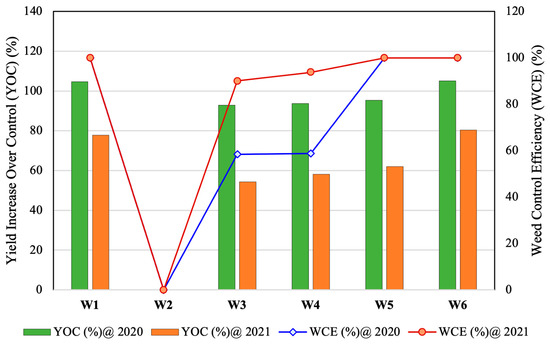
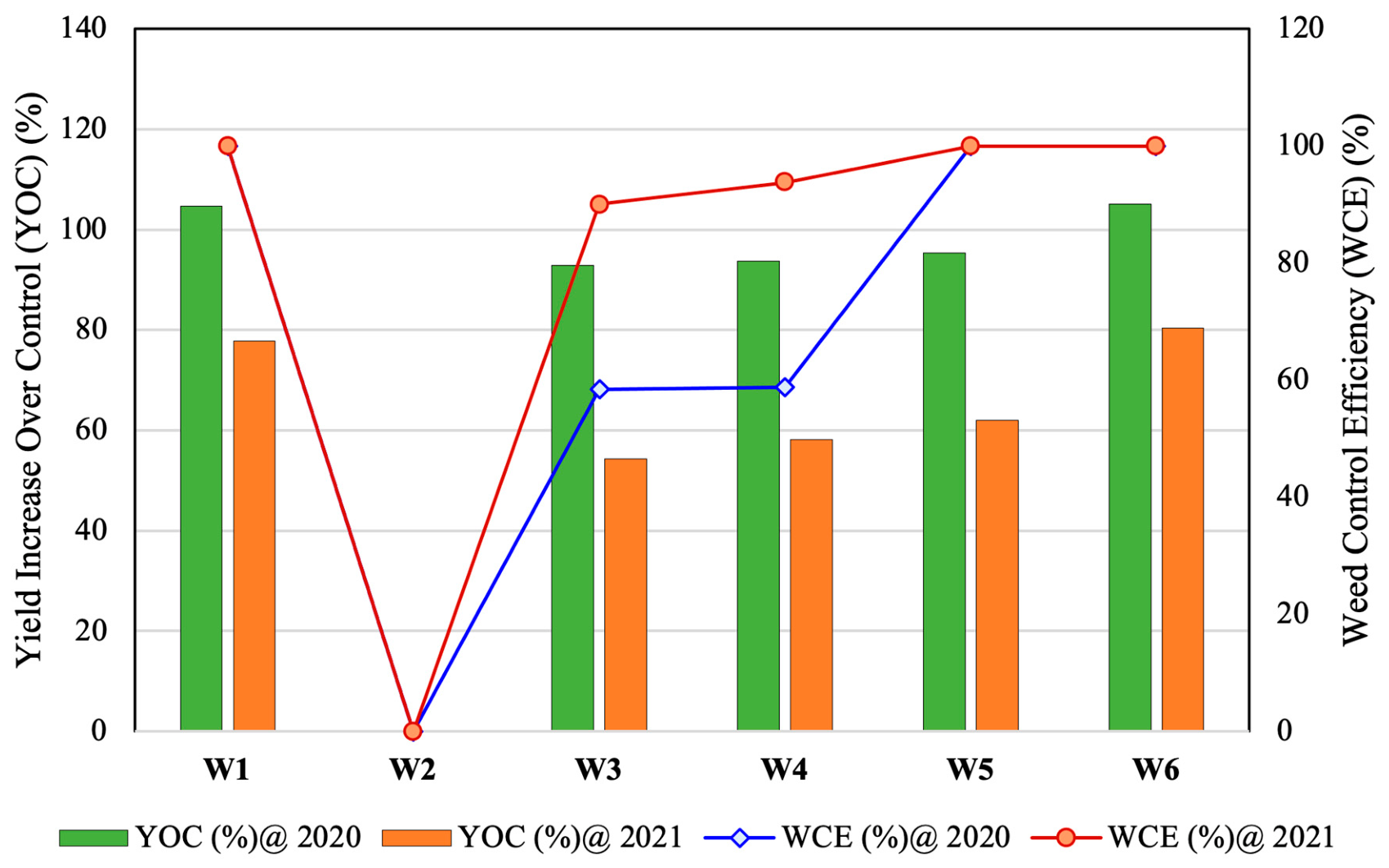
Consistent with the weed density and biomass responses, Pyrazosulfuron-ethyl and Penoxsulam achieved 100% weed control efficiency (WCE), comparable to the season-long weed-free treatment, whereas the season-long weedy treatment had zero WCE. Pretilachlor and Acetachlor (14%) + Bensulfuron methyl (4%) showed lower WCE in 2020 but substantially improved performance in 2021 (Figure 1). The WCE values presented in Figure 1 represent averages across the two sampling dates (30 and 60 DAT).
Figure 1.
Effect of different herbicides on the percent yield increase over season-long weedy treatment (control) and weed control efficiency during 2020 and 2021. WCE values represent the average weed control efficiency across the two sampling dates (30 and 60 DAT). Here, W1 = season-long weed-free, W2 = season-long weedy, W3 = Pretilachlor, W4 = Acetachlor (14%) + Bensulfuron- methyl (4%), W5 = Pyrazosulfuron-ethyl, and W6 = Penoxsulam.
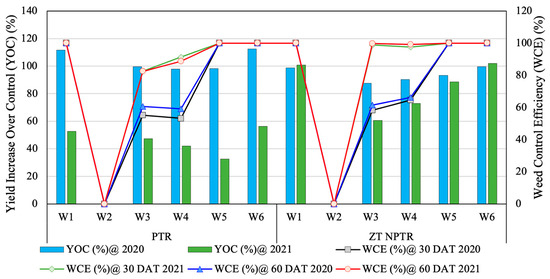
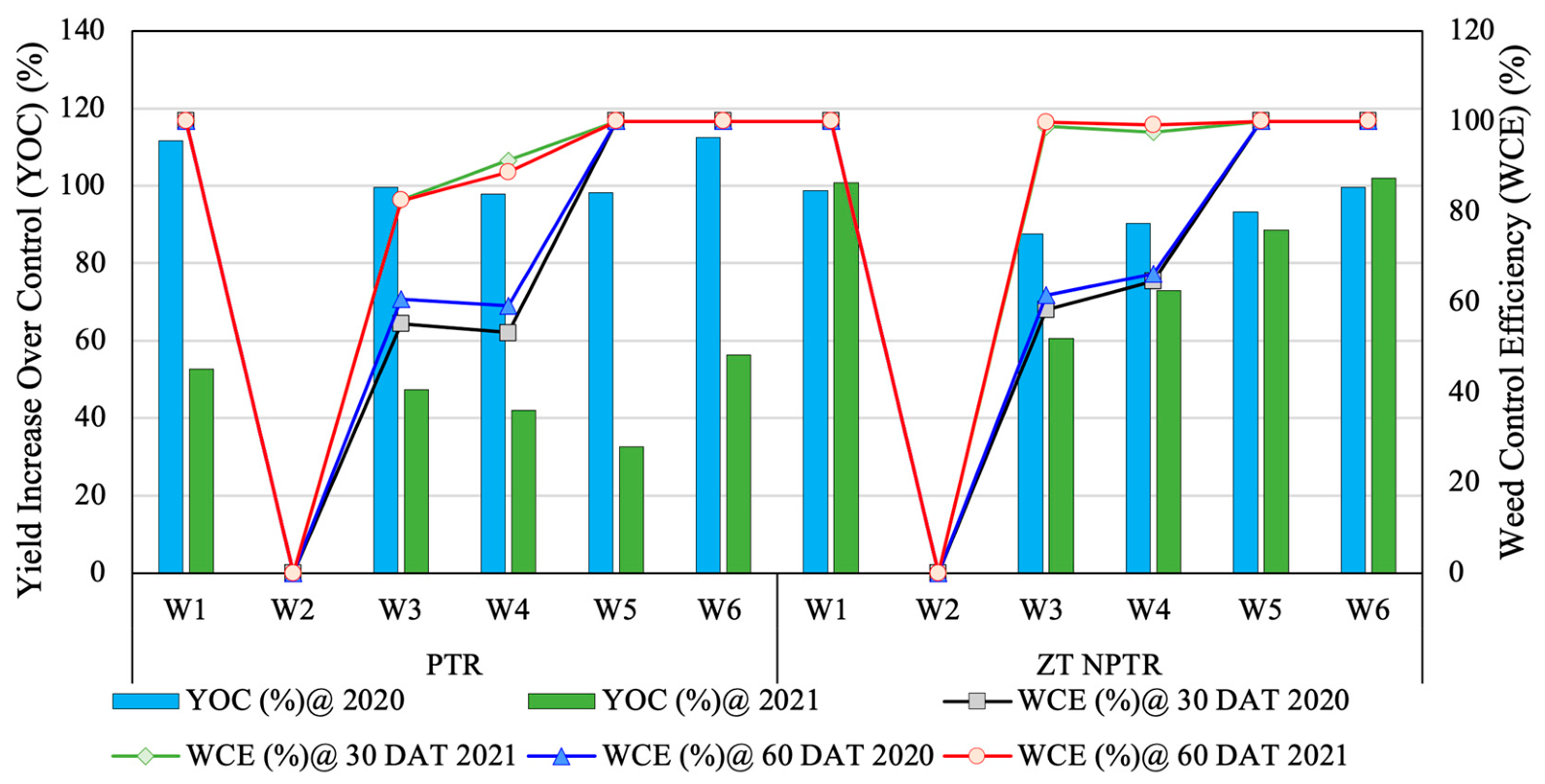
When the two production systems were considered separately, the superior performance of Pyrazosulfuron-ethyl and Penoxsulam was consistent across both sampling dates and years. Under ZT NPTR, the WCE of Pretilachlor or Acetachlor (14%) + Bensulfuron methyl (4%) increased markedly in 2021 compared with 2020 and approached complete weed control (Figure 2).
Figure 2.
Effect of different weed management practices on the percent yield increase over season-long weedy treatment (control) and weed control efficiency under puddled transplanted rice (PTR) and zero-till non-puddled transplanted rice (ZT NPTR) rice production systems during 2020 and 2021. Here, W1 = season-long weed-free, W2 = season-long weedy, W3 = Pretilachlor, W4 = Acetachlor (14%) + Bensulfuron- methyl (4%), W5 = Pyrazosulfuron-ethyl, and W6 = Penoxsulam.
3.4. Yield-Contributing Characters and Yield
Within each experimental year, production system significantly influenced the measured yield-contributing characters and yield parameters (Table 7 and Table 8). Compared with PTR, ZT NPTR increased grain yield by approximately 5% in 2020 and 35% in 2021. ZT NPTR also increased straw yield by approximately 5% and 10%, respectively, and harvest index by approximately 4% and 9%. Similar improvements under ZT NPTR were observed for effective tillers, grains panicle−1, and 1000-grain weight, with the relative advantage generally being greater in 2021.
Table 7.
Effect of different herbicides on the yield-contributing characters of rice under puddled transplanted rice (PTR) and zero-till non-puddled transplanted rice (ZT NPTR) production systems during 2020 and 2021.
Table 8.
Effect of different herbicides on the yield and harvest index of rice under puddled transplanted rice (PTR) and zero-till non-puddled transplanted rice (ZT NPTR) production systems during 2020 and 2021.
Weed management practice significantly affected yield-contributing characters and yield within each experimental year (Table 7 and Table 8). Penoxsulam consistently produced the greatest or statistically comparable values for effective tillers, grains panicle−1, 1000-grain weight, grain and straw yield, and harvest index. Compared with the season-long weedy treatment, Penoxsulam increased grain yield by approximately 105% in 2020 and 80% in 2021. The corresponding increases were approximately 95% and 62% with Pyrazosulfuron-ethyl, 94% and 58% with Acetachlor (14%) + Bensulfuron methyl (4%), and 93% and 54% with Pretilachlor, respectively. The season-long weed-free treatment increased grain yield by approximately 105% and 78% in 2020 and 2021, respectively (Table 8, Figure 1).
Significant production system × weed management interactions were observed for most yield-contributing and yield parameters, although the magnitude and significance of the interaction varied among traits and years (Table 7 and Table 8). Penoxsulam under ZT NPTR consistently produced the highest or statistically comparable yield contributing traits and grain yield in both years and performed similarly to the season-long weed-free treatment for several yield parameters. Conversely, the season-long weedy treatment under PTR generally produced the poorest yield-contributing traits and grain yield. The advantage of effective weed management was particularly evident under ZT NPTR in 2021 (Table 7 and Table 8).
Yield increase over the season-long weedy control further demonstrated the effectiveness of the post-emergence treatments. Penoxsulam consistently produced the greatest yield advantage under both production systems, with performance generally comparable to the season-long weed-free treatment. Under PTR, the yield advantage of Penoxsulam was greater in 2020 than in 2021, whereas under ZT NPTR it remained consistently high across both years. Pyrazosulfuron-ethyl also produced substantial yield improvements, supporting the superior performance of the post-emergence treatments relative to the pre-emergence treatments (Figure 1 and Figure 2).
3.5. Economic Analysis
Partial budget analysis revealed substantial differences in economic performance among weed management practices under both rice production systems (Table 9). All herbicide-based treatments generated considerably higher net income than the season-long weedy treatment. Under PTR in 2020, net income from Pretilachlor, Acetachlor (14%) + Bensulfuron methyl (4%), Pyrazosulfuron-ethyl, and Penoxsulam was approximately 16.9-, 18.3-, 20.6-, and 17.7-fold, respectively, that of the season long-weedy treatment. Therefore, Pyrazosulfuron-ethyl provided the greatest economic advantage, with the highest BCR. In 2021, Pyrazosulfuron-ethyl remained the most profitable herbicide treatment under PTR, generating approximately 14.7-fold greater net income than the season-long weedy treatment (Table 9).
Table 9.
Cost analysis of different weed management practices in puddled transplanted rice (PTR) and zero-till non-puddled transplanted rice (ZT NPTR) production systems during 2020 and 2021 (BDT = Bangladeshi Taka, 1 BDT = 0.0082 US$).
Under ZT NPTR, herbicide-based weed management also markedly improved profitability. In 2020, Penoxsulam produced the greatest net income, approximately 7.25-fold that of the season-long weedy treatment, and also recorded the highest BCR. In 2021, Pyrazosulfuron-ethyl was the most economically advantageous treatment, generating approximately 5.82-fold greater net income than the season-long weedy treatment and the highest BCR. Overall, post-emergence herbicide treatments, particularly Pyrazosulfuron-ethyl and Penoxsulam, provided the greatest economic benefits, whereas the season-long weedy treatment consistently produced the lowest net income and BCR under both production systems.
4. Discussion
The present study demonstrated substantial differences in weed infestation, crop productivity, and economic performance between PTR and ZT NPTR production systems under different weed management practices (Table 5, Table 6, Table 7, Table 8 and Table 9). Weed density and dry biomass were consistently lower under ZT NPTR than PTR and declined markedly in the second year (Table 5 and Table 6). However, because pre-plant glyphosate application was an integral component of ZT NPTR but was not used in PTR, these differences should be interpreted as responses to the complete production systems rather than as effects of tillage alone.
Tillage operations in PTR can redistribute weed seeds within the soil profile, either burying them deeper or bringing them closer to the surface [24]. Seed burial can increase seed persistence and survival [25,26], whereas seeds remaining on or near the soil surface are more exposed to desiccation and other adverse environmental conditions that may reduce their viability [26,27]. Consequently, the persistence and viability of weed seeds in the seedbank may differ substantially between tilled and non-tilled soils depending on environmental conditions. In tilled soils, weed seedlings can also emerge from greater soil depths, whereas tillage-induced changes in soil conditions may stimulate the germination of dormant seeds through exposure to light, soil disturbance, temperature fluctuations, CO2 conditions, and increased nitrate availability [26,28,29,30]. Conversely, under zero tillage, weed seeds are concentrated near the soil surface, where a greater proportion may germinate and subsequently be controlled by weed management practices [31]. Surface-positioned seeds may also be more accessible to seed predators and environmental stresses, increasing seed removal and mortality. Effective weed control further reduces seed rain, thereby limiting replenishment of the soil seedbank and potentially reducing weed emergence in subsequent seasons.
The marked reduction in weed density and dry biomass observed in 2021 compared with 2020 (Table 5 and Table 6) may partly reflect carry-over effects of weed management imposed during the preceding season. Because the same experimental plots and treatment allocations were maintained across both years, effective weed suppression in 2020 may have reduced weed seed return to the soil and subsequently limited weed emergence in the subsequent season. Nevertheless, seasonal environmental variation and other uncontrolled factors may also have contributed to the observed year-to-year differences. Supporting this interpretation, previous studies have shown that weed seed persistence and emergence are strongly influenced by seed position within the soil profile and the prevailing management practices. For example, more than 50% of Setaria viridis (L.) P. Beauv. seeds reportedly remained viable after two years when buried at a depth of 10 cm, compared with less than 10% when retained on the soil surface [32,33].
Among the herbicide treatments, the post-emergence herbicides Pyrazosulfuron-ethyl and Penoxsulam provided the most consistent weed suppression under both production systems, achieving WCE comparable to the season-long weed-free treatment (Table 5 and Table 6; Figure 1 and Figure 2). Their superior performance likely reflects effective control of emerged weeds and suppression of later weed flushes, as previously reported for Pyrazosulfuron-based weed management in transplanted rice [34]. Pyrazosulfuron-ethyl has been reported to be particularly effective against sedges and broadleaf weeds [35,36], which were important components of the weed flora recorded in the present study (Table 4). Kogan et al. [37] also reported high efficacy of Penoxsulam, although its performance may vary across successive years. Repeated use of Penoxsulam may also impose selection pressure for herbicide resistance in weed populations [38]. Effective weed suppression translated into substantial improvement in rice productivity (Table 7 and Table 8). Across years, herbicide treatments increased grain yield by approximately 54–105% relative to the season-long weedy treatment, with Penoxsulam generally producing the greatest yield response (Table 8; Figure 1 and Figure 2). This improvement can be attributed to reduced crop-weed competition for resources, which favoured tiller production, grain formation, and ultimately grain yield [39]. Similar improvements in rice productivity following effective herbicide-based weed management have been reported previously [40,41,42,43]. Differences in crop performance between production systems may also be associated with tillage-induced changes in soil structure and the resulting crop growing environment [44]. The superior yield performance observed under ZT NPTR with Penoxsulam (Table 7 and Table 8) should, however, be interpreted within the context of the complete ZT NPTR production system, including its pre-plant glyphosate treatment.
The economic analysis further demonstrated the advantage of the effective herbicide-based weed management over the season-long weedy treatment (Table 9). Under PTR, Pyrazosulfuron-ethyl provided the greatest economic return in both years, whereas under ZT NPTR, Penoxsulam was the most profitable treatment in 2020 and Pyrazosulfuron-ethyl in 2021 (Table 9). The greater profitability of herbicide-based treatments compared with manual season-long weed-free management was primarily associated with effective weed suppression and lower weed management costs. Similar economic advantages of herbicide-based weed management in rice have been reported previously [40,45,46]. These findings indicate the Pyrazosulfuron-ethyl and Penoxsulam are promising options for economically viable weed management within the respective rice production systems.
From a conservation-agriculture perspective, ZT NPTR may offer advantages by avoiding intensive puddling and reducing soil disturbance; however, the present study primarily evaluated weed management, crop productivity, and economic performance rather than the broader environmental impacts of the production systems. It has been reported that tillage affects the physical and chemical properties of soils by destroying soil aggregates, disrupting capillary pores, and dispersing soil particles [47]. Moreover, PTR consumes about 20–40% of the total water required for raising crops, and it also promotes the formation of the hard plough pan [48]. It may also accelerate the loss of soil organic carbon, reduce soil fertility, increase irrigation-water losses, and adversely affect the environment [49]. To overcome these detrimental issues, adopting ZT NPTR may be a potential alternative to PTR in terms of better rice productivity under sustainable agriculture [8,47,50,51]. In addition, Chauhan and Opeña [52] suggested that zero-till systems can achieve yields comparable to those of conventionally tilled systems if weeds are effectively controlled, and in the absence of effective weed control, zero-till systems may result in poor grain yield.
5. Conclusions
The findings of the study demonstrated that post-emergence herbicides Penoxsulam and Pyrazosulfuron-ethyl were the most effective treatments in terms of weed control efficiency and yield increase over the season-long weedy treatment under both rice production systems. Among the treatment combinations, Penoxsulam under ZT NPTR generally produced superior yield performance, whereas Pyrazosulfuron-ethyl provided the highest economic returns in both years under PTR and in the second year of ZT NPTR; Penoxsulam was the most profitable treatment under ZT NPTR in the first year. Overall, integrating ZT NPTR with either Penoxsulam or Pyrazosulfuron-ethyl showed considerable potential for effective weed suppression, high rice productivity, and favourable economic returns while avoiding intensive puddling. However, because pre-plant glyphosate application was an integral component of the ZT NPTR system in the present study, the observed differences between PTR and ZT NPTR should be interpreted as the combined effects of the complete production systems rather than as the isolated effect of zero tillage. Further multi-year studies are warranted to evaluate the long-term productivity, economic viability, weed dynamics, and sustainability of integrating post-emergence herbicide-based weed management with ZT NPTR.
Author Contributions
Conceptualization, A.K.M.M.I., M.P.A. and M.M.R.; methodology, A.K.M.M.I., M.P.A. and M.M.R.; software, A.K.M.M.I. and I.J.; validation, A.K.M.M.I., M.P.A. and M.M.R.; formal analysis, A.K.M.M.I., M.P.A., S.Y., I.J. and M.M.R.; investigation, I.J.; resources, A.K.M.M.I. and M.P.A.; data curation, I.J., S.A.K. and S.Y.; writing—original draft preparation, I.J., A.K.M.M.I. and S.A.K.; writing—review and editing, M.P.A., M.M.R. and S.Y.; visualization, I.J., A.K.M.M.I., S.Y. and S.A.K.; supervision, A.K.M.M.I., M.P.A. and M.M.R.; project administration, A.K.M.M.I. and M.P.A.; funding acquisition, A.K.M.M.I. and M.P.A. All authors have read and agreed to the published version of the manuscript.
Funding
The study was funded by the Ministry of Education, the Government of the People’s Republic of Bangladesh through the grant number ‘LS2019959’.
Institutional Review Board Statement
Not applicable.
Informed Consent Statement
Not applicable.
Data Availability Statement
The original contributions presented in this study are included in the article. Further inquiries can be directed to the corresponding author.
Acknowledgments
The authors thankfully acknowledge the financial support provided by the Ministry of Education, The Government of the People’s Republic of Bangladesh through the grant number ‘LS2019959’. The authors also acknowledge Bangladesh Agricultural University Research System (BAURES) for providing logistic support for the successful completion of the research.
Conflicts of Interest
The authors declare no conflicts of interest.
Abbreviations
The following abbreviations are used in this manuscript:
| PTR | Puddled Transplanted Rice |
| ZT NPTR | Zero-till Non-puddled Transplanted Rice |
| DDSR | Dry Direct-seeded Rice |
| NPTR | Non-puddled Transplanted Rice |
| AEZ | Agroecological zone |
| DAT | Days After Transplanting |
| RD | Relative Weed Density |
| RDW | Relative Weed Dry Biomass |
| SDR | Summed Dominance Ratio |
| WCE | Weed Control Efficiency |
| YOC | Yield Increase Over Control |
References
- Gill, J.S.; Walia, S.S. Effect of establishment methods and nitrogen levels on growth and yield of basmati rice (Oryza sativa). Haryana J. Agron. 2014, 30, 44–48. [Google Scholar]
- Chaki, A.K.; Gaydon, D.S.; Dalal, R.C.; Bellotti, W.D.; Gathala, M.K.; Hossain, A.; Menzies, N.W. Puddled and zero-till unpuddled transplanted rice are each best suited to different environments–An example from two diverse locations in the Eastern Gangetic Plains of Bangladesh. Field Crops Res. 2021, 262, 108031. [Google Scholar] [CrossRef] [Scilit]
- Shrestha, A.; Anwar, M.P.; Islam, A.K.M.M.; Gurung, T.; Dhakal, S.; Tanveer, A.; Javaid, M.M.; Nadeem, M.; Ikram, N.A. Weed science as a new discipline and its status in some South Asian universities and colleges: Examples from Bangladesh, Bhutan, Nepal and Pakistan. CABI Rev. 2021, 16, 1–14. [Google Scholar] [CrossRef] [Scilit]
- Rahman, M.M. Potential benefits of dry direct seeded rice culture: A review. Fundam. Appl. Agric. 2019, 4, 744–758. [Google Scholar] [CrossRef] [Scilit]
- Shekhawat, K.; Rathore, S.S.; Chauhan, B.S. Weed Management in dry direct-seeded rice: A review on challenges and opportunities for sustainable rice production. Agronomy 2020, 10, 1264. [Google Scholar] [CrossRef] [Scilit]
- Farooq, M.; Siddique, K.H.; Rehman, H.; Aziz, T.; Lee, D.J.; Wahid, A. Rice direct seeding: Experiences, challenges and opportunities. Soil Tillage Res. 2011, 111, 87–98. [Google Scholar] [CrossRef] [Scilit]
- Baldev, R.K.; Dharam, B.Y.; Ashok, Y.; Narender, K.G.; Gurjeet, G.; Ram, K.M.; Bhargirath, S.C. Mechanized transplanting of rice (Oryza sativa L.) in non-puddled and no-till conditions in the rice-wheat cropping system in Haryana, India. Am. J. Plant Sci. 2013, 4, 2409–2413. [Google Scholar] [CrossRef]
- Haque, M.E.; Bell, R.W.; Islam, M.A.; Rahman, M.A. Minimum tillage unpuddled transplanting: An alternative crop establishment strategy for rice in conservation agriculture cropping systems. Field Crops Res. 2016, 185, 31–39. [Google Scholar] [CrossRef] [Scilit]
- Islam, S.; Gathala, M.K.; Tiwari, T.P.; Timsina, J.; Laing, A.M.; Maharjan, S.; Chowdhury, A.K.; Bhattacharya, P.M.; Dhar, T.; Mitra, B.; et al. Conservation agriculture based sustainable intensification: Increasing yields and water productivity for smallholders of the Eastern Gangetic Plains. Field Crops Res. 2019, 238, 1–17. [Google Scholar] [CrossRef] [Scilit]
- Gathala, M.K.; Laing, A.M.; Tiwari, T.P.; Timsina, J.; Islam, S.; Bhattacharya, P.M.; Dhar, T.P.; Ghosh, A.; Sinha, A.K.; Chowdhury, A.K.; et al. Energy-efficient, sustainable crop production practices benefit smallholder farmers and the environment across three countries in the Eastern Gangetic Plains, South Asia. J. Clean. Prod. 2020, 246, 118982. [Google Scholar] [CrossRef] [Scilit]
- Islam, A.K.M.S.; Hossain, M.M.; Saleque, M.A. Effect of unpuddled transplanting on the growth and yield of dry season rice (Oryza sativa L.) in High Barind Tract. Agriculturists 2014, 12, 91–97. [Google Scholar] [CrossRef] [Scilit]
- Swanton, C.J.; Shrestha, A.; Knezevic, S.Z.; Roy, R.C.; Ball-Coelho, B.R. Influence of tillage type on vertical weed seedbank distribution in a sandy soil. Can. J. Plant Sci. 2000, 80, 455–457. [Google Scholar] [CrossRef] [Scilit]
- Ekeleme, F.; Kamara, A.Y.; Oikeh, S.O.; Chikoye, D.; Omoigui, L.O. Effect of weed competition on upland rice production in northeastern Nigeria. In Proceedings of the 8th African Crop Science Society Conference, El-Minia, Egypt, 27–31 October 2007; African Crop Science Society: Kampala, Uganda, 2007; pp. 1287–1291. [Google Scholar]
- Murphy, S.D.; Clements, D.R.; Belaoussoff, S.; Kevan, P.G.; Swanton, C.J. Promotion of weed species diversity and reduction of weed seedbank with conservation tillage and crop rotation. Weed Sci. 2006, 54, 69–77. [Google Scholar] [CrossRef] [Scilit]
- Mishra, J.S.; Singh, V.P. Tillage and weed control effects on productivity of a dry seeded rice-wheat system on a vertisol in Central India. Soil Tillage Res. 2012, 123, 11–20. [Google Scholar] [CrossRef] [Scilit]
- Aktar, W.; Sengupta, D.; Chowdhury, A. Impact of pesticides use in agriculture: Their benefits and hazards. Interdiscip. Toxicol. 2009, 2, 1–12. [Google Scholar] [CrossRef] [Scilit] [PubMed]
- Beckie, H.J.; Shirriff, S.W.; Leeson, J.Y.; Hall, L.M.; Harker, K.N.; Dokken-Bouchard, F.; Brenzil, C.A. Herbicide-resistant weeds in the Canadian prairies: 2012 to 2017. Weed Technol. 2020, 34, 461–474. [Google Scholar] [CrossRef] [Scilit]
- Heap, I. The International Herbicide-Resistant Weed Database. Online. Available online: https://www.weedscience.org (accessed on 7 June 2026).
- Zahan, T.; Hashem, A.; Rahman, M.; Bell, R.W.; Begum, M. Efficacy of herbicides in non-puddled transplanted rice under conservation agriculture systems and their effect on establishment of the succeeding crops. Acta Sci. Malays. 2018, 2, 17–25. [Google Scholar] [CrossRef] [Scilit]
- Kumar, V.; Ladha, J.K. Direct seeding of rice: Recent developments and future research needs (Chapter Six). Adv. Agron. 2011, 111, 297–413. [Google Scholar] [CrossRef] [Scilit]
- Eager, E.A.; Haridas, C.V.; Pilson, D.; Rebarber, R.; Tenhumberg, B. Disturbance frequency and vertical distribution of seeds affect long-term population dynamics: A mechanistic seed bank model. Am. Nat. 2013, 182, 180–190. [Google Scholar] [CrossRef] [Scilit] [PubMed]
- Buhler, D.D.; Stoltenberg, D.E.; Becker, R.L.; Gunsolus, J.L. Perennial weed populations after 14 years of variable tillage and cropping practices. Weed Sci. 1994, 42, 205–209. [Google Scholar] [CrossRef] [Scilit]
- BRRI. Modern Rice Cultivation, 24th ed.; BRRI: Joydebpur, Bangladesh, 2022; p. 112. [Google Scholar]
- Mohler, C.L.; Frisch, J.C.; McCulloch, C.E. Vertical movement of weed seed surrogates by tillage implements and natural processes. Soil Tillage Res. 2006, 86, 110–122. [Google Scholar] [CrossRef] [Scilit]
- Mohler, C.L.; Galford, A.E. Weed seedling emergence and seed survival: Separating the effects of seed position and soil modification by tillage. Weed Res. 1997, 37, 147–155. [Google Scholar] [CrossRef] [Scilit]
- Nichols, V.; Verhulst, N.; Cox, R.; Govaerts, B. Weed dynamics and conservation agriculture principles: A review. Field Crops Res. 2015, 183, 56–68. [Google Scholar] [CrossRef] [Scilit]
- Anderson, R.L. A multi-tactic approach to manage weed population dynamics in crop rotations. Agron. J. 2005, 97, 1579–1583. [Google Scholar] [CrossRef] [Scilit]
- Chhokar, R.S.; Sharma, R.K.; Jat, G.R.; Pundir, A.K.; Gathala, M.K. Effect of tillage and herbicides on weeds and productivity of wheat under rice–wheat growing system. Crop Prot. 2007, 26, 1689–1696. [Google Scholar] [CrossRef] [Scilit]
- Cordeau, S.; Baudron, A.; Adeux, G. Is tillage a suitable option for weed management in conservation agriculture? Agronomy 2020, 10, 1746. [Google Scholar] [CrossRef] [Scilit]
- Benech-Arnold, R.L.; Sánchez, R.A.; Forcella, F.; Kruk, B.C.; Ghersa, C.M. Environmental control of dormancy in weed seed banks in soil. Field Crops Res. 2010, 67, 105–122. [Google Scholar] [CrossRef] [Scilit]
- Gallandt, E.R.; Fuerst, E.P.; Kennedy, A.C. Effect of tillage, fungicide seed treatment, and soil fumigation on seed bank dynamics of wild oat (Avena fatua). Weed Sci. 2004, 52, 597–604. [Google Scholar] [CrossRef] [Scilit]
- Thomas, A.G.; Banting, J.D.; Bowes, G. Longevity of green foxtail seeds in a Canadian prairie soil. Can. J. Plant Sci. 1986, 66, 189–192. [Google Scholar] [CrossRef] [Scilit]
- Jat, R.K.; Singh, R.G.; Gupta, R.K.; Gill, G.; Chauhan, B.S.; Pooniya, V. Tillage, crop establishment, residue management and herbicide applications for effective weed control in direct seeded rice of eastern Indo-Gangetic Plains of South Asia. Crop Prot. 2019, 123, 12–20. [Google Scholar] [CrossRef] [Scilit]
- Mitra, B.; Patra, K.; Bhattacharya, P.M.; Ghosh, A.; Chowdhury, A.K.; Dhar, T.; Gathala, M.K. Efficacy of pre-and post-emergence herbicide combinations on weed control in no-till mechanically transplanted rice. Cogent Food Agric. 2022, 8, 2139794. [Google Scholar] [CrossRef] [Scilit]
- Singh, V.; Jat, M.L.; Ganie, Z.A.; Chauhan, B.S.; Gupta, R.K. Herbicide options for effective weed manage-ment in dry direct-seeded rice under scented rice-wheat rotation of western Indo-Gangetic Plains. Crop Prot. 2016, 81, 168–176. [Google Scholar] [CrossRef] [Scilit] [PubMed]
- Saha, S.; Munda, S.; Singh, S.; Kumar, V.; Jangde, H.K.; Mahapatra, A.; Chauhan, B.S. Crop establishment and weed control options for sustaining dry-direct seeded rice production in eastern India. Agronomy 2021, 11, 389. [Google Scholar] [CrossRef] [Scilit]
- Kogan, M.; Gómez, P.; Fischer, A.; Alister, C. Using penoxsulam ALS inhibitor as a broad-spectrum herbicide in Chilean rice. Int. J. Agric. Nat. Resour. 2011, 38, 83–93. [Google Scholar]
- Turra, G.M.; Cutti, L.; Machado, F.M.; Dias, G.M.; Andres, A.; Markus, C.; Merotto, A., Jr. Application of ALS inhibitors at pre-emergence is effective in controlling resistant barnyard grass biotypes depending on the mechanism of resistance. Crop Prot. 2023, 172, 106325. [Google Scholar] [CrossRef] [Scilit]
- Chaudhary, A.; Venkatramanan, V.; Mishra, A.K.; Sharma, S. Agronomic and environmental determinants of direct seeded rice in South Asia. Circ. Econ. Sustain. 2023, 3, 253–290. [Google Scholar] [CrossRef] [Scilit] [PubMed]
- Islam, A.K.M.M.; Popy, F.S.; Hasan, A.K.; Anwar, M.P. Efficacy and economics of herbicidal weed management in monsoon rice of Bangladesh. J. Sci. Agric. 2017, 1, 275–293. [Google Scholar] [CrossRef] [Scilit][Green Version]
- Islam, M.R.; Jahan, I.; Anwar, M.P.; Islam, A.K.M.M. Comparative performance of puddled and zero till non-puddled transplant boro rice under different weed management practices. Fundam. Appl. Agric. 2023, 8, 497–506. [Google Scholar] [CrossRef] [Scilit]
- Awan, T.H.; Cruz, P.C.S.; Chauhan, B.S. Efficacy and economics of different herbicides, their weed species selectivity, and the productivity of mechanized dry-seeded rice. Crop Prot. 2015, 78, 239–246. [Google Scholar] [CrossRef] [Scilit]
- Singh, T.; Satapathy, B.S.; Gautam, P.; Lal, B.; Kumar, U.; Saikia, K.; Pun, K.B. Comparative efficacy of herbicides in weed control and enhancement of productivity and profitability of rice. Exp. Agric. 2018, 54, 363–381. [Google Scholar] [CrossRef] [Scilit]
- Steinmetz, Z.; Wollmann, C.; Schaefer, M.; Buchmann, C.; David, J.; Tröger, J.; Muñoz, K.; Frör, O.; Schaumann, G.E. Plastic mulching in agriculture. Trading short-term agronomic benefits for long-term soil degradation? Sci. Total Environ. 2016, 550, 690–705. [Google Scholar] [CrossRef] [Scilit] [PubMed]
- Awan, T.H.; Cruz, P.C.S.; Chauhan, B.S. Agronomic indices, growth, yield-contributing traits, and yield of dry-seeded rice under varying herbicides. Field Crops Res. 2015, 177, 15–25. [Google Scholar] [CrossRef] [Scilit]
- Rao, A.N.; Wani, S.P.; Ahmed, S.; Ali, H.; Marambe, B. An Overview of Weeds and Weed Management in Rice of South Asia. In Weed Management in Rice in the Asian-Pacific Region; Asian-Pacific Weed Science Society (APWSS): Hyderabad, India, 2017; pp. 247–281. ISBN 978-81-931978-4-4. [Google Scholar]
- Miah, M.A.M.; Islam, M.S.; Miah, M.T.H. Socio-economic impacts of farm mechanization on the livelihoods of rural labourers in Bangladesh. J. Farm Econ. 2002, 12, 147–162. [Google Scholar]
- Singh, A.; Kumar, R.; Kang, J.S. Tillage system, crop residues and nitrogen to improve the productivity of direct seeded rice and transplanted rice. Curr. Agric. Res. J. 2014, 2, 14–29. [Google Scholar] [CrossRef] [Scilit]
- Sayre, K.D.; Hoobs, P. The raised-bed system of cultivation for irrigated production conditions. In Sustainable Agriculture and the Intonational Rice-Wheat System; Lal, R., Hobbs, P.R., Norman, U., Hansen, D.O., Eds.; CRC Press: Boca Raton, FL, USA, 2004; pp. 337–355. [Google Scholar]
- Alam, M.K.; Biswas, W.K.; Bell, R.W. Greenhouse gas implications of novel and conventional rice production technologies in the Eastern-Gangetic plains. J. Clean. Prod. 2016, 112, 3977–3987. [Google Scholar] [CrossRef] [Scilit]
- Powlson, D.S.; Stirling, C.M.; Thierfelder, C.; White, R.P.; Jat, M.L. Does conservation agriculture deliver climate change mitigation through soil carbon sequestration in tropical agro-ecosystems? Agric. Ecosyst. Environ. 2016, 220, 164–174. [Google Scholar] [CrossRef] [Scilit]
- Chauhan, B.S.; Opeña, J. Effect of tillage systems and herbicides on weed emergence, weed growth, and grain yield in dry-seeded rice systems. Field Crops Res. 2012, 137, 56–69. [Google Scholar] [CrossRef] [Scilit]

Disclaimer/Publisher’s Note: The statements, opinions and data contained in all publications are solely those of the individual author(s) and contributor(s) and not of MDPI and/or the editor(s). MDPI and/or the editor(s) disclaim responsibility for any injury to people or property resulting from any ideas, methods, instructions or products referred to in the content. |
© 2026 by the authors. Licensee MDPI, Basel, Switzerland. This article is an open access article distributed under the terms and conditions of the Creative Commons Attribution (CC BY) license.