


Abstract
The excessive use of conventional NPK fertilizers can reduce nutrient use efficiency due to nutrient losses, emphasizing the need for controlled-release fertilizer systems. This study aimed to prepare and evaluate olive pomace-derived biochar (BC) as a carrier for nitrogen–phosphorus–potassium (NPK) fertilizer and assess its effects on nutrient release and lettuce performance. Biochar was produced by pyrolysis at 400 °C and loaded with NPK fertilizer. The BC/NPK composite was characterized using Fourier-transform infrared spectroscopy (FTIR) and X-ray diffraction (XRD), nutrient-release behavior was evaluated in deionized water and soil. The cumulative nutrient release reached 64% in deionized water and 91% in soil. Under greenhouse conditions, BC/NPK applied at 100% and 75% NPK rates increased lettuce fresh weight, plant height and leaf number to 163.33 and 183.67 g, 23.00 and 23.67 cm, 34 and 36, respectively. Moreover, BC/NPK reduced nitrate accumulation in lettuce leaves, with nitrate concentrations decreasing in outer leaves to 10 and 0.73 mg g−1 and in inner leaves to 2 and 1.33 mg g−1 at the 100% and 75% rates, respectively. These findings demonstrate that olive pomace-derived BC/NPK is a promising slow-release fertilizer capable of improving crop performance while supporting sustainable nutrient management and agricultural waste valorization.
1. Introduction
The increasing global demand for food production has intensified the use of mineral fertilizers to enhance crop productivity and maintain soil nutrient availability [1,2]. Among these fertilizers, nitrogen–phosphorus–potassium (NPK) formulations are extensively applied because these nutrients are essential for plant growth, metabolism, and yield formation [3]. However, the inefficient use of conventional fertilizers remains a major challenge, as significant nutrient losses occur through leaching, volatilization, and surface runoff, resulting in reduced nutrient use efficiency and contributing to environmental problems, including soil degradation, groundwater contamination, eutrophication, and greenhouse gas emissions [4]. Nitrogen is particularly prone to losses due to its high mobility in soil systems, which decreases fertilizer efficiency and increases environmental risks [5]. Therefore, the development of slow-release fertilizer systems that enhance nutrient availability, improve fertilizer use efficiency, and minimize nutrient losses has become an important approach for sustainable agricultural production [6].
Among the strategies proposed to improve fertilizer use efficiency, slow-release fertilizers have received considerable attention because they gradually supply nutrients according to plant demand, thereby reducing nutrient losses and enhancing nutrient utilization efficiency. In this context, biochar has emerged as a promising material for agricultural applications due to its distinctive physicochemical properties and multifunctional behavior [7,8]. Biochar is a carbon-rich, porous material produced from biomass through thermochemical conversion processes under limited oxygen conditions, mainly including pyrolysis, hydrothermal carbonization, gasification, and carbonization [9,10]. Its porous structure, high surface area, and abundant oxygen-containing functional groups provide active sites for nutrient adsorption and retention, making it an effective carrier for fertilizer nutrients and soil amendments [7,11,12].
The capacity of biochar to adsorb, retain, and gradually release nutrients has stimulated the development of biochar-based fertilizers as sustainable nutrient management systems. Previous studies have shown that nutrient-enriched biochar can enhance nutrient retention, reduce nutrient leaching, improve soil fertility, stimulate microbial activity, and increase nutrient use efficiency [12,13]. These functions are mainly attributed to the porous structure and oxygen-containing functional groups, including hydroxyl, carboxyl, and phenolic groups, which provide active sites for nutrient adsorption and immobilization [14,15]. Several studies have demonstrated that NPK-loaded biochar (BC/NPK) can improve nutrient availability, enhance soil water retention, and promote crop productivity compared with conventional fertilizer applications [16,17,18]. In particular, the controlled release of nitrogen from biochar-based fertilizers may enhance nitrogen use efficiency and reduce nitrate losses from agricultural systems [19]. Therefore, biochar-based fertilizers have gained increasing attention as environmentally sustainable agrochemical products derived from renewable resources. However, inconsistent effects of biochar application on crop performance, including reduced growth responses in some leafy vegetables such as lettuce, have also been reported, suggesting that the effectiveness of biochar-based fertilizers is strongly influenced by feedstock characteristics, pyrolysis conditions, and application rates [20,21].
The physicochemical properties and agronomic performance of biochar are strongly affected by the characteristics of the biomass feedstock used during production. Biochars produced from agricultural residues, including rice husk, sawdust, corn stover, and olive-derived wastes, have demonstrated potential for nutrient retention and soil amendment applications due to their porous structures and surface functional properties [22,23,24,25]. Among these feedstocks, olive pomace represents a promising resource because it is generated in substantial quantities as a major by-product of the olive oil industry, particularly in Mediterranean regions. However, its improper disposal can lead to environmental concerns due to its high organic matter content and the presence of phytotoxic compounds that may limit direct agricultural application [26]. Therefore, converting olive pomace into biochar offers a sustainable waste valorization approach while producing a functional carbon-based material with potential applications in soil improvement and fertilizer formulation [27].
Olive pomace-derived biochar (BC) exhibits several physicochemical characteristics that support its application as a carrier for slow-release fertilizers, including high carbon content, developed porosity, mineral components, and abundant surface functional groups [28,29]. These characteristics provide active sites for nutrient adsorption and retention, facilitating efficient nutrient loading and controlled release in soil systems [30]. In addition, structural and chemical characterization techniques, including Fourier-transform infrared spectroscopy (FTIR), X-ray diffraction (XRD), and scanning electron microscopy (SEM), have shown that nutrient impregnation can modify biochar surface chemistry, mineral composition, and pore structure, contributing to improved nutrient retention and release regulation [31]. Therefore, olive pomace-derived biochar represents a promising renewable platform for developing sustainable fertilizer formulations.
Lettuce (Lactuca sativa L.) is one of the most widely consumed leafy vegetables worldwide and is recognized as a nitrate-accumulating crop due to its high nitrogen demand and ability to store nitrate in leaf tissues. Excessive application of nitrogen fertilizers can increase nitrate accumulation in lettuce, which may negatively affect crop quality and raise concerns regarding human health [32]. Therefore, improving nitrogen use efficiency while maintaining adequate nutrient availability and minimizing nitrate accumulation is an important goal for sustainable lettuce production and fertilizer management strategies [4,33].
Despite the increasing interest in biochar-based fertilizers, the development and agronomic evaluation of NPK-loaded olive pomace-derived biochar as a slow-release fertilizer system remain insufficiently explored, particularly for lettuce production. Limited information is available regarding the ability of olive pomace biochar to serve as an effective NPK carrier and its influence on nutrient release behavior, crop productivity, and nitrate accumulation in leafy vegetables. Therefore, understanding the interaction between controlled nutrient release from biochar-based fertilizers and plant nitrogen uptake is essential for improving fertilizer use efficiency and maintaining crop quality. Further investigation into the release characteristics and agronomic performance of olive pomace-derived BC/NPK systems is needed to support their application as sustainable fertilizer alternatives.
Therefore, this study aimed to develop an olive pomace-derived biochar-based NPK fertilizer system, characterize its physicochemical and structural properties, and evaluate its potential for nutrient loading and controlled release. Furthermore, the agronomic performance of the resulting BC/NPK composite was assessed under greenhouse conditions by evaluating its effects on lettuce growth, yield-related traits, and quality parameters, with particular emphasis on nitrogen utilization and nitrate accumulation.
2. Materials and Methods
2.1. Plant Material
Certified seeds of lollo bionda-type loose-leaf lettuce (Lactuca sativa L.), cultivar Locarno RZ85-81, were purchased from a local supplier in Amman, Jordan. It was selected due to its commercial importance, uniform growth characteristics, rapid growth cycle, and suitability for greenhouse production systems, making it an appropriate model for evaluating nutrient management strategies and the effectiveness of biochar-based slow-release fertilizers [32,34].
2.2. Preparation of Biochar and NPK-Loaded Biochar
Briefly, BC was produced by pyrolysis at 400 °C for 3 h using a tube furnace (Protherm-PC 402, Protherm Furnaces, Ankara, Turkey). The selected pyrolysis temperature provides a balance between carbonization and preservation of oxygen-containing functional groups, which enhance cationic exchange capacity, making the resulting biochar suitable as a carrier for slow-release fertilizers [35]. After cooling to room temperature, the biochar was impregnated with an aqueous NPK fertilizer solution (19:19:19, N:P:K) at a biochar-to-NPK ratio of 1:1 (w/w), prepared by dissolving the required amount of fertilizer in a limited volume of water [36]. The solution volume was adjusted to ensure complete absorption by the biochar without the formation of free solution, facilitating efficient nutrient loading within the biochar structure. The impregnation process was conducted for 24 h at room temperature. Following impregnation, the BC/NPK composite was oven-dried at 60 °C for 24 h. The dried material was crushed, passed through a 2 mm sieve, and pelletized prior to characterization and greenhouse application.
2.3. Physicochemical Characterization of BC and BC/NPK
FTIR analysis was performed using an FTIR spectrometer (Thermo Nicolet NEXUS 670, Thermo Scientific, Waltham, MA, USA) over a spectral range of 4000–400 cm−1 with a resolution of 4 cm−1 using KBr pellets.
The crystalline structure of the samples was examined using an X-ray powder diffractometer (X’Pert PRO, PANalytical, Amsterdam, The Netherlands) equipped with Cu Kα radiation (λ = 1.5418 Å), operated at 40 kV and 30 mA. Diffraction patterns were recorded over a 2θ range of 4–60° with a step size of 0.02°.
2.4. Nutrient Release Behavior in Deionized Water
The nutrient-release behavior of BC/NPK was evaluated indirectly through electrical conductivity (EC) measurements [37]. Samples of the prepared BC/NPK were added to 100 mL of deionized water in plastic containers and maintained at room temperature. At each sampling time, a 10 mL aliquot was withdrawn for EC measurement using a TDS/EC meter (HOLD, Model A1, Shanghai, China). After each measurement, the withdrawn aliquot was immediately replaced with an equal volume (10 mL) of deionized water to maintain a constant solution volume throughout the experiment. Electrical conductivity was recorded daily for 30 days [38].
2.5. Nutrient Release Behavior in Soil
A peat moss–sand mixture (1:1, w/w) was amended with BC/NPK fertilizer and packed into glass columns fitted with drainage valves. Distilled water (80 mL) was added to each column, and the columns were maintained at room temperature.
Control columns received the same amount of commercial NPK fertilizer. At predetermined intervals, 10 mL leachate samples were collected and analyzed for electrical conductivity using a TDS/EC meter (HOLD, Model A1, China). To maintain a constant volume, 10 mL of distilled water was added after each sampling event [38].
2.6. Soil Water Retention Capacity
Samples of the soil mix of peat moss and sand (weight 1:1) were amended with 5%, 10%, and 15% biochar, then put in plastic cups and weighed (W0), irrigated to field capacity and weighed again (W1). For the control group, plastic cups were filled with the soil mix without biochar. Cups were left at room temperature and weighed daily (W2). Soil water content (SW %) was calculated according to Equation (1) and expressed as percentage [39].
SW (%) = (W2 − W0)/(W1 − W0) × 100
2.7. Greenhouse Experiment
The greenhouse experiment was conducted during the 2025–2026 growing season (November 2025 to February 2026) at the School of Agriculture, University of Jordan. The experiment was arranged in a completely randomized design (CRD) comprising four treatments: NPK fertilizer applied at 75 kg/ha (NPK-M) and 100 kg/ha (NPK-H). BC/NPK applied at 75 kg/ha (BC/NPK-M), and at 100 kg/ha (BC/NPK-H). The reduced rate was included to evaluate the potential for lowering nitrogen fertilizer inputs while maintaining adequate crop performance. The NPK treatments served as controls for comparison with the corresponding BC/NPK treatments. Each treatment was replicated three times.
2.7.1. Plant Growth Conditions
Lettuce seeds were sown in polystyrene trays (209 cells) filled with peat moss under greenhouse conditions. The peat moss had the following characteristics: pH 6.2, EC 18 mS/m, N 100 mg/L, P 30 mg/L, and K 200 mg/L, in addition to trace elements including Fe, Mn, B, Cu, Zn, and Mo.
At the four-leaf stage, seedlings were transplanted into plastic pots (5 kg capacity; 30 cm diameter × 30 cm depth) containing a peat moss–sand mixture (1:1, w/w).
The sand was washed repeatedly and sterilized before mixing with peat moss to remove excess salts and minimize the presence of pathogenic microorganisms that could affect lettuce growth.
2.7.2. Fertilizer Application
NPK fertilizer was applied at two rates: a high rate (H; 100% of the recommended rate, equivalent to 100 kg ha−1) and a medium rate (M; 75% of the recommended rate, equivalent to 75 kg ha−1). For the pot experiment, these rates corresponded to 3.6 and 2.7 g pot−1, respectively. The same fertilizer quantities were incorporated into the BC matrix to prepare the slow-release green fertilizer. NPK application was divided into three split doses throughout the growing season according to the suggestions of Bianco and Pimpini [40] to synchronize nutrient availability with plant requirements at different growth stages. Accordingly, 25% of the total fertilizer amount was applied two weeks after transplanting, another 25% at four weeks after transplanting, and the remaining 50% at seven weeks after transplanting [41].
2.7.3. Plant Growth and Quality Measurements
At harvest, plants were cut at the soil surface and fresh weight was recorded immediately. Samples were subsequently oven-dried at 70 °C for 72 h to determine dry matter (DM) content. Nitrate concentration was determined in the outer and inner leaves using a Palintest nitrate kit and expressed as mg kg−1 FW [41].
Total nitrogen was determined using the Kjeldahl method and expressed as a percentage of dry matter. Color parameters (L*, a*, and b*) were measured using a Chroma Meter (CR-400, Konica Minolta, Chiyoda-ku, Japan). Total soluble solids (TSS) were measured using a portable refractometer and expressed as °Brix [38].
2.7.4. Determination of Photosynthetic Pigments
Photosynthetic pigments were determined according to the method of Arnon [42]. Fresh leaf tissue (1 g) was homogenized in 80% acetone, centrifuged at 10,000 rpm for 10 min, and filtered. The absorbance of the supernatant was measured at 475, 645, and 663 nm.
Pigment concentrations were calculated as follows:
where V is the extract volume (mL) and W is the sample weight (g).
Chlorophyll a = [12.7A663 − 2.69A645] × V/(1000 × W)
Chlorophyll b = [22.9A645 − 4.68A663] × V/(1000 × W)
Carotenoids = [A475 × 10 × V]/(2500 × W)
2.8. Statistical Analysis
Data were subjected to analysis of variance (ANOVA) using SPSS software version 22 (IBM Corp., Armonk, NY, USA). Mean separation was performed using the least significant difference (LSD) test at p < 0.05. Pearson correlation analysis was also performed. All measurements were conducted in triplicate, and results are presented as mean ± standard deviation.
3. Results and Discussion
3.1. FTIR Analysis
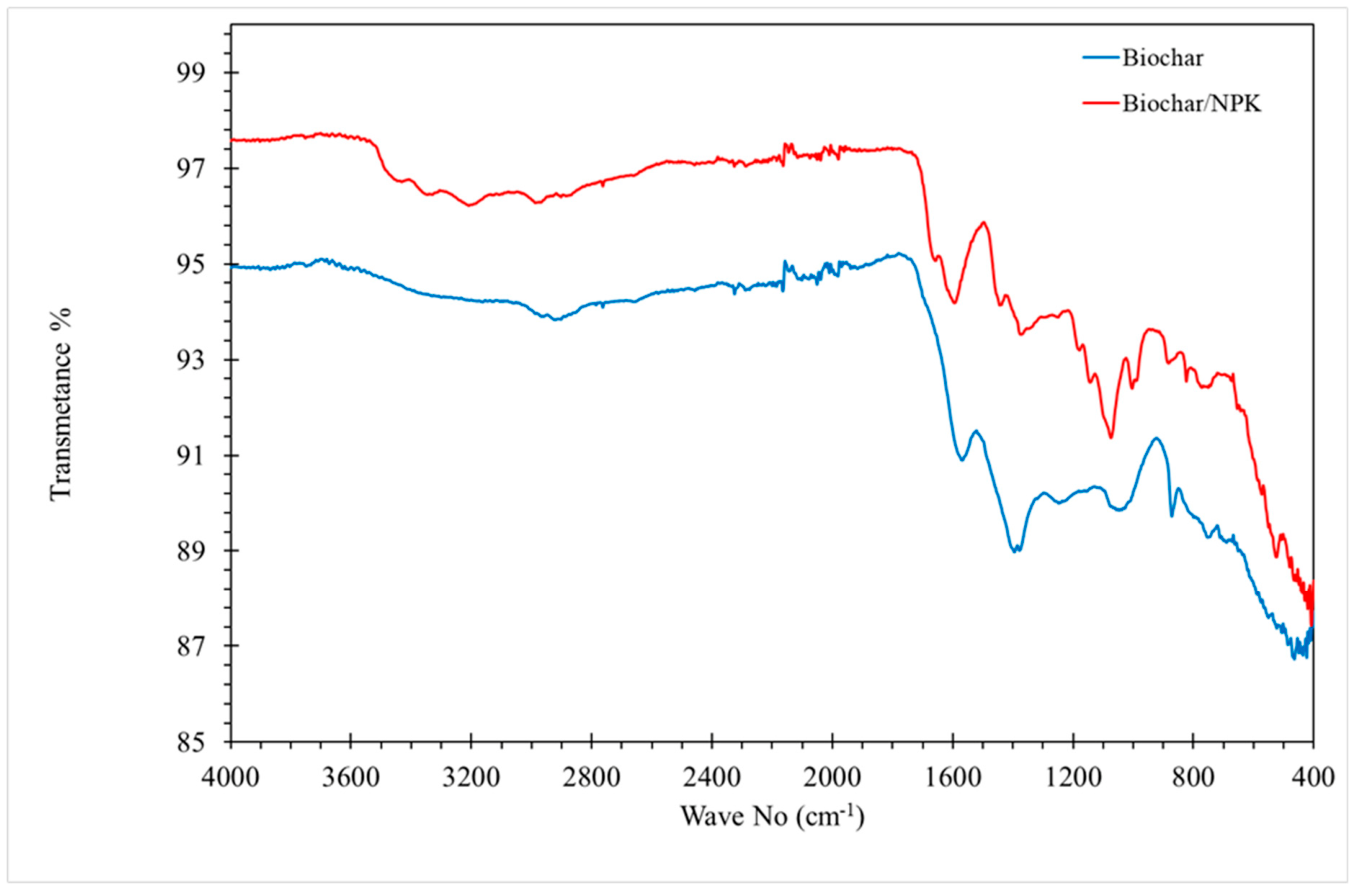
The FTIR spectra of BC and BC/NPK are presented in Figure 1. Both samples exhibited a broad absorption band in the region of 3200–3500 cm−1, which is attributed to O–H stretching vibrations associated with hydroxyl groups and adsorbed water molecules. The weak bands observed around 2920–2850 cm−1 correspond to aliphatic C–H stretching vibrations.
Figure 1.
FTIR spectra of olive pomace-derived biochar (BC) and NPK-loaded biochar (BC/NPK) showing changes in surface functional groups after fertilizer impregnation.
A prominent band near 1600 cm−1 was assigned to aromatic C=C and carbonyl (C=O) functional groups, reflecting the aromatic structure of the biochar matrix formed during pyrolysis. Following NPK loading, slight changes in band intensity and shape were observed, suggesting interactions between fertilizer components and oxygen-containing functional groups on the biochar surface.
More noticeable changes were detected within the 1400-1000 cm−1 region, where bands associated with C-O and phosphate-related vibrations became more pronounced after fertilizer loading. These changes indicate the successful incorporation of nutrient-containing species onto the biochar surface. In addition, several bands below 800 cm−1 were attributed to inorganic mineral vibrations associated with fertilizer-derived compounds [43].
Overall, the FTIR results suggest that NPK impregnation modified the surface chemistry of the biochar by introducing nutrient-associated functional groups, which may contribute to improved nutrient retention and controlled nutrient release.
3.2. X-Ray Diffraction (XRD) Analysis
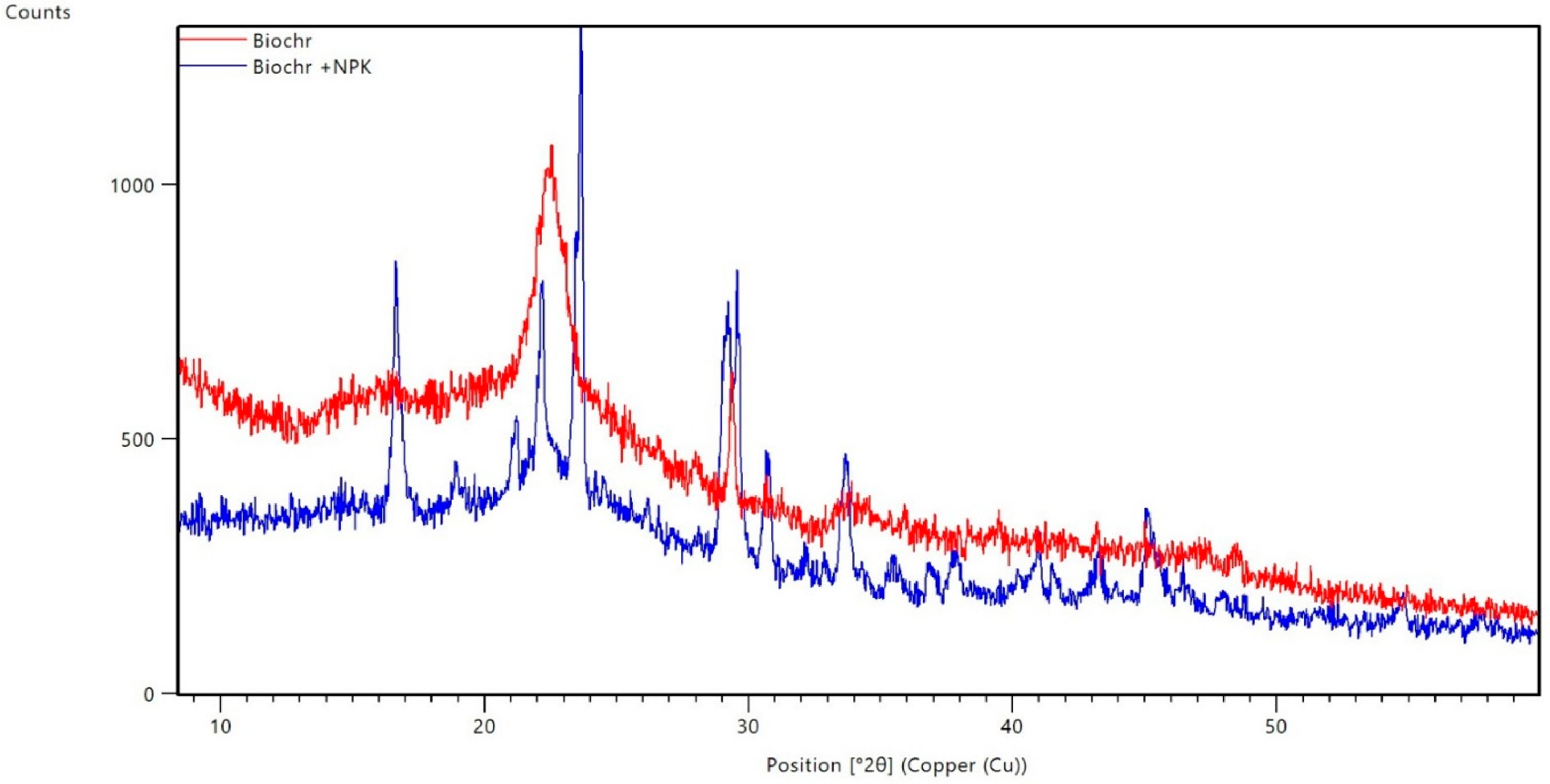
The XRD patterns of BC and BC/NPK are shown in Figure 2. The raw biochar exhibited a broad diffraction band centered at approximately 2θ = 20–25°, indicating the predominance of amorphous carbonaceous structures typically formed during biomass pyrolysis.
Figure 2.
XRD patterns of BC and BC/NPK illustrating the appearance of crystalline mineral phases following NPK loading.
Following NPK loading, several sharp diffraction peaks appeared throughout the diffractogram, indicating an increase in crystallinity relative to the untreated biochar. The emergence of these peaks suggests the presence of crystalline mineral phases associated with the incorporated fertilizer components. In particular, intense reflections observed in the regions of approximately 16°, 23–24°, 29–31°, and 45° (2θ) demonstrate the deposition of inorganic nutrient-containing compounds onto the biochar matrix.
The coexistence of amorphous carbon structures and newly formed crystalline phases indicates that the biochar served as an effective support material for fertilizer loading. These structural modifications may enhance nutrient retention within the biochar matrix and contribute to the slow-release behavior observed during nutrient-release experiments.
3.3. Nutrient Release Behavior in Deionized Water
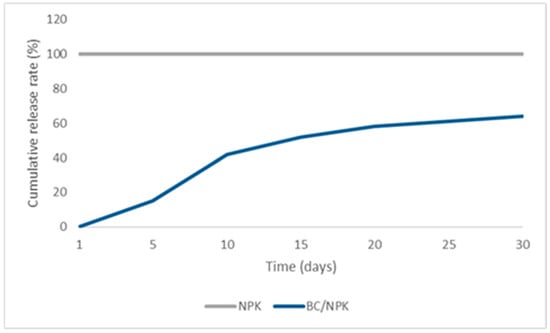
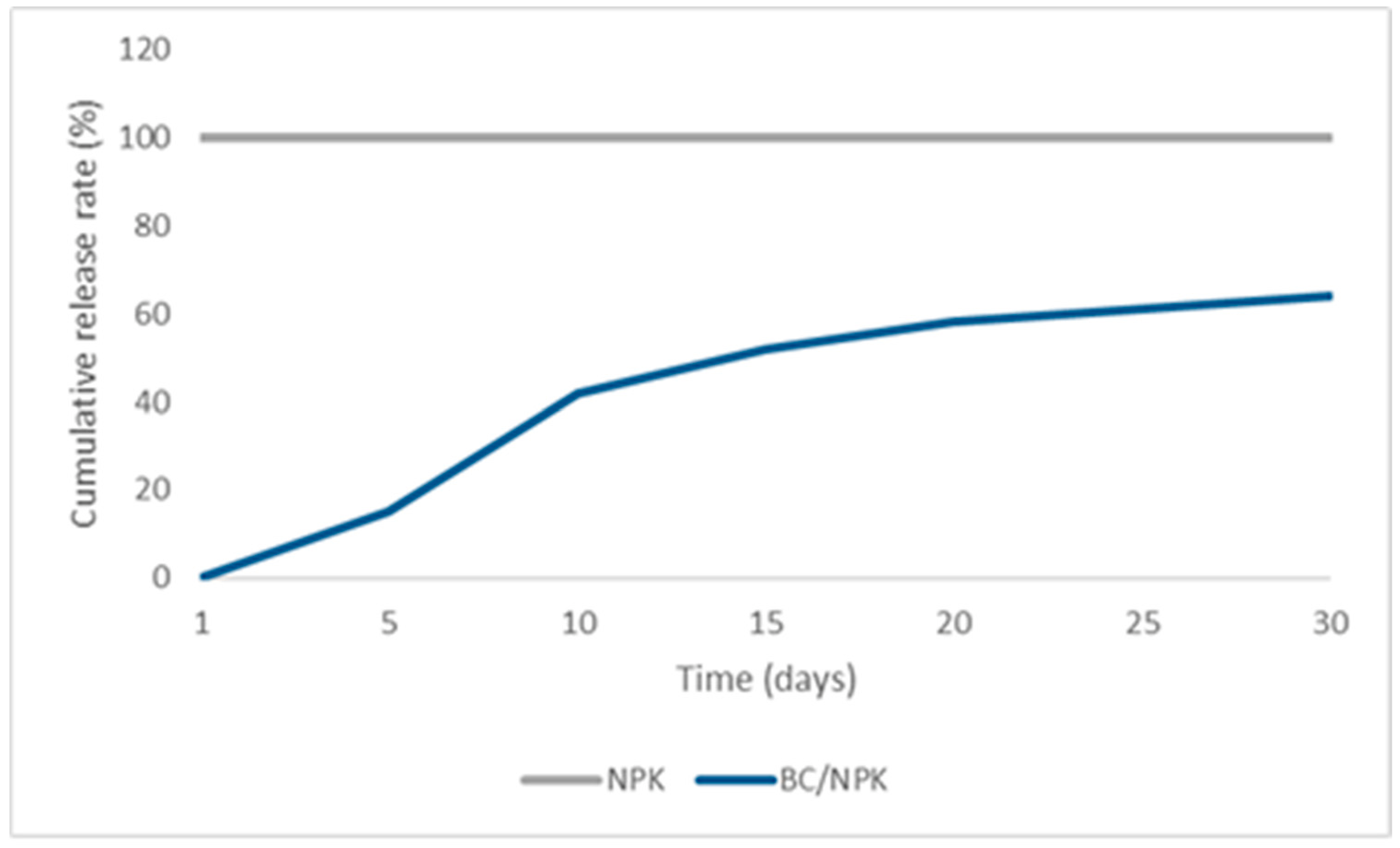
The nutrient-release profile of BC/NPK in deionized water is presented in Figure 3. A gradual increase in nutrient release was observed throughout the experimental period, indicating the controlled-release characteristics of the biochar-based fertilizer. The cumulative release increased from approximately 1% on day 1 to about 64% after 30 days.
Figure 3.
Cumulative nutrient release (%) of NPK and BC/NPK in deionized water during 30 days of incubation.
The absence of a rapid initial release suggests that a substantial proportion of the nutrients was retained within the porous biochar matrix and released progressively over time. This behavior may be attributed to the adsorption of nutrient ions onto the biochar surface as well as their retention within the pore structure. The release pattern observed in the present study is consistent with the characteristics of slow-release fertilizers and agrees with previous findings reported by Chen et al. [44]. Furthermore, the release behavior complies with the criteria established by the Committee of European Normalization for slow-release fertilizers [45].
The gradual nutrient release observed in this study supports the potential use of BC as an effective carrier for fertilizer nutrients, contributing to improved nutrient-use efficiency and reduced nutrient losses.
3.4. Nutrient Release Behavior in Soil
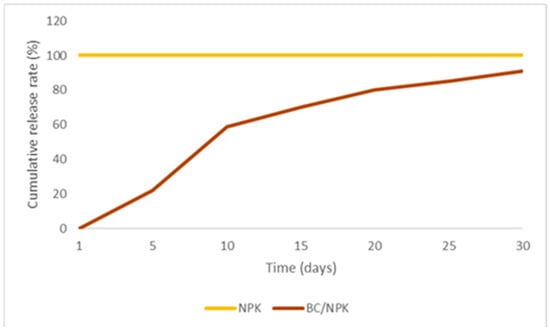
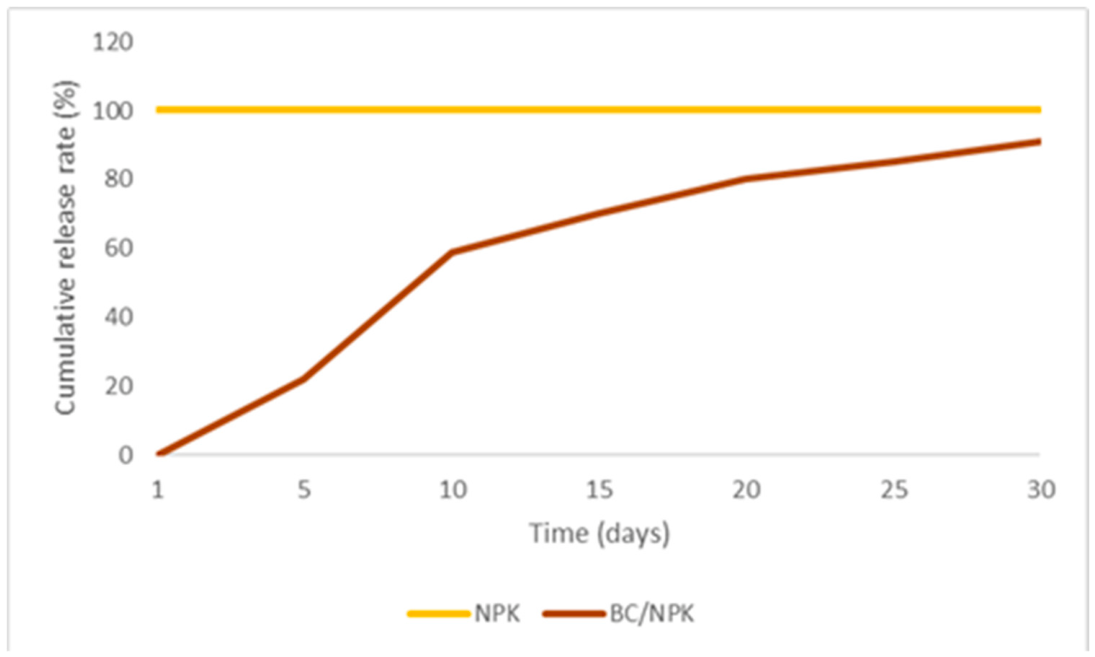
The release profile of BC/NPK in the peat moss–sand mixture (1:1, w/w) is shown in Figure 4. The results demonstrated a gradual increase in nutrient release throughout the experimental period, reaching approximately 91% after 30 days. In contrast, the commercial fertilizer exhibited a more rapid release pattern.
Figure 4.
Cumulative nutrient release (%) of NPK and BC/NPK in a peat moss–sand mixture during 30 days of incubation.
The slower release observed for BC/NPK may be attributed to the adsorption and immobilization of nutrient ions within the porous structure of BC, followed by their gradual diffusion into the surrounding soil medium. This finding is supported by the FTIR and XRD analyses, which indicated the successful incorporation of nutrient-containing compounds onto the biochar surface.
The sustained-release behavior observed in soil is particularly important under agricultural conditions because it may reduce nutrient leaching and improve nutrient availability throughout the crop growth period. Similar release patterns have been reported by Sim et al. [10]. These results agree with the previous study conducted by Zyadeh et al. [38]. Moreover, the release profile satisfies the criteria of slow-release fertilizers established by the Committee of European Normalization [45].
3.5. Soil Water Retention Capacity
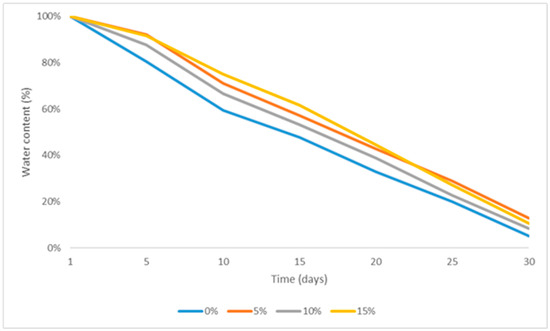
The effect of BC addition on soil water retention is presented in Figure 5. The incorporation of BC improved the water-holding capacity of the peat moss–sand mixture throughout the storage period. All BC-amended treatments retained higher water contents than the control treatment, with the greatest retention observed at the 15% BC application rate.
Figure 5.
Effect of BC application rate (0, 5, 10, and 15%) on soil water retention during 30 days.
The control treatment (0) exhibited a continuous decline in water content, reaching approximately 5% by day 30. In contrast, soils amended with 5%, 10%, and 15% BC maintained higher moisture levels, reaching approximately 13%, 10%, and 12%, respectively, at the end of the experiment. Although numerical differences in soil water content were observed among treatments, these differences were not statistically significant at day 30 (p = 0.51).
The enhanced water retention can be attributed to the highly porous structure and large surface area of biochar, which increase the soil’s capacity to store water and reduce moisture loss. Similar findings have been reported by Sim et al. [10]. Improved soil water retention may contribute to reduced irrigation requirements and enhanced plant performance under water-limited conditions [4].
3.6. Growth Parameters at Harvest
The application of BC/NPK significantly (p < 0.05) improved the vegetative growth of lettuce compared with the corresponding commercial NPK treatments (Table 1). Fresh weight, plant height, and number of leaves were consistently higher in plants receiving BC/NPK at both fertilization rates. The greatest fresh weight was recorded in the 75% BC/NPK treatment (183.67 g), followed by the 100% BC/NPK treatment (163.33 g), whereas the lowest values were observed in the corresponding NPK treatments.
Table 1.
Effect of NPK fertilizer and BC/NPK applied at two fertilization rates on lettuce growth parameters at harvest.
Similarly, BC/NPK-treated plants exhibited greater plant height and produced more leaves than plants receiving commercial NPK alone. The superior performance of the BC/NPK treatments suggests that BC enhanced nutrient availability and nutrient-use efficiency while improving soil physical properties such as water retention and aeration. These improvements likely promoted root development and biomass accumulation, resulting in enhanced vegetative growth [46,47]. The improved growth observed in BC/NPK-treated plants may also be attributed to the gradual release of nutrients from the biochar matrix, which enhances nutrient availability throughout the growing period.
Interestingly, the 75% BC/NPK treatment produced growth parameters comparable to or greater than those obtained with the 100% fertilization rate, indicating that the incorporation of biochar may allow a reduction in fertilizer input without compromising plant growth. Similar positive effects of biochar-amended fertilizers on crop performance have been reported previously [44,48]. However, the beneficial effects of biochar are highly dependent on its application rate and physicochemical properties. However, excessive biochar application can negatively affect lettuce growth. Lee et al. [49] reported that high biochar application rates reduced lettuce fresh weight by 13–20%. These findings may be associated with the high C/N ratio of biochar, which can promote nitrogen immobilization and temporarily reduce nitrogen availability for plant growth.
Although TSS values tended to be numerically higher in the BC/NPK treatments, the differences were not statistically significant (p ≥ 0.05). Likewise, dry matter content was not significantly (p ≥ 0.05) affected by the treatments, indicating that biochar primarily influenced plant growth and biomass production rather than the accumulation of soluble solids or dry matter content. Nevertheless, the slight numerical variation observed in TSS may be associated with differences in nitrogen availability and nutrient uptake, as previous studies have suggested that reduced nitrogen fertilization can influence soluble solids accumulation in plant tissues [50].
3.7. Nitrate, Total Nitrogen and Protein Contents
The combined application of BC and NPK fertilizer significantly (p < 0.05) affected nitrate accumulation, total nitrogen, and protein content in lettuce leaves (Table 2). In general, the BC/NPK treatments reduced nitrate accumulation while improving nitrogen and protein contents compared with the corresponding commercial NPK treatments. Nitrate accumulation in both inner and outer leaves was significantly (p < 0.05) reduced following biochar application. In the inner leaves, nitrate concentration decreased from 10.00 to 2.00 mg kg−1 at the 100% fertilization rate and from 11.67 to 1.33 mg kg−1 at the 75% fertilization rate when BC/NPK was applied. Similar trends were observed in the outer leaves, where nitrate concentration decreased from 75.00 to 10.00 mg kg−1 and from 21.67 to 5.00 mg kg−1 at the 100% and 75% fertilization rates, respectively. These results agree with previous studies showing that biochar application can reduce nitrate accumulation in leafy vegetables. Abd–Elrahman et al. [51] reported decreased nitrate accumulation in lettuce following biochar amendment, while Garcia-Rodriguez et al. [52] observed reduced nitrate concentration in spinach leaves with biochar application. These effects may be related to improved nitrogen use efficiency and enhanced nitrogen assimilation, which promote the incorporation of nitrate into plant organic compounds rather than its accumulation in leaf tissues.
Table 2.
Effect of NPK and BC/NPK applied at two fertilization rates on nitrate accumulation, total nitrogen, and protein content of lettuce at harvest.
The reduction in nitrate accumulation may be attributed to the ability of biochar to retain nutrients and regulate nitrogen release in the soil. The porous structure and large surface area of biochar enhance nutrient adsorption and reduce nitrogen losses, resulting in a more gradual supply of nitrogen for plant uptake and assimilation. In addition, biochar may stimulate microbial processes involved in nitrogen transformation, thereby improving nitrogen-use efficiency [4].
Nitrogen is the primary nutrient governing lettuce growth, photosynthetic capacity, protein synthesis, and nitrate accumulation; only nitrogen-related parameters were evaluated to assess the agronomic performance of the BC/NPK composite. In leafy vegetables such as lettuce, nitrogen management is particularly important because excessive nitrogen application results in nitrate accumulation in edible tissues, posing potential food safety concerns without necessarily improving photosynthetic performance or yield [53].
Total nitrogen content was significantly (p < 0.05) increased by BC/NPK at the 100% fertilization rate, where values increased from 3.55% in the NPK treatment to 5.65% in the BC/NPK treatment. This increase suggests improved nitrogen availability and assimilation when biochar was incorporated with mineral fertilizer. At the 75% fertilization rate, the increase in total nitrogen content was less pronounced, with values of 3.65% and 3.86% recorded for NPK and BC/NPK, respectively.
A similar trend was observed for protein content. Plants receiving BC/NPK at the 100% fertilization rate exhibited significantly (p < 0.05) higher protein content than those receiving commercial NPK alone, increasing from 22.17% to 35.29%, reflecting enhanced nitrogen metabolism and protein synthesis. Although protein content also increased under the 75% fertilization rate, the magnitude of the response was smaller, increasing from 22.81% to 24.15%, than that observed at the higher fertilization level.
Overall, the results demonstrate that integrating biochar with NPK fertilizer can simultaneously reduce nitrate accumulation and improve nitrogen utilization in lettuce plants. These findings highlight the potential of BC/NPK as a sustainable fertilizer system capable of improving nitrogen-use efficiency while minimizing excessive nitrate accumulation in edible tissues.
3.8. Pigment Analysis
Nitrogen is a key structural component of chlorophyll molecules; therefore, chlorophyll content is widely used as an indicator of plant nitrogen status and the effectiveness of nitrogen fertilization [54]. In addition, Chlorophyll is an indicator of plant health and productivity, as it is responsible for photosynthesis [55]. The effects of BC/NPK and NPK fertilization on chlorophyll a, chlorophyll b, total chlorophyll, and carotenoid contents are presented in Table 3.
Table 3.
Effect of NPK and BC/NPK applied at two fertilization rates on chlorophyll and carotenoid contents of lettuce leaves at harvest.
The results showed that none of the measured photosynthetic pigments were significantly (p ≥ 0.05) affected by fertilizer type or application rate. Although minor numerical variations were observed among treatments, these differences were not statistically significant. At the 100% fertilization rate, BC/NPK resulted in slightly lower chlorophyll and carotenoid contents than the corresponding NPK treatment, whereas at the 75% fertilization rate, pigment concentrations tended to be slightly higher in the BC/NPK treatment. However, the magnitude of these changes was insufficient to indicate a meaningful effect of biochar application on pigment accumulation.
Chlorophyll and carotenoid contents are closely associated with plant nutritional status and photosynthetic activity. The absence of significant differences among treatments suggests that both fertilizer systems supplied sufficient nutrients to maintain normal pigment synthesis and photosynthetic function. These findings indicate that the gradual nutrient-release characteristics of BC/NPK were adequate to support pigment formation at levels comparable to those obtained with conventional NPK fertilization.
The stability of chlorophyll and carotenoid contents across treatments further suggests that biochar incorporation did not adversely affect plant physiological status. Similar responses have been reported in studies where biochar improved nutrient retention and soil properties without causing significant changes in photosynthetic pigment concentrations [56]. Demonstrating that the incorporation of biochar into the fertilizer system neither enhanced nor reduced chlorophyll and carotenoid accumulation, indicating that BC/NPK maintained normal photosynthetic pigment levels while potentially providing agronomic benefits associated with improved nutrient retention and controlled nutrient release.
Contrary to the present findings, several studies have reported significant increases in chlorophyll and carotenoid contents following biochar application. For example, bamboo-derived nano-biochar enhanced chlorophyll b, total chlorophyll, and carotenoid concentrations in lettuce under saline conditions, indicating improved photosynthetic performance [57]. Similarly, biochar increased chlorophyll content in lettuce grown under salinity and enhanced chlorophyll accumulation in maize [58], while other studies reported either increases or decreases in photosynthetic pigments depending on biochar feedstock and application rate. These discrepancies likely arise from differences in biochar feedstock, pyrolysis temperature, application rate, soil characteristics, crop species, environmental conditions, and nutrient status. In the present study, the primary benefit of the BC/NPK composite appears to have been improved nutrient-use efficiency and controlled nutrient release rather than stimulation of photosynthetic pigment synthesis.
3.9. Color Analysis
The effects of BC/NPK and NPK fertilization on the color parameters (L*, a*, and b*) of outer and inner lettuce leaves are presented in Table 4. No significant (p ≥ 0.05) differences were observed among treatments for any of the measured color attributes, regardless of fertilizer rate or leaf position. Although minor numerical variations were detected in some treatments, these differences were not statistically significant and therefore did not indicate meaningful changes in leaf color. The results suggest that the incorporation of biochar with NPK fertilizer did not adversely affect leaf pigmentation or visual quality.
Table 4.
Effect of NPK and BC/NPK applied at two fertilization rates on color parameters (L*, a*, and b*) of outer and inner lettuce leaves at harvest.
Leaf color parameters are closely associated with chlorophyll concentration, carotenoid content, and the physiological status of plant tissues [59]. The absence of significant changes in L*, a*, and b* values is consistent with the pigment analysis results, which also demonstrated relatively stable chlorophyll and carotenoid contents among treatments. These findings indicate that biochar application did not alter pigment biosynthesis or degradation processes under the conditions of the present study.
From a practical perspective, maintaining stable leaf color is important because visual appearance is one of the primary quality attributes influencing consumer acceptance and marketability. Therefore, the results suggest that BC/NPK can be used to improve nutrient-use efficiency and plant growth without negatively affecting the visual quality of lettuce leaves. This observation is particularly important for leafy vegetables such as lettuce, where consumer preference is strongly influenced by leaf appearance and color uniformity [4]. The findings demonstrate that biochar incorporation had no detrimental effect on leaf color characteristics and maintained stable pigmentation across all treatments, supporting the suitability of BC/NPK as a sustainable fertilizer system for lettuce production.
4. Conclusions
Olive pomace-derived biochar was successfully developed as an NPK fertilizer carrier, with FTIR and XRD confirming effective nutrient incorporation and the BC/NPK composite demonstrating controlled nutrient release in water and soil. BC/NPK enhanced lettuce growth, improved nitrogen-related quality attributes, and markedly reduced nitrate accumulation compared with conventional fertilization while maintaining plant physiological and visual quality. Its superior performance at a reduced NPK rate demonstrates its potential to improve nutrient-use efficiency, reduce reliance on mineral fertilizers, and promote circular nutrient management through olive pomace valorization. However, these findings are limited to short-term greenhouse conditions and a single crop, warranting further field validation across different soil types, climates, cropping systems, and growing seasons, together with assessments of long-term agronomic performance, environmental impacts, and economic viability. Overall, olive pomace-derived BC/NPK represents a promising and sustainable strategy for advancing resource-efficient fertilization and resilient crop production.
Author Contributions
Conceptualization, M.Z., O.A.A.-S., O.A.D. and S.J.; methodology, M.Z., S.J., E.S.Y.A.-T., N.O., R.H.A.O. and R.O.A.; software, M.Z., I.H., O.A.D., R.H.A.O., E.F. and S.J.; validation, M.Z., A.M.F.A., O.A.D. and R.H.A.O.; formal analysis, M.K., J.Y.A.,M.A.B., E.F. and A.M.F.A.; investigation, M.Z., M.A.B., E.F. and N.A.-Q.; resources, All authors.; data curation, M.Z., S.J., N.O., R.O.A., M.A.B., O.A.A.-S. and I.H.; writing—original draft preparation, M.Z. and S.J.; writing—review and editing, S.J. and N.A.-Q.; visualization, All authors; supervision, M.Z.; project administration, M.Z., I.H., S.J., J.Y.A. and M.K.; funding acquisition, All authors. All authors have read and agreed to the published version of the manuscript.
Funding
This research was funded by Al HUSSEIN FUND FOR EXCELLENCE.
Institutional Review Board Statement
Not applicable.
Informed Consent Statement
Not applicable.
Data Availability Statement
The original contributions presented in this study are included in the article. Further inquiries can be directed to the corresponding authors.
Conflicts of Interest
The authors declare no conflicts of interest.
Abbreviations
The following abbreviations are used in this manuscript:
| BC | Olive pomace-derived biochar |
| BC/NPK | NPK-loaded biochar fertilizer |
| EC | Electrical conductivity |
| FTIR | Fourier-transform infrared spectroscopy |
| NPK | Nitrogen–phosphorus–potassium |
| XRD | X-ray diffraction |
References
- Misra, P.; Shukla, P.K.; Pramanik, K.; Gautam, S.; Kole, C. Nanotechnology for crop improvement. In Plant Nanotechnology: Principles and Practices; Kole, C., Ed.; Springer International Publishing: Cham, Switzerland, 2016; pp. 219–256. [Google Scholar] [CrossRef] [Scilit]
- Zhang, X.; Davidson, E.A.; Mauzerall, D.L.; Searchinger, T.D.; Dumas, P.; Shen, Y. Managing nitrogen for sustainable development. Nature 2015, 528, 51–59. [Google Scholar] [CrossRef] [Scilit] [PubMed]
- Omara, A.E.D.; Elsakhawy, T.; Alshaal, T.; El-Ramady, H.; Kovács, Z.; Fári, M. Nanoparticles: A Novel Approach for Sustainable Agro-Productivity. Environ. Biodiv. Soil Secur. 2019, 3, 29–62. [Google Scholar] [CrossRef] [Scilit]
- Zyadeh, M.; Kasrawi, M.; Hamadneh, I.; Jaradat, S. The effects of novel nanohydroxyapatite/hydrogel/N-fertilizers on the growth and quality of lettuce. J. Saudi Soc. Agric. Sci. 2025, 24, 14. [Google Scholar] [CrossRef] [Scilit]
- Gu, B.; Zhang, X.; Lam, S.K.; Yu, Y.; Van Grinsven, H.J.M.; Zhang, S.; Wang, X.; Bodirsky, B.L.; Wang, S.; Duan, J.; et al. Cost-effective mitigation of nitrogen pollution from global croplands. Nature 2023, 613, 77–84. [Google Scholar] [CrossRef] [Scilit] [PubMed]
- Li, J.; Liu, Y.; Liu, J.; Cui, X.; Hou, T.; Cheng, D. A novel synthetic slow release fertilizer with low energy production for efficient nutrient management. Sci. Total Environ. 2022, 831, 154844. [Google Scholar] [CrossRef] [Scilit] [PubMed]
- Dangi, S.; Gao, S.; Duan, Y.; Wang, D. Soil microbial community structure affected by biochar and fertilizer sources. Appl. Soil Ecol. 2020, 150, 103452. [Google Scholar] [CrossRef] [Scilit]
- Lehmann, J.; Cowie, A.; Masiello, C.A.; Kammann, C.; Woolf, D.; Amonette, J.E.; Cayuela, M.L.; Camps-Arbestain, M.; Whitman, T. Biochar in climate change mitigation. Nat. Geosci. 2021, 14, 883–892. [Google Scholar] [CrossRef] [Scilit]
- Mian, M.M.; Liu, G. Recent progress in biochar-supported photocatalysts: Synthesis, role of biochar, and applications. RSC Adv. 2018, 8, 14237–14248. [Google Scholar] [CrossRef] [Scilit] [PubMed]
- Sim, D.H.H.; Tan, I.A.W.; Lim, L.L.P.; Hameed, B.H. Encapsulated biochar-based sustained release fertilizer for precision agriculture: A review. J. Clean. Prod. 2021, 303, 127018. [Google Scholar] [CrossRef] [Scilit]
- Zhou, Z.; Gao, T.; Zhu, Q.; Yan, T.; Li, D.; Xue, J.; Wu, Y. Increases in bacterial community network complexity induced by biochar-based fertilizer amendments to karst calcareous soil. Geoderma 2019, 337, 691–700. [Google Scholar] [CrossRef] [Scilit]
- Agarwal, H.; Kashyap, V.H.; Mishra, A.; Bordoloi, S.; Singh, P.K.; Joshi, N.C. Biochar-based fertilizers and their applications in plant growth promotion and protection. 3 Biotech 2022, 12, 136. [Google Scholar] [CrossRef] [Scilit] [PubMed]
- Yan, T.; Xue, J.; Zhou, Z.; Wu, Y. Biochar-based fertilizer amendments improve the soil microbial community structure in a karst mountainous area. Sci. Total Environ. 2021, 794, 148757. [Google Scholar] [CrossRef] [Scilit] [PubMed]
- Fan, Q.; Sun, J.; Chu, L.; Cui, L.; Quan, G.; Yan, J.; Hussain, Q.; Iqbal, M. Effects of chemical oxidation on surface oxygen-containing functional groups and adsorption behavior of biochar. Chemosphere 2018, 207, 33–40. [Google Scholar] [CrossRef] [Scilit] [PubMed]
- Dong, W.; Xing, J.; Chen, Q.; Huang, Y.; Wu, M.; Yi, P.; Pan, B.; Xing, B. Hydrogen bonds between the oxygen-containing functional groups of biochar and organic contaminants significantly enhance sorption affinity. Chem. Eng. J. 2024, 499, 156654. [Google Scholar] [CrossRef] [Scilit]
- Das, S.K.; Ghosh, G.K. Developing biochar-based slow-release NPK fertilizer for controlled nutrient release and its impact on soil health and yield. Biomass Convers. Biorefinery 2023, 13, 13051–13063. [Google Scholar] [CrossRef] [Scilit]
- Peng, J.; Han, X.; Li, N.; Chen, K.; Yang, J.; Zhan, X.; Luo, P.; Liu, N. Combined application of biochar with fertilizer promotes nitrogen uptake in maize by increasing nitrogen retention in soil. Biochar 2021, 3, 367–379. [Google Scholar] [CrossRef] [Scilit]
- Gwenzi, W.; Nyambishi, T.J.; Chaukura, N.; Mapope, N. Synthesis and nutrient release patterns of a biochar-based N–P–K slow-release fertilizer. Int. J. Environ. Sci. Technol. 2018, 15, 405–414. [Google Scholar] [CrossRef] [Scilit]
- Liao, J.; Liu, X.; Hu, A.; Song, H.; Chen, X.; Zhang, Z. Effects of biochar-based controlled release nitrogen fertilizer on nitrogen-use efficiency of oilseed rape (Brassica napus L.). Sci. Rep. 2020, 10, 11063. [Google Scholar] [CrossRef] [Scilit] [PubMed]
- Spokas, K.A.; Reicosky, D.C. Impacts of sixteen different biochars on soil greenhouse gas production. Ann. Environ. Sci. 2009, 3, 179–193. [Google Scholar]
- Deenik, J.L.; McClellan, T.; Uehara, G.; Antal, M.J.; Campbell, S. Charcoal volatile matter content influences plant growth and soil nitrogen transformations. Soil Sci. Soc. Am. J. 2010, 74, 1259–1270. [Google Scholar] [CrossRef] [Scilit]
- Wijitkosum, S. Biochar derived from agricultural wastes and wood residues for sustainable agricultural and environmental applications. Int. Soil Water Conserv. Res. 2022, 10, 335–341. [Google Scholar] [CrossRef] [Scilit]
- Otoni, J.P.; Matoso, S.C.G.; Pérez, X.L.O.; da Silva, V.B. Potential for agronomic and environmental use of biochars derived from different organic waste. J. Clean. Prod. 2024, 449, 141826. [Google Scholar] [CrossRef] [Scilit]
- Gupta, N.; Mahur, B.K.; Izrayeel, A.M.D.; Ahuja, A.; Rastogi, V.K. Biomass conversion of agricultural waste residues for different applications: A comprehensive review. Environ. Sci. Pollut. Res. 2022, 29, 73622–73647. [Google Scholar] [CrossRef] [Scilit] [PubMed]
- Enaime, G.; Lübken, M. Agricultural waste-based biochar for agronomic applications. Appl. Sci. 2021, 11, 8914. [Google Scholar] [CrossRef] [Scilit]
- Alcazar-Ruiz, A.; Maisano, S.; Chiodo, V.; Urbani, F.; Dorado, F.; Sanchez-Silva, L. Enhancing CO2 capture performance through activation of olive pomace biochar: A comparative study of physical and chemical methods. Sustain. Mater. Technol. 2024, 42, e01177. [Google Scholar] [CrossRef] [Scilit]
- El-Bassi, L.; Azzaz, A.A.; Jellali, S.; Akrout, H.; Marks, E.A.; Ghimbeu, C.M.; Jeguirim, M. Application of olive mill waste-based biochars in agriculture: Impact on soil properties, enzymatic activities and tomato growth. Sci. Total Environ. 2021, 755, 142531. [Google Scholar] [CrossRef] [Scilit] [PubMed]
- Gullap, M.K.; Karabacak, T.; Severoglu, S.; Kurt, A.N.; Ekinci, M.; Turan, M.; Aktas, H.; Yildirim, E. Biochar derived from olive oil pomace mitigates salt stress on seedling growth of forage pea. Front. Plant Sci. 2024, 15, 1398846. [Google Scholar] [CrossRef] [Scilit] [PubMed]
- Lustosa Filho, J.F.; da Silva, A.P.F.; Costa, S.T.; Gomes, H.T.; de Figueiredo, T.; Hernández, Z. Biochars derived from olive mill byproducts: Typology, characterization, and eco-efficient application in agriculture—A systematic review. Sustainability 2024, 16, 5004. [Google Scholar] [CrossRef] [Scilit]
- Zhang, H.; Voroney, R.P.; Price, G.W. Effects of biochar-based fertilizers on soil quality and crop productivity: A review. Biochar 2022, 4, 1–18. [Google Scholar] [CrossRef] [Scilit]
- Rao, D.; Rajput, P.; Choudhary, R.; Yadav, S.; Yadav, S.K.; Rajput, V.D.; Minkina, T.; Ercisli, S.; Matić, S. Multifaceted characteristics of biochar and its implementation in environmental management in a sustainable way. Environ. Qual. Manag. 2024, 34, e22305. [Google Scholar] [CrossRef] [Scilit]
- Santamaria, P. Nitrate in vegetables: Toxicity, content, intake and EC regulation. J. Sci. Food Agric. 2006, 86, 10–17. [Google Scholar] [CrossRef] [Scilit]
- Bian, Z.; Wang, Y.; Zhang, X.; Li, T.; Grundy, S.; Yang, Q.; Cheng, R. A review of environment effects on nitrate accumulation in leafy vegetables grown in controlled environments. Foods 2020, 9, 732. [Google Scholar] [CrossRef] [Scilit] [PubMed]
- Pavlou, G.C.; Ehaliotis, C.D.; Kawadias, V.A. Effect of organic and inorganic fertilizers applied during successive crop seasons on growth and nitrate accumulation in lettuce. Sci. Hortic. 2007, 111, 319–325. [Google Scholar] [CrossRef] [Scilit]
- Altıkat, A.; Alma, M.H.; Altıkat, A.; Bilgili, M.E.; Altıkat, S. A comprehensive study of biochar yield and quality concerning pyrolysis conditions: A multifaceted approach. Sustainability 2024, 16, 937. [Google Scholar] [CrossRef] [Scilit]
- Ozor, T.; Wei, L.; Alam, S.S. Review of selecting suitable biochar for biochar-based fertilizer application in sustainable agriculture. Sustain. Sci. Technol. 2026, 3, 012001. [Google Scholar] [CrossRef] [Scilit]
- Cancellier, E.; Degryse, F.; Silva, D.R.G.; da Silva, R.C.; McLaughlin, M.J. Rapid and low-cost method for evaluation of nutrient release from controlled-release fertilizers using electrical conductivity. J. Polym. Environ. 2018, 26, 4388–4395. [Google Scholar] [CrossRef] [Scilit]
- Zyadeh, M.; Kasrawi, M.A.R.; Hamadneh, I.M.; Jaradat, S.J.; Abushawer, A.I. Synthesis of a novel cellulose-based hydrogel/nano-hydroxyapatite composite and potential regulation of nitrogen fertilizer release. Cellul. Chem. Technol. 2025, 59, 49–55. [Google Scholar] [CrossRef] [Scilit]
- Olad, A.; Zebhi, H.; Salari, D.; Mirmohseni, A.; Reyhani Tabar, A. Slow-release NPK fertilizer encapsulated by carboxymethyl cellulose-based nanocomposite with the function of water retention in soil. Mater. Sci. Eng. C 2018, 90, 333–340. [Google Scholar] [CrossRef] [Scilit] [PubMed]
- Bianco, V.V.; Pimpini, F. Lettuce (Lactuca sativa L.). In Orticultura; Patron: Bologna, Italy, 1990; pp. 270–319. [Google Scholar]
- Abu-Rayyan, A.; Kharawish, B.H.; Al-Ismail, K. Nitrate content in lettuce (Lactuca sativa L.) heads in relation to plant spacing, nitrogen form and irrigation level. J. Sci. Food Agric. 2004, 84, 931–936. [Google Scholar] [CrossRef] [Scilit]
- Arnon, D.I. Copper enzymes in isolated chloroplasts. Polyphenoloxidase in Beta vulgaris. Plant Physiol. 1949, 24, 1–15. [Google Scholar] [CrossRef] [Scilit] [PubMed]
- Haris, M.; Hamid, Y.; Usman, M.; Wang, L.; Saleem, A.; Su, F.; Guo, J.; Li, Y. Crop-residues derived biochar: Synthesis, properties, characterization and application for the removal of trace elements in soils. J. Hazard. Mater. 2021, 416, 126212. [Google Scholar] [CrossRef] [Scilit]
- Chen, L.; Chen, Q.; Rao, P.; Yan, L.; Shakib, A.; Shen, G. Formulating and optimizing a novel biochar-based fertilizer for simultaneous slow-release of nitrogen and immobilization of cadmium. Sustainability 2018, 10, 2740. [Google Scholar] [CrossRef] [Scilit]
- Trenkel, M.E. Controlled-Release and Stabilized Fertilizers in Agriculture; International Fertilizer Industry Association: Paris, France, 1997; Volume 11. [Google Scholar]
- Qian, L.; Chen, L.; Joseph, S.; Pan, G.; Li, L.; Zheng, J.; Zhang, X.; Zheng, J.; Yu, X.; Wang, J. Biochar compound fertilizer as an option to reach high productivity but low carbon intensity in rice agriculture of China. Carbon Manag. 2014, 5, 145–154. [Google Scholar] [CrossRef] [Scilit]
- Xia, H.; Riaz, M.; Zhang, M.; Liu, B.; Li, Y.; El-Desouki, Z.; Jiang, C. Biochar-N fertilizer interaction increases N utilization efficiency by modifying soil C/N component under N fertilizer deep placement modes. Chemosphere 2022, 286, 131594. [Google Scholar] [CrossRef] [Scilit] [PubMed]
- An, X.; Wu, Z.; Qin, H.; Liu, X.; He, Y.; Xu, X.; Li, T.; Yu, B. Integrated co-pyrolysis and coating for the synthesis of a new coated biochar-based fertilizer with enhanced slow-release performance. J. Clean. Prod. 2021, 283, 124642. [Google Scholar] [CrossRef] [Scilit]
- Lee, Y.N.; Kim, S.S.; Lee, D.W.; Shim, J.H.; Jeon, S.H.; Roh, A.S.; Kwon, S.I.; Seo, D.C.; Kim, S.H. Characterization and application of biochar derived from greenhouse crop by-products for soil improvement and crop productivity in South Korea. Appl. Biol. Chem. 2024, 67, 112. [Google Scholar] [CrossRef] [Scilit]
- Gerendás, J. Significance of potassium supply for quality of fruits and vegetables. In Proceedings of the International Conference on Advances in Potassium Research for Efficient Soil & Crop Management, New Delhi, India, 28–29 August 2017; p. 48. [Google Scholar]
- Abd-Elrahman, S.H.; Saudy, H.S.; El-Fattah, D.A.A.; Hashem, F.A.E. Effect of irrigation water and organic fertilizer on reducing nitrate accumulation and boosting lettuce productivity. J. Soil Sci. Plant Nutr. 2022, 22, 2144–2155. [Google Scholar] [CrossRef] [Scilit]
- Garcia-Rodriguez, A.F.; Moreno-Racero, F.J.; Álvarez Morales, R.; Colmenero-Flores, J.M.; Knicker, H.; Rosales, M.A. Biochar enhances nitrogen use efficiency in lettuce by promoting its metabolic assimilation. Plant Soil 2026, 518, 299–317. [Google Scholar] [CrossRef] [Scilit] [PubMed]
- Htwe, N.M.P.S.; Ruangrak, E. A review of sensing, uptake, and environmental factors influencing nitrate accumulation in crops. J. Plant Nutr. 2021, 44, 1054–1065. [Google Scholar] [CrossRef] [Scilit]
- Croft, H.; Chen, J.M.; Wang, R.; Mo, G.; Luo, S.; Luo, X.; He, L.; Gonsamo, A.; Arabian, J.; Zhang, Y.; et al. The global distribution of leaf chlorophyll content. Remote Sens. Environ. 2020, 236, 111479. [Google Scholar] [CrossRef] [Scilit]
- Palta, J.P. Leaf Chlorophyll Content. In The Green Revolution: Its Impact on Crop Production and Environment; Virmani, S.M., Tandon, H.L.S., Alagarswamy, G., Eds.; Oxford & IBH Publishing Co.: New Delhi, India, 1990; pp. 89–100. [Google Scholar]
- Singh, H.; Northup, B.K.; Rice, C.W.; Prasad, P.V.V. Biochar applications influence soil physical and chemical properties, microbial diversity, and crop productivity: A meta-analysis. Biochar 2022, 4, 8. [Google Scholar] [CrossRef] [Scilit]
- Harakotr, B.; Taebuanhuad, S.; Jirakiattikul, Y.; Puangchick, T. Foliar Application of Bamboo-Derived Nano-Biochar Enhances Morphological and Biochemical Responses of Lettuce (Lactuca sativa L.) Under Salt Stress. Plants 2026, 15, 9. [Google Scholar] [CrossRef] [Scilit] [PubMed]
- Marcelino, I.P.; Andrade, M.A.N.; Ferreira, G.W.; Rauber, L.R.; Knoth, L.F.; Godinho, M.; Soares, C.R.F.S.; Piccolo, M.C.; Charlo, H.C.O.; Torres, J.L.R.; et al. Maize growth benefited by biochar and Azospirillum brasilense inoculation in subtropical soil. Front. Environ. Sci. 2026, 14, 1772361. [Google Scholar] [CrossRef] [Scilit]
- McGuire, R.G. Reporting of objective color measurements. HortScience 1992, 27, 1254–1255. [Google Scholar] [CrossRef] [Scilit]

Disclaimer/Publisher’s Note: The statements, opinions and data contained in all publications are solely those of the individual author(s) and contributor(s) and not of MDPI and/or the editor(s). MDPI and/or the editor(s) disclaim responsibility for any injury to people or property resulting from any ideas, methods, instructions or products referred to in the content. |
© 2026 by the authors. Licensee MDPI, Basel, Switzerland. This article is an open access article distributed under the terms and conditions of the Creative Commons Attribution (CC BY) license.