


Abstract
Improving nitrogen use efficiency while maintaining maize productivity under rainfed conditions is an important objective of sustainable crop management. This study evaluated the residual effects of mineral nitrogen fertilization and pea–oat cover crops on plant height, ear leaf area (ELA), grain yield, and nitrogen use efficiency (NUE) of maize (Zea mays L.). A field experiment was conducted using the maize hybrid Kneja 561 grown under continuous monoculture and monoculture following a pea–oat cover crop mixture incorporated into the soil during the previous season. Residual effects of ammonium nitrate and urea previously applied at rates of 60 and 120 kg N ha−1 were assessed. Cover crops significantly improved maize performance compared with continuous monoculture. Plant height increased by 5.72%, ear leaf area by 4.33%, grain yield by 16.5% as compared with continuous monoculture, and nitrogen use efficiency by 13.73%, indicating more efficient utilization of residual nitrogen. Analysis of variance showed significant effects of the cropping system and nitrogen fertilization on ear leaf area and nitrogen use efficiency, whereas their interaction was not significant. The results demonstrate that integrating pea–oat cover crops into maize production can enhance ear leaf development, improve the efficiency of residual nitrogen use, and increase grain yield under rainfed conditions, supporting the adoption of cover cropping as a sustainable agronomic practice.
1. Introduction
Improving nitrogen use efficiency (NUE) while maintaining stable maize productivity under increasingly frequent drought conditions has become one of the major challenges for sustainable agriculture. Maize (Zea mays L.) is among the world’s most important cereal crops, providing food, feed, and raw materials for numerous industrial applications. However, its high nitrogen demand, combined with the low efficiency of fertilizer nitrogen utilization, poses significant economic and environmental challenges [1,2,3,4].
Nitrogen is the primary nutrient limiting maize productivity. Despite the widespread use of mineral nitrogen fertilizers, a considerable proportion of applied nitrogen is not utilized by plants because of leaching, volatilization, and denitrification losses, resulting in reduced fertilizer efficiency and increased environmental risks [5,6]. However, the efficiency of mineral nitrogen fertilizers is often limited due to nitrogen losses and insufficient synchronization between soil N availability and crop demand, which may reduce nitrogen use efficiency and increase environmental risks [5]. Consequently, improving nitrogen use efficiency has become a major objective of sustainable crop production systems.
Among the agronomic practices proposed to enhance nitrogen use efficiency, the use of cover crops has attracted increasing attention. Cover crops improve soil fertility, increase soil organic matter, stimulate biological activity, and enhance nutrient cycling while reducing nitrate leaching and other pathways of nitrogen loss [7,8]. Legume-based cover crops are particularly valuable because they contribute biologically fixed nitrogen, whereas grasses effectively capture residual soil nitrogen and reduce nutrient losses during fallow periods. Mixtures of legumes and grasses may therefore provide complementary benefits by simultaneously increasing nitrogen availability and improving nitrogen conservation.
Ear leaf area (ELA) is one of the most important physiological traits associated with maize productivity. The ear leaf contributes a substantial proportion of the assimilates required for grain filling and is closely related to photosynthetic capacity, grain formation, and final yield [9,10]. Consequently, changes in ear leaf development provide valuable information on crop physiological performance and the effectiveness of agronomic practices affecting nutrient availability.
Numerous studies have demonstrated that cover crops improve maize growth, grain yield, and nitrogen use efficiency through enhanced nutrient cycling and improved soil conditions [11,12,13,14]. Nevertheless, information remains limited regarding the combined residual effects of mineral nitrogen fertilizers and pea–oat cover crops on maize biometric characteristics, ear leaf development, and nitrogen use efficiency under the rainfed agroecological conditions of Southeastern Europe. Such information is particularly important because crop responses to residual nitrogen are strongly influenced by local soil and climatic conditions.
Although the beneficial effects of legume-based cover crops on maize production have been widely reported, less information is available on their interaction with residual nitrogen fertilization, particularly under rainfed conditions characterized by severe drought. Furthermore, limited studies have simultaneously evaluated ear leaf area, grain yield, and nitrogen use efficiency as integrated indicators of maize response to cover crop-based nitrogen management. This study addresses this gap by investigating the combined effects of a pea–oat cover crop mixture and residual nitrogen fertilization on maize performance under drought-prone conditions.
Therefore, the objective of this study was to evaluate the effects of residual mineral nitrogen fertilization and pea–oat cover crops on selected biometric traits, ear leaf area, grain yield, and nitrogen use efficiency of maize grown under rainfed conditions. The specific objectives of this study were to: (i) evaluate the effects of pea–oat cover crops and residual mineral nitrogen fertilization on maize biometric traits, including plant height, ear height, and number of leaves above the ear; (ii) determine changes in ear leaf area (ELA) as an indicator of maize physiological performance; (iii) assess the impact of cover cropping and residual nitrogen fertilization on grain yield under rainfed conditions; and (iv) quantify changes in nitrogen use efficiency (NUE) in response to the integrated management system.
We hypothesized that incorporating pea–oat cover crops would enhance the utilization of residual mineral nitrogen, resulting in improved plant growth, greater ear leaf development, higher nitrogen use efficiency, and increased grain yield compared with continuous maize monoculture.
2. Materials and Methods
2.1. Experimental Site and Soil Characteristics
The field experiment was conducted in 2025 at the experimental field of the Maize Research Institute, Knezha, Bulgaria, under rainfed conditions on a typical Chernozem soil. Prior to the establishment of the experiment, soil samples were collected from the 0–20 and 20–40 cm layers for chemical analysis. The soil contained 31.2 and 27.3 mg alkaline-hydrolyzable nitrogen per 1000 g soil, respectively for 0–20 cm and 20–40 layers, while available phosphorus (P2O5) amounted to 2.3 and 1.5 mg per 100 g soil. Soil pH was determined using an ORION STAR A217 pH meter ((Thermo Fisher Scientific Inc., Waltham, MA, USA)). Alkaline-hydrolyzable nitrogen was determined according to the Kornfield method, whereas available phosphorus was analyzed by the Egner–Riehm method using a Specol 11 spectrophotometer (Carl Zeiss Jena, Jena, Germany). The soil mineral N content was not measured.
2.2. Experimental Design and Crop Management
The study was carried out using the maize hybrid Kneja 561, developed at the Maize Research Institute through heterosis breeding by crossing genetically divergent inbred lines [15]. The experiment was arranged as a randomized complete block design with four replications. The individual plot area was 10 m2, and plant density was maintained at 53,000 plants ha−1.
Two cropping systems were evaluated: (i) continuous maize monoculture and (ii) maize monoculture following a pea–oat cover crop mixture. The cover crop, consisting of pea and oat in a 3:1 seed ratio, was sown in August of the preceding year and incorporated into the soil before maize sowing.
Mineral nitrogen fertilizers had been applied during the previous growing season as ammonium nitrate or urea at rates of 60 and 120 kg N ha−1. No mineral nitrogen fertilizer was applied during the experimental year, allowing the assessment of the residual effects of nitrogen fertilization and cover cropping on maize growth and nitrogen use efficiency.
2.3. Measurements
At the appropriate growth stage, the following biometric traits were recorded: plant height (cm), ear height (cm), and number of leaves above the ear.
Ear leaf area (ELA) was estimated according to McKee [16] using the following equation:
where L is ear leaf length (cm), W is maximum ear leaf width (cm), and 0.75 is the empirical correction coefficient proposed for maize. Ear leaf length and maximum width were measured in centimeters (cm), and ear leaf area was expressed in square centimeters (cm2)
ELA = L × W × 0.75,
Maize was harvested at physiological maturity when grain moisture reached the standard level of approximately 14%. Grain yield (kg ha−1) was determined for each experimental plot.
Nitrogen use efficiency (NUE) was calculated according to Bowen and Zapata [17] as:
where GY is grain yield (kg ha−1) and N is nitrogen applied during the last year (kg N ha−1).
NUE = GY/N,
Grain yield data are presented primarily to support the calculation and interpretation of nitrogen use efficiency under residual nitrogen fertilization and cover crop management.
2.4. Statistical Analysis
Statistical analyses were performed using IBM SPSS Statistics for Windows, Version 20.0 [18]. Mean values, standard deviation (SD), and coefficient of variation (CV) were calculated for all measured traits.
The effects of cropping system, residual nitrogen fertilization, and their interaction were evaluated using analysis of variance (ANOVA). Fisher’s least significant difference (LSD) test at p ≤ 0.05 was used for mean separation when significant differences among treatment means were detected.
3. Results
3.1. Weather Conditions
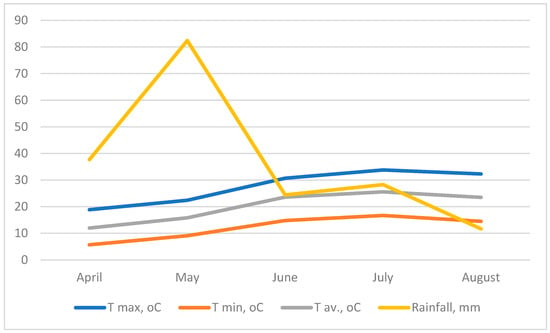
Weather conditions during the 2025 growing season are presented in Figure 1. Total precipitation during the maize growing period (April–August) amounted to only 184.5 mm, representing the lowest seasonal rainfall recorded at the experimental site over the last decade. For comparison, precipitation over a 30-year period was 340.8 mm. Consequently, maize plants experienced severe water deficit throughout most of the growing season, providing suitable conditions for evaluating the effects of cover crops and residual nitrogen fertilization under rainfed production.
Figure 1.
Temperature and rainfall for the period of study (2025). Source: Knezha Synoptic Station, National Institute of Meteorology and Hydrology (NIMH), Pleven Branch, located at the Maize Research Institute, Knezha.
A rainfall event in June temporarily improved soil moisture and supported vegetative growth. However, prolonged dry periods combined with high temperatures accelerated tasselling and silking. During July, only one agronomically effective rainfall event (10.0 mm) was recorded, while extreme heat prevailed, including 11 days with temperatures between 30 and 35 °C and 14 days above 35 °C, with a maximum temperature of 42 °C. These conditions coincided with flowering and pollination, which are among the most drought-sensitive developmental stages in maize.
Dry conditions persisted throughout August, when precipitation totaled only 11.7 mm. High temperatures accelerated grain filling and physiological maturity, further intensifying drought stress. Overall, the meteorological conditions during the experimental season were considerably less favorable than the long-term average and created a challenging environment for maize production. Consequently, the growing season provided an appropriate opportunity to evaluate the contribution of pea–oat cover crops to improving maize growth and nitrogen utilization under water-limited conditions.
3.2. Biometric Traits
The biometric characteristics of maize grown under continuous monoculture and monoculture following pea–oat cover crops are presented in Table 1 and Table 2.
Table 1.
Biometric traits of maize grown under continuous monoculture.
Table 2.
Biometric traits of maize grown under monoculture following cover crops.
Across all fertilization treatments, plants grown after cover crops exhibited greater vegetative development than those cultivated under continuous monoculture. Mean plant height increased from 196.3 cm to 208.2 cm, corresponding to an increase of 5.72%. The greatest plant height (224.0 cm) was recorded following residual application of ammonium nitrate at 60 kg N ha−1 after cover crops, whereas the lowest value (183.1 cm) was observed in the unfertilized continuous monoculture.
Ear height also tended to increase following cover crops, although the differences among fertilization treatments were less pronounced than those observed for plant height. Similarly, the number of leaves above the ear showed only minor variation, ranging from 4.6 to 5.6 under continuous monoculture and from 4.9 to 5.5 following cover crops.
The overall increase in plant height suggests that the incorporation of pea–oat residues improved early-season nutrient availability and promoted more vigorous vegetative growth. The improved vegetative growth observed after pea–oat cover cropping may be associated with enhanced nutrient availability and improved soil conditions; however, these mechanisms were not directly quantified in the present study. Comparable responses have been reported by Finney et al. [12], Blanco-Canqui et al. [11], Dabney et al. [19], and Schipanski et al. [13], who demonstrated that legume-based cover crops improve soil fertility, nutrient cycling, and subsequent maize growth.
3.3. Ear Leaf Area
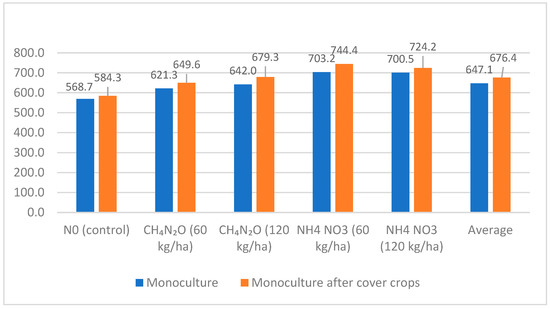
Ear leaf area (ELA), one of the main determinants of photosynthetic capacity during the grain-filling period, responded positively to both residual nitrogen fertilization and cover cropping (Figure 2). The coefficient of variation was low in both cultivation systems (CV = 8.8% and 9.4%), indicating high experimental precision and uniform crop development.
Figure 2.
Ear leaf area (ELA) of maize under different treatments. ELA was calculated from leaf length and maximum leaf width according to McKee (1964) [16].
The lowest ELA values were recorded in the unfertilized control treatments. Under continuous monoculture, residual urea fertilization increased ELA by 9.2% and 12.9% at the 60 and 120 kg N ha−1 rates, respectively, whereas residual ammonium nitrate increased ELA by 23.2% and 23.7%. The same response pattern was observed following pea–oat cover crops, although ELA values remained consistently higher than those recorded under continuous monoculture across all fertilization treatments.
The effects of cropping system and residual nitrogen fertilization on ear leaf area were further evaluated using two-way analysis of variance (Table 3). Both factors significantly affected ELA. The cropping system exerted a highly significant effect (F = 36.40, p < 0.001), while fertilizer treatment explained an even greater proportion of the observed variation (F = 121.52, p < 0.001). In contrast, the interaction between cropping system and fertilizer treatment was not significant (F = 0.88, p = 0.496), indicating that the beneficial effect of cover crops on ear leaf development was expressed consistently across all residual nitrogen treatments.
Table 3.
Two-way ANOVA for ear leaf area (ELA).
The concurrent increases in ear leaf area, grain yield, and nitrogen use efficiency indicate a close physiological relationship among these traits. Compared with continuous monoculture, the incorporation of pea–oat cover crops increased ear leaf area by 4.33%, grain yield by 16.5%, and nitrogen use efficiency by 13.73%. Enhanced ear leaf development may have increased the photosynthetically active leaf surface during grain filling, thereby promoting more efficient assimilation and translocation of photoassimilates to developing kernels. In addition, improved synchronization between nitrogen availability and crop demand probably contributed to the more efficient conversion of residual nitrogen into grain yield.
Similar relationships among canopy development, nitrogen uptake, and grain productivity have been reported by Ciampitti and Vyn (2012) [20], Mueller and Vyn (2016) [21], and Asibi et al. (2019) [22]. These findings are also consistent with the observations of Finney et al. [12] and Blanco-Canqui et al. [11], who reported improved soil functioning and enhanced crop growth following the use of cover crops.
Present results further indicate that the beneficial effects of pea–oat cover crops extended beyond additional nitrogen supply and included improvements in crop physiological performance. Consequently, ear leaf area may serve as a practical physiological indicator for evaluating the effectiveness of cover crop-based nitrogen management strategies in maize cultivated under rainfed conditions.
3.4. Grain Yield
Grain yield reflected the cumulative effects of improved crop growth, enhanced ear leaf development, and more efficient utilization of residual nitrogen (Table 4). The observed differences in grain yield were consistent with the variation in ear leaf area, suggesting that improved canopy development contributed to greater assimilate production during grain filling.
Table 4.
Maize grain yield under conventional continuous monoculture, kg ha−1.
Under continuous monoculture, grain yield ranged from 4149 to 4429 kg ha−1, with an average of 4310 kg ha−1 (Table 4).
Following pea–oat cover crops, average grain yield increased to 5023 kg ha−1, corresponding to a 16.5% increase compared with continuous monoculture (Table 5).
Table 5.
Maize grain yield following cover crops.
Remarkably, the unfertilized treatment following pea–oat cover crops produced higher grain yield than several fertilized treatments under continuous monoculture. This finding demonstrates the beneficial residual effects of pea–oat cover crops under rainfed conditions. Similar improvements in maize productivity following the incorporation of legume-based cover crops have been reported by Finney et al. [12], Schipanski et al. [13], and Blanco-Canqui et al. [11], who attributed these responses to improved nutrient cycling, enhanced soil fertility, and more efficient resource utilization. The present results support these observations, indicating that cover crop incorporation can partially compensate for reduced mineral nitrogen inputs while maintaining grain productivity under water-limited conditions.
3.5. Nitrogen Use Efficiency
Nitrogen use efficiency (NUE) closely reflected the observed differences in grain yield between cultivation systems (Table 6).
Table 6.
NUE under conventional continuous monoculture, kg grain ha−1 kg N.
Analysis of variance revealed a highly significant effect of residual nitrogen fertilization on nitrogen use efficiency (F = 277.8; p < 0.001). The highest NUE values were recorded at the 60 kg ha−1 rate irrespective of fertilizer type (70.82–73.82 kg grain ha−1 kg N), whereas NUE for the 120 kg ha−1 rate was found 36.30–36.38 kg grain ha−1 kg N. No statistically significant differences were observed between urea and ammonium nitrate at the same nitrogen rate. The least significant difference (LSD0.05) was 4.16 kg grain ha−1 kg N.
A similar pattern was observed in maize grown after the pea–oat cover crop. NUE values were highest at the residual nitrogen rate of 60 kg ha−1 for both fertilizer types (83.93 and 83.54 kg grain ha−1 kg N) and significantly lower at the residual nitrogen rate of 120 kg ha−1 (41.90 and 42.53 kg grain ha−1 kg N) (Table 7).
Table 7.
Nitrogen use efficiency under monoculture following cover crops.
Compared with monoculture, maize grown after the cover crop exhibited consistently higher NUE at all residual nitrogen rates, indicating a more efficient utilization of available soil nitrogen.
The type of nitrogen fertilizer did not significantly influence NUE. Analysis of variance showed a highly significant fertilization effect (F = 83.74; p < 0.001), while the least significant difference was LSD0.05 = 8.28 kg grain ha−1 kg N.
A factorial ANOVA demonstrated that the cultivation system significantly affected nitrogen use efficiency (F = 31.76; p < 0.001). Fertilizer treatment exerted the strongest influence on NUE (F = 212.77; p < 0.001), whereas the interaction between cultivation system and fertilizer treatment was not significant (F = 1.30; p = 0.310) (Table 8). These results indicate that the beneficial effect of cover crops on NUE was expressed similarly across all fertilization treatments.
Table 8.
Two-way ANOVA for nitrogen use efficiency (NUE).
Average NUE increased from 54.33 kg grain ha−1 kg N under conventional monoculture to 62.97 kg grain ha−1 kg N following cover crops, corresponding to an increase of 13.73%. The higher NUE observed following cover crops was accompanied by increased ear leaf area and grain yield, indicating improved synchronization between nitrogen availability and crop demand. The higher NUE observed following pea–oat cover cropping may be related to improved synchronization between nitrogen availability and maize demand. However, nitrogen mineralization dynamics and recovery pathways were not directly measured in this experiment. In addition, cover crop residues may have improved soil structure, water availability and microbial activity, creating more favorable conditions for nutrient uptake. These observations are in agreement with the findings of Finney et al. [12] and Schipanski et al. [13], who reported that legume-based cover crops enhance nitrogen cycling and improve nitrogen availability for subsequent crops, thereby contributing to greater nutrient use efficiency.
The absence of a significant interaction between cropping system and fertilizer treatment indicates that the beneficial effect of cover crops was expressed consistently across all residual nitrogen treatments. This suggests that cover cropping can improve nitrogen utilization independently of fertilizer source and may therefore represent an effective strategy for reducing nitrogen inputs while maintaining crop productivity. Similar conclusions have also been reported by Blanco-Canqui et al. [11], who emphasized the role of cover crops in improving soil functions and supporting sustainable nutrient management.
The decline in NUE observed at the higher residual nitrogen rate (120 kg ha−1) is consistent with the widely reported decrease in nitrogen use efficiency as nitrogen supply exceeds crop demand. Under such conditions, a greater proportion of nitrogen remains unused by plants and becomes susceptible to losses through leaching, volatilization, or immobilization. The substantially higher NUE recorded at the 60 kg ha−1 rate suggests that this nitrogen level was more closely aligned with maize requirements under the environmental conditions of the experiment. Similar relationships between nitrogen rate and NUE have been reported by Hirel et al. (2007) [22].
Taken together, the results demonstrate that ear leaf area, grain yield and nitrogen use efficiency responded in a similar manner to both cover cropping and residual nitrogen fertilization. The increase in ear leaf area by 4.33%, grain yield by 16.5%, and NUE by 13.73% following pea-oat cover crops indicates that improvements in crop physiological performance were closely linked to more efficient utilization of residual nitrogen resources. These findings are consistent with previous studies reporting that cover crops improve soil fertility, nutrient cycling, and nitrogen use efficiency while supporting stable maize productivity under rainfed conditions (Blanco-Canqui et al. [11]; Finney et al. [12]; Schipanski et al. [13]).
3.6. Integrated Response of Ear Leaf Area, Grain Yield and Nitrogen Use Efficiency
The combined analysis of ear leaf area, grain yield, and nitrogen use efficiency indicates a coordinated improvement of maize physiological performance following pea–oat cover cropping. The positive response of these traits suggests that the beneficial effects of cover crops extended beyond additional nitrogen supply and involved improved soil conditions, nutrient cycling, and more efficient synchronization between nitrogen availability and crop demand under rainfed conditions.
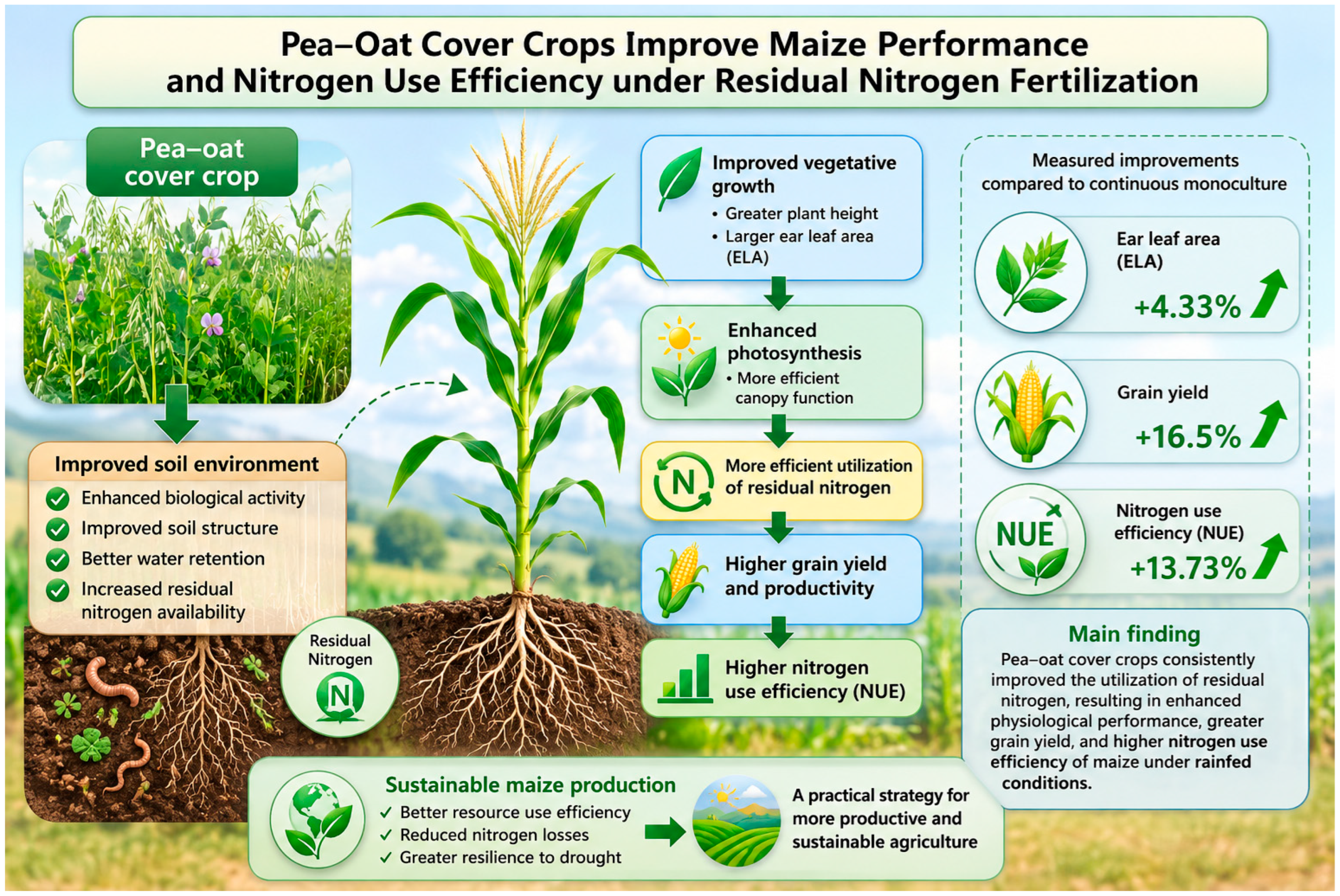
The consistent response across residual nitrogen treatments indicates that cover cropping contributed to greater stability of maize performance under water-limited conditions. The conceptual relationship among improved soil processes, enhanced canopy development, increased grain productivity, and improved nitrogen utilization is summarized in Figure 3.
Figure 3.
Proposed conceptual framework explaining how pea–oat cover crops improve the utilization of residual nitrogen, leading to enhanced ear leaf development, higher grain yield and greater nitrogen use efficiency in rainfed maize.
Study Limitations and Future Perspectives
Although the present study was conducted during a single growing season, the experimental year was characterized by pronounced water deficit and high temperature conditions, providing valuable insights into maize responses to pea–oat cover crops under drought-prone rainfed conditions. The obtained results demonstrate the potential of cover crops to improve maize productivity and nitrogen use efficiency under stressful environmental conditions. However, multi-year experiments conducted under contrasting climatic scenarios are required to further validate the consistency and long-term stability of these effects.
4. Conclusions
The present study demonstrated that incorporating a pea–oat cover crop into a continuous maize production system improved crop performance and the efficiency of residual nitrogen utilization under rainfed conditions. Compared with continuous monoculture, cover cropping increased plant height, ear leaf area, grain yield, and nitrogen use efficiency, indicating enhanced physiological performance and improved synchronization between nitrogen availability and crop demand.
Residual nitrogen rate exerted a greater influence on nitrogen use efficiency than fertilizer source. The highest NUE values were consistently obtained at the residual application rate of 60 kg N ha−1, whereas increasing the rate to 120 kg N ha−1 substantially reduced nitrogen use efficiency regardless of fertilizer type.
The absence of significant interactions between cropping system and fertilizer treatment demonstrates that the beneficial effects of cover crops were consistently expressed across all nitrogen treatments. These findings indicate that pea–oat cover crops can improve the utilization of residual nitrogen independently of fertilizer source.
Overall, integrating pea–oat cover crops with moderate nitrogen fertilization represents a promising agronomic strategy for improving nitrogen use efficiency, maintaining grain productivity, and increasing the sustainability of maize production under increasingly water-limited environments.
Further research should focus on the long-term effects of pea–oat cover crops on soil nitrogen dynamics, microbial community structure, and biological processes involved in nitrogen cycling to better understand the mechanisms underlying improved nitrogen use efficiency in maize production systems.
Author Contributions
Conceptualization, V.V. and E.V.; methodology, V.V.; software, V.V.; validation, V.V., E.V. and N.P.; formal analysis, V.V.; investigation, V.V.; resources, V.V.; data curation, V.V.; writing—original draft preparation, V.V.; writing—review and editing, V.V., E.V. and N.P.; visualization, V.V.; supervision, V.V. All authors have read and agreed to the published version of the manuscript.
Funding
This research received no external funding.
Institutional Review Board Statement
Not applicable.
Informed Consent Statement
Not applicable.
Data Availability Statement
The data presented in this study are available from the corresponding author upon reasonable request.
Conflicts of Interest
The authors declare no conflicts of interest.
References
- Shiferaw, B.; Prasanna, B.M.; Hellin, J.; Bänziger, M. Crops that feed the world 6. Past successes and future challenges to the role played by maize in global food security. Food Secur. 2011, 3, 307–327. [Google Scholar] [CrossRef] [Scilit]
- Food and Agriculture Organization of the United Nations. FAOSTAT Statistical Database. 2025. Available online: https://www.fao.org/faostat/ (accessed on 11 July 2026).
- Marschner, P. (Ed.) Marschner’s Mineral Nutrition of Higher Plants, 3rd ed.; Academic Press: London, UK, 2012; Available online: https://home.czu.cz/storage/737/65060_Mineral-Nutrition-of-higher-plants-Marschner-2012.pdf (accessed on 11 July 2026).
- Hirel, B.; Tétu, T.; Lea, P.J.; Dubois, F. Improving nitrogen use efficiency in crops for sustainable agriculture. Agron. Sustain. Dev. 2011, 31, 1452–1485. [Google Scholar] [CrossRef] [Scilit]
- Zhang, X.; Davidson, E.A.; Mauzerall, D.L.; Searchinger, T.D.; Dumas, P.; Shen, Y. Managing nitrogen for sustainable development. Nature 2015, 528, 51–59. [Google Scholar] [CrossRef] [Scilit] [PubMed]
- Tóth, Š.; Šoltysová, B.; Dupľák, Š.; Porvaz, P. Impact of Soil-Applied Humic Ameliorative Amendment on the Ligno-Cellulose Quality and Calorific Value of Switchgrass Panicum virgatum L. Agronomy 2023, 13, 1854. [Google Scholar] [CrossRef] [Scilit]
- Poeplau, C.; Don, A. Carbon sequestration in agricultural soils via cultivation of cover crops—A meta-analysis. Agric. Ecosyst. Environ. 2015, 200, 33–41. [Google Scholar] [CrossRef] [Scilit]
- Kaspar, T.C.; Singer, J.W. The Use of Cover Crops to Manage Soil. In Soil Management: Building a Stable Base for Agriculture; Hatfield, J.L., Sauer, T.J., Eds.; American Society of Agronomy and Soil Science Society of America: Madison, WI, USA, 2011; pp. 321–337. [Google Scholar] [CrossRef] [Scilit]
- Tollenaar, M.; Lee, E.A. Yield potential, yield stability and stress tolerance in maize. Field Crops Res. 2002, 75, 161–169. [Google Scholar] [CrossRef] [Scilit]
- Valentinuz, O.R.; Tollenaar, M. Vertical profile of leaf senescence during the grain-filling period in older and newer maize hybrids. Crop Sci. 2004, 44, 827–834. [Google Scholar] [CrossRef] [Scilit]
- Blanco-Canqui, H.; Shaver, T.M.; Lindquist, J.L.; Shapiro, C.A.; Elmore, R.W.; Francis, C.A.; Hergert, G.W. Cover Crops and Ecosystem Services: Insights from Studies in Temperate Soils. Agron. J. 2015, 107, 2449–2474. [Google Scholar] [CrossRef] [Scilit]
- Finney, D.M.; White, C.M.; Kaye, J.P. Biomass Production and Carbon/Nitrogen Ratio Influence Ecosystem Services from Cover Crop Mixtures. Agron. J. 2016, 108, 39–52. [Google Scholar] [CrossRef] [Scilit]
- Schipanski, M.E.; Barbercheck, M.; Douglas, M.R.; Finney, D.M.; Haider, K.; Kaye, J.P.; Kemanian, A.R.; Mortensen, D.A.; Ryan, M.R.; Tooker, J.; et al. A framework for evaluating ecosystem services provided by cover crops in agroecosystems. Agric. Syst. 2014, 125, 12–22. [Google Scholar] [CrossRef] [Scilit]
- Thapa, R.; Mirsky, S.B.; Tully, K.L. Cover crops reduce nitrate leaching in agroecosystems: A global meta-analysis. J. Environ. Qual. 2018, 47, 1400–1411. [Google Scholar] [CrossRef] [Scilit] [PubMed]
- Yordanov, G. Highly harvested Kneja 561 maize hybrid—A new selection of Bulgarian maize. J. Mt. Agric. Balk. 2019, 22, 24–35. [Google Scholar]
- McKee, G.W. A Coefficient for Computing Leaf Area in Hybrid Corn. Agron. J. 1964, 56, 240–241. [Google Scholar] [CrossRef] [Scilit]
- Bowen, G.D.; Zapata, F. Efficiency in uptake and use of nitrogen by plants. In Stable Isotopes in Plant Nutrition, Soil Fertility and Environmental Studies: Proceedings of an International Symposium, Vienna, Austria, 15–19 October 1990; Agency, Ed.; International Atomic Energy Agency (IAEA): Vienna, Austria, 1991; pp. 349–362. Available online: https://www-pub.iaea.org/MTCD/Publications/PDF/te_1272_prn.pdf?utm_source=chatgpt.com (accessed on 11 July 2026).
- IBM SPSS Statistics for Windows, Version 20.0; IBM Corp.: Armonk, NY, USA, 2011.
- Dabney, S.M.; Delgado, J.A.; Reeves, D.W. Using Winter Cover Crops to Improve Soil and Water Quality. Commun. Soil Sci. Plant Anal. 2001, 32, 1221–1250. [Google Scholar] [CrossRef] [Scilit]
- Ciampitti, I.A.; Vyn, T.J. Physiological perspectives of changes over time in maize yield dependency on nitrogen uptake and associated nitrogen efficiencies: A review. Field Crops Res. 2012, 133, 48–67. [Google Scholar] [CrossRef] [Scilit]
- Mueller, S.M.; Vyn, T.J. Maize Plant Resilience to N Stress and Correlations with Canopy Development and Grain Yield. Agron. J. 2016, 108, 2267–2280. [Google Scholar] [CrossRef] [Scilit]
- Hirel, B.; Le Gouis, J.; Ney, B.; Gallais, A. The challenge of improving nitrogen use efficiency in crop plants: Towards a more central role for genetic variability and quantitative genetics within integrated approaches. J. Exp. Bot. 2007, 58, 2369–2387. [Google Scholar] [CrossRef] [Scilit] [PubMed]

Disclaimer/Publisher’s Note: The statements, opinions and data contained in all publications are solely those of the individual author(s) and contributor(s) and not of MDPI and/or the editor(s). MDPI and/or the editor(s) disclaim responsibility for any injury to people or property resulting from any ideas, methods, instructions or products referred to in the content. |
© 2026 by the authors. Licensee MDPI, Basel, Switzerland. This article is an open access article distributed under the terms and conditions of the Creative Commons Attribution (CC BY) license.