


Abstract
Rotator cuff tears are common, and although surgical repair is frequently performed, re-tear and complication rates remain substantial. The impact of selective serotonin reuptake inhibitors (SSRIs) and serotonin–norepinephrine reuptake inhibitors (SNRIs) on postoperative outcomes after rotator cuff repair is not well understood. Using the TriNetX Research Network, adult patients undergoing arthroscopic rotator cuff repair were identified and stratified into SSRI/SNRI users (at least one prescription within 3 months preoperatively and continued use within 2 years postoperatively) and non-users. Propensity score matching was performed for demographic and medical comorbidities, yielding 2457 patients in each cohort. At 1-year follow-up, SSRI/SNRI users demonstrated lower rates of adhesive capsulitis compared with controls (3.1% vs. 5.8%; RR 0.53; 95% CI 0.41–0.70; p < 0.001), with similar revision rotator cuff repair rates. This pattern persisted at 2 years (3.6% vs. 6.1%; RR 0.58; 95% CI 0.45–0.75; p < 0.001), with comparable revision rates between groups. There were no differences in 30-day emergency department visits, readmissions, or 90-day postoperative infections. SSRI/SNRI users had lower early opioid use (21.0% vs. 29.5%; RR 0.71; p < 0.001) but higher prolonged (17.2% vs. 14.1%; RR 1.22; p = 0.003) and chronic opioid use (16.7% vs. 9.1%; RR 1.84; p < 0.001). In this large national cohort, SSRI/SNRI use was associated with lower rates of adhesive capsulitis and differences in postoperative opioid utilization, without differences in revision rotator cuff repair or short-term complications. These findings reflect associations rather than causation and highlight the need for further studies to clarify underlying mechanisms and clinical implications.
1. Introduction
Rotator cuff tears are a common source of shoulder pain and dysfunction, with surgical repair frequently performed to restore strength and mobility. In the United States, between 250,000 and 500,000 rotator cuff repairs are performed annually, particularly in middle-aged and elderly patients [1]. Despite advances in surgical technique and rehabilitation, re-tear rates remain substantial, ranging up to 94%, depending on tear size, tissue quality, and patient factors [2]. Identification of modifiable risk factors for tendon healing failure is therefore clinically important.
Selective serotonin reuptake inhibitors (SSRIs) and serotonin–norepinephrine reuptake inhibitors (SNRIs) are widely prescribed for depression, anxiety, and other psychiatric conditions, with approximately 13% of U.S. adults reporting SSRI use [3]. Beyond their central nervous system effects, serotonergic antidepressants influence peripheral serotonin signaling, which plays a role in collagen synthesis, bone metabolism, and tendon healing [4]. Preclinical studies suggest that serotonin modulates fibroblast proliferation and extracellular matrix production, and disruption of these pathways may impair tendon-to-bone healing [5]. Clinically, serotonergic antidepressant use has been associated with decreased bone mineral density, increased fracture risk, and delayed fracture healing [6,7]. However, the relationship between SSRI/SNRI use and outcomes after rotator cuff repair remains poorly understood.
In addition to potential effects on tendon biology, antidepressant use may influence postoperative recovery through modulation of pain perception and opioid utilization. Patients with depression and anxiety have been shown to experience greater postoperative pain, lower satisfaction, and increased healthcare utilization following orthopaedic procedures [8,9]. Furthermore, psychological comorbidities have been associated with inferior patient-reported outcomes following arthroscopic rotator cuff repair (ARCR) [10]. Because SSRIs and SNRIs alter serotonergic and noradrenergic pain pathways, these medications may affect postoperative analgesic requirements independently of their psychiatric indications. Persistent postoperative opioid utilization following ARCR also remains a significant concern due to its association with poorer recovery and increased healthcare utilization [11].
Existing literature evaluating antidepressant use in shoulder surgery remains limited and somewhat conflicting. While certain studies have suggested increased postoperative complications and stiffness among patients prescribed antidepressants [12], experimental investigations have demonstrated potentially beneficial effects of serotonergic modulation on tendon-to-bone healing and inflammation [4,13,14]. These conflicting findings highlight the need for larger studies evaluating both structural and clinical outcomes following ARCR in patients prescribed SSRIs or SNRIs.
Given the prevalence of serotonergic antidepressant use among patients undergoing rotator cuff repair and the complex role of serotonin in musculoskeletal biology, this study aimed to (1) evaluate whether SSRI/SNRI use is associated with adverse postoperative outcomes, including re-tear, reoperation, and complications, and (2) determine whether SSRI/SNRI use affects longer-term structural integrity following repair. Although serotonergic signaling may influence fibroblast activity and extracellular matrix production in experimental models, systemic SSRI/SNRI exposure has also been associated with impaired bone and connective tissue healing, providing a rationale for a potential net adverse effect on tendon repair outcomes. Therefore, we hypothesized that SSRI/SNRI use would be associated with higher rates of re-tear and reoperation compared with SSRI/SNRI-naïve patients.
2. Materials and Methods
The data used in this retrospective cohort study was collected from the TriNetX Research Network, which provided access to electronic medical records (diagnoses, procedures, medications, laboratory values, genomic information) from over 150 million patients from 102 healthcare organizations. TriNetX is compliant with the Health Insurance Portability and Accountability Act (HIPAA), certified to the ISO 27001:2013 standard [15], and maintains an Information Security Management System (ISMS) to protect healthcare data. All patient-level data are de-identified according to HIPAA standards. Because only de-identified records were used, the study was exempt from Institutional Review Board approval. Given the retrospective design of this study utilizing a large administrative database, no a priori sample size or power calculation was conducted, in accordance with STROBE recommendations for observational studies.
Patients aged ≥18 years who underwent ARCR were identified and divided into two cohorts: (1) patients with preoperative SSRI/SNRI exposure with continued postoperative use, defined as those who had at least one prescription for an SSRI or SNRI within 3 months prior to surgery and at least one prescription within 2 years following surgery, and (2) patients who were never prescribed SSRIs/SNRIs during the same observation window. This exposure definition was intended to capture patients with established preoperative SSRI/SNRI use and continued postoperative therapy, thereby minimizing misclassification from postoperative initiation of antidepressant therapy. The 3-month preoperative window was selected to identify patients with active, ongoing antidepressant therapy proximate to the index procedure, while minimizing misclassification of remote or historical SSRI/SNRI use. The 2-year postoperative window was chosen to capture continued exposure during the clinically relevant period of tendon healing, remodeling, and functional recovery following ARCR. Exclusion criteria included polytrauma within six months prior to surgery, prior shoulder or humerus surgery, prior fractures of the shoulder or upper arm, osteoporosis with pathological fracture, systemic connective tissue disorders, long-term corticosteroid use, Ehlers–Danlos or Marfan syndromes, autoinflammatory or inflammatory polyarthropathies, and other specified conditions (Supplementary Table S1).
Propensity score matching (1:1) was performed using demographic and clinical variables including age, sex, body mass index, diabetes mellitus, dyslipidemia, peripheral vascular disease, tobacco use, substance use disorders, mood disorders, anxiety and stress-related disorders, chronic pain syndrome, fibromyalgia, complex regional pain syndrome, upper-extremity mononeuropathies, and sleep disorders.
To further evaluate the potential influence of baseline opioid exposure on postoperative opioid utilization outcomes, a prespecified subgroup analysis was performed in opioid-naïve patients, defined as individuals without a documented opioid prescription prior to ARCR. The same propensity score matching methodology and outcome assessments were subsequently applied within this subgroup.
Primary outcomes assessed at one and two years postoperatively were adhesive capsulitis of the shoulder and revision rotator cuff repair. Secondary outcomes included 30-day emergency department (ED) visits, 30-day hospital readmissions, 90-day postoperative infections, and postoperative opioid use, stratified as early (1–30 days), prolonged (30–90 days), and chronic (90–180 days). Effect estimates were reported as risk ratios (RR) with 95% confidence intervals (CI) and corresponding p-values.
TriNetX rounds event counts fewer than 11, which may introduce slight imprecision in outcomes influenced by this reporting constraint. Within the TriNetX platform, analyses are conducted on available data for each variable, and no imputation for missing data was performed. Adjustments for multiple comparisons were not applied, as analyses were prespecified. A two-sided p-value < 0.05 was considered statistically significant.
3. Results
Prior to propensity score matching, 2504 patients aged ≥18 years met criteria for preoperative SSRI/SNRI exposure with continued postoperative use (defined as at least one prescription within 3 months before surgery and within 2 years after surgery) following ARCR, compared with 72,764 patients who were not prescribed SSRIs/SNRIs during the same timeframe. A 1:1 propensity score matching approach was performed using a greedy nearest-neighbor algorithm with a caliper of 0.1 pooled standard deviations. Scores were derived from a logistic regression model, incorporating age, sex, race, body mass index, and overall comorbidity burden (Supplementary Table S1). Each cohort included 2457 patients after matching. Demographic and clinical characteristics of the matched cohorts are presented in Supplementary Table S2, with all covariates demonstrating adequate balance, as reflected by standardized mean differences < 0.10.
3.1. One-Year and Two-Year Outcomes
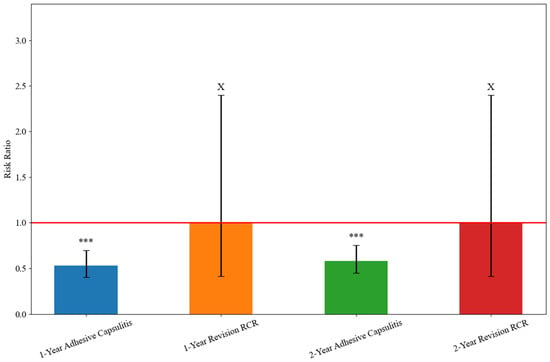
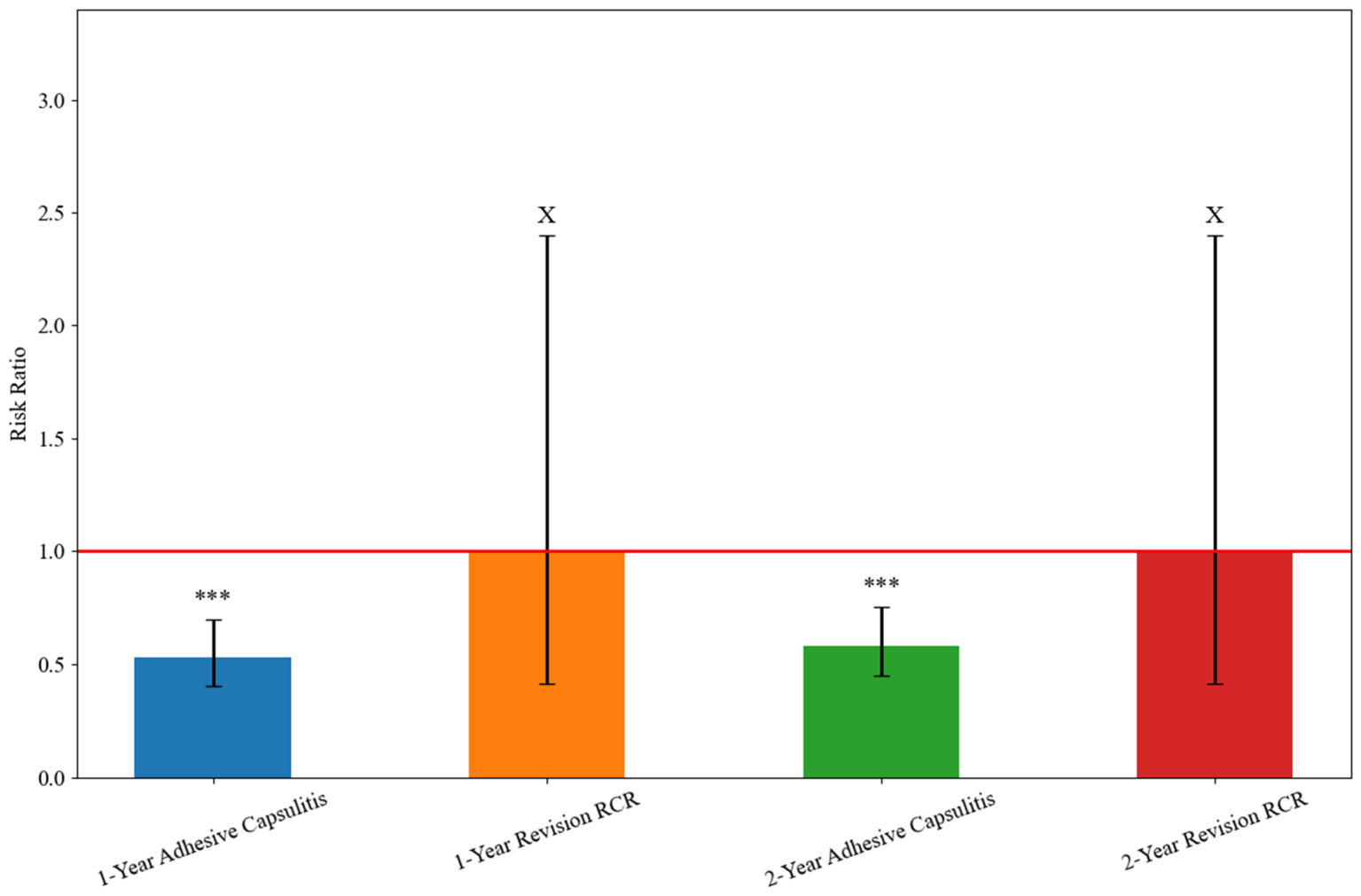
At both one- and two-year follow-up, patients with preoperative SSRI/SNRI exposure and continued postoperative use demonstrated significantly lower rates of adhesive capsulitis compared with controls (1 year: 3.1% vs. 5.8%; RR: 0.531; 95% CI: 0.405–0.698; p < 0.001; 2 years: 3.6% vs. 6.1%; RR: 0.583; 95% CI: 0.451–0.753; p < 0.001). Revision rotator cuff repair rates were low and comparable between groups at both one and two years (both time points: 0.4% vs. 0.4%; RR: 1.000; 95% CI: 0.417–2.398; p = 1.000) (Table 1, Figure 1).
Table 1.
One-year and two-year outcomes between SSRI/SNRI and control cohorts following ARCR. * Event counts are less than 11 and rounded due to TriNetX limitations in reporting small-event-count data to prevent patient deindividualization. ^ p-values may not accurately represent significance as calculations are done with rounded patient populations. RCR: rotator cuff repair; ARD: absolute risk difference; CI: confidence interval.
Figure 1.
One-year and two-year outcomes between SSRI/SNRI and control cohorts following ARCR. *** <0.001; X ≤ 10 patients in at least one group due to TriNetX protection of patient information. RCR: rotator cuff repair.
3.2. Thirty-Day, Ninety-Day, and Postoperative Opioid-Use Outcomes
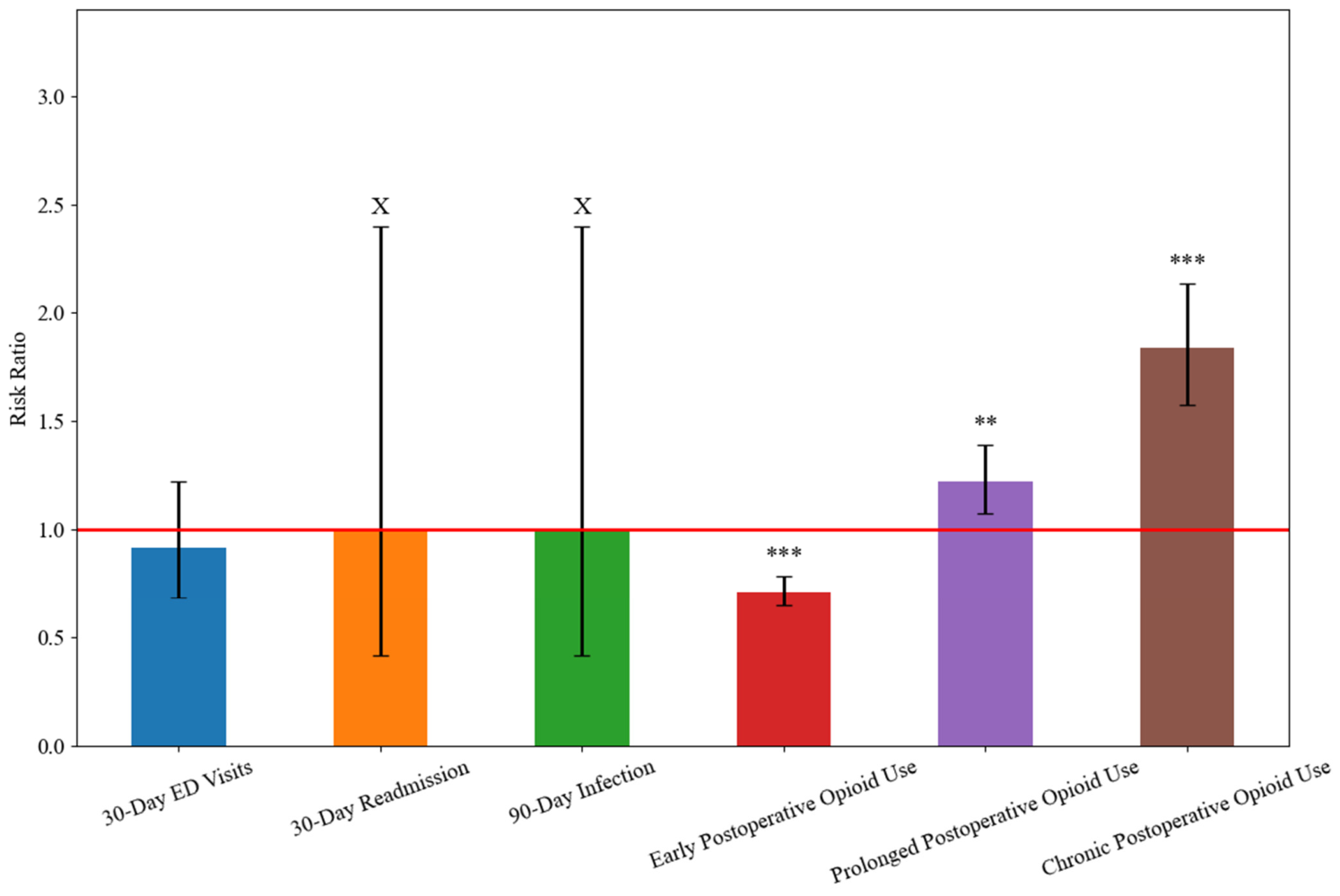
Among 2457 patients in each matched cohort, there were no significant differences in 30-day ED visits (3.5% vs. 3.8%; p = 0.541), 30-day readmissions (0.4% vs. 0.4%; p = 1.000), or 90-day postoperative infections (0.4% vs. 0.4%; p = 1.000) between SSRI/SNRI users and controls.
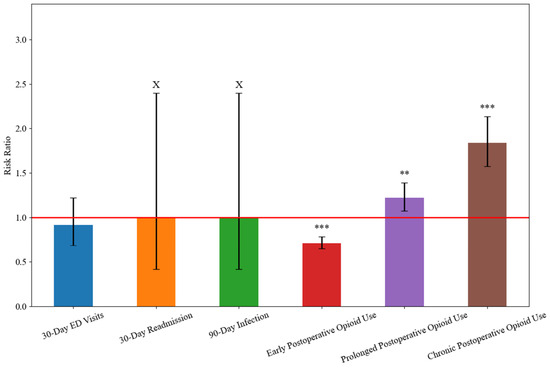
Postoperative opioid utilization demonstrated a mixed pattern. Patients in the SSRI/SNRI cohort had lower rates of early opioid use (1–30 days) compared with controls (21.0% vs. 29.5%; RR: 0.712; 95% CI: 0.645–0.785; p < 0.001), but higher rates of prolonged opioid use (30–90 days; 17.2% vs. 14.1%; RR: 1.220; 95% CI: 1.070–1.390; p = 0.003) and chronic opioid use (90–180 days; 16.7% vs. 9.1%; RR: 1.835; 95% CI: 1.575–2.138; p < 0.001) (Table 2, Figure 2).
Table 2.
Thirty-day, ninety-day, and postoperative opioid-use outcomes between SSRI/SNRI and control cohorts following ARCR. * Event counts are less than 11 and rounded due to TriNetX limitations in reporting small-event-count data to prevent patient deindividualization. ^ p-values may not accurately represent significance as calculations are done with rounded patient populations. ED: emergency department; ARD: absolute risk difference; CI: confidence interval.
Figure 2.
Thirty-day, ninety-day, and postoperative opioid-use outcomes between SSRI/SNRI and control cohorts following ARCR. ** <0.01; *** <0.001; X ≤ 10 patients in at least one group due to TriNetX protection of patient information. ED: emergency department.
3.3. Opioid-Naïve Subgroup Analysis
A subgroup analysis restricted to opioid-naïve patients demonstrated findings consistent with the primary analysis. SSRI/SNRI users continued to exhibit lower rates of early postoperative opioid utilization (15.0% vs. 20.6%; RR 0.727, p = 0.006) and higher rates of chronic postoperative opioid use (6.8% vs. 4.2%; RR 1.621, p = 0.034). Rates of prolonged opioid use remained directionally higher among SSRI/SNRI users but did not reach statistical significance (8.8% vs. 6.2%; RR 1.419, p = 0.066) (Table 3). Detailed cohort matching for this subgroup analysis is provided in Supplementary Table S3.
Table 3.
Postoperative opioid-use outcomes between opioid-naïve SSRI/SNRI and control cohorts following ARCR. ARD: absolute risk difference; CI: confidence interval.
4. Discussion
This study evaluated postoperative outcomes following ARCR in patients prescribed SSRIs or SNRIs preoperatively with continued postoperative exposure. The SSRI/SNRI cohort did not differ from controls in terms of ED visits, readmissions, or postoperative infections. SSRI/SNRI use was associated with significantly reduced early postoperative opioid utilization, yet significantly greater prolonged and chronic postoperative opioid use. No differences were observed in revision rotator cuff repair rates at 1- and 2-year follow-ups, while the risk of adhesive capsulitis was significantly lower in the SSRI/SNRI cohort at both time points.
In this study, no differences were observed in 30-day readmissions or emergency department (ED) visits between groups. In contrast, Moore et al. found that patients on antidepressant therapy had significantly increased ED visits and nonsignificantly increased readmissions following ARCR [12]. While our results differ, it is plausible that emergent medical needs are more common among patients on SSRIs/SNRIs, particularly since depression itself is a recognized risk factor for both ED visits and readmissions following surgery [8,9]. Infection rates did not differ between groups, consistent with prior studies reporting minimal to no effect of SSRI/SNRI usage on postoperative infections [12,16].
SSRI/SNRI use was associated with decreased early postoperative opioid use but increased prolonged and chronic opioid use. Previous studies have reported that SSRIs/SNRIs can reduce early postoperative pain and opioid requirements following procedures such as total knee arthroplasty [13,17], which may explain our findings of reduced early opioid use. Conversely, antidepressant therapy has been linked to long-term opioid utilization [12,18], and the presence of depression itself is a risk factor for chronic opioid use [12,19]. These factors likely contribute to the increased rates of prolonged and chronic opioid use observed in our cohort. Importantly, similar directional findings were observed in a subgroup analysis restricted to opioid-naïve patients, with SSRI/SNRI users demonstrating lower rates of early postoperative opioid use and higher rates of chronic opioid use compared with controls. These findings suggest that baseline opioid exposure alone does not fully explain the observed associations between SSRI/SNRI use and postoperative opioid utilization.
Notably, the SSRI/SNRI cohort demonstrated significantly lower rates of adhesive capsulitis. Preclinical studies indicate that SSRIs may improve biomechanical and histological outcomes following rotator cuff repair [4]. While Moore et al. reported that antidepressants were associated with increased shoulder stiffness, our results diverge, potentially due to differences in cohort selection, including the grouping of SSRIs and SNRIs, or the exclusion of patients with prior shoulder fractures, surgeries, or connective tissue disorders in our study [12]. Although SSRIs and SNRIs have been reported to possess anti-inflammatory properties [13,14], any biological explanation for the observed reduction in adhesive capsulitis should be considered speculative. The present findings are based on administrative coding data and may also reflect differences in diagnostic coding practices, follow-up patterns, rehabilitation adherence, healthcare utilization, or other unmeasured factors rather than a direct pharmacologic effect of SSRI/SNRI therapy. The absence of differences in revision rotator cuff repair rates suggests that SSRI/SNRI therapy was not associated with an increased likelihood of clinically recognized failure requiring reoperation; however, revision surgery is an imperfect surrogate for structural tendon integrity, as re-tears may be managed nonoperatively or remain undiagnosed.
This study has several limitations. The use of an insurance claims database introduces the potential for coding errors and misclassification of procedures, diagnoses, and medications. The use of adhesive capsulitis diagnostic codes as a study outcome may be particularly susceptible to misclassification and detection bias, as coding practices, frequency of follow-up, rehabilitation adherence, and thresholds for diagnosis may vary across providers and health systems. Consequently, the observed association between SSRI/SNRI use and reduced rates of adhesive capsulitis should be interpreted cautiously. Although propensity score matching was performed, factors such as medication adherence, depression severity, operative time, and tear size could not be controlled, potentially confounding the results. Moreover, the database lacks granular clinical detail, including surgical technique, rotator cuff tear characteristics (e.g., tear size, tendon involvement, and chronicity), and repair construct (e.g., single- versus double-row repair), as well as rehabilitation protocols and medication-specific factors such as timing, route of administration, and dosage. Although an opioid-naïve subgroup analysis was performed, residual confounding from unmeasured factors related to psychiatric disease severity, pain burden, and prescribing practices may still influence postoperative opioid utilization outcomes. Furthermore, patient-reported measures of functionality and improvement were not available, limiting assessment of the functional impact of SSRI/SNRI therapy following ARCR. Small event counts (fewer than 11) are rounded within TriNetX to preserve patient privacy, which may reduce precision for certain outcomes. Additionally, revision rotator cuff repair was used as a surrogate for structural failure; however, this measure likely underestimates true re-tear rates, as many are managed nonoperatively or remain clinically undetected. Finally, as a database study, the population may overrepresent patients treated in larger academic or integrated health systems, potentially limiting generalizability.
Future prospective studies are warranted to better delineate the causal relationship between perioperative SSRI/SNRI use and postoperative outcomes following ARCR. Specifically, studies incorporating detailed clinical data, such as depression severity, medication adherence, dosing, and duration of therapy, would help clarify whether the observed associations are attributable to the pharmacologic effects of SSRIs/SNRIs or the underlying psychiatric condition. Additionally, prospective designs should include standardized assessments of pain, functional outcomes, and patient-reported measures to better characterize the clinical significance of reduced early opioid use and increased long-term opioid utilization. Further investigation into the biological mechanisms underlying the reduced incidence of adhesive capsulitis, including the potential anti-inflammatory and antifibrotic effects of these medications, is also needed. Finally, randomized or carefully controlled prospective cohort studies may help determine whether perioperative management of antidepressant therapy can be optimized to enhance recovery while minimizing the risk of prolonged opioid dependence.
5. Conclusions
In this large national cohort, perioperative SSRI/SNRI use among patients undergoing ARCR was associated with lower rates of adhesive capsulitis at 1- and 2-year follow-up and higher rates of prolonged and chronic opioid use. Revision rotator cuff repair rates were similar between groups, suggesting no difference in clinically recognized reoperation for structural failure. These findings demonstrate associations between SSRI/SNRI use and postoperative outcomes related to shoulder stiffness and opioid utilization. However, these findings should be interpreted in the context of limitations related to the absence of granular clinical data, including tendon characteristics and surgical technique, which may influence postoperative outcomes. Future studies should investigate underlying mechanisms, consider depression severity and medication adherence, and incorporate functional outcomes to clarify the role of SSRI/SNRI therapy in optimizing recovery after rotator cuff repair.
Supplementary Materials
The following supporting information can be downloaded at https://www.mdpi.com/article/10.3390/psychoactives5030021/s1, Table S1: CPT, ICD-9-CM, ICD-10-CM, RxNorm Codes for Query; Table S2: Propensity score matching for patients undergoing arthroscopic rotator cuff repair; Table S3: Propensity score matching for opioid-naïve patients undergoing arthroscopic rotator cuff repair.
Author Contributions
Conceptualization, R.J.M., S.A.M. and B.M.G.; methodology, R.J.M. and B.M.G.; validation, R.J.M. and E.R.; formal analysis, A.G.; investigation, A.G.; data curation, A.G.; writing—original draft preparation, R.J.M., A.G. and E.R.; writing—review and editing, S.A.M., D.L.B. and B.M.G.; visualization, R.J.M.; supervision, B.M.G. and D.L.B.; project administration, B.M.G. All authors have read and agreed to the published version of the manuscript.
Funding
This research received no external funding.
Institutional Review Board Statement
Ethical review and approval were waived for this study due to use of de-identified patient records only.
Informed Consent Statement
Patient consent was waived because this retrospective study used only de-identified data from the TriNetX Research Network, and no identifiable patient information was accessed or direct interaction with participants occurred.
Data Availability Statement
The data used in this retrospective cohort study was collected from the TriNetX Research Network.
Conflicts of Interest
The authors declare no conflicts of interest.
References
- Adams, C.R.; DeMartino, A.M.; Rego, G.; Denard, P.J.; Burkhart, S.S. The Rotator Cuff and the Superior Capsule: Why We Need Both. Arthroscopy 2016, 32, 2628–2637. [Google Scholar] [CrossRef] [Scilit] [PubMed]
- Trasolini, N.A.; Waterman, B.R. Editorial Commentary: Rotator Cuff Repairs Fail at an Alarmingly High Rate During Long-Term Follow-Up: Graft Augmentation and Biologics May Improve Future Outcomes. Arthroscopy 2022, 38, 2413–2416. [Google Scholar] [CrossRef] [Scilit] [PubMed]
- Brody, D.J.; Gu, Q. Antidepressant Use Among Adults: United States, 2015–2018; NCHS Data Brief, no 377; National Center for Health Statistics: Hyattsville, MD, USA, 2020.
- Yoon, J.P.; Yoon, J.W.; Kim, H.; Oh, J.H. Selective Serotonin Reuptake Inhibitor Promotes Bone-Tendon Interface Healing in a Rotator Cuff Tear Rat Model. Tissue Eng. Regen. Med. 2022, 19, 853–860. [Google Scholar] [CrossRef] [Scilit] [PubMed]
- Bliziotes, M. Update in Serotonin and Bone. J. Clin. Endocrinol. Metab. 2010, 95, 4124–4132. [Google Scholar] [CrossRef] [Scilit] [PubMed]
- Mercurio, M.; de Filippis, R.; Spina, G.; De Fazio, P.; Segura-Garcia, C.; Galasso, O.; Gasparini, G. The use of antidepressants is linked to bone loss: A systematic review and metanalysis. Orthop. Rev. 2022, 14, 38564. [Google Scholar] [CrossRef] [Scilit] [PubMed]
- Richards, J.B.; Papaioannou, A.; Adachi, J.D.; Joseph, L.; Whitson, H.E.; Prior, J.C.; Goltzman, D. Effect of Selective Serotonin Reuptake Inhibitors on the Risk of Fracture. Arch. Intern. Med. 2007, 167, 188–194. [Google Scholar] [CrossRef] [Scilit] [PubMed]
- Wilson, J.M.; Farley, K.X.; Erens, G.A.; Bradbury, T.L.; Guild, G.N. Preoperative Depression Is Associated with Increased Risk Following Revision Total Joint Arthroplasty. J. Arthroplast. 2020, 35, 1048–1053. [Google Scholar] [CrossRef] [Scilit] [PubMed]
- Knapp, P.; Layson, J.T.; Mohammad, W.; Pizzimenti, N.; Markel, D.C. The Effects of Depression and Anxiety on 90-Day Readmission Rates After Total Hip and Knee Arthroplasty. Arthroplast. Today 2021, 10, 175–179. [Google Scholar] [CrossRef] [Scilit] [PubMed]
- Johnson, A.H.; York, J.J.; Lashgari, C.J.; Petre, B.M.; Turcotte, J.J.; Redziniak, D.E. Effects of preexisting depression and anxiety on postoperative outcomes following arthroscopic rotator cuff repair. JSES Int. 2022, 6, 984–988. [Google Scholar] [CrossRef] [Scilit] [PubMed]
- Simpson, E.R.; Smith, K.; Mathur, A.; Saunders, P.; Gazzaniga, D.; Parvaresh, K.C.; Kassam, H.F. Preoperative Anxiety Levels and Postoperative Opioid Use in Patients Undergoing Arthroscopic Rotator Cuff Repair: A Prospective Cohort Study. Orthop. J. Sports Med. 2026, 14, 23259671261427788. [Google Scholar] [CrossRef] [Scilit] [PubMed]
- Moore, B.P.; DeShazo, S.J.; Somerson, J.S. Preoperative antidepressant use in patients with depression is associated with increased complications and additional shoulder procedures following rotator cuff repair. JSES Int. 2024, 9, 98–108. [Google Scholar] [CrossRef] [Scilit] [PubMed]
- Wang, L.; Wang, R.; Liu, L.; Qiao, D.; Baldwin, D.S.; Hou, R. Effects of SSRIs on peripheral inflammatory markers in patients with major depressive disorder: A systematic review and meta-analysis. Brain Behav. Immun. 2019, 79, 24–38. [Google Scholar] [CrossRef] [Scilit] [PubMed]
- Tynan, R.J.; Weidenhofer, J.; Hinwood, M.; Cairns, M.J.; Day, T.A.; Walker, F.R. A comparative examination of the anti-inflammatory effects of SSRI and SNRI antidepressants on LPS stimulated microglia. Brain Behav. Immun. 2012, 26, 469–479. [Google Scholar] [CrossRef] [Scilit] [PubMed]
- ISO/IEC 27001:2013; Information Security Management Standards. International Organization for Standardization: Geneva, Switzerland, 2013.
- Yao, J.J.; Kremers, H.M.; Kremers, W.K.; Lewallen, D.G.; Berry, D.J. Perioperative Inpatient Use of Selective Serotonin Reuptake Inhibitors Is Associated With a Reduced Risk of THA and TKA Revision. Clin. Orthop. Relat. Res. 2018, 476, 1191–1197. [Google Scholar] [CrossRef] [Scilit] [PubMed]
- Starr, J.; Bbaker, T.; Backonja, M.; Rozel, I. (363) Antidepressant Use in Patients with a History of Depression is Associated with Reduced Opioid Use after Total Knee Arthroplasty. J. Pain 2019, 20, S65. [Google Scholar] [CrossRef] [Scilit]
- Narayanan, R.; Dalton, J.; McCurdy, M.A.; Issa, T.Z.; Oris, R.J.; Tomlak, A.; Lee, Y.; McCall, K.; Norceide, D.; Mangan, J.J.; et al. Serotonin-norepinephrine reuptake inhibitor and gabapentinoid use independently predict greater postoperative opioid consumption in lumbar fusion patients. Eur. Spine J. 2025, 34, 2445–2452. [Google Scholar] [CrossRef] [Scilit] [PubMed]
- O’Connell, C.; Azad, T.D.; Mittal, V.; Vail, D.; Johnson, E.; Desai, A.; Sun, E.; Ratliff, J.K.; Veeravagu, A. Preoperative depression, lumbar fusion, and opioid use: An assessment of postoperative prescription, quality, and economic outcomes. Neurosurg. Focus 2018, 44, E5. [Google Scholar] [CrossRef] [Scilit] [PubMed]

Disclaimer/Publisher’s Note: The statements, opinions and data contained in all publications are solely those of the individual author(s) and contributor(s) and not of MDPI and/or the editor(s). MDPI and/or the editor(s) disclaim responsibility for any injury to people or property resulting from any ideas, methods, instructions or products referred to in the content. |
© 2026 by the authors. Licensee MDPI, Basel, Switzerland. This article is an open access article distributed under the terms and conditions of the Creative Commons Attribution (CC BY) license.