


Abstract
Background/Objectives: In a recent meta-analysis of 1186 empirical studies, results showed that impulsivity may be one of the most important predictors of substance use. As such, the current study examined the association between an emerging psychological construct in the military veteran population, moral injury, and impulsivity—a construct found in high prevalence among military veterans. Methods: In this cross-sectional pilot study, 31 veterans completed the Moral Injury Purchase Task (MIPT), a behavioral economic assessment of sensitivity to moral injury–related relief, and the Monetary Choice Questionnaire. Demand indices for moral injury were derived, and delay discounting was quantified using area under the curve (AUC) and effective delay (ED50). Results: Participants were primarily White and male, with an average age of 38.55 years. Multivariable linear regression models adjusted for age, race, and sex. Higher moral injury intensity (b = 0.002, SE = 0.001, p = 0.04) and clinically significant moral injury (b = 0.17, SE = 0.07, p = 0.02) were associated with greater delay discounting AUCs, indicating increased preference for immediate outcomes. ED50 was not significantly associated with moral injury indices. Conclusions: Results suggest that moral injury may be linked to contextually driven shifts toward immediate reinforcement. Practitioners should consider including delay discounting in clinical settings.
1. Introduction
With high substance use prevalence rates among veterans (i.e., unhealthy alcohol use and misuse of prescription medication), the US is faced with a national epidemic that requires decisive and ongoing action. Behavioral health professionals and researchers aim to better understand and characterize mental health conditions and disorders sustained from combat to develop mental health strategies to improve population health [1]. The most recognized military conflicts in modern U.S. history began in the early 2000s following the 9/11 attacks on the World Trade Centers. Consequently, a 20-year military campaign ensued between the U.S. and terroristic operatives, which catalyzed five full-scale conflicts across numerous Middle Eastern countries [2]. Moreover, the Post 9/11 conflicts were characterized by long and multiple back-to-back deployments and many years down range in hostile, high-paced combat operations with exposures to challenging and dynamic battlefield conditions. During the 20 years of Iraq and Afghanistan deployments, political and military leadership structures were also changing, creating difficulties in consistent mission interpretations and operations, adding to the burden of military operations.
To date, approximately 7100 service members have died while supporting the Global War on Terrorism campaign, and roughly two million have deployed abroad since 2001 [3]. Returning from combat deployments, service members, afflicted by the lows (casualties of war), began exhibiting signs and symptoms of stress, anxiety, and depression commonly associated with post-traumatic stress disorder (PTSD). Paralleling these outcomes has been the documentation of the high prevalence of psychological impulsivity among veterans, which has been shown to be highly correlated with substance use [4].
An emerging mental health concern among military veterans is moral injury [5], which has been defined as a breach of core values and ethical principles by external factors or personal actions [6]. Moral injury may be prevalent in approximately 50% of veterans [7] and has been shown to be associated with adverse outcomes, such as anxiety, depression, post-traumatic stress [8], substance use, tobacco use, and suicidality [9,10]. Qualitative analyses have shown that veterans often do not seek help for mental health conditions, including moral injury due to perceived stigma [11]. Research has also shown that this stigma may follow them out of military service into civilian life and can impact reintegration, relationships in their families, at work, and in university settings as they pursue degrees [12]. The stigma also creates a hesitancy to seek services and puts them at further risk for prolonged and worsening conditions. Moral injury has also been associated with disruptions in meaning-making, identity, and purpose, all of which play important roles in how veterans interpret their lived experiences and envision future possibilities [13].
Past research has shown that a more well-known mental health problem experienced by veterans, post-traumatic stress, is highly associated with a behavioral economic concept known as delay discounting or impulsivity [14,15]. Delay discounting—a proxy for impulsivity—has been shown to predict several adverse outcomes, including suicidality [16] and substance use [17]. However, despite a known association between post-traumatic stress and moral injury [18], no studies have examined whether moral injury is associated with delay discounting.
Moral injury may influence delay discounting through several psychological mechanisms. Veterans experiencing moral injury often report disruptions in meaning-making, future orientation, and identity [5,6], which may diminish the perceived value of delayed rewards while increasing the appeal of immediate relief from psychological distress. From a behavioral economic perspective, this shift toward avoidance-driven reinforcement and short-term emotional regulation may manifest as steeper delay discounting, providing a theoretical basis for the hypothesis that greater moral injury would be associated with greater impulsive decision-making.
Given the reported high prevalence of moral injury among veterans in some studies, addressing this research gap is increasingly urgent to improve understanding, assessment, and support for those affected. As such, the purpose of the present pilot study was to examine the correlation between moral injury and delay discounting (i.e., impulsivity) in a sample of U.S. military student veterans.
2. Materials and Methods
Data from 33 participants for this cross-sectional pilot study were drawn from all completed baseline surveys of an ongoing larger parent project between December 2023 and December 2025. All surveys were self-administered online via Desire 2 Learn with no researcher supervision. The parent project sought to better understand how psychological characteristics and the random assignment of a veteran peer-mentor influence veterans’ educational experiences in a collegiate certificate program. Some overlap between the current sample and the parent project occurred.
Because two participants reported unsystematic data according to Stein et al. [19] criteria, researchers removed them from the dataset and included 31 veterans in the analytic sample (n = 31). Inclusion/exclusion criteria for the parent study were the same as the current study (i.e., requirement to be a United States military veteran). Veteran status was verified using social security number-blinded DD214 discharge certificates (i.e., documents that certify the separation of a service member from the military). The study was IRB approved, and the protocol for this study followed the Declaration of Helsinki, and all participants provided written informed consent before participation.
Moral injury in this study was assessed using a validated behavioral economic tool called the Moral Injury Purchase Task (MIPT) [20], which was developed based on existing hypothetical purchase task models, including one regarding cocaine use [21]. Hypothetical purchase tasks (HPTs) are time-efficient simulation procedures completed via questionnaires that combine concepts from economic modeling and theories of psychological reinforcement [21]. HPTs capture consumption patterns (i.e., demand) across an escalating schedule of prices. The Moral Injury Purchase Task (MIPT) includes a hypothetical scenario in which veteran participants are asked to consider a deployment during which they witnessed potentially morally injurious events. Veteran participants are then asked to respond to a series of questions, like the following: “For $0 per year, how many years would you purchase services to help you never think about your experiences in war?” This question is repeated 16 more times with escalating prices ranging from $5 to $163,840. The use of the MIPT provides a gauge of how much a veteran values relief from moral injury and their “demand” for treatment. The MIPT provides a threshold for clinical significance, moving the concept of moral injury from conceptual to diagnostic applications.
Delay discounting, described as “the decrease in the present value of a future outcome as the delay to that outcome increases” [22], was measured using the valid and reliable 27-item Monetary Choice Questionnaire [23]. The monetary choice questionnaire prompts participants to make a choice between a small and more immediate amount of money and a larger and more delayed amount of money. An example item follows: “Would you prefer $34 today or $35 in 186 days?”
We used Koffarnus et al.’s [24] modified exponential demand curve model (Equation (1)) to analyze data from the MIPT. After characterizing participant demand with the demand curve, it is possible to calculate several behavioral economic demand indices to represent a participant’s sensitivity to moral injury. Breakpoint (BP) represents the point at which consumption on the MIPT reaches zero, while intensity (Q0) represents the number of years consumed when the price is free and alpha represents the rate of decline. Pmax is the price point at which demand becomes elastic, and Omax is the total expenditure at Pmax. Diagnosable moral injury (MI) represents those who had an intensity of ≥30 on the MIPT [20].
In Equation (1), represents predicted consumption at a given cost (), is demand intensity or consumption when cost is zero, is the demand elasticity parameter that reflects sensitivity to increasing cost, is a scaling constant representing the logarithmic range of consumption values, and the exponential term models the nonlinear decline in consumption as cost increases. Rates of discounting were developed for each participant using Equation (2) based on the pattern of choices in the monetary choice questionnaire. After fitting the curve to the data, it is possible to calculate the area under the curve (AUC) [25] and the effective delay (ED50), which is the point at which the larger delayed reward loses half of its value (i.e., 1/k [26]). While higher values of ED50 indicate lower impulsivity, lower values of AUC indicate greater impulsivity.
V = A/(1 + kD)
In Equation (2), V represents the subjective (discounted) value of a delayed reward, A is the amount of the reward, D is the delay until the reward is received, and k is the discounting rate parameter, with larger values of k indicating steeper discounting and a stronger preference for smaller immediate rewards over larger delayed rewards. After calculating the previously described indices on the MIPT and the monetary choice questionnaire, we estimated two multivariable linear regression models, in which AUC and ED50 were regressed on each of the indices from the MIPT (i.e., BP, Pmax, Omax, Alpha, and Q0). In each of these models, we adjusted for age (years), race (White or non-White), and sex (male or female), as in past studies [7]. Given the small sample size in this pilot study, the estimated models may be underpowered to detect significant relationships. We used R version 4.3.1. in all analyses (Vienna, Austria).
3. Results
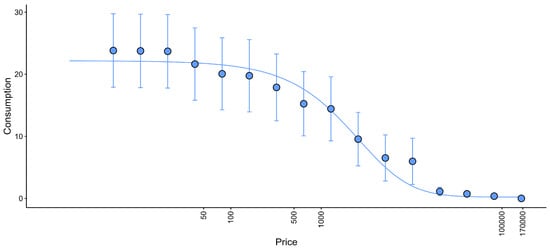
Demographic characteristics of the study sample are summarized in Table 1. Participants were primarily White and male, with an average age of 38.55 years. As shown in Figure 1, consumption decreased on the MIPT as the price of the intervention increased. Following estimation of the demand equation, extracted demand indices showed that average intensity was 31.16 (SD = 39.56), Pmax was 3066.79 (SD = 6883.60), Omax was 64,603.19 (SD = 192,210.80), alpha was 1.21 (SD = 2.16), and break point was 9591.77 (SD = 21,193.26). Given that MIPT intensity included a standard deviation larger than the mean, the distribution for this variable was severely skewed. Furthermore, 11 (35.48%) veterans reported an intensity of ≥30 on the MIPT, indicating that they may have exhibited clinically significant moral injury.
Table 1.
Demographic characteristics of the veteran participants in this pilot study (n = 31).
Figure 1.
Hypothetical demand curve with 95% confidence intervals based on military veteran participant data from the Moral Injury Purchase Task (n = 31).
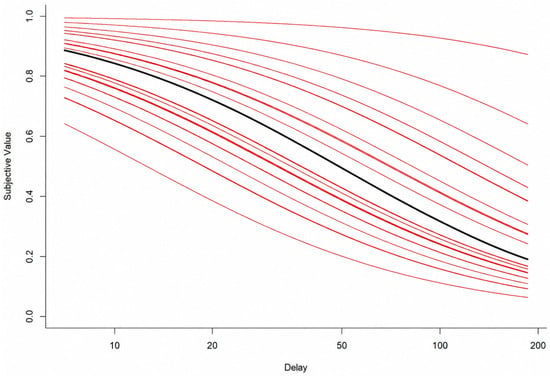
As expected, discounting curves were downward sloping, suggesting that preference for delayed rewards decreased as the delay was lengthened (Figure 2). Discounting varied across individuals; however, most veterans’ curves started to decline around a delay of ten. The sharpest decline in preference for the delayed reward was between days 20 and 100. Descriptive analysis showed that the average AUC value was 0.40 (SD = 0.19), and the average ED50 was 5.22 (SD = 6.93).
Figure 2.
Individual delay discounting curves (in red), with a mean (in black) curve, from military veteran participants on the Monetary Choice Questionnaire (n = 31).
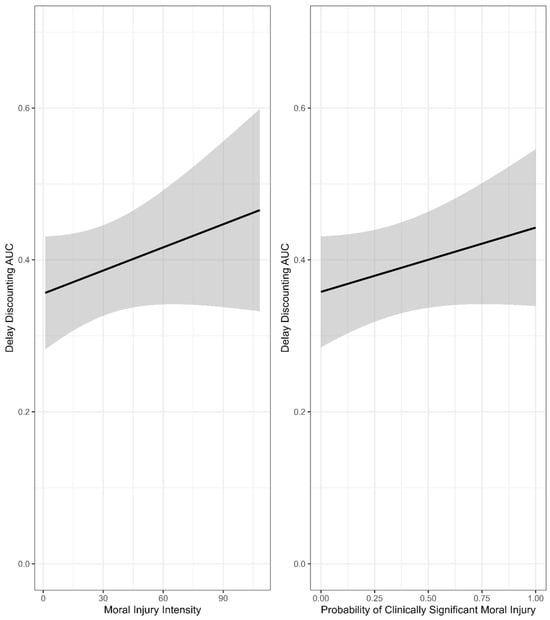
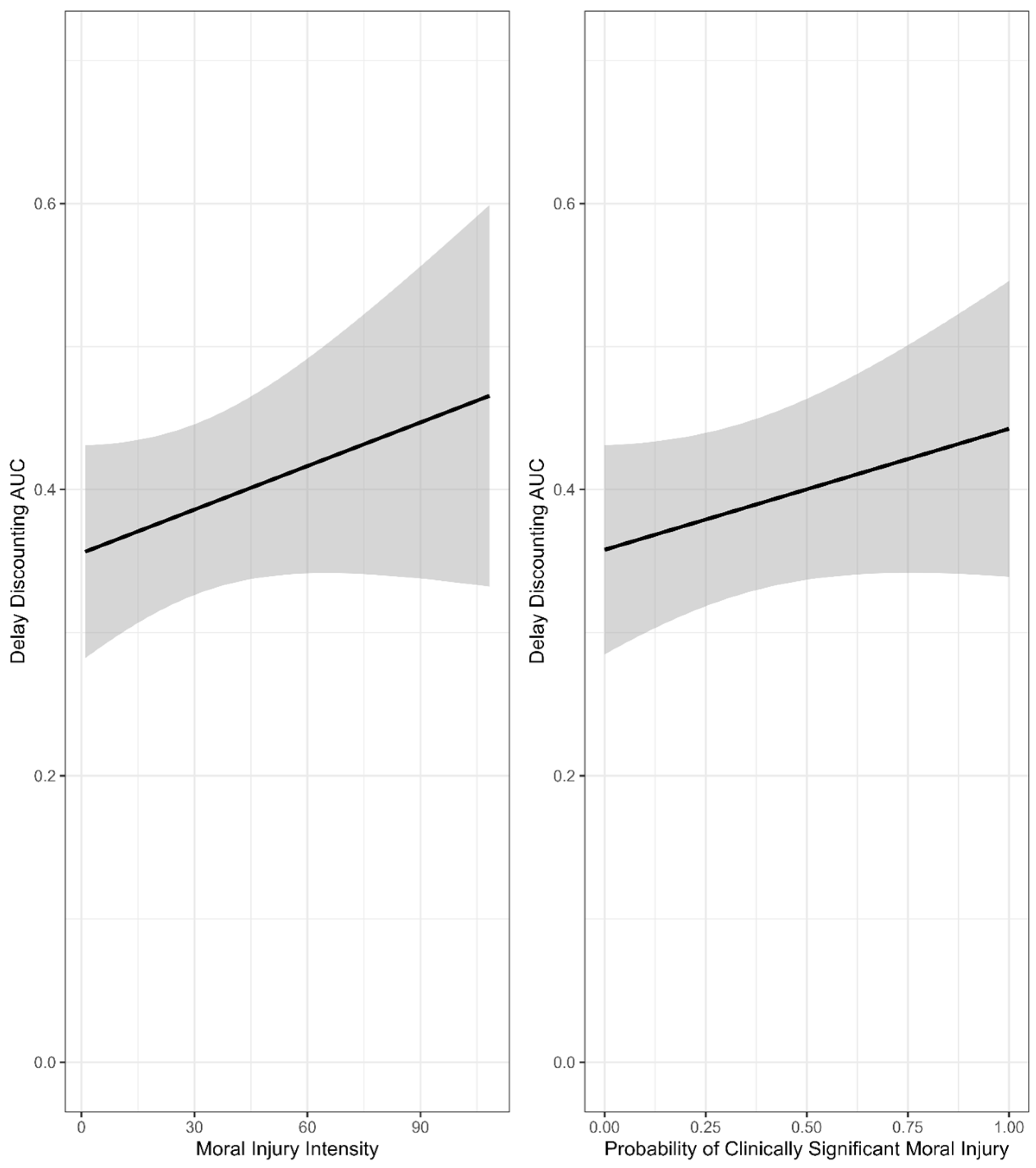
Figure 3 summarizes the results of the multivariable linear regression models, where AUC and ED50 served as dependent variables and behavioral economic indices from the MIPT served as independent variables. Results showed that moral injury intensity was positively associated with delay discounting AUCs after adjustment for covariates (b = 0.002, SE = 0.001, p = 0.04). The magnitude of the significant intensity effect (b = 0.002 on an AUC scale of 0–1) is very small relative to the intensity range, such that a one-unit increase corresponded to a small shift in AUC. Furthermore, clinically significant moral injury, indicated by MIPT intensity scores ≥ 30, was also associated with delay discounting AUCs after adjustment for covariates (b = 0.17, SE = 0.07, p = 0.02). These results suggest that increasing levels of moral injury severity may be associated with greater levels of impulsivity (Figure 3). Models for the ED50 did not exhibit statistical significance.
Figure 3.
Multivariable linear regression results for the adjusted association between moral injury and the delay discounting area under the curve with corresponding 95% confidence intervals in gray (n = 31). Note: The moral injury intensity panel included a regression coefficient of b = 0.002 (p = 0.04) while the probability of clinically significant moral injury panel included a regression coefficient of b = 0.17 (p = 0.02).
4. Discussion
The present study examined the correlation between moral injury and delay discounting (i.e., impulsivity), which has been shown to predict adverse outcomes, including substance use [17]. In this study, delay discounting was positively associated with moral injury intensity as measured with the Moral Injury Purchase Task (MIPT), which has been shown in previous studies to be the most sensitive behavioral economic index in hypothetical purchase tasks [27]. Although moral injury has not been examined specifically in previous delay discounting studies, previous meta-analyses have found an association between delay discounting and adverse mental health outcomes [28]. The aforementioned association suggests that veterans with a higher intensity of moral injury may also have more severe impulsivity and thus be at greater risk for suicidality and substance use. The present study also showed that moral injury intensity scores > 30, which has been suggestive of clinically significant and diagnosable moral injury [20], were associated with higher levels of delay discounting.
The correlation between moral injury and delay discounting presents an opportunity for continued research, which may lead to effective screening to address moral injury’s detrimental effects on health, including increased risks of mental health disorders, substance use, and impaired decision-making. Moral injury can lead to profound psychological distress, yet stigma frequently discourages individuals from disclosing their experiences and seeking help. Traditional screening methods for moral injury, such as self-report questionnaires or clinical interviews, may exacerbate this issue by requiring veterans to explicitly recount traumatic or guilt-inducing events, which can feel confrontational or shameful. For instance, measures like the Moral Injury Questionnaire-Military Version (MIQ-M) often ask direct questions about morally transgressive acts, which may lead to underreporting due to fear of judgment or reluctance to relive painful memories [13]. This reluctance can result in veterans providing untruthful or incomplete responses, undermining the accuracy of these tools and delaying critical interventions.
In contrast, behavioral economic tasks like the delay discounting tool and the MIPT offer a more discreet and less invasive approach to screening. The delay discounting task measures preferences for immediate versus delayed rewards, indirectly reflecting impulsivity and decision-making patterns associated with moral injury without requiring explicit disclosure of personal experiences. Similarly, the MIPT, adapted from behavioral economics, assesses the value individuals place on hypothetical moral injury treatment [20]. These tools are less likely to trigger or elicit defensiveness or shame, as they focus on behavioral tendencies rather than personal histories or potentially stigmatizing experiences, making them particularly suitable for veterans who may be hesitant to engage with traditional measures that may carry more stigma or feel pathologizing. When used in clinical settings, reliance on traditional measures may unintentionally create additional barriers to disclosure, engagement, and access to care.
Following continued research and a stronger evidence base, implementing these tasks in routine health assessments, such as within Veterans Affairs (VA) clinics or primary care settings, could improve early identification of moral injury, especially among veterans who might otherwise avoid seeking help due to stigma. By capturing subtle behavioral markers of distress, these tools may facilitate timely interventions, such as moral-injury-specific treatments [29,30].
The stigma surrounding mental health has pervaded the military and veteran community for decades [31]. Although there have been efforts to improve the delivery of mental health services, public health practitioners and researchers are determined to implement policies and guidelines aimed at enhancing the healthcare experience for service members and veterans. The VA healthcare system strives to provide outreach programs and resources to support the veteran population [32,33].
Civilian health care systems are now providing outpatient therapy sessions to military veterans diagnosed with posttraumatic stress disorders, depression, and generalized anxiety at almost the same rate as VA providers. The application of the delay discounting tool in these settings may facilitate earlier identification of veterans at elevated risk by capturing impulsive decision-making patterns associated with suicide vulnerability and other adverse mental health outcomes.
Additionally, a possible alternative interpretation is that delay discounting captures more than impulsivity alone. Veterans experiencing moral injury may struggle with future orientation, meaning, or unresolved moral conflict, leading to a greater preference for immediate rewards over delayed rewards. Future research might examine whether veterans perceive that delay discounting reflects not only psychological distress but also veterans’ efforts to manage, avoid, or resolve moral pain and whether these influence treatment engagement, recovery, and reintegration outcomes. Such work may help clarify whether delay discounting functions primarily as a marker of impulsivity or whether it also reflects disruptions in both future orientation and processes related to engaging in moral repair and healing.
The research team selected a cross-sectional pilot study design to examine the correlation between moral injury and delay discounting; thus, the investigators could not make causal inferences [34]. Social desirability bias should be taken into consideration when using survey instruments that include self-report strategies, as participants may consciously or unconsciously tailor their answers to align with perceived social norms or expectations rather than their true beliefs, behaviors, or experiences. Since the research participants (n = 31) were gathered from a college certificate program, the study may not be generalizable to the broader veteran community due to selection bias toward highly educated participants. Additionally, the MIPT has only been validated by the research team associated with this manuscript and thus may need further external validation to verify scientific accuracy. Furthermore, we may have missed some important covariates, such as military branch and years of service, but given the limited sample size, we wouldn’t have been able to adjust for these variables in our models.
Lastly, since this project was a pilot study and used a small sample size, it is possible that models were underpowered to detect significant relationships; therefore, results should be interpreted with caution. Because this was an exploratory pilot study designed to identify potential associations between moral injury demand indices and delay discounting, the statistically significant associations observed should be interpreted cautiously, as they may represent chance findings and require replication in larger, adequately powered studies with prespecified hypotheses.
5. Conclusions
In this pilot study, we found that greater moral injury intensity may be associated with greater delay discounting among military veterans. Although these findings are preliminary and should be interpreted cautiously given the cross-sectional design and small sample size, they provide initial evidence supporting the application of behavioral economic approaches to the study of moral injury. Future studies with larger, more diverse veteran samples and longitudinal designs are needed to replicate these findings, clarify the directionality of the association, and determine whether behavioral economic measures such as delay discounting and the Moral Injury Purchase Task may have value as complementary tools for understanding, assessing, and monitoring moral injury in clinical and research settings.
Author Contributions
Conceptualization, J.T.M.; methodology, J.T.M. and E.M.; software, J.T.M. and E.M.; validation, J.T.M. and E.M.; formal analysis, J.T.M. and E.M.; investigation, E.M.; resources, J.T.M.; data curation, J.T.M., E.M. and L.J.; writing—original draft preparation, J.T.M., E.M., J.K., J.N.H., C.M., L.J., K.C. and K.S.; writing—review and editing, J.T.M., E.M., J.K., J.N.H., C.M., L.J., K.C. and K.S.; visualization, E.M.; supervision, J.T.M.; project administration, J.T.M. All authors have read and agreed to the published version of the manuscript.
Funding
This research was funded by the US National Science Foundation, grant number 2321159.
Institutional Review Board Statement
The study was conducted in accordance with the Declaration of Helsinki, and approved by the Institutional Review Board (or Ethics Committee) of Southern Illinois University (protocol code 22043, 3 August 2022).
Informed Consent Statement
Informed consent was obtained from subjects involved in the study.
Data Availability Statement
Data can be made available upon reasonable request.
Acknowledgments
During the preparation of this manuscript/study, the author(s) used ChatGPT 5.5 for the purposes of editing grammar and syntax. The authors have reviewed and edited the output and take full responsibility for the content of this publication.
Conflicts of Interest
Author Logan Jerolds is employed by the company Perk Practical LLC. The remaining authors declare that the research was conducted in the absence of any commercial or financial relationships that could be construed as a potential conflict of interest.
Abbreviations
The following abbreviations are used in this manuscript:
| MIPT | Moral Injury Purchase Task |
| VA | Veterans Affairs |
| DoW | Department of War |
| PTSD | Posttraumatic Stress Disorder |
References
- Sher, L. The Impact of Relationships Within Combat Units on Post-Deployment Suicide Risk. Behav. Sci. 2024, 14, 1040. [Google Scholar] [CrossRef] [Scilit] [PubMed]
- Defense Casualty Analysis System. Defense Causality Analysis System (DCAS). Available online: https://dcas.dmdc.osd.mil/dcas/home (accessed on 28 July 2026).
- Institute of Medicine (US) Committee on the Initial Assessment of Readjustment Needs of Military Personnel, Veterans, and Their Families. Operation Enduring Freedom and Operation Iraqi Freedom: Demographics and Impact. In Returning Home from Iraq and Afghanistan: Preliminary Assessment of Readjustment Needs of Veterans, Service Members, and Their Families; National Academies Press: Washington, DC, USA, 2010. Available online: https://www.ncbi.nlm.nih.gov/books/NBK220068/ (accessed on 28 July 2026).
- Pursel, A.; Nichols, R.; Lindquist, K. Combat amputee care for global war on terror veterans: A systematic review. J. Mil. Veteran Fam. Health 2024, 10, 7–29. [Google Scholar] [CrossRef] [Scilit] [PubMed]
- Williams, C.L.; Berenbaum, H. The regretted actions and inactions of military veterans and psychological problems. Cogn. Ther. Res. 2024, 48, 923–931. [Google Scholar] [CrossRef] [Scilit]
- Litz, B.T.; Plouffe, R.A.; Nazarov, A.; Murphy, D.; Phelps, A.; Coady, A.; Houle, S.A.; Dell, L.; Frankfurt, S.; Zerach, G.; et al. Defining and assessing the syndrome of moral injury. Front. Psychiatry 2022, 13, 923928. [Google Scholar] [CrossRef] [Scilit] [PubMed]
- Maguen, S.; Griffin, B.; Pietrzak, R.; McLean, C.; Hamblen, J.; Norman, S. Prevalence of moral injury in a nationally representative sample of combat veterans, healthcare workers, and first responders. J. Gen. Intern. Med. 2026, 41, 424–430. [Google Scholar] [CrossRef] [Scilit] [PubMed]
- Richardson, N.M.; Lamson, A.L.; Smith, M.; Eagan, S.M.; Zvonkovic, A.M.; Jensen, J. Defining moral injury among military populations: A systematic review. J. Trauma Stress 2020, 33, 575–586. [Google Scholar] [CrossRef] [Scilit] [PubMed]
- McDaniel, J.T.; Redner, R.; Jayawardene, W.; Haun, J.; Clapp, J.; Che, D.; Renzaglia, K.; Abou-Jabal, D. Moral injury is a risk factor for substance use and suicidality among military veterans with traumatic brain injury. J. Relig. Health 2023, 62, 3926–3941. [Google Scholar] [CrossRef] [Scilit] [PubMed]
- McDaniel, J.T.; Redner, R.; Haun, J.; McCowen, P.; Higgins, S.T. Moral injury among women military veterans and demand for cigarettes: A behavioral economic investigation using a hypothetical purchase task. Prev. Med. 2024, 188, 108036. [Google Scholar] [CrossRef] [Scilit] [PubMed]
- Houle, S.A.; Pollard, C.; Jetly, R.; Ashbaugh, A.R. Barriers and facilitators of help seeking among morally injured Canadian Armed Forces veterans and service members: A qualitative analysis. J. Mil. Veteran Fam. Health 2022, 8, 58–71. [Google Scholar] [CrossRef] [Scilit]
- Weiss, E.L.; Rubin, A.; Graeser, N. Transitioning to Civilian Life Scale (TCLS): Development, reliability, and validity. Mil. Behav. Health 2019, 7, 74–84. [Google Scholar] [CrossRef] [Scilit]
- Currier, J.M.; Holland, J.M.; Malott, J. Moral injury, meaning making, and mental health in returning veterans. J. Clin. Psychol. 2015, 71, 229–240. [Google Scholar] [PubMed]
- Olin, C.C.; McDevitt, M.M.E.; Murphy, J.G.; Zakarian, R.J.; Roache, J.D.; Young, M.S.; Litz, B.T.; Keane, T.M.; Peterson, A.L. The associations between posttraumatic stress disorder and delay discounting, future orientation, and reward availability: A behavioral economic model. J. Trauma Stress 2022, 35, 1252–1262. [Google Scholar] [CrossRef] [Scilit] [PubMed]
- Bird, B.M.; Levitt, E.E.; Stewart, S.H.; Wanklyn, S.G.; Meyer, E.C.; Murphy, J.G.; McDevitt-Murphy, M.E.; MacKillop, J. Posttraumatic stress and delay discounting: A meta-analytic review. Psychol. Med. 2023, 54, 437–446. [Google Scholar] [CrossRef] [Scilit] [PubMed]
- McManimen, S.L.; Hay, J.; Long, C.; Bryan, C.J.; Aase, D.M. Associations among postruamtic stress disorder symptoms, suicidal ideation, suicide attempts, and reward discounting. Stress Health J. Int. Soc. Investig. Stress 2024, 40, e3370. [Google Scholar] [CrossRef] [Scilit] [PubMed]
- Reynolds, B. A review of delay-discounting research with humans. Behav. Pharmacol. 2006, 17, 651–667. [Google Scholar] [CrossRef] [Scilit] [PubMed]
- Barnes, H.A.; Hurley, R.A.; Taber, K.H. Moral injury and PTSD: Often co-occurring yet mechanistically different. J. Neuropsychiatry Clin. Neurosci. 2019, 31, A4-103. [Google Scholar] [CrossRef] [Scilit] [PubMed]
- Stein, J.S.; Koffarnus, M.N.; Snider, S.E.; Quisenberry, A.J.; Bickel, W.K. Identification and management of nonsystematic purchase task data: Toward best practice. Exp. Clin. Psychopharmacol. 2015, 23, 377–386. [Google Scholar] [CrossRef] [Scilit] [PubMed]
- McDaniel, J.T.; Jenkins, W.D.; Hughes, C. Establishing diagnostic criteria for moral injury in United States military veterans. Health Behav. Policy Rev. 2024, 11, 1700–1709. [Google Scholar]
- Jacobs, E.A.; Bickel, W.K. Modeling drug consumption in the clinic using simulation procedures. Exp. Clin. Psychopharmacol. 1999, 7, 412–426. [Google Scholar] [CrossRef] [Scilit] [PubMed]
- Kirby, K.N. One-year temporal stability of delay-discounting rates. Psychon. Bull. Rev. 2009, 16, 457–462. [Google Scholar] [CrossRef] [Scilit] [PubMed]
- Kirby, K.N.; Petry, N.M.; Bickel, W.K. Heroin addicts have higher discount rates for delayed rewards than non-drug using controls. J. Exp. Psychol. Gen. 1999, 128, 78–87. [Google Scholar] [CrossRef] [Scilit] [PubMed]
- Koffarnus, M.N.; Franck, C.T.; Stein, J.S.; Bickel, W.K. A modified exponential behavioral economic demand model to better describe consumption data. Exp. Clin. Psychopharmacol. 2015, 23, 504–512. [Google Scholar] [CrossRef] [Scilit] [PubMed]
- Myerson, J.; Green, L.; Warusawitharana, M. Area under the curve as a measure of discounting. J. Exp. Anal. Behav. 2013, 76, 235–243. [Google Scholar]
- Yoon, J.H.; Higgins, S.T. Turning k on its head: Comments on the use of an ED50 in delay discounting research. Drug Alcohol Depend. 2008, 95, 169–172. [Google Scholar] [CrossRef] [Scilit] [PubMed]
- Zvorsky, I.; Nighbor, T.D.; Kurti, A.N.; DeSarno, M.; Naude, G.; Reed, D.D.; Higgins, S.T. Sensitivity of hypothetical purchase task indices: A systematic literature review. Prev. Med. 2019, 128, 105789. [Google Scholar] [CrossRef] [Scilit] [PubMed]
- Li, Q.; Zhang, X.; Hu, Z. Delay discounting in emotional disorders: A three level meta-analysis. J. Affect. Dis. 2026, 394, 120515. [Google Scholar] [CrossRef] [Scilit] [PubMed]
- Litz, B.T.; Lebowitz, L.; Gray, M.J.; Nash, W.P. Adaptive Disclosure: A New Treatment for Military Trauma, Loss, and Moral Injury; Guilford Press: New York, NY, USA, 2017. [Google Scholar]
- McDaniel, J.T.; Ezigbo, U.; Copeland, P. A moral injury intervention to decrease moral injury severity: An ‘ABA’ single subject design with a rural woman veteran. J. Relig. Spiritual. Soc. Work Soc. Thought 2026, 45, 66–85. [Google Scholar] [CrossRef] [Scilit]
- McGuffin, J.J.; Riggs, S.A.; Raiche, E.M.; Romero, D.H. Military and veteran help seeking behaviors: Role of mental health stigma and leadership. Mil. Psychol. 2021, 33, 332–340. [Google Scholar] [CrossRef] [Scilit] [PubMed]
- US Department of Veterans Affairs. MIRECC/COE Home. 2025. Available online: https://www.mirecc.va.gov/ (accessed on 28 July 2026).
- US Department of Veterans Affairs. National Veteran Suicide Prevention Annual Report. 2024. Available online: https://www.mentalhealth.va.gov/docs/data-sheets/2024/2024-Annual-Report-Part-1-of-2_508.pdf (accessed on 28 July 2026).
- Savitz, D.A.; Wellenius, G.A. Can cross-sectional studies contribute to causal inference? Am. J. Epidemiol. 2023, 192, 514–516. [Google Scholar] [CrossRef] [Scilit] [PubMed]

Disclaimer/Publisher’s Note: The statements, opinions and data contained in all publications are solely those of the individual author(s) and contributor(s) and not of MDPI and/or the editor(s). MDPI and/or the editor(s) disclaim responsibility for any injury to people or property resulting from any ideas, methods, instructions or products referred to in the content. |
© 2026 by the authors. Licensee MDPI, Basel, Switzerland. This article is an open access article distributed under the terms and conditions of the Creative Commons Attribution (CC BY) license.