


Abstract
This study investigated academic and environmental predictors of national licensing examination success among physical therapy graduates in Thailand, examining overall academic achievement, domain-specific competencies (Code 01: Law/Ethics/Administration; Code 02: Techniques; Code 03: Clinical), admission pathway, and COVID-19-related online-learning disruption. This retrospective cohort study analyzed 342 graduates (2020–2023) using multivariable logistic regression and Pearson correlation, with GPA-based predictors rescaled per 0.1-point increase. Undergraduate GPAX and Code 02/03 grades were the strongest positive predictors of both first-attempt and annual licensing success (adjusted OR range 1.35–1.74, all p < 0.001). Online-learning duration reduced first-attempt odds by 24% (OR = 0.757, p = 0.036) but did not affect annual success, while TCAS admission round was a significant negative predictor of first-attempt success only in the model excluding domain-specific scores (OR = 0.671, p = 0.011); Code 01 score was not significant in any model. These findings indicate that domain-specific academic performance, rather than general achievement or admission pathway, was the strongest predictor of licensing success, underscoring the value of early monitoring of coursework performance for identifying at-risk students.
1. Introduction
Higher education institutions worldwide are increasingly expected to demonstrate that graduates possess the competencies required for professional practice. As governments, employers, and accreditation bodies place growing emphasis on graduate outcomes, licensure and certification examinations have become key indicators of workforce readiness and educational quality. Understanding what predicts success in these high-stakes assessments is therefore critical for student support, curriculum development, and quality improvement [1].
Health professions education faces particularly strong expectations for graduate competence, since licensure examinations serve as gatekeepers to practice and public safety. Cumulative GPA and early academic performance have consistently been associated with licensure success across health professions, including physical therapy [2,3,4,5], and preadmission characteristics such as standardized admission scores have shown similar associations [6]. These findings suggest that both entry characteristics and educational experiences contribute to graduate readiness.
Despite the literature, gaps remain regarding the relative contribution of specific educational experiences to examination success. Existing studies have largely focused on overall academic achievement, whereas the predictive value of competency domains within professional curricula remains less clear—particularly whether theoretical competencies (e.g., law, ethics, and administration) or practical and clinical competencies more strongly predict licensure performance, and evidence linking coursework assessment to clinical performance more broadly remains inconsistent [7]. It is also unclear whether admission pathways continue to influence outcomes once students progress through a competency-based curriculum.
These questions are particularly relevant where students enter higher education through diverse admission pathways, which range internationally from single standardized examinations to multi-stage processes combining academic records, aptitude tests, and interviews; selection criteria at entry can meaningfully predict subsequent academic performance [8]. In Thailand, undergraduate admissions use the Thai University Central Admission System (TCAS), comprising several recruitment rounds with differing selection criteria and applicant profiles. While admission mechanisms are assumed to influence academic success, evidence on their long-term association with licensure outcomes remains limited—insight that could inform both admission policy and targeted academic support.
The COVID-19 pandemic posed an additional challenge for professional education globally, forcing programs reliant on practical training to rapidly shift online, raising concerns about competency development. Systematic reviews suggest that prolonged e-learning constrained hands-on skill acquisition in health profession education [9,10], with similar disruptions documented more broadly across medical education [11]. However, the long-term consequences of these disruptions for licensure examination performance remain poorly understood.
Health professions relying on national licensure examinations as gatekeepers to practice—including medicine, nursing, dentistry, and allied health fields such as physical therapy—share these challenges in preparing graduates for high-stakes assessment [12]. Physical therapy provides a valuable case study, since graduates must demonstrate practice readiness through a national licensure examination before entering the workforce. Therefore, this study investigated academic and environmental predictors of national licensing examination success among physical therapy graduates in Thailand, examining overall academic achievement, domain-specific competencies, admission pathway, and COVID-19-related online-learning disruption on both first-attempt and cumulative annual examination outcomes. Beyond physical therapy, these findings may offer a transferable model for identifying at-risk students and aligning curricula with licensure requirements across health professions sharing similar competency-based assessment structures.
2. Materials and Methods
2.1. Ethics Statement
This study was approved under exempt review by the Human Research Ethics Committee of Walailak University (certificate no. WUEC-25-272-01). Because this research utilized retrospective, fully de-identified institutional records, the requirement for active informed consent was waived by the committee.
2.2. Study Design
This was a retrospective cohort study.
2.3. Setting
The study was conducted at Walailak University, Nakhon Si Thammarat, Thailand, which operates a trimester academic calendar for its four-year professional physical therapy curriculum. The study population comprised four consecutive graduating cohorts, academic years 2020 to 2023, a period spanning the years immediately preceding and during the COVID-19 pandemic. Licensure outcomes were ascertained from national examination records administered by the Physical Therapy Council of Thailand.
2.4. Participants
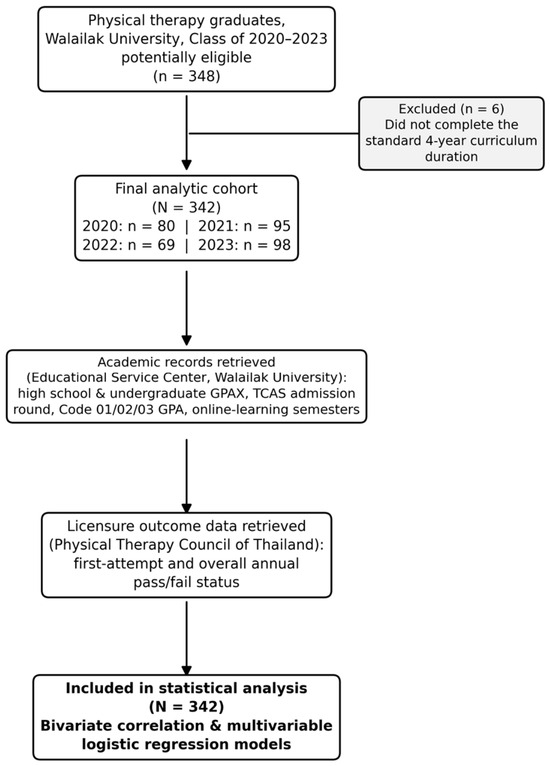
Eligible participants were physical therapy graduates of Walailak University from the Class of 2020 to 2023 who completed the four-year curriculum within the standard duration. Of 348 graduates who potentially met eligibility criteria, 6 were excluded for completing the curriculum beyond the standard 4-year duration, yielding a final analytic cohort of N = 342 (2020: n = 80; 2021: n = 95; 2022: n = 69; 2023: n = 98). Participant selection and data flow are detailed in Figure 1.
Figure 1.
Participant selection and data flow for physical therapy graduates, Walailak University, Class of 2020–2023. Of 348 graduates who potentially met eligibility criteria, 6 were excluded for not completing the curriculum within the standard 4-year duration, yielding a final analytic cohort of N = 342 (2020: n = 80; 2021: n = 95; 2022: n = 69; 2023: n = 98).
2.5. Variables
The outcome variables were first-attempt licensing examination result (pass/fail) and overall annual cumulative pass status (pass/fail, allowing for re-examination within the same year). The primary exposure variables were undergraduate cumulative GPAX and grade in three national licensing-examination content domains: Code 01 (Law, Ethics, and Administration), Code 02 (Techniques), and Code 03 (Clinical). Here, “Code 01–03” denote the three content domains assessed on the national physical therapy licensing examination, and the corresponding “GPA of Code 01–03” variables refer to students’ cumulative undergraduate course grades in coursework mapped to each domain, rather than to performance on the licensing examination itself. Covariates were high school cumulative GPA, Thai University Central Admission System (TCAS) university admission round, and number of online-learning semesters completed during the curriculum. GPA-based variables were treated as continuous predictors, rescaled per 0.1-point increase for interpretability; TCAS admission round was treated as an ordinal covariate (Round 1 = 1 to Round 4 = 4); and the number of online-learning semesters was treated as a continuous count variable.
2.6. Data Sources/Measurement
Data were obtained from two official institutional sources after authorization. The Educational Service Center of Walailak University provided high school and undergraduate cumulative GPAX, TCAS admission round, GPA in the Code 01/02/03 domains, and number of online-learning semesters, all extracted directly from official academic transcripts and enrollment records. The Physical Therapy Council of Thailand provided first-attempt and overall annual pass/fail status from national examination records. All data were anonymized prior to analysis and managed in Microsoft Excel. Because all variables were drawn from complete official institutional and national examination records for the entire eligible cohort, there were no missing values for any variable, and no missing-data imputation procedures were required.
TCAS, established in 2018, is the centralized nationwide platform through which nearly all Thai universities admit undergraduate students, via four sequential rounds of decreasing selectivity: Round 1 (portfolio review, no written examination), Round 2 (quota, regional/talent-based criteria), Round 3 (admission, matched via standardized national test scores), and Round 4 (direct Admission, filling remaining seats).
2.7. Potential Bias and Confounding
Several potential sources of bias were addressed. Selection bias was minimized by including the complete eligible cohort across four consecutive years, using a single, pre-specified exclusion criterion applied uniformly. Information bias was minimized by obtaining all variables from official institutional and national examination records rather than self-report. Because Undergraduate GPAX, Subject Code 02, and Subject Code 03 scores were highly collinear (Pearson r > 0.85), entering them simultaneously would have introduced substantial multicollinearity; this was addressed by fitting three separate models, each isolating one collinear predictor while retaining the remaining covariates. Confounding by admission pathway and prior academic ability was addressed by including high school GPA and TCAS admission round as covariates in all models.
2.8. Study Size
No a priori sample size or power calculation was performed. The study included the complete, retrospectively identifiable population of physical therapy graduates who met the eligibility criteria across four consecutive academic cohorts (2020–2023) at the single participating institution (N = 342), rather than a randomly drawn subsample; the achieved size therefore reflects the total available eligible population during the observation period.
2.9. Statistical Methods
Descriptive statistics summarized categorical (frequencies/percentages) and continuous (mean ± SD) variables. Bivariate Pearson correlation screened for multicollinearity among continuous academic predictors; formal variance inflation factor (VIF) diagnostics were not computed, so the correlation matrix served as the basis for identifying and addressing collinear predictors. Because Undergraduate GPAX, Subject Code 02, and Subject Code 03 scores were highly collinear (r > 0.85), entering them simultaneously in a single model would have inflated standard errors and produced unstable, difficult-to-interpret coefficient estimates for each predictor; three separate multivariable binary logistic regression models were fitted to isolate their independent effects, with Models 1.1/2.1 (Undergraduate GPAX), Models 1.2/2.2 (Subject Code 02), and Models 1.3/2.3 (Subject Code 03). High school GPA, TCAS admission round, online-learning semesters, and Subject Code 01 score were entered as covariates in all models. Models 1.1–1.3 predicted annual cumulative success; Models 2.1–2.3 predicted first-attempt success. Adjusted Odds Ratios (ORs) and 95% CIs for GPA-based predictors are expressed per 0.1-point increase for interpretability; count-based variables remain on their original scale. TCAS admission round was retained as an ordinal covariate (Round 1 = 1 to Round 4 = 4) rather than a fully categorical (dummy-coded) variable. This decision reflects both a substantive and a statistical consideration. Substantively, the four TCAS rounds occur in a fixed temporal and increasingly inclusive sequence, with later rounds progressively opening admission to a broader applicant pool after earlier, more selective rounds are filled; treating round as an ordered variable is therefore consistent with this underlying admission structure. Statistically, the four rounds were highly imbalanced in size (Round 1: n = 106; Round 2: n = 47; Round 3: n = 182; Round 4: n = 7, or 2.0% of the sample), and fully categorical dummy-coding would have used this very small Round 4 subgroup as a comparison category, producing unstable coefficient estimates prone to inflated standard errors and potential quasi-complete separation. The ordinal specification was therefore judged to provide a more stable and interpretable estimate of the admission-round gradient than a saturated categorical model, at the cost of assuming a monotonic relationship across rounds. Model fit was assessed with Nagelkerke’s R2, the Hosmer–Lemeshow goodness-of-fit test, and overall classification accuracy. Analyses used IBM SPSS Statistics 25.0 (IBM Corp., Armonk, NY, USA), with significance set at p < 0.05. Regression coefficients (B), Wald statistics, and adjusted ORs with 95% CIs were computed for each model.
This study is reported in accordance with the STROBE (STrengthening the Reporting of OBservational studies in Epidemiology) guideline for cohort studies (see Supplementary Materials). Generative artificial intelligence (Claude, Anthropic) was used to assist with manuscript text editing and language revision; it was not used for study design, data collection, statistical analysis, or interpretation of results, which were performed entirely by the authors.
3. Results
3.1. Participant Characteristics and Pass Rates
A final analytic cohort of 342 physical therapy graduates (Class of 2020–2023; 2020: n = 80; 2021: n = 95; 2022: n = 69; 2023: n = 98) was included (Figure 1, Table 1). The overall first-attempt pass rate was 47.95% (n = 164), ranging from 65.00% (2020) to 33.67% (2023), while the overall annual cumulative pass rate was 81.87% (n = 280). Online-learning exposure ranged from three to seven semesters, peaking in 2022. Mean high school and Undergraduate GPAX were 3.32 ± 0.33 and 3.21 ± 0.38, respectively. The distribution of TCAS admission rounds also shifted markedly across cohorts: Round 1 accounted for 82.50% of the 2020 cohort but fell to 14.49–15.79% in 2021–2023, while Round 3 rose from 8.75% (2020) to 62.11–73.91% (2021–2023) (Table 1).
Table 1.
Academic characteristics and license examination pass rates of Physical Therapy graduates (N = 342).
3.2. Bivariate Correlation Analysis of Academic Predictors
Bivariate correlations (Table 2) showed statistically significant positive associations among all academic metrics (p < 0.001). Undergraduate GPAX correlated strongly with Subject Code 02 (r = 0.865) and Code 03 (r = 0.856), and Codes 02 and 03 were highly correlated with each other (r = 0.902), indicating substantial multicollinearity among these variables. High school GPAX showed only weak-to-moderate correlations with university-level variables (r = 0.207–0.309).
Table 2.
Pearson correlation matrix among undergraduate academic performances and high school GPAX (N = 342).
3.3. Multivariable Predictors of Licensing Examination Success
Because of the high collinearity among Undergraduate GPAX, Code 02, and Code 03 scores, three separate logistic regression models were fitted for annual cumulative success (Table 3) and first-attempt success (Table 4).
Table 3.
Multivariable logistic regression models predicting annual cumulative licensing success (N = 342).
Table 4.
Multivariable logistic regression models predicting immediate first-attempt licensing success (N = 342).
GPA-based predictors are expressed as adjusted ORs per 0.1-point increase, given the limited realistic range of GPA variation; count-based variables (online semesters, TCAS admission round) remain on their original scale.
3.3.1. Annual Cumulative Licensing Success (Models 1.1, 1.2, and 1.3)
Undergraduate GPAX, Subject Code 02 score, and Subject Code 03 score were each independent, statistically significant positive predictors of annual cumulative success across their respective models (all p < 0.001; Table 3), with the model containing Subject Code 03 explaining the greatest variance (Nagelkerke R2 = 0.482). TCAS admission round, high school GPA, online-learning semesters, and Subject Code 01 score were not significant predictors in any of the Models 1.1–1.3 (Table 3). This pattern confirms that core professional-domain performance provides substantially greater explanatory power than overall GPA alone. Hosmer–Lemeshow goodness-of-fit tests did not indicate significant lack of fit for any of the three annual-success models (all p > 0.43; Table 3).
3.3.2. Immediate First-Attempt Licensing Success (Models 2.1, 2.2, and 2.3)
The same three core predictors were again significant positive predictors of first-attempt success across their respective models (all p < 0.001; Table 4), with the model containing Subject Code 03 showing the best fit (Nagelkerke R2 = 0.446). Two secondary patterns emerged that were specific to first-attempt success. First, the number of online-learning semesters was a significant negative predictor only in the model containing Subject Code 02, where each additional online-learning semester reduced the odds of first-attempt success by approximately 24% (Table 4); this effect was not significant in the other two models, nor for annual cumulative success. Second, unlike in preliminary analyses, Subject Code 01 score was not a significant predictor once the core professional-domain predictor was entered in any model, and TCAS admission round reached significance only in the model containing overall GPAX rather than domain-specific scores (Table 4). This pattern mirrors the annual-success models, reaffirming that professional-domain competency—rather than generic academic achievement—is the strongest predictor of licensure outcomes across both outcome timeframes. Hosmer–Lemeshow tests likewise indicated adequate fit for all three first-attempt models (all p > 0.50; Table 4). Overall classification accuracy ranged from 86.8% to 88.3% for the annual-success models and from 68.7% to 76.3% for the first-attempt models, though annual-model accuracy was likely inflated by the imbalanced outcome distribution (82% annual pass rate), which would be expected to yield higher sensitivity than specificity for these models.
4. Discussion
Taken together, these findings point to a consistent hierarchy among the predictors examined: domain-specific professional coursework outperformed both generic academic achievement and admission pathway, while online-learning exposure showed a more limited, timeframe-specific association. The following sections interpret each of these patterns in turn.
The dominance of Code 02 and Code 03 performance likely reflects their close alignment with the clinical reasoning and practical decision-making assessed on the national examination, and their high intercorrelation (r = 0.902) suggests these courses may function as internal proxies for licensure-relevant competency, consistent with evidence that coursework assessments can track subsequent clinical performance [7]. High school GPA and Subject Code 01 score losing predictive value once professional coursework was entered is consistent with the interpretation that generic prior academic ability matters less as students progress into specialized, competency-based training [13].
The persistence of a TCAS admission-round effect only in the model containing overall GPAX—but not once domain-specific scores (Code 02 or Code 03) were included—suggests that the apparent disadvantage associated with later admission rounds does not persist independently of subsequent domain-specific academic performance, with which it is closely correlated not as an independent barrier to licensure success, consistent with evidence that proximal and distal predictors of academic performance tend to share substantial explained variance [14]. This pattern is consistent with admission pathway being associated with, rather than exerting a direct and persistent independent effect on, subsequent licensure outcomes once professional coursework performance is accounted for. Similarly, the differentiated impact of online learning—significant for first-attempt but not annual cumulative success—suggests a temporary rather than a persistent disadvantage, though the retrospective, cohort-level design cannot establish whether this pattern reflects a temporary skill–acquisition gap, subsequent institutional remediation of the kind shown to help offset pandemic-related clinical skills deficits elsewhere [15], or other unmeasured factors that changed across cohorts.
These findings are broadly consistent with prior work linking cumulative GPA and course-level academic performance to licensure success in physical therapy and other health professions [2,3,4,5,16,17], and with reports from the Philippines [18] and Thailand [19,20] describing similar associations in non-US curricula. The GPA-based odds ratios observed here (adjusted OR per 0.1-point increase of approximately 1.3–1.7) are comparable in magnitude to those previously reported for undergraduate GPA and licensure-related outcomes [2,4]. The negative effect of online-learning duration on first-attempt success aligns with reviews describing pandemic-era constraints on clinical skill acquisition [9,10], and the concurrent rise in GPAX alongside falling pass rates mirror pandemic-associated grade inflation reported elsewhere [21]. This may partly reflect the online platforms used to evaluate clinical and psychomotor skills during this period, as live and video-based assessment formats have shown inconsistent measurement agreement in healthcare education, with some studies reporting reduced fidelity for video-based formats relative to direct observation [22]. An admission-pathway effect persisted only alongside overall GPAX, and was absorbed once domain-specific scores were entered, having no clear precedent in the reviewed literature, which has generally examined preadmission or overall academic variables [4,5,6] in isolation rather than jointly with domain-specific coursework, and may represent a curriculum-specific finding warranting replication. Finally, the diminishing effect of admission pathway once professional coursework was entered echoes findings that specific preadmission credentials, such as prior degree type, do not meaningfully differentiate later professional-phase outcomes [16], though comparison is limited by cross-country variation in admission systems [23].
4.1. Limitations
Despite a comprehensive four-year sample, several limitations apply. As a single-institution study within a single national licensing system, the magnitude of associations—particularly for online-learning duration and TCAS admission round—may not generalize to institutions with different curricula, admissions systems, or digital infrastructure; however, the broader pattern of professional coursework outperforming generic academic indicators has been reported across diverse settings, including the Philippines [18], other Thai institutions [19,20], and other health professions [2,3,4,5,16,17], suggesting this relationship may generalize even where effect sizes differ. Models captured only academic metrics, not non-academic factors such as psychological distress, burnout, or test-preparation behavior, which have been shown elsewhere to influence examination performance among health professions students [24], nor dispositional traits such as grit and resilience, which are meaningful correlates of student success and coping with pandemic-related disruption [25]. The number of online-learning semesters was determined entirely by graduation cohort (Table 1) rather than individual exposure; this cannot be disentangled from other unmeasured factors that changed across cohorts (e.g., curricular revisions, faculty turnover, examination difficulty), so the effect should be interpreted as a cohort-level association not an individual-level causal exposure. TCAS admission round was modeled as ordinal instead of fully categorical, given the small Round 4 subgroup (n = 7); this assumes a monotonic association and may not fully capture qualitative differences in selection mechanisms between rounds.
4.2. Recommendations for Practice and Future Research
These findings suggest several potential directions institutions may wish to consider, pending further validation: realigning Subject Code 01 instruction toward the case-based approaches used in Codes 02 and 03, an approach supported by meta-analytic evidence that case-based learning combined with problem-based learning improve clinical thinking and practical competency more effectively than traditional lecture-based instruction [26]; providing supplementary hands-on clinical preparation where extended online delivery has been necessary; and monitoring Subject Code 02/03 performance as a potential early indicator for academic support, rather than a fixed threshold, an approach consistent with recent evidence that early academic performance can support at-risk detection in health sciences education [27]. Future research using prospective designs with individual-level tracking of online-learning exposure and replication across other institutions and licensing systems would help establish whether these associations generalize and translate into effective interventions.
5. Conclusions
This study’s principal contribution is demonstrating that domain-specific professional competency outweighs general academic achievement and admission pathway as the strongest predictor of licensure success in this cohort. Prolonged online-learning exposure during COVID-19 was associated with reduced first-attempt—but not annual—pass rates, an association that should be interpreted at the cohort level given the study’s retrospective design. These findings point to early monitoring of domain-specific coursework performance as a potentially useful, low-cost signal for identifying students who may benefit from additional academic support, though the effectiveness of any resulting intervention would need to be evaluated prospectively.
Supplementary Materials
The following supporting information can be downloaded at https://www.mdpi.com/article/10.3390/ime5030090/s1. The STROBE (STrengthening the Reporting of OBservational studies in Epidemiology) checklist for this study is available as Supplementary Material.
Author Contributions
Conceptualization, O.M. and P.V.; methodology, O.M., P.V., N.C., H.P., A.D. and N.H.-I.; formal analysis, O.M., P.V., N.C., H.P., A.D. and N.H.-I.; validation, O.M., P.V., N.C., H.P., A.D. and N.H.-I.; data curation, O.M., P.V., N.C., H.P., A.D. and N.H.-I.; writing—original draft preparation, O.M. and P.V.; writing—review and editing, O.M., P.V., N.C., H.P., A.D. and N.H.-I.; project administration, O.M. All authors have read and agreed to the published version of the manuscript.
Funding
This research received no external funding.
Institutional Review Board Statement
The study was conducted in accordance with the Declaration of Helsinki, and approved under exempt review by the Human Research Ethics Committee of Walailak University (protocol code: WUEC-25-272-01).
Informed Consent Statement
Participant consent was waived due to the retrospective, fully de-identified nature of the institutional academic and examination records used in this study, as approved by the Human Research Ethics Committee of Walailak University.
Data Availability Statement
The data underlying this study are not publicly available due to institutional privacy restrictions on student academic records but are available from the corresponding authors upon reasonable request.
Acknowledgments
The authors thank the Educational Service Center of Walailak University and the Physical Therapy Council of Thailand for providing access to the academic and licensing examination records used in this study. During the preparation of this manuscript, the authors used Claude (Anthropic, Claude Sonnet model) for the purposes of manuscript text editing, drafting revisions to the Introduction and Discussion Sections, reference formatting, and preparing Supplementary Documentation. The authors have reviewed and edited the output and take full responsibility for the content of this publication.
Conflicts of Interest
The authors declare no conflicts of interest.
Abbreviations
The following abbreviations are used in this manuscript:
| GPAX | Grade point average |
| TCAS | Thai University Central Admission System |
| OR | Odds ratio |
| CI | Confidence interval |
| STROBE | STrengthening the Reporting of OBservational studies in Epidemiology |
References
- Caballero, C.L.; Hansen, L.; Walker, A.; Rosenberg, C.; Orr, P.; Claringbold, G.; Sturre, V.L.; Forsyth, L. Untangling graduate employability and work readiness to inform evidence-based practice in higher education. High. Educ. Res. Dev. 2026, 45, 1247–1264. [Google Scholar] [CrossRef] [Scilit]
- Kume, J.; Reddin, V.; Horbacewicz, J. Predictors of physical therapy academic and NPTE licensure performance. Health Prof. Educ. 2019, 5, 185–193. [Google Scholar] [CrossRef] [Scilit]
- Reynolds, B.; Unverzagt, C.; Koszalinski, A.; Gatlin, R.; Seale, J.; Gagnon, K.; Eaton, K.; Koppenhaver, S.L. Predictors of success on the National Physical Therapy Examination in 2 US accelerated-hybrid Doctor of Physical Therapy programs. J. Phys. Ther. Educ. 2022, 36, 225–231. [Google Scholar] [CrossRef] [Scilit]
- Utzman, R.R.; Riddle, D.L.; Jewell, D.V. Use of demographic and quantitative admissions data to predict performance on the National Physical Therapy Examination. Phys. Ther. 2007, 87, 1181–1193. [Google Scholar] [CrossRef] [Scilit]
- Wolden, M.; Hill, B.; Voorhees, S. Predicting success for student physical therapists on the National Physical Therapy Examination: Systematic review and meta-analysis. Phys. Ther. 2020, 100, 73–89. [Google Scholar] [CrossRef] [Scilit]
- Nuciforo, M.; Litvinsky, Y.; Rheault, W. Variables predictive of admission to US physical therapist education programs. J. Phys. Ther. Educ. 2014, 28, 112–119. [Google Scholar] [CrossRef] [Scilit]
- Terry, R.; Hing, W.; Orr, R.; Milne, N. Do coursework summative assessments predict clinical performance? A systematic review. BMC Med. Educ. 2017, 17, 40. [Google Scholar] [CrossRef] [Scilit]
- Mercer, A.; Puddey, I.B. Admission selection criteria as predictors of outcomes in an undergraduate medical course: A prospective study. Med. Teach. 2011, 33, 997–1004. [Google Scholar] [CrossRef] [Scilit]
- Naciri, A.; Radid, M.; Kharbach, A.; Chemsi, G. E-learning in health professions education during the COVID-19 pandemic: A systematic review. J. Educ. Eval. Health Prof. 2021, 18, 27. [Google Scholar] [CrossRef] [Scilit]
- Ng, L.; Seow, K.C.; MacDonald, L.; Correia, C.; Reubenson, A.; Gardner, P.; Spence, A.L.; Bunzli, S.; De Oliveira, B.I.R. eLearning in physical therapy: Lessons learned from transitioning a professional education program to full eLearning during the COVID-19 pandemic. Phys. Ther. 2021, 101, pzab082. [Google Scholar] [CrossRef] [Scilit]
- Chen, S.-Y.; Lo, H.-Y.; Hung, S.-K. What is the impact of the COVID-19 pandemic on residency training: A systematic review and analysis. BMC Med. Educ. 2021, 21, 618. [Google Scholar] [CrossRef] [Scilit]
- Pantaleo, F.; Stievano, A.; Mastroianni, C.; Petrucci, G.; Mazzitelli, N.; Piredda, M.; De Marinis, M.G.; Marchetti, A. The nursing student licensure examination: A scoping review. Nurs. Rep. 2025, 15, 299. [Google Scholar] [CrossRef] [Scilit]
- Desy, J.; Coderre, S.; Veale, P.; Busche, K.; Woloschuk, W.; McLaughlin, K. Can we predict failure in licensure exams from medical students’ undergraduate academic performance? Can. Med. Educ. J. 2021, 12, 6–13. [Google Scholar] [CrossRef] [Scilit]
- Niessen, A.S.M.; Meijer, R.R.; Tendeiro, J.N. Predicting performance in higher education using proximal predictors. PLoS ONE 2016, 11, e0153663. [Google Scholar] [CrossRef] [Scilit][Green Version]
- Saad, S.; Richmond, C.; King, D.; Jones, C.; Malau-Aduli, B. The impact of pandemic disruptions on clinical skills learning for pre-clinical medical students: Implications for future educational designs. BMC Med. Educ. 2023, 23, 364. [Google Scholar] [CrossRef] [Scilit]
- Fell, N.; Mabey, R.; Mohr, T.; Ingram, D. The preprofessional degree: Is it a predictor of success in physical therapy education programs? J. Phys. Ther. Educ. 2015, 29, 13–21. [Google Scholar] [CrossRef] [Scilit]
- Cook, C.; Engelhard, C.; Landry, M.D.; McCallum, C. Modifiable variables in physical therapy education programs associated with first-time and three-year National Physical Therapy Examination pass rates in the United States. J. Educ. Eval. Health Prof. 2015, 12, 44. [Google Scholar] [CrossRef] [Scilit]
- Garcia, R.F.; Orilla, L.T. Predicting success in professional licensure examinations through discriminant function analysis. Int. J. Res. Innov. Soc. Sci. 2025, 9, 12. [Google Scholar] [CrossRef] [Scilit]
- Suttiwong, J.; Kaewkhuntee, W. Factors related to results of physical therapy license examination of graduates in 2013–2015, Faculty of Physical Therapy, Mahidol University: A case study. Thai J. Phys. Ther. 2017, 39, 85–96. (In Thai). Available online: https://he02.tci-thaijo.org/index.php/tjpt/article/view/112154 (accessed on 18 July 2026).
- Oatme, S.; Waropastrakul, N.; Sarnkhaowkhom, C. Factors affecting the results of national nursing license examination among newly graduated nurses in a private nursing college, Thailand: A mixed methods research. Sci. Eng. Health Stud. 2021, 15, 21050006. [Google Scholar] [CrossRef]
- Karadag, E. Effect of COVID-19 pandemic on grade inflation in higher education in Turkey. PLoS ONE 2021, 16, e0256688. [Google Scholar] [CrossRef] [Scilit]
- Pacailler, M.; Ashdown, A.; Powers, S.; Ball, R.; Perry, K.; Scerbo, M.W. Live vs. video skill assessments in healthcare: Are the formats comparable? In Proceedings of the Human Factors and Ergonomics Society Annual Meeting; SAGE Publications: Los Angeles, CA, USA, 2023; Volume 67, pp. 2323–2328. [Google Scholar] [CrossRef] [Scilit]
- Kang, M.H.; Lee, T.H.; Cha, S.M.; Oh, J.S.; Lee, T.S.; Oh, T.Y.; Kim, S.Y.; Lee, H.S.; Lee, G.W.; Kim, K.S. Proposal for improving the system of physical therapy education and the Korean physical therapist licensing examination based on a comparison of the systems in World Confederation for Physical Therapy member countries. J. Educ. Eval. Health Prof. 2017, 14, 10. [Google Scholar] [CrossRef] [Scilit]
- Alamri, A.; Nazir, M.A. Test anxiety and related factors among health professions students: A Saudi Arabian perspective. Behav. Sci. 2022, 12, 98. [Google Scholar] [CrossRef] [Scilit]
- Munn, A.C.; George, T.P.; Phillips, T.A.; Kershner, S.H.; Hucks, J.M. Resilience and GRIT among undergraduate nursing students during the COVID-19 pandemic. Int. J. Nurs. Educ. Scholarsh. 2022, 19, 1. [Google Scholar] [CrossRef] [Scilit]
- Lu, B.-R.; Shi, X.-Y.; An, L.; He, K.; Guo, M.; Sun, Z.-G. Effectiveness of case-based learning combined with problem-based learning versus lecture-based learning in clinical medical education: A systematic review and meta-analysis. Postgrad. Med. J. 2026, 102, 615–625. [Google Scholar] [CrossRef] [Scilit]
- Al Hashmi, R.A.M.; Ozturk, I.; Elmehdi, H.M. Early detection of at-risk health sciences students: A machine learning-based predictive study using midterm grades. BMC Med. Educ. 2025, 25, 1651. [Google Scholar] [CrossRef] [Scilit]

Disclaimer/Publisher’s Note: The statements, opinions and data contained in all publications are solely those of the individual author(s) and contributor(s) and not of MDPI and/or the editor(s). MDPI and/or the editor(s) disclaim responsibility for any injury to people or property resulting from any ideas, methods, instructions or products referred to in the content. |
© 2026 by the authors. Published by MDPI on behalf of the Academic Society for International Medical Education. Licensee MDPI, Basel, Switzerland. This article is an open access article distributed under the terms and conditions of the Creative Commons Attribution (CC BY) license.