


Abstract
General practitioners (GPs) are at the forefront of stunting interventions, but only a few studies have examined their understanding of growth monitoring. Therefore, this study aims to assess the effectiveness of massive open online course (MOOC)-based Continuing Medical Education (CME) programs to increase GPs’ knowledge of nutrition and early detection of growth abnormalities. The study procedures were carried out using a pre- and post-cohort approach involving 121 GPs, mostly working in primary care in Indonesia. The pre- and post-test scores were observed before and after the 12-week MOOC intervention, and the participants were asked for feedback. There were 190 verified participants; the attrition rate was 27.4% (n = 52), and there were six participants with incomplete data, leaving 121 participants as the final sample. The results showed that post-test scores significantly increased after intervention in all domains. These domains included early-life nutrition (7.00 to 9.00), breastfeeding and lactation management (5.56 to 7.78), and feeding problems (7.33 to 8.00) (p < 0.001). Participants reported high satisfaction and preferred a combination of synchronous and asynchronous learning. The feedback suggested improving parental education techniques, specifically in low-socioeconomic settings, and strengthening collaboration between GPs and nutritionists in managing feeding problems.
1. Introduction
General practitioners (GPs) are at the forefront of stunting interventions, including prevention, education and early detection, as the condition remains a major public health challenge in the Indonesian health system. Although its prevalence decreased from 21.6% in 2022 to 19.8% in 2024, the value remained substantially higher than the national target of 14% [1,2]. Stunting, defined as height-for-age below 2 standard deviations from World Health Organization (WHO) Child Growth Standards, is associated with impaired cognitive development, lower educational attainment, and adverse long-term health outcomes [3]. Despite GPs’ important roles in stunting education and prevention, few studies have examined their knowledge of growth monitoring and early growth disorder detection.
The development of knowledge and skills in nutrition in undergraduate and graduate medical education is necessary for physicians to offer counseling on healthy eating habits and optimal nutritional care. However, Crowley et al. in 2019 reported consistent evidence indicating a discrepancy between the nutritional education received by medical students and the necessary nutritional competencies and attitudes required for physicians to deliver effective and efficient nutritional care [4,5]. This gap in nutrition education in medical schools has been reported consistently worldwide.
To deliver clinical care in accordance with the current evidence, medical practitioners must regularly refresh their knowledge and skills through Continuing Medical Education (CME). Workshops, conferences, and seminars have traditionally filled in practice gaps by having the facilitator conduct the sessions in person while the practitioners travel to a certain location to participate [6]. Since the COVID-19 pandemic, face-to-face learning methods have been altered to virtual methods, which are frequently referred to as e-learning [7]. Participants in e-learning can learn at a distance, and virtual teaching and learning processes are made possible. The benefit of e-learning is that it allows for the distribution of knowledge and saves resources by enabling participants from distant regions to join training sessions. Among various e-learning instruments, the massive open online course (MOOC) has emerged as a relatively recent phenomenon in adult learning. It fulfills the functions of continuous education and professional development [8]. The MOOC also provides flexible access to educational resources through self-paced learning, multimedia materials, quizzes, and discussion forums, allowing healthcare professionals to learn regardless of time and location [9]. Website-based medical courses are relatively uncommon in Indonesia, and existing online medical courses typically take the form of one-way online lectures or video conferencing through applications. Despite the advantages offered by online CME, one of its challenges is participant engagement [6]. To date, the effectiveness of online CME is still debatable.
Knowles’ theory of andragogy suggests that adult learners benefit from educational approaches that are self-directed, problem-centered, relevant to their professional roles, and build upon their previous experiences [10]. Supporting this theory, a 2024 study applying Knowles’ theory of andragogy in biomedical research workshops found that participants’ positive learning experiences were largely associated with readiness to learn in relation to their professional roles and problem-centered learning [11]. These adult learning characteristics are in line with MOOC-based continuing medical education, which integrates self-paced asynchronous learning with interactive synchronous sessions and case-based activities. This indicates that MOOC-based CME may represent a suitable educational strategy to enhance knowledge among practicing GPs. Therefore, this study aimed to evaluate improvements in GPs’ knowledge regarding nutrition and the early detection of growth abnormalities through a MOOC-based CME program. The test scores before and after completing the module were compared, and feedback was obtained from participants about this online module.
2. Materials and Methods
2.1. Study Design
This study used a pre- and post-cohort design. The participants’ pre- and post-test scores were compared on each topic. The inclusion criteria in this study were participants who completed the entire series of modules for 12 weeks, completed the pre- and post-tests, and were willing to complete the demographic and feedback questionnaires. The exclusion criteria were participants who did not complete the module, did not complete the pre-test or post-test, did not complete the questionnaire, and had other missing data. The primary outcome was knowledge improvement, while the secondary outcome was participant feedback.
2.2. Participant
Eligible participants for this e-learning module were GPs in Indonesia, specifically GPs working in primary care in peripheral areas. A kick-off webinar that was open to public health workers was held, and then the participating GPs were invited to take part in a 12-week free training module. GPs who registered for this module created an account with an email on the continuing medical education website managed by IMERI University of Indonesia. The participants accessed the module only after being verified by the administrator. The final analytical sample consisted of 121 participants who completed the entire 12-week training program, the pre- and post-tests, the demographic questionnaire, and the feedback questionnaire.
2.3. Intervention
This study intervention module was titled “The Role of General Practitioners in Monitoring Growth and Early Detection of Children’s Growth Disorders,” with 6 learning topics, and lasted 12 weeks. The module consisted of 3 synchronous sessions in the form of webinars through an online meeting application interspersed with 3 asynchronous sessions in the form of online video lectures, animated videos, simulation videos, and demonstration videos on cooking complementary foods. The learning management system used for the study training module was accessible at https://onlinecourse-imeri.fk.ui.ac.id/enrol/index.php?id=145 (accessed on 1 May 2026).
Topics delivered synchronously included nutrition in early life, case simulations of lactation management and feeding problems in early childhood. Meanwhile, topics delivered asynchronously included following anthropometric measurements and interpretation of growth charts, complementary feeding and medical indications for formula milk. The online video lectures were equipped with interactive quiz features. The participants could set their own learning pace in the asynchronous session but had to complete the topic before the synchronous session to be able to join the synchronous session. On the website page, a contact person was provided whom participants could reach when experiencing any problems. Each subject expert who became a facilitator provided a list of reading recommendations to enrich the participants’ self-learning materials on each topic. The designers of the module also set up a discussion forum on the website for a limited time where participants could post questions or cases in daily practice and be answered directly by facilitators. Participants could also write responses to questions and participate in discussions.
2.4. Study Instruments
2.4.1. Knowledge Assessment
Up to 24 h before each synchronous session, participants were required to complete a case-based, multiple-choice question pre-test containing 10 questions. The questions covered 3 domains, namely, early-life nutrition, breastfeeding as well as lactation management, and feeding problems, and were reviewed by subject experts. Subsequently, the participants were asked to complete a post-test with the same questions with a passing grade of 7 out of 10 after the webinar session ended. The use of identical pre- and post-test questions was intended to ensure objective and consistent measurement of knowledge change across time. By using the same items, differences in scores more-accurately reflected learning gains rather than variability in question difficulty or content coverage, which occur when different test forms are used. This approach minimized the risk of measurement bias arising from unequal item familiarity (e.g., participants knowing one topic but not another) and allowed for direct comparison of individual performance before and after the intervention. Participants who did not reach the passing grade were allowed to repeat the test. The grades collected in this study were those of tests taken for the first time. At the end of the module, participants completed a multiple-choice question comprehensive test of 6 modules.
2.4.2. Demographic and Feedback Assessment
After completing the comprehensive test, the participants were asked to complete a demographic questionnaire that collected information on age, sex, years of practice, university accreditation, workplace category, geographical region of practice, average pediatric patient exposure, and participation in nutrition-related educational activities during the previous 2 years. Participants were also required to complete a feedback questionnaire assessing their satisfaction with the MOOC, preferred learning format, perceived time and technical constraints, willingness to pay for future courses, and suggestions for improving the training. The feedback questionnaire used in this study was an original creation by the authors, specifically designed to align with the objectives of this study. It was not adopted from other studies to ensure its relevance to this MOOC.
2.5. Statistical Analysis
The data were analyzed using IBM SPSS Statistics Version 29.0 2023 software for Mac. Participant characteristics and feedback questionnaire responses were analyzed descriptively. Normally distributed numerical variables were presented as mean ± standard deviation, while non-normally distributed numerical variables were presented as median (range). Categorical variables were presented as frequencies and percentages. The pre-test and post-test results for each topic were analyzed using the Kolmogorov–Smirnov test. This study obtained ethical approval with ethical review number 23-04-0511.
3. Results
3.1. Participant Recruitment and Retention
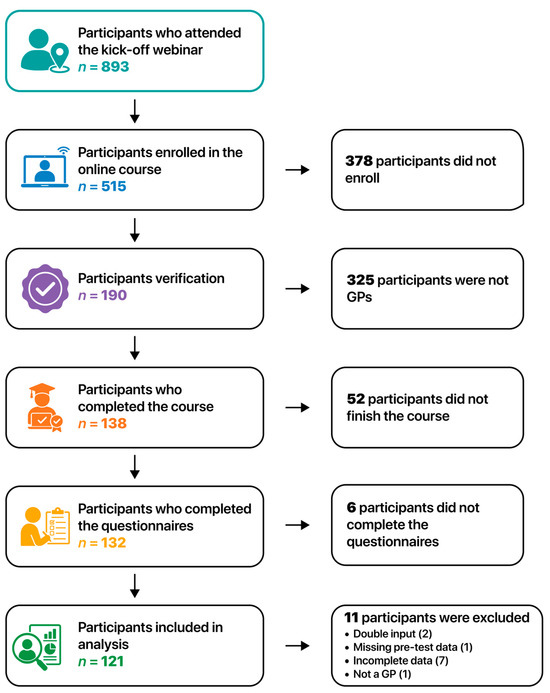
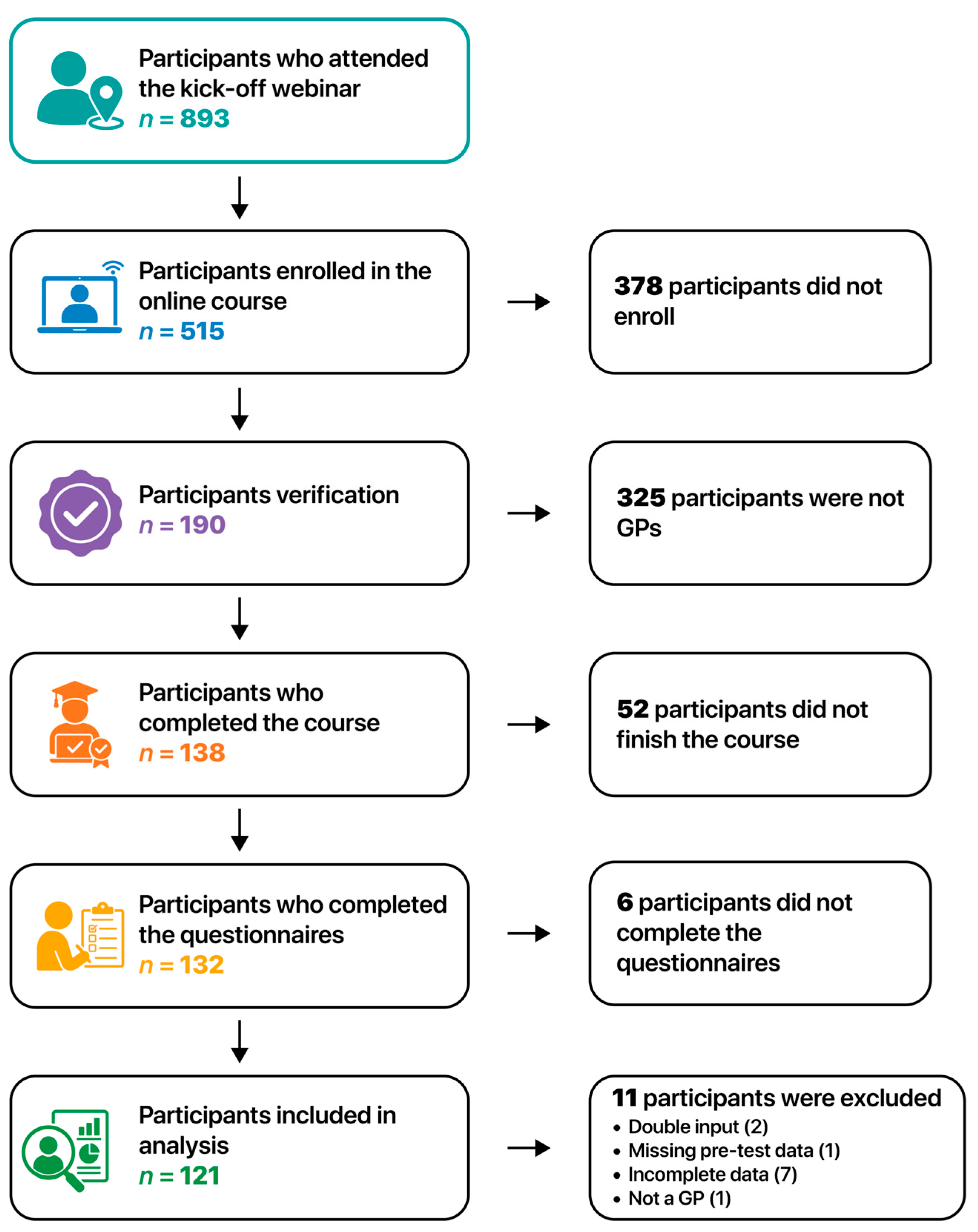
A total of 808 participants attended the kick-off webinar out of 1040 who registered for it, but only 515 people registered for the online training and logged in. Among the 515 registrants who logged in, a total of 325 participants were not GPs and could not continue taking the module. The remaining participants who passed the reverification were 190 people, and 138 people (72.6%) completed the module, with a 27.4% attrition rate. Following data review, six participants were excluded because of incomplete data, resulting in a final analytical sample of 121 participants. The recruitment flowchart is shown in Figure 1.
Figure 1.
Subject recruitment flowchart.
3.2. Participant Characteristics
The characteristics of the participants are presented in Table 1. In this training, there were fresh graduates; some had no work experience (0 years). Universities were categorized based on their accreditation, and most of the participants in this study, approximately 79.3% of the total participants, came from A-accredited universities. The working regions were divided into Sumatra; Java and Bali; Kalimantan and Sulawesi; and Nusa Tenggara Barat (NTB), Nusa Tenggara Timur (NTT), Maluku, and Papua. The workplace service category included primary healthcare facilities such as community health centers, private clinics and type D hospitals; secondary healthcare facilities such as type C hospitals; and tertiary healthcare facilities such as type A and B hospitals.
Table 1.
Distribution of subject characteristics.
3.3. Pre- and Post-Test Results
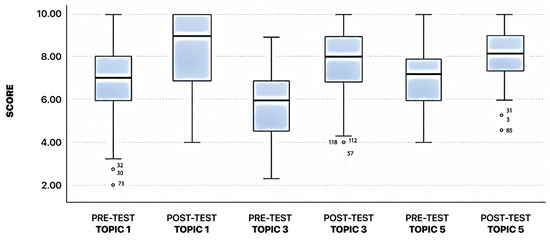
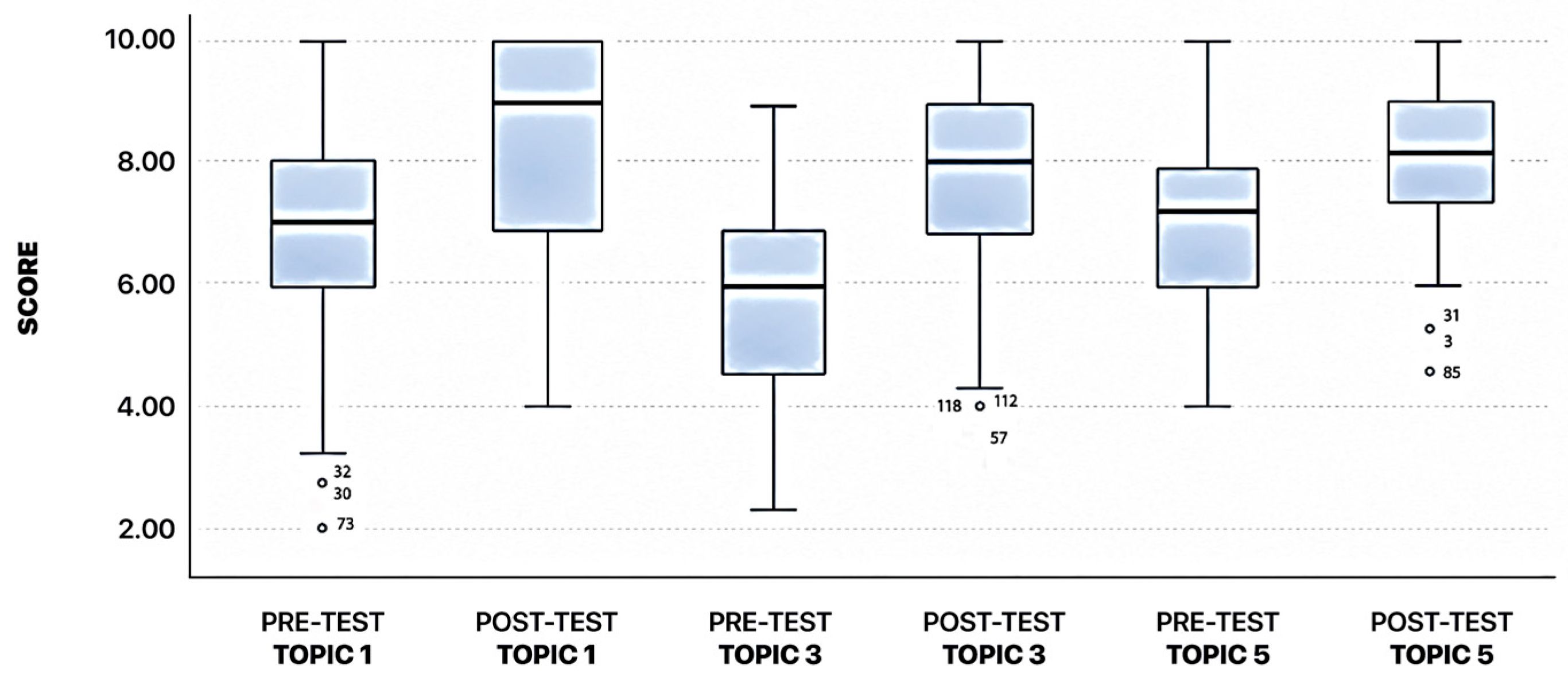
The results of the pre-test and post-test scores are presented in Table 2 and Figure 2. An increase was observed in the participants’ post-test results after completing the training module compared with the pre-test results. No significant correlation was shown between the other variables and the pre- and post-test scores of all the topics. The outlier results for the pre- and post-test scores had the following characteristics: more than 10 years of work experience or less than 3 years, B-accredited university origin, pediatric patients <5 years in daily practice and never attended seminars on pediatric nutrition in the past year.
Table 2.
Pre- and post-test nonparametric test results.
Figure 2.
Pre-test and post-test score boxplots. Circles indicate outliers, and the numbers represent the corresponding case numbers.
For the comprehensive test results, 18 out of 121 subjects (14.8%) did not score a passing grade of at least 7 out of 10 on the first attempt. Of the 18 subjects, 14 subjects graduated from A-accredited universities, and four other subjects came from B-accredited universities. The lowest score on the exit test was 0.50, with the highest score being 10.
3.4. Feedback Questionnaires
In the feedback questionnaire, almost all the participants (120 out of 121) stated that the training met their needs. The training made it easier to improve their knowledge of child nutrition without having to travel to distant places to attend face-to-face training, with a learning schedule that could be customized. This was specifically true for participants working on islands and remote areas. Out of a total of 121 participants, 104 preferred e-learning with this combination of asynchronous and synchronous sessions, seven preferred asynchronous sessions only, five preferred synchronous sessions only, and five preferred face-to-face training. The participants experienced time and technical constraints. Approximately 38.8% of the 121 participants experienced time constraints, but we did not further explore the causes of these time constraints in the questionnaire. Moreover, 28.9% of the participants encountered technical constraints, and the kinds of technical constraints the participants encountered during the training were also not fully explored. Participants confirmed their willingness to pay when this type of training was held again. Only a few participants were not willing to pay, namely, 12.4%. With respect to the content of the materials, most participants stated that the materials presented in the training were sufficient, and only 8 out of a total of 121 participants mentioned that the material presented was not clear enough.
4. Discussion
4.1. Role of General Practitioners in Stunting Prevention
GPs, nurses, midwives, nutritionists, and sanitarians are among the health professionals actively involved in reducing the prevalence of stunting in Indonesia. Because it is regarded as the key to the development of Indonesian health system, the role of health workers in achieving maximum service in the primary stage of care is crucial. Health workers must have the duty and responsibility to implement minimum service standards in the health sector to create a healthy society [12]. Competencies related to basic child nutrition have been outlined in the Indonesian Doctor Competency Standards as a part of GP competencies. In the structure of undergraduate medical education, this knowledge is acquired during clinical rotations in pediatrics and community medicine. After graduating, GPs can attend numerous seminars on child nutrition, but they are not as structured as this MOOC-based course.
In cases of stunting, the role of GPs is to diagnose and monitor growth. Physicians establish an accurate diagnosis through medical history and physical examination, including height and weight measurements. Further examination is needed to determine the presence of infections or other conditions that could cause stunting. This emphasizes the need to provide stunting knowledge to frontline health workers [13].
This study demonstrated significant improvements in participants’ knowledge across the three domains assessed in the pre- and post-tests, namely, early-life nutrition, breastfeeding and lactation management, and feeding problems. The domains represent core competencies for GPs in child growth monitoring and stunting prevention. These comprise nutritional practices during the first years of life, breastfeeding support, and the identification and management of common feeding problems encountered in primary care. Breastfeeding remains a public health priority in Indonesia, as exclusive breastfeeding coverage, although improving, remains below the national target of 80%. Continued support and counseling from trained healthcare professionals is essential to improve breastfeeding practices [14]. Similarly, feeding problems were included as one of the core domains because they are a common concern among parents of young children, with approximately 50–60% of parents reporting feeding difficulties. Persistent feeding problems could adversely affect nutritional status and growth if not appropriately managed [15].
The remaining three topics, anthropometric measurements and growth chart interpretation, complementary feeding, and medical indications for formula milk, were evaluated through a comprehensive examination to assess participants’ overall understanding of all six learning modules.
4.2. Attrition Rate
Owing to the high level of interest in this course topic when the module was running, the participants included not only GPs but also specialist doctors, nutritionists, community health workers, and other professionals. Therefore, the administrator conducted a rescreening by asking participants to enter the six-digit member identification number of Indonesian Medical Association. This explained why there was a significant decrease in participants completing the module compared with participants who had registered.
This study had a relatively high attrition rate (27.4%). High dropout rates have consistently been reported as one of the major challenges of MOOC-based learning. A recent MOOC study published in 2025 reported a completion rate of only approximately 23%, showing the persistent difficulty in maintaining learner engagement in online courses [16]. According to Thepwongsa et al., the primary challenge with online CME was its perceived time-consuming nature. This included both time constraints, as GPs were occupied with their regular practice, and substantial time commitments due to the lengthy duration of online CME programs. GPs often need to allocate time after regular working hours for online learning. However, face-to-face learning activities, such as conferences, allow requests for educational leave. Moreover, traditional in-person CME activities typically occur over a shorter duration than the more prolonged asynchronous online learning form [17]. In 2015, Jordan K noted that completion rates differ significantly on the basis of course length, with longer courses generally having lower completion rates. However, Perna et al. in 2014 reported no correlation between course length and completion rate [18,19].
Based on a study by Zhu et al., retention and dropout rates became part of the main study topics in online learning courses since 2017 and beyond [20]. Huang H et al., in their systematic review in 2023, divided the major categories of factors affecting dropout rates into five categories, namely, course attributes, social status, cognitive ability, emotional factors and learning behavior. The design, content and duration of open online learning courses were factors in the course attribute category. Family reasons (such as household responsibilities) were part of social status. IT level, language, and previous experience were included in cognitive ability. Satisfaction, curiosity, self-regulation and demographics were emotional factors. One of the factors included in learning behavior was engagement with teachers and fellow students [21]. A previous study by Dalipi et al. in 2018 showed that there were two main factors that affect the likelihood of learners dropping out of a MOOC, including learner-related factors, such as a lack of motivation, a lack of time, a lack of background knowledge, and skill deficiencies, and MOOC-related factors, such as course design, feelings of isolation, a lack of interactivity, and hidden costs [22].
4.3. Effectiveness of Online CME
The results showed a significant increase in post-test scores. The improvement across all knowledge domains suggested that the course may have been effective in addressing multiple aspects of child nutrition and growth monitoring rather than focusing on a single topic. The greatest improvement was observed in the breastfeeding and lactation domain. Improvements following online CME have also been reported by Padbury et al. in 2020 [23]. Padbury and colleagues conducted a comparable pre- and post-assessment study, demonstrating the effectiveness of an online, CME-accredited, video-based roundtable discussion with field experts. This session significantly increased the knowledge and confidence of hematologists/oncologists concerning the guideline-recommended utilization of direct oral anticoagulants in the management of cancer-associated thrombosis. A 2021 study showed that online CME successfully increased the knowledge and confidence of cardiologists and primary care physicians in diagnosing hereditary transthyretin amyloidosis [24]. Similarly, a systematic review by Thepwongsa et al. in 2014 examined 11 studies on the effectiveness of online CME specific to GPs’ satisfaction, knowledge, clinical application and patient outcomes [25]. In the studies assessing GPs’ satisfaction, all satisfaction must be reported using the online learning method. Some studies showed improvements in GPs’ knowledge after online CME intervention. In 2023, Thepwongsa et al. conducted a cross-sectional and before-and-after study with 279 GP trainees enrolled in a new online diabetes program. The knowledge scores were not significantly different before and after the program [17]. Patient outcomes or improvements in clinical practice were not explored in this study.
4.4. Participants’ Feedback
Almost all the participants stated satisfaction with the module and that the training improved their knowledge of child nutrition. This result was consistent with that of Andrew Jang et al., indicating that more than 80% of CME participants were satisfied with their online education activities [26]. Similarly, a more recent MOOC study conducted in Ecuador found that 80% of participants reported high satisfaction with the course and that 95% would recommend it to their colleagues, showing the acceptability of well-designed online educational programs among healthcare professionals [27]. In this study, most of the participants preferred a combination of synchronous and asynchronous delivery methods, followed by some participants who preferred one of the methods alone or conventional face-to-face delivery. The participants were asked to write down their reasons. The participants who preferred asynchronous sessions only said that asynchronous sessions could be accessed anytime and that the participants did not have to match the webinar schedule with their personal schedule. The participants who selected this combination method said it was more flexible and easier to manage their learning time. The participants could repeat the material or video when there was something they did not understand and could ask questions during the synchronous session. Therefore, there was still interaction between teachers and participants. Interaction between participants and teachers was needed to maintain their motivation to learn. The participants who preferred face-to-face training noted that the face-to-face sessions were more interactive and that the participants could focus more because they had allocated continuous time for the training.
The participants’ suggestions on each topic were addressed. For the topic of early-life nutrition, participants suggested increasing the number of Q&A discussions and case simulations. The participants also suggested adding material for effective communication to parents whose children have growth disorders. For the anthropometric measurements and chart interpretation topic, the feedback from the participants was to create a pocketbook for daily practice. With respect to breastfeeding and lactation management, the most common feedback was to deepen the material on lactation assistance and create additional sessions. The participants were interested in learning more about breastfeeding by working mothers, strategies to promote breastfeeding in low-income areas, social and cultural issues that discourage exclusive breastfeeding, oxytocin massage, the “baby spa” phenomenon, and how to support relactation in mothers whose infants have already received formula milk. The participants also suggested that lactation management must play a role during synchronous sessions in the future. For the subject of complementary food, participants suggested adding complementary food menu topics on the basis of local ingredients that were easy to find, converting measurements to tablespoons to make it easier to apply for education of caregivers, how to count complementary food calories, and myths and facts about complementary food circulating in the community. With respect to feeding problems, common recommendations included implementing educational approaches for parents of children with feeding problems, particularly in low-socioeconomic areas. In addition, early collaboration between GPs and nutritionists was advised for the prompt management of feeding issues. For the last topic, medical indications of formula milk, participants suggested adding material to WHO regulations related to the distribution of formula milk and addressing problems caused by formula milk, such as diarrhea or constipation.
In general, the participants were satisfied with the content of the training and suggested further sessions in the form of advanced classes or other child nutrition topics. Technical feedback included audio problems, where some participants reported noise leaking during the recording of the online lecture video and the speaker’s voice not being clear during the webinar session. Another technical problem was that some pre- or post-test answers were not immediately recorded on the website. Therefore, participants had to repeat answers that had not been saved. In relation to technical issues, the participants were satisfied with the helpful contact person. They were also satisfied with the administrative support team, which regularly provided reminders of the webinar schedule and the deadline for completing the module.
A feedback questionnaire was sent to the GPs who did not complete the training. Among the 52 participants who did not complete the survey, up to 10% (n = 5) responded and sent feedback. All of them did not complete the training because of a lack of time. In this study, 3 out of 5 participants stated that the duration of the training was too long. Technical difficulties were experienced by 3 of the 5 participants and were one of the reasons they did not complete the training. Only 1 of the 5 participants did not complete the online training due to preference for face-to-face training.
4.5. Limitations of the Study
This study had several limitations. During the dissemination phase, invitations were extended not only to GPs but also to other healthcare professionals to increase awareness of the program. Consequently, many non-GP participants enrolled and remained in the course until the end of topic 1. Participants also experienced technical issues, including audio interference and difficulties saving their test responses. This study assessed only participants’ knowledge and did not evaluate clinical performance or long-term knowledge retention. In addition, the perception questionnaire used in this study was not statistically validated.
The absence of a control group and the relatively high attrition rate could represent potential sources of bias, including selection, attrition, and testing effects, and must be considered when interpreting the results. In addition, as the analysis was limited to participants who completed the course, the improvement observed may partly reflect differences in participant engagement. The results must be interpreted with caution, and further studies using more-rigorous designs are warranted to confirm these results. However, this study provides preliminary evidence of the positive impact of a MOOC-based CME program on short-term knowledge outcomes and shows its potential relevance for similar resource-constrained and primary care settings.
Despite these constraints, the training demonstrated several strengths, including interactive components such as synchronous sessions, case-based simulations, and discussion forums. In addition, the training administrators were responsive in addressing participants’ technical and learning-related challenges. A considerable interest in information about child nutrition was observed, indicating the need for more-consistent and scheduled offerings of MOOCs, specifically on this topic. Online learning provided practical options for GPs to stay updated about child nutrition and growth monitoring.
5. Conclusions
In conclusion, this study suggests that MOOC-based CME may improve GPs’ knowledge, particularly in child nutrition and growth monitoring. The increase in test scores is consistent with a possible improvement in knowledge. Participants reported high satisfaction and generally preferred a blended learning approach. These results show the potential of flexible online CME to support primary care capacity, specifically in resource-constrained settings. However, further studies with more-rigorous designs are needed to confirm these results and assess longer-term outcomes. Future work can explore the long-term impact on daily practice, reasons for dropping out and motivational factors of participants.
Author Contributions
Y.D., Y.A., D.S. and T.P. conceptualized and initiated the study. Y.D., T.P., Y.A., R.M. and D.G.B.K. were involved in developing the MOOC learning materials. All authors contributed to data collection. Y.D. and R.M. performed data analysis. All authors reviewed and provided critical input during manuscript preparation and approved the final version of the manuscript. All authors have read and agreed to the published version of the manuscript.
Funding
The authors disclose receipt of the following financial support for the MOOC-based CME development and publication of this article: this work was supported by PT. Nutricia Indonesia Sejahtera, Grant No. REF 060/NIS/AG-PUSBANGKI/III/2023.
Institutional Review Board Statement
This study was approved by the Research Ethics Committee of Universitas Indonesia (approval number 23-04-0511, 29 May 2023) and was conducted in accordance with the Declaration of Helsinki as well as the relevant institutional ethical guidelines and regulations.
Informed Consent Statement
All participants provided informed consent to participate in this study. Participation was voluntary, and participants could withdraw at any time without any consequences. Informed consent to publish anonymized data was obtained from all participants.
Data Availability Statement
The datasets analyzed during the current study are not publicly available due to privacy and confidentiality considerations related to educational participants but are available from the corresponding author on reasonable request. Any data provided will be anonymized in accordance with institutional and ethical guidelines.
Conflicts of Interest
The authors declare that this study received funding from Danone Nutricia for the development of the MOOC and publication support. This funding did not influence the independence of the investigation, including the study design, data collection, analysis, interpretation, or reporting of the results.
Abbreviations
| CME | Continuing medical education |
| GPs | General practitioners |
| IMERI | Indonesian Medical Education and Research Institute |
| MOOC | Massive open online course |
| NTB | Nusa Tenggara Barat |
| NTT | Nusa Tenggara Timur |
| WHO | World Health Organization |
References
- Indonesian Ministry of Health. Buku Saku Hasil Survei Status Gizi Indonesia (SSGI) 2022; Indonesian Ministry of Health: Jakarta, Indonesia, 2023.
- Indonesian Ministry of Health. Buku Saku Hasil Survei Status Gizi Indonesia (SSGI) 2024; Indonesian Ministry of Health: Jakarta, Indonesia, 2025.
- World Health Organization. Stunting in a Nutshell. Available online: https://www.who.int/news/item/19-11-2015-stunting-in-a-nutshell (accessed on 28 July 2023).
- Cardenas, D.; Díaz, G.; Cadavid, J.; Lipovestky, F.; Canicoba, M.; Sánchez, P.; Álvarez, L.; Duarte, Y.; Reyes, J.G.G.; de Noyola, G.M.; et al. Nutrition in medical education in Latin America: Results of a cross-sectional survey. J. Parenter. Enter. Nutr. 2022, 46, 229–237. [Google Scholar] [CrossRef] [Scilit] [PubMed]
- Crowley, J.; Ball, L.; Hiddink, G.J. Nutrition in medical education: A systematic review. Lancet Planet. Health 2019, 3, e379–e389. [Google Scholar] [CrossRef] [Scilit] [PubMed]
- Praharaj, S.K.; Ameen, S. The relevance of telemedicine in continuing medical education. Indian J. Psychol. Med. 2020, 42, 97S–102S. [Google Scholar] [CrossRef] [Scilit] [PubMed]
- Wang, Z.Y.; Zhang, L.J.; Liu, Y.H.; Jiang, W.X.; Jia, J.Y.; Tang, S.L.; Liu, X.Y. The effectiveness of e-learning in continuing medical education for tuberculosis health workers: A quasi-experiment from China. Infect. Dis. Poverty 2021, 10, 72. [Google Scholar] [CrossRef] [Scilit] [PubMed]
- Dhanani, J.; Chavda, N.; Patel, N.; Tandel, K. Awareness and utilization of massive open online course (MOOC) and video series as continuous learning tools for faculties. Int. J. Med. Sci. Public Health 2016, 5, 1540. [Google Scholar] [CrossRef] [Scilit]
- Zhang, Y.; Liu, S.; Li, C.; Hao, A. Impact of a MOOC-Based Blended Learning Model on Performance, Satisfaction, and Perceptions in a Histology Course for Chinese Medical Students. Adv. Med. Educ. Pract. 2025, 16, 1537–1551. [Google Scholar] [CrossRef] [Scilit] [PubMed]
- Knowles, M.S.; Holton, E.F., III; Swanson, R.A. The Adult Learner: The Definitive Classic in Adult Education and Human Resource Development, 8th ed.; Routledge: New York, NY, USA, 2015. [Google Scholar]
- Knapke, J.M.; Hildreth, L.; Molano, J.R.; Schuckman, S.M.; Blackard, J.T.; Johnstone, M.; Kopras, E.J.; Lamkin, M.K.; Lee, R.C.; Kues, J.R.; et al. Andragogy in Practice: Applying a Theoretical Framework to Team Science Training in Biomedical Research. Br. J. Biomed. Sci. 2024, 81, 12651. [Google Scholar] [CrossRef] [Scilit] [PubMed]
- Prastiwi, A.S.; Munawir, A.; Rokhmah, D. The effect of health officer role to the program of stunting prevention on first 1000 days of life in Indonesia. Med. Leg. Update 2020, 20, 104–109. [Google Scholar] [CrossRef] [Scilit]
- Basrowi, R.W.; Dilantika, C.; Sitorus, N.L.; Yosia, M. Impact of Indonesian healthcare worker in stunting eradication. Indones. J. Community Occup. Med. 2022, 2, 107–113. [Google Scholar] [CrossRef] [Scilit]
- World Health Organization. Breastfeeding in Indonesia on the Rise, but Mothers Need More Support. Available online: https://www.who.int/indonesia/news/detail/01-08-2025-breastfeeding-in-indonesia-on-the-rise--but-mothers-need-more-support (accessed on 6 July 2026).
- Sjarif, D.R.; Yuliarti, K.; Lestari, E.D.; Sidiartha, I.G.; Nasar, S.S.; Mexitalia, M. (Eds.) Rekomendasi Praktik Pemberian Makan Berbasis Bukti Pada Bayi Dan Batita Di Indonesia Untuk Mencegah Malnutrisi; Ikatan Dokter Anak Indonesia: Jakarta, Indonesia, 2015. [Google Scholar]
- Wiese-Posselt, M.; Saydan, S.; Lâm, T.-T.; Rörig, A.; Bergmann, C.; Becker, F.; Kurzai, O.; Feufel, M.A.; Gastmeier, P.; Schneider, S. Development and evaluation of a massive open online course (MOOC) to teach medical students the prudent use of antibiotics. Antimicrob. Resist. Infect. Control 2025, 14, 105. [Google Scholar] [CrossRef] [Scilit] [PubMed]
- Thepwongsa, I.; Muthukumar, R.; Sripa, P.; Piterman, L. Uptake and effectiveness of online diabetes continuing education: The perspectives of Thai general practitioner trainees. Heliyon 2023, 9, e13355. [Google Scholar] [CrossRef] [Scilit] [PubMed]
- Jordan, K. Massive open online course completion rates revisited: Assessment, length and attrition. Int. Rev. Res. Open Distrib. Learn. 2015, 16, 341–358. [Google Scholar] [CrossRef] [Scilit]
- Perna, L.W.; Ruby, A.; Boruch, R.F.; Wang, N.; Scull, J.; Ahmad, S.; Evans, C. Moving through MOOCs. Educ. Res. 2014, 43, 421–432. [Google Scholar] [CrossRef] [Scilit]
- Zhu, M.; Sari, A.R.; Lee, M.M. A comprehensive systematic review of MOOC research: Research techniques, topics, and trends from 2009 to 2019. Educ. Technol. Res. Dev. 2020, 68, 1685–1710. [Google Scholar] [CrossRef] [Scilit]
- Huang, H.; Jew, L.; Qi, D. Take a MOOC and then drop: A systematic review of MOOC engagement pattern and dropout factor. Heliyon 2023, 9, e15220. [Google Scholar] [CrossRef] [Scilit] [PubMed]
- Dalipi, F.; Imran, A.S.; Kastrati, Z. MOOC dropout prediction using machine learning techniques: Review and research challenges. In Proceedings of the 2018 IEEE Global Engineering Education Conference (EDUCON), Tenerife, Spain, 17–20 April 2018; IEEE: New York, NY, USA, 2018; pp. 1007–1014. [Google Scholar] [CrossRef] [Scilit]
- Padbury, C.; Harris, M.; LaCouture, M.; Spyropoulos, J. Success of online CME at improving knowledge and confidence around guideline-directed management of cancer-associated thrombosis. Blood 2020, 136, 13. [Google Scholar] [CrossRef] [Scilit]
- Harris, M.; O’Connor, A.; Boutsalis, G. Effectiveness of online CME at improving cardiologists’ and PCPs’ knowledge and confidence related to diagnosis and treatment of hereditary transthyretin amyloidosis. Circulation 2021, 144, 9037. [Google Scholar] [CrossRef] [Scilit]
- Thepwongsa, I.; Kirby, C.N.; Schattner, P.; Piterman, L. Online continuing medical education (CME) for GPs: Does it work? A systematic review. Aust. Fam. Physician 2014, 43, 717–721. [Google Scholar] [PubMed]
- Jang, A.; Kim, M.; Lee, S.M.K.; Ha, I.H.; Shin, J.Y.; McClain, R.; Lee, J. Evaluating the effectiveness of online continuing medical education during the COVID-19 pandemic. Med. Teach. 2023, 45, 852–858. [Google Scholar] [CrossRef] [Scilit] [PubMed]
- Espinoza-Castro, B.; Encina, V.; Garrido, M.A.; Vinueza, F.I.; Piedra, J.P.; Garzon-Villalba, X.; Radon, K. Online learning for crisis response: Evaluating reach and perceived knowledge gains from the MOOC “Infection, Prevention, and Control of Acute Respiratory Infections for Healthcare Workers in Low- and Middle-Income Countries (IPC MOOC)”. BMC Med. Educ. 2025, 25, 1150. [Google Scholar] [CrossRef] [Scilit] [PubMed]

Disclaimer/Publisher’s Note: The statements, opinions and data contained in all publications are solely those of the individual author(s) and contributor(s) and not of MDPI and/or the editor(s). MDPI and/or the editor(s) disclaim responsibility for any injury to people or property resulting from any ideas, methods, instructions or products referred to in the content. |
© 2026 by the authors. Published by MDPI on behalf of the Academic Society for International Medical Education. Licensee MDPI, Basel, Switzerland. This article is an open access article distributed under the terms and conditions of the Creative Commons Attribution (CC BY) license.