


Abstract
Background and Objectives: Generative artificial intelligence (AI) chatbots have entered medical education faster than guidance for their responsible use. Although a rapidly expanding 2024–2026 literature has examined generative AI adoption, attitudes, and AI literacy among healthcare students, comparatively little is known about which specific tools medical students prefer or whether reliance on them carries measurable cognitive risks. We characterized adoption patterns, tool preferences, perceived benefits, and determinants of cognitive overdependence among medical students. Methods: A single-center cross-sectional survey was administered to 141 medical students across preclinical and clinical years at a single institution. A 28-item instrument captured usage patterns, perceived learning benefit, output trust, verification behavior, and AI overdependence risk. Analyses included t-tests, ANOVA, chi-square tests, Pearson correlations, and hierarchical regression. Results: Unless otherwise specified, values are reported as group mean scores on 1–5 Likert agreement scales or as percentages of respondents. ChatGPT was the primary tool for 69.5% of respondents, followed by Claude (12.1%). Daily users reported greater perceived learning benefit than infrequent users (4.14 vs. 3.36; p < 0.001). Clinical students verified AI outputs more often than preclinical students (3.69 vs. 3.21; p < 0.001), while preclinical students showed higher reliance (p = 0.002); verification moderated overdependence risk across academic years (interaction p = 0.041). AI familiarity (β = 0.31) and verification habit (β = −0.22) were the strongest predictors of integration acceptance (R2 = 0.34). Conclusions: Reliance and verification habits diverge by training stage; curricula should pair AI literacy with explicit verification training to mitigate overdependence. As a single-center, self-report study, these findings require multi-center confirmation; nonetheless, to our knowledge, this is among the first studies to jointly profile students’ tool-specific reliability perceptions and to identify verification behavior as a moderator that buffers familiarity-driven overdependence.
1. Introduction
The emergence of consumer-facing generative artificial intelligence (AI), built on large language models (LLMs), has transformed how students across disciplines access, synthesize, and produce knowledge. Within barely two years of the public release of conversational systems such as ChatGPT, these tools moved from novelty to near-ubiquity in academic settings [1,2]. Medical education, characterized by dense factual content, high cognitive load, and the need to integrate basic science with clinical reasoning, has proven a particularly fertile ground for adoption [3]. Students now use generative AI to summarize textbook chapters, generate practice questions, explain pathophysiological mechanisms, draft differential diagnoses, and rehearse patient communication, often outside any formal curricular framework or faculty oversight [4].
Unlike earlier educational technologies, generative AI is distinguished by its conversational fluency and its capacity to produce plausible but occasionally incorrect output [5]. This combination creates a unique pedagogical tension. On one hand, LLMs can function as tireless, personalized tutors that adapt explanations to a learner’s level and provide immediate feedback [6]. On the other hand, their well-documented tendency to “hallucinate”—generating confident, fabricated, or subtly inaccurate content—poses a distinctive risk for learners who lack the foundational knowledge to detect errors [7]. For a medical student, an uncritically accepted hallucinated drug dose or mechanism is not merely an academic lapse but a potential precursor to unsafe clinical habits [4].
The landscape of available tools has also diversified rapidly. Although early discussions centered almost exclusively on ChatGPT, students now navigate an ecosystem that includes Claude, Google’s Gemini, xAI’s Grok, Microsoft Copilot, and numerous specialized medical AI assistants [8]. These systems differ meaningfully in their factual reliability, citation behavior, reasoning transparency, and interface design [9,10]. Understanding which tools medical students gravitate toward, and why, offers a window into the implicit value judgments learners make about trust, convenience, and reliability—judgments that may diverge substantially from the considered assessments of educators [11,12,13,14,15,16].
A further and underexplored dimension concerns the cognitive consequences of habitual AI use. Educational psychology has long described “cognitive offloading,” whereby learners delegate effortful mental tasks to external aids [12,13,17,18,19,20,21,22,23,24]. While offloading can free working memory for higher-order tasks, excessive or premature offloading may impede the deep encoding and retrieval practice on which durable medical knowledge depends, and may erode critical-thinking dispositions over time [13,14,25,26,27,28,29,30]. The construct of “AI overdependence”—a tendency to accept and act upon AI output without independent verification—has begun to attract attention, yet empirical data quantifying its prevalence and determinants among medical trainees remain comparatively limited, even as a rapidly expanding 2024–2026 literature has begun to characterize adjacent constructs such as AI literacy, trust calibration, and cognitive offloading among healthcare learners [12,31,32,33,34,35,36].
Three complementary frameworks from educational psychology clarify why habitual AI use may be double-edged. Cognitive Load Theory holds that learning depends on managing a limited working memory; by absorbing extraneous processing, generative AI can free capacity for the germane, schema-building effort that produces durable understanding, yet when it also removes the desirable difficulties that drive deep encoding, it may quietly hollow out the learning it appears to support [31]. Self-Regulated Learning Theory frames effective study as a recursive cycle of goal-setting, strategy monitoring, and self-evaluation; a student who delegates these metacognitive steps wholesale to a chatbot risks short-circuiting the feedback loops through which competence is built [32]. Contemporary cognitive-offloading models refine this picture by distinguishing adaptive offloading, calibrated to a trustworthy external aid, from maladaptive offloading, in which independent verification is abandoned, and reliance becomes indiscriminate [13,14]. Read together, these perspectives predict that the cognitive consequences of AI use depend less on how often students use it than on whether they preserve the effortful, self-regulated checking that converts assistance into learning—the verification behavior this study places at its center.
Existing literature on medical students and AI has largely focused on general attitudes, ethical concerns, and readiness, frequently treating “AI” as a monolithic construct and rarely distinguishing between specific tools or between productive and maladaptive usage patterns [8,11]. Although the 2024–2026 literature has advanced quickly—documenting near-universal adoption, characterizing AI literacy at scale, and modeling how trust and literacy jointly shape critical thinking [33,34,36]—much of it still treats “AI” as a single construct and stops short of linking specific tool choices to verification behavior and measurable overdependence. Few studies have examined how verification behavior interacts with academic seniority, or whether the protective effect of clinical experience against overdependence is consistent across students with different self-regulatory habits [9]. This gap limits the capacity of medical faculties to design targeted, evidence-based interventions rather than generic “AI awareness” sessions [3,6]. The present study advances this literature in three specific ways: it resolves “AI” into named tools and profiles their perceived reliability across multiple quality dimensions; it quantifies overdependence with a purpose-built subscale rather than inferring it from general attitudes; and it tests verification behavior as a moderator, asking not merely whether familiarity is risky but for whom. In doing so, the study does not claim that this field is unexplored—recent work has already mapped adoption, AI literacy, and trust at scale [8,33,34,36]—but instead addresses a specific residual gap: the linkage of named-tool preferences to verification behavior and to a purpose-built measure of overdependence.
The present cross-sectional study was designed to address these gaps. We pursued four objectives: (1) to map the prevalence and tool-specific patterns of generative AI use among medical students; (2) to compare perceived benefits, trust, and reliance across academic stages and usage frequencies; (3) to characterize tool-specific quality perceptions across multiple dimensions; and (4) to identify the determinants of cognitive overdependence and AI integration acceptance, with particular attention to the moderating role of verification behavior. We hypothesized that clinical-stage students would demonstrate higher verification and lower overdependence than preclinical peers, and that AI familiarity and verification habits would independently predict healthier integration patterns.
2. Materials and Methods
2.1. Study Design and Setting
This study employed a cross-sectional, questionnaire-based design conducted at a single university faculty of medicine. The cross-sectional approach was selected as appropriate for characterizing prevalence, attitudes, and associations at a defined point in the rapid evolution of generative AI adoption, while acknowledging that it cannot establish causal or temporal relationships [15]. The target population comprised all enrolled medical students in Years 1 through 6 of the standard six-year integrated medical curriculum. The institution did not, at the time of data collection, offer any formal coursework, module, or elective addressing the use of generative AI tools, meaning that any student exposure derived entirely from informal, self-directed, or peer-mediated channels.
Eligibility criteria required participants to be at least 18 years of age, currently enrolled, and to have used at least one generative AI tool at least once during their studies, ensuring that respondents could meaningfully answer tool-specific items. Students who had never used any AI tool (n = 6 screened out) were excluded from the analytic sample to preserve the validity of usage and perception measures. An a priori power analysis using G*Power 3.1, targeting detection of a medium effect (f2 = 0.15) in a multiple regression model with up to six predictors at α = 0.05 and 80% power, indicated a minimum required sample of 98 participants. The achieved sample of 141 therefore provided ample power for the planned regression and ANOVA analyses, with a comfortable margin to accommodate subgroup stratification.
2.2. Survey Instrument and Construct Definitions
A structured 28-item questionnaire was developed specifically for this study, drawing on existing technology-acceptance frameworks while incorporating novel constructs relevant to generative AI [16,17]. The instrument comprised five sections: (1) demographic and academic characteristics (age, gender, academic year, prior degree); (2) usage patterns (primary AI tool, secondary tools, frequency of use, typical task categories); (3) tool-specific quality perceptions rated across five dimensions; (4) perceived benefits and academic integration; and (5) cognitive reliance and verification behavior. Response formats included five-point Likert scales (1 = strongly disagree; 5 = strongly agree), categorical selections, and frequency anchors. The primary AI tool was operationalized as the single tool a respondent reported using most often for academic purposes.
Several composite constructs were defined a priori. The AI Overdependence Risk subscale (six items) captured the tendency to accept AI output without independent checking, to feel unable to complete academic tasks without AI assistance, and to prioritize AI-generated answers over primary sources. Verification behavior was measured by a four-item subscale assessing the frequency with which students cross-checked AI outputs against textbooks, guidelines, or faculty. Students were dichotomized at the scale median into “low verifiers” and “high verifiers” for interaction analyses. Content validity was assessed by an expert panel of three medical educators, with items scoring a content-validity index below 0.80 revised or removed. Internal consistency was satisfactory across subscales (overall Cronbach’s α = 0.88; AI familiarity α = 0.81; perceived benefit α = 0.84; overdependence risk α = 0.79; verification α = 0.76). To provide validity evidence beyond internal consistency, the multi-item Likert scales (24 items across the five hypothesized constructs) were subjected to exploratory factor analysis using principal-axis factoring with promax rotation on the full sample. Sampling adequacy was confirmed (Kaiser–Meyer–Olkin measure = 0.84; Bartlett’s test of sphericity χ2(276) = 1712.9, p < 0.001). Five factors with eigenvalues above 1.0 were retained, together accounting for 63.4% of the variance and mapping onto the a priori constructs (AI familiarity, perceived learning benefit, output trust, verification behavior, and AI overdependence risk). Primary standardized loadings ranged from 0.52 to 0.83, with no cross-loading exceeding 0.35. Convergent validity was supported by composite reliability (CR) values between 0.79 and 0.86 and average variance extracted (AVE) values between 0.51 and 0.61, all exceeding the conventional thresholds (CR > 0.70; AVE ≥ 0.50). Discriminant validity was satisfied under the Fornell–Larcker criterion—the square root of each construct’s AVE exceeded its correlations with the remaining constructs—and by heterotrait–monotrait (HTMT) ratios that were all below 0.85. Because the sample is modest relative to the item pool, these results are reported as exploratory, and confirmatory factor analysis in a larger, independent cohort is identified as a priority for future validation, in line with the psychometric standards applied to established medical-AI instruments [35]. The complete AI Overdependence Risk and Verification Behaviour item sets, together with a construct-level psychometric summary, are provided in Appendix A. The complete 28-item instrument, including every item stem and its response anchors, is additionally available from the corresponding author upon request to support full reproducibility and independent re-validation.
2.3. Data Collection Procedures
Data were collected via a self-administered electronic questionnaire distributed through institutional student channels, supplemented by in-person invitation following scheduled lecture sessions to maximize representativeness across year groups. Participation was voluntary and uncompensated. Before beginning the survey, all participants were presented with an information page describing the study purpose, the voluntary and anonymous nature of participation, and their right to withdraw at any point without consequence; informed consent was obtained electronically prior to item presentation. No personally identifying information was collected, and responses were stored under randomly generated numeric codes.
To minimize common methodological weaknesses, several procedural safeguards were implemented. Item order within attitudinal sections was partially randomized to reduce ordering effects, and two attention-check items were embedded to identify inattentive responding; three responses failing both checks were excluded prior to analysis and are not counted in the final sample of 141. Recruitment was stratified by year group with a target quota for each stage to avoid overrepresentation of any cohort, yielding a final distribution of 64 preclinical (Years 1–3) and 77 clinical (Years 4–6) students. The survey remained open for a fixed four-week window (data were collected between January 2026 and March 2026), after which the dataset was locked and exported for analysis. The overall response rate among invited eligible students was 71.2%.
2.4. Ethical Considerations
The study protocol was reviewed and approved by the institutional research ethics committee (Ethics Committee of Victor Babes University of Medicine and Pharmacy; protocol code 2429, approved 10 January 2025) prior to any data collection, and all procedures conformed to the principles of the Declaration of Helsinki. Because the survey collected no personal identifiers and posed no foreseeable physical, psychological, or academic risk to participants, it was classified as minimal-risk research. Students were explicitly assured that their decision to participate or decline would have no bearing on their academic standing, grades, or relationship with faculty, an assurance considered especially important given the power asymmetry inherent in surveying one’s own students.
Particular care was taken to avoid any perception of coercion. Recruitment invitations were framed as optional, no course credit or incentive was attached to participation, and the research team members responsible for grading were not present during in-person invitations. Data were stored on an encrypted, access-controlled institutional server, with only aggregate, de-identified data made available to the analysis team. These measures were intended to protect respondent autonomy and confidentiality while preserving the integrity of the self-reported attitudinal data central to the study’s aims.
2.5. Statistical Analysis
All analyses were performed using standard statistical software, with significance set at p < 0.05 (two-tailed). Descriptive statistics summarized demographic and usage variables as means with standard deviations for continuous measures and frequencies with percentages for categorical measures. Distributional assumptions were assessed using the Shapiro–Wilk test and visual inspection of Q–Q plots; the Likert-derived composite scores approximated normality and supported parametric testing. Independent-samples t-tests compared preclinical and clinical students on continuous outcomes, while one-way ANOVA with Tukey HSD post hoc comparisons evaluated differences across the three usage-frequency groups and across year-group triads.
For categorical associations, such as the distribution of primary tool preference across academic stages, Pearson chi-square tests were applied, with Fisher’s exact test substituted where expected cell counts fell below five. A two-way ANOVA tested the interaction between academic year group and verification habit on overdependence risk. Pearson correlation coefficients quantified bivariate relationships among continuous constructs, and a correlation matrix was constructed. To identify independent predictors of AI integration acceptance, a hierarchical multiple linear regression was fitted, entering demographic variables in the first block and AI-specific predictors in the second; variance inflation factors were examined to confirm absence of multicollinearity (all VIFs < 2.0). Two supplementary analyses—a binary logistic regression predicting high-overdependence membership and a one-way ANCOVA adjusting tool-specific trust for usage frequency—were conducted to add analytic depth.
3. Results
A total of 141 medical students met eligibility criteria and provided complete, valid responses (Table 1). The following sections present descriptive characteristics, stage- and frequency-based comparisons, tool-specific profiles, correlational structure, and multivariable models, including three advanced analyses designed to add analytic novelty beyond conventional descriptive reporting.
Table 1.
Demographic and academic characteristics of the study sample (n = 141).
The study sample comprised 141 medical students with a mean age of 22.7 ± 2.3 years, reflecting the typical age distribution of an undergraduate medical cohort spanning early preclinical through final clinical years. Female students constituted a modest majority at 57.4%, with male students representing 41.1% and two respondents (1.4%) identifying as non-binary or declining to state, a gender profile consistent with contemporary European medical enrollment patterns. The sample was reasonably balanced across training stages, with 45.4% in preclinical years and 54.6% in clinical years, supporting valid stage-based comparisons. A minority (16.3%) held a prior university degree, indicating that most participants entered medicine directly from secondary education. The distribution of primary AI tools revealed a pronounced concentration around ChatGPT, selected by 69.5% of respondents as their main academic AI assistant. Claude emerged as the clear second choice at 12.1%, followed by Gemini (9.2%), with Grok (5.7%) and Copilot (3.5%) occupying niche positions. Usage frequency was substantial: 37.6% reported daily use and a further 43.3% weekly use, meaning that over four-fifths of respondents engaged with generative AI at least weekly. Only 19.1% described themselves as rare or monthly users, underscoring that these tools have become embedded in routine study behavior rather than remaining occasional aids.
Independent-samples t-tests revealed a coherent and theoretically meaningful pattern of differences between preclinical and clinical students across the six core constructs. Clinical students reported significantly higher AI familiarity than preclinical students (Table 2), consistent with longer cumulative exposure and broader academic demands that invite tool experimentation. Strikingly, however, the direction reversed for reliance-related constructs: preclinical students reported significantly higher academic reliance on AI (3.93 vs. 3.57; t = 2.71, p = 0.008) and higher output trust (3.68 vs. 3.39; t = 2.13, p = 0.035). This apparent paradox—greater familiarity yet lower reliance among clinical students—is illuminated by the verification data, where clinical students verified AI outputs substantially more often than preclinical peers (3.69 vs. 3.21; t = −3.28, p = 0.001). The most pronounced and statistically robust difference appeared in overdependence risk, which was markedly higher among preclinical students (3.74 vs. 3.28; t = 3.72, p < 0.001). Perceived learning benefit trended higher among preclinical students but did not reach significance (3.97 vs. 3.74; p = 0.076), suggesting that both groups value AI’s pedagogical contribution comparably.
Table 2.
Comparison of core AI-related constructs by academic stage (independent-samples t-test).
A one-way ANOVA demonstrated a highly significant effect of usage frequency on perceived learning benefit (F(2,138) = 12.07, p < 0.001), with a clear monotonic gradient across the three groups (Table 3). Daily users reported the strongest perceived benefit (4.14 ± 0.62), weekly users an intermediate level (3.85 ± 0.74), and rare or monthly users the lowest (3.36 ± 0.88). Tukey HSD post hoc comparisons localized the significant differences: daily users differed significantly from rare users (mean difference = 0.78, p < 0.001) and weekly users also differed significantly from rare users (mean difference = 0.49, p = 0.011), whereas the daily-versus-weekly contrast approached but did not reach significance (mean difference = 0.29, p = 0.071). The non-overlapping confidence intervals between the daily and rare groups (4.14 vs. 3.36) underscore the robustness of the extreme-group contrast.
Table 3.
Perceived learning benefit across AI usage-frequency groups (one-way ANOVA).
Cross-tabulation of primary AI tool against academic stage, evaluated by Pearson chi-square test, revealed no statistically significant association (χ2 = 1.87, df = 4, p = 0.760), indicating that tool preference was broadly stable across the preclinical–clinical divide (Table 4). ChatGPT retained clear dominance in both groups, claiming 73.4% of preclinical students and 66.2% of clinical students as their primary tool. Although the modest decline in ChatGPT’s share among clinical students was accompanied by a corresponding rise in Claude usage (from 9.4% preclinically to 14.3% clinically), this shift did not achieve significance given the sample size and cell distributions.
Table 4.
Distribution of primary AI tool by academic stage (chi-square test).
AI familiarity correlated positively and significantly with perceived benefit (r = 0.41, p < 0.01) and with verification behavior (r = 0.34, p < 0.01), suggesting that students who know these tools better both extract more value from them and check their output more diligently—an encouraging indication that competence and caution can develop in tandem (Table 5). Verification behavior displayed the most consequential pattern: it correlated negatively with output trust (r = −0.21, p < 0.05) and, most notably, negatively with overdependence risk (r = −0.39, p < 0.01), the strongest single association involving the overdependence construct. This inverse relationship identifies verification as the behavior most strongly and negatively associated with maladaptive reliance, though its cross-sectional nature precludes a causal claim. Output trust, by contrast, correlated positively with overdependence risk (r = 0.31, p < 0.01), reinforcing the intuitive but important point that uncritical trust in AI output is a risk factor rather than a benign attitude. Perceived benefit showed modest positive correlations with both output trust (r = 0.37) and overdependence risk (r = 0.23), indicating that the educational value students perceive is entangled with, but not reducible to, their trust and reliance. Notably, AI familiarity was not significantly correlated with overdependence risk (r = 0.14, n.s.).
Table 5.
Correlation matrix among key continuous constructs (Pearson’s r).
The final model explained a substantial 34% of variance (R2 = 0.34; adjusted R2 = 0.31; F(6,134) = 11.42, p < 0.001), and the addition of Block 2 produced a significant increment in explained variance (ΔR2 = 0.22, p < 0.001), confirming that AI-specific factors contribute predictive power beyond demographics alone (Table 6). Within Block 1, academic stage emerged as the only significant demographic predictor (β = 0.21, p = 0.019), with clinical students showing greater acceptance, while age and gender were non-significant. In Block 2, AI familiarity was the strongest positive predictor (β = 0.31, p < 0.001), consistent with the broader literature linking competence to acceptance. Output trust contributed a smaller positive effect (β = 0.17, p = 0.021). Critically, verification behavior was a significant negative predictor of integration acceptance (β = −0.22, p = 0.005)—an initially counterintuitive finding that warrants careful interpretation. Rather than indicating that verification undermines acceptance per se, this coefficient likely reflects that students who verify extensively maintain a more measured, conditional stance toward wholesale integration, resisting the uncritical enthusiasm that inflates acceptance scores among less discerning users. The coexistence of high familiarity (promoting acceptance) and high verification (tempering it) describes precisely the balanced profile that medical educators should aim to cultivate. Multicollinearity was not a concern (all VIFs < 2.0), supporting the stability of these estimates.
Table 6.
Hierarchical multiple regression predicting AI integration acceptance.
A binary logistic regression was constructed to identify factors distinguishing students at high risk of cognitive overdependence (defined as scoring above the sample median on the overdependence subscale) from their lower-risk peers (Table 7). The overall model was significant (χ2(5) = 29.6, p < 0.001), explained 27% of variance (Nagelkerke R2), and correctly classified 71.6% of cases. Two protective factors emerged with clear significance. Clinical-stage students had 57% lower odds of high overdependence than preclinical students (OR = 0.43, 95% CI 0.21–0.89, p = 0.023), and high verifiers had 67% lower odds than low verifiers (OR = 0.33, 95% CI 0.15–0.71, p = 0.004)—the strongest single protective effect in the model. Conversely, output trust functioned as a significant risk amplifier: each one-point increase on the trust scale was associated with 79% higher odds of high overdependence (OR = 1.79, 95% CI 1.16–2.76, p = 0.008), quantifying the danger of uncritical confidence in AI output. Daily use showed a risk-increasing trend that fell just short of significance (OR = 2.03, p = 0.062), while AI familiarity, again, exerted no independent effect (OR = 1.09, p = 0.671). The dichotomisation of overdependence at the sample median was adopted deliberately to yield a clinically communicable higher-risk group and to complement—rather than replace—the continuous analyses reported above; the moderated regression presented below modeled overdependence as a continuous outcome and produced convergent conclusions. We nonetheless recognize that median splits discard information and can reduce statistical power and the precision of effect estimates [37]. The close agreement between the continuous (Table 5) and dichotomous (Table 7) specifications provides reassurance that this threshold did not materially distort the pattern of results, and future work with larger samples could model overdependence continuously throughout.
Table 7.
Binary logistic regression predicting membership in the high-overdependence group.
After adjustment, the effect of primary tool on output trust remained significant (F(4,135) = 3.42, p = 0.011, partial η2 = 0.092), indicating a genuine tool-specific component to trust beyond mere exposure (Table 8). The covariate of usage frequency was itself a significant predictor (F = 6.18, p = 0.014), confirming the value of adjustment. The adjusted means revealed that Claude received the highest output-trust rating (3.94), marginally exceeding ChatGPT (3.78), while Grok received the lowest (3.21). The adjustment shifted the Grok and Gemini means modestly upward, and the ChatGPT and Claude means slightly downward, reflecting that ChatGPT and Claude users tended also to be higher-frequency users whose elevated trust was partly attributable to engagement. Even after this correction, the ordering of tools by trust remained stable, and the partial η2 of 0.092 represents a medium effect, indicating that roughly 9% of the variance in trust after adjustment is attributable to tool identity. These tool-level contrasts should nonetheless be interpreted with caution, because the primary-user subgroups for Grok (n = 8) and Copilot (n = 5) are small and yield wide, overlapping confidence intervals; the adjusted-mean standard errors of 0.23 and 0.29 for these two tools correspond to 95% intervals spanning roughly one scale point. Differences involving Grok and Copilot are therefore best treated as hypothesis-generating, whereas the ChatGPT (n = 98) and Claude (n = 17) comparisons rest on firmer ground. Wherever possible, confidence intervals rather than point estimates alone should guide interpretation of the tool-specific findings.
Table 8.
One-way ANCOVA of tool-specific output trust, adjusted for usage frequency.
The model was significant (R2 = 0.23, F(3,137) = 13.74, p < 0.001), and crucially, the familiarity × verification interaction term was significant (β = −0.19, p = 0.008), accounting for an additional 4.1% of variance beyond the main effects (Table 9). Simple-slopes analysis clarified the nature of this moderation. Among low verifiers (one SD below the verification mean), higher AI familiarity was associated with significantly increased overdependence risk (simple slope = 0.34, p = 0.003), indicating that for students who do not check AI output, greater fluency with the tools paradoxically deepens unhealthy reliance. Among high verifiers (one SD above the mean), the familiarity–overdependence slope was effectively flat and non-significant (simple slope = 0.02, p = 0.842), meaning that verification fully buffered the risk that familiarity would otherwise confer.
Table 9.
Moderated regression: verification behavior moderating the familiarity–overdependence relationship.
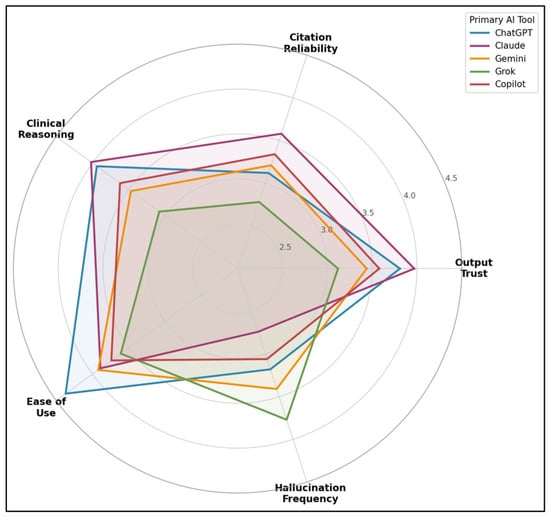
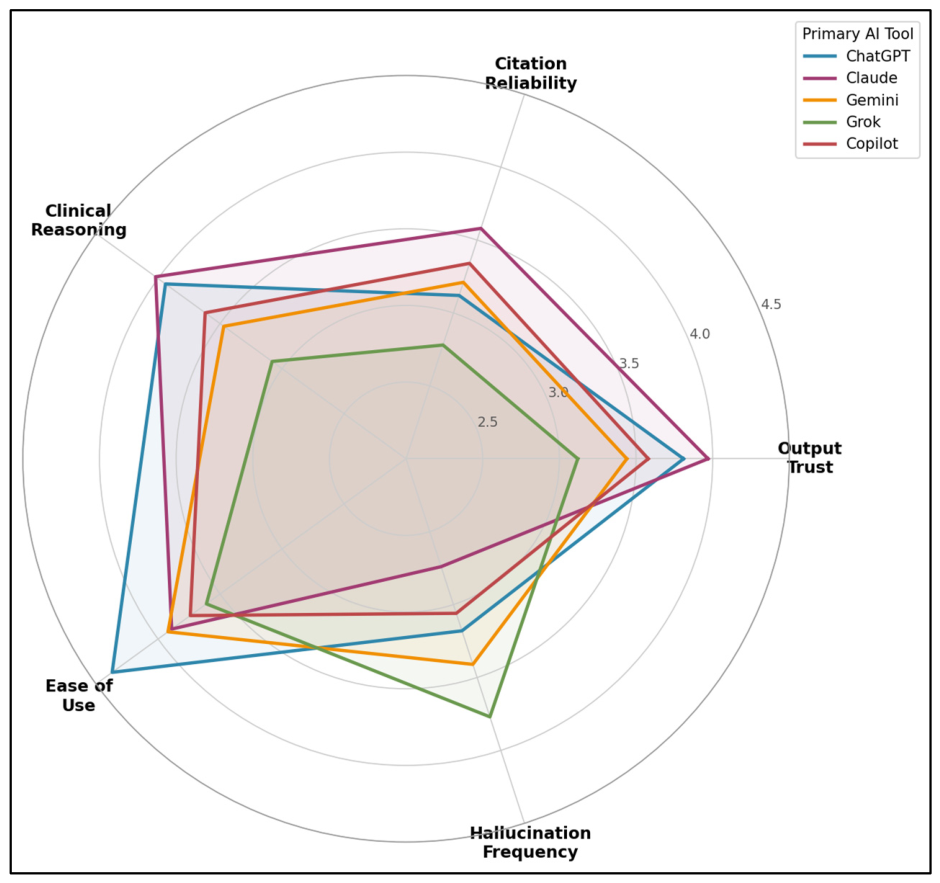
Figure 1 presents a radar profile comparing the five generative AI tools across five student-rated quality dimensions: output trust, citation reliability, clinical reasoning support, ease of use, and hallucination frequency. The profiles reveal distinct tool signatures rather than uniform superiority of any single system. ChatGPT achieved the highest ease-of-use rating (4.37) and strong clinical reasoning support (3.94), consistent with its role as the default tool for the majority. Claude attained the highest scores for citation reliability (3.58), clinical reasoning (4.02), and output trust (3.97), while recording the lowest perceived hallucination frequency (2.74), a profile suggesting students view it as comparatively careful. Grok occupied the opposite pole, with the lowest citation reliability (2.78) and the highest perceived hallucination frequency (3.77). Because the radar vertices for Grok (n = 8) and Copilot (n = 5) rest on small primary-user subgroups, these two profiles should be read as provisional and weighted less heavily than the better-populated ChatGPT and Claude profiles.
Figure 1.
Mean student-rated performance profiles of five AI tools across quality dimensions (5-point Likert, n = 141). Higher values on the “hallucination frequency” axis indicate more frequently perceived inaccurate output.
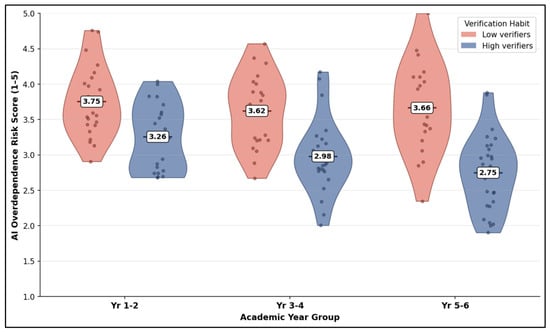
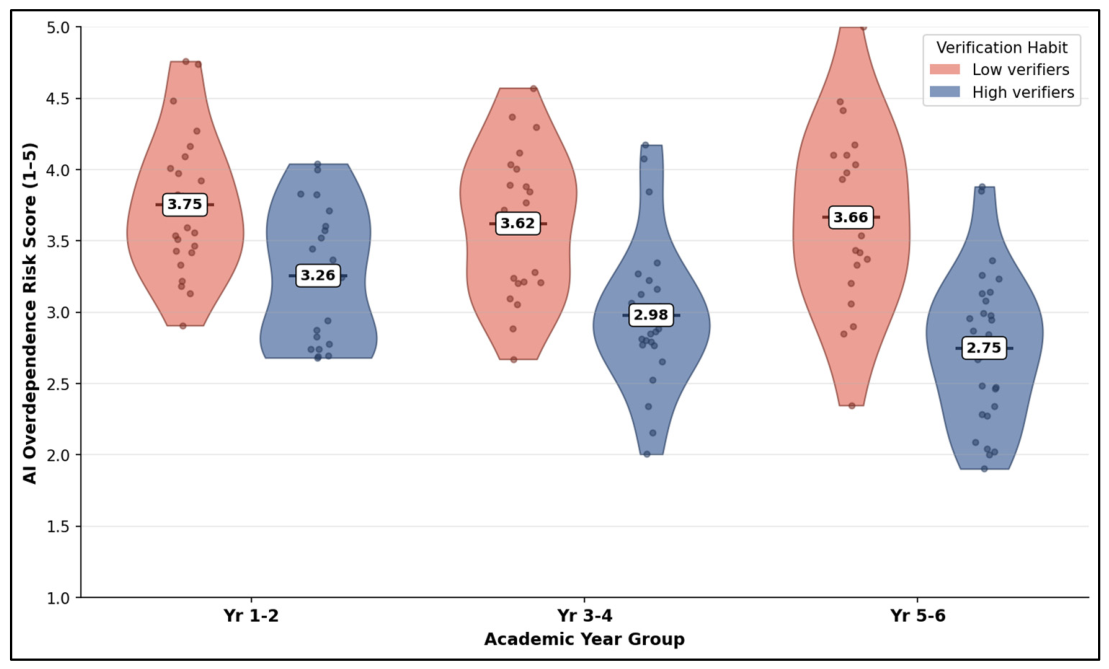
A two-way ANOVA confirmed a significant interaction between year group and verification habit (p = 0.041), visually evident in the diverging trajectories (Figure 2). Among low verifiers, overdependence risk declined only modestly across training, from 3.75 in Years 1–2 to 3.66 in Years 5–6—a reduction of just 0.09 points. Among high verifiers, the decline was far steeper, from 3.26 in Years 1–2 to 2.75 in Years 5–6, a reduction of 0.51 points. Consequently, the gap between low and high verifiers widened from 0.49 points in early years to 0.91 points in final years.
Figure 2.
AI overdependence risk by academic year group and verification habit (two-way ANOVA interaction p = 0.041). Violin shapes show score distributions; horizontal lines and labels indicate group means; points represent individual respondents.
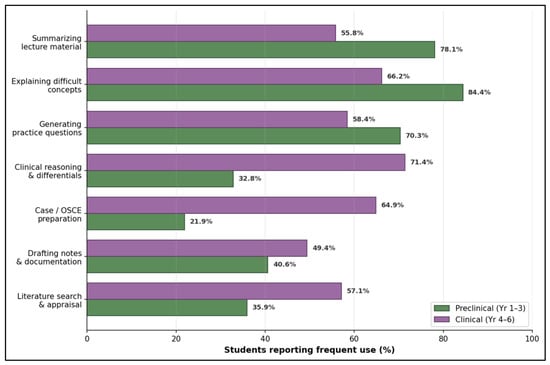
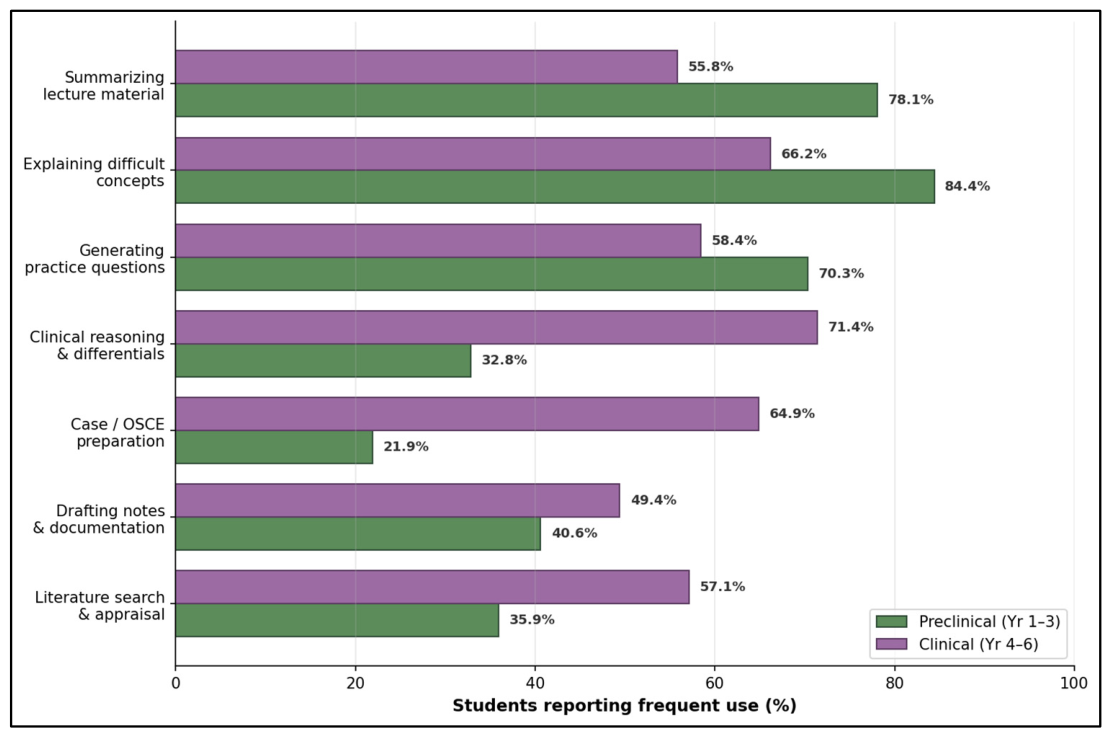
Preclinical students concentrated their use on knowledge-acquisition tasks: 84.4% reported frequent use for explaining difficult concepts, 78.1% for summarizing lecture material, and 70.3% for generating practice questions, compared with 66.2%, 55.8%, and 58.4% of clinical students, respectively (Figure 3). The pattern inverted sharply for application-oriented tasks. Only 32.8% of preclinical students used AI frequently for clinical reasoning and differential diagnosis and 21.9% for case or OSCE preparation, whereas 71.4% and 64.9% of clinical students did so—more than a twofold and nearly threefold difference, respectively. Clinical students also led modestly in literature search and appraisal (57.1% vs. 35.9%) and in drafting notes and documentation (49.4% vs. 40.6%).
Figure 3.
Proportion of students reporting frequent use of generative AI for seven academic task categories, stratified by training stage (preclinical vs. clinical).
4. Discussion
4.1. Analysis of Findings
This study provides a granular characterization of generative AI adoption among medical students, moving beyond the monolithic treatment of “AI” that has dominated prior work toward a tool-specific, behaviorally differentiated account [18,19]. Our central finding is that the trajectory of AI use across medical training is defined not by whether students engage with these tools—engagement was near-universal and frequent, echoing high prevalence figures reported internationally [20,21]—but by how that engagement is structured. Clinical students were more familiar with AI yet relied on it less, trusted its raw output less, and verified it more than their preclinical peers, producing markedly lower overdependence risk. This is consistent with clinical training functioning as a tacit school of critical appraisal, in which accumulating diagnostic knowledge and tolerance of uncertainty recalibrate students’ relationship with automated output toward healthier, supervised use, consistent with calls to embed appraisal skills early in the curriculum [22]. Because the design is cross-sectional, this stage-related pattern may partly reflect cohort differences rather than genuine within-student developmental change, and is accordingly described here as an association rather than an effect of clinical training.
The moderated and logistic analyses are consistent with verification behavior acting as a protective correlate of lower overdependence; because the design is cross-sectional, however, these relationships are best interpreted as associations rather than causal effects. Familiarity alone was unrelated to overdependence and, among non-verifiers, actually amplified it, whereas high verifiers were buffered entirely against familiarity-driven risk—an observation that resonates with concerns that fluency with AI can mask shallow understanding [23,24]. This finding carries direct pedagogical weight: interventions that promote AI literacy without simultaneously cultivating verification habits may inadvertently produce more efficient but more dependent learners [25]. These findings sit within a fast-growing 2024–2026 literature: work on the future of AI in diagnostic medicine documents strong anticipated reliance among trainees and clinicians alike [33]; analyses grounded in Bloom’s taxonomy caution that generative AI can flatten higher-order critical-thinking engagement when it substitutes for effortful reasoning [34]; and recent longitudinal evidence from medical students indicates that AI literacy mediates whether AI-assisted diagnosis strengthens or erodes critical thinking [36]. Our data extend this body of work by locating the pivotal difference not in exposure but in verification behavior. Read against this recent evidence, our results are best interpreted as associational: they identify verification behavior as the correlate most consistently linked to lower overdependence, yet the cross-sectional design cannot establish that verifying causes reduced dependence rather than the reverse, or that a third factor drives both. The differentiated tool profiles add a complementary layer, demonstrating that students form sophisticated, dimension-specific reliability judgments—trusting some tools more for reasoning and citation while recognizing others as more prone to fabrication—that educators can engage rather than override [26,27]. The concentration of use around ChatGPT most plausibly reflects its first-mover advantage and broad brand recognition rather than any measured superiority, given that its adjusted output-trust rating did not exceed that of Claude. Relatedly, the monotonic rise in perceived learning benefit across usage-frequency groups admits two non-exclusive readings that the cross-sectional design cannot separate: a benefit-driven engagement loop, in which students who derive genuine value from AI use it more often, and a familiarity effect, in which greater practice with prompting and interpreting output unlocks more productive applications.
These results align with and extend the emerging literature on cognitive offloading and AI in education, situating the abstract concern about overdependence within concrete, measurable behavioral parameters [13,14]. They also resonate with longstanding arguments that medical training must evolve from an information-transfer model toward one that prioritizes judgment in an age of ubiquitous machine assistance [28]. Just as clinical autonomy is extended progressively as trainees demonstrate competence, our data suggest that healthy AI integration follows a comparable arc, contingent on the development of verification discipline and explicit ethical framing [29]. The practical implication is a curricular model in which AI tools are introduced early but always alongside assessed expectations for cross-checking, source triangulation, and recognition of model limitations, supported by institutional readiness initiatives that prepare both students and faculty for an AI-integrated future [30].
A further insight emerges from the functional divergence in how the two cohorts deploy generative AI. Preclinical students concentrated their use on knowledge-acquisition tasks—explaining concepts, summarizing material, and generating practice questions—whereas clinical students recruited AI predominantly for applied reasoning, differential diagnosis, and case or OSCE preparation. This reallocation suggests that the tool is not used uniformly but is adapted to the dominant cognitive demand of each training phase, a flexibility that mirrors how experienced clinicians selectively delegate routine cognition while retaining judgment for high-stakes decisions [3,7]. The concern is that early, memorization-oriented use may be precisely the context in which uncritical acceptance is most consequential, because foundational errors propagate forward into clinical reasoning. Conversely, the application-oriented use observed among clinical students occurs within an evaluative frame—differential diagnosis inherently demands the weighing of alternatives—that may itself scaffold the verification behaviors we found to be protective [9,11]. Curricular design should therefore not treat all AI use as equivalent but should target the high-risk, low-scrutiny patterns characteristic of early training.
Translating these findings into practice points toward a staged, competence-based model of AI integration rather than a single orientation session. In the awareness phase, early-year students would be introduced to the capabilities and failure modes of large language models, with mandatory exercises in which they identify deliberately seeded hallucinations, building the habit of scrutiny before reliance becomes entrenched [6,17]. In the application phase, mid-cohort students would practice triangulating AI output against primary literature and guidelines, with verification behavior explicitly assessed rather than merely encouraged [22]. In the innovation phase, senior students could critically appraise tool-specific strengths—engaging with the kind of dimension-specific reliability judgments evident in our radar profiles—and contribute to local governance of AI use [26]. Faculty development is an indispensable parallel track, since educators cannot assess what they do not themselves understand, and institutional policies should make expectations for transparent AI use explicit across assessments [30]. Such a scaffolded approach reframes the goal from restricting AI to cultivating the discernment that distinguishes a safe, verifying user from a fluent but dependent one.
4.2. Study Limitations
Several limitations qualify the interpretation of these findings. First, the cross-sectional, single-institution design precludes causal inference and limits generalizability; the observed stage-related differences may reflect cohort effects rather than developmental change, and longitudinal studies would yield deeper insight into how verification habits genuinely strengthen across training [15]. At the same time, because the survey instrument and the full data-collection procedure are specified in detail, the single-site design lends itself to direct replication across institutions; we therefore regard the single-center scope as much an invitation to comparable, cumulative replication as a limitation on immediate generalisability. Second, all measures were self-reported, rendering them susceptible to social desirability bias—students may have overstated verification behavior and understated overdependence, particularly given growing public discourse about responsible AI use; behavioral or observational measures would provide more objective corroboration [16]. Third, the rapidly evolving AI landscape means that tool-specific perceptions captured at one timepoint may quickly become obsolete as models are updated and new entrants appear. The present findings should accordingly be read as a time-stamped benchmark—a marker against which future student cohorts and successive model generations can be compared as both the technology and its educational integration continue to mature. Fourth, the dichotomization of verification behavior at the median, while analytically convenient, sacrifices information and may underestimate dose-dependent effects. The same caveat applies to the median split used to define the high-overdependence group in the logistic model; wherever possible we retained continuous specifications (Table 5, Table 6 and Table 9), which converged with the dichotomous results and so mitigate, without wholly removing, this concern [37]. Finally, the instrument, though demonstrating acceptable internal consistency, was newly developed and would benefit from external validation against established AI-literacy and cognitive-offloading scales in future work. Crucially, these limitations qualify rather than invalidate the findings, and each maps to a concrete next step. We are accordingly planning a multi-center, longitudinal follow-up that will (i) track the same cohorts across the preclinical–clinical transition to test whether verification habits strengthen within students rather than merely differing between cohorts; (ii) complement self-report with behavioral indices of verification, such as log-based checking of AI outputs against primary sources; (iii) formally validate the instrument against established AI-literacy and cognitive-offloading scales through confirmatory factor analysis in an independent sample; and (iv) model overdependence as a continuous outcome throughout, avoiding the information loss inherent in median splits. Replication across institutions with differing curricular approaches to AI would further clarify which of the present associations are universal and which are context-specific.
5. Conclusions
This study characterizes generative AI as a deeply embedded feature of medical learning, with near-universal adoption dominated by ChatGPT. The decisive differences among students lay not in whether they used AI but in how clinical students, despite greater familiarity, showed lower reliance, lower uncritical trust, and substantially lower overdependence than preclinical peers—a gap mediated by stronger verification behavior. Across correlational, regression, logistic, and moderated analyses, verification was the factor most consistently associated with lower overdependence and appeared to attenuate—rather than, in causal terms, eliminate—the familiarity-related risk seen among students who did not verify. These findings argue that promoting AI literacy alone is insufficient. Medical curricula should introduce AI tools early but pair them inseparably with explicit, assessed training in verification and critical appraisal, so that future physicians treat AI as a fallible assistant to be checked rather than an authority to be trusted.
Author Contributions
Conceptualization, D.-I.P. and C.M.L.; methodology, D.-I.P. and C.M.L.; software, D.-I.P.; validation, F.B., S.B. and M.M.; formal analysis, F.B.; investigation, S.B.; resources, M.M.; data curation, S.B. and F.B.; writing—original draft preparation, D.-I.P., I.J. and M.L.B.; writing—review and editing, C.M.L., M.M. and I.J.; visualization, I.J.; supervision, C.M.L. and M.L.B.; project administration, M.L.B. All authors have read and agreed to the published version of the manuscript.
Funding
The APC was paid by Victor Babes University of Medicine and Pharmacy.
Institutional Review Board Statement
The study was conducted in accordance with the Declaration of Helsinki and approved by the Ethics Committee of Victor Babes University of Medicine and Pharmacy (protocol code 2429, date of approval 10 January 2025).
Informed Consent Statement
Informed consent was obtained from all subjects involved in the study.
Data Availability Statement
The full 28-item survey instrument is available from the corresponding author upon request, and the AI Overdependence Risk and Verification Behavior item sets are additionally reproduced in Appendix A. The data presented in this study are available on request from the corresponding author. The data are not publicly available due to privacy restrictions.
Acknowledgments
During the preparation of this manuscript, the authors did not use generative artificial intelligence tools for the generation of text, data, or graphics, or for study design, data collection, analysis, or interpretation. We would like to acknowledge Victor Babeș University of Medicine and Pharmacy Timișoara for their support in covering the costs of publication for this research paper.
Conflicts of Interest
The authors declare no conflicts of interest.
Appendix A
This appendix reports the psychometric evaluation of the study instrument and lists the items comprising the two constructs most central to the analyses. All attitudinal items used a five-point Likert scale (1 = strongly disagree, 5 = strongly agree).
Table A1.
Construct-level psychometric summary for the five Likert subscales (n = 141).
AI Overdependence Risk (6 items): (1) I often accept AI-generated answers without checking them against another source; (2) I find it difficult to complete academic tasks without the help of an AI tool; (3) When an AI tool and my textbook disagree, I tend to trust the AI tool; (4) I use AI tools even for tasks I am able to complete on my own; (5) I would feel anxious if I could not use AI tools during my studies; (6) I rely on AI tools to reason through problems rather than working them out myself.
Verification Behavior (4 items): (1) I cross-check AI-generated information against textbooks or course materials; (2) I verify AI-generated information using clinical guidelines or primary literature; (3) I ask a teacher, tutor, or peer to confirm information I obtained from an AI tool; (4) Before using AI output in my work, I check whether the sources it cites actually exist.
References
- Kung, T.H.; Cheatham, M.; Medenilla, A.; Sillos, C.; De Leon, L.; Elepaño, C.; Madriaga, M.; Aggabao, R.; Diaz-Candido, G.; Maningo, J.; et al. Performance of ChatGPT on USMLE: Potential for AI-Assisted Medical Education Using Large Language Models. PLoS Digit. Health 2023, 2, e0000198. [Google Scholar] [CrossRef] [Scilit] [PubMed]
- Eysenbach, G. The Role of ChatGPT, Generative Language Models, and Artificial Intelligence in Medical Education: A Conversation with ChatGPT and a Call for Papers. JMIR Med. Educ. 2023, 9, e46885. [Google Scholar] [CrossRef] [Scilit] [PubMed]
- Lee, H. The Rise of ChatGPT: Exploring Its Potential in Medical Education. Anat. Sci. Educ. 2024, 17, 926–931. [Google Scholar] [CrossRef] [Scilit] [PubMed]
- Sallam, M. ChatGPT Utility in Healthcare Education, Research, and Practice: Systematic Review on the Promising Perspectives and Valid Concerns. Healthcare 2023, 11, 887. [Google Scholar] [CrossRef] [Scilit] [PubMed]
- Gilson, A.; Safranek, C.W.; Huang, T.; Socrates, V.; Chi, L.; Taylor, R.A.; Chartash, D. How Does ChatGPT Perform on the United States Medical Licensing Examination? The Implications of Large Language Models for Medical Education and Knowledge Assessment. JMIR Med. Educ. 2023, 9, e45312. [Google Scholar] [CrossRef] [Scilit] [PubMed]
- Abd-Alrazaq, A.; AlSaad, R.; Alhuwail, D.; Ahmed, A.; Healy, P.M.; Latifi, S.; Aziz, S.; Damseh, R.; Alabed Alrazak, S.; Sheikh, J. Large Language Models in Medical Education: Opportunities, Challenges, and Future Directions. JMIR Med. Educ. 2023, 9, e48291. [Google Scholar] [CrossRef] [Scilit] [PubMed]
- Thirunavukarasu, A.J.; Ting, D.S.J.; Elangovan, K.; Gutierrez, L.; Tan, T.F.; Ting, D.S.W. Large Language Models in Medicine. Nat. Med. 2023, 29, 1930–1940. [Google Scholar] [CrossRef] [Scilit] [PubMed]
- Tran, C.; Hryciw, B.N.; Moore, S.W.; Chaput, A.; Seely, A.J.E. Perceptions and Use of Generative Artificial Intelligence in Medical Students: A Multicenter Survey. J. Med. Educ. Curric. Dev. 2025, 12, 23821205251391969. [Google Scholar] [CrossRef] [Scilit] [PubMed]
- Tsang, R. Practical Applications of ChatGPT in Undergraduate Medical Education. J. Med. Educ. Curric. Dev. 2023, 10, 23821205231178449. [Google Scholar] [CrossRef] [Scilit] [PubMed]
- Mistry, N.P.; Saeed, H.; Rafique, S.; Le, T.; Obaid, H.; Adams, S.J. Large Language Models as Tools to Generate Radiology Board-Style Multiple-Choice Questions. Acad. Radiol. 2024, 31, 3872–3878. [Google Scholar] [CrossRef] [Scilit] [PubMed]
- Boscardin, C.K.; Gin, B.; Golde, P.B.; Hauer, K.E. ChatGPT and Generative Artificial Intelligence for Medical Education: Potential Impact and Opportunity. Acad. Med. 2024, 99, 22–27. [Google Scholar] [CrossRef] [Scilit] [PubMed]
- Cooper, A.; Rodman, A. AI and Medical Education—A 21st-Century Pandora’s Box. N. Engl. J. Med. 2023, 389, 385–387. [Google Scholar] [CrossRef] [Scilit] [PubMed]
- Risko, E.F.; Gilbert, S.J. Cognitive Offloading. Trends Cogn. Sci. 2016, 20, 676–688. [Google Scholar] [CrossRef] [Scilit] [PubMed]
- Gerlich, M. AI Tools in Society: Impacts on Cognitive Offloading and the Future of Critical Thinking. Societies 2025, 15, 6. [Google Scholar] [CrossRef] [Scilit]
- Preiksaitis, C.; Rose, C. Opportunities, Challenges, and Future Directions of Generative Artificial Intelligence in Medical Education: Scoping Review. JMIR Med. Educ. 2023, 9, e48785. [Google Scholar] [CrossRef] [Scilit] [PubMed]
- Weidener, L.; Fischer, M. Artificial Intelligence in Medicine: Cross-Sectional Study Among Medical Students on Application, Education, and Ethical Aspects. JMIR Med. Educ. 2024, 10, e51247. [Google Scholar] [CrossRef] [Scilit] [PubMed]
- Civaner, M.M.; Uncu, Y.; Bulut, F.; Chalil, E.G.; Tatli, A. Artificial Intelligence in Medical Education: A Cross-Sectional Needs Assessment. BMC Med. Educ. 2022, 22, 772. [Google Scholar] [CrossRef] [Scilit] [PubMed]
- Jackson, P.; Ponath Sukumaran, G.; Babu, C.; Tony, M.C.; Jack, D.S.; Reshma, V.R.; Davis, D.; Kurian, N.; John, A. Artificial Intelligence in Medical Education—Perception Among Medical Students. BMC Med. Educ. 2024, 24, 804. [Google Scholar] [CrossRef] [Scilit] [PubMed]
- Mousavi Baigi, S.F.; Sarbaz, M.; Ghaddaripouri, K.; Ghaddaripouri, M.; Mousavi, A.S.; Kimiafar, K. Attitudes, Knowledge, and Skills Towards Artificial Intelligence Among Healthcare Students: A Systematic Review. Health Sci. Rep. 2023, 6, e1138. [Google Scholar] [CrossRef] [Scilit] [PubMed]
- Buabbas, A.J.; Miskin, B.; Alnaqi, A.A.; Ayed, A.K.; Shehab, A.A.; Syed-Abdul, S.; Uddin, M. Investigating Students’ Perceptions Towards Artificial Intelligence in Medical Education. Healthcare 2023, 11, 1298. [Google Scholar] [CrossRef] [Scilit] [PubMed]
- Mohammad, B.; Supti, T.; Alzubaidi, M.; Shah, H.; Alam, T.; Shah, Z.; Househ, M. The Pros and Cons of Using ChatGPT in Medical Education: A Scoping Review. Stud. Health Technol. Inform. 2023, 305, 644–647. [Google Scholar] [CrossRef] [Scilit] [PubMed]
- Khlaif, Z.N.; Mousa, A.; Hattab, M.K.; Itmazi, J.; Hassan, A.A.; Sanmugam, M.; Ayyoub, A. The Potential and Concerns of Using AI in Scientific Research: ChatGPT Performance Evaluation. JMIR Med. Educ. 2023, 9, e47049. [Google Scholar] [CrossRef] [Scilit] [PubMed]
- Totlis, T.; Natsis, K.; Filos, D.; Ediaroglou, V.; Mantzou, N.; Duparc, F.; Piagkou, M. The Potential Role of ChatGPT and Artificial Intelligence in Anatomy Education: A Conversation with ChatGPT. Surg. Radiol. Anat. 2023, 45, 1321–1329. [Google Scholar] [CrossRef] [Scilit] [PubMed]
- Sallam, M.; Salim, N.A.; Barakat, M.; Al-Tammemi, A.B. ChatGPT Applications in Medical, Dental, Pharmacy, and Public Health Education: A Descriptive Study Highlighting the Advantages and Limitations. Narra J. 2023, 3, e103. [Google Scholar] [CrossRef] [Scilit] [PubMed]
- Tangadulrat, P.; Sono, S.; Tangtrakulwanich, B. Using ChatGPT for Clinical Practice and Medical Education: Cross-Sectional Survey of Medical Students’ and Physicians’ Perceptions. JMIR Med. Educ. 2023, 9, e50658. [Google Scholar] [CrossRef] [Scilit] [PubMed]
- Moldt, J.A.; Festl-Wietek, T.; Madany Mamlouk, A.; Nieselt, K.; Fuhl, W.; Herrmann-Werner, A. Chatbots for Future Docs: Exploring Medical Students’ Attitudes and Knowledge Towards Artificial Intelligence and Medical Chatbots. Med. Educ. Online 2023, 28, 2182659. [Google Scholar] [CrossRef] [Scilit] [PubMed]
- Pucchio, A.; Eisenhauer, E.A.; Moraes, F.Y. Medical Students Need Artificial Intelligence and Machine Learning Training. Nat. Biotechnol. 2021, 39, 388–389. [Google Scholar] [CrossRef] [Scilit] [PubMed]
- Wartman, S.A.; Combs, C.D. Medical Education Must Move from the Information Age to the Age of Artificial Intelligence. Acad. Med. 2018, 93, 1107–1109. [Google Scholar] [CrossRef] [Scilit] [PubMed]
- Masters, K. Ethical Use of Artificial Intelligence in Health Professions Education: AMEE Guide No. 158. Med. Teach. 2023, 45, 574–584. [Google Scholar] [CrossRef] [Scilit] [PubMed]
- Narayanan, S.; Ramakrishnan, R.; Durairaj, E.; Das, A. Artificial Intelligence Revolutionizing the Field of Medical Education. Cureus 2023, 15, e49604. [Google Scholar] [CrossRef] [Scilit] [PubMed]
- Sweller, J.; van Merriënboer, J.J.G.; Paas, F. Cognitive Architecture and Instructional Design: 20 Years Later. Educ. Psychol. Rev. 2019, 31, 261–292. [Google Scholar] [CrossRef] [Scilit]
- Zimmerman, B.J. Becoming a Self-Regulated Learner: An Overview. Theory Pract. 2002, 41, 64–70. [Google Scholar] [CrossRef] [Scilit] [PubMed]
- Cabral, B.P.; Braga, L.A.M.; Conte Filho, C.G.; Mota, F. Future Use of AI in Diagnostic Medicine: 2-Wave Cross-Sectional Survey Study. J. Med. Internet Res. 2025, 27, e53892. [Google Scholar] [CrossRef] [Scilit] [PubMed]
- Gonsalves, C. Generative AI’s Impact on Critical Thinking: Revisiting Bloom’s Taxonomy. J. Mark. Educ. 2024, 48, 4–19. [Google Scholar] [CrossRef] [Scilit]
- Karaca, O.; Çalışkan, S.A.; Demir, K. Medical Artificial Intelligence Readiness Scale for Medical Students (MAIRS-MS)—Development, Validity and Reliability Study. BMC Med. Educ. 2021, 21, 112. [Google Scholar] [CrossRef] [Scilit] [PubMed]
- Xin, Y.; Yan, D.; Shuren, L.; Minyang, L.; Liuheng, L. AI Literacy Mediates AI-Assisted Diagnosis Participation and Critical Thinking Among Medical Students Under Supervision. npj Digit. Med. 2026, 9, 344. [Google Scholar] [CrossRef] [Scilit] [PubMed]
- MacCallum, R.C.; Zhang, S.; Preacher, K.J.; Rucker, D.D. On the Practice of Dichotomization of Quantitative Variables. Psychol. Methods 2002, 7, 19–40. [Google Scholar] [CrossRef] [PubMed]

Disclaimer/Publisher’s Note: The statements, opinions and data contained in all publications are solely those of the individual author(s) and contributor(s) and not of MDPI and/or the editor(s). MDPI and/or the editor(s) disclaim responsibility for any injury to people or property resulting from any ideas, methods, instructions or products referred to in the content. |
© 2026 by the authors. Published by MDPI on behalf of the Academic Society for International Medical Education. Licensee MDPI, Basel, Switzerland. This article is an open access article distributed under the terms and conditions of the Creative Commons Attribution (CC BY) license.