


Abstract
Health Professions Education research is playing an increasing role in ensuring evidence-based practice in Health Professions Education (HPE). To this end, HPE research uses, among other approaches, comparisons as a method in the sense of Comparative Education Research (CER), which allows to compare programs at different levels of education. To obtain evidence-based results, it needs a methodologically sound approach with transparent and justifiable sampling strategies as well as defined sampling criteria. The aim of this research is to identify sampling criteria used in CER for program comparisons and to draw conclusions about what HPE research can probably learn from that. We conducted a scoping review following the Arksey and O’Malley framework, searching three databases and grey literature for international comparative education studies. Four reviewers selected and analyzed the studies using content analysis. A total of 68 studies were included, and six sampling criteria for international CER were identified: (1) culture, (2) education system, (3) curriculum of an education program, (4) ranking, achievement or performance, (5) state and relevance of research, and (6) opportunities and pragmatic reasons. All these criteria appear to be applicable to education research on HPE programs. The sampling criteria derived can serve as a guide for sample selection in international CER and HPE research, providing impetus to improve the quality of research methodology. This necessitates unrestricted access to data on educational programs and a more profound comprehension of the cultural, political and educational characteristics of the respective country.
1. Introduction
The field of HPE continues to grow, driven by different education programs, such as disciplinary HPE programs (e.g., undergraduate and postgraduate medical, nursing, and allied health programs) as well as graduate-level programs in HPE, such as Master of Health Professions Education (MHPE) [1,2]. Correspondingly, research activities in HPE have expanded considerably, evolving from basic education studies to increasingly sophisticated and methodologically diverse investigations across multiple dimensions of HPE [3]. Research in the field of HPE aims not only to evaluate the effectiveness of education programs, but also to support their design, improve teaching methods, address curriculum-related challenges, and ensure these programs meet the evolving needs of educators and students [4,5,6,7]. HPE research covers diverse topics, including admissions, curriculum development, evaluation of content and teaching, and the transition to professional practice. This research ensures that HPE remains aligned with current developments in healthcare and education, contributing to global improvements in healthcare system [2,8,9].
One valuable approach to advancing HPE research is through systematically comparing education programs and systems across countries and contexts to identify similarities and differences in educational approaches, outcomes, and structures [10,11,12,13]. Comparisons allow to uncover best practices and provide evidence-based insights applicable to HPE and other educational contexts [14,15,16].
International comparative research activities in HPE require a theoretically and methodologically sound approach to be meaningful. In this context, it is worth considering general and higher education research, particularly the relatively new field of CER. There is an intense debate in this field about what constitutes appropriate CER methods and how to identify existing approaches suitable for the intended comparisons [17,18]. This debate includes discussions about the challenges of CER and the demand for greater plurality in the choice of methods [19,20] and the development of new methods [21,22]. The key challenge in CER is to strike a balance between the unique contexts of the phenomena being studied while maintaining sufficient common ground for comparability and analytical generalizations [23]. This applies to both variable-oriented quantitative research [24,25] and case-based qualitative research [23,26]. Thus, the debate revolves around competing expectations of methodological rigor as essential for meaningful comparisons. These range from calls for increased standardization to arguments that emphasize contextual sensitivity and methodological flexibility.
A transparent and justified sampling strategy that addresses general questions such as the population, sampling and recruitment methods, rationale for sample size and data collection duration is key [27]. Since education systems and programs can vary considerably, it is crucial to select cases that represent the diversity of educational practices and their impacts in order to ensure the quality of international CER [12,28,29]. While sampling alone cannot guarantee that research findings are valid, reliable and applicable beyond the specific study context, a clearly defined sample is essential.
Against this background, this paper addresses the challenges in sampling in international CER that focuses on comparing programs in general or higher education. The aims of our research are (1) to identify sampling criteria used in CER for program comparisons, and (2) to draw conclusions for sampling in comparative HPE research. With the results of this study, we hope to contribute to the discourse about stricter and more reliable sampling criteria in comparative HPE research and ultimately to provide impetus for improving the quality of research methodology in this emerging scientific field.
2. Materials and Methods
We conducted a scoping review using the Arksey and O’Malley framework [30] to compile a broad range of sampling criteria used in CER. This more exploratory review method allows the inclusion of studies with heterogeneous designs and methodologies. This review was prepared in accordance with the Preferred Reporting Items for Systematic reviews and Meta-Analyses extension for Scoping Reviews (PRISMA-ScR) Checklist guideline [31]. The study protocol has been registered on Open Science Frameworks “https://osf.io/x9uvd/overview” (accessed on 11 January 2026).
2.1. Identifying Relevant Studies
After identifying the research question, we conducted a comprehensive search of several databases, including Web of Science, ERIC, SocINDEX, grey literature sources www.greylit.org (accessed on 23 July 2024), and Google Scholar. Additionally, reference lists of identified articles were manually screened to locate further relevant studies.
We restricted the search to the last 10 years to capture literature reflecting the current state of the field, including contemporary terminology, practices, and contextual conditions relevant to our review question. This time frame also provided a pragmatic and transparent boundary for the evidence-mapping process, consistent with scoping review methodology. Studies that employed all research methods were included; reviews were excluded. Search terms were comparative analysis, comparative education, international, program and/or study (Table 1).
Table 1.
Search strategy for Web of Science, ERIC, SocINDEX and grey literature sources (* stands for truncation).
The search was conducted in English. The search strategy was developed in collaboration with an experienced health-based librarian (more detailed information in the acknowledgements). The identification of relevant studies was completed on 31 July 2024.
2.2. Study Selection
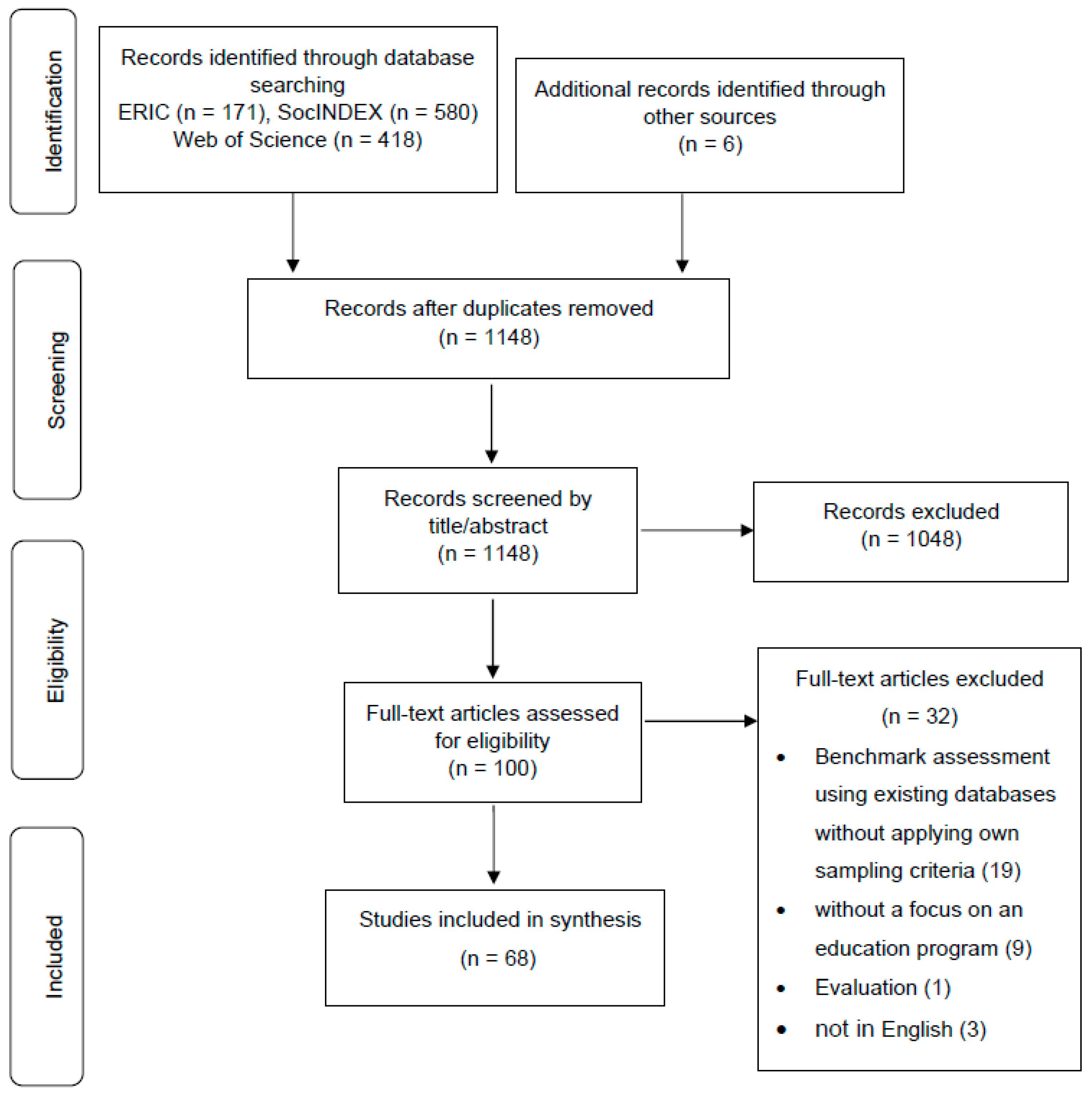
Titles and abstracts of all identified papers (n = 1148 after duplicates removal) were screened twice by independent reviewers considering the inclusion criteria (Table 2). The 1148 articles were divided among reviewers D.H., F.M., S.C.S., and F.S.. At the same time, the first author F.K. screened all articles (title and abstract). There was a high degree of agreement due to the jointly developed and adapted inclusion and exclusion criteria. Any discrepancies between the five reviewers were resolved by consensus. To manage references and eliminate duplicates, we used the Rayyan software tool [32]. After the title and abstract screening F.K. read the full texts (n = 100).
Table 2.
Characteristics of included and excluded studies.
2.3. Charting the Data
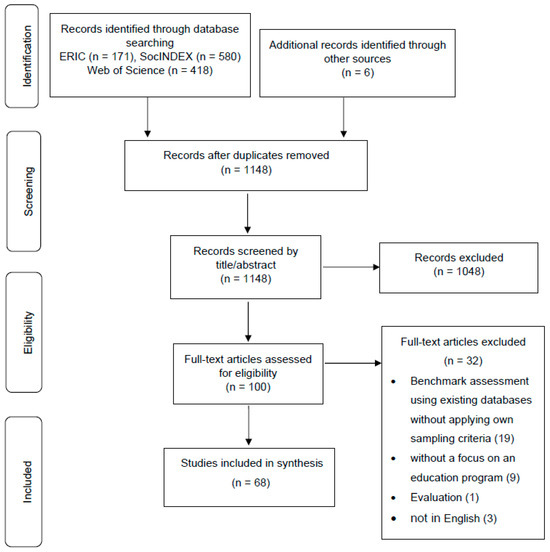
The first author, F.K., extracted the basic study parameters from the included studies into a table and sorted them according to important characteristics, including comparison countries, study design, and education level (Table A1). D.H., F.M., S.C.S., and F.S. then independently checked the table based on a full-text review (n = 100) according to our defined criteria (Table 2). At the end of the selection process, we included n = 68 studies (Figure 1).
Figure 1.
Flow diagram of search and study selection process.
2.4. Analysis of Selected Studies and Summary of Results
We conducted a qualitative content analysis [33,34] to identify sampling criteria employed in CER for program comparisons. We analyzed the introductions and methodologies of the literature to describe the study design, the sample size and the sampling procedure of the 68 included studies. The criteria for sampling were only described implicitly in the CER analyzed studies. For this reason, the first author (F.K.) developed inductive categories reflecting the sampling procedure. The sampling criteria were derived from these categories. Next, F.K. discussed the identified sampling criteria with the co-authors (D.H., F.M., S.C.S., and F.S.) during two team meetings. All reviewers agreed on the patterns and thematic concepts. The first author reviewed and recorded all the data and presented the final concepts to the co-authors, who reviewed and refined the sample criteria to ensure the analysis was trustworthy. Furthermore, a frequency count was conducted to determine the number of countries under comparison, the countries most frequently studied, the study designs employed, and the education level of the programs (see Section 3.1 and Table A1).
3. Results
3.1. Study Overview
The 68 eligible studies included research using quantitative (n = 21), qualitative (n = 12), and mixed methods designs (n = 7); document and course syllabus analyses (n = 10); and secondary analyses of international large-scale assessments and social surveys (n = 18). Across the 68 analyzed studies, a total of 79 countries were compared. Most frequently, research was focused on countries in North America and Europe. These countries include the United States (n = 18), Great Britain (n = 18) and Germany (n = 14). In contrast, only five countries from South America and six from Africa were included. The education levels included primary/secondary (n = 22), higher education (n = 41), and adult education (n = 5).
3.2. Sampling Criteria
From the analysis of the studies, we have inductively derived six criteria for sampling selection. Five criteria are based on content-related aspects: Culture (C1), Education system (C2), Curriculum of an education program (C3), Ranking, achievement or performance (C4), and State and relevance of research (C5). One criterion is based on technical considerations in sample selection: Opportunities and pragmatic reasons (C6).
- (1)
- Culture (C1)
Cultural similarities or differences were used to select the sample. This also includes country-specific or regional characteristics. Comparisons have been made between studies examining differences among Asian and Western countries [35,36,37], Western and Eastern countries [38,39], Middle Eastern countries [40], Nordic countries [41], Western Europe and the United States [42] or variations among Arab countries with different political and social contexts [43]. In most cases, sampling decisions were justified by culture particularities. However, in some cases, the pragmatic for selecting specific regions, continents, or geographical areas was not provided [44], or was vaguely attributed to geographic proximity, shared EU membership, or presumed cultural, political, and economic convergence [45,46]. Factors such as academic achievement, social status, and religion in a country or the influence of its history were also considered [36,43,47,48].
- (2)
- Education system (C2)
In some cases, sampling decisions were based on differences or similarities in education systems, which have developed historically and are closely linked to the respective political framework and developments. Differences in education systems are reflected in whether education is provided by state or private institutions [49,50], in the education level at which performance-based differentiation begins [51], and in existing social inequalities [52]. Countries can also be selected according to the expectations of the labor market, reflected in selection procedures, teaching methods, and internship programs [53], or according to the cooperation between educational institutions and the labor market during studies and internships [54].
- (3)
- Curriculum of an education program (C3)
Furthermore, countries were selected based on anticipated differences and similarities in their curricula. A distinction is made between curricula that are less defined, informal, and minimally differentiated, which contribute to lower stratification, and more formalized curricula that explicitly sort students into different tracks [55]. Samples were selected based on the proportion of practical training in the study program, its evaluation, and on the learning methods employed, such as personal professional portfolios, student-led learning, blended learning, and clinical reasoning [56,57,58]. Additionally, the selection of countries was influenced by political demands on degree program content that have yet to be implemented [59]. Finally, the name of the degree program and its associated curricula are also aspects for selection [60,61,62].
- (4)
- Ranking, achievement or performance (C4)
Results of large-scale assessments such as the Program for International Student Assessment (PISA) and the Trends in International Mathematics and Science Study (TIMSS) were also used to select international CER samples. Countries with the highest and lowest PISA or TIMSS performance levels were contrasted, for example, to demonstrate a correlation between teacher motivation and pupil performance [63]. Similarly, success rates in the performance ranking were also compared with a country’s economic development [64]. In addition to rankings that classified school performance, other ranking systems were used, such as those based on the individualism index [65], which could be utilized to distinguish between collectivist and individualist countries [66].
- (5)
- State and relevance of research (C5)
Countries were selected based on the relevance of the phenomenon under investigation and the existence of previous studies on the programs in those countries. Furthermore, the countries were selected for comparison because the study programs under investigation had already been successfully developed and implemented in programs to address specific issues, such as bullying in schools [67] or stress in universities [68]. This provided other countries with an opportunity to learn from these experiences and adopt a similar best-practice approach [69,70,71,72].
- (6)
- Opportunities and pragmatic reasons (C6)
The sampling criterion of ‘opportunities and pragmatic reasons’ is based on technical considerations in sample selection. This sampling criterion was used in the analyzed studies in conjunction with the convenience sampling strategy. Such convenience samples could be illustrated by students enrolled in the same degree program or attending the same conference [73,74,75,76,77] or studying at partner universities [78]. Another common reason was the researcher’s origin and geographical proximity to the surveyed group, such as when the researchers contributed to the analyzed program [79]. Sample selection was predicated on its accessibility, rather than on the theoretical framework or research question of the study.
3.3. Study Criteria Application
The six identified sampling criteria were applied individually or in combination in the analyzed studies. To highlight differences between countries, typically only one criterion was used, for example culture differences (C1). To justify the selection of countries and institutions, two criteria were commonly applied, such as differences between the curricula of education programs (C3) and pragmatic reasons, like the researcher`s geographical proximity to the surveyed group (C6). Criteria C1 to C5 were primarily used for country selection at the macro level. Educational institutions or individuals at the meso- or micro levels were often selected based on criterion C6 or without justification.
4. Discussion
The aim of this review was (1) to identify sampling criteria used in CER for program comparisons, and (2) to draw conclusions for sampling in comparative HPE research. We identified six sampling criteria used in the included literature: Five content-related criteria (C1-Culture, C2-Education system, C3-Curriculum of an education program, C4-Ranking, achievement or performance, and C5-State and relevance of research) and one criterion based on technical considerations (C6-Opportunities and pragmatic reasons).
As emphasized in the introduction with reference to Park et al. [18], transparent and well-defined sampling criteria are essential for ensuring research quality in CER and HPE. This perspective is shared by other authors in the field [26]. However, most CER studies analyzed rarely provided detailed justifications for their sampling decisions, making it difficult to understand the methodology and assess the validity of the comparisons. For this review, these criteria needed to be derived inductively from the analyzed studies because they were usually only mentioned implicitly rather than explicitly stated and justified in the methodology sections. This is all the more problematic given that both HPE and CER research often aim to compare education programs and measures within complex education systems [11,12,80]. HPE research has an additional layer of complexity because it operates at the intersection of education and health systems, each of which has its own regulatory, ethical, and structural conditions. Therefore, comparative research in this context is further complicated by the need to consider clinical realities, patient safety, professional regulations, and competency-based outcomes. Clear documentation of sampling decisions in HPE research allows other researchers to evaluate the selection of countries and programs, enabling them to draw appropriate insights and conclusions [8]. Creating and using reporting guidelines for this type of CER could improve the situation and encourage researchers to disclose their sampling criteria.
Our analysis reveals that sampling rationales in CER studies are often more transparent at the macro level than on the meso or micro levels. CER studies at the macro level often provide clear justifications for the selection of particular countries based on criteria such as cultural differences (C1) or education system characteristics (C2). However, explicit justifications are often lacking at the meso and micro levels (e.g., selection of specific institutions or programs, and selection of individual participants). This lack of transparency at the meso and micro levels poses a serious challenge, because these levels directly impact on the comparability of education programs and learners’ experiences. Without justification of institutional or participant-level choices, it becomes difficult to determine whether observed similarities or differences stem from the programs themselves or from selection bias introduced by unarticulated sampling decisions. This pattern suggests a critical gap in methodological transparency that HPE research should address [81].
In order to make meaningful and methodologically sound comparisons, the sampling criteria must be clearly defined and applied consistently at all three levels. From the perspective of CER, sampling decisions are not neutral; rather, they reflect assumptions about which structural, institutional, or cultural dimensions are analytically relevant. The Framework for Comparative Education Analyses developed by Bray et al. can be used to justify and describe sample selection in more detail, taking into account the micro, macro, and meso levels [22]. In this framework the three levels are further differentiated: Level 1: Individual (micro); Levels 2 and 3: Classroom and school (meso) and Levels 4, 5, and 6: District, states/provinces, countries, world regions/continents (macro) [22]. It is particularly important to systematically formulate and apply sampling criteria at all these different levels, as clinical training structures and access to practice environments vary considerably between institutions and countries. Careful consideration should therefore be given to how sampling criteria are applied at all three levels to ensure that comparisons are meaningful and methodologically sound. This could be included in reporting guidelines for comparative HPE research. In addition to the criteria derived inductively in this study, established comparative education approaches—such as system-based criteria that focus on similarities and differences in education [22] or health systems and culturally informed perspectives [65]—can further support an analytically grounded selection of cases.
A convenience sample (C6) is commonly used in CER and HPE when access to education programs or research participants is limited. HPE research faces specific access barriers, including the limited availability of clinical learning environments, regulatory restrictions on international collaborations, ethical considerations in healthcare, and the heterogeneity of professional roles across different healthcare systems [8,20]. These challenges require flexible sampling procedures that take practical constraints into account while maintaining theoretical rigor [27]. However, the methodological literature in CER also points to problems due to methodological limitations and reflects practical constraints when using convenience samples [81]. Strengthening methodological reflection requires a clearer discussion of the potential consequences of using convenience sampling. These consequences include limited representativeness, excessive dependence on existing partners, and the selection of institutions that are easily accessible, making it easy to collect samples. Our findings suggest that the strategic use of C6 in combination with other criteria allows for methodologically sound adaptations to real-world research conditions, e.g., selection based on convenience and due to different curricula [78,82]. Furthermore, geographical proximity, linguistic compatibility, and existing institutional partnerships can be strategic responses to subject-specific constraints if they are transparently justified and combined with substantive selection criteria [79,83].
To meet the challenges of HPE, the application of the above sampling criteria requires subject-specific adjustments that reflect the particular characteristics of HPE. For instance, when applying the criterion “curriculum of an education program” (C3), sample selection in HPE research should focus on differences in educational content, teaching methods, program structures, educational policy frameworks, different professional legal frameworks, professional competency requirements and different models of clinical training integration [84]. Similarly, the “ranking and performance criterion” (C4) must be expanded to include health-specific metrics, such as patient outcomes, success rates in obtaining professional licenses, and integration into health systems. The status and relevance of the “research criterion” (C5) are particularly important in HPE research because the implementation of educational innovations has the potential to impact on professional practice and patient care. When applying this criterion, countries with comparable or different healthcare challenges, workforce structures or professional development needs could be considered. In addition to adapting the sampling criteria to the specificities of the HPE context, additional sampling criteria could be developed to reflect the unique characteristics of HPE. These criteria could include health system integration, professional regulatory frameworks, clinical practice settings, and patient safety considerations [3,85].
This review has strengths as well as limitations. For the first time, this review systematically compiled and analyzed studies in international CER to determine which sampling criteria are used to examine education programs, and to provide impetus for the future design of HPE. Sampling criteria were identified to contribute to the development of more rigorous and reliable research in the field of international CER and HPE, and ultimately to improve the quality of research methodology in these areas. However, there are several limitations to be considered. The review is limited to three databases focusing on education articles published in English. To obtain results reflecting the current methodological approach in CER, the search period was limited to ten years. The search could have distinguished between different levels of CER research or focused on articles about higher education. However, this was not done to gain a general understanding of the sampling criteria used in CER.
5. Conclusions
The sampling criteria derived from studies on education programs in CER can serve as an orientation for sample selection in international CER and HPE research, or at least provide impetus for improving the quality of methodology in these fields of research. Beyond providing a descriptive overview of existing criteria, this study highlights the central importance of sample selection in comparative CER and HPE research, which determines not only what is compared, but also what forms of comparison are possible. A key implication of this review is that sample selection decisions in comparative HPE research should be understood as theoretically grounded and multi-stage processes rather than purely technical or pragmatic decisions. To enable a transparent and analytically sound selection process, selection criteria should be systematically developed and explicitly justified for all three levels: macro (e.g., selection of countries or regions), meso (e.g., selection of specific institutions or programs), and micro (e.g., selection of individual participants). Future studies should therefore consciously integrate the three levels and reflect on their interrelationships when combining different sampling criteria.
The present study focused on sampling in CER. Further studies are needed that specifically address and analyze the sampling procedure in HPE. Additionally, quantitative and qualitative studies should evaluate the sampling criteria for different research designs. Qualitative studies could explore how the proposed criteria are understood and applied in different institutional and national contexts. This would help to identify context-specific challenges and unintended effects. Conversely, quantitative studies could examine the robustness and comparability of the criteria across larger samples and assess their implications for the validity and generalizability of comparative findings.
Furthermore, the findings underscore the importance of embedding sampling strategies in a broader understanding of cultural, political, and educational contexts. Deeper engagement with these contextual dimensions is essential for assessing the comparability of cases and for interpreting similarities and differences meaningfully. Future research should explicitly state the contextual assumptions underlying sampling decisions and explain how these assumptions influence comparative interpretations. To improve transparency and cumulative knowledge building in this area, we strongly recommend developing reporting guidelines for comparative educational research in HPE.
In terms of methodological development, two concrete recommendations emerge from this study. First, future research could evaluate the proposed sampling criteria through both qualitative and quantitative studies to assess their applicability, robustness, and limitations in different comparative designs. Second, unrestricted access to data on education programs could be considered a prerequisite for high-quality comparative HPE research, requiring the commitment of both research and educational institutions.
Author Contributions
Conceptualization, F.K.; methodology, F.K., D.H. and F.M.; software, F.K. and D.H.; validation, F.K., D.H. and F.M.; formal analysis, F.K.; investigation, F.K.; resources, M.E.; data curation, F.K.; writing—original draft preparation, F.K.; writing—review and editing, F.K., D.H., F.M. and M.E.; visualization, F.K.; supervision, M.E.; project administration, M.E. All authors have read and agreed to the published version of the manuscript.
Funding
The authors declare that they have not received a grant from funding agencies in the public, commercial, or not-for-profit sectors (institutional funding).
Data Availability Statement
The original contributions presented in this study are included in the article (Appendix A: Table A1).
Acknowledgments
The authors would like to thank Simone Campos Silva (S.C.S.) and Fabio Schnepf (F.S.), for their contribution to the study selection. Many thanks also to Joshua Paul, for his careful proofreading and helpful suggestions for linguistic improvement. Finally, the authors would like to say thank to Corinna Dressler, and Meghan R. Forrest for their professional support in compiling the review [86].
Conflicts of Interest
The manuscript has been read and approved by all the authors. Language editing assistance was provided by DeepL. The tool was used solely for grammar correction and stylistic improvement. The authors are responsible for all ideas and conclusions presented. The authors declare no conflicts of interest.
Appendix A
Table A1.
Data extraction table.
References
- Rees, C.E.; Monrouxe, L.V. Introducing Foundations of Health Professions Education Research. In Foundations of Health Professions Education Research, 1st ed.; Rees, C., Monrouxe, L., O’Brien, B., Gordon, L., Palermo, C., Eds.; Wiley: Hoboken, NJ, USA, 2023; pp. 1–9. [Google Scholar] [CrossRef] [Scilit]
- Tekian, A.; Dekhtyar, M.; Park, Y.S. The rapid growth and expansion of Master of health professions education (MHPE) programs: A mixed-methods study of international curricular trends and guidelines for programs. Med. Teach. 2024, 46, 341–348. [Google Scholar] [CrossRef] [Scilit]
- Blouin, D.; Tekian, A.; Kamin, C.; Harris, I.B. The impact of accreditation on medical schools’ processes. Med. Educ. 2018, 52, 182–191. [Google Scholar] [CrossRef] [Scilit]
- Tekian, A.; Harris, I. Preparing health professions education leaders worldwide: A description of masters-level programs. Med. Teach. 2012, 34, 52–58. [Google Scholar] [CrossRef] [Scilit]
- Schermerhorn, J.; Wilcox, S.; Durning, S.; Costello, J.; Norton, C.; Meyer, H. Graduate health professions education programs as they choose to represent themselves: A website review. MedEdPublish 2023, 13, 13. [Google Scholar] [CrossRef] [Scilit]
- Barabasch, A.; Heller, N. The Swiss PET system and similar programs in Germany and Austria. In Comparative Vocational Education Research; Pilz, M., Li, J., Eds.; Springer Fachmedien: Wiesbaden, Germany, 2020; pp. 97–111. [Google Scholar] [CrossRef] [Scilit]
- Tekian, A.; Artino, A. AM Last Page: Master’s Degree in Health Professions Education Programs. Acad. Med. 2013, 88, 1399. [Google Scholar] [CrossRef] [Scilit] [PubMed]
- Rees, C.E.; King, O.A.; Monrouxe, L.V. Impact in Health Professions Education Research. In Foundations of Health Professions Education Research, 1st ed.; Rees, C., Monrouxe, L., O’Brien, B., Gordon, L., Palermo, C., Eds.; Wiley: Hoboken, NJ, USA, 2023; pp. 233–253. [Google Scholar] [CrossRef] [Scilit]
- Varpio, L.; Gruppen, L.; Hu, W.; O’Brien, B.; Ten Cate, O.; Humphrey-Murto, S.; Irby, D.M.; van der Vleuten, C.; Hamstra, S.J.; Durning, S.J. Working Definitions of the Roles and an Organizational Structure in Health Professions Education Scholarship: Initiating an International Conversation. Acad. Med. 2017, 92, 205–208. [Google Scholar] [CrossRef] [Scilit] [PubMed]
- Adamson, B. International comparative studies in teaching and teacher education. Teach. Teach. Educ. 2012, 28, 641–648. [Google Scholar] [CrossRef] [Scilit]
- Afdal, H.W. The promises and limitations of international comparative research on teacher education. Eur. J. Teach. Educ. 2019, 42, 258–275. [Google Scholar] [CrossRef] [Scilit]
- Kosmützky, A.; Nokkala, T. Challenges and trends in comparative higher education: An editorial. High. Educ. 2014, 67, 369–380. [Google Scholar] [CrossRef] [Scilit]
- Lehmann, Y.; Ayerle, G.; Beutner, K.; Karge, K.; Behrens, J.; Landenberger, M. Bestandsaufnahme der Ausbildung in den Gesundheitsfachberufen im europäischen Vergleich (GesinE)—Zentrale Ergebnisse und Schlussfolgerungen. Gesundheitswesen 2015, 78, 407–413. [Google Scholar] [CrossRef] [Scilit] [PubMed]
- Cantwell, B. Explanatory accounts in international and comparative higher education research. High. Educ. Q. 2020, 74, 149–161. [Google Scholar] [CrossRef] [Scilit]
- Sarkar, M.; Rees, C.E.; Barber, C.; Palermo, C. A review of trends in health professions education research at the turn of three decades (2000, 2010, and 2020). Nurse Educ. Today 2025, 146, 106558. [Google Scholar] [CrossRef] [Scilit] [PubMed]
- Weiler, H.N. Keyword: International Research on Higher Education: Scholarship Between Policy and Science. Z. Für Erzieh. 2008, 11, 516–541. [Google Scholar] [CrossRef] [Scilit]
- Pandey, M.P. Innovative research methods in comparative education: Emerging trends and applications. Discov. Educ. 2025, 4, 210. [Google Scholar] [CrossRef] [Scilit]
- Wiseman, A.W.; Anderson, E.W.; Damaschke, L.; Galegher, E.; Dzotsenidze, N.; Park, M. Navigating the terrain of comparative education: An introduction. In Handbook on Comparative Education; Edward Elgar Publishing: Cheltenham, UK, 2025. [Google Scholar] [CrossRef] [Scilit]
- Hantrais, L. Methodological pluralism in international comparative research. Int. J. Soc. Res. Methodol. 2014, 17, 133–145. [Google Scholar] [CrossRef] [Scilit]
- Milošević, D.; Maksimović, J. Methodology of Comparative Research in Education: Role and Significance. Int. J. Cogn. Res. Sci. Eng. Educ. 2020, 8, 155–162. [Google Scholar] [CrossRef] [Scilit]
- Orekhova, E.Y. Comparative pedagogy: Changing research perspective. Perspect. Sci. Educ. 2024, 68, 10–23. [Google Scholar] [CrossRef] [Scilit]
- Bray, M.; Adamson, B.; Mason, M. (Eds.) Comparative Education Research: Approaches and Methods; Springer International Publishing: Cham, Switzerland, 2014. [Google Scholar] [CrossRef] [Scilit]
- Kosmützky, A.; Nokkala, T.; Diogo, S. Between context and comparability: Exploring new solutions for a familiar methodological challenge in qualitative comparative research. High. Educ. Q. 2020, 74, 176–192. [Google Scholar] [CrossRef] [Scilit]
- Patzelt, W.J. Wissenschaftstheoretische Grundlagen sozialwissenschaftlichen Vergleichens. In Vergleichen in der Politikwissenschaft; Kropp, S., Minkenberg, M., Eds.; VS Verlag für Sozialwissenschaften: Wiesbaden, Germany, 2005; pp. 16–54. [Google Scholar] [CrossRef] [Scilit]
- Ebbinghaus, B. When Less is More: Selection Problems in Large-N and Small-N Cross-National Comparisons. Int. Sociol. 2005, 20, 133–152. [Google Scholar] [CrossRef] [Scilit]
- Mahoney, J. Qualitative Methodology and Comparative Politics. Comp. Political Stud. 2007, 40, 122–144. [Google Scholar] [CrossRef] [Scilit]
- Park, Y.S.; Zaidi, Z.; O’Brien, B.C. RIME Foreword: What Constitutes Science in Educational Research? Applying Rigor in Our Research Approaches. Acad. Med. 2020, 95, Si–Sv. [Google Scholar] [CrossRef] [Scilit] [PubMed]
- Fairbrother, G.P. Quantitative and Qualitative Approaches to Comparative Education. In Comparative Education Research: Approaches and Methods; Bray, M., Adamson, B., Mason, M., Eds.; Springer International Publishing: Cham, Switzerland, 2014; pp. 71–93. [Google Scholar] [CrossRef] [Scilit]
- Antonucci, L. Comparative Research in Higher Education Studies: Considering the Different Levels of Comparison and Emerging Methodological Challenges. In Theory and Method in Higher Education Research; International Perspectives on Higher Education Research; Bd. 9; Emerald Group Publishing Limited: Leeds, UK, 2014; pp. 1–19. [Google Scholar] [CrossRef] [Scilit]
- Arksey, H.; O’Malley, L. Scoping studies: Towards a methodological framework. Int. J. Soc. Res. Methodol. 2005, 8, 19–32. [Google Scholar] [CrossRef] [Scilit]
- Tricco, A.C.; Lillie, E.; Zarin, W.; O’Brien, K.K.; Colquhoun, H.; Levac, D.; Moher, D.; Peters, M.D.J.; Horsley, T.; Weeks, L.; et al. PRISMA Extension for Scoping Reviews (PRISMA-ScR): Checklist and Explanation. Ann. Intern. Med. 2018, 169, 467–473. [Google Scholar] [CrossRef] [Scilit]
- Ouzzani, M.; Hammady, H.; Fedorowicz, Z.; Elmagarmid, A. Rayyan—A web and mobile app for systematic reviews. Syst. Rev. 2016, 5, 210. [Google Scholar] [CrossRef] [Scilit]
- Hsieh, H.F.; Shannon, S.E. Three Approaches to Qualitative Content Analysis. Qual. Health Res. 2005, 15, 1277–1288. [Google Scholar] [CrossRef] [Scilit]
- Levac, D.; Colquhoun, H.; O’Brien, K.K. Scoping studies: Advancing the methodology. Implement. Sci. 2010, 5, 69. [Google Scholar] [CrossRef] [Scilit] [PubMed]
- Tan, C.Y.; Liu, D. What Is the Influence of Cultural Capital on Student Reading Achievement in Confucian as Compared to Non-Confucian Heritage Societies? Comp. J. Comp. Int. Educ. 2018, 48, 896–914. [Google Scholar] [CrossRef] [Scilit]
- Prendergast, M.; Hongning, Z. A Comparative Study of Students Attitudes towards Mathematics in Two Different School Systems. Int. J. Math. Teach. Learn. 2016, 17, 1–24. [Google Scholar] [CrossRef] [Scilit]
- Baikady, R.; Nadesan, V.; Gao, J. What brings people to the social work classroom: A comparative perspective from India and China. Soc. Work. Educ. 2023, 42, 629–645. [Google Scholar] [CrossRef] [Scilit]
- Carnoy, M.; Khavenson, T.; Ivanova, A. Using TIMSS and PISA results to inform educational policy: A study of Russia and its neighbours. Comp. J. Comp. Int. Educ. 2015, 45, 248–271. [Google Scholar] [CrossRef] [Scilit]
- Bodovski, K.; Jeon, H.; Byun, S.Y. Cultural capital and academic achievement in post-socialist Eastern Europe. Br. J. Sociol. Educ. 2017, 38, 887–907. [Google Scholar] [CrossRef] [Scilit]
- Abdullah, H.K.; Hassanpour, B. Digital design implications: A comparative study of architecture education curriculum and practices in leading architecture firms. Int. J. Technol. Des. Educ. 2021, 31, 401–420. [Google Scholar] [CrossRef] [Scilit]
- Hutchinson, G.S.; Korazim-Kőrösy, Y. Do national welfare systems have an influence on interdisciplinary collaborations within schools of social work and their communities? The case of the Nordic countries. Int. Soc. Work 2017, 60, 45–60. [Google Scholar] [CrossRef] [Scilit]
- Kobernyk, O.; Yashchuk, S.; Yermakova, S.; Chmyr, V.; Bukina, T.; Romanenko, V. The Latest Trends in The Professional Training of Masters in the Field of Engineering and Technology. Rev. Rom. Pentru Educ. Multidimens. 2022, 14, 453–471. [Google Scholar] [CrossRef] [Scilit]
- Ibrahim, Q.A. Glocalization and international social work education: A comparative study of Palestine, Jordan, Saudi Arabia, Oman, Yemen, Egypt, Libya, and Morocco. Int. Soc. Work 2017, 60, 1399–1417. [Google Scholar] [CrossRef] [Scilit]
- Kwarteng, J.T.; Servoh, M.W. Benchmarking accounting curricula of selected universities in Africa with global standards. Cogent Educ. 2023, 10, 2239632. [Google Scholar] [CrossRef] [Scilit]
- Soto-Sanfiel, M.T.; Villegas-Simón, I.; Angulo-Brunet, A. Film literacy in secondary schools across Europe: A comparison of five countries’ responses to an educational project on cinema. Int. J. Media Cult. Politics 2018, 14, 187–213. [Google Scholar] [CrossRef] [Scilit] [PubMed]
- Nonte, S.; Hartwich, L.; Willems, A.S. Promoting reading attitudes of girls and boys: A new challenge for educational policy? Multi-group analyses across four European countries. Large-Scale Assess. Educ. 2018, 6, 5. [Google Scholar] [CrossRef] [Scilit]
- van Noord, J.; Spruyt, B.; Kuppens, T.; Spears, R. Education-Based Status in Comparative Perspective: The Legitimization of Education as a Basis for Social Stratification. Soc. Forces 2019, 98, 649–676. [Google Scholar] [CrossRef] [Scilit]
- Fernández Espinosa, V.; López González, J. Virtues and values education in schools: A study in an international sample. J. Beliefs Values 2024, 45, 69–85. [Google Scholar] [CrossRef] [Scilit]
- van der Merwe, N.; McChlery, S.; Visser, S.S. Balancing academic and professional pedagogies: A comparative study of two accounting departments in South Africa and the UK. Teach. High. Educ. 2014, 19, 276–288. [Google Scholar] [CrossRef] [Scilit]
- Gard, G.; Dagis, D. Physiotherapy students’ perceptions of learning in clinical practice in Sweden and India. Nurse Educ. Today 2016, 36, 381–386. [Google Scholar] [CrossRef] [Scilit]
- Bernardi, F.; Valdés, M.T. Sticky educational expectations: A cross-country comparison. Res. Soc. Strat. Mobil. 2021, 75, 100624. [Google Scholar] [CrossRef] [Scilit]
- Chitsamatanga, B.B.; Rembe, S.; Shumba, J. Are universities Serving Lunch before Breakfast through Staff Development Programmes? A comparative study of the experiences of female academics in South African and Zimbabwean universities. Womens Stud. Int. Forum 2018, 70, 79–88. [Google Scholar] [CrossRef] [Scilit]
- Tham, P.; McFadden, P.; Russ, E.; Baldschun, A.; Blakeman, P.; Griffiths, A. How do we prepare students for the challenges of social work? Examples from six countries around the world. Soc. Work. Educ. 2023, 42, 494–510. [Google Scholar] [CrossRef] [Scilit]
- Haanwinckel, B.Z.; Fawcett, B.; Garcia, J.A.B. Contrasts and reflections: Social work fieldwork supervision in Brazil and England. Int. Soc. Work 2018, 61, 943–953. [Google Scholar] [CrossRef] [Scilit]
- Urick, A.M.; Ford, T.G.; Page Wilson, A.S.; Consuegra, E. How does instructional leadership influence opportunity to learn in mathematics? A comparative study of pathways for grade 4 students in the U.S. and Belgium. Res. Comp. Int. Educ. 2022, 17, 372–398. [Google Scholar] [CrossRef] [Scilit]
- Hammerness, K.; Klette, K.; Jenset, I.S.; Canrinus, E.T. Opportunities to Study, Practice, and Rehearse Teaching in Teacher Preparation: An International Perspective. Teach. Coll. Rec. 2020, 122, 1–46. [Google Scholar] [CrossRef] [Scilit]
- El Islami, R.A.Z.; Xue, S.; Sari, I.J.; Ngan, L.H.M.; Khwaengmake, V.; Khan, S.; Bien, N.V.; Faikhamta, C.; Khuyen, N.T.; Prasoplarb, T. A Comparison of School Science Curricula of Indonesia, Vietnam, and Thailand. Asia-Pac. Soc. Sci. Rev. 2022, 22, 6. Available online: https://animorepository.dlsu.edu.ph/apssr/vol22/iss2/6 (accessed on 16 January 2025). [CrossRef] [Scilit]
- Guraya, S.Y.; Sulaiman, N.; Guraya, S.S.; Yusoff, M.S.B.; Roslan, N.S.; Al Fahim, M.; Abdelrehman, D.; Khoshhal, S. Understanding the climate of medical professionalism among university students; A multi-center study. Innov. Educ. Teach. Int. 2021, 58, 351–360. [Google Scholar] [CrossRef] [Scilit]
- Tiede, J.; Grafe, S. Media Pedagogy in German and U.S. Teacher Education. Comunicar 2016, 24, 19–28. [Google Scholar] [CrossRef] [Scilit]
- Ní Fhloinn, E.; Fitzmaurice, O. Mathematics Lecturers’ Views on the Student Experience of Emergency Remote Teaching Due to COVID-19. Educ. Sci. 2022, 12, 787. [Google Scholar] [CrossRef] [Scilit]
- Devos, F.; Jilet, L.; Bouazza, N.; Foissac, F.; Tréluyer, J.M.; Chappuy, H.; Ancel, P.Y. Identification and comparison of France to other countries of the teaching of research to nursing students: Results of an international survey of nursing educator. Nurse Educ. Today 2021, 97, 104717. [Google Scholar] [CrossRef] [Scilit]
- Labra, O.; Ependa, A.; Chamblas, I.; Gingras-Lacroix, G.; Antoniadis, A.; Biston, C.; Mukeshimana, M.; Giroux, M. HIV/AIDS knowledge and attitudes among social work students: A comparative study. Int. Soc. Work 2023, 66, 1030–1044. [Google Scholar] [CrossRef] [Scilit]
- Abazaoğlu, İ.; Aztekin, S. The Role of Teacher Morale and Motivation on Students’ Science and Math Achievement: Findings from Singapore, Japan, Finland and Turkey. Univers. J. Educ. Res. 2016, 4, 2606–2617. [Google Scholar] [CrossRef] [Scilit]
- Kaya, M. Relationship among Socioeconomic Status, Attitude toward Science, School Climate and Students’ Science Achievement: A Cross-Country Comparison of TIMSS. Sci. Educ. Int. 2022, 33, 366–375. [Google Scholar] [CrossRef] [Scilit]
- Hofstede, G. Dimensionalizing Cultures: The Hofstede Model in Context. Online Read. Psychol. Cult. 2011, 2. Available online: https://scholarworks.gvsu.edu/orpc/vol2/iss1/8 (accessed on 16 January 2025).
- Hagenauer, G.; Gläser-Zikuda, M.; Volet, S. University teachers’ perceptions of appropriate emotion display and high-quality teacher-student relationship: Similarities and differences across cultural-educational contexts. Frontline Learn. Res. 2016, 4, 44–74. [Google Scholar] [CrossRef] [Scilit]
- Chen, I.H.; Gamble, J.H.; Lin, C.Y. Peer victimization’s impact on adolescent school belonging, truancy, and life satisfaction: A cross-cohort international comparison. Curr. Psychol. 2023, 42, 1402–1419. [Google Scholar] [CrossRef] [Scilit]
- Coffey, M.; Samuel, U.; Collins, S.; Morris, L. A Comparative Study of Social Work Students in India and the UK: Stress, Support and Well-Being. Br. J. Soc. Work. 2014, 44, 163–180. [Google Scholar] [CrossRef] [Scilit]
- Sin, I.L.; Leung, M.W.H.; Waters, J.L. Degrees of value: Comparing the contextual complexities of UK transnational education in Malaysia and Hong Kong. Comp. J. Comp. Int. Educ. 2019, 49, 132–148. [Google Scholar] [CrossRef] [Scilit]
- Barnes, R. Preparing teachers for transition to an international Christian school. Int. J. Christ. Educ. 2021, 25, 198–214. [Google Scholar] [CrossRef] [Scilit]
- Widyaningrum, N.; Bhat, M.; Lee, W. Microfinance in India, Indonesia, and the United States: Implications for social work. Int. Soc. Work 2019, 62, 754–767. [Google Scholar] [CrossRef] [Scilit]
- Flem, A.L.; Jönsson, J.H.; Alseth, A.K.; Strauss, H.; Antczak, H. Revitalizing social work education through global and critical awareness: Examples from three Scandinavian schools of social work. Eur. J. Soc. Work. 2017, 20, 76–87. [Google Scholar] [CrossRef] [Scilit]
- Berková, K.; Frendlovská, D.; Chalupová, M.; Kubišová, A.; Krpálková Krelová, K.; Kolářová, D. International Comparison of Higher Education Representatives’ and Students’ Attitudes Towards Feedback Learning. Int. J. Eng. Pedagog. IJEP 2023, 13, 141–157. [Google Scholar] [CrossRef] [Scilit]
- Johnson, B.; Činčera, J. Examining the Relationship between Environmental Attitudes and Behaviour in Education Programmes. Soc. Stud. Soc. Stud. 2015, 12, 97–111. [Google Scholar] [CrossRef] [Scilit]
- Clivaz, S.; Miyakawa, T. The effects of culture on mathematics lessons: An international comparative study of a collaboratively designed lesson. Educ. Stud. Math. 2020, 105, 53–70. [Google Scholar] [CrossRef] [Scilit]
- Dearden, J.; Macaro, E. Higher education teachers’ attitudes towards English medium instruction: A three-country comparison. Stud. Second. Lang. Learn. Teach. 2016, 6, 455–486. [Google Scholar] [CrossRef] [Scilit]
- Van der Klink, M.; Kools, Q.; Avissar, G.; White, S.; Sakata, T. Professional development of teacher educators: What do they do? Findings from an explorative international study. Prof. Dev. Educ. 2017, 43, 163–178. [Google Scholar] [CrossRef] [Scilit]
- Lake, D.; Engelke, M.K.; Kosko, D.A.; Roberson, D.W.; Jaime, J.F.; López, F.R.; Rivas, F.M.P.; Salazar, Y.M.; Salmeron, J.J. Nicaraguan and US nursing collaborative evaluation study: Identifying similarities and differences between US and Nicaraguan curricula and teaching modalities using the community engagement model. Nurse Educ. Today 2017, 51, 34–40. [Google Scholar] [CrossRef] [Scilit]
- Frick, B.L.; Pyhältö, K. Experiences of the doctoral journey: A cross-national perspective. Innov. Educ. Teach. Int. 2022, 59, 70–81. [Google Scholar] [CrossRef] [Scilit]
- Cook, D.A.; Levinson, A.J.; Garside, S. Method and reporting quality in health professions education research: A systematic review: Reporting quality in health professions education research. Med. Educ. 2011, 45, 227–238. [Google Scholar] [CrossRef] [Scilit] [PubMed]
- Varpio, L.; O’Brien, B.; Rees, C.E.; Monrouxe, L.; Ajjawi, R.; Paradis, E. The applicability of generalisability and bias to health professions education’s research. Med. Educ. 2021, 55, 167–173. [Google Scholar] [CrossRef] [Scilit]
- Crisp, B.R. The challenges in developing cross-national social work curricula. Int. Soc. Work 2017, 60, 6–18. [Google Scholar] [CrossRef] [Scilit]
- Tannehill, D.; Demirhan, G.; Čaplová, P.; Avsar, Z. Continuing professional development for physical education teachers in Europe. Eur. Phys. Educ. Rev. 2021, 27, 150–167. [Google Scholar] [CrossRef] [Scilit]
- Irby, D.M.; Cooke, M.; O’Brien, B.C. Calls for Reform of Medical Education by the Carnegie Foundation for the Advancement of Teaching: 1910 and 2010. Acad. Med. 2010, 85, 220–227. [Google Scholar] [CrossRef] [Scilit]
- Boelen, C.; Woollard, B. Social accountability and accreditation: A new frontier for educational institutions: Social accountability and accreditation. Med. Educ. 2009, 43, 887–894. [Google Scholar] [CrossRef] [Scilit]
- Dressler, C.; Forrest, M.R. Supporting systematic, scoping and other types of reviews: Workshops and services offered by the Medical Library at Charité. J. EAHIL 2024, 20, 4–11. [Google Scholar] [CrossRef] [Scilit]
- Altun, A.; Kalkan, Ö.K. Cross-national study on students and school factors affecting science literacy. Educ. Stud. 2021, 47, 403–421. [Google Scholar] [CrossRef] [Scilit]
- Cheung, K.C. The effects of resilience in learning variables on mathematical literacy performance: A study of learning characteristics of the academic resilient and advantaged low achievers in Shanghai, Singapore, Hong Kong, Taiwan and Korea. Educ. Psychol. 2017, 37, 965–982. [Google Scholar] [CrossRef] [Scilit]
- Cummins, P.A.; Harrington, A.K.; Yamashita, T. Individual Learning Accounts: A Comparison of Implemented and Proposed Initiatives. Adult Learn. 2022, 33, 147–157. [Google Scholar] [CrossRef] [Scilit]
- De La Fuente Robles, Y.; Martín Cano, M.C. Youth and adolescent social work education. Analysis of the impact of the Bologna plan on university study programs in Europe. Soc. Work. Educ. 2020, 39, 9–22. [Google Scholar] [CrossRef] [Scilit]
- Forbes, C.T.; Neumann, K.; Schiepe-Tiska, A. Patterns of inquiry-based science instruction and student science achievement in PISA 2015. Int. J. Sci. Educ. 2020, 42, 783–806. [Google Scholar] [CrossRef] [Scilit]
- Huang, C.J.L.; Oga-Baldwin, W.L.Q. Assessing Outcomes of Teacher Education: Quantitative Case Studies from Individual Taiwanese and Japanese Teacher Training Institutions. Asia-Pac. Educ. Res. 2015, 24, 579–589. [Google Scholar] [CrossRef] [Scilit]
- Ibrahim, Q.A.; Sorur, M.; Labidi, L.; Osburn, L.G. Quality of social work education and practice in the Arab countries: A comparative study of Palestine, Qatar and Tunisia. Soc. Work. Educ. 2021, 40, 1010–1023. [Google Scholar] [CrossRef] [Scilit]
- Karakoç Alatlı, B. Investigation of Factors Associated with Science Literacy Performance of Students by Hierarchical Linear Modeling: PISA 2015 Comparison of Turkey and Singapore. Educ. Sci. 2020, 45, 17–49. [Google Scholar] [CrossRef] [Scilit]
- Kılıç Depren, S.; Depren, Ö. Cross-Cultural Comparisons of the Factors Influencing the High Reading Achievement in Turkey and China: Evidence from PISA 2018. Asia-Pac. Educ. Res. 2022, 31, 427–437. [Google Scholar] [CrossRef] [Scilit]
- Kim, J.; Celis, S. Global Partnership as a Strategy for Internationalisation: MBAs in Latin America and Asia and Oceania. High. Educ. Policy 2016, 29, 355–378. [Google Scholar] [CrossRef] [Scilit]
- Leung, X.Y.; Wen, H.; Jiang, L. What do hospitality undergraduates learn in different countries? An international comparison of curriculum. J. Hosp. Leis. Sport Tour. Educ. 2018, 22, 31–41. [Google Scholar] [CrossRef] [Scilit]
- Levy, S.; Okoye, U.O.; Ingram, R. Making the ‘Local’ Visible in Social Work Education: Insights from Nigeria and Scotland on (Re)balancing and Contextualising Indigenous and International Knowledge. Br. J. Soc. Work. 2022, 52, 4299–4317. [Google Scholar] [CrossRef] [Scilit]
- Meng, L.; Muñoz, M.; King Hess, K.; Liu, S. Effective teaching factors and student reading strategies as predictors of student achievement in PISA 2009: The case of China and the United States. Educ. Rev. 2017, 69, 68–84. [Google Scholar] [CrossRef] [Scilit]
- Mulero, L.; Cunill, J.; Grau, M.D.; Mancho, F. Studying forests in an open schooling project. J. Technol. Sci. Educ. 2022, 12, 362. [Google Scholar] [CrossRef] [Scilit]
- Novotná, J.; Gosztonyi, K.; Hošpesová, A.; Fried, K.; Moraová, H.; Gordon Győri, J. Mathematics teacher education in the Czech Republic and Hungary: Commonalities and differences. ZDM—Math. Educ. 2021, 53, 1541–1553. [Google Scholar] [CrossRef] [Scilit]
- Rasmussen, J.; Bayer, M. Comparative study of teaching content in teacher education programmes in Canada, Denmark, Finland and Singapore. J. Curric. Stud. 2014, 46, 798–818. [Google Scholar] [CrossRef] [Scilit]
- Salajan, F.D.; Duffield, S.K.; Glava, A.E.; Glava, C.C. A comparative study of two pre-service teacher preparation programmes in the USA and Romania. Comp. J. Comp. Int. Educ. 2017, 47, 483–498. [Google Scholar] [CrossRef] [Scilit]
- Sanders, M.R.; Hoang, N.P.T.; Gerrish, R.J.; Ralph, A.; McWilliam, J. The Change of Practitioner’s Self-Efficacy in Triple P Professional Training: Moderating Role of Practitioner Characteristics, Country, and Delivery Mode. J. Child Fam. Stud. 2023, 32, 1470–1482. [Google Scholar] [CrossRef] [Scilit]
- Sa-Nguanmanasak, T.; Khampirat, B. Comparing Employability Skills of Technical and Vocational Education Students of Thailand and Malaysia: A Case Study of International Industrial Work-Integrated Learning. J. Tech. Educ. Train. 2019, 11, 94–109. Available online: https://publisher.uthm.edu.my/ojs/index.php/JTET/article/view/4280/3143 (accessed on 11 January 2026). [CrossRef] [Scilit]
- Sulosaari, V.; Blaževičienė, A.; Bragadóttir, H.; Bäckström, J.; Heikkilä, J.; Hellesø, R.; Hopia, H.; Lenk-Adusoo, M.; Norlyk, A.; Urban, R. A comparative review of advanced practice nurse programmes in the Nordic and Baltic countries. Nurse Educ. Today 2023, 127, 105847. [Google Scholar] [CrossRef] [Scilit] [PubMed]
- Tsai, S.L.; Smith, M.L.; Hauser, R.M. Families, Schools, and Student Achievement Inequality: A Multilevel MIMIC Model Approach. Sociol. Educ. 2017, 90, 64–88. [Google Scholar] [CrossRef] [Scilit]
- Yalcın, S. Teacher Behaviours Explaining Turkish and Dutch Students’ Mathematic Achievements. Int. J. Eval. Res. Educ. IJERE 2017, 6, 174. [Google Scholar] [CrossRef] [Scilit]

Disclaimer/Publisher’s Note: The statements, opinions and data contained in all publications are solely those of the individual author(s) and contributor(s) and not of MDPI and/or the editor(s). MDPI and/or the editor(s) disclaim responsibility for any injury to people or property resulting from any ideas, methods, instructions or products referred to in the content. |
© 2026 by the authors. Published by MDPI on behalf of the Academic Society for International Medical Education. Licensee MDPI, Basel, Switzerland. This article is an open access article distributed under the terms and conditions of the Creative Commons Attribution (CC BY) license.