
Challenges and Opportunities in the Implementation of Competency-Based Medical Education for Undergraduates in Northern India

Abstract
1. Introduction
2. Materials and Methods
2.1. Study Design and Study Subjects
2.2. Sampling, Recruitment, Data Collection, and Analysis
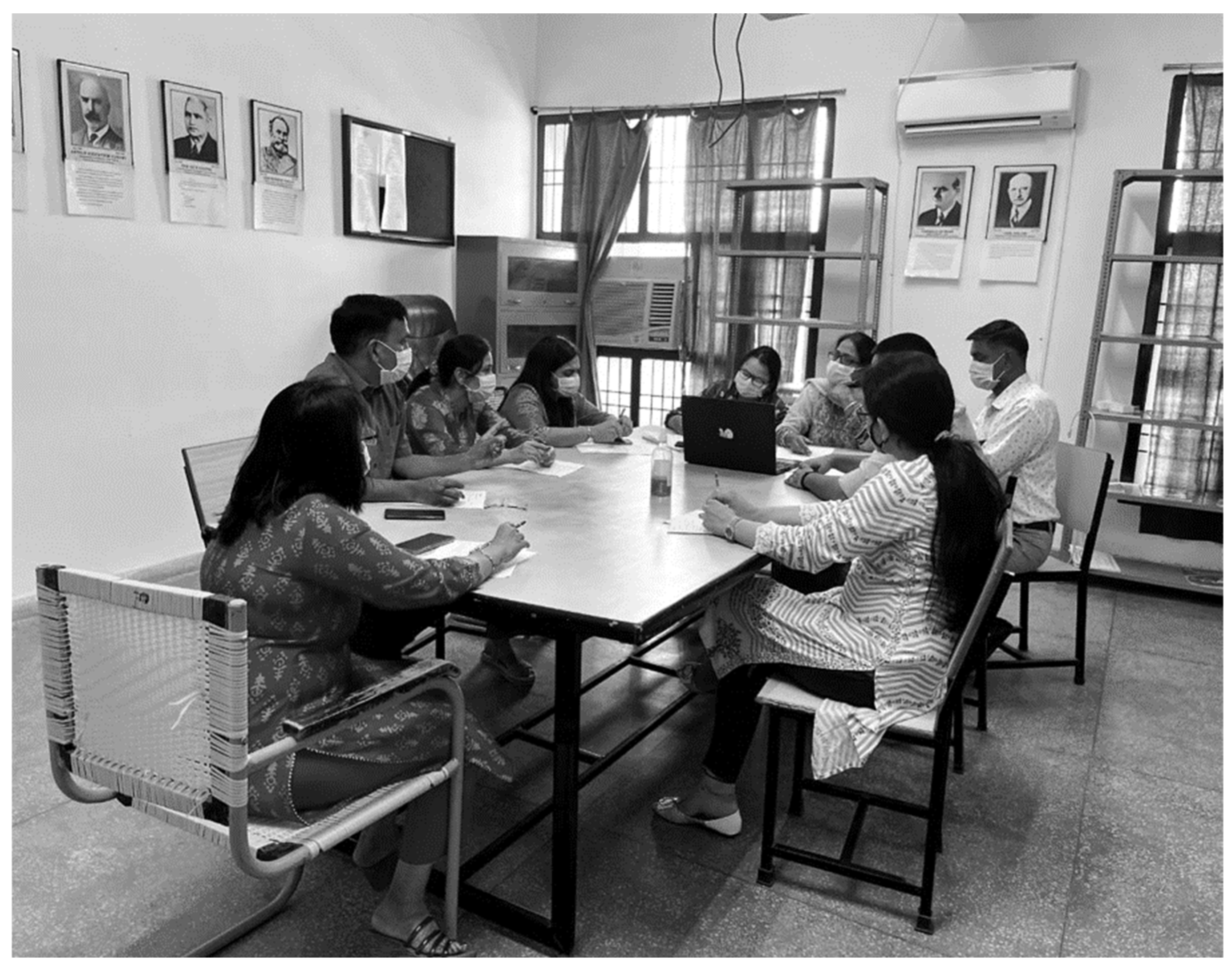
2.3. Focal Group Discussions
2.4. Online Survey
3. Results
3.1. Demographics of Participants
3.2. Themes from FGDs
3.2.1. In-House Training
3.2.2. Time Constraints
3.2.3. Foundation Course
3.2.4. Course Design
3.2.5. Learning Resource Material
3.2.6. Attitude, Ethics, and Communication (AETCOM)
3.2.7. Early Clinical Exposure
3.2.8. Clinical Demonstration
3.2.9. Horizontal and Vertical Integration
3.2.10. Infrastructure
3.2.11. Inadequate Man-Power
3.2.12. Administrative Support
3.2.13. Documentation and Record-Keeping
3.2.14. Student Participation and Performance
3.2.15. Awareness and Attitude Towards CBME
4. Discussion
5. Conclusions
Supplementary Materials
Author Contributions
Funding
Institutional Review Board Statement
Informed Consent Statement
Data Availability Statement
Conflicts of Interest
Abbreviations
| CBME | Competency-based medical education |
| FGD | Focal group discussion |
| MEU | Medical education unit |
| FDP | Faculty development program |
References
- Undergraduate Medical Education Board. National Medical Commission. Available online: https://www.nmc.org.in/MCIRest/open/getDocument?path=/Documents/Public/Portal/LatestNews/Implementation.pdf (accessed on 9 November 2023).
- Stevenson, A. (Ed.) The Oxford Dictionary of English, 3rd ed.; Oxford University Press: Oxford, UK, 2010; p. 355. [Google Scholar]
- Sturgis, C.; Casey, K. Introduction. In Quality Principles for Competency-Based Education; iNACOL: Vienna, Austria, 2018; p. 7. [Google Scholar]
- McGaghie, W.C.; Miller, G.E.; Sajid, A.W.; Telder, T.V. Competency-Based Curriculum Development in Medical Education; Public Health Paper No. 68; World Health Organization: Geneva, Switzerland, 1978. [Google Scholar]
- Swing, S.R. The ACGME outcome project: Retrospective and prospective. Med. Teach. 2007, 29, 648–654. [Google Scholar] [CrossRef]
- Hawkins, R.E.; Welcher, C.M.; Holmboe, E.S.; Kirk, L.M.; Norcini, J.J.; Simons, K.B.; Skochelak, S.E. Implementation of competency-based medical education: Are we addressing the concerns and challenges? Med. Educ. 2015, 49, 1086–1102. [Google Scholar] [CrossRef]
- Frank, J.R.; Snell, L.S.; Cate, O.T.; Holmboe, E.S.; Carraccio, C.; Swing, S.R.; Harris, P.; Glasgow, N.J.; Campbell, C.; Dath, D. Competency-based medical education: Theory to practice. Med. Teach. 2010, 32, 638–645. [Google Scholar] [CrossRef] [PubMed]
- Kumar, V.D.; Rajasekhar, S.S. Overarching challenges to be addressed before implementing competency-based medical education in India. BLDE Univ. J. Health Sci. 2019, 4, 44–45. [Google Scholar] [CrossRef]
- Suma, M.P.; Suresh, N.M.; SendilKumaran, D. Challenges in implementation of the competency-based medical education (CBME). Natl. J. Res. Community Med. 2021, 10, 1–4. [Google Scholar]
- Ramanathan, R.; Shanmugam, J.; Gopalakrishnan, S.M.; Palanisamy, K.T.; Narayanan, S. Challenges in the Implementation of Competency-Based Medical Curriculum: Perspectives of Prospective Academicians. Cureus 2022, 14, e32838. [Google Scholar] [CrossRef]
- Shrivastava, S.R.; Shrivastava, P.S. Qualitative study to identify the perception and challenges faced by the faculty of community medicine in the implementation of competency-based medical education for postgraduate students. Fam. Med. Community Health 2019, 7, e000043. [Google Scholar] [CrossRef]
- Gopalakrishnan, S.; Catherine, A.P.; Kandasamy, S.; Ganesan, H. Challenges, and opportunities in the implementation of competency-based medical education—A cross-sectional survey among medical faculty in India. J. Educ. Health Promot. 2022, 11, 206. [Google Scholar] [CrossRef]
- Shah, N.; Desai, C.; Jorwekar, G.; Badyal, D.; Singh, T. Competency-based medical education: An overview and application in pharmacology. Indian J. Pharmacol. 2016, 48, S5–S9. [Google Scholar] [CrossRef]
- Soundariya, K.; Kalaiselvan, G.; Rajalakshmi, M.; Sindhuri, R. Implementation and evaluation of competency-based medical education in phase I of undergraduate medical curriculum. J. Adv. Med. Educ. Prof. 2022, 10, 228–234. [Google Scholar]
- Bhagat, S.; Dongre, S.; Pusdekar, Y. Competency-based medical education: Perspectives from students’ lens: A Cross-sectional study among undergraduate medical students. Ann. Afr. Med. 2025, 24, 310–316. [Google Scholar] [CrossRef]
- Sulena, S.; Kulkarni, A.; Mathur, M.; Jyoti, N.; Sidhu, T.K.; Badyal, D.; Guha, R. Challenges in implementing competency-based medical education in India—Stakeholders’ perspective: A Mixed-method analysis. Int. J. Appl. Basic Med. Res. 2024, 14, 225–232. [Google Scholar] [CrossRef]
- Wasti, S.P.; Simkhada, P.; van Teijlingen, E.R.; Sathian, B.; Banerjee, I. The growing importance of mixed-methods research in health. Nepal. J. Epidemiol. 2022, 12, 1175–1178. [Google Scholar] [CrossRef]
- Streefkerk, R. Qualitative vs. Quantitative Research-Differences, Examples, and Methods. Scribbr. Available online: https://www.scribbr.com/methodology/qualitative-quantitative-research/ (accessed on 23 July 2023).
- Dornan, T.; Tan, N.; Boshuizen, H.; Gick, R.; Isba, R.; Mann, K.; Scherpbier, A.; Spencer, J.; Timmins, E. How and what do medical students learn in clerkships? Experience-based learning (ExBL). Adv. Health Sci. Educ. Theory Pract. 2014, 19, 721–749. [Google Scholar] [CrossRef]
- Annual report 2020-21. Department of Health & Family Welfare, Ministry of Health & Family Affairs, Government of India. Available online: https://www.mohfw.gov.in/?q=en/publications-3 (accessed on 5 June 2023).
- Herur, A.; Kolagi, S. Competency-based medical education: Need of the hour: Let’s do our bit…! BLDE Univ. J. Health Sci. 2016, 1, 59–60. [Google Scholar] [CrossRef]
- Kulkarni, P.; Pushpalatha, K.; Bhat, D. Medical education in India: Past, present, and future. APIK J. Int. Med. 2019, 7, 69–73. [Google Scholar] [CrossRef]
- Ramanathan, R.; Shanmugam, J.; Sridhar, M.G.; Palanisamy, K.; Narayanan, S. Exploring faculty perspectives on competency-based medical education: A report from India. J. Educ. Health Promot. 2021, 10, 402. [Google Scholar] [CrossRef] [PubMed]
- Agrawal, A.; Sharma, A.; Sharma, A.; Agrawal, C. Challenges faced by medical faculty in implementation of competency-based medical education and lessons learned. J. Educ. Health Promot. 2024, 13, 345. [Google Scholar] [CrossRef]
- Ananthakrishnan, N. Acute shortage of teachers in India: Existing problems and possible solutions. Natl. Med. J. India 2007, 20, 25–29. [Google Scholar] [PubMed]
- National Medical Commission. Competency-Based Undergraduate Curriculum. Available online: https://www.nmc.org.in/information-desk/for-colleges/ug-curriculum (accessed on 9 August 2023).
- Verma, A.; Shete, S. Perceptions of 1st-year MBBS students and 1st-year medical faculties toward AETCOM-based medical curriculum. Natl. J. Physiol. Pharm. Pharmacol. 2024, 14, 592–596. [Google Scholar] [CrossRef]
- Udgiri, R.; Ganganahalli, P. Perceptions of Attitude, Ethics, and Communication (AETCOM) modules among Indian medical graduates in their first professional year: An educational observational study. Cureus 2024, 16, e64611. [Google Scholar] [CrossRef]
- Kamath, L.; Chakraborty, A.; Asanaliyar, M. Perception and reflections of second year medical students on attitude, ethics, and communication skills module on patient autonomy and decision making in a tertiary care teaching hospital. J. Med. Soc. 2023, 37, 51–56. [Google Scholar] [CrossRef]
- Sahadevan, S.; Kurian, N.; Mani, A.M.; Kishor, M.R.; Menon, V. Implementing competency-based medical education curriculum in undergraduate psychiatric training in India: Opportunities and challenges. Asia-Pac. Psychiatry 2021, 13, e12491. [Google Scholar] [CrossRef] [PubMed]
- Rohit, D.; Joshi, K.P.; Suhasini, P.; Jamadar, D. Students’ perception of foundation course—A new experience in the MBBS curriculum in India. Int. J. Med. Sci. Educ. 2019, 6, 1–7. [Google Scholar]
- Sobti, S.; Gupta, M.; Gupta, V.; Gupta, A.; Parihar, S.; Singh, V. Assessment of newly introduced foundation course for medical undergraduates: Students’ vs. faculty’s perspective. J. Fam. Med. Prim. Care 2020, 9, 3042–3047. [Google Scholar]
- Singh, S.; Sarmishtha, G.; Himanshu, P. Foundation program for MBBS students at the entry-level: Experience at an Indian Medical School. Southeast Asian J. Med. Educ. 2007, 1, 33–37. [Google Scholar]
- Khilnani, A.K.; Patel, J.; Khilnani, G. Students’ feedback on the Foundation Course in Competency-Based Medical Education Curriculum. Int. J. Res. Med. Sci. 2019, 7, 4408–4409. [Google Scholar] [CrossRef]
- Caverzagie, K.J.; Nousiainen, M.T.; Ferguson, P.C.; Ten Cate, O.; Ross, S.; Harris, K.A.; Busari, J.; Bould, M.D.; Bouchard, J.; Iobst, W.F.; et al. Overarching challenges to the implementation of competency-based medical education. Med. Teach. 2017, 39, 588–593. [Google Scholar] [CrossRef]
- Singh, T.; Saiyad, S.; Virk, A.; Kalra, J.; Mahajan, R. Assessment toolbox for Indian medical graduate competencies. J. Postgrad. Med. 2021, 67, 80–90. [Google Scholar] [CrossRef]
- Humphrey-Murto, S.; Wood, T.J.; Ross, S.; Tavares, W.; Kvern, B.; Sidhu, R.; Sargeant, J.; Touchie, C. Assessment Pearls for Competency-Based Medical Education. J. Grad. Med. Educ. 2017, 9, 688–691. [Google Scholar] [CrossRef]
- Wu, M.J.; Zhao, K.L.Y.; Fils-Aime, F. Response rates of online surveys in published research: A meta-analysis. Comput. Hum. Behav. Rep. 2022, 7, 100197. [Google Scholar] [CrossRef]
- Broyles, L.M.; Rodriguez, K.L.; Price, P.A.; Bayliss, N.K.; Sevick, M.A. Overcoming barriers to the recruitment of nurses as participants in health care research. Qual. Health Res. 2011, 21, 1705–1718. [Google Scholar] [CrossRef] [PubMed]
- Kotter, J.P. Communicating the Change Vision. In Leading Change, 2nd ed.; Harvard Business School Press: Boston, MA, USA, 2012; p. 87. [Google Scholar]



| Variable | Number (%) |
|---|---|
| |
| 10 (12%) |
| 21 (26%) |
| 50 (62%) |
| |
| 25 (31%) |
| 56 (69%) |
| |
| 68 (84%) |
| 13 (16%) |
| |
| 65 (91%) |
| 43 (61%) |
| 53 (75%) |
| 12 (17%) |
| 3 (4%) |
| |
| 4 (5%) |
| 21 (26%) |
| 23 (28%) |
| 41 (51%) |
| Themes Emerged from FGD | Verbatim Quotations |
|---|---|
| Participation & performance | |
| Participants felt that CBME has improved students’ interest in the subject and has promoted self-directed learning. | “Students are actively participating in discussions” “Cramming among students is reduced” “Students more confident in facing the practical” |
| Systematic and integrated | |
| Participants felt that students realize the importance of basic sciences as they can correlate them with their clinical application. Well-planned curriculum | “Amalgamation of clinical orientation with basic sciences is good” “Better orientation of terminologies” “Assessment strategy in the curriculum is very good” |
| Attitude and communication | |
| The implementation of ATCOM has improved communication skills and attitude. | “When dealing with patients during the practical demonstration and clinical posting, students looked more empathetic and concerned.” |
| Time constraints | |
| Participants felt that the time allotment for the foundation course and some of the competencies were not proportionate. | “Foundation course time of one month is too long.” “Number of competencies in pathology more but the time has been reduced for phase II” “Duration of II phases is not adequate” |
| Learning resource material | |
| Participants felt that the currently available books and materials are suitable for traditional teaching | “Books based on new curriculum are few” “Only competency list is added in the already available text” |
| Infrastructure | |
| Participants indicated that there is a lack of infrastructure for implementing CBME | “We have to take our laptops to lecture theaters” “Technical support is not adequate during class” “Skill Lab facility is lacking” “No facility for video conferencing” “No availability of vehicles for taking students for community visits” |
| Manpower | |
| Participants indicated that the available teaching and non-teaching staff are not sufficient | “Multiple courses in the department” “Separate faculty for each course” “With a limited number of staff, small group discussion is not possible” |
| Administrative support | |
| Participants felt that the administration of the institute does not address their concerns Guidelines are not being released on time from the university | “Everyone is not an expert in technology” “MEU not supportive” “Even after reminders adequate logistic support not provided” “University guidelines come at the last moment” |
| Integration | |
| Participants indicated that the vertical integration is challenging at times | “Awareness about the importance of CBME lacking in clinical faculty” “Lack of understanding of the seriousness of things” “Casual attitude of clinical faculty” “On paper support for integration” |
| |
| 67 (83%) |
| 2 (3%) |
| 12 (14%) |
| |
| 61 (75%) |
| 20 (25%) |
| |
| 63 (79%) |
| 11 (13%) |
| 7 (8%) |
| |
| 69 (85%) |
| 2 (3%) |
| 10 (12%) |
| |
| 39 (48%) |
| 10 (12%) |
| 32 (40%) |
| Areas/Themes | Gaps Identified | Suggested Measures |
|---|---|---|
| CBME related | ||
| Small group teaching | Time constraints for the number of lectures required | Simultaneous teaching by different teachers Rationalize student–teacher ratio |
| Learning resources material | Lack of optimum material implement the learning in its true essence | Development of model material by a similar governing body as performed by NCERT for the school curriculum |
| Self-directed learning | No subject-wise guidelines are available | Develop guidelines at the central or peripheral level |
| Clinical demonstration | Lack of space in the outpatient department Objections from patients to repetitive examination Some competencies are not demonstrable | Teaching in small batches Adopt a video-based demonstration lecture Rationalize competencies through a feedback mechanism |
| Vertical integration | Lack of time for clinical stream teachers due to time devoted to clinical work | The minimum number of teaching faculty in medical institutes should be based on the number of students as well as the daily clinical workload |
| Early clinical exposure | Lack of practical demonstration Difficulty in vertical integration | Use of additional audio-visual resources Rationalize clinical work-teaching time allotment |
| Assessment | Lack of formative assessment tools | Sensitize faculty to develop such methods and techniques through inter-college workshops |
| Logistics related | ||
| Course design | Teachers are not adequately sensitized and are unaware of implementation techniques | Conduct a teacher sensitization program |
| Student–teacher ratio | A high student–teacher ratio | Standardize the student–teacher ratio |
| Administrative support | Lack of administrative support in providing infrastructure | Regulations and inspections by governing bodies to ensure adequate infrastructure |
| Documentation | Increased time spent | Simplify data collection and use digital modes |
Disclaimer/Publisher’s Note: The statements, opinions and data contained in all publications are solely those of the individual author(s) and contributor(s) and not of MDPI and/or the editor(s). MDPI and/or the editor(s) disclaim responsibility for any injury to people or property resulting from any ideas, methods, instructions or products referred to in the content. |
© 2026 by the authors. Published by MDPI on behalf of the Academic Society for International Medical Education. Licensee MDPI, Basel, Switzerland. This article is an open access article distributed under the terms and conditions of the Creative Commons Attribution (CC BY) license.
Share and Cite
Virani, S.; Rewri, P.; Gupta, P.; Badyal, D. Challenges and Opportunities in the Implementation of Competency-Based Medical Education for Undergraduates in Northern India. Int. Med. Educ. 2026, 5, 23. https://doi.org/10.3390/ime5010023
Virani S, Rewri P, Gupta P, Badyal D. Challenges and Opportunities in the Implementation of Competency-Based Medical Education for Undergraduates in Northern India. International Medical Education. 2026; 5(1):23. https://doi.org/10.3390/ime5010023
Chicago/Turabian StyleVirani, Shalini, Parveen Rewri, Priya Gupta, and Dinesh Badyal. 2026. "Challenges and Opportunities in the Implementation of Competency-Based Medical Education for Undergraduates in Northern India" International Medical Education 5, no. 1: 23. https://doi.org/10.3390/ime5010023
APA StyleVirani, S., Rewri, P., Gupta, P., & Badyal, D. (2026). Challenges and Opportunities in the Implementation of Competency-Based Medical Education for Undergraduates in Northern India. International Medical Education, 5(1), 23. https://doi.org/10.3390/ime5010023