


Abstract
Background: A significant percentage of patients with major depressive disorder (MDD) fail to achieve remission with antidepressant monotherapy and frequently experience residual mood and cognitive symptoms that impair their functional recovery. Thus, an augmentation with vortioxetine, a multimodal antidepressant with reported cognitive benefits, might be a useful strategy for such patients. Methods: We conducted a 12-week naturalistic, prospective observational study in a Malaysian university hospital; 40 adults with MDD and inadequate response to at least eight weeks of antidepressant therapy received either adjunctive vortioxetine or optimization of their existing antidepressant as part of treatment-as-usual care. Depressive symptoms were assessed using the Montgomery–Åsberg Depression Rating Scale (MADRS), cognitive symptoms using the Perceived Deficits Questionnaire-5 (PDQ-D5), and global improvement using the Clinical Global Impressions—Improvement (CGI-I) scale. Results: Both groups demonstrated significant improvements in MADRS and PDQ-D5 scores over 12 weeks (p < 0.001). Remission rates at Week 12 were high in both groups (93.8% adjunctive vortioxetine vs. 86.7% control). Both groups demonstrated significant improvements in depressive and cognitive symptoms over 12 weeks. Although between-group differences were not statistically significant, descriptive trends toward earlier symptomatic improvement were observed in the adjunctive vortioxetine group in several core depressive symptoms, including apparent sadness, suicidal ideation, and appetite disturbance. Greater clinician-rated global improvement was observed in the vortioxetine group at Week 12 (87.5% vs. 40.0%, p < 0.001). Conclusions: In this outpatient clinical setting, adjunctive vortioxetine was associated with earlier improvement of core depressive symptoms and greater global clinical improvement compared with optimization of existing antidepressant therapy. Collectively, these findings suggest adjunctive vortioxetine as a clinically relevant option for patients with MDD who show an inadequate response to antidepressant monotherapy; however, findings are exploratory and not causal, and thus larger RCTs are needed for affirmation.
1. Introduction
Major depressive disorder (MDD) is expected to be the leading contributor to global disability by 2030 and remains a major public health concern worldwide [1,2]. A significant proportion of patients fail to achieve remission with first-line monotherapy, despite the availability of multiple potent antidepressants. Real-world clinical evidence, including the Sequenced Treatment Alternatives to Relieve Depression (STAR*D) study, indicates that fewer than one-third of patients attain remission following initial antidepressant treatment [3]. Hence, persistence of depressive symptoms is associated with impaired psychosocial functioning, increased relapse risk, and greater healthcare utilization [4,5,6].
Inadequate treatment response includes both non-response (<25% symptom improvement) and partial response (25–50% improvement) [7]. Partial responders frequently experience residual symptoms such as low mood, anxiety, irritability, and somatic complaints, which further worsen functional impairment and relapse vulnerability [4,8]. Moreover, cognitive dysfunction, manifesting as difficulties in attention, memory and executive functioning, has been widely acknowledged as a core dimension of MDD that may persist even after affective symptoms improve and may significantly disrupt occupational and social functioning [9,10].
Vortioxetine is a newer antidepressant classified as ‘multimodal serotonin modulator’ as it combines serotonin transporter inhibition with agonist or antagonist activity at several serotonin receptor subtypes, including 5-HT1A, 5-HT1B, 5-HT3, and 5-HT7 receptors. This pharmacological profile has been associated with improvements in both mood symptoms and cognitive functioning in patients with MDD [11,12,13]. Numerous randomized controlled trials and meta-analyses of vortioxetine have shown positive impacts on functional outcomes and both subjective and objective cognitive measures [14,15,16]. Vortioxetine may be an effective augmentation strategy in patients with inadequate response to selective serotonin reuptake inhibitors or other antidepressants as suggested by observational and chart-review studies [3,13].
Real-world prospective data evaluating vortioxetine augmentation in Southeast Asian clinical settings remain limited, despite the growing international evidence. Specifically, there are few comparative observational studies that compare the optimization of current antidepressant therapy with adjunctive vortioxetine, while concurrently assessing depression and cognitive outcomes. Therefore, the present study examined clinical, cognitive, and global outcomes over 12 weeks in Malaysian outpatients with MDD who had inadequate response to antidepressant monotherapy and either received treatment-as-usual antidepressant optimization or adjunctive vortioxetine.
2. Results
A total of 40 patients were enrolled, with 20 in each treatment group. Thirty-one participants completed the 12-week follow-up. Table 1 shows the baseline demographic and clinical characteristics of all the patients. Half of the patients were aged 18–29 years old (50.0%) and most of them were female (77.5%), which constituted a significance difference between the vortioxetine and the control group (60.0% vs. 95.0%, p = 0.020). Additionally, patients in the vortioxetine group had significantly higher systolic blood pressure compared to the control group (median 130.0 vs. 115.0 mmHg, p = 0.011). A statistically significant between-group difference was observed in baseline systolic blood pressure measurements. Baseline depressive severity was higher in the vortioxetine group, whereas other demographic and clinical characteristics were broadly comparable between groups. Table 2 demonstrates the changes in severity scores in MADRS.
Table 1.
Baseline demographic and clinical characteristics of patients in the vortioxetine and control groups.
Table 2.
Changes in severity scores in MADRS.
Remission rates as presented in Table 3 show none of the patients had remission at baseline. In Week 2, both groups achieved remission, with the control group achieving a rate of 26.3%, compared to 16.7% in the vortioxetine group. Subsequently, the remission rates increased steadily in both groups, reaching 93.8% in the vortioxetine group and 86.7% in the control group by Week 12.
Table 3.
Number of patients achieving remission (MADRS ≤ 10) at each assessment point over 12 weeks in the vortioxetine and control groups.
Both groups showed significant reductions in MADRS and PDQ-D5 scores over time (p < 0.001) as shown in Table 4. Although between-group differences in total scale scores were not statistically significant, descriptive trends toward earlier improvement in several MADRS symptom domains were observed in the vortioxetine group—including apparent sadness, suicidal thoughts, and appetite disturbance.
Table 4.
Repeated-measures ANOVA for changes in depressive symptoms (MADRS) and cognitive symptoms (PDQ-D5) over 12 weeks in the vortioxetine and control groups.
Clinician-rated global improvement differed significantly between groups as demonstrated in Table 5. By Week 12, 87.5% of patients receiving adjunctive vortioxetine were rated as “very much improved” on the CGI-I scale, compared with 40.0% of patients in the control group (p < 0.001).
Table 5.
Distribution of Clinical Global Impressions—Improvement (CGI-I) ratings across follow-up assessments in the vortioxetine and control groups.
Adverse events were generally mild to moderate and were summarized descriptively based on available documented records. Nausea or vomiting was the most commonly reported adverse event in both groups and occurred more frequently in the adjunctive vortioxetine group. Four participants receiving adjunctive vortioxetine discontinued treatment due to nausea. Other reported adverse events included dry mouth, drowsiness, headache, increased appetite, yawning, light-headedness, and palpitations. No serious adverse events were reported during the study period. A summary of reported adverse events is presented in Table 6.
Table 6.
Summary of Reported Adverse Events During the 12-Week Follow-Up.
3. Discussion
In this prospective real-world study of Malaysian outpatients with MDD and inadequate response to antidepressant monotherapy, adjunctive vortioxetine was associated with earlier improvement in key depressive symptoms and greater clinician-rated global improvement over 12 weeks. Both adjunctive vortioxetine and optimization of existing antidepressant therapy were associated with significant improvements in depressive and cognitive symptoms over 12 weeks [3,17]. These findings should be interpreted within the context of an exploratory observational design.
In the vortioxetine augmentation group, an earlier reduction in symptoms such as apparent sadness and suicidal ideation was noted. These findings are clinically relevant because these features are closely linked to illness severity and functional impairment [18,19]. Vortioxetine’s multimodal pharmacological profile makes it biologically plausible through serotonin transporter inhibition, facilitating neurotransmitter release with 5-HT3 blockade and rapidly desensitizing presynaptic autoreceptors with 5-HT1A agonism [13,20,21]. However, no causal conclusion can be inferred due to the current study design.
International guidelines recommend both strategies, dose optimization and incorporating an adjunctive medication, for inadequate response to an initial antidepressant [22,23]. This possibly explains the high remission rates in both groups, combined with the intensive follow-up, adherence monitoring, and psychosocial support consistent with standard specialist care [24]. The initial differences in symptom severity and the non-randomized design may have influenced the progression of symptom remission. Both groups exhibited similar improvements in subjective cognitive complaints; however, adjunctive vortioxetine was associated with an earlier effect, indicating that mood enhancement may substantially contribute to perceived cognitive recovery [25,26].
These findings are consistent with international real-world studies demonstrating symptomatic, cognitive, and functional benefits of vortioxetine in routine practice [27,28]. The present study extends this evidence to a Southeast Asian clinical context and supports the clinical relevance of vortioxetine augmentation in patients with residual symptoms despite antidepressant monotherapy.
Importantly, the absence of significant between-group differences in primary outcomes may reflect limited statistical power rather than true equivalence and should not be interpreted as definitive evidence of comparable efficacy. Although descriptive trends toward earlier symptomatic improvement were observed in the vortioxetine augmentation group, between-group differences did not reach statistical significance and should therefore be interpreted cautiously.
3.1. Limitations
Several limitations should be considered when interpreting the findings of this study. First, the single-centre design and relatively small sample size limited statistical power and reduced the generalizability of the findings to broader populations. The pilot nature of the study also increased the risk of type II error, whereby potentially meaningful between-group differences may not have reached statistical significance.
Second, the non-randomized naturalistic design introduced potential selection bias and confounding by indication, as treatment allocation was determined by routine clinical judgement rather than random assignment. Consequently, baseline differences between groups, including depressive severity and sex distribution, may have influenced treatment trajectories and clinical outcomes. The skewed sex distribution may limit the generalizability of findings and reflects the natural clinical population encountered during recruitment. Treatment allocation was not influenced by sex. In addition, the absence of blinding may have contributed to observer and expectation bias, particularly for clinician-rated outcomes such as CGI-I assessments.
Third, CGI-I ratings were performed by multiple treating psychiatrists in routine clinical practice, which may have introduced inter-rater variability and subjective assessment bias. This may partly explain the discrepancy between clinician-rated global improvement and the absence of statistically significant between-group differences in MADRS and PDQ-D5 scores.
Fourth, although repeated-measures analyses were conducted longitudinally, missing follow-up data and participant attrition may have affected the robustness of the findings. The use of available-case analyses rather than more rigorous imputation methods may have introduced attrition bias. Furthermore, the relatively high dropout rate may have influenced remission estimates at later follow-up points.
Fifth, cognitive outcomes were assessed using the subjective PDQ-D5 self-report instrument without accompanying objective neuropsychological testing. As subjective cognitive complaints may be influenced by mood state and individual perception, the findings regarding cognitive improvement should be interpreted cautiously.
Sixth, adverse events and medication tolerability were not systematically quantified beyond routine clinical monitoring, limiting detailed evaluation of the safety profile of adjunctive vortioxetine in this cohort.
Finally, the relatively short 12-week follow-up period limits conclusions regarding long-term efficacy, sustainability of remission, relapse prevention, and functional recovery. Therefore, the present findings should be considered exploratory and hypothesis-generating. Larger randomized controlled studies with blinded assessments, objective cognitive measures, longer follow-up duration, and more representative samples are required to confirm these preliminary observations.
3.2. Clinical Implication
From a clinical perspective, these findings suggest that adjunctive vortioxetine may be a practical augmentation strategy for patients with major depressive disorder who demonstrate an inadequate response to antidepressant monotherapy. Earlier improvements in core depressive symptoms and clinician-rated global functioning may support treatment optimization in routine psychiatric practice, particularly in specialist outpatient settings.
4. Materials and Methods
4.1. Study Design and Participants
A 12-week, naturalistic, prospective observational study was conducted at the Psychiatry Outpatient Clinic of Universiti Malaya Medical Centre, Malaysia between March and August 2024. A naturalistic design refers to an observational clinical setting in which treatment decisions were made according to routine clinical practice without protocol-mandated intervention or random assignment [17].
Eligible participants were adults aged 18–65 years with a DSM-5 diagnosis of MDD who had demonstrated an inadequate response to at least eight weeks of antidepressant monotherapy at a clinically appropriate dose. Inadequate response included both non-response and partial response, based on the treating psychiatrist’s clinical judgement. Exclusion criteria were active psychotic symptoms, medical instability or delirium, significant cognitive impairment from other causes and current augmentation with antipsychotics, mood stabilizers, or psychostimulants. Baseline physiological parameters including blood pressure and heart rate were recorded as part of routine clinical assessment and tolerability monitoring.
The study was conducted in accordance with the Declaration of Helsinki and Good Clinical Practice guidelines. Written informed consent was obtained from all participants.
4.2. Treatment Groups
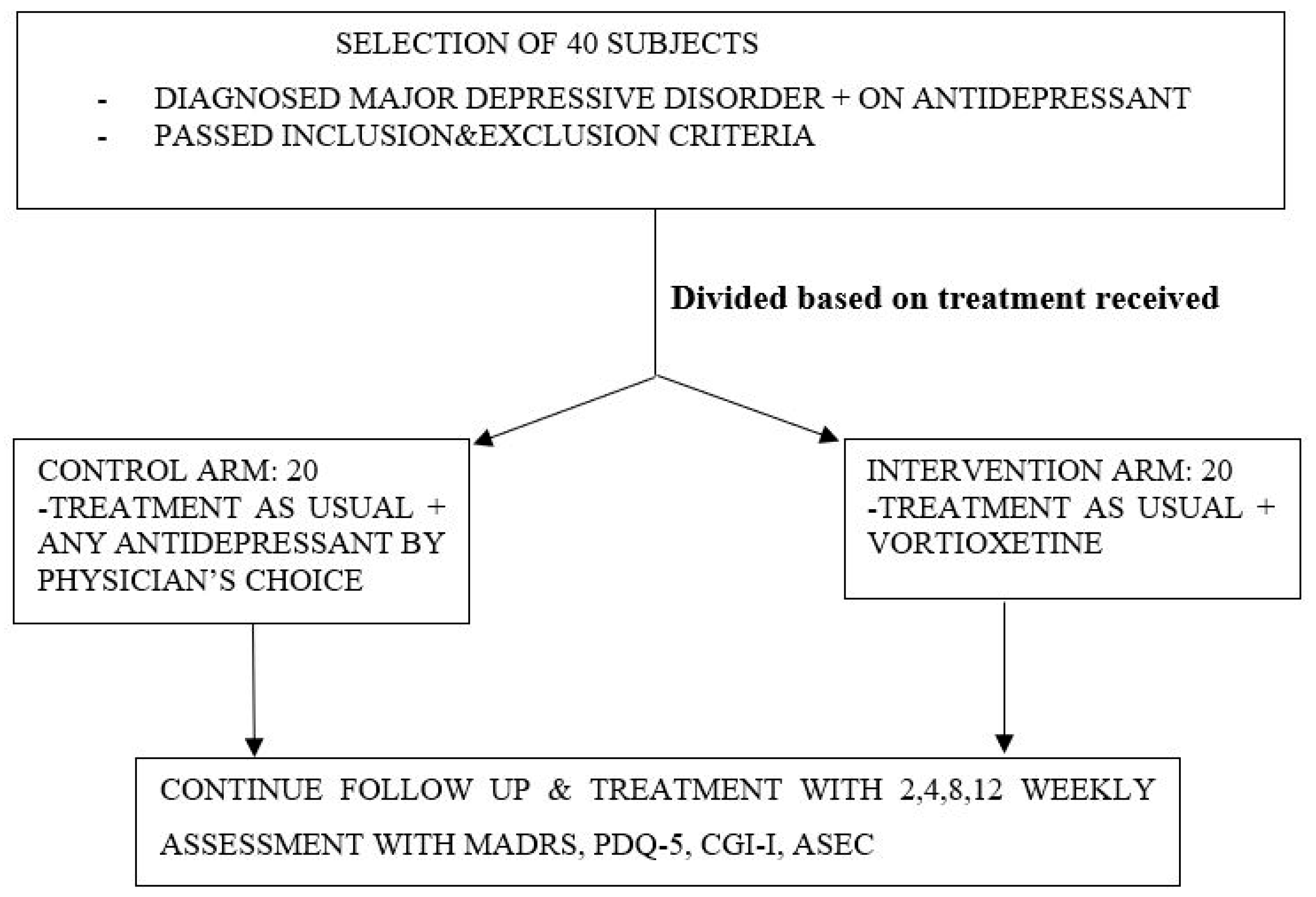
Participants received either adjunctive vortioxetine added to their existing antidepressant regimen or optimization of their current antidepressant as part of standard care, as shown in Figure 1. Optimization strategies included dose escalation, adherence reinforcement, or within-class adjustments at the discretion of the treating psychiatrist. Vortioxetine was prescribed at flexible doses up to 20 mg/day. Follow-up assessments were conducted at baseline and Weeks 2, 4, 8, and 12.
Figure 1.
Methodological Framework.
4.3. Outcome Measures
The primary outcome was change in depressive symptom severity measured using the Montgomery–Åsberg Depression Rating Scale (MADRS) [29]. Remission was defined as an MADRS total score ≤10 [11].
Secondary outcomes included subjective cognitive symptoms assessed with the Perceived Deficits Questionnaire-5 (PDQ-D5) [30], clinician-rated global improvement measured using the Clinical Global Impressions—Improvement (CGI-I) scale [31], and remission rates over the follow-up period. Adverse effects were monitored using the Antidepressant Side-Effect Checklist [32] during routine visits.
4.4. Statistical Analysis
Statistical analyses were performed using SPSS version 30.0. Categorical variables were presented as frequencies and percentages, while continuous variables were summarized as means with standard deviations or medians with interquartile ranges, as appropriate. Between-group comparisons were conducted using Mann–Whitney U tests for continuous variables and Chi-square tests for categorical variables. Changes in outcomes over time were analyzed using repeated-measures analysis of variance (ANOVA) to examine the effects of time, treatment, and time × treatment interaction. Assumptions for repeated-measures models (including sphericity) were assessed using standard procedures, with corrections applied where appropriate. Given the observational design, all analyses were exploratory. Missing follow-up data were analyzed using available-case analyses at each time point, without formal imputation procedures. A two-tailed p-value < 0.05 was considered statistically significant. Given the exploratory and observational design, findings should be interpreted as hypothesis-generating rather than confirmatory.
5. Conclusions
In this outpatient clinical setting, adjunctive vortioxetine and optimization of existing antidepressant therapy were both associated with significant improvements in depressive and cognitive symptoms in patients with MDD, who had an inadequate response to monotherapy. Vortioxetine as adjunct treatment was linked with earlier improvement in key depressive symptoms and greater clinician-rated global improvement. Overall, these findings suggest that adjunctive vortioxetine may represent a clinically relevant augmentation strategy in routine outpatient settings. However, larger controlled studies are required to confirm these observations.
Author Contributions
Conceptualization, T.R. and C.G.N.; methodology, T.R. and C.G.N.; validation, C.G.N., J.J.I.W. and A.S.A.A.; formal analysis, T.R.; investigation, T.R.; resources, C.G.N.; data curation, T.R.; writing—original draft preparation, T.R.; writing—review and editing, C.G.N., J.J.I.W. and A.S.A.A.; supervision, C.G.N., J.J.I.W. and A.S.A.A.; project administration, T.R. All authors have read and agreed to the published version of the manuscript.
Funding
This research received no external funding.
Institutional Review Board Statement
The study was conducted in accordance with the Declaration of Helsinki and approved by the Universiti Malaya Medical Centre Medical Research Ethics Committee (MREC ID: 2023519-12467) on 26 June 2024.
Informed Consent Statement
Informed consent was obtained from all subjects involved in the study.
Data Availability Statement
The data presented in this study are available on reasonable request from the corresponding author. The data are not publicly available due to privacy and ethical restrictions related to patient confidentiality.
Conflicts of Interest
The authors declare no conflicts of interest.
Abbreviations
The following abbreviations are used in this manuscript:
| ANOVA | Analysis of Variance |
| CGI-I | Clinical Global Impressions—Improvement |
| CI | Confidence Interval |
| DBP | Diastolic Blood Pressure |
| DSM-5 | Diagnostic and Statistical Manual of Mental Disorders, Fifth Edition |
| MADRS | Montgomery–Åsberg Depression Rating Scale |
| MDD | Major Depressive Disorder |
| MREC | Medical Research Ethics Committee |
| PDQ-D5 | Perceived Deficits Questionnaire–5 |
| Q1 | First Quartile |
| Q3 | Third Quartile |
| SD | Standard Deviation |
| SBP | Systolic Blood Pressure |
| SERT | Serotonin Transporter |
| SPSS | Statistical Package for the Social Sciences |
| SSRI | Selective Serotonin Reuptake Inhibitor |
| TAU | Treatment As Usual |
| UMMC | Universiti Malaya Medical Centre |
| vs | Versus |
| ≤ | Less than or equal to |
| % | Percentage |
| p | Probability value |
References
- Kraus, C.; Kadriu, B.; Lanzenberger, R.; Zarate, C.A., Jr.; Kasper, S. Prognosis and improved outcomes in major depression: A review. Transl. Psychiatry 2019, 9, 127. [Google Scholar] [CrossRef] [Scilit] [PubMed]
- Ministry of Health Malaysia (MOH). Clinical practise guidelines. In Clinical Practice Guidelines (CPG) on Management of Major Depressive Disorder; Ministry of Health Malaysia (MOH): Putrajaya, Malaysia, 2019. [Google Scholar]
- De Berardis, D.; Fornaro, M.; Anastasia, A.; Vellante, F.; Olivieri, L.; Rapini, G.; Serroni, N.; Orsolini, L.; Valchera, A.; Carano, A.; et al. Adjunctive vortioxetine for SSRI-resistant major depressive disorder: A “real-world” chart review study. Braz. J. Psychiatry 2020, 42, 317–321. [Google Scholar] [CrossRef] [Scilit]
- Paykel, E.S. Partial remission, residual symptoms, and relapse in depression. Dialogues Clin. Neurosci. 2008, 10, 431–437. [Google Scholar] [CrossRef] [Scilit] [PubMed]
- Cristancho Mario, A.; Kocsis James, H.; Thase Michael, E. Dysthymic Disorder and Other Chronic Depressions. Focus 2012, 10, 422–427. [Google Scholar] [CrossRef] [Scilit]
- Tian, W.-H.; Liu, T.-C.; Chen, C.-S.; Liu, L.-F.; Tien, J.J. The relationship between depressive symptoms and health service utilization for elderly people in Taiwan. Health Policy 2012, 108, 256–267. [Google Scholar] [CrossRef] [Scilit]
- Nierenberg, A.A.; DeCecco, L.M. Definitions of antidepressant treatment response, remission, nonresponse, partial response, and other relevant outcomes: A focus on treatment-resistant depression. J. Clin. Psychiatry 2001, 62, 5–9. [Google Scholar]
- Israel, J.A. The Impact of Residual Symptoms in Major Depression. Pharmaceuticals 2010, 3, 2426–2440. [Google Scholar] [CrossRef] [Scilit]
- Lam, R.W.; Kennedy, S.H.; McLntyre, R.S.; Khullar, A. Cognitive dysfunction in major depressive disorder: Effects on psychosocial functioning and implications for treatment. Can. J. Psychiatry 2014, 59, 649–654. [Google Scholar] [CrossRef] [Scilit]
- Baune, B.T.; Brignone, M.; Larsen, K.G. A Network Meta-Analysis Comparing Effects of Various Antidepressant Classes on the Digit Symbol Substitution Test (DSST) as a Measure of Cognitive Dysfunction in Patients with Major Depressive Disorder. Int. J. Neuropsychopharmacol. 2018, 21, 97–107. [Google Scholar] [CrossRef] [Scilit] [PubMed]
- Alvarez, E.; Perez, V.; Artigas, F. Pharmacology and clinical potential of vortioxetine in the treatment of major depressive disorder. Neuropsychiatr. Dis. Treat. 2014, 10, 1297–1307. [Google Scholar] [CrossRef] [Scilit]
- Katona, C.L.; Katona, C.P. New generation multi-modal antidepressants: Focus on vortioxetine for major depressive disorder. Neuropsychiatr. Dis. Treat. 2014, 10, 349–354. [Google Scholar] [CrossRef] [Scilit]
- Sanchez, C.; Asin, K.E.; Artigas, F. Vortioxetine, a novel antidepressant with multimodal activity: Review of preclinical and clinical data. Pharmacol. Ther. 2015, 145, 43–57. [Google Scholar] [CrossRef] [Scilit]
- Huang, I.-C.; Chang, T.-S.; Chen, C.; Sung, J.-Y. Effect of Vortioxetine on Cognitive Impairment in Patients with Major Depressive Disorder: A Systematic Review and Meta-analysis of Randomized Controlled Trials. Int. J. Neuropsychopharmacol. 2022, 25, 969–978. [Google Scholar] [CrossRef] [Scilit]
- McIntyre, R.; Harrison, J.; Loft, H.; Jacobson, W.; Olsen, C.K. The Effects of Vortioxetine on Cognitive Function in Patients with Major Depressive Disorder: A Meta-Analysis of Three Randomized Controlled Trials. Int. J. Neuropsychopharmacol. 2016, 19, pyw055. [Google Scholar] [CrossRef] [Scilit] [PubMed]
- Christensen, M.C.; Loft, H.; McIntyre, R.S. Vortioxetine improves symptomatic and functional outcomes in major depressive disorder: A novel dual outcome measure in depressive disorders. J. Affect. Disord. 2018, 227, 787–794. [Google Scholar] [CrossRef] [Scilit] [PubMed]
- Mattingly, G.W.; Ren, H.; Christensen, M.C.; Katzman, M.A.; Polosan, M.; Simonsen, K.; Hammer-Helmich, L. Effectiveness of Vortioxetine in Patients with Major Depressive Disorder in Real-World Clinical Practice: Results of the RELIEVE Study. Front. Psychiatry 2022, 13, 824831. [Google Scholar] [CrossRef] [Scilit]
- Mouchet-Mages, S.; Baylé, F.J. Sadness as an integral part of depression. Dialogues Clin. Neurosci. 2008, 10, 321–327. [Google Scholar] [CrossRef] [Scilit]
- Su, Y.A.; Ye, C.; Xin, Q.; Si, T. Major depressive disorder with suicidal ideation or behavior in Chinese population: A scoping review of current evidence on disease assessment, burden, treatment and risk factors. J. Affect. Disord. 2023, 340, 732–742. [Google Scholar] [CrossRef] [Scilit]
- Stahl, S.M. Modes and nodes explain the mechanism of action of vortioxetine, a multimodal agent (MMA): Enhancing serotonin release by combining serotonin (5HT) transporter inhibition with actions at 5HT receptors (5HT1A, 5HT1B, 5HT1D, 5HT7 receptors). CNS Spectr. 2015, 20, 93–97. [Google Scholar] [CrossRef] [Scilit]
- Bang-Andersen, B.; Ruhland, T.; Jørgensen, M.; Smith, G.; Frederiksen, K.; Jensen, K.G.; Zhong, H.; Nielsen, S.M.; Hogg, S.; Mørk, A.; et al. Discovery of 1-[2-(2,4-Dimethylphenylsulfanyl)phenyl]piperazine (Lu AA21004): A Novel Multimodal Compound for the Treatment of Major Depressive Disorder. J. Med. Chem. 2011, 54, 3206–3221. [Google Scholar] [CrossRef] [Scilit]
- National Institute for Health and Care Excellence [NICE]. Depression in Adults: Treatment and Management; National Institute for Health and Care Excellence: London, UK, 2022. [Google Scholar]
- Lam, R.W.; Kennedy, S.H.; Adams, C.; Bahji, A.; Beaulieu, S.; Bhat, V.; Blier, P.; Blumberger, D.M.; Brietzke, E.; Chakrabarty, T.; et al. Canadian Network for Mood and Anxiety Treatments (CANMAT) 2023 Update on Clinical Guidelines for Management of Major Depressive Disorder in Adults: Réseau canadien pour les traitements de l’humeur et de l’anxiété (CANMAT) 2023: Mise à jour des lignes directrices cliniques pour la prise en charge du trouble dépressif majeur chez les adultes. Can. J. Psychiatry 2024, 69, 641–687. [Google Scholar] [CrossRef] [Scilit]
- Husain, M.I.; Nigah, Z.; Ansari, S.U.H.; Khoso, A.B.; Kiran, T.; Umer, M.; Ansari, M.A.; Bhatia, M.R.; Khan, S.A.; Husain, M.O.; et al. Measurement-Based Care to Enhance Antidepressant Treatment Outcomes in Major Depressive Disorder: A Randomized Clinical Trial. JAMA Netw. Open 2025, 8, e2529427. [Google Scholar] [CrossRef] [Scilit]
- Vega, J.N.; Albert, K.M.; Mayer, I.A.; Taylor, W.D.; Newhouse, P.A. Subjective cognition and mood in persistent chemotherapy-related cognitive impairment. J. Cancer Surviv. 2022, 16, 614–623. [Google Scholar] [CrossRef] [Scilit]
- Douglas, K.M.; Porter, R.J.; Young, A.H. Cognition in mood disorders. BJPsych Open 2021, 7, e16. [Google Scholar] [CrossRef] [Scilit]
- Wang, G.; Xiao, L.; Ren, H.; Simonsen, K.; Ma, J.; Xu, X.; Guo, P.; Wang, Z.; Bai, L.; Heldbo Reines, E.; et al. Effectiveness and Safety of Vortioxetine for Major Depressive Disorder in Real-World Clinical Practice: Results from the Single-Arm RELIEVE China Study. Neuropsychiatr. Dis. Treat. 2022, 18, 1939–1950. [Google Scholar] [CrossRef] [Scilit] [PubMed]
- Chin, C.N.; Zain, A.; Hemrungrojn, S.; Ung, E.K.; Kwansanit, P.; Au Yong, K.C.; Chong, M.S.W.; Inpa, C.; Yen, T.H.; Yeoh, B.B.D.; et al. Results of a real-world study on vortioxetine in patients with major depressive disorder in South East Asia (REVIDA). Curr. Med. Res. Opin. 2018, 34, 1975–1984. [Google Scholar] [CrossRef] [Scilit] [PubMed]
- Montgomery, S.A.; Asberg, M. A new depression scale designed to be sensitive to change. Br. J. Psychiatry 1979, 134, 382–389. [Google Scholar] [CrossRef] [Scilit] [PubMed]
- Sumiyoshi, T.; Uchida, H.; Watanabe, K.; Oosawa, M.; Ren, H.; Moriguchi, Y.; Fujikawa, K.; Fernandez, J. Validation and Functional Relevance of the Short Form of the Perceived Deficits Questionnaire for Depression for Japanese Patients with Major Depressive Disorder. Neuropsychiatr. Dis. Treat. 2022, 18, 2507–2517. [Google Scholar] [CrossRef] [Scilit]
- Guy, W.; National Institute of Mental Health; Psychopharmacology Research Branch; Early Clinical Drug Evaluation Program. ECDEU Assessment Manual for Psychopharmacology, Rev. ed.; United States Department of Health, Education, and Welfare: Washington, DC, USA; Public Health Service, Alcohol, Drug Abuse, and Mental Health Administration: Rockville, MD, USA; National Institute of Mental Health, Psychopharmacology Research Branch, Division of Extramural Research Programs: Rockville, MD, USA, 1976.
- Uher, R.; Farmer, A.; Henigsberg, N.; Rietschel, M.; Mors, O.; Maier, W.; Kozel, D.; Hauser, J.; Souery, D.; Placentino, A.; et al. Adverse reactions to antidepressants. Br. J. Psychiatry 2009, 195, 202–210. [Google Scholar] [CrossRef] [Scilit]

Disclaimer/Publisher’s Note: The statements, opinions and data contained in all publications are solely those of the individual author(s) and contributor(s) and not of MDPI and/or the editor(s). MDPI and/or the editor(s) disclaim responsibility for any injury to people or property resulting from any ideas, methods, instructions or products referred to in the content. |
© 2026 by the authors. Licensee MDPI, Basel, Switzerland. This article is an open access article distributed under the terms and conditions of the Creative Commons Attribution (CC BY) license.