


Abstract
Background/Objectives: The accumulation of unused and expired pharmaceuticals in households is a growing public health concern with implications for patient safety, rational drug use, and environmental health. However, systematic risk characterization integrating clinical and environmental perspectives at the community level remains limited, particularly in low- and middle-income settings. This study aimed to develop and apply a composite risk index, grounded in an eco-pharmacovigilance framework, for the assessment of health risks associated with accumulated household pharmaceuticals in southeastern Mexico. Methods: A cross-sectional study was conducted in 526 randomly selected households using stratified sampling. Guided in-home medication inventories were performed with participant collaboration, and pharmaceuticals were classified according to the Anatomical Therapeutic Chemical (ATC) system. A composite risk index (CRI = Fr × PR) was developed within an eco-pharmacovigilance framework. The frequency of accumulation (Fr) for each therapeutic group was multiplied by a potential risk score (PR) derived through a structured multidisciplinary expert consensus process integrating clinical toxicity, environmental persistence, and antimicrobial resistance potential. Results: A total of 2184 pharmaceutical units were recorded during the household inventories, of which 28.7% were expired. Expired medications were primarily retained rather than actively used, representing a latent risk for inappropriate self-medication and accidental exposure. The therapeutic groups with the highest CRI values were antihypertensives (CRI = 42.3), antidiabetics (CRI = 37.8), and antibiotics (CRI = 31.5), indicating a relatively higher contribution within the composite risk index framework to overall household pharmaceutical risk. These findings highlight priority therapeutic groups driven by the combined effect of high accumulation frequency, distinct accumulation patterns, and intrinsic hazard. Conclusions: Household pharmaceutical accumulation can be characterized using a composite, eco-pharmacovigilance-based approach that integrates exposure and hazard dimensions. The proposed framework functions as a prioritization tool rather than a precise quantitative measure, enabling the identification of therapeutic groups requiring targeted intervention. Findings should be interpreted as indicative of relative risk patterns rather than precise estimates, given the exploratory design and guided data collection approach. The proposed framework provides a practical tool for prioritizing interventions aimed at improving rational drug use, reducing accumulation, and mitigating environmental impact. Further validation in diverse settings is warranted to strengthen its applicability.
1. Introduction
The accumulation of medications in households has emerged as a global public health and environmental concern. Traditionally, pharmacological studies have focused on drug consumption and prescription patterns. However, in recent decades it has been recognized that domestic medication storage represents an additional risk, not only due to potential misuse but also because of the potential exposure to pharmacologically active substances in the environment. For the purposes of this study, household pharmaceutical accumulation is defined as the presence of unused, expired, or stored medications that are not currently in active therapeutic use. The World Health Organization (WHO) has noted that improper handling of medications at home significantly contributes to self-medication, dosing errors, pharmacological interactions, and accidental toxicity, especially in vulnerable populations such as children and the elderly [1,2].
This phenomenon has increasing health and environmental relevance, as it implies risks affecting patient health through inappropriate use. Accumulated medications may be consumed without prescription or after expiration, increasing the risk of adverse effects, intoxications, or antibiotic resistance. It also raises the risk of involuntary exposure, particularly among children or older adults, and may lead to improper disease management since self-medication with previously stored drugs can delay seeking professional care. Environmentally, the accumulation of medications poses a chemical contamination risk due to improper disposal, leading to bioaccumulation and ecosystem disruption. Furthermore, medication accumulation has socio-economic significance, as unused drugs represent wasted resources and economic loss. Storage culture reflects purchasing habits, overprescription, and lack of education on safe medication handling [3].
International studies have documented that chronic-use medications, such as antihypertensives, antidiabetics, and anti-inflammatories, tend to accumulate in households, increasing the likelihood of prolonged storage and expiration. Studies in Spain, the United States, and Brazil reported that 30–50% of surveyed households possess expired or leftover medications, with antibiotics and analgesics being most frequent. Accumulation reflects not only consumption habits but also prescription and dispensing practices, which may encourage repeated or excessive acquisition [4,5,6]. However, most of these studies are primarily descriptive and do not integrate clinical and environmental risk dimensions into a unified analytical framework.
Household accumulation has significant implications for eco-pharmacovigilance, an emerging field evaluating the environmental effects of medications after they leave clinical control. Inadequate disposal of leftovers, such as flushing down drains or throwing in the trash, contributes to pharmaceutical residues in surface and groundwater, affecting aquatic flora and fauna and increasing antimicrobial resistance risk. Antibiotics, hormones, and anti-inflammatory drugs are particularly persistent and may bioaccumulate, producing long-term adverse effects on sensitive ecosystems [7,8,9].
From a health perspective, medication accumulation is linked to self-medication and inappropriate drug use, increasing morbidity due to adverse reactions, bacterial resistance, and complications in chronic diseases. Households that store medications often use incorrect doses or expired drugs, posing a direct risk to family health. The lack of expired-drug collection programs limits healthcare systems’ capacity to control exposure and community health risks [10]. Despite its growing relevance, there remains a lack of practical tools that integrate accumulation frequency with multidimensional risk factors to prioritize interventions at the community level, particularly in low- and middle-income settings.
Local particularities must be considered in accumulation analysis. Studies show that prevalence and types of accumulated medications vary with socioeconomic factors, age, chronic disease prevalence, and prescription habits. In urban communities with high incidence of hypertension and diabetes, antihypertensives and antidiabetics dominate storage, whereas in rural areas, analgesics and commonly used antibiotics may predominate. This variability underscores the importance of tailoring mitigation strategies to local population characteristics [11,12].
Risk evaluation methodologies have evolved toward mixed approaches, combining qualitative and quantitative analyses. Tools such as use–impact matrices, composite indices, and heatmaps enable identification of critical medications and linking them with accumulation motives and potential health and environmental risks. This approach provides a comprehensive perspective beyond simple inventories, incorporating intervention priority dimensions. However, the validity of such approaches depends critically on the transparency and reproducibility of data collection procedures and on the robustness of the criteria used to assign risk scores, aspects that have not been consistently addressed in previous research. This study addresses domestic medication accumulation as a stratified, multidimensional phenomenon, combining clinical, environmental, and social risks. Identifying representative therapeutic groups, predominant accumulation reasons, and risk stratification generates evidence supporting public health strategies, including education campaigns, medication collection, and rational prescription guidelines for chronic diseases [13]. In addition, this study explicitly acknowledges the inherent methodological challenges of household-based data collection and adopts a structured and standardized approach to enhance consistency and interpretability of the findings.
In summary, household medication accumulation is a complex phenomenon involving prescription patterns, consumption, domestic handling, and disposal. Available evidence emphasizes the urgency of an integrated approach combining health policies, community education, and environmental monitoring to reduce risks to human health and the environment. Therefore, the objective of this study was to qualitatively and quantitatively evaluate health and environmental risks associated with household medication accumulation by identifying drug types, therapeutic groups, accumulation motives, storage practices, and final disposal, aiming to provide evidence for strategies that optimize drug use, prevent community health risks, and mitigate environmental impact.
Given the exploratory nature of the study, the findings are intended to support risk prioritization rather than to establish causal inferences. We hypothesized that therapeutic groups with higher accumulation frequency and greater intrinsic risk—based on clinical toxicity, environmental persistence, and antimicrobial resistance potential—would contribute relatively more to overall household pharmaceutical risk.
2. Results
2.1. Use–Impact Risk Matrix
Household medication accumulation was initially stratified using a use–impact risk matrix based on household-level frequency, in which therapeutic groups were cross tabulated according to their prevalence of accumulation and potential clinical impact. The mean number of pharmaceutical units per household was 4.2, and medication accumulation was observed in 83.1% of visited households (526/633). This approach enabled the identification of medications that posed the greatest risk at the intersection of these two dimensions.
Antihypertensives and antibiotics were the only therapeutic groups classified as high-risk, with a risk score of six (usage score = 2, impact score = 3), reflecting their substantial clinical relevance in household accumulation. Several therapeutic groups fell into the moderate-risk category, including non-opioid analgesics (risk score = 3), NSAIDs (risk score = 4), antispasmodics (risk score = 4), antihistamines (risk score = 4), antidiabetics (risk score = 4), and antiplatelet/anticoagulants (risk score = 3). Low-risk groups included lipid-lowering agents (risk score = 2), antiepileptics (risk score = 2), psychotropics (risk score = 2), bronchodilators/antitussives (risk score = 2), and diuretics (risk score = 2).
The graphical representation of the use–impact matrix (Figure 1) illustrates the distribution of therapeutic groups across the four quadrants defined by usage frequency (low, medium, high) and clinical impact (low, medium, high). Antibiotics occupied the high-impact zone despite moderate usage frequency, while non-opioid analgesics, with the highest usage frequency, were positioned in the moderate-impact zone. Antihypertensives and cardiovascular drugs demonstrated medium usage but high clinical impact, elevating their risk profile. These results indicate that high usage frequency does not necessarily correspond to high clinical impact, highlighting the importance of integrating both dimensions when designing medication safety strategies.
Figure 1.
Use–impact risk matrix of medications accumulated in households. The x-axis represents usage frequency based on the percentage of households: low (≤5%, score 1), medium (>5–15%, score 2), high (>15%, score 3). The y-axis represents clinical impact (1 = low, 2 = medium, 3 = high). Each point corresponds to a therapeutic group positioned according to its usage and impact scores. The risk score for each group is calculated as the product of both dimensions (usage × impact), as shown in Table 1. Color coding: green (risk score 1–2, low risk), yellow/orange (risk score 3–4, moderate risk), red (risk score ≥5, high risk).
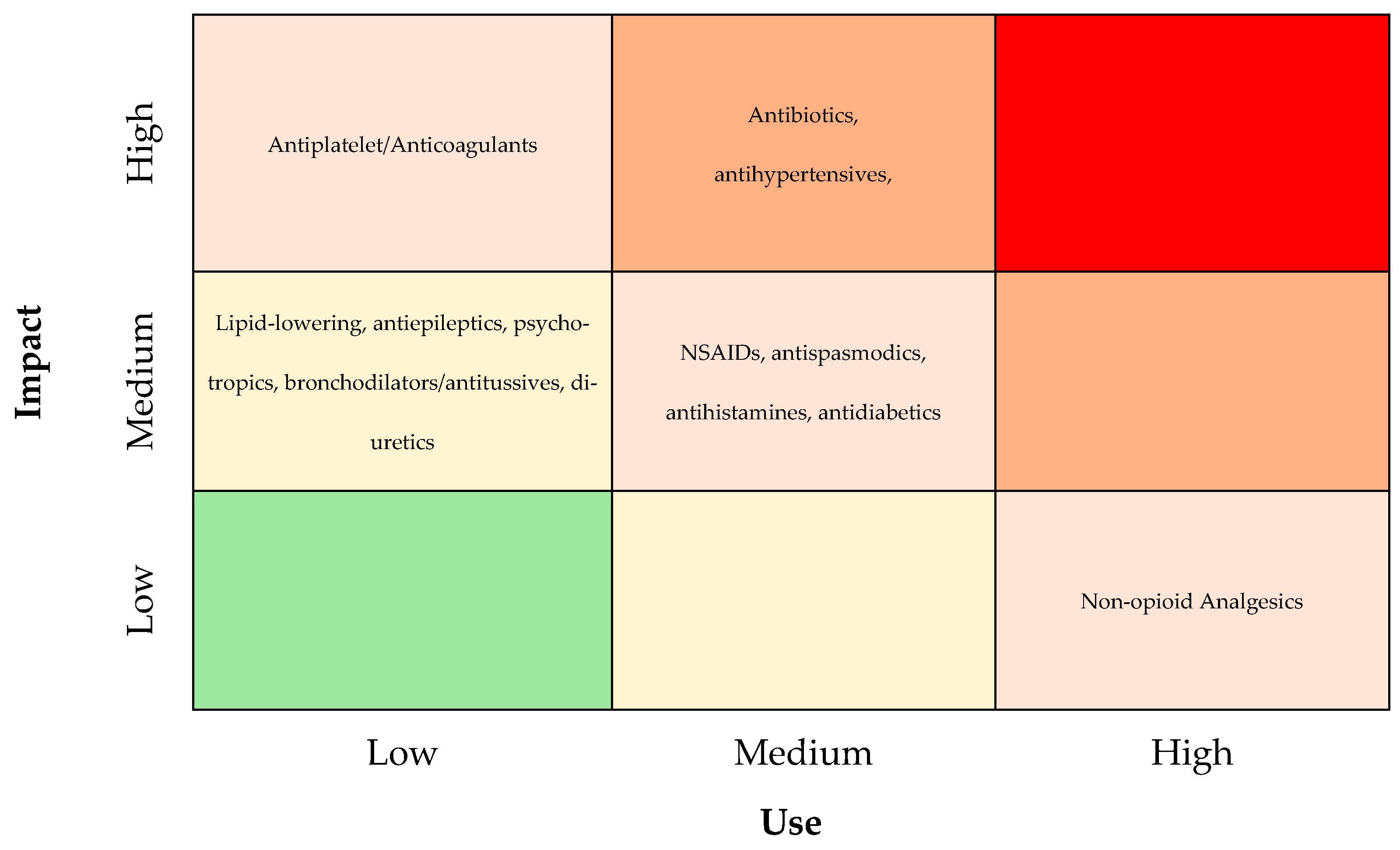
Table 1.
Use–impact risk matrix for household medication accumulation. Risk categories were defined as follows: low (scores 1–2), medium (3–4), and high (≥5). % Use represents the proportion of households reporting each therapeutic group. Color coding indicates increasing levels of risk, from low (green) to moderate (yellow) and high (orange).
These findings suggest that frequency of accumulation alone may be insufficient to characterize risk, reinforcing the need for integrated metrics combining exposure and hazard dimensions. This distribution further supports the differentiation between commonly accumulated medications with lower clinical impact and less frequent but higher-risk therapeutic groups.
2.2. Composite Risk Index and Risk Stratification
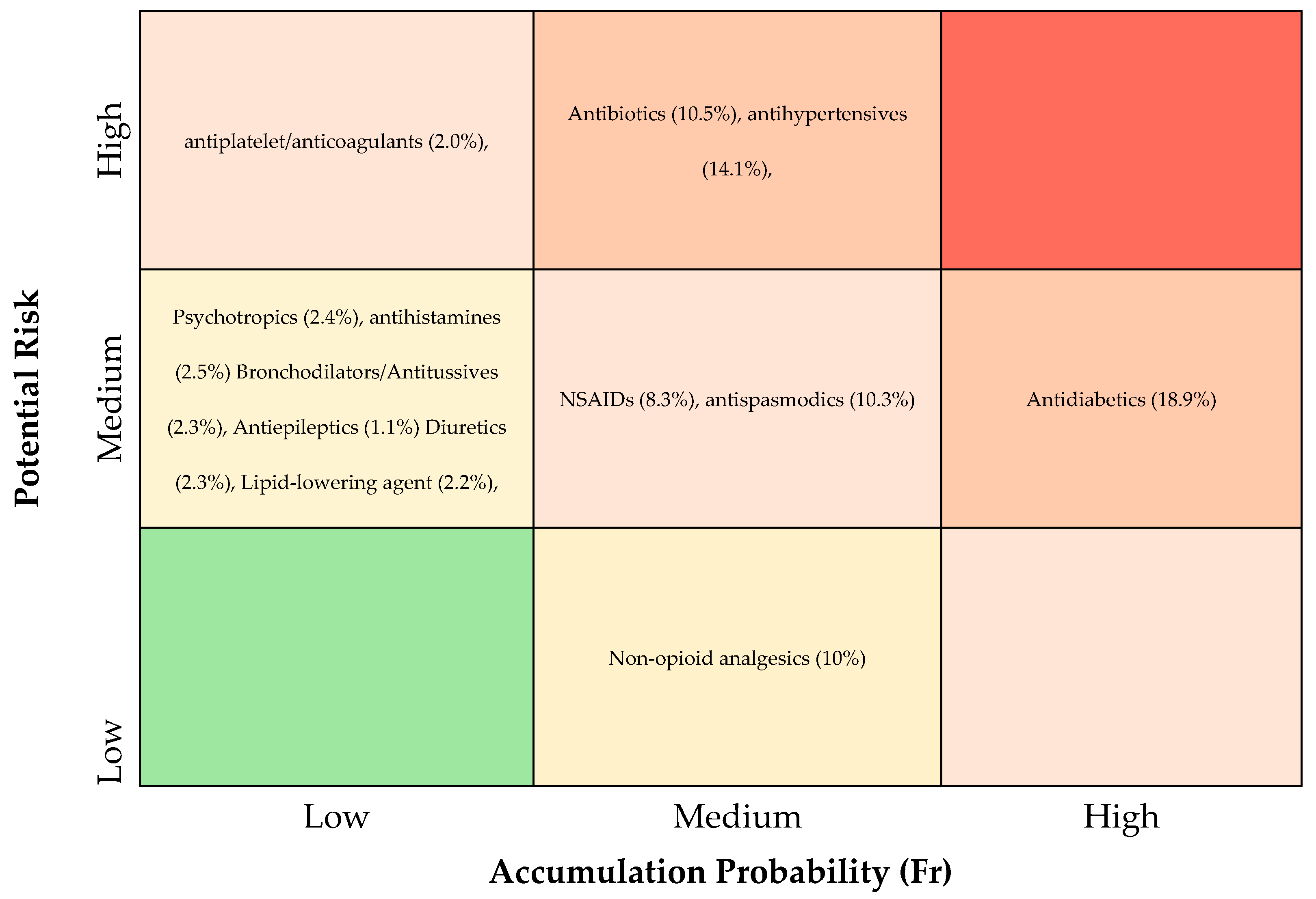
Building upon the use–impact matrix (household-level analysis), a composite risk index (CRI) was applied using unit-level frequency (Fr) to better capture the relative contribution of each therapeutic group to the overall accumulation burden. Therapeutic groups were positioned according to their accumulation probability (Fr; x-axis) and potential risk score (PR; y-axis). CRI values correspond to the product of accumulation probability (Fr) and potential risk score (PR), as defined in the methodological framework. Differences between the use–impact matrix (household-level analysis) and the composite risk index (unit-level analysis) arise from the integration of additional dimensions in the latter, including environmental persistence and antimicrobial resistance potential. Fr values differ from Table 1 because they are calculated at the unit level. Fr represents the percentage of pharmaceutical units and should not be interpreted as household prevalence. Risk categories were assigned according to predefined thresholds (low <10, moderate 10–30, high >30), as described in the methodological framework.
Antibiotics and antihypertensives were concentrated in the high-risk zone, characterized by medium accumulation probability and high potential risk. Antidiabetics were located in the high-probability zone with medium potential risk, indicating a substantial contribution to overall risk driven primarily by their high frequency of accumulation rather than intrinsic hazard. This distinction highlights the complementary nature of household-level and unit-level metrics, allowing differentiation between behavioral patterns of accumulation and actual exposure burden. Groups located in the upper-right region of the matrix represent convergence of high exposure and high hazard, constituting priority targets for intervention (Figure 2).
Figure 2.
Accumulation risk matrix of therapeutic groups based on accumulation probability (Fr) and potential risk score (PR). The x-axis represents the observed relative frequency of accumulation (Fr), expressed as the percentage of pharmaceutical units (not households) categorized as low (≤5%), medium (>5–15%), and high (>15%), while the y-axis represents the potential risk score (PR; range 1–3). Therapeutic groups are positioned within the matrix according to these two dimensions. Cells represent combinations of accumulation probability and risk level, allowing identification of high, moderate, and low-risk zones. Risk zones are defined according to the composite risk index (CRI = Fr × PR) thresholds described in Section 2.2. Color coding indicates increasing levels of risk, from low (green) to moderate (yellow/orange) and high (red). Groups located in the upper-right region represent the highest priority for intervention.
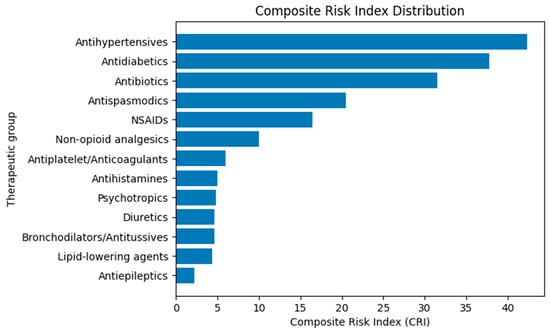
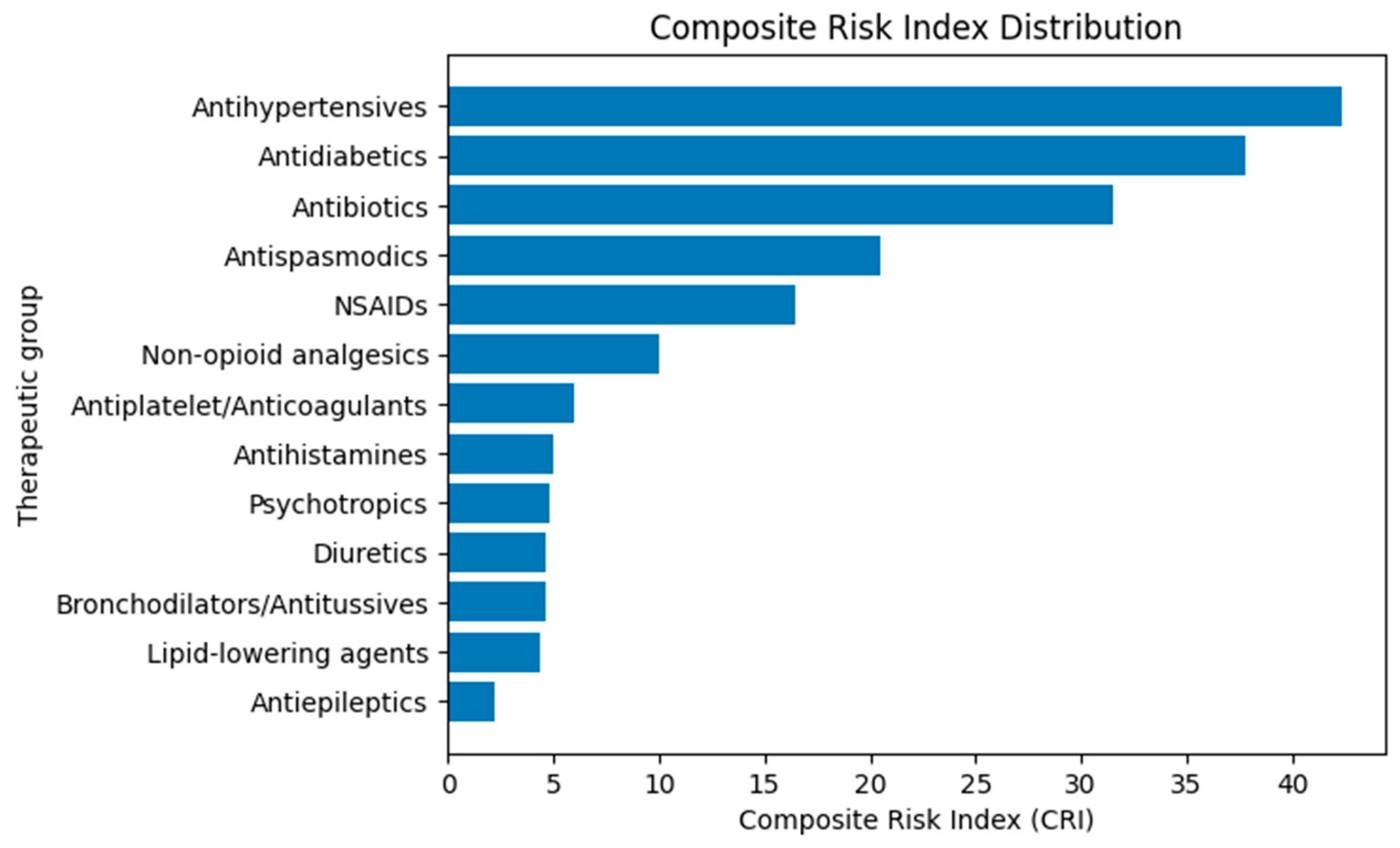
The numerical composite risk index (CRI), expressed as a relative measure integrating accumulation probability (Fr) and potential risk (PR), is presented in Figure 3 and revealed a clear gradient of risk across therapeutic groups (Table 2). Antihypertensives exhibited the highest CRI value (42.3), followed by antidiabetics (37.8) and antibiotics (31.5), indicating their dominant contribution to overall household pharmaceutical risk. Intermediate values were observed for antispasmodics (20.5) and NSAIDs (16.5), while lower values were identified for non-opioid analgesics (10.0), antihistamines (5.0), and psychotropic drugs (4.8).
Figure 3.
Distribution of the composite risk index (CRI) across therapeutic groups. Horizontal bars represent relative CRI values calculated as the product of accumulation probability (Fr) and potential risk score (PR). Higher values indicate greater overall risk associated with each therapeutic group.
Table 2.
Composite Risk Index (CRI) by therapeutic group based on unit-level frequency (Fr) and potential risk score (PR). Color coding indicates increasing levels of risk, from low (green) to moderate (yellow) and high (orange).
To support the interpretability and internal consistency of the PR scoring framework, domain-level patterns were consistent across therapeutic groups and aligned with predefined criteria. Antibiotics systematically received the highest scores in the antimicrobial resistance domain, while antihypertensives showed higher contributions from clinical toxicity and environmental persistence. Non-antibiotic groups consistently scored lower in the AMR domain, as expected by design. These patterns provide indirect evidence of coherence in the expert-based scoring approach.
These results should be interpreted as complementary rather than contradictory, reflecting different analytical perspectives on accumulation patterns and risk characterization.
2.3. Accumulation Reasons and Risk Heatmap
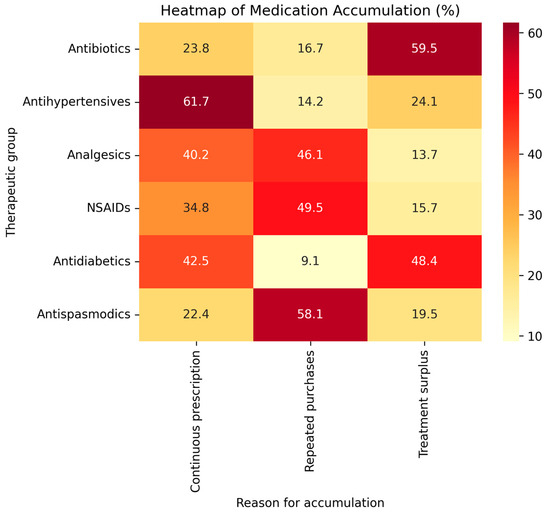
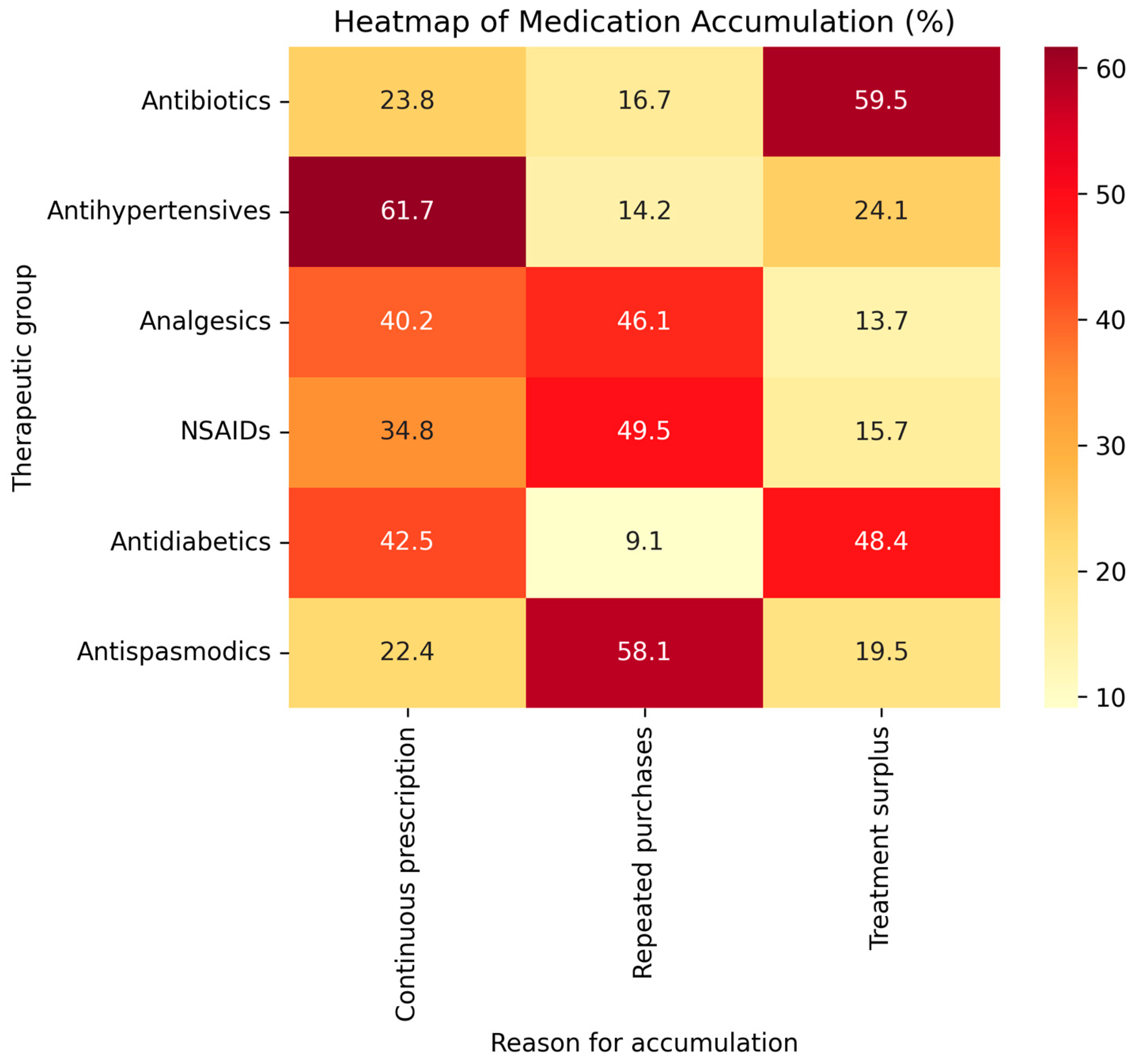
To further elucidate the drivers of medication accumulation and their association with risk, a heatmap analysis was conducted crossing accumulation reasons with representative therapeutic groups (Figure 4). Cell values represent the percentage distribution within each therapeutic group (row-wise normalization), enabling direct comparison across therapeutic groups.
Figure 4.
Heatmap of medication accumulation by therapeutic group and reported reason for accumulation. Rows represent therapeutic groups and columns represent accumulation reasons. Cell values represent the percentage distribution within each therapeutic group (row-wise normalization). Color intensity reflects increasing relative frequency, with darker shades indicating higher values. Distinct patterns across therapeutic groups highlight different underlying drivers of medication accumulation.
Continuous prescriptions predominated for antihypertensives (61.7%) and to a lesser extent for antidiabetics (42.5%), placing these groups in the high-risk zone, consistent with the chronic nature of these conditions.
Repeated purchases, indicative of self-medication or overconsumption, were notably associated with antispasmodics (58.1%), NSAIDs (49.5%), and analgesics (46.1%), suggesting inappropriate use and potential contribution to medication overuse. In contrast, antibiotics showed a lower proportion of repeated purchases (16.7%), indicating a different accumulation pattern. Treatment surplus was the predominant accumulation reason for antibiotics (59.5%) and was also substantial for antidiabetics (48.4%), reflecting incomplete treatment adherence and raising concerns regarding antimicrobial resistance and inappropriate medication disposal.
These patterns suggest that accumulation is driven by distinct mechanisms depending on therapeutic group, including chronic treatment continuity, self-medication behaviors, and incomplete treatment adherence.
3. Discussion
This study provides a comprehensive assessment of household medication accumulation in southeastern Mexico using an eco-pharmacovigilance framework that integrates clinical, environmental, and behavioral dimensions. The combined use of a use–impact matrix, a composite risk index (CRI), and accumulation pattern analysis allowed for a multidimensional characterization of pharmaceutical risk at the household level. Medication accumulation was highly prevalent, affecting 83.1% of households included in the analytical sample, with a mean of 4.2 pharmaceutical units per household. Nearly one-third (28.7%) of stored medications were expired, representing a substantial reservoir of potential health and environmental risk.
Importantly, expired medications were primarily retained rather than actively used, although their presence constitutes a latent risk for inappropriate self-medication and accidental exposure. Differences between the use–impact matrix and the CRI arise primarily because the latter incorporates additional dimensions, including environmental persistence and antimicrobial resistance potential, which increase the relative contribution of certain therapeutic groups such as antidiabetics. These differences do not represent inconsistencies, but rather reflect the use of complementary analytical approaches capturing distinct dimensions of pharmaceutical risk. These findings should be interpreted as indicative of relative risk patterns within the proposed framework rather than precise quantitative estimates, given the exploratory design of the study.
A key finding is that a limited number of therapeutic groups account for relatively higher contributions within the composite risk index framework to overall household pharmaceutical risk. As shown in Figure 3, antihypertensives, antidiabetics, and antibiotics together account for the largest share of the total CRI, highlighting their relevance as priority targets for intervention. This pattern reflects the convergence of medium-to-high accumulation frequency and elevated intrinsic risk, particularly in the context of chronic disease management and antimicrobial use. These results suggest, rather than definitively establish, prioritization pathways for intervention.
The use–impact matrix (Figure 1) provides a qualitative classification of therapeutic groups based on frequency and clinical impact, while the CRI integrates additional environmental and resistance-related dimensions, which may explain differences in risk ranking across methods. It is important to note that the position of therapeutic groups in the matrix reflects their distribution across these dimensions, whereas overall risk is determined by the combined effect of both components. The use of different frequency metrics (household-level vs. unit-level) provides complementary insights, distinguishing between how widespread a therapeutic group is across households and its quantitative contribution to total pharmaceutical accumulation. This methodological complementarity strengthens the internal coherence of the findings and reduces potential misinterpretation arising from single-metric approaches.
The convergence of medium-to-high accumulation frequency and high intrinsic risk in these groups highlights the need for targeted interventions. Antihypertensives and antidiabetics, primarily accumulated through continuous prescriptions, reflect the high prevalence of chronic diseases in the region and the challenges of long-term medication management. Antibiotics, although less frequently accumulated, pose a relatively higher risk due to clinical toxicity, environmental persistence, and potential selection for antimicrobial resistance—a triple burden effectively captured by the eco-pharmacovigilance framework.
The accumulation risk matrix (Figure 2) further supports these findings by identifying therapeutic groups located in the upper region of the matrix (medium accumulation probability and high potential risk) as critical targets for intervention. The heatmap analysis (Figure 4) reveals that different mechanisms drive the accumulation of specific therapeutic groups. Continuous prescriptions were the primary driver for antihypertensives and antidiabetics, reflecting the burden of chronic diseases and long-term treatment patterns. In contrast, repeated purchases were most prominent among antispasmodics, NSAIDs, and analgesics, suggesting self-medication practices and potential overuse.
Antibiotics, however, were primarily associated with treatment surplus rather than repeated purchases, indicating incomplete treatment adherence and raising concerns regarding improper use and disposal. These patterns should be interpreted cautiously, as they depend on observed household data that may be influenced by reporting and accessibility limitations.
From a public health perspective, these results underscore the importance of integrating household-level monitoring into pharmacovigilance systems. The high prevalence of accumulated medications, including expired products, represents a potential source of inappropriate use, adverse effects, and environmental contamination. In particular, the accumulation of antibiotics raises concerns regarding antimicrobial resistance, both through misuse and environmental exposure. The eco-pharmacovigilance framework applied in this study offers a scalable and practical tool for risk prioritization. The composite risk index (CRI) should therefore be interpreted as a prioritization tool rather than a precise quantitative estimate, consistent with semi-quantitative approaches used in environmental and public health risk assessment [14,15]. Potential interventions include the implementation of medication take-back programs, strengthening regulation of over-the-counter antibiotic sales, public education campaigns on rational drug use, and optimization of prescribing and dispensing practices to reduce unnecessary accumulation.
Several limitations should be acknowledged. First, the study was conducted in a single urban setting, which may limit generalizability to other regions. Second, the household medication inventory relied on a guided inspection supported by participant collaboration, and therefore some medications may not have been captured, introducing potential underestimation of accumulation. Third, the cross-sectional design captures accumulation at a single time point and does not reflect temporal dynamics. Fourth, the absence of inferential statistical analysis limits causal interpretation, as the study was designed for exploratory risk characterization rather than hypothesis testing.
Additionally, the potential risk score (PR) was derived from a relatively small multidisciplinary expert panel. Although the panel was intentionally composed of complementary expertise (clinical pharmacy, pharmacology, and environmental toxicology) and followed a structured consensus approach, some degree of inter-expert variability cannot be excluded, which may affect the reproducibility of the scoring system. Furthermore, the PR was not subjected to formal validation, inter-rater reliability testing, or sensitivity analyses. Therefore, it should be interpreted as a preliminary, expert-informed prioritization tool rather than a definitive measure of risk. In addition, because the CRI combines a percentage-based frequency measure (Fr) with a bounded risk score (PR), the resulting values may be more strongly influenced by relative accumulation frequency than by differences in intrinsic hazard. Consequently, CRI values should be interpreted as relative prioritization indicators rather than precise representations of absolute risk. Nevertheless, the use of predefined criteria, a structured consensus process, and the consistency of domain-level scoring patterns across therapeutic groups provide indirect support for the internal validity of the PR assignment. Future research should aim to strengthen this approach through larger expert panels, formal consensus methodologies (e.g., Delphi techniques), and empirical validation using independent datasets.
Future studies should incorporate larger expert panels and formal consensus methods, such as Delphi techniques, as well as empirical validation using external datasets. Nevertheless, expert-based scoring approaches are widely used in environmental and public health risk assessment when empirical data are limited, supporting the conceptual validity of this approach. These limitations are inherent to household-based observational studies and should be considered when interpreting the findings within a broader public health context.
Despite these limitations, several strengths enhance the robustness of the study. The use of direct household observation—rather than self-report alone—improves data reliability. The integration of clinical, environmental, and antimicrobial resistance dimensions provides a more comprehensive risk characterization than conventional descriptive approaches. Furthermore, the use of both household-level and unit-level frequency metrics strengthens internal consistency and interpretability.
The patterns observed are consistent with international literature. Studies in Spain, the United States, and Brazil report that 30–50% of households store expired or leftover medications, with chronic-use medications and antibiotics being the most frequently accumulated [4,5,6]. This study extends previous findings by integrating frequency and multidimensional risk into a unified and operational risk assessment framework.
The predominance of antihypertensives and antidiabetics aligns with the epidemiological transition in Mexico and Latin America, where non-communicable diseases are leading causes of morbidity and mortality [16]. The high prevalence of these medications in homes likely reflects disease burden, challenges in adherence, and prescription refill patterns. Similar trends have been reported in Brazil and Colombia, where cardiovascular and antidiabetic medications dominate household stocks [7,17].
Antibiotics, despite lower accumulation frequency, occupy the high-risk category due to clinical and environmental impact, consistent with the growing recognition of antibiotics as priority targets for eco-pharmacovigilance [8,18]. Their accumulation pattern was characterized primarily by treatment surplus (59.5%), rather than repeated purchases, suggesting incomplete treatment adherence and potential misuse. This pattern has also been documented in middle-income settings [11,19] and is particularly concerning given the global antimicrobial resistance crisis [20,21].
The relatively high accumulation of non-opioid analgesics and NSAIDs contrasts with some European studies, where these groups are secondary to chronic disease medications [5]. This difference may reflect local prescribing practices, over-the-counter availability, and cultural patterns of self-medication in Mexico [15].
The integrated eco-pharmacovigilance framework used in this study provides a holistic view of household medication accumulation, encompassing clinical, environmental, and resistance-related risks [4,18,22]. This framework is intended as a prioritization tool rather than a definitive risk quantification model, and its application should be adapted and validated in different contexts.
Clinical implications include increased opportunities for inappropriate use, self-medication with expired products, dose errors, and drug interactions. Nearly 30% of stored medications were expired, potentially reducing efficacy or increasing toxicity [23], and posing a risk of accidental ingestion by children or vulnerable adults [1].
Environmental implications arise from improper disposal through trash, sinks, or toilets, contributing to pharmaceutical contamination of aquatic ecosystems [10,24,25]. Antibiotics, NSAIDs, and antihypertensives have been detected in surface and drinking waters globally [26]. Their persistence can cause ecotoxicological effects and contribute to antimicrobial resistance in environmental bacteria [8,27].
Antimicrobial resistance implications are reinforced by the accumulation of antibiotics combined with repeated purchases, highlighting community-level drivers of resistance. Misuse of antibiotics—including self-medication, incomplete courses, or use of expired products—is a well-established risk factor for the emergence and spread of resistant organisms [20,28]. Environmental contamination further amplifies selective pressure [29].
These findings inform pharmacovigilance, environmental health, and public health policy. Household monitoring should be integrated into pharmacovigilance activities, with community pharmacies serving as sentinel sites [30]. Safe medication disposal programs are urgently needed, such as take-back kiosks or collection events, coupled with public awareness campaigns [9]. Prescribing practices should be reviewed to reduce surplus, including smaller dispensing quantities, medication synchronization, and regular reviews [31]. Stronger enforcement of prescription requirements and patient education is critical, particularly for antibiotics [14,32].
Future research should include multicenter studies to assess generalizability across Mexico and Latin America, longitudinal studies to track accumulation dynamics, environmental monitoring of pharmaceutical residues, and intervention studies evaluating strategies to reduce accumulation and associated risks. Further refinement and validation of the composite risk index, including expansion of expert input and incorporation of empirical data, will be essential to strengthen its applicability. Despite these limitations, the consistency of patterns observed across analytical approaches supports the internal coherence of the findings and reinforces their relevance for public health prioritization.
4. Materials and Methods
4.1. Study Design and Population
This study employed a community-based cross-sectional design to examine household medication accumulation and associated environmental health risks from a pharmacoepidemiological perspective. The investigation was conducted in San Francisco de Campeche, the capital of Campeche state, southeastern Mexico, selected for its diverse sociodemographic composition, including both historic barrios and recently developed residential colonias [33].
A stratified random sampling strategy was implemented to ensure representative coverage across geographic location, urban development, and socioeconomic indicators. Ten neighborhoods representing traditional, residential, peripheral, and mixed urban settings were selected (San Francisco, Santa Ana, San Román, Guadalupe, Bellavista, Camino Real, Montecristo, Solidaridad Urbana, Leovigildo, and Bosques de Campeche).
Data collection occurred from October 2024 to June 2025, allowing for potential seasonal variations in medication acquisition and disposal practices. From the 633 households initially enrolled, 107 households without any stored medications were excluded, leaving a final sample of 526 households for analysis.
Inclusion criteria: households with at least one adult (≥18 years) providing informed consent.
Exclusion criteria: households headed by healthcare professionals (to avoid bias in medication management knowledge) and unoccupied dwellings after three visit attempts on different days and times.
Sample size calculation: assuming a conservative prevalence of 50% for medication accumulation (which maximizes sample size requirements), with a 95% confidence level and a 4% margin of error, the minimum required sample size was 601 households [19]. The initial enrollment of 633 households exceeded this requirement; after excluding 107 households without any stored medications, the final analytical sample comprised 526 households. Although the final analytical sample (n = 526) was slightly below the calculated minimum, the results should be interpreted as exploratory and descriptive. This reduction in sample size may have decreased statistical precision, and findings should be interpreted with appropriate caution. Accordingly, no formal inference is intended, and the analysis focuses on identifying relative patterns rather than population-level estimates. To further assess the impact of the reduced analytical sample size, a post hoc precision estimation indicates that a sample of 526 households corresponds to an approximate margin of error of 4.3% (assuming 50% prevalence and 95% confidence level), which is only slightly higher than the originally targeted 4%. Therefore, although statistical precision is modestly reduced, the analytical sample remains adequate for exploratory and descriptive purposes.
The sample size calculation was originally based on the total number of households visited, assuming a conservative prevalence of 50% for medication accumulation in the general population. Therefore, the initial target population included all households, regardless of whether medications were present at the time of the visit. This implies that the sample size estimation was designed to represent the general household population rather than being restricted to households with accumulated medications.
The exclusion of households without stored medications (n = 107) represents an analytical restriction applied after data collection and may introduce selection bias, as the resulting estimates are conditional on the presence of accumulated medications. Consequently, households without accumulation are underrepresented in the analytical sample, which may affect the generalizability of the findings to the broader population.
Consequently, the findings should be interpreted as reflecting patterns and relative risk within households exhibiting pharmaceutical accumulation, rather than as population-level prevalence estimates. This distinction is consistent with the exploratory and prioritization-oriented nature of the study. Given the exploratory nature of the study, no formal hypothesis testing was conducted. Instead, the analysis focused on identifying relative differences across therapeutic groups based on accumulation frequency and intrinsic hazard.
4.2. Data Collection
Home visits were conducted by trained pharmacists and field researchers following standardized protocols. After obtaining written informed consent, two data collection components were implemented:
Pharmaceutical Inventory: A guided household medication inventory was conducted with the assistance of the household member primarily responsible for medication management. Medications were recorded based on those voluntarily presented by participants and those accessible during a structured room-by-room inspection. Information collected included brand and generic name, pharmaceutical form, strength, package size, remaining units, and expiration date. Although efforts were made to systematically review common and non-conventional storage areas (e.g., kitchens, bathrooms, bedrooms), the completeness of the inventory depended on participant cooperation, accessibility, and visibility of stored medications. Therefore, it is possible that some medications were not captured.
For the purposes of this study, household pharmaceutical accumulation was operationally defined as the presence of unused, expired, or stored medications not currently in active therapeutic use. Particular attention was directed toward commonly reported storage areas such as kitchens, bathrooms, and bedrooms, as these locations often harbor forgotten or expired products [34]. This operational definition establishes a clear analytical boundary, distinguishing accumulation from active therapeutic use and ensuring consistency across data collection and analysis. This distinction is critical for interpreting accumulation as a risk condition rather than a measure of medication consumption.
To enhance reproducibility and procedural consistency, the inventory procedure followed a predefined operational sequence. Field staff initiated the inspection in commonly reported storage areas (kitchen, bathroom, and bedroom), followed by additional locations identified by participants (e.g., living rooms, storage spaces, or personal bags). Direct observation was prioritized whenever medications were visible and accessible; otherwise, participant-assisted presentation was used. All field personnel underwent prior standardized training sessions, including protocol familiarization, mock household visits, and calibration exercises, to ensure consistency in identification, recording, and classification of medications across households. This approach aimed to minimize inter-observer variability while acknowledging the inherent limitations of household-based inventories.
Structured Questionnaire: Administered to the household member primarily responsible for medication management, covering: Acquisition channels (prescription, over-the-counter, samples, leftovers from others), Frequency and patterns of acquisition, Primary reasons for accumulation (continuous prescription, repeated purchases, leftover treatments, medication changes), Storage practices and locations, Disposal practices (trash, drain, donation, return programs) [35,36]. The complete structured questionnaire is provided as Supplementary Materials to ensure transparency and reproducibility.
All data were recorded on standardized paper forms and subsequently entered into a validated Microsoft Excel database with built-in validation checks to minimize entry errors.
4.3. Medication Classification
To ensure international comparability and adherence to standardized nomenclature, all medications were classified according to the Anatomical Therapeutic Chemical (ATC) system maintained by the World Health Organization, at the fifth level (chemical substance) where possible [37]. For analytical purposes, medications were aggregated into the following major therapeutic categories: Antihypertensives (C02–C09), analyzed separately from other cardiovascular subgroups such as diuretics and antiplatelet agents, Antidiabetics (A10), Systemic antibiotics (J01), Non-opioid analgesics (N02), Non-steroidal anti-inflammatory drugs (NSAIDs, M01), Antispasmodics (A03), Antihistamines (R06), Others (including psychotropics, lipid-lowering agents, respiratory medications). This classification framework enabled the identification of therapeutic groups with the highest accumulation frequencies and provided the foundation for subsequent risk stratification.
4.4. Risk Assessment: Eco-Pharmacovigilance Framework
A mixed-methods approach combining qualitative and quantitative analyses was applied in three sequential stages, each building upon the previous to create a comprehensive and defensible risk profile [18,38,39].
4.4.1. Use–Impact Matrices
As an exploratory step, use–impact matrices were constructed by cross-tabulating therapeutic groups with household-reported accumulation reasons. Each cell represented the relative frequency of occurrence for a specific combination, calculated as the number of households reporting that combination divided by the total number of households in the analytical sample. This technique allowed for the identification of critical intersections where high-frequency accumulation coincided with clinically or environmentally significant medication categories [38].
Usage frequency was operationalized as an ordinal variable based on the proportion of households reporting each therapeutic group. Thresholds were defined a priori as follows: low (≤5%, score = 1), medium (>5–15%, score = 2), and high (>15%, score = 3). This categorization enabled comparison across therapeutic groups and facilitated integration with the clinical impact dimension for composite risk estimation. In this matrix, usage frequency was defined at the household level, representing the proportion of households reporting the presence of each therapeutic group, in order to capture behavioral patterns of medication accumulation. For the heatmap analysis (Figure 4), accumulation reasons were expressed as percentages within each therapeutic group (row-wise normalization), rather than absolute counts, in order to facilitate comparability across therapeutic groups with different frequencies of occurrence.
4.4.2. Composite Risk Index (CRI): Conceptual Framework
The centerpiece of the risk assessment was the development of a composite risk index (CRI) grounded in eco-pharmacovigilance principles. Eco-pharmacovigilance encompasses the detection, assessment, and prevention of adverse effects of pharmaceuticals in the environment, as well as effects on human health resulting from environmental exposure [18]. This framework was selected because household medication accumulation sits precisely at the intersection of clinical pharmacology (risks of inappropriate use, toxicity, self-medication) and environmental health (risks of improper disposal, persistence, ecotoxicity). The CRI was designed to integrate multiple dimensions of risk into a single, interpretable metric. The underlying premise is that risk posed by a given therapeutic group is a function of both how frequently it accumulates (exposure probability) and its intrinsic potential to cause harm (hazard severity). This conceptualization aligns with established risk assessment paradigms in epidemiology and toxicology [40,41]. The use of different frequency metrics (household-level vs. unit-level) provides complementary insights, distinguishing between how widespread a therapeutic group is across households and its quantitative contribution to total pharmaceutical accumulation.
4.4.3. Composite Risk Index (CRI): Mathematical Formulation
The CRI was calculated for each therapeutic group as: CRI = Fr × PR
Where:
Fr (Relative Frequency): The percentage of pharmaceutical units belonging to a specific therapeutic group relative to the total number of units inventoried across all households. This unit-based metric was selected to reflect the relative contribution of each therapeutic group to the overall accumulation burden and potential exposure. It is calculated as:
PR (Potential Risk Score): A weighted score (range 1–3, with 3 representing the highest risk) assigned to each therapeutic group based on a multidisciplinary evaluation of three eco-pharmacovigilance domains: clinical toxicity, environmental persistence, and antimicrobial resistance (AMR) potential. The PR is itself a composite score, designed to capture the multidimensional nature of pharmaceutical risk.
The CRI is not intended to provide an absolute measure of risk, but rather a comparative tool for prioritizing therapeutic groups based on relative exposure and hazard. This approach is consistent with semi-quantitative risk assessment models commonly used in environmental health and pharmacoepidemiology.
The multiplicative structure was chosen because it reflects the epidemiological principle that population risk is the product of exposure probability and hazard severity [42]. This approach amplifies differences when both components are high, allowing for synergistic identification of therapeutic groups requiring urgent intervention, while yielding moderate scores for groups with high frequency but low hazard (e.g., low-toxicity analgesics) or low frequency but high hazard (e.g., hospital-use medications rarely found in households) [43].
4.4.4. Potential Risk Score (PR): Domain Definitions
To ensure transparency and scientific defensibility, each domain of the PR was explicitly defined with scoring criteria established a priori based on published evidence and international guidelines:
Domain 1: Clinical Toxicity
Score 3 (High): Medications with narrow therapeutic index; known to cause severe, life-threatening adverse reactions (e.g., anaphylaxis from antibiotics, severe hypotension from antihypertensives); classified by WHO as “highly hazardous” in acute poisoning guidelines [39].
Score 2 (Moderate): Medications associated with moderate adverse effects requiring medical attention but rarely life-threatening; potential for toxicity in overdose but with relatively wide safety margin (e.g., NSAIDs, antidiabetics).
Score 1 (Low): Medications with wide therapeutic index; adverse effects generally mild and self-limiting (e.g., non-opioid analgesics at therapeutic doses, second-generation antihistamines).
Domain 2: Environmental Persistence
Score 3 (High): Compounds with documented half-lives >60 days in environmental matrices; known to resist biodegradation; evidence of bioaccumulation potential (log Kow > 4.5); frequently detected in water bodies at concerning concentrations (e.g., fluoroquinolones, diclofenac) [18,24].
Score 2 (Moderate): Compounds with moderate half-lives (10–60 days); partially biodegradable; detected in environmental samples but at lower frequencies (e.g., some antihypertensives, ibuprofen).
Score 1 (Low): Compounds degrading rapidly (half-life <10 days); readily biodegradable; rarely detected in monitoring studies (e.g., many analgesics).
Domain 3: Antimicrobial Resistance (AMR) Potential
Score 3 (High): Antibiotics classified by WHO as “Highest Priority Critically Important Antimicrobials for Human Medicine,” particularly those used as last-line therapies or for which resistance poses significant public health threats (e.g., fluoroquinolones, third/fourth-generation cephalosporins, carbapenems) [20].
Score 2 (Moderate): Antibiotics classified as “Highly Important” or “Critically Important” but with lower priority (e.g., tetracyclines, amoxicillin)
Score 1 (Low): Non-antibiotic therapeutic classes; antibiotics with minimal environmental selection potential. All non-antibiotic groups default to 1.
4.4.5. PR Assignment Process: Multidisciplinary Expert Panel
PR scores were determined through a structured consensus process involving a multidisciplinary expert panel comprising: two clinical pharmacists, one pharmacologist specializing in drug toxicity, and one environmental toxicologist with expertise in pharmaceutical contaminants. The process included: (1) independent review of evidence for each therapeutic group; (2) individual proposal of domain-specific scores with documented rationale; (3) panel discussion to resolve discrepancies; and (4) final PR calculation as the rounded average of the three domain scores. This structured and transparent process was designed to reduce subjectivity and enhance consistency in scoring.
Although the PR scoring process was designed to be structured and transparent, it remains an expert-informed, semi-quantitative approach and should be interpreted accordingly. Given the relatively small size of the expert panel and the absence of formal inter-rater reliability testing, quantitative agreement statistics were not calculated. Similarly, no external validation or sensitivity analyses were performed at this stage. Therefore, the PR score should be interpreted as a preliminary, expert-informed prioritization tool intended to support comparative risk assessment rather than as a definitive or fully validated metric. To further enhance transparency and facilitate independent evaluation, domain-specific scores and their supporting rationale for each therapeutic group are provided in Supplementary Material S1. Key scoring patterns are also reflected in Section 2 to improve interpretability.
Future research should aim to strengthen the robustness of this approach through larger expert panels, formal consensus methodologies (e.g., Delphi techniques), and empirical validation using independent datasets.
4.4.6. Risk Stratification and Interpretation
Based on calculated CRI values, therapeutic groups were stratified into three risk zones:
Low risk (CRI < 10): Groups with low accumulation frequency and/or low potential risk; may be monitored but do not require immediate intervention.
Moderate risk (CRI 10–30): Groups with moderate accumulation frequency and/or moderate potential risk; warrant targeted education and monitoring.
High risk (CRI > 30): Groups with high accumulation frequency and high potential risk across multiple domains; should be prioritized for immediate intervention, including enhanced pharmacovigilance, public awareness campaigns, and safe disposal programs.
Threshold values (10 and 30) were selected based on the natural distribution of CRI values in the preliminary analysis and represent meaningful breakpoints for public health prioritization. These thresholds can be calibrated for application in other settings as needed.
4.4.7. Visual Representations and Statistical Analysis
This study was designed as a descriptive and exploratory pharmacoepidemiological assessment rather than a hypothesis-testing analysis. Consequently, inferential statistical tests were not applied. Instead, descriptive statistics (frequencies, percentages, and proportions) were used to characterize accumulation patterns, and the composite risk index (CRI) was applied as a semi-quantitative tool to rank therapeutic groups according to combined exposure and hazard dimensions. This approach is appropriate for early-stage risk characterization and prioritization in public health research. Additionally, anonymized raw data supporting the findings are available from the corresponding author upon reasonable request to ensure transparency and reproducibility.
Overall, the methodological framework integrates standardized data collection procedures, internationally recognized classification systems (ATC), and a transparent, multi-dimensional risk assessment approach. By combining behavioral (household-level) and exposure-based (unit-level) metrics within a semi-quantitative framework, the study ensures internal consistency, reproducibility, and conceptual robustness, while enabling meaningful prioritization of therapeutic groups in a real-world public health context.
4.5. Ethical Considerations
The study adhered to the Declaration of Helsinki and institutional research guidelines. Participants provided written informed consent after receiving detailed information about study objectives, procedures, and their rights. Data were anonymized at collection by assigning unique household identifiers, securely stored, and accessible only to the research team.
5. Conclusions
Household medication accumulation represents a measurable source of health and environmental risk that can be systematically characterized using an eco-pharmacovigilance approach. In this study, a limited number of therapeutic groups—particularly antihypertensives, antidiabetics, and antibiotics—accounted for a relatively higher share of overall risk due to the combined effect of accumulation frequency, group-specific accumulation patterns, and intrinsic hazard. The integration of a use–impact matrix with a composite risk index (CRI) provides a practical framework for identifying priority targets for intervention at the community level.
These findings should be interpreted as indicative of relative risk patterns within the proposed framework, rather than precise quantitative estimates, given the exploratory design and the guided nature of household data collection. Nevertheless, the proposed framework offers a scalable tool to support public health strategies aimed at optimizing prescribing practices, reducing inappropriate medication use, and improving disposal systems. Further validation in diverse settings and with expanded methodological approaches is warranted to strengthen its robustness and generalizability. Together, these approaches enhance interpretability and reduce potential bias associated with single-metric assessments.
Supplementary Materials
The following supporting information can be downloaded at: https://www.mdpi.com/article/10.3390/pharma5020013/s1, Supplementary Material S1 (PDF, Structured Questionnaire).
Author Contributions
Conceptualization, R.M.d.J.M.-Á. and M.M.G.-M.; methodology, R.M.d.J.M.-Á. and M.M.G.-M.; software, R.M.d.J.M.-Á., R.E.C.-M.; validation, M.M.G.-M. and D.A.L.-S.; formal analysis, R.M.d.J.M.-Á., M.M.G.-M., D.Y.-N., R.E.C.-M.; investigation, R.M.d.J.M.-Á., D.Y.-N. and R.E.C.-M.; resources, R.M.d.J.M.-Á. and M.M.G.-M.; data curation, R.M.d.J.M.-Á., P.G.-Q. and R.E.C.-M.; writing—original draft preparation, R.M.d.J.M.-Á., M.M.G.-M., D.Y.-N. and R.E.C.-M.; writing—review and editing, R.M.d.J.M.-Á., M.M.G.-M., P.G.-Q., R.E.C.-M.; visualization, P.G.-Q., D.Y.-N., R.E.C.-M., D.A.L.-S.; supervision, R.M.d.J.M.-Á. and M.M.G.-M.; project administration, M.M.G.-M., D.Y.-N. and D.A.L.-S. All authors have read and agreed to the published version of the manuscript.
Funding
This research received no external funding.
Institutional Review Board Statement
Ethical review and approval were waived for this study because the authors’ institution does not have a formal ethics committee for social research involving interviews with adult participants. The study was conducted in accordance with internationally recognized ethical principles for research involving human participants. The study was classified as risk-free research in accordance with Article 17 of the Regulations of the General Health Law on Health Research, the research involved non-invasive interviews focused on participants’ habits regarding the use, storage, disposal, and informal circulation of medications, without any biological, clinical, physiological, or psychological intervention.
Informed Consent Statement
Informed consent was obtained from all subjects involved in the study prior to the interviews. Participants were informed about the purpose of the research and their voluntary participation. They were also informed that they could withdraw from the interview at any time without consequences. All responses were collected anonymously, and no personally identifiable information was recorded. The study was conducted in accordance with the ethical principles of the Declaration of Helsinki.
Data Availability Statement
The data presented in this study are available on reasonable request from the corresponding author, subject to ethical and confidentiality considerations.
Acknowledgments
During the preparation of this manuscript, the authors used GenAI for language refinement, assistance with structuring sections, and formatting of references in accordance with journal guidelines. Following the use of this tool, the authors thoroughly reviewed and edited the content and take full responsibility for the final version of the manuscript.
Conflicts of Interest
The authors declare no conflict of interest.
References
- Holloway, K.A.; van Dijk, L. Rational use of medicines. WHO Drug Inf. 2011, 25, 121–127. [Google Scholar]
- Wirtz, V.J.; Hogerzeil, H.V.; Gray, A.L.; Bigdeli, M.; de Joncheere, C.P.; Ewen, M.A.; Gyansa-Lutterodt, M.; Jing, S.; Luiza, V.L.; Mbindyo, R.M.; et al. Essential medicines for universal health coverage. Lancet 2017, 389, 403–476. [Google Scholar] [CrossRef] [Scilit]
- Velo, G.; Hughes, D. Problems with self-medication and the role of the pharmacist. Drug Saf. 2005, 28, 1117–1125. [Google Scholar]
- Coma, A.; Modamio, P.; Lastra, C.F.; Bouvy, M.L.; Mariño, E.L. Almacenamiento doméstico de medicamentos en España. Gac. Sanit. 2008, 22, 525–531. [Google Scholar]
- Seehusen, D.A.; Edwards, J. Patient practices and beliefs concerning disposal of medications. J. Am. Board Fam. Med. 2006, 19, 542–545. [Google Scholar] [CrossRef] [Scilit]
- Abreu, M.N.S.; Pereira, D.G.; Silva, L.C. Descarte de medicamentos e impacto ambiental: Uma revisão integrativa. Rev. Gestão Ambient. Sustentabilidade 2015, 4, 92–107. [Google Scholar]
- Daughton, C.G.; Ruhoy, I.S. Environmental footprint of pharmaceuticals: The significance of factors beyond direct excretion to sewers. Environ. Toxicol. Chem. 2009, 28, 2495–2521. [Google Scholar] [CrossRef] [Scilit]
- Kümmerer, K. Pharmaceuticals in the environment. Annu. Rev. Environ. Resour. 2010, 35, 57–75. [Google Scholar] [CrossRef] [Scilit]
- Zilker, M.; Sörgel, F.; Holzgrabe, U. Pharmacokinetic evaluation of expired medications. Eur. J. Pharm. Sci. 2019, 127, 24–30. [Google Scholar]
- World Health Organization. World Health Statistics 2011. Bull. World Health Organ. 2011, 89, 161–240. [Google Scholar]
- Kotwani, A.; Wattal, C.; Katewa, S.; Joshi, P.C.; Holloway, K. Irrational use of antibiotics and role of the pharmacist: An insight from a qualitative study in New Delhi, India. J. Clin. Pharm. Ther. 2012, 37, 308–312. [Google Scholar] [CrossRef] [Scilit]
- West, L.M.; Diack, L.; Cordina, M.; Stewart, D. A systematic review of the literature on ‘medicine wastage’: Causes and consequences. Int. J. Pharm. Pract. 2014, 22, 95–105. [Google Scholar]
- Bound, J.P.; Voulvoulis, N. Household disposal of pharmaceuticals as a pathway for aquatic contamination in the United Kingdom. Environ. Health Perspect. 2005, 113, 1705–1711. [Google Scholar] [CrossRef] [Scilit]
- National Research Council. Risk Assessment in the Federal Government: Managing the Process; National Academy Press: Washington, DC, USA, 1983. [Google Scholar]
- Covello, V.T.; Merkhofer, M.W. Risk Assessment Methods: Approaches for Assessing Health and Environmental Risks; Plenum Press: New York, NY, USA, 1993. [Google Scholar]
- Elizalde-Velázquez, A.; Gómez-Oliván, L.M.; Galar-Martínez, M.; Islas-Flores, H.; Dublán-García, O.; SanJuan-Reyes, N. Amoxicillin in the aquatic environment: A review. Environ. Toxicol. Pharmacol. 2017, 55, 186–192. [Google Scholar]
- Petrović, M.; Gonzalez, S.; Barceló, D. Analysis and removal of emerging contaminants in wastewater and drinking water. TrAC Trends Anal. Chem. 2003, 22, 685–696. [Google Scholar] [CrossRef] [Scilit]
- Dreser, A.; Vázquez-Vélez, E.; Treviño, S.; Wirtz, V.J. Regulation of antibiotic dispensing in Mexico: A legal and policy analysis. Health Policy Plan. 2017, 32, 705–713. [Google Scholar]
- Ezzati, M.; Riboli, E. Behavioral and dietary risk factors for noncommunicable diseases. N. Engl. J. Med. 2013, 369, 954–964. [Google Scholar] [CrossRef] [Scilit]
- Santos, L.H.M.L.M.; Araújo, A.N.; Fachini, A.; Pena, A.; Delerue-Matos, C.; Montenegro, M.C.B.S.M. Ecotoxicological aspects related to the presence of pharmaceuticals in the aquatic environment. J. Hazard. Mater. 2010, 175, 45–95. [Google Scholar] [CrossRef] [Scilit]
- Glassmeyer, S.T.; Hinchey, E.K.; Boehme, S.E.; Daughton, C.G.; Ruhoy, I.S.; Conerly, O.; Daniels, R.L.; Lauer, L.; McCarthy, M.; Nettesheim, T.G.; et al. Disposal practices for unwanted residential medications in the United States. Environ. Int. 2009, 35, 566–572. [Google Scholar] [CrossRef] [Scilit]
- González-González, J.S. Ecofarmacovigilancia: El efecto de los medicamentos sobre el medio ambiente. PANAMACANI 2024, 2, 5–7. [Google Scholar]
- Fewtrell, L.; Bartram, J. Water Quality: Guidelines, Standards and Health; IWA Publishing: London, UK, 2001. [Google Scholar]
- Silva, L.J.G.; Lino, C.M.; Meisel, L.M.; Pena, A. Selective serotonin re-uptake inhibitors (SSRIs) in the aquatic environment: An ecopharmacovigilance approach. Sci. Total Environ. 2012, 437, 185–195. [Google Scholar] [CrossRef] [Scilit]
- World Health Organization. Pharmaceuticals in Drinking-Water; WHO Technical Report Series No. 1010; WHO: Geneva, Switzerland, 2018. [Google Scholar]
- European Medicines Agency. Guideline on the Environmental Risk Assessment of Medicinal Products for Human Use; EMA: London, UK, 2018. [Google Scholar]
- Roos, V.; Gunnarsson, L.; Fick, J.; Larsson, D.G.J.; Rudén, C. Prioritising pharmaceuticals for environmental risk assessment: Towards adequate and feasible first-tier selection. Sci. Total Environ. 2012, 421–422, 102–110. [Google Scholar] [CrossRef] [Scilit]
- Guo, J.; Sinclair, C.J.; Selby, K.; Boxall, A.B.A. Multi-criteria decision analysis for prioritizing the monitoring of emerging contaminants in the aquatic environment. Environ. Pollut. 2016, 212, 91–100. [Google Scholar]
- Institute for Health Metrics and Evaluation. Global Burden of Disease Study 2019; IHME: Seattle, WA, USA, 2021. [Google Scholar]
- Pagán, J.A.; Ross, S.; Yau, J. Self-medication and health insurance coverage in Mexico. Health Policy 2006, 75, 170–177. [Google Scholar] [CrossRef] [Scilit]
- Laxminarayan, R.; Duse, A.; Wattal, C.; Zaidi, A.K.M.; Wertheim, H.F.L.; Sumpradit, N.; Vlieghe, E.; Hara, G.L.; Gould, I.M.; Goossens, H.; et al. Antibiotic resistance—The need for global solutions. Lancet Infect. Dis. 2013, 13, 1057–1098, Erratum in Lancet Infect. Dis. 2014, 14, 11 and in Lancet Infect Dis. 2014, 14, 182. [Google Scholar] [CrossRef] [Scilit]
- Berendonk, T.U.; Manaia, C.M.; Merlin, C.; Fatta-Kassinos, D.; Cytryn, E.; Walsh, F.; Buergmann, H.; Sørum, H.; Norström, M.; Pons, M.-N.; et al. Tackling antibiotic resistance: The environmental framework. Nat. Rev. Microbiol. 2015, 13, 310–317. [Google Scholar] [CrossRef] [Scilit]
- Lumbreras, B.; Hernández-Aguado, I. Epidemiología y salud pública: Una relación necesaria. Gac. Sanit. 2012, 26, 399–400. [Google Scholar]
- WHO Collaborating Centre for Drug Statistics Methodology. Guidelines for ATC classification. Basic Clin. Pharmacol. Toxicol. 2020, 126, 3–10. [Google Scholar]
- Garjón, F.J.; Azparren, A.; Vergara, I. Desarrollo de una matriz de riesgo para la evaluación de medicamentos. Aten. Primaria 2012, 44, 456–462. [Google Scholar]
- Holm, G.; Snape, J.R.; Murray-Smith, R.; Talbot, J.; Taylor, D.; Sörme, P. Implementing ecopharmacovigilance in practice: Challenges and potential opportunities. Drug Saf. 2013, 36, 533–546. [Google Scholar] [CrossRef] [Scilit]
- Gómez-Oliván, L.M.; Neri-Cruz, N.; Galar-Martínez, M.; Islas-Flores, H.; García-Medina, S. Binary mixtures of diclofenac with paracetamol, ibuprofen, naproxen, and acetylsalicylic acid: Toxicological evaluation. Chemosphere 2014, 112, 347–354. [Google Scholar]
- World Health Organization. Critically Important Antimicrobials for Human Medicine, 6th ed.; WHO: Geneva, Switzerland, 2019. [Google Scholar]
- Castro-Pastrana, L.I.; Baños-Medina, M.I.; López-Luna, M.A.; Torres-García, B.L. Ecofarmacovigilancia en México: Perspectivas para su implementación. Rev. Mex. Cienc. Farm. 2015, 46, 16–40. [Google Scholar]
- Boxall, A.B.A. The environmental side effects of medication. EMBO Rep. 2004, 5, 1110–1116. [Google Scholar] [CrossRef] [Scilit]
- Heberer, T. Occurrence, fate, and removal of pharmaceutical residues in the aquatic environment: A review of recent research data. Toxicol. Lett. 2002, 131, 5–17. [Google Scholar] [CrossRef] [Scilit]
- Ternes, T.A.; Joss, A. Micropollutants in the water cycle. Environ. Sci. Technol. 2015, 49, 5845–5846. [Google Scholar]
- Zuccato, E.; Castiglioni, S.; Bagnati, R.; Melis, M.; Fanelli, R. Source, occurrence and fate of antibiotics in the Italian aquatic environment. J. Hazard. Mater. 2010, 179, 1042–1048. [Google Scholar] [CrossRef] [Scilit] [PubMed]

Disclaimer/Publisher’s Note: The statements, opinions and data contained in all publications are solely those of the individual author(s) and contributor(s) and not of MDPI and/or the editor(s). MDPI and/or the editor(s) disclaim responsibility for any injury to people or property resulting from any ideas, methods, instructions or products referred to in the content. |
© 2026 by the authors. Licensee MDPI, Basel, Switzerland. This article is an open access article distributed under the terms and conditions of the Creative Commons Attribution (CC BY) license.