


Abstract
Hilsa muscle biomass was hydrolyzed to recover bioactive proteins and peptides using subcritical water hydrolysis (SWH) with ultrasound pretreatment at various temperatures (150–250 °C) and pressures (40–80 bar). Hydrolysis yield was increased with rising temperature and pressure, with the highest yield (98.70 ± 0.60%) observed at 250 °C and 80 bar using SWH with ultrasound pretreatment (UPT). The properties of the hydrolysates—including pH, taurine content, and color values—were influenced by the hydrolysis conditions. Additionally, total protein content, reducing sugar levels, antioxidant activity, foaming capacity (FC), and foaming stability (FS) increased at higher temperatures and pressures. Hydrolysates prepared at 225 °C and 70 bar, as well as at 250 °C and 80 bar, contained highly bioactive peptides and molecules that exhibited inhibitory effects on hydroxyl radicals and prevented λ DNA degradation. The highest 2,2′-azino-bis(3-ethylbenzothiazoline-6-sulfonic acid) (ABTS) and 2,2-diphenyl-1-picrylhydrazyl (DPPH) activities were observed in hydrolysates obtained at 225 °C and 70 bar with ultrasound pretreatment, reaching 96.88 ± 0.26% and 76.36 ± 2.84%, respectively. Amino acid profile analysis showed that the greatest number of amino acids (eight) was detected in hydrolysates produced through SWH at 250 °C and 80 bar. Overall, SWH combined with ultrasound pretreatment markedly enhanced yield and biofunctional properties of hilsa protein hydrolysates, highlighting their potential applications in food, pharmaceutical, and cosmetic industries.
1. Introduction
Hilsa (Tenualosa ilisha) is a highly popular fish species in the Indian subcontinent and is also found in the Bay of Bengal, the Arabian Gulf, the Arabian Sea, the Red Sea, the Vietnam Sea, and the China Sea [1]. It is widely consumed in South Asia and the Middle East due to its nutritional value, taste, and flavor. Hilsa is highly sought after, being rich in proteins, lipids, and various biologically active compounds. Although fish are traditionally cooked and consumed as whole foods, hydrolysis of fish tissue macromolecules offers an alternative and efficient approach for enhancing the bioavailability of bioactive components, including proteins, peptides, amino acids, and reducing sugars [2]. Hydrolysis, which converts large protein molecules into low molecular weight peptides, has gained considerable interest in the food, pharmaceutical, and cosmetic industries due to its antioxidant, antihypertensive, antimicrobial, anti-obesity, anti-osteoporosis, anticancer, and anti-wrinkle properties [3,4,5]. Additionally, fish protein hydrolysis rich in bioactive peptides and amino acids, have attracted considerable interest due to their diverse functional and bioactive properties and their potential applications in food, nutraceutical, and health-promoting products [6]. Industrial hydrolysis methods include chemical (acid, alkali, or catalytic) and enzymatic processes, each with notable drawbacks. Chemical hydrolysis often requires harsh reaction conditions and can lead to significant environmental pollution, whereas enzymatic methods are time-consuming and costly. In this context, subcritical water hydrolysis offers an environmentally friendly, efficient, and cost-effective alternative to conventional methods.
Subcritical water refers to liquid water maintained under pressure at temperatures between its normal boiling point (100 °C) and its critical temperature (374 °C). This stable state is achieved either by applying overpressure, which raises the boiling point, or by heating water in a sealed vessel, where it remains in equilibrium with its saturated vapor pressure [7]. Subcritical water serves as an excellent solvent and an effective catalyst for the hydrolysis or biodegradation of various biomacromolecules. Under subcritical conditions, water exhibits a decreased dielectric constant and density, which enhances the solubility of hydrocarbons and facilitates complex decomposition reactions and depolymerization [8]. Consequently, subcritical water has emerged as a promising solvent and catalyst, offering several advantages over conventional extraction methods. These advantages include simplicity, shorter extraction times, higher yields, reproducibility, high-quality extracts, and reduced costs for extracting agents, and environmental friendliness.
High temperatures at atmospheric pressure and high hydrostatic pressure at ambient temperatures do not degrade macromolecules such as proteins; rather, they cause protein denaturation [9]. In contrast, subcritical water hydrolysis (SWH) combines high temperature and pressure, resulting in both the hydrolysis and unfolding of proteins, converting them into peptides and free amino acids [10]. However, excessively high temperatures or prolonged extraction periods can degrade peptides into amino acids and further break them down into organic acids. Therefore, determining appropriate and optimal conditions, particularly temperature, is critical for producing the desired functional peptides. Optimal conditions also depend on the protein source; for example, animal-derived proteins generally require higher temperatures or longer reaction times than plant-based proteins. SWH has been applied to various fish proteins to produce hydrolysates containing biofunctional peptides or amino acids [2,11,12,13]. Nonetheless, extracting valuable biofunctional materials from fish muscle using SWH often demands high temperatures and extended extraction times, which can increase the severity factor of the process, potentially causing compound degradation and the formation of unwanted byproducts. Pretreating raw materials can mitigate this by reducing the severity factor, thereby lowering the required extraction temperature and time. Despite growing interest in SWH for producing bioactive hydrolysates from different fish species, there is limited information available on its application to hilsa, a nutritionally and economically important fish. Furthermore, the potential role of ultrasound pretreatment in enhancing the efficiency of SWH and improving the biofunctional properties of hilsa protein hydrolysates has not been systematically explored. Therefore, the objective of this study was to investigate the effect of ultrasound pretreatment combined with subcritical water hydrolysis on the yield, physicochemical characteristics, antioxidant activities, and functional properties of hilsa muscle hydrolysate (HMH).
2. Materials and Methods
2.1. Chemicals and Reagents
High-purity nitrogen gas (99.99%) was supplied by KOSEM (Yangsan, Republic of Korea). Acetic acid (C2H4O2) and iron (III) chloride hexahydrate (FeCl3·6H2O) were purchased from Merck (Darmstadt, Hessen, Germany). 3,5-Dinitrosalicylic acid (2-hydroxy-3,5-dinitrobenzoic acid), Rochelle salt (sodium potassium tartrate), sodium hydroxide, ABTS+ (2,2′-azinobis-[3-ethylbenzothiazoline-6-sulfonic acid]), and DPPH (2,2-diphenyl-1-picrylhydrazyl) were obtained from Sigma-Aldrich (St. Louis, MO, USA). All other reagents used in this study were of analytical or HPLC grade.
2.2. Sample Collection and Preparation
Hilsa, with an average body weight of 1.45 ± 0.28 kg, was purchased in frozen condition from a fish supplier in Busan, Republic of Korea. According to the supplier, the fish were originally harvested from the Bay of Bengal, Bangladesh, using a trawl net, and the ungutted fish were immediately frozen at −60 °C and transported to Busan, Republic of Korea, within 6–8 weeks. Upon arrival at the laboratory, the fish were thawed and washed with cold distilled water (4 °C). Scales were carefully removed, and the muscle tissue was collected. The collected material was then washed again in cold distilled water (4 °C) and freeze-dried for 72 h. After drying, the skin was removed, and the muscle was ground using an electric blender (Hanil, HMF-3260S, Seoul, Republic of Korea). Oil extraction was performed using supercritical carbon dioxide at 45 °C and 25 MPa, following the previously reported method [14].
2.3. Pretreatment of Hilsa Muscle Using Ultrasound
Ultrasound refers to sound waves with frequencies typically between 20 kHz and 100 MHz, well above the range of human hearing. In this study, 6 g of ground muscle was combined with 160 mL of deionized water in a 500 mL beaker for ultrasonic pretreatment. The mixture was subjected to ultrasound treatment at 40 °C for 30 min using a Powersonic 610 ultrasonic bath (Hwashin Technology Co., Seoul, Republic of Korea) operating at 400 W and 60 Hz. These conditions were selected based on their suitability for promoting cavitation and improving mass transfer while minimizing excessive thermal effects and potential degradation of hydrolysate components [15].
2.4. Subcritical Water Hydrolysis
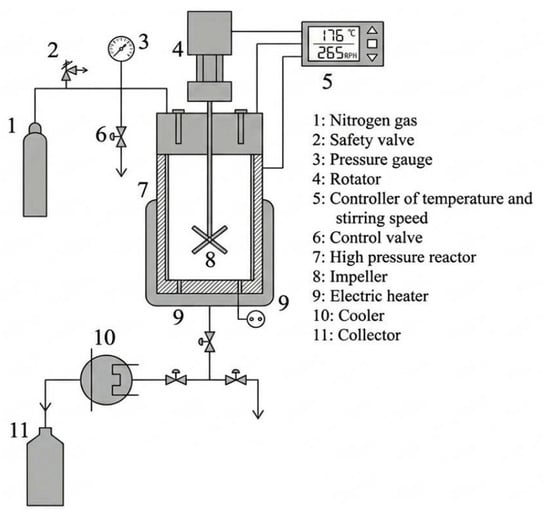
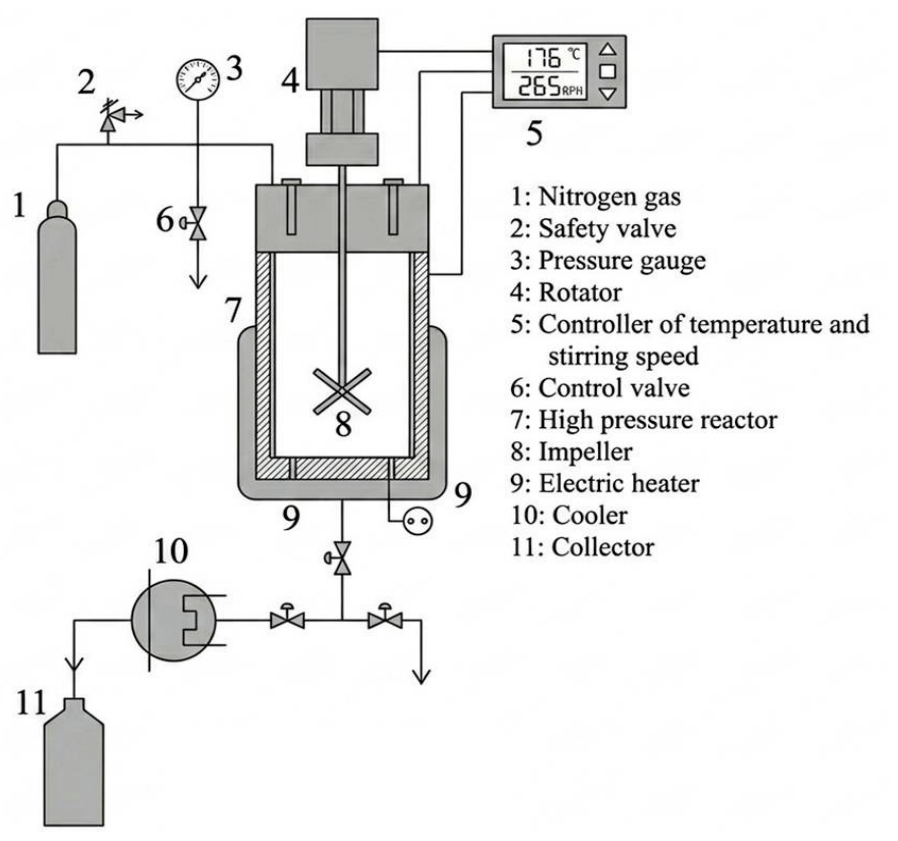
Subcritical water hydrolysis (SWH) of de-oiled hilsa muscle, with and without pretreatment, was carried out using a laboratory-scale SWH unit consisting of a 200 cm3 batch-type reactor made of 276 Hastelloy (Phosentech Co. Ltd., Daejeon, Republic of Korea; Figure 1). The reactor was equipped with temperature control. Finely ground de-oiled hilsa muscle (6 g) was placed into the reactor (component 7) along with 160 mL of distilled water. The reactor was tightly sealed and heated using an electric heater (component 9) to the desired temperature (150–250 °C) and pressure (40–80 bar). Pressure was maintained using nitrogen gas and monitored with a pressure gauge (component 3). The sample was continuously stirred at 150 rpm using a four-blade stirrer (component 8). Once the set temperature and pressure were achieved, the reaction was allowed to proceed for 5 min. The resulting hydrolysate was collected from the reactor through a valve connected to a refrigerated circulating water bath. The hydrolysate was then filtered using filter paper (Advantec No. 5A), lyophilized, and stored at –20 °C for further analysis. For each combination of SWH temperature and pressure, including ultrasound pretreatment, the experiment was conducted in three independent experimental runs. Each resulting hydrolysate was analyzed independently, and the data are expressed as mean ± standard deviation (SD) of three independent experiments. The hydrolysis yields of the hydrolysate were measured using the following Equation (1).
where W1 = Weight of dried sample used for hydrolysis, W2 = Weight of dried powder residue recovered after hydrolysis.
Figure 1.
Schematic diagram of subcritical water hydrolysis apparatus used in this study. Reactor volume: 200 cm3 (200 mL) batch-type Hastelloy reactor; heating rate: 5.0 °C/min; impeller size and speed: 10 cm and 150 rpm.
2.5. Determination of Taurine Content
The taurine content of HMH was determined following the method of To et al. [16] with slight modifications. High-performance liquid chromatography (HPLC; Model 600E system controller, Milford, MA, USA) equipped with a 484 UV–VIS detector and an Eclipse Plus C18 column (5 µm, 4.6 mm × 250 mm, Agilent, Santa Clara, CA, USA) was used. For taurine derivatization 1 mL of hydrolysate sample was mixed with 2 mL of carbonate buffer and 0.5 mL of dimethyl sulfoxide (DMSO), followed by the addition of 0.1 mL of 2,4-dinitrofluorobenzene (DNFB). The mixture was vortexed for 30 s and heated at 40 °C for 15 min. Subsequently, 6.5 mL of phosphate buffer was added, and the resulting solution was thoroughly mixed and filtered through a 0.22 µm syringe filter. Taurine content was determined by using a high-performance liquid chromatography (Agilent 1100, Agilent Technologies, USA) with column C18, 5 µm, 250 mm × 4.6 mm using the UV–Vis detector at 360 nm. The HPLC operation was performed under isocratic conditions using a mobile phase consisting of acetonitrile and phosphate buffer (pH 6.0) at a ratio of 89:11 (v/v), with a flow rate of 1.0 mL/min. The column temperature was maintained at 30 °C. The chromatographic run time was 25 min, and a sample volume of 5 µL was injected for each analysis.
2.6. Measurement of the Color and pH
The color of the liquid HMH obtained under different SWH conditions was measured using a Lovibond RT Series portable reflectance spectrophotometer (Tintometer India Pvt. Ltd., Hyderabad, India) [14]. The instrument was calibrated using black and white tiles. Liquid samples were placed in a 1 cm path-length glass cuvette, and color was expressed in terms of L*, a*, and b* values, representing lightness, redness/greenness, and yellowness/blueness, respectively. The pH of HMH was determined at ambient temperature using a pH meter (Mettler Toledo Five Easy Plus, Zurich, Switzerland). Prior to measurement, the pH meter was calibrated with technical buffer solutions of pH 4.0, 7.0, and 9.0.
2.7. Determination of Total Protein
The total protein content of HMH was determined following the method of Rasli et al. [17] with slight modifications. Briefly, 100 µL of HMH was mixed with 1 mL of Bradford reagent and thoroughly shaken. The absorbance was measured at 595 nm using a spectrophotometer (Synergy HT, BioTek Instruments, Inc., Winooski, VT, USA) against a blank. A standard calibration curve was prepared using bovine serum albumin (BSA) as the reference standard at concentrations ranging from 0 to 10 µg/100 µL.
2.8. Determination of Reducing Sugar Content
Reducing sugar content was determined using the 3,5-dinitrosalicylic acid (DNS) method, following a previously reported procedure with slight modifications [18]. Briefly, 100 µL of HMH was mixed with 1 mL of DNS reagent and heated in boiling water for 10 min. The sample was then cooled to room temperature, and 1 mL of 40% potassium sodium tartrate (Rochelle salt) solution was added. After standing for 10 min, the absorbance was measured at 570 nm using a spectrophotometer. The reducing sugar content was quantified using a glucose (0–1.0 mg/mL) calibration curve and expressed as mg/mL.
2.9. Foaming Properties of HMH
Briefly, 20 mL of HMH samples were whipped at 13,500 rpm for 1 min at room temperature to incorporate air. The aerated samples were immediately transferred into a 50 mL graduated cylinder, and the total volume was recorded both immediately and after 30 min. FC and FS were then calculated using the following Equations (2) and (3).
where Vi = Volume of hydrolysate solution before whipping, Vw = Volume of hydrolysate solution after whipping.
where Vi = Volume of hydrolysate solution before whipping, V30 = Volume of hydrolysate solution after 30 min of whipping.
2.10. Determination of Antioxidant Activities
2.10.1. 2,2-Azino-di(3-ethylbenzthiazoline-6-sulfonate) Free Radical Scavenging Ability
The ABTS+ (2,2′-azino-bis(3-ethylbenzothiazoline-6-sulfonic acid)) radical scavenging activity of HMH was determined using a modified method based on Roy et al. [19]. Briefly, a 7 mM ABTS solution was prepared in distilled water. To generate the ABTS+ stock solution, an equal volume of freshly prepared 2.45 mM potassium persulfate solution was mixed with the ABTS solution and incubated in the dark at room temperature for 16 h. The resulting ABTS+ solution was then diluted with HPLC-grade ethanol to obtain a working solution with an absorbance of approximately 0.70 ± 0.02 at 734 nm. For the assay, 100 µL of HMH was mixed with 3.9 mL of the ABTS+ working solution and incubated in the dark for 30 min. The absorbance of the mixture was subsequently measured at 734 nm using a spectrophotometer.
2.10.2. DPPH Free Radical Scavenging Capacity
The DPPH (2,2-diphenyl-1-picrylhydrazyl) free radical scavenging activity of HMH was determined following Haq et al. [14] with minor modifications. Briefly, 100 µL of HMH was mixed with 3.9 mL of 0.2 mM DPPH solution prepared in ethanol. The mixture was vortexed for 4 s and then incubated in the dark at room temperature for 30 min. The absorbance was measured at 517 nm using a spectrophotometer against a blank.
2.10.3. Determination of Metal Chelating Activity
The metal chelating activity of HMH was determined following Klompong et al. [20] with minor modifications. Briefly, 100 µL of HMH (5 mg/mL) was mixed with 870 µL of distilled water. The mixture was allowed to react at room temperature for 10 min with 10 µL of 2 mM FeCl2 and 20 µL of 5 mM ferrozine. The absorbance was subsequently measured at 562 nm. The control was prepared using the same procedure, except that distilled water was used in place of the HMH sample.
2.11. DNA Protection Assay (DPA)
The DNA protection activity of HMH was assessed using Fenton’s reagent [21]. Briefly, 6.5 µL of HMH sample, 2 µL of λ DNA (Takara, Cat. No. 3010; 400 µg; 300 ng/µL), and 1.5 mL of Fenton’s reagent (20 mM FeCl3, 12.5 mM ascorbic acid, and 7.5 mM H2O2) were mixed. The mixture was incubated at 37 °C for 30 min, after which DNA integrity was analyzed using 1% (w/v) agarose gel electrophoresis. DNA bands were visualized under UV light, and images were captured (Vilber Lourmat, Lamirault, Collégien, France). The positive control contained λ DNA with distilled water instead of HMH, while the negative control contained λ DNA, distilled water, and Fenton’s reagent.
2.12. Determination of Amino Acids by TLC
The amino acid composition of HMH was determined following the method of Suraiya et al. [21]. Briefly, standard amino acids and HMH samples were applied to a TLC cellulose plastic sheet (20 × 20 cm2, Merck, Rahway, NJ, USA). Amino acid standards and hydrolysate samples were applied as small spots using a capillary tube approximately 1.5–2.0 cm above the lower edge of the plate. The mobile phase consisted of 2-propanol and distilled water (70:30, v/v) was used for chromatographic development. The developing chamber was saturated with the mobile phase for approximately 20–30 min before plate development. The plates were then placed in the chamber and developed by ascending chromatography until the solvent front had migrated approximately 10 cm from the point of application, which required 45 min. Amino acid spots were visualized by spraying the plate with 0.25% ninhydrin dissolved in acetone. The TLC plate was then dried and heated in a hot oven at 110 °C for 10 min. Standards including cysteine, glycine, leucine, valine, arginine, methionine, serine, phenylalanine, glutamic acid, histidine, tryptophan, alanine, tyrosine, and threonine were used for comparison with the amino acids present in HMH.
2.13. Statistical Analysis
All values are expressed as means ± standard deviations from three independent experiments. The reported values represent three independent experimental replicates (independent experiments; n = 3) rather than repeated measurements of the same experimental sample. Data were analyzed using one-way analysis of variance (ANOVA) with SPSS 20.0 software (SPSS Inc., Chicago, IL, USA). Differences between means were evaluated using Duncan’s Multiple Range Test (DMRT), with statistical significance set at p < 0.05.
3. Results and Discussion
3.1. Hydrolysis Yield and Taurine Content
The yield of HMH prepared under different SWH conditions is presented in Table 1. Using conventional water extraction (WE) and ultrasound-assisted extraction (UAE), the HMH yields were 14.66% ± 1.46% and 16.52% ± 0.53%, respectively, with no significant difference between the two extraction methods (p > 0.05). In this study, a novel technique—subcritical water hydrolysis combined with ultrasound pretreatment (SWH with UPT)—was introduced. The highest hydrolysis yield, 98.70% ± 0.60%, was obtained from the SWH with UPT sample at 250 °C/80 bar. Hydrolysis yield increased with higher temperature and pressure, likely due to enhanced protein solubility under these conditions. Under subcritical conditions, the water ionization constant decreases due to reduced surface tension and fluid viscosity, which ultimately enhances mass transfer and solubility at elevated temperature and pressure [6]. Additionally, ultrasound can further increase hydrolysis yield through several mechanisms: (a) it promotes the breakdown of cell walls via strong pressure gradients and shear forces generated by cavitation; (b) high-frequency ultrasonic vibrations facilitate the release of proteins bound within cellular structures into the solvent. The hydrolysis yields observed in this study are consistent with previous reports [22,23,24].
Table 1.
Physical properties of hilsa muscle hydrolysates obtained by different treatments in subcritical water hydrolysis. L*, a*, and b* values, representing lightness, redness/greenness, and yellowness/blueness, respectively. UPT: Ultrasound pretreatment.
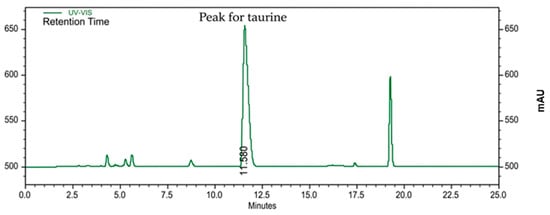
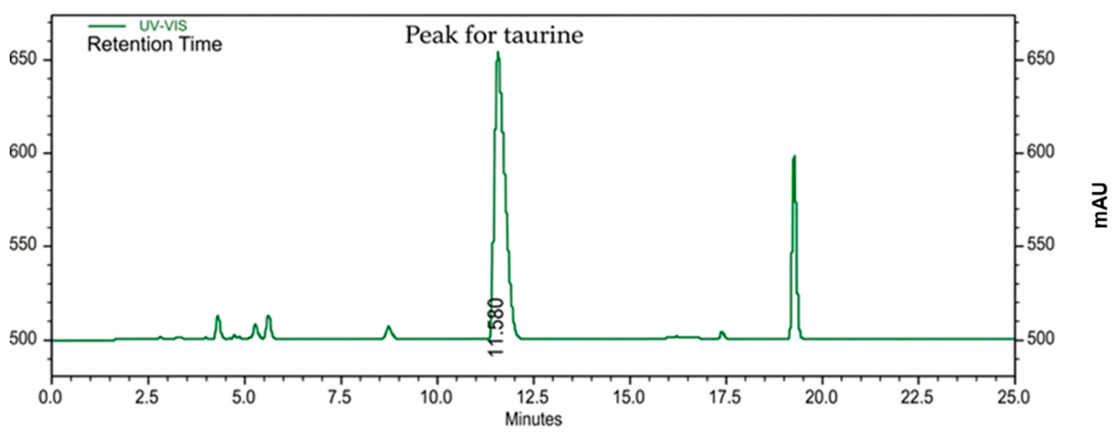
The taurine content of HMH obtained using different treatments is summarized in Table 1 and the retention time of taurine in hilsa muscle hydrolysates obtained at 175 °C/50 bar using SWH with UPT is shown in Figure 2. Temperature and pressure treatment in SWH increased the taurine content compared with water extraction and ultrasound extraction. The highest taurine concentration, 1.09 ± 0.02 mg/mL, was observed in HMH prepared at 175 °C/50 bar using SWH with UPT, compared to 0.60 ± 0.05 mg/mL for WE and 0.74 ± 0.03 mg/mL for UAE. These results suggest that SWH, particularly when combined with ultrasound pretreatment, has strong potential for efficiently extracting the total taurine present in raw hilsa muscle. Taurine is a non-essential amino acid abundant in fish that plays a vital role in human health, including antioxidant activity, cardiovascular protection, osmoregulation, membrane stabilization, and support of skeletal muscle function [25].
Figure 2.
The retention time of taurine in a representative hilsa muscle hydrolysate sample obtained by SWH with UPT at 175 °C/50 bar, the condition at which the taurine content was maximized. Followed by derivatization, taurine was quantified by HPLC–UV at 360 nm using a C18 column under isocratic conditions with acetonitrile/phosphate buffer (89:11, v/v), a flow rate of 1.0 mL/min, and a column temperature of 30 °C.
3.2. pH and Color Values of HMH
Color is an important quality attribute of fish protein hydrolysates because it can influence their visual acceptability and suitability for incorporation into food products. The observed color variation may be partly associated with Maillard-type reactions between reducing sugars and free amino groups of amino acids and peptides during thermal processing, resulting in the formation of colored Maillard reaction products. Such color development is particularly relevant to the intended application of the hydrolysates as functional food ingredients, as excessive browning may adversely affect the appearance and consumer acceptability of products formulated with the hydrolysates. The color parameters of HMH are presented in Table 1. The L* (lightness) value significantly decreased with increasing temperature and pressure for both SWH without UPT and SWH with UPT, indicating that the hydrolysate darkens at higher temperatures and pressures. This darkening is likely due to the increased presence of amino acids and reducing sugars, which are more abundant under these conditions [26]. In contrast, the a* (red/green) and b* (yellow/blue) values increased at higher temperatures. Overall, no significant differences were observed between SWH with UPT and SWH without UPT in terms of color.
The highest pH values of HMH were 9.25 ± 0.03 and 9.15 ± 0.03 at 250 °C/80 bar for SWH without UPT and SWH with UPT, respectively, as shown in Table 1. In comparison, lower pH values were observed for WE (6.46 ± 0.02) and UAE (6.28 ± 0.02). The differences in pH response to UPT at 225 °C/70 bar and 250 °C/80 bar may be attributed to the temperature- and pressure-dependent changes in the hydrolysis and degradation reactions. UPT sample at 225 °C/70 bar, may have enhanced the release of alkaline compounds, such as amino groups and other basic nitrogenous constituents, resulting in a slight increase in pH from 7.56 to 7.88. In contrast, at the higher temperature and pressure of 250 °C/80 bar, intensified thermal degradation and subsequent reactions may have promoted the formation of acidic compounds, including organic acids, which could offset the release of basic constituents and consequently reduce the pH from 9.25 to 9.15. pH increased with rising temperature and pressure, likely due to the generation of hydroxyl ions (OH−) at high temperatures in the liquid state of subcritical water through self-ionization [20,27]. Similar findings were reported for the hydrolysis of shortfin scad (Decapterus macrosoma), which showed a pH of 9.0 under the optimized conditions of 50 °C for 60 min [28]. From a food-application perspective, the relatively high pH of hydrolysates produced under the most severe SWH conditions should also be considered. Although alkaline hydrolysates may possess favorable solubility and functional characteristics, a pH close to 9 may be unsuitable for direct incorporation into some food formulations because it can affect taste, sensory acceptability, ingredient compatibility, and formulation stability. Therefore, pH adjustment or neutralization may be necessary before application, depending on the intended food product. These findings indicate that optimization of SWH conditions should consider not only hydrolysis yield and biofunctional activity but also the final pH and functional suitability of the hydrolysate.
3.3. Total Protein and Reducing Sugar Content
The total protein content of HMH increased with rising hydrolysis temperature and pressure (Table 2). This trend was evident across the range of hydrolysis conditions (150 °C/40 bar to 250 °C/80 bar) for both SWH without UPT and SWH with UPT. The highest total protein content, 505.60 ± 2.39 µg/mL, was observed in HMH prepared at 250 °C/80 bar, whereas the lowest content, 220.06 ± 1.60 µg/mL, was found in HMH prepared at 150 °C/40 bar without pretreatment. For the UPT samples, protein content increased with temperature and pressure up to 225 °C/70 bar (505.54 ± 2.41 µg/mL); however, further increases in SWH conditions led to a slight decrease. This reduction at higher temperatures and pressures may result from protein degradation due to the combined effects of ultrasound pretreatment and subcritical water hydrolysis. At elevated temperatures, the water ionization constant increases, which can initially enhance protein solubility and hydrolysis yield [11,23]? Ultrasound likely contributes by generating cavitation and mechanical effects, which weaken the tissue matrix and facilitate protein extraction at lower temperatures [29]. Nevertheless, protein content decreased beyond 225 °C for SWH with UPT, as summarized in Table 2. Significant differences were also observed between conventional methods, with WE yielding 298.44 ± 1.05 µg/mL and UAE yielding 222.31 ± 2.03 µg/mL. Similar trends have been reported in squid viscera, where protein content ranged from 275.76 ± 5.22 to 660.58 ± 2.94 mg/g in raw and de-oiled squid viscera hydrolysates over temperatures of 180 °C to 280 °C [2].
Table 2.
Biochemical properties of hilsa muscle hydrolysates obtained by different treatments in subcritical water hydrolysis. BSA: Bovine Serum Albumin; UPT: Ultrasound pretreatment.
The reducing sugar (RS) content of HMH exhibited a non-monotonic response to increasing SWH temperature and pressure. For SWH without UPT, RS content increased with increasing hydrolysis severity up to 200 °C/60 bar, reaching a maximum of 2.22 ± 0.02 mg/mL, but subsequently decreased markedly to 0.73 ± 0.03 mg/mL at 225 °C/70 bar and 0.40 ± 0.02 mg/mL at 250 °C/80 bar. In contrast, the ultrasound-pretreated hydrolysate reached its maximum RS content of 2.09 ± 0.02 mg/mL at 225 °C/70 bar, followed by a decrease to 0.46 ± 0.03 mg/mL at 250 °C/80 bar. The initial increase may be associated with enhanced hydrolysis and release of reducing sugars under subcritical-water conditions, whereas the subsequent decline may reflect further degradation or conversion of reducing sugars and their participation in secondary thermal reactions under increasing hydrolysis severity [10,15]. Thus, RS accumulation did not increase progressively with temperature and pressure, but instead showed a treatment-dependent maximum followed by a pronounced decline under more severe conditions. The increase in RS content with temperature and pressure is likely due to the presence of hydronium (H3O+) and hydroxide (OH−) ions under subcritical water conditions, which react with proteins to release more reducing sugars [15]. At 250 °C/80 bar, RS levels dropped to 0.40 ± 0.02 mg/mL for SWH without UPT and 0.46 ± 0.03 mg/mL for SWH with UPT. This decrease may result from protein degradation into free amino acids and the formation of organic acids under severe SWH conditions [10].
3.4. Foaming Capacity and Stability
The foaming capacity (FC) of HMH obtained under different SWH temperatures and pressures showed distinct patterns (Table 2). The highest FC, 201.33% ± 2.09%, was observed in HMH prepared at 175 °C/50 bar using SWH with UPT, whereas FC values for WE and UAE were 123.33% ± 2.08% and 76.66% ± 1.52%, respectively. In contrast, the maximum FC for HMH without pretreatment was 184.28% ± 1.73% at 200 °C/60 bar. FC generally increased with temperature and pressure up to a certain point, beyond which it decreased. For HMH without pretreatment, FC increased up to 200 °C/60 bar, while for ultrasound-pretreated samples, the maximum was reached at 175 °C/50 bar. However, under excessive SWH severity, further protein/peptide degradation may produce smaller peptides that have reduced capacity to form and maintain a cohesive interfacial film, resulting in decreased FC. Thus, the decline in FC at higher temperatures is likely associated with excessive peptide fragmentation rather than simply with protein degradation itself. During foaming, proteins adsorb at the air–water interface, with polar groups oriented toward water and nonpolar groups toward air; unfolding of the protein exposes hydrophobic regions, lowers interfacial tension, and enhances FC [11,30]. The higher FC values in the present study may be attributed to differences in protein origin, processing techniques, and thermal parameters [30]. Foaming is an important functional property that contributes to desirable rheological characteristics and plays a critical role in various food-processing operations [31].
Foam stability (FS) exhibited a pattern similar to that of foaming capacity. FS values for WE and UAE were 43.77 ± 1.71% and 47.18 ± 1.89%, respectively. For HMH produced by SWH without UPT, the maximum FS was 86.23% ± 1.93% at 200 °C/60 bar, followed by 85.70% ± 0.62%, 79.66% ± 2.51%, and 78.75% ± 1.39% at 225 °C/70 bar, 175 °C/50 bar, and 250 °C/80 bar, respectively. In HMH produced by SWH with UPT, the highest FS was 103.33% ± 2.30% at 225 °C/70 bar, followed by 94.40% ± 1.63%, 85.29% ± 1.12%, and 72.97% ± 1.70% at 200 °C/60 bar, 175 °C/50 bar, and 250 °C/80 bar, respectively. FS increased with temperature and pressure up to a certain point for both SWH without UPT and SWH with UPT. Beyond 200 °C/60 bar (without UPT) and 225 °C/70 bar (with UPT), FS values declined sharply. Although FS was higher in SWH-treated samples than in WE, differences between SWH without UPT and SWH with UPT were not substantial. In conclusion, the foaming properties of HMH are influenced by the size and structure of peptides generated under SWH conditions, with ultrasound pretreatment further modifying these effects. Foaming characteristics reflect foam’s capacity for stability, with foam stability (FS) depending on protein concentration, hydration, and molecular interactions. Foaming capacity (FC) is largely influenced by protein solubility, hydrophobicity, and flexibility [32]. While foam formation and bubble dynamics are governed by the penetration, movement, and restructuring of molecules at the air–water interface, effective foam formation also relies on the adsorption of denatured protein layers at the colloidal interface, which trap air within the liquid [33]. These are important functional properties of fish protein hydrolysates because they determine the ability of proteins and peptides to form and maintain air–water interfaces. High FC reflects the ability of hydrolysate components to rapidly adsorb at the air–water interface and facilitate foam formation, whereas high FS indicates their ability to maintain a stable interfacial film and retard foam collapse. Consequently, hydrolysates with high FC and FS may be useful in food formulations where aerated structures contribute to product volume, appearance, texture, and mouthfeel [34]. In the present study, the higher FC and FS observed for SWH-derived hydrolysates compared with WE and UAE indicate their potential as functional ingredients in applications requiring foam formation and stabilization.
3.5. Antioxidant Activities
3.5.1. ABTS+ Radical Scavenging Ability
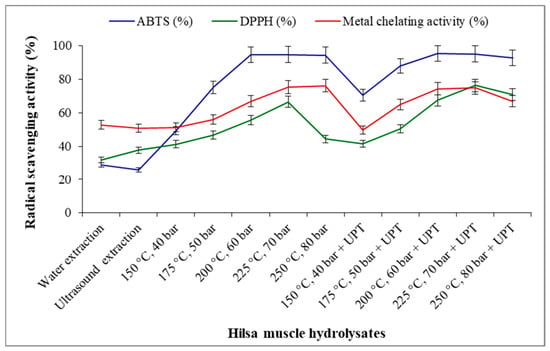
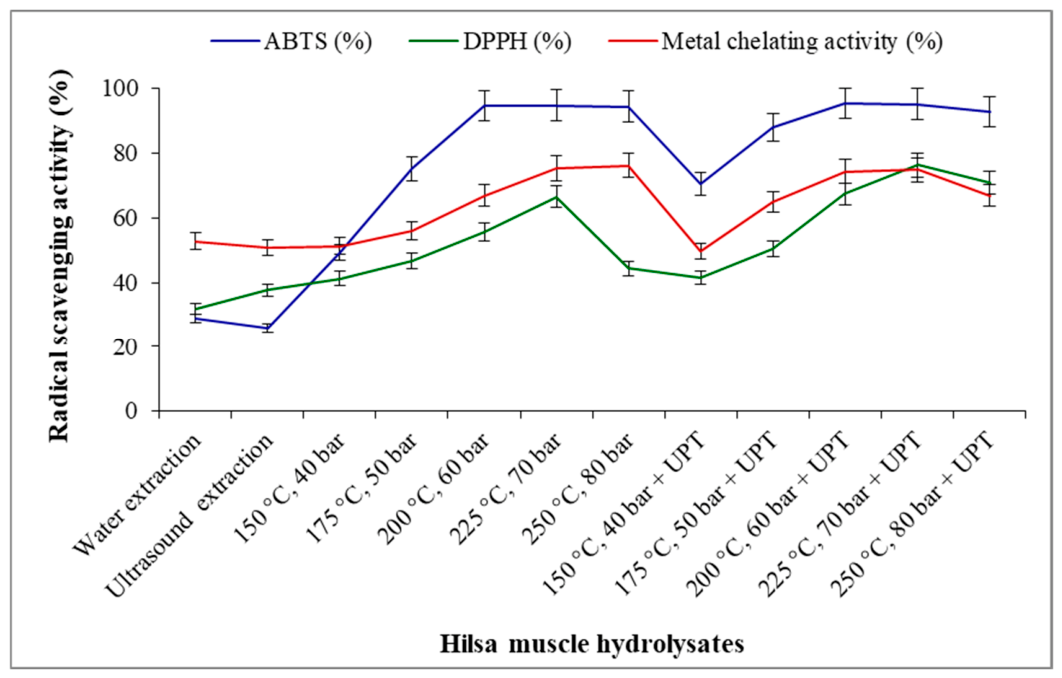
ABTS radical scavenging activity of HMH increased with rising temperature and pressure for both SWH without UPT and SWH with UPT, as shown in Figure 3. The highest ABTS+ activity was recorded at 95.84% ± 0.06% for SWH without UPT and 96.88% ± 0.26% for SWH with UPT, both at 225 °C/70 bar. This indicates that ABTS+ activity primarily depends on the number and sequence of amino acids in the hydrolysate [35], as higher temperatures promote the formation of peptides and amino acids that enhance radical scavenging activity. Interestingly, ABTS+ activity decreased at the highest temperature and pressure used in this study for both SWH without UPT and SWH with UPT samples, likely due to the degradation of some bioactive peptides and amino acids under severe SWH conditions. Similar trends have been reported for oyster hydrolysates, where ABTS activity peaked at 225 °C/100 bar and declined with further increases in temperature and pressure [13]. A significant difference was also observed between conventional methods and SWH treatments, with WE showing 28.88% ± 0.70% and UAE 25.79% ± 0.75% ABTS+ activity. Notably, the HMH prepared in this study demonstrated stronger ABTS+ activity compared to Scomber japonicus meat hydrolysate prepared by SWH, which exhibited 47.44% activity at 140 °C for 5 min.
Figure 3.
Antioxidant activities of different treated hilsa muscle hydrolysates ABTS+, DPPH and metal chelating activity. UPT: Ultrasound pretreatment.
3.5.2. DPPH Radical Scavenging Ability
The DPPH radical scavenging activity of HMH at different temperatures and pressures is presented in Figure 3. For HMH treated with SWH and ultrasound pretreatment (UPT), DPPH activity increased with rising temperature and pressure, reaching a maximum of 76.36% ± 2.84% at 225 °C/70 bar. In contrast, the highest activity for HMH treated with SWH without UPT was 66.53% ± 2.40% at the same conditions. DPPH radical scavenging activity was significantly lower in conventional extracts, with WE and UAE showing 31.77% ± 2.48% and 37.69% ± 0.53%, respectively. At the highest SWH conditions (250 °C/80 bar), DPPH activity decreased sharply for both pretreated and non-pretreated samples, likely due to peptide and amino acid degradation affecting proton donor availability, which reduces DPPH scavenging [6]. These results indicate that SWH with UPT facilitates the extraction of more electron-donating compounds, enhancing radical scavenging and contributing to the stability of functional food materials. Similar trends have been reported for oyster muscle hydrolysates, where DPPH activity declined at elevated SWH temperature and pressure (250 °C/120 bar) [13]. Overall, the observed changes in DPPH activity in the present study are consistent with previous reports.
3.5.3. Metal Chelating Activity
The metal chelating assay was used to evaluate Fe2+ chelating capacity, as shown in Figure 3. Antioxidants that chelate metals prevent ferrozine from forming a complex with Fe2+, thereby inhibiting color development. The metal chelating activity of HMH varied depending on the hydrolysis conditions. The highest activity was observed at 76.26% ± 0.98% for HMH produced at 250 °C/80 bar without UPT and 74.96% ± 0.26% for HMH produced at 225 °C/70 bar with UPT. In contrast, WE and UAE showed considerably lower activity, at 52.77% ± 0.31% and 50.83% ± 0.55%, respectively. Metal chelating activity generally increased with rising SWH temperature and pressure but declined at the highest studied conditions, likely due to excessive peptide cleavage at elevated temperatures, which affected the availability of amino and carboxyl groups for Fe2+ binding. Similarly, oyster hydrolysates produced at 250 °C/120 bar also showed reduced metal chelating activity [13]. Overall, HMH with high metal chelating activity represents a promising source of functional ingredients for the food industry. Radical-scavenging activities were evaluated based on the reduction in absorbance measured by the respective spectrophotometric assays and expressed as percentage inhibition. Although UV–Vis spectral plots were not included, the quantitative absorbance-based results provide the basis for comparing the antioxidant activities of the hydrolysates.
3.6. DNA Protection Ability
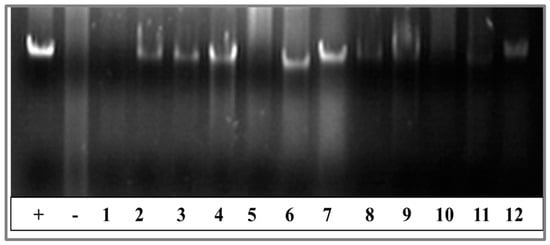
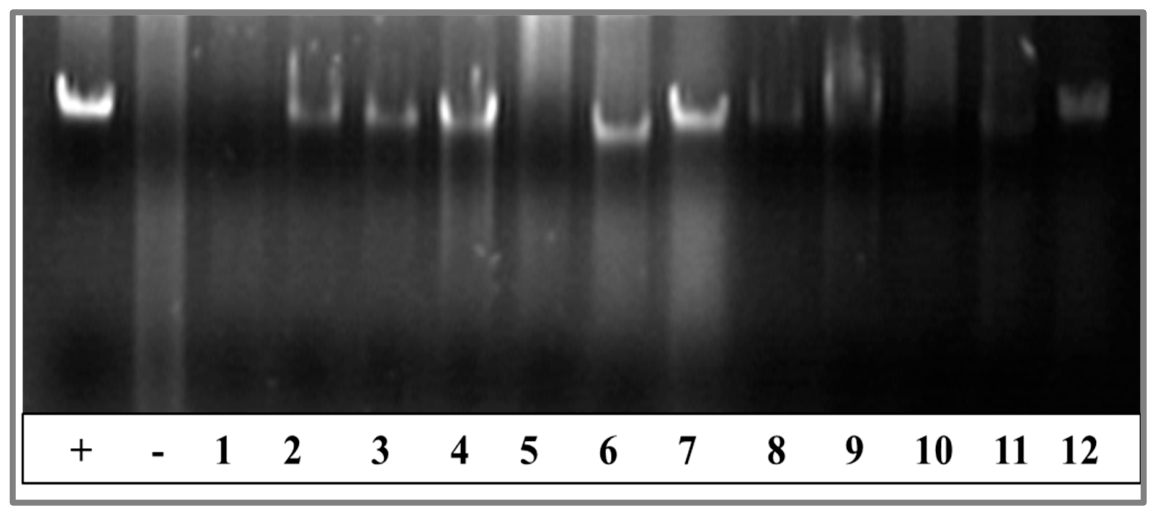
The λ DNA protection assay of HMH is presented in Figure 4. In this assay, hydroxyl radicals generated by Fenton’s reagent degrade λ DNA, whereas bioactive compounds in the hydrolysates protect it from degradation. The presence of illuminated bands indicates intact λ DNA, confirming protective effects of the hydrolysates. HMH effectively safeguarded λ DNA, while the negative control without hydrolysate showed complete DNA degradation. The extent of protection varied with hydrolysis conditions. As shown in Figure 4, Lane “+” (positive control) exhibited strong bands, indicating no DNA damage, whereas Lane “−” (negative control) showed no bands due to complete degradation. Among the hydrolysate-treated samples, Lanes “6” and “7” displayed the highest band intensity, indicating maximal DNA protection. These correspond to HMH prepared at 225 °C/70 bar and 250 °C/80 bar, suggesting that these conditions produced highly bioactive peptides capable of scavenging hydroxyl radicals and preventing DNA damage. Fish peptides are particularly rich in hydrophobic amino acids, which are effective in scavenging free radicals [36]. Previous studies have also reported that fish protein hydrolysates prepared with alcalase contain bioactive peptides with strong antioxidant properties, capable of protecting DNA from oxidative damage [37].
Figure 4.
DNA protection ability of hilsa muscle hydrolysates. Lane “+”: λ DNA + DW (+ control); Lane “-”: λ DNA + DW + Fenton’s reagent (− control); Lane-1: Water extract (WE); Lane-2: Ultrasound assisted extract (UAE); Lane-3: SWH at 150 °C, 40 bar; Lane-4: SWH at 175 °C, 50 bar; Lane-5: SWH at 200 °C, 60 bar; Lane-6: SWH at 225 °C, 70 bar; Lane-7: SWH at 250 °C, 80 bar; Lane-8: SWH at 150 °C, 40 bar with ultrasound pretreatment; Lane-9: SWH at 175 °C, 50 bar with ultrasound pretreatment; Lane-10: SWH at 200 °C, 60 bar with ultrasound pretreatment; Lane-11: SWH at 225 °C, 70 bar with ultrasound pretreatment; Lane-12: SWH at 250 °C, 80 bar with ultrasound pretreatment.
3.7. Amino Acid Composition
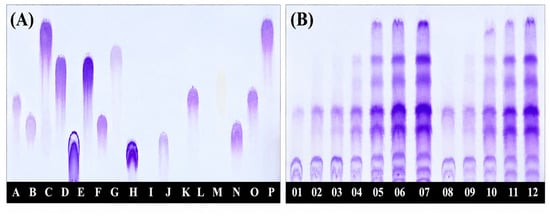
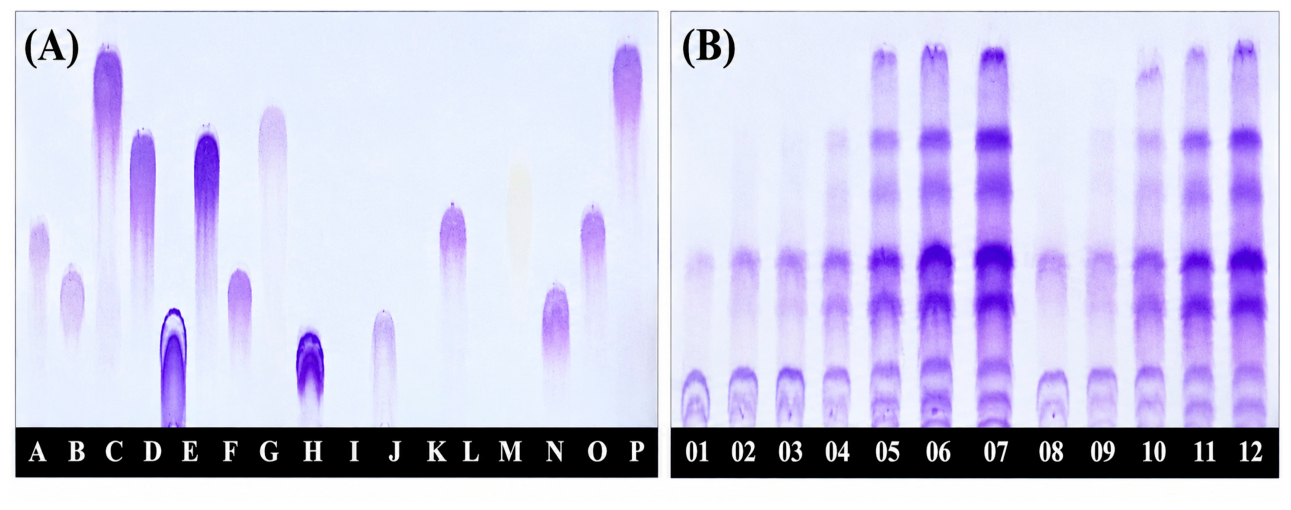
The TLC profiles of amino acid standards and HMH produced under different SWH conditions are shown in Figure 5. Amino acids in HMH were identified by comparing their Rf values with those of the standards. The highest number of amino acids was observed in Lane 07 (SWH at 250 °C/80 bar), with eight amino acids detected. The number of detectable amino acids decreased with lower SWH temperatures and pressures. Lanes 08–12 correspond to HMH samples pretreated with ultrasound and hydrolyzed under varying SWH conditions. In these pretreated samples, the number of amino acids increased with increasing temperature and pressure; however, the intensity of the bands decreased, likely due to partial degradation of amino acids during the combined sonication and SWH process. This suggests that while ultrasound pretreatment enhances hydrolysis and extraction, it may also contribute to the breakdown of certain amino acids under high-temperature and high-pressure conditions. Suraiya et al. [38] analyzed amino acids in various fermented products of Saccharina japonica using TLC and observed variations in the detected bands depending on the product. Similarly, HMH produced at 250 °C/80 bar without pretreatment contained a range of essential and non-essential amino acids, including arginine, glutamic acid, valine, serine, glycine, methionine, and leucine. The amino acid profile observed in the present study by TLC showed the presence of several amino acids, which is broadly consistent with amino acids reported in previous studies of fish protein hydrolysates. However, direct comparison with the HPLC-quantified amino acid concentrations reported by Pal et al. [39] is not appropriate because the present study used TLC for qualitative/semi-quantitative identification, whereas the previous study employed HPLC for quantitative determination. Therefore, the comparison is intended only to indicate similarities in the occurrence of amino acids, and differences in abundance should not be interpreted quantitatively.
Figure 5.
TLC plates of amino acids (cellulose plate). (A) TLC bands of standard amino acids; Lane-A: Cysteine; Lane-B: Glycine; Lane-C: Leucine; Lane-D: Valine; Lane-E: Arginine; Lane-F: Methionine; Lane-G: Serine; Lane-H: Phenylalanine; Lane-I: Glutamic acid; Lane-J: Histidine; Lane-K: Tryptophan; Lane-L: Alanine; Lane-M: Tyrosine; Lane-N: Glutamic acid; Lane-O: Threonine; Lane P: Isoleucine. (B) TLC bands of amino acids of hilsa muscle hydrolysate at different treatments in subcritical water hydrolysis; Lane-1: Water extract (WE); Lane-2: ultrasound assisted extract (UAE); Lane-3: SWH at 150 °C, 40 bar; Lane-4: SWH at 175 °C, 50 bar; Lane-5: SWH at 200 °C, 60 bar; Lane-6: SWH at 225 °C, 70 bar; Lane-7: SWH at 250 °C, 80 bar; Lane-8: SWH at 150 °C, 40 bar with ultrasound pretreatment; Lane-9: SWH at 175 °C, 50 bar with ultrasound pretreatment; Lane-10: SWH at 200 °C, 60 bar with ultrasound pretreatment; Lane-11: SWH at 225 °C, 70 bar with ultrasound pretreatment; Lane-12: SWH at 250 °C, 80 bar with ultrasound pretreatment.
Essential amino acids cannot be synthesized by the human body and must be obtained through dietary sources [31]. Free amino acids such as leucine, methionine, threonine, and alanine exhibit multiple biological functions, including supporting body protein balance, enhancing memory and hormone secretion, and serving as an energy source for skeletal muscles [40]. Therefore, defatted HMH produced at 250 °C/80 bar without pretreatment contains a high number of nutritionally important amino acids and could be considered a valuable dietary supplement.
4. Conclusions
Overall, the findings demonstrate that SWH—with or without ultrasound pretreatment—effectively modified the physicochemical, functional, and bioactive properties of hilsa muscle hydrolysates. However, no single SWH condition was universally optimal across all measured responses, as the maximum protein content, foaming properties, antioxidant activities, taurine content and amino-acid diversity occurred under different temperature–pressure combinations. Therefore, the selection of SWH conditions should be guided by the intended end use and desired characteristics of the hydrolysate. Moderate-to-high processing conditions may be suitable for enhancing selected functional or bioactive properties, whereas less severe conditions may be preferable when preservation of specific compounds or functional characteristics is prioritized. Further process optimization using a multi-response approach would be required to identify application-specific operating conditions for scale-up and industrial production. However, extreme SWH conditions led to a decline in activity, likely due to the degradation of bioactive peptides and amino acids. Ultrasound pretreatment further improved the hydrolysis process, increasing the extraction efficiency and overall bioactivity of HMH. The hydrolysates were found to be rich in taurine, total protein, reducing sugars, antioxidant compounds, and a diverse profile of essential and non-essential amino acids. In addition, the FC and FS of HMH were favorable, indicating their potential functionality in food formulations. Overall, these findings demonstrate that HMH produced via ultrasound-assisted SWH possesses promising physicochemical and biofunctional characteristics, making it suitable for applications in the food, pharmaceutical, and cosmetic industries.
Author Contributions
Conceptualization, M.H., S.S., R.A. and J.-S.P.; methodology, M.H., S.S., R.A. and H.-J.L.; software, T.C.H., R.P. and H.-J.L.; validation, J.-S.P., B.-S.C. and R.A.; formal analysis, M.H., T.C.H., M.S.A., M.S.C. and V.C.R.; investigation, M.H., S.S. and R.A.; resources, J.-S.P., B.-S.C. and R.A.; data curation, M.T.A., M.S.A. and V.C.R.; writing—original draft preparation, M.H., V.C.R.; M.S.A. and M.T.A., writing—review and editing, B.-S.C., R.P., M.S.C. and T.C.H., visualization, M.S.A., R.P., M.T.A. and V.C.R.; supervision, B.-S.C. and H.-J.L.; project administration, M.H., H.-J.L. and B.-S.C.; funding acquisition, B.-S.C. All authors have read and agreed to the published version of the manuscript.
Funding
The authors would like to express their gratitude to the National Research Foundation of Korea (NRF) for funding this research work, supported by the Korean government’s Ministry of Science and Information & Communication Technology (MSIT), grant No. 2023R1A2C1005569.
Institutional Review Board Statement
Not applicable. The fish samples used in this study were purchased in a frozen condition. No fish were captured, handled, euthanized, or subjected to any experimental procedures while alive.
Informed Consent Statement
Not applicable.
Data Availability Statement
All needed data is presented in this manuscript.
Conflicts of Interest
The authors declare no conflicts of interest.
References
- Hossain, M.A.; Almatar, S.M.; Al-Hazza, A.A. Proximate, fatty acid and mineral composition of hilsa, Tenualosa ilisha (Hamilton 1822) from the Bay of Bengal and Arabian Gulf. Indian J. Fish. 2014, 61, 58–66. [Google Scholar]
- Anal, A.K.; Noomhorm, A.; Vongsawasdi, P. Protein Hydrolysates and Bioactive Peptides from Seafood and Crustacean Waste: Their Extraction, Bioactive Properties and Industrial Perspectives. In Marine Proteins and Peptides; Kim, S.-K., Ed.; Wiley-Blackwell: Chichester, UK, 2013. [Google Scholar]
- Senadheera, T.R.; Dave, D.; Shahidi, F. Antioxidant potential and physicochemical properties of protein hydrolysates from body parts of North Atlantic sea cucumber (Cucumaria frondosa). Food Prod. Process. Nutr. 2021, 3, 1–22. [Google Scholar] [CrossRef] [Scilit]
- Pan, Y.; Deng, Z.; Shahidi, F. Natural bioactive substances for the control of food-borne viruses and contaminants in food. Food Prod. Process. Nutr. 2020, 2, 1–19. [Google Scholar] [CrossRef] [Scilit]
- Mosquera, M.; Giménez, B.; Ramos, S.; López-Caballero, M.E.; Gómez-Guillén, M.D.C.; Montero, P. Antioxidant, ACE-inhibitory, and antimicrobial activities of peptide fractions obtained from dried giant squid tunics. J. Aquat. Food Prod. Technol. 2016, 25, 444–455. [Google Scholar] [CrossRef] [Scilit]
- Halim, N.R.A.; Yusof, H.M.; Sarbon, N.M. Functional and bioactive properties of fish protein hydrolysates and peptides: A comprehensive review. Trends Food Sci. Technol. 2016, 51, 24–33. [Google Scholar] [CrossRef] [Scilit]
- Álvarez-Viñas, M.; Rodríguez-Seoane, P.; Flórez-Fernández, N.; Torres, M.D.; Díaz-Reinoso, B.; Moure, A.; Domínguez, H. Subcritical Water for the Extraction and Hydrolysis of Protein and Other Fractions in Biorefineries from Agro-Food Wastes and Algae: A Review. Food Bioprocess Technol. 2021, 14, 373–387. [Google Scholar] [CrossRef] [Scilit]
- Nunes, L.F.; Ugalde, G.A.; Anschau, K.F.; Müller, E.I.; Tres, M.V.; Zabot, G.L.; Kuhn, R.C. Clean Production of Sugars from Brewer’s Spent Grains Using Subcritical Water Hydrolysis and Steam Explosion. Sustain. Chem. 2024, 5, 308–323. [Google Scholar] [CrossRef] [Scilit]
- Rodiles-López, J.O.; Jaramillo-Flores, M.E.; Gutiérrez-López, G.F.; Hernández-Arana, A.; Fosado-Quiroz, R.E.; Barbosa-Cánovas, G.V.; Hernández-Sánchez, H. Effect of high hydrostatic pressure on bovine α-lactalbumin functional properties. J. Food Eng. 2008, 87, 363–370. [Google Scholar] [CrossRef] [Scilit]
- Marcet, I.; Álvarez, C.; Paredes, B.; Díaz, M. The use of sub-critical water hydrolysis for the recovery of peptides and free amino acids from food processing wastes. Review of sources and main parameters. Waste Manag. 2016, 49, 364–371. [Google Scholar] [CrossRef] [Scilit]
- Pires, C.; Leitão, M.; Sapatinha, M.; Gonçalves, A.; Oliveira, H.; Nunes, M.L.; Marques, A. Protein hydrolysates from salmon heads and cape hake by-products: Comparing enzymatic method with subcritical water extraction on bioactivity properties. Foods 2024, 13, 2418. [Google Scholar] [CrossRef] [Scilit]
- Barea, P.; Melgosa, R.; Benito-Román, Ó.; Illera, A.E.; Beltrán, S.; Sanz, M.T. Green Fractionation and Hydrolysis of Fish Meal to Improve Their Techno-Functional Properties. Food Chem. 2024, 452, 139550. [Google Scholar] [CrossRef] [Scilit]
- Melgosa, R.; Trigueros, E.; Sanz, M.T.; Cardeira, M.; Rodrigues, L.; Fernández, N.; Matias, A.A.; Bronze, M.R.; Marques, M.; Paiva, A.; et al. Supercritical CO2 and subcritical water technologies for the production of bioactive extracts from sardine (Sardina pilchardus) waste. J. Supercrit. Fluids 2020, 164, 104943. [Google Scholar] [CrossRef] [Scilit]
- Haq, M.; Ahmed, R.; Cho, Y.J.; Chun, B.S. Quality properties and bio-potentiality of edible oils from Atlantic salmon by-products extracted by supercritial carbon dioxide and conventional methods. Waste Biomass Valorization 2017, 8, 1953–1967. [Google Scholar] [CrossRef] [Scilit]
- Bermúdez-Aguirre, D.; Mobbs, T.; Barbosa-Cánovas, G.V. Ultrasound applications in food processing. In Ultrasound Technologies for Food and Bioprocessing; Springer: New York, NY, USA, 2010; pp. 65–105. [Google Scholar]
- To, V.A.; Liou, C.H.; Yang, S.D. Can dietary with a taurine supplement improve lipid utilization, growth performance, haemolymph parameters and immune responses of white shrimp (Litopenaeus vannamei)? Aquacult. Res. 2021, 52, 6612–6625. [Google Scholar] [CrossRef] [Scilit]
- Rasli, H.I.; Sarbon, N.M. Preparation and physicochemical characterization of fish skin gelatine hydrolysate from shortfin scad (Decapterus macrosoma). Int. Food Res. J. 2019, 26, 287–294. [Google Scholar]
- Miller, G.L. Use of dinitrosalicylic acid reagent for determination of reducing sugar. Anal. Chem. 1959, 31, 426–428. [Google Scholar] [CrossRef] [Scilit]
- Roy, V.C.; Getachew, A.T.; Cho, Y.J.; Park, J.S.; Chun, B.S. Recovery and bio-potentialities of astaxanthin-rich oil from shrimp (Penaeus monodon) waste and mackerel (Scomberomous niphonius) skin using concurrent supercritical CO2 extraction. J. Supercrit. Fluid. 2020, 159, 104773. [Google Scholar] [CrossRef] [Scilit]
- Klompong, V.; Benjakul, S.; Kantachote, D.; Shahidi, F. Antioxidant activity and functional properties of protein hydrolysate of yellow stripe trevally (Selaroides leptolepis) as influenced by the degree of hydrolysis and enzyme type. Food Chem. 2007, 102, 120–131. [Google Scholar] [CrossRef] [Scilit]
- Suraiya, S.; Park, H.D.; Jang, W.J.; Choi, Y.B.; Rafiquzzaman, S.M.; Sarker, M.K.; Kong, I.S. Utilization of Saccharina japonica as a solid-fermented substrate for the production of bioactive ethanolic extract. Waste Biomass Valorization 2020, 11, 1917–1928. [Google Scholar] [CrossRef] [Scilit]
- Melgosa, R.; Marques, M.; Paiva, A.; Bernardo, A.; Fernández, N.; Sá-Nogueira, I.; Simões, P. Subcritical Water Extraction and Hydrolysis of Cod (Gadus morhua) Frames to Produce Bioactive Protein Extracts. Foods 2021, 10, 1222. [Google Scholar] [CrossRef] [Scilit]
- Rodrigues, L.A.; Matias, A.A.; Paiva, A. Recovery of antioxidant protein hydrolysates from shellfish waste streams using subcritical water extraction. Food Bioprod. Process. 2021, 130, 154–163. [Google Scholar] [CrossRef] [Scilit]
- Fan, X.; Hu, S.; Wang, K.; Yang, R.; Zhang, X. Coupling of ultrasound and subcritical water for peptides production from Spirulina platensis. Food Bioprod. Process. 2020, 121, 105–112. [Google Scholar] [CrossRef] [Scilit]
- Muangthai, P.; Klongnganchui, K. Taurine in fresh sea fishes and processed sea fishes. Asian J. Nat. Appl. Sci. 2015, 4, 11–19. [Google Scholar]
- Watchararuji, K.; Goto, M.; Sasaki, M.; Shotipruk, A. Value-added subcritical water hydrolysate from rice bran and soybean meal. Biores. Technol. 2008, 99, 6207–6213. [Google Scholar] [CrossRef] [Scilit]
- Jimenez Moreno, J.; de Freitas Marinho, L.; Sanches Contieri, L.; Barroso, T.L.C.T.; Rostagno, M.A.; Forster Carneiro, T. Obtaining Extracts and Hydrolysates from Cambuci Peel Through Subcritical Water: An In-Line Detection Approach. Food Bioprocess Technol. 2024, 17, 4960–4979. [Google Scholar] [CrossRef] [Scilit]
- Ishak, N.H.; Sarbon, N.M. Optimization of the Enzymatic Hydrolysis Conditions of Waste from Shortfin Scad (Decapterus macrosoma) for the Production of Angiotensin I-Converting Enzyme (ACE) Inhibitory Peptide Using Response Surface Methodology. Int. Food Res. J. 2017, 24, 1735–1743. [Google Scholar]
- Wu, W.; Jia, J.; Wen, C.; Yu, C.; Zhao, Q.; Hu, J. Optimization of ultrasound assisted extraction of abalone viscera protein and its effect on the iron-chelating activity. Ultrason. Sonochem. 2021, 77, 105670. [Google Scholar] [CrossRef] [Scilit]
- Phetchthumrongchai, T.; Tachapuripunya, V.; Chintong, S.; Roytrakul, S.; E-kobon, T.; Klaypradit, W. Properties of protein hydrolysates and bioinformatics prediction of peptides derived from thermal and enzymatic process of skipjack tuna (Katsuwonus pelamis) roe. Fishes 2022, 7, 255. [Google Scholar] [CrossRef] [Scilit]
- Mahdabi, M.; Hosseini Shekarabi, S.P. A Comparative Study on Some Functional and Antioxidant Properties of Kilka Meat, Fishmeal, and Stickwater Protein Hydrolysates. J. Aquat. Food Prod. Technol. 2018, 27, 844–858. [Google Scholar] [CrossRef] [Scilit]
- Chang, K.; Jiang, W.; Liu, J. Effect of subcritical water treatment on the structure and foaming properties of egg white protein. Food Hydrocol. 2022, 124, 107241. [Google Scholar] [CrossRef] [Scilit]
- Esua, O.J.; Sun, D.W.; Cheng, J.H.; Wang, H.; Lv, M. Functional and bioactive properties of Larimichthys polyactis protein hydrolysates as influenced by plasma functionalized water-ultrasound hybrid treatments and enzyme types. Ultrason. Sonochem. 2022, 86, 106023. [Google Scholar] [CrossRef] [Scilit]
- Haq, M.; Chun, M.S.; Ali, M.S.; Han, J.M.; Kim, J.W.; Park, S.W.; Choi, M.-S.; Lee, S.-M.; Park, J.-S.; Lee, H.-J.; et al. Molecular size reduction and functional properties of Atlantic salmon waste protein treated by subcritical water. Int. J. Biol. Macromol. 2025, 309, 142888. [Google Scholar] [CrossRef] [Scilit]
- Wiriyaphan, C.; Chitsomboon, B.; Yongsawadigul, J. Antioxidant activity of protein hydrolysates derived from threadfin bream surimi byproducts. Food Chem. 2012, 132, 104–111. [Google Scholar] [CrossRef] [Scilit]
- Abuine, R.; Rathnayake, A.U.; Byun, H.G. Biological activity of peptides purified from fish skin hydrolysates. Fish. Aquat. Sci. 2019, 22, 1–14. [Google Scholar] [CrossRef] [Scilit]
- Ma, W.; Li, N.; Lin, L.; Wen, J.; Zhao, C.; Wang, F. Research progress in lipid metabolic regulation of bioactive peptides. Food Prod. Process. Nutr. 2023, 5, 1–12. [Google Scholar] [CrossRef] [Scilit]
- Suraiya, S.; Siddique, M.P.; Lee, J.M.; Kim, E.Y.; Kim, J.M.; Kong, I.S. Enhancement and characterization of natural pigments produced by Monascus spp. using Saccharina japonica as fermentation substrate. J. Appl. Phycol. 2018, 30, 729–742. [Google Scholar] [CrossRef] [Scilit]
- Pal, M.; Mukhopadhyay, T.; Ghosh, S. Proximate, fatty acid, and amino acid compositions of fish muscle and egg tissue of hilsa (Tenualosa ilisha). J. Aquat. Food Prod. Technol. 2011, 20, 160–171. [Google Scholar] [CrossRef] [Scilit]
- Berlowska, J.; Dudkiewicz-Kołodziejska, M.; Pawlikowska, E.; Pielech-Przybylska, K.; Balcerek, M.; Czysowska, A.; Kregiel, D. Utilization of post-fermentation yeasts for yeast extract production by autolysis: The effect of yeast strain and saponin from Quillaja saponaria. J. Inst. Brew. 2017, 123, 396–401. [Google Scholar] [CrossRef] [Scilit]

Disclaimer/Publisher’s Note: The statements, opinions and data contained in all publications are solely those of the individual author(s) and contributor(s) and not of MDPI and/or the editor(s). MDPI and/or the editor(s) disclaim responsibility for any injury to people or property resulting from any ideas, methods, instructions or products referred to in the content. |
© 2026 by the authors. Licensee MDPI, Basel, Switzerland. This article is an open access article distributed under the terms and conditions of the Creative Commons Attribution (CC BY) license.