


Abstract
Filamentous cyanobacteria in the genus Nostoc show color diversity in their natural habitats, ranging from bright green to yellow–green to brown. In contrast, laboratory cultures are typically uniform in color, which is attributed to differences in light spectrum and intensity. Nostoc contains several bioactive pigments, including phycocyanin, phycoerythrin, allophycocyanin, carotenoids, and scytonemin, which are involved in light harvesting, photoprotection, and UV screening. Variations in light spectrum and intensity regulate the abundance and organization of these pigments, altering colony coloration and affecting photosynthetic performance, stress tolerance, and growth. These changes impact biomass and pigment productivity. In this review, we synthesize recent findings on how light regulates pigment biosynthesis in Nostoc and examine how wavelength, irradiance, and photoperiod influence pigment composition, biomass accumulation, and pigment productivity, considering both underlying photoregulatory mechanisms and cultivation design. This perspective connects photophysiological insights with practical strategies, including staged lighting and LED-based systems, to improve pigment yield while maintaining biomass production. These insights support the future application of Nostoc pigments in food, cosmetic, and pharmaceutical sectors.
1. Introduction
Cyanobacteria are widely known as highly adaptable, oxygenic photosynthetic prokaryotes that contribute to carbon sequestration and nutrient cycling via photosynthesis and, in many taxa, nitrogen fixation [1,2]. They thrive in diverse environments, ranging from aquatic systems to extreme habitats such as Antarctic rocks and desert crusts [3,4]. In this group, Nostoc species have a long history as traditional food sources and are now receiving increased attention for their biotechnological potential [5,6,7]. A characteristic of Nostoc is its ability to adjust to changing environments, which is often shown by colony color changes resulting from shifts in pigment composition [8,9]. In natural habitats, fluctuations in irradiance and spectrum, ultraviolet (UV) exposure, and desiccation drive pigment variation and color diversity, but this diversity is reduced under constant, moderate laboratory lighting conditions [3,8,10,11].
The primary pigment systems for photosynthesis and photoprotection in Nostoc include chlorophyll a (Chl a), carotenoids, and phycobiliproteins (PBPs) [12,13,14]. PBPs include phycocyanin (PC), phycoerythrin (PE), and allophycocyanin (APC). These water-soluble pigments are organized into phycobilisomes (PBSs), which function as light-harvesting antennae and enable chromatic acclimation by improving the absorption of specific wavelengths [1,12,14,15]. Carotenoids contribute to energy dissipation and antioxidant defense and are widely considered industrially relevant pigments, including for use in cosmetic applications [13,15,16]. In addition to these pigment systems, cyanobacteria produce UV- and stress-protective compounds, such as scytonemin (a sheath-associated UV-screening pigment) and mycosporine-like amino acids (MAAs), which mitigate UV-driven oxidative stress and cellular damage [9,11,17,18]. They also use carotenoid-associated proteins that protect cells under strong light, connecting pigment systems with photoprotection [19].
As these pigments and protective systems support light capture and stress protection, their production changes in response to environmental conditions. Light spectrum and intensity control chromatic acclimation, which regulates physiology and metabolism, impacting (i) pigment composition per biomass, (ii) photosynthetic performance and growth, and (iii) volumetric pigment productivity [1,14,20,21,22,23]. This is relevant for practical applications because light spectrum and intensity are controllable, and light-emitting diode (LED) systems enable reproducible, wavelength-specific cultivation strategies [1]. For example, studies on Nostoc cultivation have demonstrated that light quality and intensity shift pigment profiles and affect biomass formation and extracellular product production [5,24]. Stress studies highlight that UV exposure should be applied carefully because it can increase reactive oxygen species (ROS) accumulation and damage cellular machinery, reducing growth and altering pigmentation, photosynthesis, and nitrogen-related processes [9,25].
Knowledge of light-driven pigment regulation in Nostoc is necessary to understand the ecology and color changes in these species and to ensure the sustainable production of valuable natural compounds. Nostoc pigments and extracts have high value in food, cosmetic, pharmaceutical, and related industries, as they function as natural colorants and bioactive compounds with antioxidant, anti-inflammatory, antimicrobial, and anticancer potential [13,16,17,26,27,28,29,30,31,32]. In the food sector, cyanobacteria-derived pigments, such as chlorophylls, carotenoids, and PBPs, are used as natural colorants, and their health-related attributes further increase their value [13,27]. PBPs are even more attractive because they are water-soluble and commonly extracted using aqueous methods [14,17]. In cosmetics and skincare, cyanobacterial pigments, such as carotenoids and PBPs, are used as antioxidant and antiaging-oriented ingredients [16,33]. Moreover, photoprotective compounds, such as scytonemin and MAAs, are being explored for topical applications, including photoprotection and antiaging-oriented skincare concepts; this is consistent with the fact that UV-B is a strong oxidative stressor in aquatic photosynthetic microorganisms [9,11,18,33]. Genus-focused reviews remain necessary, as cyanobacterial genera differ in their chemical composition and applications [34].
To the best of our knowledge, few reviews have summarized how light spectrum and intensity regulate pigment biosynthesis in Nostoc and how these organisms acclimate to changing light environments by adjusting their pigment composition. This is important for ecology and bioprocess design [1,6,21,22]. Nostoc provides a valuable genus-level model, as many species are widely distributed across aquatic, terrestrial, and extreme habitats, where tolerance to desiccation, high irradiance, and UV exposure is essential [3,8,24]. Their colonies, mats, and sheathed aggregates generate internal light gradients and UV-screening microenvironments that influence color plasticity, photoprotection, and cultivation scale-up. Together, these ecological and structural characteristics are associated with specialized photoprotective systems, including carotenoid-related protection and extracellular scytonemin-containing sheaths. As pigment composition, metabolite profiles, and stress responses vary among cyanobacterial genera, broad cyanobacterial models may not fully capture light-regulated pigment dynamics in Nostoc. Therefore, this review summarizes the available literature on light-regulated pigment biosynthesis in Nostoc, emphasizing Chl a, carotenoids, PBPs (PC, PE, and APC), and UV-associated protective systems, and presents some light-related cultivation strategies that support the sustainable production of high-value natural pigments.
2. Pigments Present in Nostoc
Nostoc contains several pigments that support photosynthesis and protect cells from fluctuating light, UV exposure, and desiccation stress, including Chl a, PBPs, carotenoids, and scytonemin. Table 1 provides a functional overview of these pigment systems, showing their location, main roles, and major light-related drivers. Thylakoid-associated pigments, including Chl a, PBPs, and carotenoids, are mainly involved in photosynthetic light capture, energy transfer, and protection against excess excitation energy. Sheath-associated scytonemin provides an external UV-screening layer. Together, these pigments determine colony color and reflect shifts between light harvesting and photoprotection under changing environmental conditions [3,8,35].
Chl a is the primary photosynthetic pigment present in oxygenic cyanobacteria, including Nostoc. It is embedded in the thylakoid membranes and acts as the central component of the reaction centers in Photosystems I (PSI) and II (PSII), driving photochemical reactions and photosynthetic electron transport [5,36,37]. Chl a primarily absorbs light in the blue (approximately 430–440 nm) and red (approximately 660–680 nm) regions of the spectrum [37]. In Nostoc, Chl a levels are generally stable but can decline significantly under stress, such as high UV radiation or extreme light intensity, a process known as photobleaching [22,38,39].
PBPs are water-soluble, brightly colored proteins assembled into PBSs that attach to the surface of thylakoid membranes and serve as the main light-harvesting antennae, transferring excitation energy to Chl a [12]. Their relative composition—especially the PE:PC:APC ratio—explains many visible “color shifts” in colonies and mats and alters the excitation balance between PSI and PSII [12,40]. In PBSs, PC (~620 nm) and APC (~650 nm) are core PBPs that capture orange/red light and transfer energy to Chl a [29,41]. In contrast, PE (~560 nm) extends absorption into the green/yellow region and is often inducible, increasing under green-enriched light via chromatic acclimation, which maximizes photon capture [12,40,42,43].
Carotenoids are hydrophobic pigments embedded in thylakoid membranes and outer cellular layers. They have two main roles: light harvesting in the blue-green region (400–550 nm) and, more importantly, photoprotection through the quenching of singlet oxygen and other ROS generated under high-light stress [15,28,35,44]. Major carotenoids in Nostoc include beta-carotene, echinenone, and myxoxanthophyll [45]. In addition to their direct antioxidant function, carotenoids contribute to specialized protein-based photoprotective systems that regulate excess excitation energy before it cause photodamage. Specifically, carotenoid-binding proteins, including orange carotenoid protein (OCP)-related systems and their homologs, provide a regulated route for non-photochemical quenching by converting excess excitation energy into heat [15,19]. Recent studies on N. flagelliforme have identified “red proteins” or helical carotenoid proteins (HCPs) that bind the ketocarotenoid canthaxanthin. These proteins are structurally related to OCP and represent a distinct carotenoid–protein adaptation in this terrestrial species [19,46]. These proteins indicate that carotenoids in Nostoc function not only in membrane-associated antioxidant protection but also in specialized energy-dissipation systems associated with stress tolerance [19,46].
Table 1.
Overview of the major pigment groups in Nostoc, including their cellular localization, light-absorption characteristics, and functions related to photosynthesis and photoprotection. APC = allophycocyanin; Chl a = chlorophyll a; PBS = phycobilisomes; PC = phycocyanin; PE = phycoerythrin; PSI = Photosystem I; PSII = Photosystem II.
Scytonemin is a yellow-brown, lipid-soluble, extracellular “sunscreen” pigment located in the extracellular polysaccharide sheath of Nostoc and other cyanobacteria [11]. In addition to UV screening, scytonemin is also discussed in biomedical-oriented reviews as a cyanobacterial pigment with therapeutic relevance [17]. It is capable of broad UV absorption, with a maximum at approximately 384–390 nm [44], and its synthesis is often triggered by UV-A exposure and high-light/desiccation stress [46,47]. Scytonemin is chemically stable and persists in the sheath for long periods, even when cells are dormant [37]. This is particularly relevant for terrestrial and mat-forming Nostoc, in which desiccation cycles and intermittent irradiation repeatedly expose colonies to UV stress [3,8]. By intercepting UV-A radiation before it reaches the cell, it prevents DNA damage and photo-oxidation of the photosynthetic apparatus [47,48]. As scytonemin production can occur at the cost of growth, its induction reflects the trade-off between photoprotection and biomass accumulation.
3. Effects of Light Spectrum
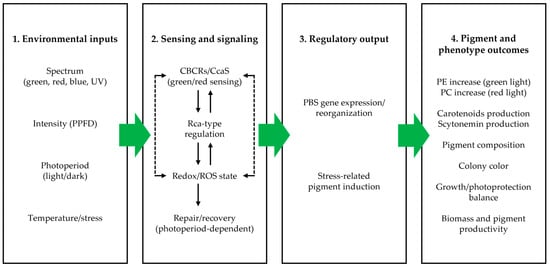
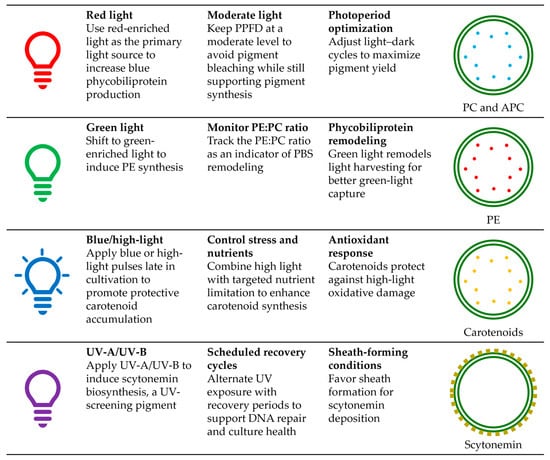
Many Nostoc species alter their pigment composition in response to ambient light, a phenomenon known as complementary chromatic adaptation (CCA), which enables cyanobacteria to maximize light harvesting. For example, cells accumulate red-pigmented PE under green light, while they synthesize blue-pigmented PC under red light [40]. These green- and red-light responses are supported by molecular mechanisms, including sensor kinases such as CcaS, which regulate the expression of PBP genes [41,42]. In cyanobacteria, light-regulated pigment changes are mediated by photoreceptors and signaling cascades that control PBS composition and broader physiology, and chromatic acclimation is a well-studied example showing that cells adjust PBS components in response to wavelength and irradiance [1]. Cyanobacteriochromes (CBCRs) are bilin-based photoreceptors that cover UV-visible wavelengths and distinguish closely related wavelengths, activating wavelength-specific regulatory pathways, including PBS reorganization [1]. CBCRs confer broad UV-visible sensing, and green/red sensing systems such as CcaS, link spectral signals to PBS regulation [1,41]. In N. punctiforme, CBCR CcaS detects green light and regulates genes involved in PE synthesis, illustrating a direct pathway from light perception to pigment output [41,42]. Mechanistically, CcaS undergoes reversible green/red photoconversion, which modulates its signaling activity, switching its regulatory output so that PE-related genes are promoted under green light and reduced under red light [1,41]. CCA also involves complex regulatory networks, such as regulator of chromatic adaptation (Rca) pathways, indicating that these pigmentation shifts experience tight genetic regulation rather than passive pigment turnover [1]. CCA is mechanistically diverse across cyanobacteria, and multiple regulatory systems, including Rca-type pathways, link light sensing to PBS remodeling, contributing to strain-dependent responses in Nostoc [1,40]. These pathways act as an integrated regulatory network, with CBCR/CcaS and Rca-type regulation converging on PBS gene expression and the cellular redox/ROS state (shaped by irradiance and stress) modulating the strength and stability of pigment outcomes, which explains the strain-dependent PE/PC responses under similar spectra [1,12,37,40,41,42]. Figure 1 summarizes how spectrum, irradiance, photoperiod, and stress signals integrate to shape pigment composition in Nostoc. In contrast, the effects of blue and purple light are mainly based on empirical observations and reflect condition-dependent, stress-driven photoprotection rather than a specific adaptation program [41,49]. Figure 2 and Table 2 show the impact of light on pigment composition in Nostoc.
Figure 1.
Integrated model showing how light spectrum (CBCR/CcaS; Rca-type pathways), irradiance-driven excitation pressure, and redox/ROS signaling jointly regulate PBS composition and pigment outcomes in Nostoc. CBCRs = cyanobacteriochromes; PBS = phycobilisomes; PC = phycocyanin; PE = phycoerythrin; PPFD = photosynthetic photon flux density; Rca = regulator of chromatic adaptation; ROS = reactive oxygen species.
Figure 2.
Light-based strategies for regulating pigment composition and improving cultivation performance in Nostoc. The colored dots indicate the main target pigments promoted under each light condition. APC = allophycocyanin; PBS = phycobilisomes; PC = phycocyanin; PE = phycoerythrin; PPFD = photosynthetic photon flux density.
Red light generally promotes Chl a and PC production in Nostoc. For example, N. sphaeroides grown under red light shows higher dry biomass and PC content than under other wavelengths [29], and N. flagelliforme exhibits increased PC content relative to APC under red light, likely to improve light absorption [24]. Because of this, red LEDs are commonly used to enhance PC accumulation and maintain productive growth; for example, red-light intensity modulation increases PC in N. commune [21]. Red light may also reduce the need for PE-rich antennal components compared to green light and can support efficient photosynthesis at moderate irradiance [20,22]. These observations are consistent with PBS remodeling under chromatic acclimation, in which regulatory responses shift antenna composition to favor absorption in the dominant wavelength environment [1]. This response is mediated by phosphorelay regulatory systems such as the Rca pathway, in which cyanobacteriochrome sensor kinases detect changes in red and green light and regulate the expression of PBP-related genes [40]. This suggests that red-biased spectra paired with a moderate intensity and a controlled photoperiod are often favorable for PC productivity.
Green light tends to increase PE and shift the color of Nostoc toward yellow–green or brown by changing the PBS. For example, in Nostoc sp. strain MAC, exposure to green light altered the PE:PC ratio to >2:1, and the cells became brown. In contrast, white light kept the ratio near 1:1, and the cells stayed green [12]. Green-enriched conditions generally promote PE accumulation and pigment rebalancing in cyanobacteria capable of PBS adjustment [40,42,50]. This is supported by green-light sensing pathways (e.g., CCAs/CBCR-based regulation) that upregulate PE-related gene expression in responsive strains [41,42]. Under green light, regulators, such as RcaC, promote PE gene expression and repress specific PC-related genes; under red light, this regulatory pattern is reversed, enabling dynamic PBS reorganization in response to spectral conditions [42]. In practice, green light can be used in a short “induction phase” before harvesting to obtain PE-rich biomass or extracts.
Blue light can increase some compounds in Nostoc, such as total protein and PBPs, as reported for N. sphaeroides [29]. This increase in total protein may reflect greater PBP accumulation, as PBS/PBPs constitute a large fraction of cellular soluble proteins [14,29]. Blue light can enhance specific PBPs, such as PE, and as these light-harvesting structures may constitute up to 50% of the total soluble protein in cyanobacterial cells, their accumulation directly contributes to a higher biomass protein content [29]. However, blue light does not always favor growth. In N. flagelliforme, blue light (and other single-color treatments) reduced biomass compared to white light, suggesting that it may stimulate specific pigments while limiting the overall productivity when used alone [5,49]. This is often because blue light triggers stress/photoprotection responses, especially at higher intensities, increasing the excitation pressure, ROS formation, and carotenoid accumulation, depending on the species and conditions [15,35]. The effects of blue light are dependent on the conditions; at a higher intensity, it can act as a stressor, but under a moderate photosynthetic photon flux density (PPFD) and appropriate nutrient conditions, some Nostoc strains show increased PBPs [9,24]. In N. sphaeroides, increased PBPs have been reported under blue light and moderate irradiance (~30 μmol photons m−2 s−1), consistent with stimulation without bleaching-level stress [29]. Therefore, it is crucial to distinguish productive pigment accumulation from stress-induced accumulation. Optimized spectra (e.g., mixed or white light) increase pigment content and biomass, whereas monochromatic blue light increases specific PBPs but reduces the biomass and polysaccharide yield [5,49]. This distinction should be assessed considering the growth rate, Chl a stability (including bleaching), and ROS-related indicators [9]. Blue-light responses are often mediated by redox/ROS-driven photoprotection pathways rather than CCA-specific PBS switching, explaining condition-dependent outcomes [1,9,24,37].
Table 2.
Effects of light on pigment production in various Nostoc species and strains. Chl a = chlorophyll a; EPS = extracellular polymeric substances; MAAs = mycosporine-like amino acids; PAR = photosynthetically active radiation (broad-spectrum visible light, 400–700 nm) without spectral tuning; PBPs = phycobiliproteins; PC = phycocyanin; PE = phycoerythrin. Increased/decreased indicates a change relative to the control/reference condition reported in the cited study (often a white-light control under otherwise identical conditions). Biomass refers to biomass yield (typically dry weight) unless the cited study reports a different growth metric.
In addition to light color, UV exposure is a major factor in scytonemin induction and broader stress acclimation. Enhanced UV-B can alter growth and pigment content in N. muscorum [25] and N. commune [51]. Scytonemin provides extracellular screening, and its production is associated with UV-A exposure and sheath development [47]. As scytonemin is localized in the sheath, it indirectly protects the internal photosynthetic apparatus by screening incident UV before it reaches sensitive cellular targets, reducing UV-driven photooxidation and stress on photosystems and pigments [11,47]. This mechanism is consistent with observations that UV-B reduces Chl a and PBPs and suppresses Nostoc growth, supporting the advantage of sheath-level UV screening [25,52]. In cultivation, this suggests using controlled, time-limited UV conditions rather than continuous exposure when targeting scytonemin.
Overall, these light-driven responses are often strain- and context-dependent, and differences among studies reflect the natural habitats of the Nostoc strains. The habitat likely contributes to variation across Nostoc studies because the natural environment influences a strain’s pigment response. Aquatic strains often prioritize the adjustment of PBPs to capture changing underwater light spectra [12]. In contrast, terrestrial and subaerial mat-formers experience stronger UV and desiccation cycles and rely more on sheath-associated protection, including extracellular sheaths enriched in scytonemin and carotenoids, rather than primarily adjusting antenna pigments [10,44]. These ecological differences likely contribute to the strain-dependent pigment responses reported in the literature. As the habitat alters UV exposure, desiccation frequency, and optical environment, it can shift pigment strategies between PBS-based light harvesting and sheath-associated photoprotection [10,11,12,44]. Table 3 summarizes this habitat framework to interpret cross-study variability.
Table 3.
Habitat context for pigment responses in Nostoc. This table summarizes how habitat-driven stressors (e.g., spectral filtering, UV exposure, desiccation, and internal gradients) shift pigment strategies toward PBS-based regulation (PBPs) or sheath-associated photoprotection (scytonemin/carotenoids), explaining cross-study variability. Chl a = chlorophyll a; EPS = extracellular polymeric substances; MAAs = mycosporine-like amino acids; PAR = photosynthetically active radiation (broad-spectrum visible light, 400–700 nm) without spectral tuning; PBPs = phycobiliproteins; PC = phycocyanin; PE = phycoerythrin; PPFD = photosynthetic photon flux density.
4. Effects of Light Intensity
Light intensity is another critical factor, as too little light limits photosynthesis, whereas too much light causes photoinhibition and oxidative stress [38,54]. In many cyanobacteria, moderate light often increases the pigment content per biomass, but very high light can reduce PBPs (photobleaching/downregulation) and increase carotenoids and other protective compounds [35,44,48]. For example, in N. calcicola, the light intensity and photoperiod affect growth and biochemical composition, highlighting the balance between productivity and stress responses [22]. Pigment synthesis depends on light–dark cycles (photoperiod) and environmental conditions [37,43]. For example, the same daily light dose leads to different pigment outcomes depending on how it is delivered—continuous light, longer days at a lower PPFD, or shorter periods at a higher PPFD [22,23]. Across studies on Nostoc, low-to-moderate PPFD generally ranges from approximately 20 to 100 μmol photons m−2 s−1. In contrast, higher light intensities, particularly in combination with UV and photosynthetically active radiation (PAR), increase stress responses and protective pigment production and reduce PBPs and Chl a [6,9,22]. In dense cultures, self-shading reduces photodamage in inner cells but also limits light penetration, lowering overall photosynthetic efficiency and making mixing and reactor design important for high-density cultivation and scale-up [3,6,55]. Photoperiod is also crucial, as continuous light and light–dark cycles produce different effects at the same daily light dose. This is especially relevant for LED-based cultivation, as photoperiod can be adjusted to balance productivity, stress, and pigment accumulation [1,23].
4.1. Low-to-Moderate Intensity: Pigment Accumulation
Cyanobacteria generally exhibit a negative correlation between light intensity and the light-harvesting pigment content, optimizing their antennal systems to maximize photon capture under low-light conditions. This strategy of pigment accumulation ensures photosynthetic efficiency when energy is scarce. For example, N. calcicola prefers low light (21–63 µmol/m2/s), under which PBPs and Chl a accumulate maximally; intensities surpassing this range significantly decrease the pigment content, as the cells adjust to avoid excess energy absorption [22]. Similarly, N. sphaeroides requires a specific moderate intensity of roughly 90 µmol/m2/s to optimize PBP yield, which has been reported as the pigment content per biomass (mg gDW−1) and/or pigment productivity (mg pigment per g dry biomass), depending on the study, with production dropping at higher or lower intensities, indicating the precise window for optimal biosynthesis [29]. This behavior is consistent with findings in other Nostoc species, in which low light acts as a stimulant for PC and PE synthesis to broaden light harvesting and high light triggers their degradation [56]. Overall, previous studies have suggested an effective irradiance range for PBP accumulation and biomass production, typically within 30–90 μmol photons m−2 s−1. This includes for N. calcicola (~21–63), N. commune (~30), and N. sphaeroides (~90), for which high PBP yields can be achieved without photoinhibition [21,22,29].
4.2. High Intensity: Photoinhibition and Photoprotection
Exposure to high light intensity (99–250 µmol/m2/s, depending on the specific cyanobacterial species) acts as a stressor that induces photoinhibition and activates photoprotective mechanisms to prevent oxidative damage [11]. Under these conditions, Nostoc species often undergo “bleaching”, a regulated reduction in light-harvesting pigments, such as PE and PC, to limit excess photon absorption [38]. Photoinhibition is closely linked to PSII damage and repair. Under continuous high light exposure, ROS can damage the D1 protein of PSII, increasing the need for efficient repair cycles [38,48]. When damage exceeds repair capacity, photosynthetic efficiency is reduced, and bleaching may occur [48]. Carotenoids and extracellular scytonemin can reduce ROS formation and protect the photosynthetic apparatus under excess light [38]. Simultaneously, cells regulate the synthesis of carotenoids, which serve as non-enzymatic antioxidants that quench ROS generated by over-excited photosystems. For example, in Nostoc sp. strain HKAR-2, exposure to high PAR combined with UV-B radiation reduces Chl a but increases carotenoids [52]. At irradiances above ~100 μmol photons m−2 s−1, cells often shift from light harvesting to photoprotection. In some cases, high irradiance may promote extracellular UV-screening mechanisms, such as scytonemin accumulation [11]. Under extreme light exposure of up to ~500 μmol photons m−2 s−1, PBP photobleaching has been observed, whereas antioxidant carotenoids may contribute to oxidative stress mitigation [38]. When high irradiance is accompanied by desiccation, the photoprotective response is associated with survival under dormancy-like conditions. In terrestrial N. flagelliforme, HCP accumulation has been reported under combined stress conditions, suggesting that these OCP-related proteins complement pigment reduction and carotenoid accumulation by providing an additional route for dissipating excess energy [19,46]. Thus, in the context of light intensity, HCPs are not simply carotenoid-binding proteins but part of a high light and desiccation-response strategy that protects photosynthetic structures during severe environmental stress [19,46]. From a cultivation perspective, these patterns suggest that PPFD should be maintained below ~90 μmol photons m−2 s−1 when PBPs are the target products and that applying higher irradiance, often as a secondary stress phase, will enrich protective compounds, such as scytonemin [11,21,22]. Dark recovery may also mitigate high light-induced pigment loss; in Nostoc sp. strain VKB02, PC and PE decreased under high intensity PAR/UV exposure but recovered during the subsequent dark phase [54].
5. Two-Step Culture to Promote Pigment Biosynthesis
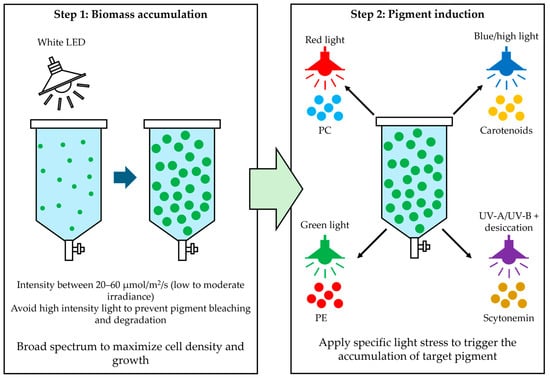
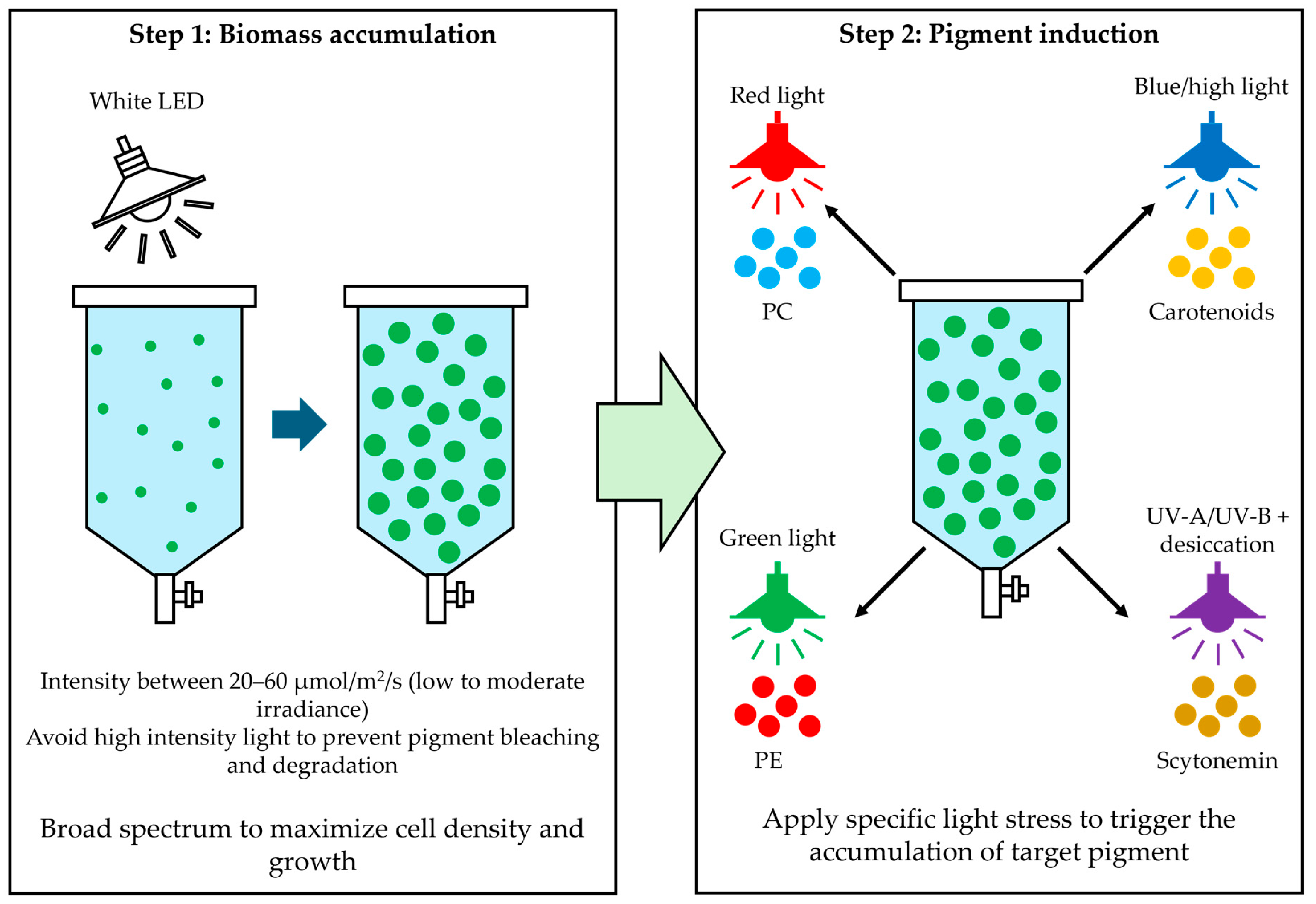
Two-step culture (a growth phase followed by a targeted induction phase) is a practical method for improving the commercial pigment yield of Nostoc because it separates two competing objectives; efficient biomass accumulation and pigment biosynthesis, which often requires stress (Figure 3). In a single-stage method, continuous exposure to induction conditions (e.g., UV, high light, or certain monochromatic spectra) stimulates specific pigments but frequently reduces overall energy capture, damages light-harvesting complexes, and reduces biomass productivity. A two-step method reduces this risk by enabling cultures to accumulate biomass before applying controlled induction (light spectrum shifts, intensity increases, and/or UV exposure) to increase pigment biosynthesis [21,22,25,36,46,47]. This trade-off may be relevant in Nostoc, as colony and mat structures generate internal light gradients, which restrict induction light from reaching deeper biomass layers [3,6]. At scale, this becomes a bottleneck because dense aggregates, biofilms, and extracellular sheaths cause strong light attenuation, and single-cell light-distribution assumptions underestimate internal shading in Nostoc [55].
Figure 3.
Schematic representation of a two-step cultivation strategy. Step 1 involves biomass accumulation and Step 2 promotes pigment induction under controlled light conditions. The different light colors indicate specific light conditions, while the colored circles represent the main pigments promoted under each condition.
In Step 1, the biomass production phase, cultures are maintained under conditions that favor photosynthesis and rapid growth—commonly broad-spectrum or red-enriched light at low-to-moderate PPFD—increasing biomass and cell density. Moderate irradiance (e.g., ~21–63 μmol/m2/s) supports growth and maintains Chl a and PBP levels [22], and moderate-intensity red light promotes PC accumulation without driving chronic oxidative stress [21]. As PBPs are sensitive to long-term high light exposure, Stage 1 should minimize continuous photoexcitation stress, which causes pigment bleaching or degradation, to produce sufficient biomass for the subsequent induction step [35,44,48]. As the culture density increases, self-shading can intensify these gradients, making reactor design and mixing critical for maintaining uniform light exposure [3,23,30]. For industrial scale-up, quantitative modeling of the internal photon field can estimate how PPFD decays in dense cultures and identify an effective culture depth; wavelength-specific attenuation models have been applied to Nostoc to improve biomass prediction under self-shading [50].
In Step 2, pigment induction occurs during a controlled light stress phase, following biomass accumulation, and the light is intentionally changed to enrich the target pigments using the wavelength and/or irradiance as specific induction signals. For PC production, maintaining a red-biased spectrum and adjusting irradiance can be effective, as shown for N. commune under red LEDs [21]. For PE, a green-enriched induction step is supported because chromatic acclimation remodels PBSs to improve green light harvesting and increase PE compared to other PBPs [40,42]. For carotenoids, induction is associated with increased excitation pressure (e.g., short high light and/or blue-enriched phases), consistent with the functions of carotenoids in energy dissipation and ROS quenching under photooxidative conditions [4,15,35]. Scytonemin is induced by UV-A/UV-B exposure, especially when combined with high light and desiccation [11,45,53,57]. However, extended UV exposure can degrade PBPs, damage DNA, and suppress growth [25,52]; thus, prolonged UV treatment may result in low biomass or culture failure. In contrast, in a two-step method, biomass is first accumulated under adequate nutrients, and then, a short UV/high-light induction phase is applied to promote scytonemin production (often alongside carotenoids) without compromising productivity. Thus, the effectiveness of the induction step depends on whether light reaches the whole culture or remains limited to the surface layers, which is an important consideration for scale up [3,6]. To scale-up Nostoc cultivation, reactor design should reduce self-shading using shallow culture layers and sufficient mixing so that cells move between bright and shaded zones [6,55]. In addition, lighting settings (spectrum, PPFD, and photoperiod) and basic culture configuration (e.g., depth/optical path) should be reported to support comparisons and reproducibility [1,23]. In Nostoc, scale-up is constrained by colony/mat morphology, which creates internal light gradients [3,55]. As biomass accumulates, the surface layers can receive induction light (red/UV), and deeper layers may remain under low-light conditions. Therefore, optical path length, mixing intensity, and light distribution influence whether induction affects the bulk culture or only the surface [6,55]. These constraints are consistent with observations of aggregate-driven heterogeneity in Nostoc ecology and controlled cultivation [3,6]. Scale-up often favors cultivation designs with short optical paths and high surface-to-volume ratios rather than deep ponds or large-diameter tubes [50]. Examples include flat-panel or narrow-tube photobioreactors and air-lift systems, which improve light exposure in dense cultures and reduce localized photobleaching [23,30,55].
An example supporting the two-step approach comes from studies on N. flagelliforme, which have shown that continuous monochromatic light promotes pigment-specific responses but reduces the total biomass compared to broader spectra [5,49]. To address this, a two-stage lighting strategy was used: cultures were first grown under white light for 9 days to build dense biomass and shifted to a defined red/blue/green mixture for another 9 days. This approach improved final biomass and extracellular matrix production compared to static light regimens [6]. This approach is commercially relevant because cyanobacterial PC is widely used as a natural colorant and nutraceutical/cosmeceutical ingredient produced through mass cultivation, extraction, and purification. Although commercial spirulina, genus Limnospira, and former Arthrospira currently dominate the market, studies on Nostoc suggest that light-regime optimization using controlled LED lighting could improve Nostoc productivity as an alternative producer [6,14,21,26,58]. Proper design is important, as dense Nostoc cultures can self-shade, and targeted induction, such as red light for PC or UV-A for scytonemin, must be balanced against biomass loss. Overall, these findings support the use of two-step cultivation to separate biomass accumulation from stress-induced pigment synthesis, improving productivity in Nostoc cultivation systems.
6. Effects of Environmental Stress, Climate Change, and Scale-Up Challenges
Although monochromatic light can induce specific pigment responses, mixed wavelengths often support better overall performance, especially when the goal is to balance biomass formation with product accumulation. For example, when culturing N. flagelliforme, a “wavelength-shift” strategy—white light followed by a switch to a red:green:blue mixture (12:5:5)—significantly increased biomass and extracellular polysaccharide production [6]. However, the effects of light on Nostoc pigment biosynthesis do not occur in isolation and are influenced by environmental and cultivation factors that alter cellular redox balance, energy and nutrient utilization, and the effective light intensity experienced by cells in the colony. In this context, spectrum determines photon absorption, intensity regulates the excitation pressure and photodamage risk, and photoperiod controls recovery and repair capacity, influencing the pigment composition and productivity [1,23]. Cross-study comparisons are limited by differences in lighting technology and reporting, including light spectra, culture depth, and PPFD measurement, which may make it difficult to distinguish true biological variation among strains. Therefore, reporting spectrum, PPFD, photoperiod, culture depth, and system design are essential for distinguishing the technical effects from biological responses.
Nutrient availability (especially nitrogen) shifts the balance between growth and pigment/protective systems, and stress can strengthen or induce spectrum-driven responses [39,44,48]. This is important because PBPs function both as light-harvesting pigments and as internal nitrogen reserves; under nitrogen limitation, cyanobacteria mobilize these proteins, leading to bleaching and a reduced PBP content regardless of the light spectrum [14,43]. Therefore, nitrogen supply should be considered with light optimization. As both pigment biosynthesis and nitrogen fixation (via nitrogenase) are energy-intensive, pigment induction under high light or UV can compete for ATP and reducing power, particularly in heterocyst-forming strains; therefore, optimization should consider nitrogen status and nitrogen fixation performance, where relevant [1,14]. Salinity, temperature, heavy metals, and general stress physiology interact with light responses, often enhancing carotenoid-based photoprotection and destabilizing PBPs under harsh conditions [4,35,52]. In N. muscorum, for instance, combined salt stress and UV-B caused a stronger reduction in PC and Chl a than either stressor alone, despite the upregulation of antioxidant enzymes [59]. Under severe light or UV stress, Nostoc may shift its energy to protective pigments (e.g., carotenoids and scytonemin), and strong UV-B rapidly suppresses nitrogenase activity, indicating that survival can take priority over nitrogen fixation [25,39]. Moreover, the effects of the light spectrum also depend on irradiance. Moderate intensities promote CCA, whereas excessive irradiance may shift cells to generalized stress responses, including carotenoid and scytonemin production [11,37].
Temperature also plays a critical role. Low temperatures combined with light stress induce specific alterations in fatty acid and pigment profiles as a survival mechanism [46], whereas high temperatures (e.g., 39 °C) mimic the physiological effects of green light, altering the PE:PC ratio, even under white light [12]. High temperatures induce pigment ratio shifts similar to those triggered by specific light colors, although its mechanistic link to chromatic acclimation signaling remains unclear and may involve redox/ROS signaling [1]. Furthermore, the toxicity of heavy metals such as chromium (Cr VI) in N. commune has been shown to be wavelength-dependent, with specific light spectra influencing the photochemical efficiency of PSII under metal stress conditions [36]. Cultivation is also crucial, as Nostoc often grows as colonies, mats, or aggregates, in which self-shading and diffusion limits create internal gradients in intensity and spectrum, leading to heterogeneous pigment accumulation that cannot be predicted from incident light alone [3,8,55]. In addition, strain and species differences, which are shaped by habitat history (e.g., terrestrial/desiccation-exposed forms), influence sheath development and thus scytonemin potential and UV tolerance [3,10,47]. The photoperiod influences tolerance to spectrum–intensity combinations because dark phases enable PSII repair and PBP recovery after high light exposure [48,54]. These factors are expected to become even more important given climate change.
Climate change is an increasingly important factor to consider because it alters the light and stress conditions experienced by Nostoc species. Warmer temperatures and more frequent droughts can intensify desiccation, reduce water films, and expose colonies and mats to stronger sunlight and UV, especially in terrestrial habitats, increasing the risk of severe cellular damage [3,8,10]. Under continuous stress, Nostoc may produce more protective pigments and fewer light-harvesting pigments; thus, shifts in colony color reflect changes in photosynthetic performance and stress tolerance [35,44,48]. To survive intense drying, species such as N. flagelliforme produce specialized “red proteins” (HCPs) that act as safety valves, binding carotenoids and dissipating excess absorbed light as heat when water is unavailable for normal photosynthesis [19,46]. Extreme temperatures alone can also modify the organization and pigment ratios of the light-harvesting apparatus [12,46]. A major challenge is adapting laboratory light strategies to outdoor or industrial cultivation, as Nostoc experiences fluctuating sunlight, self-shading, and multiple stressors. LED supplementation and two-stage induction may stabilize pigment production on larger scales.
Despite recent progress, several key knowledge gaps must be addressed to make light-driven pigment optimization in Nostoc scalable and predictive. The pigment composition varies among strains and is influenced by environmental factors, suggesting that strain-specific responses should be considered when developing optimization strategies for Nostoc [40,42,58]. Moreover, studies on scytonemin have explained induction and function, but few report production-ready parameters under controlled UV-A/UV-B dosing conditions [25,46,47,53]. Scale-up is also challenging because colonies and mats create strong internal light gradients (self-shading); thus, incident PPFD alone may not predict pigment outcomes [3,8,55]. Future work should optimize biomass and pigment productivity together (not pigment percentage alone) and connect cultivation conditions to downstream pigment stability and processing performance. Additional priorities include standardized LED studies with full spectral reporting, volumetric pigment productivity, scale-up design and mixing, and stress indicators, such as ROS-related responses, Chl a stability, and pigment changes.
7. Conclusions
Pigment production in Nostoc species is strongly regulated by the light environment, making light regulation a key strategy for pigment optimization. Production systems should move beyond static white light and use dynamic LED lighting designed for specific pigment targets. PBPs are governed by chromatic adaptation, and moderate red light favors PC productivity, whereas green-enriched light promotes PE accumulation in responsive strains. In contrast, high light and UV exposure should be used as short induction treatments for protective pigments, such as carotenoids and scytonemin, as prolonged stress can reduce biomass productivity. Pigment responses cannot be interpreted from light spectrum alone. Studies should report spectral composition, PPFD, photoperiod, and cultivation system design to improve comparability. Environmental factors, such as temperature, nutrient availability, salinity, and climate-related stress, also interact with light responses and should be integrated into optimization studies. Overall, optimized lighting conditions, two-stage cultivation, and improved process design may transform Nostoc into a scalable system for high-value pigment production.
Author Contributions
Conceptualization, M.K., A.N., H.I. and T.S.; methodology, M.K., A.N., H.I. and T.S.; validation, M.K., A.N., H.I. and T.S.; formal analysis, M.K., A.N., H.I. and T.S.; investigation, M.K., A.N., H.I. and T.S.; resources, M.K.; data curation, M.K. and A.N.; writing—original draft preparation, M.K. and A.N.; writing—review and editing, M.K., A.N., H.I. and T.S.; visualization, M.K. and A.N.; supervision, M.K.; project administration, M.K.; funding acquisition, M.K. All authors have read and agreed to the published version of the manuscript.
Funding
This research received no external funding.
Institutional Review Board Statement
Not applicable.
Informed Consent Statement
Not applicable.
Data Availability Statement
The original contributions presented in this study are included in the article. Further inquiries can be directed to the corresponding author.
Acknowledgments
The authors thank the reviewers for their valuable comments and feedback on our manuscript.
Conflicts of Interest
Authors Hiroyuki Ishiwata and Tadashi Shoji are employed by the company Nishimatsu Construction. The remaining authors declare that the research was conducted in the absence of any commercial or financial relationships that could be construed as potential conflicts of interest.
Abbreviations
The following abbreviations are used in this manuscript:
| UV | Ultraviolet |
| Chl a | Chlorophyll a |
| PBPs | Phycobiliproteins |
| PC | Phycocyanin |
| PE | Phycoerythrin |
| APC | Allophycocyanin |
| PBS | Phycobilisomes |
| PSI | Photosystem I |
| PSII | Photosystem II |
| ROS | Reactive oxygen species |
| HCPs | Helical carotenoid proteins |
| OCP | Orange carotenoid protein |
| CCA | Complementary chromatic adaptation |
| Rca | Regulator of chromatic adaptation |
| CBCRs | Cyanobacteriochromes |
| PPFD | Photosynthetic photon flux density |
| EPS | Extracellular polymeric substances |
| MAAs | Mycosporine-like amino acids |
| PAR | Photosynthetically active radiation |
References
- Gupta, A.; Pandey, P.; Gupta, R.; Tiwari, S.; Singh, S.P. Responding to light signals: A comprehensive update on photomorphogenesis in cyanobacteria. Physiol. Mol. Biol. Plants 2023, 29, 1915–1930. [Google Scholar] [CrossRef] [Scilit] [PubMed]
- Mehdizadeh Allaf, M.; Peerhossaini, H. Cyanobacteria: Model microorganisms and beyond. Microorganisms 2022, 10, 696. [Google Scholar] [CrossRef] [Scilit] [PubMed]
- Dodds, W.K.; Gudder, D.A.; Mollenhauer, D. The ecology of Nostoc. J. Phycol. 1995, 31, 2–18. [Google Scholar] [CrossRef] [Scilit]
- Maurya, P.K.; Kumar, V.; Mondal, S.; Singh, S.P. Photoautotrophic black-colored cyanobacterial soil crust biosynthesizes photoprotective compounds and is capable of using blue, green, and red wavelengths of light for its growth. Environ. Sci. Pollut. Res. 2023, 30, 16756–16769. [Google Scholar]
- Dai, Y.J.; Li, J.; Wei, S.M.; Chen, N.; Xiao, Y.P.; Tan, Z.L.; Jia, S.R.; Yuan, N.N.; Tan, N.; Song, Y.J. Effect of light with different wavelengths on Nostoc flagelliforme cells in liquid culture. J. Microbiol. Biotechnol. 2013, 23, 534–538. [Google Scholar] [CrossRef] [Scilit] [PubMed]
- Han, P.-p.; Shen, S.-g.; Wang, H.-Y.; Yao, S.-y.; Tan, Z.-l.; Zhong, C.; Jia, S.-r. Applying the strategy of light environment control to improve the biomass and polysaccharide production of Nostoc flagelliforme. J. Appl. Phycol. 2017, 29, 55–65. [Google Scholar]
- Spolaore, P.; Joannis-Cassan, C.; Duran, E.; Isambert, A. Commercial applications of microalgae. J. Biosci. Bioeng. 2006, 101, 87–96. [Google Scholar] [CrossRef] [Scilit] [PubMed]
- Sanmartín, P.; Aira, N.; Devesa-Rey, R.; Silva, B.; Prieto, B. Relationship between color and pigment production in two stone biofilm-forming cyanobacteria (Nostoc sp. PCC 9104 and Nostoc sp. PCC 9025). Biofouling 2010, 26, 499–509. [Google Scholar] [CrossRef] [Scilit] [PubMed]
- Rupali, B.; Sharma, P.K. Effect of UV-B radiation on physiological and biochemical changes in a freshwater cyanobacterium, Scytonema hofmannii. Environ. Exp. Biol. 2021, 19, 89–96. [Google Scholar] [CrossRef] [Scilit]
- De Chazal, N.M.; Smith, G.D. Characterization of a brown Nostoc species from Java that is resistant to high light intensity and UV. Microbiology 1994, 140, 3183–3189. [Google Scholar] [CrossRef] [Scilit]
- Garcia-Pichel, F.; Castenholz, R.W. Characterization and biological implications of scytonemin, a cyanobacterial sheath pigment 1. J. Phycol. 1991, 27, 395–409. [Google Scholar] [CrossRef] [Scilit]
- Anderson, L.; Rayner, M.; Sweet, R.; Eiserling, F. Regulation of Nostoc sp. phycobilisome structure by light and temperature. J. Bacteriol. 1983, 155, 1407–1416. [Google Scholar] [CrossRef] [Scilit] [PubMed]
- Deepan, B.; Manoj, S.; Tharani, E.; Saranraj, P. Microalgae as a sustainable and versatile biosource. Int. J. Microbiol. Res. 2025, 16, 24–37. [Google Scholar]
- Roy, D.; Verma, S.; Das, S.; Chakdar, H.; Pabbi, S. Production and applications of cyanobacterial phycocyanin: Trends and prospects. Indian J. Microbiol. 2025, 65, 1567–1585. [Google Scholar] [PubMed]
- Saini, D.K.; Pabbi, S.; Shukla, P. Cyanobacterial pigments: Perspectives and biotechnological approaches. Food Chem. Toxicol. 2018, 120, 616–624. [Google Scholar] [CrossRef] [Scilit] [PubMed]
- Morone, J.; Lopes, G.; Morais, J.; Neves, J.; Vasconcelos, V.; Martins, R. Cosmetic application of cyanobacteria extracts with a sustainable vision to skincare: Role in the antioxidant and antiaging process. Mar. Drugs 2022, 20, 761. [Google Scholar] [CrossRef] [Scilit] [PubMed]
- Sabat, S.; Patra, S.; Swain, S.; Bej, S.; Bishoyi, A.K.; Sahoo, C.R.; Padhy, R.N. Phycocompounds from cyanobacteria: Exploring synergistic effects with conventional anticancer and antimicrobial properties. ACS Omega 2025, 10, 23957–23980. [Google Scholar] [CrossRef] [Scilit] [PubMed]
- Srinidhiy, C.; Nellore, J.; Prakash, P.; Moovendhan, M. Harnessing algae-derived bioactive compounds for sustainable and effective photoprotection in skincare. Appl. Biochem. Biotechnol. 2025, 197, 7767–7799. [Google Scholar] [CrossRef] [Scilit] [PubMed]
- Yang, Y.-W.; Yin, Y.-C.; Li, Z.-K.; Huang, D.; Shang, J.-L.; Chen, M.; Qiu, B.-S. Orange and red carotenoid proteins are involved in the adaptation of the terrestrial cyanobacterium Nostoc flagelliforme to desiccation. Photosynth. Res. 2019, 140, 103–113. [Google Scholar] [CrossRef] [Scilit] [PubMed]
- Hotos, G.N.; Antoniadis, T.I. The effect of colored and white light on growth and phycobiliproteins, chlorophyll and carotenoids content of the marine cyanobacteria Phormidium sp. and Cyanothece sp. in batch cultures. Life 2022, 12, 837. [Google Scholar] [CrossRef] [Scilit] [PubMed]
- Kaewmaneesuk, J.; Ariyadet, C.; Thirabunyanon, M.; Jaturonglumlert, S.; Daengprok, W. Influence of led red-light intensity on phycocyanin accumulation in the cyanobacterium Nostoc commune Vaucher. J. Fundam. Appl. Sci. 2018, 10, 457–467. [Google Scholar]
- Khajepour, F.; Hosseini, S.A.; Ghorbani Nasrabadi, R.; Markou, G. Effect of light intensity and photoperiod on growth and biochemical composition of a local isolate of Nostoc calcicola. Appl. Biochem. Biotechnol. 2015, 176, 2279–2289. [Google Scholar] [CrossRef] [Scilit] [PubMed]
- Polyzois, A.; Kirilovsky, D.; Dufat, T.-h.; Michel, S. Effects of modification of light parameters on the production of cryptophycin, cyanotoxin with potent anticancer activity, in Nostoc sp. Toxins 2020, 12, 809. [Google Scholar] [CrossRef] [Scilit] [PubMed]
- Han, P.-P.; Shen, S.-G.; Guo, R.-J.; Yao, S.-Y.; Sun, Y.; Tan, Z.-L.; Jia, S.-R. The regulation of photosynthetic pigments in terrestrial Nostoc flagelliforme in response to different light colors. Algal Res. 2017, 25, 128–135. [Google Scholar] [CrossRef] [Scilit]
- Agrawal, S. Effect of enhanced ultraviolet-B radiation on growth, pigmentation, nitrogen metabolism and polyamine contents in a cyanobacterium Nostoc muscorum. Biotronics 1996, 25, 110006175784. [Google Scholar]
- Garg, D.; Gupta, U. Optimization of culture conditions of newly isolated cyanobacteria Nostoc BGLR 1 for nutraceutical formulation. Biomass Convers. Biorefin. 2024, 14, 9849–9865. [Google Scholar]
- Hassan, S.; Meenatchi, R.; Pachillu, K.; Bansal, S.; Brindangnanam, P.; Arockiaraj, J.; Kiran, G.S.; Selvin, J. Identification and characterization of the novel bioactive compounds from microalgae and cyanobacteria for pharmaceutical and nutraceutical applications. J. Basic Microbiol. 2022, 62, 999–1029. [Google Scholar] [CrossRef] [Scilit] [PubMed]
- Mandal, M.K.; Chanu, N.K.; Chaurasia, N. Cyanobacterial pigments and their fluorescence characteristics: Applications in research and industry. In Advances in Cyanobacterial Biology; Elsevier: Amsterdam, The Netherlands, 2020; pp. 55–72. [Google Scholar]
- Ma, R.; Lu, F.; Bi, Y.; Hu, Z. Effects of light intensity and quality on phycobiliprotein accumulation in the cyanobacterium Nostoc sphaeroides Kützing. Biotechnol. Lett. 2015, 37, 1663–1669. [Google Scholar] [CrossRef] [Scilit] [PubMed]
- Reis, A.; Mendes, A.; Lobo-Fernandes, H.; Empis, J.; Novais, J.M. Production, extraction and purification of phycobiliproteins from Nostoc sp. Bioresour. Technol. 1998, 66, 181–187. [Google Scholar] [CrossRef] [Scilit]
- Singh, V.K.; Jha, S.; Rana, P.; Mishra, S.; Kumari, N.; Singh, S.C.; Anand, S.; Upadhye, V.; Sinha, R.P. Resilience and mitigation strategies of cyanobacteria under ultraviolet radiation stress. Int. J. Mol. Sci. 2023, 24, 12381. [Google Scholar] [CrossRef] [Scilit] [PubMed]
- Kurahashi, M.; Naka, A. Edible terrestrial cyanobacteria for food security in the context of climate change: A comprehensive review. Appl. Biosci. 2025, 4, 26. [Google Scholar] [CrossRef] [Scilit]
- Martínez-Ruiz, M.; Martínez-González, C.A.; Kim, D.-H.; Santiesteban-Romero, B.; Reyes-Pardo, H.; Villaseñor-Zepeda, K.R.; Meléndez-Sánchez, E.R.; Ramírez-Gamboa, D.; Díaz-Zamorano, A.L.; Sosa-Hernández, J.E. Microalgae bioactive compounds to topical applications products—A review. Molecules 2022, 27, 3512. [Google Scholar] [CrossRef] [Scilit] [PubMed]
- Tarazona Delgado, R.; dos Santos Ferreira Filho, R.; Borges Mendes, C.R. The cyanobacteria genus Aphanothece: Bioactive compounds and applications in biotechnology. Appl. Biochem. Biotechnol. 2025, 197, 4189–4223. [Google Scholar] [CrossRef] [Scilit] [PubMed]
- Rastogi, R.P.; Sinha, R.P.; Moh, S.H.; Lee, T.K.; Kottuparambil, S.; Kim, Y.-J.; Rhee, J.-S.; Choi, E.-M.; Brown, M.T.; Häder, D.-P. Ultraviolet radiation and cyanobacteria. J. Photochem. Photobiol. B Biol. 2014, 141, 154–169. [Google Scholar] [CrossRef] [Scilit] [PubMed]
- Sharma, A.; Maurya, N.; Sundaram, S.; Jaiswal, S. Effect of the nature of the photonic energy on the photochemical and physiochemical response of Nostoc commune under Cr (VI) toxicity. Int. Microbiol. 2025, 28, 2795–2808. [Google Scholar] [CrossRef] [Scilit] [PubMed]
- Wada, N.; Sakamoto, T.; Matsugo, S. Multiple roles of photosynthetic and sunscreen pigments in cyanobacteria focusing on the oxidative stress. Metabolites 2013, 3, 463–483. [Google Scholar] [CrossRef] [Scilit] [PubMed]
- Bhandari, R.; Sharma, P.K. High-light-induced changes on photosynthesis, pigments, sugars, lipids and antioxidant enzymes in freshwater (Nostoc spongiaeforme) and marine (Phormidium corium) cyanobacteria. Photochem. Photobiol. 2006, 82, 702–710. [Google Scholar] [CrossRef] [Scilit] [PubMed]
- Tyagi, R.; Srinivas, G.; Vyas, D.; Kumar, A.; Kumar, H. Differential effect of ultraviolet-B radiation on certain metabolic processes in a chromatically adapting Nostoc. Photochem. Photobiol. 1992, 55, 401–407. [Google Scholar] [CrossRef] [Scilit] [PubMed]
- Kehoe, D.M.; Gutu, A. Responding to color: The regulation of complementary chromatic adaptation. Annu. Rev. Plant Biol. 2006, 57, 127–150. [Google Scholar] [CrossRef] [Scilit] [PubMed]
- Hirose, Y.; Narikawa, R.; Katayama, M.; Ikeuchi, M. Cyanobacteriochrome CcaS regulates phycoerythrin accumulation in Nostoc punctiforme, a group II chromatic adapter. Proc. Natl. Acad. Sci. USA 2010, 107, 8854–8859. [Google Scholar] [CrossRef] [Scilit] [PubMed]
- Bezy, R.P.; Wiltbank, L.; Kehoe, D.M. Light-dependent attenuation of phycoerythrin gene expression reveals convergent evolution of green light sensing in cyanobacteria. Proc. Natl. Acad. Sci. USA 2011, 108, 18542–18547. [Google Scholar] [CrossRef] [Scilit] [PubMed]
- Johnson, E.M.; Kumar, K.; Das, D. Physicochemical parameters optimization, and purification of phycobiliproteins from the isolated Nostoc sp. Bioresour. Technol. 2014, 166, 541–547. [Google Scholar] [CrossRef] [Scilit] [PubMed]
- Pandey, A.; Pathak, J.; Singh, D.K.; Ahmed, H.; Singh, V.; Kumar, D.; Sinha, R.P. Photoprotective role of UV-screening pigment scytonemin against UV-B-induced damages in the heterocyst-forming cyanobacterium Nostoc sp. strain HKAR-2. Braz. J. Bot. 2020, 43, 67–80. [Google Scholar] [CrossRef] [Scilit]
- Ehling-Schulz, M.; Bilger, W.; Scherer, S. UV-B-induced synthesis of photoprotective pigments and extracellular polysaccharides in the terrestrial cyanobacterium Nostoc commune. J. Bacteriol. 1997, 179, 1940–1945. [Google Scholar] [CrossRef] [Scilit] [PubMed]
- Shang, J.-L.; Xie, Y.-X.; Shi, L.-Y.; Diao, S.-R.; Guan, J.-Y. Molecular mechanisms of Nostoc flagelliforme environmental adaptation: A comprehensive review. Plants 2025, 14, 1582. [Google Scholar] [CrossRef] [Scilit] [PubMed]
- Soule, T.; Stout, V.; Swingley, W.; Meeks, J.; Garcia-Pichel, F. Molecular genetics and genomic analysis of scytonemin biosynthesis in Nostoc punctiforme ATCC 29133. J. Bacteriol. 2007, 189, 4465–4472. [Google Scholar] [CrossRef] [Scilit] [PubMed]
- Pathak, J.; Kumar, D.; Singh, D.K.; Ahmed, H.; Kannaujiya, V.K.; Sinha, R.P. Ultraviolet radiation and salinity-induced physiological changes and scytonemin induction in cyanobacteria isolated from diverse habitats. Biointerface Res. Appl. Chem. 2022, 12, 3590–3606. [Google Scholar] [CrossRef] [Scilit]
- Han, P.-p.; Shen, S.-g.; Wang, H.-Y.; Sun, Y.; Dai, Y.-j.; Jia, S.-r. Comparative metabolomic analysis of the effects of light quality on polysaccharide production of cyanobacterium Nostoc flagelliforme. Algal Res. 2015, 9, 143–150. [Google Scholar] [CrossRef] [Scilit]
- Ortiz-Moreno, M.-L.; Cárdenas-Poblador, J.; Agredo, J.; Solarte-Murillo, L.-V. Modeling the effects of light wavelength on the growth of Nostoc ellipsosporum. Univ. Sci. 2020, 25, 113–148. [Google Scholar] [CrossRef] [Scilit]
- Austin, P.A.; Ross, I.S.; Mills, J.D. Regulation of pigment content and enzyme activity in the cyanobacterium Nostoc sp. Mac grown in continuous light, a light-dark photoperiod, or darkness. Biochim. Biophys. Acta (BBA)-Bioenerg. 1996, 1277, 141–149. [Google Scholar] [CrossRef] [Scilit]
- Kannaujiya, V.K.; Sinha, R.P. Impacts of diurnal variation of ultraviolet-B and photosynthetically active radiation on phycobiliproteins of the hot-spring cyanobacterium Nostoc sp. strain HKAR-2. Protoplasma 2017, 254, 423–433. [Google Scholar] [PubMed]
- Zhou, Z.; Yang, Z.; Li, Y. Effect of CO2 increase in atmosphere and UV-B intensification on Nostoc commune photosynthetic pigment and UV-B masking materials. Wuhan Univ. J. Nat. Sci. 2012, 17, 255–260. [Google Scholar] [CrossRef] [Scilit]
- Jaiswal, M.; Amin, N.; Kannaujiya, V.K. Impacts of PAR and UV radiation on diurnal photosynthesis performance, pigment composition, and antioxidant function of the hot-spring cyanobacterium Nostoc sp. strain VKB02. Arch. Microbiol. 2025, 207, 144. [Google Scholar] [CrossRef] [Scilit] [PubMed]
- Mouga, T.; Pereira, J.; Moreira, V.; Afonso, C. Unveiling the cultivation of Nostoc sp. under controlled laboratory conditions. Biology 2024, 13, 306. [Google Scholar] [CrossRef] [Scilit] [PubMed]
- De Oliveira, C.A.; Oliveira, W.; Ribeiro, S.; Stringheta, P.; Nascimento, A. Effect of light intensity on the production of pigments in Nostoc spp. Eur. J. Biol. Med. Sci. Res. 2014, 2, 23–36. [Google Scholar]
- Naurin, S.; Bennett, J.; Videau, P.; Philmus, B.; Soule, T. The response regulator Npun_F1278 is essential for scytonemin biosynthesis in the cyanobacterium Nostoc punctiforme ATCC 29133. J. Phycol. 2016, 52, 564–571. [Google Scholar] [CrossRef] [Scilit] [PubMed]
- Jaiswal, A.; Koli, D.K.; Kumar, A.; Kumar, S.; Sagar, S. Pigments analysis of cyanobacterial strains. Int. J. Chem. Stud. 2018, 6, 1248–1251. [Google Scholar] [CrossRef] [Scilit]
- Chris, A. Interactive effects of NaCl and UV-B radiation on growth, pigments and antioxidants in cyanobacterium Nostoc muscorum. Biochem. Cell. Arch. 2015, 15, 409–416. [Google Scholar]

Disclaimer/Publisher’s Note: The statements, opinions and data contained in all publications are solely those of the individual author(s) and contributor(s) and not of MDPI and/or the editor(s). MDPI and/or the editor(s) disclaim responsibility for any injury to people or property resulting from any ideas, methods, instructions or products referred to in the content. |
© 2026 by the authors. Licensee MDPI, Basel, Switzerland. This article is an open access article distributed under the terms and conditions of the Creative Commons Attribution (CC BY) license.