


Abstract
Conventional thermal disposal of chlorinated hydrocarbon (CHC) waste poses high risks of dioxin, furan, chlorine, and phosgene formation, while plasma destruction remains energy-intensive. This work determines the optimal thermodynamic conditions for the allothermal, non-catalytic steam—carbon dioxide gasification of various CHCs utilizing high-temperature detonation gases (2450–2850 K) expanded to atmospheric pressure to achieve non-toxic, valuable syngas and commercial-grade hydrochloric acid. Thermodynamic modeling ensures complete soot- and hydrocarbon-free conversion with 100% carbon conversion efficiency, dry syngas yield up to 5.7 Nm3/kg, and cold gas efficiency reaching 138%. For highly chlorinated (above 70 wt.% chlorine) or unsaturated feedstocks, a co-feeding method using external hydrocarbons (C4H8O2 as an example) was validated to suppress the formation of major ecotoxicants like Cl2, COCl2, and C2Cl2. As for other chlorine-containing ecotoxicants, including highly toxic dioxins, their concentrations in the equilibrium gasification products remain negligibly small, even in the absence of dilution. Importantly, a solvent mass fraction of no more than 0.33 in the initial blend is sufficient to entirely achieve this toxic species suppression. For all considered CHCs (undiluted or diluted with C4H8O2), chlorine is shown to bind exclusively to hydrogen chloride (HCl), with all hazardous emissions remaining below the conditional 1 ppm safety limit. To achieve this, a chlorine capture algorithm was substantiated based on the dissolution of generated HCl within the residual steam condensate or externally delivered water upon cooling the gasification products to 293 K. The proposed technology offers an efficient and environmentally safe alternative to expensive plasma methods for toxic organic waste disposal.
1. Introduction
Chlorinated hydrocarbons form the basis of a wide range of industrial wastes. They are contained in polymers and by-products of their synthesis, solvents, finishing materials, resins, dyes, and flame retardants, as well as enter the environment with wastewater, municipal and industrial waters, and landfill leachates. The neutralization of such substrates represents a critical environmental challenge for modern society. This is due to the high risks of emission of extremely hazardous chemical substances—chlorine, phosgene, furans, dioxins, and polychlorinated biphenyls—into the atmosphere, soil, and water bodies [1].
In accordance with requirements for the production and disposal technologies of organochlorine compounds, key tasks include [2] minimizing the volume of waste and by-fraction generation, involving by-products in useful practical turnover, and ensuring the complete environmental safety of technological cycles. Consequently, target recycling algorithms must guarantee the exhaustive conversion of CHCs into non-toxic components, such as hydrochloric acid, water, syngas, and carbon dioxide. At the same time, the secondary formation of hazardous ecotoxicants—dioxins, chlorine, phosgene, furans, polycyclic aromatic hydrocarbons, and soot—must be completely eliminated.
To date, an extensive range of methods has been proposed for the destruction of organochlorine waste. These include disposal in specialized repositories [3], adsorption [4], chlorolysis [5], liquid-phase oxidation [6], alkaline hydrogenation [7], dehydrochlorination [8], polycondensation [9], direct incineration [10,11], pyrolysis [12,13], plasma-chemical destruction [14,15,16], autothermal gasification with oxygen blasting [17], as well as allothermal catalytic steam conversion [18,19,20].
The most recent research emphasizes thermochemical conversion and advanced catalytic methods to address the challenges of processing chlorine-rich waste, focusing on in situ contaminant mitigation, tar abatement, and the distribution of chlorine species during the degradation of complex feedstocks [21,22,23]. Key advancements include sorbent-based hot gas cleaning [24], the utilization of supercritical water in hydrothermal processes to suppress dioxin formation [25], and plasma-driven electrified gasification to effectively break stable C-Cl bonds [26].
Despite the obvious technological advantages of these approaches [27,28], most of them do not ensure absolute safety and completeness of the conversion of CHCs into harmless substances. The only exception is high-temperature plasma destruction [29]; however, its widespread implementation is limited by high energy intensity and significant capital costs.
A particular hazard when using thermal disposal methods is the secondary synthesis of dioxins. It is known [30] that these most dangerous by-products are actively formed at relatively low temperatures (520–670 K) in the presence of oxygen, active chlorine, catalysts, and carbon matrices (including soot). The thermal decomposition of dioxins is initiated only at temperatures above 900 K. In this regard, effective technologies for the thermal disposal of CHCs must be implemented in a temperature regime significantly exceeding 900 K, with the strict exclusion of the simultaneous presence of oxygen, active forms of chlorine, and particulate carbon in the disposal reactors.
As an affordable alternative to costly plasma technologies, the method of allothermal, high-temperature, non-catalytic steam—carbon dioxide gasification of organic waste was proposed in [31]. This technology exhibits superior energy efficiency over plasma gasification by requiring minimal electrical power, which is strictly limited to control systems, ignition, and cooling components [32]. Thermodynamic modeling of this atmospheric-pressure process for liquid hydrocarbon waste demonstrated that conversion occurs within a stream of an ultra-superheated (above 2000 K) gasifying agent (GA)—a mixture of steam and carbon dioxide [33]. The high-temperature GA is sourced from the atmospheric-pressure expansion products of pulsed or continuous detonation of an oxygen/air mixture with methane or self-generated syngas. Thermodynamic analysis of n-hexadecane processing (simulating waste motor oil) confirmed complete conversion into pure syngas composed exclusively of hydrogen (56.5 vol.% dry) and carbon monoxide (43.5 vol.% dry), yielding a lower heating value (LHV) of approximately 19.4 MJ/kg [33].
When applying this detonation-driven approach to CHCs, the core thermodynamic principle of ecotoxicant control relies on shifting the chemical equilibrium at bulk temperatures above 2000 K. Under these conditions, the Gibbs free energy balances completely forbid the existence of complex aromatic structures, forcing the transformation of CHCs into the simplest, thermodynamically stable products: CO, H2, CO2, H2O, and HCl. The highly uniform temperature profile within a compact flow-through gasifier reactor caused by supersonic (over 1 km/s) injection of detonation products ensures that no “cold pockets” exist where intermediate precursors could survive. Furthermore, since the high-temperature conversion occurs entirely in the gas phase and lacks both free oxygen and solid ash matrices or catalytic metal surfaces (typically found in conventional fluidized bed reactors or incinerators), the heterogeneous de novo synthesis pathways of polychlorinated dibenzo-p-dioxins and dibenzofurans (PCDD/Fs) are fundamentally blocked. Finally, the rapid gas-dynamic expansion of the detonation products and their intense mixing with residual gases in the gasifier reactor drives an ultrafast kinetic quenching, so that extreme cooling rates force the reacting mixture to quickly bypass the critical dioxin reformation temperature window without any recombination. Consequently, the technical pathway advantage of this technology relative to the literature lies in its ability to suppress hazardous ecotoxicants at the fundamental thermodynamic and kinetic levels simultaneously.
This work is a direct continuation of the research initiated in [33]. Its key objective is to determine the optimal modes of allothermal, high-temperature, non-catalytic steam—carbon dioxide gasification of CHCs using thermodynamic modeling. Within the scope of this task, the process parameters ensuring the complete conversion of CHCs into non-toxic useful products are established, which allows for eliminating the risks of hazardous ecotoxicant formation.
2. Materials and Methods
2.1. Chemical Compounds
The substances listed in Table 1 are selected as the objects of study in ascending order of the chlorine mass fraction () in their composition. In addition, Table 1 provides references to literature sources containing experimental data on the composition of gaseous products from the catalytic steam conversion of the respective compounds. These profile datasets were used to validate the calculation methodology.
Table 1.
Chemical compounds considered in this work.
2.2. Calculation Method
Thermodynamic modeling of the gasification process was performed using the Aspen Plus software package (version V10, 2017) [42] in a zero-dimensional approximation. The calculation algorithm is based on the Gibbs free energy minimization procedure. The following assumptions were made when constructing the model:
- The process under consideration is steady-state;
- Gas components are described by the ideal gas equation of state;
- Mixing of the feedstock and the gasifying agent occurs instantaneously and homogeneously;
- Chemical reactions occur instantaneously, reaching thermodynamic equilibrium;
- Hydraulic pressure drops in the system are neglected;
- The mineral fraction (ash) is absent in the feedstock composition;
- Cooling of the generated syngas to standard conditions occurs instantaneously, ensuring the “freezing” of its chemical composition.
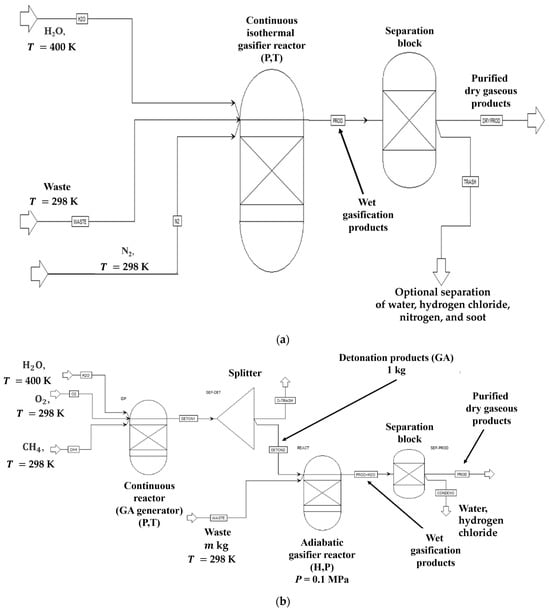
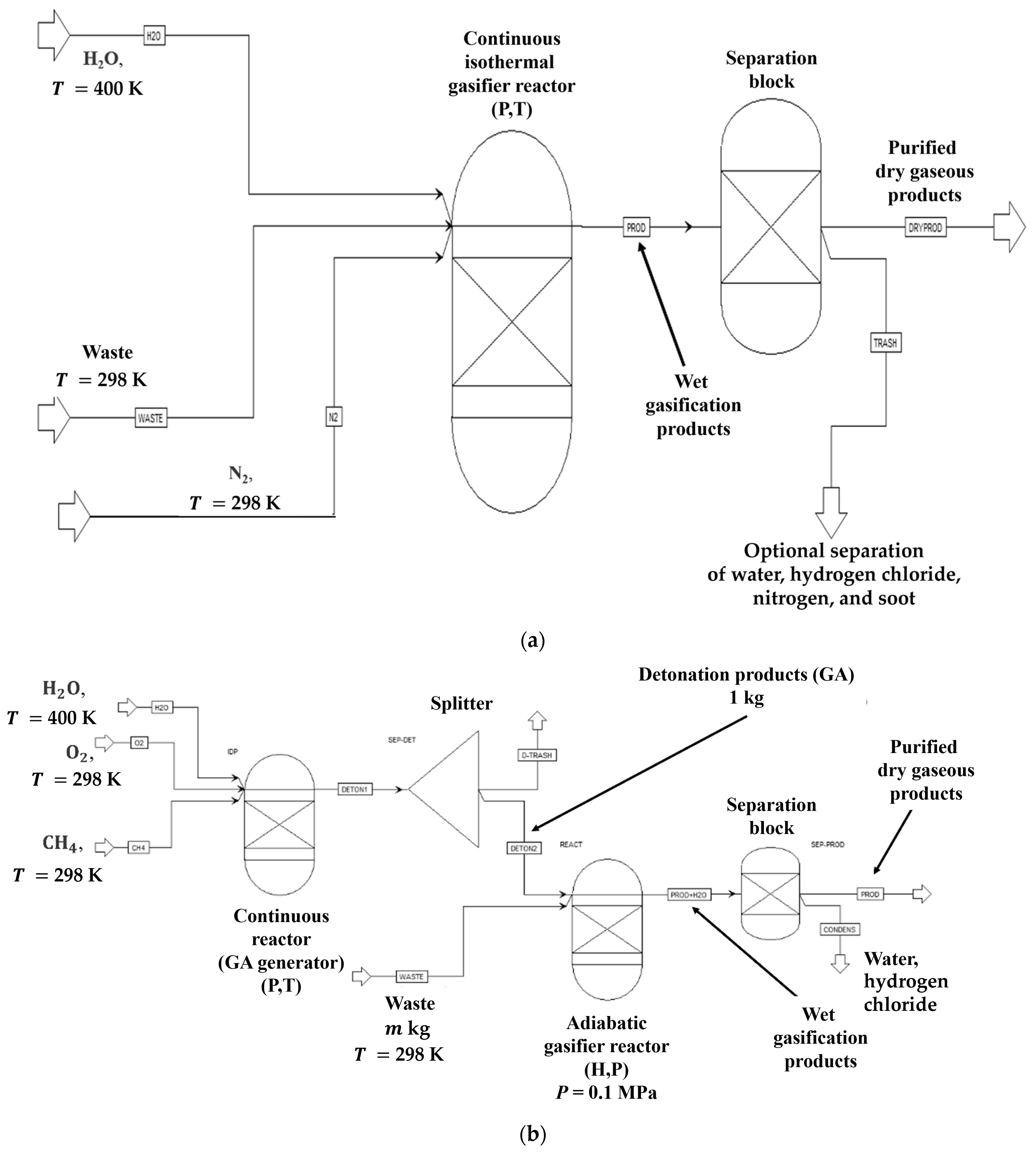
Figure 1 presents the calculation flowsheets of the gasification process for the studied chemical compounds developed in the Aspen Plus environment.
Figure 1.
Schematic diagrams of gasification processes implemented in the Aspen Plus software package: (a) steam gasification of feedstock (used for model validation); (b) steam—carbon dioxide gasification in a stream of detonation products of a ternary methane–oxygen–water vapor mixture expanded to atmospheric pressure.
The calculation flowsheet in Figure 1a is designed to validate the mathematical model against literature data on the steam conversion of feedstock at a pressure of 0.1 MPa. It includes inlet streams of the processed feedstock, steam, and a diluent gas (nitrogen), the ratios between which are set in strict accordance with the conditions of the cited experimental works. In a continuous isothermal gasifier reactor, homogenization of the inlet streams is performed, followed by the calculation of the corresponding equilibrium chemical composition at a fixed temperature. At the outlet of the reaction volume, a stream of wet gasification products is formed and directed to the separation block. This block provides optional separation of accompanying components: water, hydrogen chloride, nitrogen, and particulate carbon (soot). The resulting dry or purified stream of gaseous products is used to validate the calculation methodology by comparing its composition with experimental data.
The calculation flowsheet in Figure 1b is developed to model the regimes of high-temperature steam—carbon dioxide gasification of CHCs, where the detonation products of a triple methane–oxygen–water vapor mixture expanded to atmospheric pressure act as the GA. The flowsheet includes the following sequential blocks and physicochemical stages:
- Inlet streams of the combustible mixture components—O2, CH4, and H2O—with mass consumption of , , and (kg), respectively.
- A continuous reactor modeling the generation of the high-temperature GA (predominantly H2O and CO2). In this block, homogenization of the initial streams is performed at atmospheric pressure, and the thermodynamically equilibrium composition of the detonation products is calculated at a pressure of 0.1 MPa and a fixed temperature in the range of 2450 to 2850 K. Since the Aspen Plus software package lacks built-in tools for the direct calculation of the Chapman–Jouguet (CJ) parameters, the boundaries of this temperature interval were set exogenously based on preliminary modeling in specialized packages, namely SDToolbox [43] and Cantera [44]. The described algorithm allows for the adequate simulation of GA generation in the form of detonation products expanded to a pressure of 0.1 MPa.
- A stream splitting block (splitter), which receives the high-temperature GA from the continuous reactor. The splitter doses exactly 1 kg of the GA for feeding into the gasifier reactor, which significantly simplifies the subsequent interpretation and comparison of the calculation results. The excess amount of the generated GA is excluded from the further calculation cycle.
- An inlet feedstock stream with a mass of (kg), which determines the specific consumption of the processed feedstock per 1 kg of the GA. The feedstock is supplied to the system at a standard temperature of 298 K.
- An adiabatic gasifier reactor, where 1 kg of the high-temperature GA and kg of the feedstock are first mixed at atmospheric pressure, followed by the calculation of the equilibrium composition of the reaction products at 0.1 MPa and constant entropy. The total mass of the substances formed at the outlet of the adiabatic volume is 1 + (kg).
- A separator unit that splits the wet gasification products into a gaseous phase (H2, CO, CO2, CH4, etc.) and condensable species. It features optional water and HCl removal to ensure the correct evaluation of the dry gas composition. Additionally, the potential for complete dissolution of the generated hydrogen chloride within the residual steam condensate is analyzed for each considered CHC.
It is important to emphasize that the zero-dimensional Gibbs free energy minimization approach assumes an idealized state of instantaneous mixing and full thermodynamic equilibrium. Under practical operating conditions, several factors can induce deviations from these predicted values, namely, mixing and residence time constraints as well as heat losses. The rapid expansion of detonation products inherently facilitates intense macro- and micro-mixing. Given the ultra-high temperatures (up to 2450–2850 K), the chemical reaction time scales are very short compared to the gas residence time within the reaction zone, driving the system close to local thermodynamic equilibrium. The feedstock injection must preferably be finely atomized by the detonation or a detonation-induced shock wave to overcome localized mixing limitations that could restrict complete conversion. As for heat losses, practical reactors usually suffer from thermal losses through the walls, which lower the actual syngas temperature. Under these conditions, a lower operating temperature would slightly shift the equilibrium composition, potentially increasing the residual concentrations of minor byproducts or requiring higher GA consumption to compensate. However, 3D CFD calculations discussed in [45] indicate that under conditions of a high-speed (about 1 km/s on average) flow of detonation products entering a gasifier reactor, the wall temperature has a minor effect on the mean mass temperature in the reactor. In view of this, the present 0D model can be used to establish a clear upper thermodynamic boundary and identify the fundamental operating zones for efficient chlorine capture.
3. Results and Discussion
3.1. Model Validation: n-hexadecane
As the first test object for validating the developed model, n-hexadecane (n-C16H34) was chosen, which is commonly used as a physicochemical surrogate for waste motor oil [46]. The calculations were carried out according to the flowsheet presented in Figure 1a. The specific LHV of the initial n-hexadecane is 44.5 MJ/kg.
In addition to the main components (H2, CO, CH4, O2, CO2, and H2O), the list of potential steam conversion products included hydrogen peroxide (H2O2), as well as light hydrocarbons, alcohols, and aldehydes of the C1–C5 series (preliminary calculations showed that higher hydrocarbons of the C6–C12 series, like C6H6, C6H6O, C7H8O, …, C12H10, C12H8O2, etc., effectively decomposed at temperatures under consideration). Furthermore, unlike the baseline model [33], solid carbon in the graphite modification (C) was introduced into the phase composition of the products to simulate the formation of particulate soot.
Table 2 provides a comparison of the calculated and experimental compositions of the syngas generated during the catalytic steam conversion of n-hexadecane at atmospheric pressure. The range of investigated temperatures () was from 923 to 1246 K, and the steam-to-carbon (/C) ratio varied from 2.7 to 4.0. The table also indicates the corresponding literature sources that served as the basis for model validation. The comparison of calculated and measured concentrations was performed exclusively for long-term experiments in which the H2, CO, CO2, and CH4 profiles remained stable throughout the entire reactor operation time. From a thermodynamic perspective, validating the model against data at 550–973 °C (823–1246 K) provides a robust foundation. At ultra-high temperatures (up to 2450–2850 K), chemical reaction rates increase exponentially, meaning that thermodynamic equilibrium is achieved almost instantaneously without the need for catalytic acceleration. Therefore, a thermodynamic model that aligns well with experimental data at lower temperatures (where kinetic limitations are more pronounced) can be reliably extended to ultra-high-temperature conditions.
Table 2.
Comparison of calculated and experimental equilibrium compositions of syngas obtained from catalytic steam reforming of n-hexadecane at atmospheric pressure.
The high convergence of theoretical and experimental data indicates that, under the conditions considered, the steam conversion process reaches a thermodynamically equilibrium degree of conversion, and the developed model adequately describes the composition of the gasification products. It should be noted that when using certain catalytic systems, the complete conversion of the feedstock was not achieved in the experiments, which is explained either by the short residence time of the reactants in the reaction zone or by catalyst deactivation. The presence or absence of soot formation in the catalytic bed, recorded by the authors of the cited works, is reflected in the “Soot” column (a dash indicates the absence of relevant information in the primary source).
3.2. Model Validation: Chlorinated Hydrocarbons
As the next objects for validating the calculation methodology, the CHCs listed in Table 1 were selected. Thermodynamic modeling was carried out according to the flowsheet presented in Figure 1a. In addition to the components of the baseline model for n-hexadecane, many chlorine-containing substances available in the Aspen database were included in the list of potential steam conversion products such as: Cl2, HCl, ClO2, Cl2O, CCl4, CHCl3, CH2Cl2, COCl2, C2Cl2, C2H3Cl3, C2Cl6, C2H3ClO, C2H5ClO, C3H3Cl, C3H4Cl2, C3H5ClO, C4H7Cl, C4H9Cl, C5H9Cl, C6Cl6, C6H4Cl2, C6H5Cl, C6H4Cl2O, C7H6Cl2, C7H5Cl3, C7H5ClO3, C7H13ClO2,C8H7Cl, C8H3ClO3, C10H7Cl, etc., as well as such highly toxic polychlorinated dibenzo-1,4-dioxins (using tetrachlorodibenzodioxin, C12H4Cl4O2, as an example).
Table 3 provides a comparison of the calculated and experimental compositions of the syngas generated during the catalytic steam conversion of various CHCs at atmospheric pressure. The range of investigated temperatures () was from 973 to 1023 K (700–750 C), and the steam-to-carbon (/C) ratio varied widely from 2.0 to 20.0. Model validation for CHCs at 700–750 C or 973–1023 K ensures accuracy at ultra-high temperatures (up to 2450–2850 K). At such conditions, reaction rates increase exponentially, reaching equilibrium instantly without catalysts. This justifies extending the lower-temperature thermodynamic model to ultra-high-temperature zones.
Table 3.
Comparison of calculated and experimental equilibrium compositions of syngas obtained during the catalytic steam conversion of CHCs at atmospheric pressure.
3.3. Conditions for Achieving Complete Conversion into Non-Toxic Useful Products: n-hexadecane
To determine the conditions for achieving complete conversion of feedstocks into non-toxic industrially useful components using allothermal, high-temperature, non-catalytic steam—carbon dioxide gasification, the conversion of n-hexadecane was examined in the first stage. Modeling of this process was carried out according to the calculation scheme presented in Figure 1b. The methodology for processing and interpreting the obtained results, described in detail below using n-hexadecane as an example, is an end-to-end approach and is applied to all CHCs investigated in this work.
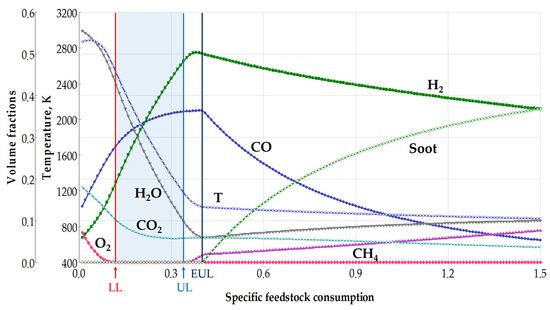
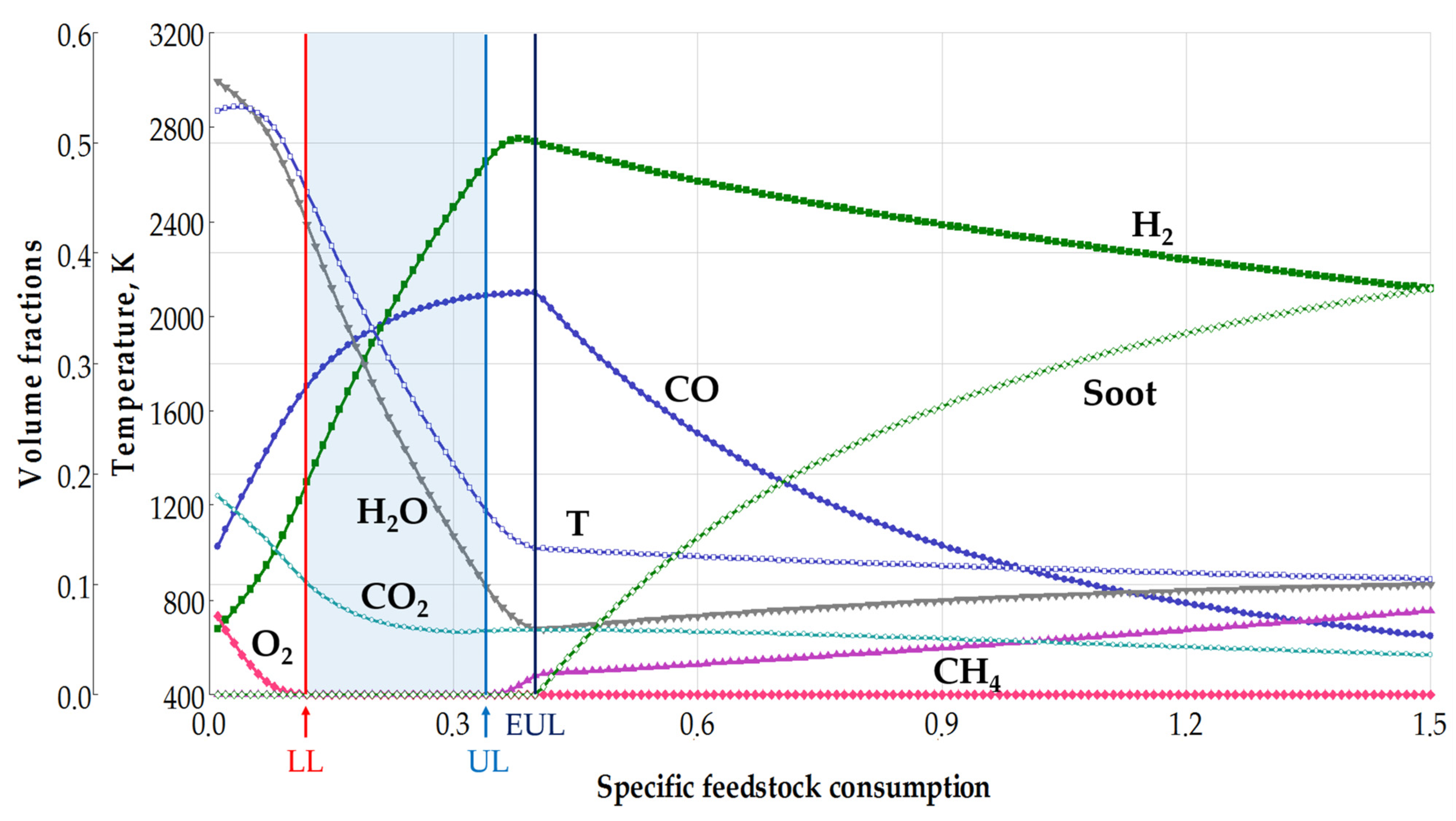
Figure 2 shows characteristic calculated dependences of the process temperature and the equilibrium composition of n-hexadecane gasification products on the specific feedstock consumption m. The modeling was performed for the conditions of GA generation during the detonation of a stoichiometric methane–oxygen mixture (fuel equivalence ratio 1) without the addition of water vapor ( 0). The point on the graphs characterizes the temperature and the initial equilibrium composition of the GA at the inlet of the adiabatic gasifier reactor. According to the calculations, at the inlet to the reaction zone, the GA has a temperature of 2852 K and contains 56 vol.% H2O, 19 vol.% CO2, 12 vol.% CO, 8 vol.% O2, and 5 vol.% H2 (the presence of radicals such as H, O, and OH in the expanded detonation products was not taken into account during the graphical visualization of the results in Figure 2).
Figure 2.
Calculated temperature and equilibrium composition of n-hexadecane gasification products as a function of specific feedstock consumption m (gasification by detonation products of a stoichiometric methane–oxygen mixture without steam addition: 1, 0).
As follows from the graphical dependences in Figure 2, the introduction of feedstock () into the gasifier reactor initiates a complex of physicochemical transformations that change the temperature and component composition of the medium. In the range of specific consumption 0 0.03, a moderate increase in the temperature of the gasification products up to a maximum extremum is observed, after which it monotonically decreases at 0.03. The initial heating of the system is due to the total exothermic effect of the reactions occurring predominantly through the oxidation of feedstock fragments by residual free oxygen in the GA. The subsequent temperature drop is determined by the dominance of endothermic reactions of steam (C + H2O = CO + H2) and carbon dioxide (C + CO2 = CO + CO) conversion of carbon contained in the initial feedstock.
Thermodynamic analysis indicates the existence of a certain range of values within which free oxygen ([O2] = 0), particulate carbon ([C] = 0), and hydrocarbons ([CH4] = 0) are simultaneously absent from the equilibrium product composition. For the conditions reflected in Figure 2, this interval is localized within the boundaries 0.11 0.35. This range is defined as the operating window of the gasification process, and its left and right boundaries are defined as the lower limit (LL) and upper limit (UL) of the operating window, respectively. For a more detailed analysis, an extended upper limit (EUL) is also introduced into consideration, fixing the region where [O2] = 0 and [C] = 0, but the presence of methane is allowed ([CH4] 0). Notably, the process temperatures realized at the UL and EUL of the operating window correspond well to the range of temperatures (700–950 °C or 973–1223 K) considered in the validation examples of Section 3.1.
The efficiency of the gasification process is traditionally evaluated using a set of integral indicators. These include the specific dry gas yield (DGY), carbon conversion efficiency (CCE), cold gas efficiency (CGE), and net energy efficiency (NEE).
The specific dry gas yield (DGY, Nm3/kg) characterizes the volumetric yield of gaseous products per unit mass of the processed feedstock:
where is the volume of the obtained dry syngas, Nm3; is the mass of the initial feedstock, kg.
The carbon conversion efficiency (CCE, %) represents the ratio of the total mass of carbon within the target components of the dry syngas to its total amount supplied to the gasifier reactor with the feedstock and the GA:
where is the mass fraction of carbon in the -th component of is the total mass fraction of carbon entering the gasifier reactor as part of the feedstock and the GA.
The cold gas efficiency (CGE, %) determines the fraction of the feedstock’s chemical energy transferred into the target gaseous energy carrier and describes the potential thermodynamic efficiency of the process:
where is the LHV of the obtained dry syngas, MJ/Nm3; is the LHV of the initial feedstock, MJ/kg.
The net energy efficiency (NEE, %) characterizes the ratio of the total chemical and thermal energy of the generated stream to the total energy inputs required to implement the process, including the potential of the feedstock and external energy supplies for GA generation [47]:
where is the mass of the obtained dry syngas, kg; is the enthalpy change in the syngas upon its cooling to normal temperature, MJ/kg; is the mass of steam within the gasification products, kg; is the specific latent heat of steam condensation (2.26 MJ/kg); is the LHV of methane (50 MJ/kg); is the specific energy consumption for oxygen production (1.1 MJ/kg [48]).
Unlike the CGE criterion, the NEE indicator provides a more comprehensive coverage of the system’s energy balance, since it takes into account both the thermal potential of cooling the syngas and the direct energy consumption for the generation of the high-temperature GA.
Calculations similar to the baseline case (see Figure 2) were performed for GAs generated during the detonation of fuel-lean ( 0.75) and fuel-rich ( 1.5) methane–oxygen mixtures. The modeling was conducted both for the initial compositions without dilution ( 0) and with the introduction of an additional amount of water vapor into the combustible mixture ( 20 and 40 vol.%). Table 4 shows five calculation modes in terms of the parameters of the initial combustible mixtures ( and ), as well as their corresponding calculated equilibrium temperatures () and GA component compositions. To assess the effect of detonation product dissociation, the calculations were performed in two variants: excluding and including the presence of free radicals (H, O, and OH). A comparison of the obtained data shows that the total content of radical components in the detonation products expanded to atmospheric pressure can reach 10 vol.%.
Table 4.
Parameters of the explosive mixture, equilibrium temperatures, and GA compositions at the inlet of the gasifier reactor.
Table 5 systemizes the results of modeling n-hexadecane gasification processes, performed both excluding and including the presence of radical components (H, O, and OH) within the expanded detonation products of the same five methane–oxygen mixtures. For each mode, the values of the specific feedstock consumption at the LL, UL, and EUL of the gasification operating window (referred to as the operational points (OP)), the final adiabatic syngas temperature , the equilibrium composition of the wet syngas, as well as the equilibrium composition, volume, and mass of the dry syngas obtained after the separation of condensed moisture are given. In addition, the table presents the calculated LHVs of the dry syngas and the integral process efficiency indicators: DGY, CCE, CGE, and NEE. When calculating the enthalpy term in Equation (4), the heat capacity values of the syngas components were taken at 298 K.
Table 5.
Thermodynamic and integral indicators of the n-hexadecane gasification process at the boundaries of the operating window.
Analysis of the data in Table 5 shows that complete conversion of the feedstock carbon (CCE = 100%) is ensured in all investigated modes. The specific dry gas yield reaches a level of 4.5–8.3 Nm3/kg either at the upper (UL and EUL) or lower (LL) limits of the operating window. The cold gas efficiency exceeds the 100% barrier across almost the entire range of parameters, peaking at 182%, which indicates a significant contribution of the detonation GA to the chemical potential of the products. The net energy efficiency indicator varies predominantly within the range of 70–90%. The inclusion of radical species (H, O, and OH) in the GA generally alters the dry-gas performance under identical baseline conditions, exerting the maximum impact on dry-gas volume and mass (up to 15%), LHV (up to 15%), as well as CGE and NEE (up to 8%), which stems from elevated final adiabatic syngas temperatures () (caused by radical recombination) and enhanced dry-gas H2 and CO content.
With an increase in the parameter from the LL to the EUL, an increase in the LHV of the produced syngas from 11.4 to 18.3 MJ/kg is observed for the GA generated by the detonation of fuel-lean ( 0.75) methane–oxygen mixtures, while the total volume fraction of combustible components in the dried and CO2-purified stream reaches 97%. It should be emphasized that removing the rigid restriction on the presence of methane in the final gas composition (the transition from UL to EUL) provides a pronounced improvement in all techno-economic and energy indicators of the considered technological scheme.
3.4. Conditions for Achieving Complete Conversion into Non-Toxic Useful Products: Chlorinated Hydrocarbons
To determine the conditions for achieving complete conversion of CHCs into non-toxic and industrially useful components using allothermal, high-temperature, non-catalytic steam—carbon dioxide gasification, the conversion of chlorohexadecane ( 14 wt.%) was examined in the next stage. Modeling of the gasification process was carried out according to the calculation scheme presented in Figure 1b. The methodology for processing the obtained data corresponds to the algorithm described above for the baseline hydrocarbon feedstock (n-hexadecane); however, the composition of potential gasification products was expanded to include chlorine-containing substances.
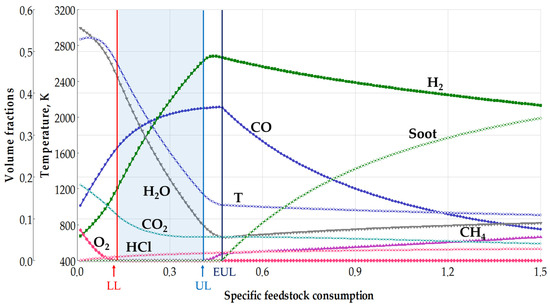
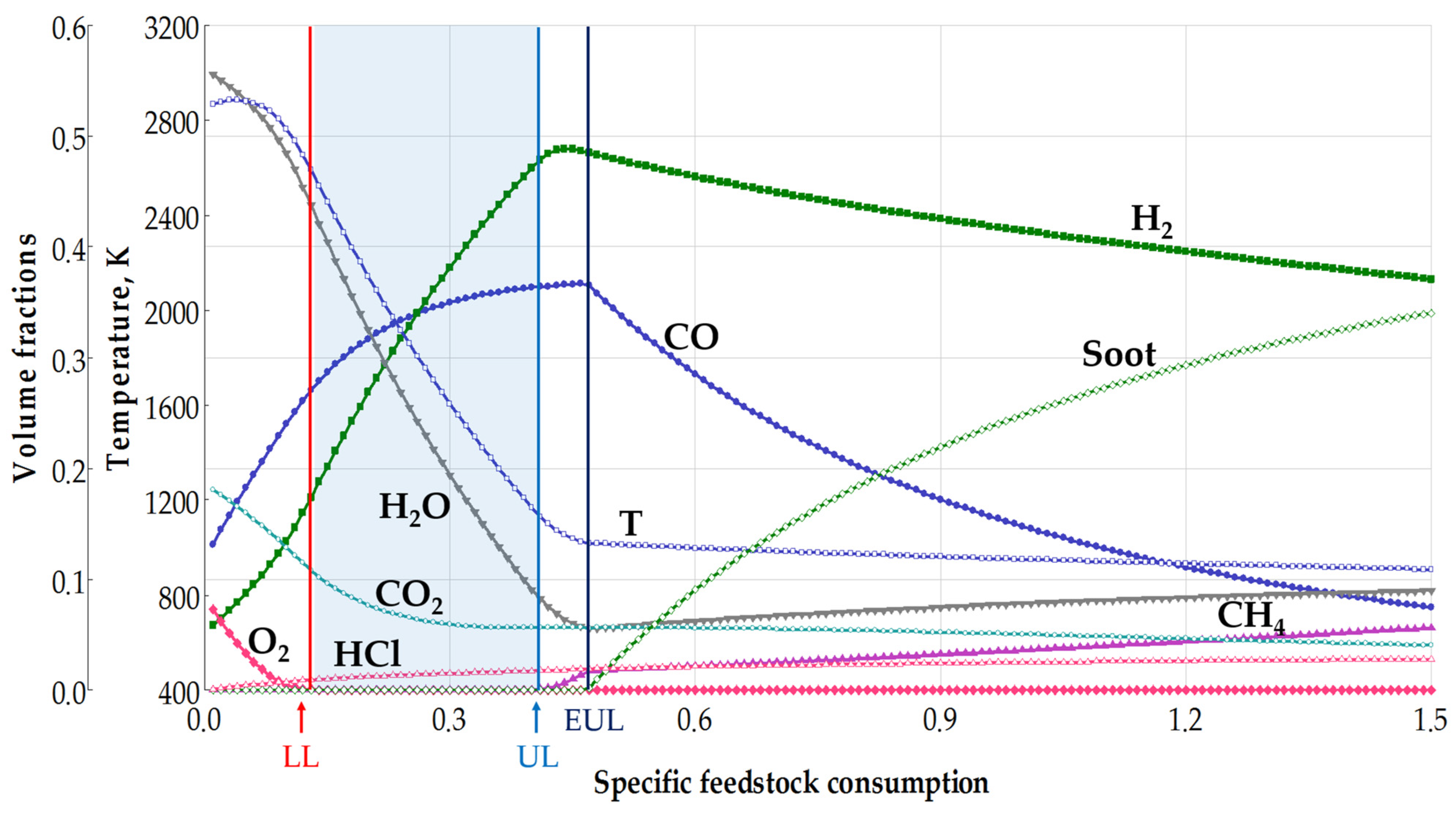
Figure 3 shows the calculated dependences of the process temperature and the equilibrium composition of chlorohexadecane gasification products on the specific feedstock consumption . The conditions for the generation of the high-temperature GA are identical to the baseline case (see Figure 2): detonation of a stoichiometric methane–oxygen mixture ( 1, 0). Accordingly, at the point , the parameters of the material and heat flows at the inlet of the adiabatic gasifier reactor completely match the data presented in Figure 2.
Figure 3.
Calculated temperature and equilibrium composition of chlorohexadecane gasification products as a function of the specific feedstock consumption m (gasification by detonation products of a stoichiometric methane–oxygen mixture without steam addition ( 1, 0).
The main difference between the thermodynamic profiles in Figure 3 is the appearance of hydrogen chloride (HCl) in the gasification products at , the volume fraction of which increases monotonically as the consumption of the processed feedstock increases. It should be emphasized that within the investigated range of conditions, other chlorine-containing compounds (including molecular chlorine Cl2, phosgene COCl2, and highly toxic dioxins C12H4Cl4O2 are virtually absent from the gas phase—their equilibrium volume fractions are significantly less than the conditional safety level of 10−6 (1 ppm).
The behavior of temperature and concentrations of the main gas components (H2, CO, CO2, H2O) is qualitatively equivalent to the dependences in Figure 2. Similarly, the operating window of the gasification process stands out on the graphs, characterized by the simultaneous fulfillment of the conditions [O2] = [C] = [CH4] = 0. For chlorohexadecane, the operating window is localized within the boundaries 0.13 0.41, where the LL and UL correspond to specific feedstock consumption values of 0.13 and 0.41. The extended operating window ([O2] [C] 0 at [CH4] 0) is limited to the range of 0.13 0.46, fixing the EUL at 0.46. Notably, the process temperatures realized at the UL and EUL of the operating window approximately correspond to the range of temperatures (700–750 °C or 973–1023 K) considered in the validation examples of Section 3.2.
Similar calculations were performed for all CHCs listed in Table 1, utilizing the detonation products of a stoichiometric, dry methane–oxygen mixture ( 1, 0) as the GA. The thermodynamic modeling evaluated two scenarios: with and without the inclusion of radical species (H, O, and OH).
The preliminary thermodynamic analysis indicated a distinct threshold at a chlorine content of approximately 70 wt.%. For feedstocks with a chlorine content below this value, designated as moderately chlorinated hydrocarbons, all hazardous chlorinated by-products (excluding HCl) remained strictly below the conditional 1 ppm safety threshold. Conversely, for feedstocks with a chlorine content exceeding this 70 wt.% limit, classified as highly chlorinated hydrocarbons, a sharp increase in toxic emissions was observed.
However, a more rigorous thermodynamic constraint was identified when dichloroacetylene C2Cl2 was introduced into the equilibrium product basis. It was revealed that the chlorine content ( alone is a necessary but insufficient criterion for predicting gasification safety. Specifically, for CHCs characterized by unsaturated (double) carbon–carbon bonds, the formation of C2Cl2 exceeding 1 ppm was observed even at chlorine concentrations well below the 70 wt.% threshold.
This phenomenon can be attributed to the high thermodynamic stability of the Cl–CC–Cl molecule at elevated temperatures (above ~1200 K), driven by its strong triple bond and resonance stabilization. Under hydrogen-deficient conditions typical for high-chlorine matrices, the presence of pre-existing double bonds in the precursor molecules significantly lowers the activation barrier for the synthesis of unsaturated chlorinated species. Thus, the molecular structure of the initial waste exerts a strong “hereditary” effect on the equilibrium product distribution.
This finding justifies the necessity of the co-feeding strategy proposed in this work. As shown below, the introduction of an external hydrocarbon source (e.g., C4H8O2) successfully mitigates this structural effect. By shifting the C:H:O atomic balance, the co-feeding method suppresses C2Cl2 formation and ensures that chlorine binds exclusively into manageable hydrogen chloride (HCl) across all types of CHC waste.
3.4.1. Moderately Chlorinated Hydrocarbons
The thermodynamic results for moderately chlorinated hydrocarbons are summarized in Table 6. For each investigated compound, the table provides the chlorine mass fraction (), the specific feedstock consumption () at the identified operational points (LL, UL, and EUL), and the final adiabatic gasification temperature (). Additionally, it details the equilibrium wet gas composition, the volume and mass of the chlorine-free dry gas obtained after moisture and hydrogen chloride separation, the lower heating value LHV (), and the integral efficiency indicators (DGY, CCE, CGE, and NEE). These efficiency indicators are determined based on the chlorine-free dry gas composition, where the enthalpy term () in Equation (4) is evaluated using the specific heat capacities of the dry gas components at 298 K.
Table 6.
Thermodynamic and integral indicators of the gasification process of moderately chlorinated hydrocarbons at the boundaries of the operating window.
It should be noted that during the gasification of certain CHCs—specifically those with highly chlorinated matrices or unsaturated structures—it is advisable to implement the co-feeding strategy used in [20]. The approach involves co-feeding organochlorine wastes with aliphatic or oxygen-containing hydrocarbons. This method simultaneously reduces the total mass fraction of chlorine in the reactive mixture and suppresses C2Cl2 formation, thereby ensuring that chlorine binds exclusively into manageable hydrogen chloride (HCl). In Table 6, this strategy is demonstrated using a blended feedstock consisting of chloroform and ethyl acetate (CHCl3 + 16.5 C4H8O2) mixed at a 1:16.5 molar ratio, yielding a solvent mass fraction of 0.924.
Analysis of the data in Table 6 indicates that complete conversion of the feedstock carbon (CCE = 100%) is ensured across all investigated CHC gasification modes. The volumetric yield of dry gas at the LL of the operating range is higher than at the UL and EUL, reaching up to ~5.7 Nm3/kg for C16H33Cl. This value consistently decreases with an increase in the chlorine content (), dropping to ~1.9 Nm3/kg for CH3Cl.
The CGE of the process exceeds the 100% barrier across almost the entire parameter range, reaching a maximum value of 138%. This occurs because the high-temperature GA introduces substantial external thermal and chemical energy into the control volume. Importantly, the energy balance for the detonation-driven gasification is governed by the NEE, which incorporates the energy required to generate the GA, thus remaining below 100% for the overall integrated system. Therefore, when comparing the proposed technology with conventional allothermal or plasma-assisted methods, the NEE serves as the primary metric. The achieved NEE values (~89%) demonstrate that detonation-driven gasification is thermodynamically competitive with high-temperature plasma arc systems (NEE ≈ 84%, based solely on electricity-to-thermal conversion [49,50]), while offering significantly lower capital costs due to the absence of expensive power supply complexes. The inclusion of radical species (H, O, and OH) in the GA generally yields a trend consistent with the previously outlined chlorohexadecane gasification data.
With an increase in the specific feedstock consumption from the LL to the EUL, a monotonic increase in the LHV of the generated gas up to 18 MJ/kg is observed. At the same time, the maximum total volume fraction of combustible components in the dried and CO2-purified product stream reaches 99%. It should be emphasized that removing the restriction on the presence of methane in the final gas composition (the transition from UL to EUL) provides a pronounced improvement in all integral performance and energy indicators of the considered technological scheme for CHC utilization.
The potential for complete hydrogen chloride dissolution within the residual steam condensate is also addressed. To evaluate this, Table 7 details the thermodynamic parameters governing HCl absorption by the aqueous phase of the wet gasification products. As a limiting condition, the formation of a saturated hydrochloric acid solution with a molar ratio of HCl/H2O 0.36 at a temperature of 293 K and a pressure of 0.1 MPa [51] is adopted. The specific feedstock consumption corresponding to the formation of such a saturated solution is designated as . As before, the GA consisted of the detonation products of a stoichiometric, water-vapor-free methane–oxygen mixture ( 1, 0). Two calculation scenarios were compared, considering the system both with and without radical components (H, O, and OH).
Table 7.
Characteristics of gasification products of moderately chlorinated hydrocarbons at the specific feedstock consumption corresponding to the complete dissolution of HCl in the steam condensate at 293 K and 0.1 MPa.
Data in Table 7 demonstrate that the entire amount of hydrogen chloride generated during the gasification of all considered moderately chlorinated compounds can be completely dissolved within the residual steam condensate. For a given feedstock, the threshold value is either equal to or less than the corresponding value at the EUL.
For CH3Cl, it is found that LL, meaning that feedstock gasification under these conditions would require the presence of free oxygen in the GA, which is unacceptable [30]. Under these circumstances, two solutions are possible. The first approach involves the external addition of steam to the wet gasification products upstream of the separator (see Figure 1b) to ensure complete dissolution of the generated HCl in water. The second solution is the co-feeding of the organochlorine feedstock with aliphatic or oxygen-containing hydrocarbons, which reduces the total mass fraction of chlorine in the reactive mixture. The effectiveness of this latter approach is demonstrated using the CHCl3 + 16.5 C4H8O2 blend as an example (see Table 7).
To provide a practical baseline for the process economics, the specific consumption of the detonation mixture components can be readily quantified based on the data in Table 7. For instance, for every 1 kg of a moderately chlorinated hydrocarbon (C12H6Cl4, 49%) processed at the optimal operating point (0.4), the system consumes 0.5 kg of CH4 and 2.0 kg of O2 to generate the required high-temperature GA. This yields 2.3 kg of syngas (composed of 29 vol.% H2, 58 vol.% CO, and 13 vol.% CO2) and 1.2 kg of a saturated aqueous solution of hydrochloric acid.
3.4.2. Highly Chlorinated Hydrocarbons
An important distinguishing feature of CHC conversion, particularly for highly chlorinated feedstocks, is the potential presence of hazardous species such as Cl2, COCl2, C2Cl2, and other chloring-containing species, including dioxin C12H4Cl4O2, in the gasification products. To systematically evaluate this phenomenon, Table 8 summarizes the equilibrium mass yields () and volume fractions (in ppm) of these ecotoxicants calculated at the UL of the corresponding operating windows for all investigated CHCs. In this table, each CHC is examined across a spectrum of dilution levels with ethyl acetate (C4H8O2), where denotes the mass fraction of the solvent in the blended feedstock (including the undiluted case where 0), and denote the masses of the ecotoxicants and CHC at the UL, respectively.
Table 8.
The mass yields and volume fractions of Cl2, COCl2, and C2Cl2 in the gasification products calculated at the UL of the corresponding operating windows for CHCs undiluted and diluted in C4H8O2.
The primary objective of this data matrix is to identify the critical dilution thresholds required to mitigate toxic emissions. The thermodynamic analysis demonstrates that while the gasification of some undiluted feedstocks ( 0) results in unacceptably high concentrations of Cl2, COCl2, and C2Cl2 (notably, the mass yields and volume fractions of other chlorine-containing species, including highly toxic dioxins, remain much less than 1 ppm even in the absence of dilution), the systematic increase of triggers a sharp, highly non-linear drop in both the mass yields and volumetric fractions of these pollutants. For instance, during the gasification of pure C2HCl3, the equilibrium mass yield and volume fractions of C2Cl2 reach 0.24 and 7.1 × 10⁴ ppm, respectively; however, introducing a solvent mass fraction of 10 wt.% ( 0.1) in the mixture reduces these values to 0.1 and 2.0 × 10⁴ ppm. A further increase to 20 wt.% ( 0.2) causes a steep decline to 0.0026 and 370 ppm, and at ( 0.33), the C2Cl2 mass yield and volume fraction fall to negligible 1.6 × 10⁻⁶ and 0.16 ppm, respectively. A closely matching non-linear trend is also observed for the other targeted ecotoxicants. Ultimately, the data establish the specific minimum dilution ratios at which the concentrations of all target hazardous species are successfully suppressed below the conditional environmental safety limit of 1 ppm. Importantly, the data in Table 8 demonstrate that the required maximum mass fraction of the solvent does not exceed 0.33 ( 0.33) across all investigated cases, confirming the high economic and technical viability of the proposed co-feeding strategy.
The pronounced non-linear behavior is attributed to a shift in the thermodynamic equilibrium driven by the changing elemental ratios (primarily H:Cl) in the reaction zone. In undiluted highly chlorinated feedstocks, the deficit of hydrogen restricts the complete binding of chlorine into HCl, thereby leaving a significant pool of chlorine radicals available for the synthesis of C2Cl2, COCl2, and Cl2. The introduction of C4H8O2 enriches the system with hydrogen. Due to the power-law nature of the law of mass action and mass balance equations, this hydrogen enrichment exponentially shifts the chemical equilibrium toward the highly stable HCl. Once the solvent mass fraction approaches the threshold of 0.33, the excess hydrogen completely scavenges the available chlorine, resulting in the observed multi-order drop in ecotoxicant concentrations.
3.5. Comparison Between Thermal Plasma Gasification and the Proposed Detonation-Driven Gasification
In thermal plasma arc gasification [49,50], the local torch temperature exceeds 10,000 K, while the average bulk temperature in the reactor zone typically ranges between 1500 and 2000 K. Generating this thermal plasma requires enormous external electrical energy inputs (typically 1–3 kWh per kg of waste processed), resulting in a NEE (up to ~84%, based solely on electricity-to-thermal conversion). If the losses inherent in electricity generation are additionally taken into account, the overall NEE becomes considerably lower. In contrast, the proposed detonation-driven process achieves a highly uniform bulk reaction temperature on the same level of 1500–2000 K and above (up to 2450–2850 K) directly from the chemical energy of the detonating methane–oxygen mixture. Because it eliminates the intermediate electricity generation phase and relies on direct chemical-to-thermal conversion, the integrated system achieves a significantly higher NEE of up to ~89% for combustible CHCs.
Thermal plasma destruction of chlorinated wastes provides a high toxicant destruction and removal efficiency (above 99.99%). However, because plasma gasification often operates with local temperature gradients, localized quenching can sometimes lead to micro-proportions of unreacted molecular chlorine (Cl2) or trace phosgene (COCl2) if the cooling rate is not strictly controlled. The detonation-driven 0D model developed in this work demonstrates that at a uniform process temperature on the same level of 1500–2000 K and above, chlorine can be bound exclusively into hydrogen chloride (HCl), while hazardous ecotoxicants (such as phosgene and dioxins) remain below the conditional 1 ppm threshold. Furthermore, the proposed process provides a distinct engineering advantage: the high moisture content in the residual steam condensate allows for the direct, in situ synthesis of commercial-grade hydrochloric acid upon cooling to 293 K, thereby solving the problem of secondary waste stream purification that often complicates plasma gasification plants. Finally, Table 9 compares the literature-reported thermal plasma gasification data with the proposed detonation-driven gasification system in terms of reaction temperature, energy consumption/efficiency, product purity, and toxicant control efficiency.
Table 9.
Comparison between thermal plasma gasification and the proposed detonation-driven gasification.
4. Conclusions
In this work, using thermodynamic modeling in the Aspen Plus software package, the fundamental feasibility and high efficiency of allothermal, high-temperature, non-catalytic steam—carbon dioxide gasification for the environmentally safe utilization of CHCs have been substantiated. Detonation products of ternary methane–oxygen–water vapor mixtures expanded to atmospheric pressure were considered as the steam—carbon dioxide GA.
Based on the obtained calculation data, the following key conclusions have been formulated:
- Validation of the developed 0D model was performed using literature data on the catalytic steam reforming of pure hydrocarbon feedstock (n-hexadecane) and various CHCs at atmospheric pressure. Good agreement between the theoretical and experimental equilibrium gas compositions confirms the adequacy of the chosen thermodynamic basis (Gibbs free energy minimization).
- It was established that within the investigated range of conditions, utilizing the high-temperature GA ( 2450–2850 K) ensures that the chlorine heteroatom binds predominantly into hydrogen chloride (HCl). For moderately chlorinated CHCs (chlorine content below 70 wt.%) with saturated molecular structures, the equilibrium volume fractions of major chlorine-containing ecotoxicants—molecular chlorine (Cl2), phosgene (COCl2), and dichloroacetylene (C2Cl2)—do not exceed the conditional threshold value of 10−6 (1 ppm) in the reaction zone. As for other chlorine-containing ecotoxicants, including highly toxic dioxins, their equilibrium concentrations remain negligibly small (with their fractions dropping well below 1 ppm) across all investigated gasification modes, even for undiluted feedstocks. This demonstrates that chlorine is bound exclusively into HCl under these conditions, thereby ensuring an environmentally safe thermal waste disposal process.
- For each investigated feedstock, the boundaries of the operating windows are determined in terms of the specific feedstock consumption (per 1 kg of GA), within which free oxygen, particulate carbon (soot), and hydrocarbons are simultaneously absent from the conversion products. It is shown that allowing the presence of methane in the final products (the transition to the extended upper limit, EUL) significantly improves all integral characteristics of the process.
- Complete conversion of the feedstock carbon (CCE = 100%) is ensured across all operating modes of CHC gasification. The volumetric yield of dry syngas reaches up to 5.7 Nm3/kg of feedstock at a lower heating value (LHV) of up to 18 MJ/kg, with the total fraction of combustible components reaching up to 99 vol.%. The CGE exceeds the 100% barrier (up to 138%), proving the effective transformation of the detonation product energy into the chemical energy of the syngas.
- It was demonstrated that the gasification of undiluted highly chlorinated or unsaturated CHCs leads to unacceptably high equilibrium concentrations of Cl2, COCl2, and C2Cl2, exceeding the conditional 1 ppm safety limit. To overcome this structural constraint, a feedstock dilution strategy using an external hydrocarbon source (C4H8O2) was proposed. Shifting the C:H:O atomic balance via systematic feedstock blending effectively suppresses the formation of these hazardous species, ensuring that their concentrations in the syngas drop below 1 ppm across the entire operating window. Importantly, a solvent mass fraction of no more than 0.33 ( 0.33) in the initial feedstock blend is sufficient to achieve this toxic species suppression.
- A chlorine capture algorithm was substantiated based on the dissolution of the generated HCl within the residual steam condensate upon cooling the gasification products to 293 K. For highly chlorinated feedstocks (chlorine content above 70 wt.%), a moisture deficit coupled with a free oxygen excess in the GA makes standard gasification unfeasible. To address this, a co-feeding method using external hydrocarbons was proposed and validated (demonstrated via co-feeding CHCs with C4H8O2). This approach ensures complete HCl dissolution across the entire operating range, yielding a commercial-grade aqueous hydrochloric acid solution.
The proposed method of detonation-driven steam—carbon dioxide gasification of CHCs is a promising, economically affordable, and less energy-intensive alternative to high-temperature plasma-chemical technologies for toxic industrial waste utilization. While the present 0D thermodynamic model establishes the theoretical boundaries and operating windows for safe chlorine capture, it directly serves as a foundational design tool for upcoming physical testing. Future work will focus on pilot-scale experimental validation of the proposed technology within the identified optimal operating windows under strict environmental and safety controls.
Author Contributions
Conceptualization, S.M.F.; methodology, S.M.F.; software, N.V.A. and F.S.F.; validation, S.M.F., N.V.A. and F.S.F.; formal analysis, S.M.F.; investigation, N.V.A. and F.S.F.; resources, S.M.F.; data curation, S.M.F., N.V.A. and F.S.F.; writing—original draft preparation, S.M.F.; writing—review and editing, S.M.F.; supervision, S.M.F.; project administration, S.M.F.; funding acquisition, S.M.F. All authors have read and agreed to the published version of the manuscript.
Funding
This research received no external funding.
Institutional Review Board Statement
Not applicable.
Data Availability Statement
The original contributions presented in this study are included in the article. Further inquiries can be directed to the corresponding author.
Conflicts of Interest
The authors declare no conflicts of interest.
Abbreviations
The following abbreviations are used in this manuscript:
| CCE | Carbon conversion efficiency |
| CGE | Cold gas efficiency |
| CHC | Chlorinated hydrocarbons |
| CJ | Chapman–Jouguet |
| DGY | Dry gas yield |
| EUL | Extended upper limit |
| GA | Gasifying agent |
| LHV | Lower heating value |
| LL | Lower limit |
| NEE | Net energy efficiency |
| OP | Operating points |
| PCDD/Fs | polychlorinated dibenzo-p-dioxins and dibenzofurans |
| UL | Upper limit |
References
- Stockholm Convention on Persistent Organic Pollutants (POPs). Available online: https://www.pops.int/TheConvention/ThePOPs/The12InitialPOPs/tabid/296/Default.aspx (accessed on 28 May 2026).
- Papp, R. Organochlorine waste management. Pure Appl. Chem. 1996, 68, 1801–1808. [Google Scholar] [CrossRef] [Scilit]
- Grabovnikov, V.A.; Borevsky, B.V. Podzemnoe zahoronenie zhidkih othodov—Uspehi, problemy, perspektivy [Underground disposal of liquid wastes—Successes, problems, prospects]. Geoekologiya Inzhenernaya Geol. Gidrogeol. Geokriol. 2011, 6, 512–523. (In Russian) [Google Scholar]
- Catherine, H.N.; Ou, M.-H.; Manu, B.; Shih, Y. Adsorption mechanism of emerging and conventional phenolic compounds on graphene oxide nanoflakes in water. Sci. Total Environ. 2018, 635, 629–638. [Google Scholar] [CrossRef] [Scilit] [PubMed]
- Shannahan, C.E.; Weber, H.; Hauptman, G.; Carduck, N. Chlorolysis Applied to the Conversion of Chlorocarbon Residues. EPA-600/2-78-146. 1978. Available online: https://nepis.epa.gov/Exe/ZyPDF.cgi/9101840A.PDF?Dockey=9101840A.PDF (accessed on 28 May 2026).
- Li, C.; He, L.; Yao, X.; Yao, Z. Recent advances in the chemical oxidation of gaseous volatile organic compounds (VOCs) in liquid phase. Chemosphere 2022, 295, 133868. [Google Scholar] [CrossRef] [Scilit] [PubMed]
- Torrento, C.; Audí-Miro, C.; Bordeleau, G.; Marchesi, M.; Rosell, M.; Otero, N.; Soler, A. The use of alkaline hydrolysis as a novel strategy for chloroform remediation: The feasibility of using construction wastes and evaluation of carbon isotopic fractionation. Environ. Sci. Technol. 2014, 48, 1869−1877. [Google Scholar] [CrossRef] [Scilit]
- Lingaiah, N.; Uddin, M.A.; Muto, A.; Imai, T.; Sakata, Y. Removal of organic chlorine compounds by catalytic dehydrochlorination for the refinement of municipal waste plastic derived oil. Fuel 2001, 80, 1901–1905. [Google Scholar] [CrossRef] [Scilit]
- Annenkova, V.Z.; Khaliullin, A.K.; Bugun, L.G.; Voronkov, M.G. Issledovanie processa polikondensacii hlorbenzolov s sul’fidom natriya [Investigation of the polycondensation of chlorobenzenes with sodium sulfide]. Vysokomol. Soedin. Seriya B 1982, 24, 278–282. (In Russian) [Google Scholar]
- Muganlinsky, F.F.; Treger, Y.A.; Lyushin, M.M. Himiya i Tekhnologiya Galogenorganicheskih Soedinenij [Chemistry and Technology of Organohalogen Compounds]; Khimiya Publisher: Moscow, Russia, 1991; 272p. (In Russian) [Google Scholar]
- Vaisman, Y.I.; Ketov, A.A.; Korotaev, V.N.; Krasnovskikh, M.P. Ob ekologicheskoj opasnosti szhiganiya organicheskih othodov v prisutstvii soedinenij hlora [On the environmental hazard of incineration of organic wastes in the presence of chlorine compounds]. Ekol. Promyshlennost’ Ross. [Ecol. Ind. Russ.] 2018, 22, 14–17. (In Russian) [Google Scholar] [CrossRef] [Scilit]
- Mishakov, I.V.; Bauman, Y.I.; Dyachkova, S.G.; Potylitsyna, A.R.; Vedyagin, A.A. Kompleksnyj podhod k utilizacii hlororganicheskih soedinenij na primere othodov proizvodstva vinilhlorida [Integrated approach to the utilization of organochlorine compounds on the example of vinyl chloride production wastes]. Dokl. Akad. Nauk. Khimiya Nauk. O Mater. [Dokl. Chem.] 2023, 508, 70–78. (In Russian) [Google Scholar] [CrossRef] [Scilit]
- Chang, S.H. Plastic waste as pyrolysis feedstock for plastic oil production: A review. Sci. Total Environ. 2023, 877, 162719. [Google Scholar] [CrossRef] [Scilit] [PubMed]
- Liu, Y.J.; Crittenden, J.C.; Wang, L.; Liu, P.L. Dechlorination and decomposition of chloroform induced by glow discharge plasma in an aqueous solution. J. Hazard. Mater. 2018, 308, 84–90. [Google Scholar]
- Chu, C.; Wang, P.; Bor’e, A.; Ma, W.; Chen, G.; Wang, P. Thermal plasma co-gasification of polyvinylchloride and biomass mixtures under steam atmospheres: Gasification characteristics and chlorine release behavior. Energy 2023, 262, 125385. [Google Scholar] [CrossRef] [Scilit]
- Kim, S.W.; Park, H.-S.; Kim, H.-J. 100 kW steam plasma process for treatment of PCBs (polychlorinated biphenyls) waste. Vacuum 2003, 70, 59–66. [Google Scholar] [CrossRef] [Scilit]
- Yamamoto, T.; Sato, H.; Matsukura, Y.; Ujisawa, Y.; Ishida, H.; Sasaki, S.; Hata, Y. Gasification and smelting system using oxygen blowing for plastic waste including polyvinyl chloride. J. Mater. Cycles Waste Manag. 2004, 6, 6–12. [Google Scholar] [CrossRef] [Scilit]
- Ortego, J.D., Jr.; Richardson, J.T.; Twigg, M.V. Catalytic steam reforming of chlorocarbons: Methyl chloride. Appl. Catal. B Environ. 1997, 12, 339–355. [Google Scholar] [CrossRef] [Scilit]
- Shafiei, M.; Richardson, J.T. Dechlorination of chlorinated hydrocarbons by catalytic steam reforming. Appl. Catal. B 2004, 54, 251–259. [Google Scholar] [CrossRef] [Scilit]
- Wu, Q.; Xu, C.; Zheng, Y.; Liu, J.; Deng, Z.; Liu, J. Steam reforming of chloroform-ethyl acetate mixture to syngas over Ni-Cu based catalysts. Catalysts 2021, 11, 826. [Google Scholar] [CrossRef] [Scilit]
- Koritár, M.; Haydary, J. Reduction of tar, sulfur, chlorine and CO2 in syngas produced by gasification of refuse-derived fuel pellets. Sci. Rep. 2025, 15, 18446. [Google Scholar] [CrossRef] [Scilit] [PubMed]
- Ayuso-Díaz, I.; Perez-Gil, S.; Lopez, G.; Santamaria, L.; Antoñanzas-González, F.J. Progress on waste plastics gasification process: A review of operating conditions, reactors and catalysts for clean syngas production and tar abatement. Int. J. Hydrogen Energy 2025, 148, 150000. [Google Scholar] [CrossRef] [Scilit]
- Qi, Y.; Muhammad, U.; Zhang, W.; Song, Y.; Zhang, M.; Wang, M.; Xu, C.; Xu, Y.; Cai, S.; Han, C.; et al. A comprehensive evaluation of recent advancement in municipal solid waste gasification: Research status, technical challenges and Perspectives. Sep. Purif. Technol. 2025, 358, 130443. [Google Scholar] [CrossRef] [Scilit]
- Kopsch, M.; Schuster, P.; Yazhenskikh, E.; Sitzmann, J.; Müller, M. Chemical hot gas cleaning of Alkali, Chlorine, and Sulphur species in a sorption enhanced gasification process at 650 °C. Fuel 2026, 406, 136933. [Google Scholar] [CrossRef] [Scilit]
- Moustafa, A.; Abdelrahman, K.; Abdelhaleem, A.; Fahim, I.S. Valorization of plastic waste via hydrothermal liquefaction and hydrothermal gasification: Review and bibliometric analysis. J. Anal. Appl. Pyrolysis 2025, 189, 107112. [Google Scholar] [CrossRef] [Scilit]
- Helf, A.; Keller, F.; Gräbner, M. Electrification of gasification-based chemical recycling—A techno-economic assessment. Energy Convers. Manag. 2026, 353, 121181. [Google Scholar] [CrossRef] [Scilit]
- Voronkov, M.G.; Tatarova, L.A.; Trofimova, K.S.; Verkhozina, E.I.; Khaliullin, A.K. Pererabotka promyshlennyh hlor- i serosoderzhashchih othodov [Processing of industrial chlorine- and sulfur-containing wastes]. Him. V Interes. Ustojchivogo Razvit. [Chem. Sustain. Dev.] 2001, 9, 393–403. (In Russian) [Google Scholar]
- Wang, J.; Shih, Y.; Wang, P.Y.; Yu, H.Y.; Su, J.F.; Huang, C.-P. Hazardous waste treatment technologies. Water Environ. Res. 2019, 91, 1177–1198. [Google Scholar] [CrossRef] [Scilit] [PubMed]
- Semenova, S.L. Plazma i pererabotka othodov: Rasshirenie vozmozhnostej [Plasma and waste processing: Expanding opportunities]. Klim. Prir. [Clim. Nat.] 2018, 2, 46–57. (In Russian) [Google Scholar]
- Fedorov, L.A. Dioksiny kak Ekologicheskaya Opasnost’: Retrospektiva i Perspektivy [Dioxins as an Environmental Hazard: Retrospective and Prospects]; Nauka Publisher: Moscow, Russia, 1993; 266p. (In Russian) [Google Scholar]
- Frolov, S.M.; Smetanyuk, V.A.; Nabatnikov, S.A. Sposob Gazifikacii Uglya v Sil’no Peregretom Vodyanom Pare i Ustrojstvo Dlya Ego Osushchestvleniya [Method for Coal Gasification in Highly Superheated Water Vapor and a Device for Its Implementation]. Russian Federation Patent, No. RU 2683751 C1, 1 April 2019. (In Russian) [Google Scholar]
- Frolov, S.M. Organic waste gasification by ultra-superheated steam. Energies 2023, 16, 219. [Google Scholar]
- Panin, K.S.; Smetanyuk, V.A.; Frolov, S.M. Gazifikaciya zhidkih uglevodorodnyh othodov vysokotemperaturnymi produktami gazovoj detonacii: Termodinamicheskie raschety sostava i temperatury poluchaemogo sintez-gaza [Gasification of liquid hydrocarbon wastes by high-temperature gas detonation products: Thermodynamic calculations of the composition and temperature of the obtained synthesis gas]. Goren. Vzryv [Combust. Explos.] 2024, 17, 74–94. (In Russian) [Google Scholar] [CrossRef] [Scilit]
- Ming, Q.; Healey, T.; Allen, L.; Irving, P. Steam reforming of hydrocarbon fuels. Catal. Today 2022, 77, 51–64. [Google Scholar]
- Shoynkhorova, T.B.; Simonov, P.A.; Potemkin, D.I.; Snytnikov, P.V.; Belyaev, V.D.; Ishchenko, A.V.; Svintsitskiy, D.A.; Sobyanin, V.A. Highly dispersed Rh-, Pt-, Ru/Ce0.75Zr0.25O2–δ catalysts prepared by sorption-hydrolytic deposition for diesel fuel reforming to syngas. Appl. Catal. B Environ. 2018, 237, 237–244. [Google Scholar] [CrossRef] [Scilit]
- Hirata, K.; Kamizono, M.; Katagiri, K.; Kusumi, M.; Takeda, Y.; Shinoki, T.; Tanigawa, H. Steam reforming of petroleum heavy hydrocarbons. Trans. JSME 2018, 84, 17-00384. [Google Scholar] [CrossRef] [Scilit]
- Kim, D.H.; Kang, J.S.; Lee, Y.J.; Park, N.K.; Kim, Y.C.; Hong, S.I.; Moon, D.J. Steam reforming of n-hexadecane over noble metal-modified Ni-based catalysts. Catal. Today 2008, 136, 228–234. [Google Scholar] [CrossRef] [Scilit]
- Thormann, J.; Maier, L.; Pfeifer, P.; Kunz, U.; Deutschmann, O.; Schubert, K. Steam reforming of hexadecane over a Rh/CeO2 catalyst in microchannels: Experimental and numerical investigation. Int. J. Hydrogen Energy 2009, 34, 5108–5120. [Google Scholar] [CrossRef] [Scilit]
- Thormann, J.; Pfeifer, P.; Kunz, U.; Schubert, K. Reforming of diesel fuel in a micro reactor. Int. J. Chem. React. Eng. 2008, 6, P1. [Google Scholar] [CrossRef] [Scilit]
- Coute, N.; Ortego, J.D., Jr.; Richardson, J.T.; Twigg, M.V. Catalytic steam reforming of chlorocarbons: Trichloroethane, trichloroethylene and perchloroethylene. Appl. Catal. B Environ. 1998, 19, 175–187. [Google Scholar] [CrossRef] [Scilit]
- Intarajang, K.; Richardson, J.T. Catalytic steam reforming of chlorocarbons: Catalyst comparisons. Appl. Catal. B Environ. 1999, 22, 27–34. [Google Scholar] [CrossRef] [Scilit]
- Chen, H.; Liu, Y.; Zuo, J.C.; Deng, Y.; Wang, H.; Fan, Q. Advances in the use of Aspen for lignocellulosic biomass gasification. Bioresour. Technol. Rep. 2026, 34, 102620. [Google Scholar] [CrossRef] [Scilit]
- SDToolBox—Numerical Tools for Shock and Detonation Wave Modeling. Available online: https://shepherd.caltech.edu/SDT (accessed on 28 May 2026).
- Goodwin, D.G.; Moffat, H.K.; Schoegl, I.; Speth, R.L.; Weber, B.W. Cantera: An Object-Oriented Software Toolkit for Chemical Kinetics, Thermodynamics, and Transport Processes; Version 3.0.0; Zenodo: Genève, Switzerland, 2023. [Google Scholar]
- Frolov, S.M.; Smetanyuk, V.A.; Sergeev, S.S. Reactor for waste gasification with highly superheated steam. Dokl. Phys. Chem. 2020, 495, 191–195. [Google Scholar] [CrossRef] [Scilit]
- Distaso, E.; Amirante, R.; Calò, G.; De Palma, P.; Tamburrano, P.; Reitz, R.D. Predicting lubricant oil induced pre-ignition phenomena in modern gasoline engines: The reduced GasLube reaction mechanism. Fuel 2020, 281, 118709. [Google Scholar] [CrossRef] [Scilit]
- Chaiwatanodom, P.; Vivapatarakij, S.; Assabumrungrat, S. Thermodynamic analysis of biomass gasification with CO2 recycle for synthesis gas production. Appl. Energy 2014, 114, 10–17. [Google Scholar] [CrossRef] [Scilit]
- Tijmensen, M.J.A.; Faaij, A.P.C.; Hamelinck, C.N.; van Hardeveld, M.R.M. Exploration of the possibilities for production of Fischer Tropsch liquids and power via biomass gasification. Biomass Bioenergy 2002, 23, 129–152. [Google Scholar] [CrossRef] [Scilit]
- Fabry, F.; Rehmet, C.; Rohani, V.; Fulcheri, L. Waste gasification by thermal plasma: A review. Waste Biomass Valorization 2013, 4, 421–439. [Google Scholar] [CrossRef] [Scilit]
- Oliveira, M.; Ramos, A.; Ismail, T.M.; Monteiro, E.; Rouboa, A. A Review on plasma gasification of solid residues: Recent advances and developments. Energies 2022, 15, 1475. [Google Scholar] [CrossRef] [Scilit]
- Kiper, R.A. Rastvorimost’ Veshchestv. Spravochnik [Solubility of Substances. Handbook], 2nd ed.; Chemister: Pushchino, Russia, 2020; p. 205. Available online: https://chemister.ru/Books/Chembooks/rastvorimost-veshestv-2020.pdf (accessed on 28 May 2026). (In Russian)

Disclaimer/Publisher’s Note: The statements, opinions and data contained in all publications are solely those of the individual author(s) and contributor(s) and not of MDPI and/or the editor(s). MDPI and/or the editor(s) disclaim responsibility for any injury to people or property resulting from any ideas, methods, instructions or products referred to in the content. |
© 2026 by the authors. Licensee MDPI, Basel, Switzerland. This article is an open access article distributed under the terms and conditions of the Creative Commons Attribution (CC BY) license.