
Identifying Gaps in the Control of Porcine Cysticercosis in Kenya: A One Health Qualitative Study of Multi-Stakeholder Perspectives from Busia County

 , , ,
, , ,
Simple Summary
Abstract
1. Introduction
2. Materials and Methods
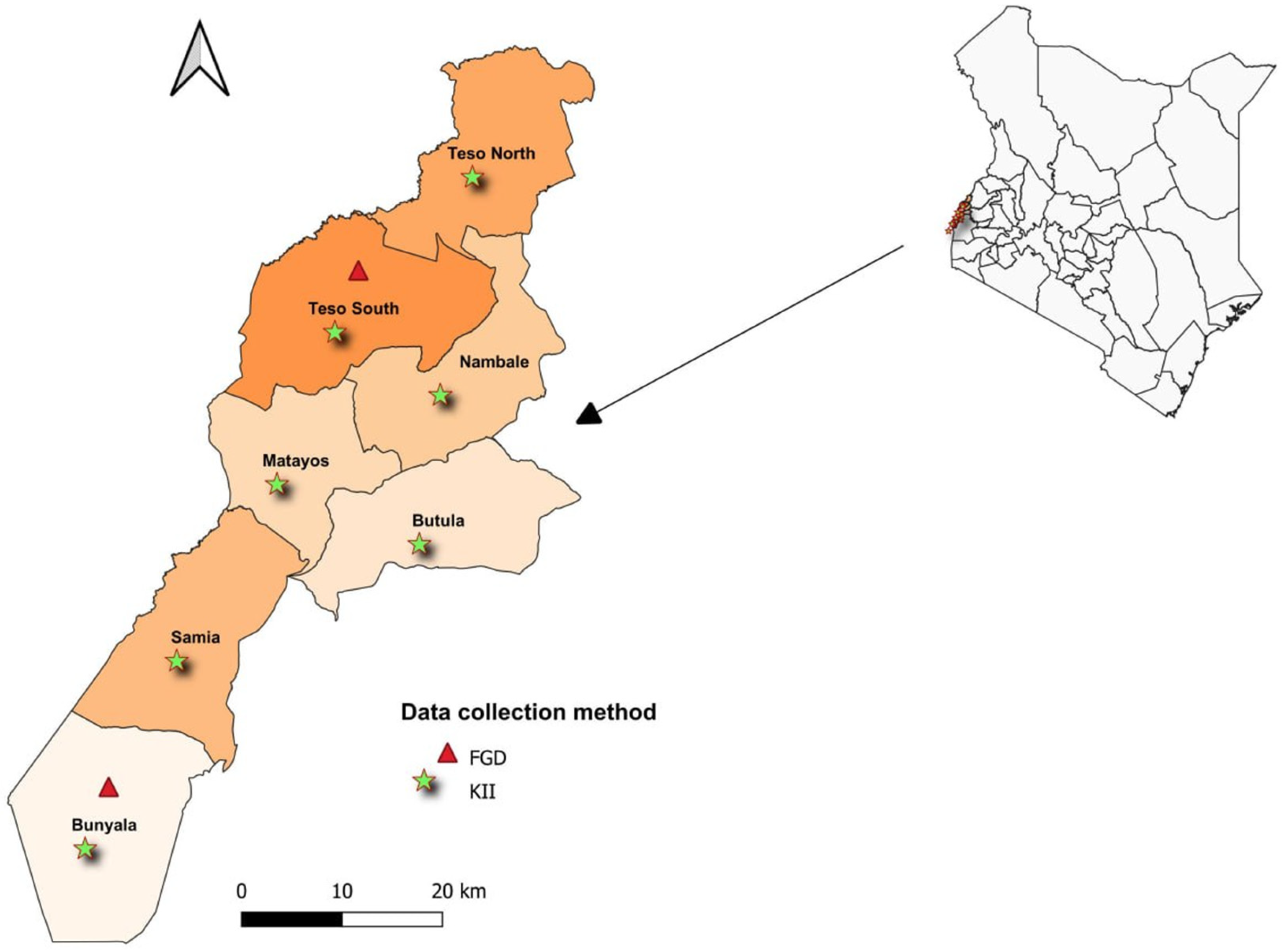
2.1. Study Area
2.2. Study Design
2.3. Sample Size, Study Population, and Sampling Procedures
2.4. Data Collection Methods
2.4.1. Data Collection Using KIIs
2.4.2. Data Collection Using FGDs
2.5. Data Management and Analysis
3. Results and Discussion
3.1. Demographic Characteristics of Participants
3.2. From Feed to Fear: Uncovering the Public Health Implications of Porcine Cysticercosis in Busia County
3.2.1. What Drives Pig Production in Busia County?
Economic, Cultural, and Social Drivers of Smallholder Extensive Pig Farming
3.2.2. Keeping Pigs Healthy: Navigating the Minefield of Production Challenges
3.2.3. The Unsolved Risks of Sanitation, Hygiene, and Water Quality
Breaking the Cycle of Poor Latrine Access
Handwashing Practices: From Practice to Persistence
Water Source and Treatment Practices
3.2.4. Pork Source and Inspection Practices: Health Risks from Home Slaughter and Inspection Gaps
3.2.5. Awareness Gaps Triggering Critical Risks: Public Health and Economic Consequences
3.2.6. Pathways to Change: Proposed Interventions and Strategic Recommendations
Strengthening Education and Awareness
Integrated One Health Governance: Enhancing Intersectoral Collaboration and Community–Government Engagement
4. Conclusions
5. Limitation
Supplementary Materials
Author Contributions
Funding
Institutional Review Board Statement
Informed Consent Statement
Data Availability Statement
Acknowledgments
Conflicts of Interest
Abbreviations
| WHO | World Health Organization |
| AHEWs | Animal Health Extension Workers |
| ASF | African Swine Fever |
| CHWs | Community Health Workers |
| FGDs | Focus Group Discussions |
| KIIs | Key Informant Interviews |
| NCC | Neurocysticercosis |
| SSA | Sub-Sahara Africa |
References
- World Health Organization; Food and Agriculture Organization; World Organisation for Animal Health. Guidelines for the Surveillance, Prevention, and Control of Taeniosis/Cysticercosis; WHO: Geneva, Switzerland, 2014; Available online: https://www.who.int/publications/i/item/9290446560 (accessed on 23 December 2019).
- World Health Organization. Landscape Analysis: Control of Taenia solium; WHO: Geneva, Switzerland, 2019; Available online: https://www.who.int/publications/i/item/9789241508643 (accessed on 23 November 2019).
- Lightowlers, M.W. Control of Taenia solium taeniasis/cysticercosis: Past practices and new possibilities. Parasitology 2013, 140, 1566–1577. [Google Scholar] [CrossRef]
- Ndimubanzi, P.C.; Carabin, H.; Budke, C.M.; Nguyen, H.; Qian, Y.J.; Rainwater, E.; Ito, A.; Takayanagi, R.; Sultana, R.; Schantz, P.M. A systematic review of the frequency of neurocysticercosis with a focus on people with epilepsy. PLoS Negl. Trop. Dis. 2010, 4, e870. [Google Scholar] [CrossRef]
- Kungu, J.M.; Dione, M.M.; Ocaido, M.; Ejobi, F. Status of Taenia solium cysticercosis and predisposing factors in developing countries involved in pig farming. Int. J. One Health 2015, 1, 6–13. [Google Scholar] [CrossRef]
- Gabriël, S.; Dorny, P.; Mwape, K.E.; Trevisan, C.; Braae, U.C.; Magnussen, P.; Willingham, A.L.; Praet, N.; Nsadha, T.; Phiri, A.M.; et al. Control of Taenia solium taeniasis/cysticercosis: The best way forward for sub-Saharan Africa? Acta Trop. 2016, 164, 252–260. [Google Scholar] [CrossRef] [PubMed]
- Dermauw, V.; Carabin, H.; Ganaba, R.; Cissé, A.; Tarnagda, Z.; Gabriël, S.; Praet, N.; Kyobe, J.; Zinsstag, J.; Vercruysse, J.; et al. Factors associated with the 18-month cumulative incidence of seroconversion of active infection with Taenia solium cysticercosis in Burkina Faso. Am. J. Trop. Med. Hyg. 2018, 99, 1018–1027. [Google Scholar] [CrossRef] [PubMed]
- The Carter Center. Summary of the Twenty-First Meeting of the International Task Force for Disease Eradication (ITFDE); The Carter Center: Atlanta, GA, USA, 2013. [Google Scholar]
- Assana, E.; Lightowlers, M.W.; Zoli, A.P.; Geerts, S. Taenia solium taeniosis/cysticercosis in Africa: Risk factors, epidemiology and prospects for control using vaccination. Vet. Parasitol. 2013, 195, 14–23. [Google Scholar] [CrossRef]
- Gulelat, Y.; Eguale, T.; Kebede, N.; Aleme, H.; Fèvre, E.M.; Cook, E.A.J. Epidemiology of Porcine Cysticercosis in Eastern and Southern Africa: Systematic Review and Meta-Analysis. Front. Public Health 2022, 10, 836177. [Google Scholar] [CrossRef]
- Zulu, G.; Stelzle, D.; Mwape, K.E.; Welte, T.M.; Strømme, H.; Mubanga, C.; Mutale, W.; Abraham, A.; Hachangu, A.; Schmidt, V.; et al. The epidemiology of human Taenia solium infections: A systematic review of the distribution in Eastern and Southern Africa. PLoS Negl. Trop. Dis. 2023, 17, e0011042. [Google Scholar] [CrossRef]
- Githigia, S.M.; Murekefu, A.; Otieno, R.O. Prevalence of porcine cysticercosis and risk factors for Taenia solium taeniosis in Funyula division of Busia District, Kenya. Kenya Vet. 2005, 29, 37–42. [Google Scholar]
- Mutua, F.K.; Randolph, T.F.; Arimi, S.M.; Kitala, P.M.; Githigia, S.M.; Willingham, A.L.; Njeruh, F.M. Palpable lingual cysts, a possible indicator of porcine cysticercosis, in Teso District, Western Kenya. J. Swine Health Prod. 2007, 15, 206–212. [Google Scholar] [CrossRef]
- Kagira, J.M.; Maingi, N.; Kanyari, P.W.N.; Githigia, S.M.; Ng’ang’a, J.C.; Gachohi, J.M. Seroprevalence of Cysticercus cellulosae and associated risk factors in free-range pigs in Kenya. J. Helminthol. 2010, 84, 398–403. [Google Scholar] [CrossRef]
- Eshitera, E.E.; Githigia, S.M.; Kitala, P.; Thomas, L.F.; Fèvre, E.M.; Harrison, L.J.S.; Mwihia, E.W.; Otieno, R.O.; Ojiambo, F.; Maingi, N. Prevalence of porcine cysticercosis and associated risk factors in Homa Bay District, Kenya. BMC Vet. Res. 2012, 8, 234. [Google Scholar] [CrossRef]
- Mwabonimana, M.F.; King’ori, A.M.; Inyagwa, C.M.; Bebe, B.O. Porcine cysticercosis risks: Awareness, attitudes and perceptions on safety practices among farmers, butcher-owners and consumers in Western Kenya. Afr. J. Infect. Dis. 2020, 14, 16–22. [Google Scholar]
- Chege, B.; Ndambuki, G.; Owiny, M.; Kiyong’a, A.; Fèvre, E.M.; Cook, E.A.J. Improved latrine coverage may reduce porcine cysticercosis: A comparative cross-sectional study, Busia County, Kenya. Front. Vet. Sci. 2023, 10, 1155467. [Google Scholar] [CrossRef] [PubMed]
- Thomas, L.F. Epidemiology of Taenia solium Cysticercosis in Western Kenya. Ph.D. Thesis, University of Edinburgh, Edinburgh, UK, 2013. [Google Scholar]
- Wardrop, N.A.; Thomas, L.F.; Atkinson, P.M.; de Glanville, W.A.; Cook, E.A.J.; Wamae, C.N.; Fèvre, E.M.; Mukoko, D.M.; Njenga, M.K.; Omondi, D.; et al. The influence of socio-economic, behavioural, and environmental factors on Taenia spp. transmission in western Kenya: Evidence from a cross-sectional survey in humans and pigs. PLoS Negl. Trop. Dis. 2015, 9, e0004223. [Google Scholar] [CrossRef] [PubMed]
- Fèvre, E.M.; de Glanville, W.A.; Thomas, L.F.; Cook, E.A.J.; Kariuki, S.; Wamae, C.N. An integrated study of human and animal infectious disease in the Lake Victoria crescent small-holder crop-livestock production system, Kenya. BMC Infect. Dis. 2017, 17, 393. [Google Scholar] [CrossRef] [PubMed]
- Gabriël, S.; Mwape, K.E.; Hobbs, E.C.; Devleesschauwer, B.; Van Damme, I.; Zulu, G.; Mwelwa, C.; Mubanga, C.; Masuku, M.; Mambwe, M.; et al. Potential elimination of active Taenia solium transmission in Africa. N. Engl. J. Med. 2020, 383, 396–397. [Google Scholar] [CrossRef]
- Hossain, M.S.; Shabir, S.; Toye, P.; Thomas, L.F.; Falcone, F.H. Insights into the diagnosis, vaccines, and control of Taenia solium, a zoonotic, neglected parasite. Parasites Vectors 2023, 16, 380. [Google Scholar] [CrossRef]
- World Health Organization. Preventable Epilepsy: Taenia solium Infection Burdens Economies, Societies, and Individuals; WHO: Geneva, Switzerland, 2016; Available online: https://www.who.int/publications/i/item/9789241549486 (accessed on 10 February 2026).
- World Health Organization. Ending the Neglect to Attain the Sustainable Development Goals: A Road Map for Neglected Tropical Diseases 2021–2030; WHO: Geneva, Switzerland, 2020; Available online: https://apps.who.int/bookorders (accessed on 10 February 2026).
- World Health Organization. Taenia solium Taeniasis/Cysticercosis Diagnostic Tools: Report of a Stakeholder Meeting; WHO: Geneva, Switzerland, 2016; Available online: https://iris.who.int/bitstream/handle/10665/206543/9789241510516_eng.pdf?sequence=1 (accessed on 19 June 2025).
- Wanjau, M.N.; Kivuti-Bitok, L.W.; Aminde, L.N.; Veerman, L. Stakeholder perceptions of current practices and challenges in priority setting for non-communicable disease control in Kenya: A qualitative study. BMJ Open 2021, 11, e043641. [Google Scholar] [CrossRef]
- Levy, M. Challenges and Opportunities of Small-Holder Pig Production and Marketing in Western Kenya. Ph.D. Thesis, University of Guelph, Guelph, ON, Canada, 2014. Available online: https://atrium.lib.uoguelph.ca/items/1ce3241d-d5d7-477d-9484-5ee797d82e6f (accessed on 28 November 2025).
- County Government of Busia. County Integrated Development Plan for Busia 2023–2027; County Government of Busia: Busia, Kenya, 2023. Available online: https://www.busiacounty.go.ke/assets/documents/uploads/COUNTY%20INTEGRATED%20DEVELOPMENT%20PLAN%20-%202023%20-%202027-zBMPm.pdf (accessed on 28 November 2025).
- County Government of Busia. County Integrated Development Plan 2018–2022; County Government of Busia: Busia, Kenya, 2018. Available online: https://repository.kippra.or.ke/handle/123456789/1200 (accessed on 1 October 2021).
- FAO. Pig Sector Kenya; FAO Animal Production and Health Livestock Country Reviews: Rome, Italy, 2012. Available online: https://www.fao.org/sustainable-food-value-chains/library/details/en/c/263192/ (accessed on 10 July 2018).
- Kagira, J.M.; Kanyari, P.W.N.; Maingi, N.; Githigia, S.M.; Ng’ang’a, J.C.; Karuga, J.W. Characteristics of the smallholder free-range pig production system in western Kenya. Trop. Anim. Health Prod. 2010, 42, 865–873. [Google Scholar] [CrossRef]
- Downie-Ngini, K. Investigating Risk Factors and Prevalence for Neurocysticercosis: A Case Study of Busia District, Kenya. Ph.D. Thesis, University of Edinburgh, Edinburgh, UK, 2009. Available online: https://core.ac.uk/download/429720926.pdf (accessed on 25 November 2019).
- Zemedhun, Y.G.; Egulae, T.; Wubie, N.K.; Akoko, J.M.; Fèvre, E.M.; Cook, E.A.J. The epidemiology and spatial distribution of Taenia solium taeniosis and cysticercosis in Kenya: The case of Busia County. PLoS Negl. Trop. Dis. 2025, 19, e0013746. [Google Scholar] [CrossRef]
- Runfola, D.; Anderson, A.; Baier, H.; Crittenden, M.; Dowker, E.; Fuhrig, S.; Gaughan, A.; Griffiths, E.; Jochem, W.; Puckett, S. GeoBoundaries: A global database of political administrative boundaries. PLoS ONE 2020, 15, e0231866. [Google Scholar] [CrossRef]
- United States Agency for International Development (USAID) Center for Development Information and Evaluation. Performance Monitoring and Evaluation TIPS: Conducting Key Informant Interviews; USAID: Washington, DC, USA, 1996. Available online: https://www.cdc.gov/training-development/media/pdfs/2024/04/Performance-monitoring-evaluation-tips-key-informant-interviews.pdf (accessed on 30 January 2021).
- Nyumba, O.T.; Wilson, K.; Derrick, C.J.; Mukherjee, N. The use of focus group discussion methodology: Insights from two decades of application in conservation. Methods Ecol. Evol. 2018, 9, 20–32. [Google Scholar] [CrossRef]
- Ames, H.; Glenton, C.; Lewin, S. Purposive sampling in a qualitative evidence synthesis: A worked example from a synthesis on parental perceptions of vaccination communication. BMC Med. Res. Methodol. 2019, 19, 26. [Google Scholar] [CrossRef]
- Parker, C.; Scott, S.; Geddes, A. Snowball Sampling. In SAGE Research Methods Foundations; SAGE Publications: London, UK, 2020. [Google Scholar] [CrossRef]
- Nowell, L.S.; Norris, J.M.; White, D.E.; Moules, N.J. Thematic analysis: Striving to meet the trustworthiness criteria. Int. J. Qual. Methods 2017, 16, 160940691773384. [Google Scholar] [CrossRef]
- Bekhet, A.K.; Zauszniewski, J.A. Methodological triangulation: An approach to understanding data. Nurse Res. 2012, 20, 40–43. [Google Scholar] [CrossRef] [PubMed]
- O’Brien, B.C.; Harris, I.B.; Beckman, T.J.; Reed, D.A.; Cook, D.A. Standards for reporting qualitative research: A synthesis of recommendations. Acad. Med. 2014, 89, 1245–1251. [Google Scholar] [CrossRef] [PubMed]
- Braae, U.C. Epidemiology and control of Taenia solium in Africa. Ph.D. Thesis, University of Copenhagen, Copenhagen, Denmark, 2017. Available online: https://www.researchgate.net/profile/Uffe-Braae/publication/328902505_Epidemiology_and_control_of_Taenia_solium_in_Africa/links/5beaab614585150b2bb291bc/Epidemiology-and-control-of-Taenia-solium-in-Africa.pdf (accessed on 1 February 2019).
- Ngwili, N.; Thomas, L.; Githigia, S.; Johnson, N.; Wahome, R.; Roesel, K. Stakeholders’ knowledge, attitude, and perceptions on the control of Taenia solium in Kamuli and Hoima Districts, Uganda. Front. Vet. Sci. 2022, 9, 833721. [Google Scholar] [CrossRef]
- Thys, S.; Mwape, K.E.; Lefèvre, P.; Dorny, P.; Phiri, A.M.; Marcotty, T.; Phiri, I.K.; Gabriël, S. Why pigs are free-roaming: Communities’ perceptions, knowledge and practices regarding pig management and taeniosis/cysticercosis in a Taenia solium endemic rural area in Eastern Zambia. Vet. Parasitol. 2016, 225, 33–42. [Google Scholar] [CrossRef] [PubMed]
- Ngowi, H.A.; Carabin, H.; Kassuku, A.A.; Mlozi, M.R.S.; Mlangwa, J.E.D.; Willingham, A.L. A health-education intervention trial to reduce porcine cysticercosis in Mbulu District, Tanzania. Prev. Vet. Med. 2008, 85, 52–67. [Google Scholar] [CrossRef]
- Zoli, A.; Shey-Njila, O.; Assana, E.; Nguekam, J.P.; Dorny, P.; Brandt, J.; Geerts, S. Regional status, epidemiology and impact of Taenia solium cysticercosis in Western and Central Africa. Acta Trop. 2003, 87, 35–42. [Google Scholar] [CrossRef] [PubMed]
- Okello, A.L.; Thomas, L.F. Human taeniasis: Current insights into prevention and management strategies in endemic countries. Risk Manag. Healthc. Policy 2017, 10, 107–116. [Google Scholar] [CrossRef] [PubMed]
- De Almeida, A.; Olmo, L.; Copland, R.; Alders, R.; Toribio, J.A.L.M.L. Investigation of animal health and husbandry practices in smallholder pig production systems in Timor-Leste. Vet. Parasitol. Reg. Stud. Rep. 2021, 26, 100615. [Google Scholar] [CrossRef] [PubMed]
- Gebregziabhear, E. Swine husbandry practices in Ethiopia: A review. J. Biol. Agric. Healthc. 2022, 12, 22–29. [Google Scholar] [CrossRef]
- Kenya National Bureau of Statistics. Kenya Population and Housing Census: Distribution of Population by Socio-Economic Characteristics; KNBS: Nairobi, Kenya, 2019. Available online: http://www.knbs.or.ke (accessed on 27 March 2024).
- Wilson, C.; Nonga, H.E.; Mdegela, R.H.; Makingi, G.; Stelzle, D.; Mkupasi, E.M.; Winkler, A.S.; Ngowi, H.A. Effect of community health education intervention on prevalence and pig farmers’ knowledge, attitudes, and practices related to porcine cysticercosis in selected areas of Tanzania. Vet. Med. Int. 2025, 2025, 9929531. [Google Scholar] [CrossRef]
- Schlegelmilch, M.P.; Lakhani, A.; Saunders, L.D.; Jhangri, G.S. Evaluation of water, sanitation and hygiene program outcomes shows knowledge behavior gaps in Coast Province, Kenya. Pan Afr. Med. J. 2016, 23, 145. [Google Scholar] [CrossRef]
- Wafula, K.S. East African Public Health Laboratory Networking Project (EAPHLNP) Initial Environmental & Social Audit Study Report Regional Public Health Laboratory Located in Busia Town; EAPHLNP: Busia, Kenya, 2018; Available online: https://documents.worldbank.org/pt/publication/documents-reports/documentdetail/592301562580060472 (accessed on 12 February 2026).
- World Health Organization. Water, Sanitation and Hygiene (WASH); WHO: Geneva, Switzerland, 2026; Available online: https://www.who.int/health-topics/water-sanitation-and-hygiene-wash#tab=tab_1 (accessed on 12 February 2026).
- Bukachi, S.A.; Ngutu, M.; Muthiru, A.W.; Lépine, A.; Kadiyala, S.; Domínguez-Salas, P. Consumer perceptions of food safety in animal-source foods choice and consumption in Nairobi’s informal settlements. BMC Nutr. 2021, 7, 75. [Google Scholar] [CrossRef]
- Kuboka, M.; Grace, D.; Artursson, K.; Lindahl, J.; Carlsson, G.; Mutua, F. Food safety in informal public markets in Kenya: Perceptions of stakeholders in the food chain. Front. Sustain. Food Syst. 2024, 8, 1411318. [Google Scholar] [CrossRef]
- Mlowe, F.; Mlangwa, J.; Mkupasi, E.; Winkler, A.S.; Nyerere, A.D.; Churi, A.; Ngowi, H.; Karimuribo, E. Taenia solium cysticercosis and taeniosis reporting in the current medical and veterinary diseases reporting systems in Tanzania: A cross-sectional study. Vet. Med. Int. 2024, 2024, 5592872. [Google Scholar] [CrossRef]
- Joshi, D.D.; Maharjan, M.; Johansen, M.V.; Willingham, A.L.; Sharma, M. Improving meat inspection and control in resource-poor communities: The Nepal example. Acta Trop. 2003, 87, 119–127. [Google Scholar] [CrossRef]
- Thomas, L.F.; Harrison, L.J.S.; Toye, P.; de Glanville, W.A.; Cook, E.A.J.; Wamae, C.N.; Fèvre, E.M. Prevalence of Taenia solium cysticercosis in pigs entering the food chain in western Kenya. Trop. Anim. Health Prod. 2016, 48, 233–238. [Google Scholar] [CrossRef]
- Beam, M.; Spencer, A.; Fernandez, L.; Atto, R.; Muro, C.; Vilchez, P.; Garcia, H.H.; Bernal, T.; Handali, S.; Gilman, R.H.; et al. Barriers to participation in a community-based program to control transmission of Taenia solium in Peru. Am. J. Trop. Med. Hyg. 2018, 98, 1748–1754. [Google Scholar] [CrossRef]
- Maridadi, A.F.; Lwelamira, J.; Simime, F.G. Knowledge and practices related to Taenia solium cysticercosis-taeniasis among smallholder farmers in selected villages in Kilolo District, Iringa Region, Southern Highlands of Tanzania. Int. J. Anim. Vet. Adv. 2011, 3, 196–201. [Google Scholar]
- Sarti, E.; Flisser, A.; Schantz, P.M.; Gleizer, M.; Loya, M.; Plancarte, A.; de Gortari, M.; Morales, G.; Ayvar, V.; García, H.; et al. Development and evaluation of a health education intervention against Taenia solium in a rural community in Mexico. Am. J. Trop. Med. Hyg. 1997, 56, 127–132. [Google Scholar] [CrossRef] [PubMed]
- Sarti, E.; Rajshekhar, V. Measures for the prevention and control of Taenia solium taeniosis and cysticercosis. Acta Trop. 2003, 87, 137–143. [Google Scholar] [CrossRef] [PubMed]
- Alexander, A.M.; Mohan, V.R.; Muliyil, J.; Dorny, P.; Rajshekhar, V. Changes in knowledge and practices related to taeniasis/cysticercosis after health education in a south Indian community. Int. Health 2012, 4, 164–169. [Google Scholar] [CrossRef]
- Wohlgemut, J.; Dewey, C.; Levy, M.; Mutua, F. Evaluating the efficacy of teaching methods regarding prevention of human epilepsy caused by Taenia solium neurocysticercosis in Western Kenya. Am. J. Trop. Med. Hyg. 2010, 82, 634–640. [Google Scholar] [CrossRef] [PubMed]
- Nyangi, C.; Mkupasi, E.M.; Ngowi, H.A.; Mahonge, C.; Winkler, A.S. Impact of health education interventions for control of Taenia solium cysticercosis/taeniasis in endemic countries: A systematic review. Public Health Chall. 2025, 4, e70147. [Google Scholar] [CrossRef]


| Participant Group | Data Collection Tool | Sub-County | Female | Male | Total Participants | ||||||
|---|---|---|---|---|---|---|---|---|---|---|---|
| 18–35 | 36–45 | 46–65 | >65 | 18–35 | 36–45 | 46–65 | >65 | ||||
| Animal Health Extension Workers | FGD | Teso South & Bunyala | 0 | 1 | 0 | 0 | 3 | 3 | 0 | 0 | 7 |
| Community Health Workers | FGD | Teso South | 1 | 1 | 1 | 0 | 0 | 4 | 2 | 0 | 9 |
| Community Health Workers | FGD | Bunyala | 0 | 2 | 1 | 0 | 2 | 2 | 3 | 0 | 10 |
| Community leaders | FGD | Teso South | 0 | 1 | 1 | 1 | 0 | 3 | 5 | 2 | 13 |
| Community leaders | FGD | Bunyala | 0 | 1 | 0 | 1 | 2 | 2 | 3 | 2 | 11 |
| Male pig farmers | FGD | Teso South | 0 | 0 | 0 | 0 | 5 | 8 | 7 | 1 | 21 |
| Male pig farmers | FGD | Bunyala | 0 | 0 | 0 | 0 | 5 | 6 | 7 | 1 | 19 |
| Female pig farmers | FGD | Teso South | 5 | 8 | 6 | 0 | 0 | 0 | 0 | 0 | 19 |
| Female pig farmers | FGD | Bunyala | 3 | 4 | 3 | 1 | 0 | 0 | 0 | 0 | 11 |
| Sub-county VO & County DVS | KII | All Busia sub-counties * | 0 | 0 | 0 | 0 | 1 | 4 | 3 | 0 | 8 |
| Theme | Key Finding | Gap Identified | Proposed Intervention |
|---|---|---|---|
| Theme 1: Drivers of pig production | Extensive pig production predominated, influenced by feed and housing costs, limited land, livelihood strategies, and perceptions of indigenous pigs as hardy. | Limited affordability of feed and housing, weak access to financial credit, limited market incentives for improved production, weak enforcement of confinement-related regulations | Improve access to affordable feed markets, strengthen financial and credit support for farmers, promote market incentives for improved production systems, support context-appropriate enforcement of pig confinement regulations, and strengthen extension services |
| Theme 2: Pig health challenges and system constraints | High burden of pig diseases (ASF, suspected cysticercosis, and parasitic infections), potentially linked to free-roaming practices, irregular deworming, and inadequate preventive health management. | Limited routine veterinary care (including irregular deworming), shortage of veterinary/extension personnel, weak diagnostic capacity for diseases such as porcine cysticercosis, and limited access to animal health services | Strengthen veterinary outreach and workforce capacity improve routine deworming campaigns, enhance diagnostic capacity at local level, and strengthen integrated One Health surveillance between veterinary and public health sectors |
| Theme 3: Sanitation, hygiene, and water contamination risks | Poor sanitation (open defecation, inadequate latrines) and poor hygiene practices contribute to environmental contamination affecting humans and pigs | Structural barriers to sanitation (including flooding, poor soil conditions), limited access to clean water and soap, and inconsistent hygiene behavior | Implement context-specific sanitation infrastructure (flood-resilient latrines), improve water access systems, expand hygiene education linked to infrastructure support, and integrate WASH interventions with livestock management practices |
| Theme 4: Pork source and meat inspection gaps | Gaps in meat inspection capacity, informal slaughter practices, and limited consumer awareness regarding pork safety | Insufficient meat inspection capacity (including staffing and logistical constraints); weak enforcement of slaughter regulations; low public awareness of food safety risks | Strengthen meat inspection workforce and logistics, enforce slaughter regulations, enhance consumer awareness of safe pork sourcing, and support formalization of pork value chains |
| Theme 5: Awareness gaps on zoonotic risks | Limited understanding of porcine cysticercosis transmission and zoonotic risks; partial awareness of hygiene-related risks but weak understanding of full transmission cycle | Limited awareness of porcine cysticercosis and zoonotic transmission, fragmented understanding of transmission pathways, reliance on informal knowledge systems, and weak One Health education. | Strengthen community-level One Health education campaigns, integrate zoonotic disease education into extension services, and use locally appropriate communication channels |
| Theme 6: Pathways to change and system-level interventions | Strengthening community education, improving feed access, and One Health coordination, including veterinary–public health collaboration. | Weak operational One Health implementation, fragmented coordination between veterinary and public health sectors; limited enforcement of existing regulations | Strengthen One Health governance at county level; improve intersectoral coordination; enhance extension systems; combine education with structural support (credit, markets, feed access); support community-based engagement |
Disclaimer/Publisher’s Note: The statements, opinions and data contained in all publications are solely those of the individual author(s) and contributor(s) and not of MDPI and/or the editor(s). MDPI and/or the editor(s) disclaim responsibility for any injury to people or property resulting from any ideas, methods, instructions or products referred to in the content. |
© 2026 by the authors. Licensee MDPI, Basel, Switzerland. This article is an open access article distributed under the terms and conditions of the Creative Commons Attribution (CC BY) license.
Share and Cite
Gulelat, Y.; Eguale, T.; Kebede, N.; Aleme, H.; Majiwa, H.; Cook, E.A.J. Identifying Gaps in the Control of Porcine Cysticercosis in Kenya: A One Health Qualitative Study of Multi-Stakeholder Perspectives from Busia County. Zoonotic Dis. 2026, 6, 22. https://doi.org/10.3390/zoonoticdis6020022
Gulelat Y, Eguale T, Kebede N, Aleme H, Majiwa H, Cook EAJ. Identifying Gaps in the Control of Porcine Cysticercosis in Kenya: A One Health Qualitative Study of Multi-Stakeholder Perspectives from Busia County. Zoonotic Diseases. 2026; 6(2):22. https://doi.org/10.3390/zoonoticdis6020022
Chicago/Turabian StyleGulelat, Yewubdar, Tadesse Eguale, Nigatu Kebede, Hailelule Aleme, Hamilton Majiwa, and Elizabeth A. J. Cook. 2026. "Identifying Gaps in the Control of Porcine Cysticercosis in Kenya: A One Health Qualitative Study of Multi-Stakeholder Perspectives from Busia County" Zoonotic Diseases 6, no. 2: 22. https://doi.org/10.3390/zoonoticdis6020022
APA StyleGulelat, Y., Eguale, T., Kebede, N., Aleme, H., Majiwa, H., & Cook, E. A. J. (2026). Identifying Gaps in the Control of Porcine Cysticercosis in Kenya: A One Health Qualitative Study of Multi-Stakeholder Perspectives from Busia County. Zoonotic Diseases, 6(2), 22. https://doi.org/10.3390/zoonoticdis6020022