


Abstract
Drawing on signaling theory, this study investigates the role of lead founders’ human capital signals in the success outcomes of equity crowdfunding (ECF) campaigns. While prior research emphasizes entrepreneurial teams or broadly defined founder characteristics, the role of dominant entrepreneurial actors remains underexplored. We focus on the lead founder, defined as the individual combining founder status, CEO authority, and ownership concentration, as the primary signal carrier in ECF contexts. Using a multi-platform dataset of 1067 campaigns from Republic Europe, Crowdcube, Mamacrowd, and Invesdor (2012–2024), we examine how lead founders’ education and experience shape investor decisions. Our results indicate that industry-related education is the strongest predictor of the number of investors. Furthermore, while industry experience alone can positively predict investor engagement, its role disappears once education is accounted for, suggesting that education in industry-related fields can outweigh industry experience in shaping investor perceptions. Additionally, our findings suggest that entrepreneurial experience and attendance at a top-ranked university do not contribute meaningfully to explaining investor participation. Accordingly, the study contributes to the human capital signaling literature by showing that investors evaluate the incremental informational value of human capital signals rather than assessing each signal independently, and highlights the centrality of the lead founder in decision-making under highly uncertain crowdfunding environments.
JEL Classification:
G23
1. Introduction
The changes in the financial environment subsequent to the financial crisis in 2008 have extremely caused difficulties in accessing new credit from banks [1,2] and investments through venture capitalists [3]. As a result, an alternative source of financing was necessary for entrepreneurs who have historically been undervalued by traditional financing markets, allowing them to overcome this obstacle and giving a better opportunity to attract financing for their small and unlisted ventures [1,4,5]. This has contributed to the emergence of crowdfunding, an innovative form of entrepreneurial funding and a viable financing option for supporting young ventures. It enables the raising of small amounts of capital from numerous individuals via virtual platforms [6,7,8,9]. ECF, also known as crowdinvesting, is a subdivision of crowdfunding in which small and risky businesses are enabled to sell small financial securities in order to raise the capital they need [4,10,11,12,13]. ECF platforms are open to the crowd [14,15], meaning that they are accessible even to inexperienced investors lacking the capacity to make investment decisions. As a result, their investments carry significant risk [1]. ECF has captured the attention of policymakers. Initial regulations were introduced in the UK in 2010. This form of crowdfunding was later legalized in other countries, such as the US, Finland, Italy, and Australia [1,16]. In terms of size, progress, and regulatory environment, the UK is now the leader in the ECF market [1]. The number of operating ECF platforms in the UK reached 16 in 2022 [17], compared to 13 in 2017 and 4 in 2010 [18]. The growth of the global CF market is expected to reach $38.71 billion in 2029 with a forecast compound annual growth rate (CAGR) of 17.3% [19].
Previous academic research on ECF has relied on signaling theory [20,21] to explain this form of crowdfunding phenomenon [4,22,23]. The interactions between potential investors, who are non-professionals, and entrepreneurs seeking funding take place exclusively on the internet [24]. Such investors may not have great experience in evaluating investment opportunities [1,25,26] or in performing deep due diligence face-to-face with entrepreneurs searching for financing for their start-ups [22]. Additionally, they need to make their investment choices within a limited duration [27]. As a result, even start-ups with high potential for success may not raise funding [23]. Accordingly, entrepreneurs are interested in demonstrating attributes and taking actions that act as signals of their start-ups’ intrinsic quality, thereby helping to overcome the information asymmetries experienced by uninformed investors [1]. Before making their investment decisions, these investors must search for these signals within the information provided by the entrepreneurs in the crowdfunding campaign documents or readily available on the internet [22]. According to the literature on entrepreneurial finance, we emphasize that among these signals, founders’ human capital is the key one that holds a prominent position. Ventures possessing superior human capital quality are likely to operate more efficiently, attract more funders, and raise significant amounts of capital [28]. Human capital encompasses various aspects and is closely linked to the skills and abilities of entrepreneurs, resulting in the success of start-ups and the remuneration of their investors for the uncertainty linked to their future potential [23].
Drawing on signaling theory, prior studies suggest that human capital characteristics constitute important signals for equity crowdfunding (ECF) investors [1,4,22,23], with educational background and professional experience among the most influential factors shaping investment decisions. However, while a substantial portion of the ECF literature examines the signaling role of team members or broadly defined founder characteristics [4,22,23,29], research emphasizing founder-CEOs and dominant entrepreneurial actors has mainly developed within broader entrepreneurial finance contexts, particularly venture capital and initial coin offerings [30,31]. Consequently, the role of the lead founder as the central signal carrier in equity crowdfunding remains underexplored.
Building on this gap, the study contributes to the entrepreneurial finance and ECF literature in several ways.
First, it integrates and extends recent evidence by [32], which shows that the alignment between CEO position and dominant ownership is among the strongest predictors of crowdfunding success. Extending this perspective, our study shifts the analytical focus from entrepreneurial teams and general founder characteristics toward the lead founder, the entrepreneurial actor who simultaneously combines founder status, CEO authority, and ownership concentration. We argue that in highly uncertain and information-asymmetric crowdfunding environments, characterized by the opacity and risk of early-stage ventures and the relatively unsophisticated nature of many ECF investors [1], investors do not evaluate all team members equally. Instead, they anchor their judgments around the most visible and influential entrepreneurial actor: the founder-CEO [33,34] with concentrated ownership. In doing so, the study offers a more refined explanation of how investor attention is allocated in ECF settings and how lead founder signals contribute to campaign outcomes.
Second, the study contributes to the human capital signaling literature by demonstrating that the positive association of the lead founder’s industry experience disappears once industry-related education is included in the model. This suggests that the two signals convey overlapping information about entrepreneurial competence and that investors place greater weight on the lead founder’s formal, domain-specific education. Accordingly, under highly uncertain crowdfunding environments, investors evaluate the incremental informational value of human capital signals, rather than assessing each signal independently.
Third, the study contributes empirically by analyzing a multi-platform dataset comprising both initial and seasoned campaigns launched between 2012 and 2024 on four ECF platforms: Republic Europe and Crowdcube from the UK, Mamacrowd from Italy, and Invesdor from Finland. By incorporating campaigns across multiple European markets and platform contexts, the study provides broader and more generalizable evidence on lead founder signaling in equity crowdfunding than prior single-platform or single-country studies.
The remainder of this study is structured as follows: Section 2 summarizes the related entrepreneurial finance literature and presents the testable hypotheses. The data and methodology are presented in Section 3. Section 4 discusses our econometric results. Section 5 presents the results of the robustness checks. Finally, Section 6 summarizes the findings and discusses the contributions, implications, limitations, and extensions for future research.
2. Related Literature and Hypothesis Development
2.1. Lead Founder’s Human Capital Signals
Research on entrepreneurial finance has long recognized the importance of human capital signals, but most studies focus either on the entrepreneurial team [4,22,29] or on broadly defined founder characteristics [23]. A parallel strand highlights the CEO’s critical role in early-stage ventures [33,34,35]. More recently, ref. [32] shows that the proportion of shares held by the largest shareholder (firstholder) and the alignment between CEO position and dominant ownership are among the strongest predictors of ECF crowdfunding success. Equity crowdfunding (ECF) is a setting marked by severe information asymmetry, limited due diligence opportunities, and predominantly unsophisticated retail investors [1,22]. In this context, we argue that investors do not evaluate all team members equally. Instead, they anchor their judgments on the lead founder: the individual who simultaneously holds founder status, CEO authority, and concentrated ownership [32]. The lead founder acts as a dominant signaler because this triple role provides unusually clear and credible signals. Founder status signals venture-specific knowledge, CEO authority signals decision-making power, and concentrated ownership signals aligned incentives and reduced agency risk [31,32]. Compared to dispersed team-level signals, which can conflict, dilute, or be hard to attribute, the lead founder’s signals are more observable, less ambiguous, and therefore more diagnostic of venture quality, especially when investors face severe time and information constraints [27]. This logic differs sharply from prior team-based signaling studies, which implicitly assume that all team members’ human capital is equally weighted and additive. Accordingly, investors may prioritize the lead founder as the ultimate decision-maker and risk-bearer. Particularly, under conditions endemic to ECF: high environmental uncertainty (early-stage ventures) and low investor sophistication [1,25]. Consequently, our study focuses specifically on the lead founder’s human capital signals, education and experience, as the primary independent variables.
2.2. Educational Background
Educational background is a classic signal of unobservable entrepreneurial ability, yet the empirical evidence in entrepreneurial finance is deeply mixed. The contradictions can be partially resolved by distinguishing who is being examined (team, founder, founder-CEO or lead founder) and what type of education is considered (general business, industry-specific, or prestige).
Several studies report positive associations. In venture capital, ref. [36] finds that team members with a PhD increase financing. In ECF, refs. [4,23] show that founders with an MBA or higher degrees (doctor/professor) attract more backers and raise more capital. Ref. [1] demonstrates that ventures with at least one graduate team member raise higher amounts and attract more investors. Refs. [37,38] link directors’ educational attainment (including PhDs) to larger contributions. Ref. [22] finds that business education significantly predicts ECF success.
Conversely, other studies find non-significant or contradictory results. Ref. [29] reports no significant effect of a bachelor’s degree in business on capital raising. Ref. [22] also finds that industry-related education does not significantly predict success. However, the theoretical rationale is that founders with education related to their start-up fields possess competencies to resolve technical difficulties, understand industry-specific client demands, and apply relevant technologies [39]; founders with business education are believed to have aptitudes for developing business strategies and understanding market dynamics [22,40]. Yet, the empirical evidence for industry-related education remains weak. Extending this evidence, ref. [22] further shows that years spent earning graduate or postgraduate degrees from higher-ranked universities (i.e., those ranked within the top 800 globally) are more positively linked to crowdfunding success compared to lower-ranked universities. Using machine learning, ref. [32] shows that average team education has only weak explanatory power compared to CEO ownership signals. In ICOs, ref. [30] finds no significant relationship for CEO education.
Taken together, the existing evidence on educational background in entrepreneurial finance provides inconclusive results, especially within equity crowdfunding settings. While several studies relate higher or industry-specific education to improved fundraising outcomes, other research finds limited or no significant relationship. This mixed evidence suggests that the importance of educational signals depends on how investors perceive their relevance and credibility under uncertainty, and crucially, on whose education is being evaluated. Most prior studies examine teams or founders broadly, without isolating the lead founder (the individual who combines founder status, CEO authority, and ownership concentration). In ECF, where information asymmetry is substantial, we argue that the lead founder’s educational background acts as a visible indicator of expertise and venture-specific knowledge. Moreover, educational credentials from high-quality universities may serve as stronger legitimacy signals, associated with superior training, selectivity, and perceived capability. Therefore:
H1a.
A lead founder’s education in the field is positively associated with the success outcomes of an ECF campaign.
H1b.
A lead founder’s education at a high-quality university is positively associated with the success outcomes of an ECF campaign.
2.3. Professional Experience
Professional experience is another key human capital signal, yet the empirical evidence in entrepreneurial finance is also mixed. The contradictions can be partially resolved by distinguishing the type of experience (entrepreneurial, managerial, or industry-specific) and the organizational role (team member, founder, CEO, founder-CEO or lead founder).
Several studies report positive associations. In venture capital, ref. [36] shows that founders with prior work experience (including failed ventures) are valued for their negotiation skills and resilience. Within ECF, refs. [22,41] find that founders with prior entrepreneurial experience (having led one or more ventures) are more likely to succeed, attract more investors, and raise more capital. Ref. [4] demonstrates that founding team tenure and age heterogeneity predict success and increase success outcomes. Ref. [29] reports that prior founding experience positively affects capital raised, and senior management experience in small firms also helps. Ref. [37] finds a positive effect of directors’ industry experience.
Conversely, other studies find that industry-specific experience, especially at the founder level, does not significantly predict success and enhance success outcomes. Refs. [22,41] both report that founders’ prior industry experience has no significant relationship with campaign success, number of investors, or amount raised. Ref. [1] shows that team members’ experience in the same industry is not significant, while finance/business experience is. Ref. [32] finds that both entrepreneurial and industry experience have only weak relationships compared to CEO ownership. In VC, ref. [31] similarly reports that founder-CEOs’ industry-specific experience is not significantly related to financing decisions, although international experience is. However, the theoretical rationale for why industry experience and entrepreneurial experience matter is strong. Investors are likely to infer that a founder with prior working experience in the same industry as the start-up is well acquainted with its environment [42]. Such a founder possesses extensive industry-specific expertise in technologies, production methods, and competitive dynamics [43,44,45], which enhances the ability to identify opportunities within the industry [46]. Furthermore, by being previously employed in the start-up industry, the founder has likely established social connections with suppliers, consumers, and other key stakeholders, which can be leveraged to benefit the start-up [22]. Entrepreneurial experience is also valued because it provides competencies and skills that enable the detection and exploitation of profitable opportunities [22].
Overall, prior findings regarding professional experience remain mixed, especially concerning industry-specific experience in crowdfunding environments. While several studies suggest that professional experience relates to success outcomes, others report non-significant relationships. These mixed findings indicate that the signaling value of professional experience depends not only on the type of experience (entrepreneurial, managerial, or industry-specific) but also on the organizational role of the individual examined (founder-CEO, founder, managerial director, or broader team member). They further suggest that investors evaluate experience-based signals according to their perceived relevance and credibility in uncertain investment environments. However, most prior studies examine teams or founders broadly, without isolating the lead founder (who combines founder status, CEO authority, and ownership concentration). In highly uncertain ECF settings, the lead founder’s entrepreneurial and industry-related experience may serve as important indicators of competence, opportunity recognition, and venture execution capability. Therefore:
H2a.
A lead founder’s experience in the field is positively associated with the success outcomes of an ECF campaign.
H2b.
A lead founder’s entrepreneurial experience is positively associated with the success outcomes of an ECF campaign.
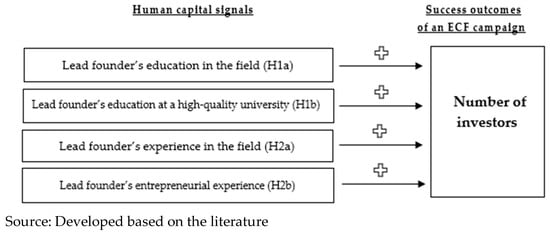
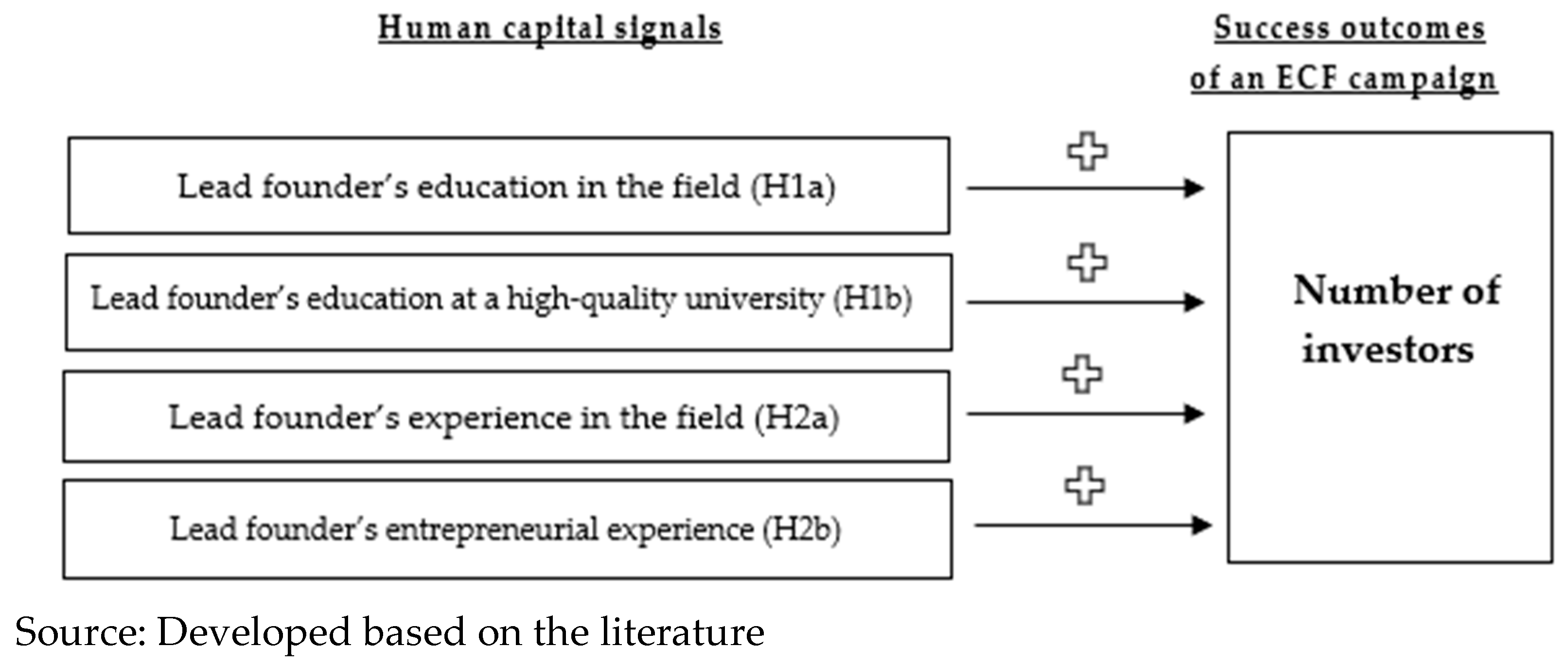
Figure 1 summarizes the four hypotheses. This diagram outlines the introduced hypotheses, indicating the expected signs of the relationships.
Figure 1.
Research design.
3. Data and Methodology
3.1. Data Sources and Sample Identification
Our initial data collection contains 1795 initial and seasoned ECF campaigns launched on four platforms. Most campaigns are from Crowdcube and Republic Europe (previously Seedrs), which are among the well-established platforms in the UK market [47]. Offerings on both platforms are primarily equity-focused [11]. To extend our data to additional European platforms, we included offerings from Invesdor, a Finnish ECF platform founded in 2012. It is also one of the first and largest ECF platforms in Europe. Additionally, we included campaigns from Mamacrowd, an Italian ECF platform. We specifically chose these two platforms because their characteristics align with those of Crowdcube and Republic Europe, allowing us to consolidate the data seamlessly. All these platforms operate according to the “All-Or-Nothing” model.
Our data is hand-collected, merged, and aggregated from multiple sources. We initially identified and extracted detailed information concerning the characteristics of each campaign from publicly available platform data, including the number of investors participating in the campaign, the amount of capital raised, the target capital to be achieved, the firm valuation and the number of social media links on the campaign page, as well as information about technology firms. We also identified the campaign date to determine whether it was before or after the COVID-19 pandemic.
For the human capital variables, we first identified the number of core team members listed on the campaign page, along with their brief biographies when available. We also searched for their first names and profile photos on the campaign page to identify gender and ethnic minorities (An individual belongs to the ethnic minority group if they were Black or Asian. Visual assessment of profile photographs follows the established methodological precedent of [30]). This dataset was then augmented using official LinkedIn profiles (via links provided on the campaign pages) by manually searching for information regarding the lead founders’ educational and professional backgrounds when this information was not declared in the brief biographies. Specifically, we consider an individual to be a lead founder if he or she is defined as a founder, owner, or entrepreneur, serves as the CEO (or managing director), and holds the majority of shares (i.e., is the majority shareholder) in the venture. In some cases, leadership and ownership are shared equally among the founders (i.e., none of the founders holds a majority stake and all founders may share the CEO role, or they are simply listed as co-founders without a formal CEO title). In such cases, each founder is considered a lead founder, and the human capital variables are coded as 1 if at least one of these lead founders possesses the respective characteristic, and 0 if otherwise. We also used official LinkedIn profiles to determine gender and ethnicity when photos were unavailable on the campaign pages.
To obtain the largest dataset possible, missing data was then extracted from the businesses’ websites as well as from Companies House. All sources used in the study have also been used in other ECF studies related to ours, such as [1,4,22,38]. Due to the difficulty of collecting data concerning founders’ human capital, specifically their industry-related education and experience, we excluded 728 campaigns with missing information. For example, it is incorrect to classify a founder as a non-graduate if no information is available from either source, as this underestimates founders with educational backgrounds. Our empirical analyses are based on 1067 ECF campaigns, consisting of 613 initial campaigns and 454 seasoned campaigns, conducted by 677 businesses and launched and closed between 2012 and 2024. Table 1 provides a description of our data.
Table 1.
Data description.
Public information on the platforms is primarily available for successful campaigns. One possible reason is that platforms may display lists of past and present campaigns for marketing purposes, leading to the deletion of unsuccessful campaigns [17]. As a result, our dataset primarily includes successful campaigns. A small subset of near-successful campaigns (21 campaigns that reached between 80% and 90% of their funding goals) is also included. This may introduce survivorship bias into the analysis, as the sample may overrepresent ventures that were already capable of attracting investor attention and funding. Accordingly, the findings should be interpreted with caution, as they primarily explain variation across mostly successful campaigns rather than the general determinants of campaign success and failure in the broader ECF market.
During the process of gathering our dataset, we came across notable success stories from various businesses. One such example is “Freetrade Limited,” a UK-based, award-winning investment platform that offers commission-free trading. The firm’s mission is to make trading accessible to everyone. Between 2016 and 2023, the company successfully raised more than £29 million through ten campaigns (equity and convertible) on Crowdcube from 33,780 investors. In 2019 and 2020, Freetrade was recognized as the best online investment platform at the British Bank Awards.
3.2. Method and Variables
According to previous studies [1,17,22,38,48], our dependent variable is Ln_investors, which is defined as the natural logarithm of the number of investors participating in an ECF campaign. Since all campaigns in our sample have already reached their funding target, our dependent variable does capture the variation in success outcomes, i.e., variation in investor participation among successful ECF campaigns. All models are estimated using Ordinary Least Squares (OLS) with robust standard errors. Year, industry, country, and platform fixed effects are included to control for unobserved heterogeneity across time, sectors, geographies, and crowdfunding platforms. Standard errors are clustered at the platform level to account for within-platform error correlation, as platforms operate in distinct regulatory and market environments across countries.
For our set of human capital variables, we follow previous studies such as [1,4,22,29,32,41,48] to test H1a, we use an independent variable that captures the lead founder’s educational background: Education-in-the-field is coded as a binary variable equal to 1 if the lead founder has obtained a degree in a field of study that is directly related to the focal venture’s industry, and 0 if otherwise. Additionally, to test H1b, we incorporate a dummy variable, University, measured as a binary variable equal to 1 if the lead founder obtained at least one degree from a university ranked among the top 100 global universities, and 0 if otherwise. University rankings are based on internationally recognized global university ranking systems, specifically the QS World University Rankings. To test H2a, we employ a variable that highlights the lead founder’s professional experience: Experience-in-the-field is coded as a binary variable equal to 1 if the lead founder has prior professional experience in the same or closely related industry as the focal venture, and 0 if otherwise. The industry classification is based on the venture’s primary activity as mentioned on each campaign page on the crowdfunding platform. Furthermore, to test H2b, our study incorporates a dummy variable, Entrepreneurial_experience, which assesses whether the lead founder has previously owned a firm before the current one.
For illustrative purposes, consider Freetrade Limited, a UK-based fintech investment platform operating in the financial services industry. The firm’s founder and CEO, Adam Dodds, holds a degree in finance from McGill University, which is ranked among the top 100 universities worldwide. Accordingly, this observation would be coded as follows: University = 1, since the degree was obtained from a top-ranked institution; Education_in_the_field = 1, as the field of study (finance) is directly aligned with the venture’s industry; and Experience-in-the-field = 1, as prior professional experience in the finance sector corresponds to the firm’s core industry and predates the current venture. Following the literature [1,4,17,22,23,32,38,47,48,49,50,51], we employ a set of control variables: Female-founder, a dummy variable that takes the value of one if the founder is a woman; Core_team refers to the number of core team members featured on the campaign page; we also employ Links, which refers to the number of external websites and social media links featured on the offering page, including Twitter, Facebook, Instagram, LinkedIn, Companies House, and the firm’s website; and Tech-industry refers to firms operating within the technology industry. A dummy variable COVID-19 is also used to capture campaigns conducted during the COVID-19 pandemic; Ethnic_minority controls for racial disparities and is coded as a binary variable equal to 1 when at least one core team member is Black or Asian, and 0 if otherwise. We also incorporate Ln_target and Ln_firm_valuation, which capture, respectively, the funding target to be raised during the campaign and the firm’s valuation prior to the launch of the campaign. Full variables and their definitions are given in Table 2.
Table 2.
Variable definitions.
4. Empirical Results
In this section, we first report descriptive statistics for a sample of 1067 initial and seasoned ECF campaigns. We then present and discuss the main results of our multivariate analysis.
4.1. Univariate Analysis
Table 3 presents the descriptive statistics of the dataset. Regarding our dependent variable, the number of investors ranges from a minimum of 6 to a maximum of 35,899 per campaign, indicating that some campaigns are extremely popular. The substantial gap between the maximum and minimum values, together with the large standard deviations, indicates considerable variation in the number of investors, firm valuations, and target capital across campaigns. In particular, the average of more than 500 investors per campaign is broadly consistent with the findings of [17], highlighting the strong heterogeneity that characterizes crowdfunding activity. Looking at the human capital features, lead founders with educational backgrounds related to their firms’ industries constitute 40.5% of the total lead founders, compared to 22% in the study in [22]. Additionally, over half of the lead founders (57.1%) have professional backgrounds in fields related to their firms’ industries, while 40.7% previously owned a firm before the current one.
Table 3.
Descriptive statistics for the dependent, independent and control variables employed in the empirical analyses.
We observe that only 25% of founders are women, compared to 28.2% in [11]. Interestingly, regarding the variable University, our descriptive statistics report that 45% of lead founders have been educated at a university ranked among the top 100 in the world. In addition, the number of core team members presented on each campaign page ranges from 1 to 22, with an average of nearly 6 per campaign. Our sample contains more than half of the ventures from the technology industry, accounting for 69.4%.
4.2. Multicollinearity Checks
Table 4 presents the results of the multicollinearity test by reporting the correlation matrix among the variables. Overall, the table indicates low correlations among the variables included in the analysis. In addition, we conducted a variance inflation factor (VIF) analysis, presented in Table 5, to further assess the presence of multicollinearity. The results confirm that multicollinearity is not a concern in our estimations. Specifically, the average VIF is 1.30, which is well below the commonly accepted threshold of 5. Moreover, the maximum VIF is 2.03 for Ln_firm_valuation, remaining substantially below the critical threshold of 10.
Table 4.
Correlation Matrix for all variables used in the empirical analyses.
Table 5.
Results of variance inflation factor (VIF) analysis.
4.3. Multivariate Analysis
In this part of the section, we conduct a set of regression analyses to examine the role of human capital signals in the success outcomes of ECF campaigns, measured by the number of investors participating in the campaign (Ln_investors).
To assess the marginal effects of each human capital variable and to reduce potential omitted variable bias, we adopt a leave-one-out approach within our OLS regression framework. We estimate models including all individual variables simultaneously, removing them one by one. Specifically, we estimate five OLS specifications: Model 1 includes all four individual human capital variables simultaneously (Education_in_the_field, University, Experience_in_the_field, and Entrepreneurial_experience) alongside the controls. Models 2–5 sequentially exclude one of these four variables. The results of the OLS regressions for Ln_investors are summarized in Table 6.
Table 6.
Analyses of the role of lead founders’ human capital signals in the success outcomes of ECF campaigns, measured by Ln_investors, using OLS regressions.
In support of H1a, our results (Model 1, Table 6) suggest that a lead founder’s Education_in_the_field is the most robust and significant predictor of the number of investors. In Model 1 (the full model with all four human capital variables), the coefficient is 0.325 (p < 0.001), indicating that a one-unit increase in Education_in_the_field is associated with a 32.5% increase in the number of investors. This coefficient remains highly stable across Models 3, 4, and 5, ranging from 0.315 to 0.333, all statistically significant. This finding may be explained by the fact that the lead founders’ education in industry-related fields serves as an important signal for investor participation. On one hand, lead founders with industry education possess competencies that enable them to successfully manage their ventures: they may have the skills to resolve specific technical difficulties related to those fields, understand the demands of industry-specific clients, and apply industry-specific technologies [39]. The coefficient for University (being educated at a university ranked among the top 100 globally) is not statistically significant in any model, with coefficients ranging from 0.057 to 0.090 (all p > 0.10). This finding suggests that even an elite university credential does not independently signal credibility to equity crowdfunding investors. Rather, field-specific human capital (Education_in_the_field) dominates, underscoring that investors prioritize domain-relevant knowledge rather than a prestigious educational institution. Thus, H1b is rejected. These findings stand in contrast with [22] and confirm the idea that in ECF, the lead founder functions as the most visible and influential signal for investors.
Experience_in_the_field shows an interesting pattern. In Model 1 (controlling for education), its coefficient is non-significant (0.012, p > 0.10) [22,41]. However, when Education_in_the_field is excluded (Model 2), Experience_in_the_field becomes significant (0.143, p < 0.05). This suggests that field education and experience are correlated signals; while field experience alone positively predicts investor participation, this association disappears once industry-related education is controlled for. Investors appear to prioritize formal domain education over industry experience. Thus, we find conditional support for H2. The limited positive explanatory power of Experience_in_the_field aligns with the findings of [32]. Overall, investors appear to rely more heavily on industry-specific education as a signal of competence, treating it as a substitute for industry experience in their evaluation of the lead founder. Entrepreneurial_experience is non-significant across all models (coefficients ranging from 0.055 to 0.083, all p > 0.10), suggesting that a lead founder’s start-up experience without domain-specific alignment does not serve as a credible signal to investors in equity crowdfunding. Consequently, H2b is rejected. This finding is comparable to that of [29]. Concerning control variables, the estimates in all models provide evidence that Ln_investors is negatively associated with Female_founder at a significance level of 10%. Female founders face greater difficulties in convincing investors compared to male founders. The findings of [11,52] concerning the gender gap in ECF are strongly related to ours. This suggests that female founders are frequently viewed as less skilled in business development and innovation and tend to receive fewer firm resources compared to their male counterparts. One reason for this gap is attributed to differences between men and women in networks, human capital, growth goals, or the nature of firms run by men and women [53]. The size of the core team is significantly associated with a higher number of investors, consistent with the findings of [1,37].
However, across all models, the presence of ethnic minority members within the core team does not appear to have a significant relationship with the number of investors. One possible explanation for this result is the limited representation of Black or Asian individuals in our sample, which accounts for only 4% of the observations. This lack of evidence aligns with [48]. In addition, all models exhibit a significantly positive association between Links and Ln_investors, implying that higher values of Links are related to a greater number of investors. This confirms the importance of social networks in ECF. Ln_target is positive and significant (p < 0.001), which may reflect that potential investors perceive equity crowdfunding campaigns with higher funding targets as indicators of stronger growth ambitions and expansion potential [54]. Moreover, larger funding targets are often associated with greater expected returns [54,55], thereby enhancing investor participation. This finding is consistent with the results reported by [56,57]. Ln_firm_valuation is positive and significant at the 1% level, which may reflect that a higher pre-money valuation acts as a credible signal of venture quality to potential investors. This finding aligns with the results reported by [4]. Our findings further indicate that the coefficient for Tech_industry is negative and statistically significant across all models (β ≈ −0.20 to −0.28, p < 0.001), suggesting that ventures operating in the technology sector are associated with a lower number of investors in equity crowdfunding markets. This finding supports the view that equity crowdfunding success is lower in contexts characterized by greater uncertainty surrounding a start-up’s future prospects. High-tech start-ups typically operate in highly dynamic environments characterized by rapid and unpredictable change [23,58], which generally results in greater uncertainty regarding their future prospects compared to firms in other industries. The result is also consistent with the evidence reported by [22]. COVID-19 is not significant, implying that the pandemic period is not systematically associated with investor count. This finding aligns with [59].
5. Robustness Checks
5.1. Alternative Measure
To ensure the consistency of our empirical results, we perform a set of analyses. First, the dependent variable Ln_investors is replaced with Ln_raised, the natural logarithm of the total capital raised during the campaign. This allows us to verify whether the role of the human capital signals remains the same when focusing on a different campaign outcome rather than the number of investors. The results are shown in Table 7.
Table 7.
Analyses of the role of lead founders’ human capital signals in the success outcomes of ECF campaigns measured by ln-raised, using OLS regressions.
The empirical results in Table 7 show that Education_in_the_field continues to show a positive and statistically significant association, although its coefficient is smaller. Experience_in_the_field follows a similar pattern to the main findings, confirming that education and experience act as correlated signals, where education takes precedence when both are present. University and Entrepreneurial_experience remain non-significant across all specifications. Most control variables exhibit patterns consistent with our main findings. For instance, the coefficients for Core_team, Links, Ln_target, and Ln_firm_valuation remain positive and significant. The non-significance of Tech_industry implies that high-tech uncertainty [23,58] is associated with a lower number of investors but is not systematically related to the total amount of capital. This pattern may reflect that participating investors in technology ventures contribute larger sums on average, compensating for the narrower investor base. In addition, the non-significant evidence for Female-founder suggests that the amount of capital raised may not be systematically associated with female founders because the few investors who are indifferent to gender disparities may invest larger amounts on average, partially offsetting the lower participation rate.
5.2. Quantile Regressions
To address concerns that extreme values in the number of investors can drive results obtained from mean-based models, the system of models is replicated by replacing the OLS regressions with quantile regressions at the 25th, 50th, and 75th percentiles. This alternative approach enables us to examine the roles across the distribution of the number of investors and perform a more robust analysis against the effects of overdispersion. The results are presented in Table 8 (Models 1 and 2), Table 9 (Models 3 and 4), and Table 10 (Model 5). These specifications replicate the same approach used in our OLS analysis.
Table 8.
Analyses of the role of lead founders’ human capital signals in the success outcomes of ECF campaigns measured by ln-investors, using Quantile regressions (Models 1 and 2).
Table 9.
Analyses of the role of lead founders’ human capital signals in the success outcomes of ECF campaigns measured by ln-investors, using Quantile regressions (Models 3 and 4).
Table 10.
Analyses of the role of lead founders’ human capital signals in the success outcomes of ECF campaigns measured by ln-investors, using Quantile regressions (Model 5).
The results show that Education-in-the-field is associated with a higher number of investors across different points of the distribution, i.e., at the lower end (25th percentile), the median (50th percentile), and the higher level of investor participation (75th percentile). The magnitude of this association varies slightly across quantiles (largest at the lower tail of investor count (Q25) and smallest at the median), but the coefficient remains stable across the leave-one-out specifications (Models 3–5), confirming robustness.
Our results also show that Experience_in_the_field is not significant in the full model (Model 1) at any quantile, mirroring the OLS result. However, when Education_in_the_field is excluded (Model 2), field experience becomes positive and significant across all three quantiles (strongest at the lower and median quantiles). This is again consistent with the OLS finding that education and experience are correlated signals, with education dominating when both are observable. University remains non-significant in all models and across all quantiles, except for a single weakly significant coefficient at the median in Model 2 (0.103, p < 0.05). Entrepreneurial_experience is also non-significant in the full model (Model 1) across quantiles, except at the 75th percentile in Models 2–4, and only when education is omitted from the model. Core_team and Links are positive and significant across most quantiles, with stronger significance at the lower tail. Ln_target and Ln_firm_valuation are uniformly positive and significant across all quantiles and models, confirming that financial metrics matter throughout the distribution. Tech_industry is negative and significant at Q25 and Q50 in most specifications, but often non-significant at Q75, indicating that the disadvantage of high-tech uncertainty is most acute for campaigns with few investors. Overall, the quantile regression analysis (Table 8, Table 9 and Table 10) confirms the robustness of our OLS findings.
5.3. Endogeneity Concerns
Our study may face endogeneity concerns, such as omitted variable bias, unobserved confounding factors, potential selection bias, or possible reverse causality between lead founders’ human capital and the success outcomes of ECF campaigns. To address this issue, we employ two complementary methods: propensity score matching (PSM) and entropy balancing.
5.3.1. Entropy Balancing
Entropy balancing (presented in Table 11) is used to eliminate differences in observable covariates between campaigns led by founders with a specific human capital attribute (treatment group) and those without (control group). This approach adjusts the weights of the control group so that its distribution of key covariates converges with the treatment group in terms of mean, variance, and skewness, thereby preserving important information in the adjusted dataset [60,61]. Since entropy balancing requires a binary treatment variable, we perform a separate balancing procedure for each binary indicator of human capital: Education_in_the_field, University, Experience_in_the_field, and Entrepreneurial_experience. Consequently, we estimate four distinct entropy-balanced models, each evaluating the average treatment relationship between one specific human capital characteristic and the number of investors. The reported results align with those presented in Table 6.
Table 11.
Analyses of the role of lead founders’ human capital signals in the success outcomes of ECF campaigns measured by ln-investors, using Entropy balancing.
5.3.2. Propensity Score Matching (PSM)
In our study, PSM (presented in Table 12) is used to reduce the effect of potential differences across lead founders’ human capital characteristics that may confound the results [62,63,64,65,66,67]. As with entropy balancing, we apply PSM separately for each binary human capital indicator. We start by estimating propensity scores using logit models [68], where the dependent variables are whether campaigns are led by lead founders with Education_in_the_field, a high-quality University, Experience_in_the_field, or Entrepreneurial_experience. Next, we match them to similar campaigns without these attributes. Finally, we conduct our regression analyses on the propensity score-matched sample [61]. Overall, our findings are related to those discussed in Table 6.
Table 12.
Analyses of the role of lead founders’ human capital signals in the success outcomes of ECF campaigns measured by ln-investors, using Propensity score matching (PSM).
6. Conclusions
The aforementioned analyses are used to examine the role of lead founders’ human capital signals in the success outcomes of ECF campaigns. By leveraging signaling theory, we use a dataset that includes both initial and seasoned campaigns from four ECF platforms, including Republic and Crowdcube from the UK, Mamacrowd from Italy, and Invesdor from Finland, covering the period from 2012 to 2024.
6.1. Contribution
This study contributes to the entrepreneurial finance and equity crowdfunding (ECF) literature in several ways. First, drawing on signaling theory and extending recent evidence by [32], it shifts the analytical focus from entrepreneurial teams and general founder characteristics toward the lead founder as the entrepreneurial actor who simultaneously combines founder status, CEO authority, and ownership concentration. Second, it contributes to the human capital signaling literature by demonstrating that the positive association of the lead founder’s industry experience disappears once industry-related education is included, showing that investors evaluate the incremental informational value of signals. Third, it contributes empirically by analyzing a multi-platform dataset across four European ECF platforms, providing broader generalizability.
6.2. Discussion
Overall, our results yield several conclusions. The findings show that industry-related education of the lead founder is the most influential determinant of investor participation. This finding may be explained by the fact that the lead founders’ education in industry-related fields serves as a powerful signal for investor participation. On one hand, lead founders with industry education possess competencies that enable them to successfully manage their ventures: they may have the skills to resolve specific technical difficulties related to those fields, understand the demands of industry-specific clients, and apply industry-specific technologies [39]. On the other hand, such education also enhances the credibility and perceived reliability of the lead founder in the eyes of investors, as it signals structured training and familiarity with industry-specific knowledge, thereby reducing perceived uncertainty about the venture’s ability to execute and grow successfully. Attending a top-ranked university does not independently show a significant association with the number of investors. This suggests that, when evaluating the lead founder, investors place greater emphasis on venture-specific and actionable knowledge rather than general educational prestige. The results further indicate that industry experience loses its explanatory power once industry-related education is accounted for, implying that formal education can underscore industry experience in shaping investor perceptions. Entrepreneurial experience, in contrast, is not significantly associated with investor behavior, suggesting that general start-up experience without domain alignment is not perceived as a strong credibility signal in equity crowdfunding contexts. Together, these findings highlight that investors evaluate human capital signals in a hierarchical manner, prioritizing formal, domain-specific education of the lead founder over more general forms of experience. These findings contribute to a more refined understanding of decision-making in equity crowdfunding by showing that investors do not evaluate human capital signals uniformly across teams but instead concentrate on the lead founder as the dominant reference point. They also highlight that investors combine human capital signals with structural and contextual cues to reduce uncertainty, ultimately shaping participation patterns in equity crowdfunding campaigns.
6.3. Implications
This study has several implications for research on entrepreneurial finance and equity crowdfunding. First, it confirms a straightforward pattern: investors rely more heavily on observable, venture-specific human capital signals of the lead founder, particularly industry-related education, when making investment decisions under high uncertainty. This suggests that not all human capital signals are equally informative, and that investors systematically prioritize signals they perceive as more directly linked to venture execution capabilities. The evidence that industry experience loses significance once industry-related education is included suggests that investors do not simply accumulate signals but instead evaluate their relative informational value. This highlights a substitution association among human capital signals, where formal education can outweigh experiential learning in shaping investor perceptions. Additionally, while prior research emphasizes entrepreneurial teams or broadly defined founder characteristics, the study highlights the importance of concentrating analytical attention on the lead founder as the primary signal carrier. This refines current approaches in the literature that often treat entrepreneurial teams as homogeneous units.
The study has practical implications for entrepreneurs, platform designers, and policymakers. For entrepreneurs, it suggests that highlighting industry-relevant educational backgrounds may be more relevant to investor participation than emphasizing general experience or unrelated credentials. For platforms, it highlights the importance of how founder information is presented, as human capital signals play a key role in reducing perceived uncertainty and shaping investment behavior in equity crowdfunding markets. As a result, ECF platforms could improve their processes of due diligence by placing greater emphasis on lead founders’ human capital attributes. They could, for instance, require lead founders to provide information about their education and professional experience in an organized format that is immediately accessible on campaign pages, and consider developing a standardized human capital scoring system to make these signals more comparable across campaigns. Such practices may help address the absence of tangible performance or financial history in early-stage firms, reduce information asymmetry for investors, and support sustainability in the ECF market. The results may also inform discussions on whether policymakers should mandate the disclosure of such information.
6.4. Limitations and Future Research
Despite employing propensity score matching (PSM) and entropy balancing to reduce selection bias, important endogeneity concerns may still remain. In particular, successful ventures may be more likely to attract founders with stronger human capital characteristics, creating potential reverse causality. In addition, founders with higher levels of education or experience may selectively choose more reputable crowdfunding platforms, which may independently be related to campaign success. Furthermore, although several control variables are included in the analysis, omitted variables such as campaign quality, prior venture traction, financial performance, marketing intensity, or social media visibility may also affect investor participation and fundraising outcomes. Accordingly, the findings should be interpreted primarily as associative rather than strictly causal relationships. While the empirical results provide robust evidence regarding the signaling role of lead founders’ human capital in equity crowdfunding, caution is warranted when drawing causal conclusions. Future research could address these limitations by employing alternative identification strategies, longitudinal designs, or instrumental variable approaches to further isolate causal effects. A further limitation of the study relates to potential sampling and survivorship bias. Public information on ECF platforms is primarily available for successful campaigns, as unsuccessful campaigns are often removed from platform archives or become inaccessible over time. Consequently, our dataset consists predominantly of successful campaigns, together with a small number of near-successful campaigns. This limitation has important implications for the interpretation of our findings. Specifically, the results should be understood as explaining variation across mostly successful campaigns rather than identifying the general determinants of campaign success versus failure in the broader ECF market. As a result, the findings may overrepresent the characteristics and signaling mechanisms associated with ventures that were already capable of attracting substantial investor attention. Future research would benefit from access to more comprehensive datasets, including unsuccessful campaigns, in order to provide a fuller understanding of how lead founders’ signals are associated with crowdfunding outcomes across both successful and unsuccessful campaigns. Future research could also investigate whether the lead founder’s human capital signals predict overfunding, especially in samples that include both successful and unsuccessful campaigns or using alternative research designs. Finally, our dataset covers ventures from various industries, platforms, and countries. However, the relatively small number of observations for certain countries or platforms constrains the ability to conduct meaningful comparisons across them. Consequently, the findings should be interpreted as generalizable patterns, leaving room for future studies to build on this work by exploring how country- or platform-level heterogeneity shapes the signaling function of lead founders’ human capital. Another direction that may enrich this line of research is comparing campaigns initiated by firms at different stages of development. Expanding the analysis to include other geographies could also be valuable. Future studies could further extend these results by exploring how different dimensions of human capital are associated with long-term venture performance and survival.
Author Contributions
Conceptualization, I.G.; methodology, I.G. and H.B.; software, I.G.; validation, I.G. and H.B.; formal analysis, I.G.; investigation, I.G. and H.B.; resources, I.G. and H.B.; data curation, I.G. and H.B.; writing—original draft preparation, I.G.; writing—review and editing, I.G., H.B. and J.T.; visualization, I.G.; supervision, H.B.; project administration, I.G., H.B. and J.T.; funding acquisition, J.T. All authors have read and agreed to the published version of the manuscript.
Funding
This work was supported by the Deanship of Scientific Research, Vice Presidency for Graduate Studies and Scientific Research, King Faisal University, Saudi Arabia [Grant No. KFU262976].
Institutional Review Board Statement
Not applicable.
Informed Consent Statement
Not applicable.
Data Availability Statement
The data presented in this study is available upon reasonable request due to privacy reasons.
Conflicts of Interest
The authors declare no conflicts of interest.
References
- Barbi, M.; Mattioli, S. Human capital, investor trust, and equity crowdfunding. Res. Int. Bus. Financ. 2019, 49, 1–12. [Google Scholar] [CrossRef] [Scilit]
- Kahle, K.M.; Stulz, R.M. Access to capital, Investment, and the financial crisis. J. Financ. Econ. 2013, 110, 280–299. [Google Scholar] [CrossRef] [Scilit]
- EVCA. EVCA Annual Report 2012–2013; European Venture Capital Association: Brussels, Belgium, 2013. [Google Scholar]
- Coakley, J.; Lazos, A.; Liñares-Zegarra, J.M. Equity crowdfunding founder teams: Campaign success and venture failure. Br. J. Manag. 2022, 33, 286–305. [Google Scholar]
- Mollick, E.; Robb, A. Democratizing innovation and capital access: The role of crowdfunding. Calif. Manag. Rev. 2016, 58, 72–87. [Google Scholar] [CrossRef] [Scilit]
- Agrawal, A.; Catalini, C.; Goldfarb, A. Crowdfunding: Geography, social networks, and the timing of investment decisions. J. Econ. Manag. Strategy 2015, 24, 253–274. [Google Scholar] [CrossRef] [Scilit]
- Mollick, E. The dynamics of crowdfunding: An exploratory study. J. Bus. Ventur. 2014, 29, 1–16. [Google Scholar] [CrossRef] [Scilit]
- Ordanini, A.; Miceli, L.; Pizzetti, M.; Parasuraman, A. Crowd-funding: Transforming customers into investors through innovative service platforms. J. Serv. Manag. 2011, 22, 443–470. [Google Scholar] [CrossRef] [Scilit]
- Lambert, T.; Schienbacher, A. An empirical analysis of crowdfunding. Soc. Sci. Res. Netw. 2010, 1578175, 23. [Google Scholar]
- Allen, F.; Gu, X.; Jagtiani, J. A survey of fintech research and policy discussion. Rev. Corp. Financ. 2021, 1, 259–339. [Google Scholar] [CrossRef] [Scilit]
- Rossi, A.; Vanacker, T.; Vismara, S. Vismara Equity crowdfunding: New evidence from US and UK markets. Rev. Corp. Financ. 2021, 1, 407–453. [Google Scholar] [CrossRef] [Scilit]
- Cumming, D.; Meoli, M.; Vismara, S. Investors’ choices between cash and voting rights: Evidence from dual-class equity crowdfunding. Res. Policy 2019, 48, 103740. [Google Scholar] [CrossRef] [Scilit]
- Hornuf, L.; Schwienbacher, A. Market mechanisms and funding dynamics in equity crowdfunding. J. Corp. Financ. 2018, 50, 556–574. [Google Scholar] [CrossRef] [Scilit]
- Block, J.H.; Groh, A.; Hornuf, L.; Vanacker, T.; Vismara, S. The entrepreneurial finance markets of the future: A comparison of crowdfunding and initial coin offerings. Small Bus. Econ. 2021, 57, 865–882. [Google Scholar]
- Signori, A.; Vismara, S. Does success bring success? The post-offering lives of equity-crowdfunded firms. J. Corp. Financ. 2018, 50, 575–591. [Google Scholar] [CrossRef] [Scilit]
- Barbi, M.; Bigelli, M. Crowdfunding practices in and outside the US. Res. Int. Bus. Financ. 2017, 42, 208–223. [Google Scholar] [CrossRef] [Scilit]
- Vu, A.N.; Christian, J. UK Equity Crowdfunding Success: The Impact of Competition, Brexit and COVID-19. Br. J. Manag. 2024, 35, 321–344. [Google Scholar]
- Estrin, S.; Gozman, D.; Khavul, S. The evolution and adoption of equity crowdfunding: Entrepreneur and investor entry into a new market. Small Bus. Econ. 2018, 51, 425–439. [Google Scholar] [CrossRef] [Scilit]
- Research and Markets. Crowdfunding Market Report 2025; Research and Markets: Dublin, Ireland, 2025. [Google Scholar]
- Spence, M. Job market signaling. Q. J. Econ. 1973, 87, 355–374. [Google Scholar] [CrossRef] [Scilit]
- Spence, M. Signaling in retrospect and the informational structure of markets. Am. Econ. Rev. 2002, 92, 434–459. [Google Scholar] [CrossRef] [Scilit]
- Piva, E.; Rossi-Lamastra, C. Human capital signals and entrepreneurs’ success in equity crowdfunding. Small Bus. Econ. 2018, 51, 667–686. [Google Scholar] [CrossRef] [Scilit]
- Ahlers, G.K.; Cumming, D.; Günther, C.; Schweizer, D. Signaling in equity crowdfunding. Entrep. Theory Pract. 2015, 39, 955–980. [Google Scholar] [CrossRef] [Scilit]
- Drover, W.; Wood, M.S.; Zacharakis, A. Attributes of angel and crowdfunded investments as determinants of VC screening decisions. Entrep. Theory Pract. 2017, 41, 323–347. [Google Scholar]
- Block, J.; Hornuf, L.; Moritz, A. Which updates during an equity crowdfunding campaign increase crowd participation? Small Bus. Econ. 2018, 50, 3–27. [Google Scholar]
- Agrawal, A.; Catalini, C.; Goldfarb, A. Some simple economics of crowdfunding. Innov. Policy Econ. 2014, 14, 63–97. [Google Scholar] [CrossRef] [Scilit]
- Courtney, C.; Dutta, S.; Li, Y. Resolving information asymmetry: Signaling, endorsement, and crowdfunding success. Entrep. Theory Pract. 2017, 41, 265–290. [Google Scholar]
- Zacharakis, A.L.; Meyer, G.D. The potential of actuarial decision models: Can they improve the venture capital investment decision? J. Bus. Ventur. 2000, 15, 323–346. [Google Scholar] [CrossRef] [Scilit]
- Lim, J.Y.-K.; Busenitz, L.W. Evolving human capital of entrepreneurs in an equity crowdfunding era. J. Small Bus. Manag. 2020, 58, 106–129. [Google Scholar]
- Colombo, M.G.; Fisch, C.; Momtaz, P.P.; Vismara, S. The CEO beauty premium: Founder CEO attractiveness and firm valuation in initial coin offerings. Strateg. Entrep. J. 2022, 16, 491–521. [Google Scholar] [CrossRef] [Scilit]
- Zheng, H.; Piao, X.; Park, S. The Role of Founder-CEO, Human Capital and Legitimacy in Venture Capital Financing in China’s P2P Lending Industry. Sustainability 2021, 13, 1625. [Google Scholar] [CrossRef] [Scilit]
- Yang, J.; Xin, J.; Zeng, Y.; Liu, P.J. Signaling and perceiving on equity crowdfunding decisions—A machine learning approach. Small Bus. Econ. 2025, 65, 315–356. [Google Scholar] [CrossRef] [Scilit]
- Momtaz, P.P. CEO emotions and firm valuation in initial coin offerings: An artificial emotional intelligence approach. Strateg. Manag. J. 2021, 42, 558–578. [Google Scholar]
- Momtaz, P.P. Initial coin offerings, asymmetric information, and loyal CEOs. Small Bus. Econ. 2021, 57, 975–997. [Google Scholar]
- Kaplan, S.N.; Sensoy, B.A.; Strömberg, P. Should investors bet on the jockey or the horse? Evidence from the evolution of firms from early business plans to public companies. J. Financ. 2009, 64, 75–115. [Google Scholar] [CrossRef] [Scilit]
- Hsu, D.H. Experienced entrepreneurial founders, organizational capital, and venture capital funding. Res. Policy 2007, 36, 722–741. [Google Scholar] [CrossRef] [Scilit]
- Johan, S.; Zhang, Y. Quality revealing versus overstating in equity crowdfunding. J. Corp. Financ. 2020, 65, 101741. [Google Scholar] [CrossRef] [Scilit]
- Prokop, J.; Wang, D. Is there a gender gap in equity-based crowdfunding? Small Bus. Econ. 2022, 59, 1219–1244. [Google Scholar]
- Lofstrom, M.; Bates, T.; Parker, S.C. Why are some people more likely to become small-businesses owners than others: Entrepreneurship entry and industry-specific barriers. J. Bus. Ventur. 2014, 29, 232–251. [Google Scholar] [CrossRef] [Scilit]
- Wang, M.-T.; Degol, J. Motivational pathways to STEM career choices: Using expectancy–value perspective to understand individual and gender differences in STEM fields. Dev. Rev. 2013, 33, 304–340. [Google Scholar] [CrossRef] [Scilit]
- Troise, C.; Matricano, D.; Sorrentino, M.; Candelo, E. Investigating investment decisions in equity crowdfunding: The role of projects’ intellectual capital. Eur. Manag. J. 2022, 40, 406–418. [Google Scholar] [CrossRef] [Scilit]
- Cohen, B.D.; Dean, T.J. Information asymmetry and investor valuation of IPOs: Top management team legitimacy as a capital market signal. Strateg. Manag. J. 2005, 26, 683–690. [Google Scholar] [CrossRef] [Scilit]
- Gimeno, J.; Folta, T.B.; Cooper, A.C.; Woo, C.Y. Survival of the fittest? Entrepreneurial human capital and the persistence of underperforming firms. Adm. Sci. Q. 1997, 42, 750–783. [Google Scholar] [CrossRef] [Scilit]
- Burton, M.; Sørensen, J.B.; Beckman, C.M. Coming from good stock: Career histories and new venture formation. In Social Structure and Organizations Revisited; Emerald Group Publishing Limited: Bingley, UK, 2002; pp. 229–262. [Google Scholar]
- Behrens, J.; Patzelt, H.; Schweizer, L.; Bürger, R. Specific managerial human capital, firm age, and venture capital financing of biopharmaceutical ventures: A contingency approach. J. High Technol. Manag. Res. 2012, 23, 112–121. [Google Scholar] [CrossRef] [Scilit]
- Feeser, H.R.; Willard, G.E. Founding strategy and performance: A comparison of high and low growth high tech firms. Strateg. Manag. J. 1990, 11, 87–98. [Google Scholar] [CrossRef] [Scilit]
- Rossi, A.; Vismara, S. What do crowdfunding platforms do? A comparison between investment-based platforms in Europe. Eurasian Bus. Rev. 2018, 8, 93–118. [Google Scholar] [CrossRef] [Scilit]
- Cumming, D.J.; Martinez-Salgueiro, A.; Reardon, R.S.; Sewaid, A. COVID-19 bust, policy response, and rebound: Equity crowdfunding and P2P versus banks. J. Technol. Transf. 2021, 47, 1825–1846. [Google Scholar] [CrossRef] [Scilit] [PubMed]
- Dridi, I.; Gafrej, O.; Salhi, J. Determinants of Reward Crowdfunding Success for Technology Projects: The Moderating Role of Platform Age. Adv. Decis. Sci. 2026, 30, 68–113. [Google Scholar] [CrossRef] [Scilit]
- Salhi, J.; Dridi, I.; Gafrej, O. Unlocking success in tech reward crowdfunding: A hybrid probit-machine learning approach with SHAP-driven feature analysis. Int. J. Financ. Eng. 2026, 13, 2650002. [Google Scholar]
- Younkin, P.; Kuppuswamy, V. The colorblind crowd? Founder race and performance in crowdfunding. Manag. Sci. 2018, 64, 3269–3287. [Google Scholar] [CrossRef] [Scilit]
- Mark, G.; Oranburg, S.C. Female entrepreneurs and equity crowdfunding in the US: Receiving less when asking for more. J. Bus. Ventur. Insights 2018, 10, e00099. [Google Scholar] [CrossRef] [Scilit]
- Carter, S.; Rosa, P. Indigenous rural firms: Farm enterprises in the UK. Int. Small Bus. J. 1998, 16, 15–27. [Google Scholar] [CrossRef] [Scilit]
- Lukkarinen, A.; Teich, J.E.; Wallenius, H.; Wallenius, J. Success drivers of online equity crowdfunding campaigns. Decis. Support Syst. 2016, 87, 26–38. [Google Scholar] [CrossRef] [Scilit]
- Sapienza, H.J.; Amason, A.C. Effects of innovativeness and venture stage on venture capitalist-entrepreneur relations. Interfaces 1993, 23, 38–51. [Google Scholar] [CrossRef] [Scilit]
- Lim, J.Y. Funding Target, Number of Entrepreneurs and Venture Stage: Optimizing for Success in Equity Crowdfunding. Int. J. Bus. Sci. Appl. Manag. 2025, 20, 35–50. [Google Scholar] [CrossRef] [Scilit]
- Virginia, K.W.; Esther, W.W. Equity Based Crowdfunding: Determinants of Successful Campaign: The Case of Crowdcube Platform in the United Kingdom. Public Financ. Q. 2022, 67, 130–149. [Google Scholar] [CrossRef] [Scilit]
- Bourgois, L.J., III; Eisenherdt, K.M. Strategic decision processes in high velocity environments: Four cases in the microcomputer industry. Manag. Sci. 1988, 34, 816–835. [Google Scholar] [CrossRef] [Scilit]
- Torkanovskiy, E.; Voinov, A. COVID-19 for crowdfunding: Catalyst or deterrent? Evidence from Russia. Indones. Cap. Mark. Rev. 2022, 14, 3. [Google Scholar] [CrossRef] [Scilit]
- Hainmueller, J. Entropy Balancing for Causal Effects: A Multivariate Reweighting Method to Produce Balanced Samples in Observational Studies. Political Anal. 2012, 20, 25–46. [Google Scholar] [CrossRef] [Scilit]
- Nizar, H.; Uyar, A.; Lakhal, F.; Karaman, A.S. Does the Corporate Lifecycle Affect Board Structure? International Evidence. Corp. Gov. Int. Rev. 2025, 33, 1223–1250. [Google Scholar] [CrossRef] [Scilit]
- Zhou, Y.; Cui, J.; Wang, N. Do backers prefer crowdfunding or pre-order? An empirical study. Front. Psychol. 2022, 13, 984775. [Google Scholar] [CrossRef] [Scilit] [PubMed]
- Wang, N.; Li, Q.; Liang, H.; Ye, T.; Ge, S. Understanding the importance of interaction between creators and backers in crowdfunding success. Electron. Commer. Res. Appl. 2018, 27, 106–117. [Google Scholar] [CrossRef] [Scilit]
- Wang, N.; Liang, H.; Xue, Y.; Ge, S. Mitigating information asymmetry to achieve crowdfunding success: Signaling and online communication. J. Assoc. Inf. Syst. 2021, 22, 773–796. [Google Scholar] [CrossRef] [Scilit]
- DeFond, M.L.; Hann, R.N.; Hu, X. Does the Market Value Financial Expertise on Audit Committees of Boards of Directors? J. Account. Res. 2005, 43, 153–193. [Google Scholar] [CrossRef] [Scilit]
- Magura, S.; McKean, J.; Kosten, S.; Tonigan, J.S. A novel application of propensity score matching to estimate alcoholics anonymous’ effect on drinking outcomes. Drug Alcohol Depend. 2013, 129, 54–59. [Google Scholar] [CrossRef] [Scilit] [PubMed]
- Austin, P.C. A critical appraisal of propensity-score matching in the medical literature between 1996 and 2003. Stat. Med. 2008, 27, 2037–2049. [Google Scholar] [CrossRef] [Scilit] [PubMed]
- Rosenbaum, P.R.; Rubin, D.B. Constructing a control group using multivariate matched sampling methods that incorporate the propensity score. Am. Stat. 1985, 39, 33–38. [Google Scholar] [CrossRef] [Scilit]

Disclaimer/Publisher’s Note: The statements, opinions and data contained in all publications are solely those of the individual author(s) and contributor(s) and not of MDPI and/or the editor(s). MDPI and/or the editor(s) disclaim responsibility for any injury to people or property resulting from any ideas, methods, instructions or products referred to in the content. |
© 2026 by the authors. Licensee MDPI, Basel, Switzerland. This article is an open access article distributed under the terms and conditions of the Creative Commons Attribution (CC BY) license.