3.1.1. Operational Architecture
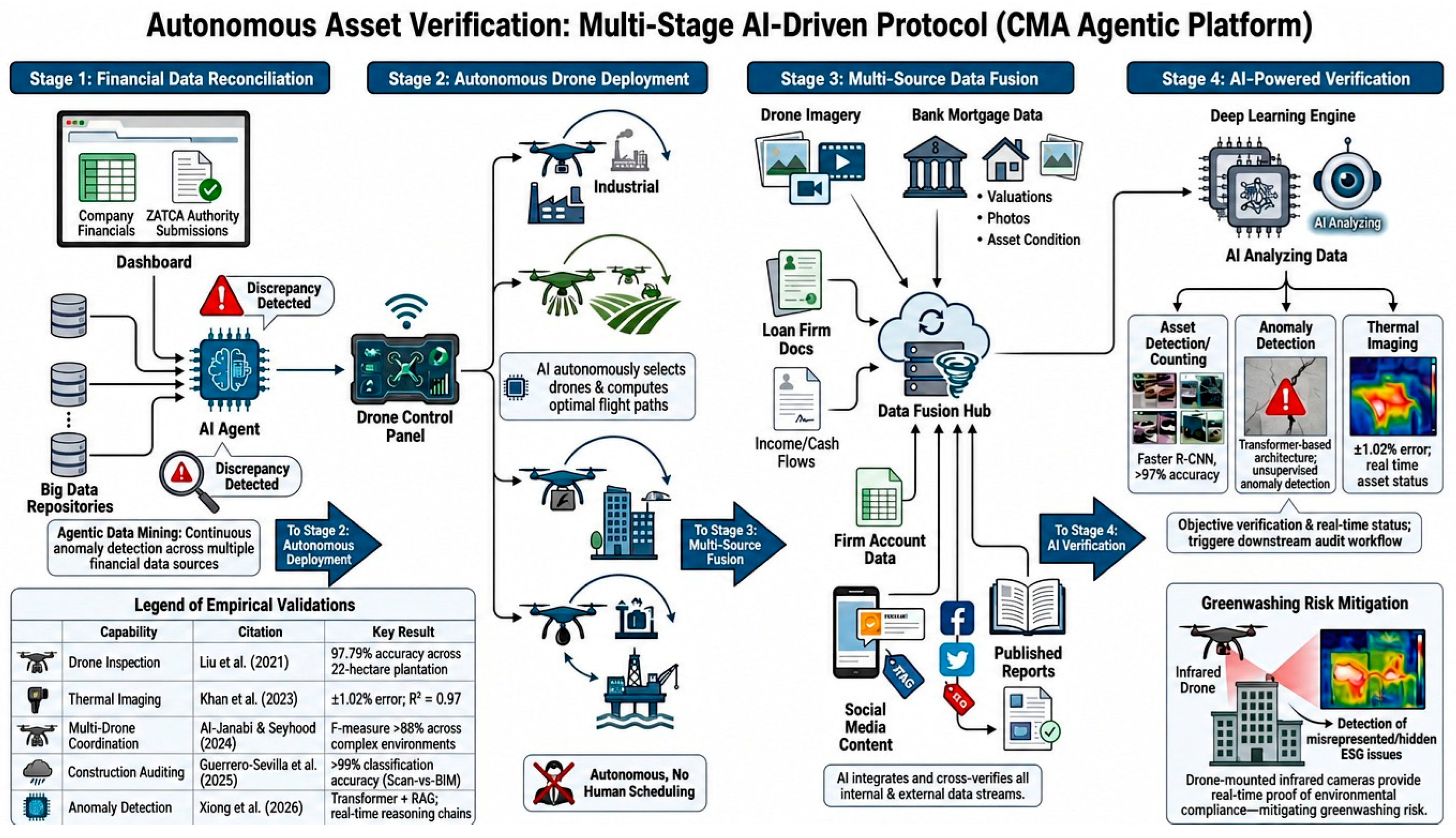
The Asset Verification segment operationalises Audit Tasks 1, 2, 3 and 4 as mapped in this paper’s TAF. The four tasks span asset existence and valuation verification, compliance and ESG monitoring, risk and anomaly detection, and construction progress assessment. When a company applies for listing on the Saudi Stock Exchange, or when a scheduled verification cycle is triggered by the platform’s continuous monitoring algorithms, the AI Agent autonomously initiates a multi-stage verification protocol. No human scheduling, mission planning or real-time supervision is required at any stage of execution. The architecture of this protocol is illustrated in
Figure 1, which maps the four-stage workflow from financial-data extraction through autonomous drone deployment, multi-source data fusion and AI-powered verification to the final governance outcome.
Stage 1: Financial Data Reconciliation
The platform extracts asset data from the company’s financial records, cross-references the extracted figures against submissions to the Zakat, Tax and Customs Authority (ZATCA, hereafter “ZATCA Authority”), and identifies any discrepancies requiring physical verification. This stage implements what this paper terms Agentic Data Mining: the continuous, autonomous monitoring of big-data repositories for anomaly detection across multiple financial data sources simultaneously [
48]. Unlike passive AI tools, which require an auditor to query a database and interpret results, the AI Agent monitors these repositories continuously. It identifies deviations between what firms report, what the ZATCA Authority holds on record, and what bank mortgage data confirms about the existence, condition and valuation of each registered asset. When a discrepancy is detected—for example, a building reported at a valuation materially higher than the average of three professional real-estate agent assessments held by the bank—the system does not flag the item for human scheduling. It autonomously advances the process to Stage 2 and triggers drone deployment without human instruction.
Stage 2: Autonomous Drone Deployment
On detection of a verification requirement, the AI Agent autonomously selects the appropriate drone platform based on asset type—industrial, agricultural, construction or offshore—and calculates optimal flight trajectories using fuzzy linear fractional transportation programming integrated with IoT-enabled multi-drone coordination [
19]. This trajectory-optimisation model continuously adjusts flight altitude in real time based on terrain morphology, fuel constraints, flight restrictions and physical threats. It achieves precision, recall and F-measure performance metrics all exceeding 88 per cent across emergency and complex industrial environments. The platform deploys multiple drones simultaneously across large Saudi industrial facilities and transmits verified physical-asset data to the AI Agent for real-time reconciliation against financial ledger records. No human operator is required to schedule, supervise or interpret individual flights. As
Figure 1 illustrates, this stage encompasses the full range of Saudi industrial geographies—from cement plants and petrochemical refineries to agricultural facilities and offshore oil infrastructure. Each setting presents distinct operational constraints that the autonomous trajectory system navigates without modification to its core logic.
Stage 3: Multi-Source Data Fusion
The platform integrates drone-captured imagery with a comprehensive constellation of internal and external data sources, as depicted in the Data Fusion Hub in
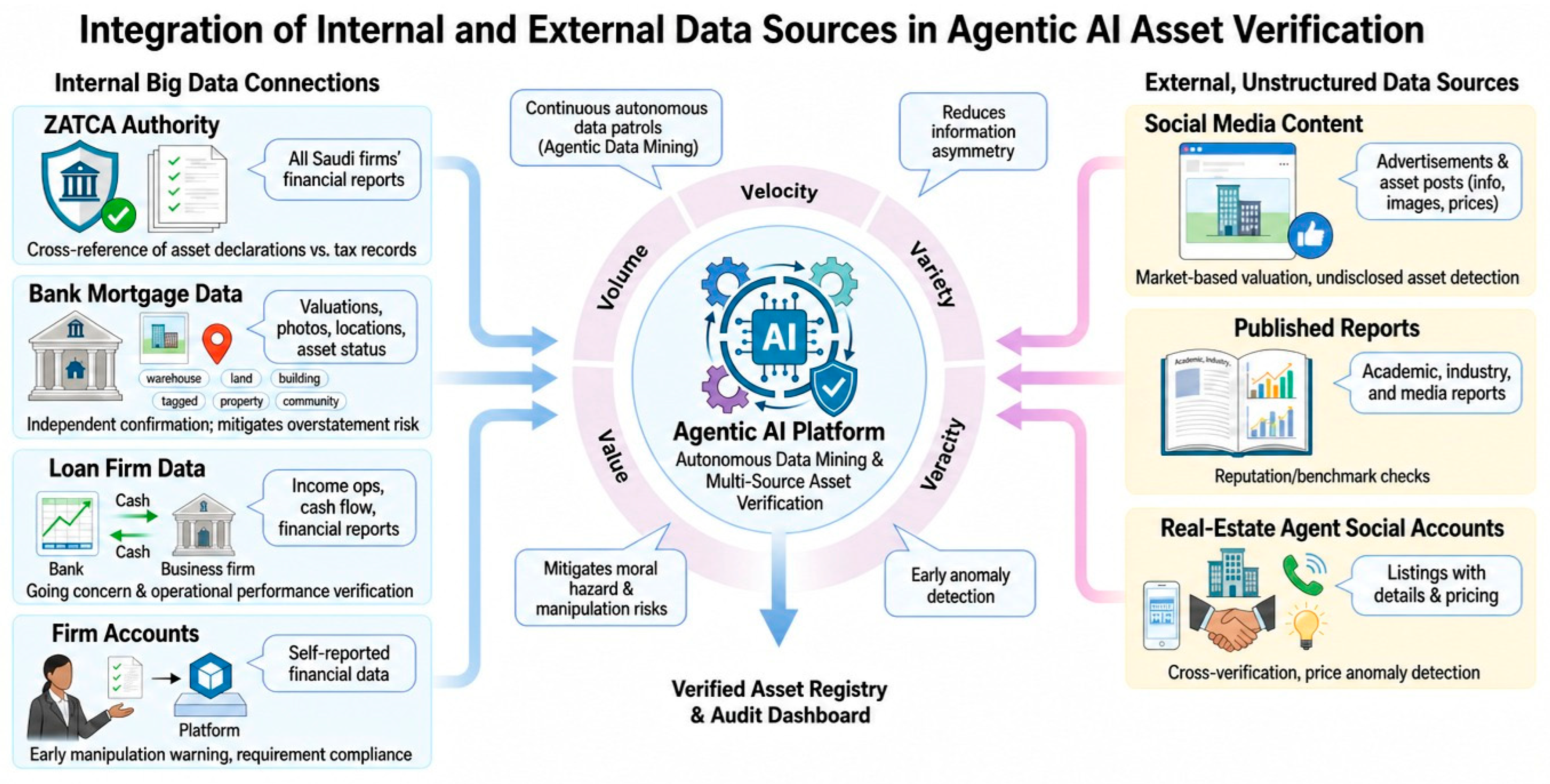
Figure 1. Internally, the platform draws on three categories of data. The first is bank mortgage data, including professional real-estate agent valuations, photographs, locations and asset-condition reports. The second is loan firm documentation, including income operations, cash flow evidence and financial reports. The third is firm-provided account data submitted directly to the platform. Externally, the platform crawls social-media content—company advertisements and real-estate agent postings with asset information and pricing—and cross-references these against formal declarations. This social-media verification mechanism directly addresses one of the most persistent forms of information asymmetry in the Saudi market: a manager cannot simultaneously maintain two materially different asset valuations across formal regulatory channels and informal social-media channels without the platform detecting the discrepancy. Published reports and academic literature further enrich the contextual benchmarking layer. The fused data stream is then passed to Stage 4 for AI-powered verification, a transition that
Figure 1 marks with the label “To Stage 4: AI Verification”. This confirms that the entire progression from anomaly detection to physical evidence fusion is executed without human intervention at any intermediate decision point.
Stage 4: AI-Powered Verification
Deep-learning models process the fused multi-source data stream through three parallel analytical pipelines, each validated by independent empirical literature reviewed in this paper. First, the Faster R-CNN architecture achieves more than 97 per cent accuracy in asset detection and counting. It autonomously locates, counts and precisely maps individual physical assets across large and complex sites, including biological assets in agricultural settings, without human interpretation of imagery [
21]. Second, transformer-based anomaly detection identifies deviations from expected operational patterns without requiring human operators to predefine what an anomaly looks like. This enables the system to distinguish between normal asset conditions and anomalous deviations across diverse industrial environments where the range of possible irregularities is too varied to be exhaustively catalogued in advance [
36]. Third, thermal imaging validates the operational status of physical assets with a measurement error of only ±1.02 per cent. It produces location-specific evidence of energy inefficiency, structural deterioration and invisible hazards—including heat leakages and insulation failures that managers might present as fully operational infrastructure in their financial disclosures [
20]. The right-hand panel of
Figure 1 illustrates these three analytical outputs—Asset Detection and Counting, Anomaly Detection, and Thermal Imaging—converging on the determination of objective verification status and triggering the downstream audit workflow. Where discrepancies persist after data fusion and AI analysis, the platform escalates to CMA human review. Where assets are confirmed, the registry is updated, and the verification record is permanently archived for audit-trail purposes.
3.1.3. Addressing the Greenwashing Risk
The Asset Verification segment directly addresses one of the three core research gaps identified in this paper: the absence of any existing study examining how Agentic Drone Swarms could provide objective, real-time physical verification of ESG disclosures within Saudi Vision 2030s’ sustainability framework [
50].
Saudi Arabia’s Vision 2030 agenda mandates a transition toward sustainable industrial practices across the Kingdom’s highest-emission sectors, including petrochemicals, cement and energy. Current ESG disclosure practices within these sectors rely on managerial self-reporting, which is structurally vulnerable to greenwashing—the presentation of sustainability claims that do not reflect operational reality. The platform addresses this vulnerability directly through the Greenwashing Risk Mitigation capability illustrated in the bottom-right panel of
Figure 1.
Drone-mounted infrared cameras autonomously measure thermal resistance across physical asset surfaces under variable environmental conditions. This produces location-specific, independently verified evidence of whether a facility’s environmental performance matches what its management reports [
20]. The thermal data captured by the drone swarm cannot be altered retrospectively by management, cannot be selectively presented to favour particular site conditions, and does not depend on the auditor’s physical presence at a remote or hazardous facility. It therefore provides what self-reported ESG disclosures structurally cannot: independently generated, continuously updated and physically grounded evidence of environmental compliance.
This mechanism directly operationalises Research Question 3 of this paper—the theoretical basis for proposing Agentic Drone Swarms as a mechanism for real-time ESG verification. It translates the conceptual proposition into a technically specified and empirically grounded governance mechanism with immediate applicability to Saudi Arabia’s Vision 2030 regulatory environment.
3.1.4. Audit Task Mapping: From Theoretical Framework to Platform Architecture
The Asset Verification segment does not operate as a generic inspection tool. Each of its four analytical pipelines maps directly onto specific audit tasks derived from the TAF developed in this paper, translating theoretical governance propositions into operationally specified platform functions. The four audit tasks addressed by Segment 1—asset verification and valuation (Task 1), compliance and ESG integrity (Task 2), risk and anomaly detection (Task 3), and construction progress and quality control (Task 4)—collectively cover the range of physical evidence required to close the information-asymmetry gaps that define the Saudi audit-quality problem. Each task is described below with its data inputs, analytical purpose, and agency-theory alignment as implemented within the CMA platform.
Audit Task 1: Asset Verification and Valuation
The first and most foundational audit task the platform executes is the autonomous verification of the existence, condition and valuation accuracy of corporate assets declared in financial statements submitted to the CMA. This task directly addresses the information-asymmetry construct at the core of agency theory: the gap between what managers know about the true condition and value of the assets they steward, and what shareholders and regulators can independently verify [
51]. In the Saudi context, this gap is structurally amplified by concentrated family ownership and the prevalence of related-party transactions. These conditions create a setting in which asset overstatement—the declaration of ghost inventory, the reporting of impaired assets as fully operational, or the inflation of property valuations—represents a persistent and documented form of earnings management [
2]. Ref. [
52] extend the [
13] drone-enabled inventory observation precedent by examining its implications for auditor liability, providing direct legal-context support for the platform’s Audit Task 1 architecture.
The platform addresses this task through four parallel data streams, each targeting a distinct dimension of asset verification. Image data collected by the drone swarm is processed through the Faster R-CNN deep-learning architecture. This architecture autonomously detects, counts and precisely locates individual physical assets across large and complex sites—including biological assets in agricultural settings—with accuracy consistently exceeding 97 per cent and false-positive rates tenfold lower than conventional machine-learning approaches [
21]. This capability eliminates the sampling limitations of traditional manual verification, in which an auditor visits a subset of assets during scheduled site visits and extrapolates findings to the entire population. That procedure creates a predictable window of opportunity for managers to present favourable conditions during the inspection period while concealing unfavourable ones between visits. Video data provides continuous real-time monitoring of asset counts and movements, offering visual audit documentation that cannot be altered retrospectively and that the platform archives in its permanent evidence record. Geospatial data confirms that declared assets occupy the physical locations recorded in the asset registry, using GPS coordinates to verify that a building reported at a specific location in Riyadh or Jeddah actually exists at those coordinates and not merely in the financial statements. Thermal data provides the deepest layer of verification, detecting the operational status of physical assets through heat signatures. This reveals idle machinery presented as active, structural deterioration presented as sound infrastructure, and insulation failures presented as fully functional facilities.
Table 3 summarises the complete data architecture of Audit Task 1 as implemented within the CMA platform.
Audit Task 2: Compliance and ESG Integrity
The second audit task the platform executes extends the physical verification function beyond financial asset accuracy into the domain of environmental, social and governance (ESG) compliance. This task directly addresses Research Question 3 of this paper and the ESG assurance deficit identified by [
50] as one of the most significant unresolved gaps in the AI-accounting literature. In the Saudi context, Vision 2030 mandates a transition toward sustainable industrial practices across the Kingdom’s highest-emission sectors. As long as sustainability disclosures continue to rely on managerial self-reporting, the absence of independently verified ESG data creates a structurally uncloseable greenwashing risk. The platform addresses this risk by deploying the same drone swarm infrastructure used for financial asset verification to collect environmental sensor data. This provides objective, real-time physical evidence of whether industrial operations comply with the environmental, safety and boundary conditions to which listed companies attest in their sustainability disclosures.
Environmental sensor data collected by the drone swarm monitors pollutant levels, including CO
2 and methane, across industrial facilities. It provides the CMA with objective evidence of whether emissions comply with Saudi environmental regulations, directly mitigating the moral hazard of managers who might otherwise suppress or understate environmental costs to protect short-term profitability [
50]. Ref. [
53] further demonstrate that multi-agentic architectures can monitor carbon-related operational constraints across global supply chains. This evidence provides additional scholarly support for the platform’s CO
2 and methane emission-verification function under Vision 2030 sustainability mandates. Geospatial data uses high-precision GPS to verify that physical activities—including mining, drilling and industrial processing—remain within the authorised legal boundaries declared in operating licences. This provides the principal, comprising shareholders and the CMA as regulator, with objective proof that the agent is operating within legal mandates rather than encroaching on protected areas or exceeding permitted extraction zones [
54]. Image and video data enable the platform to conduct autonomous safety audits via drone footage, verifying adherence to occupational health and safety standards across active construction and industrial sites. This visual evidence cannot be manipulated in a written management report, and the platform archives it for regulatory inspection on demand [
55]. Thermal and infrared data detect invisible hazards, including overheated machinery, heat leakages, insulation failures and structural deterioration, that jeopardise the safety and operational integrity of industrial facilities. They produce a permanent audit trail that holds executives accountable for asset upkeep and creates the evidentiary basis for [
10] concept of leadership maintenance accountability.
Table 4 summarises the complete data architecture of Audit Task 2 as implemented within the CMA platform.
Audit Task 3: Risk and Anomaly Detection
The third audit task the platform executes is the most analytically sophisticated. It involves the autonomous identification of anomalous events, patterns and changes across the physical environments of Saudi industrial facilities that may signal fraud, misappropriation or governance failure before those signals appear in financial statements. This task operationalises what agency theory terms fraud deterrence: the reduction in the information gap that managers might exploit to misappropriate or strip company assets during the periods between scheduled human audit visits. In the Saudi market, prolonged audit tenure creates extended windows of auditor familiarity and reduced professional scepticism. The continuous nature of platform-based anomaly detection therefore provides precisely the neutral, non-relational monitoring that human audit procedures cannot sustain.
Time-series imagery enables the platform to detect unauthorised alterations or missing assets by comparing sequential drone imagery captured across multiple verification cycles. It identifies changes in asset composition, inventory levels or structural configuration that are not reflected in the financial records submitted to the CMA [
56]. This change-detection function is directly relevant to the moral hazard problem in the Saudi market. A manager who systematically strips assets from a subsidiary, misappropriates inventory between audit cycles, or authorises unauthorised construction or demolition cannot conceal these actions from a system that continuously compares current physical conditions against archived baseline imagery.
Video data enables the platform to monitor live drone feeds for unusual activity patterns—workers at unexpected locations, machinery operating outside declared operational hours, or vehicles accessing restricted areas—and to flag these deviations for CMA investigation. Transformer-based anomaly detection provides the technical foundation for this capability. Deep-learning architectures can learn representations of normal operational patterns and autonomously identify deviations from those patterns without requiring human operators to predefine what an anomaly looks like. This unsupervised learning paradigm is essential for the Saudi industrial audit context, where the range of possible anomalies across cement plants, petrochemical refineries and offshore infrastructure is too diverse and context-specific to be exhaustively catalogued in advance [
36]. Thermal sensors detect unexpected temperature changes indicating equipment malfunctions, safety risks and deferred maintenance. This independent verification confirms that the agent is not neglecting asset upkeep to inflate short-term cash flows by deferring necessary repairs. Machine learning applied to historical drone data enables predictive risk assessment. It identifies facilities and asset classes where the probability of irregularity is elevated based on patterns in previous verification cycles.
Multi-agent coordination systems demonstrate that AI organiser agents can autonomously evaluate environmental conditions, resource availability and task urgency to dispatch the most appropriate autonomous vehicle without human scheduling. This validated self-organisation logic underpins the predictive, trigger-based drone deployment mechanism of the TAF [
49]. Ref. [
57] further establish drone-based assessment within the Maqasid Shariah framework for Takaful operations. Their work provides culturally and institutionally proximate precedent for drone-enabled assurance in the Saudi market and the broader GCC.
Table 5 summarises the complete data architecture of Audit Task 3.
Audit Task 4: Construction Progress and Quality Control
The fourth and final audit task executed by the Asset Verification segment addresses one of the most persistent and practically consequential forms of earnings management in the Saudi construction and infrastructure sector: the overstatement of project completion percentages to accelerate cash disbursements from project owners to contractors under long-term construction contracts. Under the percentage-of-completion method required by IFRS for long-term contract revenue recognition, the timing and quantum of revenue and cash flows depend entirely on the objective assessment of how much work has actually been completed at each reporting date. If a contractor overstates completion—reporting 70 per cent completion when the physical site reflects only 55 per cent—the resulting acceleration of cash disbursements represents a direct transfer of value from project owner to contractor. The financial statements obscure this transfer, and traditional periodic site visits cannot reliably detect it [
58]. Ref. [
13] further establish, in their framework of potential drone applications in auditing, that drone-based verification can support the measurement of progress toward completion of performance obligations under FASB ASC 606-10-25-27 and 606-10-55-17. This provides direct conceptual precedent for the platform’s Audit Task 4 construction-progress verification function.
The platform addresses this task by deploying the drone swarm to provide continuous, objective visual documentation of construction milestone completion. This enables the CMA and external auditors to independently verify the percentage of completion used for revenue recognition in long-term contracts without requiring physical auditor presence at the site [
58]. Image and video data provide real-time visual updates on construction milestones. The platform compares current site conditions against the completion percentages reported in interim financial statements and flags material discrepancies for escalation.
The Scan-vs-BIM methodology developed by [
18] provides the technical foundation for this capability at the highest level of precision. Ground drones equipped with terrestrial laser scanners collect three-dimensional point cloud data from active construction sites, which is compared against pre-existing Building Information Modelling plans to identify structural discrepancies between what was planned and what was physically built. The methodology detects structural translations, overhangs, section variations and construction voids with classification accuracy exceeding 99 per cent and a mean Intersection over Union of 0.75, without manual intervention at any stage of the data processing pipeline. Ref. [
47] provide the foundational exploratory framework establishing drone use in internal and external audits, on which the present Audit Task 4 architecture builds.
Geospatial data verifies that construction activity remains within the planned legal boundaries declared in the CMA project documentation. This protects the principal from legal liabilities and regulatory fines arising from the agent’s negligent or opportunistic encroachment. LiDAR and three-dimensional mapping assess structural dimensions against engineering specifications, ensuring that build quality meets contractually agreed standards. This independent quality verification confirms that contractors are not cutting corners on material quality to accelerate completion or protect performance bonuses.
Time-series data provides the platform’s most powerful construction governance capability. Sequential drone imagery compared against original construction blueprints through AI-enabled software produces an objective, time-stamped record of build quality and project advancement. This record cannot be altered retrospectively by management, ensuring that reported completion rates and associated financial disclosures accurately reflect physical reality at each stage of the construction lifecycle [
58].
Table 6 summarises the complete data architecture of Audit Task 4 as implemented within the CMA platform.





.png)