


Abstract
This paper explores the relationship between risk-taking attitudes, different dimensions of trust, and the adoption of financial technology (FinTech) in an emerging Central European economy. Based on survey data collected via LimeSurvey (October to December 2025) in Hungary, multivariate linear regression models were estimated to explore the relationship between FinTech usage, individual risk-taking propensity, and four dimensions of trust, while controlling for socioeconomic variables. The results indicate that higher institutional trust in independent financial actors facilitates FinTech adoption. However, higher institutional trust in domestic financial and governmental actors has an inhibiting effect. When trust dimensions are added to the model, the positive association with general risk-taking propensity becomes statistically marginal, indicating that trust-related factors account for a substantial share of the observed variation. Further tests regarding the possible direction of this causation confirm that FinTech use is also linked to increased trust in independent financial actors. This study adds to the FinTech literature by demonstrating that usage is related not only to generalized trust and individual risk propensity but also to differentiated institutional trust attitudes. The findings highlight that institutional background is an important determinant of digital financial behavior in emerging economies.
Keywords:
fintech adoption; trust; risk propensity; digital financial services; institutional trust; Hungary JEL Classification:
D81; G21; O16; O33
1. Introduction
The increasingly fast pace of digitalization in financial services has drastically changed how people evaluate financial risks, form financial decisions, and carry out financial transactions. Earlier research has often approached this issue through broad technology-acceptance frameworks, such as the Technology Acceptance Model (TAM), the Theory of Planned Behavior (TPB), and the Unified Theory of Acceptance and Use of Technology (UTAUT). These frameworks remain useful for organizing determinants, such as perceived usefulness, ease of use, social influence, and facilitating conditions. In the context of digital finance, however, they are not sufficient on their own. Financial technologies differ from many other digital services because they involve money, contractual commitments, personal data, security concerns, and the possibility of direct financial loss. For this reason, FinTech adoption research repeatedly identifies trust and perceived risk as central explanatory mechanisms rather than secondary extensions of generic acceptance models [1,2,3].
FinTech cannot be viewed as a single technology but rather as an ever-evolving, dynamic network of software and algorithms designed to improve financial processes and enhance customer experience [4]. It includes such innovative tools as digital banking, mobile payments, cryptocurrencies, blockchain technology, and P2P lending platforms [5,6,7]. The evolution of FinTech accelerated significantly following the 2008 global financial crisis, shifting from back-office banking innovations toward consumer-facing digital financial services [6,8,9].
The main focus of FinTech is to increase efficiency, accessibility, and innovation in financial services, whereby it is often disrupting traditional banking models [8,9]. Researchers have often emphasized the transformative nature of FinTech, as it fundamentally changes how people make financial decisions. By reducing transaction costs and making personalized financial management readily accessible, FinTech increases financial inclusion [5,6,7,8,9,10,11]. A supportive regulatory framework can further facilitate this process [12,13,14]. There are many benefits to inclusion, and it has long been known that inclusion and development are linked. However, there are risks associated with this nonlinear relationship, especially when excessive growth is paired with insufficient supervision and inadequate financial education [11].
Financial decision-making in the digital era is influenced by the interaction of several factors, such as demographic characteristics, trust, and risk perceptions, alongside more practical factors, such as ease of use and digital financial literacy [4,14,15,16].
Trust is particularly important in FinTech environments because consumers usually make decisions without face-to-face interaction and without direct visibility into the provider, the technological infrastructure, or the regulatory protections behind a transaction. Under such conditions, trust reduces uncertainty, compensates for information asymmetry, and makes engagement with innovative financial services more likely. Perceived risk plays the opposite role by increasing hesitation and expected vulnerability. As a result, digital financial adoption is shaped not only by whether a service appears useful or easy to use, but also by whether users regard the relevant institutions and actors as credible, transparent, and reliable. This is especially consequential in emerging and transitional settings, where institutional confidence may vary across domestic, foreign, supranational, and socially mediated sources of authority.
This issue is particularly relevant in the Hungarian context. Official reporting by the Hungarian National Bank (MNB) identified PayPal, Wise, Revolut, and Barion as the four most important innovative FinTech service providers present in Hungary already in 2021, together accounting for nearly 4 million user accounts [17]. More recent MNB evidence indicates the continued expansion of digital banks and FinTech providers, such as Revolut and Wise, and notes that Revolut alone had reached 1.5 million Hungarian customers by mid-2024 [18]. Digital payment usage has reached approximately 60–65% of the population, while mobile banking penetration is close to 70% and continues to grow [19]. At the same time, the MNB’s “FinTech and Digitalisation Report” states that foreign ownership background remains prevalent, especially among larger FinTech companies in Hungary [20]. In such a market environment, FinTech usage cannot be understood solely as a matter of utility or innovation acceptance; it is also connected to the institutional orientation of users and to the specific targets of trust that structure their financial choices.
Accordingly, the present study does not attempt to estimate an omnibus adoption model containing all possible determinants of FinTech use. Instead, it focuses on a narrower but theoretically meaningful question: whether differentiated forms of institutional trust, together with general risk-taking propensity, help explain FinTech usage in an emerging Central European economy. Existing research tends to concentrate on developed countries while largely neglecting emerging markets, despite the fact that these regions have frequently served as hubs of innovation, often fast-tracking the adoption of digital solutions. More specifically, the study distinguishes between domestic institutional trust, independent financial trust, European institutional trust, and public societal trust, and examines how these orientations are associated with FinTech usage propensity alongside demographic and socioeconomic controls. This approach is deliberate. It allows us to isolate how the target of trust matters in a financial environment where domestic and cross-border actors coexist and where institutional affiliation may shape adoption patterns.
The article is organized as follows: The next chapter describes the theoretical background, including trust and risk definitions. Section 3 presents the methodology and data. Section 4 presents results followed by Section 5. The article ends with conclusions, including study limitations and proposed future research avenues.
2. Literature Review
2.1. Theoretical Background
Technology Acceptance Models and FinTech Adoption
TAM is one of the most widely applied frameworks to explain user adoption of technological innovations [16,21]. Several studies looked at usage patterns in diverse national settings and they have consistently shown that perceived usefulness (PU) and perceived ease of use PEOU significantly influence individuals’ intentions to adopt digital financial services [7,16,22,23]. TAM has also been applied to various FinTech fields, such as banking, mobile payments, and cryptocurrency platforms, proving it to be a robust model for explaining customer adoption patterns [23,24,25]. Albuainain and Ashby [26] noted that for the success of FinTech, customer adoption is critical while it simultaneously affects both bank performance and competitive positioning.
Information, security, and service attributes interact to influence perceived value. When examined through the prism of the three pillars of financial inclusion—access, usage, and quality—perceived value is closely aligned with the notion of quality as it is defined in financial services [11,27]. Access and usage issues are distinct. The issue of access primarily results from market failures that restrict the supply of financial services, whereas the problem of actual utilization is mainly due to demand-side factors, such as lack of knowledge (both financial and digital), lack of trust in financial organizations, or fear of becoming indebted [27].
Technological innovation can promote growth only in a financial system that is capable of evolving and efficiently helping the economy to actually take advantage of these new technologies. Additionally, technology innovation itself may have a significant impact on how financial systems function, for instance, by changing how information is acquired, processed, and distributed [28].
TAM provides a strong theoretical basis; however, scholars often expand on it by adding contextual and psychological variables. Gefen, Karahanna, and Straub [29] were among the first to integrate trust into the model, which has since become a standard in FinTech research. The extended model might also include additional items, such as risk perception, security concerns, social influence, financial literacy, and self-efficacy, to better predict FinTech adoption [15,16,23,25,30,31,32]. The concepts of digital financial literacy and self-efficacy have also increasingly found their placement within the extensions of TAM. A few studies testify that both of these variables have an appreciable contribution in raising the confidence and intention of customers to use FinTech [33,34].
In this regard, Ajzen’s Theory of Planned Behavior (TPB) [35] explains FinTech adoption by introducing into the model the predictors of attitude, subjective norms, and perceived behavioral control. In fact, most previous research has underlined the view that social influence and normative pressure have a strong impact on the development of behavioral intention in both developed and emerging markets in several sectors of activities [16,23,32,36].
The UTAUT model, developed by Venkatesh et al. [36], combines several previous technology acceptance models, including TAM and TPB. FinTech studies employing UTAUT have strong explanatory power across several fields, including digital banking, mobile payments, and even cryptocurrency adoption [15,16,36,37]. The model also accounts for the moderating variables of age, gender, and experience, which may also influence adoption outcomes [16,24].
Digital financial literacy studies are building on the seminal work on classical financial literacy research by Lusardi and Mitchell [38]. In FinTech, digital financial literacy is defined as the ability of individuals to comprehend digital products, assess their risks, and make informed financial decisions [13,33,39]. Higher digital financial knowledge increases one’s chances of using mobile banking, online credit services, or neobanks [40,41]. When users possess increased digital and financial knowledge, it strengthens their perception of usefulness and ease of use, which in turn reduces risk perception and deepens their trust in the FinTech platforms themselves [13,32,42].
2.2. Conceptualizing Trust and Risk in FinTech
Prior research consistently supports the importance of the trust–risk relationship. Mahmud et al. [3], based on evidence from an emerging economy, show that trust and risk related variables remain among the most relevant predictors of FinTech adoption. Ryu and Ko [1] similarly demonstrate that trust and perceived risk are closely intertwined in explaining continuance intention in FinTech contexts. Service and information quality shape user perceptions through these uncertainty-related channels. Meta-analytic evidence from mobile banking also points in the same direction: trust has significant relationships with risk factors, quality dimensions, technology-acceptance variables, and behavioral outcomes. This suggests that trust should be treated as a structurally important factor in digital financial usage research rather than as a simple add-on [2]. Taken together, these findings justify a focused analytical view in which trust and risk are treated as central to the theoretical discussion, even when a study does not attempt to include every possible predictor identified in the broader adoption literature.
2.2.1. Risk-Taking Attitude and Perceived Risk
FinTech literature addresses two types of risks; general (objective) risk and perceived (subjective) risk.
General Risk Attitude
Behavioral finance literature on the financial decision-making process suggests that financial decision making is not entirely rational. Rather, these decisions are shaped by a complex interplay of risk preferences, intuition, and individual attitudes. In this context, risk-taking attitude is defined as an individual’s willingness to engage with uncertain financial outcomes. This concept aligns closely with the Diffusion of Innovations (DOI) theory [43].
In emerging economies, Jariyapan et al. [32] found that consumers with higher risk tolerance were more likely to adopt cryptocurrency platforms. Setiawan et al. [12] reported similar findings in Indonesia, and noted that risk-tolerant consumers are more likely to accept novel FinTech services, such as cryptocurrency and digital lending. According to Chan et al. [7] and Jariyapan et al. [32] interpersonal trust provides risk buffering, especially in peer-influenced environments, such as cryptocurrency adoption. User innovativeness and risk tolerance have also been shown to influence early adoption of FinTech services, especially among younger and technologically savvy populations [44,45]. Balaskas et al. [23] note that risk-taking interacts with trust and perceived usefulness as users are more inclined to adopt FinTech when they perceive the technology as trustworthy and useful.
Perceived Risk
Perceived risk, which is theoretically grounded in e-commerce research by Pavlou [46], is a central barrier to FinTech adoption. Perceived risk, encompassing the dimensions of financial loss, data privacy, fraud, operational risks and regulatory uncertainty, has been reported to negatively influence the adoption of FinTech [16,32]. Studies in emerging economies indicate that perceived risk is a significant barrier, particularly in unregulated or novel markets [13,36,47]. Unlike general risk attitudes, perceived risk directly mediates adoption intention; even risk-tolerant individuals may refrain from using FinTech if perceived risk is high [32,36].
Risk perception moderates the effects of TAM components; even if PU and PEOU are high, elevated perceived risk can suppress behavioral intention [16,23]. However, financial literacy and trust mitigate perceived risk, reinforcing the need for integrated adoption models [13,32].
In FinTech contexts, perceived risk, particularly related to data security, privacy, and financial loss, plays a central role in adoption decisions [36,37]. Studies on cryptocurrency and innovative financial services reveal that financial literacy moderates the impact of perceived risk on behavioral intention, enabling more informed and confident decision-making [12,32].
2.2.2. Trust as a Multilayer Concept
Building on Pavlou [46] and Gefen et al. [29], FinTech studies consistently identify trust as a prerequisite for adoption. Trust is a multidimensional construct encompassing confidence in technology providers, financial institutions, regulators, and peer networks. Empirical evidence from Hungary and other European contexts suggests that trust significantly moderates the relationship between technology acceptance and actual usage behavior [24,47,48,49]. As the notion of trust is closely linked to culture, customers in certain countries are more likely to adopt FinTech solutions [11].
Zarifis and Cheng [50] suggest that trust in Fintech is primarily shaped by four factors: the psychological predisposition of individuals toward trust, sociological factors affecting trust, trust in organizations and providers, and trust in AI and related tech. In digital-only environments, trust compensates for the lack of face-to-face interaction and mitigates perceived uncertainty [51,52]. Neobanks and open-banking platforms, in particular, rely heavily on trust and transparency due to the absence of physical branches and traditional interpersonal interactions [51,52,53].
The Trust Theoretic Model (TTM) was proposed by Chandra et al. [54] in their study on consumer adoption of M-payment systems. According to this model, which is based on research in the area of technology adoption and trust, “Mobile service provider characteristics” and “mobile technology environment characteristics” are two important components that promote confidence in these systems. Perceived risk and perceived regulatory support are the two main aspects that have been shown to influence customer trust when it comes to mobile technology features.
In FinTech research, trust is often categorized into three forms (Table 1):
Table 1.
Forms of trust in adoption decisions.
Interpersonal/Personal Trust
Personal trust, which refers to trust in individuals and recommendations by peers and social circles, affects early adoption behavior through social influence. However, its direct impact on service usage is typically weaker than that of institutional trust [51,53]. Chan et al. [7] highlighted that interpersonal trust is especially relevant in peer-influenced environments, such as open banking. Interpersonal trust and social influence further reinforce adoption through normative pressures [7,23].
Social Trust
Social trust, defined as generalized trust in the reliability and fairness of societal actors and systems, underpins both personal and institutional trust. It has recently been highlighted as a mechanism for enabling confidence in financial systems. Social trust is particularly important for vulnerable or less-informed users [55]. Although less frequently operationalized directly, social trust is implied in trust studies of national-level regulatory or financial infrastructure [23,26].
Zarifis and Cheng [50] demonstrated how a person’s psychological inclination to trust and sociological elements affecting that person’s trust will impact their trust in financial and insurance companies.
Institutional Trust
Institutional trust refers to confidence in formal organizations, such as banks, FinTech providers, and regulators [49,52]. Institutional trust diminishes the perceived risk of digital service usage and is thereby an important determinant of the use of ICT-enabled financial services [23,48]. This is evidenced in a number of studies that show that institutional trust in banks, FinTech providers, insurers, and the regulatory body significantly impacts the adoption, continuation, and satisfaction with digital financial services [23,36,48]. Balaskas et al. [23] and Putri et al. [25] found that institutional trust strongly predicts adoption intention for digital banking and MSME FinTech platforms. In emerging economies, institutional trust is particularly important because it reduces perceived risk and uncertainty [12,25,26]. According to research by Amnas et al. [47], trust in FinTech is significantly positively impacted by perceived regulatory backing. These services are more likely to be trusted by users who believe there is a robust regulatory framework in place because it provides them with a sense of security and confidence.
Trust is often defined relatively broadly in the existing literature, such as trust in technology, providers, or platforms. While this approach is certainly valid, it may obscure an important problem: the object of trust is not always the same in institutional terms. Users may distinguish between trust in domestic financial and governmental institutions, trust in foreign or independent financial actors, trust in supranational European institutions, and trust mediated through broader public or societal channels. Such a differentiation is especially relevant in contexts where financial innovation is embedded in a multi-level institutional setting. Tello-Gamarra et al. [56] explicitly argue that, despite the obvious relationship between fintechs and institutions, the details of this relationship remain insufficiently explored in the literature. More recent empirical work by Campos-Teixeira et al. [57] reinforces this point by showing that fintechs interact with institutional actors across multiple levels in an emerging economy and that the institutional setting is not merely a background context but part of the phenomenon itself.
Broader evidence from transitional and South-Eastern European environments points in a similar direction. Lep et al. [58], although not working specifically on FinTech adoption, show that institutional trust contributes to the use of e-services and that the strength of this contribution varies across countries and contexts. This is important because it suggests that institutional trust can affect digitally mediated service uptake even when the technology itself is similar across settings. For emerging and post-transition economies, then adoption is likely to be influenced not only by technological acceptance variables but also by the institutional landscape in which digital services are embedded. This observation strengthens the argument that the target of trust deserves more differentiated treatment in studies of financial technology use.
Eastern European Context
Beyond financial services, trust in public institutions has broader implications for individuals’ attitudes toward systemic risks and policy interventions. Research in Central and Eastern Europe has shown that trust in institutions influences attitudes towards complex socioeconomic issues, suggesting parallels with financial decision-making under uncertainty [59]. Trust in institutions and social trust are especially relevant given the differences in regulatory environments and varying perceptions of the reliability of the public sector [52,59]. As Nagy et al. [24] noted in their study on neobank adoption in Hungary, institutional trust plays a much more critical role in transitional economies that have recently undergone a financial crisis. Social trust, which refers to trust in societal norms and confidence in the regulatory structures, mediates adoption behaviors, especially in environments where trust in institutions may be inherently lower.
Recent research has increasingly focused on the context-dependent nature of trust and risk perceptions, which may systematically differ between advanced, emerging, and transitional economies. Quintus et al. [60] show that while trust consistently predicts digital service usage in various markets, the sources and mechanisms of trust differ. Emerging market consumers rely more on institutional assurances and third-party signals, whereas users in advanced markets depend more on prior experience and brand familiarity. Furthermore, Quintus et al. [60] observed that in emerging markets, consumers often substitute institutional trust with reliance on international or non-domestic actors, particularly when domestic institutions are perceived to be inefficient or non-transparent. In Central and Eastern Europe, institutional trust is influenced by both current regulatory performance and historical legacies. In fact, Lep et al. [58] found that in post-socialist countries, trust in public institutions is a more critical predictor of online service adoption than interpersonal trust or social influence. In a cross-country research design, they found that generalized trust in institutions mediates online service adoption, even after controlling for individual values and technology attitudes.
Data from emerging and transitional economies show that FinTech adoption behavior is influenced less by technological novelty and more by institutional credibility and regulatory confidence. Putrevu and Mertzanis [44,61], in their study of digital payment adoption across emerging economies, found that even when the underlying infrastructure and access are adequate, weak institutional trust still increases perceived risk and impedes adoption.
2.2.3. Interaction Between Trust and Risk
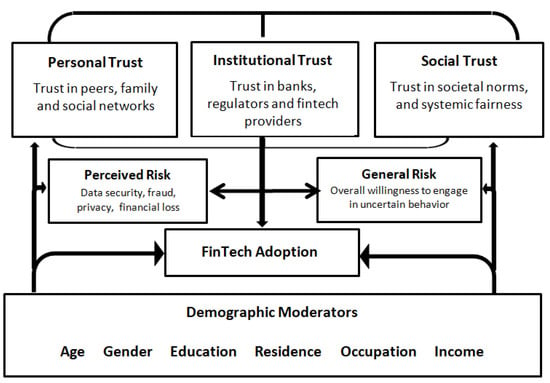
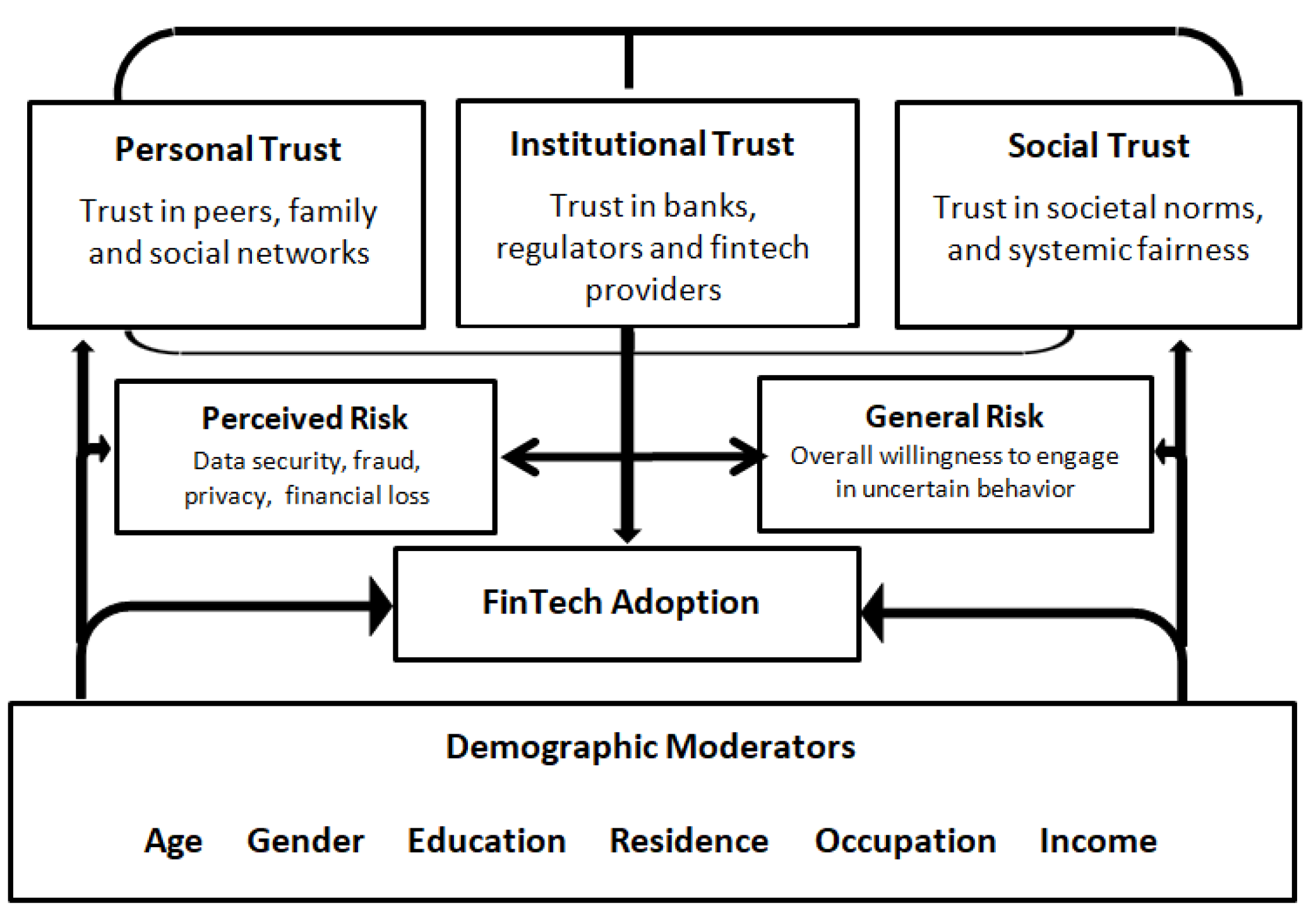
Trust functions as a risk-mitigation mechanism, and institutional trust is particularly effective in reducing perceived uncertainty, thus increasing confidence in digital financial systems [23,48,49]. While personal trust can moderate risk perceptions through peer recommendations, institutional trust remains the dominant factor in mitigating risk in large-scale adoption contexts [51,53]. High confidence in banks, regulators, and FinTech providers lowers perceived risk and increases adoption likelihood [23,25,26]. Although, institutional trust plays a primary role, interpersonal trust can also aid adoption by providing social proof and guidance, especially in open banking or cryptocurrency contexts [7]. Confidence in social norms or system integrity can also reduce perceived risk, especially in transitional economies where regulatory frameworks may still be developing [24]. Taneja et al. [62] offer strong evidence in their research on digital payments and neobanks that trust, security perceptions, and perceived risk form a combined decision-making system and are not independent predictors. Their findings suggest that once trust in system integrity and in governance is established, the marginal effect of individual risk sensitivity diminishes. Hence, trust plays a dual role as both a direct predictor of adoption and as an indirect moderator of perceived risk (Figure 1).
Figure 1.
Conceptual model of trust, risk, and demographic factors in FinTech adoption (authors’ conceptualization).
2.3. Demographic Determinants of FinTech Adoption
Prior research indicates that demographic characteristics systematically shape FinTech adoption through differences in digital literacy, access to technology, and financial behavior. Age is consistently identified as a key factor, with younger individuals more likely to adopt digital financial services due to greater technological familiarity and lower perceived risk [15,16,52,63]. Gender differences have also been observed, with men typically exhibiting higher adoption rates, partly reflecting differences in risk attitudes and financial behavior [33,36]. Employment status and income-related factors further influence adoption, as individuals engaged in full-time work or entrepreneurial activities tend to have greater exposure to financial services and higher demand for efficient financial management tools [13,40,41,45]. Finally, place of residence plays a role, as urban populations benefit from better digital infrastructure, higher service availability, and greater exposure to innovation, all of which facilitate FinTech usage [42,58]. Place of residence may also be linked to differences in institutional exposure and trust formation. However, the relationship between the rural–urban divide and trust (either form) remains underexplored, and its role in shaping FinTech adoption is not yet clearly established [58,59].
2.4. Synthesis and Research Gap
Against this background, the present study addresses a more specific gap than the broader FinTech-adoption literature. It does not seek to test a universal full-factor architecture of technology adoption, nor does it aim to include every predictor previously discussed in TAM-, TPB-, or UTAUT-oriented models. As Balaskas found in his recent review, a substantial portion of the empirical literature views trust as a supplementary addition to current adoption models rather than as a stand-alone theory [64]. Instead, this study examines whether differentiated institutional trust helps explain FinTech usage propensity when analyzed together with general risk-taking propensity and standard socioeconomic controls. In an emerging economy like Hungary, where trust is low and risk-avoidance is high, this topic is especially relevant.
By distinguishing among multiple trust targets, this study aims to contribute to the literature in two ways. First, it refines the role of trust beyond a generalized one-dimensional construct. Second, it places FinTech adoption within an institutional context, which is especially meaningful in an emerging European economy where domestic, foreign, and supranational actors coexist in everyday financial life. Accordingly, the following section formulates the research questions concerning differentiated trust, risk-taking propensity, and demographic predictors of FinTech usage.
2.5. Research Questions/Hypotheses
- RQ1: How do different trust dimensions influence FinTech adoption?
H1.
Trust in independent/foreign financial institutions is positively associated with FinTech adoption.
H2.
Trust in domestic institutions is negatively associated with FinTech adoption.
- 2.
- RQ2: Does general risk-taking propensity influence FinTech adoption after accounting for trust?
H3.
Risk-taking propensity influences adoption only when trust factors are excluded.
- 3.
- RQ3: How do demographic factors influence adoption?
H4.
Demographic factors (male, younger, full-time, entrepreneur, urban) are positively associated with adoption.
3. Materials and Methods
Data were collected using LimeSurvey (v. 6.15.15) between October and December 2025. Respondents had to be 15 years or older. Completion of the questionnaire was entirely voluntary. 326 responders filled out the survey completely, including the last part relating to trust. Participants were enlisted using non-probability convenience sampling. While the selection process was monitored iteratively to minimize any apparent imbalances across key demographic characteristics, it should be noted that the sample is not nationally representative and is intended primarily for analytical and theory-testing purposes. Like with most voluntary online surveys, there is a potential for selection bias.
Methodology
Exploratory factor analysis (EFA) was conducted on 21 items measuring trust using principal axis factoring (PAF) and Promax, given the expected correlations among trust dimensions. Factor retention was guided by eigenvalues > 1, scree plot inspection, and conceptual interpretability. Three items were excluded due to low loadings (<0.35) on all factors and lack of conceptual alignment, leaving 18 items.
The results of EFA revealed that the four factors explained 58.1% of the variance in the data (Table 2). All retained items loaded ≥ 0.40 on their respective factors, with no substantial cross-loadings, providing evidence consistent with construct validity. To further assess the discriminant validity of the study, pairwise correlations among the extracted trust factors were examined. Correlations were below the commonly accepted threshold (|r| < 0.70). This suggests that the constructs capture related yet distinct dimensions of trust. Higher correlations observed within factors reflect internal consistency rather than overlap across constructs. Although this study did not use confirmatory factor analysis, the combination of factor loadings, reliability measures, and inter-factor correlations provides reasonable support for construct validity in an exploratory research setting. The results had good sampling adequacy and were therefore suitable for factor analysis (KMO = 0.838; Bartlett’s test p < 0.001). Factor scores were saved for further analysis via the regression method. These four factors were:
- Domestic Institutional Trust: judiciary, government policy, domestic banks and insurance companies, the central bank, financial regulatory system, and state healthcare
- Independent Financial Trust: foreign banks and insurance companies, neo-banks, crypto, financial journals, and independent financial advisors
- European Institutional Trust: EU institutions and the European Central Bank.
- Public Societal Trust: social media influencers, the domestic media, and political parties
Table 2.
Exploratory factor analysis.
Although Factor 3 consists of only two items, this is acceptable in exploratory settings when items are highly correlated and conceptually coherent (both items loaded strongly on the factor EKB = 0.947, EU_Inst = 0.924). Reliability in this case was assessed using the Spearman–Brown coefficient. The result showed that the factor is reliable enough for analysis (r_SB = 0.94).
A FinTech usage propensity index (FTScore) was calculated for each respondent by summing up the binary indicators of FinTech usage. Given the study’s focus on observable FinTech behaviors across multiple domains, a summative index provides a transparent and interpretable measure of engagement breadth. A total of 14 questions relating to payment, investment, and administrative technologies were asked, out of which 12 were retained for the indicator (two items were excluded for less than 0.25 Corrected Item-Total Correlation, which is a standard threshold for ensuring internal consistency). For testing the internal consistency of the index, Cronbach’s alpha was used, which indicated acceptable reliability (α = 0.74). For a robustness check of the FTScore, a principal component analysis constrained to a single component was conducted. The one-component solution explained 27% of the total variance (KMO 0.744). All the items loaded positively on the component (range = 0.37 to 0.69), which indicated that the items share a common underlying tendency towards FinTech usage. While the explained variance of the single-component solution is relatively low (27%), this reflects the inherently heterogeneous nature of FinTech adoption across different service categories (e.g., payments, investments, administrative tools). The FTScore is therefore interpreted as a composite proxy of adoption breadth rather than a unidimensional latent construct. Similar approaches are common in exploratory FinTech adoption studies where usage patterns span multiple functional domains [65,66]. Descriptive statistics of the data can be seen in Table 3.
Table 3.
Descriptive statistics (N = 326).
As the survey instrument was not originally designed for latent variable modeling and the study focuses on examining associations between observable trust dimensions rather than estimating a full structural adoption framework, the empirical analysis relies on multiple linear regression. This approach is appropriate for isolating the independent contribution of theoretically defined predictors without imposing a full structural model. In contrast, structural equation modeling (SEM) typically requires more extensive measurement design and larger samples to reliably estimate latent constructs and indirect effects. Given the exploratory and theory-focused nature of this study, regression analysis provides a transparent and suitable framework. Regression-based approaches remain widely used in FinTech adoption research when the objective is to test relationships between behavioral and institutional predictors rather than to estimate comprehensive latent adoption frameworks [67,68].
Two linear regression models were run to examine the associations between various factors and the FinTech usage propensity index (FTScore). Model 1 looked at the relationship between risk-taking propensity and FTScore while controlling for key demographic factors such as age, gender, education, income, occupation, and place of residence (categorical variables were dummy-coded). Model 2 expanded on this analysis by incorporating four trust constructs: trust in domestic financial institutions/government, independent/foreign financial institutions, European institutions, and media and influencers, as well as risk-taking propensity and the same demographic variables.
Model 1:
FTScoreᵢ = β0 + β1(RiskAttᵢ) + β2(Ageᵢ) + β3(Genderᵢ dummy) + β4(Eduᵢ) +
β5(Incomeᵢ) + β6(Occupᵢ dummy) +β7(Domicileᵢ dummy) + εᵢ
β5(Incomeᵢ) + β6(Occupᵢ dummy) +β7(Domicileᵢ dummy) + εᵢ
Model 2:
FTScoreᵢ = β0 + β1(RiskAttᵢ) + β2(TRDomᵢ) +β3(TRIndᵢ) + β4(TREUᵢ) +
β5(TRSocᵢ) + β6(Ageᵢ) + β7(Genderᵢ dummy) +β8(Eduᵢ) + β9(Incomeᵢ) +
β10(Occupᵢ dummy) +β11(Domicileᵢ dummy) + εᵢ
β5(TRSocᵢ) + β6(Ageᵢ) + β7(Genderᵢ dummy) +β8(Eduᵢ) + β9(Incomeᵢ) +
β10(Occupᵢ dummy) +β11(Domicileᵢ dummy) + εᵢ
This modeling strategy allows us to examine associations between trust dimensions, risk propensity, and FinTech engagement while remaining consistent with the cross-sectional, exploratory nature of the study.
4. Results
First, a multiple linear regression was run to examine the extent to which risk-taking propensity and demographic characteristics are associated with FTscores (Model 1). The overall model was significant (F(15, 320) = 6.28, p < 0.001), explaining approximately 24% of the variance in FTScore (Adjusted R2 = 0.238). Significant positive associations were observed for gender, full-time employment, being an entrepreneur, unemployed status, income, education, and risk-taking propensity. Multicollinearity was within acceptable range (VIF < 3.5) (Table 4):
Table 4.
Model 1 linear regression examining the influence of risk-taking and demographics on FinTech usage (FTScore) (N = 326).
For Model 2, trust variables were added. The overall model was significant (F(19, 316) = 6.23, p < 0.001) and explained approximately 28% of the variance in FTScore (Adjusted R2 = 0.281). Among trust factors, Independent Financial Trust was positively associated with FTScore (β = 0.258, p = 0.001), whereas Domestic Institutional Trust showed a small negative association (β = −0.171, p = 0.023). European Institutional Trust and Social Trust were not significantly associated with FTScore. Significant demographic variables were: being male, having full-time employment, being an entrepreneur, and unemployed status. Multicollinearity statistics were acceptable (VIF < 3) for all variables (Table 5).
Table 5.
Model 2. Linear regression examining the influence of risk-taking, trust factors, and demographics on FinTech usage (FT Score) (N = 326).
Robustness and Additional Analyses
Additional analyses were conducted to examine the robustness of the results and the structural form of the relationships. First, to test for synergistic or moderating effects, interaction models were estimated with cross-product terms between trust dimensions. The results showed no statistically significant interaction effects. The model fit did not improve, which suggests that trust dimensions are additive variables.
Non-linear relationships between trust dimensions and FTScore were also looked at. None of the models with quadratic terms for trust dimensions were statistically significant, and the model fit also remained unchanged. Therefore, a linear relationship between trust dimensions and FTScore is reinforced.
To provide a robustness check, we also tested whether the influence on income and education on FTScore is mediated through domestic or independent trust. The results showed that domestic trust does not influence of the effect of the two variables, while independent trust is strongly associated with adoption, though income and education do not have a significant influence on independent trust. Because bootstrapping was not performed, these results are interpreted as a robustness check rather than formal evidence of mediation (Table 6).
Table 6.
Robustness check of income and education on FTScore via Trust.
Additional regression analyses were run to test for potential reverse causation, with the two trust variables (Domestic and Independent Trust) as the dependent and FT Score as the independent variable. The findings show that there is no significant impact of Domestic Trust. In the case of Independent Trust, however, FT Score proved to be significant (B = 0.085, SE = 0.024, p < 0.001), which indicates a partially reciprocal relationship. The findings suggest that the link between trust and FinTech-related behaviors is not necessarily unidirectional. Although the theoretical framework posits that trust influences these behaviors, the results indicate a potential feedback effect, especially in the case of independent trust. Therefore, the observed associations should be interpreted as potentially reciprocal rather than strictly causal.
5. Discussion
The purpose of this research was to explore the relationship between FinTech usage and multiple facets of trust and individual risk-taking propensity in an emerging European economy. Model 1 is consistent with previous research, showing that general risk-taking propensity is positively associated with increased FinTech usage when controlled for demographic factors. This finding aligns with behavioral finance and innovation diffusion theories, which suggest that individuals with a higher tolerance for uncertainty are more likely to adopt novel financial technologies [32,43]. However, in Model 2, which incorporates the four trust factors, the effect of general risk-taking became non-significant. According to the findings of previous studies, the influence of institutional and financial trust on the adoption of FinTech behaviors is predominant over personality-based risk tendencies [62]. This pattern indicates that the association between risk preferences and FinTech usage is contingent on institutional trust contexts rather than reflecting a stable personality-driven effect.
It is important to note that, although the overall explanatory power of the models is moderate, this is due to a deliberate analytical choice rather than model misspecification. The purpose of the regression analysis was not to maximize explained variance, but rather to isolate the role of distinct trust dimensions within a theory-driven framework. As such, several well-established predictors of FinTech adoption (e.g., perceived usefulness, effort expectancy, and service-specific characteristics) were intentionally excluded. Therefore, the moderate explanatory power of the models should be interpreted in light of this design choice rather than as evidence of model incompleteness.
Adding the trust dimensions increases the adjusted R2 from 0.238 to 0.281, suggesting that trust accounts for a meaningful part of the variance in FTScore beyond the demographic and risk attitude effects. Specifically, trust in independent or international financial institutions is positively related to FinTech usage, while trust in domestic financial and governmental institutions is negatively associated with it. This pattern indicates that individuals with lower confidence in domestic institutions are more likely to use FinTech services. At the same time, those with higher confidence in international or independent actors are more likely to adopt them. The observed configuration of effects is consistent with, but not direct evidence of, a trust-substitution mechanism, where FinTech services may be perceived as alternatives to traditional domestic institutions. However, the substitution mechanism itself cannot be directly tested using cross-sectional survey data.
According to the findings of multiple studies, the adoption of digital financial practices in these markets is influenced by a variety of factors, including institutional quality, regulatory credibility, and perceived governance shortcomings [60,61]. This suggests that FinTech is valued precisely because it operates outside the domestic institutional framework that some users distrust. Social trust, as measured by confidence in media, influencers, and political actors, shows a limited association with FinTech usage. This supports prior findings that social influence plays a secondary or indirect role in the adoption of financial technology, particularly when institutional trust signals are available [69].
The results show that the inclusion of the trust variables mitigates the effect of income and education, which may indicate that part of the effect of income and education on FinTech usage goes through the trust-related mechanisms. However, robustness checks using minimal mediation models show that income and education are not significantly associated with either domestic or independent trust. This suggests that these trust dimensions do not formally mediate socioeconomic effects. Instead, higher income and education likely operate alongside trust through parallel mechanisms such as access to technology, digital literacy, and familiarity with complex financial products [13,33,39,40,70]. Individuals with higher-incomes tend to adopt FinTech services more willingly, likely due to greater access to technology and a higher capacity to absorb financial risks. This is particularly true for premium services such as investment platforms and digital wealth management [23,36,71].
Among the demographic variables, age, gender, and employment status remained significant. This is also supported by the literature, where it is found that professionals and students show higher adoption rates. This reflects their increased exposure to technology and their greater need for efficient and more expeditious financial management [13,40,41,45]. Due to their familiarity with technology and higher digital literacy rates, younger generations, i.e., Millennials and Gen Z, are more likely to adopt FinTech services [15,16,52,63]. Older adults may require a higher level of institutional trust in order to compensate for their lower digital literacy and higher perceived risk levels [23,72]. Gender differences remained strong for both models. Previous findings have suggested that gender gaps in FinTech usage largely diminish once trust and financial literacy are taken into account [33,36].
Additional robustness tests helped to refine the results regarding causal interpretation. Tests for interaction effects between the dimensions of trust did not produce any statistically significant results. This finding suggests that the effects of different trust types are cumulative rather than multiplicative. Likewise, models with quadratic trust terms did not demonstrate significant non-linear relationships. Reverse-causation tests, on the other hand, indicated that while FTScore does not have a strong correlation with domestic trust, it is positively associated with independent trust. The use of digital financial services has the potential to not only reflect prior trust perceptions among consumers but also to reinforce trust over time. This points to a feedback process rather than being purely selection-driven.
H1 and H2 are supported by the results, indicating that institutional trust operates in a differentiated manner across domains. H3 receives partial support, as risk-taking propensity is associated with FTScore only in the absence of institutional trust measures. Finally, H4 is supported only partially, with several demographic characteristics showing significant associations across model specifications. Taken together, these results should be interpreted as identifying robust association patterns rather than definitive causal pathways. The findings highlight the central role of institutional trust configurations in shaping, and potentially being shaped by, FinTech engagement. They also highlight the importance of longitudinal research designs to explore directionality and feedback effects in greater depth.
6. Conclusions
The objective of this study was to examine the association between multiple dimensions of trust and individual risk-taking propensity with FinTech behaviors in an emerging European context. The findings show a correlation between FinTech usage and trust in financial institutions perceived to be independent. Additionally, higher levels of trust in domestic financial and government institutions are associated with lower FinTech usage. At the same time, general risk-taking propensity is positively correlated with FinTech usage only in models where trust measures are excluded.
Results do not offer conclusive evidence of a causal trust-substitution mechanism but rather reveal a systematic pattern of relationships. Specifically, there is a link between FinTech usage behavior and the various trust orientations towards domestic versus independent financial actors. The result of the robustness test shows that the relationships are linear, additive, and not driven by interaction effects between trust dimensions. Minimal mediation analyses further suggest that the effect of socioeconomic variables, such as income and education, is not mediated by trust but instead appear to operate through other factors, including access to technology, digital skills, and financial literacy.
Additional reverse causality tests show that while FTScore does not have a significant impact on domestic institutional trust, it is positively associated with trust in independent financial actors. This finding suggests a partially reciprocal relationship, implying that trust both conditions and is reinforced by engagement with digital financial services. Therefore, FinTech adoption behavior should be viewed as part of a dynamic trust–technology feedback process rather than the product of a one-way effect based on pre-existing institutional confidence.
6.1. Policy Implications
The policy implications are two-fold. FinTech providers should prioritize establishing trust with their users, focusing on communication that emphasizes transparency and independence from traditional institutions. As Zarifis and Cheng [50] have shown in their model, a provider has more influence on ‘Trust in financial organization’ than on the other three components of psychological disposition, sociological factors, or trust in AI. Conversely, traditional, domestic institutions should focus on enhancing their image by improving their regulatory credibility, transparency, and institutional independence. Putrevu and Mertzanis [44] have also emphasized that strengthening governance quality and consumer protection may be more effective than merely expanding the technological infrastructure. In emerging and transitional economies, the promotion of FinTech services requires a multifaceted approach. This should include both encouraging innovation and addressing institutional trust deficits, as these deficits are often the ones motivating consumers to seek alternatives to the traditional financial system.
6.2. Limitations and Further Research Avenues
There are several limitations to the study that should be acknowledged. Firstly, the study is based on cross-sectional survey data, which limits causal inference and does not allow for direct observation of trust dynamics over time. Reverse-causation tests were conducted; however, longitudinal or experimental designs could establish directionality more conclusively. Secondly, there is limited generalizability as it focuses on a single nation. In fact, trust structures can vary considerably across countries, depending on the regulatory environment, historical legacies, and the development of financial markets. Future cross-country analysis could test whether the observed differences between domestic and independent trust also apply to other emerging or transitional economies.
The modest sample size and use of a non-probability sampling approach limit the generalizability of the findings and may introduce selection bias. Therefore, the results should be interpreted with caution. Future research using larger or nationally representative samples would help validate these findings and enable subgroup analyses (e.g., by age, income, or residence) to better capture heterogeneous adoption patterns across different population segments. Thirdly, the usage of FinTech is measured by a composite index, which could mask differences in the usage patterns of specific services, such as payments, digital banking, and investment platforms. Disaggregated analyses could provide a clearer understanding of how trust and risk interact across these different domains. Finally, general risk-taking propensity was used in place of FinTech-specific perceived risk measures. Future research could also examine whether the various types of trust have a similar effect of reducing the influence of perceived risk on adoption. A broader questionnaire design and larger sample would also enable the application of structural equation modeling (SEM), which could better capture latent constructs, indirect effects, and potential mediation mechanisms between trust dimensions and FinTech adoption.
The present study makes a valuable contribution to the FinTech literature by showing that institutional trust patterns, rather than generalized trust or individual risk tolerance alone, are associated with FinTech behaviors. These findings draw attention to the fact that broader institutional and cognitive contexts are necessary for understanding FinTech adoption patterns, particularly in emerging markets where trust in domestic institutions remains low.
Author Contributions
Conceptualization, Z.D. and Á.B.H.; methodology, Z.D.; software, Z.D. and Á.B.H.; validation, Z.D. and Á.B.H.; formal analysis, Z.D.; data curation, Z.D. and Á.B.H.; writing—original draft preparation, Z.D.; writing—review and editing, Z.D. and Á.B.H.; visualization, Z.D.; supervision, Z.D.; project administration, Á.B.H.; All authors have read and agreed to the published version of the manuscript.
Funding
This research received no external funding.
Institutional Review Board Statement
Approval Waived. We would like to clarify that in Hungary, there is currently no formal requirement for any local Institutional Review Board (IRB) or ethics committee for studies of this nature. Nevertheless, the authors have strictly adhered to ethical principles while conducting this research, in line with the standards outlined in the Declaration of Helsinki (1975, revised 2013). In accordance with the General Data Protection Regulation (GDPR) principles of data minimization and privacy by design, no personal data were collected or processed, either automatically or through survey questions. Specifically, IP addresses, referral sources, and other technical identifiers were not recorded, and the questionnaire did not include items that could be used to infer respondents’ identities. Access to the LimeSurvey system and the dataset was restricted exclusively to the research team. The survey was designed solely for scientific research purposes. All questions focused on attitudes and perceptions related to financial technologies, trust, and risk, without collecting sensitive or commercially exploitable information. All data were stored and processed solely for scientific analysis in accordance with established ethical guidelines for social science research.
Informed Consent Statement
Informed consent was obtained from all subjects involved in the study.
Data Availability Statement
Due to privacy and ethical reasons the raw data supporting the conclusions of this article are available on a reasonable request from the corresponding author.
Acknowledgments
During the preparation of this manuscript, the authors used ChatGPT 5.3 for assisting in refining text and editing grammar. The authors (Z.D. and Á.B.H.) have reviewed and edited the output and take full responsibility for the content of this publication.
Conflicts of Interest
The authors declare no conflicts of interest.
Abbreviations
The following abbreviations are used in this manuscript:
| TAM | Technology Acceptance Model |
| TPB | Theory of Planned Behavior |
| UTAUT | Unified Theory of Acceptance and Use of Technology |
| PU | Perceived Usefulness |
| PEOU | Perceived Ease of Use |
| DOI | Diffusion of Innovation |
| ICT | Information and Communication Technology |
| EFA | Exploratory Factor Analysis |
| TTM | Trust Theoretic Model |
| PAF | Principal Axis Factoring |
References
- Mahmud, K.; Joarder, M.M.A.; Muheymin-Us-Sakib, K. Adoption Factors of FinTech: Evidence from an Emerging Economy Country-Wide Representative Sample. Int. J. Financ. Stud. 2023, 11, 9. [Google Scholar] [CrossRef] [Scilit]
- Ryu, H.-S.; Ko, K.S. Sustainable Development of Fintech: Focused on Uncertainty and Perceived Quality Issues. Sustainability 2020, 12, 7669. [Google Scholar] [CrossRef] [Scilit]
- Kumar, P.; Chauhan, S.; Gupta, P.; Jaiswal, M.P. A Meta-Analysis of Trust in Mobile Banking: The Moderating Role of Cultural Dimensions. Int. J. Bank Mark. 2023, 41, 1207–1238. [Google Scholar] [CrossRef] [Scilit]
- Rajpal, S.; Manglani, A. Drivers of FinTech adoption: Insights from a global review of recent literature. Account. Res. J. 2025, 39, 84–103. [Google Scholar] [CrossRef] [Scilit]
- Thakor, A.V. FinTech and banking: What do we know? J. Financ. Intermed. 2020, 41, 100833. [Google Scholar] [CrossRef] [Scilit]
- Giglio, F. FinTech: A literature review. Int. Bus. Res. 2022, 15, 80–85. [Google Scholar] [CrossRef] [Scilit]
- Chan, R.; Troshani, I.; Rao Hill, S.; Hoffmann, A. Towards an understanding of consumers’ FinTech adoption: The case of Open Banking. Int. J. Bank Mark. 2022, 40, 886–917. [Google Scholar] [CrossRef] [Scilit]
- Frost, J. The Economic Forces Driving FinTech adoption across Countries. The Technological Revolution in Financial Services: How Banks, FinTechs, and Customers win Together, BIS Working Papers. 2020. Available online: https://ssrn.com/abstract=3535904 (accessed on 18 July 2025).
- Takeda, A.; Ito, Y. A review of FinTech research. Int. J. Technol. Manag. 2021, 86, 67–88. [Google Scholar] [CrossRef] [Scilit]
- Acharyya, M.; Butterfield, K. Adoption of IoT-Based Insurance Solutions: Comparative Evidence from Health, Motor, and Home Sectors. SSRN 2025, 1–31. [Google Scholar] [CrossRef] [Scilit]
- De Mariz, F. Finance with a Purpose: FinTech, Development and Financial Inclusion in the Global Economy; World Scientific Books; World Scientific Publishing Co. Pte. Ltd.: Singapore, 2022. [Google Scholar] [CrossRef] [Scilit]
- Setiawan, B.; Nugraha, D.P.; Irawan, A.; Nathan, R.J.; Zeman, Z. User innovativeness and FinTech adoption in Indonesia. J. Open Innov. Technol. Mark. Complex. 2021, 7, 188. [Google Scholar] [CrossRef] [Scilit]
- Alsabah, M.; Alsaber, A.; AlReshaid, F.; Moharrak, M.; Boresli, N.; Al-Kandari, A. Exploring the convergence of technology acceptance and financial literacy: A study on sustainable credit card use in an emerging economy. Int. Rev. Manag. Mark. 2025, 15, 45–57. [Google Scholar] [CrossRef] [Scilit]
- Aracil, E.; Fernández-Méndez, L.; Roch-Dupré, D.; Fuertes, F.J. Trust and financial inclusion: A literature review with reference to the digital transformation. Heliyon 2025, 11, e44128. [Google Scholar] [CrossRef] [Scilit]
- Firmansyah, E.A.; Masri, M.; Anshari, M.; Besar, M.H.A. Factors affecting FinTech adoption: A systematic literature review. FinTech 2022, 2, 21–33. [Google Scholar] [CrossRef] [Scilit]
- Singh, S.; Sahni, M.M.; Kovid, R.K. What drives FinTech adoption? A multi-method evaluation using an adapted technology acceptance model. Manag. Decis. 2020, 58, 1675–1697. [Google Scholar] [CrossRef] [Scilit]
- Magyar Nemzeti Bank. Financial Stability Report; MNB: Budapest, Hungary, 2021. [Google Scholar]
- Magyar Nemzeti Bank. Financial Stability Report; MNB: Budapest, Hungary, 2025. [Google Scholar]
- Statista. Digital Payments in Hungary—Statistics & Facts. Available online: https://www.statista.com/topics/10312/digital-payments-in-hungary/ (accessed on 20 March 2026).
- Magyar Nemzeti Bank. FinTech and Digitalisation Report; MNB: Budapest, Hungary, 2025. [Google Scholar]
- Davis, F.D. Perceived usefulness, perceived ease of use, and user acceptance of information technology. MIS Q. 1989, 13, 319–340. [Google Scholar] [CrossRef] [Scilit]
- Tun-Pin, C.; Keng-Soon, W.C.; Yen-San, Y.; Pui-Yee, C.; Hong-Leong, J.T.; Shwu-Shing, N. An adoption of FinTech service in Malaysia. South East Asia J. Contemp. Bus. 2019, 18, 134–147. [Google Scholar]
- Balaskas, S.; Koutroumani, M.; Komis, K.; Rigou, M. FinTech services adoption in Greece: The roles of trust, government support, and technology acceptance factors. FinTech 2024, 3, 83–101. [Google Scholar] [CrossRef] [Scilit]
- Nagy, S.; Molnár, L.; Papp, A. Customer adoption of Neobank services from a technology acceptance perspective–evidence from Hungary. Decis. Mak. Appl. Manag. Eng. 2023, 7, 187–208. [Google Scholar] [CrossRef] [Scilit]
- Putri, S.A.; Sartika, D.; Gunarto, M.; Helmi, S. Factors Affecting the Level of Trust of MSMEs in Using FinTech Using the Technology Acceptance Model (TAM). In Proceedings of the 4th South American International Industrial Engineering and Operations Management Conference, Lima, Peru, 9–11 May 2023; pp. 685–695. Available online: https://ieomsociety.org/proceedings/2023peru/182.pdf (accessed on 19 October 2025).
- Albuainain, A.; Ashby, S. Enablers and Barriers in FinTech Adoption: A Systematic Literature Review of Customer Adoption and Its Impact on Bank Performance. FinTech 2025, 4, 49. [Google Scholar] [CrossRef] [Scilit]
- Roa, M.J. Financial Inclusion in Latin America and the Caribbean: Access, Usage and Quality; CEMLA: Mexico City, Mexico, 2015; Volume 10. [Google Scholar]
- Levine, R. Finance and growth: Theory and evidence. In Handbook of Economic Growth; Elsevier: Amsterdam, The Netherlands, 2005; Volume 1, pp. 865–934. [Google Scholar]
- Gefen, D.; Karahanna, E.; Straub, D.W. Trust and TAM in online shopping: An integrated model. MIS Q. 2003, 27, 51–90. [Google Scholar] [CrossRef] [Scilit]
- Gharahkhani, M.; Pourhashemi, S.O. Adoption of Mobile Insurance Using TAM: A Case Study. Int. J. Indust. Eng. Manag. Sci. 2020, 7, 45–54. [Google Scholar]
- Nangin, M.A.; Barus, I.R.G.; Wahyoedi, S. The effects of perceived ease of use, security, and promotion on trust and its implications on FinTech adoption. J. Consum. Sci. 2020, 5, 124–138. [Google Scholar] [CrossRef] [Scilit]
- Jariyapan, P.; Mattayaphutron, S.; Gillani, S.N.; Shafique, O. Factors influencing the behavioural intention to use cryptocurrency in emerging economies during the COVID-19 pandemic: Based on technology acceptance model 3, perceived risk, and financial literacy. Front. Psychol. 2022, 12, 814087. [Google Scholar] [CrossRef] [Scilit] [PubMed]
- Pant, S.K.; Agarwal, M. Impact of Digital Financial Literacy on Financial Technology Adoption. Bharatiya Shikska Shodh Patrika 2023, 42, 200–253. Available online: https://ssrn.com/abstract=4838234 (accessed on 18 July 2025).
- Sumartini, A.R.; Suprapti, N.W.S.; Piartrini, P.S.; Sukaatmadja, I.P.G. Digital Financial Literacy and Self-efficacy in Increasing Intention to Use Digital Bank with the Technology Acceptance Model Theory Approach: A Literature Review. Int. Res. J. Manag. IT Soc. Sci. 2024, 11, 252–263. [Google Scholar] [CrossRef] [Scilit]
- Ajzen, I. The theory of planned behavior. Organ. Behav. Hum. Decis. Process. 1991, 50, 179–211. [Google Scholar] [CrossRef] [Scilit]
- Hasan, R.; Ashfaq, M.; Shao, L. Evaluating drivers of FinTech adoption in the Netherlands. Glob. Bus. Rev. 2024, 25, 1576–1589. [Google Scholar] [CrossRef] [Scilit]
- Venkatesh, V.; Morris, M.G.; Davis, G.B.; Davis, F.D. User Acceptance of Information Technology: Toward a Unified View. MIS Q. 2003, 27, 425–478. [Google Scholar] [CrossRef] [Scilit]
- Lusardi, A.; Mitchell, O.S. The Economic importance of financial literacy: Theory and evidence. J. Econ. Lit. 2014, 52, 5–44. [Google Scholar] [CrossRef] [Scilit]
- Priya, C.S.; Rao, P.V. A study on factors influencing financial literacy and FinTech adoption. MATEC Web Conf. 2024, 392, 01049. [Google Scholar] [CrossRef] [Scilit]
- Sarengat, L.M.; Mahadwartha, P.A. The Effect of Technology Acceptance Model and Internet Usage Factory to Financial Literacy of Active User of Financial Technology Application Among Millennial Generation. Bus. Financ. J. 2021, 6, 119–126. [Google Scholar] [CrossRef] [Scilit]
- Wijayanto, E.; Martia, D.Y.; Adhi, N.; Rikawati, R. Application of the TAM model and financial literacy on interest in QRIS digital payments (study on Semarang state polytechnic students). Formosa J. Sci. Technol. 2024, 3, 165–176. [Google Scholar] [CrossRef] [Scilit]
- Tmava, Q.; Ahmeti, F. Examining the interconnected dynamics of financial knowledge and financial technology adoption: A comprehensive analysis. Multidiscip. Sci. J. 2025, 7, 2025518. [Google Scholar] [CrossRef] [Scilit]
- Rogers, E.M. Diffusion of Innovations, 3rd ed.; Free Press: New York, NY, USA, 1983. [Google Scholar]
- Solarz, M.; Swacha-Lech, M. Determinants of the Adoption of Innovative FinTech Services by Millennials. E&M Econ. Manag. 2021, 24, 149–166. [Google Scholar] [CrossRef] [Scilit]
- Kurucz, A.; Vinkóczi, T.; Tamás, B.; Idziak, E. Unveiling the Future of FinTech: Exploring the Behavioral Intentions Behind FinTech Adoption. J. Risk Financ. Manag. 2025, 18, 546. [Google Scholar] [CrossRef] [Scilit]
- Pavlou, P.A. Consumer acceptance of electronic commerce: Integrating trust and risk with the technology acceptance model. Int. J. Electron. Com. 2003, 7, 101–134. [Google Scholar] [CrossRef] [Scilit]
- Amnas, M.B.; Selvam, M.; Raja, M.; Santhoshkumar, S.; Parayitam, S. Understanding the determinants of FinTech adoption: Integrating UTAUT2 with trust theoretic model. J. Risk Financ. Manag. 2023, 16, 505. [Google Scholar] [CrossRef] [Scilit]
- Jafri, J.A.; Amin, S.I.M.; Rahman, A.A.; Nor, S.M. A systematic literature review of the role of trust and security on FinTech adoption in banking. Heliyon 2024, 10, e22980. [Google Scholar] [CrossRef] [Scilit]
- Roh, T.; Yang, Y.S.; Xiao, S.; Park, B.I. What makes consumers trust and adopt FinTech? An empirical investigation in China. Electron. Com. Res. 2024, 24, 3–35. [Google Scholar] [CrossRef] [Scilit]
- Zarifis, A.; Cheng, X. A model of trust in Fintech and trust in Insurtech: How Artificial Intelligence and the context influence it. J. Behav. Exp. Financ. 2022, 36, 100739. [Google Scholar] [CrossRef] [Scilit]
- Garteiz-Goxeascoa, M.M. Building Trust in Digital-Only Banks: A Survey-Based Study of Neobank Users and Non-Users. Master’s Thesis, Tilburg University, Tilburg, The Netherlands, 2025. Available online: https://arno.uvt.nl/show.cgi?fid=184794" (accessed on 18 July 2025).
- Molnár, L.; Nagy, S.; Papp, A. A neobank-szolgáltatások ismertségének és használatának, valamint fogyasztói elfogadásának vizsgálata a bizalommal kibővített TAM-modell alapján. Hung. Stat. Rev. 2024, 102, 912–946. [Google Scholar] [CrossRef] [Scilit]
- Duong, N.M. Conceptual model on consumer’s FinTech adoption: The case of Neobank. In Proceedings of the 6th International Conference on Contemporary Issues in Economics, Management and Business, Hanoi, Vietnam, 28–29 November 2023; pp. 1467–1498. Available online: https://www.researchgate.net/publication/390142103_Conceptual_Model_on_Consumer%27s_FinTech_Adoption_The_Case_of_Neobank (accessed on 18 July 2025).
- Srivastava, S.C.; Chandra, S.; Theng, Y.L. Evaluating the role of trust in consumer adoption of mobile payment systems: An empirical analysis. Commun. Assoc. Inf. Syst. 2010, 27, 29. [Google Scholar] [CrossRef] [Scilit]
- Zeng, F.; Hu, B. The Impact of Social Trust on the Development of Digital Finance. Int. J. Financ. Stud. 2025, 13, 232. [Google Scholar] [CrossRef] [Scilit]
- Tello-Gamarra, J.; Campos-Teixeira, D.; Longaray, A.A.; Reis, J.; Hernani-Merino, M. Fintechs and Institutions: A Systematic Literature Review and Future Research Agenda. J. Theor. Appl. Electron. Commer. Res. 2022, 17, 722–750. [Google Scholar] [CrossRef] [Scilit]
- Campos-Teixeira, D.; Tello-Gamarra, J.; Reis, J.; Longaray, A.A.; Hernani-Merino, M. Fintechs and Institutions: Evidence from an Emerging Economy. J. Risk Financ. Manag. 2025, 18, 212. [Google Scholar] [CrossRef] [Scilit]
- Lep, Ž.; Trunk, A.; Babnik, K. Value Orientations and Institutional Trust as Contributors to the Adoption of Online Services in Youth: A Cross-Country Comparison. Front. Psychol. 2022, 13, 887587. [Google Scholar] [CrossRef] [Scilit]
- Deák, Z.; Vaznonienė, G.; Wojewódzka-Wiewiórska, A. Understanding the attitudes towards climate change in the context of trust in selected countries of Central and Eastern Europe. Serb. J. Manag. 2024, 19, 449–470. [Google Scholar] [CrossRef] [Scilit]
- Quintus, M.; Mayr, K.; Hofer, K.M.; Chiu, Y.T. Managing consumer trust in e-commerce: Evidence from advanced versus emerging markets. Int. J. Retail. Distrib. Manag. 2024, 52, 1038–1056. [Google Scholar] [CrossRef] [Scilit]
- Putrevu, J.; Mertzanis, C. The adoption of digital payments in emerging economies: Challenges and policy responses. Digit. Policy Regul. Gov. 2024, 26, 476–500. [Google Scholar] [CrossRef] [Scilit]
- Taneja, S.; Ali, L.; Siraj, A.; Ferasso, M.; Luthra, S.; Kumar, A. Leveraging digital payment adoption experience to advance the development of digital-only (neo) banks: Role of trust, risk, security, and green concern. IEEE Trans. Eng. Manag. 2024, 71, 10862–10873. [Google Scholar] [CrossRef] [Scilit]
- Pintér, É.; Bagó, P.; Berényi, L.; Molnár, L.; Deutsch, N.; Pintér, T. How do digitalization and the FinTech phenomenon affect financial decision-making in the younger generation? Acta Polytech. Hung. 2021, 18, 191–208. [Google Scholar] [CrossRef] [Scilit]
- Balaskas, S. Trust as Predictor and Mechanism in Green FinTech Adoption: A Systematic Review and Meta-Analysis. FinTech 2026, 5, 22. [Google Scholar] [CrossRef] [Scilit]
- Zheng, C.; Rahman, M.A.; Hossain, S.; Alam Siddik, M.N. Construction of a composite fintech index to measure financial inclusion for developing countries. Appl. Econ. 2024, 56, 6498–6515. [Google Scholar] [CrossRef] [Scilit]
- Rizvi, S.K.A.; Rahat, B.; Naqvi, B.; Umar, M. Revolutionizing finance: The synergy of fintech, digital adoption, and innovation. Technol. Forecast. Soc. Change 2024, 200, 123112. [Google Scholar] [CrossRef] [Scilit]
- Okat, D.; Paaso, M.; Pursiainen, V. Trust in Traditional Finance and Consumer Fintech Adoption. Rev. Corp. Financ. Stud. 2025, 14, 408–438. [Google Scholar] [CrossRef] [Scilit]
- Guo, P.; Cheng, M.; Shen, Y. FinTech adoption and bank risk-taking: Evidence from China. Appl. Econ. Lett. 2024, 31, 594–602. [Google Scholar] [CrossRef] [Scilit]
- Soelasih, Y.; Sorongan, F.A.; Legowo, M.B. Building Attitude, Trust, and Social Influence in Increasing Behavioral Intention to Use Neobank. Qual.-Access Success 2025, 26, 224–235. [Google Scholar] [CrossRef] [Scilit]
- Deák, Z. Financial Knowledge of Hungarian High School Students. Pract. Theory Syst. Educ. 2023, 18, 1–10. [Google Scholar] [CrossRef] [Scilit]
- Yoshino, N.; Morgan, P.J. Financial Literacy and FinTech Adoption in Japan; ADBI Working Paper Series. No. 1095; Asian Development Bank Institute (ADBI): Tokyo, Japan, 2020; Available online: https://www.econstor.eu/bitstream/10419/238452/1/adbi-wp1095.pdf (accessed on 18 July 2025).
- Choi, Y.; Han, S.; Lee, C. Exploring drivers of FinTech adoption among elderly consumers. Technol. Soc. 2024, 78, 102669. [Google Scholar] [CrossRef] [Scilit]

Disclaimer/Publisher’s Note: The statements, opinions and data contained in all publications are solely those of the individual author(s) and contributor(s) and not of MDPI and/or the editor(s). MDPI and/or the editor(s) disclaim responsibility for any injury to people or property resulting from any ideas, methods, instructions or products referred to in the content. |
© 2026 by the authors. Licensee MDPI, Basel, Switzerland. This article is an open access article distributed under the terms and conditions of the Creative Commons Attribution (CC BY) license.