


Abstract
The success in the recovery of degraded areas is dependent on the acquisition of quality seedlings coupled. However, nursery activity is complex and involves significant operational and input costs. The present work had as its objective to evaluate the effects of the substrate and the chemical fertilization on the production and quality of Canavalia rosea (Sw.) DC. seedlings and their respective production costs. Ten treatments were tested, consisting of two substrates with sand: clay:coconut fiber (2:1:1 and 1:2:1) and five fertilizations (without fertilizer, with simple superphosphate, simple superphosphate + micronutrients, with NPK 04-14-08, and NPK 04-14-08 + micronutrients). The emergence speed index, emergence percentage, seedling height, stem diameter, leaf number, leaf area, shoot, root, and total dry mass, and Dickson quality index were evaluated. The 1:2:1 substrate and the fertilization levels with simple superphosphate, with simple superphosphate + micronutrients, with NPK 04-14-08, and with NPK 04-14-08 + micronutrients were higher than the control, with values 17% higher for seedling height, 5.4% for the number of leaves, and 18.9% for leaf area. Aiming at the low cost and the quality of the seedlings, it is recommended to use the substrate in the proportion 1:2:1, and fertilization with simple superphosphate.
1. Introduction
The degradation of coastal ecosystems, especially restinga areas, has highlighted the urgent need for the development of ecological restoration projects. Among the native species with great potential for these projects, Canavalia rosea (Sw.) DC., commonly known as beach bean, stands out. It is a species of the Fabaceae family, distributed throughout all tropical and subtropical coastal areas of the world [1]. This species is a creeping, herbaceous, perennial legume with a stoloniferous habit that plays a fundamental ecological role in dune fixation, soil protection against wind erosion, and enrichment of degraded areas due to its biological nitrogen fixation capacity [2]. Furthermore, C. rosea can be used as food, for pharmaceuticals, and bioactive compounds, and, being a perennial herbaceous species with a stoloniferous habit, it controls soil erosion in dry and sandy coastal areas [3].
Despite its ecological relevance and potential use in coastal landscaping, the successful establishment of C. rosea in the field depends directly on the initial survival of the plants, which demands the production of high-quality seedlings. The nursery phase is one of the most critical stages of the production process, and the morphological and physiological quality of these seedlings is strongly influenced by the nutritional and physical conditions provided during their initial development [4]. Among the factors that most influence the quality and final cost of the seedling, the substrate and fertilization management play central roles.
The substrate acts as mechanical support and a reservoir of water and oxygen for the root system. For coastal dune species, adapted to sandy soils with low water retention, finding a substrate that balances porosity and water retention capacity is a challenge that directly impacts root architecture and plant vigor. Thus, the substrate used for seedling production must contain raw materials with good biological and physicochemical characteristics in order to promote an increase in dry matter in the aerial part and root and accelerate seedling growth [5].
Organic materials are increasingly being used as alternatives to substrates in seedling production. Coconut fiber is emerging on the market as an alternative to the impact generated by the accumulation of discarded coconuts, given the high consumption of coconut water, which brings environmental and logistical difficulties [6]. In addition to the environmental, economic, and social importance of using coconut husk as fiber, it presents excellent physicochemical properties for seedling production, such as high porosity, good aeration capacity, and high cation exchange capacity due to its inertness, all considering the abundance of the raw material [7].
In addition, chemical fertilization emerges as an essential tool to accelerate growth in nurseries. The strategic supply of macronutrients and micronutrients can optimize the photosynthetic rate and biomass accumulation. Adequate nutrition allows the root system to explore larger volumes of substrate, contributing to increased water and nutrient absorption, ensuring plant growth [8], and making them more vigorous to withstand adversities in the field [9]. Furthermore, according to the aforementioned authors, in forest nurseries, fertilizers composed of water-soluble nitrogen, phosphorus, and potassium are used; however, native forest species may have specific nutritional requirements, making it necessary to study which nutrients are suitable for producing quality seedlings for each species.
Thus, the quality standard required for C. rosea seedlings takes into account morphological, growth, and development characteristics. To withstand the critical conditions of water deficit, intense ultraviolet radiation, and mechanical abrasion from sandy wind, these seedlings must exhibit a good germination rate, thick stem diameter, plant height, number of leaves, biomass accumulation, and high Dickson Quality Index, consolidated morpho-physiological indicators that translate into high survival rates and adaptive capacity of seedlings in the field [10].
Considering the natural habitat of C. rosea (sandy soils of low fertility), it is assumed that the species responds positively to the addition of nutrients via chemical fertilization and the use of enriched substrates. Thus, we hypothesize that the use of substrates with higher levels of chemical fertilization promotes positive effects that increase the quality and growth of C. rosea seedlings in an economically viable way. Therefore, the objective was to evaluate the cost and effects of the substrate, with different proportions of sand:clay:coconut fiber, and chemical fertilization on the production and quality of C. rosea seedlings in tubes, through morphological variables.
2. Materials and Methods
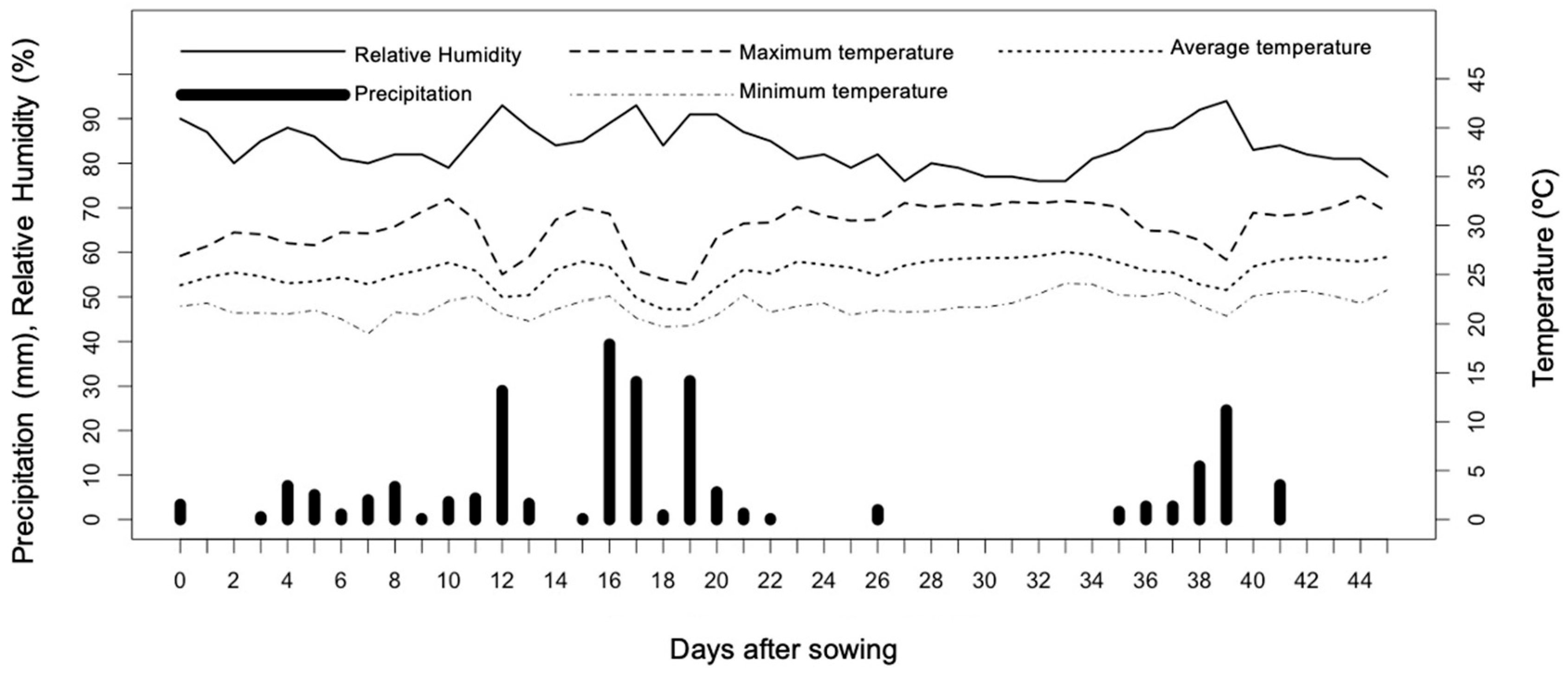
The experiment was conducted in a greenhouse with 30% shade cloth at the Federal University of Espírito Santo—São Mateus Campus, located at approximately 38 m altitude. The region has an Aw (humid tropical) climate, according to the Köppen classification [11]. The meteorological data for the study area during the experiment were obtained from the automatic surface observation meteorological station of the National Institute of Meteorology located in the municipality (Figure 1).
Figure 1.
Precipitation, relative humidity, maximum, minimum, and average temperature during the period during which the experiment was conducted, in the municipality of São Mateus, ES.
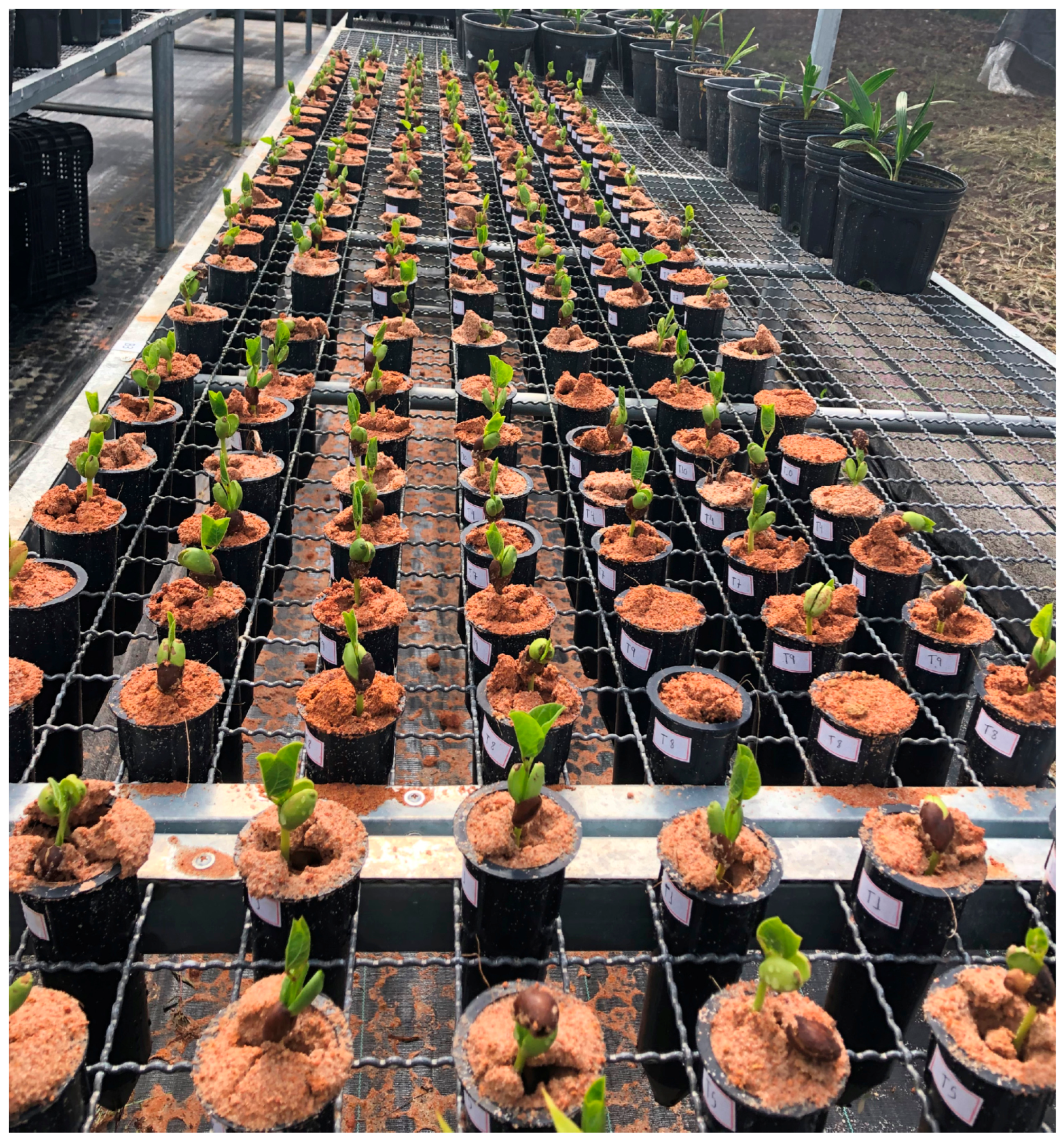
The experimental design was in randomized blocks, in a 2 × 5 factorial scheme, corresponding to two substrates and five fertilizations, corresponding to ten treatments, whose representation is in Table 1. Each treatment was composed of seven plants per plot and three blocks, totaling 210 plants in the experimental field (Figure 2). The fertilization of the substrates was adapted from the manual for the production of seedlings of native forest species [12].
Table 1.
Treatments and their respective substrate and fertilization formulations for the production of Canavalia rosea seedlings.
Figure 2.
Beginning of emergence of Canavalia rosea, with plots arranged in a randomized block design.
The preparation of the coconut fiber used in the substrates was carried out with a coconut crusher, model Trc40 from the Trapp® brand, with a power of 5 hp, and dried on plastic canvas until complete dehydration. The sand and clay were collected from extraction deposits, areas that will later be revegetated with these seedlings. The substrates were prepared in volumetric proportions, according to the treatments described previously, with the application of 250 g m−3 of dolomitic limestone for all treatments and homogenized for subsequent filling of the tubes. The nutritional composition of the substrates with a mixture of sand + clay + coconut fiber (2:1:1) (S1) and a mixture of sand + clay + coconut fiber (1:2:1) (S2) can be seen in Table 2.
Table 2.
Chemical characteristics of the substrate with a mixture of sand + clay + coconut fiber in a 2:1:1 ratio (S1) and substrate with a mixture of sand + clay + coconut fiber in a 1:2:1 ratio (S2).
The tubes used in seedling production had a conical shape, with a capacity of 290 cm3, perforated at the lower end, with eight grooves and dimensions of 19.0 cm in height and 5.4 cm in internal diameter at the upper opening. The irrigation frequency was four times a day for 15 min using sprinklers, totaling an average rainfall of 8 mm day−1.
The C. rosea seeds were collected and provided by the José Bahia Socio-Cultural and Environmental Center, undergoing a three-month storage period in paper bags with a temperature of approximately 5 °C and a humidity of approximately 50%. During preparation, they were placed in a glass beaker, immersed for 15 min in a solution containing 1% of the fungicide Captan® (Adama, Brazil, Londrina) [13] and subsequently washed with distilled water. There was partial elimination of the tegument in the region opposite the hilum of all seeds, as suggested by Costa et al. [14], and soon after, one seed was sown per tube. The seedlings remained in the greenhouse for 45 days after sowing.
During emergence, the emergence speed index (ESI) was determined through daily seedling counts, as proposed by Maguire [15]. The emergence of cotyledons was adopted as an emergence criterion. At the end of the experiment, 45 days after sowing, a period in which the seeds had already expressed their maximum germination capacity [16], the percentage of emergence (%E), height (H), stem diameter (SD), number of leaves (NL), leaf area (LA), shoot dry mass (SDM), root dry mass (RDM), total dry mass (TDM), and Dickson quality index (DQI) [17].
where: ESI = emergence speed index; E1, E2, … En = number of seedlings counted in the first count, second count, and last count; N1, N2, … Nn = number of days from sowing to the first, second, and last count.
where: DQI = Dickson quality index; TDM = total dry mass, in g; SDM = shoot dry mass, in g; RDM = root dry mass, in g; SH = seedling height, in cm; SD = stem diameter, in mm.
The height of the seedlings was measured with a ruler graduated in millimeters, from the collar region to the apical bud. The collar diameter was obtained using a digital caliper in millimeters. To determine the dry mass of the plants, the seedlings were separated into aerial parts and roots. The roots were washed in running water, and subsequently, both parts were placed in separate, identified paper bags and dried in an oven at 65 °C until they reached a constant weight. They were then weighed on a Gehaka® BK300 semi-analytical balance (Gehaka®, Brazil, São Paulo), with a precision of 0.01 g.
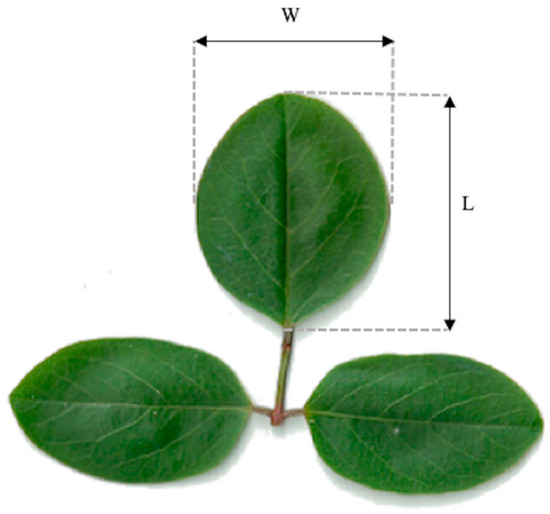
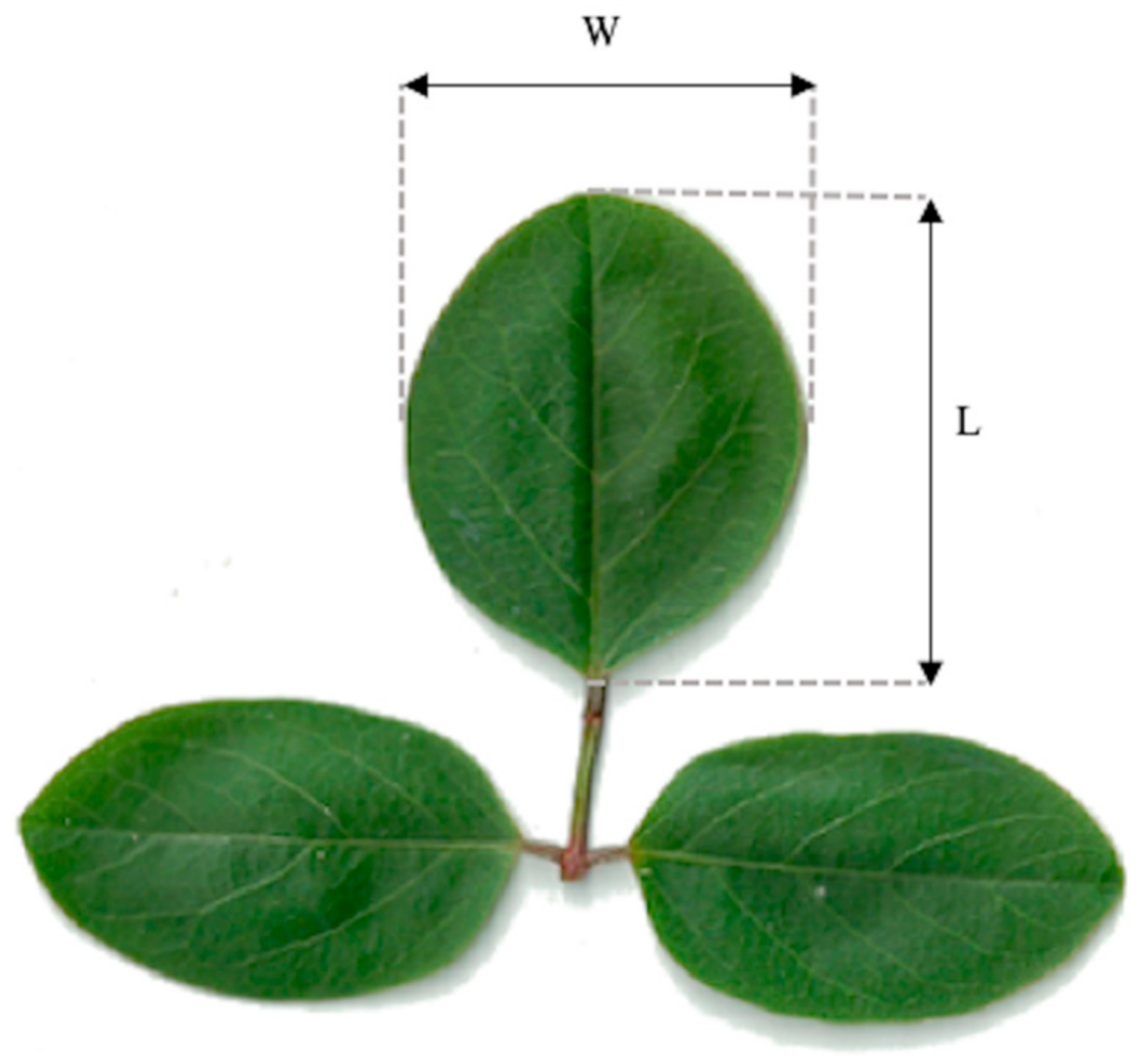
To determine the leaf area, all trifoliate leaves of C. rosea were scanned using an HP® Deskjet F4280 scanner (HP®, Brazil, São Paulo), and the images were saved in TIF format at 75 dpi. Each leaf was composed of 3 leaflets. The length (L) along the main vein and the maximum width (W) of the leaf blade, in cm, of the last leaflet of each compound leaf were measured (Figure 3), and subsequent reading of the leaf area of each plant was carried out with the ImageJ® software version 1.51v [18], which was calibrated as described by Santos et al. [19]. Subsequently, the equation was used with the length and width to determine the leaf area according to Pinheiro et al. [20].
Figure 3.
Representation of the measurement of length (L) along the main vein and maximum width (W) of the leaf blade of the last leaflet of leaves of Canavalia rosea seedlings.
For the statistical analyses, the mean of the seven plants in each of the three blocks was used. The data were subjected to analysis of variance using the F test (p < 0.05), and when significant, the interactions were broken down and the means compared using the Tukey test (p < 0.05), using the ‘ExpDes.pt’ data package version 1.2 [21] in the R software version 3.5.1 [22].
To determine the production cost per cubic meter of the treatments (substrate + fertilization), the cost of each product and its proportion in the formulation were calculated. Market prices for sand, clay, and fertilizers in the São Mateus—ES region during 2018 were used. For the cost of coconut fiber, only the freight cost for transporting the coconuts and the labor time for shredding them were taken into account.
3. Results
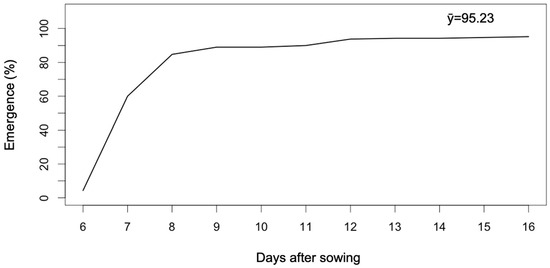
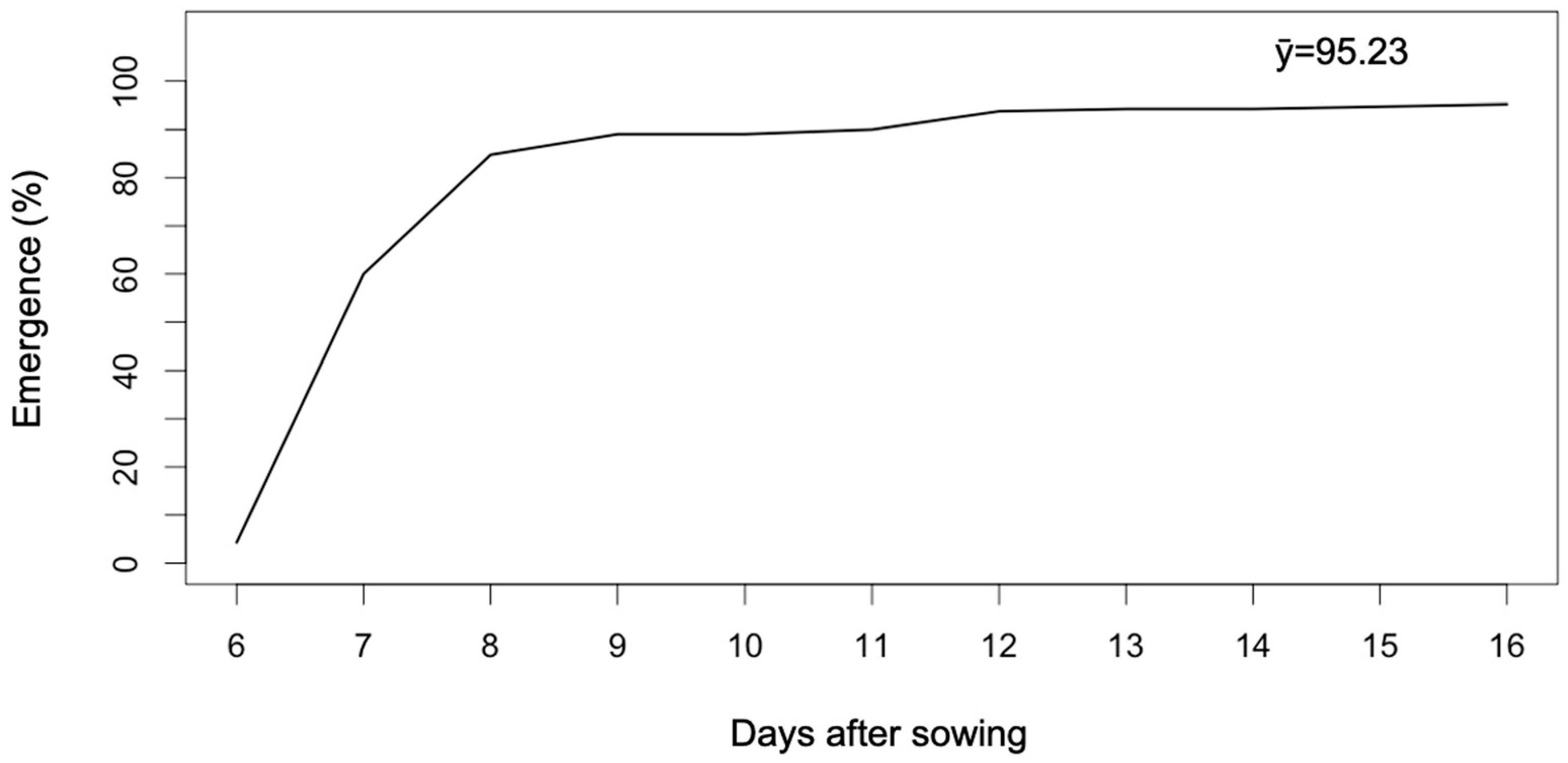
It is noted that only the shoot dry mass variable showed an interaction between the substrate and fertilizer factors (Table A1). For seedling height, number of leaves, leaf area, and total dry mass, the factors were studied in isolation when significant, and the other variables did not show statistical differences. It is also observed that the percentage of emergence of C. rosea seeds in the tested substrates is considered high, with an average above 90% (Table 3), although the seeds underwent a storage period. The average emergence speed index observed in the tested substrates was 5.67 seeds day−1 (Table 3), with seedling emergence beginning six days after sowing (Figure 4).
Table 3.
Percentage of emergence and emergence speed index of C. rosea seeds under different substrates and chemical fertilization.
Figure 4.
Percentage of emergence of C. rosea seedlings grown under different substrates and chemical fertilization.
Among the substrate levels studied, the sand:clay:coconut fiber mixture in a 1:2:1 ratio (S2) provided seedlings with a statistically higher average height than substrate S1, reaching 14.87 cm (Table 4). When analyzing the fertilizer factor, we observed that the fertilized levels (A1, A2, A3, and A4) showed statistically higher averages than level A0. The substrates with single superphosphate (A1), single superphosphate + micronutrients (A2), NPK 4-14-8 (A3), and NPK 4-14-8 + micronutrients (A4) were statistically equal to each other (Table 4).
Table 4.
Seedling height and stem diameter of C. rosea seedlings grown under different substrates and chemical fertilization, 45 days after sowing.
For the variables number of leaves and leaf area of the seedlings, the S2 substrate level showed the best averages, with approximately 4 leaves and 180.06 cm2, respectively (Table 5). Regarding the fertilizers tested, levels A1, A2, A3, and A4 showed statistically higher averages than level A0 for both variables (Table 5); this result may be related to the nutritional supply to the seedlings.
Table 5.
Number of leaves and leaf area of C. rosea seedlings grown under different substrates and chemical fertilization, 45 days after sowing.
Regarding the dry mass of the aerial part, where a significant interaction was observed between the substrate and fertilizer factors (Table 6), it is noted that substrate S1 was inferior to substrate S2 at levels A2 and A4, showing that the addition of micronutrients did not have a significant effect on the dry mass of the aerial part of C. rosea seedlings in the substrate with the highest sand fraction. Studying the fertilizers within each substrate level in relation to the dry mass of the aerial part, it was found that in substrate S1, the fertilizer levels were statistically equal, and in substrate S2, the fertilizer level A0 (1.33 g) showed a lower average than the other levels (Table 6). The treatments that provided the highest average shoot dry mass were S1A0 (1.44 g), S1A1 (1.75 g), S1A3 (1.69 g), S2A1 (1.77 g), S2A2 (2.00 g), S2A3 (1.80 g), and S2A4 (2.01 g).
Table 6.
Shoot dry mass and root dry mass of C. rosea seedlings grown under different substrates and chemical fertilization, 45 days after sowing.
In the total dry mass variable, the factors were studied separately. It was found that both substrate levels, S1 and S2, were statistically similar. Regarding fertilizer, levels A1 (2.75 g), A2 (2.72 g), A3 (2.77 g), and A4 (2.69 g) provided better average total dry mass, differing statistically from A0, with an average of 2.09 g (Table 7). Not showing significance for this index, the average DQI found in the tested treatments was 0.45 (Table 7).
Table 7.
Total dry mass and Dickson quality index of C. rosea seedlings grown under different substrates and chemical fertilization, 45 days after sowing.
Analyzing the production cost of the substrates, it appears that the lowest production cost was for the sand:clay:coir fiber substrate in a 1:2:1 ratio (S2), costing R$ 63.47 m−3, around 9% cheaper than the sand:clay:coir fiber mixture in a 2:1:1 ratio (S1) (Table 8). Among the fertilizer levels tested, the one that presented the highest cost was the substrate fertilized with NPK 4-14-8 + FTE BR12 (A4), R$ 3.68 m−3, approximately 124% more expensive than the substrate fertilized with simple superphosphate, A1 (R$ 1.64 m−3).
Table 8.
Cost per cubic meter of the ten treatments used, based on 2018 purchase prices in the São Mateus-ES region.
4. Discussion
The substrates with a mixture of sand + clay + coconut fiber in a 2:1:1 ratio (S1) and in a 1:2:1 ratio (S2) provided a high percentage of emergence of C. rosea seeds, with an average of over 90%, even though the seeds had undergone a storage period. These findings are similar to those found by Gonçalves et al. [23] in C. rosea seeds freshly collected from ripe fruits to germinate under ambient conditions, in topsoil and sand, observing 100% germination in both substrates. However, Costa et al. [14] obtained germination of less than 20% in a BOD-type germinator at a temperature of 25 °C when no type of scarification was performed on the C. rosea seed, and germination of approximately 90% when the same scarification used in this work was performed, highlighting the importance of this practice for the germination process of seeds of this species.
It should be noted that the lack of significant differences in germination percentage between substrates S1 and S2 may be related to nutrient availability, specifically due to the equal amount of phosphorus present in both substrates, since this nutrient is fundamental for initial development and energy metabolism [24]. Furthermore, substrates S1 and S2 presented pH values of 5.0 and 5.7, respectively, values considered ideal for the absorption of micronutrients such as iron and manganese, favoring the germination process [25,26].
Furthermore, corroborating the findings of this study, Gonçalves et al. [23] achieved emergence above 80% eight days after sowing. Sixteen days after sowing, the emergence evaluation was completed, with 95.23% of the seedlings having emerged. This finding is also important for the nurseryman, as the high speed of germination followed by seedling emergence are characteristics of interest in seedling production. The faster the seedling emerges, the less vulnerable it will be to environmental adversities [27], allowing for the production of vigorous seedlings in a short period of time. In addition, the sowing and transplanting time of the seedlings to the field is reduced, saving space, irrigation, fertilization, and nursery labor.
It was observed that the substrate composed of sand, clay, and coconut fiber in a 1:2:1 ratio (S2) promoted increases in seedling height, number of leaves, and leaf area. This suggests that the substrate with higher clay content (S2) likely possesses a larger specific surface area [28] and facilitated better utilization of applied fertilizers due to its higher cation exchange capacity, organic matter content, and base saturation. Furthermore, fertilizing the substrate with single superphosphate (A1), single superphosphate plus micronutrients (A2), NPK 4-14-8 (A3), and NPK 4-14-8 plus micronutrients (A4) resulted in significant gains compared to the unfertilized substrate (A0). Thus, the importance of fertilization for plant development is evident.
Observing the reduced growth of C. rosea in the substrate without added nutrients (A0), we can infer that phosphorus (P) was likely the limiting nutrient for seedling growth, given that substrates containing N, K, and micronutrients showed development similar to that of substrates containing only P. However, this inference is merely a suggestion; it should be viewed with caution and analyzed in future studies regarding substrates for C. rosea seedling production.
It should be noted that the height of the seedlings is a characteristic that allows the initial growth potential to be measured in the field, being considered one of the oldest parameters for the classification and selection of seedlings, and when used in isolation, it is efficient for estimating the quality standard of seedlings in nurseries, as it is a non-destructive and easily measured variable [29,30,31].
The treatments tested did not differ significantly in terms of collar diameter, with an average diameter of 3.51 mm. This indicates that seedlings from any substrate tested in this work may have high potential for survival and growth in the field. For Gonçalves et al. [32], the diameter of the appropriate stem for seedlings of forest species must be between 5 and 10 mm, a range higher than that found in this study. However, it is known that the development of forest species is very variable, which may be an intrinsic morphological characteristic of this species, indicating that these proposed values are not applicable to C. rosea, as found by Delarmelina et al. [33], for Sesbania virgata.
It is possible to note that the addition of micronutrients did not provide gains in the dry mass of the aerial part of C. rosea seedlings in the S1 substrate with a higher sand fraction. Micronutrients, although required in smaller quantities by plants, are essential for their development. Among the micronutrients present in FTE BR12 is boron, playing a role in cell elongation, nucleic acid synthesis, hormonal responses, membrane function and cell cycle regulation; zinc, being necessary for the activity of many enzymes and being required for the biosynthesis of chlorophyll; manganese, activating several enzymes in plant cells, including decarboxylases and dehydrogenases, involved in the citric acid cycle, activated by manganese ions; and copper, associated with enzymes involved in redox reactions, such as plastocyanine, which is involved in the transfer of electrons during the light-dependent reactions of photosynthesis [24].
Sandy soils are chemically poor, as they have a low cation exchange capacity and reduced specific surface area, resulting in a lower tendency to retain water and an increased loss of nutrients through leaching [34,35]. This may explain what happened with the unsatisfactory development of the substrate with a higher sand fraction (S1), in the variables plant height, number of leaves, leaf area, and dry mass of the aerial part. Thus, plants with adequate nutrition have greater reserves of dry matter in the aerial part [36].
In general, the treatments tested had no effect on root dry mass, with an overall average of 0.91 g. Better conditions for the establishment of seedlings, acquisition of nutrients and water, can be obtained with greater development of the root system. Thus, in situations of temporary scarcity of resources, the species is able to tolerate the adversities present in the field for longer [37].
The addition of fertilizer (A1, A2, A3, and A4), regardless of the substrate (S1 or S2), provided better averages of total dry mass. According to Cruz et al. [38], the total dry mass must be taken into account to produce quality seedlings, and the higher the value, the better. It can be inferred that levels A1, A2, A3, and A4 provided seedlings with greater potential for survival capacity in the field, thus highlighting the importance of nutrition for the dry mass of plants.
It is evident that, at all tested levels, the seedlings exhibited a Dickson Quality Index (DQI) greater than 0.2, a value recommended by Hunt [39] as an indicator of high-quality seedlings for forest species. The DQI is widely used as a reliable indicator of seedling quality because it accounts for morphological characteristics [9], providing insights into seedling robustness and biomass distribution balance [40], which are associated with higher survival rates after transplanting [41]. However, it should be noted that the 0.2 value serves merely as a reference for C. rosea, given that it is an herbaceous legume species; this specific value has not been validated for it under field conditions. It is worth highlighting that the quality standard presented in all substrates is related to the rusticity characteristics of C. rosea, which, even in natural conditions with sandy soils, poor in nutrients and high incidence of solar radiation, present root nodules with the capacity for biological nitrogen fixation [23,42,43,44].
Although all substrate and fertilizer levels produced seedlings with statistically similar quality indices, substrate level S2 and fertilizer levels A1, A2, A3, and A4 stood out, as these presented height, number of leaves, leaf area and total dry mass statistically higher than the other levels, and when there was an interaction for dry mass of the aerial part, the treatments S2A1, S2A2, S2A3 and S2A4 also presented higher averages. To determine the point for transplanting seedlings, nurseries have efficiently used the height of the plant as a criterion to estimate its quality [31]. However, seedlings with a higher size, number of leaves, leaf area, and satisfactory dry mass may imply greater potential for survival and initial growth in the field.
In a resting environment, as evidenced by Lourenço Junior and Cuzzuol [45], they found that C. rosea is more nutritionally demanding in absorbing N and K than P. This result was not observed in this study, as only fertilization with simple superphosphate fertilizer (source of P) in the substrate was sufficient for good seedling development in a greenhouse. According to Lambers et al. [46], when native species adapted to environments with low fertility are subjected to high nutritional levels, they accumulate nutrients instead of allocating them for growth, using them only in environments with limiting nutritional conditions. According to the authors, this is evidence of adaptive strategies developed by these plants to survive in environments with low fertility.
It is noteworthy that both substrates S1 and S2 contain coconut fiber in their composition, which has the characteristic of maintaining a favorable environment for seedling development, maintaining adequate moisture, preventing waterlogging and dehydration [47]. This is a sustainable alternative for the efficient production of seedlings [48,49].
The substrate containing a sand:clay:coconut fiber mixture in a 1:2:1 ratio improved morphological characteristics, specifically seedling height, number of leaves, and leaf area in C. rosea seedlings compared to S1. This mixture could be adopted in the production process for this species, potentially reducing the time required to obtain seedlings ready for field transplanting. Regarding substrate fertilization, the use of single superphosphate is recommended, in addition to yielding development comparable to substrates enriched with single superphosphate plus micronutrients, NPK 04-14-08, or NPK 04-14-08 plus micronutrients, which produces seedlings with greater height, leaf count, leaf area, and biomass. However, future work is needed to identify whether other fertilizations favor the development of C. rosea post-planting in areas of low fertility, according to the theory of Lambers et al. [46], presented previously.
It should also be noted that although level A0 (without added nutrients) is low cost, it is not recommended as it does not promote good seedling development. In addition to the cost of producing the substrate, it is important to take into account the quality of the seedlings [50].
5. Conclusions
The results demonstrate that substrate composition directly influences the growth and quality of Canavalia rosea seedlings. The substrate composed of sand, clay, and coconut fiber in a 1:2:1 ratio yielded the best vegetative performance while also offering lower production costs. Although the 1:2:1 substrate is inexpensive, its use without nutritional supplementation is not recommended, as the lack of fertilization significantly limits seedling growth. Among the fertilization levels tested, the application of 1.5 kg m−3 of single superphosphate proved to be the most suitable choice; it promoted significant increases in plant height, leaf number, leaf area, and biomass production while maintaining low production costs. Therefore, using a sand:clay:coconut fiber substrate in a 1:2:1 ratio combined with 1.5 kg m−3 of single superphosphate is recommended as a technically efficient and economically viable strategy for producing high-quality Canavalia rosea seedlings.
Despite the consistency of the results, the evaluation was conducted under controlled nursery conditions and covered only specific substrate combinations and fertilization levels; it did not consider other nutrient sources, alternative substrate materials, or seedling performance after transplanting to field conditions. Future research should evaluate the behavior of Canavalia rosea seedlings after field transplanting, assessing survival, initial growth, and establishment under various environmental conditions, particularly in restinga areas and coastal ecosystem restoration projects. Furthermore, investigating new substrate combinations using organic waste or low-cost alternative materials, as well as different fertilizer sources and dosages, is recommended to simultaneously optimize seedling quality, production process sustainability, and cost efficiency.
Author Contributions
Conceptualization, A.P.B.P., L.F.T.d.M., J.V.G.S., A.d.S.J. and A.L.R.A.; methodology, A.P.B.P., L.F.T.d.M., J.V.G.S., A.d.S.J. and A.L.R.A.; software, V.d.S.O., A.P.B.P., J.V.G.S., A.d.S.J. and A.L.R.A.; validation, V.d.S.O., A.P.B.P., J.V.G.S., A.d.S.J. and A.L.R.A.; formal analysis, V.d.S.O., L.F.T.d.M., V.D., F.R.P., J.S.B.P. and E.R.S.; investigation, V.D., L.F.T.d.M., F.R.P., J.S.B.P. and E.R.S.; resources, V.D., F.R.P., J.S.B.P. and E.R.S.; data curation, V.d.S.O., V.D., F.R.P., J.S.B.P. and E.R.S.; writing—original draft preparation, V.d.S.O., A.A.F. and S.D.-A.; writing—review and editing, V.d.S.O., A.A.F. and S.D.-A.; visualization, V.d.S.O., A.A.F. and S.D.-A.; supervision, A.A.F. and S.D.-A.; project administration, A.A.F. and S.D.-A.; funding acquisition, A.A.F. and S.D.-A. All authors have read and agreed to the published version of the manuscript.
Funding
This research received no external funding.
Data Availability Statement
The original contributions presented in this study are included in the article. Further inquiries can be directed to the corresponding authors.
Conflicts of Interest
The authors declare no conflicts of interest.
Abbreviations
The following abbreviations are used in this manuscript:
| ESI | Emergence speed index |
| %E | Percentage of emergence |
| H | Seedling height |
| SD | Stem diameter |
| NL | Number of leaves |
| LA | Leaf area |
| SDM | Shoot dry mass |
| RDM | Root dry mass |
| TDM | Total dry mass |
| DQI | Dickson quality index |
Appendix A
Table A1.
Summary of the analysis of variance of emergence percentage (%E), emergence speed index (ESI), seedling height (H), stem diameter (SD), number of leaves (NL), leaf area (LA), shoot dry mass (SDM), root dry mass (RDM), total dry mass (TDM) and Dickson quality index (DQI) of Canavalia rosea seedlings grown under different substrates and chemical fertilization, 45 days after sowing.
References
- Sazzad, N.; Fahad, F.I.; Sakib, S.A.; Reza, A.S.M.A.; Islam, M.N.; Capasso, R. Unveiling the therapeutic potential of Canavalia rosea leaves: Exploring antioxidant, anti-inflammatory, anti-arthritic, and cytotoxic activities through biological and molecular docking evaluation with DFT analysis. Heliyon A Cell Press J. 2024, 10, 19. [Google Scholar] [CrossRef] [Scilit]
- Huang, J.; Liu, N.; Ren, H.; Jian, S.G. Physiology and biochemical characteristics of Canavalia maritime under stress. J. Trop. Subtrop. Bot. 2019, 27, 157–163. [Google Scholar]
- Lin, R.; Zheng, J.; Pu, L.; Wang, Z.; Mei, Q.; Zhang, M.; Jian, S. Genome-wide identification and expression analysis of aquaporin family in Canavalia rosea and their roles in the adaptation to saline-alkaline soils and drought stress. BMC Plant Biol. 2021, 21, 333. [Google Scholar] [CrossRef] [Scilit] [PubMed]
- Weckner, F.C.; Campos, M.C.C.; Nascimento, E.P.; Mantovanelli, B.C.; Nascimento, M.F. Avaliação das mudas de mamoeiro sob o efeito da aplicação de diferentes composições de biofertilizantes. Rev. Univ. Val. Rio Verde 2016, 14, 700–706. Available online: http://periodicos.unincor.br/index.php/revistaunincor/article/view/2539 (accessed on 21 June 2026).
- Yamanishi, O.K.; Fagundes, G.R.; Machado Filho, J.A.; Valone, G.V. Efeito de diferentes substratos e duas formas de adubação na produção de mudas de mamoeiro. Rev. Bras. Frutic. 2004, 26, 2. [Google Scholar] [CrossRef] [Scilit]
- Silva, R.B.E.; Matos, V.P.; Farias, S.G.G.; Sena, L.H.M.; Silva, D.Y.B.O. Germinação e vigor de plântulas de Parkia platycephala Benth. em diferentes substratos e temperaturas. Rev. Ciênc. Agronôm. 2017, 48, 142–150. Available online: https://www.scielo.br/j/rca/a/VV7JgZCvhT5zhxn9SxszkHs/?format=html&lang=pt (accessed on 21 June 2026).
- Rodrigues, L.A.; Muniz, T.A.; Samarão, S.S.; Cyrino, A.E. Qualidade de mudas de Moringa oleífera Lam. Cultivadas em substratos com fibra de coco verde e compostos orgânicos. Rev. Ceres 2018, 63, 4. [Google Scholar] [CrossRef] [Scilit]
- Natale, W.; Lima Neto, A.J.; Rozane, D.E.; Parent, L.E. Mineral nutrition evolution in the formation of fruit tree rootstocks and seedlings. Rev. Bras. Frutic. 2018, 40, 6. [Google Scholar] [CrossRef] [Scilit]
- Dias, I.M.; Barreto, Í.D.C.; Ferreira, R.A. Efeito de dosagens de fertilizante fosfatado na determinação de volume ótimo de produção de mudas de espécies florestais nativas. Sci. Agrar. Parana. 2016, 15, 4. [Google Scholar] [CrossRef] [Scilit]
- Silva, L.N.; Lima, L.K.S.; Santos, I.S.; Sampaio, S.R.; Coelho Filho, M.A.; Jesus, O.N. Biometrics and physiological parameters of sour passion fruit seedlings produced on organic substrates. Aust. J. Crop Sci. 2023, 17, 2. [Google Scholar] [CrossRef] [Scilit]
- Alvares, C.A.; Stape, J.L.; Sentelhas, P.C.; Gonçalves, J.L.M.; Sparovek, G. Köppen’s climate classification map for Brazil. Meteorol. Z. 2014, 22, 6. [Google Scholar] [CrossRef] [Scilit] [PubMed]
- Scremin-Dias, E.; Kalife, C.; Menegucci, Z.; Dos, R.H.; Souza, P.R. Produção de Mudas de Espécies Florestais Nativas: Manual; UFMS: Campo Grande, Brazil, 2006; p. 56. [Google Scholar]
- Pires, J.S.B.; Silva, F.B.C.; Barbosa, M.E.S.; Cavilha, G.R.; Coelho, M.M.; Otilia, S.M.; Moreira, J.W.D.M.; Marquito, G.R.M.; Hoste, F.G.; Jeveaux-Machado, A.J.C.; et al. Biostimulant Potential of Ascophyllum nodosum in Mitigating the Effects of Salinity on the Germination of Zea mays L. Seeds 2026, 5, 14. [Google Scholar] [CrossRef] [Scilit]
- Costa, T.S.; Aoyama, E.M.; Falqueto, A.R. Superação de dormência e salinidade na germinação de sementes e vigor de plântulas de Canavalia rosea (Sw.) DC.—Fabaceae. Rev. Ciênc. Agro-Ambient. 2013, 11, 1. [Google Scholar]
- Maguire, J.D. Speed of germination-aid in selection and evaluation for seeding emergence and vigor. Crop Sci. 1962, 2, 2. [Google Scholar] [CrossRef] [Scilit]
- Manual de Produção de Mudas de Espécies Nativas do Bioma Mata Atlântica do Horto Carlos Toledo Rizzini. 2020. Available online: www.rio.rj.gov.br/dlstatic/10112/91265/4304601/ManualdeMudas2020_web1.pdf (accessed on 21 June 2026).
- Dickson, A.; Leaf, A.L.; Hosner, J.F. Quality appraisal of white spruce and white pine seedling stock in nurseries. For. Chron. 1960, 36, 10–13. [Google Scholar] [CrossRef] [Scilit]
- Schindelin, J.; Rueden, C.T.; Hiner, M.C.; Eliceiri, K.W. The ImageJ Ecosystem: An Open Platform for Biomedical Image Analysis. Mol. Reprod. Dev. 2015, 82, 7–8. [Google Scholar] [CrossRef] [Scilit] [PubMed]
- Santos, K.T.H.; Santos, G.P.; Santos, J.S.H.; Schmildt, E.R. Recursos para a determinação da área foliar. In Modelagem da Área Foliar Individual; Schmildt, E.R., Oliveira, V.S., Dousseau-Arantes, S., Eds.; Brazilian Journal: São José dos Pinhais, Brazil, 2023. [Google Scholar]
- Pinheiro, A.P.B.; Oliveira, V.S.; Santos, K.T.H.; Santos, J.S.H.; Santos, G.P.; Silva, J.V.G.; Jardim, A.S.; Longue, L.L.; Nunes, S.F.; Azeredo, A.L.R.; et al. Estimation Leaf Area by Composite Leaves of Canavalia rosea Seedlings Through Linear Dimensions from Last Leaflet. J. Agric. Sci. 2019, 11, 9. [Google Scholar] [CrossRef] [Scilit]
- Ferreira, E.B.; Cavalcanti, P.P.; Nogueira, D.A. ExpDes.pt: Experimental Designs Package (Portuguese). R Package Version 1.2.0. 2018. Available online: https://cran.r-project.org/web/packages/ExpDes.pt/ExpDes.pt.pdf (accessed on 21 June 2026).
- R Core Team. R: A Language and Environment for Statistical Computing; R Foundation for Statistical Computing: Vienna, Austria, 2026; Available online: www.R-project.org/ (accessed on 21 June 2026).
- Gonçalves, I.P.; Gama, M.C.; Correia, M.C.R.; Lima, H.A. Caracterização dos frutos, sementes e germinação de quatro espécies de leguminosas da restinga de Maricá, Rio de Janeiro. Rodriguésia 2008, 59, 3. [Google Scholar] [CrossRef] [Scilit]
- Taiz, L.; Zeiger, E.; Møller, I.M.; Murphy, A. Fisiologia e Desenvolvimento Vegetal, 6th ed.; Artmed: Porto Alegre, Brazil, 2017; p. 888. [Google Scholar]
- Dhaliwal, S.S.; Sharma, V.; Shukla, A.K. Impact of micronutrients in mitigation of abiotic stresses in soils and plants: A progressive step toward crop security and nutritional quality. Adv. Agron. 2022, 173, 1–78. [Google Scholar] [CrossRef] [Scilit]
- Silva, I.E.B.; Moreira, J.C. Resíduos agroindustriais do Vale do Ivaí-PR: Potencial biotecnológico para a produção de cogumelos comestíveis e enzimas industriais. Rev. Terra Cult. Cad. Ensino Pesqui. 2024, 40, 77. [Google Scholar]
- Martins, C.C.; Borges, A.S.; Pereira, M.R.R.; Lopes, M.T.G. Posição da semente na semeadura e tipo de substrato sobre a emergência e crescimento de plântulas de Schizolobium parahyba (Vell.) S.F. Blake. Ciênc. Florest. 2012, 22, 4. [Google Scholar] [CrossRef] [Scilit]
- Ding, F.; Huang, Y.; Sun, W.; Jiang, G.; Chen, Y. Decomposition of organic carbon in fine soil particles is likely more sensitive to warming than in coarse particles: An incubation study with temperate grassland and forest soils in Northern China. PLoS ONE 2014, 9, 4. [Google Scholar] [CrossRef] [Scilit] [PubMed]
- Parviainen, J.V. Qualidade e avaliação de qualidade de mudas florestais. In Seminário de Sementes e Viveiros Florestais; FUPEF: Curitiba, Brazil, 1981; pp. 59–90. [Google Scholar]
- Mexal, J.L.; Landis, T.D. Target seedling concepts: Height and diameter. In Target Seedling Symposium, Meeting of the Western Forest Nursery Associations; General Technical Report RM-200; United States Departament of Agriculture, Forest Service: Fort Collins, CO, USA, 1990. [Google Scholar]
- Gomes, J.M.; Couto, L.; Leite, H.G.; Xavier, A.; Garcia, S.L.R. Parâmetros morfológicos na avaliação da qualidade de mudas de Eucalyptus grandis. Rev. Árvore 2002, 26, 6. [Google Scholar] [CrossRef] [Scilit]
- Gonçalves, J.L.M.; Santarelli, E.G.; de Moraes, S.P.; Manara, M.P.; Stape, J.L. Produção de mudas de espécies nativas: Substrato, nutrição, sombreamento e fertilização. In Nutrição e Fertilização Florestal; Gonçalves, J.L.M., Benedetti, V., Eds.; IPEF: Piracicaba, Brazil, 2000; pp. 309–350. [Google Scholar]
- Delarmelina, W.M.; Caldeira, M.V.W.; Faria, J.C.T.; Gonçalves, E.O.; Rocha, R.L.F. Diferentes Substratos para a Produção de Mudas de Sesbania virgata. Floresta Ambient. 2014, 21, 2. Available online: https://www.scielo.br/j/floram/a/PZhNsSChS3VXyTdpPZKmfMf/?lang=pt (accessed on 21 June 2026).
- Usowicz, B.; Hajnos, M.; Sokołowska, Z.; Jozefaciuk, G.; Bowanko, G.; Kossowski, J. Spatial variability of physical and chemical soil properties in a field and commune scale. Acta Agrophysica 2004, 103, 1–90. [Google Scholar]
- Šimanský, V.; Juriga, M.; Jonczak, J.; Uzarowicz, Ł.; Stępieńet, W. How relationships between soil organic matter parameters and soil structure characteristics are affected by the long-term fertilization of a sandy soil. Geoderma 2019, 342, 75–84. [Google Scholar] [CrossRef] [Scilit]
- Schumacher, M.V.; Ceconi, D.E.; Santana, C.A. Influência de diferentes doses de fósforo no crescimento de mudas de angico vermelho (Parapiptadenia rígida (Bentham). Brenan). Rev. Árvore 2004, 28, 149–155. [Google Scholar] [CrossRef] [Scilit]
- Reis, B.E.; Paiva, H.N.; Barros, A.L.F.; Cardoso, W.C. Crescimento e qualidade de mudas de jacarandá-da-bahia (Dalbergia nigra (Vell.) Allemão ex Benth.) em resposta à adubação com potássio e enxofre. Ciênc. Florest. 2012, 22, 2. [Google Scholar] [CrossRef] [Scilit]
- Cruz, C.A.F.; Paiva, H.N.; Guerrero, C.R.A. Efeito da adubação nitrogenada na produção de mudas de Sete-Cascas (Samanea inopinata (Harms) Ducke). Rev. Árvore 2006, 30, 4. [Google Scholar] [CrossRef] [Scilit]
- Hunt, G.A. Effect of styroblock design and cooper treatment on morphology of conifer seedlings. In Target Seedling Symposium, Meeting of the Western Forest Nursery Associations; General Technical Report; USDA: Washington, DC, USA, 1990; pp. 218–222. [Google Scholar]
- Fonseca, E.P.; Valéri, S.V.; Miglioranza, É.; Fonseca, N.A.N.; Couto, L. Padrão de qualidade de mudas de Trema micrantha (L.) Blume, produzidas sob diferentes períodos de sombreamento. Rev. Árvore 2002, 26, 4. [Google Scholar] [CrossRef] [Scilit]
- Binotto, A.F.; Lúcio, A.D.; Lopes, S.J. Correlations between growth variables and the Dickson quality index in forest seedlings. Cerne 2010, 16, 457–464. [Google Scholar] [CrossRef] [Scilit]
- Imai, R.; Kajita, Y.; Yamamoto, T.; Takayama, K.; Kajita, T. The complete chloroplast genome of a pantropical legume, Canavalia rosea. Mitochondrial DNA B Resour. 2021, 6, 2. [Google Scholar] [CrossRef] [Scilit] [PubMed]
- Zou, T.; Pu, L.; Lin, R.; Mo, H.; Wang, Z.; Jian, S.; Zhang, M. Roles of Canavalia rosea metallothioneins in metal tolerance and extreme environmental adaptation to tropical coral reefs. J. Plant Physiol. 2022, 268, 153559. [Google Scholar] [CrossRef] [Scilit] [PubMed]
- Ding, Q.; Huang, Z.; Wang, Z.; Jian, S.; Zhang, M. Identifying Calmodulin and Calmodulin-like Protein Members in Canavalia rosea and Exploring Their Potential Roles in Abiotic Stress Tolerance. Int. J. Mol. Sci. 2024, 25, 11725. [Google Scholar] [CrossRef] [Scilit] [PubMed]
- Lourenço Junior, J.; Cuzzuol, G.R.F. Caracterização de solos de duas formações de restinga e sua influência na constituição química foliar de Passiflora mucronata Lam. (Passifloraceae) e Canavalia rosea (Sw.) DC. (Fabaceae). Acta Bot. Bras. 2009, 23, 239–246. [Google Scholar] [CrossRef] [Scilit]
- Lambers, J.; Chapin, F.S.; Pons, T.L. Plant Physiological Ecology; Springer: New York, NY, USA, 1998; p. 540. [Google Scholar]
- Mariotti, B.; Martini, S.; Raddi, S.; Tani, A.; Jacobs, D.F.; Oliet, J.A.; Maltoni, A. Coconut coir as a sustainable nursery growing media for seedling production of the ecologically diverse Quercus species. Forests 2020, 11, 522. [Google Scholar] [CrossRef] [Scilit]
- Ferrarezi, R.S.; Qin, K.; Nguyen, L.X.; Poole, S.D.; Cárdenas-Gallegos, J.S.; Oliveira, H.F.E.; Housley, M.J. Multi-season evaluation of substrates for optimized arugula and lettuce production in hydroponics. HortScience 2024, 59, 3. [Google Scholar] [CrossRef] [Scilit]
- Procópio, I.J.S.; Lima, R.R.C.; Almeida, J.C.; Santos, C.C.; Araújo, P.V.N. Agricultural use of green coconut husk as a growing substrate. Rev. Obs. La Econ. Latinoam. 2026, 24, 2. [Google Scholar] [CrossRef] [Scilit]
- Simões, D.; Silva, R.B.G.; Silva, M.R. Composição do substrato sobre o desenvolvimento, qualidade e custo de produção de mudas de Eucalyptus grandis Hill ex Maiden × Eucalyptus urophylla S. T. Blake. Ciênc. Florest. 2012, 22, 91–100. Available online: https://www.scielo.br/j/cflo/a/pG3T35DTjBGrhwmSTsMLc9M/?lang=pt (accessed on 21 June 2026).

Disclaimer/Publisher’s Note: The statements, opinions and data contained in all publications are solely those of the individual author(s) and contributor(s) and not of MDPI and/or the editor(s). MDPI and/or the editor(s) disclaim responsibility for any injury to people or property resulting from any ideas, methods, instructions or products referred to in the content. |
© 2026 by the authors. Licensee MDPI, Basel, Switzerland. This article is an open access article distributed under the terms and conditions of the Creative Commons Attribution (CC BY) license.