


Abstract
This study investigates the possibility of producing a complex W–Mo–Cr-containing alloy via metallothermic reduction of oxide concentrates in the presence of direct reduced iron (DRI) in an induction furnace under atmospheric conditions. A complex FeAlSiCa alloy was used as a reductant due to its high exothermicity and combined reducing potential. Thermodynamic analysis showed that the reduction of WO3 and MoO3 is more favorable compared to Cr2O3, which is reflected in the temperature profiles of the process. Experimental results confirmed that the addition of FeAlSiCa leads to intensive exothermic reactions and promotes melt formation. The estimated apparent recovery of W and Mo reached up to ~99%, while Cr estimated apparent recovery remained lower (up to ~70%) due to its higher thermodynamic stability and kinetic limitations. Microstructural analysis revealed a heterogeneous structure consisting of an Fe-based matrix and W–Mo-rich phases, including characteristic “fishbone” morphologies. An increase in reductant amount led to higher Si content in the alloy, indicating the need for composition optimization. The results demonstrate the feasibility of direct complex alloying as an alternative to conventional ferroalloy-based methods and highlight the potential for developing resource-efficient and low-carbon metallurgical technologies.
Keywords:
ferroalloy; steel; tungsten; molybdenum; chrome; reduction; induction furnace; metallurgy; complex alloy 1. Introduction
Metallothermic reduction (including aluminothermy, silicothermy, and calciothermy) remains a widely used tool within short-route technologies for the production of metals and alloys from oxide raw materials or metallurgical waste, particularly when the target product is not a pure metal but rather a master alloy or an iron-based alloy with a specified composition [1,2,3,4,5]. Recent studies emphasize two major trends: (i) detailed thermodynamic design, including the use of thermodynamic software packages such as FactSage and HSC, to control oxygen potential, the activities of metallothermic reaction products (e.g., SiO2, Al2O3, etc.), and slag formation, and (ii) direct alloying through the reduction of alloying element oxides directly in molten steel or Fe, which can shorten the “ore → ferroalloy → steel” production chain and reduce the direct carbon footprint [1,6,7,8,9].
The high economic and environmental efficiency of metallothermic processes can be achieved under specific conditions [2]. For example, aluminothermic processes require access to a low-cost source of green aluminum, as its production is highly energy-intensive [10,11]. In the case of silicothermy using FeSi, a key limitation is the carbon intensity of FeSi production, which, when considering the full life cycle, may result in CO2 emissions exceeding those of carbothermic processes [2,12].
Against this background, interest has emerged in a relatively new reductant—FeAlSiCa, which contains not only Al (approximately 17–24 wt.%) and Si (approximately 42–53 wt.%), but also Ca (approximately 8–15 wt.%) [2]. Previous studies have demonstrated the effectiveness of FeAlSiCa for the reduction of Cr, W, and Mo oxides [2,8,13,14]. A distinctive feature of this reductant, in addition to its complex composition, is its production route [15]. It is primarily produced from industrial waste, including blast furnace slag from ArcelorMittal Temirtau (now Qarmet, Kazakhstan) and high-ash coal from the Saryadyr deposit in Kazakhstan. Thus, the use of FeAlSiCa contributes to a more sustainable technological approach by incorporating the recycling of low-grade materials. Furthermore, the high exothermicity of FeAlSiCa oxidation provides potential for significant improvements in energy efficiency [1,15].
Published data indicate that conventional metallothermic and direct-alloying processes can provide relatively high recovery of individual alloying elements when the charge composition, reductant amount, and slag chemistry are properly controlled. For tungsten, W recovery of up to 95.4% has been reported during the aluminothermic reduction smelting of W concentrates [16]. For Mo, FeMo production from MoO3-containing charges using mill scale as an Fe source has been shown to reach a Mo efficiency of 97.98% under optimized aluminothermic conditions [3]. Silicothermic reduction has also been investigated for W-containing systems: the reduction of scheelite, CaWO4, by Si at 1423–1523 K was shown to be kinetically controlled by diffusion through the product layer, indicating the importance of mass-transfer limitations in silicothermic W reduction [17]. In addition, silicothermic self-reducing MoO3 briquettes have been used for direct Mo alloying in molten steel; in this process, CaO and FeSi suppressed MoO3 volatilization, CaF2 promoted low-melting slag formation and metal–slag separation, and Mo recovery reached 95% [18]. In the case of Cr, direct alloying of steel through silicothermic self-reduction of chromite ore using Si-containing solid waste has been reported; the addition of CaO and Al2O3 improved slag properties and increased Cr recovery from 86.4% to 95.4% [19]. These studies confirm the effectiveness of metallothermic and direct-alloying approaches for individual W-, Mo-, and Cr-containing systems. However, they mainly consider separate alloying elements or individual oxide systems, whereas the simultaneous reduction of W-, Mo-, and Cr-containing oxide raw materials in a combined DRI-based charge remains insufficiently studied.
Regarding direct alloying of steel, the addition of steel scrap and/or DRI should not be considered a neutral Fe source. Instead, it represents a controllable quality factor: scrap increases the likelihood of accumulation of residual elements (Cu, Sn, Sb, As, Bi, etc.), which are difficult to remove in steelmaking units and may contribute to casting defects and hot shortness. In contrast, DRI is often used as a diluent for residual elements and as a source of Fe, but it introduces challenges related to reoxidation, increased slag formation (due to the presence of residual SiO2, Al2O3, etc.), energy consumption, and gas evolution [20,21,22,23].
In the present study, the possibility of direct alloying of steel with W, Mo, and Cr through metallothermic reduction in an induction furnace with the addition of DRI is investigated. The motivation for this research is to explore the potential for expanding the application of FeAlSiCa as an accessible reductant for a complex system of oxide materials.
Despite the progress achieved in metallothermic reduction and direct alloying studies, most published works have focused either on individual oxide systems or on the introduction of a single alloying element into an Fe-based melt. Direct alloying with Cr from chromite or Cr-containing oxides has been investigated in several studies, whereas W- and Mo-containing systems are more commonly considered in the context of separate ferrotungsten, ferromolybdenum, or refractory alloy production. However, the simultaneous reduction of W-, Mo-, and Cr-containing oxide raw materials in one DRI-based charge remains insufficiently studied. In particular, there is limited information on the combined temperature behavior, mutual influence of oxide concentrates, apparent recovery of W, Mo, and Cr, and microstructural features of the resulting complex alloy.
The scientific contribution of this study is the demonstration of simultaneous metallothermic reduction of W-, Mo-, and Cr-containing oxide concentrates in a combined DRI-based charge using FeAlSiCa as a multicomponent reductant under atmospheric induction smelting conditions. Unlike previous studies focused mainly on individual oxide concentrates or single-alloying-element systems, this work evaluates a combined W–Mo–Cr system and relates the temperature behavior, thermodynamic characteristics, apparent recovery of alloying elements, and microstructural features of the obtained alloy. This approach may provide a basis for developing complex alloying materials from oxide raw materials while reducing the dependence on separate conventional ferroalloys such as FeW, FeMo, and FeCr.
2. Materials and Methods
DRI obtained from mill scale, W-, Mo-, and Cr-concentrates, FeAlSiCa reductant, and lime as a flux were used as the initial materials. The initial chemical compositions of the materials are presented in Table 1 and Table 2.
Table 1.
Chemical composition of initial metallic materials, wt.%.
Table 2.
Chemical composition of initial concentrates and lime, wt.%.
A charge mixture (particle size < 120 μm) was prepared. The particle-size fraction was obtained by preliminary grinding and sieving of the raw materials to ensure comparable granulometry and homogeneous mixing of the charge components. In the charge mixture, DRI was introduced as the base of the alloy, and FeAlSiCa as the reductant in three variants: a stoichiometric amount for the complete reduction of the main components of W-, Mo-, and Cr-concentrates, and with 10% and 20% excess.
The stoichiometric amount of reductant was determined based on the total oxygen content of the reducible oxide components in the charge. The oxygen balance was evaluated using classical metallothermic reduction reactions, including the formation of SiO2, Al2O3, and CaO from Si, Al, and Ca, respectively. In a simplified form, the reduction of the target oxides can be expressed as:
where Me represents W, Mo, Cr, or Fe, and [O] is oxygen released from the reducible oxide component. The oxygen was assumed to be bound by the active components of FeAlSiCa according to:
MexOy → xMe + y[O]
Si + 2[O] → SiO2, 2Al + 3[O] → Al2O3, Ca + [O] → CaO
The required amount of FeAlSiCa was calculated considering the combined oxygen affinity of its active components and their mass fractions in the alloy. The total molar reducing capacity of these elements was adjusted to ensure complete reduction of the available oxygen in the charge.
Lime was added at a ratio of 1.8 g CaO per 1 g SiO2 to increase slag basicity and bind undesirable impurities. The total amount of SiO2 used for lime calculation included both SiO2 initially present in the concentrates and SiO2 expected to form as a result of Si oxidation from the FeAlSiCa reductant.
The calculated charge compositions, wt.%:
- -
- Charge 1 (stoichiometric FeAlSiCa): 25.88% DRI; 10.00% W-concentrate; 17.50% Mo-concentrate; 7.20% Cr-concentrate; 7.82% FeAlSiCa; 31.60% lime.
- -
- Charge 2 (10% excess FeAlSiCa): 22.90% DRI; 10.00% W-concentrate; 17.50% Mo-concentrate; 7.20% Cr-concentrate; 8.61% FeAlSiCa; 33.79% lime.
- -
- Charge 3 (20% excess FeAlSiCa): 19.93% DRI; 10.00% W-concentrate; 17.50% Mo-concentrate; 7.20% Cr-concentrate; 9.39% FeAlSiCa; 35.98% lime.
To compare the thermal behavior of individual oxide systems, W-, Mo-, and Cr-concentrates were first reduced separately using FeAlSiCa with a 10% excess relative to the stoichiometric amount. These experiments were used only to record and compare the temperature profiles of individual concentrates. The alloying experiments were then carried out using a combined DRI-based charge containing all three concentrates, namely W-, Mo-, and Cr-concentrates, together with FeAlSiCa and lime.
The process was carried out in a high-frequency induction furnace with a transformer power of 16 kVA under atmospheric conditions. The charge mixture was loaded into a ceramic crucible (~99.9% Al2O3), which was placed inside a graphite crucible heated in the working zone of the induction furnace, transferring heat to the primary crucible. The current during melting was increased in steps of 40–50 A with a holding time of 3 min at each step up to 500 A, followed by a holding time of 6 min. The 3 min holding time at each step was selected based on preliminary trials, which showed that further holding did not lead to a significant increase in temperature. The final 6 min holding period was chosen as the maximum practical duration of the experiment because longer exposure promoted degradation of the ceramic crucible under the applied high-temperature conditions.
The temperature inside the ceramic crucible was measured using a thermocouple protected by an alumina sheath, with the thermocouple tip positioned near the central zone of the charge/melt.
Gibbs free energy calculations were performed using the HSC Chemistry 10 software package (Outotec Research, Pori, Finland).
After the process, the ceramic crucible was removed and cooled in air. The smelting products were extracted from the crucible and mechanically separated into metal and slag phases based on their visual appearance, density difference, and fracture behavior. Residual slag attached to the metal surface was removed mechanically before weighing and analysis. The separated metal and slag fractions were weighed and prepared for further characterization. Representative samples of the metallic and slag phases were mounted, ground, and polished using standard metallographic procedures.
The chemical composition and elemental distribution of the metallic products were examined by energy-dispersive X-ray spectroscopy, EDS (Oxford Instruments, Abingdon, UK). EDS analysis was used as a semi-quantitative method to evaluate the overall composition of selected microstructural areas and the local composition of individual structural constituents. Microstructural investigation was performed using a Zeptools ZEM20 scanning electron microscope, SEM (ZEPTOOLS, Tongling City, China). SEM/EDS analysis was carried out on polished cross-sections in backscattered electron (BSE) mode at an accelerating voltage of 15 kV.
3. Results
3.1. Temperature Profile and Kinetics
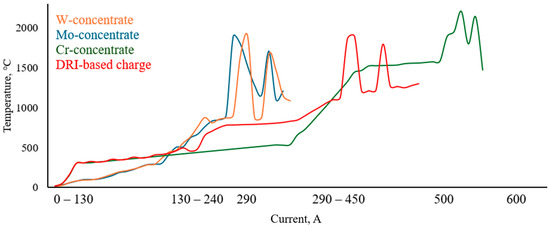
Figure 1 shows the temperature profile curves for three individual concentrates and a DRI-based charge with the addition of a 10% excess of FeAlSiCa, corresponding to Charge 2.
Figure 1.
Temperature profiles of induction furnace smelting during the separate reduction of W-, Mo-, and Cr-concentrates and the combined DRI-based Charge 2 containing all three concentrates with a 10% excess of FeAlSiCa relative to the stoichiometric amount.
The obtained results were generally consistent with previously reported data [13,14]. The temperature profile of the process differs significantly among the various charge compositions, although certain common patterns can be identified. For example, the multi-stage behavior observed for W- and Mo-concentrates can be divided into stages of charge heating and removal of adsorbed gases, followed, presumably, by a stage of activation of reduction processes and the formation of intermediate oxides [24,25]. Subsequently, higher temperatures lead to the melting stage of the charge and the occurrence of intensive exothermic effects associated with the metallothermic reduction of W and Mo oxides.
In the case of the Cr-concentrate, a prolonged heating stage is observed, which is associated with the high thermodynamic stability of Cr2O3. This is followed by a stage characterized by a sharp increase in temperature due to the formation of a liquid phase and improved heat transfer. Thereafter, the system undergoes melting accompanied by intensive metallothermic reduction of Cr2O3, which is associated with pronounced exothermic effects.
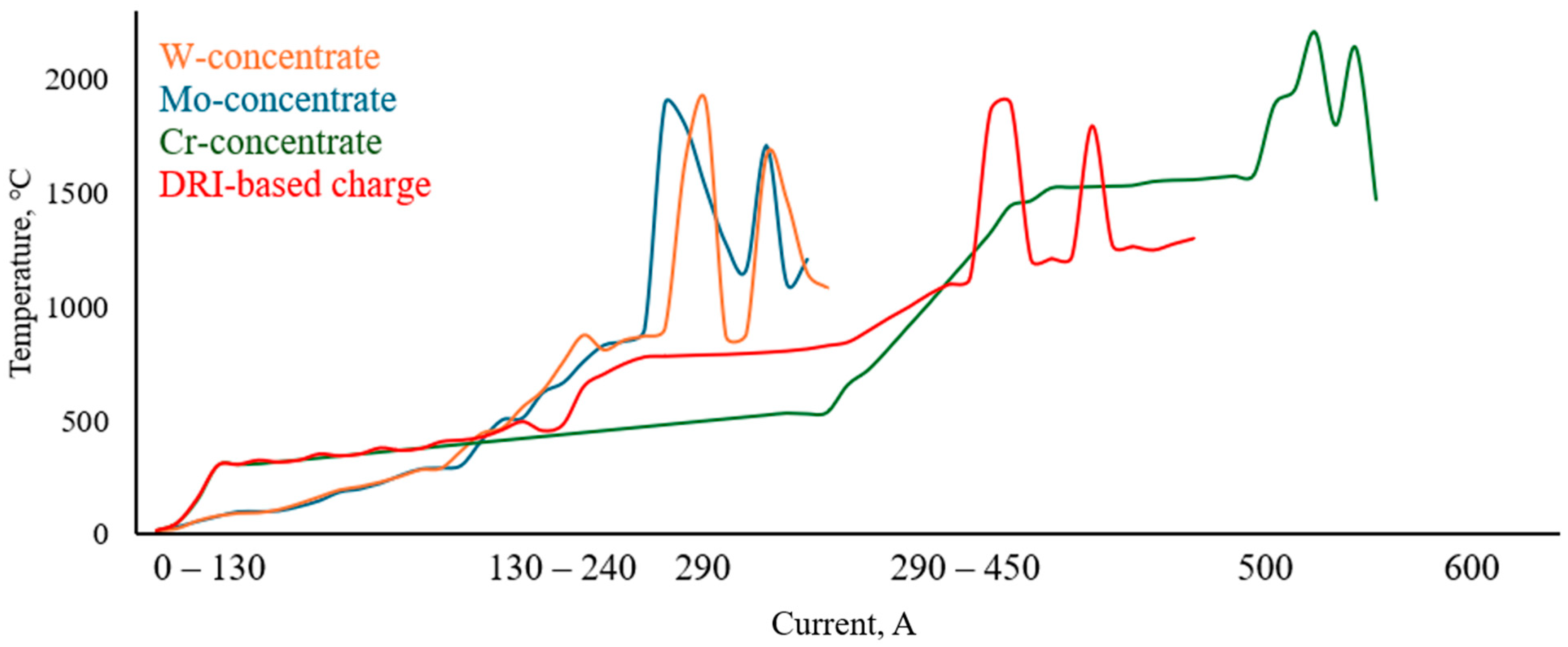
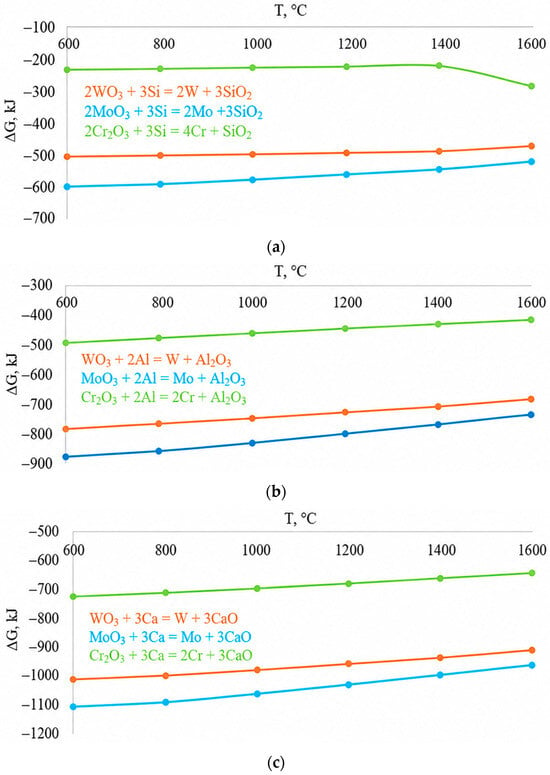
Exothermic effects are also observed for W- and Mo-concentrates. While such peaks for the Cr-concentrate occur during holding at a current of 500 A, for W- and Mo-concentrates, a current of 290 A is sufficient. This behavior is associated with significantly more negative Gibbs free energy (ΔG) values, the results of which are presented in Figure 2.
Figure 2.
Dependence of Gibbs free energy (ΔG) on temperature for silicothermic (a), aluminothermic (b), and calciothermic (c) reduction of W, Mo, and Cr oxides.
Although the reduction of Cr2O3 is thermodynamically feasible, its significantly higher stability compared to WO3 and MoO3 results in a less negative Gibbs free energy change. However, the observed delay in reduction and higher temperature of exothermic peaks are not governed solely by thermodynamics. Kinetic limitations also play a critical role, including slower diffusion through the solid oxide layer, limited contact between phases at early stages, and the necessity of forming a liquid phase to enhance mass transfer. As a result, the reduction of Cr2O3 is initiated at later stages of the process, when sufficient temperature and melt formation are achieved, enabling more efficient reaction kinetics.
The presence of two peaks on each of the curves for the concentrates likely indicates the sequential oxidation of the more exothermic elements Ca and Al, followed by Si. These peaks correspond to temperature intervals of approximately 1600–1900 °C for W- and Mo-concentrates, and above 2000 °C for the Cr-concentrate. Despite the more negative ΔG values associated with the reduction of WO3 and MoO3, the temperature peaks for the Cr-concentrate are observed at higher temperatures. This is attributed to the higher thermodynamic stability of Cr2O3, which requires a greater degree of preliminary heating to initiate the reaction. As a result, the reduction of Cr2O3 begins at a later stage of the smelting process, when the temperature in the crucible has already reached significantly higher values.
For the combined DRI-based charge, corresponding to Charge 2, the temperature profile reflects the simultaneous interaction of several components rather than the reduction of a single oxide concentrate. In this system, DRI acts as the metallic Fe-bearing base of the charge, while FeAlSiCa provides Si, Al, and Ca as active reducing elements. During heating, the reducible oxides present in W-, Mo-, and Cr-concentrates, mainly WO3, MoO3, Cr2O3, and Fe2O3, are reduced by Si, Al, and Ca, with the formation of the corresponding metallic components and oxide products such as SiO2, Al2O3, and CaO. These oxide products, together with added lime and gangue components of the concentrates, form a CaO–SiO2–Al2O3–MgO-based slag phase, while W, Mo, Cr, and Fe are transferred into the metallic phase.
Compared with the individual concentrates, the DRI-based charge shows a more moderate and broadened thermal response. This behavior can be explained by the high proportion of metallic DRI, which dilutes the oxide-bearing part of the charge and absorbs part of the heat released by metallothermic reactions. At the same time, the simultaneous reduction of several oxides and progressive slag formation result in noticeable exothermic effects at later stages of heating. Thus, the temperature profile of the DRI-based charge represents a combined effect of metallothermic reduction, metallic melt formation, and slag formation.
Comparison with the previous study on direct Cr alloying using Cr-concentrate and FeAlSiCa [8] indicates that the thermal profile is strongly affected by charge composition. In the previous Cr-based system, the oxide part of the charge was less complex, which resulted in a smoother temperature profile. In contrast, the present DRI-based W–Mo–Cr charge contains several reducible oxide systems simultaneously, leading to a more complex thermal response.
3.2. Microstructure and Elemental Composition of Metal Samples
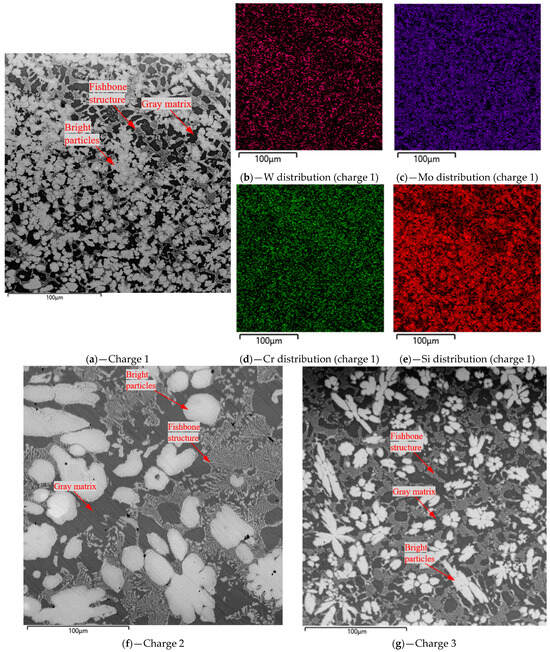
Figure 3 presents microstructural images of metal samples obtained from different charge compositions. For charge variant 1, elemental distribution maps are also shown.
Figure 3.
SEM/BSE microstructure and elemental distribution of metal samples obtained from different charge compositions: (a) BSE image of Charge 1 without EDS mapping, showing the Fe-rich matrix, W–Mo-enriched bright particles, and fishbone-type structures; (b–e) W, Mo, Cr, and Si elemental distribution maps for Charge 1, respectively; (f) BSE image of Charge 2; and (g) BSE image of Charge 3.
As shown in Figure 3a, the microstructure of Charge 1 consists of an Fe-rich gray matrix, rounded bright W–Mo-enriched particles, and elongated branched “fishbone”-type structures. The fishbone-type structures are visible in the BSE image as branched bright-gray regions located between the Fe-rich matrix and the rounded W–Mo-enriched particles. Similar chemically heterogeneous structures are also observed in Charges 2 and 3, although the relative contrast and morphology vary with increasing FeAlSiCa addition.
The results of EDS analysis of the observed regions (overall map) and individual microstructural constituents are presented in Table 3.
Table 3.
Results of semi-quantitative EDS analysis of the microstructure of metal samples, wt.%.
Based on the data presented in Table 3, a clear trend of increasing Si content in the metal phase with increasing FeAlSiCa addition can be observed. From the elemental analysis of the microstructural constituents, the gray matrix can be interpreted as an Fe-rich matrix region, possibly corresponding to an Fe-based solid solution. The bright particles are enriched in W and Mo, while the fishbone-type structures are also W–Mo-enriched but contain a relatively lower Mo content compared with the rounded bright particles.
Based on EDS analysis, Si appears to be present in all microstructural constituents. Considering the limited solubility of Si in refractory metals such as Mo and W, this may indicate partial dissolution of Si in the matrix and/or the possible formation of fine silicide-type constituents. However, the exact phase identity of these constituents cannot be confirmed by EDS alone.
The observed “fishbone”-type structures are likely associated with eutectic or near-eutectic solidification involving W–Mo-rich phases and the Fe-based matrix. Such morphologies typically form under conditions of rapid solidification and compositional segregation, where refractory elements with limited solubility in Fe are redistributed during solidification. The presence of Si may further promote the formation of complex intermetallic or silicide phases, contributing to the development of this characteristic morphology.
It should be noted that SEM/EDS provides information on local chemical composition and elemental distribution, but it does not allow unambiguous crystallographic phase identification. Therefore, the phase-related interpretation presented here should be considered preliminary and based on chemical contrast, morphology, and elemental enrichment. Confirmation of specific phases, including possible silicides, requires additional XRD, EBSD, or TEM analysis and will be addressed in future work.
3.3. Recovery of W, Mo, and Cr
Based on the average mass of W, Mo, and Cr in their respective concentrates and the semi-quantitative SEM/EDS overall-area composition of the obtained metallic products, the apparent recovery of these elements was estimated at different levels of FeAlSiCa addition. Several areas were analyzed for each sample, and the results showed comparable W, Mo, and Cr contents; therefore, the average SEM/EDS values were used for the recovery estimation. Since SEM/EDS is a semi-quantitative method, the obtained recovery values should be considered approximate and are used primarily to compare the effect of FeAlSiCa addition on the transfer of W, Mo, and Cr into the metallic phase.
The apparent recovery of each target element was estimated using the following equation:
where is the apparent recovery of element i(W, Mo, Cr), mmetal is the mass of the obtained metallic product, is the semi-quantitative SEM/EDS content of element i in the metallic product, mconc,i is the mass of the corresponding concentrate introduced into the charge, and is the content of element i in the corresponding concentrate.
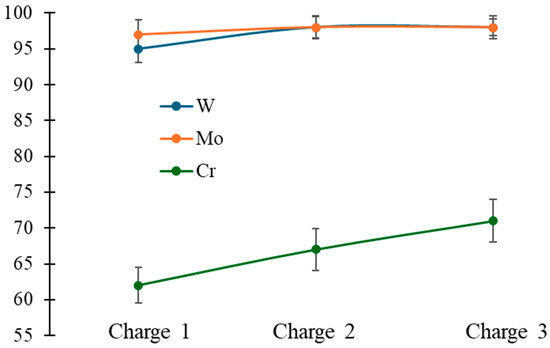
The calculation results are presented in Figure 4.
Figure 4.
Estimated apparent recovery of W, Mo, and Cr for different charge compositions.
As shown in Figure 4, a clear trend of increasing estimated apparent recovery of the main components from their concentrates with increasing FeAlSiCa content can be observed. At the same time, the parallel increase in Si content is likely undesirable, since, for example, high-speed steels alloyed with this set of elements typically do not contain significant amounts of Si.
A distinctive feature is the remarkably high estimated apparent recovery of W and Mo (up to ~99%) and the relatively lower recovery of Cr (up to ~70%). These results correlate well with the previously discussed thermodynamic characteristics of the reduction processes. It can also be noted that the combined estimated apparent recovery of these components yields values comparable to those obtained previously during their individual extraction [13,14].
This indicates a limited influence of the presence of other raw materials and the absence of significant competition between the concentrates during the reduction process. At the same time, the presence of DRI also affects the process. Previous studies have reported that the addition of Fe powder improves Cr recovery, and during induction melting, its recovery in a silicothermic process under an Ar atmosphere reached 95.4% [7]. The use of FeAlSiCa under atmospheric conditions, combined with the addition of DRI in the form of Fe powder, allowed for 83% Cr recovery [8]. However, in the present case, the fraction of DRI was significantly higher since the cited studies focused on direct alloying of steel [7,8]. Therefore, it can be expected that further studies on similar direct complex alloying of W, Mo, and Cr in DRI-based systems may yield comparable results.
4. Discussion
Steel is traditionally alloyed using ferroalloys: FeW, FeMo, and FeCr are used to introduce W, Mo, and Cr, respectively. Low-carbon grades of these ferroalloys are typically produced using silicothermic and aluminothermic methods [26,27,28,29]. As an example of steels containing these elements, high-speed steels can be noted, in which they are introduced in the form of ferroalloys during furnace smelting [26]. The obtained results provide a basis for further investigation of the possibility of producing such steels by direct multicomponent alloying, bypassing the intermediate stage of ferroalloy production [30]. Similarly, the possibility of producing such a complex alloy for steel alloying using a single material instead of separate FeW, FeMo, and FeCr can be considered. Previously, similar complex alloys have been developed for systems such as Ni–Cr [31,32], Fe–Si–Mn–Al [33], Fe–Si–Mn–Cr [6], and others [34,35,36].
The feasibility of applying direct alloying of steel or the use of a complex alloy should be evaluated through dedicated experimental studies. In particular, key issues include the efficiency of element assimilation and their possible oxidation. The presence of Si in the alloy may be technologically relevant because Si-containing ferroalloys are generally characterized by lower oxidizability and improved dissolution behavior in liquid steel [6,34,37]. However, these effects were not directly quantified in the present work. Therefore, in this study, the main experimentally supported observation is the increase in Si content in the metallic product with increasing FeAlSiCa addition, together with high W and Mo recovery and comparatively lower Cr recovery.
The presence of DRI in the charge should be considered not only as a source of metallic Fe but also as a factor influencing the physicochemical conditions of the process. A high fraction of metallic Fe contributes to dilution of the oxide phase, reduces the overall oxygen potential of the system, and promotes earlier formation of a metallic melt. At the same time, residual oxides present in DRI (e.g., SiO2, Al2O3) may increase slag volume and affect mass transfer conditions. Thus, DRI plays a dual role, simultaneously facilitating reduction through melt formation and influencing slag chemistry, which in turn affects the recovery of alloying elements.
Overall, the obtained results clearly demonstrate the feasibility of complex metallothermic reduction of W, Mo, and Cr in the presence of Fe powder derived from DRI under atmospheric conditions in an induction furnace. Further studies may significantly expand these findings.
However, in the present study, the beneficial effect of Si should be interpreted with caution. Although the increase in FeAlSiCa addition was accompanied by an increase in Si content in the alloy from 3.62% in Charge 1 to 11.73–12.34% in Charges 2 and 3, the obtained data do not allow the individual contribution of Si to oxidation resistance, volatilization suppression, or element assimilation to be separated from the overall effect of increased reductant addition and higher exothermic heat release. The recovery values show that W and Mo were transferred into the metal with high efficiency, reaching approximately 99%, whereas Cr recovery remained lower, not exceeding approximately 70%. Therefore, the role of Si in the present process is dual: it may contribute to reduction and melt formation, but its excessive transfer into the metallic phase can be undesirable for subsequent alloy design, especially for steels in which Si content must be limited.
Several limitations of the proposed approach should also be noted. First, the lower recovery of Cr compared with W and Mo indicates that complete reduction of all target oxides was not achieved under the selected atmospheric induction smelting conditions. This is consistent with the higher thermodynamic stability of Cr2O3 and possible kinetic limitations related to mass transfer between the oxide, slag, and metal phases. Second, the present study mainly evaluates the composition of the metallic product, while the detailed distribution of W, Mo, and Cr between the metal and slag phases was not quantified. Therefore, the contribution of residual oxides in the slag, mechanical entrainment, and possible volatilization losses requires further investigation. Third, the increase in Si content with increasing FeAlSiCa addition represents a technological limitation because excessive Si may affect the final alloy composition, phase constitution, melting behavior, and suitability of the alloy for direct steel alloying.
From a practical point of view, the proposed approach may be considered as a preliminary route for producing complex W–Mo–Cr-containing alloying material or for direct multicomponent alloying of steel using oxide raw materials. The potential technological advantage is related to the combination of oxide reduction and alloy formation in one smelting step, which may reduce the need for separate FeW, FeMo, and FeCr additions. A preliminary economic consideration suggests that the feasibility of the process will depend mainly on the cost and consumption of FeAlSiCa, the amount of lime required for slag formation, energy consumption during induction smelting, and the recovery of W, Mo, and Cr. From an environmental perspective, the use of DRI obtained from mill scale and FeAlSiCa produced from technogenic raw materials supports waste valorization and may reduce dependence on conventional carbon-intensive ferroalloy production routes. However, a detailed techno-economic assessment and life-cycle analysis are required in future studies to quantitatively confirm these advantages.
Future studies should focus on optimizing FeAlSiCa excess, slag basicity, holding time, atmosphere, and charge composition. A complete metal–slag mass balance is also required to quantify the distribution of W, Mo, and Cr between the metallic and slag phases. Additional XRD, EBSD, or TEM analysis should be performed to confirm the phase composition of the alloy, particularly the possible formation of silicide-type constituents.
Thus, further optimization should focus not only on maximizing W, Mo, and Cr recovery, but also on controlling Si transfer into the metal and reducing residual Cr losses. This may be achieved by optimizing the FeAlSiCa excess, slag basicity, holding time, and atmosphere, as well as by performing a complete metal–slag mass balance in future studies.
5. Conclusions
- The feasibility of producing a complex W–Mo–Cr-containing alloy by simultaneous metallothermic reduction of oxide concentrates in the presence of DRI was demonstrated under atmospheric induction smelting conditions. The proposed approach combines DRI as an Fe-bearing metallic base and FeAlSiCa as a multicomponent reductant in one smelting process.
- Thermodynamic analysis and temperature-profile measurements showed that the reduction behavior of the individual concentrates differs significantly. W- and Mo-containing systems exhibited more favorable reduction behavior, whereas Cr-concentrate required higher-temperature conditions due to the higher thermodynamic stability of Cr2O3 and possible kinetic limitations.
- For the combined DRI-based charge, the temperature profile reflected the simultaneous interaction of several oxide systems, metallic DRI, FeAlSiCa, and slag-forming components. The process involved metallothermic reduction, metallic melt formation, and CaO–SiO2–Al2O3–MgO-based slag formation.
- Increasing the amount of FeAlSiCa promoted the transfer of alloying elements into the metallic phase. The estimated apparent recovery of W and Mo reached approximately 99%, whereas Cr recovery remained lower and did not exceed approximately 70%, indicating that Cr2O3 reduction is the limiting stage of the process.
- SEM/BSE and semi-quantitative EDS analysis showed that the obtained alloy had a chemically heterogeneous microstructure consisting of an Fe-rich matrix region, rounded W–Mo-enriched bright particles, and fishbone-type W–Mo-enriched structures. The observed Si distribution suggests the possible formation of silicide-type constituents; however, their exact crystallographic identification requires additional phase analysis.
- The main technological limitation of the proposed route is the increased transfer of Si into the metallic phase with increasing FeAlSiCa addition. Further optimization should focus on balancing W, Mo, and Cr recovery with control of Si content, slag basicity, holding time, atmosphere, and complete metal–slag mass balance. Future work should also include a detailed economic and environmental assessment of the process.
Author Contributions
Conceptualization, Y.M. and A.A.; methodology, A.A., A.S. and Z.S. (Zhadiger Sadyk); software, S.K.; validation, Y.M., A.A. and S.K.; formal analysis, A.S. and Z.S. (Zhadiger Sadyk); investigation, Z.S. (Zhalgas Saulebek) and R.T.; resources, Y.M. and Z.S. (Zhadiger Sadyk); data curation, Z.S. (Zhalgas Saulebek) and R.T.; writing—original draft preparation, A.A.; writing—review and editing, Y.M.; visualization, S.K.; supervision, Y.M.; project administration, Y.M.; funding acquisition, Y.M. All authors have read and agreed to the published version of the manuscript.
Funding
This research is funded by the Committee of Industry of the Ministry of Industry and Construction of the Republic of Kazakhstan under program-targeted funding for scientific research for 2024–2026, BR23991563: “Creation of Innovative Resource-Saving Technologies for Mining and Integrated Processing of Mineral and Technogenic Raw Materials.”
Data Availability Statement
The original contributions presented in this study are included in the article. Further inquiries can be directed to the corresponding authors.
Conflicts of Interest
Authors Zhalgas Saulebek and Ruslan Toleukadyr were employed by the company QazMetals Engineering. The remaining authors declare that the research was conducted in the absence of any commercial or financial relationships that could be construed as a potential conflict of interest.
Abbreviations
The following abbreviations are used in this manuscript:
| DRI | Direct reduced iron |
| FeAlSiCa | Ferroaluminosilicalcium |
| FeSi | Ferrosilicon |
| FeCr | Ferrochrome |
| FeW | Ferrotungsten |
| FeMo | Ferromolybdenum |
| SEM | Scanning electron microscopy |
| EDS | Energy-dispersive spectroscopy |
References
- Wang, X.; Liao, J.; Ma, X.; Zhao, B. Exothermic and Slag Formation Behavior of Aluminothermic Reduction of Mo and V Oxides. Metals 2025, 15, 704. [Google Scholar] [CrossRef] [Scilit]
- Akhmetov, A.; Zulhan, Z.; Sadyk, Z.; Burumbayev, A.; Zhakan, A.; Kabylkanov, S.; Toleukadyr, R.; Saulebek, Z.; Ayaganova, Z.; Makhambetov, Y. Carbon-Free Smelting of Ferrochrome Using FeAlSiCa Alloy. Processes 2025, 13, 1745. [Google Scholar] [CrossRef] [Scilit]
- Öncel, L. Production of Ferromolybdenum from Mill Scale via Aluminothermic Process. Sinop Üniv. Fen Bilim. Derg. 2020, 5, 64–76. [Google Scholar] [CrossRef] [Scilit]
- Xu, K. (Ed.) The ECPH Encyclopedia of Mining and Metallurgy; Springer Nature: Singapore, 2024; ISBN 9789819920853. [Google Scholar]
- Abdirashit, A.; Yessengaliyev, D.; Kelamanov, B.; Sariyev, O.; Abikenova, G.; Nurgali, N.; Almagambetov, M.; Zhuniskaliyev, T.; Kuatbay, Y.; Abylay, Z. Investigation of the Possibility of Obtaining Nickel-Containing Ferroalloys from Lateritic Nickel Ores by a Metallothermic Method. Metals 2025, 15, 428. [Google Scholar] [CrossRef] [Scilit]
- Hu, X.; Sundqvist Ökvist, L.; Eriksson, J.; Yang, Q.; Björkman, B. Direct Alloying Steel with Chromium by Briquettes Made from Chromite Ore, Mill Scale, and Petroleum Coke. Steel Res. Int. 2017, 88, 1600247. [Google Scholar] [CrossRef] [Scilit]
- Hu, X.; Wang, H.; Teng, L.; Seetharaman, S. Direct Chromium Alloying by Chromite Ore with the Presence of Metallic Iron. J. Min. Metall. B Metall. 2013, 49, 207–215. [Google Scholar] [CrossRef] [Scilit]
- Akhmetov, A.; Makhambetov, Y.; Smagulov, A.; Sadyk, Z.; Toleukadyr, R.; Baisanov, S. Atmospheric Induction Direct Chromium Alloying of Steel Using FeAlSiCa as a Metallothermic Reductant. Materials 2026, 19, 1111. [Google Scholar] [CrossRef] [Scilit]
- Pastor-Vallés, E.; Abadías Llamas, A.; Pettersen, J.B. Carbon-Neutral Silicon via Aluminothermic Reduction? Exploring Industrial Symbiosis through Life Cycle Assessment. ACS Sustain. Chem. Eng. 2025, 13, 14893–14902. [Google Scholar] [CrossRef] [Scilit]
- Lian, X.; Gao, H.; Shen, L.; Yu, Y.; Wang, Y.; Peng, Z. Life Cycle Assessment of Primary Aluminum Production. Processes 2025, 13, 419. [Google Scholar] [CrossRef] [Scilit]
- Gautam, M.; Pandey, B.; Agrawal, M. Carbon Footprint of Aluminum Production. In Environmental Carbon Footprints; Elsevier: Amsterdam, The Netherlands, 2018; pp. 197–228. ISBN 9780128128497. [Google Scholar]
- Zhang, Y.; Cai, Y.; Liu, S.; Su, Z.; Jiang, T. Life Cycle Assessment of Aluminum-Silicon Alloy Production from Secondary Aluminum in China. J. Clean. Prod. 2023, 392, 136214. [Google Scholar] [CrossRef] [Scilit]
- Saulebek, Z.K.; Abdirashit, A.M.; Toleukadyr, R.T.; Lu, N.Y. Research of Processes for Producing Molybdenum- and Tungsten-containing Refractory Alloys Using Ferroalumosilicocalcia. Min. J. Kaz. 2025, 9, 63–68. [Google Scholar] [CrossRef] [Scilit]
- Makhambetov, Y.; Kutzhanov, M.; Toleukadyr, R.; Myrzagaliyev, A.; Sadyk, Z.; Saulebek, Z.; Akhmetov, A. Utilization of Chromite Spinel Powder in the Metallothermic Smelting of Low-Carbon Ferrochrome. Processes 2025, 13, 2288. [Google Scholar] [CrossRef] [Scilit]
- Makhambetov, Y.N.; Timirbayeva, N.R.; Baisanov, S.O.; Baisanov, A.S. Research of Physical and Chemical Characteristics of the New Complex Calcium-Containing Ferroalloy. CIS Iron Steel Rev. 2020, 19, 18–22. [Google Scholar] [CrossRef] [Scilit]
- Yücel, O.; Özçelebi, M.A. Reduction Smelting of Bursa-uludağ Tungsten Concentrates by the Aluminothermic Process. Scand. J. Metall. 2000, 29, 108–113. [Google Scholar] [CrossRef] [Scilit]
- Shu, Q.; Wu, J.; Chou, K. Kinetics Study on Reduction of CaWO4 by Si from 1423 K to 1523 K. High Temp. Mater. Process. 2015, 34, 805–811. [Google Scholar] [CrossRef] [Scilit]
- Song, S.Q.; Xue, Z.L.; Zhang, J.; Dong, J. Silicothermic Self-Reducing MoO3 Briquettes for Direct Alloying of Mo in Molten Steel. Ironmak. Steelmak. 2014, 41, 628–632. [Google Scholar] [CrossRef] [Scilit]
- Chen, Y.; Xue, Z.; Song, S. The Direct Alloying of Steel through Silicothermic Self-Reduction of Chromite Ore Utilizing Si-Containing Solid Waste. Metals 2024, 14, 138. [Google Scholar] [CrossRef] [Scilit]
- Nagashanmugam, K.B.; Sivakumar, P.; Priyatharshni, S.; Rajan, R.; Maragathamani, S.; Lavanya, R.; Prabhu, N.; Ponnusamy, S. Iron Making in Induction Furnace for Casting Steel Billets. Mater. Today Proc. 2023, S2214785323036490. [Google Scholar] [CrossRef] [Scilit]
- Ahmed, A.; El-Fawakhry, M.K.; Eissa, M.; Shahein, S. Direct Chromium Alloying by Smelting Reduction of Mill Scale and Low Grade Chromite Ore. Ironmak. Steelmak. Process. Prod. Appl. 2015, 42, 648–655. [Google Scholar] [CrossRef] [Scilit]
- Maximizing Iron Unit Yield from Ore to Liquid Steel (Part 3)—Melting Practice. Available online: https://www.midrex.com/tech-article/maximizing-iron-unit-yield-from-ore-to-liquid-steel-part-3-melting-practice/ (accessed on 26 March 2026).
- Kapoor, I.; Davis, C.; Li, Z. Effects of Residual Elements during the Casting Process of Steel Production: A Critical Review. Ironmak. Steelmak. 2021, 48, 712–727. [Google Scholar] [CrossRef] [Scilit]
- Yeh, C.-L.; Chen, M.-C. Metallothermic Reduction of MoO3 on Combustion Synthesis of Molybdenum Silicides/MgAl2O4 Composites. Materials 2021, 14, 4800. [Google Scholar] [CrossRef] [Scilit]
- Baghdasaryan, A.M.; Niazyan, O.M.; Khachatryan, H.L.; Kharatyan, S.L. DTA/TG Study of Tungsten Oxide and Ammonium Tungstate Reduction by (Mg + C) Combined Reducers at Non-Isothermal Conditions. Int. J. Refract. Met. Hard Mater. 2014, 43, 216–221. [Google Scholar] [CrossRef] [Scilit]
- Yang, J.; Sainio, T.; Arcos, D.; Bourgeois, F.; Bru, K.; Häkkinen, A.; Andreiadis, E.; Meyer, D.; Bellier, Q.; Bart, H.-J.; et al. State of the Art on the Recovery of Refractory Metals from Primary Resources; MSP-REFRAM Project Report D2.2; GTK: Espoo, Finland, 2016; 112p, Available online: https://prometia.eu/wp-content/uploads/2020/12/MSP-REFRAM-D2.2-State-of-the-art-on-the-recovery-of-refractory-metals-from-primary-resources.pdf (accessed on 26 March 2026).
- Kornievskiy, V.N.; Panchenko, A.I.; Logozinskiy, I.N.; Salnikov, A.S.; Gasik, M.I.; Shibeko, P.A.; Budnik, I.L.; Yakovitskiy, A.V. Ferromolybdenum Production according to Silicoaluminthermal Method: High Quality, Chemical and Granulometric Composition Stability. In Proceedings of the XIV International Ferroalloys Congress (INFACON XIV), Kyiv, Ukraine, 31 May–4 June 2015; pp. 139–142. [Google Scholar]
- Sheybani, K.; Paydar, M.H.; Shariat, M.H. Effect of Mechanical Activation on Aluminothermic Reduction of Molybdenum Trioxide. Int. J. Refract. Met. Hard Mater. 2019, 82, 245–254. [Google Scholar] [CrossRef] [Scilit]
- Du Preez, S.P.; Van Kaam, T.P.M.; Ringdalen, E.; Tangstad, M.; Morita, K.; Bessarabov, D.G.; Van Zyl, P.G.; Beukes, J.P. An Overview of Currently Applied Ferrochrome Production Processes and Their Waste Management Practices. Minerals 2023, 13, 809. [Google Scholar] [CrossRef] [Scilit]
- Song, T.; Wang, Z.; Bao, Y.; Gu, C. Study of Direct Alloying of Steels by Carbon Reduction of Cr2O3 under Vacuum. J. Mater. Res. Technol. 2024, 28, 3903–3910. [Google Scholar] [CrossRef] [Scilit]
- Abdirashit, A.; Kelamanov, B.; Sariyev, O.; Yessengaliyev, D.; Abilberikova, A.; Zhuniskaliyev, T.; Kuatbay, Y.; Naurazbayev, M.; Nazargali, A. Study of Nickel–Chromium-Containing Ferroalloy Production. Processes 2025, 13, 1258. [Google Scholar] [CrossRef] [Scilit]
- Kelamanov, B.; Yessengaliyev, D.; Sariev, O.; Akuov, A.; Samuratov, Y.; Zhuniskaliyev, T.; Kuatbay, Y.; Mukhambetgaliyev, Y.; Kolesnikova, O.; Zhumatova, A.; et al. Technological Analysis of the Production of Nickel-Containing Composite Materials. J. Compos. Sci. 2024, 8, 179. [Google Scholar] [CrossRef] [Scilit]
- Zhuniskaliyev, T.; Nurumgaliyev, A.; Chekimbayev, A.; Kelamanov, B.; Kuatbay, Y.; Mukhambetgaliyev, Y.; Mukhambetkaliyev, A.; Abdirashit, A. Experimental Investigation of the Influence of Phase Compounds on the Friability of Fe-Si-Mn-Al Complex Alloy. Metals 2024, 14, 1091. [Google Scholar] [CrossRef] [Scilit]
- Gasik, M. (Ed.) Handbook of Ferroalloys: Theory and Technology; Butterworth-Heinemann: Oxford, UK, 2013. [Google Scholar]
- Ivanovich Zhuchkov, V.; Vadimovich Zayakin, O. Manufacturing and Application of Complex Ferroalloys. KnE Mater. Sci. 2019, 5, 138. [Google Scholar] [CrossRef] [Scilit]
- Baisanov, S.O.; Salina, V.A.; Tokaeva, Z.M. Technology of Obtaining New Generation of Complex Ferroalloy with the Use of Kazakh Barite Ore. In Proceedings of the XIV International Ferroalloys Congress (INFACON XIV), Kiev, Ukraine, 31 May–4 June 2015; pp. 567–571. [Google Scholar]
- Andreev, N.A.; Zhuchkov, V.I.; Zayakin, O.V. Density of Chromium-Containing Ferroalloys. Russ. Metall. 2013, 2013, 418–419. [Google Scholar] [CrossRef] [Scilit]

Disclaimer/Publisher’s Note: The statements, opinions and data contained in all publications are solely those of the individual author(s) and contributor(s) and not of MDPI and/or the editor(s). MDPI and/or the editor(s) disclaim responsibility for any injury to people or property resulting from any ideas, methods, instructions or products referred to in the content. |
© 2026 by the authors. Licensee MDPI, Basel, Switzerland. This article is an open access article distributed under the terms and conditions of the Creative Commons Attribution (CC BY) license.