


Abstract
This study evaluated changes in physicochemical properties, oxidative stability, colour, and texture of commercially available plant-based meat alternatives (PBMAs) and their meat counterparts during consumer-relevant post-opening refrigerated storage. Four product categories (salami, bacon, kabanos sausages, and frankfurters), each represented by a plant-based alternative and its corresponding conventional meat product, were analysed immediately after package opening and after 7 days of refrigerated storage (4 ± 1 °C). Physicochemical parameters (pH, oxidation–reduction potential, water activity), colour, cutting force, thiobarbituric acid reactive substances (TBARS), and ABTS radical-scavenging activity were determined. Frankfurters were additionally evaluated before and after heating. Storage-related quality changes depended primarily on product category rather than product origin. Plant-based salami and bacon showed substantially greater lipid oxidation than meat products, whereas kabanos sausages exhibited comparable oxidative stability. Plant-based kabanos maintained more stable colour and texture during storage, while frankfurters displayed formulation- and heating-dependent responses. Cluster analysis confirmed that quality characteristics were product-specific and did not consistently separate plant-based from meat products. PBMAs cannot be considered a homogeneous food category with respect to post-opening quality. Product-specific evaluation is therefore essential when assessing the dietetic value, storage stability, and practical suitability of PBMAs.
1. Introduction
Plant-based meat alternatives (PBMAs) have become an increasingly important segment of the food market, driven by consumer interest in sustainable diets, animal welfare, and the potential health benefits associated with reducing meat consumption [1,2]. This growing market presence is reflected in 4965 PBMA product launches recorded worldwide between 2019 and 2021, including new products, new varieties, reformulations, relaunches, and packaging changes [2]. These products are designed to imitate the sensory and culinary properties of conventional meat products and are typically formulated from plant proteins, vegetable oils, dietary fibre, hydrocolloids, flavourings, and colour-forming ingredients [2,3,4]. However, PBMAs do not constitute a nutritionally or technologically homogeneous food category. Their composition, nutritional value, degree of processing, and technological properties vary considerably depending on the raw materials, formulation, and type of product being imitated [1,3].
From a dietetic perspective, PBMAs should be evaluated beyond their simple classification as alternatives to animal-derived foods. Commercial products differ widely in protein sources, lipid fractions, dietary fibre, sodium, micronutrient fortification, and degree of processing. Depending on formulation, they may provide dietary fibre, contain no dietary cholesterol, and offer a more favourable fatty acid profile than some conventional meat products; however, differences in protein quality, micronutrient content and bioavailability, sodium concentration, and overall formulation complicate direct nutritional comparisons [5,6,7,8,9]. Dietary fibre is particularly relevant because, in addition to its nutritional role, it may influence water retention, structure, texture, and matrix stability [10]. Consequently, PBMAs constitute a highly heterogeneous group of foods, and their dietetic evaluation requires consideration of the nutritional and technological characteristics of individual commercial products.
The same heterogeneity applies to technological quality. The structure of PBMAs is created through interactions among plant proteins, water, vegetable oils, fibres, starches, hydrocolloids, colourants, flavouring agents, and other functional ingredients. These components determine water binding, texture, appearance, and stability, and their interactions may differ substantially from those occurring in muscle-based foods [1,4,10,11]. Thus, similarity to meat at the time of purchase does not necessarily imply similar behaviour during preparation or storage. Differences between meat and plant-based matrices may become particularly evident during heating, when changes in water and fat retention, colour, and texture determine the properties of the product as actually consumed [12].
Importantly, the quality of these products should be considered not only at purchase but also at the time of actual consumption. Differences between plant-based and animal-derived matrices may influence physicochemical conditions, colour, mechanical properties, and oxidative behaviour during storage [2,3]. PBMAs therefore cannot be assumed to undergo the same post-opening changes as the conventional meat products they are intended to replace.
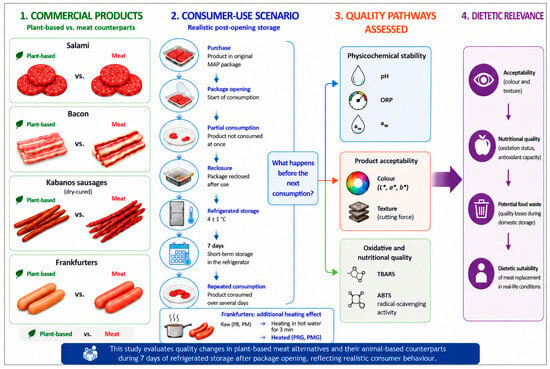
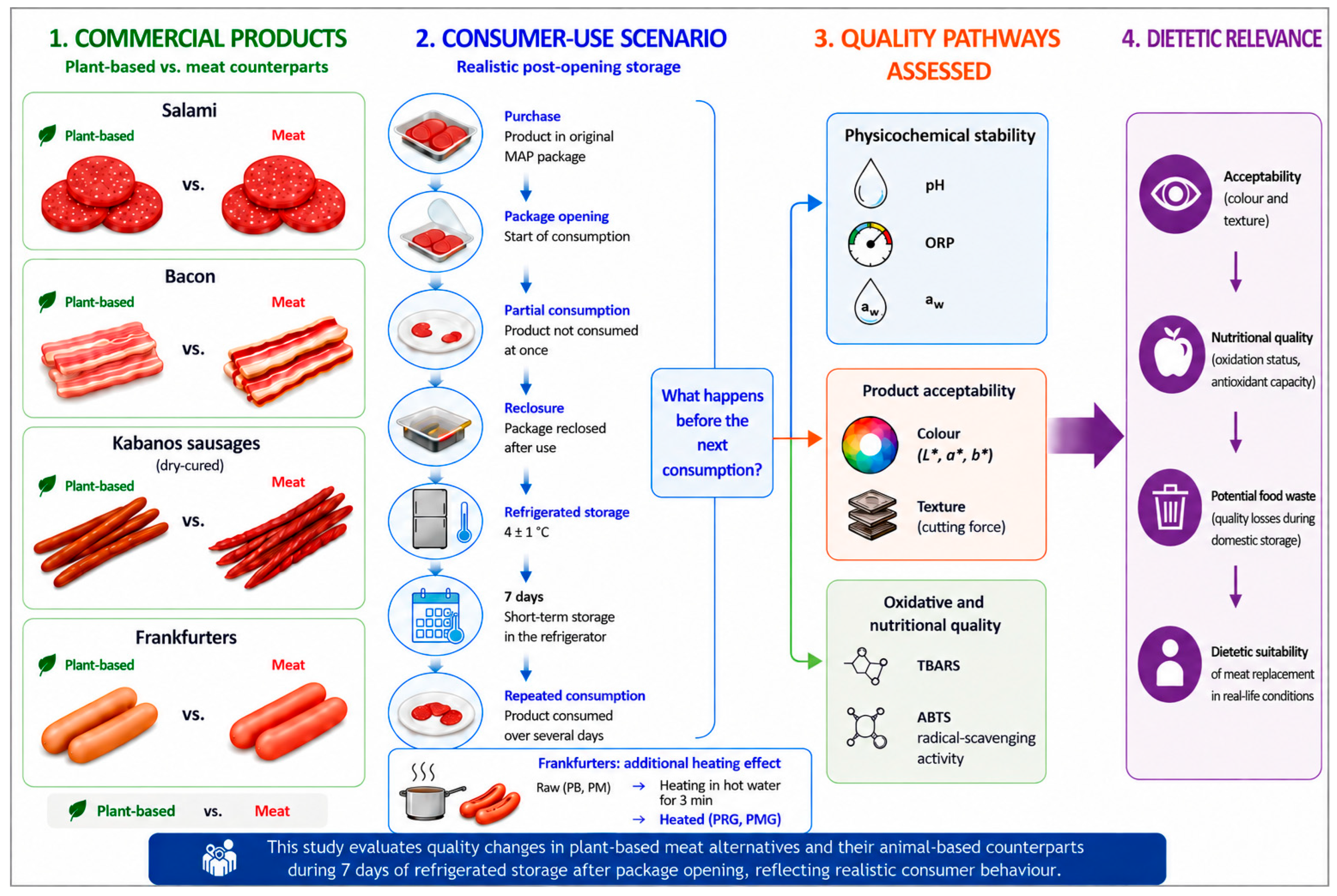
This issue is particularly relevant for products sold in multi-serving packages, such as salami, bacon, kabanos sausages, and frankfurters. Under household conditions, a package may be opened, partially consumed, reclosed, and returned to the refrigerator for subsequent consumption over several days. Nevertheless, commercial PBMAs are often evaluated at a single time point or under storage conditions that do not directly reflect this pattern of consumer use. Quality characteristics measured immediately after package opening may therefore differ from those present when the remaining product is subsequently consumed. The consumer-use pathway from package opening and partial consumption to reclosure, refrigerated storage, and later consumption thus provided the conceptual framework for the present study (Figure 1).
Figure 1.
Conceptual framework of the study evaluating quality changes in commercial plant-based meat alternatives and their animal-based counterparts during consumer-relevant post-opening refrigerated storage. The experimental model simulated package opening, partial product consumption, reclosure, refrigerated storage for 7 days, and subsequent consumption. Instrumental colour and cutting force were assessed as attributes related to appearance and texture, respectively. The asterisks in the L*, a*, b* notation are part of the standard designation for color coordinates in the CIELAB (CIE L*a*b*) color space.
As illustrated in Figure 1, post-opening quality was evaluated through three complementary pathways. Physicochemical stability was assessed using pH, oxidation–reduction potential (ORP), and water activity (aw). Colour parameters and cutting force were used to characterise instrumental attributes related to product appearance and texture, respectively. Oxidative characteristics were evaluated using thiobarbituric acid reactive substances (TBARS) as an indicator of lipid oxidation, together with ABTS radical-scavenging activity as an in vitro measure of the capacity of extractable compounds to scavenge free radicals. This integrated approach was intended to characterise changes occurring between initial package opening and subsequent consumption rather than conventional unopened-package shelf life.
Oxidative stability is particularly relevant because the lipid fraction of PBMAs may differ markedly from that of conventional processed meats. Plant-based products frequently contain added vegetable oils, which may provide a more favourable fatty acid profile but may also differ in susceptibility to oxidation depending on their degree of unsaturation and the protective capacity of the food matrix [2,3]. The combined assessment of TBARS and ABTS radical-scavenging activity was therefore used to characterise complementary aspects of oxidative behaviour during post-opening storage. ABTS radical-scavenging activity was interpreted as an in vitro measure of the radical-scavenging capacity of compounds extractable under the analytical conditions and not as an indicator of nutritional quality or in vivo antioxidant effects.
The diversity of commercial PBMAs supports the need for product-specific comparisons. Salami, bacon-style products, dry sausages, and emulsion-type frankfurters represent markedly different food matrices and may respond differently to storage. Conclusions derived from a single product category therefore cannot necessarily be extrapolated to PBMAs as a whole. Comparing matched plant-based and animal-based products across several categories may help determine whether post-opening changes reflect product origin or the specific characteristics of the food matrix.
Therefore, the aim of this study was to assess quality changes occurring during short-term post-opening refrigerated storage of selected commercially available PBMAs and to compare them with corresponding animal-based products. The study included products from several commercial categories, although these represent only a small part of the wide range of PBMAs and conventional meat products available on the market. Four product categories were evaluated: kabanos sausages, bacon, salami, and frankfurters. Products were analysed after package opening and again following 7 days of refrigerated storage at 4 ± 1 °C, representing short-term post-opening refrigerated storage (Figure 1). Physicochemical parameters (pH, ORP, and aw), colour and cutting force, and oxidative characteristics (TBARS and ABTS radical-scavenging activity) were evaluated as complementary dimensions of post-opening quality. Frankfurters were additionally evaluated before and after heating because thermal preparation represents their typical mode of consumption and may modify differences between plant-based and meat matrices [12].
The study tested the hypothesis that PBMAs and their conventional meat counterparts differ in their susceptibility to quality changes during post-opening refrigerated storage. By combining several matched product categories with a post-opening refrigerated storage model, the study aimed to determine whether plant-based alternatives exhibit a consistent pattern of stability or deterioration relative to conventional meat products, or whether these responses are primarily product-specific. This approach may contribute to a more comprehensive dietetic assessment of PBMAs by considering not only their characteristics at purchase but also the stability of quality-related attributes under conditions reflecting actual household use.
2. Materials and Methods
2.1. Materials
The research material consisted of commercially available retail products representing both plant-based meat alternatives and their conventional meat counterparts. Four product categories were included in the study: plant-based and pork kabanos sausages, frankfurters (emulsion-type sausages), salami, and bacon. The products were selected to represent commercially available alternatives within each product category, enabling a comparative evaluation of their quality characteristics.
All products were purchased from retail stores in Lublin, Poland. For each product variant, ten retail packages of the same commercial product were analysed. These comprised five packages from each of two independent production batches, purchased at different times. Thus, each product variant was represented by two production batches of the same product from the same manufacturer. All products were obtained in their original, unopened modified atmosphere packages (MAP). The declared use-by date of every product exceeded the duration of the experimental period.
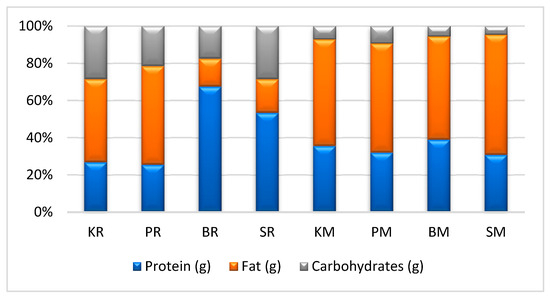
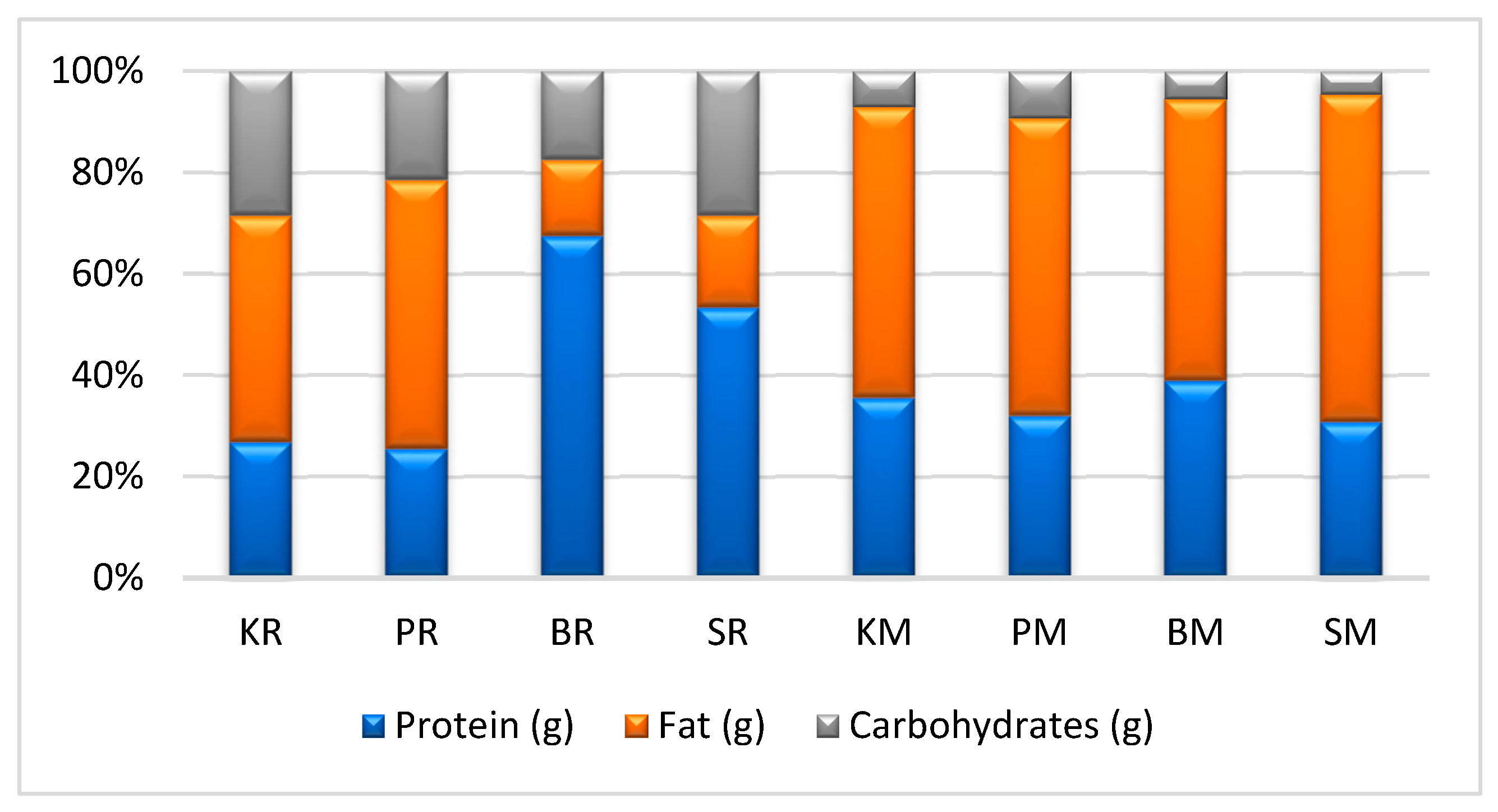
Immediately after purchase, the products were transported to the laboratory under refrigerated conditions in insulated containers and stored at 4 ± 1 °C according to the manufacturers’ recommendations. The chemical composition and nutritional values declared on the product labels are presented in Figure 2.
Figure 2.
Chemical composition and nutritional values declared on the product labels. (SM—meat salami; SR—plant-based salami; BM—meat bacon; BR—plant-based bacon; PM—meat frankfurters; PR—plant-based frankfurters; KM—meat kabanos; KR—plant-based kabanos).
On day 1, a representative portion was collected from each retail package for analysis. The remaining product was placed in a resealable plastic bag, closed, and stored at 4 ± 1 °C for 7 days. Thus, the experimental design represented post-opening refrigerated storage. The 7-day storage period was selected to represent a short-term period during which an opened multi-serving product may remain refrigerated in household use and to allow the assessment of quality changes occurring after loss of the original modified-atmosphere conditions. After this period, a second portion was collected from the same experimental unit and analysed. This protocol was designed to simulate a common household practice in which a multi-serving package is opened, partially consumed, reclosed without modified-atmosphere repackaging, and returned to the refrigerator for later consumption.
In the case of frankfurters, analyses were additionally performed both before and after heating. For thermal treatment, water was brought to boiling (approximately 100 °C) and removed from the heat. The frankfurters were immediately immersed in the hot water and heated for 3 min. After 3 min, the frankfurters were immediately removed from the water. The plant-based and pork frankfurters after heating were designated as PRG and PMG, respectively.
2.2. pH Determination
For pH determination, a 5 g sample was finely comminuted and homogenized with 45 mL of chilled distilled water for 1 min. The homogenate was filtered through filter paper, and the pH was measured in the filtrate using a CPC-501 pH/conductivity meter (Elmetron, Zabrze, Poland) equipped with a combined ERH-111 glass electrode (Elmetron, Zabrze, Poland). The instrument was calibrated using standard buffer solutions prior to each series of measurements.
2.3. Oxidation–Reduction Potential (ORP)
The oxidation–reduction potential (ORP) was determined using a platinum combined electrode (ERPt-13, Elmetron, Zabrze, Poland) connected to the CPC-501 meter. Samples were prepared following the same procedure as described for pH determination. The measured values were corrected relative to the standard hydrogen electrode (SHE) and expressed as millivolts (mV).
2.4. Water Activity
Water activity (aw) was measured using a LabMaster-aw analyzer (Novasina AG, Lachen, Switzerland) equipped with a temperature-controlled measuring chamber maintained at 20 ± 1 °C. Approximately 5 g of finely comminuted sample was placed into the measuring cup and equilibrated in the measuring chamber until a stable reading was obtained. The instrument was calibrated before analysis using certified Novasina humidity standards.
2.5. Determination of Lipid Oxidation (TBARS Assay)
Lipid oxidation was evaluated by determining thiobarbituric acid reactive substances (TBARS) according to the method described by Pikul et al. [13]. Briefly, 3 g of homogenized sample was mixed with 0.2 mL of 0.01% butylated hydroxytoluene (BHT) in ethanol and 12 mL of chilled 4% perchloric acid. The mixture was homogenized for 2 min using an Ultra-Turrax T25 Basic homogenizer (IKA-Werke, Staufen, Germany) at 10,500 rpm. The homogenate was centrifuged at 6700 rpm for 8 min at 4 °C and subsequently filtered through filter paper.
Aliquots of 0.65 mL of filtrate were mixed with an equal volume (0.65 mL) of 0.02 M thiobarbituric acid (TBA) solution. Blank samples containing 0.65 mL of 4% perchloric acid and 0.65 mL of TBA reagent were prepared simultaneously. The reaction mixtures were heated in a boiling water bath for 20 min, cooled to room temperature, and the absorbance was measured at 532 nm using a Hitachi U-5100 UV-Vis spectrophotometer (Hitachi, Tokyo, Japan) against the reagent blank. The TBARS value was expressed as mg malondialdehyde (MDA)/kg sample.
2.6. ABTS Radical-Scavenging Activity
ABTS Radical-Scavenging Activity was determined using the ABTS•+ radical cation decolorization assay according to the method of Re et al. [14]. The ABTS•+ radical was generated by reacting 2,2′-azinobis-(3-ethylbenzothiazoline-6-sulfonic acid) with potassium persulfate and allowing the mixture to stand in the dark for 16 h at room temperature. Before analysis, the ABTS solution was diluted with 0.02 M sodium phosphate buffer (pH 6.6) to obtain an absorbance of 0.70 ± 0.02 at 734 nm.
For sample extraction, the product was mixed with distilled water at a sample-to-solvent ratio of 1:10 (w/v). The mixture was homogenised for 1 min using an Ultra-Turrax T25 Basic homogeniser (IKA-Werke, Staufen, Germany) at 10,500 rpm and subsequently centrifuged at 6700 rpm for 8 min at 4 °C. The resulting supernatant was filtered through filter paper, and the filtrate was used for the ABTS assay.
The sample extract (0.2 mL) was mixed with the ABTS working solution (1.8 mL), incubated for 6 min at room temperature, and the absorbance was measured at 734 nm. Radical-scavenging activity was calculated according to the following equation:
where As is the absorbance of the sample and Ac is the absorbance of the control solution.
Radical-scavenging activity (%) = [1 − (As/Ac)] × 100
2.7. Instrumental Colour Measurement
Instrumental colour was determined in the CIELab colour space, where L* represents lightness, a* the red–green coordinate, and b* the yellow–blue coordinate. Colour measurements were performed at room temperature using a spherical spectrophotometer (X-Rite Inc., Grand Rapids, MI, USA) with illuminant D65 and a 10° standard observer, and the specular component excluded (SCE). Prior to analysis, the instrument was calibrated according to the manufacturer’s instructions.
Colour was measured directly on the external surface of whole kabanos sausages and frankfurters, whereas commercially sliced salami and bacon were measured on the exposed surface of the slices. Owing to the small diameter of the kabanos sausages, a reduced measurement aperture was used to ensure complete coverage of the measurement area by the sample surface, whereas the standard 13 mm aperture was applied for the remaining products. Three measurements were taken at different locations on each sample, and the mean CIELab values (L*, a*, and b*) were used for statistical analysis.
2.8. Texture Analysis
Texture properties were evaluated by measuring the maximum cutting force using the Warner–Bratzler shear test. Measurements were performed using a TA-XT plus texture analyzer (Stable Micro Systems Ltd., Surrey, UK) equipped with a V-shaped Warner–Bratzler blade (0.9 mm thickness, 60° triangular aperture). Samples were tested in their original commercial form without preparation of standardized test specimens. Samples were tested in their original commercial form without preparation of standardized test specimens. Kabanos sausages and frankfurters were analysed as whole products, retaining their original diameters (10 ± 1 mm and 21 ± 2 mm, respectively), whereas salami and bacon were analysed as commercially sliced products, with a slice thickness of 2.5 ± 0.5 mm, without further modification. Each sample was positioned centrally beneath the blade and sheared completely at a constant crosshead speed of 500 mm/min. The maximum cutting force (CF) required to cut through the sample was recorded and expressed in Newtons (N). Three replicate measurements were performed for each experimental unit, and the mean value was used for statistical analysis. Within each product category, the same sample form and measurement conditions were applied to the plant-based and corresponding meat product.
2.9. Statistical Analyses
Statistical analyses were performed using Statistica version 13 (TIBCO Software Inc., Palo Alto, CA, USA). Results are expressed as means and standard errors of the mean (SEM). Statistical analyses were performed separately for each product category (salami, bacon, kabanos sausages, and frankfurters); therefore, no statistical comparisons were made between different product categories. Within each category, the plant-based product was compared with its corresponding meat counterpart. Ten retail packages were analysed for each product variant, comprising five packages from each of two independent production batches of the same commercial product purchased at different times. The individual retail package was considered the experimental unit (n = 10 per product variant). Production batch was not included as a separate factor in the statistical model.
Data for salami, bacon, and kabanos sausages were analysed using a two-factor repeated-measures analysis of variance (ANOVA). Product variant (plant-based vs. meat; W) was treated as the between-subject factor, whereas storage time (day 1 vs. day 7; T) was treated as the within-subject repeated-measures factor. Measurements performed on days 1 and 7 were matched within the same experimental unit because the remaining product from each package was stored and subsequently reanalysed after 7 days. The model evaluated the main effects of storage time (T) and product variant (W), as well as their interaction (T × W).
Data for frankfurters were analysed using a three-factor mixed-design repeated-measures ANOVA. Product variant (plant-based vs. meat; W) was treated as the between-subject factor, whereas storage time (day 1 vs. day 7; T) and heating treatment (before vs. after heating; C) were treated as within-subject repeated-measures factors. At each storage time, portions obtained from the same experimental unit were analysed both without thermal treatment and after heating according to the manufacturer’s instructions. The model evaluated the main effects of storage time (T), product variant (W), and heating treatment (C), all two-way interactions (T × W, T × C, and W × C), and the three-way interaction (T × W × C). When significant effects were observed, differences between means were identified using Tukey’s honestly significant difference (HSD) post hoc test. Statistical significance was established at p < 0.05. Separate hierarchical cluster analyses (HCA) were performed for three groups of variables: (i) physicochemical parameters (pH, ORP, and aw), (ii) colour parameters and cutting force, and (iii) TBARS and ABTS radical-scavenging activity. The analyses were based on mean values for each product variant under the respective experimental conditions. Prior to clustering, all variables were standardized to account for differences in measurement scales. Ward’s agglomerative method with Euclidean distance was used.
3. Results
3.1. Physicochemical Changes
The effects of storage time and product variant on pH differed among the analysed product groups (Table 1). In salami, pH was affected by storage time (p = 0.0006), variant (p < 0.0001), and the time × variant interaction (p = 0.0030).
Table 1.
p-values for the main and interaction effects of storage time [T] and product variant (plant-based or meat) [W], and heating treatment [C] on the physicochemical parameters of commercial products.
The interaction analysis showed that the pH of plant-based salami remained unchanged between days 1 and 7 (6.170 and 6.187, respectively; p > 0.05), whereas that of the meat product decreased from 4.554 to 4.107 (p < 0.05) (Table 2). Accordingly, the overall time effect indicated a decrease in pH during storage (Table S1), while the variant effect showed a higher mean pH in the plant-based than in the meat salami (6.178 vs. 4.330; p < 0.05) (Table S1). Thus, the storage-related change in this product group was associated with further acidification of the meat salami, whereas the plant-based alternative maintained a stable pH.
Table 2.
Time × variant interaction effect—pH.
In bacon, storage time (p = 0.0163) and variant (p = 0.0003) significantly affected pH, while the time × variant interaction was not significant (p > 0.05) (Table 1). Irrespective of variant, the mean pH decreased from 5.643 on day 1 to 5.392 on day 7 (p < 0.05) (Table S1). Moreover, the plant-based bacon had a higher overall pH than its meat counterpart (5.772 vs. 5.263; p < 0.05) (Table S1). Although the numerical values for individual variants changed from 5.807 to 5.737 in plant-based bacon and from 5.480 to 5.047 in meat bacon during storage (Table 2), the non-significant time × variant interaction (p > 0.05) indicates that the magnitude of the storage-related response did not differ between the two variants.
In kabanos sausages, pH was not affected by storage time, and no time × variant interaction was observed (p > 0.05), whereas a significant variant effect was found (p = 0.0002) (Table 1). The plant-based kabanos sausages had a higher mean pH than the meat product (5.943 vs. 5.441; p < 0.05) (Table S1). Therefore, the pH difference within this product group was associated with the product variant rather than with storage-related changes.
In frankfurters, pH was affected by storage time (p = 0.0160), heating (p = 0.0024), and variant (p < 0.0001), with significant time × heating (p = 0.0017), heating × variant (p = 0.0092), and time × heating × variant interactions (p = 0.0171) (Table 1). The overall effects indicated a decrease in pH during storage (Table S1), a higher mean pH in the meat than in the plant-based variant (6.401 vs. 6.085; p < 0.05) (Table S1), and a lower pH after heating than before heating (6.153 vs. 6.333; p < 0.05) (Table S1). The time × heating interaction further showed that differences in pH between storage times depended on the healing treatment (Table S1), while the heating × variant interaction indicated that differences in pH before and after heating depended on the product variant (Table S1).
Considering the significant three-way interaction, the detailed response was evaluated separately for each combination of variant and heating treatment (Table 3). On day 1, heating decreased the pH of the plant-based frankfurters from 6.464 in the product before heating to 5.817 in the product after heating (p < 0.05), whereas no corresponding difference was observed between meat frankfurters before and after heating (6.523 and 6.437, respectively; p > 0.05). After 7 days, the pH values of plant-based frankfurters before and after heating were similar (6.033 and 6.027, respectively; p > 0.05), as were those of the corresponding meat products (6.310 and 6.333, respectively; p > 0.05). The plant-based frankfurters therefore showed a greater pH response to processing conditions, particularly immediately after heating, whereas the meat products maintained comparatively similar pH values across heating treatments and storage times.
Table 3.
Time × variant × heating interaction effect (frankfurters)—pH.
The effects of storage time and product variant on oxidation–reduction potential (ORP) differed among the analysed product groups (Table 1). In salami, ORP was affected by storage time (p < 0.0001), variant (p = 0.0002), and the time × variant interaction (p < 0.0001). The interaction analysis showed that ORP increased during storage in both variants, from 301.74 to 406.00 mV in the plant-based salami and from 316.20 to 335.33 mV in the meat product (p < 0.05) (Table 4).
Table 4.
Time × variant interaction effect—ORP [mV].
The increase was more pronounced in the plant-based product, which consequently reached a higher ORP than the meat salami on day 7 (406.00 vs. 335.33 mV; p < 0.05), whereas the variants did not differ on day 1 (p > 0.05). Accordingly, the overall time effect indicated an increase in ORP during storage (Table S2), while the variant effect showed a higher mean ORP in the plant-based than in the meat salami (353.87 vs. 325.77 mV; p < 0.05) (Table S2). Thus, although both products shifted towards more oxidising conditions during storage, this change was more pronounced in the plant-based alternative.
In bacon, storage time and variant significantly affected ORP (p < 0.0001 for both effects), whereas the time × variant interaction was not significant (p > 0.05) (Table 1). Irrespective of variant, the mean ORP increased from 282.85 mV on day 1 to 321.50 mV on day 7 (p < 0.05) (Table S2). Moreover, the plant-based bacon had a higher overall ORP than its meat counterpart (335.10 vs. 269.25 mV; p < 0.05) (Table S2). Although the numerical values increased from 313.20 to 357.00 mV in the plant-based bacon and from 252.50 to 286.00 mV in the meat product during storage (Table 4), the non-significant time × variant interaction (p > 0.05) indicates that the magnitude of the storage-related response did not differ between the two variants.
In kabanos sausages, ORP was not affected by storage time or product variant, and no time × variant interaction was observed (p > 0.05) (Table 1). Therefore, no significant differences in ORP were identified between the plant-based and meat variants or in their responses to storage.
In frankfurters, ORP was affected by storage time and variant (p < 0.0001 for both effects), and a significant time × variant interaction was observed (p = 0.0241), whereas heating and the interactions involving heating were not significant (p > 0.05) (Table 1). The interaction analysis showed that ORP increased from 320.95 to 345.67 mV in the plant-based frankfurters and from 285.12 to 330.00 mV in the meat products during storage (Table 4). The meat frankfurters had a lower ORP than the plant-based products on day 1 (285.12 vs. 320.95 mV; p < 0.05), whereas the variants did not differ after 7 days of storage (330.00 vs. 345.67 mV; p > 0.05). Accordingly, the overall time effect indicated an increase in ORP during storage (Table S2), while the variant effect showed a higher mean ORP in the plant-based than in the meat frankfurters (333.31 vs. 309.06 mV; p < 0.05) (Table S2). Thus, the initially lower ORP of the meat frankfurters increased during storage, resulting in comparable ORP values between the plant-based and meat variants by day 7.
The effects of storage time and product variant on water activity (aw) differed among the analysed product groups (Table 1). In salami, aw was affected by storage time (p = 0.0050) and variant (p = 0.0020), whereas the time × variant interaction was not significant (p > 0.05). Irrespective of variant, the mean aw decreased from 0.924 on day 1 to 0.908 on day 7 (p < 0.05) (Table S3). Moreover, the plant-based salami had a higher overall aw than its meat counterpart (0.925 vs. 0.907; p < 0.05) (Table S3). Thus, although the plant-based product was characterised by higher water availability, the storage-related decrease in aw did not differ between the plant-based and meat variants.
In bacon, storage time significantly affected aw (p < 0.0001), whereas the variant effect was not significant (p > 0.05). However, a significant time × variant interaction was observed (p = 0.0067) (Table 1). The interaction analysis showed that aw decreased during storage in both variants, from 0.953 to 0.940 in the plant-based bacon and from 0.967 to 0.935 in the meat product (p < 0.05) (Table 5). On day 1, the meat bacon had a higher aw than the plant-based alternative (0.967 vs. 0.953; p < 0.05), whereas the variants did not differ after 7 days of storage (0.935 vs. 0.940; p > 0.05). Accordingly, the overall time effect indicated a decrease in aw during storage (Table S3). Thus, the initially higher aw of the meat bacon decreased during storage, resulting in comparable values between the plant-based and meat variants by day 7.
Table 5.
Time × variant interaction effect—aw.
In kabanos sausages, aw was not affected by storage time or product variant, and no time × variant interaction was observed (p > 0.05) (Table 1). Therefore, no significant differences in aw were identified between the plant-based and meat variants or in their responses to storage.
In frankfurters, aw was affected by storage time, variant, and heating (p < 0.0001 for all effects), with a significant time × variant interaction (p = 0.0019) (Table 1). The time × variant interaction showed that aw remained unchanged in the plant-based frankfurters between days 1 and 7 (0.982 and 0.979, respectively; p > 0.05), whereas it decreased in the meat products from 0.972 to 0.955 (p < 0.05) (Table 5). On day 1, the plant-based frankfurters had a higher aw than the meat products (0.982 vs. 0.972; p < 0.05), and this difference was maintained after 7 days of storage (0.979 vs. 0.955; p < 0.05). Accordingly, the overall time effect indicated a decrease in aw during storage (Table S3), while the variant effect showed a higher mean aw in the plant-based than in the meat frankfurters (0.980 vs. 0.964; p < 0.05) (Table S3). Heating also resulted in a lower overall aw after heating than before heating (0.970 vs. 0.974; p < 0.05) (Table S3). Thus, the plant-based frankfurters maintained a stable and consistently higher aw during storage, whereas the meat products showed a significant reduction in water availability.
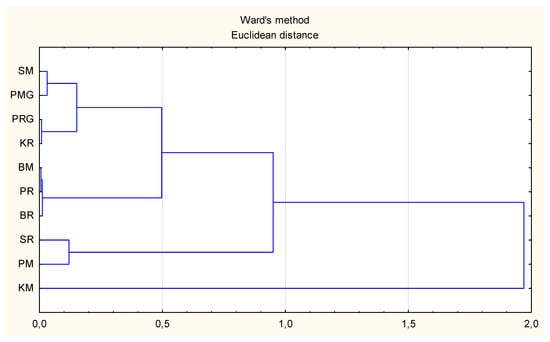
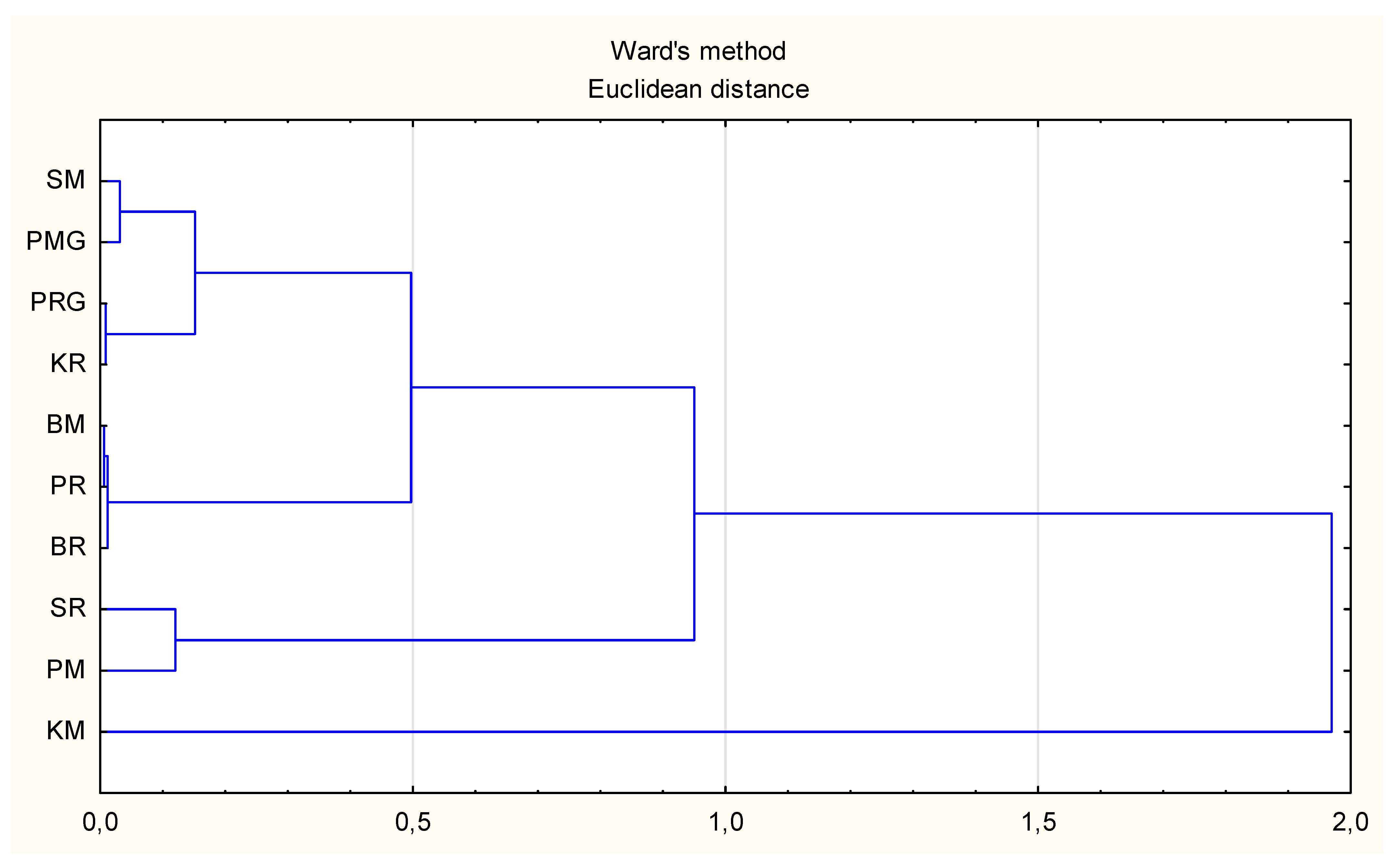
Hierarchical cluster analysis revealed differences in the overall physicochemical profiles of the analysed products (Figure 3). The closest clustering was observed for SM, PMG, PRG, and KR, which formed a relatively compact group. BM, PR, and BR also showed close similarity and subsequently joined this cluster. In contrast, SR and PM formed a separate subgroup, indicating greater dissimilarity from the other products. KM was clearly separated from all remaining products and showed the greatest dissimilarity in its combined physicochemical profile. Overall, the clustering pattern did not show a consistent separation between the plant-based and corresponding meat products, supporting a product-specific rather than origin-dependent pattern of physicochemical similarity.
Figure 3.
Dendrogram resulting from hierarchical cluster analysis of physicochemical parameters. (SM—meat salami; SR—plant-based salami; BM—meat bacon; BR—plant-based bacon; PM—meat frankfurters before heating; PR—plant-based frankfurters before heating; PMG—meat frankfurters after heating; PRG—plant-based frankfurters after heating; KM—meat kabanos; KR—plant-based kabanos).
3.2. Colour and Texture Changes
The effects of storage time and product variant on colour parameters differed among the analysed product groups (Table 6).
Table 6.
p-values for the main and interaction effects of storage time [T] and product variant (plant-based or meat) [W], and heating treatment [C] on color parameters (L*, a*, and b*) and cutting force (CF) of commercial products.
In salami, colour was affected by variant but remained stable during storage, with no significant time × variant interactions (p > 0.05). The plant-based product was darker (L*: 42.734 vs. 56.208), but more red (a*: 22.362 vs. 18.072) and yellow (b*: 17.922 vs. 8.314) than the meat salami (p < 0.05) (Table S4). Thus, the colour differences between the variants were maintained throughout storage.
In bacon, L* remained unaffected by storage time and variant (p > 0.05), whereas the plant-based product showed greater redness than the meat counterpart (a*: 14.99 vs. 7.01; p < 0.05) (Table S4). Yellowness was affected by the time × variant interaction (p = 0.0205), and the plant-based bacon had a markedly higher overall b* than the meat product (26.96 vs. 7.832; p < 0.05) (Table S4). Overall, the plant-based bacon was distinguished primarily by its greater redness and yellowness.
In kabanos sausages, storage-related changes differed between variants for all colour parameters (Table 6). The plant-based product showed relatively small changes in L* (41.770–42.814), a* (10.860–11.132), and b* (9.333–9.567), whereas the meat product became darker (L*: 51.620 to 44.223), more red (a*: 9.100 to 13.273), and more yellow (b*: 6.370 to 9.998) during storage (p < 0.05) (Table 7, Table 8 and Table 9). Accordingly, the overall effects indicated decreases in lightness (Table S4) and increases in redness and yellowness (Table S4). By day 7, the variants no longer differed in L* or b* (p > 0.05), although the meat product showed greater redness (13.273 vs. 11.132; p < 0.05), indicating substantial convergence of their colour profiles during storage.
Table 7.
Time × variant interaction effect—lightness (L*).
Table 8.
Time × variant interaction effect—redness (a*).
Table 9.
Time × variant interaction effect—yellowness (b*).
In frankfurters, the time × variant interaction was significant for all three colour parameters (Table 6). During storage, the initial difference in L* disappeared as the meat product became lighter (67.992 to 72.008; p < 0.05), while the plant-based variant showed no significant change (76.113–73.207; p > 0.05) (Table 7). Redness remained stable in the plant-based product (9.097–9.363; p > 0.05) but decreased in the meat frankfurters (9.412 to 8.120; p < 0.05) (Table 8), consistent with the overall decrease in a* during storage (Table S4). Conversely, b* increased in the plant-based variant (18.275 to 19.527; p < 0.05) but remained unchanged in the meat product (13.295–12.552; p > 0.05) (Table 9), with the plant-based frankfurters showing greater overall yellowness (Table S4). Heating slightly increased redness overall (Table S4), and the heating × variant interaction showed that the difference between variants observed in products before heating was no longer evident after heating (Table S4).
The effects of storage time and product variant on cutting force (CF) differed among the analysed product groups (Table 6). In salami, CF was affected by storage time (p = 0.0036), variant (p = 0.0002), and the time × variant interaction (p = 0.0007). Overall, CF decreased during storage (1.113 to 0.822 N; p < 0.05) (Table S5), and the plant-based salami required a lower cutting force than the meat product (0.737 vs. 1.198 N; p < 0.05) (Table S5). Thus, the plant-based alternative was characterised by lower resistance to cutting, although the significant interaction indicates that storage-related changes depended on the variant.
In bacon, CF was affected only by variant (p < 0.0001), whereas storage time and the time × variant interaction were not significant (p > 0.05) (Table 6). The plant-based bacon showed a markedly lower CF than its meat counterpart (0.542 vs. 1.561 N; p < 0.05) (Table S5), indicating substantially lower cutting resistance of the plant-based product.
In kabanos sausages, CF was affected by storage time, variant, and their interaction (p < 0.0001 for all effects) (Table 6). CF remained unchanged in the plant-based product (0.858–0.879 N; p > 0.05), whereas it increased markedly in the meat product from 0.878 to 2.120 N (p < 0.05) (Table S5). Accordingly, the overall time effect indicated an increase in CF during storage (Table S5), while the plant-based variant showed a lower mean CF than the meat product (0.868 vs. 1.499 N; p < 0.05) (Table S5). Thus, the plant-based kabanos sausages maintained stable cutting resistance, whereas the meat product became considerably harder to cut during storage.
In frankfurters, CF was affected by storage time (p = 0.0009) and heating (p = 0.0363), whereas the overall variant effect was not significant (p > 0.05) (Table 6). However, significant time × heating (p < 0.0001), heating × variant (p = 0.0001), and time × heating × variant interactions (p = 0.0162) were observed. Overall, CF decreased during storage (Table S5) and was lower after heating than before heating (Table S5), while the two-way interactions confirmed that the response depended on both storage time and product variant (Table S5). Considering the significant three-way interaction, CF in the plant-based frankfurters remained unchanged during storage before heating (0.297–0.307 N; p > 0.05), whereas it decreased after heating from 0.467 to 0.263 N (p < 0.05) (Table S5). In contrast, CF in the meat frankfurters before heating increased from 0.333 to 0.480 N, while after heating, it reached the lowest value after storage (0.103 N; p < 0.05). These findings indicate that cutting resistance in frankfurters was strongly dependent on the combined effects of product variant, heating, and storage.
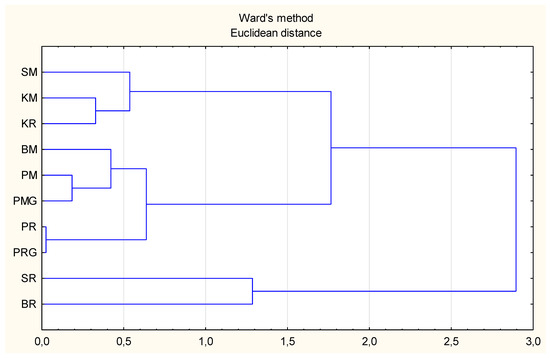
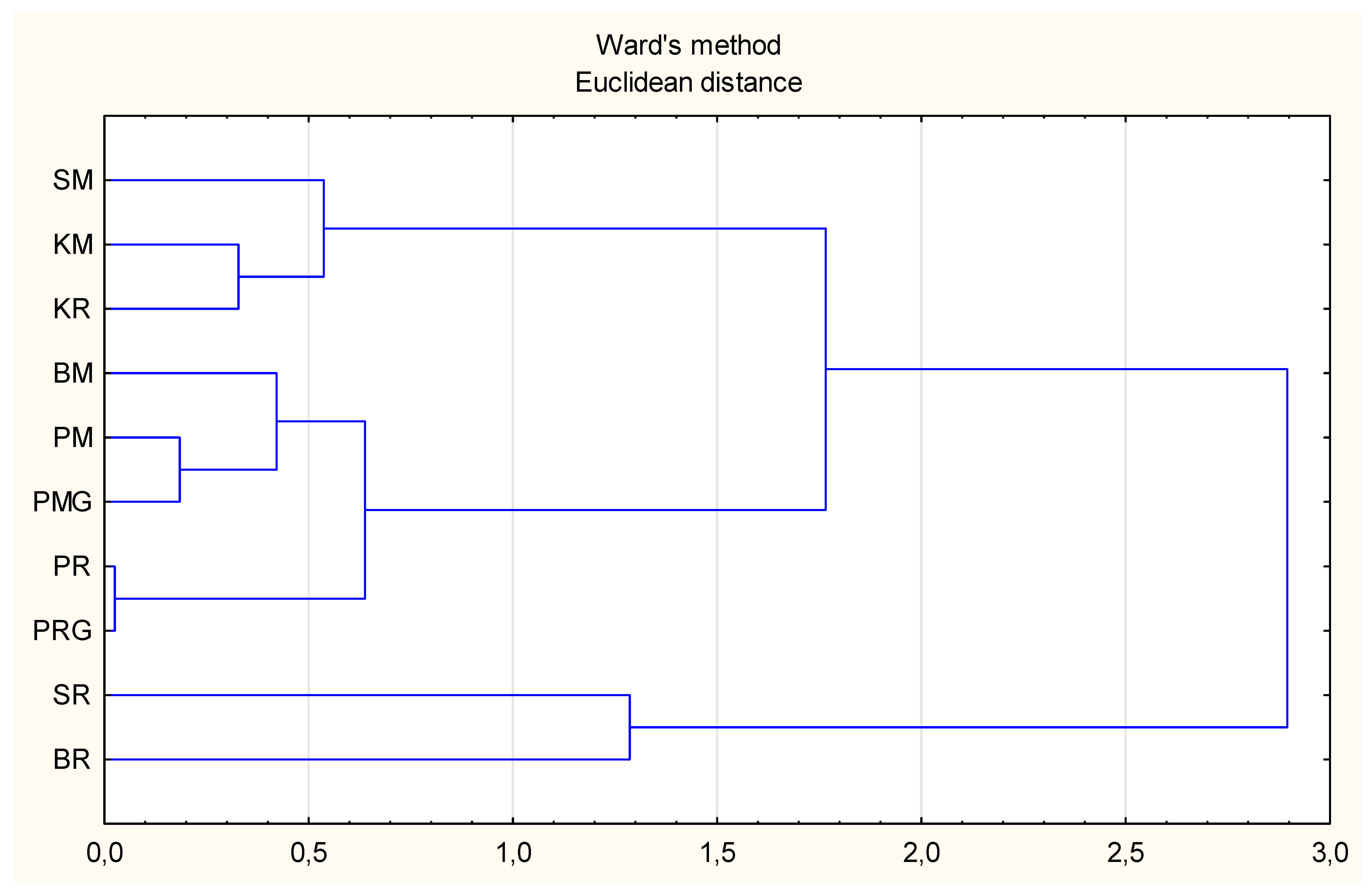
Hierarchical cluster analysis based on colour parameters and cutting force revealed two major clusters (Figure 4). One cluster comprised SM, KM, KR, BM, and the frankfurters before and after heating (PM, PMG, PR, and PRG). Within this cluster, the plant-based frankfurters before and after heating (PR and PRG) showed particularly close similarity, as did the corresponding meat frankfurters (PM and PMG). Meat and plant-based kabanos sausages (KM and KR) also clustered closely. In contrast, plant-based salami (SR) and plant-based bacon (BR) formed a separate cluster, clearly distinct from the remaining products. Overall, the clustering pattern did not show a consistent separation between plant-based and meat products, indicating that similarities in the combined colour and cutting-force profiles were product-specific.
Figure 4.
Dendrogram resulting from hierarchical cluster analysis of colour and textural (cutting force) parameters. (SM—meat salami; SR—plant-based salami; BM—meat bacon; BR—plant-based bacon; PM—meat frankfurters before heating; PR—plant-based frankfurters before heating; PMG—meat frankfurters after heating; PRG—plant-based frankfurters after heating; KM—meat kabanos; KR—plant-based kabanos).
3.3. Oxidation Status
The effects of storage time and product variant on TBARS levels and ABTS radical-scavenging activity differed among the analysed product groups (Table 10).
Table 10.
p-values for the main and interaction effects of storage time [T] and product variant (plant-based or meat) [W], and heating treatment [C] on thiobarbituric acid reactive substances (TBARS; mg MDA/kg) and ABTS radical-scavenging activity (%) of commercial products.
In salami, TBARS was affected by storage time (p = 0.0023), variant (p = 0.0010), and the time × variant interaction (p = 0.0033). TBARS increased in the plant-based product from 0.387 to 1.913 mg MDA/kg (p < 0.05), whereas the meat salami remained unchanged (0.275–0.227 mg MDA/kg; p > 0.05) (Table 11). Accordingly, the overall effects indicated an increase in TBARS during storage (0.331 to 1.070 mg MDA/kg; p < 0.05) (Table S6) and higher levels in the plant-based than in the meat salami (1.150 vs. 0.251 mg MDA/kg; p < 0.05) (Table S6). Thus, lipid oxidation developed predominantly in the plant-based alternative during storage.
Table 11.
Time × variant interaction effect—TBARS [mg MDA/kg].
In bacon, storage time, variant, and their interaction all affected TBARS (p < 0.0001) (Table 10). The plant-based product showed a marked increase from 0.265 to 4.770 mg MDA/kg during storage (p < 0.05), whereas TBARS remained unchanged in the meat bacon (0.128–0.105 mg MDA/kg; p > 0.05) (Table 11). Accordingly, TBARS increased overall during storage from 0.197 to 2.437 mg MDA/kg (p < 0.05) (Table S6), while the plant-based bacon had substantially higher levels than the meat product (2.518 vs. 0.117 mg MDA/kg; p < 0.05) (Table S6). Thus, lipid oxidation during storage was almost exclusively associated with the plant-based bacon.
In kabanos sausages, TBARS was not affected by storage time, variant, or the time × variant interaction (p > 0.05) (Table 10). Therefore, no significant differences in lipid oxidation were identified between the plant-based and meat variants or during storage.
In frankfurters, TBARS was affected by variant (p < 0.0001), with significant time × variant (p = 0.0453) and heating × variant interactions (p = 0.0222), whereas storage time, heating, time × heating, and the three-way interaction were not significant (p > 0.05) (Table 10). TBARS remained unchanged during storage in both the plant-based (0.645–0.851 mg MDA/kg; p > 0.05) and meat frankfurters (0.208–0.168 mg MDA/kg; p > 0.05), while the plant-based products showed higher values than their meat counterparts (Table 11). Accordingly, the overall variant effect confirmed higher TBARS in the plant-based than in the meat frankfurters (0.748 vs. 0.188 mg MDA/kg; p < 0.05) (Table S6). The heating × variant interaction further showed higher TBARS in the plant-based than in the meat product both before heating (0.641 vs. 0.225 mg MDA/kg) and after heating (0.854 vs. 0.151 mg MDA/kg; p < 0.05), whereas heating did not significantly affect TBARS within either variant (p > 0.05) (Table S6). Overall, the plant-based frankfurters were characterised by greater lipid oxidation than their meat counterparts, although TBARS did not increase significantly during storage.
In salami, ABTS activity was affected by storage time (p < 0.0001), variant (p = 0.0001), and the time × variant interaction (p = 0.0034). ABTS activity increased during storage in both variants, from 51.571 to 86.082% in the plant-based salami and from 47.199 to 70.447% in the meat product (p < 0.05) (Table 12). The increase was greater in the plant-based product, which showed higher activity than the meat salami on day 7 (p < 0.05), whereas the variants did not differ on day 1 (p > 0.05). Accordingly, ABTS activity increased overall during storage (49.386 to 78.264%; p < 0.05) (Table S7) and was higher in the plant-based than in the meat salami (68.827 vs. 58.823%; p < 0.05) (Table S7).
Table 12.
Time × variant interaction effect—ABTS [%].
In bacon, neither storage time nor variant affected ABTS activity (p > 0.05), whereas the time × variant interaction was significant (p < 0.0001) (Table 10). ABTS activity decreased in the plant-based product from 86.954 to 70.361%, but increased in the meat bacon from 70.014 to 80.082% (p < 0.05) (Table 12). Consequently, the plant-based bacon showed higher ABTS activity on day 1, whereas the meat product showed higher activity after 7 days of storage (p < 0.05), indicating opposite storage-related responses of the two variants.
In kabanos sausages, ABTS activity was affected by storage time (p < 0.0001), variant (p = 0.0262), and the time × variant interaction (p = 0.0215) (Table 10). Activity decreased in both variants, from 72.883 to 48.625% in the plant-based product and from 87.193 to 48.282% in the meat product (p < 0.05) (Table 12). The meat product showed higher activity on day 1, whereas the variants did not differ after 7 days (p > 0.05). Accordingly, the overall effects indicated a decrease in ABTS activity during storage (80.038 to 48.454%; p < 0.05) (Table S7) and higher mean activity in the meat than in the plant-based kabanos sausages (67.738 vs. 60.754%; p < 0.05) (Table S7).
In frankfurters, ABTS activity was affected by storage time (p < 0.0001) and variant (p = 0.0006), with significant time × heating, time × variant, heating × variant, and time × heating × variant interactions (p ≤ 0.0209) (Table 10). Overall, ABTS activity increased during storage (39.464 to 72.036%; p < 0.05) and was higher in the meat than in the plant-based frankfurters (57.443 vs. 54.057%; p < 0.05) (Table S7). Considering the significant three-way interaction, ABTS activity increased during storage in plant-based frankfurters before heating (39.959 to 70.189%), meat frankfurters before heating (27.186 to 85.660%), and plant-based frankfurters after heating (30.738 to 75.344%; p < 0.05), whereas it remained unchanged in the cooked meat product (59.973–56.959%; p > 0.05) (Table S7). The time × heating and heating × variant interactions further confirmed that the response depended on both storage and product variant (Table S7). Thus, the increase in radical-scavenging activity during storage was strongly dependent on the combined effects of variant and heating treatment.
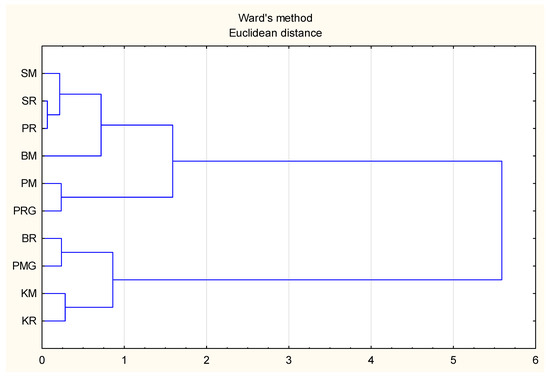
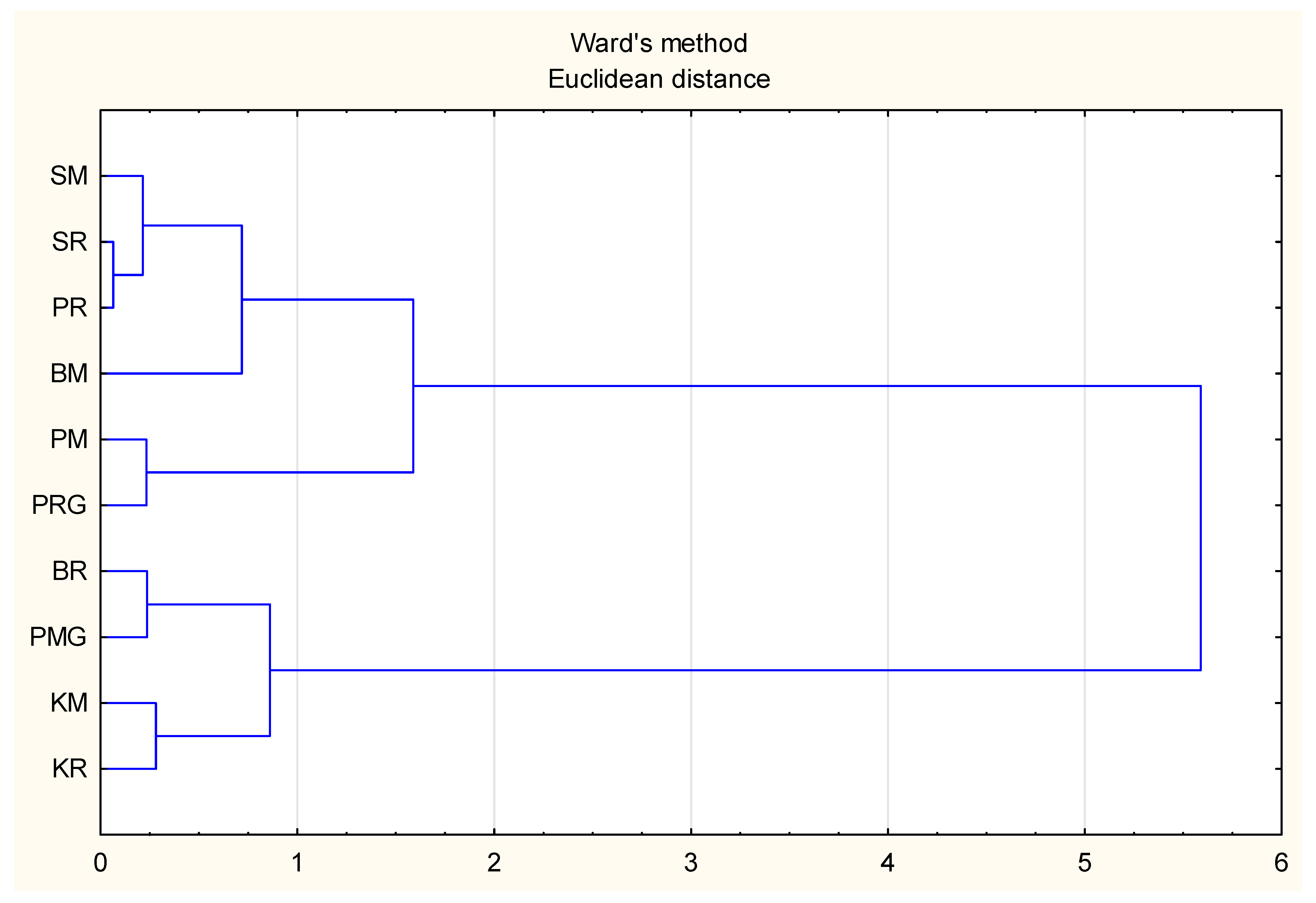
Hierarchical cluster analysis based on TBARS and ABTS radical-scavenging activity separated the products into two major clusters (Figure 5). One cluster comprised meat and plant-based salami (SM and SR), plant-based frankfurters before heating (PR), meat bacon (BM), meat frankfurters before heating (PM), and plant-based frankfurters after heating (PRG). The second cluster comprised plant-based bacon (BR), meat frankfurters after heating (PMG), and both kabanos variants (KM and KR). Within the latter cluster, meat and plant-based kabanos sausages (KM and KR) showed particularly close similarity. Overall, the clustering pattern did not show a consistent separation between plant-based and meat products, supporting a product-specific pattern of oxidative characteristics rather than one determined solely by product origin.
Figure 5.
Dendrogram resulting from hierarchical cluster analysis of TBARS and ABTS radical-scavenging activity parameters. (SM—meat salami; SR—plant-based salami; BM—meat bacon; BR—plant-based bacon; PM—meat frankfurters before heating; PR—plant-based frankfurters before heating; PMG—meat frankfurters after heating; PRG—plant-based frankfurters after heating; KM—meat kabanos; KR—plant-based kabanos).
4. Discussion
The present study showed that quality changes during short-term post-opening refrigerated storage could not be explained by a simple distinction between plant-based and animal-based products. Instead, the magnitude and direction of storage-related changes were product-specific and, for some quality attributes, differed between the matched plant-based and meat variants. This finding is important because PBMAs are often considered a single food category despite substantial differences in protein sources, lipid fractions, water-binding systems, fibres, colourants, and other technological ingredients. Previous reviews have similarly emphasised the substantial compositional and nutritional heterogeneity of commercial PBMAs and the strong dependence of their properties on formulation and processing [2,3,6,15]. The cluster analyses supported this interpretation, as none of the evaluated quality domains produced a consistent separation of all plant-based products from their meat counterparts. Thus, the hypothesis of a uniform difference in storage stability between PBMAs and conventional meat products was not supported; rather, post-opening quality changes were product-specific.
The consumer-oriented storage model is central to the interpretation of these findings. Products were evaluated after package opening and again after 7 days of refrigerated storage, simulating a realistic household scenario in which a multi-serving package is partially consumed, reclosed, and stored for subsequent consumption. Consequently, the results describe changes occurring between first and later consumption rather than conventional unopened-package shelf life. This distinction is dietetically relevant because quality at the time of actual consumption may differ from that at purchase and may influence product acceptance, repeated use, and food waste.
4.1. Physicochemical Stability
Marked differences in pH were observed between matched products. Plant-based salami, bacon, and kabanos sausages had higher pH than their meat counterparts, with the greatest difference observed for salami (6.178 vs. 4.330). This is consistent with the different processing principles of conventional fermented or dry-cured meats and their plant-based analogues. Acidification is fundamental to traditional fermented meat products, whereas PBMAs are constructed from plant proteins, oils, fibres, hydrocolloids, and other ingredients and do not necessarily reproduce the biochemical processes responsible for the low pH of fermented meat [3,16]. During storage, pH remained stable in plant-based salami but decreased from 4.554 to 4.107 in meat salami, indicating different acid–base stability of the two matrices.
Frankfurters followed a different pattern: the plant-based product had a lower mean pH than the meat variant, and its response depended on storage and heating. This confirms that physicochemical behaviour cannot be generalised across PBMAs. Heating can modify protein conformation, ionisation, and interactions among proteins, polysaccharides, and water, and these responses differ between plant- and animal-based matrices [2,17].
Several plant-based products also exhibited a more oxidising environment. ORP increased during storage in plant-based salami (301.74–406.00 mV) and bacon (313.20–357.00 mV), and the plant-based variants generally showed higher ORP than their meat counterparts. Although ORP is not a direct measure of lipid oxidation, this pattern is relevant when considered alongside the TBARS results. Water activity also changed in a product-specific manner, with plant-based salami and frankfurters showing higher mean aw than the corresponding meat products. Such differences probably reflect contrasting water-binding mechanisms in meat proteins and plant-based matrices containing protein isolates, fibres, starches, and hydrocolloids [10].
Overall, the physicochemical results did not indicate universally greater or lower stability of PBMAs. This was also reflected in the physicochemical dendrogram, which showed clustering according to shared product characteristics rather than a consistent plant-versus-meat division.
4.2. Colour and Cutting Force
Colour is a major technological challenge in PBMAs because conventional meat colour is largely determined by myoglobin chemistry, whereas plant-based products rely on added pigments and interactions among colourants, proteins, lipids, pH, and processing conditions [18]. In the present study, plant-based products did not consistently reproduce the colour characteristics of their meat counterparts. Plant-based salami was darker than meat salami, plant-based frankfurters were lighter, and several plant-based products showed greater redness and yellowness.
The clearest storage-related differences occurred in kabanos sausages. Meat kabanos became darker during storage (L*: 51.620–44.223), while the plant-based variant remained stable. Redness increased markedly in the meat product (9.100–13.273), whereas changes in the plant-based alternative were limited. Thus, the plant-based kabanos showed greater instrumental colour stability. Frankfurters behaved differently: the initial difference in lightness narrowed during storage, redness remained stable in the plant-based product but decreased in the meat variant, and heating modified redness differently depending on product variant. These results demonstrate that plant-based and meat matrices respond differently not only to storage but also to preparation before consumption.
Structural differences were even more pronounced. Plant-based salami, bacon, and kabanos sausages had lower cutting force than their meat counterparts, with the largest difference observed for bacon (0.542 vs. 1.561 N). Conventional processed meat derives its structure primarily from muscle and connective tissue proteins, whereas PBMAs depend on the structuring of plant proteins and their interactions with oils, fibres, starches, and hydrocolloids. Consequently, texture is strongly influenced by ingredient functionality, protein structuring, water and oil binding, and processing conditions [1,10,11,19].
During storage, cutting force remained stable in plant-based kabanos (0.858–0.879 N) but increased markedly in the meat product (0.878–2.120 N). This suggests greater textural stability of the plant-based analogue, although it also confirms that its matrix did not reproduce the progressive hardening of the conventional dried product. In frankfurters, the significant interaction among storage, variant, and heating showed that texture at consumption depended on preparation. Previous comparisons of meat and plant-based analogues have similarly demonstrated differences in heating-induced changes in appearance, texture, and fluid retention, reflecting fundamental differences in matrix structure [12]. This is particularly relevant because frankfurters are normally consumed after heating, and analysis of the products before heating alone may not accurately reflect the texture experienced by consumers.
The colour and texture dendrogram further indicated that product structure was more influential than plant or animal origin, with frankfurters forming a distinct group from salami, bacon, and kabanos sausages. Thus, imitation of product appearance did not necessarily correspond to reproduction of mechanical properties, which remains a major challenge in PBMA development [11,19].
4.3. Lipid Oxidation and In Vitro Radical-Scavenging Activity
The oxidative results were among the most important findings of the study. Plant-based salami and bacon were considerably more susceptible to lipid oxidation than their meat counterparts. TBARS increased from 0.387 to 1.913 mg MDA/kg in plant-based salami and from 0.265 to 4.770 mg MDA/kg in plant-based bacon, whereas both corresponding meat products remained stable. These findings demonstrate that plant-derived ingredients do not inherently confer greater oxidative stability.
Vegetable oils used in PBMAs may provide a nutritionally favourable fatty acid profile but, depending on their degree of unsaturation, may also be more susceptible to oxidation. Oxidative stability additionally depends on the antioxidant system, oxygen exposure, metals, processing history, and the physical organisation of lipids within the matrix [2,3,20]. The particularly large increase in plant-based bacon therefore indicates low oxidative stability of its lipid fraction under the applied post-opening storage conditions.
However, this response was not universal. Plant-based frankfurters had higher mean TBARS than meat frankfurters (0.748 vs. 0.188 mg MDA/kg), but neither variant showed a significant increase during storage. Kabanos sausages showed no significant effects of time or variant. These contrasting responses further demonstrate that oxidative stability is determined by the specific product matrix rather than plant origin alone.
The ABTS results provided complementary information on the in vitro radical-scavenging capacity of the products. However, changes in ABTS radical-scavenging activity should not be interpreted as changes in nutritional quality or as evidence of in vivo antioxidant effects, as the assay reflects the radical-scavenging capacity of compounds extractable under the analytical conditions. The response was strongly product-specific. In salami, ABTS activity increased in both variants, reaching 86.082% in the plant-based and 70.447% in the meat product after storage. In bacon, the variants responded oppositely: ABTS activity decreased from 86.954 to 70.361% in the plant-based product but increased from 70.014 to 80.082% in meat bacon.
The relationship between ABTS activity and lipid oxidation was not consistent across products. The simultaneous increase in TBARS and ABTS activity in plant-based salami demonstrates that greater in vitro radical-scavenging activity did not necessarily correspond to greater oxidative stability. In contrast, the marked increase in TBARS in plant-based bacon was accompanied by a decline in ABTS activity, which may indicate insufficient antioxidant protection as oxidation progressed, although causality cannot be established from the present data. In kabanos sausages, ABTS activity decreased substantially in both variants and converged after storage, whereas frankfurters showed a complex response dependent on storage, variant, and heating.
Overall, the combined TBARS and ABTS results indicate that lipid oxidation and in vitro radical-scavenging activity describe distinct aspects of product chemistry. The oxidative dendrogram similarly showed no universal separation between plant-based and meat products, reinforcing the conclusion that oxidative behaviour was determined primarily by the specific product matrix, including lipid composition, antioxidant and pro-oxidant compounds, and structural characteristics.
4.4. Dietetic and Practical Implications
From a dietetic and practical perspective, the evaluation of PBMAs should therefore consider not only their declared nutritional composition at purchase but also the stability of quality-related attributes under realistic conditions of preparation and post-opening household storage. These products may provide dietary fibre and, depending on formulation, a more favourable fatty acid profile, but commercial PBMAs vary widely in nutritional composition and may differ from meat products in protein content and quality, micronutrient content, sodium content, and degree of processing [2,3,5,6,9]. The present findings add another dimension to their evaluation by showing that physicochemical, colour, textural, and oxidative characteristics at the time of subsequent consumption may differ substantially from those observed immediately after package opening.
No plant-based product was superior across all evaluated quality domains. Plant-based kabanos showed relatively stable colour and cutting force, whereas plant-based bacon underwent pronounced lipid oxidation. Plant-based salami showed stable pH but increasing TBARS, while frankfurters exhibited complex responses to both storage and heating. Therefore, PBMAs should be assessed as individual products rather than as a nutritionally and technologically uniform category, which is consistent with the substantial compositional and functional heterogeneity reported for commercial PBMAs [2,4,6].
This has practical implications for repeated consumption and food waste. Changes in colour and texture may affect perceived acceptability, as appearance and texture are among the sensory attributes contributing to consumer responses to plant-based alternatives [21,22,23]. Oxidative deterioration, however, may not necessarily be accompanied by equally pronounced visible changes. Product-specific information on post-opening stability may therefore support more realistic storage recommendations and help consumers use PBMAs effectively as substitutes for conventional meat products.
4.5. Strengths and Limitations
A major strength of this study was the direct comparison of matched plant-based and animal-based products across four distinct commercial categories using a consumer-relevant post-opening storage model. The additional evaluation of frankfurters before and after heating further increased the practical relevance of the study, because heating may affect the appearance, texture, and fluid-holding properties of plant-based and meat matrices differently [12].
The main limitation is that commercial products represent complete formulations; therefore, differences cannot be attributed to individual ingredients. Accordingly, the differences observed between the plant-based and meat variants should be interpreted as specific to the commercial products and food matrices examined in this study rather than as general differences between PBMAs and conventional meat products. PBMAs may vary substantially in protein source, lipid fraction, fibres, hydrocolloids, antioxidants, preservatives, pigments, and processing conditions, all of which can influence their nutritional and technological properties [2,3,4,11]. Moreover, one commercial product was evaluated for each product category and variant; therefore, the findings should not be generalised to all products within a given PBMA or meat-product category. The inclusion of two independent production batches increased the representation of each selected product but did not capture the full between-brand variability of the commercial market. This limitation is particularly relevant given the substantial heterogeneity reported among commercially available PBMAs [6,9].
Only two storage time points were evaluated, and microbiological and sensory analyses were not performed. Instrumental colour and cutting force should therefore be interpreted as attributes related to appearance and texture rather than direct measures of consumer acceptance, which requires sensory assessment [22,23]. Similarly, ABTS activity represents in vitro radical-scavenging capacity and not nutritional quality or in vivo antioxidant effects.
5. Conclusions
Overall, post-opening quality was governed primarily by the interaction between product category and product variant. Plant-based alternatives were more stable for some attributes, particularly the colour and cutting force of kabanos sausages, but less stable for others, most notably lipid oxidation in salami and bacon. Heating further modified these relationships in frankfurters. The cluster analyses consistently supported this interpretation, as plant-based products did not form a single group distinct from meat products.
Thus, the hypothesis of uniformly greater or lower stability of PBMAs compared with conventional meat products was not supported. Plant-based substitution creates distinct food matrices with their own physicochemical, structural, and oxidative behaviour. From a dietetic perspective, PBMAs should therefore be evaluated not only according to nutritional composition at purchase but also according to their quality stability under realistic conditions of preparation and post-opening household storage.
Supplementary Materials
The following supporting information can be downloaded at https://www.mdpi.com/article/10.3390/dietetics5040057/s1, Table S1. Effects of storage time, product variant, heating, and their interactions on pH values of the studied products. Table S2. Effects of storage time and product variant on oxidation–reduction potential (ORP) values of the studied products. Table S3. Effects of storage time, product variant, and heating on water activity (aw) of the studied products. Table S4. Effects of storage time, product variant, heating, and their interactions on instrumental colour parameters (L*, a*, and b*) of the studied products. Table S5. Effects of storage time, product variant, heating, and their interactions on cutting force (N) of the studied products. Table S6. Effects of storage time, product variant, and product variant × heating interaction on TBARS content (mg MDA/kg) of the studied products. Table S7. Effects of storage time, product variant, heating, and their interactions on ABTS radical-scavenging activity (%) of the studied products.
Author Contributions
Conceptualization, P.K.; methodology, P.K.; formal analysis, P.K. and J.S. (Jessica Sosik); investigation, J.S. (Jessica Sosik); writing—original draft preparation, J.S. (Jessica Sosik); writing—review and editing, P.K. and J.S. (Joanna Stadnik); visualization, P.K. and J.S. (Jessica Sosik); supervision, P.K. and J.S. (Joanna Stadnik). All authors have read and agreed to the published version of the manuscript.
Funding
This research received no external funding.
Institutional Review Board Statement
Not applicable.
Informed Consent Statement
Not applicable.
Data Availability Statement
The original contributions presented in this study are included in the article/Supplementary Materials. Further inquiries can be directed to the corresponding author.
Acknowledgments
During the preparation of this manuscript, the authors used OpenAI (GPT-5.6) and its image-generation functionality to assist in the development of the conceptual illustration presented in Figure 1. The authors have reviewed and edited the output and take full responsibility for the content of this publication.
Conflicts of Interest
The authors declare no conflicts of interest.
References
- He, J.; Evans, N.M.; Liu, H.; Shao, S. A review of research on plant-based meat alternatives: Driving forces, history, manufacturing, and consumer attitudes. Compr. Rev. Food Sci. Food Saf. 2020, 19, 2639–2656. [Google Scholar] [CrossRef] [Scilit] [PubMed]
- Andreani, G.; Sogari, G.; Marti, A.; Froldi, F.; Dagevos, H.; Martini, D. Plant-based meat alternatives: Technological, nutritional, environmental, market, and social challenges and opportunities. Nutrients 2023, 15, 452. [Google Scholar] [CrossRef] [Scilit] [PubMed]
- Ahmad, M.; Qureshi, S.; Akbar, M.H.; Siddiqui, S.A.; Gani, A.; Mushtaq, M.; Hassan, I.; Dhull, S.B. Plant-based meat alternatives: Compositional analysis, current development and challenges. Appl. Food Res. 2022, 2, 100154. [Google Scholar] [CrossRef] [Scilit]
- Munialo, C.D.; Baeghbali, V.; Acharya, P. Plant-based alternatives to meat products. Foods 2025, 14, 1396. [Google Scholar] [CrossRef] [Scilit] [PubMed]
- Swing, C.J.; Thompson, T.W.; Guimaraes, O.; Geornaras, I.; Engle, T.E.; Belk, K.E.; Gifford, C.L.; Nair, M.N. Nutritional composition of novel plant-based meat alternatives and traditional animal-based meats. J. Food Sci. Nutr. 2021, 7, 109. [Google Scholar] [CrossRef] [Scilit] [PubMed]
- Romão, B.; Botelho, R.B.A.; Torres, M.L.; Maynard, D.D.C.; de Holanda, M.E.M.; Borges, V.R.P.; Raposo, A.; Zandonadi, R.P. Nutritional profile of commercialized plant-based meat: An integrative review with a systematic approach. Foods 2023, 12, 448. [Google Scholar] [CrossRef] [Scilit] [PubMed]
- Lindberg, L.; McCann, R.R.; Smyth, B.; Woodside, J.V.; Nugent, A.P. The environmental impact, ingredient composition, nutritional and health impact of meat alternatives: A systematic review. Trends Food Sci. Technol. 2024, 149, 104483. [Google Scholar] [CrossRef] [Scilit]
- El Sadig, R.; Wu, J. Are novel plant-based meat alternatives the healthier choice? Food Res. Int. 2024, 183, 114184. [Google Scholar] [CrossRef] [Scilit] [PubMed]
- Xie, Y.; Cai, L.; Zhou, G.; Li, C. Comparison of nutritional profile between plant-based meat analogues and real meat: A review focusing on ingredients, nutrient contents, bioavailability, and health impacts. Food Res. Int. 2024, 187, 114460. [Google Scholar] [CrossRef] [Scilit] [PubMed]
- Stanišić, N.; Kurćubić, V.S.; Stajić, S.B.; Tomasevic, I.D.; Tomasevic, I. Integration of dietary fibre for health benefits, improved structure, and nutritional value of meat products and plant-based meat alternatives. Foods 2025, 14, 2090. [Google Scholar] [CrossRef] [Scilit] [PubMed]
- Imran, M.; Liyan, Z. Production of plant-based meat: Functionality, limitations and future prospects. Eur. Food Res. Technol. 2023, 249, 2189–2213. [Google Scholar] [CrossRef] [Scilit]
- Zhou, H.; Vu, G.; Gong, X.; McClements, D.J. Comparison of the cooking behaviors of meat and plant-based meat analogues: Appearance, texture, and fluid holding properties. ACS Food Sci. Technol. 2022, 2, 844–851. [Google Scholar] [CrossRef] [Scilit]
- Pikul, J.; Leszczynski, D.E.; Kummerow, F.A. Evaluation of three modified TBA methods for measuring lipid oxidation in chicken meat. J. Agric. Food Chem. 1989, 37, 1309–1313. [Google Scholar] [CrossRef] [Scilit]
- Re, R.; Pellegrini, N.; Proteggente, A.; Pannala, A.; Yang, M.; Rice-Evans, C. Antioxidant activity applying an improved ABTS radical cation decolorization assay. Free Radic. Biol. Med. 1999, 26, 1231–1237. [Google Scholar] [CrossRef] [Scilit] [PubMed]
- Safdar, B.; Zhou, H.; Li, H.; Cao, J.; Zhang, T.; Ying, Z.; Liu, X. Prospects for plant-based meat: Current standing, consumer perceptions, and shifting trends. Foods 2022, 11, 3770. [Google Scholar] [CrossRef] [Scilit] [PubMed]
- Flores, M.; Piornos, J.A. Fermented meat sausages and the challenge of their plant-based alternatives: A comparative review on aroma-related aspects. Meat Sci. 2021, 182, 108636. [Google Scholar] [CrossRef] [Scilit] [PubMed]
- Kyriakopoulou, K.; Keppler, J.K.; van der Goot, A.J. Functionality of ingredients and additives in plant-based meat analogues. Foods 2021, 10, 600. [Google Scholar] [CrossRef] [Scilit] [PubMed]
- Wu, H.; Sakai, K.; Zhang, J.; McClements, D.J. Plant-based meat analogs: Color challenges and coloring agents. Food Nutr. Health 2024, 1, 4. [Google Scholar] [CrossRef] [Scilit]
- Godschalk-Broers, L.; Sala, G.; Scholten, E. Meat analogues: Relating structure to texture and sensory perception. Foods 2022, 11, 2227. [Google Scholar] [CrossRef] [Scilit] [PubMed]
- Abdullah, F.A.A.; Dordevic, D.; Kabourkova, E.; Zemancová, J.; Dordevic, S. Antioxidant and sensorial properties: Meat analogues versus conventional meat products. Processes 2022, 10, 1864. [Google Scholar] [CrossRef] [Scilit]
- Szenderák, J.; Fróna, D.; Rákos, M. Consumer acceptance of plant-based meat substitutes: A narrative review. Foods 2022, 11, 1274. [Google Scholar] [CrossRef] [Scilit] [PubMed]
- Appiani, M.; Rabitti, N.S.; Methven, L.; Cattaneo, C. Sensory properties and consumer acceptance of plant-based meat, dairy, fish and eggs analogs: A systematic review. Front. Sustain. Food Syst. 2023, 7, 1268068. [Google Scholar] [CrossRef] [Scilit]
- Kumari, S.; Alam, A.N.; Hossain, M.J.; Lee, E.Y.; Hwang, Y.H.; Joo, S.T. Sensory evaluation of plant-based meat: Bridging the gap with animal meat, challenges and future prospects. Foods 2024, 13, 108. [Google Scholar] [CrossRef] [Scilit] [PubMed]

Disclaimer/Publisher’s Note: The statements, opinions and data contained in all publications are solely those of the individual author(s) and contributor(s) and not of MDPI and/or the editor(s). MDPI and/or the editor(s) disclaim responsibility for any injury to people or property resulting from any ideas, methods, instructions or products referred to in the content. |
© 2026 by the authors. Licensee MDPI, Basel, Switzerland. This article is an open access article distributed under the terms and conditions of the Creative Commons Attribution (CC BY) license.