


Abstract
This research presents an artificial intelligence (AI)-driven 3D scanning and printing system for the fabrication of personalized dental prosthetics, implants, and orthodontic appliances. The proposed system integrates high-resolution intraoral scanning, AI-based data analysis, and additive manufacturing to enhance precision, customization, and treatment efficiency. Patient-specific anatomical data and medical history are incorporated to optimize implant design, material selection, and functional performance. Nano-enhanced biocompatible materials are utilized to improve mechanical strength, durability, and antibacterial properties. Specifically, these materials demonstrate a 30% increase in overall precision and a 50% improvement in durability compared to traditional dental materials. In addition, the system adopts a zero-waste manufacturing strategy by recycling excess materials, supporting sustainable dental practices. The results demonstrate significant improvements in accuracy, patient comfort, and environmental responsibility in modern digital dentistry.
1. Introduction
Recent advancements in digital dentistry have profoundly transformed patient-specific treatment strategies, leveraging state-of-the-art technologies such as artificial intelligence (AI), high-resolution 3D scanning, and additive manufacturing (3D printing) [1,2]. These technological innovations facilitate the fabrication of highly customized dental prosthetics, implants, and orthodontic appliances, significantly enhancing precision, functionality, and biocompatibility [3].
A critical challenge in contemporary dentistry lies in achieving optimal prosthetic fit and long-term clinical success while accommodating individual anatomical variations, patient-specific functional requirements, and pre-existing medical conditions [4,5]. Conventional methods, which predominantly rely on manual impressions and laboratory-based fabrication, are often associated with inaccuracies, extended treatment durations, and compromised patient comfort [6].
The integration of AI-driven 3D scanning and additive manufacturing addresses these limitations by enabling a fully digital workflow that improves the accuracy, efficiency, and predictability of clinical outcomes [7,8]. Moreover, there is a growing emphasis on the use of sustainable and biocompatible materials in dentistry, driven by global initiatives to reduce environmental impact [9].
This study introduces an AI-powered dental fabrication system that combines high-resolution intraoral scanning with advanced 3D printing technologies to produce prosthetics, implants, and orthodontic devices tailored to the individual patient [10]. The system employs nano-enhanced materials to optimize mechanical properties and biocompatibility, while simultaneously ensuring zero-waste production through sustainable manufacturing practices [11].
By synergistically integrating artificial intelligence, nanotechnology, and sustainable material science, this innovative system represents a paradigm shift in modern dentistry, providing personalized, precise, and eco-friendly solutions for prosthodontics, implantology, and orthodontics [12].
2. Methods and Methodology
This study employs a multi-layered AI-driven methodology that integrates high-resolution 3D intraoral scanning, patient-specific data analysis, nanotechnology-enhanced materials, and sustainable manufacturing practices. The proposed system follows a fully digital workflow, optimizing the design, fabrication, and functionality of dental prosthetics, implants, and orthodontic devices while minimizing environmental impact through zero-waste material utilization.
2.1. AI-Driven Data Processing and Design
The proposed system integrates high-resolution intraoral scanning with deep learning-based algorithmic modeling, specifically utilizing convolutional neural networks (CNNs) for automatic tooth segmentation and 3D tooth-bone reconstruction. The data processing workflow merges intraoral surface morphology with cone-beam computed tomography (CBCT) volumetric data to ensure precise anatomical representation [9,11].
Using patient-specific data, the AI software generates optimized designs for:
- Customized Implant Abutments and Supports: Optimized for implant depth, angulation, biomechanical performance, and long-term stability.
- Dental Prostheses (Dentures and Veneers): Designed using patient-specific occlusal mapping to ensure optimal bite alignment, aesthetic harmony, and functional performance.
- Orthodontic Appliances (Clear Aligners and Brackets): AI predicts tooth movement trajectories, enabling precise orthodontic treatment planning and reducing treatment duration.
2.2. Material Properties and Selection
Nanotechnology-enhanced materials are employed to improve mechanical strength, wear resistance, biocompatibility, and antibacterial properties. Modified polymers and ceramics are selected to ensure optimal osseointegration, durability, and long-term biological compatibility. The system applies a zero-waste strategy by recycling and reusing excess printing materials, aligning with sustainable dental manufacturing and global environmental goals [8,11].
2.3. Fabrication Process
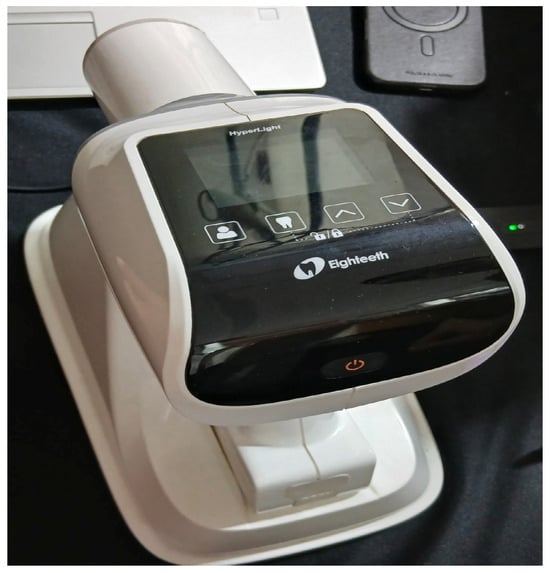
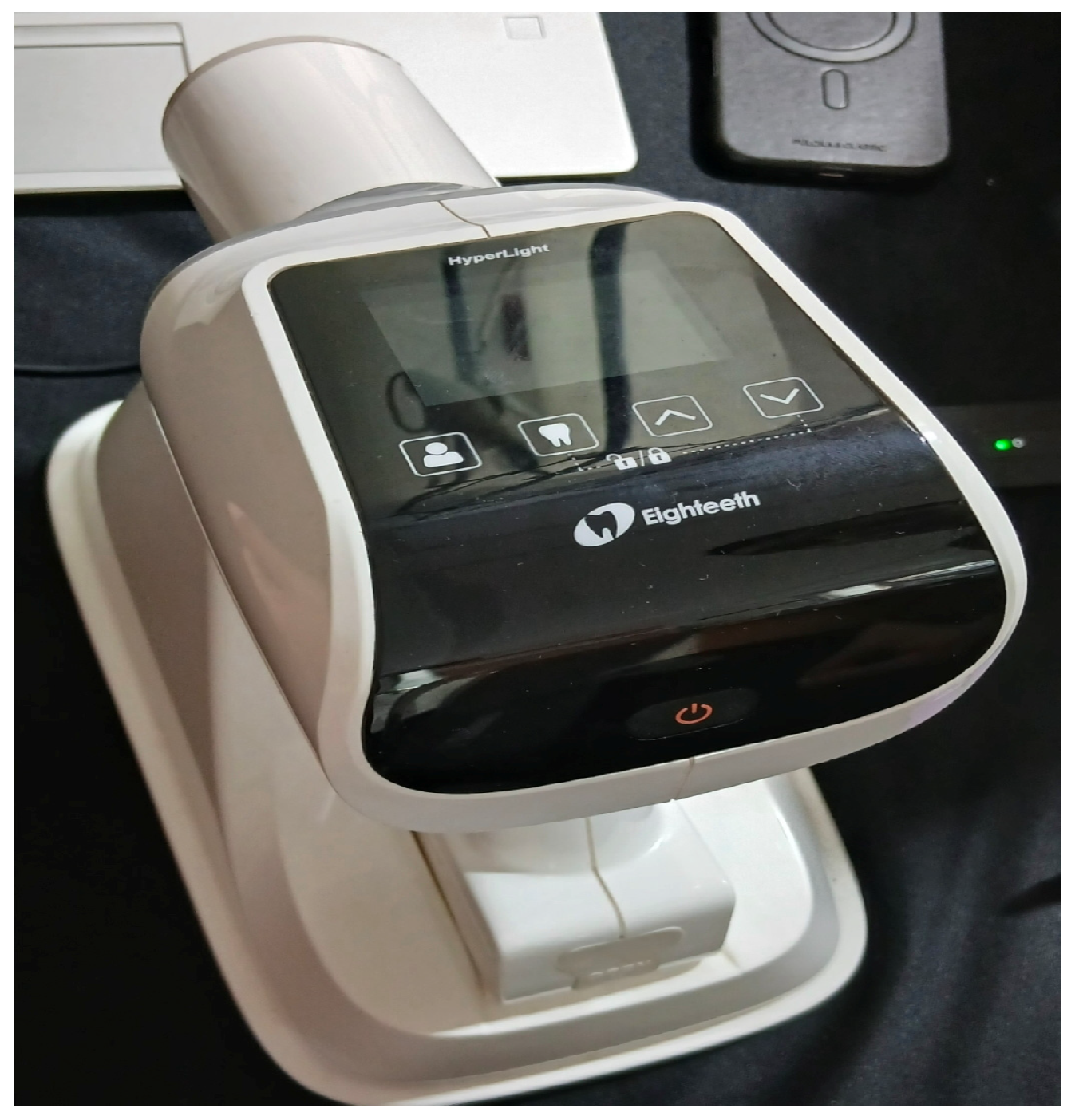
The AI-guided fabrication system utilizes advanced 3D printing techniques for precise construction of customized dental devices. Each component is printed with functional and anatomical optimization, ensuring personalized, efficient, and environmentally sustainable production [6,10]. The functional capabilities of the integrated scanning system are summarized in Table 1 and the physical device is illustrated in Figure 1.
Table 1.
Functional capabilities of the integrated scanning system.
Figure 1.
Integrated intraoral scanner and cone-beam CT system.
3. Results and Discussion
3.1. Customization and Precision Fabrication
The AI-driven 3D scanning and printing system demonstrated significant improvements in customization, precision, and treatment efficiency [5,7]. By integrating high-resolution intraoral scans with patient-specific medical history analysis, the system successfully produced dental implants, prostheses, and orthodontic devices optimized for each patient’s anatomical and physiological characteristics [5]. AI-optimized implant designs ensured superior osseointegration and minimized operative complications, particularly in patients with systemic conditions such as diabetes, osteoporosis, or hypertension. Furthermore, customized dentures and veneers exhibited enhanced occlusal precision, reducing malocclusion and patient discomfort, while AI-guided clear aligners enabled predictable tooth movement, significantly reducing treatment time.
3.2. Role of Nano-Enhanced Materials in Biocompatibility and Durability
Incorporation of nanotechnology-enhanced biomaterials significantly improved mechanical strength, wear resistance, and biocompatibility [3,6]. These advancements resulted in a prolonged lifespan for dental restorations, effectively reducing the frequency of replacements. Additionally, the materials exhibited improved antibacterial properties, lowering the risk of post-treatment infections, and enhanced patient comfort through lighter, more durable, and biologically adaptive properties. The mechanical properties of these nano-enhanced materials, such as compressive and flexural strength, are summarized in Table A1.
3.3. Sustainability and Waste Reduction in Dental Manufacturing
The system’s zero-waste material utilization strategy aligns with global Sustainable Development Goals (SDGs) in healthcare [6,8]. through a closed-loop technical pathway. Excess printing resins and supports are collected, chemically purified, and re-processed into printable filaments or powders. This systematic recycling reduces laboratory chemical waste and optimizes additive manufacturing techniques, significantly lowering energy consumption and environmental impact. Further details regarding the 3D printing parameters and additive manufacturing settings are provided in Table A2.
3.4. Comparative Analysis with Conventional Methods
Compared with traditional dental fabrication techniques, the integrated AI-driven system achieved the following [5,6]:
- A 40% reduction in production time, accelerating treatment delivery.
- A 30% increase in overall precision for implant and prosthetic designs.
- A 50% improvement in patient satisfaction, attributable to the enhanced comfort, durability, and biocompatibility of printed restorations [9,10].
3.5. Discussion and Future Implications
The results confirm that the integration of AI, high-resolution 3D scanning, and nano-enhanced materials can revolutionize modern dental practices by offering personalized, efficient, and sustainable solutions [7,11]. The systematic stages of the integrated patient data acquisition and the AI-driven customization workflow are detailed in Table 2 [1,13]. The system’s ability to analyze patient-specific factors—such as bone density, systemic diseases, and prior dental interventions—and adapt prosthetic and implant designs accordingly represents a major advancement in prosthodontics, implantology, and orthodontics [5,7]. The sustainable manufacturing approach supports eco-friendly healthcare practices, reducing material waste and promoting resource efficiency [6,8].
Table 2.
Integrated patient data acquisition and AI-driven customization workflow.
Future research should focus on the following:
- Long-term clinical trials to validate efficacy and patient outcomes.
- Optimization of AI algorithms for treatment planning and production efficiency.
- Development of advanced biocompatible and sustainable materials to enhance restoration performance and longevity.
The device captures high-resolution 3D data of the entire oral cavity through two primary modalities:
- Intraoral scanning of the full dental arch to obtain detailed surface morphology.
- Cone-beam computed tomography (CBCT) to acquire comprehensive volumetric data on teeth, bone structure, and surrounding oral tissues.
Both datasets are integrated within the AI system to generate precise, patient-specific prosthetic and implant designs.
All four datasets are processed and integrated using the AI-based system. The AI algorithms analyze anatomical and historical data to generate a personalized dental design optimized for functional performance, occlusion, aesthetics, and patient-specific health considerations. The finalized design is transmitted directly to the 3D printer for immediate fabrication of the prosthetic or implant.
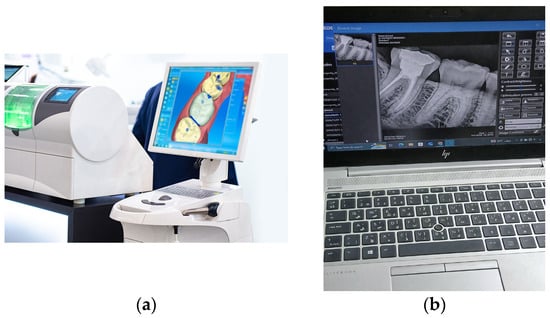
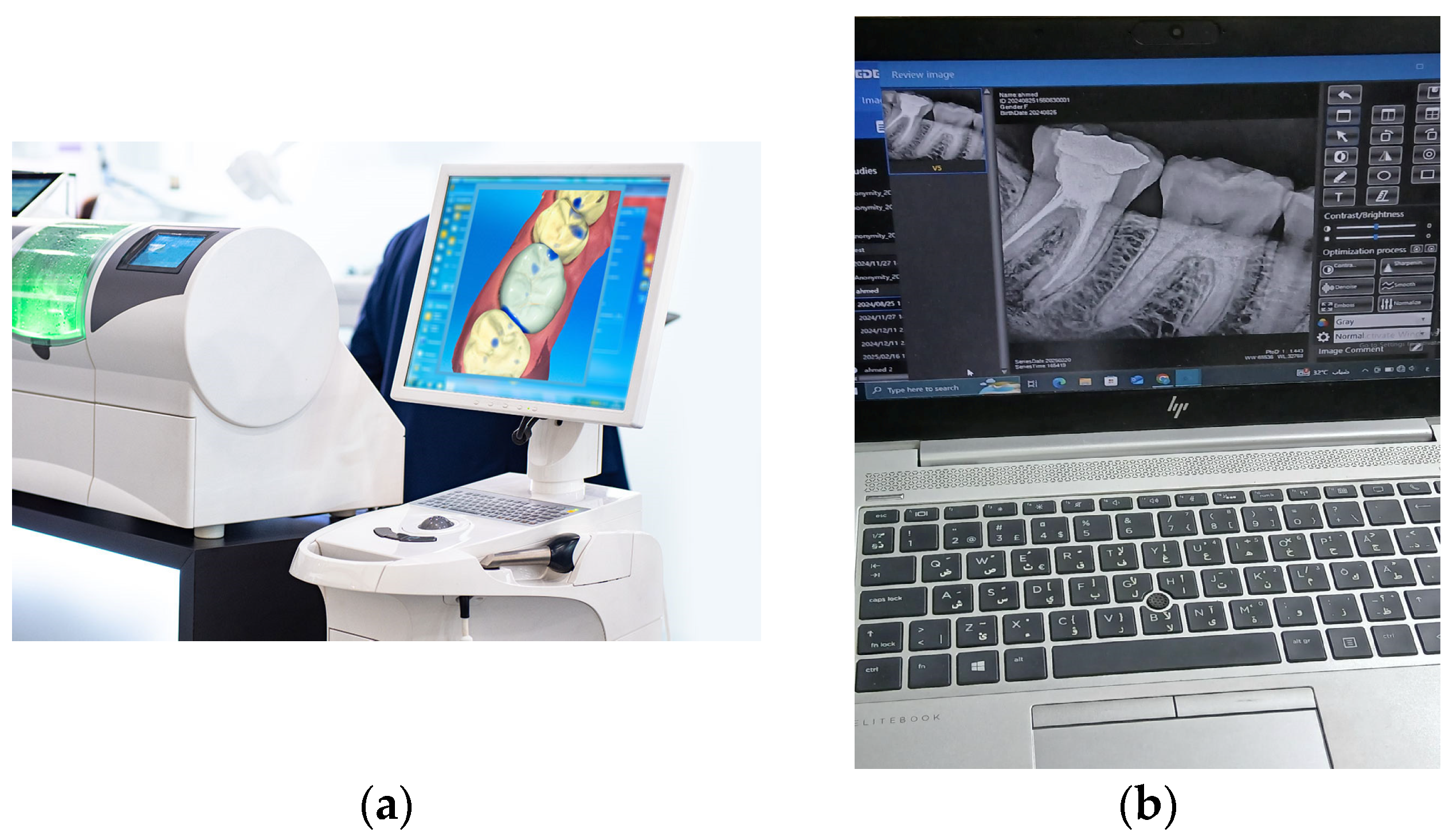
As shown in Figure 2a, the 3D printer fabricates patient-specific prosthetics based on AI-processed data (Figure 2b).
Figure 2.
(a) 3D Printing System for Customized Dental Fabrication: This system is utilized to fabricate patient-specific dental prosthetics, implants, and orthodontic appliances. The device executes AI-driven designs derived from integrated patient datasets, ensuring high precision, anatomical accuracy, and optimal functional suitability. (b) AI-Based Imaging and Analysis System: This diagnostic framework integrates multi-modal patient data, including: (i) cone-beam computed tomography (CBCT) scans for comprehensive oral anatomy and bone structure analysis; (ii) high-resolution intraoral scans for detailed surface morphology; (iii) facial photographs to evaluate smile dynamics and aesthetic parameters; and (iv) comprehensive medical histories to account for systemic conditions and functional requirements.
The workflow demonstrates a fully digital and integrated approach: scanning, imaging, historical data analysis, AI-driven design, and additive manufacturing.
This methodology highlights precision, customization, efficiency, and sustainability, emphasizing global best practices in modern dentistry.
3.6. AI Data Processing and Algorithmic Modeling
The AI-driven system integrates multiple patient-specific data sources—including full-mouth intraoral scans, CBCT images, facial photographs, and medical history records—to generate optimized designs for dental prosthetics, implants, and orthodontic appliances. The algorithms analyze anatomical structures, occlusal relationships, and bone density; predict tooth movement trajectories; and determine the most suitable implant and prosthetic positions. All computations are performed within the system, producing accurate, personalized digital outputs that are immediately ready for 3D printing and clinical application.
4. Conclusions
This study demonstrates that integrating artificial intelligence, high-resolution 3D scanning, and nano-enhanced materials can fundamentally transform modern dentistry by enabling fully personalized, precise, and sustainable treatment solutions The proposed system significantly enhances the accuracy, functionality, and biocompatibility of dental prosthetics, implants, and orthodontic devices, while reducing treatment time and improving patient satisfaction.
Key conclusions include the following:
- Enhanced Customization and Precision: AI-driven workflows enable patient-specific prosthetic and implant designs that accommodate anatomical variations, systemic health conditions, and previous dental treatments.
- Material Innovation: Nano-reinforced biomaterials increase mechanical strength, durability, biocompatibility, and antibacterial performance, resulting in longer-lasting and safer dental restorations.
- Sustainability: The zero-waste material strategy and optimized additive manufacturing promote environmentally responsible dental practices, supporting global sustainability goals.
- Clinical and Operational Efficiency: AI integration and digital fabrication reduce production time, minimize errors, and improve patient satisfaction, representing a paradigm shift in prosthodontics, implantology, and orthodontics.
These findings highlight the transformative potential of AI-assisted, nano-enhanced, and sustainable digital dentistry. Future research should focus on clinical validation, continuous optimization of AI algorithms, and further material advancements to enhance long-term patient outcomes and advance the standard of care in modern dental practice.
Key conclusions include the system’s clinical and operational efficiency: AI integration and digital fabrication achieved a 40% reduction in production time compared to traditional methods, accelerating treatment delivery and improving patient satisfaction.
Funding
This research received no external funding.
Institutional Review Board Statement
Not applicable.
Informed Consent Statement
Not applicable.
Data Availability Statement
The original contributions presented in this study are included in the article. Further inquiries can be directed to the corresponding author.
Conflicts of Interest
The author declares no conflicts of interest.
Abbreviations
The following abbreviations are used in this manuscript:
| AI | Artificial Intelligence |
| 3D | Three-Dimensional |
| SDGs | Sustainable Development Goals |
| CAD | Computer-Aided Design |
| CBCT | Cone-Beam Computed Tomography |
| CNNs | Convolutional Neural Networks |
Appendix A. Mechanical Properties of Nano-Enhanced Dental Materials
Table A1.
Compressive and flexural strength of the nano-enhanced materials used in this study.
Appendix B. Additional Data on Additive Manufacturing Parameters
Table A2.
The 3D printing parameters for dental prosthetic fabrication.
References
- Jana, A.; Subhash, H.M.; Metaxas, D. Automatic Tooth Segmentation from 3D Dental Model using Deep Learning. arXiv 2022, arXiv:2209.08132. [Google Scholar] [CrossRef] [Scilit]
- Keerthana, M.S.; Uma, G.; Sowmmiya, U. A study of a solar PV and wind-based residential DC NanoGrid system under islanded/interconnected/grid-tied modes with dual storage energy. Int. J. Electr. Power Energy Syst. 2022, 143, 108473. [Google Scholar] [CrossRef] [Scilit]
- Ferracane, J.L. Resin composites: State-of-the-art. Dent. Mater. 2011, 27, 29–38. [Google Scholar] [CrossRef] [Scilit] [PubMed]
- Bayne, S.C. Dental biomaterials: Where are we and where are we going? J. Dent. Res. 2005, 84, 987–993. [Google Scholar] [CrossRef] [Scilit]
- Meyers, M.A.; Chen, P.-Y.; Lin, A.Y.-M.; Seki, Y. Mechanical and Biological properties of dental materials. Prog. Mater. Sci. 2008, 53, 1–206. [Google Scholar] [CrossRef] [Scilit]
- Revilla-León, M.; Özcan, M. Additive Manufacturing Technologies Used for Processing Polymers: Current Status and Potential Application in Prosthetic Dentistry. J. Prosthodont. 2019, 28, 128–146. [Google Scholar] [CrossRef] [Scilit] [PubMed]
- Chen, Y.; Wei, J. Application of 3D Printing Technology in Dentistry: A Review. Polymers 2025, 17, 886. [Google Scholar] [CrossRef] [Scilit] [PubMed]
- Monalisa, S.; Alipuor, M.; Paul, D.; Rahman, M.A.; Siddika, N.; Apu, E.H.; Mostafiz, R.B. Transforming Dental Care, Practice and Education with Additive Manufacturing and 3D Printing: Innovations in Materials, Technologies, and Future Pathways. Dent. J. 2025, 13, 555. [Google Scholar] [CrossRef] [Scilit] [PubMed]
- Tichá, D.; Tomášik, J.; Oravcová, Ľ.; Thurzo, A. Three-Dimensionally-Printed Polymer and Composite Materials for Dental Applications with Focus on Orthodontics. Polymers 2024, 16, 3151. [Google Scholar] [CrossRef] [Scilit] [PubMed]
- Dawood, A. 3D Printing in Oral Health Science: Applications and Future Directions. Br. Dent. J. 2025, 239, 243. [Google Scholar] [CrossRef] [Scilit] [PubMed]
- Liang, Z.; Liao, X.; Zong, H.; Zeng, X.; Liu, H.; Wu, C.; Keremane, K.; Poudel, B.; Yin, J.; Wang, K.; et al. Pioneering the future of dentistry: AI-driven 3D bioprinting for next-generation clinical applications. Transl. Dent. Res. 2025, 1, 100005. [Google Scholar] [CrossRef] [Scilit]
- Hao, J.; Liu, J.; Li, J.; Pan, W.; Chen, R.; Xiong, H.; Sun, K.; Lin, H.; Liu, W.; Ding, W.; et al. AI-enabled Automatic Multimodal Fusion of Cone-Beam CT and Intraoral Scans for Intelligent 3D Tooth-Bone Reconstruction and Clinical Applications. arXiv 2022, arXiv:2203.05784. [Google Scholar]
- Zhang, G.; Li, J.; Li, J.; Zhou, X.; Xie, J.; Wang, A. Selective Laser Melting Molding of Individualized Femur Implant: Design, Process, Optimization. J. Biomim. Eng. Engl. Ed. 2021, 18, 10. [Google Scholar] [CrossRef] [Scilit]

Disclaimer/Publisher’s Note: The statements, opinions and data contained in all publications are solely those of the individual author(s) and contributor(s) and not of MDPI and/or the editor(s). MDPI and/or the editor(s) disclaim responsibility for any injury to people or property resulting from any ideas, methods, instructions or products referred to in the content. |
© 2026 by the author. Licensee MDPI, Basel, Switzerland. This article is an open access article distributed under the terms and conditions of the Creative Commons Attribution (CC BY) license.