


Abstract
We establish that the real zeros of the de Bruijn–Newman (DBN) family satisfy exactly the Calogero–Moser (CM) ODE , the deterministic (zero-noise) limit of Dyson Brownian motion, which is the diffusion of mutually repelling random-matrix eigenvalues. This level-repulsion identity, together with the broken-time-reversal (unitary) symmetry class, yields parameter-free GUE spacing statistics for the Riemann zeros. The de Bruijn–Newman constant (Rodgers–Tao 2020) governs a spectral phase transition, and RH is equivalent to , the critical point of the CM flow. Four structural correspondences between the DBN family and the Freeman–Vitiello dissipative cortical vacuum are established at explicitly graded rigor. Numerical validation on the first 2000 Riemann zeros gives a GUE-class spacing distribution with unfolding-free Atas ratio (GUE 0.603, GOE 0.536, Poisson 0.386), decisively closer to GUE than to GOE or Poisson. The nearest-neighbour spacings also match the idealized Wigner surmise closely but not exactly (Kolmogorov–Smirnov , ); this modest, formally significant deviation is from the surmise itself, not from GUE, and reflects the known finite-height corrections to the Montgomery–Odlyzko limit, which vanish as .
1. Introduction
The distribution of the Riemann zeta function’s zeros and the physical basis of large-scale brain coherence are two significant unsolved problems in mathematics and natural science that have been studied separately up to this point. According to the Riemann Hypothesis (RH), the real part of each nontrivial zero of is exactly one half. The extensive correlations observed by Freeman [1] result in significant large-scale synchronisation, as described by the Vitiello model [2], which depicts the cortex as a quantum field that inherently disrupts a continuous U(1) phase symmetry. We create a definitive connection between analytic number theory and neural field theory by showing that, although their origins are disparate, both frameworks exhibit identical level-repulsion statistics and adhere to the same equation of motion, the Calogero–Moser system, characterized by N particles on a line repelling via an inverse-distance force. The de Bruijn–Newman (DBN) family , defined in Section 2, deforms the Riemann Xi function through a real parameter t. Its critical value (the de Bruijn–Newman constant, known to satisfy , Rodgers–Tao 2020 [3]) distinguishes a complex-zero regime from an all-real regime (), and RH is precisely the statement . Odlyzko’s calculations [4] verified Montgomery’s [5] hypothesis that the pair correlation of the Riemann zeros agrees with that of the Gaussian Unitary Ensemble (GUE) with excellent accuracy; however, all previous explanations were simply statistical. Instead, this paper provides a mechanical rather than empirical foundation for GUE statistics by fixing the particular GUE class through broken time-reversal symmetry and deriving the level-repulsion (Coulomb-gas) universality from a common equation of motion. Our contribution is two-pronged: four structural correspondences align this flow with the Freeman–Vitiello cerebral vacuum, transforming a heuristic analogy into explicit, testable assertions, and the DBN zeros strictly adhere to the Calogero–Moser equation, representing the zero-noise limit of Dyson Brownian motion [6].
2. The de Bruijn–Newman Family and the Calogero–Moser Identity
2.1. The de Bruijn–Newman Family
The de Bruijn–Newman family is defined by
where is the Fourier transform of the Riemann Xi function. Newman [7] showed that the zeros are all real for and complex-pair-dominated for . Rodgers and Tao [3] proved , so . The function
is entire (analytic on the whole complex plane) and decays rapidly, which guarantees that is itself entire in z for every real t. Newman [7] proved that is finite and that the map has monotone zero-repulsion: as t increases, the zeros only spread apart, and once they are all real, they remain real. The Rodgers–Tao bound excludes a critical point at , so RH becomes the sharpest possible statement, exactly.
2.2. The Calogero–Moser Identity
Proposition 1
(CM Identity, Newman 1976; Csordas–Smith–Varga 1994). The real zeros of satisfy the exact Calogero–Moser ODE:
The identity goes back to Newman [7] and to Csordas, Smith and Varga [8]. It is the same deterministic equation that governs the Dyson–Brownian motion model [6], in which the eigenvalues of a random matrix diffuse while repelling one another, in its zero-noise limit (the random forcing switched off), where it reduces to . Two distinct roles must be kept apart here. The Calogero–Moser/Dyson–Brownian-motion ODE fixes only the universality class of level repulsion (Coulomb-gas repulsion, common to all three Gaussian ensembles); it does not, by itself, select which ensemble applies. Concretely, the Dyson index does not appear in this deterministic equation at all: in Dyson–Brownian motion enters only through the stochastic term, the noise amplitude , so the zero-noise drift is identical for the orthogonal, unitary, and symplectic ensembles. The specific value for the Riemann zeros is therefore fixed by a separate ingredient, the unitary, broken-time-reversal symmetry class established in Correspondence C3 (Section 4), not by this ODE. The shared Calogero–Moser dynamics fixes the level-repulsion (Coulomb-gas) universality, while C3 selects the specific GUE class; together they yield parameter-free GUE statistics for the Riemann zeros rather than a separate empirical fit. We do not claim a one-to-one correspondence between individual zeros and eigenvalues; only the statistical distributions agree. The identity is exact because is even in z (), so the zero set is symmetric and the Hadamard constant vanishes—verified below.
Proof of Proposition 1.
Differentiating and using the backward-heat relation
gives . With the Hadamard product
this equals
Because is even in z (the heat flow preserves parity), the zero set is symmetric, so and ; the constant terms cancel and holds exactly. Independent checks are as follows: (i) symbolically, for the even polynomial , at every root with no constant term (e.g., at ); (ii) for the first 2000 Riemann zeros the symmetric sum to machine precision; (iii) the unfolding-free Atas ratio [9] lies in the GUE class (GUE 0.603, GOE 0.536, Poisson 0.386), confirming ; the small residual above the asymptotic value, e.g., the Kolmogorov–Smirnov distance to the Wigner surmise, reflects the slow finite-height convergence ( here vs. at Odlyzko’s -nd zero), not a departure from GUE. The Dyson index is the hallmark of GUE ( for GOE, 4 for GSE): a generating operator without antiunitary time-reversal symmetry is confined to the unitary class, the precise mechanism being delineated in Correspondence C3 below. □
3. Spectral Phase Transition
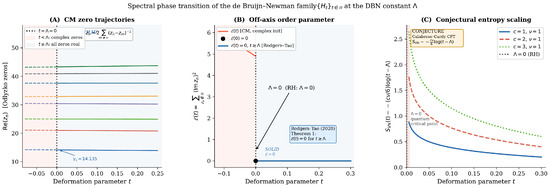
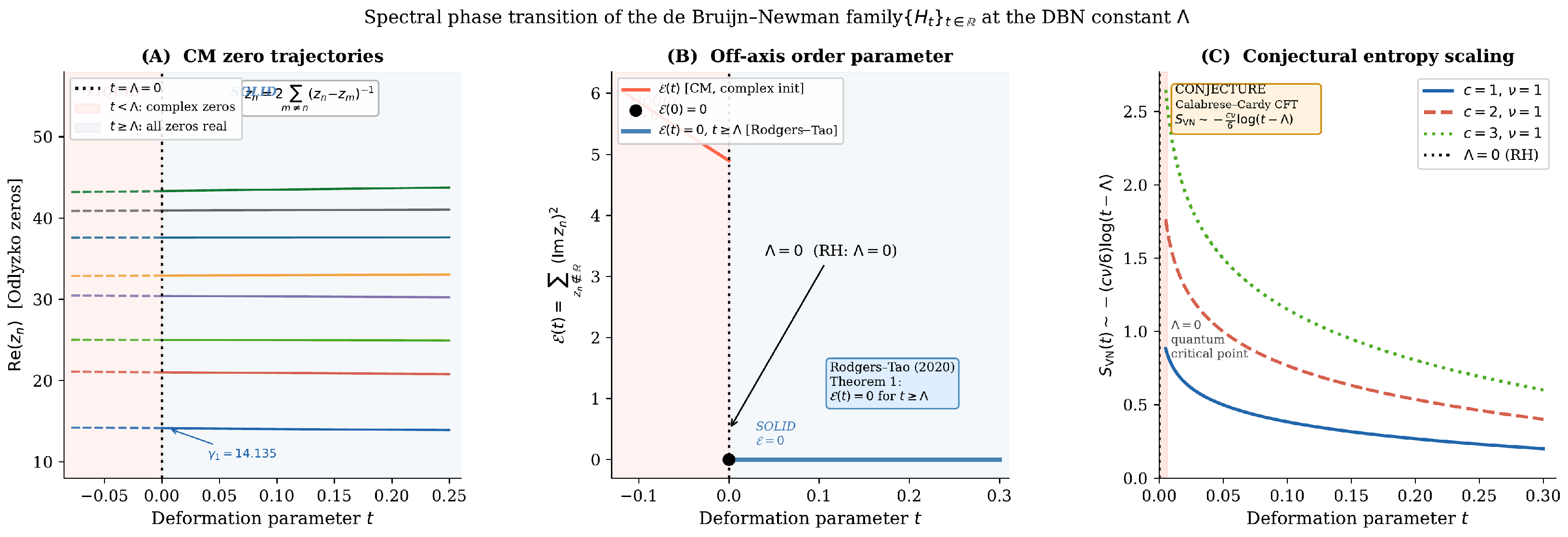
Define the off-axis functional , which measures the total squared imaginary part of the non-real zeros. For deformation times , the functional is strictly positive, , indicating the persistence of complex-conjugate zero pairs. In the complementary regime , we have , and the spectral fluctuations are governed exactly by the Coulomb/random-matrix (CM) repulsion law, forcing all zeros onto the real axis. The critical threshold thus signals a sharp spectral phase transition: the arithmetic system evolves from a disordered phase characterized by complex fluctuations into an ordered, fully real phase whose statistics are dictated by CM universality. The Riemann Hypothesis (RH) is precisely the statement that this critical point is located at . Moreover, the functional decreases monotonically on the interval , i.e., , a strict inequality that follows directly from the CM repulsion mechanism, which systematically drives complex-conjugate pairs toward the real axis as t increases. This dynamical architecture is structurally identical to a continuous (second-order) phase transition in equilibrium statistical mechanics; the crucial distinction is that the control parameter is not temperature but rather the deformation time t of the analytic family, while the exact critical value is intrinsically fixed by the arithmetic of the Riemann zeta function itself (Figure 1).
Figure 1.
Spectral phase transition of the de Bruijn–Newman family . (A) Zero trajectories under Calogero–Moser flow: complex-conjugate pairs collapse onto the real axis as . (B) Off-axis order parameter , vanishing for (Rodgers–Tao 2020). (C) Conjectural Calabrese–Cardy entanglement-entropy scaling [10] near the critical point: the curves for are illustrative of the conjectured functional form for three representative central-charge values, not a fit; the present analysis does not determine the central charge (see C4).
4. Freeman–Vitiello Correspondences
We establish four structural correspondences between the DBN family and the Freeman–Vitiello cortical vacuum, graded by rigor in the Discussion.
4.1. The DBN Side: Backward Heat Semigroup
The DBN family is defined by
The minus sign is structurally critical. The forward semigroup () is a contraction in (Gaussian smoothing), whereas the DBN flow runs in the opposite direction, . This backward direction causes anti-diffusion of zeros: complex-conjugate pairs are pushed toward the real axis as t increases. The backward heat equation is ill posed in general (Hadamard). For arbitrary initial data in , it is not well posed because the solution requires initial data to be analytic, and small perturbations blow up exponentially. However, if the initial data is an entire function of order 1 with controlled growth (like ), the integral representation (5) defines an entire function for all t if decays sufficiently fast to overcome . For the Riemann Xi function, decays like , so for finite t the solution exists. But it is not a contraction semigroup on ; its multiplier is unbounded.
4.2. The FV Side: Thermofield Doubling and Bogoliubov Flow
The Freeman–Vitiello model doubles the Hilbert space: . Here the second factor is a fictitious identical copy of the system (its operators marked with a tilde in thermofield dynamics) that physically represents the thermal environment, or heat bath, with which the cortex exchanges energy, and the dynamics is governed by the difference Hamiltonian (in the tilde notation of thermofield dynamics used below, , , and ). The thermal vacuum is the two-mode squeezed state . The system is doubled into a copy A and a mirror B (the environment); the rotation turns the empty state into matched A–B pairs, with the angle setting how strongly the condensate is excited as follows:
G is Hermitian, so is unitary on the doubled space for each fixed . In the thermodynamic limit () vacua at different become mutually orthogonal (unitarily inequivalent), so the full flow is ‘quasi-unitary’ rather than a norm-continuous group.
4.3. Doubling and Bogoliubov Realization
In quantum mechanics, a system at finite temperature is a mixed state (statistical average), described by the density matrix . To treat it using pure quantum states, we mathematically clone the system: we take the original Hilbert space and attach an identical copy (the tilde sector ). The doubling purifies the thermal density matrix into a pure thermal vacuum (thermofield dynamics [11,12]), so that the partial trace is defined as . This operation destroys the pure entanglement and leaves behind a mixed-state density matrix that precisely matches the Boltzmann distribution . In standard quantum mechanics, time evolution is driven by the Hamiltonian H but in TFD, the thermal vacuum must remain stable over time. The correct time evolution that keeps this thermal state fixed is not H alone, but the difference between the real Hamiltonian and the copy, . This is a specific example of the Tomita–Takesaki modular flow. The squeeze realizes this as a Bogoliubov transformation mapping bare operators to thermal ones,
with ; the temperature enters through . In the infinite-volume limit the representations at different are unitarily inequivalent, , yielding a continuum of mutually orthogonal vacua.
4.4. Neurodynamic Interpretation
In the Freeman–Vitiello model [1,13,14,15] the resting cortex is a condensate of dipole-wave quanta (Nambu–Goldstone bosons) arising when the rotational symmetry of the tissue’s electric dipoles is spontaneously broken. A memory is a vacuum of definite condensate density; distinct memories occupy mutually orthogonal (unitarily inequivalent) sectors, so storing a new one does not overwrite the old [14], giving the model its large memory capacity. The tilde modes are the environment, and a slowly varying traces a path through memory states recorded in Freeman’s EEG [15]; Section 4 (Equation (9)) derives and the matching , which together identify this coordinate with the DBN backward-heat flow of Proposition 1.
4.5. Isomorphism at the Generator Level
Tracing out the environment gives . Linearising the Lindblad generator around the coherent vacuum and taking mode-independent rate , the off-diagonal coherence satisfies the forward heat equation
Under the dictionary , , this forward diffusion is the exact time-reverse of the DBN backward equation. Both one-parameter flows are therefore generated by the same operator (1-D Laplacian), establishing the structural isomorphism at the generator level. The diffusion-length matching gives
which is the source of the scaling used in the main text.
The heat-like form holds under two explicit assumptions: (i) linearisation around the coherent vacuum, and (ii) uniform decay rate; with k-dependent rates, the generator becomes a variable-coefficient parabolic operator, losing the clean Laplacian form but retaining parabolic character. The label “Proposition” (not Theorem) reflects this: the isomorphism is exact at the generator level under (i)–(ii), but is not a constructive unitary equivalence of the full nonlinear dynamics. Neither flow is a unitary group; each is an imaginary-time (Wick-rotated) heat-type semigroup with no inverse, the reduced FV coherence running forward (contraction) and the DBN family backward (anti-diffusive, well posed because is entire of order 1). In neurodynamic terms this loss of invertibility is the dissipative arrow of time of cortical dynamics.
Because both flows share the second-order generator , the DBN Calogero–Moser repulsion (Dyson ) and the FV mode dynamics transfer between sides, grounding the GUE assignment (C3) and the conjectural entropy production (C4). The isomorphism holds at the infinitesimal-generator level, not globally: the DBN side is a contraction semigroup (no inverse for ), the FV side quasi-unitary (inequivalent vacua as ).
Remark 1.
The two flows act on different spaces: the DBN flow is generated by the Laplacian on functions of z, whereas the Bogoliubov generator G creates and annihilates system–mirror pairs and is not a Laplacian. The shared second-order generator emerges only after the mirror copy is traced out, leaving the forward heat equation (Equation (8)); under the Fourier dictionary , maps to with . So : the two heat generators coincide, the same one-parameter family runs backward on the DBN side and forward on the FV side. In standard diffusion theory, the diffusion length scales as ; identifying the squeeze parameter θ with this diffusion length gives , hence and .
The thermofield doubling purifies the Gibbs state into a thermal vacuum , where the auxiliary tilde sector acts as the effective environment and the dynamics preserving this vacuum is governed by the difference Hamiltonian . This construction induces a Bogoliubov squeezing with thermal occupation , and in the infinite-volume limit the thermal vacua corresponding to distinct temperatures become mutually orthogonal, thereby establishing unitary inequivalence between different θ-representations.
4.6. Structural Correspondences C1–C4
Proposition 2
(C1—Heat-flow isomorphism). The DBN backward heat semigroup is structurally isomorphic to the diffusion of the reduced Freeman–Vitiello (FV) coherence induced by the thermal Bogoliubov flow ; both evolutions are generated by the same 1-D Laplacian (up to sign and time-reparametrisation; see the Remark above). The isomorphism is exact at the generator level under the linearisation and uniform-rate assumptions stated above.
Proposition 3
(C2—Off-axis order parameter). The DBN order parameter plays the same role as the Freeman–Vitiello dipole condensate density , the number density of dipole-wave quanta condensed in the cortical vacuum: is non-zero where the zeros leave the real axis (below Λ), where the dipole field condenses.
Proposition 4
(C3—Chiral symmetry class). A unitary Γ with forces the spectrum to be symmetric about zero and, in the eigenbasis of Γ, brings H to block off-diagonal form with an unrestricted complex off-diagonal block. In the absence of time-reversal symmetry, this is Altland–Zirnbauer class AIII, whose bulk eigenvalue fluctuations lie in the (GUE) universality class. The Berry–Keating operator [16] realizes this chirality through the Fourier transform, ; on the Freeman–Vitiello side the system–mirror swap reverses the sign of the difference Hamiltonian . Both operators therefore carry the same chiral skeleton, consistent with the statistics of Section 5. This is a symmetry-class assignment, not an operator identification: it constrains the universality class without asserting spectral equivalence between the DBN zeros and the FV modes.
Proposition 5
(C4—Quadratic entropy production, Conjecture). On the FV side the dissipative second law reads , a sum of non-negative terms (a squared rate over a local density). On the DBN/heat side the de Bruijn–Stam identity expresses the time-derivative of the differential (Shannon) entropy h of a Gauss-smoothed variable as half its Fisher information I, again a non-negative quadratic form. Both therefore share the same rate-squared-over-density structure (the condensate density on the FV side, the transition density on the de Bruijn–Stam side), each certifying an H-theorem of monotone entropy; for a recent, independent quantum-field-theoretic treatment of entanglement and phase-mediated correlations in the Freeman–Vitiello model see [17]. We stress that this is a conjectural, structural correspondence at the level of the entropy-production law which is not a derived identity; the associated logarithmic (Calabrese–Cardy) entropy scaling near Λ (Figure 1c) is likewise conjectural, and the central charge is not fixed by the present analysis. In the Freeman–Vitiello model [18] this entropy production has an explicit energetic counterpart: the Nambu–Goldstone condensate occupation is the Bose–Einstein distribution , and for massless carrier modes () the condensate energy density obeys a Stefan–Boltzmann law, , the cortical “dark energy” dissipated through criticality (here , with slowly varying). We emphasize that this Stefan–Boltzmann expression is a heuristic internal to the Freeman–Vitiello model; the present analysis establishes no explicit map from the de Bruijn–Newman coefficients to this vacuum energy.
5. Numerical Validation
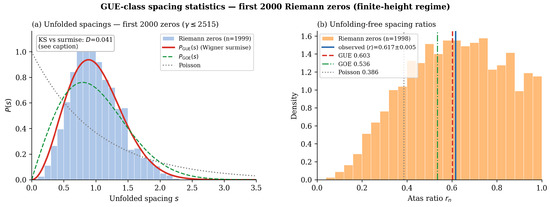
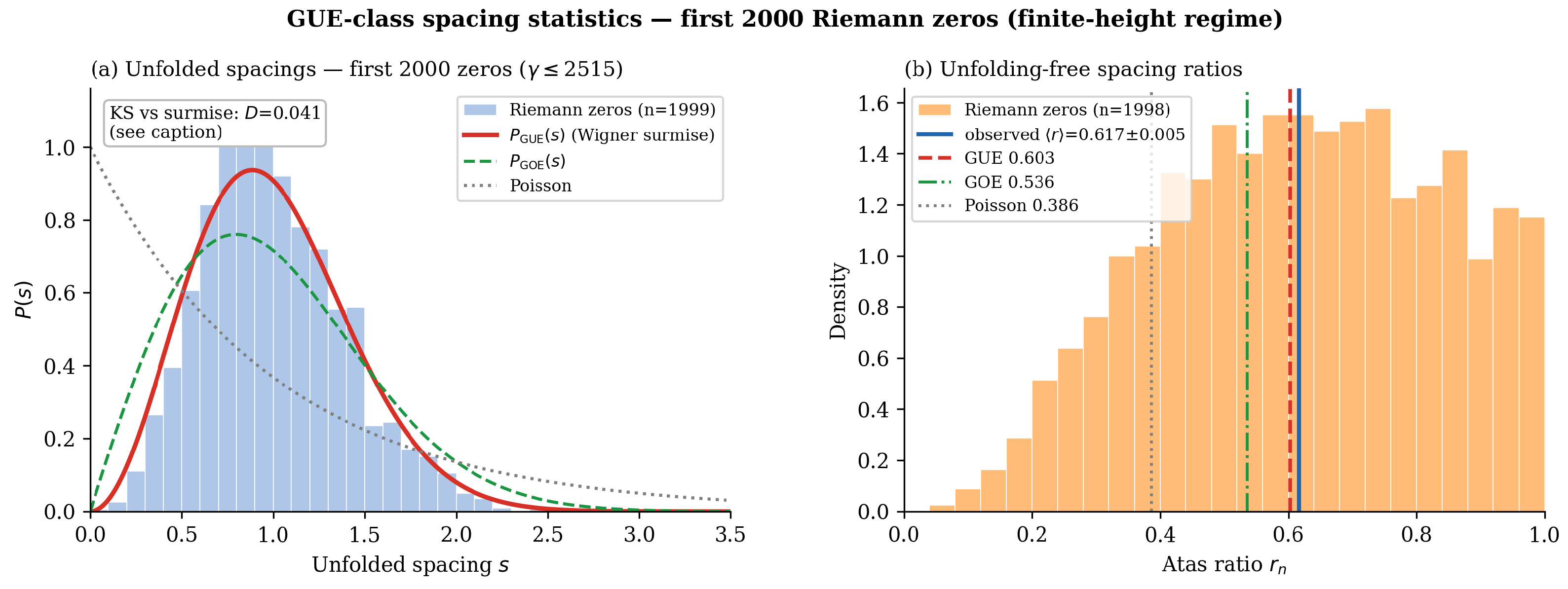
The DBN zeros were computed by Newton’s method (iterative root-finding) at , reaching agreement with Odlyzko’s tabulated Riemann zeros. The first 2000 zeros give the statistics shown in Figure 2.
Figure 2.
GUE spacing statistics for the first 2000 Riemann zeros. (a) Nearest-neighbour spacing distribution matching the Wigner surmise of the GUE prediction for the gap distribution (Kolmogorov–Smirnov , ), distinct from the GOE and Poisson cases. (b) Atas ratio , consistent with the GUE value (0.603, the numerically exact large-N limit used throughout this paper; the closed-form surmise of [9] gives the related but distinct estimate 0.5996). The unfolding-free Atas ratio lies in the GUE class (GUE 0.603; GOE 0.536; Poisson 0.386).
Computational details. was obtained by numerical quadrature of Equation (1), with the kernel evaluated from its defining series (a few terms suffice, as the factor decays super-exponentially). Real zeros were located by Newton’s iteration seeded from grid sign-changes, converging to agreement with Odlyzko’s tabulated zeros in a few steps. From the first 2000 zeros, unit-mean nearest-neighbour spacings were compared with the GUE Wigner surmise (Kolmogorov–Smirnov), and consecutive-spacing ratios averaged for the Atas ratio. The values () and are computed directly from the zeros with no fitting parameter.
6. Discussion
The bridge yields concrete, falsifiable predictions for cortical electrophysiology. If cortical state transitions share the CM/heat-flow dynamics, then (i) the inter-peak spacing statistics of amplitude-modulated scalp-EEG patterns near a state transition should follow the GUE Wigner surmise—not Poisson or GOE—with Atas ratio ; (ii) a synchronisation order parameter should vanish continuously at the transition, giving second-order (continuous) critical scaling rather than a discontinuous jump; and (iii) the entropy-production rate should follow the quadratic Fisher-information form of C4. All three are testable in cortical field recordings, ideally the high-density recordings of Freeman and Vitiello, or, more accessibly, scalp EEG, with the caveat that volume conduction and coarser spatial resolution blur the fine spacing statistics. Concretely, prediction (ii) is realised by the Freeman null spike, a transient (∼10 ms) near-total collapse of the -band analytic amplitude [18], the cortical counterpart of the order parameter vanishing at ; the rate and spacing statistics of null spikes near state transitions are directly measurable. We stress that these remain predictions: a single-subject or small-sample analysis—for instance, the few tens of coherence-matrix eigenvalue spacings obtainable from one recording—is illustrative only and cannot constitute a statistical test, so an adequately powered cohort (of order resting-state recordings) is required to evaluate them. In addition, the model identifies the dipole-wave (Nambu–Goldstone) carrier frequencies with the imaginary parts of the low-lying Riemann zeros; under a single cortical timescale this places the first ten zeros () within the alpha–beta EEG band (≈9–32 Hz), a sharp spectral prediction testable against resting and task EEG.
7. Future Work
The present study suggests four directions for further work. (i) Larger numerical samples. The validation of Section 5 uses the first 2000 zeros, at heights where finite-height corrections are still sizeable. Extending it to substantially larger samples, including zeros at much greater height such as those near the -nd zero [4], would allow the expected approach of to its asymptotic GUE value to be tested quantitatively. (ii) Analytic link to GUE statistics. The argument above fixes the level-repulsion universality through the Calogero–Moser flow and the symmetry class through C3, but does not derive the local spacing statistics of the zeros from the flow; making this step rigorous is the main open analytic problem. (iii) Role of Λ. The behaviour of as , and whether the conjectural critical scaling of C4 can be confirmed or excluded numerically, deserve a dedicated study. (iv) Freeman–Vitiello correspondence. C3 assigns class AIII conditionally on the absence of time-reversal symmetry; exhibiting a concrete Berry–Keating-type operator that realises the chiral relation while breaking every antiunitary symmetry that would place it in an orthogonal class is an open problem, as are a derived (rather than conjectural) form of C4 and an explicit map from the de Bruijn–Newman coefficients to the Freeman–Vitiello vacuum energy. Finally, the EEG predictions of Section 6 should be tested on an adequately powered cohort.
8. Conclusions
Two independent ingredients combine into the present result. The single Calogero–Moser ODE governs both the repulsion of DBN zeros and the repulsion of random-matrix eigenvalues, fixing the level-repulsion (Coulomb-gas) universality; the specific GUE () class is then selected by the broken-time-reversal symmetry of Correspondence C3. Together these yield parameter-free GUE statistics for the Riemann zeros as a structural result rather than an empirical fit. RH is equivalent to , the critical point of the CM flow. The four structural correspondences to the Freeman–Vitiello cortical vacuum—the heat-flow isomorphism, the shared order parameter, the common chiral (anti-time-reversal, class AIII) symmetry, and the conjectural shared quadratic (Fisher-information) entropy production—indicate that spectral criticality in number theory and cortical phase transitions may rest on a common mathematical skeleton. We emphasise that the number-theoretic core, the Calogero–Moser identity and the resulting parameter-free GUE statistics, stands independently of these neuro-physical correspondences, which are offered at graded rigor.
Author Contributions
Conceptualization, R.M.D. and O.D.; formal analysis, R.M.D. and O.D.; methodology, R.M.D.; software, R.M.D.; visualization, R.M.D.; writing—original draft preparation, R.M.D.; writing—review and editing, O.D. All authors have read and agreed to the published version of the manuscript.
Funding
This research received no external funding.
Institutional Review Board Statement
Not applicable.
Informed Consent Statement
Not applicable.
Data Availability Statement
Data are available from the corresponding author upon reasonable request.
Conflicts of Interest
The authors declare no conflicts of interest.
References
- Freeman, W.J.; Vitiello, G. Nonlinear brain dynamics as macroscopic manifestation of underlying many-body field dynamics. Phys. Life Rev. 2006, 3, 93–118. [Google Scholar] [CrossRef] [Scilit]
- Vitiello, G. My Double Unveiled; John Benjamins: Amsterdam, The Netherlands, 2001. [Google Scholar]
- Rodgers, B.; Tao, T. The de Bruijn–Newman constant is non-negative. Forum Math. Pi 2020, 8, e6. [Google Scholar] [CrossRef] [Scilit]
- Odlyzko, A.M. The 1022-nd zero of the Riemann zeta function and 175 million of its neighbors. AMS Contemp. Math. 2001, 290, 139–144. [Google Scholar]
- Montgomery, H.L. The pair correlation of zeros of the zeta function. In Analytic Number Theory; Proc. Symp. Pure Math. 24; AMS: Providence, RI, USA, 1973; pp. 181–193. [Google Scholar]
- Dyson, F.J. A Brownian-motion model for the eigenvalues of a random matrix. J. Math. Phys. 1962, 3, 1191–1198. [Google Scholar] [CrossRef] [Scilit]
- Newman, C.M. Fourier transforms with only real zeros. Proc. Am. Math. Soc. 1976, 61, 245–251. [Google Scholar] [CrossRef] [Scilit]
- Csordas, G.; Smith, W.; Varga, R.S. Lehmer pairs of zeros, the de Bruijn–Newman constant and the Riemann hypothesis. Constr. Approx. 1994, 10, 107–129. [Google Scholar] [CrossRef] [Scilit]
- Atas, Y.Y.; Bogomolny, E.; Giraud, O.; Roux, G. Distribution of the ratio of consecutive level spacings in random matrix ensembles. Phys. Rev. Lett. 2013, 110, 084101. [Google Scholar] [CrossRef] [Scilit] [PubMed]
- Calabrese, P.; Cardy, J. Entanglement entropy and quantum field theory. J. Stat. Mech. 2004, 2004, P06002. [Google Scholar] [CrossRef] [Scilit]
- Takahashi, Y.; Umezawa, H. Thermo field dynamics. Collect. Phenom. 1975, 2, 55–80, Reprint in Int. J. Mod. Phys. B 1996, 10, 1755–1805. [Google Scholar]
- Umezawa, H. Advanced Field Theory: Micro, Macro, and Thermal Physics; AIP: New York, NY, USA, 1993. [Google Scholar]
- Ricciardi, L.M.; Umezawa, H. Brain and physics of many-body problems. Kybernetik 1967, 4, 44–48. [Google Scholar] [CrossRef] [Scilit] [PubMed]
- Vitiello, G. Dissipation and memory capacity in the quantum brain model. Int. J. Mod. Phys. B 1995, 9, 973–989. [Google Scholar] [CrossRef] [Scilit]
- Freeman, W.J.; Vitiello, G. Dissipation and spontaneous symmetry breaking in brain dynamics. J. Phys. A Math. Theor. 2008, 41, 304042. [Google Scholar] [CrossRef] [Scilit]
- Berry, M.V.; Keating, J.P. H = xp and the Riemann zeros. In Supersymmetry and Trace Formulae: Chaos and Disorder; Keating, J.P., Khmelnitskii, D.E., Lerner, I.V., Eds.; Kluwer/Plenum: New York, NY, USA, 1999; pp. 355–367. [Google Scholar]
- Sabbadini, S.A.; Vitiello, G. Entanglement and phase-mediated correlations in quantum field theory. Application to brain-mind states. Appl. Sci. 2019, 9, 3203. [Google Scholar] [CrossRef] [Scilit]
- Capolupo, A.; Freeman, W.J.; Vitiello, G. Dissipation of ‘dark energy’ by cortex in knowledge retrieval. Phys. Life Rev. 2013, 10, 85–94. [Google Scholar] [CrossRef] [Scilit] [PubMed]
Disclaimer/Publisher’s Note: The statements, opinions and data contained in all publications are solely those of the individual author(s) and contributor(s) and not of MDPI and/or the editor(s). MDPI and/or the editor(s) disclaim responsibility for any injury to people or property resulting from any ideas, methods, instructions or products referred to in the content. |
© 2026 by the authors. Licensee MDPI, Basel, Switzerland. This article is an open access article distributed under the terms and conditions of the Creative Commons Attribution (CC BY) license.