


Abstract
Poultry manure is a valuable nutrient source, but insufficient stabilisation may cause phytotoxic effects during early plant development. This study evaluated the phytotoxicity of fresh and composted poultry manure using seed germination and root elongation bioassays. Elutriates of aerated and static compost mixtures, poultry manure composts, and fresh manure were tested on sunflower (Helianthus annuus L.), mungbean (Vigna radiata L.), and white mustard (Sinapis alba L.). Germination and relative root growth indices were calculated. Aerated compost mixtures showed minimal phytotoxicity, whereas fresh and partially composted manure strongly inhibited seedling development. Mungbean was the most sensitive species. Root elongation was more sensitive than germination, confirming bioassays as reliable tools for assessing compost maturity and fertiliser safety.
1. Introduction
The integration of organic residues from agro-industrial operations as agricultural inputs, such as fertilisers, is a practice that is recommended for reducing greenhouse gas emissions and pollution, improving agricultural efficiency, and increasing agricultural sustainability and circularity [1].
One such residue is poultry manure, which represents an abundant by-product of the poultry industry. It contains high levels of nitrogen, phosphorus, and organic matter [2], which makes it desirable as an organic fertiliser, supporting nutrient recycling, and helping restore and maintain soil fertility and crop productivity [3,4,5].
However, the application of this organic residue in its fresh or raw form (i.e., freshly collected from the barn) presents various issues. Without proper treatment, raw poultry manure can lead to phytotoxic effects due to the presence of salts, ammonia, or heavy metals [6,7]. Immature composts derived from manures can cause inhibition of seed germination and seedling growth due to excess nitrogen or toxic compounds [8,9]. Chicken manure extracts have shown destructive inhibition of seed germination and high phytotoxicity in radish [10]. Bioassays with chicken manures often show seed germination indexes below 50%, indicating moderate to high phytotoxicity and reduced root development [7,11,12].
With proper composting, on the other hand, the resulting poultry manure fertilisers, alone or mixed with soil and other by-products, could support normal germination and promote stronger root development, given that sufficient time between their application and sowing has passed [12,13,14,15]. In this way, composting poultry manure increases germination index and radicle length by degrading phytotoxic organic compounds as well as reducing ammonium and salinity [8,16].
To ensure the safe agricultural use of manure-derived products, it is necessary to use rapid and reliable assessment methods. Seed germination and root elongation bioassays are simple, cost-effective, and sensitive biological indicators for evaluating phytotoxicity and, by extension, compost maturity [17,18].
Therefore, this study aimed to evaluate the phytotoxicity of fresh and composted poultry manures using a multi-species bioassay approach. We assessed the effects of different manure-derived fertilisers on the germination and early root growth of sunflower, mungbean, and white mustard to determine their viability and safety as agricultural inputs.
2. Methods
This study assessed the phytotoxicity of fertilisers derived from poultry manure using seed germination and root elongation bioassays. Three plant species commonly used in phytotoxicity assessments were selected: sunflower (Helianthus annuus L.), mungbean (Vigna radiata L.), and white mustard (Sinapis alba L.).
Five poultry manure-derived fertilisers were evaluated: an aerated compost mixture (MA; poultry manure + maize stover), a static compost mixture (MS), aerated poultry manure (PA), static poultry manure (PS), and fresh poultry manure (FPD) as described by Campuzano et al. [17]. Aqueous elutriates of these fertilisers were prepared at a concentration of 10% (w/v). Distilled water (0% fertiliser) was used as the control treatment.
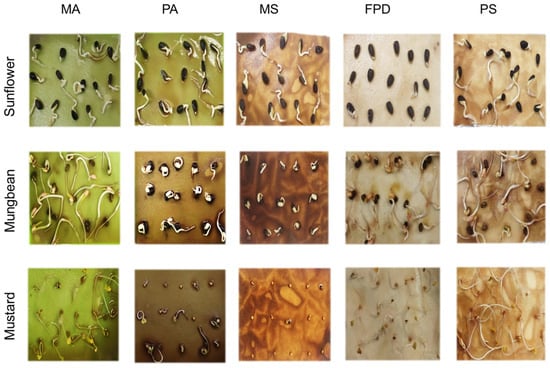
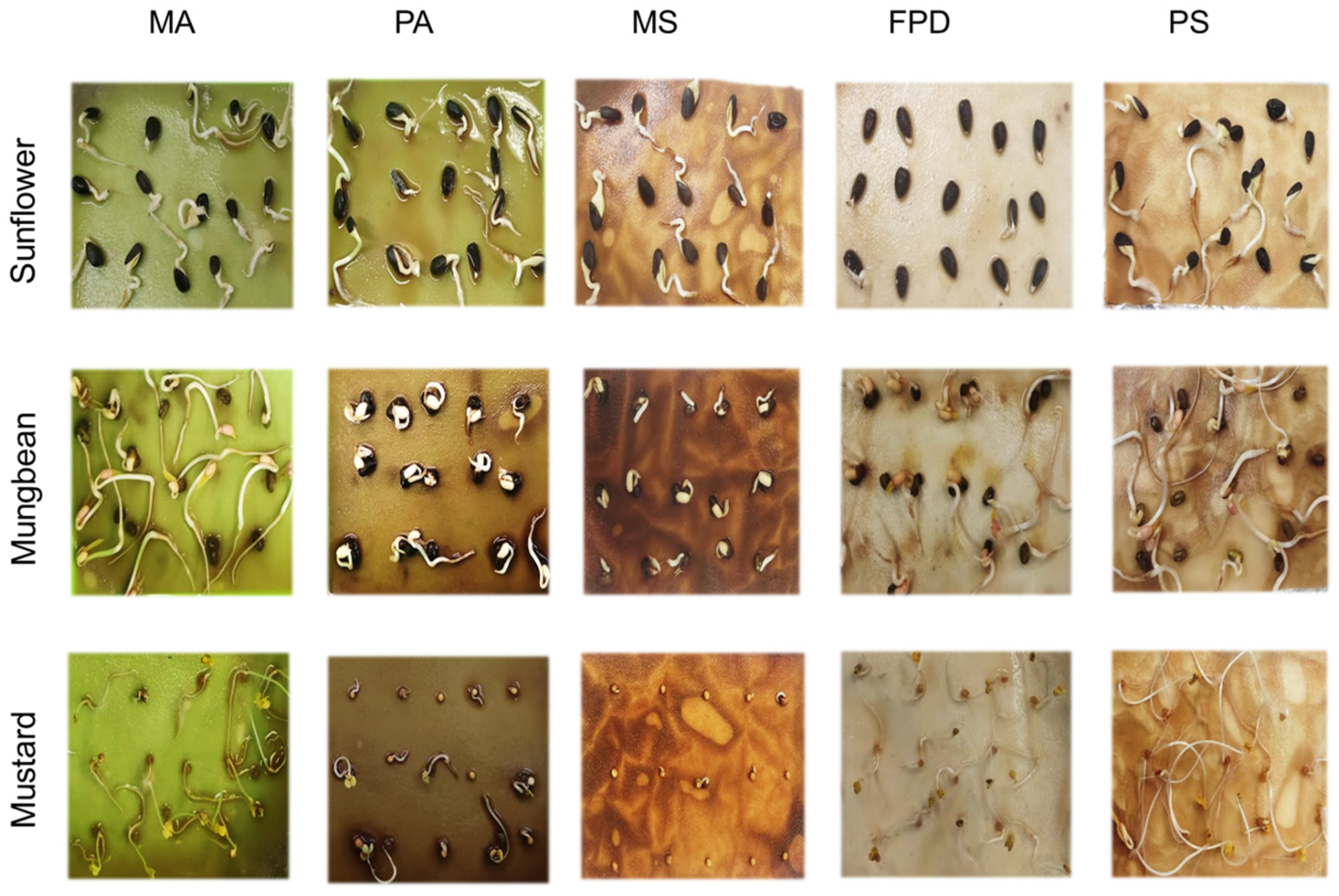
Seeds were surface-disinfected prior to the assays and placed in sterile plastic germination trays lined with filter paper moistened with 20 mL of the corresponding fertiliser elutriate. Each experimental unit consisted of 15 seeds. Germination trays were covered to prevent desiccation and incubated under laboratory conditions (25 ± 2 °C) in darkness. Germinated seeds (GSs) and root length (RL) were recorded daily during the incubation period. A seed was considered germinated when a visible radicle had emerged. On day 5, the total number of germinated seeds was recorded, and radicle length was measured. Treatments were arranged in a completely randomised design with three replicates for each plant species. The arrangement of seeds in the experimental units is shown in Figure 1.
Figure 1.
Visual examples of germination and radicular response of seeds exposed to different poultry manure-derived fertilisers: aerated compost mixture (MA), aerated poultry manure (PA), static compost mixture (MS), fresh poultry manure (FPD) and static poultry manure (PS).
From the raw data, the following indices were calculated according to Equations (1)–(4) [18,19]:
- Relative growth index (RGI);
- Germination index (GI);
- Root elongation index (REI);
- Seed germination index (SGI);
RGI values between 0 and 0.8 indicate inhibition of root elongation, values between 0.8 and 1.2 indicate no significant effect, and values greater than 1.2 indicate stimulation. GI values lower than 0.8 indicate inhibition of germination [19]. For REI and SGI, the values were also used to classify the elutriate toxicity as low (0 to −0.25), moderate (−0.25 to −0.5) or high (<−0.5).
Data were analysed using analysis of variance (ANOVA), followed by Dunnett’s multiple comparison test to evaluate differences between fertiliser treatments and the control. Statistical significance was established at p ≤ 0.05. All statistical analyses were performed using Minitab 20.3 (Minitab Inc., State College, PA, USA).
3. Results
The tested seeds showed different germination and root elongation responses when exposed to elutriates of composted and non-composted poultry manure fertilisers (p ≤ 0.05, Table 1). In general, composted treatments showed a germination percentage statistically similar to the control, particularly in sunflower and mustard seeds (Table 1). In contrast, fresh poultry droppings (FPDs) significantly reduced germination in these species.
Table 1.
Germination percentage and root length of elutriates of different poultry manure-derived fertilisers.
Root elongation responses varied among species. Mungbean roots were strongly affected, as all treatments produced significantly shorter roots than the control. Mustard and, in particular, sunflower seeds were less sensitive to changes in root elongation and were not affected by most composted treatments. In contrast, fresh poultry droppings consistently caused a reduction in both germination and root length (Table 1).
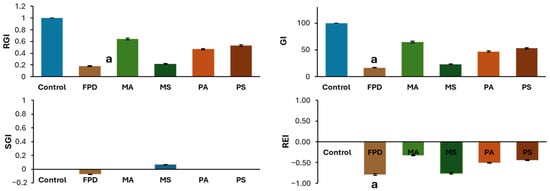
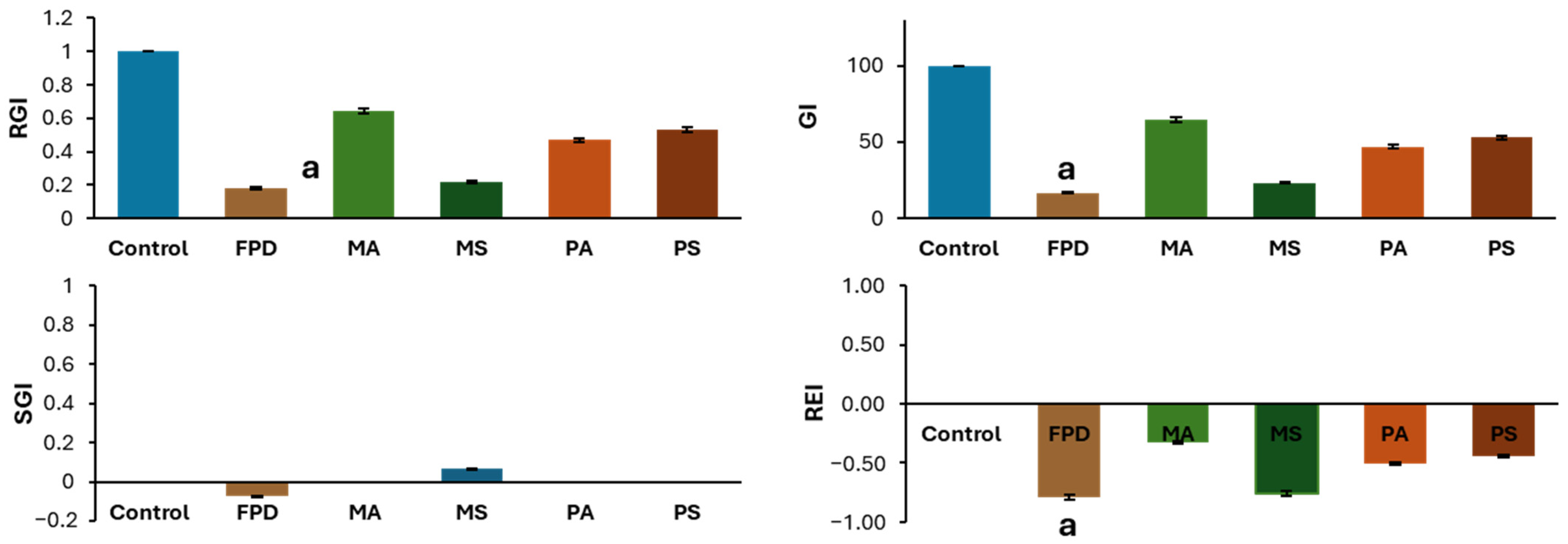
Regarding the calculated indices, sunflower seeds showed no inhibition effects on elongation with composted treatments, MS, MA, and PS, with average relative growth index (RGI) values ranging between 0.84 and 1.03 (Figure 2), while FPD and PA showed inhibiting effects with RGIs of 0.52 and 0.69, respectively (Figure 2). Germination index (GI) values showed that only FPD inhibited sunflower germination, while the rest of the treatments presented values well above the 80% threshold (Figure 2). Mixtures of poultry manure and maize stover presented no toxicity for sunflower seeds as the SGI values were above 0. A low toxicity level was detected in fresh poultry manure as well as in manure composted in a static pile (Figure 2). REI, in contrast, indicated low toxicity for most composts, as well as FPD, but only the values of the latter were significantly different from those of the control (Figure 1 and Figure 2).
Figure 2.
Germination indices of sunflower seeds exposed to different poultry manure-derived fertilisers: aerated compost mixture (MA), aerated poultry manure (PA), static compost mixture (MS), fresh poultry manure (FPD) and static poultry manure (PS). Relative growth index (RGI), germination index (GI), root elongation index (REI), and seed germination index (SGI). Means labelled with “a” are significantly different from those of the control treatment (Dunnet, p ≤ 0.05).
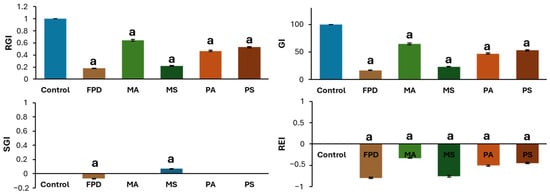
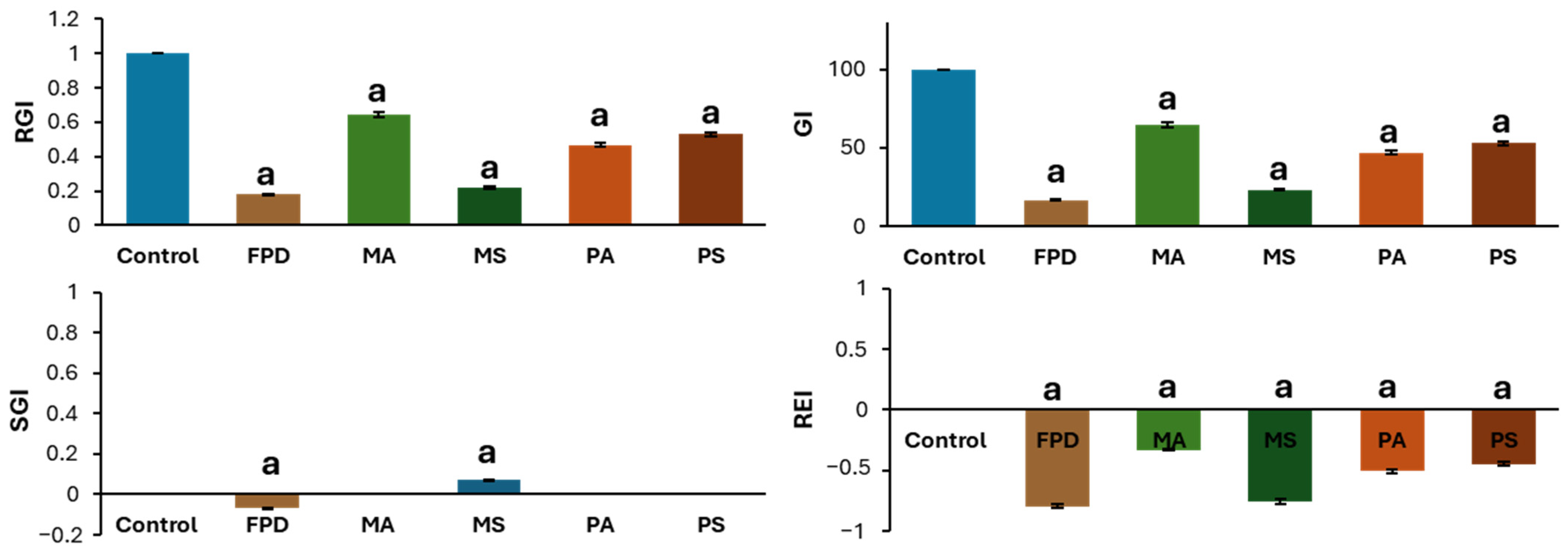
Mungbean seeds showed high sensitivity to all treatments. Both RGI and GI values were below 0.65 and 65, respectively, indicating inhibition of both germination and root elongation (Figure 3). Although SGI values indicated no toxicity in composted and poultry manure treatments (SGI ≥ 0), REI values indicated moderate toxicity for MA and PS and high toxicity for PA, MS, and FPD in terms of root development (Figure 3). These results indicate that mungbean roots are particularly sensitive to the phytotoxic compounds present in poultry manure-derived fertilisers.
Figure 3.
Germination indices of mungbean seeds exposed to different fertilisers: aerated compost mixture (MA), aerated poultry manure (PA), static compost mixture (MS), fresh poultry manure (FPD) and static poultry manure (PS). Relative growth index (RGI), germination index (GI), root elongation index (REI), and seed germination index (SGI). Means labelled with “a” are significantly different from those of the control treatment (Dunnet, p ≤ 0.05).
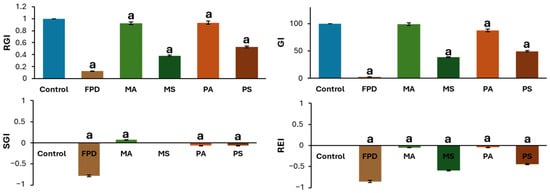
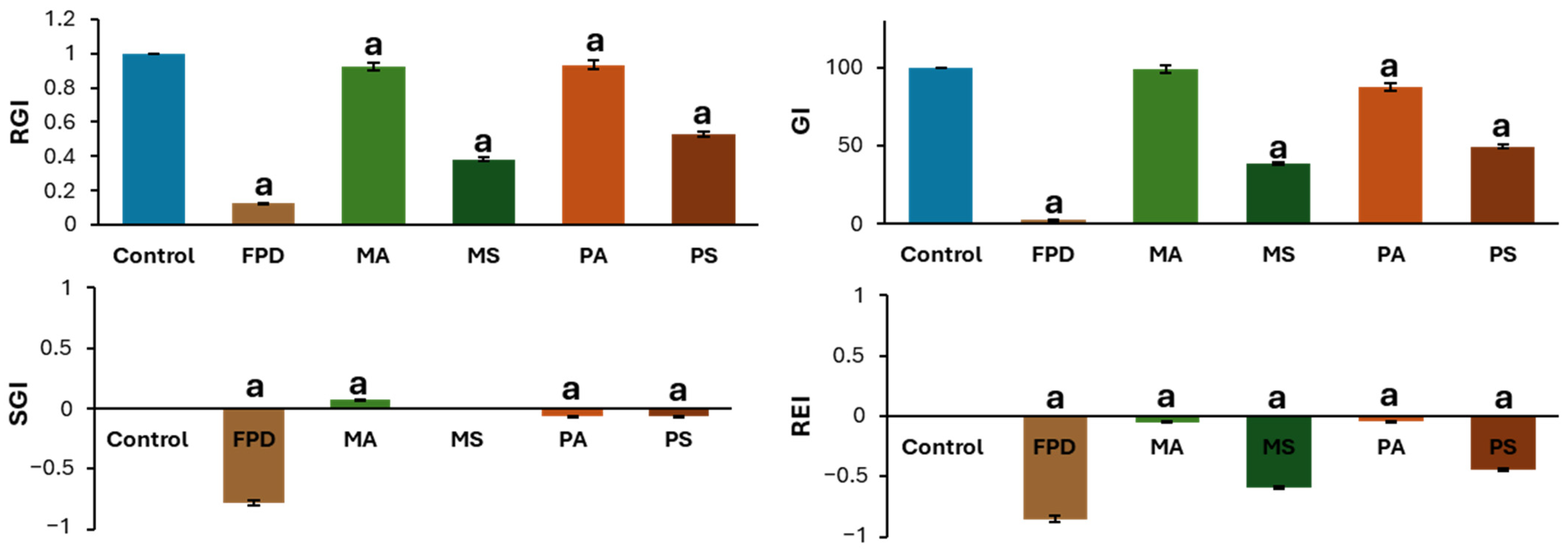
White mustard showed variable responses, depending on the treatment. No inhibitory effects were observed for PA and MA treatments, whereas MS, PS, and FPD caused inhibition of both germination and root elongation (Figure 1, Figure 4). SGI and REI values indicated low to moderate toxicity for PA and PS treatments, while FPD showed high phytotoxicity; REI values also indicated high toxicity in MS and low toxicity for MA (Figure 4).
Figure 4.
Germination indices of white mustard seeds exposed to different fertilisers: aerated compost mixture (MA), aerated poultry manure (PA), static compost mixture (MS), fresh poultry manure (FPD) and static poultry manure (PS). Relative growth index (RGI), germination index (GI), root elongation index (REI), and seed germination index (SGI). Means labelled with “a” are significantly different from the control treatment (Dunnet, p ≤ 0.05).
Root elongation indices (RGI and REI) proved to be more sensitive indicators of phytotoxicity than germination indices (GI and SGI). Among the species tested, mungbean showed the highest sensitivity, while sunflower was the most tolerant. These results suggest that the selected species can serve as effective bioindicators for evaluating the phytotoxicity of poultry manure-derived composts at different stages of stabilisation.
4. Discussion
This study demonstrates that the phytotoxicity of poultry manure-derived fertilisers is strongly dependent on composting conditions, degree of stabilisation, and plant species. Composted treatments, particularly aerated compost mixtures, showed lower phytotoxic effects on seed germination and root elongation, whereas fresh and partially stabilised poultry manure exhibited higher toxicity. These results are consistent with previous studies indicating that immature or inadequately composted manures can inhibit early plant development due to the presence of unstable compounds such as volatile fatty acids and other low-molecular-weight organics [20], excess ammonium, and soluble salts [8,9,11]. All these factors had been reported as key negative drivers of the germination index.
The aerated compost mixture (MA) consistently showed the lowest phytotoxicity across species, with germination and root elongation responses close to or above the non-toxicity threshold (Figure 1, Table 1). Aeration enhances microbial activity and promotes nitrification, ammonia volatilisation, and the degradation of phenolic and other phytotoxic organic compounds generated during manure decomposition [2,16,21]. This explains the higher GI and RGI values observed in aerated compost mixtures, indicating not only the absence of toxicity but also the stimulation of root growth. Similar increases in the germination index after compost maturation have been reported for poultry manure-based composts amended with crop residues and lignocellulosic materials [13,15,21]. Static compost (MS) showed variable responses, indicating partial stabilisation but the persistence of inhibitory compounds at higher concentrations.
Fresh poultry manure (FPD) and static composts (PS and MS) caused strong inhibition of germination and radicle elongation, particularly in mungbean. These results are consistent with previous studies reporting the high phytotoxicity of raw poultry manure due to elevated ammonium, osmotic stress, and pH instability during early stages of organic residue decomposition [10,11]. The elutriate concentration suggests that fresh manure could be applied at lower concentrations or after sufficient composting time (Table 1), to avoid ammonium/ammonia toxicity symptoms such as root apex necrosis, stunting and death [22].
Plant species differed markedly in their sensitivity to poultry manure-derived fertilisers. Sunflower showed low sensitivity to composted treatments, supporting its use as a bioindicator for moderately mature composts. In contrast, mungbean was highly sensitive to most treatments, making it a conservative indicator of residual phytotoxicity. Mustard displayed variable responses, showing strong tolerance to aerated composts but sensitivity to aerated poultry manure, highlighting species-specific interactions with compost composition. Such species-specific responses have been widely reported in phytotoxicity bioassays and reflect differences in seed coat permeability, metabolic activity during germination, and tolerance to soluble salts or ammonium [11,23].
Across all species and treatments, root elongation (RGI) was more sensitive than germination (GI) in detecting phytotoxic effects. In several cases, seeds germinated but exhibited significantly reduced radicle growth, particularly under fresh and partially composted manure treatments (Figure 1). This confirms that radicle elongation is a more reliable early indicator of chemical stress and compost immaturity than germination alone [9,18].
From a broader agroecological perspective, the management of poultry manure is particularly relevant in low- and middle-income regions where the dependence on cheap chicken protein leads to intensive poultry production [24,25]. In those contexts, it is estimated that up to 1 kg of poultry droppings are generated per kg of meat produced [26]. Such large volumes of organic residues must be stabilised before agricultural use, since inadequate treatment of manure may lead to soil salinity, ammonium toxicity, or the accumulation of phytotoxic compounds that affect early crop establishment [24,25]. The results obtained in this study highlight the importance of appropriate composting strategies to ensure that manure-derived fertilisers contribute positively to soil fertility and crop development while avoiding negative soil–plant interactions.
5. Conclusions
The phytotoxicity of poultry manure-derived fertilisers depended primarily on the composting method and degree of maturity. Aerated composted mixtures showed limited inhibitory effects on seed germination and root elongation, indicating a higher degree of stabilisation, whereas fresh and partially stabilised poultry manure caused strong inhibition of early seedling development. The bioassay species differed in sensitivity: sunflower showed low sensitivity to composted treatments, mungbean showed high sensitivity to residual phytotoxicity, and white mustard exhibited intermediate responses, supporting the use of multiple species in phytotoxicity assessments. Root elongation proved to be more sensitive than germination for detecting phytotoxic effects. Overall, combined germination and radicle growth bioassays provide a reliable biological tool for evaluating compost maturity and the potential impact of manure-derived fertilisers on early plant development. Further research is needed to determine safe application rates for these fertilisers and to explore the use of mineral amendments or mineral waste materials during composting or fertiliser formulation to improve stabilisation and reduce phytotoxicity risks associated with manure-derived fertilisers.
Author Contributions
Conceptualization, E.D.-H. and M.E.D.-H.; methodology, E.D.-H. and M.E.D.-H.; formal analysis, V.C.-R., A.D.-H., M.E.D.-H., E.D.-H., and H.C.-C.; investigation, V.C.-R., H.C.-C., A.D.-H., M.E.D.-H., and E.D.-H.; resources, E.D.-H. and M.E.D.-H.; writing—original draft preparation, V.C.-R., A.D.-H., E.D.-H., and M.E.D.-H.; writing—review and editing E.D.-H., A.D.-H., M.E.D.-H., H.C.-C. and V.C.-R. All authors have read and agreed to the published version of the manuscript.
Funding
This work was supported by UNAM-PAPIIT IA207626, SECIHTI grant no. 534775 and FES Cuautitlán UNAM Project: CI2454.
Institutional Review Board Statement
Not applicable.
Informed Consent Statement
Not applicable.
Data Availability Statement
The data presented in this study are available in the article.
Conflicts of Interest
The authors declare no conflict of interest.
References
- FAO. Manual de Compostaje del Agricultor: Experiencias en América Latina; FAO: Rome, Italy, 2013; Available online: https://www.fao.org/4/i3388s/i3388s.pdf (accessed on 2 September 2025).
- Insam, H.; Klammsteiner, T.; Gómez-Brandòn, M. Biology of compost. Encycl. Soils Environ. 2023, 1, 522–532. [Google Scholar] [CrossRef] [Scilit]
- Mažeika, R.; Arbačiauskas, J.; Masevičienė, A.; Narutytė, I.; Šumskis, D.; Žičkienė, L.; Rainys, K.; Drapanauskaite, D.; Staugaitis, G.; Baltrusaitis, J. Nutrient Dynamics and Plant Response in Soil to Organic Chicken Manure-Based Fertilizers. Waste Biomass Valorization 2020, 12, 371–382. [Google Scholar] [CrossRef] [Scilit]
- Agbede, T. Poultry manure improves soil properties and grain mineral composition, maize productivity and economic profitability. Sci. Rep. 2025, 15, 16501. [Google Scholar] [CrossRef] [Scilit] [PubMed]
- Baishya, A.; Sorathiya, L.M.; Barot, B.; Rathwa, A.; Gadhvi, D.; Ao, T. Poultry Waste Utilisation: A Nutrient-Rich Organic Resource for Sustainable Agriculture. Asian J. Adv. Agric. Res. 2025, 25, 42–49. [Google Scholar] [CrossRef] [Scilit]
- Lončarić, Z.; Galić, V.; Nemet, F.; Perić, K.; Galić, L.; Ragályi, P.; Uzinger, N.; Rékási, M. The Evaluation of Compost Maturity and Ammonium Toxicity Using Different Plant Species in a Germination Test. Agronomy 2024, 14, 2636. [Google Scholar] [CrossRef] [Scilit]
- Kebrom, T.H.; Woldesenbet, S.; Bayabil, H.K.; Garcia, M.; Gao, M.; Ampim, P.; Awal, R.; Fares, A. Evaluation of phytotoxicity of three organic amendments to collard greens using the seed germination bioassay. Environ. Sci. Pollut. Res. 2019, 26, 5454–5462. [Google Scholar] [CrossRef] [Scilit]
- Kong, Y.; Wang, G.; Chen, W.; Yang, Y.; Ma, R.; Li, D.; Shen, Y.; Li, G.; Yuan, J. Phytotoxicity of farm livestock manures in facultative heap composting using the seed germination index as indicator. Ecotoxicol. Environ. Saf. 2022, 247, 114251. [Google Scholar] [CrossRef] [Scilit]
- Tiquia, S.M.; Tam, N.F. Characterization and composting of poultry litter in forced-aeration piles. Process. Biochem. 2002, 37, 869–880. [Google Scholar] [CrossRef] [Scilit]
- Kong, Y.; Wang, G.; Tang, H.; Yang, J.; Yang, Y.; Wang, J.; Li, G.; Li, Y.; Yuan, J. Multi-omics analysis provides insight into the phytotoxicity of chicken manure and cornstalk on seed germination. Sci. Total. Environ. 2023, 861, 160611. [Google Scholar] [CrossRef] [Scilit]
- Ravindran, B.; Mupambwa, H.A.; Silwana, S.; Mnkeni, P.N. Assessment of nutrient quality, heavy metals and phytotoxic properties of chicken manure on selected commercial vegetable crops. Heliyon 2017, 3, e00493. [Google Scholar] [CrossRef] [Scilit]
- El-Zeadani, H.; Abubaker, J.; Essalem, M.; Alghali, A. Germination of several wheat cultivars in desert soil after amendment with raw and digested poultry manure with and without combination with mineral fertilizer. Int. J. Recycl. Org. Waste Agric. 2018, 7, 335–343. [Google Scholar] [CrossRef] [Scilit]
- Adeyemi, F.O.; Kehinde-Fadare, A.F.; Olajide, O.O. Germination, Growth and Yield Responses of Leaf Amaranth (Amaranthus hybridus) to Rates and Times of Poultry Manure Application. Sustain. Agric. Res. 2021, 10, 40. [Google Scholar] [CrossRef] [Scilit]
- Chisom, I.F.; Onyinye, M.A.; May, O.N.; Crescent, C.O.; Bibian, A.O. Effects of Poultry Manure Application on the Early Seedling Development of Treculia africana (Breadfruit). Sumerianz J. Biotechnol. 2022, 5, 16–22. [Google Scholar] [CrossRef] [Scilit]
- Abubaker, J.; Abobaker, A.; Essalem, M.; Bertata, N. Germination of alfalfa (Medicago sativa L.) seeds in Desert soil after fertilization with raw and digested animal manure. J. Arid. Agric. 2024, 10, 65–73. [Google Scholar] [CrossRef] [Scilit]
- Wang, G.; Kong, Y.; Liu, Y.; Li, D.; Zhang, X.; Yuan, J.; Li, G. Evolution of phytotoxicity during the active phase of co-composting of chicken manure, tobacco powder and mushroom substrate. Waste Manag. 2020, 114, 25–32. [Google Scholar] [CrossRef] [Scilit]
- Campuzano, H. Recycling of Organic Residues to Improve the Circularity of a Poultry Production System. Bachelor’s Thesis, National Autonomous University of Mexico, Mexico City, Mexico, 2024. [Google Scholar]
- Bagur-González, M.G.; Estepa-Molina, C.; Martín-Peinado, F.; Morales-Ruano, S. Toxicity assessment using Lactuca sativa L. bioassay of the metal(loid)s As, Cu, Mn, Pb and Zn in soluble-in-water saturated soil extracts from an abandoned mining site. J. Soils Sediments 2011, 11, 281–289. [Google Scholar] [CrossRef] [Scilit]
- Rizzo, P.F.; Young, B.J.; Viso, N.P.; Carbajal, J.; Martínez, L.E.; Riera, N.I.; Bres, P.A.; Beily, M.E.; Barbaro, L.; Farber, M.; et al. Integral approach for the evaluation of poultry manure, compost, and digestate: Amendment characterization, mineralization, and effects on soil and intensive crops. Waste Manag. 2022, 139, 124–135. [Google Scholar] [CrossRef] [Scilit]
- Wang, G.; Kong, Y.; Yang, Y.; Ma, R.; Shen, Y.; Li, G.; Yuan, J. Superphosphate, biochar, and microbial inoculum regulate phytotoxicity and humification during chicken manure composting. Sci. Total. Environ. 2022, 824, 153958. [Google Scholar] [CrossRef] [Scilit]
- Wang, Y.; Xu, P.; Wang, Y.; Su, J.; Xu, Z.; Jiang, Z.; Wei, Y.; Hang, S.; Ding, X.; Zhang, H.; et al. Effects of aeration modes and rates on nitrogen conversion and bacterial community in composting of dehydrated sludge and corn straw. Front. Microbiol. 2024, 15, 1372568. [Google Scholar] [CrossRef] [Scilit]
- Bello, M.S.; Kolawole, O.S. Phytotoxicity Assessment of Different Animal Manure on Selected Vegetable Crops in Kashere Community, Gombe State, Nigeria. J. Appl. Sci. Environ. Manag. 2024, 28, 873–881. [Google Scholar] [CrossRef] [Scilit]
- Pan, W.L.; Madsen, I.J.; Bolton, R.P.; Graves, L.; Sistrunk, T. Ammonia/Ammonium Toxicity Root Symptoms Induced by Inorganic and Organic Fertilizers and Placement. Agron. J. 2016, 108, 2485–2492. [Google Scholar] [CrossRef] [Scilit]
- Kacprzak, M.; Malińska, K.; Grosser, A.; Sobik-Szołtysek, J.; Wystalska, K.; Dróżdż, D.; Jasińska, A.; Meers, E. Cycles of carbon, nitrogen and phosphorus in poultry manure management technologies—Environmental aspects. Crit. Rev. Environ. Sci. Technol. 2022, 53, 914–938. [Google Scholar] [CrossRef] [Scilit]
- Manogaran, M.; Shamsuddin, R.; Yusoff, M.; Lay, M.; Siyal, A. A Review on Treatment Processes of Chicken Manure. Clean. Circ. Bioecon. 2022, 2, 100013. [Google Scholar] [CrossRef] [Scilit]
- Gržinić, G.; Piotrowicz-Cieślak, A.; Klimkowicz-Pawlas, A.; Górny, R.L.; Ławniczek-Wałczyk, A.; Piechowicz, L.; Olkowska, E.; Potrykus, M.; Tankiewicz, M.; Krupka, M.; et al. Intensive poultry farming: A review of the impact on the environment and human health. Sci. Total. Environ. 2023, 858, 160014. [Google Scholar] [CrossRef] [Scilit]

Disclaimer/Publisher’s Note: The statements, opinions and data contained in all publications are solely those of the individual author(s) and contributor(s) and not of MDPI and/or the editor(s). MDPI and/or the editor(s) disclaim responsibility for any injury to people or property resulting from any ideas, methods, instructions or products referred to in the content. |
© 2026 by the authors. Licensee MDPI, Basel, Switzerland. This article is an open access article distributed under the terms and conditions of the Creative Commons Attribution (CC BY) license.