


Abstract
Deteriorated seeds of okra varieties ‘Smooth Green’ and ‘Red Ruby’ were reinvigorated by soaking in plasma-activated water (PAW). After PAW treatment, germination and seedling characteristics were determined and compared with hydroprimed deteriorated seeds, unprimed deteriorated seeds, and healthy untreated seeds. Differences among treatments were analyzed using ANOVA and Tukey’s HSD test at α = 0.05. PAW-treated deteriorated seeds exhibited higher vigor and faster germination in both varieties compared with untreated seeds. Furthermore, PAW-treated seedlings developed longer and heavier shoots and roots. It is concluded that soaking deteriorated seeds in PAW enhanced germination by 12–16%. These findings demonstrate that PAW treatment can improve the germination and seedling characteristics of deteriorated okra seeds.
1. Introduction
Seed deterioration is an inevitable, progressive process that begins after physiological maturity and is accelerated by exposure to unfavorable conditions such as high temperature, high moisture, and poor ventilation [1]. Deteriorated seeds are characterized by reduced germination, delayed and non-uniform emergence, and weak seedlings [2]. These seeds also exhibit low seedling vigor, making them more susceptible to pathogens and other biotic and abiotic stresses [3,4]. These physiological changes in seeds are caused by membrane damage, lipid peroxidation, enzyme inactivation, and oxidative stress resulting from the accumulation of reactive oxygen species.
Many smallholder farmers often use seeds saved from previous harvests that are stored under suboptimal conditions, which promote seed deterioration. The use of deteriorated seeds results in poor crop stand and plant establishment. Due to weak seedling stands, many seedlings die, and replanting or replacement increases production costs and leads to uneven and unsynchronized crop growth. This ultimately negatively affects yield and incurs economic losses [5,6].
Okra (Abelmoschus esculentus L.) is an economically important vegetable crop widely cultivated in tropical and subtropical regions, including the Philippines. It is commonly consumed as a viand in the Philippines and is known for its high nutritional value, adaptability, and strong market demand. Okra is a rich source of dietary fiber, vitamins, and antioxidants [7]. The seeds of okra are known to exhibit physiological dormancy, which can result in low germination viability when exposed to suboptimal storage conditions [8]. Low and erratic germination hinders successful crop establishment; therefore, fast and uniform germination is essential and is typically achieved using high-quality seeds [9].
To address seed deterioration, several seed invigoration techniques have been developed to improve germination and seedling vigor, thereby enhancing seed quality. These techniques include hydropriming, osmopriming, hormonal priming, and the application of physical treatments aimed at repairing or mitigating damage through antioxidant activity and metabolic repair mechanisms [10]. In recent years, several studies have explored the use of plasma-based technologies for seed enhancement, as these approaches offer innovative and eco-friendly alternatives [11]. Direct exposure of water to plasma produces plasma-activated water (PAW), which contains reactive species such as hydrogen peroxide and nitrates that can stimulate physiological and biochemical processes in seeds [12]. Multiple studies have demonstrated the positive effects of PAW on seed germination characteristics; however, only a few studies have examined its invigorating effects on deteriorated seeds. This study aims to determine the effect of PAW priming on the germination and seedling characteristics of two okra varieties, ‘Green Smooth’ and ‘Red Ruby’.
2. Materials and Methods
2.1. Preparation of Distilled Plasma-Activated Water
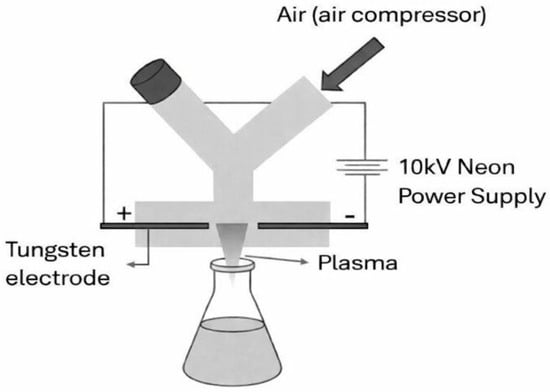
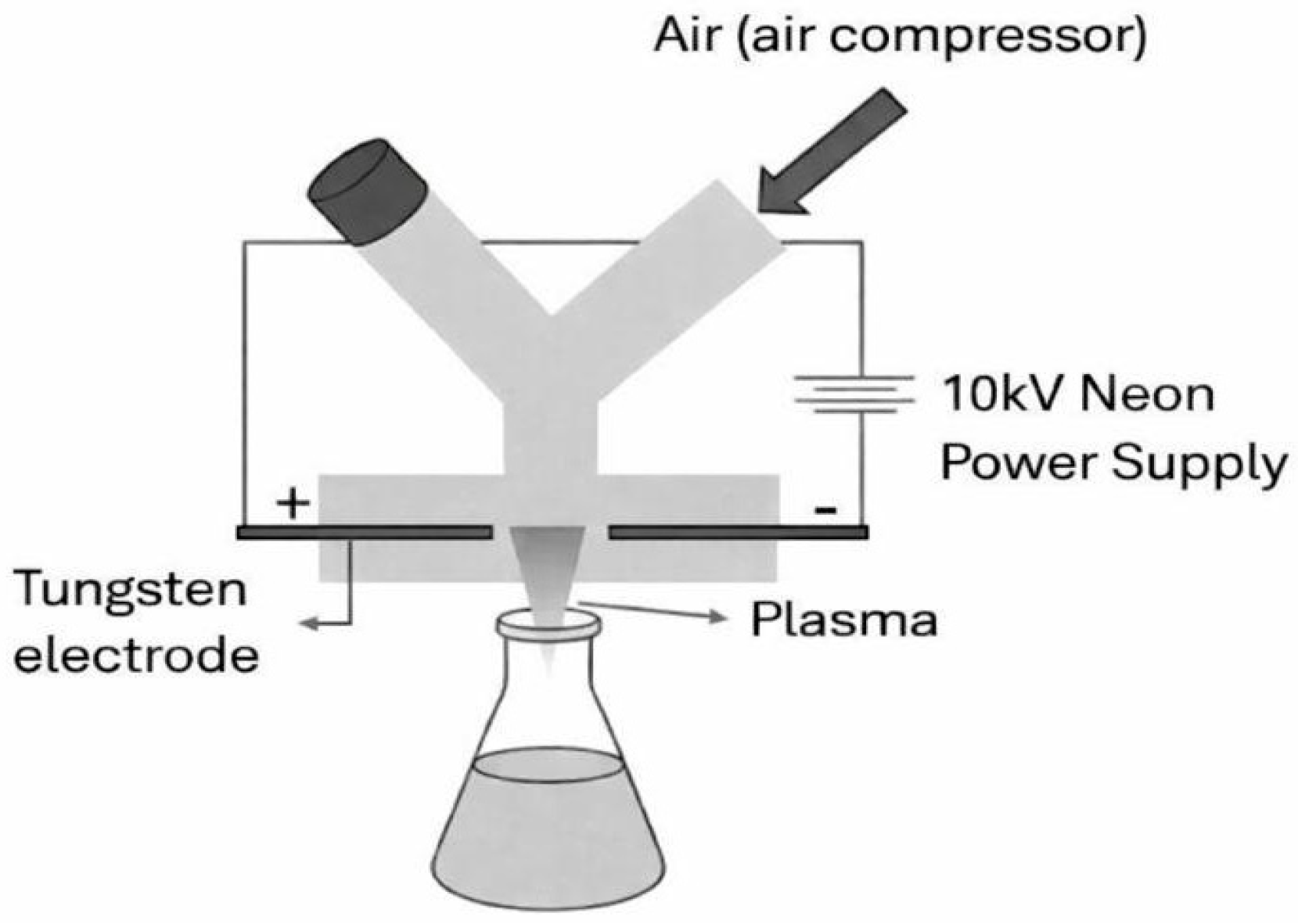
Plasma activated water was generated using an Atmospheric Pressure Plasma Jet (APPJ) in the Research Laboratory of the Philippine Science High School Main Campus in Metro Manila, Philippines [11]. The APPJ has two 0.5 mm diameter tungsten (W) rods as electrodes spaced 10 mm in the middle Further, these rods were enclosed in a custom-built glass tube with a 14 mm outside diameter sealed with rubber. The electrodes were connected to a 10 kV, 30 mA neon light power supply. The upper part of the custom-built glass tube had two openings as gas inlets. One was sealed with a rubber stopper, while the other was connected to an air compressor that delivered 55 L min−1 (Figure 1). Distilled water (200 mL) was exposed to APP with a nozzle-to-water distance at approximately 5 cm for 10 min.
Figure 1.
Diagram of the Plasma Activated Water Preparation device used in the study [11].
2.2. Physical and Chemical Characterization of Plasma-Activated Water (PAW)
The physical and chemical properties of distilled water exposed to APP (PAW) were measured. These properties included pH, electrical conductivity (EC), resistance, total dissolved solids (TDS), and oxidation–reduction potential (ORP) and were compared with those of untreated distilled water. The procedure was adapted from Dela Cruz et al. [11], in which a handheld automatic water quality meter (YY-1010) was used to measure pH, TDS (ppm), EC (µS cm−1), and resistivity (MΩ) [11]. The resolution and accuracy of the measurements were as follows: pH, 0.01 with an accuracy of ±0.02; EC, 1 µS cm−1 with an accuracy of ±2% of full scale; TDS, 1 ppm with an accuracy of ±2% of full scale; and resistivity, 0.1 MΩ with an accuracy of ±1% of full scale.
2.3. Preparation of Seed Treatments
The experiments were arranged in a completely randomized design (CRD) with three replications and two subsamples per replication for the germination test to determine seed germination characteristics, while 10 seedlings per subsample were used to measure seedling characteristics. One hundred seeds were used per subsample, a total of 3600 seeds per variety. Four treatments: deteriorated seeds treated with PAW, deteriorated hydroprimed seeds, deteriorated unprimed seeds, and healthy untreated seeds were implemented.
Seeds of A. esculentus ‘Red Ruby’ and ‘Smooth Green’ were sourced from commercial seed stores in Quezon City. ‘Red Ruby’ is a red okra variety, while ‘Smooth Green’ is a green okra variety. Okra seeds were subjected to accelerated aging (AA) by placing them in a plastic vessel containing distilled water and spreading them in a single layer on a plastic net to avoid direct contact with the water. The vessel was placed in an oven at 40–45 °C for 72 h. A germination test conducted after AA showed a reduction in germination from 92% to 74%, and the seeds were therefore considered deteriorated and subsequently divided into treatments.
For treatment 1, seeds were soaked in PAW, while for treatment 2, seeds were soaked in distilled water for 8 h. Seeds from both treatments were blot-dried and then air-dried for an additional 8 h after soaking.
2.4. Presoaking, Germination Tests, and Seedling Characterization
Seeds were subjected to a germination test using the top-of-paper method. Germinated seeds were counted 24 h after the start of the germination test and continued daily until the 14th day [13]. A seed was considered germinated when the radicle had protruded. After counting, the germinated seeds were sown in garden soil and used for seedling characterization after 14 days of growth in the soil medium. Observations of germination were conducted until the 7th day. Germination percentage (GP%), germination rate index (GRI), and germination speed (GS) were computed (Table 1).
Table 1.
Summary of the formula used in the study.
Seeds were placed equidistantly on moist paper towels in glass Petri dishes and kept at room temperature in complete darkness. The paper towels were sprayed with distilled water using an atomizer throughout the 14-day testing period to maintain moisture. Higher germination percentage indicates higher seed viability, while a higher germination rate index reflects greater vigor and more uniform, earlier germination [14]. Furthermore, higher germination speed indicates more rapid germination [15].
For seedling characterization, germinated seeds were sown in moist, sterilized garden soil mixed with vermicast and placed in plastic pots. Seedlings were watered daily and kept in a greenhouse receiving sunlight from morning to afternoon. Seedling growth was assessed by randomly selecting 10 seedlings per subsample. Root and shoot lengths (cm) were measured using a ruler, while seedling fresh weight (g) was determined using an analytical balance. Dry weight was obtained after oven-drying the seedlings at 60 °C for 72 h.
2.5. Statistical Analysis
The physical and chemical parameters of PAW and untreated distilled water were compared using Student’s independent t-test after meeting the assumptions of normality and homogeneity of variance. Data on seed germination and seedling characteristics were analyzed using analysis of variance (ANOVA) after satisfying the same assumptions. Pairwise comparisons among treatments were performed using Tukey’s HSD test at the 5% level of significance. All statistical analyses were conducted using Jamovi 2.3.15 statistical software [16].
3. Results and Discussion
3.1. Physical and Chemical Properties of PAW
The physicochemical characteristics of distilled water exposed to APP for 10 min and untreated distilled water were measured (Table 2). Significant differences were observed in all measured physical and chemical parameters when APP-treated water (PAW) was compared with untreated distilled water. Untreated distilled water had a pH of 6.59, whereas PAW exhibited an acidic pH of 3.09. Furthermore, electrical conductivity (EC) increased from 166 S/m in untreated distilled water to an average of 581.5 S/m in PAW, while total dissolved solids (TDS) increased from 0 ppm to 153.5 ppm. Increased oxidative potential was observed in PAW (403.5 V) compared with untreated distilled water (195 V). In contrast, untreated distilled water exhibited high resistivity (3354.4 MΩ), whereas PAW showed markedly lower resistivity (41.59 MΩ) (Table 2).
Table 2.
Summary of Physical and Chemical Properties of Plasma Activated water and untreated distilled water.
Plasma exposure or treatment induces changes in the physicochemical properties of water, as reported by several authors [11,17,18]. Wang et al. [17] and Dela Cruz et al. [11] indicated that the increased acidity of PAW, along with higher electrical conductivity, total dissolved solids, and oxidation–reduction potential, can be attributed to the elevated concentration of ions and the formation of hydrogen peroxide, as well as nitric and peroxynitrous compounds, which are strong oxidizing species. Furthermore, the higher concentration of reactive and electrically conductive species reduces the resistivity of the water [11].
3.2. Effects of Plasma-Activated Water on Seed Germination Performance
Deteriorated okra seeds of two varieties were soaked in PAW, which was found to significantly affect their germination characteristics for both Green Smooth (GS) and Red Ruby (RR) (Table 3). Germination percentage (GP) was highest in deteriorated seeds treated with PAW for both cultivars. GP of PAW-treated deteriorated seeds was higher for Red Ruby (80.50%; p < 0.00) and Green Smooth (81.50%; p < 0.00) compared with hydroprimed seeds (RR = 76.67%; GS = 73.83%) and untreated deteriorated seeds (RR = 72.17%; GS = 69.83%).
Table 3.
Effect of Plasma—Activated Water (PAW) Treatment on Germination Percentage, Germination. Rate Index, and Germination Speed of Deteriorated Seeds compared to Healthy—Untreated seeds of Two Okra varieties ‘Red Ruby’ and ‘Green Smooth’ Seeds.
Similarly, the germination rate index (GRI) showed significant differences across treatments for both varieties (RR, p < 0.00; GS, p < 0.00). PAW-treated deteriorated seeds of RR (40.32) differed significantly from untreated deteriorated seeds (32.59), while in GS, the GRI of PAW-treated deteriorated seeds (39.28) was significantly higher than that of untreated deteriorated seeds (25.41). Germination speed followed the same trend, with PAW-treated deteriorated seeds showing higher values for both varieties (GS = 17.20; RR = 17.46) compared with hydroprimed deteriorated seeds (GS = 16.33; RR = 15.75) and untreated deteriorated seeds (GS = 15.01; RR = 14.89).
The results indicated that PAW had a promotive effect on the germination of deteriorated seeds, regardless of the okra cultivar. The increase in GRI also reflected substantially faster and more uniform germination, which was further supported by the higher germination speed observed in PAW-treated deteriorated seeds compared with untreated and hydroprimed deteriorated seeds.
Varied responses to plasma exposure have been observed across different crop species. Several studies have reported that plasma treatment improves germination characteristics in crops, such as lettuce using dielectric barrier discharge (DBD) plasma [17], okra and water lettuce using APPJ [11], and eggplant [18], among others. Few studies have investigated the invigoration effect of PAW on deteriorated seeds, but these studies have also reported promotive effects on germination. Given these positive effects, the reinvigorating potential of PAW was examined in the present experiment.
Moreover, the study by Raga et al. [19] corroborates the results of this study. Raga et al. explored the use of PAW priming and ultrafine bubbles on deteriorated true shallot seeds. Their findings showed that PAW priming improved seed physiology, increasing germination and radicle emergence by more than 80%, which was comparable to the germination rate and radicle emergence of fresh seeds. The authors explained that PAW promoted higher amylase activity, total protein content, and seed respiration rate, thereby enhancing germination. They further suggested that increased production of reactive oxygen species (ROS) promoted pre-germinative metabolism, which may be a potential mechanism for the physiological improvement of deteriorated seeds.
The significant improvement in GP, GRI, and GS observed under PAW treatment of deteriorated seeds can be attributed to the presence of reactive oxygen and nitrogen species (RONS) generated through plasma activation. These reactive species may also increase seed coat permeability, enhancing water imbibition and oxygen diffusion, thereby accelerating pre-germinative activities and breaking seed dormancy [20,21]. Additionally, nitrate and nitrite ions formed in PAW may act as signaling molecules that stimulate enzyme activation and hormonal balance, further promoting germination [22]. While these studies provide theoretical explanations for the effects of PAW on seed germination, further experimental confirmation is needed.
The poor performance of deteriorated seeds and the observed improvement after PAW treatment demonstrate that PAW, as an external activator, can help overcome the physiological constraints inherent to deteriorated seeds. Hydropriming also improved germination parameters, but its effects were insufficient compared with the stimulation provided by PAW, as seen in the germination percentage and speed of PAW-treated deteriorated seeds. The similar trend of response across both okra varieties—Green Smooth and Red Ruby—indicates that PAW is effective regardless of varietal differences.
3.3. Effects of Plasma-Activated Water on Seedling Parameters
Seedlings from PAW-treated, hydroprimed, unprimed deteriorated, and healthy untreated okra seeds across both varieties were planted in garden soil and grown for 14 days. Root and shoot lengths of seedlings were measured, and the effects of PAW on these parameters are presented in Table 4.
Table 4.
Effect of Plasma—Activated Water Treatment on Root and Shoot Length of Seedlings germinated from Deteriorated Seeds compared to Healthy—Untreated seeds of Two Okra varieties ‘Red Ruby’ and ‘Green Smooth’ Seeds.
Seedling root length was significantly improved by PAW treatment of deteriorated seeds in both cultivars (GS and RR). In Red Ruby, PAW-treated deteriorated seeds produced the longest roots (9.16 cm), which were comparable to those of healthy untreated seeds and longer than roots from hydroprimed and unprimed deteriorated seeds. Similarly, shoots were longest in seedlings from PAW-treated deteriorated seeds. For Green Smooth, PAW-treated deteriorated seeds produced roots measuring 9.88 cm, while Red Ruby measured 9.16 cm.
Regarding shoot length (Table 4), a similar trend was observed, with significant differences across treatments for both GS and RR varieties. Seedlings from PAW-treated deteriorated seeds of RR (11.95 cm) and GS (12.25 cm) were longer than those from hydroprimed and untreated deteriorated seeds. Statistical analysis indicated that PAW treatment promoted more vigorous seedlings during the early growth stages for both okra varieties.
In cv. ‘Green Smooth’, PAW-treated seeds produced significantly longer roots (9.88 ± 0.88 cm) than non-primed deteriorated seeds, with values comparable to hydroprimed and healthy untreated seeds. Shoot length was also improved by PAW treatment (11.74 ± 3.47 cm), although hydropriming resulted in the highest mean shoot length (12.25 ± 1.23 cm). In both cultivars, non-primed deteriorated seeds consistently exhibited significantly reduced root and shoot growth. These results demonstrate that PAW treatment effectively mitigates the adverse effects of seed deterioration on early seedling growth.
The results of this study are consistent with previous findings on the response of adlai seeds to PAW soaking [23]. In that study, PAW-treated seeds exhibited longer shoots and roots compared to hydroprimed adlai seeds. Furthermore, PAW has been shown to improve the growth of soybeans, tartary buckwheat, and Erythrina velutina [12]. This increased growth can be attributed to enhanced nutrient uptake, enzymatic activity, and cell elongation, which contribute to longer shoots and roots [24]. Early seedling growth may also be stimulated by signaling pathways and hormonal changes triggered by reactive species present in PAW [25].
The reactive oxygen species in plasma-activated water promote meristem activity and cell wall loosening, accelerating elongation of both roots and shoots [21]. Additionally, nitrogen-containing species such as nitrate and nitrite in PAW can enhance nitrogen availability and promote shoot growth through improved nutrient assimilation [26]. The poor performance of untreated seeds suggests that the absence of external stimulation limits early plant developmental processes. These findings align with previous reports indicating that plasma-activated water or plasma-based seed treatments improve seedling morphology across various crop species [27].
3.4. Effects of Plasma-Activated Water on Seedling Biomass
Fresh and dry biomass of seedlings from PAW-treated, hydroprimed, unprimed deteriorated, and healthy untreated okra seeds across varieties were measured (Table 5). Fresh and dry seedling biomass differed significantly across treatments for both Red Ruby and Green Smooth varieties (p < 0.00). However, comparable dry weights were observed across treatments for both varieties (p > 0.05). Moreover, in Arabidopsis, non-thermal plasma treatment has been reported to improve germination and long-term growth, as evidenced by increased seedling biomass, enhanced production of antioxidants and phytohormones, and upregulation of drought tolerance genes [28].
Table 5.
Effect of Plasma—Activated Water Treatment on Root and Shoot Dry and Fresh Weights of Seedlings germinated from deteriorated seeds compared to Healthy—Untreated seeds of Two okra varieties ‘Red Ruby’ and ‘Green Smooth’ seeds.
The significantly higher fresh biomass observed in PAW-treated deteriorated seeds of Red Ruby indicates that PAW promotes seedling development and growth. Additionally, the effects of PAW have been explored in Poa pratensis, where seed priming and PAW irrigation improved plant biomass and photosynthetic pigment content [29]. Similar results were reported in lettuce, where PAW treatment increased photosynthetic pigments and enhanced the plant’s photosynthetic rate [30]. The increase in biomass in Red Ruby demonstrates that PAW continues to influence seedling growth beyond germination, whereas the comparable response in Green Smooth suggests cultivar-specific sensitivity to PAW. Varietal differences have also been reported in these okra varieties when seeds were subjected to direct plasma exposure, particularly in root and shoot biomass compared with untreated seeds [12].
In the present study, although PAW-treated deteriorated seeds had higher numerical biomass values, these differences were not statistically significant. The significant increase in biomass observed in Red Ruby may be attributed to earlier, faster, and more efficient nutrient mobilization, which accelerates seed nutrient catabolism and makes stored nutrients readily available to the growing embryo. Increased nitrate availability likely enhanced nitrogen assimilation, contributing to higher dry matter production, Dela Cruz et al., [11]. Cultivar differences imply that while PAW treatment can affect biomass, its effects are not uniform across varieties, as the rate of nutrient assimilation and dry matter accumulation may also be influenced by the genetic background and growth dynamics of each variety.
4. Summary, Conclusions, and Recommendations
This study investigated the effects of atmospheric pressure plasma (APP)-activated water (PAW) on the germination and seedling characteristics of deteriorated seeds of two okra varieties (Abelmoschus esculentus cv. ‘Smooth Green’ and cv. ‘Red Ruby’). Deteriorated okra seeds were soaked in PAW for 8 h and then air-dried for 8 h before undergoing a germination test using the top-of-paper method. Comparisons were made among three treatments: PAW-treated deteriorated seeds, distilled water-treated deteriorated seeds, and untreated deteriorated seeds.
Results showed that PAW-treated seeds exhibited the highest germination percentage, germination index, and faster germination compared to the other treatments for both okra varieties. Furthermore, PAW-treated seeds developed longer shoots and roots than seedlings from hydroprimed and untreated seeds. In Red Ruby, heavier fresh and dry biomass was observed in PAW-treated seedlings. PAW treatment improved germination percentage by 12% in ‘Smooth Green’ and 16% in ‘Red Ruby’.
These findings demonstrate that PAW priming is an effective technique for enhancing germinability, seed vigor, and seedling performance in deteriorated okra seeds. The researchers recommend using PAW priming as a method to reinvigorate deteriorated seeds of other okra varieties and potentially other crop species.
Author Contributions
Conceptualization, A.S.P., A.A., C.J.D.C., G.G. and M.G.; methodology, A.S.P., C.J.D.C., M.G. and G.G.; software, A.S.P.; validation, A.S.P., M.G., A.A. and G.G.; formal analysis, A.S.P., C.J.D.C., M.G. and G.G.; investigation, A.S.P., M.G., C.J.D.C. and A.A.; resources, A.S.P., A.A., G.G. and C.J.D.C.; data curation, A.S.P., M.G. and C.J.D.C.; writing—original draft preparation, A.S.P., C.J.D.C. and M.G.; writing—review and editing, A.S.P., C.J.D.C., M.G., A.A. and G.G.; visualization, A.S.P. and M.G.; supervision, A.S.P., C.J.D.C. and M.G.; project administration, A.S.P., C.J.D.C. and M.G.; funding acquisition, A.S.P., C.J.D.C. and M.G. All authors have read and agreed to the published version of the manuscript.
Funding
This research received no external funding.
Institutional Review Board Statement
Not applicable.
Informed Consent Statement
The original contributions presented in this study are included in the article.
Data Availability Statement
Data is available upon request to the corresponding author.
Acknowledgments
The authors would like to acknowledge the support provided by the Philippine Science High School (PSHS) System and the Philippine Council for Agriculture, Aquatic and Natural Resources Research and Development. Moreover, the authors would like to acknowledge the logistical support provided by the administrators of the PSHS-Main Campus and the staff and faculty of its Research Unit, specifically Ian Robles, Gerard Hope Tiburcio, and Elliard Roswell Yanza. Further, the authors acknowledge the anonymous reviewers who thoroughly scrutinized the paper. During the preparation of this manuscript/study, the author(s) used Grammarly 1.2.218 and Chatgpt 5.1 for the purposes of improving the grammar of the write up. The authors have reviewed and edited the output and take full responsibility for the content of this publication.
Conflicts of Interest
The authors declare no conflicts of interest.
References
- Xing, W.; Li, Y.; Zhou, L.; Hong, H.; Liu, Y.; Luo, S.; Zou, J.; Zhao, Y.; Yang, Y.; Xu, Z.; et al. Deciphering Seed Deterioration: Molecular Insights and Priming Strategies for Revitalizing Aged Seeds. Plants 2025, 14, 1730. [Google Scholar] [CrossRef] [Scilit]
- Reed, R.; Bradford, K.; Khanday, I. Seed germination and vigor: Ensuring crop sustainability in a changing climate. Heredity 2022, 128, 450–459. [Google Scholar] [CrossRef] [Scilit]
- Jyoti, R.; Hitendra, K.; Malik, K.; Raj, P.; Dahiya, P. Influence of ionization on reflection of solitary waves in a magnetized plasma. Phys. Plasmas 2013, 20, 092113. [Google Scholar] [CrossRef] [Scilit]
- McDonald, M.B. Seed Quality Assessment. Seed Sci. Res. 1998, 8, 265–276. [Google Scholar] [CrossRef] [Scilit]
- Weekly Crop Update. University of Delaware. Available online: https://sites.udel.edu/weeklycropupdate/?p=11710 (accessed on 12 December 2025).
- Copeland, L.; Mcdonald, M. Principles of Seed Science and Technology; Springer: New York, NY, USA, 2001. [Google Scholar]
- Gemede, F.; Habtamu, R.; Negussie, D.; Haki, G.; Woldegiorgis, A.; Beyene, F. Nutritional Quality and Health Benefits of “Okra” (Abelmoschus esculentus): A Review. J. Food Process Technol. 2015, 25, 16–25. [Google Scholar] [CrossRef]
- Demir, İ. The effects of heat treatment on hardseededness of serially harvested okra seed lots at optimum and low temperatures. Sci. Hortic. 2001, 89, 1–7. [Google Scholar] [CrossRef] [Scilit]
- Denton, O.; Oyekale, K.; Adeyeye, J.A.; Nwangburuka, C.C.; Wahab, O.D. Effect of dry-heat treatment on the germination and seedling emergence of Corchorus olitorius seed. Agric. Sci. Res. J. 2013, 3, 18–22. [Google Scholar]
- Hasanović, M.; Durmić-Pašić, A.; Karalija, E. Seed Priming Beyond Stress Adaptation: Broadening the Agronomic Horizon. Agronomy 2025, 15, 1829. [Google Scholar] [CrossRef] [Scilit]
- Dela Cruz, C.J.M.; San Pascual, A.O.; Gravidez, M.B.; Chupungco, A.M.A. Enhancing seed germination of Abelmoschus esculentus (L.) Moench and Ipomoea aquatica Forssk. through atmospheric pressure plasma-activated distilled water. Palawan Sci. 2025, 17, 78–90. [Google Scholar] [CrossRef] [Scilit]
- San Pascual, A.; Dela Cruz, C.; Gravidez, M.; Garcia, G.; Aquino, A.; Bucsit, J.; Purisima, E. Non-Thermal Atmospheric Pressure Plasma Treatment to Improve Seed Germination and Seedling Growth of Two Okra (Abelmoschus esculentus (L.) Moench) Va rieties. Philipp. J. Crop Sci. 2025, 50, 29–37. [Google Scholar]
- Rao, N.K.; Hanson, J.; Dulloo, M.E.; Ghosh, K.; Nowell, D.; Larinde, M. Manual of seed handling in genebanks. In Handbooks for Genebanks No. 8; Bioversity International: Rome, Italy, 2006. [Google Scholar]
- Bhadra, M.; Mondal, S.; Das, A.; Bandyopadhyay, A. Gibberellic acid treatment improves seed germination and seedling establishment in Tinospora cordifolia (Willd.) Hook. F. and Thoms. J. Appl. Biol. Biotech. 2024, 12, 128–135. [Google Scholar] [CrossRef] [Scilit]
- Khalaki, M.A.; Ghorbani, A.; Dadjou, F. Influence of Nano-Priming on Festuca ovina Seed Germination and Early Seedling Traits under Drought Stress, in Laboratory Condition. Ecopersia 2019, 7, 133–139. [Google Scholar]
- Jamovi, Version 2.3.15. Statistical Software. The Jamovi Project: Sydney, Australia, 2022. Available online: https://www.jamovi.org (accessed on 21 January 2026).
- Wang, T.C.; Hsu, S.Y.; Lai, Y.T.; Duh, J.G. Improving the Growth Rate of Lettuce Sativa Young Plants via Plasma-Activated Water Generated by Multitubular Dielectric Barrier Discharge Cold Plasma System. IEEE Trans. Plasma Sci. 2022, 50, 2104–2109. [Google Scholar] [CrossRef] [Scilit]
- Rashid, M.; Rashid, M.M.; Alam, M.S. Enhancement of Growth, Enzymes, Nutrition and Yield of Eggplant: Combined Effects of Plasma Treatments. Plasma Chem. Plasma Process. 2023, 43, 163–181. [Google Scholar] [CrossRef] [Scilit]
- Raga, Y.; Widajati, E.; Satriyas, I.; Yohanes, P. Enhancing viability and vigor of deteriorated true shallot seeds (Allium cepa var. ascalonicum) through ultra-fine bubble and plasma-activated water priming. J. Seed Sci. 2024, 46, e202446029. [Google Scholar] [CrossRef] [Scilit]
- Benabderrahim, M.A.; Bettaieb, I.; Rejili, M. Boosting Seed Performance with Cold Plasma. App. Sci. 2025, 15, 10996. [Google Scholar] [CrossRef] [Scilit]
- Šerá, B.; Šerý, M.; Zahoranová, A.; Tomeková, J. Germination Improvement of Three Pine Species (Pinus) After Diffuse Coplanar Surface Barrier Discharge Plasma Treatment. Plasma Chem. Plasma Process. 2021, 41, 211–226. [Google Scholar] [CrossRef] [Scilit]
- Ferreyra, M.G.; Caffaro, M.M.; Santamaría, B.; Zilli, C.; Hernández, A.; Fina, B.L.; Vélez, A.S.; Balestrasse, K.B.; Prevosto, L. Plasma-Activated Water Produced by a Moderately High Energy-Efficient 1-Liter Reactor: Effects on Germination and Growth of Tomato and Bell Pepper Plants. Plants 2025, 14, 722. [Google Scholar] [CrossRef] [Scilit]
- Garcia, G.; San Pascual, A.; Dela Cruz, C.; Gravidez, G.; Vera Cruz, J.; Bucsit, J.; Purisima, E.; Aquino, A. Improving Germination and Seedling Growth of Adlai (Coix lacryma-jobi L.) Seed Using Atmospheric Pressure Plasma. In Proceedings of the Poster Presentation of the 28th Federation of Plant Science Association of the Philippines Scientific Conference, Cebu City, Philippines, 26–28 August 2025. [Google Scholar]
- Guragain, R.P.; Prakash, S.; Pradhan, S.P.; Baniya, H.B.; Pandey, B.P.; Basnet, N.; Sedhai, B.; Dhungana, S.; Chhetri, G.K.; Joshi, U.W.; et al. Impact of Plasma-Activated Water (PAW) on Seed Germination of Soybean. J. Chem. 2021, 2021, 7517052. [Google Scholar] [CrossRef] [Scilit]
- Pizá, M.P.; Prevosto, L.; Zilli, C.; Cejas, E.; Hector, K.; Balestrasse, K. Effects of non–thermal plasmas on seed-borne Diaporthe/Phomopsis complex and germination parameters of soybean seeds. Innov. Food Sci. Emerg. Technol. 2018, 49, 82–91. [Google Scholar] [CrossRef] [Scilit]
- Randeniya, L.; Groot, G.J.J.B. Non-Thermal Plasma Treatment of Agricultural Seeds for Stimulation of Germination, Removal of Surface Contamination and Other Benefits: A Review. Plasma Process. Polym. 2015, 12, 608–623. [Google Scholar] [CrossRef] [Scilit]
- Bormashenko, E.; Grynyov, R.; Bormashenko, Y.; Drori, E. Cold radiofrequency plasma treatment modifies wettability and ger mination speed of plant seeds. Sci. Rep. 2012, 2, 741. [Google Scholar] [CrossRef] [Scilit] [PubMed]
- Priatama, R.A.; Pervitasari, A.N.; Park, S.; Park, S.J.; Lee, Y.K. Current Advancements in the Molecular Mechanism of Plasma Treatment for Seed Germination and Plant Growth. Int. J. Mol. Sci. 2022, 23, 4609. [Google Scholar] [CrossRef] [Scilit] [PubMed]
- Zaboli, M.; Nejad-Alimoradi, F.; Rostami, F.; Keramat, B.; Mousavi, E.A.; Nasibi, F. Seed priming and irrigating with plasma-activated water improve the growth and drought resistance in Poa pratensis. BMC Plant Biol. 2025, 25, 1747. [Google Scholar] [CrossRef] [Scilit] [PubMed]
- Locatelli, S.; Triolone, S.; De Bonis, M.; Zanin, G.; Nicoletto, C. Non-Thermal Plasma-Activated Water Enhances Nursery Production of Vegetables: A Species-Specific Study. Agronomy 2025, 15, 209. [Google Scholar] [CrossRef] [Scilit]

Disclaimer/Publisher’s Note: The statements, opinions and data contained in all publications are solely those of the individual author(s) and contributor(s) and not of MDPI and/or the editor(s). MDPI and/or the editor(s) disclaim responsibility for any injury to people or property resulting from any ideas, methods, instructions or products referred to in the content. |
© 2026 by the authors. Licensee MDPI, Basel, Switzerland. This article is an open access article distributed under the terms and conditions of the Creative Commons Attribution (CC BY) license.