


Abstract
Plant growth-promoting rhizospheric bacteria (PGPR) are well known for their significant roles in agriculture and the environment. In our previous study, 23 chalky soil bacterial isolates were obtained from the rhizosphere of Chamaecytisus ruthenicus. In total, seven out of them were reported for their potential effect on plant growth. However, the identification and further characterization of those chalky soil bacteria have not been completed yet. Therefore, the purpose of the present study is to identify and characterize chalky soil rhizospheric bacteria (seven previously investigated and one additional bacteria). A total of eight bacterial isolates were cultured in LB and other growth media to investigate their morphological behavior, antibiotic sensitivity or resistance status, and their effect on plant growth. Moreover, 16S rRNA gene sequencing was used to identify those potent bacterial isolates. The results of the present study demonstrate that all bacterial isolates obtained stable morphology in the three types of growth media. However, four bacterial isolates (Z11, Z12, Z15 and Z44) showed color change. The antibiotic test result also revealed that all the tested bacterial isolates except Z11 and Z24 were resistant to both ampicillin (10 μg) and oxacillin (1 μg), whereas all bacterial isolates were sensitive to polymyxin (300 units), amoxicillin (20 μg), vancomycin (30 μg), ceftazidime (30 μg), erythromycin (15 μg), ciprofloxacin (5 μg), bacitracin (10 units) and streptomycin (30 μg). The result of the growth stimulation effect revealed that few bacterial isolates had a stimulation effect on the germination rate of oats and lentils, on the shoot length of maize and oats, on the root length of wheats, maize and lentils, on the fresh weight of wheats and oats or on the dry weight of oat seeds. Furthermore, the 16S rRNA gene sequence analysis result revealed that the bacterial isolates belonged to Streptomycetes spp. and Jantinobacterium sp. To conclude, the potential chalky soil rhizospheric bacteria have a substantial impact on agriculture and the environment.
1. Introduction
Plant growth-promoting rhizobacteria (PGPR) are beneficial bacteria that colonize plant roots and enhance plant growth through a wide variety of mechanisms [1,2]. The mode and mechanism of PGPR activity differ depending on the host plant species, soil type and soil nutritional status [3]. Recently, the use of PGPR is steadily increasing [1] and they have been used as bioremediation, biopesticides, biofertilizers, probiotics and antibiotics in modern agriculture [4,5,6]. Many studies have reported that growth-promoting activity has been shown in several PGPR species from the genera Azotobacter, Azospirillum, Pseudomonas, Acetobacter, Burkholderia, Serratia, Bacillus, Klebsiella, Enterobacter, Alcaligenes, Aeromonas, Herbaspirillum, Acinetobacter, Agrobacterium, Bradyrhizobium, Xanthomonas, Stenotrophomonas, Arthrobacter and Streptomyces [3,7,8]. In our previous study about 23 chalky soil bacteria that were isolated from the rhizosphere of Chamaecytisus ruthenicus, few of them showed antimicrobial activity against phytopathogenic microbes such as Erwinia herbicola, Micrococcus roseus, Pectobacterium carotovorum, Fusarium avenaceum, Rhizoctonia solani, Alternaria brassicicola, Bipolaris sorokiniana and Pythium ultimum. Moreover, these bacterial isolates also exhibited a growth stimulation effect on the germinated seeds of wheat, maize, oats and lentils [3]. Even though little information was available, further characterization is required for the complete description of these chalky soil bacteria. Therefore, the aim of the present study was to describe morphological behavior in different growth media, to evaluate the level of the bacteria’s resistance or sensitivity to different antibiotics, to evaluate the growth stimulation effect on germinated seeds and to identify those selective chalky soil bacteria using 16S rRNA gene sequencing.
2. Methods
2.1. Morphological Behavior of Bacterial Isolates
To evaluate the morphological behavior of the selected bacterial isolates, eight bacterial isolates were cultured in three different kinds of growth media: LB with a reduced concentration of 5% (yeast extract = 0.2 g/L, tryptone = 0.4 g/L, NaCl = 0.2 g/L and agar = 4 g/L), LB with a normal concentration (yeast extract = 1 g/L, tryptone = 2 g/L, NaCl = 1 g/L, and agar = 4 g/L) and sugar growth medium (tryptone = 0.6 g/L, peptone = 1 g/L, sugar = 2 g/L, NaCl = 1 g/L, and agar = 4 g/L). The plates were incubated for 48 h at 29 °C. The colony morphology including the shape, margin, elevation, surface, color and pigmentation of each isolate was examined.
2.2. Evaluation of Bacterial Sensitivity or Resistance to Antibiotics
The disc diffusion method was utilized to evaluate the level of sensitivity or resistance of those selected bacterial isolates. In addition, eighteen types of antibiotics including Cefotaxime (30 μg), Streptomycin (300 units), Oxacillin (1 μg), Trimethroprim (75 μg), Polymyxin (300 units), Ceftazidime (30 μg), Gentamicin (10 μg), Tetracycline (30 μg), Erythromycin (15 μg), Ofloxacin (5 μg), Vancomycin (30 μg), Bacitracin (10 units), Ampicillin (10 μg), Lincomycin (15 μg), Meropenem (10 μg), Amoxicillin (20 μg), Rifampin (5μg) and Ciprofloxacin (5 μg) were used. The cultured bacterial strains (72 h at 29 °C) were inoculated and evenly distributed on plates containing the LB growth medium (composition: yeast extract 1 g/L, peptone 2 g/L, sodium chloride 5 g/L, and agar 20 g/L). Then, antibiotic disks were applied on the surface of the inoculated LB growth medium and the zones of growth inhibition surrounding each antibiotic disk were measured to the nearest millimeter after the incubation period (48 h at 29 °C).
2.3. Growth Stimulation Effect of Bacterial Isolates
Seed germination was performed to evaluate the growth stimulation effects of bacterial isolates on four seeds (wheat, maize, oats, and lentils). In 10 mL of LB liquid medium, eight bacterial isolates (Z10, Z11, Z12, Z15, Z24, Z26, Z44 and Z82) were cultured and incubated at 29 °C for 72 h. On a total of 36 plates, 25 surface-sterilized seeds from each variety were placed. Thereafter, except for the control group, 15 mL of bacterial solution that had been diluted to an OD 600 of 0.1 was applied to each plate. The control group, however, received merely water as an addition. For a week, 15 mL of water was added to the plates on each day. The growth stimulation experiment was performed in triplicate. The germination rate, shoot length, root length, fresh and dry weight of the seedlings were measured after the seeds had germinated. The data were statistically evaluated using a t-test at p = 0.05.
2.4. Identification of Bacterial Isolates Using 16S rRNA Gene Sequencing
Genomic DNA was isolated from cells using the Fungal/Bacterial DNA Kit (Zymo Research, 160 USA) according to the manufacturer’s instructions. The 16S rRNA gene was amplified by PCR using universal primers for 16S rRNA prokaryotes: 27f (5′-AGAGTTTGATCCTGGCTCAG3′) and 1492r (5′-TACGGYTACCTTGTTACGACTT3′). The amplified DNA was purified using the Zymoclean Gel DNA Recovery Kit (Zymo Research, Irvine, CA, USA). The sequencing of PCR DNA fragments was performed on an Applied Biosystems Genetic Analyzer automatic sequencer. Primary phylogenetic screening of the obtained sequences was performed using the BLAST program [http://www.ncbi.nlm.nih.gov/blast (accessed on 26 July 2023)] in the EzBioCloud database (www.ezbiocloud.net (accessed on 26 July 2023)). The nucleotide sequences of the 16S rRNA gene obtained for strain 82 were manually aligned with the sequences of reference strains of the nearest microorganisms. A phylogenetic tree was constructed using partial 16S rRNA gene sequences by the neighbor-joining method with a bootstrap test of 1000 replicates, which was performed using MEGA 11.0.
3. Results
3.1. Morphological Behavior of Bacterial Isolates
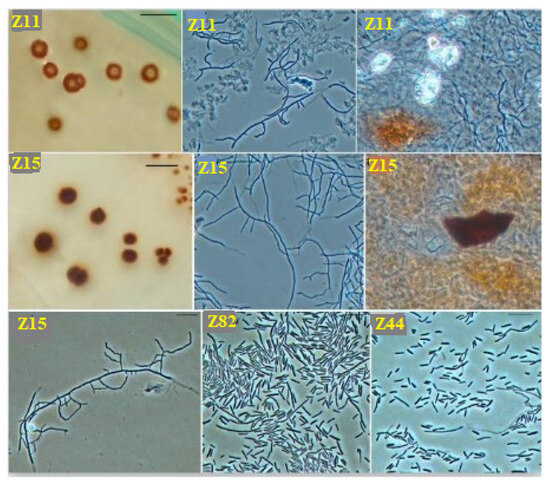
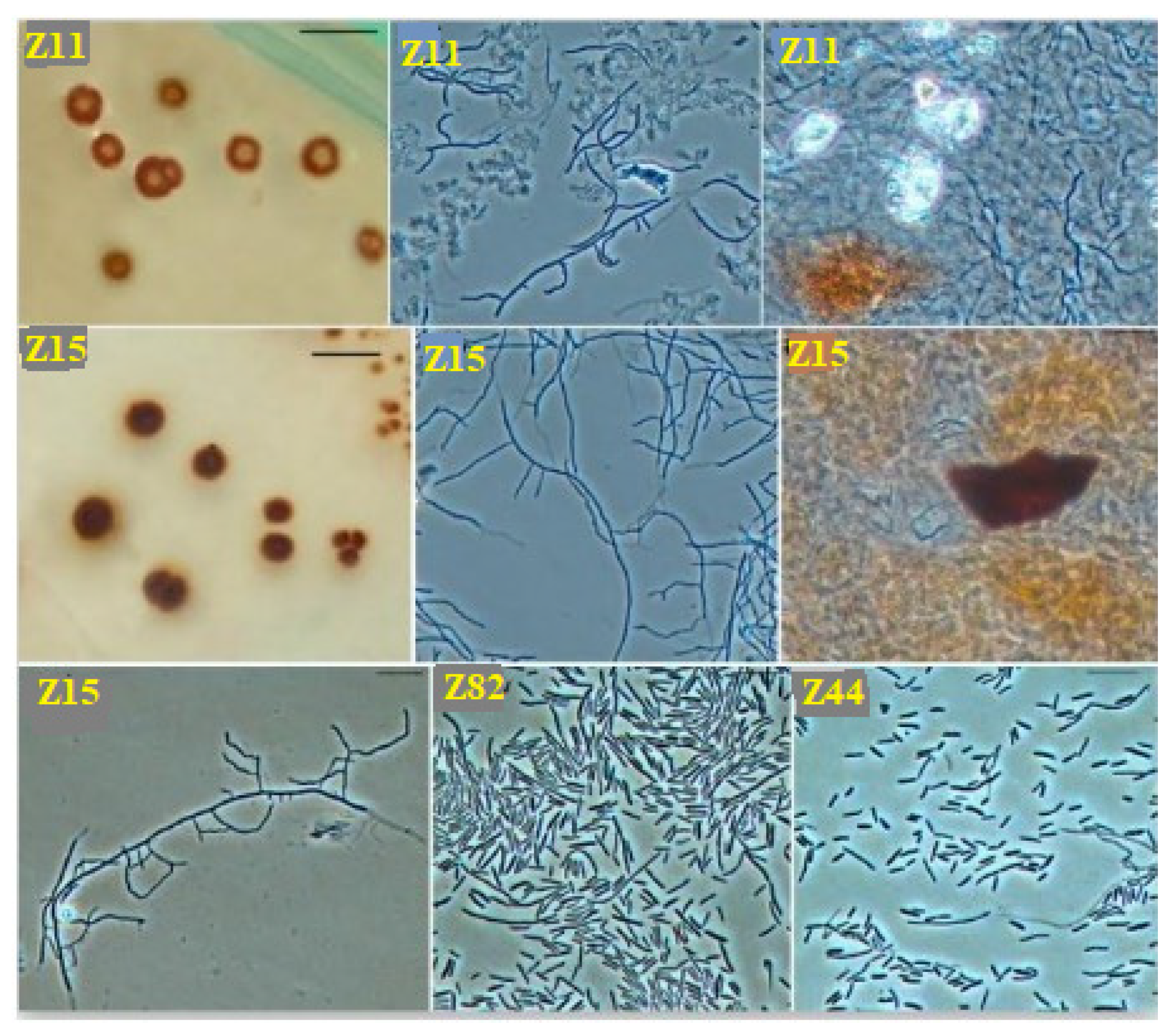
The colony morphology of the bacterial isolates were examined. The morphological characteristics of the bacterial isolates are presented in Table 1 and Figure 1. Except color, all bacterial isolates showed stable morphological characteristics. In general, four bacterial isolates (Z11, Z12, Z15 and Z44) showed color change in the three types of growth media.
Table 1.
Morphological characteristics of bacterial isolates on the three types of growth media.
Figure 1.
Photo of colonies bar—5 μm. Other photos: bar—10 μm. For culture Z 11 and Z 15, photographs of colonies and cells after subculture and cells from colonies with crystals are presented. Photos of bacteria in the bottom row are cells from freshly inoculated cultures.
3.2. Evaluation of Bacterial Sensitivity or Resistance to Antibiotics
An antibiotic test was performed to evaluate the level of bacterial sensitivity or resistance. The antibiotic test result (Table 2) revealed that all the tested bacterial isolates except Z11 and Z24 were resistant to both Ampicillin (10 μg) and Oxacillin (1 μg). However, all bacterial isolates were sensitive to Polymyxin (300 units), Amoxicillin (20 μg), Vancomycin (30 μg), Gentamicin (10 μg), Erythromycin (15 μg), Ofloxacin (5 μg), Ciprofloxacin (5 μg), Bacitracin (10 units) and Streptomycin (30 μg).
Table 2.
Measurement of the inhibition zone around the antibiotic discs (mm).
3.3. Growth Stimulation Effect of Bacterial Isolates
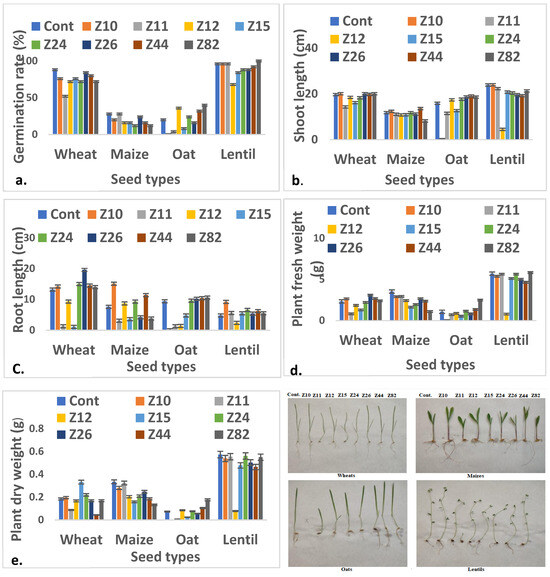
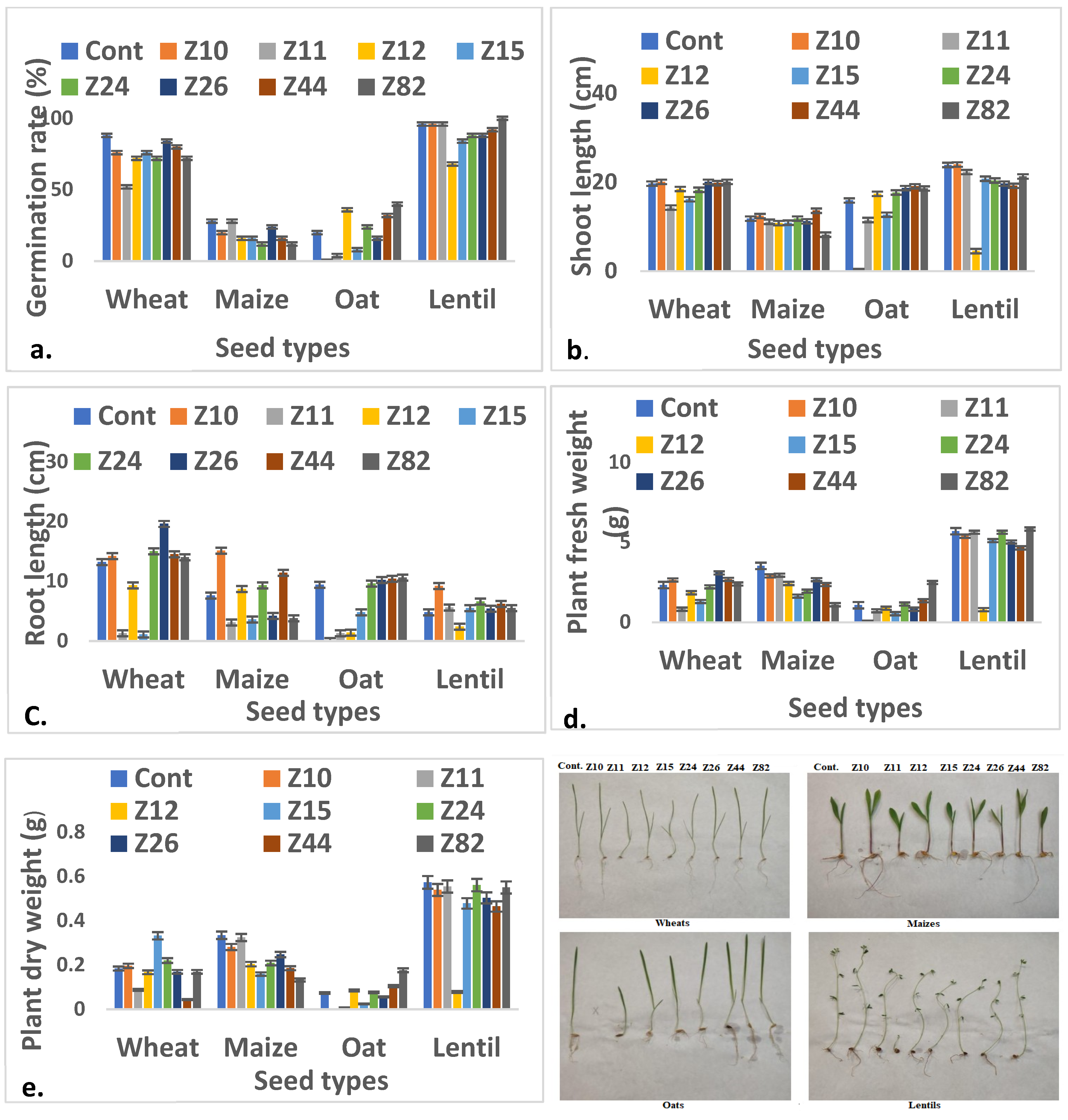
The growth stimulation effect of bacterial isolates on the germinated seeds (germination rate, shoot and root length and plant fresh and dry weight) is presented in Figure 2. In Figure 2a, it is shown that the bacterial isolates Z12, Z24, Z44 and Z82 showed a significant increase in the germination rate of oat seeds. However, bacterial isolates Z82 significantly increased the germination rate of lentils (p = 0.05). Figure 2b presents the effect of the bacterial isolates on the shoot length of the germinated seeds. The shoot length of maize was significantly increased by Z44. However, bacterial isolates Z12, Z24, Z26, Z44 and Z82 significantly increased the shoot length of the oat plants (p = 0.05). Figure 2c indicates that the bacterial isolates Z24, Z26, and Z44 significantly increased the root length of the wheat. However, the root length of the maize and lentil plants was significantly increased by Z10, Z24, and Z44 (p = 0.05). In Figure 2d it is shown that the fresh weight of wheat plants was significantly increased by Z10, Z26 and Z44 (p = 0.05). However, bacterial isolates Z44 and Z82 significantly increased the fresh weight of the oat plants. However, Figure 2e indicated that the dry weight of wheat plants were significantly increased by Z10, Z15 and Z24. Moreover, the dry weight of the oat plants was significantly increased by Z44 and Z82 (p = 0.05).
Figure 2.
The growth stimulation effect of bacterial isolates on the germinated seeds of wheat, maize, oats and lentils: (a). Germination rate (%), (b). Shoot length (cm), (c). Root length (cm), (d). Plant fresh weight (g) and (e). Plant dry weight (g).
3.4. Identification of Bacterial Isolates Using 16S rRNA Gene Sequencing
Molecular genetic identification of strain 82 by 16S rRNA showed that it belongs to the species Janthinobacterium rivuli with 99% certainty. The accuracy of identifying representatives of the Streptomycetes family did not allow us to identify them to individual species at this stage. However, according to preliminary data, strain 11 can be tentatively attributed to the species Streptomyces lasiicapitis, 15—Streptomyces griseoaurantiacus, Z15—Streptomyces aureoverticillatus/Streptomyces lasiicapitis/Streptomyces labedae/Streptomyces longissimus/Streptomyces rubrogriseus/Streptomyces thinghirensis. Work to identify these strains will continue.
4. Discussion
In the present study, eight bacterial isolates were characterized for their morphological characteristics, antibiotic sensitivity or resistance, growth stimulation effect and molecular identification using 16S rRNA gene sequencing. Even though all bacterial isolates had stable morphological characteristics in the three types of growth media, four bacterial isolates (Z11, Z12, Z15 and Z44) showed color change. The antibiotic test result revealed that almost all bacterial isolates were sensitive to all of the tested antibiotics. However, all bacterial isolates were resistant to oxacillin (1 μg), excluding Z11, and ampicillin (10 μg), excluding Z24. Moreover, the antibiotic cefotaxime (30 μg) was resisted by Z10; ceftazidime (30 μg), meropenem (10 μg) and rifampin (5 μg) were resisted by Z12; lincomycin (15 μg) was resisted by Z15 and Z44; tetracycline (30 μg) was resisted by Z15 and Z82; and trimethroprim (75 μg) was resisted by Z26. Some published articles reported that antibiotics like streptomycin and oxytetracycline have been used in agriculture as a tool for the management of phytopathogens. Such kinds of antibiotics not only had an impact on phytopathogens but also numerous beneficial bacteria such as plant growth-promoting rhizobacteria [9,10]. Therefore, the application of such kinds of antibiotics might be harmful for the chalky soil bacterial isolates that were examined in the present study. On the other hand, those chalky soil bacterial isolates which were resistant to antibiotics may require further investigation especially on environmental concern. The growth stimulation effect of bacterial isolates was also examined in the present study. The result of growth stimulation effect revealed that few bacterial isolates had a stimulation effect on the germination rate of an oats and lentils, on the shoot length of maize and oats, on the root length of wheats, maize and lentils, on the fresh weight of wheats and oats or on the dry weight of an oat seeds. The 16S rRNA gene sequencing results revealed that the potent chalky soil bacterial isolates belong to the Streptomyces spp. bacterial strain.
5. Conclusions
The present study was conducted to identify and characterize the chalky soil bacteria found in the rhizosphere of Chamaecytisus ruthenicus. Morphologically, all the bacterial colonies had stable morphological characteristics except for color change. Regarding the level of chalky soil bacterial isolates to antibiotics, the majority of the studied bacterial isolates were sensitive to most antibiotics; however, a few bacterial isolates were also resistant to some antibiotics. Most of the bacterial isolates had growth stimulation effects on the germination rate, shoot and root length, fresh and dry weight of the germinated seeds (wheat, maize, oats and lentils). The 16S rRNA gene sequencing result revealed that those selected bacterial isolates belong to Streptomaces spp. In the future, an investigation into biochemical testing and the environmental significance of those potent chalky soil bacterial isolates will be required. On the basis of the present and past studies on chalky soil bacterial isolates, we can conclude that the bacterial isolates had plant growth-promoting activities and they will play a significant role in both agriculture and environment.
Author Contributions
Conceptualization, I.P.S. and Z.A.A.; methodology, Z.A.A. and N.E.S.; software, Y.K. and Y.D.; validation, Z.A.A., T.N.A. and V.N.P.; formal analysis, Y.K. and Y.D.; investigation, Z.A.A., N.E.S., V.N.P. and T.N.A.; resources, I.P.S. and N.E.S.; data curation, Y.K. and Y.D.; writing—original draft preparation, Z.A.A. and I.P.S.; writing—review and editing, V.N.P., T.N.A., Z.A.A. and I.P.S.; visualization, Z.A.A. and I.P.S.; supervision, I.P.S.; project administration, I.P.S.; funding acquisition, I.P.S. All authors have read and agreed to the published version of the manuscript.
Funding
This research received no external funding.
Institutional Review Board Statement
This article does not contain descriptions of studies with human participants or animals performed by any of the authors.
Informed Consent Statement
Not applicable.
Data Availability Statement
Data are contained within the article.
Conflicts of Interest
The authors declare no conflicts of interest in the financial, or any other, sphere.
References
- Ashrafuzzaman, M.; Mossen, F.A.; Ismail, M.R.; Hoque, A.; Islam, M.Z.; Shahidullah, S.M.; Meon, S. Efficiency fo plant growth-promoting rhizobacteria (PGPR) for the enhancement of rice growth. Afr. J. Biotechnol. 2009, 8, 1247–1252. [Google Scholar]
- Hardiansyah, M.Y.; Musa, Y.; Jaya, A.M. Identification of plant growth promoting rhizobacteria from thorny bamboo rhizosphere with 3% KOH gram test and gram staining test. Int. J. Appl. Biol. 2020, 4, 7–17. [Google Scholar]
- Asfha, Z.A.; Suzina, N.E.; Kocharovskaya, Y.; Delegan, Y.; Solyanikova, I.P. Isolation and Characterization of Plant Growth-Promoting Bacteria from the Rhizosphere of Chamaecytisus ruthenicus (Russian Broom) Growing in Chalky Soil. Eng. Proc. 2023, 37, 121. [Google Scholar] [CrossRef] [Scilit]
- Karnwal, A. Isolation and identification of plant growth promoting rhizobacteria from maize (Zea mays L.) rhizosphere and their plant growth promoting effect on rice (Oryza sativa L.). J. Plant Prot. Res. 2017, 57, 144–151. [Google Scholar] [CrossRef] [Scilit]
- Naveed, M.; Mubeen, S.; Khan, S.; Ahmed, I.; Khalid, N.; Suleria, H.A.R.; Bano, A.; Mumtaz, A.S. Identification and Characterization of rhizospheric microbial diversity by 16S rRNA gene sequencing. Braz. J. Microbiol. 2014, 45, 985–993. [Google Scholar] [CrossRef] [Scilit] [PubMed]
- Dong, W.; Liu, H.; Ning, Z.; Bian, Z.; Zeng, L.; Xie, D. Inoculation with Bacillus cereus DWO19 modulates growth, yield and rhizospheric microbial community of cherry tomato. Agronomy 2023, 13, 1458. [Google Scholar] [CrossRef] [Scilit]
- Singh, R.; Pandey, K.D.; Kumar, A.; Singh, M. PGPR isolates from the rhizosphere of vegetable crop Momordica charantia: Characterization and application as biofertilizer. Int. J. Curr. Microbiol. Appl. Sci. 2017, 6, 1789–1802. [Google Scholar]
- Kumar, A.; Paswan, D.; Vishwkarma, S.P.; Kumari, M.; Kumar, B. Screening and characterizations of suiable plant growth promoting rhizobacteria in maize based intercropping system. Pharma Innov. J. 2023, 12, 839–848. [Google Scholar]
- Osbiston, K.; Oxbrough, A.; Martinez, L.T. Antibiotic resistance levels in soils from urban and rural land uses in Great Britain. Access Microbiol. 2021, 3, acmi000181. [Google Scholar] [CrossRef] [Scilit] [PubMed]
- Mitchell, M.; Thornton, L.; Riley, M.A. Identifying mmore targeted antimicrobials active against selected bacterial phytopathogen. J. Appl. Microbiol. 2022, 132, 4388–4399. [Google Scholar] [CrossRef] [Scilit] [PubMed]

Disclaimer/Publisher’s Note: The statements, opinions and data contained in all publications are solely those of the individual author(s) and contributor(s) and not of MDPI and/or the editor(s). MDPI and/or the editor(s) disclaim responsibility for any injury to people or property resulting from any ideas, methods, instructions or products referred to in the content. |
© 2023 by the authors. Licensee MDPI, Basel, Switzerland. This article is an open access article distributed under the terms and conditions of the Creative Commons Attribution (CC BY) license (https://creativecommons.org/licenses/by/4.0/).