


Abstract
Background: Understanding firearm ownership and acquisition practices may provide insight into how youth access firearms and develop norms around ownership. Methods: Using a mixed-methods, participatory approach, we examined motivations for firearm ownership, perceptions of responsible ownership, acquisition methods, and associated safety behaviors among adults and youth. Semi-structured interviews were conducted with 249 youth and adults who were firearm owners or lived in high-violence areas. Surveys were completed by a community-based sample of 122 youth and a national sample of 446 adult firearm owners. Results: Across qualitative and quantitative data, protection and hunting were the most common reasons for firearm ownership among adults and youth, and gun or sporting goods stores were the most frequently reported acquisition source. Adult definitions of responsible ownership emphasized secure storage, firearm handling proficiency, concealed carrying, and educating others. Latent class analyses identified three classes of ownership motivations and four classes of acquisition methods. Class membership varied by demographic characteristics and firearm-related behaviors, including storage and carrying practices. Conclusion: Overlapping motivations and acquisition pathways among adults and youth, along with class-based differences in storage and carrying behaviors, suggest that adult firearm practices shape youth exposure and access. Efforts to reduce youth firearm harm should prioritize promoting secure storage and responsible acquisition among adult firearm owners, particularly within groups with levels of risk.
1. Introduction
Firearm ownership is widespread in the United States, with approximately 30% of adults reporting ownership and an estimated 400 million firearms in civilian circulation. As a result, nearly one-third of children under 18 live in households with at least one firearm (Azrael et al., 2018; Miller et al., 2022). For many youth, initial exposure to firearms occurs not through personal ownership, but through adults, parents, caregivers, relatives, or other community members, whose motivations, acquisition practices, and safety behaviors shape the environments in which youth encounter firearms. Understanding firearm ownership and acquisition behaviors may therefore provide critical insight into how youth access firearms, develop norms around ownership, and engage in storage and carrying practices. This study uses a community-based participatory, mixed-methods approach to examine firearm ownership motivations, perceptions of responsible ownership, and methods of acquisition among adults and youth.
1.1. Reasons for Ownership
Motivations for firearm ownership in the United States vary across populations and contexts, reflecting diverse patterns rather than a singular set of reasons. Among adults, protection is consistently reported as the dominant motivation, with national surveys indicating that more than 70% of firearm owners cite protection as a primary reason for ownership (Azrael et al., 2018; Crifasi et al., 2021; Degli Esposti et al., 2024). Latent class analyses further demonstrate heterogeneity within the firearm-owning population, identifying protection-motivated ownership as the largest subgroup, followed by groups characterized by recreation, hunting, tradition, and Second Amendment advocacy (Boine et al., 2022). These findings underscore that ownership motivations are not uniform and may shape how firearms are acquired, discussed, and stored within households and communities.
In contrast, relatively little research has examined motivations for firearm ownership or interest among youth. Existing evidence is limited and context-specific, and this gap likely reflects both empirical underrepresentation of youth perspectives and structural and legal constraints on firearm ownership among minors, which limit opportunities for directly assessing ownership motivations in this population. For example, one study of predominantly African American fifth- to seventh-grade students in nonmetropolitan communities found that hunting and target shooting were more commonly endorsed than protection (Cunningham et al., 2000). However, the small number of studies and their narrow demographic and geographic scope preclude broad conclusions about developmental or generational differences in motivations. As adults often structure youths’ access to and exposure to firearms, examining adult and youth perspectives within the same analytic framework may provide a more comprehensive understanding of the social contexts in which youth encounter firearms.
1.2. Responsible Ownership
While motivations for firearm ownership among adults have been widely studied, less attention has been given to how firearm owners themselves define responsibility and safety. Existing research often infers responsible ownership based on observable behaviors, such as storage practices or firearm type, rather than examining how owners conceptualize responsibility in their own terms (Boine et al., 2020, 2022; Schleimer et al., 2020). Recent qualitative research has begun to explore how being a responsible firearm owner is conceptualized within firearm-owning communities. For example, Wexler et al. (2023) describe how Native Alaskan participants discussed the practical and cultural significance of firearms alongside a deeply rooted sense of responsibility, particularly regarding safe storage in households with vulnerable individuals. Rather than externally imposed definitions of safety, this sense of responsibility was articulated in moral and relational terms: a commitment to protecting others, upholding community values, and honoring the role of firearms in everyday life.
Despite these insights, firearm owners’ perspectives on responsible ownership remain underrepresented in public health research. In contrast to adult populations, there is comparatively less research on how youth conceptualize responsibility or safe firearm-related behaviors, largely due to differences in legal access, developmental context, and patterns of exposure to firearms rather than direct ownership. This paper contributes to efforts to engage directly with firearm owners’ own frameworks for responsible ownership frameworks shaped by cultural, familial, and ethical considerations. Attending to these nuanced understandings allows research to move beyond prescriptive models, offering more grounded, respectful insights into responsible firearm ownership.
1.3. Methods of Acquisition
Legal restrictions on firearm purchases mean that youth access is largely mediated by adults, making adult acquisition pathways a critical factor in youth exposure. Federal law sets minimum age requirements for firearm purchases, with additional variation at the state level, so youth most often encounter firearms through household ownership, transfers from adults, or informal access. Understanding how adults acquire firearms is therefore essential for understanding how youth gain access and form norms around ownership.
Few studies examine how adults obtain firearms. One study in California indicated that most firearm owners purchased their firearms, with the heavy majority of these transactions occurring at retailers, including gun stores, pawn shops, and sporting goods stores (Kravitz-Wirtz et al., 2020). Non-purchase methods, such as inheritance, gifts, or trades, were less common, and among these, about four in five were transfers within families. However, due to stricter firearm-related laws in California, these results may not reflect the experiences of owners in other regions of the U.S.
Research on youth firearm acquisition has largely focused on justice-involved or high-risk populations. Among these youth, firearms are most commonly obtained through informal or illegal channels, including older peers, relatives, purchases through unregulated transactions, trades, or theft (Ash et al., 1996; Sheley & Wright, 1993; M. D. Smith, 1996; Webster, 2002). While informative, findings from high-risk samples may not reflect typical acquisition pathways among non–justice-involved youth. In particular, less is known about how youth living in firearm-owning households encounter or access firearms in contexts where adult purchasing, transfer, and storage practices shape availability.
Acquisition trends are also grounded historically, shifting in response to social and political events. For example, firearm purchases often spike during elections or media coverage of firearm policy, although the mechanisms behind these increases are not fully understood (Laqueur et al., 2019; Porfiri et al., 2019). Between March and July 2020, approximately 4.3 million firearms were purchased, with new buyers more likely to be female, Black, or Latino/a than the predominantly White, male population of prior owners (Miller et al., 2022; Schleimer et al., 2020). These shifts are consistent with emerging evidence that firearm ownership is increasing among women and Black Americans and may be shaped by experiences of discrimination, victimization, and perceived risk (Bond et al., 2023), while prior work suggests that women firearm owners resemble men in their motivations for ownership, particularly for self-protection, despite differences in ownership patterns (Wolfson et al., 2020). These new purchasers also reported higher levels of perceived threat, COVID-related fears, intolerance of uncertainty, and prior law enforcement work experience (J. C. Anestis et al., 2021; M. D. Anestis & Bryan, 2021).
1.4. Present Study
The purpose of this study was to expand current knowledge on firearm acquisition and ownership practices to provide context for understanding risk for firearm injury and to inform culturally grounded firearm injury prevention strategies. Despite the central role of adults in structuring youth firearm exposure, research rarely examines adult and youth firearm ownership and acquisition within the same analytic framework. Differences between firearm owners’ experiences and those of public health researchers further limit the breadth of existing survey research (Boine et al., 2020; Schleimer et al., 2020; Wexler et al., 2023). Furthermore, recent increases in firearm purchasing and shifts in owner demographics underscore the need for updated, community-engaged research that captures contemporary ownership patterns. The present study addresses these gaps using a mixed-methods, community-based participatory approach to examine motivations for firearm ownership, perspectives on responsible ownership, and methods of acquisition among adults and youth. Although youth are not typically legal firearm owners, we conceptualize “ownership” among youth as self-reported possession or perceived ownership (e.g., firearms received as gifts or considered personally theirs), reflecting how youth themselves experience and describe access to firearms. This conceptualization of youth ownership is applied consistently throughout the study. Examining ownership motivations, acquisition pathways, and safety norms across provides insight into the broader social contexts in which youth encounter firearms.
2. Materials and Method
2.1. Mixed-Method Approach
This study used a participatory action research approach and employed a qualitative→quantitative, exploratory sequential mixed methods design (see Author Citation for details). Research questions and procedures were guided by three advisory boards: a young adult advisory board (all Black young adults who had experience living in areas with high community violence); a firearm owners advisory board (self-identified firearm owners; majority White and male); and a community leaders advisory board (comprising adults working with youth and young adults in areas with high rates of firearm-related violence, including principals, clergy, business owners, law enforcement, medical personnel, activists, and directors of community centers). The advisory boards met monthly during the first six months of the project and quarterly thereafter. Additionally, the research team included five community research assistants across the duration of the project. All community research assistants had lived experiences as members of communities with elevated rates of firearm-related violence or as firearm owners. The advisory boards and community research assistants provided input and feedback on the qualitative interview procedures, analyses, and findings, which were then used to develop the quantitative survey. All study procedures were approved by the University’s institutional review board.
2.2. Qualitative Method
2.2.1. Participants and Setting
Qualitative interviews were conducted with participants in the Southern Gulf Coast region of the U.S. as part of a project that examined firearm-related attitudes, beliefs, and practices using participatory action research (P. N. Smith et al., 2025). Only individuals who identified as firearm owners or lived in areas with high rates of community violence were recruited, as both populations are disproportionately impacted by firearm-related injury and death. Other eligibility criteria included being at least 13 years old. Snowball sampling and community outreach were primary sources of recruitment. For prospective youth participants (<18 years old), outreach was focused on locations such as public libraries, afterschool and summer programs, schools, parks, and skating rinks.
Informed consent procedures were conducted separately for adult and youth participants. Research staff completed the consent process in person, describing study aims, procedures, risks, and confidentiality to individuals or small groups. Adult participants (≥18 years) provided written informed consent at the time of enrollment. Youth participants (<18 years) completed a two-step process involving parent/guardian consent and youth assent; these forms were provided to be completed at home and returned prior to participation. Youth received $10 for returning consent/assent forms regardless of participation.
The qualitative sample included 249 participants. Age was analyzed and is reported separately for youth and adult participants. Youth participants (age < 17) had a mean age of 14.9 years (SD = 1.5), while adult participants (age > 17) had a mean age of 42.4 years (SD = 19.2). The overall sample had a mean age of 35.6 years (SD = 20.5), reflecting the combined distribution across both groups. Fifty-two percent identified as firearm owners, and 47.6% reported living in areas with high community violence. Most participants identified as male (67.2%); 52.4% identified as Black or African American; and 44.8% identified as White. All participants initially received a $25 incentive for completing the interviews, which increased to $50 in response to feedback from the advisory boards for recruiting members of hard-to-reach groups.
2.2.2. Qualitative Interview Procedures
Research staff conducted one-on-one semi-structured qualitative interviews at a location of the participant’s choice, including community partner organizations’ spaces (e.g., community centers, clubs, parks, or libraries), participants’ homes, other public spaces, or the university. In cases where interviews took place in a participant’s home, two research staff members were present. In line with participatory action methods, interviews were conducted by community or graduate research assistants who had experience with living in communities with high rates of violence or with firearm ownership. Interviewers included two Black women (aged 20s); two White women (aged 20s); four Black men (aged 20s to 40s); and two White men (20s and 40s). The principal investigators provided interviewers with 8 h of comprehensive qualitative interview training focused on qualitative methods and interview techniques. Project leaders provided verbal and written feedback on approximately twenty percent of all interviews. Interviews ranged 30 min to 2.5 h and lasted an average of 60 min. The interview questions are provided in the Supplementary Materials.
2.2.3. Qualitative Analyses
Audio from each interview was transcribed by an independent transcription company, quality checked and de-identified by research assistants, and imported into NVivo v12 (QSR International, 2023). Given the study’s focus on shared community-level experiences, transcripts from youth and adult participants were analyzed together rather than stratified by age group. This approach was intended to capture cross-cutting themes that reflect the broader social and contextual meanings of firearm ownership and access within the community. Consistent with a grounded theory approach (Corbin & Strauss, 1990), two levels of qualitative coding (open and axial) were conducted. First, three senior team members (one postdoctoral fellow and two principal investigators) individually open coded an initial subset of transcriptions. The senior team and a graduate student then met to develop an initial set of themes. From the initial list of themes, a thematic structure was developed, wherein themes were classified into categories. To preserve the original meanings and maintain important differentiations across themes, the community research assistants evaluated the thematic structure and co-developed definitions for each theme. This process informed the development of an initial coding manual, in which themes were defined, and examples of each theme were provided. The coding manual was regularly updated following input from coders, advisory board members, and community research assistants. Five interviews were coded to consensus by three individuals. Then, transcriptions were independently coded in batches of 20 interviews until intercoder reliability met or exceeded a kappa of .40 (.50 to 1.00) (Cohen, 1960). After intercoder reliability was met, a senior doctoral student coded the remaining interviews.
3. Qualitative Results
3.1. Ownership Themes
Themes presented below reflect patterns identified across both youth and adult participants, as analyses were conducted on the combined sample to capture shared experiences and perspectives. Three primary themes emerged as reasons for ownership: protection, recreational use, and hunting (see Table 1). Over 80% (n = 204) of participants reported owning a firearm for the purpose of protection. This included protection against deadly force, robbery, animals, and home invasions as well as protection for sociopolitical reasons. For example, a 61-year-old Black man described why firearms are important to him: “Protection…just being protected and me protecting…my house.” A participant living in a rural, wooded area reported why firearms are necessary for his family: “There’s always a snake, there’s something else. If nothing else, just to get rid of varmints and things like that that need to be done” (White man, 54 years old). As an example of sociopolitical reasons for protection, a participant discussed fears related to officer-involved shootings: “I would use it to protect myself because the people that’s supposed to protect me got the pistols, and they’re using it to hurt us” (Black man, 30 years old).
Table 1.
Summary of Qualitative Themes and Rates of Endorsement.
About one-third (n = 76; 30.5%) of participants discussed owning firearms for target shooting, competitions, plinking (e.g., informal target shooting at bottles or cans), and community-driven activities for fun. For example, a participant reported, “I go to the range a lot… me and friends, me and family, we have range days. It’s a good stress reliever” (Black man, 45 years old). A 27-year-old White male described using firearms as a sport: “Competitive shooting is a hobby of mine… So, people get to know me. They associate me with firearms in a way through competition.”
Approximately 25% (n = 64) of participants reported owning firearms for hunting. This included hunting for sport and food provision. For example, a participant described how firearms are an integral part of their family through hunting and stated, “I was raised around guns my entire life, around hunting. That’s a big part of my family. A lot of our friends, we hunt or part of hunt clubs and a lot of the relationships that I have” (White man, 21 years old). Another participant reported that firearms are used to “provide food for myself ‘cause I feel like that’s such a fundamental human right and that’s such a huge source of empowerment for me and something that I really truly enjoy. I love meat. I really hate what the meat industry has become in this country” (White woman, 26 years old).
Other reasons for ownership that were discussed but were not mentioned at a high enough frequency to be considered a theme included the exercise of rights, firearm-related hobbies, and ownership by tradition. A participant discussed the following reason for firearm ownership: “It’s also very important to keep the government in check, which is the basis of the Second Amendment to begin with” (White man, 32 years old). Another participant described firearms as a hobby that included collecting and the appreciation of the craftsmanship: “I’m a collector as well. So, I think they’re aesthetically pleasing too. I think the historical aspect of them is cool to me” (White man, 27 years old). Related to ownership by tradition, a participant reported, “It’s kind of like a rite of passage for you to get your own gun… my first real gun was the .243 and that was passed down from my dad to me, and then that was passed down from his grandfather, and it was just kind of like a tradition” (White woman, 18 years old).
3.2. Responsible Firearm Ownership Themes
Two categories of themes emerged regarding responsible firearm ownership in the qualitative results: Conceptions of Responsible Firearm Ownership and Reasons for Responsible Firearm Ownership. Conceptions of Responsible Firearm Ownership included secured or locked storage; proficiency and proper handling; keeping firearms concealed; and educating others. The most common theme reported was secured or locked storage (n = 133; 53.7%). This theme described responses in which participants defined responsible firearm ownership practices as adequately securing firearms and locking them in a safe place to avoid their use by someone unqualified or to avoid accidents. This sometimes (n = 32; 12.8%) included storing firearms unloaded or with the safety on. For instance, when asked about what it means to be a responsible firearm owner, a participant said, “Well for one, you can keep them away, you keep them stored somewhere that’s safe” (Black male adolescent, 17 years old). Proficiency and proper handling was reported by 37.3% (n = 93) of participants. Responses coded under this theme described responsible firearm ownership practices as understanding how to proficiently use and properly handle firearms in efforts to avoid firearm-related accidents. This included responses discussing the need to practice using firearms to gain proficiency and to understand handling. For example, one participant explained that responsible ownership was “being able to safely operate it, meaning whether you took a class or you just have that type of experience, you read the owner’s manual, you did something to make yourself knowledgeable about all of its safety features and how to handle it safely” (Black male, 52 years old). Keeping firearms concealed emerged as a theme for 21.7% (n = 54) of participants. This consisted of responses that described responsible firearm ownership practices as keeping their firearms concealed and out of sight to prevent unqualified people from using the firearm. For instance, a participant expressed the importance of making “sure it’s like hidden safely where nobody can get to it and only you know where it’s at. You don’t tell anybody where that gun is at” (Black nonbinary person, 16 years old). Finally, a minority of individuals (n = 44; 17.7%) reported educating others—including youth and adults—as a part of responsible firearm ownership. For example, one participant reported an aspect of responsible firearm ownership as having to
…Teach other people the responsibility that goes along with that it’s just like teaching a class, you know, if you have a gun, then, if you got young people in the home then, they need to know, number one, …not to touch this gun, and, and if you do,…there would be some consequences that comes along behind it.(Black man, 55 years old)
Reasons for Responsible Firearm Ownership included safety of children and understanding potential to cause harm. Safety of children emerged as the most common reason for responsible firearm ownership (n = 104; 41.8%). This included participants who reported their reasons for being a responsible firearm owner to be related to the safety of children—both their children and other people’s children. For instance, a participant said, “keeping your gun, in a safe place…have it secure, you know, where a child would not be able to get that gun and hurt themselves or somebody else” (Black woman, 73 years old). A minority of individuals (n = 41; 16.5%) reported understanding the potential to cause harm as a reason. This theme described responses related to understanding the power of firearms and their potential to cause harm to people, animals, and/or property. For example, one participant said,
Every time I go to the range, whether I’ve been with a group of guys a hundred times or once, go over just the basics. All right, hey, we’re—everybody’s gonna go home with 10 fingers and 10 toes today, here’s what we’re gonna do, and go over it. And make sure they all verbally commit to, all right, that’s what we will do, and if anybody doesn’t follow it, you’re done. and I make sure the group understands that it is a safety aspect ‘cause people can get hurt, and they can get killed.(White man, 23 years old)
3.3. Acquisition Themes
Firearm-owning participants in our sample described six methods of how they acquired their firearms. These methods included gun or sports stores, inheritance or gifts, pawn shops, private personal sales, gun shows, and online. Over 60% (n = 79) of participants endorsed buying firearms from in-person, brick and mortar gun or sports stores like Academy, Walmart, and Bass Pro Shops. For example, a participant reported, “I normally go through Academy Sports. I go to the store and buy it” (Black man, 33 years old). Almost one-third (n = 36; 28.6%) of participants endorsed acquiring firearms through inheritance or as a gift. A 41-year-old White firearm owner reported, “When my father passed away… I inherited his guns.”
Approximately 18% of participants reported buying firearms from pawn shops. Other participants (n = 17; 13.5%) described buying firearms through personal or private sales. This included a range of responses such as buying from a known other with a bill of sale, transferring the firearm to a federal firearms license dealer before acquiring it, and buying it from others in the neighborhood. To illustrate, a participant explained that “a couple [guns] were bought from private individuals with a bill of sale” (White male, 40 years old). Almost 12% (n = 15) of participants reported acquiring firearms at gun shows. Lastly, 11.1% (n = 14) of participants reported buying their firearms online. This included buying through online licensed dealers, unspecified online dealing, and buying kits online to build firearms. A 32-year-old Black man firearm owner reported, “The AR, I actually built from a little website I got online.” Other methods were discussed but were not common enough to emerge as prevalent themes in the sample of firearm-owning participants. These included trading or bartering firearms with family and friends, uncharacterized buying of firearms from federal firearms dealers, buying from firearm brokers, and stealing.
4. Quantitative Method
4.1. Adult Participants
The final analytic adult sample was 1674 participants. Duplicate responses, participants who answered fewer than 23 questions (i.e., cases with minimal survey engagement, such as completing only 4 or 8 items), and participants who completed more than 20 questions per minute were removed during the data cleaning process. The mean age was 47.82 years (SD = 17.86; range = 18–93). The sample was 50.3% women; 45.7% men; 1.4% nonbinary; and 0.5% transgender. Participants self-reported their race or ethnicity as 61.4% White non-Hispanic, 17.3% Hispanic or Latino/a, 12.2% Black non-Hispanic, and 6.6% Asian non-Hispanic. About 39% of participants lived in a household with a firearm (including 30.1% of the sample who personally owned a firearm).
Procedures for the Adult Sample
A nationally representative sample of adults was recruited through Qualtrics via an AmeriSpeak panel, a pre-existing probability-based sample created through the NORC National Frame. The AmeriSpeak Panel is highly representative of the U.S. population, usually within one to two percentage points of U.S. Census data (NORC, 2024). Participants were recruited through Qualtrics by email or phone (based on their existing preferences). Information about the study was provided, including informed consent information. Participants completed the survey online or over the telephone in either English or Spanish. The median survey completion time was 22 min. Participants received AmeriSpeak points (cash-equivalent incentives) for study participation.
4.2. Youth Participants
Four public high schools across one county in the Southeastern U.S. were recruited to participate in the study. The goal of school recruitment was to create a moderately representative sample of youth in the county in terms of urbanicity, income, and race or ethnicity. Schools varied in income level. Specifically, one school included a majority (>85%) of students who qualified for federally subsidized free or reduced-price lunches (FRPL), and two mid-low poverty schools with student bodies where less than 50% of students qualified for FRPL (National Center for Education Statistics, n.d.). A random selection of classrooms in the schools was identified for recruitment, with the goal of recruiting 300 students per school. Students were eligible to participate if they were at least 14 years old and were enrolled in one of the selected classes. The analytic sample included 834 high school aged youth (Mage = 16.2, SD = 1.20; 14 to 21), including 13.7% 8th, 27.2% 9th, 32.7% 10th, and 26.4% 11th grade students. About half of the sample reported their sex at birth as female (n = 431, 52.9%).
Among all participants, 45.5% (n = 363) identified their race as White, and 40% (n = 320) as Black. A subset of the sample reported their race as Asian or Asian American (n = 14, 1.8%), American Indian or Alaska Native (n = 14, 1.8%), Native Hawaiian or Pacific Islander (n = 4, 0.5%), Middle Eastern or North African (n = 3, 0.4%), Multiracial (n = 71, 8.9%) or other (n = 11, 1.4%). A total of 4.9% (n = 41) of participants identified as Hispanic or Latino/a.
Procedures for the Youth Sample
School district leaders in each of the participating districts reviewed and approved the study procedures and survey prior to recruitment. Research team members visited the schools and met with students in classrooms or in large groups to provide information about the study, including consent forms. Team members followed up with schools in person 2–3 times to collect consent forms. Youth were compensated $10 if they returned their signed consent form, regardless of whether their parents or guardians provided consent to participate. Surveys were completed in February, March, and May 2023. The response rate for youth survey completion was 71.6%. Research staff administered surveys over several days. Surveys were completed online through Qualtrics in classroom settings where research assistants were present in each classroom for the duration of the survey to answer questions and provide procedural support as needed. The median survey completion time for youth was 30.28 min. Youth participants received $25 for participating.
4.3. Measures
The checklists for firearm acquisition and ownership were developed by the study team using a participatory action research approach previously presented in Section 2.1. A pool of items was generated based on the results of the qualitative interviews in collaboration with advisory boards and community research assistants. Cognitive testing (see Author Citation for details) was conducted to pilot the items and refine them to their final item counts. Each checklist included dichotomous (yes/no) items or single-item indicators assessing specific behaviors or experiences. Because these items were designed to capture discrete behaviors rather than latent constructs, traditional psychometric properties (e.g., internal consistency) were not applicable. Each checklist included an option to select “other” and write in a response; these made up a small percentage of responses and were excluded.
A series of questions were asked to identify whether participants owned or had access to firearms. Participants were asked, “Do you currently have a gun or guns?” Response options included 1 = No, 2 = Yes, and 3 = There’s a gun where I live, but it’s not mine. If participants indicated “No” response = 1, the remaining questions pertaining to firearm ownership and behavior (e.g., acquisition, storage, carrying) were skipped. If participants indicated “Yes” or “There’s a gun where I live, but it’s not mine,” then they were asked all subsequent firearm questions.
Participants who owned and had access were asked descriptive questions about firearms, such as “About how many guns are in the place you live?” Response options to this question included 1 = One, 2 = A few, 3 = A lot, and 4 = None of your business. The final option was coded as missing for the purpose of these analyses. Participants also responded to the prompt, “What kinds of guns are in the place you live? Check all that apply.” Response options included 1 = Rifles, 2 = Shotguns, 3 = Handguns, and 4 = None of your business. Responses to these two questions were treated descriptively. The analyses that used responses to checklist questions only included participants who reported “Yes” they owned a firearm (Youth N = 122; Adults N = 446).
The Reasons for Ownership Checklist was a 10-item checklist designed to assess people’s different reasons for owning firearms (e.g., “for my job,” “for sport,” “because it is my right to own”). The checklist questions were preceded by the prompt, “People own guns for lots of different reasons. Check all the ones that apply to you.” Responses were dichotomized so that 0 = not endorsed and 1 = endorsed. A full list of items for youth and adults is provided in the Supplemental Materials (Tables S2 and S4).
The Firearm Acquisition Strategies Checklist was a 13-item checklist designed to assess the different ways people acquired firearms (e.g., “gun show,” “gun or sports store,” “found or stolen”). The checklist questions were preceded by the prompt, “People get guns in different ways. How did you get the guns you have? Check all that apply to you.” Responses were dichotomized so that 0 = not endorsed and 1 = endorsed. A full list of items for youth and adults is provided in the Supplemental Materials (Tables S3 and S5).
The Methods of Storage Checklist is a 14-item checklist that assessed how and where participants stored their firearms. Participants were first prompted to respond to the question, “How do you keep your guns? Check all that apply.” Response options included “Loaded,” “Unloaded,” “With ammunition sorted separately,” and “With device locks.” Participants were then asked, “Where do you keep your guns? Check all that apply.” Examples of response options included “Sitting on a table or shelf by the door” and “In a lockbox or safe.” Using these items, we constructed a variable to reflect unsecure storage practices (1 = Yes) versus secure storage practices (0 = No). Examples of unsecured storage practices included individuals who stored firearms loaded and not in a locked environment (e.g., sitting on a table or shelf by the door). Responses that were coded as secure storage practices were those that indicated the firearm was not stored loaded or that it was stored in a locked environment.
Finally, participants were asked, “How often do you carry a gun?” and responded on a rating scale from 1 (Hardly Ever) to 5 (All the Time). These items were generated by the research team based on qualitative research and with input from the advisory boards.
Demographics
Adults’ sex, age, race, region, and household income were provided by AmeriSpeak based on their existing panel data. Region was coded into four categories: South, West, Midwest, and Northeast. Household income was dichotomized as greater than $30,000 or less than or equal to $30,000. Youths’ sex at birth, race, and grade were self-reported. Only male and female youth and Black and White youth were included in group comparisons due to low ns of any other group membership.
4.4. Quantitative Data Analyses
Descriptive statistics were conducted in SPSS v 31 to determine prevalence of and reasons for ownership and methods of acquisition. Age, sex, race, region, and income were dichotomized based on the largest represented group in the sample. Age was grouped into four categories for adults: 18 to 29 years, 30 to 44 years, 45 to 59 years, and 60 and older. Participants who reported being 30 to 44 years old constituted the largest age group in the sample and served as the reference group. Male adults were the largest group by reported biological sex and served as the reference group to female adults. Race and ethnicity were grouped into four categories: White non-Hispanic, Black non-Hispanic, Asian non-Hispanic, and Hispanic or Latino/a. White non-Hispanic adults represented the largest group and served as the reference group. Region was divided into four categories: Northeast, Midwest, South, and West. The West was the most represented region in the sample and served as the reference group. Income level was dichotomized as annual income higher or lower than $30,000, with more than $30,000 serving as the reference group.
In MPlus v8.11, latent class analyses (LCA) were run to explore subgroups characterized by distinct patterns of reasons for ownership and subgroups characterized by methods of acquisition. Since the sample size of youth participants who endorsed owning a firearm (n = 116) was relatively small (i.e., less than 300 participants), there was not sufficient power to conduct LCAs to investigate patterns of reasons for ownership and methods of acquisition within this subsample (Weller et al., 2020).
Best-fitting class selection was based on a combination of model-fit statistics, though was most reliant on the lowest Bayesian Information Criteria score (BIC), which typically indicates the most parsimonious model (Nylund et al., 2007). Other relative fit indices, including model entropy and condition numbers, which indicate classification quality and model identification, were also considered. We examined the Lo–Mendell–Rubin likelihood ratio test (LMR-LRT) and Vuong–Lo–Mendell–Rubin likelihood ratio test (VLMR-LRT) to determine whether the addition of another class improved the fit. Following the identification of the number of latent classes, we used the automatic three-step Bolck-Croon-Hagenaars (BCH) method (Asparouhov & Muthén, 2020) to test subgroup differences in the frequency of firearm carrying and storage practices. This process involved regressing the latent classes on the continuous carrying item and the dichotomized storage item (secure compared to unsecured storage) while adjusting for shifts in class membership. The significance of subgroup differences by demographics and frequency of carrying was evaluated using Wald tests and 95% bias-corrected bootstrapped confidence intervals for odds ratios. The automatic three-step (Vermunt, 2010) approach was used to test subgroup differences in categorical demographic covariates. This process involved regressing the latent classes on dichotomized covariates while adjusting for uncertainty of class assignment in the model.
5. Quantitative Results
5.1. Quantitative Rates of Ownership and Acquisition
The total quantitative youth and adult samples were 122 and 466 respectively. Primary reasons for youth ownership included hunting (n = 91; 74.6%) and protection of self (n = 27; 62.3%) and others (n = 83; 68.0%). Primary reasons for adult ownership included defense of self (n = 355; 76.2%) or others (n = 350; 75.1%) and to exercise their rights (n = 217; 46.6%). Purchase from a sport or gun store was the primary method of acquisition for youth (n = 59; 44.6%) and adults (n = 307; 65.9%). See Table 2 for a full list of frequencies by item. Adults provided information about the number and kinds of firearms in their home. Thirty-four percent (n = 160) reported having one firearm, more than half of adults (n = 259; 54.9%) reported having “a few,” and 11.1% (n = 52) reported having “a lot.” Types of firearms kept in the homes of participants included handguns (n = 382; 81.7%), rifles (n = 248; 53.1%), and shotguns (n = 226; 48.3%). Nearly a quarter of adult participants selected “none of your business” in response to items about the types of firearms kept in their home.
Table 2.
Reasons for Firearm Ownership and Methods of Acquisition Among Youth and Adults.
5.2. Patterns of Adults’ Reasons for Firearm Ownership
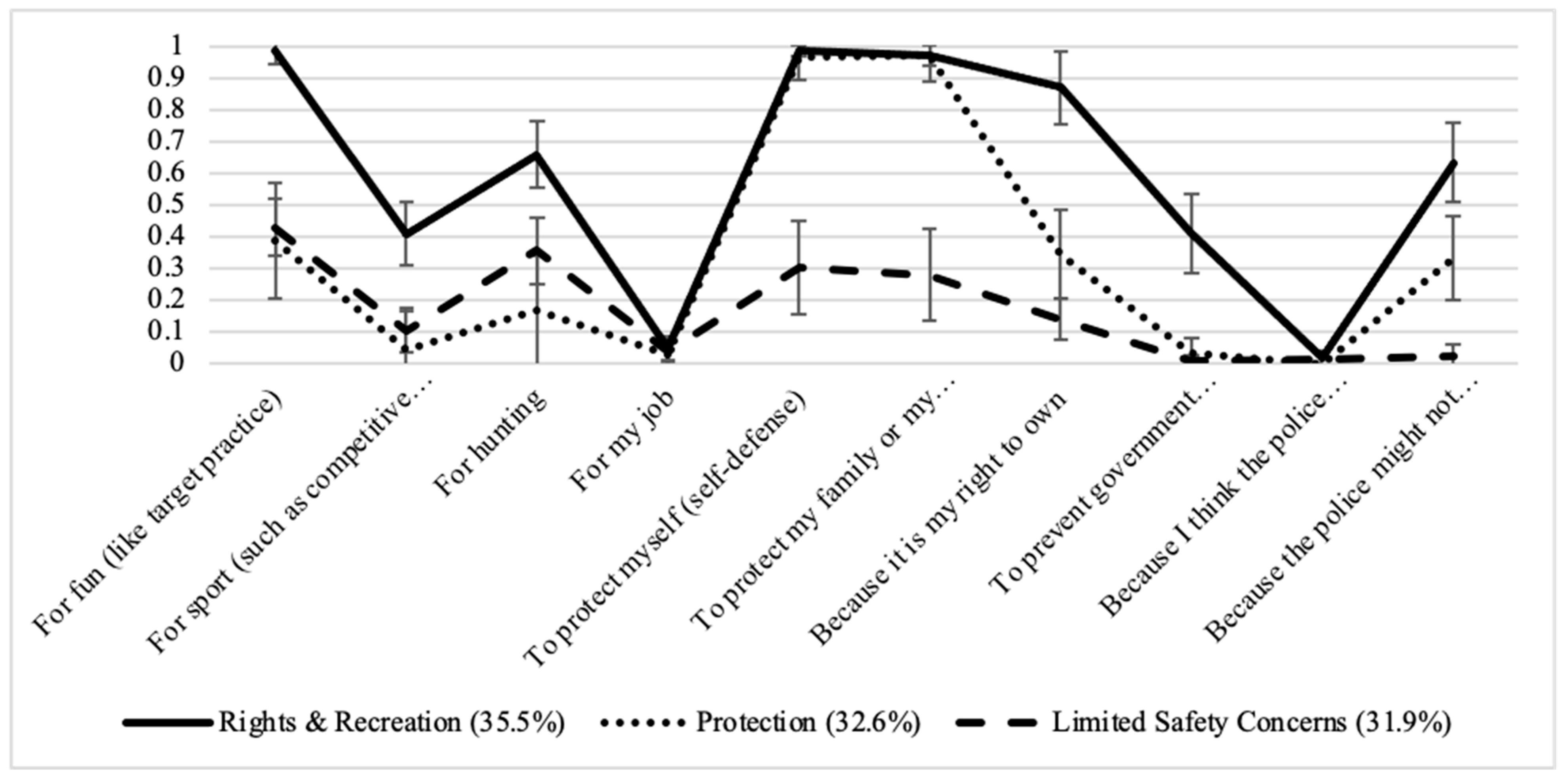
A series of LCAs were used to examine patterns of reasons for firearm ownership among adults, specifying between one and five classes (see Table 3). The three-class solution emerged as the best-fitting model according to model fit indicators. The LMR-LRT and VLMR-LRT indicated that the addition of a third class significantly improved model fit compared to the two-class solution. In addition, the BIC was at its lowest value for the three-class solution. The entropy statistic of 0.73 indicated adequate classification precision and accuracy. Figure 1 depicts the probability of endorsing each item by class. These results suggest a Rights & Recreation class (35.5%) where participants had a high probability (>.8) of endorsing ownership to exercise their right to own and prevent government overreach, as well as for recreational use; a Protection class (32.6%) where participants had a high likelihood (>.9) of endorsing ownership to protect themselves and others and a low probability of endorsing (<.4) any other reasons for ownership; and a Low Safety Concerns class (31.9%) where participants had a low probability (<.4) of endorsing all reasons for ownership. This class was most clearly differentiated from the prior two classes by the low probability of endorsing owning a firearm for the protection of themselves or others, and the belief that law enforcement might not stop crime.
Table 3.
Fit Indices for Unconstrained LCA Models with 1–5 Classes for Reasons for Firearm Ownership Among Adults.
Figure 1.
Patterns of Adults’ Reasons for Owning a Firearm. Note. N = 446.
Using the BCH technique, we examined associations between latent classes and frequency of firearm carrying and unsecured storage practices. Wald tests indicated no significant subgroup differences in frequency of carrying (χ2[2] = 0.08, p = .96). There were subgroup differences in storage methods. Specifically, compared to the Rights & Recreation and Protection classes, the Low Safety Concerns class was least likely to use unsecured storage methods (B = −2.11, p < .001 and B = −1.67, p < .001, respectively).
Differences in odds of class membership by sex, age, race, region, income level, number of firearms in the home were tested. Relative to female adults, male adults had higher odds of being in the Rights & Recreation class (OR = 1.74, p < .001). In contrast, the odds of being in the Protection class (OR = 1.60, p < .001) and Low Safety Concerns class (OR = 1.09, p < .001) were higher for female adults than male adults. White adults had higher odds of being in all classes compared to Hispanic adults (ORs 0.7 to 0.98, ps .007 to <.001). Black and Asian adults had higher odds of being in the Low Safety Concerns class compared to White adults (OR = 1.04, p = .009; OR = 2.55, p < .001, respectively). Black adults had higher odds of being in the Rights & Recreation class than White adults (OR = 4.40, p = .02).
Adults from the Northeast and Midwest had higher odds of being in the Protection (OR = 1.14, p = .003; OR = 1.04, p < .001, respectively) and Low Safety Concerns classes (OR = 1.21, p = .001; OR = 1.03, p = .001, respectively) compared to those from the West; and those from the West had higher odds of being in the Low Safety Concerns class than those from the South (OR = 1.34, p < .001). Compared to adults from the Northeast and Midwest, those from the West had higher odds of Rights & Recreation class membership (OR = 1.40, p = .002; OR = 1.27, p < .001, respectively); and adults from the South had higher odds of being in the Rights & Recreation and Protection classes than those from the West (OR = 1.14, p < .001; OR = 1.15, p < .001, respectively). Comparisons by income indicated that adults who made less than $30,000 annually had higher odds of being in the Protection class (OR = 1.14, p = .003) and the Low Safety Concerns class relative to those who made more than $30,000 annually. In contrast, those who made more than $30,000 annually had higher odds of being in the Rights & Recreation class (OR = 1.40, p = .002). Relative to adults who reported owning only one firearm, adults who owned multiple firearms had higher odds of being in the Rights & Recreation class (OR = 6.77, p = .02); and those who owned only one firearm had higher odds of being in the Low Safety Concerns class compared to those who owned multiple firearms (OR = 1.76, p = .02).
5.3. Patterns of Adults’ Methods of Firearm Acquisition
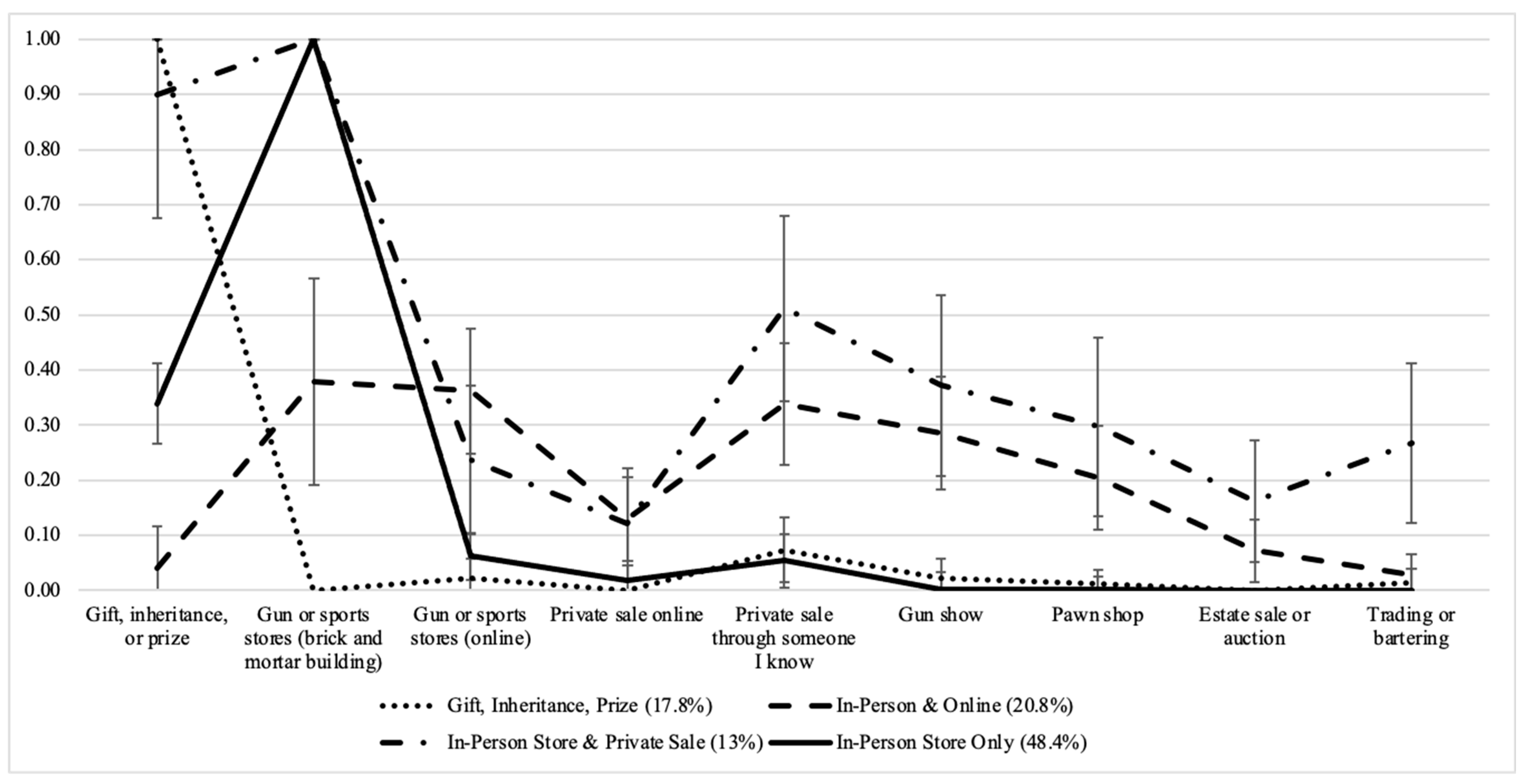
Next, LCAs were conducted to examine patterns of methods of acquisition among adults who own firearms, estimating models from one to five classes. Due to the low rate of endorsement, four items were excluded from these analyses (see Table 2 for rates by item). These items included “got it off the street,” “through my work or job,” “asked someone to buy it for me,” and “found or stolen.” The four-class solution provided the best fit when considering all indices (see Table 4). The LMR-LRT and VLMR-LRT indicated a significant improvement in model fit from the three-class solution to the four-class solution; there was not a significant improvement in model fit with the five-class solution. Though the BIC was lowest for the three-class solution, aBIC and AIC were lower for the four-class solution. An entropy of 0.83 supported classification precision and accuracy. Figure 2 depicts the probability of endorsing each item by class. The item endorsement patterns for the four-class solution yielded the following subgroups: Gun or Sports Stores Only (48.4%), In-Person & Online Purchase (20.8%), Gift, Prize, or Inheritance (17.8%), and Gun or Sports Stores & Private Sales (13%). In the Gun or Sports Store Only class, participants were characterized by a high probability of acquiring firearms at a brick-and-mortar gun or sports store (.99) with low probabilities of any other means of acquisition (.00 to .34). In the In-Person & Online Purchase class, participants reported similar probability of endorsing acquisition through brick-and-mortar gun or sports stores (.38) and online gun or sports stores (.36). In the Gift, Prize, or Inheritance class, participants were characterized by a high probability of only reporting having acquired a firearm as a gift, inheritance, or prize (.99). In the Gun or Sports Stores & Private Sales class, participants had high probability (.99) of purchase from brick-and-mortar stores and highest reports of private purchase (.51), gun shows (.37) and pawnshops (.30) compared to the other three classes.
Table 4.
Fit Indices for Unconstrained LCA Models with 1–5 Classes for Methods of Firearm Acquisition Among Adults.
Figure 2.
Adults’ Patterns of Method of Firearm Acquisition. Note. N = 466.
Using the BCH technique, we examined associations between latent classes and frequency of firearm carrying and unsecured storage practices. Each latent class was regressed on frequency of carrying. Wald tests indicated no significant subgroup differences in frequency of carrying (χ2[3] = 1.39, p = .71). There were significant subgroup differences in unsecured storage methods. Specifically, the In-Person & Online Purchase (B = 0.99, p = .01), Gun or Sports Stores & Private Sales (B = 1.39, p = .001), and Gun or Sports Stores Only (B = 0.87, p = .01) classes were more likely to endorse unsecured firearm storage than the Gift, Prize, or Inheritance class.
We then tested differences in odds of class membership by sex, age, race, region, income level, number of firearms in the home. Relative to female adults, male adults had higher odds of being in the Gift, Prize, or Inheritance class (OR = 1.01; p = .02); though conversely, the odds of being in the Gun or Sports Stores class was higher for female adults relative to male adults (OR = 2.02; p = .009). White adults, compared to Black and Hispanic adults, had higher odds of being in the In-Person & Online Purchase class (OR = 1.20, p = .04; OR = 1.96, p = .04). White adults, compared to Hispanic adults also had higher odds of being in the Gun or Sports Stores class (OR = 2.59, p = .01); though Black adults had higher odds of being in the Gun or Sports Stores class than White adults (OR = 1.41, p = .009). Black and Hispanic adults had higher odd than White adults of being in the Gift, Prize, or Inheritance class (OR = 1.61, p = .02; OR = 3.74, p = .007). No odds differences were observed by class for Asian adults.
Compared to adults from the West, adults from the Northeast had higher odds of being in the Gift, Prize, or Inheritance class and In-Person & Online Purchase class (OR = 1.65, p = .003; OR = 2.38, p = .001). Adults from the West had higher odds of being in the Gift, Prize, or Inheritance class and In-Person & Online Purchase class compared to those from the South (OR = 1.06, p = .001; OR = 1.45, p = .001); Adults from the West also had higher odds of being in the In-Person & Online Purchase class and Gun or Sports Stores & Private Sales class than those from the Midwest (OR = 1.04, p = .02; OR = 1.28, p = .001). Relative to adults from the West, those from the South had higher odds of being in the Gun or Sports Stores & Private Sales class and the Gun or Sports Stores class (OR = 1.31, p = .006; OR = 1.12, p < .001). Those from the Midwest had higher odds of being in the Gift, Prize, or Inheritance class and the Gun or Sports Stores class compared to adults from the West (OR = 1.15, p = .001; OR = 1.04, p < .001); though adults from the West had higher odds than those from the Northwest of being in the Gun or Sports Stores class (OR = 1.54, p = .001).
Comparisons by income indicated that adults who made less than $30,000 annually had higher odds of being in the Gift, Prize, or Inheritance class (OR = 1.65, p = .003) and the In-Person & Online Purchase class relative to those who made more than $30,000 annually (OR = 2.38, p = .003). In contrast, those who made more than $30,000 annually had higher odds of being in the Gun or Sports Stores class (OR = 1.54, p = .001). Compared to those who owned only one firearm, adults who owned more than one firearm had higher odds of being in the Gift, Prize, or Inheritance and Gun or Sports Stores & Private Sales classes (OR = 1.08, p = .03; OR = 5.21, p = .04, respectively); in contrast, adults with only one firearm had higher odds of being in the Gun or Sports Stores Only class compared to those who owned multiple firearms (OR = 1.52, p = .01).
6. Discussion
The purpose of this study was to develop a nuanced, community-informed understanding of firearm ownership motivations, perspectives on responsible ownership, and methods of firearm acquisition among adults and youth using a participatory action research approach. By examining both adult and youth samples, this study situates firearm ownership and acquisition within the broader social and household contexts in which youth are exposed to firearms. Consistent with prior research, our qualitative and quantitative findings identified protection and recreation as dominant motivations for firearm ownership (Azrael et al., 2018; Degli Esposti et al., 2024; Ward et al., 2024). Beyond replicating established patterns, this study extends the literature by (1) centering firearm owners’ own definitions of motivation and responsibility, (2) identifying emerging motivational profiles beyond protection and recreation, (3) characterizing diverse acquisition pathways across adult and youth samples, and (4) examining patterns of ownership motivations and acquisition strategies.
Our qualitative sample provided community-informed insights into the diverse and nuanced reasons individuals choose to own firearms, expanding beyond previously identified motivations. While themes such as protection of self and others and recreational use (e.g., hunting, sport shooting) aligned with established findings (Azrael et al., 2018; Degli Esposti et al., 2024; Ward et al., 2024), the empirical literature also highlights similar core motivations, such as self-protection, hunting, and family tradition, which influence firearm types and associated behaviors like storage practices (Boine et al., 2020, 2022; Wexler et al., 2023). For example, the latent class analysis identified a “Protection” class comprising primarily male owners motivated by safety of self and others, underscoring how personal concerns can intersect (Boine et al., 2022). Qualitative research with Native Alaskan adults further illustrates how cultural and contextual factors shape ownership, including subsistence hunting and community-based responsibility for safe firearm storage in the presence of mental health or substance use challenges (Wexler et al., 2023). While informative, much of this literature remains regionally or culturally specific and often relies on narrowly defined ownership motivations, which may overlook other meaningful reasons for firearm ownership (Boine et al., 2022; Schleimer et al., 2020). Our study builds on and broadens this work by emphasizing how motivations are deeply intertwined with individual and community-specific definitions of responsible ownership.
Additionally, the first two subgroups identified among firearm owners, Rights & Recreation and Protection, both corroborate and extend prior latent class analysis (LCA) research on ownership motivations. Previous studies have identified similar subgroups such as “family protection,” “protection against people,” “Second Amendment activism,” and “recreation,” as well as motivations related to responsible ownership like “safety of children” and “understanding the potential to cause harm” (Boine et al., 2020, 2022; Schleimer et al., 2020). Our findings advance this literature by capturing distinct motivational subgroups within these broader categories, highlighting important variations in how firearm owners conceptualize their reasons for ownership and providing deeper insight into the diversity of motivations that can inform tailored intervention strategies.
The third subgroup, Low Safety Concerns, represents a relatively underexplored segment of firearm owners characterized by low endorsement of protection- and rights-related motivations. Follow-up analyses revealed that individuals in this group were more likely to be female. This aligns with recent trends showing that women comprised nearly 50% of new firearm owners between 2019 and 2021 (Miller et al., 2022), and Asian American firearm purchases increased by over 40% during the early months of the COVID-19 pandemic (Liu et al., 2023). The latter increase has been hypothesized as a response to rising hate crimes and anti-Asian rhetoric during this period (Wu et al., 2022). This group was also more likely to make less than $30,000 annually and own only one firearm. These contextual factors suggest alternative motivations for ownership within the Low Safety Concerns subgroup, underscoring the need to consider under studied firearm-groups (e.g., first-time owners, women) and diverse sociocultural influences in understanding reasons for firearm ownership.
Patterns in reasons for ownership were associated with differences in firearm-related practices. The Protection group was most likely to endorse being most likely to own more than one firearm while the Low Safety Concerns subgroup was most likely to own only one firearm. Interestingly, there were no significant differences in the number of firearms owned for the Rights & Recreation. Further, the Rights & Recreation and Protection subgroups were most likely to store firearms unsecured. This may reflect functional considerations underlying ownership motivations. For individuals who own firearms primarily for protection against external threats, rapid accessibility may be prioritized over secure storage, as immediate access is perceived as essential for effective defensive use. Similarly, those motivated by rights-based beliefs may be less inclined towards restrictive storage practices if they perceive them as limiting autonomy or readiness. Interestingly, no differences were detected in rates of carrying for these groups. Notably, no significant differences were observed across subgroups in reported rates of firearm carrying. Such insights may inform the further investigation of the specific perspectives and behaviors of individuals who own multiple firearms in contrast with those who own just one firearm.
Our findings also identified a breadth of methods of acquisition among youth and adults. Different from prior acquisition studies, our qualitative and quantitative findings were derived from community samples rather than youth who are strictly juvenile system involved (Ash et al., 1996; Sheley & Wright, 1993; M. D. Smith, 1996; Webster, 2002). This resulted in considerable differences in reported methods of acquisition for youth in our sample. For example, previous literature has indicated juvenile system involved youth report acquiring firearms through illegal means such as “off the street” or via theft, while youth in this sample shared that they acquire firearms as gifts from family or from brick-and-mortar firearm stores. The majority of adults similarly reported their acquisition strategies as brick-and-mortar establishments (e.g., stores, pawn shops), which was reinforced by the LCA subgroup results. Three of the acquisition subgroups, Gift, Inheritance, or Prize, In-Person Store and Private Sale, and In-Person Store Only, indicated that adult firearm owners are likely to purchase firearms through traditional means, rather than informal methods (e.g., estate sale, trade and barter). These findings are comparable to those previously identified in a California-specific study where the most common means of firearm acquisition were firearm retailers or sport stores and family gifts (Kravitz-Wirtz et al., 2020). Qualitative interviews identified a unique acquisition strategy, online acquisition. To our knowledge, this is one of the first studies to consider online purchase as an aspect of firearm acquisition. One subgroup in the latent class analysis, In-Person and Online, provides further information about individuals who are likely to purchase a firearm online. These individuals engage in multiple in-person and online acquisition strategies.
Some differences were detected based on demographics and number of firearms owned by participants. The Gift, Prize, or Inheritance group had the highest odds of being male and Black or Hispanic. The Gun or Sports Stores group was most likely to be female and Black or White, and were the only group characterized by high odds of making more than $30,000 annually and owning only one firearm. The In-Person & Online Purchase group was characterized by high odds of being White and making less than $30,000 annually; however, this group did not differ significantly based on gender or number of firearms owned. Across the acquisition classes, region was highly variable—indicting differences in acquisition strategies may have less to do with regionality and more to do with annual income, sex, and gender, or another untested variable (e.g., urbanicity).
6.1. Limitations and Future Directions
Several limitations should be considered when interpreting these findings. First, the cross-sectional design limits the ability to assess temporal or causal relationships between firearm ownership motivations, acquisition strategies, and firearm-related practices. Longitudinal research is needed to examine how ownership motivations and related practices, such as storage and carrying, evolve over time. Prospective designs would also allow researchers to assess whether changes in adult ownership practices are associated with shifts in youths’ exposure to firearms or norms related to access and storage. Second, latent class analyses could not be conducted for the youth sample due to the relatively low prevalence of firearm ownership. Future studies with larger and more diverse youth samples are needed to examine whether youth exhibit distinct motivational or acquisition subgroups and how these patterns compare to those observed among adults. Such work, including that with first time firearm owners and women to better understand groups such as the Low Safety Concerns class, would strengthen understanding of shared and divergent firearm-related norms across developmental stages. Finally, although research staff were present to provide procedural support during survey administration, their presence in classroom settings may have influenced some youth responses due to social desirability concerns.
6.2. Implications and Conclusions
This study highlights the variety of motivations, acquisition pathways, and storage practices that characterize firearm ownership among adults and youth. Adult firearm ownership and acquisition behaviors constitute key social and household contexts in which youth encounter firearms. Understanding these contexts is essential for interpreting youth firearm access and storage-related practices without implying direct causal relationships. Implications for prevention and intervention efforts point to the importance of engaging adult firearm owners as partners in promoting responsible firearm ownership and adequately supervised youth access. Secure storage messaging may be more effective when it aligns with firearm owners’ own definitions of responsibility, such as protecting family members, maintaining firearm proficiency, and managing access within shared living spaces. Prior research suggests that approaches emphasizing care for loved ones and responsible stewardship resonate more strongly with firearm owners than prescriptive or punitive messaging (Betz et al., 2016).
Thus, future efforts to reduce firearm-related harm among youth should therefore consider strategies that leverage adult-defined norms and acquisition practices as points of engagement. Community-based and participatory approaches can help develop shared language around responsible ownership and foster trust between researchers, practitioners, and firearm-owning communities. Such approaches hold promise for informing culturally grounded interventions that promote secure storage, reduce injury risk, and support safe firearm practices across diverse social contexts.
Supplementary Materials
The supporting information can be downloaded at: https://www.mdpi.com/article/10.3390/youth6020063/s1.
Author Contributions
Conceptualization: C.S.W., K.R.M. and P.N.S.; Methodology: C.S.W., K.R.M. and P.N.S.; Validation: K.R.M. and P.N.S.; Formal analysis: C.S.W. and L.T.S.; Investigation: C.S.W., L.T.S., K.R.M. and P.N.S.; Resources: K.R.M. and P.N.S.; Data curation: L.T.S. and K.R.M.; Writing—original draft: C.S.W., J.N.C., L.T.S., S.T.M. and K.R.M.; Writing—review and editing: C.S.W., K.R.M., P.N.S. and C.C.; Visualization: C.S.W.; Supervision: K.R.M. and C.S.W.; Project administration: C.S.W.; Funding acquisition: K.R.M. and P.N.S. All authors have read and agreed to the published version of the manuscript.
Funding
This study was funded by a grant from the Centers for Disease Control and Prevention (CDC; R01CE003298; PIs: Mehari & Smith). The contents are those of the authors and do not necessarily represent the official views of, nor an endorsement by, the CDC or the U.S. Government. CDC had no role in the study design, data collection procedures, data analysis or interpretation, or writing of the report. During the completion of this work, Dr. Walsh was supported by a training grant from the National Institute of Mental Health (T32-MH18921) and a post-doctoral grant from the National Collaborative on Gun Violence Research; Ms. Stevens was supported by a training grant from the Eunice Kennedy Shriver National Institute of Child Health and Human Development (F31HD116419), respectively.
Institutional Review Board Statement
Ethical approval of this study was granted by University of South Alabama’s Institutional Review Board prior to any data collection (protocol code: 22-414 on 18 November 2022). Informed consent was obtained for anonymized participant information to be published in this article. The study was reviewed and approved by school district leaders in each of the participating school districts.
Informed Consent Statement
Informed consent was obtained from all subjects involved in the study.
Data Availability Statement
All data are available upon reasonable request from the corresponding author following a Data Use Agreement and IRB approval. The data are not publicly available due to privacy or ethical restrictions.
Acknowledgments
The authors thank the organizations and participants who agreed to participate as well as the advisory board members who guided the research questions, developed the recruitment strategy, and informed the interpretation of results.
Conflicts of Interest
The authors declare no conflicts of interest.
References
- Anestis, J. C., Anestis, M. D., Preston, O. C., & Rodriguez, T. R. (2021). Dispositional characteristics in firearm ownership and purchasing behavior during the 2020 purchasing surge. Social Science & Medicine, 289, 114408. [Google Scholar] [CrossRef] [Scilit]
- Anestis, M. D., & Bryan, C. J. (2021). Threat perceptions and the intention to acquire firearms. Journal of Psychiatric Research, 133, 113–118. [Google Scholar] [CrossRef] [Scilit] [PubMed]
- Ash, P., Kellermann, A., Fuqua-Whitley, D., & Johnson, A. (1996). Gun acquisition and use by juvenile offenders. JAMA: The Journal of the American Medical Association, 275(22), 1754. [Google Scholar] [CrossRef] [Scilit]
- Asparouhov, T., & Muthén, B. (2020). Comparison of models for the analysis of intensive longitudinal data. Structural Equation Modeling: A Multidisciplinary Journal, 27(2), 275–297. [Google Scholar] [CrossRef] [Scilit]
- Azrael, D., Cohen, J., Salhi, C., & Miller, M. (2018). Firearm storage in gun-owning households with children: Results of a 2015 national survey. Journal of Urban Health, 95(3), 295–304. [Google Scholar] [CrossRef] [Scilit]
- Betz, M. E., Azrael, D., Barber, C., & Miller, M. (2016). Public opinion regarding whether speaking with patients about firearms is appropriate. Annals of Internal Medicine, 165(8), 543–550. [Google Scholar] [CrossRef] [Scilit]
- Boine, C., Caffrey, K., & Siegel, M. (2022). Who are gun owners in the United States? A latent class analysis of the 2019 national lawful use of guns survey. Sociological Perspectives, 65(1), 35–57. [Google Scholar] [CrossRef] [Scilit]
- Boine, C., Siegel, M., Ross, C., Fleegler, E. W., & Alcorn, T. (2020). What is gun culture? Cultural variations and trends across the United States. Humanities and Social Sciences Communications, 7(1), 21. [Google Scholar] [CrossRef] [Scilit]
- Bond, A. E., Brooks, J. R., Rodriguez, T. R., Bandel, S. L., & Anestis, M. D. (2023). Examining characteristics and experiences of Black firearm owners. Journal of Clinical Psychology, 79(9), 2137–2154. [Google Scholar] [CrossRef] [Scilit] [PubMed]
- Cohen, J. (1960). A coefficient of agreement for nominal scales. Educational and Psychological Measurement, 20(1), 37–46. [Google Scholar] [CrossRef] [Scilit]
- Corbin, J. M., & Strauss, A. (1990). Grounded theory research: Procedures, canons, and evaluative criteria. Qualitative Sociology, 13(1), 3–21. [Google Scholar] [CrossRef] [Scilit]
- Crifasi, C. K., Ward, J. A., McGinty, E. E., Webster, D. W., & Barry, C. L. (2021). Gun purchasing behaviours during the initial phase of the COVID-19 pandemic, March to mid-July 2020. International Review of Psychiatry, 33(7), 593–597. [Google Scholar] [CrossRef] [Scilit] [PubMed]
- Cunningham, P. B., Henggeler, S. W., Limber, S. P., Melton, G. B., & Nation, M. A. (2000). Patterns and correlates of gun ownership among nonmetropolitan and rural middle school students. Journal of Clinical Child Psychology, 29(3), 432–442. [Google Scholar] [CrossRef] [Scilit]
- Degli Esposti, M., Sokol, R. L., Lee, D. B., Wiebe, D. J., Cunningham, R. M., Hawryszkiewycz, A., & Carter, P. M. (2024). Firearm ownership for protection in the USA, 2023: Results from a nationally representative survey. Injury Prevention: Journal of the International Society for Child and Adolescent Injury Prevention, 31(3), 257–261. [Google Scholar] [CrossRef] [Scilit]
- Kravitz-Wirtz, N., Pallin, R., Miller, M., Azrael, D., & Wintemute, G. J. (2020). Firearm ownership and acquisition in California: Findings from the 2018 California safety and well-being survey. Injury Prevention, 26(6), 516–523. [Google Scholar] [CrossRef] [Scilit]
- Laqueur, H. S., Kagawa, R. M. C., McCort, C. D., Pallin, R., & Wintemute, G. (2019). The impact of spikes in handgun acquisitions on firearm-related harms. Injury Epidemiology, 6(1), 35. [Google Scholar] [CrossRef] [Scilit]
- Liu, G. S., Nguyen, B. L., Lyons, B. H., Sheats, K. J., Wilson, R. F., Betz, C. J., & Fowler, K. A. (2023). Surveillance for violent deaths—National violent death reporting system, 48 states, the district of Columbia, and Puerto Rico, 2020. MMWR Surveillance Summaries, 72(5), 1–38. [Google Scholar] [CrossRef] [Scilit]
- Miller, M., Zhang, W., & Azrael, D. (2022). Firearm purchasing during the COVID-19 pandemic: Results from the 2021 national firearms survey. Annals of Internal Medicine, 175(2), 219–225. [Google Scholar] [CrossRef] [Scilit]
- National Center for Education Statistics. (n.d.). Concentration of public school students eligible for free or reduced-price lunch. Available online: https://nces.ed.gov/programs/coe/indicator/clb/free-or-reduced-price-lunch (accessed on 30 May 2022).
- NORC. (2024). AmeriSpeak panel technical overview. NORC at the University of Chicago. Available online: https://amerispeak.norc.org/content/dam/amerispeak/about-amerispeak/pdf/amerispeak-technical-overview.pdf (accessed on 5 May 2026).
- Nylund, K. L., Asparouhov, T., & Muthén, B. O. (2007). Deciding on the number of classes in latent class analysis and growth mixture modeling: A Monte Carlo simulation study. Structural Equation Modeling: A Multidisciplinary Journal, 14(4), 535–569. [Google Scholar] [CrossRef] [Scilit]
- Porfiri, M., Sattanapalle, R. R., Nakayama, S., Macinko, J., & Sipahi, R. (2019). Media coverage and firearm acquisition in the aftermath of a mass shooting. Nature Human Behaviour, 3(9), 913–921. [Google Scholar] [CrossRef] [Scilit] [PubMed]
- QSR International Pty Ltd. (2023). NVivo (Version 12) [Computer software]. Available online: https://www.qsrinternational.com/nvivo-qualitative-data-analysis-software/home (accessed on 5 May 2026).
- Schleimer, J. P., Kravitz-Wirtz, N., Pallin, R., Charbonneau, A. K., Buggs, S. A., & Wintemute, G. J. (2020). Firearm ownership in California: A latent class analysis. Injury Prevention: Journal of the International Society for Child and Adolescent Injury Prevention, 26(5), 456–462. [Google Scholar] [CrossRef] [Scilit]
- Sheley, J. F., & Wright, J. D. (1993). Motivations for gun possession and carrying among serious juvenile offenders. Behavioral Sciences & The Law, 11(4), 375–388. [Google Scholar] [CrossRef] [Scilit]
- Smith, M. D. (1996). Sources of firearm acquisition among a sample of inner-city youths: Research results and policy implications. Journal of Criminal Justice, 24(4), 361–367. [Google Scholar] [CrossRef] [Scilit]
- Smith, P. N., Cordell, C., Stevens, L. T., West, K., Morgan, S. T., Vallas, J., & Mehari, K. R. (2025). Project GRIP: An illustration of participatory action research with communities of people who own and use firearms. Psychological Reports, 128(1), 211–239. [Google Scholar] [CrossRef] [Scilit]
- Vermunt, J. K. (2010). Latent class modeling with covariates: Two improved three-step approaches. Political Analysis, 18(4), 450–469. [Google Scholar] [CrossRef] [Scilit]
- Ward, J. A., Valek, R. A., Jones, V. C., & Crifasi, C. K. (2024). Reasons for gun ownership among demographically diverse new and prior gun owners. American Journal of Preventive Medicine, 67(5), 730–739. [Google Scholar] [CrossRef] [Scilit]
- Webster, D. W. (2002). How delinquent youths acquire guns: Initial versus most recent gun acquisitions. Journal of Urban Health: Bulletin of the New York Academy of Medicine, 79(1), 60–69. [Google Scholar] [CrossRef] [Scilit] [PubMed]
- Weller, B. E., Bowen, N. K., & Faubert, S. J. (2020). Latent class analysis: A guide to best practice. Journal of Black Psychology, 46(4), 287–311. [Google Scholar] [CrossRef] [Scilit]
- Wexler, L., Apala Flaherty, A., Begum, F., White, L., Kouassi, L., Wisnieski, D., Davis, A., & Ewell Foster, C. (2023). Describing meanings and practices related to firearms, safety, and household storage in rural Alaska Native communities. Journal of Rural Mental Health, 47(1), 30–40. [Google Scholar] [CrossRef] [Scilit]
- Wolfson, J. A., Azrael, D., & Miller, M. (2020). Gun ownership among US women. Injury Prevention, 26(1), 49–54. [Google Scholar] [CrossRef] [Scilit]
- Wu, T.-Y., Hsieh, H.-F., Chow, C. M., Yang, X., Resnicow, K., & Zimmerman, M. (2022). Examining racism and firearm-related risks among Asian Americans in the United States during the COVID-19 pandemic. Preventive Medicine Reports, 27, 101800. [Google Scholar] [CrossRef] [Scilit]

Disclaimer/Publisher’s Note: The statements, opinions and data contained in all publications are solely those of the individual author(s) and contributor(s) and not of MDPI and/or the editor(s). MDPI and/or the editor(s) disclaim responsibility for any injury to people or property resulting from any ideas, methods, instructions or products referred to in the content. |
© 2026 by the authors. Licensee MDPI, Basel, Switzerland. This article is an open access article distributed under the terms and conditions of the Creative Commons Attribution (CC BY) license.