Article

Digital Technology Use, Mental Health, and Academic Performance Among University Students: The Moderating Role of Age and Sex

by
Maria Natividad Elvira-Zorzo
1,*,
Miguel Ángel Gandarillas
2,* and
Gabriela Alicia Pica-Miranda
3
1
Department of Social Psychology and Anthropology, Faculty of Psychology, University of Salamanca, Av. de la Merced 109, 37005 Salamanca, Spain
2
Department of Social, Work and Differential Psychology, Faculty of Psychology, Complutense University of Madrid, 28223 Pozuelo de Alarcón, Spain
3
Office of the Vice Rector for Academic Affairs, General Directorate of Academic Affairs, University of the Americas, Santiago 7500975, Chile
*
Authors to whom correspondence should be addressed.
Youth 2026, 6(2), 62; https://doi.org/10.3390/youth6020062
Submission received: 11 December 2025 / Revised: 17 April 2026 / Accepted: 3 May 2026 / Published: 9 May 2026

Abstract

The increasing use of digital technologies (DT) among university students has raised concerns about their associations with mental health (MH) and academic performance. Grounded in the Diversity in Learning (DinL) framework, this cross-sectional study examines how age and sex moderate the relationships between DT use, MH indicators, learning-related psychological difficulties, and academic outcomes. Data were collected through an online questionnaire administered to 4519 university students in Chile. The survey included self-reported measures of MH indicators and learning-related psychological difficulties (bad mood/irritability, anxiety, lack of motivation, attentional difficulties, and low achievement expectations), as well as academic performance and frequency of use of digital tools (social media, smartphones, gamification and collaboration applications, and asynchronous classes). Descriptive analyses, ANOVAs, and multiple regression models were employed. Results showed that younger students reported more frequent use of gamification apps, social media, and smartphones, as well as higher levels across all mental health issues and learning-related psychological difficulties. Social media use and particularly smartphone use emerged among the DT variables as the strongest predictors of MH problems and learning difficulties, with age significantly moderating these relationships. These predictors were significant for both young female and male students, although stronger associations were observed among females. Female students reported higher levels of MH problems (especially anxiety), as well as greater use of social media and smartphones. However, neither social media use nor smartphone use showed a consistent negative relationship with academic performance. Overall, these findings highlight the importance of considering age and sex differences when examining the links between digital engagement and student well-being. They also underscore the need for targeted interventions to promote healthier digital habits and emotional regulation strategies, particularly among higher-risk groups.

1. Introduction

Youth well-being transcends the mere absence of illness, representing a multidimensional state that integrates biological, psychological, and social factors. It manifests through self-awareness, functionality, productivity, and active community participation (World Health Organization, 2014, 2024). In higher education, mental health (MH) issues among university students—including anxiety, depression, and attention difficulties—have become an increasing concern. Assessing MH in educational settings is crucial, as it directly impacts students’ learning, academic performance, and overall quality of life (Poorolajal et al., 2017; Tran et al., 2017).
Evidence suggests a consistent increase in MH-related problems among university students over the past two decades (e.g., Lipson et al., 2019; Tan et al., 2023; Haidt, 2024). Cognitive and emotional challenges, combined with psychosocial stressors, tend to intensify in the absence of early, comprehensive interventions (January et al., 2018; Tian-Ci Quek et al., 2019; Mirza et al., 2021). Studies in different countries report disproportionately high rates of psychological distress, especially among younger cohorts, underscoring the need to investigate associated factors, including digital technology (DT) use (e.g., Del Valle et al., 2020; Heritage et al., 2023; Khalil et al., 2020; Lew et al., 2019).
Within this context, analyzing psychosocial risk factors linked to learning patterns has become essential for understanding educational diversity, challenges and difficulties. The construct of Diversity in Learning (DinL) integrates learning patterns and MH issues, alongside cognitive, emotional, contextual, and psychosocial factors, offering a holistic framework for understanding the diversity of student experiences and outcomes (Gandarillas et al., 2025). Recent research within this paradigm shows that factors such as sex are significantly related to students’ MH and academic performance (Elvira-Zorzo et al., 2025). By placing DT use within the DinL paradigm, the present study analyzes how age and sex moderate the relationships between DT, MH, and learning-related psychological difficulties.

1.1. Digital Technology and Mental Health in University Students

The use of DT has become a central factor influencing both the well-being and academic performance of university students. The rapid development of these tools raises concerns regarding students’ ability to integrate them healthily into daily life. Paradoxically, technologies designed to facilitate learning and well-being may also contribute to psychological distress (Duke & Montag, 2017; Forman & Van Zeebroeck, 2019). In this study, DT use refers to the frequency with which students interact with digital devices and platforms relevant to their academic and daily activities, here including smartphones, social media, collaborative applications, gamified learning tools, and asynchronous learning environments.
Habitual DT use is not inherently negative; its relationship with MH depends on type, intensity, and context. While digital educational platforms can promote learning and inclusion, multiple studies indicate that heavy smartphone and social media use is associated with anxiety, low motivation, attention difficulties, bad mood/irritability related to academic work, and low achievement expectations (e.g., Akram & Kumar, 2017; Carter et al., 2024; Elsayed, 2021; Erceg et al., 2018; Hamdi, 2018; Li et al., 2024; Perlis et al., 2025; Wolfers et al., 2020). These associations are not uniform but vary according to demographic factors such as age and sex (e.g., Fassi et al., 2024; Gao & Gao, 2024; Nagata et al., 2025; Priftis & Panagiotakos, 2023; Twenge & Martin, 2020).
Conversely, digital interventions targeting MH can effectively reduce symptoms of depression and anxiety while improving psychological well-being (Ferrari et al., 2022; Harith et al., 2022; Lattie et al., 2019; Matos Fialho et al., 2025). Furthermore, the development of digital skills has been identified as a protective factor promoting resilience, social support, and academic self-efficacy, particularly following the COVID-19 pandemic (Cassaretto et al., 2024; X. Wang et al., 2021).
Overall, the literature demonstrates both positive and negative associations between DT use and university students’ MH (Emily et al., 2019; Gandarillas et al., 2024). The COVID-19 pandemic further accelerated the transition to fully online learning environments (Suárez et al., 2022). This complexity suggests that the relationship between DT use and student well-being is influenced by psychosocial, cognitive, and environmental factors. The DinL framework employed in this study enables these factors to be considered in a holistic manner.

1.2. Age in the Relationship Between Digital Technology Use and Mental Health

Surveys in different countries indicate that younger individuals tend to use smartphones and social media more frequently than older cohorts (Horwood et al., 2021; J. C. Wang et al., 2023; Wenz & Keusch, 2023). This higher usage among youth may be attributed to both generational and developmental factors. From a developmental perspective, young students—particularly those in the first years of university—are transitioning from adolescence to emerging adulthood, a period characterized by identity formation, autonomy seeking, and social adaptation (Arnett, 2000). This stage is inherently associated with greater vulnerability to stress, anxiety, and depressive symptoms (Elhai et al., 2017; Kessler et al., 2005).
Problematic DT use may amplify these vulnerabilities through disrupted sleep, increased rumination, and attentional interference (World Health Organization Regional Office for Europe, 2025; Rudolf & Kim, 2024). Studies report that younger groups experience higher levels of anxiety, depression, impulsivity, and attention difficulties related to problematic smartphone and social media use (Dhir et al., 2018; Elhai et al., 2017; Fassi et al., 2024; Gao & Gao, 2024; Priftis & Panagiotakos, 2023; Sales et al., 2021). This susceptibility may also be driven by heightened sensitivity to social comparison and peer evaluation (Nagata et al., 2025; Twenge & Martin, 2020). Conversely, older students may possess more developed coping strategies and time-management skills, buffering the impact of digital overload (Fassi et al., 2024). However, other studies provide inconclusive evidence regarding the direct impact of intensive social media use, noting that effects depend heavily on the type and frequency of use and individual factors (Ferguson et al., 2024). These discrepancies underscore the need to further examine age as a moderator to design age-appropriate interventions.

1.3. Female–Male Differences in Digital Technology and Mental Health

Sex differences in MH are well documented. Female university students generally exhibit greater vulnerability to depression and anxiety, despite often achieving higher academic performance than their male counterparts (Nolen-Hoeksema, 2012; Steel et al., 2014; Voyer & Voyer, 2014). Females also report higher perceived stress and more frequent use of social and emotion-focused coping strategies, whereas males more frequently employ instrumental or distraction-based strategies (Graves et al., 2021; Inzunza Melo et al., 2020). These differences in emotional regulation may explain broader disparities in psychopathology (Zimmermann & Iwanski, 2014).
Intensive use of smartphones and social media has been consistently associated with poorer MH outcomes, with these relationships appearing stronger in young women (Agyapong-Opoku et al., 2025; Shannon et al., 2022). Longitudinal research suggests that intensive digital use and early exposure predict later depressive symptoms more strongly in females, likely due to heightened sensitivity to interpersonal dynamics and online social comparisons (Nagata et al., 2025; Song et al., 2025; Twenge & Martin, 2020; J. C. Wang et al., 2023). Proposed mechanisms for this higher impact in young females include:
  • Patterns of use and content exposure: Females spend more time on social or aesthetic platforms, engaging in passive browsing and appearance-focused comparisons, increasing vulnerability to internalizing symptoms (Odgers & Jensen, 2020).
  • Emotional processing: A greater propensity to ruminate following online conflicts or social exclusion (Rudolf & Kim, 2024).
  • Sleep and cognitive disturbances: Frequent nighttime smartphone use is associated with poorer sleep quality, partially mediating anxiety and depression (World Health Organization Regional Office for Europe, 2025).
Regarding academic performance, findings remain mixed. While heavy smartphone use (particularly multitasking) is generally associated with lower grades (J. C. Wang et al., 2023), the magnitude of this effect varies. Some studies suggest that the association between smartphone addiction and academic difficulties is stronger in females due to socio-emotional dependence (Song et al., 2025), whereas large-scale studies report modest sex moderation once contextual factors are controlled (Odgers & Jensen, 2020). Shared stressors such as academic workload and financial strain contribute to MH issues in both sexes, potentially narrowing the differential impact of DT use (Hu & Yeo, 2020).

1.4. Age, Sex, and Digital Behavior in Mental Health: The Present Study

This study examines how sex and age moderate the impact of DT use on MH, learning-related psychological difficulties, and academic performance among university students. By expanding the DinL construct to DT, we aim to identify predictors of MH and academic outcomes to provide evidence-based guidance for student well-being and inclusion in higher education.
Despite the growing literature, significant gaps remain. Much research examines isolated behaviors (such as social media use) without considering the broader ecosystem of technologies in academic contexts, including for instance collaborative platforms and gamified applications. Furthermore, few studies use large, diverse samples that enable detailed analysis of age differences within student groups. Additionally, sex and age are rarely examined simultaneously as moderators of both MH and learning difficulties, limiting our understanding of subgroup differences.
To address these limitations, the present study analyzes associations between various forms of DT use and MH outcomes, learning-related psychological difficulties and academic performance in a large university sample, explicitly examining the moderating roles of sex and age. This approach enables the identification of differentiated patterns of risk and protection, offering insights for targeted interventions and educational strategies.

1.5. Hypotheses

  • H1: Younger students will report higher levels of digital technology (DT) use (social media, smartphones, gamified learning tools and collaborative applications, and asynchronous learning environments) as well as greater mental health (MH) and learning-related psychological difficulties (anxiety, irritability/bad mood, lack of motivation, attentional difficulties, and low achievement expectations) than older students.
  • H2: Age will moderate the relationship between DT use and MH issues, learning-related psychological difficulties and academic performance, with stronger negative associations among younger students.
  • H3: Young female students will report greater social media and smartphone use, higher levels of MH issues, learning-related psychological difficulties, and better academic performance than young male students.
  • H4: Frequency of DT use will be a stronger predictor of MH issues, learning-related psychological difficulties and academic performance in young women than in young men.

2. Materials and Methods

2.1. Sample

The initial sample comprised 4519 university students from the University of the Americas (Chile), with proportional representation across all academic disciplines, including social sciences, humanities, arts, health and natural sciences, technology, engineering, and mathematics. For analyses focusing on younger participants, a sub-sample of 2823 students under 25 years old was selected. This sub-sample was defined based on the concept of emerging adulthood (Arnett, 2000) and the United Nations’ definition of youth (United Nations, n.d.) and consisted of 69% female and 31% male participants.

2.2. Instrument

Data were collected via an online questionnaire (see Appendix A), including selected items from the DinL scale. The DinL is a self-administered instrument designed to assess diverse psychosocial and psychoeducational learning patterns in the classroom and has demonstrated robust psychometric properties (Gandarillas et al., 2025).
Items related to MH and learning-related psychological difficulties were selected based on their established sensitivity to problematic DT use in previous research. These items assess the extent to which the following factors hindered students’ learning: bad mood/irritability, anxiety/nervousness, lack of motivation/apathy, attention and concentration difficulties, and low academic achievement expectations. Items were scored on a 4-point Likert scale (1 = not at all/very little to 4 = a lot). These items capture self-reported perceptions of psychological states within learning environments. Single-item indicators were employed to reduce respondent burden and enhance survey feasibility in a large-scale study. Although multi-item scales are generally preferred for capturing complex latent constructs, prior methodological research supports the use of single-item measures when the construct is unidimensional, clearly defined, and intended to capture overall perceptions rather than nuanced subcomponents (Diamantopoulos et al., 2012; Fisher et al., 2016; Wanous et al., 1997). In the present study, these items are not intended to provide clinical assessments but rather to capture students’ subjective perceptions of psychological discomfort within the learning context (e.g., anxiety, irritability, lack of motivation, and attentional difficulties).
Additionally, five items assessed the frequency of use of common digital tools in learning (1 = never/almost never to 4 = very often): gamification apps (e.g., Kahoot!), online collaboration apps, asynchronous online classes, social media (e.g., WhatsApp, TikTok, X), and smartphone use. Smartphone use was assessed by asking, “How many hours per day do you use your smartphone for any purpose?” with six response categories ranging from “less than an hour” to “more than 8 h.” This variable was treated as ordinal and analyzed as continuous in regression analyses.
Finally, the questionnaire collected data on academic performance (self-reported average grades from the previous year), age, and biological sex. The item ‘biological sex’ was used instead of ‘gender’ in order to examine the extent to which biological sex may be built into sex stereotypes, explaining the results.

2.3. Design and Procedure

The present study employed a cross-sectional design, with the questionnaire administered online. Participation was entirely voluntary, and all participants were assured of complete confidentiality and anonymity. Written informed consent was obtained from all participants. The study was conducted in accordance with the ethical principles of the Declaration of Helsinki (World Medical Association, 2013) and approved by the Ethical Committee of the Complutense University of Madrid (ref. no. CE_20211118-15_SOC).
The research variables were defined as follows:
Independent variables (IVs):
  • Use of digital technologies: Frequency of use of five types of digital tools in learning.
  • Age: Considered as a moderator in all analyses, grouped into four categories (18–19, 20–24, 25–30, >30 years) to test age differences, and treated as a continuous variable in multiple regression analyses.
  • Biological sex: Analyzed as a moderating variable in the sub-sample of young students (<25 years), comparing females and males.
Dependent variables (DVs):
  • MH indicators and learning-related psychological difficulties: Anxiety; bad mood/irritability; lack of motivation (apathy/discouragement/reluctance); attention difficulties; low expectations of academic achievement.
  • Academic performance: Average grades from the previous year (self-reported).

2.4. Data Analysis

Cases with more than 5% missing data or with incorrect responses (e.g., random responses or obvious errors) were excluded from the study. The final dataset comprised 4519 cases. Additionally, a sub-sample of students under 25 years old (n = 2823) was selected, in accordance with the age range defined by the United Nations (n.d.) as young and consistent with the emerging adulthood framework proposed by Arnett (2000). Descriptive analyses were conducted to assess means, standard deviations, skewness, and kurtosis of all items. Pearson correlations were subsequently computed among all study variables.
To test hypotheses regarding age (H1 and H2), the full sample was utilized. One-way analyses of variance (ANOVAs) were conducted with MH indicators, learning-related psychological difficulties, frequencies of DT use, and academic performance as dependent variables (DVs), and age groups as independent variables (IVs). Four age groups were defined to maintain comparable group sizes: (1) 18–19 years, (2) 20–24 years, (3) 25–30 years, and (4) over 30 years. Effect sizes were estimated using omega squared (ω2, fixed effects), as this measure provides a less biased estimate of the magnitude of group differences in fixed-effects designs.
Linear forward stepwise multiple regressions were conducted using frequencies of DT use as predictors of MH indicators, learning-related psychological difficulties, and academic performance. The potential moderating effect of age on the associations between DT use and study outcomes was examined. Interaction terms between primary predictors and the moderating variable were subjected to regression model testing. Variables were entered sequentially, with the inclusion criterion of p < 0.05. This procedure allowed identification of the most relevant predictors, producing a parsimonious model. Effect sizes were calculated using Cohen’s f2. Significant interactions between age and DT use on MH indicators are illustrated in graphical form.
To test hypotheses regarding sex differences in young students (H3 and H4), the sub-sample of students under 25 years old was analyzed. One-way ANOVAs were conducted with MH indicators, learning-related psychological difficulties, frequency of DT use, and academic performance as DVs, and sex as IV. Effect sizes were also estimated using omega squared (ω2, fixed effects). Linear multiple regressions (forward selection) were performed separately for female and male students, using the same inclusion criterion as above (p < 0.05), with DT use as predictors and MH indicators, learning-related difficulties, and academic performance as DVs. Effect sizes were calculated using Cohen’s f2.
Statistical analyses were performed using IBM SPSS Statistics version 31 (IBM Corp., Armonk, NY, USA) and R version 4.4.1 (R Foundation for Statistical Computing, Vienna, Austria).

3. Results

3.1. Descriptive Analyses and Correlations

Table 1 shows the descriptive statistics for the variables included in the study. The indices of skewness and kurtosis yielded values within the ±1.10 range, suggesting that the data did not deviate severely from normality and were suitable for parametric statistical analysis (Mardia, 1970).
Table 2 presents Pearson correlations among the study variables. Significant positive associations were observed among all MH indicators and learning-related psychological difficulties. Smartphone use was positively associated with psychological distress variables, whereas age was negatively associated with these variables. Similarly, frequency of smartphone use (hours per day) was the DT most positively associated with all indicators of distress (e.g., with anxiety, r = 0.12, p < 0.001). Age was negatively correlated with all indicators of MH issues and learning-related psychological difficulties at significant levels.

3.2. Differences According to Age Groups

Analyses of variance (Table 3) revealed statistically significant differences across age groups for all MH indicators, learning-related psychological difficulties, and DT use. Omega squared (ω2) values ranged from small to medium, indicating that group differences were modest but meaningful, although a few effects were very small.
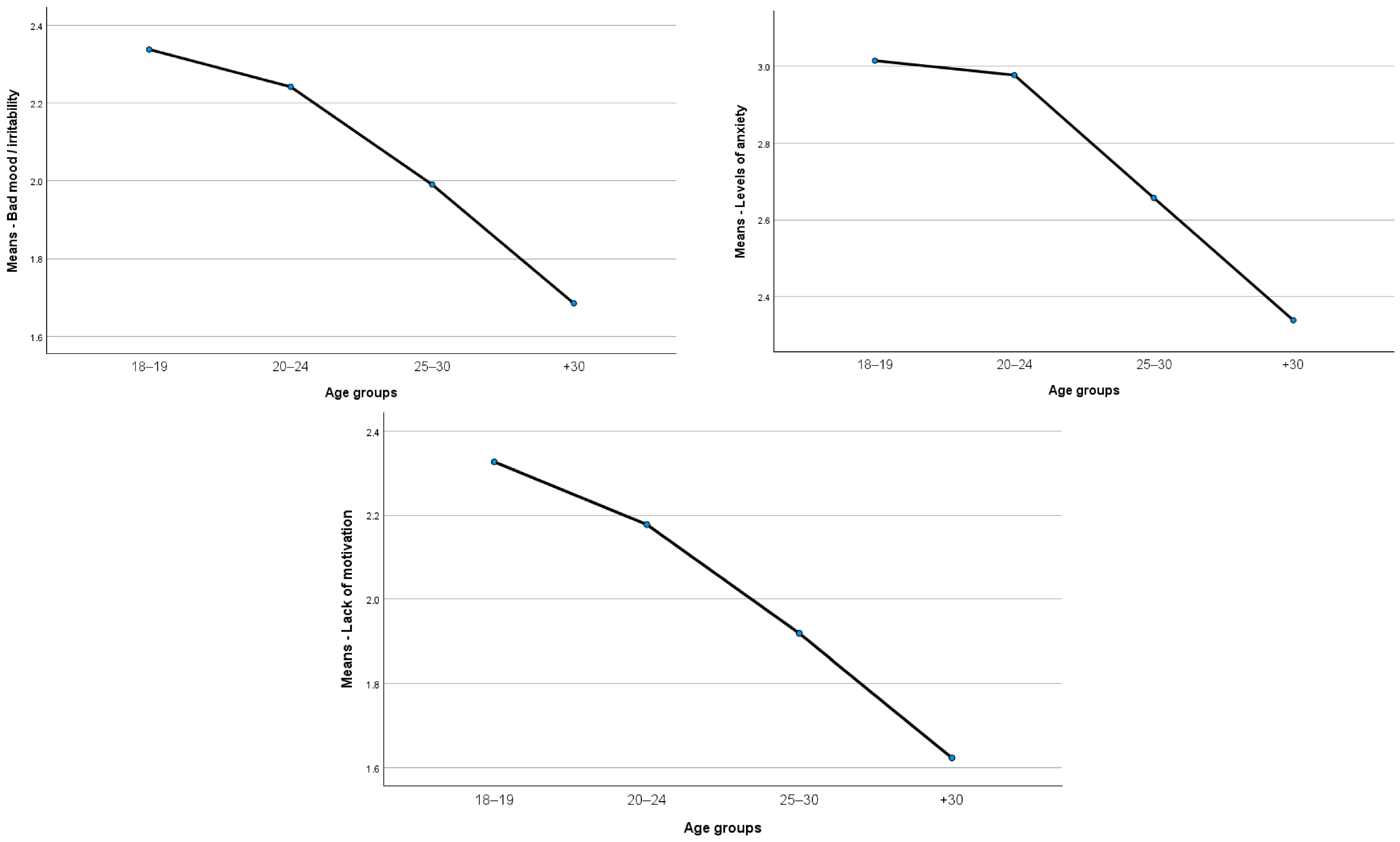
The youngest students (18–19 years old) exhibited the highest levels of anxiety (M = 3.02), bad mood/irritability (M = 2.34), lack of motivation (M = 2.33), and attention difficulties (M = 2.64), along with the lowest achievement expectations (M = 2.00). In contrast, participants over 30 years old reported significantly lowest levels across all MH and psychological difficulty indicators (p < 0.001 for all measures). This downward trend in psychological distress and learning difficulties remained consistent across intermediate age groups. Figure 1 illustrates these trends for the most significant indicators.
Regarding technology use, the youngest students reported the most frequent use of social media (M = 3.32) and smartphones (M = 4.15 h/day), whereas participants over 30 years old reported more moderate usage (M = 2.93 and M = 3.69 h/day, respectively; p < 0.001). Similar to the MH distress indicators, social media and smartphone use demonstrated a consistent decline across increasing age cohorts.
In contrast, academic performance displayed a significant trend in the opposite direction: despite reporting higher levels of distress, younger students achieved higher average grades compared to older students (F = 103.33, p < 0.001).

3.3. Multiple Regression Analyses with Age as a Moderator

Table 4 presents the results of multiple regression models examining the relationships between frequencies of different types of DT as predictors and MH issues, learning-related psychological difficulties, and academic performance as dependent variables. The R2 ranged from 0.05 to 0.10. The corresponding effect sizes, calculated using Cohen’s f2, ranged from 0.05 to 0.11, indicating small to approaching medium effects, according to conventional benchmarks.
The regression models demonstrated that the frequency of smartphone use was the most consistent predictor of all indicators of psychological distress and learning-related difficulties. Furthermore, the frequency of social media use was significantly positively associated with elevated levels of all MH and learning-related psychological indicators excepting lack of motivation, with the strongest effect observed for anxiety.
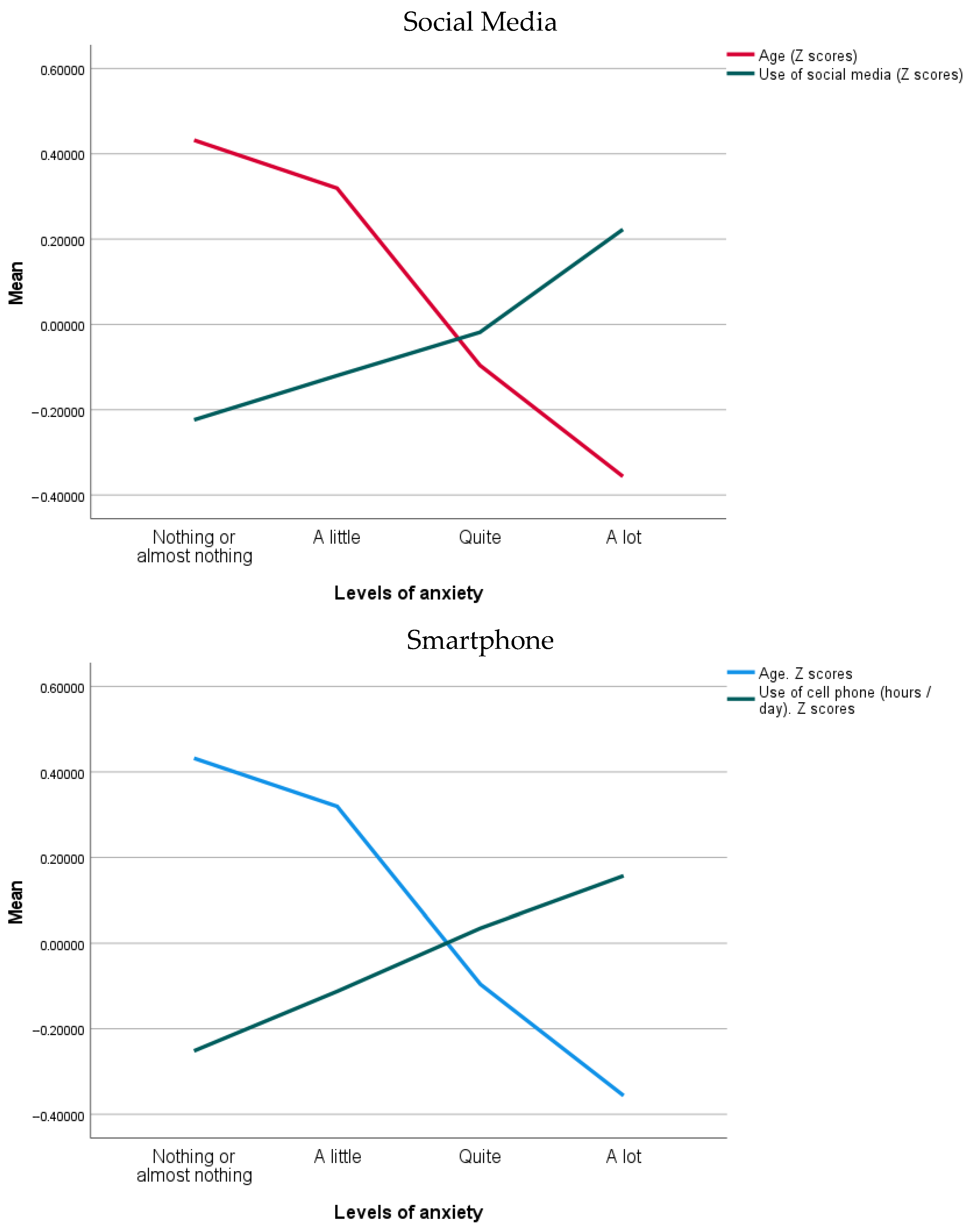
The interaction between age and frequency of smartphone use was significant in predicting most MH and learning-related difficulties, indicating that the negative impact of smartphone use on psychological distress decreases with age. Figure 2 illustrates the interactions between age and frequency of social media and smartphone use for the case of anxiety. Regarding academic performance, a different pattern emerged. Gamification applications were the strongest significant predictor of grades (p < 0.001), with a positive effect that was reversed by the moderating influence of age.

3.4. Differences Between Young Female and Male Students

In the subgroup of young students (under 25 years old), the ANOVA analyses (Table 5) revealed statistically significant differences between groups, with omega squared (ω2) values ranging from 0.000 to 0.022.
Female students reported significantly higher levels of bad mood/irritability, anxiety and attention difficulties compared to male students. No significant sex differences were observed in motivation or achievement expectations. Female students also reported more frequent use of asynchronous online classes, social media and smartphones. In contrast, male students reported significantly greater use of collaborative tools than female students. Regarding academic performance, female students reported higher grades than male students.

3.5. Differential Predictors by Sex

Table 6 presents the results of multiple regression models examining the relationships between frequency of different types of DT use as predictors and MH issues, learning-related psychological difficulties and academic performance as dependent variables, analyzed separately for females and males. The R2 values range from 0.01 to 0.03, with Cohen’s f2 values between 0.01 and 0.03, indicating small effect sizes.
The regression analyses revealed distinct predictive patterns in the young female and male groups. Among female students, smartphone use emerged as the strongest predictor of anxiety, bad mood/irritability, and lack of motivation (p < 0.001). Additionally, social media use contributed significantly to higher levels of anxiety. Among male students, both smartphone and social media use significantly predicted anxiety and bad mood/irritability, although with lower coefficients and Fs values than those observed in the female subsample.
Regarding academic performance, a different pattern emerged. For both female and male students, the use of gamification apps was the primary significant positive predictor of higher grades. However, social media use was a moderately significant predictor for female students but not for male students. Smartphone use did not reach statistical significance as a predictor of academic performance in either group.

4. Discussion

The results of this study provide strong support for the first hypothesis. A clear and consistent trend was observed across all age groups: younger students reported higher levels of bad mood/irritability, anxiety, lack of motivation, attentional difficulties, and lower achievement expectations, whereas older students exhibited progressively lower scores on these indicators. This pattern highlights age as a key factor influencing MH outcomes in university populations. These findings are consistent with previous research indicating that younger students experience greater MH challenges (Elhai et al., 2017; Kessler et al., 2005; Steel et al., 2014; Tan et al., 2023). In addition, prior studies have consistently shown a higher frequency of social media and smartphone use among younger cohorts (Elsayed, 2021; Gao & Gao, 2024; Fassi et al., 2024). Interestingly, despite reporting higher levels of distress, younger students achieved higher average grades than older students, suggesting that psychological difficulties do not necessarily translate into reduced academic performance.
The second hypothesis was also supported. The frequency of social media and smartphone use significantly predicted MH issues and learning-related psychological difficulties; specifically, higher usage was associated with increased anxiety, attentional difficulties, and reduced motivation. These findings align with previous literature linking intensive digital engagement to poorer psychological outcomes (Duke & Montag, 2017; Dhir et al., 2018; Tan et al., 2023). Notably, age emerged as a significant moderating factor. The results suggest that the negative association between those DT tools and MH weakens with increasing age. This moderating effect indicates that older students may either be less exposed to problematic digital use patterns or may have developed more effective coping and self-regulation strategies (Ferrari et al., 2022; X. Wang et al., 2021). While generational differences in early exposure to smartphones may partly explain these findings, age-specific psychosocial demands and developmental processes are also likely to play an important role (Horwood et al., 2021). Future longitudinal research is needed to disentangle these mechanisms.
Sex-based analyses partly supported the third hypothesis. Young female students reported significantly higher levels of anxiety, irritability, and attentional difficulties than males, while also achieving higher academic performance. This pattern is consistent with prior research documenting sex differences in MH, emotional regulation, coping strategies, and stress vulnerability (Nolen-Hoeksema, 2012; Steel et al., 2014; Graves et al., 2021; Méndez et al., 2002). Additionally, female students reported more frequent use of both social media and smartphones. Despite experiencing higher levels of psychological distress, female students demonstrated better academic outcomes, suggesting the presence of compensatory mechanisms such as greater academic engagement or more effective coping strategies. This interpretation is consistent with previous findings indicating that female students may sustain higher academic performance despite increased emotional burden (Elvira-Zorzo et al., 2025).
Regarding the fourth hypothesis, the results indicate that social media and smartphone use were stronger predictors of MH issues and learning-related difficulties among females than males. This finding supports previous research on gendered patterns of digital engagement and emotional processing, particularly in relation to social comparison and rumination processes (Inzunza Melo et al., 2020; Herrera et al., 2020; Martínez et al., 2019; Zimmermann & Iwanski, 2014). In contrast, other forms of DT (such as collaboration applications, asynchronous learning platforms, and gamification tools) showed minimal or slightly positive associations with MH and learning outcomes. This suggests that the impact of digital engagement is not uniform but depends on the type, purpose, and context of use (Ferrari et al., 2022; Matos Fialho et al., 2025).
The findings regarding academic performance were more nuanced. Although DT use was associated with psychological distress, its effects on academic achievement were limited. Gamification tools were positively associated with performance in both sexes, whereas social media showed a modest positive association only among female students. Notably, smartphone use did not significantly predict academic outcomes. These results suggest that students may be able to compensate for psychological difficulties in order to maintain academic performance, particularly in the short term. This pattern of “resilience under distress” is consistent with previous research indicating that MH difficulties do not always lead to immediate declines in academic achievement (Spinath et al., 2014; Voyer & Voyer, 2014), and may reflect the influence of motivational and sociocultural factors.
Overall, the observed effect sizes were small, indicating that the variables included in the models explain only a modest proportion of variance in MH and academic outcomes. This is consistent with the multifactorial nature of these constructs. Other factors (such as coping strategies, social support, sleep quality, and physical health) likely play an important role and were not included in the present study. Therefore, the results should be interpreted with caution. Nevertheless, the consistency of the findings across analyses supports their robustness and relevance.
From an applied perspective, these findings highlight the importance of monitoring both digital behaviors and psychosocial factors in university contexts. Interventions should be tailored to age- and sex-specific vulnerabilities, with particular attention to younger female students. Promoting adaptive digital engagement and emotional regulation strategies may help mitigate MH risks while supporting academic success (Elhai et al., 2017; Eisenberg et al., 2013; Saleh et al., 2017).
Finally, by adopting the Diversity in Learning (DinL) framework, this study contributes to a more comprehensive understanding of how psychosocial and contextual factors interact to shape learning processes (Gandarillas et al., 2024; Elvira-Zorzo et al., 2025). Integrating age, sex, and digital behavior into institutional policies may support more inclusive educational practices, enhance student well-being, and reduce disparities linked to psychosocial vulnerability (Hu & Yeo, 2020; Leupold et al., 2020).

Limitations and Future Research

Several limitations should be considered when interpreting these findings. First, the cross-sectional design precludes causal inferences regarding the directionality of the relationships observed. Longitudinal studies are needed to determine whether intensive DT use leads to psychological distress or whether students with pre-existing difficulties are more likely to engage in certain patterns of digital behavior. Second, the reliance on self-reported measures (including smartphone use and academic performance) may introduce recall bias or social desirability effects. Future research would benefit from incorporating objective indicators, such as digital trace data or institutional academic records.
Third, the use of single-item indicators to assess MH-related perceptions, while practical in large-scale surveys, may limit measurement precision compared to multi-item validated scales. Finally, the sample was drawn from a single Chilean university and was predominantly female, which may limit generalizability. Replication across diverse cultural and institutional contexts is needed to assess the extent to which these findings hold across different educational systems and sociocultural environments.
Future studies should also explore intervention-based approaches aimed at promoting adaptive digital habits, emotional regulation, and self-regulated learning strategies. Integrating these dimensions within the DinL framework may provide a valuable pathway for developing more inclusive and responsive educational practices that address both academic and psychosocial dimensions of student experience. They should also include analyses of the impact of artificial intelligence applications on MH indicators and learning difficulties.

5. Conclusions

This study provides evidence that age and sex play a significant role in shaping the relationships between DT use, MH, and learning-related psychological difficulties among university students. A consistent pattern emerged in which younger students reported higher levels of psychological distress, greater use of smartphones and social media, and more learning-related difficulties compared to older students. At the same time, age moderated these relationships, suggesting that older students may be less vulnerable to the negative psychological correlates of intensive digital engagement.
Sex differences were also evident, particularly among younger students. Female students reported higher levels of anxiety and attentional difficulties, as well as more frequent use of smartphones and social media. Moreover, the associations between DT use and MH indicators were stronger among females, indicating a heightened sensitivity to the potential negative effects of digital engagement.
Despite these patterns, no consistent negative relationship was found between DT use and academic performance. On the contrary, some forms of digital engagement, such as gamified learning tools, were positively associated with academic outcomes. This suggests that students may maintain academic performance despite experiencing psychological distress, possibly through compensatory effort or adaptive coping strategies.
Overall, these findings highlight the importance of adopting a differentiated approach to student well-being that considers age, sex, and patterns of digital behavior. Interventions aimed at promoting healthy digital habits and emotional regulation strategies may be particularly beneficial for younger students and especially for young women, who appear to be at greater risk of psychological distress in digitally intensive environments.


Author Contributions

Conceptualization, M.N.E.-Z. and M.Á.G.; methodology, M.N.E.-Z. and M.Á.G.; software, M.N.E.-Z. and M.Á.G.; validation, M.N.E.-Z. and M.Á.G.; formal analysis, M.N.E.-Z. and M.Á.G.; investigation, M.N.E.-Z., M.Á.G. and G.A.P.-M.; resources, M.N.E.-Z., M.Á.G. and G.A.P.-M.; data curation, M.N.E.-Z. and M.Á.G.; writing—original draft preparation, M.N.E.-Z. and M.Á.G.; writing—review and editing, M.N.E.-Z., M.Á.G. and G.A.P.-M.; visualization, M.N.E.-Z. and M.Á.G.; supervision, M.N.E.-Z. and M.Á.G.; project administration, M.N.E.-Z. All authors have read and agreed to the published version of the manuscript.

Funding

This research received no external funding.

Institutional Review Board Statement

The study was conducted in accordance with the Declaration of Helsinki, and approved by the official Ethical Committee of the Complutense University of Madrid (UCM). CE_20211118-15_SOC 2021-11-18 on the 18 November 2021.

Informed Consent Statement

Informed consent was obtained from all subjects involved in the study.

Data Availability Statement

The raw data supporting the conclusions of this article will be made available by the authors upon request as appropriate.

Conflicts of Interest

The authors declare that the research was conducted in the absence of any commercial or financial relationships that could be construed as a potential conflict of interest.

Abbreviations

The following abbreviations are used in this manuscript:
MHMental health
DTDigital Technologies
ANOVAAnalysis of variance

Appendix A. Questionnaire Used in the Study

  • Items of the Diversity in Learning (DinL) scale used in this study.
  • Difficulties that you think may be hindering your studying and learning (1 = Nothing or very little; 2 = Somewhat; 3 = Quite a bit; 4 = A lot):
Item nº
20Bad mood/Irritability
21Anxiety/nervousness
22Apathy/Discouragement/Reluctance
23Difficulties in attention and concentration
25Poor expectations of academic achievement or success
Digital technologies in the study: How often do you use the following digital and online tools? (1 = Never or almost never; 2 = Sometimes; 3 = Quite often; 4 = Very often)
  • Gamification apps (e.g., Kahoot!)
  • Apps of online collaboration with other students
  • Online asynchronous classes (previously recorded by the professor)
  • Social media and networks (e.g., WhatsApp, TikTok, Facebook, X)
How many hours a day do you use your smartphone for any purpose?
  • Less than an hour
  • Between 1 and 2 h
  • Between 3 and 4 h
  • Between 5 and 6 h
  • Between 7 and 8 h
  • More than 8 h
Biological sex:
  • Male.
  • Female.
  • I prefer not to answer
Age
Academic performance: What was your most common grade last year?
  • F
  • E-D-C
  • B
  • A

References

  1. Agyapong-Opoku, N., Agyapong-Opoku, F., & Greenshaw, A. J. (2025). Effects of social media use on youth and adolescent mental health: A scoping review of reviews. Behavioral Sciences, 15(5), 574. [Google Scholar] [CrossRef] [Scilit]
  2. Akram, W., & Kumar, R. (2017). A study on positive and negative effects of social media on society. International Journal of Computer Sciences and Engineering, 5(10), 351–354. [Google Scholar] [CrossRef] [Scilit]
  3. Arnett, J. J. (2000). Emerging adulthood: A theory of development from the late teens through the twenties. American Psychologist, 55(5), 469–480. [Google Scholar] [CrossRef] [PubMed]
  4. Carter, B., Ahmed, N., Cassidy, O., Pearson, O., Calcia, M., Mackie, C., & Kalk, N. J. (2024). ‘There’s more to life than staring at a small screen’: A mixed methods cohort study of problematic smartphone use and the relationship to anxiety, depression and sleep in students aged 13–16 years old in the UK. BMJ Ment Health, 27(1), e301115. [Google Scholar] [CrossRef] [Scilit]
  5. Cassaretto, M., Espinosa, A., & Chau, C. (2024). Effects of resilience, social support, and academic self-efficacy on mental health among Peruvian university students during the pandemic: The mediating role of digital inclusion. Frontiers in Psychology, 15, 1282281. [Google Scholar] [CrossRef] [Scilit] [PubMed]
  6. Del Valle, M., Zamora, E. V., Khalil, Y., & Altamirano, M. (2020). Rasgos de personalidad y dificultades de regulación emocional en estudiantes universitarios. Psicodebate, 20, 56–67. [Google Scholar] [CrossRef] [Scilit]
  7. Dhir, A., Yossatorn, Y., Kaur, P., & Chen, S. (2018). Online social media fatigue and psychological wellbeing—A study of compulsive use, fear of missing out, fatigue, anxiety and depression. International Journal of Information Management, 40, 141–152. [Google Scholar] [CrossRef] [Scilit]
  8. Diamantopoulos, A., Sarstedt, M., Fuchs, C., Wilczynski, P., & Kaiser, S. (2012). Guidelines for choosing between multi-item and single-item scales for construct measurement: A predictive validity perspective. Journal of the Academy of Marketing Science, 40, 434–449. [Google Scholar] [CrossRef] [Scilit]
  9. Duke, E., & Montag, C. (2017). Smartphone addiction, daily interruptions and self-reported productivity. Addictive Behaviors Reports, 6, 90–95. [Google Scholar] [CrossRef] [Scilit]
  10. Eisenberg, D., Hunt, J., & Speer, N. (2013). Mental health in American colleges and universities: Variation across student subgroups and across campuses. The Journal of Nervous and Mental Disease, 201(1), 60–67. [Google Scholar] [CrossRef] [Scilit]
  11. Elhai, J. D., Levine, J. C., Dvorak, R. D., & Hall, B. J. (2017). Non-social features of smartphone use are most related to depression, anxiety, and problematic smartphone use. Computers in Human Behavior, 69, 75–82. [Google Scholar] [CrossRef] [Scilit]
  12. Elsayed, W. (2021). The negative effects of social media on the social identity of adolescents from the perspective of social work. Heliyon, 7(2), e06327. [Google Scholar] [CrossRef] [Scilit]
  13. Elvira-Zorzo, M. N., Gandarillas, M. Á., & Martí-González, M. (2025). Psychosocial differences between female and male students in learning patterns and indicators related to mental health in STEM vs. non-STEM fields. Social Sciences, 14(2), 71. [Google Scholar] [CrossRef] [Scilit]
  14. Emily, G., Lipson, S. K., & Eisenberg, D. (2019). Technology and college student mental health: Challenges and opportunities. Frontiers in Psychiatry, 10, 246. [Google Scholar] [CrossRef] [Scilit] [PubMed]
  15. Erceg, T., Flander, G., & Brezinščak, T. (2018). The relationship between compulsive internet use and symptoms of depression and anxiety in adolescence. Alcoholism and Psychiatric Research, 54, 101–112. [Google Scholar] [CrossRef] [Scilit]
  16. Fassi, L., Thomas, K., Parry, D. A., Leyland-Craggs, A., Ford, T. J., & Orben, A. (2024). Social media use and internalizing symptoms in clinical and community adolescent samples: A systematic review and meta-analysis. JAMA Pediatrics, 178(8), 814–822. [Google Scholar] [CrossRef] [Scilit] [PubMed]
  17. Ferguson, C. J., Kaye, L. K., Branley-Bell, D., & Markey, P. (2024). There is no evidence that time spent on social media is correlated with adolescent mental health problems: Findings from a meta-analysis. Professional Psychology: Research and Practice, 56(1), 73–83. [Google Scholar] [CrossRef] [Scilit]
  18. Ferrari, M., Allan, S., Arnold, C., Eleftheriadis, D., Alvarez-Jimenez, M., Gumley, A., & Gleeson, J. F. (2022). Digital interventions for psychological well-being in university students: Systematic review and meta-analysis. Journal of Medical Internet Research, 24(9), e39686. [Google Scholar] [CrossRef] [Scilit] [PubMed]
  19. Fisher, G. G., Matthews, R. A., & Gibbons, A. M. (2016). Developing and investigating the use of single-item measures in organizational research. Journal of Occupational Health Psychology, 21, 3–23. [Google Scholar] [CrossRef] [Scilit]
  20. Forman, C., & Van Zeebroeck, N. (2019). Digital technology adoption and knowledge flows within firms: Can the internet overcome geographic and technological distance? Research Policy, 48, 103697. [Google Scholar] [CrossRef] [Scilit]
  21. Gandarillas, M. Á., Elvira-Zorzo, M. N., Osa-Subtil, I., Rodríguez-Vera, M., & Chacón-Fuertes, F. (2025). The measurement of the diversity in learning to enhance educational inclusion and achievement: Validation of a scale in higher education [La medición de la diversidad en el aprendizaje para mejorar la inclusión y el desempeño educativo: La validación de una escala en la educación superior]. Psicología Educativa, 31, 111–120. [Google Scholar] [CrossRef] [Scilit]
  22. Gandarillas, M. Á., Elvira-Zorzo, M. N., Pica-Miranda, G. A., & Correa-Concha, B. (2024). The impact of family factors and digital technologies on mental health in university students. Frontiers in Psychology, 15, 1433725. [Google Scholar] [CrossRef] [Scilit] [PubMed]
  23. Gao, J., & Gao, L. (2024). A meta-analysis of prospective cohort studies on screen time and the risk of depression in adolescents. Acta Psychologica, 251, 104530. [Google Scholar] [CrossRef] [Scilit]
  24. Graves, B. S., Hall, M. E., Dias-Karch, C., Haischer, M. H., & Apter, C. (2021). Gender differences in perceived stress and coping among college students. PLoS ONE, 16, e0255634. [Google Scholar] [CrossRef] [Scilit]
  25. Haidt, J. (2024). The anxious generation: How the great rewiring of childhood is causing an epidemic of mental illness. Random House. [Google Scholar]
  26. Hamdi, M. A. (2018). University youth dependence on social media for access to information: A survey study at the University of Tabuk, Saudi Arabia [Master’s thesis, Middle East University, Department of Journalism and Media, Faculty of Information]. [Google Scholar]
  27. Harith, S., Backhaus, I., Mohbin, N., Ngo, H. T., & Khoo, S. (2022). Effectiveness of digital mental health interventions for university students: An umbrella review. PeerJ, 10, e13111. [Google Scholar] [CrossRef] [Scilit]
  28. Heritage, B., Ladeira, C., & Steele, A. R. (2023). The development and pilot of the University Student Embeddedness (USE) scale for student retention within universities: Validation with an Australian student sample. Higher Education, 85, 27–54. [Google Scholar] [CrossRef] [Scilit]
  29. Herrera, L., Al-Lal, M., & Mohamed, L. (2020). Academic performance, self-concept, personality, and emotional intelligence in primary education: Analysis by gender and cultural group. Frontiers in Psychology, 10, 3075. [Google Scholar] [CrossRef] [Scilit] [PubMed]
  30. Horwood, S., Anglim, J., & Mallawaarachchi, S. R. (2021). Problematic smartphone use in a large nationally representative sample: Age, reporting biases, and technology concerns. Computers in Human Behavior, 122, 106848. [Google Scholar] [CrossRef] [Scilit]
  31. Hu, X., & Yeo, G. B. (2020). Emotional exhaustion and reduced self-efficacy: The mediating role of deep and surface learning strategies. Motivation and Emotion, 44, 785–795. [Google Scholar] [CrossRef] [Scilit]
  32. Inzunza Melo, B. C., Márquez Urrizola, C., & Pérez Villalobos, C. (2020). Relación entre aprendizaje autorregulado, antecedentes académicos y características sociodemográficas en estudiantes de medicina. Educación Médica Superior, 34, e1923. Available online: https://ems.sld.cu/index.php/ems/article/view/1923 (accessed on 7 September 2025).
  33. January, J., Madhombiro, M., Chipamaunga, S., Ray, S., Chingono, A., & Abas, M. (2018). Prevalence of depression and anxiety among undergraduate university students in low- and middle-income countries: A systematic review protocol. Systematic Reviews, 7, 57. [Google Scholar] [CrossRef] [Scilit]
  34. Kessler, R. C., Berglund, P., Demler, O., Jin, R., Merikangas, K. R., & Walters, E. E. (2005). Lifetime prevalence and age-of-onset distributions of DSM-IV disorders in the National Comorbidity Survey Replication: Erratum. Archives of General Psychiatry, 62(7), 768. [Google Scholar] [CrossRef] [Scilit] [PubMed]
  35. Khalil, Y., del Valle, M. V., Zamora, E. V., & Urquijo, S. (2020). Dificultades de regulación emocional y bienestar psicológico en estudiantes universitarios [Emotional regulation difficulties and psychological well-being in college students]. Subjetividad y Procesos Cognitivos, 24, 69–83. [Google Scholar]
  36. Lattie, E. G., Adkins, E. C., Winquist, N., Stiles-Shields, C., Wafford, Q. E., & Graham, A. K. (2019). Digital mental health interventions for depression, anxiety, and enhancement of psychological well-being among college students: Systematic review. Journal of Medical Internet Research, 21(7), e12869. [Google Scholar] [CrossRef] [Scilit]
  37. Leupold, C. R., Lopina, E. C., & Erickson, J. (2020). Examining the effects of core self-evaluations and perceived organizational support on academic burnout among undergraduate students. Psychological Reports, 123(4), 1260–1281. [Google Scholar] [CrossRef] [Scilit] [PubMed]
  38. Lew, B., Huen, J., Yu, P., Yuan, L., Wang, D. F., Ping, F., Abu Talib, M., Lester, D., & Jia, C. X. (2019). Associations between depression, anxiety, stress, hopelessness, subjective well-being, coping styles and suicide in Chinese university students. PLoS ONE, 14, e0217372. [Google Scholar] [CrossRef] [Scilit]
  39. Li, P., Chen, J., Duan, Z., Xu, W., & Feng, Y. (2024). Relationship between problematic smartphone use and graduate students’ research self-efficacy: A moderated mediation model. Behavioral Sciences, 14(12), 1191. [Google Scholar] [CrossRef] [Scilit]
  40. Lipson, S. K., Lattie, E. G., & Eisenberg, D. (2019). Increased rates of mental health service utilization by U.S. college students: 10-year population-level trends (2007–2017). Psychiatric Services, 70(1), 60–63. [Google Scholar] [CrossRef] [Scilit]
  41. Mardia, K. V. (1970). Measures of multivariate skewness and kurtosis with applications. Biometrika, 57, 519–530. [Google Scholar] [CrossRef]
  42. Martínez, I. M., Meneghel, I., & Peñalver, J. (2019). ¿El género afecta en las estrategias de afrontamiento para mejorar el bienestar y el desempeño académico? Revista de Psicodidáctica, 24, 111–119. [Google Scholar] [CrossRef] [Scilit]
  43. Matos Fialho, P. M., Wenig, V., Heumann, E., Müller, M., Stock, C., & Pischke, C. R. (2025). Digital public health interventions for the promotion of mental well-being and health behaviors among university students: A rapid review. BMC Public Health, 25(1), 2500. [Google Scholar] [CrossRef] [Scilit]
  44. Méndez, F. X., Inglés, C. J., & Hidalgo, M. D. (2002). Estrés en las relaciones interpersonales: Un estudio descriptivo en la adolescencia. Ansiedad y Estrés, 8, 25–36. [Google Scholar]
  45. Mirza, A. A., Baig, M., Beyari, G. M., Halawani, M. A., & Mirza, A. A. (2021). Depression and anxiety among medical students: A brief overview. Advances in Medical Education and Practice, 12, 393–398. [Google Scholar] [CrossRef] [Scilit]
  46. Nagata, J. M., Otmar, C. D., Shim, J., Balasubramanian, P., Cheng, C. M., Li, E. J., Al-Shoaibi, A. A., Shao, I. Y., Ganson, K. T., Testa, A., & Kiss, O. (2025). Social media use and depressive symptoms during early adolescence. JAMA Network Open, 8(5), e2511704. [Google Scholar] [CrossRef] [Scilit]
  47. Nolen-Hoeksema, S. (2012). Emotion regulation and psychopathology: The role of gender. Annual Review of Clinical Psychology, 8, 161–187. [Google Scholar] [CrossRef] [Scilit] [PubMed]
  48. Odgers, C. L., & Jensen, M. R. (2020). Annual research review: Adolescent mental health in the digital age: Facts, fears, and future directions. Journal of Child Psychology and Psychiatry, and Allied Disciplines, 61(3), 336–348. [Google Scholar] [CrossRef] [Scilit] [PubMed]
  49. Perlis, R. H., Uslu, A., Schulman, J., Gunning, F. M., Santillana, M., Baum, M. A., Druckman, J. N., Ognyanova, K., & Lazer, D. (2025). Irritability and social media use in US adults. JAMA Network Open, 8(1), e2452807. [Google Scholar] [CrossRef] [Scilit] [PubMed]
  50. Poorolajal, J., Ghaleiha, A., Darvishi, N., Daryaei, S., & Panahi, S. (2017). The prevalence of psychiatric distress and associated risk factors among college students using GHQ-28 questionnaire. Iranian Journal of Public Health, 46(7), 957–963. [Google Scholar]
  51. Priftis, N., & Panagiotakos, D. (2023). Screen time and its health consequences in children and adolescents. Children, 10(10), 1665. [Google Scholar] [CrossRef] [Scilit]
  52. Rudolf, R., & Kim, N. (2024). Smartphone use, gender, and adolescent mental health: Longitudinal evidence from South Korea. SSM—Population Health, 28, 101722. [Google Scholar] [CrossRef] [Scilit]
  53. Saleh, D., Camart, N., & Romo, L. (2017). Predictors of stress in college students. Frontiers in Psychology, 8, 19. [Google Scholar] [CrossRef] [Scilit]
  54. Sales, S. S., da Costa, T. M., & Gai, M. J. P. (2021). Adolescentes en la era digital: Impactos en la salud mental. Investigación, Sociedad y Desarrollo, 10, e15110917800. [Google Scholar] [CrossRef] [Scilit]
  55. Shannon, H., Bush, K., Villeneuve, P. J., Hellemans, K. G., & Guimond, S. (2022). Problematic social media use in adolescents and young adults: Systematic review and meta-analysis. JMIR Mental Health, 9(4), e33450. [Google Scholar] [CrossRef] [Scilit]
  56. Song, L., Liu, Z., Yang, Y., & Yuan, S. (2025). Mapping gender networks of smartphone addiction and academic procrastination: A network analysis study. Frontiers in Psychology, 16, 1557684. [Google Scholar] [CrossRef] [Scilit]
  57. Spinath, B., Eckert, C., & Steinmayr, R. (2014). Gender differences in school success: What are the roles of students’ intelligence, personality, and motivation? Educational Research, 56, 230–243. [Google Scholar] [CrossRef] [Scilit]
  58. Steel, Z., Marnane, C., Iranpour, C., Chey, T., Jackson, J. W., Patel, V., & Silove, D. (2014). The global prevalence of common mental disorders: A systematic review and meta-analysis 1980–2013. International Journal of Epidemiology, 43(2), 476–493. [Google Scholar] [CrossRef] [Scilit] [PubMed]
  59. Suárez, N., Cáceres, M. L., Gómez, V., & Pérez, I. C. (2022). Evaluación docente y desarrollo profesional universitario: Una revisión basada en los participantes, las dimensiones y los métodos. Publicaciones, 52(3), 135–160. [Google Scholar] [CrossRef] [Scilit]
  60. Tan, G. X., Soh, X. C., Hartanto, A., Goh, A. Y., & Majeed, N. M. (2023). Prevalence of anxiety in college and university students: An umbrella review. Journal of Affective Disorders Reports, 14, 100658. [Google Scholar] [CrossRef] [Scilit]
  61. Tian-Ci Quek, T., Wai-San Tam, W. X., Tran, B., Zhang, M., Zhang, Z., Su-Hui Ho, C., & Chun-Man Ho, R. (2019). The global prevalence of anxiety among medical students: A meta-analysis. International Journal of Environmental Research and Public Health, 16, 2735. [Google Scholar] [CrossRef] [Scilit]
  62. Tran, A., Tran, L., Geghre, N., Darmon, D., Rampal, M., Brandone, D., Gozzo, J.-M., Haas, H., Rebouillat-Savy, K., Caci, H., & Avillach, P. (2017). Health assessment of French university students and risk factors associated with mental health disorders. PLoS ONE, 12(11), e0188187. [Google Scholar] [CrossRef] [Scilit] [PubMed]
  63. Twenge, J. M., & Martin, G. N. (2020). Gender differences in associations between digital media use and psychological well-being: Evidence from three large datasets. Journal of Adolescence, 79, 91–102. [Google Scholar] [CrossRef] [Scilit]
  64. United Nations. (n.d.). Definition of youth. Available online: https://www.un.org/esa/socdev/documents/youth/fact-sheets/youth-definition.pdf (accessed on 7 September 2025).
  65. Voyer, D., & Voyer, S. D. (2014). Gender differences in scholastic achievement: A meta-analysis. Psychological Bulletin, 140(4), 1174–1204. [Google Scholar] [CrossRef] [Scilit]
  66. Wang, J. C., Hsieh, C. Y., & Kung, S. H. (2023). The impact of smartphone use on learning effectiveness: A case study of primary school students. Education and Information Technologies, 28(6), 6287–6320. [Google Scholar] [CrossRef] [Scilit]
  67. Wang, X., Zhang, R., Wang, Z., & Li, T. (2021). How does digital competence preserve university students’ psychological well-being during the pandemic? An investigation from self-determined theory. Frontiers in Psychology, 12, 652594. [Google Scholar] [CrossRef] [Scilit] [PubMed]
  68. Wanous, J. P., Reichers, A. E., & Hudy, M. J. (1997). Overall job satisfaction: How good are single-item measures? Journal of Applied Psychology, 82, 247–252. [Google Scholar] [CrossRef] [PubMed]
  69. Wenz, A., & Keusch, F. (2023). Increasing the acceptance of smartphone-based data collection. Public Opinion Quarterly, 87(2), 357–388. [Google Scholar] [CrossRef] [Scilit]
  70. Wolfers, L. N., Kitzmann, S., Sauer, S., & Sommer, N. (2020). Uso del teléfono durante la crianza: Un estudio observacional para evaluar la asociación entre la sensibilidad materna y el uso del teléfono inteligente en un parque infantil. Computers in Human Behavior, 102, 31–38. [Google Scholar] [CrossRef] [Scilit]
  71. World Health Organization. (2014). Invertir en salud mental. World Health Organization. [Google Scholar]
  72. World Health Organization. (2024). Teens, screens and mental health: Emerging evidence and implications for policy. WHO Europe. [Google Scholar]
  73. World Health Organization Regional Office for Europe. (2025). European health report 2024: Keeping health high on the agenda. World Health Organization. Available online: https://www.who.int/europe/publications/i/item/WHO-EURO-2025-10668-50440-76183 (accessed on 7 September 2025).
  74. World Medical Association. (2013). World medical association declaration of helsinki: Ethical principles for medical research involving human subjects. JAMA, 310(20), 2191–2194. [Google Scholar] [CrossRef] [Scilit] [PubMed]
  75. Zimmermann, P., & Iwanski, A. (2014). Emotion regulation from early adolescence to emerging adulthood and middle adulthood: Age differences, gender differences, and emotion-specific developmental variations. International Journal of Behavioral Development, 38, 182–194. [Google Scholar] [CrossRef] [Scilit]
Figure 1. Graphic representation of the most significant differences in mental health indicators across age groups.
Youth 06 00062 g001
Figure 2. Graphic representation on the interaction between age groups and levels of use of social media (Z scores) and smartphone use across levels of reported anxiety.
Youth 06 00062 g002
Table 1. Descriptive statistics of study variables (n = 4519).
VariableValue RangeMeanSDSkewnessKurtosis
Bad mood/irritability1–42.290.980.29−0.91
Levels of anxiety1–43.000.92−0.55−0.62
Lack of motivation1–42.261.050.31−1.11
Difficulties in attention1–42.621.01−0.03−1.12
Low achievement expectations1–41.950.970.68−0.61
Gamification apps1–41.810.920.89−0.16
Collaboration apps1–41.990.960.57−0.74
Asynchronous online classes1–42.470.98−0.01−1.01
Social media1–43.280.84−1.000.23
Use of smartphone (h/day)1–64.051.110.15−0.45
Average grades last year1–43.270.61−0.370.03
Age 19.781.740.96−0.04
Note: SD = standard deviation.
Table 2. Pearson correlations among study variables (n = 2823).
Variable123456789101112
1. Bad mood/irritability1
2. Levels of anxiety0.47 **1
3. Lack of motivation0.52 **0.40 **1
4. Difficulties in attention0.35 **0.38 **0.43 **1
5. Low achievement expectations0.39 **0.36 **0.45 **0.38 **1
6. Gamification apps0.010.030.01−0.00−0.021
7. Collaboration apps−0.030.01−0.04−0.04−0.05 **0.38 **1
8. Asynchronous online classes0.010.08 **−0.03−0.01−0.04 *0.24 **0.35 **1
9. Social media0.08 **0.13 **0.030.05 **0.040.12 **0.16 **0.19 **1
10. Use of smartphone (h/day)0.13 **0.12 **0.11 **0.09 **0.11 **−0.02−0.04 *−0.020.20 **1
11. Average grades last year−0.02−0.03−0.06 **−0.10 **−0.08 **0.09 **0.05 **0.04 *0.05 **0.011
12. Age−0.05 **−0.04 *−0.07 **−0.04 *−0.09 **−0.12 **0.010.10 **−0.05 **−0.10 **−0.22 **1
Note: * p < 0.05; ** p < 0.01.
Table 3. Differences across age groups in mental health indicators, learning-related psychological difficulties, digital technology use, and academic performance (n = 4519).
OutcomeAge GroupNMeanSDdfFpω2
Bad mood/irritability18–1915712.340.993112.27<0.0010.069
20–2412512.240.964515
25–307001.990.93
+309971.690.80
Levels of anxiety18–1915713.020.913134.69<0.0010.082
20–2412512.980.934515
25–307002.660.95
+309972.340.88
Lack of motivation18–1915712.331.063113.69<0.0010.070
20–2412512.181.034515
25–307001.920.97
+309971.620.82
Difficulties in attention and concentration18–1915712.641.01399.27<0.0010.061
20–2412512.601.014515
25–307002.250.98
+309972.040.86
Low achievement expectations18–1915712.000.98387.16<0.0010.054
20–2412511.880.954515
25–307001.650.86
+309971.450.69
Gamification apps18–1915711.920.933143.52<0.0010.086
20–2412511.680.884515
25–307001.450.81
+309971.250.60
Apps of collaboration with other students18–1915712.000.9539.75<0.0010.006
20–2412511.990.974515
25–307002.050.99
+309971.830.93
Asynchronous online classes18–1915712.410.9736.86<0.0010.004
20–2412512.560.994515
25–307002.521.04
+309972.411.06
Social media18–1915713.320.83344.04<0.0010.028
20–2412513.230.864515
25–307003.070.92
+309972.930.95
Use of smartphone (h/day)18–1915714.151.10337.74<0.0010.024
20–2412513.921.124515
25–307003.761.14
+309973.691.26
Academic performance18–1915713.380.573103.33<0.0010.064
20–2412513.120.634515
25–307003.010.61
+309973.020.64
Note: SD = standard deviation; df = degrees of freedom; ω2 = omega squared. All F-tests correspond to one-way ANOVAs.
Table 4. Multiple regression models predicting mental health, learning-related difficulties, and academic performance from digital technology use and age (n = 4519).
PredictorBad Mood/IrritabilityAnxietyLack of MotivationAttention DifficultiesLow Achievement ExpectationsAcademic Performance
B (t)B (t)B (t)B (t)B (t)B (t)
Constant1.80 (8.23) ***2.17 (10.10) ***1.98 (8.51) ***2.29 (9.97) ***1.58 (7.52) ***3.10 (21.26) ***
Gamification apps−0.03 (−0.53)0.06 (1.05)−0.03 (−0.40)0.05 (0.78)−0.04 (−0.73)0.17 (4.19) ***
Collaboration apps−0.05 (−1.07)0.03 (0.69)−0.06 (−1.09)−0.03 (−0.49)−0.07 (−1.35)−0.03 (−0.72)
Asynchronous online classes0.05 (1.20)0.11 (2.23) *0.02 (0.39)0.01 (0.24)−0.01 (−0.33)−0.04 (−1.32)
Social media0.10 (2.02) *0.13 (2.61) ***0.09 (1.66)0.11 (2.07) *0.12 (2.49) *0.06 (1.82)
Smartphone use (hours/day)0.18 (5.02) ***0.14 (3.90) ***0.18 (4.51) ***0.12 (3.02) ***0.17 (4.84) ***0.02 (0.74)
Age−0.01 (−0.78)0.00 (0.27)−0.01 (−0.81)−0.00 (−0.54)0.00 (0.07)−0.01 (−1.21)
Gamification × Age0.00 (1.05)−0.00 (−0.84)0.00 (1.12)−0.00 (−0.62)0.00 (1.10)−0.01 (−3.30) ***
Collaboration × Age0.00 (0.11)−0.00 (−1.74)0.00 (0.30)−0.00 (−0.25)0.00 (0.91)0.00 (1.13)
Asynchronous classes × Age−0.00 (−1.03)−0.00 (−1.42)−0.00 (−0.95)−0.00 (−0.58)−0.00 (−0.41)0.00 (2.16) *
Social media × Age−0.00 (−0.90)−0.00 (−0.79)−0.00 (−1.36)−0.00 (−1.48)−0.00 (−2.30) *−0.00 (−1.21)
Smartphone use × Age−0.00 (−3.39) ***−0.00 (−2.43) *−0.01 (−3.18) ***−0.00 (−1.70)−0.00 (−3.65) ***−0.00 (−0.74)
Model fit
OutcomeFR2
Bad mood/irritability40.050.09
Anxiety47.610.10
Lack of motivation37.620.08
Attention difficulties31.710.07
Low achievement expectations29.010.07
Academic performance20.250.05
Note. * p < 0.05; *** p < 0.001. Unstandardized coefficients (B) are reported with t-values in parentheses.
Table 5. Sex differences in mental health indicators, learning-related psychological difficulties, digital technology use, and academic performance among young university students (age < 25; n = 2823).
VariableRangeSexNMSDdfFpω2
Bad mood/irritability1–4Female19442.360.97125.58<0.0010.000
Male8792.160.982821
Levels of anxiety1–4Female19443.130.841126.50<0.0010.020
Male8792.721.012821
Lack of motivation1–4Female19442.281.0511.370.240.000
Male8792.231.042821
Difficulties in attention and concentration1–4Female19442.651.0115.070.020.004
Male8792.561.012821
Low achievement expectations1–4Female19441.960.9712.040.150.000
Male8791.910.952821
Gamification apps1–4Female19441.810.9310.560.460.001
Male8791.830.892821
Apps of collaboration with other students1–4Female19441.950.94112.84<0.0010.000
Male8792.090.982821
Asynchronous online classes1–4Female19442.530.97122.13<0.0010.000
Male8792.350.992821
Social media1–4Female19443.320.82114.19<0.0010.011
Male8793.190.882821
Use of smartphone (h/day)–Female19444.141.09146.25<0.0010.004
Male8793.841.122821
Academic performance–Female19443.320.61136.40<0.0010.022
Male8793.170.612821
Note: M = Mean; SD = Standard Deviation; df = Degrees of freedom. F values refer to adjusted F ratio.
Table 6. Significant multiple regressions: Digital technology use as a predictor of mental health indicators and academic performance in young male and female university students (n = 2823). (Note: Only significant predictors [p < 0.05] included in the stepwise regression equations are shown).
SexOutcomePredictorBBetatSig.FR2Sig.
FemaleBad mood/IrritabilityConstant1.88–22.06<0.00132.730.02<0.001
Use of smartphone (h/day)0.110.135.72<0.001
Levels of anxietyConstant2.59–26.39<0.00116.340.02<0.001
Social media0.110.114.62<0.001
Use of smartphone0.040.062.400.02
Lack of motivationConstant1.82–19.63<0.00125.330.01<0.001
Use of smartphone0.110.115.03<0.001
Difficulties in attentionConstant2.36–26.40<0.00110.990.01<0.001
Use of smartphone0.070.083.31<0.001
Low achievement expectationsConstant1.60–16.01<0.00119.780.02<0.001
Use of smartphone0.110.135.67<0.001
Collaboration apps−0.05−0.05−2.320.02
Academic performanceConstant3.11–51.040.00014.380.01<0.001
Gamification apps0.050.083.53<0.001
Social media0.040.052.050.04
MaleBad mood/IrritabilityConstant1.55–10.06<0.0018.460.02<0.001
Use of smartphone0.090.102.890.004
Social media0.090.082.350.019
Levels of anxietyConstant1.89–11.08<0.0018.320.03<0.001
Use of smartphone0.100.113.220.001
Social media0.090.082.260.024
Asynchronous classes0.070.072.080.038
Lack of motivationConstant1.89–15.20<0.0017.750.01<0.001
Use of smartphone0.090.092.780.005
Difficulties in attentionConstant2.23–18.51<0.0018.100.01<0.001
Use of smartphone0.090.102.850.005
Academic performanceConstant3.04–64.620.0008.940.01<0.001
Gamification apps0.070.102.990.003
Note: Unstandardized coefficients (B), standardized coefficients (β), and t-values are reported. Only statistically significant predictors (p < 0.05) from the stepwise regression models are presented. Analyses were conducted separately for female and male students aged under 25 years (n = 2823). R2 values correspond to each regression model.
Disclaimer/Publisher’s Note: The statements, opinions and data contained in all publications are solely those of the individual author(s) and contributor(s) and not of MDPI and/or the editor(s). MDPI and/or the editor(s) disclaim responsibility for any injury to people or property resulting from any ideas, methods, instructions or products referred to in the content.