


Abstract
Functional coatings for photovoltaic (PV) cover glass are often supported by optical, photocatalytic, wettability, or dust removal measurements, but these endpoints do not by themselves establish PV performance, field persistence, maintenance reduction, or environmental benefit. This critical conceptual review uses a structured, non-comprehensive evidence map of 56 primary studies published from 2006 to 2026 (46 PV-targeted and 10 boundary cases; 24 Si-Ti-containing studies) to examine how evidence moves from coating characterization to system-level outcomes. Optical and surface-functional evidence occurred in 51/56 (91.1%) and 50/56 (89.3%) studies, durability in 30/56 (53.6%), field or outdoor evidence in 24/56 (42.9%), PV performance evidence in 23/56 (41.1%), and coating-specific environmental outcomes in 3/56 (5.4%). Fifteen studies (26.8%) contained both field/outdoor exposure and PV performance evidence. Within the mapped corpus, PV performance evidence was positively associated with publication year (odds ratio 1.30 per year, 95% CI 1.10–1.53; p = 0.002), whereas the field/outdoor association was weaker (odds ratio 1.11, 95% CI 0.98–1.26; p = 0.095). The expanded map therefore supports a diagnosis of uneven, rather than absent, evidence translation. A two-track Evidence Translation Framework separates outcome evidence from mechanistic attribution and is used as a claim–audit architecture rather than a numerical quality score. The map is not presented as a prevalence census of the entire literature. Records without full-text verification are treated conservatively, and no formal inter-rater reliability is claimed.
1. Introduction
Soiling and front-surface optical losses reduce the energy delivered by photovoltaic modules, while cleaning requires water, labor, equipment, or all three. The burden is strongly climate-dependent: arid locations can experience severe dust accumulation, whereas rainfall, humidity, particle mineralogy, tilt, and cleaning practice alter both the rate of loss and the value of mitigation [1,2,3]. Transparent coatings are therefore investigated as antireflective, photocatalytic, hydrophilic, hydrophobic, or combined anti-soiling surfaces [4,5]. Their laboratory performance can be technically meaningful, but the meaning is endpoint-specific: a transmittance spectrum establishes an optical property; a dye degradation test establishes activity under that protocol; a contact angle describes wetting; and a dust removal test describes a particular contamination and cleaning condition. None of these measurements alone establishes annual PV energy gain, reduced maintenance, or net environmental benefit.
Recent reviews show that PV coating research has moved beyond simple laboratory characterization toward consideration of durability, outdoor reliability, passive soiling mitigation, and multifunctional surfaces [4,6,7]. Elsafi et al. [6] synthesized anti-soiling and antireflective coatings for desert PV systems with emphasis on characterization, durability, and standardized testing, while Hooshyar et al. [7] reviewed soiling impacts and active/passive mitigation strategies. These reviews establish the technological landscape but do not explicitly code, study by study, whether a broader claim is supported by a directly corresponding endpoint or whether a measured outcome can be mechanistically attributed to a defined coating architecture. The present review addresses this narrower methodological gap. It asks not only what functions have been reported, but how far the evidence for each study travels from material design to PV operation and environmental consequence.
The term proxy inflation is used here for the upward promotion of a narrower measurement into a broader claim without measurement of the intervening endpoint. Examples include treating dye degradation as demonstrated anti-soiling, contact angle as maintenance reduction, or reduced cleaning as sustainability without accounting for coating manufacture and service life. Proxy inflation does not imply that the original measurement is weak; it identifies a mismatch between the measured endpoint and the scope of the claim. Earlier drafts also used the term ‘graphability effect’ as a possible explanation for why visually convenient laboratory endpoints appear frequently. Because this map contains no author survey, publication bias analysis, or causal test of endpoint selection, that explanation is not used as a finding in the revised manuscript.
This paper is therefore framed as a critical conceptual review with a structured, non-comprehensive evidence map. The map contains 56 primary studies covering functional PV cover glass and front-surface coatings, including a predefined 24-study Si-Ti subgroup. The objectives are to (i) quantify evidence distribution within the mapped corpus, (ii) separate PV performance evidence from mechanistic attribution, (iii) examine whether system-level evidence is associated with publication year within the mapped corpus, (iv) compare the Si-Ti subgroup with the remaining coating studies, (v) distinguish real field operation from outdoor exposure, and (vi) examine the small set of coating-specific environmental studies in greater methodological detail. No claim is made that the 56 studies constitute a statistically representative census of the entire field.
2. Review Design and Evidence Map
2.1. Scope, Identification, and Eligibility
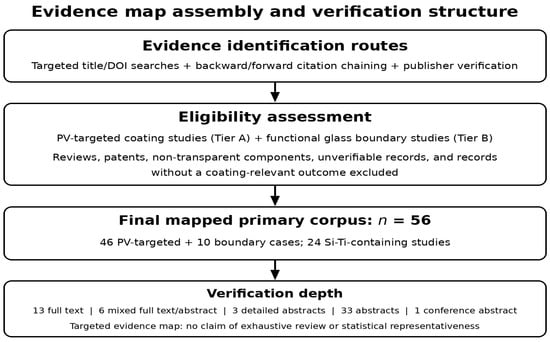
The review was designed as a critical conceptual review with a structured evidence map [8], not as a completed systematic review or meta-analysis. Evidence was assembled through backward and forward citation chaining from established PV cover glass and Si-Ti studies, targeted title and DOI searches, and publisher site verification. Search concepts combined photovoltaic or solar module terms with cover glass, front surface, antireflective, anti-soiling, self-cleaning, hydrophilic, hydrophobic, TiO2, SiO2, field exposure, durability, power output, energy yield, water use, and life-cycle assessment. The search log and DOI-linked registry are supplied in Supplementary Data S1. Because the evidence assembly was targeted rather than a database census, an initial search-hit denominator is not used and no representativeness threshold was selected a priori. Figure 1 therefore reports the evidence assembly routes, eligibility structure, final mapped corpus, and verification depth rather than presenting a PRISMA flow with retrospectively reconstructed counts.
Figure 1.
Evidence map assembly and verification structure. The figure documents the search routes, eligibility tiers, final 56-study primary corpus, and verification depth. Because the search was targeted rather than census-based, unidentified initial hit counts were not reconstructed retrospectively.
Tier A comprised primary studies explicitly targeting PV cover glass, modules, or solar cell front surfaces. Tier B comprised primary functional glass boundary studies with directly transferable optical, surface, durability, outdoor, or environmental methods. Reviews, patents, commercial reports without primary experimental data, non-transparent module components, unverifiable bibliographic records, and papers without a coating-relevant outcome were excluded from primary coding. The 2025 review by Elsafi et al. [6], which was mistakenly included as a primary record in the previous map, was reclassified as background literature and removed from all study-level counts. The final corpus therefore contains 56 primary studies: 46 PV-targeted and 10 boundary studies. The evidence identification and verification process used to assemble the final 56-study corpus is summarized in Figure 1.
The scope and coding rules applied in the evidence map are summarized in Table 1.
Table 1.
Scope and coding rules used in the expanded evidence map.
2.2. Evidence Translation Framework
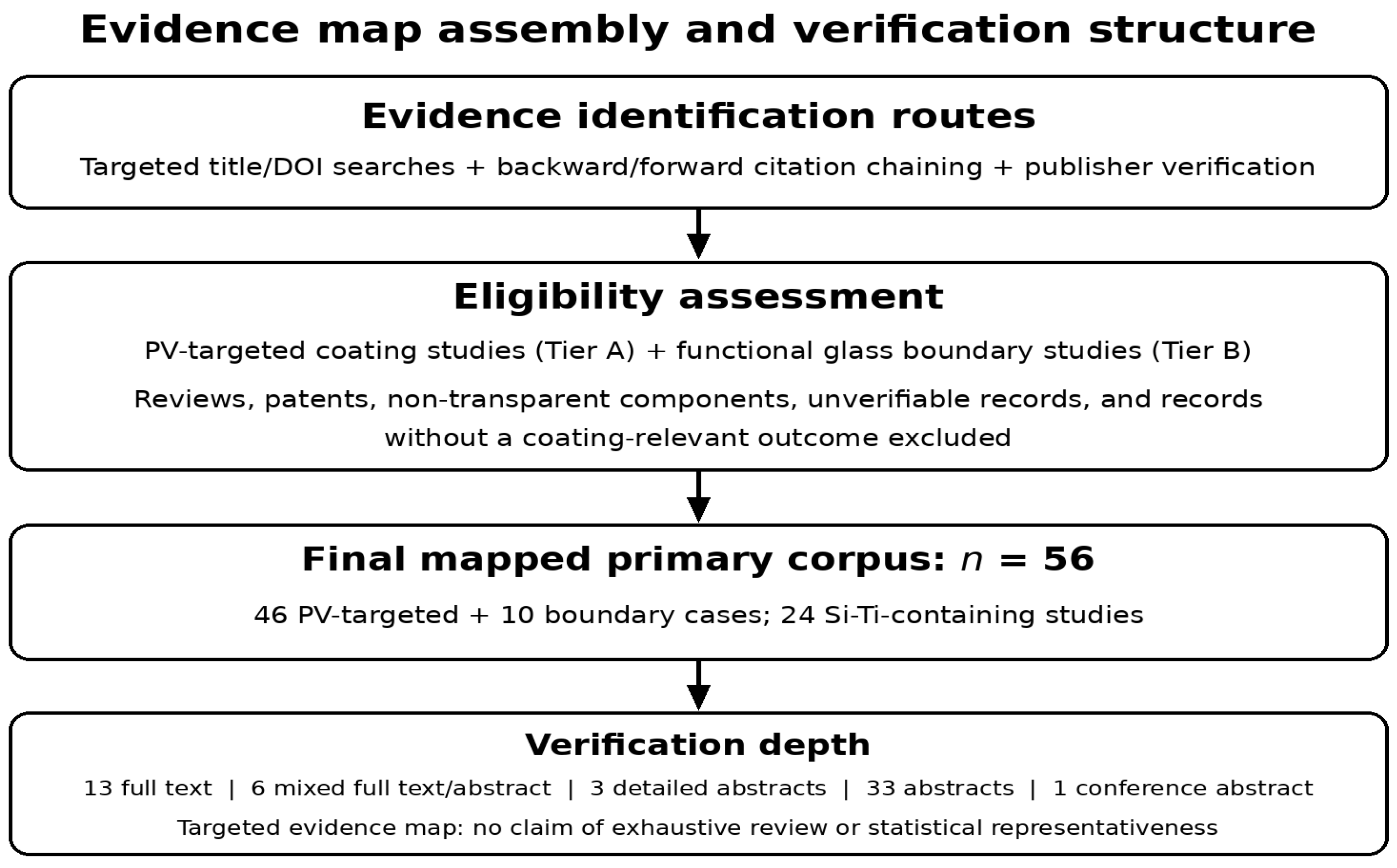
The framework contains two linked but non-identical tracks (Figure 2): The Outcome Evidence Track asks whether the following claimed endpoints were measured directly: optical response, surface function, PV electrical performance, field behavior, durability, and environmental outcome. The Mechanistic Attribution Track asks whether the outcome can be connected to a defined composition, coating architecture, process, microstructure, surface state, or degradation mechanism. The central rule is deliberately asymmetric: lower-level evidence does not inherit upward, but a directly measured higher-level outcome can stand on its own. Missing lower links restrict causal attribution, optimization, and transferability; they do not invalidate a higher-level outcome that was actually measured.
Figure 2.
Two-track Evidence Translation Framework. The upper track records the outcome demonstrated by the measurement; the lower track records how securely that outcome can be attributed to coating design or mechanism. The framework is a claim–audit architecture, not a numerical score or a technology readiness scale. Dashed vertical arrows indicate correspondence between the outcome-evidence and mechanistic-attribution tracks; they do not imply that lower-track evidence is required to validate a directly measured higher-level outcome.
The operational definitions and interpretation rules for the two-track framework are summarized in Table 2.
Table 2.
Operational definitions and interpretation rules for the two-track framework.
2.3. Coding and Analysis
Each primary record was coded as present or not identifiable for six evidence domains: optical, surface/self-cleaning, PV performance evidence, field/outdoor, durability, and environmental/LCA. ‘PV performance evidence’ includes measured electrical outcomes and explicitly modeled PV performance estimates; modeled values are not described as direct measurements in the revised text. ‘Field’ is reserved for real PV operation under site conditions with an operating device or module, whereas ‘outdoor’ denotes exposure outside the laboratory that may not include an operating PV system. The combined field/outdoor flag is retained only as a broad coverage variable because several abstract-only records do not permit a more granular distinction. For records assessed without full text, a zero means that the domain was not identifiable in the accessible abstract or metadata, not that it was proven to be absent from the article.
The final map contains 13 records verified from full text, 6 from combined full-text and abstract information, 3 from detailed abstracts, 33 from abstracts, and 1 conference abstract. No effect size pooling was attempted because coating chemistry, substrate, exposure, climate, comparator, optical metric, electrical endpoint, and duration were not commensurable. Two exploratory analyses were added in response to reviewer comments. First, logistic regression tested the association between publication year and the presence of PV performance or field/outdoor evidence. Second, two-sided Fisher exact tests compared the 24-study Si-Ti subgroup with the 32 non-Si-Ti studies across the six evidence domains; Bonferroni correction was applied across these six subgroup comparisons. These analyses describe structure within the mapped corpus and are not used to infer prevalence in the complete literature. Formal inter-rater reliability was not measured and remains a limitation. Supplementary Data S1 provides the fixed codebook and a blinded recoding sheet for future independent replication.
3. Results
3.1. Corpus Composition
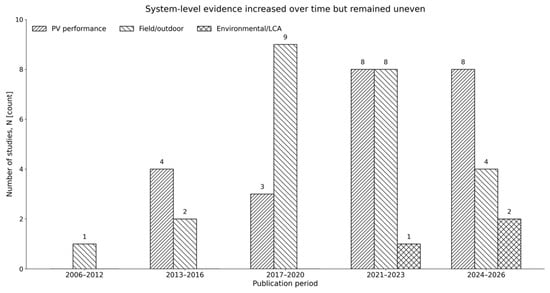
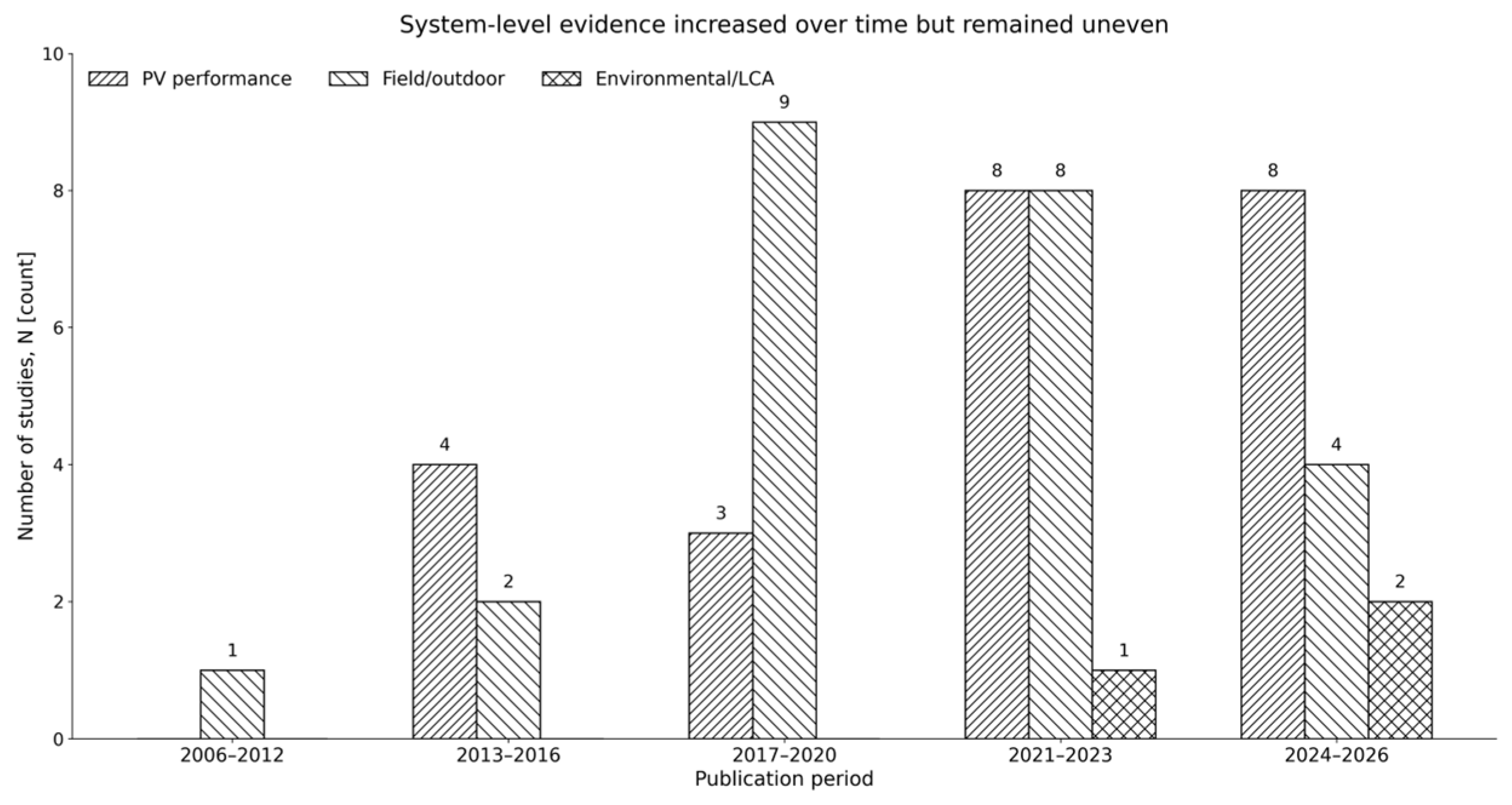
The revised structured map comprises 56 primary studies published between 2006 and 2026. Of these, 46 are PV-targeted and 10 are functional glass boundary cases. Twenty-four studies contain both silicon- and titanium-based components or directly comparable Si-Ti architectures. The evidence base broadened after 2013 from predominantly sol–gel and photocatalytic studies toward hydrophobic, hybrid, commercial anti-soiling, durability, outdoor, and environmental work. The mapped primary studies are listed chronologically in Supplementary Data S1 and in Refs. [9,10,11,12,13,14,15,16,17,18,19,20,21,22,23,24,25,26,27,28,29,30,31,32,33,34,35,36,37,38,39,40,41,42,43,44,45,46,47,48,49,50,51,52,53,54,55,56,57,58,59,60,61,62,63,64]. Figure 3 summarizes the temporal distribution of PV performance, field/outdoor, and environmental evidence.
Figure 3.
Temporal distribution of PV performance, field/outdoor, and environmental evidence in the 56 mapped primary studies. Bars are descriptive counts within the structured map; they are not prevalence estimates for all relevant literature. Within each publication-period group, the three adjacent bars represent PV performance, field/outdoor, and environmental/LCA evidence, respectively. The revised figure uses en dashes in year ranges and separates the groups to avoid label overlap.
The expanded corpus changes the substantive diagnosis. System-level evidence is present, but its distribution differs strongly by endpoint and by coating family. The earlier three-study appraisal overstated absence because it sampled a narrow chemistry. The present map instead tests where translation occurs, how it has changed over time, and whether the focal Si-Ti family follows the same pattern as the rest of the mapped literature.
3.2. Distribution of Evidence Domains
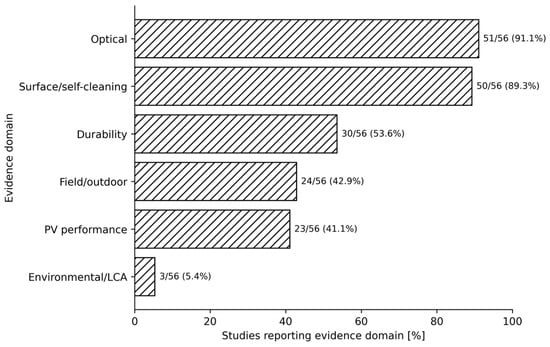
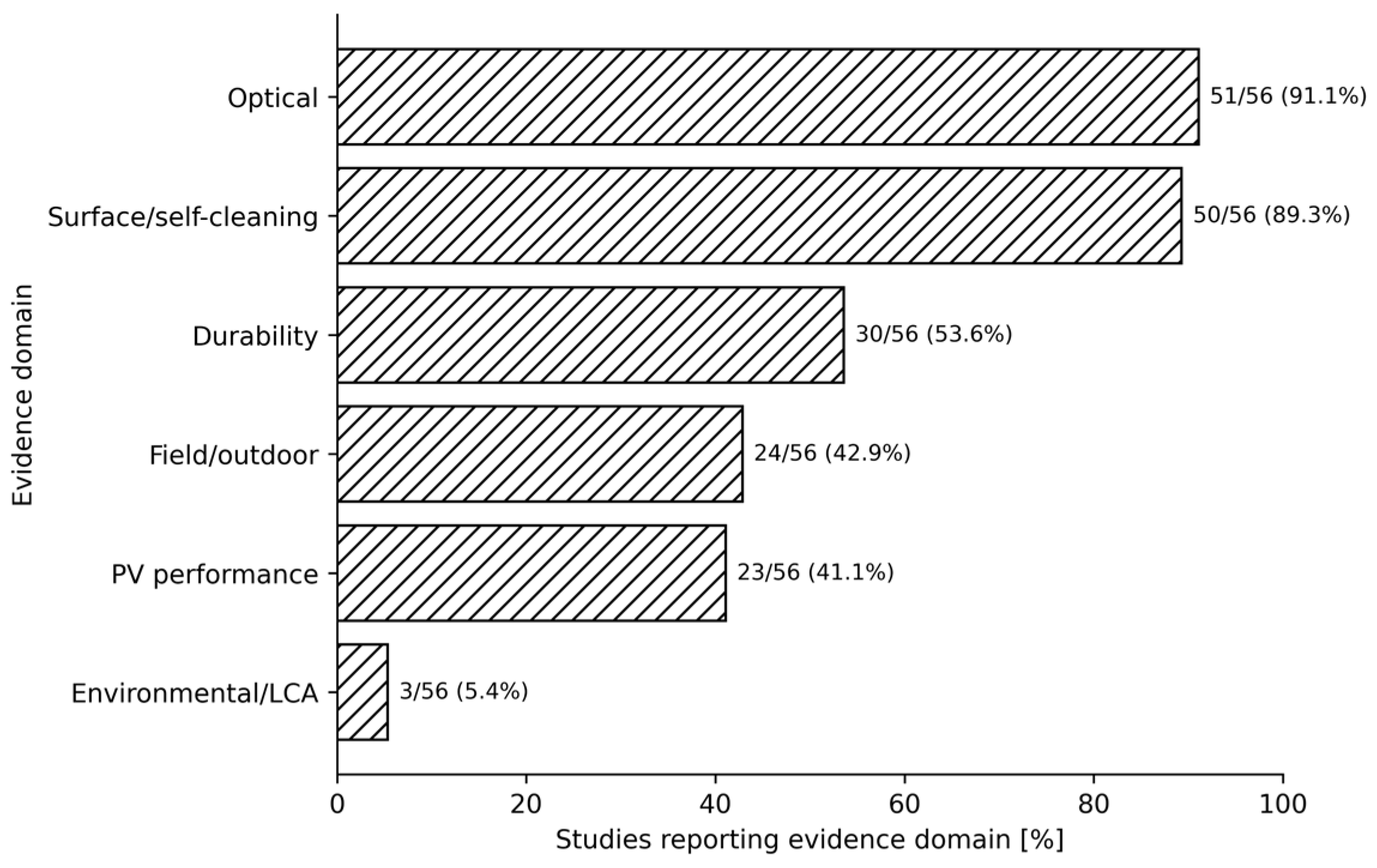
Optical outcomes were identifiable in 51/56 studies (91.1%) and surface or self-cleaning outcomes in 50/56 (89.3%). Durability evidence occurred in 30/56 (53.6%), field or outdoor evidence in 24/56 (42.9%), PV performance evidence in 23/56 (41.1%), and coating-specific environmental outcomes in 3/56 (5.4%) (Figure 4). The temporal analysis adds depth to these descriptive counts. Publication year was positively associated with PV performance evidence (odds ratio 1.30 per year, 95% CI 1.10–1.53; p = 0.002), whereas the increase in field/outdoor evidence was weaker and did not reach the conventional 0.05 threshold (odds ratio 1.11, 95% CI 0.98–1.26; p = 0.095). Within the mapped corpus, PV performance evidence was more common in later publications, whereas field/outdoor evidence showed a weaker temporal pattern. Because the corpus was assembled through a targeted, non-systematic process, this association should not be interpreted as a field-wide temporal trend. No causal explanation for the temporal shift is inferred from these data.
Figure 4.
Evidence domain coverage across all 56 mapped primary studies. Presence indicates that an accessible source explicitly reported the domain; for abstract-only records, non-identification is not proof of absence from the full article.
3.3. Most Decision-Proximal Supported Endpoint
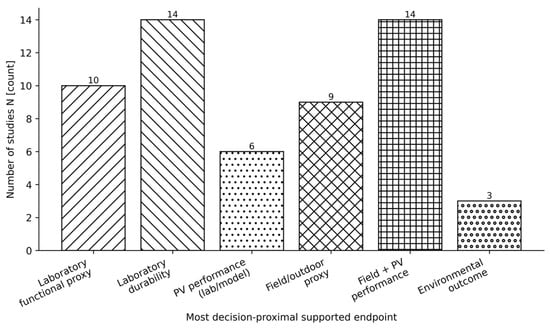
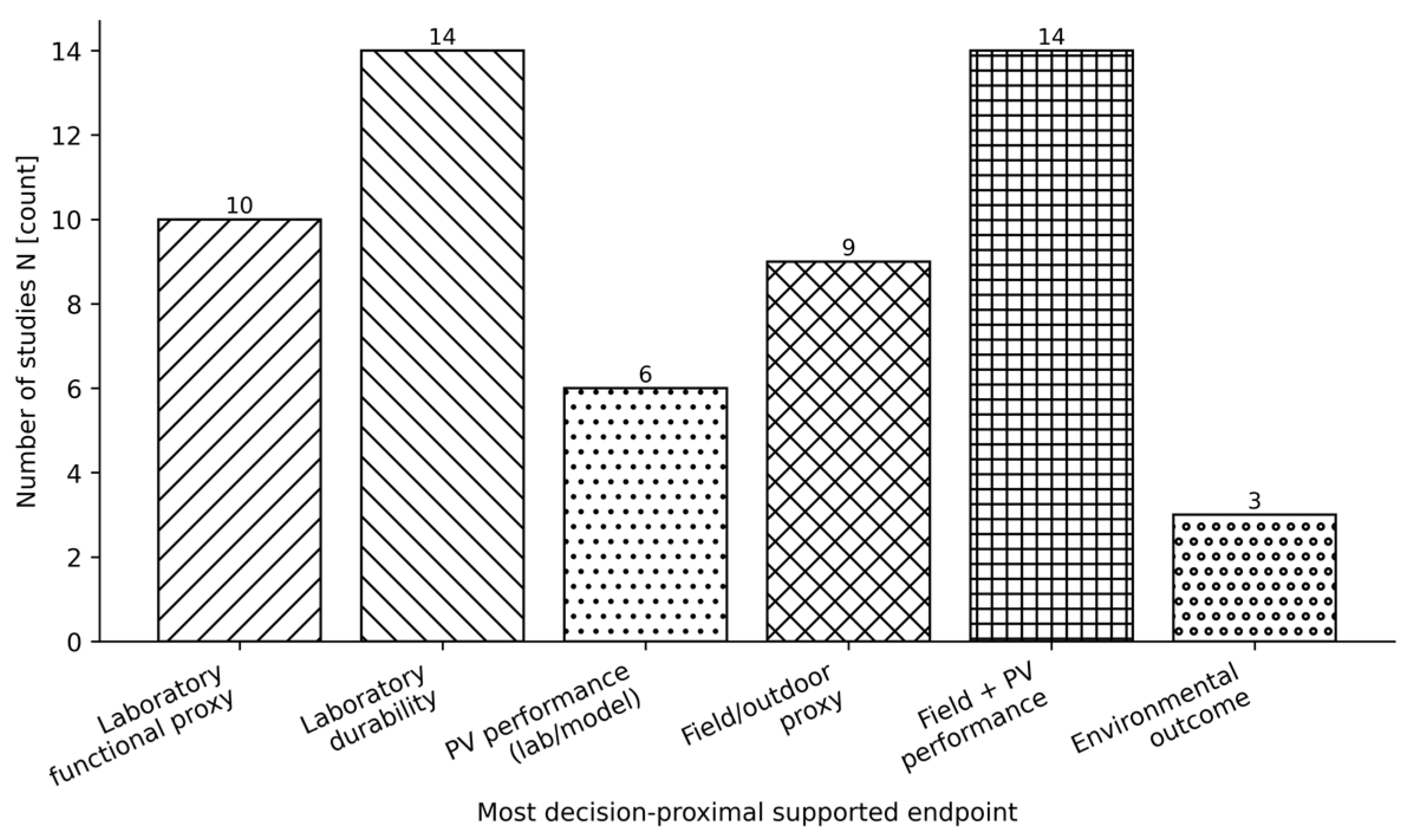
The most decision-proximal supported endpoint was a laboratory functional proxy in 10 studies and laboratory durability in 14. Six studies achieved PV performance evidence under laboratory conditions or through an explicit model, nine reported a field/outdoor proxy without PV performance evidence, 14 had field/outdoor exposure plus PV performance evidence as their most decision-proximal endpoint, and three reached a coating-specific environmental outcome (Figure 5). These categories order claim proximity, not scientific merit or technology readiness. The non-exclusive domain flags show that 23 studies contained PV performance evidence, 24 reported field/outdoor exposure, and 15 contained both.
Figure 5.
The most decision-proximal supported endpoint for each mapped primary study. Categories are mutually exclusive and do not rank intrinsic experimental quality. Modeled PV performance estimates are retained as modeled evidence and are not described as direct electrical measurements.
Study-level evidence coverage across the full map and the predefined subgroups is summarized in Table 3.
Table 3.
Study-level evidence coverage in the full map and predefined subgroups.
3.4. The Si-Ti Subgroup: From Multifunctional Design to Incomplete System Translation
The 24-study Si-Ti-containing subgroup provides the most direct test of whether the corpus-level pattern also holds for the focal material family. Optical evidence and surface-functional evidence were each identifiable in 22/24 studies, durability in 13/24, PV performance evidence in 8/24, field/outdoor evidence in 5/24, and a coating-specific environmental outcome in 1/24. Compared with the 32 non-Si-Ti studies, field/outdoor evidence was substantially less frequent in the Si-Ti subgroup (5/24, 20.8%, versus 19/32, 59.4%; Fisher exact odds ratio 0.18; unadjusted p = 0.006; Bonferroni-adjusted p = 0.036). By contrast, PV performance evidence did not differ significantly (8/24, 33.3%, versus 15/32, 46.9%; p = 0.412), and no adjusted difference was detected for optical, surface, durability, or environmental domains. This exploratory comparison identifies a material family-specific field validation deficit within the mapped corpus without implying a causal chemistry effect. A hydrophobic-versus-photocatalytic binary comparison was not imposed because these functions overlap in several multifunctional coatings and are not mutually exclusive study classes; forcing that dichotomy would create classification error rather than a defensible correlation analysis.
The exploratory comparison between the Si-Ti and non-Si-Ti subgroups is summarized in Table 4.
Table 4.
Exploratory comparison of Si-Ti and non-Si-Ti studies. p values are two-sided Fisher exact tests; multiplicity correction was applied across six domain comparisons.
Earlier Si-Ti studies established multifunctional design through layered, nanoporous, and particle-based architectures. Zhang et al. [9], San Vicente et al. [12], Li and He [13], Miao et al. [15], Ye et al. [18], and Wang et al. [21] emphasized antireflection, photocatalysis, hydrophilicity, and related self-cleaning functions. These studies are mechanistically valuable because they connect composition, layer arrangement, porosity, or particle architecture to function. Their typical endpoint, however, remains at coating or coupon scale rather than applying to module operation.
The next step in translation occurred along two partially separate routes. Li et al. [14] and Soklič et al. [20] moved toward PV performance evidence, while de Jesus et al. [22], Mazur et al. [23], Fardo et al. [39], Guo et al. [46], and Lai et al. [57] strengthened durability or multifunctional characterization. Outdoor exposure was introduced in other studies without always being paired with operating module electrical measurements. This split helps explain why the Si-Ti family can be mechanistically rich yet comparatively sparse in field evidence.
Recent work has begun to reduce this separation. Ismail et al. [53], Walz et al. [54], Batool et al. [55], and Yang et al. [58] extend PV relevance through device-level or outdoor testing, but the designs remain heterogeneous in formulation, duration, climate, and comparator. Two technical features may contribute to the slower accumulation of field evidence in Si-Ti systems: multifunctional formulations, which often vary several design variables simultaneously, and photocatalytic/hydrophilic performance, which can evolve under UV exposure, contamination, abrasion, and repeated wet–dry cycling. These mechanisms make long-duration attribution harder than a single laboratory optical or surface test. The present map supports the existence of the field validation gap; it does not by itself establish these mechanisms as its cause.
The subgroup therefore clarifies the distinction between mechanistic richness and system validation. Most Si-Ti studies explicitly connect composition or processing to structure or surface response, but binary TiO2-SiO2 systems coexist with Zr-, V-, PAA-, B4C-, and mixed-oxide formulations. This diversity can improve function while weakening cross-study transfer when composition, layer thickness, porosity, substrate, and process change together. A field or PV outcome can be valid in its own right, yet, without a controlled design axis, it cannot identify which material variable produced the gain.
Carvalho et al. [59] provide the only coating-specific environmental outcome within the 24-study Si-Ti subgroup. Their TEOS/TTIP coating study links primary process data to a prospective carbon footprint analysis and then models the consequence for a 16.4 MW PV plant. This is an important advance because it connects coating manufacture to system benefit, but it also demonstrates why coating lifetime, reapplication frequency, electricity mix, and modeled energy gain must be stated explicitly before a net-benefit claim can be transferred to other formulations or climates.
3.5. Environmental Evidence Is Emerging, Not Absent
Three primary studies reach coating-specific environmental outcomes, but they use different functional units and system boundaries. Laopreecha et al. [49] used life-cycle assessment with the CML method for a sprayed nano-silica coating, defined the functional unit as 1 kWh of electricity over a 25-year PV lifetime, and reported a 2.08% reduction in total environmental impact relative to an uncoated system while noting a small increase in photochemical oxidation from additional coating chemicals. Carvalho et al. [59] quantified primary material and energy flows for a two-layer TEOS/TTIP coating, calculated coating production greenhouse gas emissions, and linked an experimentally observed 4.5% efficiency increase to a 16.4 MW plant simulation with lifetime sensitivity analysis. Fonseca et al. [60] evaluated a nano-silica-coated 16.4 MW system using LCA and greenhouse gas payback, reporting lower modeled lifetime emissions and a shorter environmental payback than the uncoated reference. Table 5 compares these studies directly.
Table 5.
Comparative analysis of the three coating-specific environmental studies in the mapped corpus.
Together, these studies show that environmental assessment is feasible but not yet routine. The main barriers are not a lack of LCA methodology; they are the need to connect coating-scale inventory with a defensible field lifetime, reapplication schedule, cleaning baseline, and energy yield effect. Coating papers are often produced in materials laboratories that do not routinely collect process inventories or long-term operational data, while LCA studies require precisely those inputs. A practical route forward is to predefine a functional unit, meter coating process energy and materials, retain a matched uncoated control, measure coating persistence and cleaning demand under site conditions, and carry those measurements into ISO 14040/14044-compliant [65,66] scenario and sensitivity analyses rather than appending a qualitative sustainability claim after the experiment.
3.6. Integrated Results Summary
Across Section 3.1, Section 3.2, Section 3.3, Section 3.4 and Section 3.5, three findings are robust within the mapped corpus: First, optical and surface-functional measurements remain near-universal, while PV performance and field/outdoor evidence occurs in roughly two-fifths of studies, and environmental outcomes remain rare. Second, PV performance evidence is more common in later publications within the mapped corpus, but field validation is not uniformly distributed across chemistries: Si-Ti studies contain significantly less field/outdoor evidence than the non-Si-Ti group despite comparable optical, surface, and durability coverage. Third, the three environmental studies demonstrate multiple viable assessment routes but also show that net-benefit conclusions depend on functional unit, lifetime, reapplication, operating climate, and system boundary. These results motivate the integrated discussion below rather than a separate theoretical argument.
4. Integrated Interpretation and Discussion
4.1. The Revised Diagnosis: Uneven Translation
The results support a narrower and more defensible diagnosis than the earlier manuscript. System-level evidence is not largely absent: within the revised 56-study map, 23 studies contain PV performance evidence, 24 contain field/outdoor evidence, and 15 contain both. The central weakness is uneven translation and incomplete integration. Optical and surface measurements are much more prevalent, and higher-level outcomes are frequently reported without the material, exposure, comparator, or lifetime information needed for transfer between coating architectures and climates.
This distinction is the practical value of the two-track framework. A measured field energy outcome does not become invalid because a microstructural link is missing; rather, the missing link limits causal attribution and design transferability. Conversely, a richly characterized coating does not inherit an operational claim from transmittance, contact angle, or dye degradation alone. The framework therefore orders claim proximity but deliberately avoids arbitrary weighting coefficients or a technology readiness score.
4.2. Proxy Inflation Without a Causal Publication Claim
The mapped distribution is consistent with proxy inflation as a claim-level risk, not with a demonstrated publication mechanism. Optical and surface-functional evidence appears in about nine of every ten mapped studies, whereas PV performance and field/outdoor evidence occurs in about four of every ten. This imbalance is descriptive. The revised manuscript does not attribute it to visual appeal, publication incentives, or investigator preference because no author survey, publication bias analysis, or cross-field causal comparison was performed. The previously proposed ‘graphability effect’ is therefore retained only as a hypothesis that would require independent empirical testing, and it is not used to explain the results. Quantitative comparison with adjacent coating fields was not used because no review identified in those fields employed the same six-domain coding definitions; comparing raw percentages across incompatible evidence taxonomies would therefore be misleading.
The actionable point is simpler: claims should remain aligned with the endpoint actually measured. Photocatalytic activity may be scientifically strong evidence for a surface reaction without being evidence of mineral dust removal; an anti-soiling effect may reduce transmittance loss without proving lower cleaning water demand; and a field performance benefit may still require an inventory and lifetime model before it supports a net environmental claim. This endpoint discipline is independent of why particular measurements are popular. Where methylene blue photocatalytic activity is used as a standardized surface endpoint, ISO 10678 [67] provides an appropriate test framework; it does not by itself demonstrate outdoor anti-soiling performance.
4.3. Field Evidence Requires Climate and Duration Context
Twenty-four studies contain field or outdoor evidence, but these terms are not synonymous. In this review, field evidence refers to operation of an actual PV device or module under site conditions, including controlled test sites; outdoor evidence refers more broadly to external exposure and may not include an operating PV system. The combined coverage flag is used only because several abstract-only records cannot be separated more finely. Transferability depends on duration, climate, dust type, rainfall, tilt, cleaning protocol, comparator, module technology, and electrical normalization. Short outdoor exposures can show directional behavior without establishing seasonal persistence, while a coating aided by rain in a humid climate may behave differently under water-limited desert conditions.
Accordingly, field reporting should pair PV performance metrics with exposure metadata and a physically meaningful control. IEC 61724-1 [68] provides a monitoring context for PV performance, while optical properties of PV glass should be measured using IEC 62805-2 [69]. Durability claims should identify the stress sequence, retained property, intermediate time points, and uncertainty. IEC 61215-2 [70] can inform stress test selection but does not convert coupon durability into a service life prediction.
4.4. Environmental Translation Must Couple Burdens and Benefits
The three environmental studies show that sustainability claims can be evaluated quantitatively, but they also expose strong dependence on system boundary and assumptions. Laopreecha et al. [49] couple a 1 kWh functional unit to a 25-year lifetime; Carvalho et al. [59] begin from coating process inventory and scale an experimentally observed efficiency change into a plant scenario; Fonseca et al. [60] evaluate whole-system greenhouse gas payback. These are complementary rather than interchangeable designs. Their small number means that the map supports the statement that environmental assessment is emerging, not a universal estimate of coating benefit.
Future environmental studies should therefore couple four quantities: burden per coated area or per functional unit, measured or transparently modeled effect on PV energy or cleaning demand, persistence over a declared service interval, and an explicit end-of-life/system boundary. Where coating lifetime is uncertain, reapplication frequency must be treated by sensitivity analysis. Water savings should be measured rather than inferred from wettability, and release should be tested from aged finished coatings rather than extrapolated from nanoparticle suspensions. ISO 14040 [65] and ISO 14044 [66] provide the LCA framework but do not replace the required primary inventories.
4.5. A Concise Evidence Package for Future Coating Studies
The reporting package is intentionally compact and claim-dependent. It is not a regulatory checklist. A materials paper can remain at the mechanism level when its claims remain there. A PV performance claim requires an electrical measurement or an explicitly labeled model with assumptions; a field claim requires defined site exposure and a comparator; a sustainability claim requires a functional unit and burden–benefit accounting. This structure links Section 3 and Section 4 directly and avoids treating every study as if it should satisfy the same endpoint hierarchy.
The concise reporting package aligned with claim level is summarized in Table 6.
Table 6.
Concise reporting package aligned with the level of claim.
5. Limitations
This study is a critical conceptual review with a structured, non-comprehensive evidence map, not a completed systematic review. The 56-study corpus is substantially broader than the original three-study appraisal but is not claimed to contain every eligible coating paper. Evidence identification relied on citation chaining, targeted scholarly searches, and publisher verification rather than a reproducible multi-database census with dual screening. A conventional PRISMA denominator cannot be reconstructed from this targeted workflow without inventing search-hit counts; Figure 1 instead makes the evidence assembly structure and verification depth explicit. The number 56 is therefore the number of studies in final eligible mapped set, not a threshold chosen to imply representativeness.
Verification depth remains mixed: 13 records were assessed from full text, 6 from combined full-text and abstract information, and 37 from detailed abstracts, abstracts, or a conference abstract. For records not verified in full-text, a zero may represent non-reporting in the accessible abstract rather than non-measurement in the full article. The use of records without full-text verification may underestimate domain coverage, particularly for secondary outcomes that are not routinely reported in abstracts. Binary coding records presence rather than measurement quality or duration. No formal second reviewer agreement statistic was calculated; the blinded coding worksheet is intentionally unfilled, and reliability testing is deferred until an independent recoding is actually completed.
The exploratory logistic regressions and Fisher exact subgroup tests increase analytical depth but do not convert the map into a statistically representative sample of the full literature. The Si-Ti field evidence difference is robust to the stated six-comparison Bonferroni correction within this corpus, but causal explanations for that difference require dedicated comparative work. Environmental evidence remains based on three studies, and the magnitude or direction of net benefit cannot be generalized across coating families.
The observed association between publication year and PV performance evidence should be interpreted with additional caution. Because the corpus was assembled through targeted searches and citation chaining rather than systematic database sampling, the temporal pattern may partly reflect source selection, changes in terminology or abstract reporting over time, and preferential capture of more visible or highly cited studies. The regression therefore describes an association within the mapped corpus and should not be interpreted as evidence that the field as a whole has shifted toward system-level outcomes.
6. Conclusions
Expanding and auditing the evidence map changes the conclusion. After reclassifying a 2025 review that had been mistakenly coded as primary literature, the final map contained 56 primary studies: 23 contained PV performance evidence, 24 contained field/outdoor evidence, and 15 contained both. Within the mapped corpus, PV performance evidence was positively associated with publication year, while the field/outdoor association was weaker. The Si-Ti subgroup was substantially less likely than the non-Si-Ti group to include field/outdoor evidence (20.8% versus 59.4%; Bonferroni-adjusted p = 0.036), even though optical, surface, and durability coverage was similar.
The central finding is therefore uneven evidence translation, not a wholesale absence of real-world testing. Optical, wettability, photocatalytic, and dust removal measurements remain valuable within their domains, but they do not inherit upward into PV performance, maintenance, or sustainability claims. Conversely, measured higher-level outcomes can stand independently; missing mechanistic links limit causal explanation and transferability rather than invalidating the outcome itself. Modeled PV estimates are now explicitly distinguished from direct measurement.
The highest-value next step is integration: a traceable coating formulation tested with standardized PV glass optics, matched electrical controls, climate-resolved field exposure, retained properties during aging, and burden–benefit environmental analysis when sustainability is claimed. The Evidence Translation Framework and accompanying study registry are intended to make those links auditable rather than to rank technologies with an unvalidated score.
Supplementary Materials
The following supporting information can be downloaded at https://www.mdpi.com/article/10.3390/solar6050068/s1, Supplementary Data S1: The 56-study DOI-linked registry; the evidence-coding matrix; domain summaries; the codebook; the claim–evidence audit; the reference audit; the standards audit; the blinded second reviewer worksheet; and the search log.
Author Contributions
Conceptualization, D.K.M. and O.A.A.; methodology, D.K.M. and O.A.A.; formal analysis, O.A.A. and D.K.M.; investigation and literature verification, D.K.M., H.A.J., Z.H.M., and A.R.S.J.; data curation, D.K.M., Z.H.M., and A.R.S.J.; writing—original draft preparation, D.K.M.; writing—review and editing, D.K.M., H.A.J., O.A.A., Z.H.M., and A.R.S.J.; visualization, O.A.A., Z.H.M., and A.R.S.J.; supervision, D.K.M.; project administration, D.K.M. and O.A.A. All authors have read and agreed to the published version of the manuscript.
Funding
This research was supported by the British Council through the Going Global Partnerships—Researcher Challenges Grant (grant reference RCG2024-003) as part of the project “Supporting Women’s Resilience to Climate Change through Technology and Education”, led by Liverpool John Moores University in partnership with Al-Maarif University.
Institutional Review Board Statement
Not applicable.
Informed Consent Statement
Not applicable.
Data Availability Statement
All data supporting the reported results are contained within the article and Supplementary Data S1, which includes the 56-study DOI-linked registry, the evidence-coding matrix, the codebook, the claim–evidence and reference audits, the blinded second reviewer worksheet, and the search log. No proprietary data and no fabricated agreement statistics are included.
Acknowledgments
The authors gratefully acknowledge the British Council Going Global Partnerships program and the partner institutions for supporting the collaboration from which this work arose. The authors also thank the editors and reviewers whose comments improved the numerical consistency and scope statements of this review.
Conflicts of Interest
The authors declare no conflicts of interest.
References
- Sarver, T.; Al-Qaraghuli, A.; Kazmerski, L.L. A comprehensive review of the impact of dust on the use of solar energy: History, investigations, results, literature, and mitigation approaches. Renew. Sustain. Energy Rev. 2013, 22, 698–733. [Google Scholar] [CrossRef] [Scilit]
- Ilse, K.K.; Figgis, B.W.; Naumann, V.; Hagendorf, C.; Bagdahn, J. Fundamentals of soiling processes on photovoltaic modules. Renew. Sustain. Energy Rev. 2018, 98, 239–254. [Google Scholar] [CrossRef] [Scilit]
- Ilse, K.; Micheli, L.; Figgis, B.W.; Lange, K.; Daßler, D.; Hanifi, H.; Wolfertstetter, F.; Naumann, V.; Hagendorf, C.; Gottschalg, R.; et al. Techno-economic assessment of soiling losses and mitigation strategies for solar power generation. Joule 2019, 3, 2303–2321. [Google Scholar] [CrossRef] [Scilit]
- Syafiq, A.; Pandey, A.K.; Adzman, N.N.; Rahim, N.A. Advances in approaches and methods for self-cleaning of solar photovoltaic panels. Sol. Energy 2018, 162, 597–619. [Google Scholar] [CrossRef] [Scilit]
- Banerjee, S.; Dionysiou, D.D.; Pillai, S.C. Self-cleaning applications of TiO2 by photo-induced hydrophilicity and photocatalysis. Appl. Catal. B Environ. 2015, 176–177, 396–428. [Google Scholar] [CrossRef] [Scilit]
- Elsafi, A.; Aïssa, B.; Ilse, K.; Abdallah, A. Performance and durability of anti-soiling and anti-reflective coatings for photovoltaic systems in desert climates. Sol. Energy 2025, 293, 113446. [Google Scholar] [CrossRef] [Scilit]
- Hooshyar, P.; Moghadasi, H.; Moosavi, S.A.; Moosavi, A.; Nouri Borujerdi, A. Recent progress of soiling impact on solar panels and its mitigation strategies: A review. Appl. Energy 2025, 379, 124979. [Google Scholar] [CrossRef] [Scilit]
- James, K.L.; Randall, N.P.; Haddaway, N.R. A methodology for systematic mapping in environmental sciences. Environ. Evid. 2016, 5, 7. [Google Scholar] [CrossRef] [Scilit]
- Zhang, X.; Fujishima, A.; Jin, M.; Emeline, A.V.; Murakami, T. Double-layered TiO2-SiO2 nanostructured films with self-cleaning and antireflective properties. J. Phys. Chem. B 2006, 110, 25142–25148. [Google Scholar] [CrossRef] [Scilit] [PubMed]
- Medina-Valtierra, J.; Frausto-Reyes, C.; Ramirez-Ortiz, J.; Camarillo-Martínez, G. Self-cleaning test of doped TiO2-coated glass plates under solar exposure. Ind. Eng. Chem. Res. 2009, 48, 598–606. [Google Scholar] [CrossRef] [Scilit]
- Nakata, K.; Sakai, M.; Ochiai, T.; Murakami, T.; Takagi, K.; Fujishima, A. Antireflection and self-cleaning properties of a moth-eye-like surface coated with TiO2 particles. Langmuir 2011, 27, 3275–3278. [Google Scholar] [CrossRef] [Scilit] [PubMed]
- San Vicente, G.; Morales, A.; Germán, N.; Suárez, S.; Sánchez, B. SiO2/TiO2 antireflective coatings with photocatalytic properties prepared by sol-gel for solar glass covers. J. Sol. Energy Eng. 2012, 134, 041011. [Google Scholar] [CrossRef] [Scilit]
- Li, X.; He, J. Synthesis of raspberry-like SiO2-TiO2 nanoparticles toward antireflective and self-cleaning coatings. ACS Appl. Mater. Interfaces 2013, 5, 5282–5290. [Google Scholar] [CrossRef] [Scilit] [PubMed]
- Li, J.; Lu, Y.; Lan, P.; Zhang, X.; Xu, W.; Tan, R.; Song, W.; Choy, K.-L. Design, preparation, and durability of TiO2/SiO2 and ZrO2/SiO2 double-layer antireflective coatings in crystalline silicon solar modules. Sol. Energy 2013, 89, 134–142. [Google Scholar] [CrossRef] [Scilit]
- Miao, L.; Su, L.F.; Tanemura, S.; Fisher, C.A.J.; Zhao, L.L.; Liang, Q.; Xu, G. Cost-effective nanoporous SiO2-TiO2 coatings on glass substrates with antireflective and self-cleaning properties. Appl. Energy 2013, 112, 1198–1205. [Google Scholar] [CrossRef] [Scilit]
- Piliougine, M.; Cañete, C.; Moreno, R.; Carretero, J.; Hirose, J.; Ogawa, S.; Sidrach-de-Cardona, M. Comparative analysis of energy produced by photovoltaic modules with anti-soiling coated surface in arid climates. Appl. Energy 2013, 112, 626–634. [Google Scholar] [CrossRef] [Scilit]
- Weng, K.-W.; Huang, Y.-P. Preparation of TiO2 thin films on glass surfaces with self-cleaning characteristics for solar concentrators. Surf. Coat. Technol. 2013, 231, 201–204. [Google Scholar] [CrossRef] [Scilit]
- Ye, L.; Zhang, Y.; Zhang, X.; Hu, T.; Ji, R.; Ding, B.; Jiang, B. Sol-gel preparation of SiO2/TiO2/SiO2-TiO2 broadband antireflective coating for solar cell cover glass. Sol. Energy Mater. Sol. Cells 2013, 111, 160–164. [Google Scholar] [CrossRef] [Scilit]
- Said, S.A.M.; Al-Aqeeli, N.; Walwil, H.M. The potential of using textured and anti-reflective coated glasses in minimizing dust fouling. Sol. Energy 2015, 113, 295–302. [Google Scholar] [CrossRef] [Scilit]
- Soklič, A.; Tasbihi, M.; Kete, M.; Lavrenčič Štangar, U. Deposition and possible influence of a self-cleaning thin TiO2/SiO2 film on a photovoltaic module efficiency. Catal. Today 2015, 252, 54–60. [Google Scholar] [CrossRef] [Scilit]
- Wang, Y.; Wu, J.; Wang, H.; Chen, R. Effective balance of antireflection and self-cleaning properties via hollow silica nanospheres-based surface coated with scattered titania nanoparticles. Sol. Energy 2015, 122, 763–772. [Google Scholar] [CrossRef] [Scilit]
- de Jesus, M.A.M.L.; da Silva Neto, J.T.; Timò, G.; Paiva, P.R.P.; Dantas, M.S.S.; Ferreira, A.M. Superhydrophilic self-cleaning surfaces based on TiO2 and TiO2/SiO2 composite films for photovoltaic module cover glass. Appl. Adhes. Sci. 2015, 3, 5. [Google Scholar] [CrossRef] [Scilit]
- Mazur, M.; Wojcieszak, D.; Kaczmarek, D.; Domaradzki, J.; Song, S.; Gibson, D.; Placido, F.; Mazur, P.; Kalisz, M.; Poniedzialek, A. Functional photocatalytically active and scratch resistant antireflective coating based on TiO2 and SiO2. Appl. Surf. Sci. 2016, 380, 165–171. [Google Scholar] [CrossRef] [Scilit]
- Oh, W.; Kang, B.; Choi, S.; Bae, S.; Jeong, S.; Kim, S.M.; Lee, H.S.; Kim, D.; Hwang, H.; Chan, S.I. Evaluation of anti-soiling and anti-reflection coating for photovoltaic modules. J. Nanosci. Nanotechnol. 2016, 16, 10689–10692. [Google Scholar] [CrossRef] [Scilit]
- Salvaggio, M.G.; Passalacqua, R.; Abate, S.; Perathoner, S.; Centi, G.; Lanza, M.; Stassi, A. Functional nano-textured titania-coatings with self-cleaning and antireflective properties for photovoltaic surfaces. Sol. Energy 2016, 125, 227–242. [Google Scholar] [CrossRef] [Scilit]
- Adak, D.; Ghosh, S.; Chakrabarty, P.; Mondal, A.; Saha, H.; Mukherjee, R.; Bhattacharyya, R. Self-cleaning V-TiO2:SiO2 thin-film coatings with enhanced transmission for solar glass cover and related applications. Sol. Energy 2017, 155, 410–418. [Google Scholar] [CrossRef] [Scilit]
- Naufal, B.; Ullattil, S.G.; Periyat, P. A dual function nanocrystalline TiO2 platform for solar photocatalysis and self-cleaning application. Sol. Energy 2017, 155, 1380–1388. [Google Scholar] [CrossRef] [Scilit]
- Saravanan, P.; Cindrella, L.; Kwon, O.J.; Mohanraju, K. Superhydrophilic and self-cleaning rGO-TiO2 composite coatings for indoor and outdoor photovoltaic applications. Sol. Energy Mater. Sol. Cells 2017, 169, 304–312. [Google Scholar] [CrossRef] [Scilit]
- Quan, Y.-Y.; Zhang, L.-Z. Experimental investigation of the anti-dust effect of transparent hydrophobic coatings applied for solar cell covering glass. Sol. Energy Mater. Sol. Cells 2017, 160, 382–389. [Google Scholar] [CrossRef] [Scilit]
- Lin, W.; Zheng, J.; Yan, L.; Zhang, X. Sol-gel preparation of self-cleaning SiO2-TiO2/SiO2-TiO2 double-layer antireflective coating for solar glass. Results Phys. 2018, 8, 532–536. [Google Scholar] [CrossRef] [Scilit]
- Zhi, J.; Zhang, L.-Z. Durable superhydrophobic surface with highly antireflective and self-cleaning properties for the glass covers of solar cells. Appl. Surf. Sci. 2018, 454, 239–248. [Google Scholar] [CrossRef] [Scilit]
- de Jesus, M.A.M.L.; Timò, G.; Agustín-Sáenz, C.; Braceras, I.; Cornelli, M.; Ferreira, A.M. Anti-soiling coatings for solar cell cover glass: Climate and surface properties influence. Sol. Energy Mater. Sol. Cells 2018, 185, 517–523. [Google Scholar] [CrossRef] [Scilit]
- Curtis, T.; Sreenivash, V.; Simpson, L.; TamizhMani, G. Effectiveness of rain cleaning on artificially soiled PV modules with and without anti-soiling coatings. In Proceedings of the 2019 IEEE 46th Photovoltaic Specialists Conference (PVSC), Chicago, IL, USA, 16–21 June 2019; pp. 2869–2874. [Google Scholar] [CrossRef] [Scilit]
- Isaifan, R.J.; Samara, A.; Suwaileh, W.; Johnson, D.; Yiming, W.; Abdallah, A.A.; Aïssa, B. Improved self-cleaning properties of an efficient and easy-to-scale-up TiO2 thin film prepared by adsorptive self-assembly. Sci. Rep. 2017, 7, 9466. [Google Scholar] [CrossRef] [Scilit] [PubMed]
- Roslizar, A.; Dottermusch, S.; Vüllers, F.; Kavalenka, M.N.; Guttmann, M.; Schneider, M.; Paetzold, U.W.; Hölscher, H.; Richards, B.S.; Klampaftis, E. Self-cleaning performance of superhydrophobic hot-embossed fluoropolymer for photovoltaic applications. Sol. Energy Mater. Sol. Cells 2019, 189, 188–196. [Google Scholar] [CrossRef] [Scilit]
- Syafiq, A.; Vengadaesvaran, B.; Rahim, N.A.; Pandey, A.K.; Bushroa, A.R.; Ramesh, K.; Ramesh, S. Transparent self-cleaning coating of modified polydimethylsiloxane (PDMS) for real outdoor application. Prog. Org. Coat. 2019, 131, 232–239. [Google Scholar] [CrossRef] [Scilit]
- Womack, G.; Isbilir, K.; Lisco, F.; Durand, G.; Taylor, A.; Walls, J.M. The performance and durability of single-layer sol-gel anti-reflection coatings applied to solar module cover glass. Surf. Coat. Technol. 2019, 358, 76–83. [Google Scholar] [CrossRef] [Scilit]
- Šuligoj, A.; Pliekhova, O.; Vodišek, N.; Mihelčič, M.; Šurca, A.K.; Kunič, R.; Šubic, B.; Starman, J.; Ugovšek, A.; Lavrenčič Štangar, U. Field test of self-cleaning Zr-modified-TiO2-SiO2 films on glass with a demonstration of their anti-fogging effect. Materials 2019, 12, 2196. [Google Scholar] [CrossRef] [Scilit] [PubMed]
- Fardo, F.M.; Ribeiro, R.S.; Strauss, J.A.; Nardi, J.; Ferreira, L.C.; Schmökel, G.; Costa, T.M.H.; Pereira, M.B.; Horowitz, F. Double layer SiO2-TiO2 sol-gel thin films on glass for antireflection, antifogging, and UV recoverable self-cleaning. Appl. Opt. 2020, 59, 7720–7725. [Google Scholar] [CrossRef] [Scilit] [PubMed]
- Liang, Z.; Zhou, Z.; Zhao, L.; Dong, B.; Wang, S. Fabrication of transparent, durable and self-cleaning superhydrophobic coatings for solar cells. New J. Chem. 2020, 44, 14481–14489. [Google Scholar] [CrossRef] [Scilit]
- Oehler, G.C.; Lisco, F.; Bukhari, F.; Uličná, S.; Strauss, B.; Barth, K.L.; Walls, J.M. Testing the durability of anti-soiling coatings for solar cover glass by outdoor exposure in Denmark. Energies 2020, 13, 299. [Google Scholar] [CrossRef] [Scilit]
- Rad, A.S.; Afshar, A.; Azadeh, M. Anti-reflection and self-cleaning mesoporous TiO2 coatings as solar systems protective layer: Effect of porosity and roughness. Opt. Mater. 2020, 107, 110027. [Google Scholar] [CrossRef] [Scilit]
- Babin, M.; Alvarez Mira, D.; Aryan, Y.S.; García-Agúndez Blanco, M.; Poulsen, P.B.; Thorsteinsson, S. Optical transmission losses of a TiO2-based anti-soiling coating for use in outdoor photovoltaic applications. J. Photocatal. 2021, 2, 297–305. [Google Scholar] [CrossRef] [Scilit]
- Bhaduri, S.; Mallick, S.; Shiradkar, N.; Kottantharayil, A. Characterization of reliability of anti-soiling coatings using tapping-mode AFM phase imaging. J. Renew. Sustain. Energy 2021, 13, 023702. [Google Scholar] [CrossRef] [Scilit]
- Chundi, N.; Kesavan, G.; Ramasamy, E.; Mallick, S.; Kottantharayil, A.; Sakthivel, S. Ambient condition curable, highly weather stable anti-soiling coating for photovoltaic application. Sol. Energy Mater. Sol. Cells 2021, 230, 111203. [Google Scholar] [CrossRef] [Scilit]
- Guo, Z.; Zhu, Z.; Liu, Y.; Wu, C.; Tu, H.; Wang, J.; Su, X. Closed-surface multifunctional antireflective coating made from SiO2 with TiO2 nanocomposites. Materials 2021, 14, 1367. [Google Scholar] [CrossRef] [Scilit] [PubMed]
- Mahnoor, B.; Noman, M.; Rehan, M.S.; Khan, A.D. Power loss due to soiling on photovoltaic module with and without anti-soiling coating at different angle of incidence. Int. J. Green Energy 2021, 18, 1658–1666. [Google Scholar] [CrossRef] [Scilit]
- Khan, M.Z.; Ghaffar, A.; Bahattab, M.A.; Mirza, M.; Lange, K.; Abaalkheel, I.M.S.; Alqahtani, M.H.; Aldhuwaile, A.A.A.; Alqahtani, S.H.; Qasem, H.; et al. Outdoor performance of anti-soiling coatings in various climates of Saudi Arabia. Sol. Energy Mater. Sol. Cells 2022, 235, 111470. [Google Scholar] [CrossRef] [Scilit]
- Laopreecha, P.; Varabuntoonvit, V.; Kumnorkaew, P.; Muangnapoh, T.; Sodsai, T. Life cycle assessment of nano-silica coating for solar photovoltaic panel. Asia-Pac. J. Sci. Technol. 2022, 27, 11. [Google Scholar] [CrossRef]
- Tayel, S.A.; Abu El-Maaty, A.E.; Mostafa, E.M.; Elsaadawi, Y.F. Enhance the performance of photovoltaic solar panels by a self-cleaning and hydrophobic nanocoating. Sci. Rep. 2022, 12, 21236. [Google Scholar] [CrossRef] [Scilit] [PubMed]
- Acosta-Silva, Y.d.J.; Toledano-Ayala, M.; Gallardo-Hernández, S.; Godínez, L.A.; Méndez-López, A. Investigation of TiO2 deposit on SiO2 films: Synthesis, characterization, and efficiency for photocatalytic discoloration of methylene blue. Nanomaterials 2023, 13, 1403. [Google Scholar] [CrossRef] [Scilit] [PubMed]
- Bhaduri, S.; Farkade, M.; Bajhal, R.; Mallick, S.; Shiradkar, N.; Kottantharayil, A. Abrasion resistance of spray-coated anti-soiling coatings during waterless cleaning of PV modules. Mater. Today Commun. 2023, 35, 106168. [Google Scholar] [CrossRef] [Scilit]
- Ismail, A.A.; Alzubi, F.; Al-Hajji, L.A.; Alseidi, M.; Ahmad, S.; Alduweesh, A. Self-cleaning coatings for minimizing the impact of dust precipitation on the power production of solar cells utilizing mesoporous TiO2/SiO2 and ZnO/SiO2 films. Ceram. Int. 2023, 49, 22788–22796. [Google Scholar] [CrossRef] [Scilit]
- Walz, K.A.; Hoege, T.D.; Duensing, J.W.; Zeltner, W.A.; Anderson, M.A. Field tests of a self-sintering, anti-soiling, self-cleaning, nanoporous metal oxide transparent thin film coating for solar photovoltaic modules. Sol. Energy Mater. Sol. Cells 2023, 262, 112560. [Google Scholar] [CrossRef] [Scilit]
- Batool, I.; Shahzad, N.; Shahzad, R.; Satti, A.N.; Liaquat, R.; Waqas, A.; Shahzad, M.I. Self-cleaning study of SiO2-modified TiO2 nanofibrous thin films prepared via electrospinning for application in solar cells. Sol. Energy 2024, 268, 112271. [Google Scholar] [CrossRef] [Scilit]
- Koysuren, H.N.; Koysuren, O. Transparent self-cleaning coating prepared from SiO2/B4C and SiO2/B4C/TiO2 for the solar cell. J. Sol-Gel Sci. Technol. 2024, 111, 955–965. [Google Scholar] [CrossRef] [Scilit]
- Lai, S.; Aubry, E.; Sublemontier, O.; Briois, P. One-step synthesis of TiO2/SiO2-np nanocomposite photocatalytic multilayer films. Materials 2024, 17, 1227. [Google Scholar] [CrossRef] [Scilit] [PubMed]
- Yang, L.; Yang, J.; Yang, D.-Q. A durable superhydrophilic self-cleaning coating based on TiO2-SiO2-PAA nanocomposite for photovoltaic applications: Long-term outdoor study. Sol. Energy Mater. Sol. Cells 2024, 268, 112731. [Google Scholar] [CrossRef] [Scilit]
- Carvalho, M.; Andrade, H.d.N.; de Oliveira, B.F.; Cavalcante, S.L.; Gomes, K.C. Contributing to the concept of sustainable buildings: Evaluation of the carbon emissions of a solar photovoltaic coating developed in Northeast Brazil. Sustainability 2025, 17, 7897. [Google Scholar] [CrossRef] [Scilit]
- Fonseca, L.F.S.; Andrade, H.d.N.; Gualberto de Galiza, J.M.F.; Abrahão, R.; Boleydei, H.; Guillén-Lambea, S.; Carvalho, M. Greenhouse gas payback of a solar photovoltaic system in Northeast Brazil: Effects of the application of a solar coating. Energy Eng. 2025, 122, 3265–3283. [Google Scholar] [CrossRef] [Scilit]
- Sakarapunthip, N.; Nukunudompanich, M.; Sittipunsakda, O.; Sangpongsanont, Y.; Chuangchote, S.; Chenvidhya, T.; Chenvidhya, D. Comparative analysis of anti-soiling coatings for PV modules in a tropical climate. Mater. Chem. Phys. 2025, 345, 131284. [Google Scholar] [CrossRef] [Scilit]
- Arslan, M.; Deveci, İ.; Arslan, C.; Çunkaş, M. A new anti-soiling approach based on oleic acid-modified Al2O3 nanocoatings for photovoltaic panels. Sci. Rep. 2026, 16, 7615. [Google Scholar] [CrossRef] [Scilit] [PubMed]
- Jafari, P.; Sabbagh Alvani, A.A.; Sameie, H.; Rosei, F.; Ou, J. Durable highly hydrophobic coating for solar panel with benefits of self-cleaning, thermal insulation and increased energy harvesting. J. Coat. Technol. Res. 2026, 23, 1579–1600. [Google Scholar] [CrossRef] [Scilit]
- Sengupta, S.; Adak, D.; Maiti, P.S.; Ghosh, A.; Bhattacharyya, R. Model for analysis of water-cleaning impact on polysilane-based antisoiling coating in PV system. Sci. Rep. 2026, 16, 18163. [Google Scholar] [CrossRef] [Scilit] [PubMed]
- ISO 14040:2006; Environmental Management—Life Cycle Assessment—Principles and Framework. ISO: Geneva, Switzerland, 2006.
- ISO 14044:2006; Environmental Management—Life Cycle Assessment—Requirements and Guidelines. ISO: Geneva, Switzerland, 2006.
- ISO 10678:2024; Fine Ceramics (Advanced Ceramics, Advanced Technical Ceramics)—Determination of Photocatalytic Activity of Surfaces in an Aqueous Medium by Degradation of Methylene Blue, 2nd ed. ISO: Geneva, Switzerland, 2024.
- IEC 61724-1:2021; Photovoltaic System Performance—Part 1: Monitoring. IEC: Geneva, Switzerland, 2021.
- IEC 62805-2:2017; Method for Measuring Photovoltaic (PV) Glass—Part 2: Measurement of Transmittance and Reflectance. IEC: Geneva, Switzerland, 2017.
- IEC 61215-2:2021; Terrestrial Photovoltaic (PV) Modules—Design Qualification and Type Approval—Part 2: Test Procedures. IEC: Geneva, Switzerland, 2021.

Disclaimer/Publisher’s Note: The statements, opinions and data contained in all publications are solely those of the individual author(s) and contributor(s) and not of MDPI and/or the editor(s). MDPI and/or the editor(s) disclaim responsibility for any injury to people or property resulting from any ideas, methods, instructions or products referred to in the content. |
© 2026 by the authors. Licensee MDPI, Basel, Switzerland. This article is an open access article distributed under the terms and conditions of the Creative Commons Attribution (CC BY) license.