


Abstract
This study examined the contribution of drainage and collector ditches in the Syr Darya River basin to local and regional aquatic biodiversity by comparing fish and macroinvertebrate assemblages in these anthropogenic habitats with those in adjacent natural river sections. Assemblages were analyzed in relation to eight abiotic environmental variables, with particular attention to blackflies and fish. Ditches differed from adjacent river habitats in several environmental characteristics, most notably lower summer water temperatures and reduced turbidity, and supported distinct aquatic assemblages. Of the 46 animal taxa recorded, 11 were restricted to ditches, indicating that these habitats contributed a distinct component to regional biodiversity. Drainage and collector ditches also provided suitable habitats for Simuliidae larvae and supported local blackfly populations. In contrast, fish assemblages in both ditch types were dominated by non-native species, potentially reflecting environmental filtering and repeated immigration from established populations. Although ditches exhibited lower species richness than adjacent river sections, they supported several species not recorded in natural river habitats. Thus, anthropogenic ditches cannot replace natural rivers but may increase habitat heterogeneity and contribute to biodiversity conservation in highly modified landscapes. Extensive networks of irrigation canals and drainage collectors have been established throughout much of the Syr Darya River basin, substantially modifying natural freshwater habitats. This study investigated the contribution of two types of anthropogenic ditches—drainage and collector ditches—to local and regional fish and macroinvertebrate diversity by comparing their assemblages with those of adjacent natural river sections. The diversity and distribution of macroinvertebrates and fish were examined in relation to eight abiotic environmental variables, with particular attention to blackflies (Diptera: Simuliidae) and fish as ecologically and socioeconomically important components of regional aquatic ecosystems. Drainage and collector ditches differed from adjacent river habitats in several environmental characteristics, most notably lower summer water temperatures and reduced turbidity. These conditions were associated with distinct aquatic assemblages in the ditches. Of the 46 animal taxa recorded, 11 were restricted to ditches, indicating that these anthropogenic habitats supported a distinct ditch-associated component of the regional fauna. Drainage and collector ditches also provided suitable habitats for Simuliidae larvae and supported local blackfly populations. In contrast, fish assemblages in both types of ditches were dominated by non-native species. The occurrence and distribution of non-native fishes may reflect a combination of environmental filtering and repeated immigration from established populations, although the relative contribution of these mechanisms remains to be determined. Overall, the ditches exhibited lower species richness than adjacent river sections but contributed to regional biodiversity by supporting several species that were not recorded in natural river habitats. Thus, although anthropogenic ditches cannot be considered substitutes for natural river ecosystems, they increase habitat heterogeneity and provide additional aquatic habitats within highly modified landscapes. Their ecological significance should therefore be assessed not only in terms of species richness but also with regard to the composition, origin, ecological roles, and conservation status of the species they support.
1. Introduction
Freshwater ecosystems are generally characterized by exceptionally high levels of biodiversity compared with terrestrial and marine ecosystems and support a disproportionate share of the world’s aquatic biota [1,2]. Among these ecosystems, small water bodies occupy a particularly important position. Small water bodies, including ponds, lakes, small reservoirs, oxbow lakes, canals, and other local aquatic ecosystems, perform essential ecological functions and play a crucial role in maintaining biodiversity and ecological balance. Despite their limited spatial extent, these ecosystems are of considerable ecological significance, providing habitat for a wide range of aquatic organisms, including rare and native species of invertebrates, fish, and amphibians [3,4]. At the same time, small water bodies are highly sensitive to external disturbances. Their hydrological regimes are often unstable and exhibit pronounced seasonal dynamics, including fluctuations in water level, periodic drying, and winter freezing. The ecological status of these ecosystems is strongly influenced by surrounding land use, particularly agricultural activities, irrigation practices, and the discharge of return irrigation flows [5].
Agricultural drainage ditches represent a distinct type of small lotic habitat, as they exhibit characteristics of both streams and wetlands [6]. Williams et al. [3] defined agricultural ditches as “man-made channels created primarily for agricultural purposes, and which usually: (1) have a linear planform, (2) follow linear field boundaries, often turning at right angles, and (3) show little relationship with natural landscape contours”. Traditionally, the primary function of agricultural ditches has been drainage and the conveyance of water, sediments, nutrients, and pollutants from agricultural fields to downstream water bodies. Consequently, their management has historically focused on water transport and hydrological regulation. However, growing attention has been directed toward the ecological functions of drainage ditches, including their role in improving water quality, providing habitat, and supporting biodiversity [7].
The importance of drainage ditches for the conservation of freshwater biodiversity has been increasingly recognized over the past two decades [3,8,9]. Nevertheless, despite their widespread occurrence and ecological significance, drainage ditches remain among the least studied types of small freshwater ecosystems [10,11].
The Aral Sea Basin represents one of the largest agricultural regions in Central Asia, where unsustainable water management practices resulted in a major environmental disaster during the late twentieth century [12,13]. Extensive networks of irrigation canals and drainage collectors have been constructed throughout the basin, profoundly altering the region’s natural hydrological system [14,15]. Drainage waters originating from irrigated lands are considered among the principal factors negatively affecting biodiversity and biological productivity in the remaining northern part of the Aral Sea (the Small Aral Sea) [16,17].
Despite the extensive network of irrigation and drainage channels, their aquatic biodiversity remains poorly studied within the Aral Sea Basin. Existing studies suggest that these artificial water bodies may serve as important refugia from the Shardara water reservoir to the lower reach of the Syr Darya basin for several rare native fish species as Pseudoscaphirhynchus fedtschenkoi (Kessler 1872), Aspiolucius esocinus (Kessler 1874), Capoetobrama kuschakewitschi (Kessler 1872), Luciobarbus conocephalus (Kessler 1872) and Luciobarbus brachycephalus (Kessler 1872) [18,19,20], commercially valuable fish species [18,21], and non-native fishes [22,23]. However, comprehensive information on the diversity of aquatic communities inhabiting these ecosystems is still lacking. This is confirmed by the recent discovery of a new fish species as Dzihunia pseudoamudarjensis specifically in the Syr Darya irrigation system [24].
The present study aimed to compare the taxonomic composition and diversity of macroinvertebrate and fish assemblages in artificial drainage ditches and adjacent natural rivers, with particular emphasis on determining whether the ditches support assemblages similar to those of nearby rivers or harbour distinct aquatic communities. To address this knowledge gap, we investigated two types of drainage ditches in the Syr Darya River Basin downstream of the Shardara Reservoir (Kazakhstan).
2. Materials and Methods
2.1. Study Area and Sampling
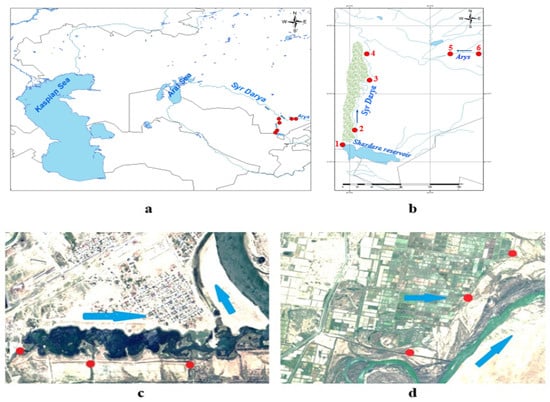
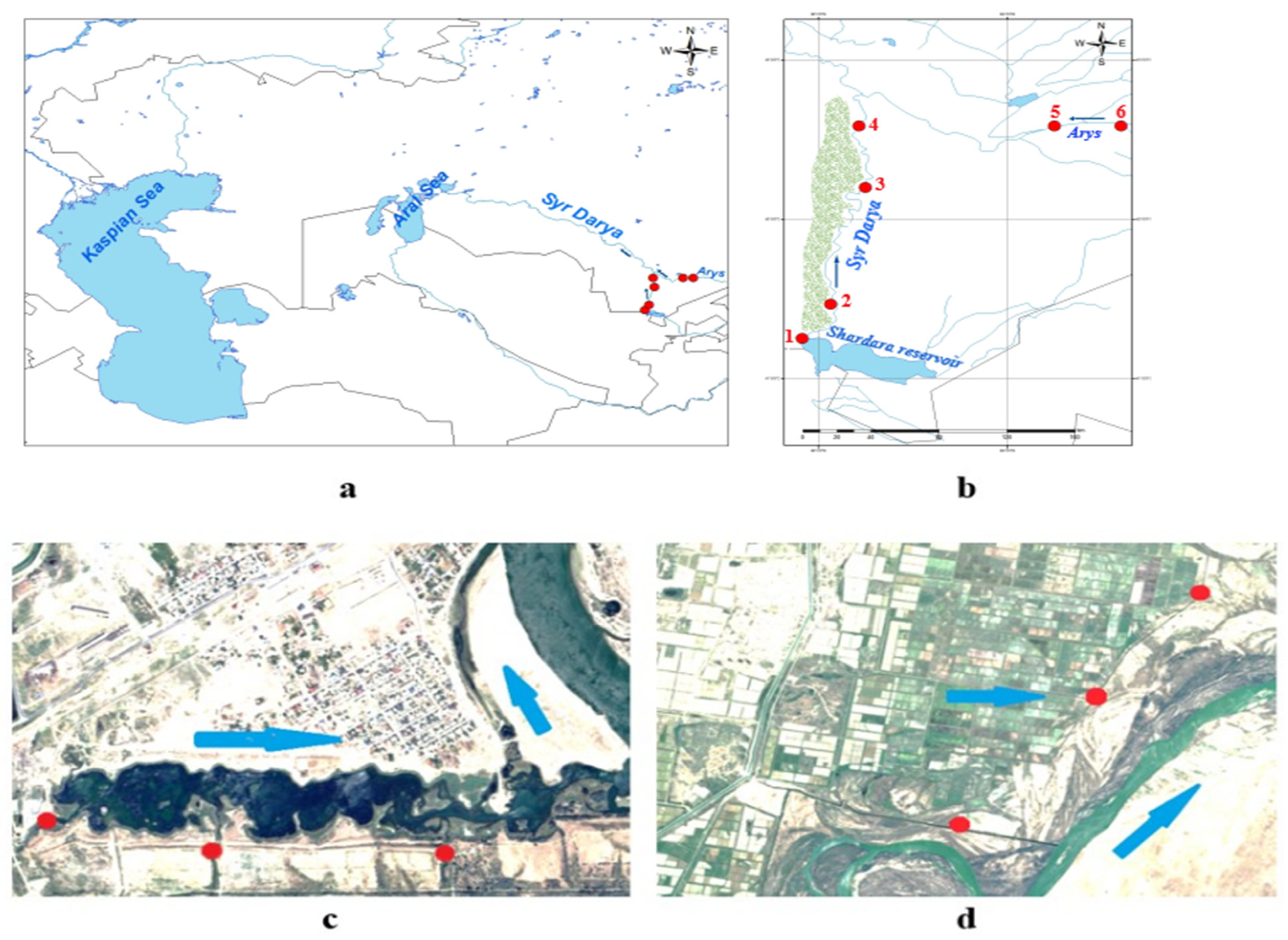
Field surveys were conducted in 2025 (March, June, October, and November) and 2026 (March and August) in irrigation ditches located downstream of the Shardara Reservoir and near Koksu village, as well as in the Syr Darya and Arys rivers (Figure 1, Table 1). The study area is located in the central part of Eurasia and is characterized by a continental climate, with hot summers and cold winters. In 2025, the lowest average air temperatures were recorded in December, ranging from −8 °C at night to +13 °C during the day, whereas the highest temperatures were observed in August, ranging from +20 °C at night to +43 °C during the day. Nighttime temperatures below 0 °C generally occur from November to March, although average daytime temperatures during this period remain above +10 °C [25]. The maximum water level in the Syr Darya River is observed in March and April, the minimum is from August to November. The water level in the drainage ditches does not change significantly. In the collector ditches, high water levels were observed from May to July, low water levels were from December to March. Sampling during different seasons was necessary to account for species-specific differences in the development and seasonal occurrence of aquatic insect larvae, as well as potential seasonal fish migrations.
Figure 1.
Map of sampling sites: (a)—study region, (b)—study area station numbers are linked to the river flow, (c)—drainage ditches (labeled as 1 in the picture (b)), (d)—collectors (labeled as 3 in the picture (b)). Blue arrows show flow direction, red circles indicate sampling sites as 1—drainage ditches; 2—Syr Darya upper site; 3—collectors; 4—Syr Darya lower site; 5—Arys upper site; 6—Arys lower site (based on Google Earth image, 1 January 2021).
Table 1.
List of sampling sites.
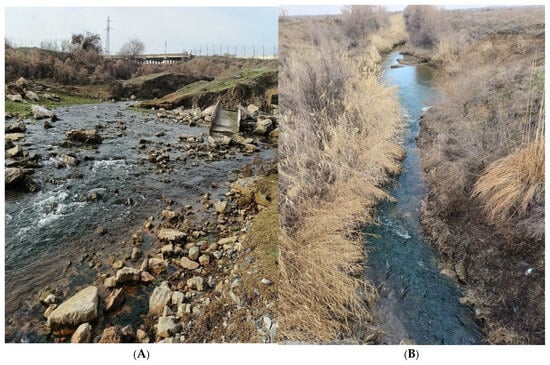
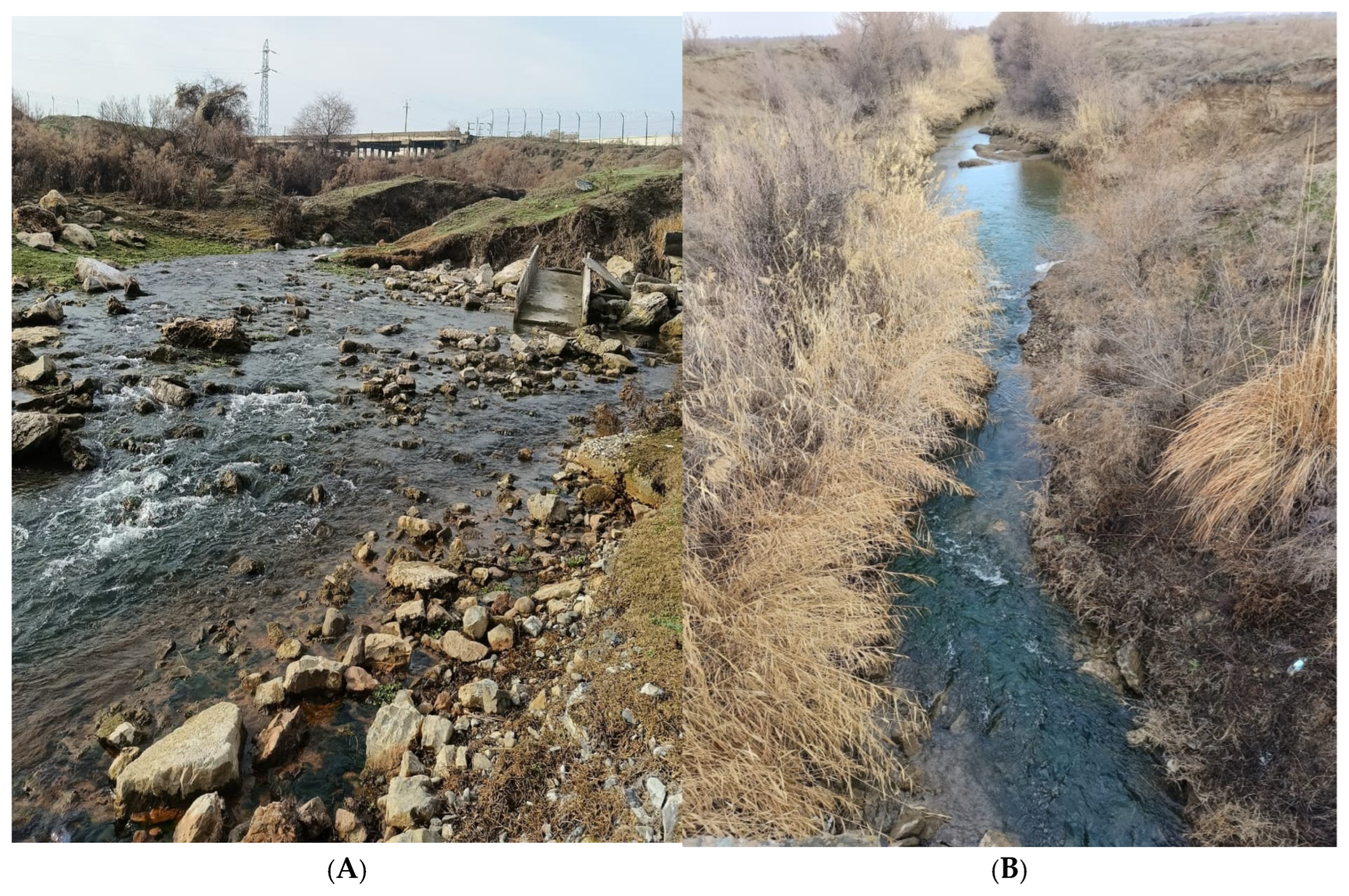
Two types of ditches were identified within the study area. The first type comprises ditches situated downstream of the Shardara Reservoir and the Kyzylkum Canal that collect groundwater seepage and discharge it into the Syr Darya River. These ditches are hereafter referred to as drainage ditches (Figure 2A). The second type comprises ditches located near Koksu village that collect return flows from agricultural fields, predominantly rice paddies, with a smaller proportion of fields cultivated with alfalfa, and convey this water to the Syr Darya River. These ditches are hereafter referred to as collectors (Figure 2B). The width of the drainage ditches studied varies more widely than that of the collectors (Table 1). The profile of both types of grooves is mostly straight. The bottoms of the drainage ditches were predominantly composed of gravel and cobble substrates, with localized areas of sandy-clay sediments. In contrast, collectors were characterized mainly by sandy-clay substrates, with occasional gravelly or silty sections. Water from all the examined ditches flows into the Syr Darya River without any obstacles. These channels were selected for the study because they were constructed more than 10 years ago and maintain flowing water throughout the year.
Figure 2.
General view of the investigated ditches: (A)—a drainage ditch from Kyzylkum Canal; (B)—a collector near the Koksu village.
The adjacent reaches of the Syr Darya and Arys rivers flow within natural river channels. The Syr Darya River is regulated upstream by the Shardara Reservoir, one of the largest reservoirs in the region. The Arys River originates in the Talas Alatau Mountains (Western Tien Shan) and is extensively utilized for irrigation. However, during winter and in years of high discharge, the river maintains connectivity with and reaches the Syr Darya River.
Water quality measurements were conducted simultaneously with fish and aquatic macroinvertebrate sampling. Water temperature, pH, concentrations of total dissolved solids (TDS in ppm), turbidity (in formazin turbidity units–FTU), dissolved oxygen, ammonia, and nitrate concentrations were measured. Turbidity was determined using a HI97303 turbidity meter; ammonia and nitrate concentrations were measured using HI96700 Ammonia LR and HI93728 photometers, respectively; dissolved oxygen was measured with a HI9146 oxygen meter; and TDS, temperature, and pH were measured using an HI98129 multiparameter meter (all instruments manufactured by Hanna Instruments, Cluj-Napoca, Romania).
Fish sampling was conducted using seine nets of 20, 5, and 1.5 m length, each with a height of 1.2 m and mesh sizes 5 mm, and a seine net 1.5 length with mesh size 3 mm. At each sampling visit, fishing was performed five times over an area of approximately 100 m2 per haul (total sampled area ≈ 500 m2) in each ditch. Sampling effort in the Syr Darya and Arys rivers was doubled to ensure adequate coverage of all available microhabitats. The species of fish measuring more than 20 cm in length were identified at the sampling sites and released then, whereas smaller fish were fixed in a 4% formaldehyde solution and subsequently identified in the laboratory. Fish nomenclature follows the Eschmeyer’s Catalog of Fishes [26].
Aquatic macroinvertebrates were collected using the standard semi-quantitative kick-sampling method with the seine net 1.5 length with mesh size 3 mm and by hand-picking specimens from the substrate [27,28]. Sampling consisted of 7–10 kicks in ditches and 15–20 kicks in rivers, each covering approximately 1 m2. Organism abundance was subsequently standardized to individuals per square meter. Larvae of blackflies (Simuliidae) were collected from a variety of substrates, including hard substrates, plant debris, vegetated banks, and submerged macrophytes, and their abundance was also expressed as individuals per square meter.
Aquatic macroinvertebrates were identified to the lowest reliable taxonomic level (genus or species). Morphological examination of aquatic invertebrates was performed using a Biolab stereomicroscope (St. Petersburg, LOMO, Russia) at magnifications of ×8, ×32, ×40, ×60, and ×80. Blackfly identification was based on regional and global taxonomic keys and reference works [29,30,31,32,33]. Other macroinvertebrates were identified to the lowest reliable taxonomic level following established identification guides [34,35,36]. Hydrobionts assemblages were characterised using species richness (S), Shannon diversity index (H), and Shannon evenness (J) [37]. Shannon indices were calculated using logarithms to base 2.
2.2. Statistics
Relationships between water physicochemical parameters and species occurrence, as well as pairwise associations among species based on presence–absence data, were assessed using Kendall’s rank correlation coefficient (τ). This non-parametric statistic is widely applied in aquatic ecology because of its robustness to non-normally distributed data and its suitability for analyzing ranked ecological variables. Correlations were considered statistically significant at p ≤ 0.05 (95% confidence level) [38].
Multivariate statistical analyses were performed following the recommendations of Legendre & Legendre [38] to investigate relationships between environmental factors and aquatic assemblage composition. Detrended correspondence analysis (DCA) was initially conducted separately for macroinvertebrate and fish assemblages to determine the appropriate ordination approach.
Multivariate relationships between freshwater macroinvertebrate and fish assemblages and environmental variables were analyzed using canonical correspondence analysis (CCA) implemented in PAST version 4.07b [39]. CCA is a direct gradient ordination method that identifies the principal patterns of variation in biological communities that can be explained by measured environmental variables [40]. In addition, redundancy analysis (RDA) was performed as an independent constrained ordination approach to evaluate the relationships between environmental factors and variation in assemblage composition under a linear response model. Both CCA and RDA were used to assess the associations between community structure and environmental conditions from complementary ordination perspectives. For this analysis, the maximum observed abundance of each species was used, regardless of the season (month) in which it was recorded. Prior to ordination, species abundance data were log-transformed using log10(x + 1). The statistical significance of canonical axes was evaluated using a Monte Carlo permutation test with a significance threshold of p < 0.05.
3. Results
The physicochemical characteristics of the investigated water bodies are presented in Table 2. Ammonium were below detection with the method used in any of the studied water bodies. Nitrates were detected in one of the drainage ditches, one of the collectors, and throughout the entire surveyed section of the Arys River. The highest concentrations of total dissolved solids (TDS) were recorded in the collector channels. Water turbidity in both kinds of ditches was substantially lower than that observed in the Syr Darya and Arys rivers (from maximal 4.31 FTU in one of the drainage ditches to minimal 10.92 FTU in the upper site of the Syr Darya River).
Table 2.
Maximal physicochemical characteristics of studied sites.
Each investigated ditch exhibited distinct physicochemical characteristics, including differences in pH, dissolved salt concentration, dissolved oxygen content, and water turbidity.
Table 3 presents data on the occurrence of different species of aquatic macroinvertebrates. The macroinvertebrate fauna comprised both widespread species occurring across all studied water bodies and taxa restricted to particular habitat types. The Oriental river prawn Macrobrachium nipponense, chironomid larvae (Chironomidae), and the blackflies Simulium (Wilhelmia) turgaicum and Simulium (Wilhelmia) pseudequinum were recorded in all studied types of water bodies. The highest taxonomic diversity was observed in the Syr Darya and Arys rivers.
Table 3.
List of aquatic invertebrate taxa recorded in the studied watercourses (“+”—present; “−”—absent; alien species are marked with an asterisk; diversity data are presented for each river as a whole, without subdivision into sampling reaches).
Four mollusc taxa, Lymnaea sp., Anisus sp., Physella (Costatella) sp., and Dreissena polymorpha, were recorded in the drainage ditches; the latter two were not recorded in the other investigated streams. The collectors were inhabited by Anodonta anatina and Rivicoliana sp., the latter of which was not recorded in the rivers or drainage ditches.
The lengths of the first DCA axes were 4.32 and 4.34 standard deviation (SD) units for macroinvertebrates and fish, respectively. As both values exceeded the conventional threshold of 4 SD units, indicating substantial species turnover along the primary gradients (Figures S9 and S10), unimodal ordination (canonical correspondence analysis, CCA) was considered appropriate for examining relationships between assemblage composition and environmental variables.
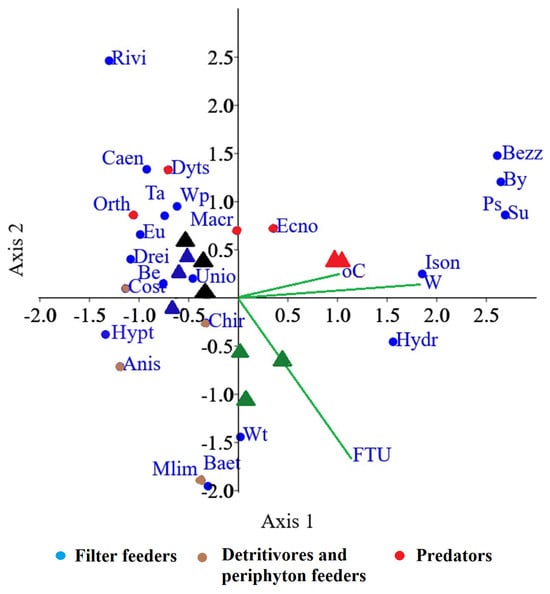
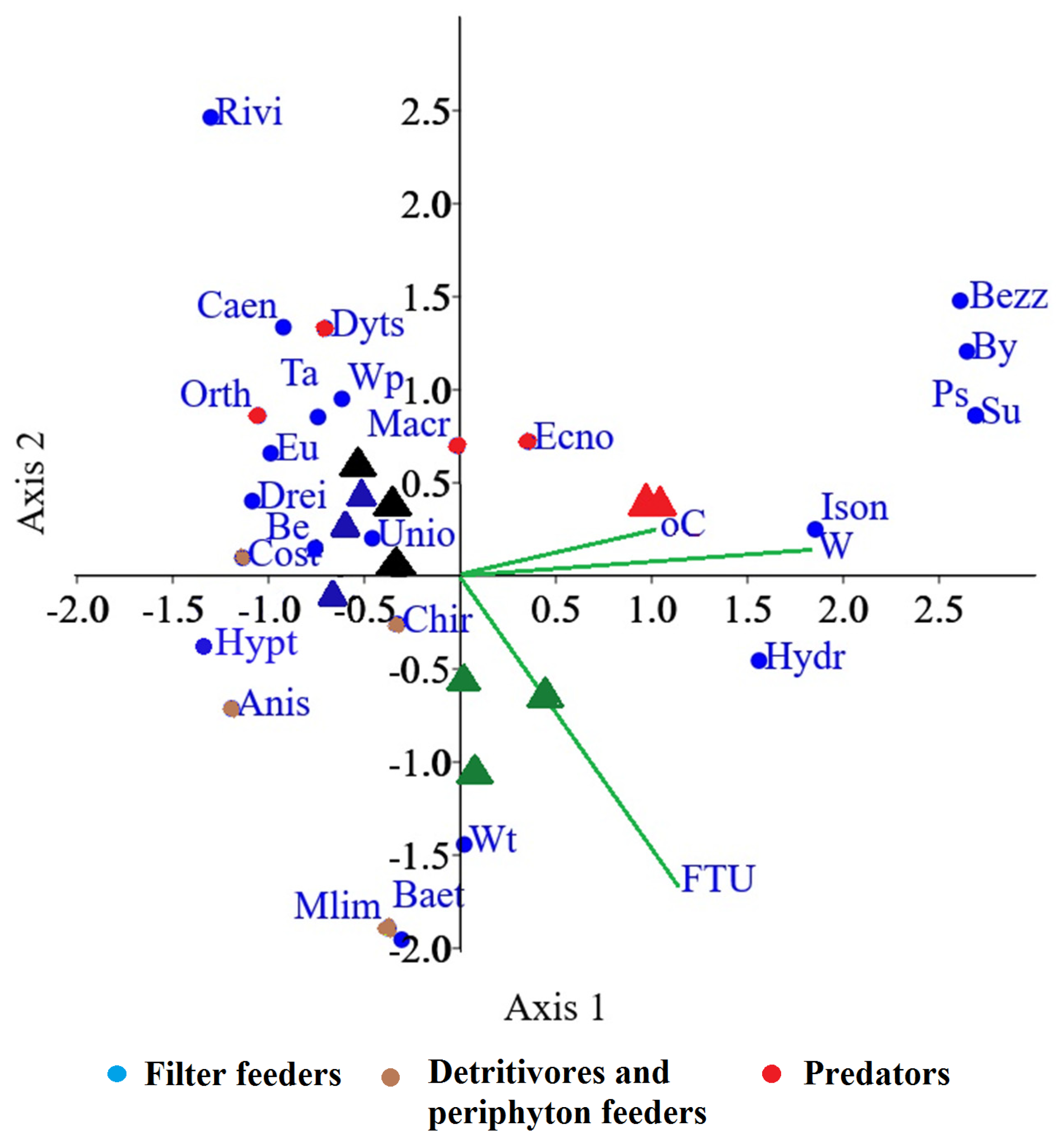
The RDA suggested that environmental variables collectively accounted for a considerable proportion of the variation in aquatic animal assemblage composition (R2 = 0.828). However, the adjusted R2 was substantially lower (0.312), and the overall relationship was not statistically significant (F = 1.604, p = 0.072; 999 permutations). Given the limited number of samples relative to the number of explanatory variables, these results should be regarded as exploratory rather than conclusive (Table S2). All the studied watercourses exhibited stream width positively correlated with flow velocities and negatively with TDS (Figure S9). The measured pH, dissolved oxygen, nitrate concentrations, and mineralization levels were within the ranges generally considered suitable for aquatic organisms [41,42,43]. Consequently, channel width (W), water temperature (°C), and turbidity (FTU) were selected for further CCA analysis because they exhibited the greatest variability among the studied watercourses. Possible relationships between the three environmental variables and macroinvertebrate density were examined using canonical correspondence analysis (CCA; Figure 3). Eigenvalues (λ) were 0.517, 0.394, and 0.089 for the first, second, and third canonical axes, respectively. The first two axes (corresponded the channels width and water temperature) explained 91.1% of the constrained variation. Turbidity differences appeared to have a weaker influence on the distribution of these invertebrate species across rivers and ditches. All the canonical axes were statistically significant (Monte Carlo test, 499 permutations; trace = 0.911, p = 0.002).
Figure 3.
CCA biplot of macroinveretebrate species, environmental factors and the sample sites. Sampling sites are marked as red triangles for the Syr Darya River, green triangles for the Arys River, blue triangles for drainage ditches, and black triangles indicates collector ditches. Environmental factors abbreviation: W—stream width, °C—water temperature, FTU—water turbidity (formazin turbidity unit). Species abbreviations are provided in Table 3.
Most of the recorded macroinvertebrate species were associated with relatively shallow, low-turbidity water and moderate temperatures. Larvae of the dragonfly genus Orthetrum and the mayfly genus Caenis were characteristic of drainage ditches, whereas larvae of the mayfly genus Isonychia were recorded exclusively in riverine habitats. A total of eight blackfly species were identified. Among these, Simulium (Eusimulium) sp. was recorded only in drainage ditches, whereas Simulium (Byssodon) maculatum, Simulium (Psilocnetha) almae, and Sulcicnephia syrdaryensis were restricted to the Syr Darya River. Simulium (Wilhelmia) pseudequinum occurred in high numbers in channels of both types but was scarce in rivers. Even among drainage ditches of the same type, the species composition and abundance of individual blackfly species varied considerably.
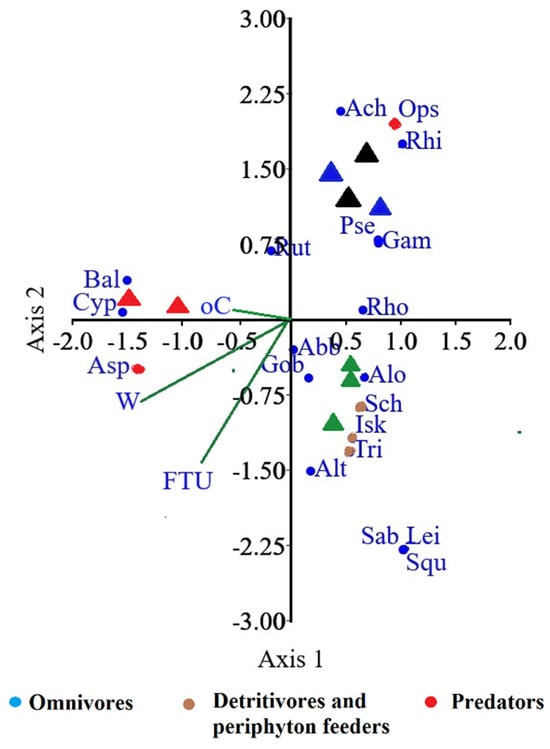
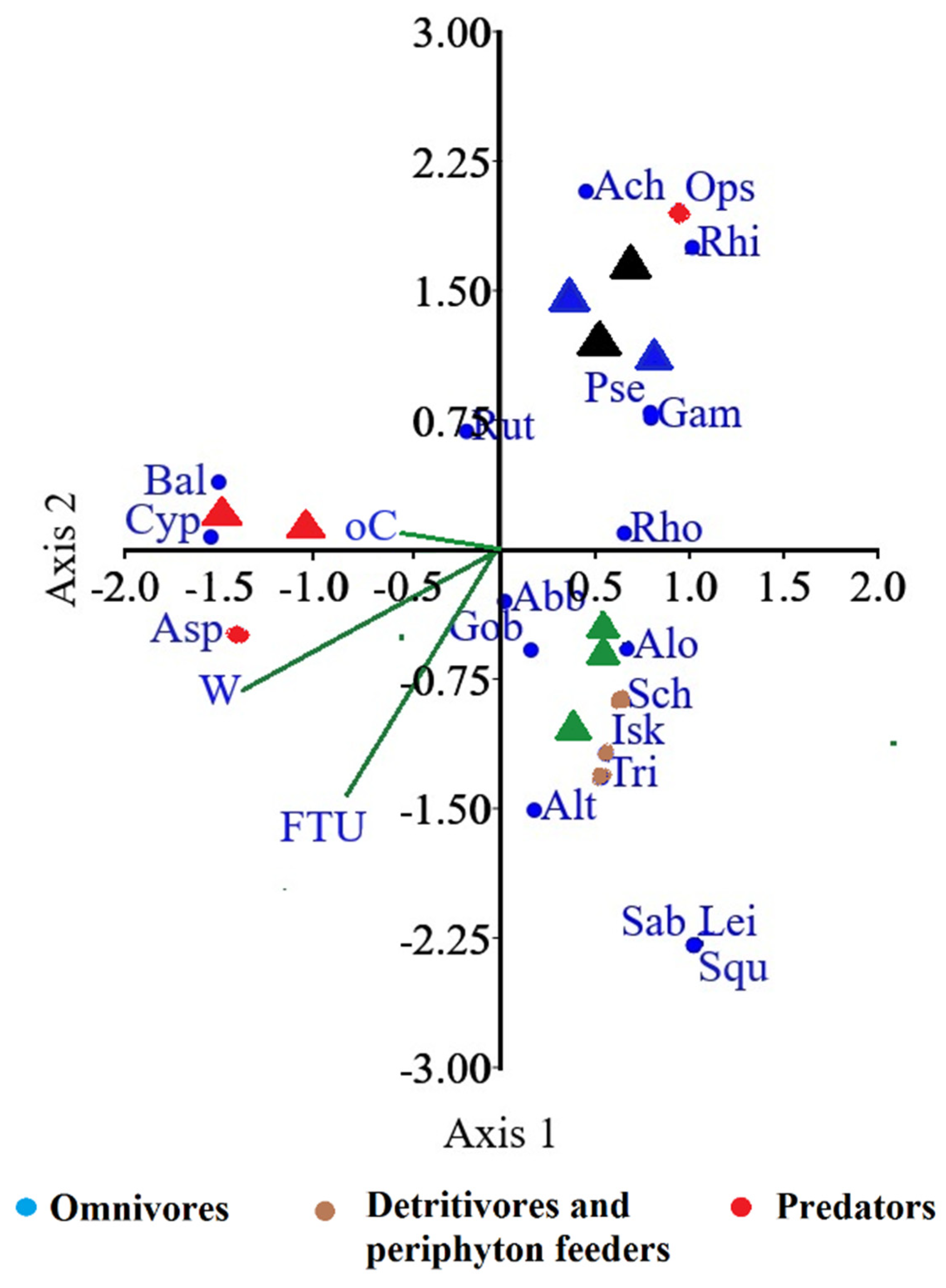
The list of detected fish species and their distribution across water bodies is presented in Table 4. Clear differences in fish diversity were observed between the ditches and the rivers. The Syr Darya River supported a high diversity of native fish species, including commercially important taxa such as Cyprinus carpio, Sander lucioperca, and Abramis brama. The ichthyofauna of the Arys River was predominantly composed of rheophilic and mountain-stream native species, including Schizothorax intermedius, Triplophysa coniptera, and Iskandaria kuschakewitschi. In contrast, mostly non-native species including Opsariichthys amurensis, Pseudorasbora parva, Gambusia holbrooki, and Rhinogobius cheni were found in the ditches.
Table 4.
List of revealed fish (“+”—present, “-”—absent, alien species marked by asterix).
Canonical correspondence analysis (Figure 4) revealed a segregation of species groups associated with the Syr Darya River, the Arys River, and drainage ditches. The CCA identified two major canonical axes, with eigenvalues of 0.648 and 0.526, respectively. Together, these axes accounted for almost all constrained inertia (55.18% and 44.82%, respectively). The third axis had a negligible eigenvalue (0.000009). The overall CCA model was statistically significant (Monte Carlo permutation test, 499 permutations; trace = 1.175, p = 0.004). However, only the second canonical axis was individually significant (p = 0.001), whereas the first and third axes were not (p = 0.082 and p = 0.978, respectively).
Figure 4.
CCA biplot of fish species, environmental factors and the sample sites. Sampling sites are marked as red triangles for the Syr Darya River, green triangles for the Arys River, blue triangles for drainage ditches, and black triangles indicates collector ditches. Environmental factors abbreviation: W—stream width, °C—water temperature, FTU—water turbidity,. Species abbreviations are provided in Table 4.
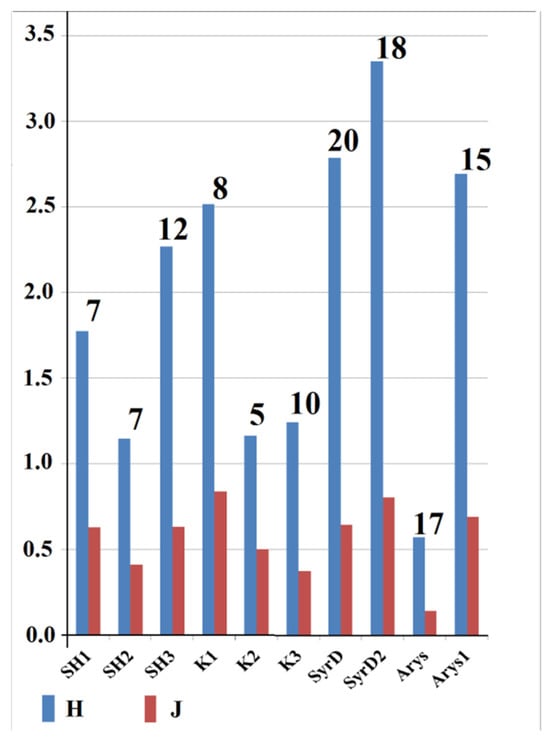
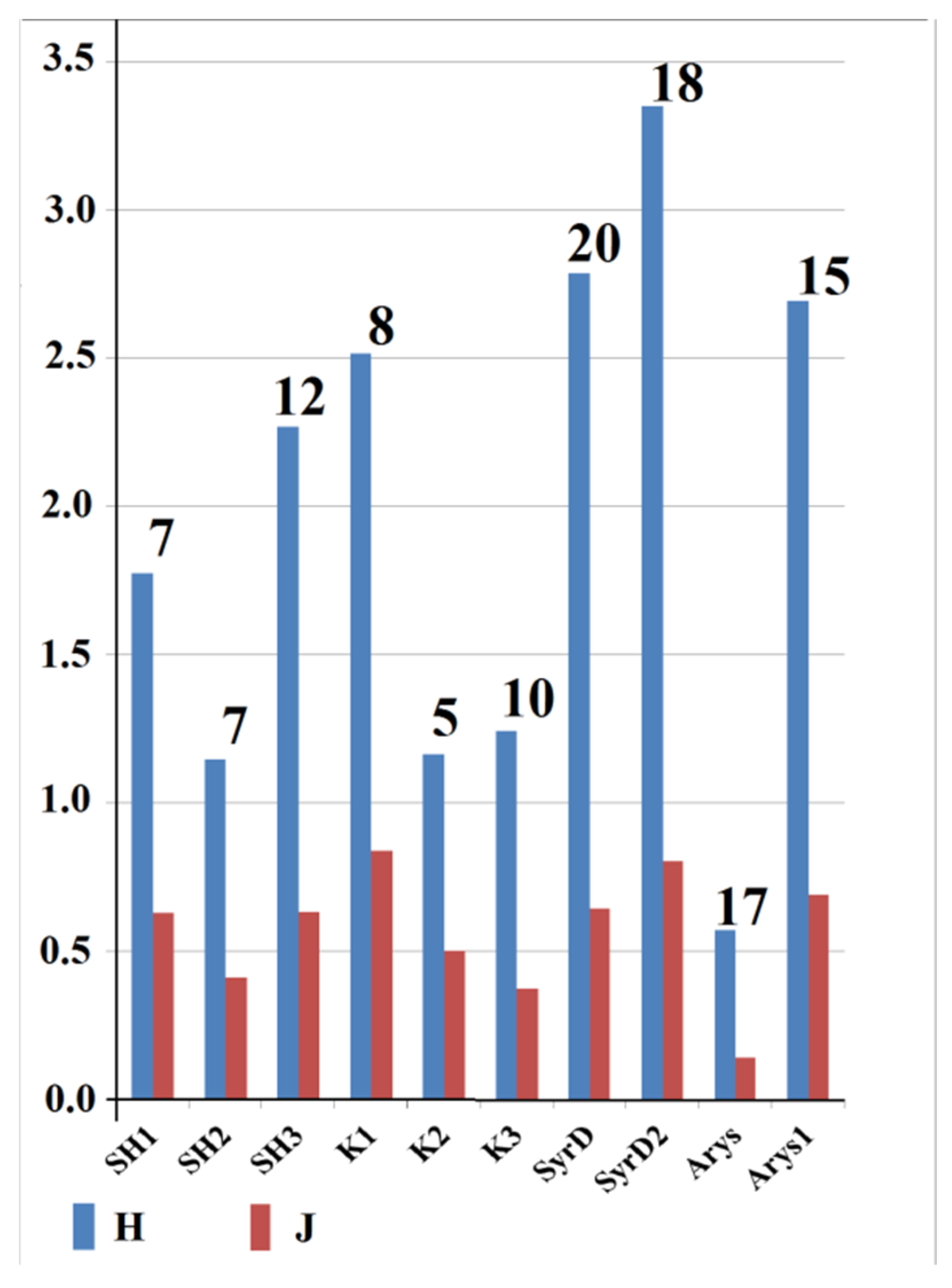
A comparative assessment of overall diversity in the studied watercourses is presented in Figure 5. The highest species richness was recorded in rivers. No fish were recorded in one of the drainage ditches, and in one of the drainage collectors. Various species of blackflies (Simuliidae) were strongly predominant in most drainage ditches and in the Arys River (Table S1). The caddisfly Hydropsyche angustipennis was the dominant species in the upper section of the Syr Darya River, accounting for 41.6% of the total abundance, whereas juvenile bream Abramis brama predominated in the lower section, accounting for 25.4%. Mosquitofish Gambusia affinis was dominant in drainage ditch SH2 (41.9%), while the bivalve mollusk Anodonta anatina was the most abundant species in collector K1 (33.8%).
Figure 5.
Overall diversity indices in the studied watercourses: H—Shannon diversity index (blue bars) and J—Shannon evenness index (red bars). Numbers above the bars indicate the total number of species recorded (S). Sampling sites are abbreviated as SH—drainage ditches K—collectors, SyrD—upper site on the Syr Darya, SyrD2—lower site on the Syr Darya, Arys—lower site on Arys, Arys1—upper site.
4. Discussion
The results revealed clear differences in habitat conditions between the ditches and the adjacent rivers. The higher turbidity observed in the Syr Darya and Arys rivers may indicate substantial soil erosion, which is a characteristic feature of river systems in arid regions [44,45]. The highest nitrate concentration was detected in one of the reservoirs, whereas nitrates were not detected in the other two reservoirs throughout the study period. Because the fields located upstream of these ditches are managed by different landowners, the observed differences may be related to differences in fertilizer application. Contrary to expectations, elevated nitrate concentrations were also detected in the Arys River. Agricultural land adjacent to the Arys River supports a diverse range of crops, including apple orchards, vineyards, vegetables, and cereals. In contrast, the collector area is dominated by rice cultivation, with some fallow fields sown with alfalfa. However, the number of observations was insufficient to statistically assess the effect of nitrate concentrations on the observed biodiversity patterns.
Of the 46 taxa recorded, the investigated ditches supported seven macroinvertebrate taxa that were not revealed the adjacent river assemblages. Although mollusks and fish most likely colonized the ditches through hydrological connections with the river network, these taxa attained relatively high population densities within the ditch habitats. This finding suggests that artificial watercourses may provide suitable environmental conditions for some taxa that are less abundant in the adjacent river channels. Canonical correspondence analysis (CCA) indicated that water temperature, stream width, and water turbidity were the primary environmental gradients structuring both macroinvertebrate and fish communities.
Aquatic macroinvertebrates were the dominant group of organisms in 8 out of 10 studied watercourses. We summarized the available information on the trophic characteristics of the recorded macroinvertebrate taxa [1,46,47,48,49,50,51,52,53,54,55,56,57,58] in Table 5. The data indicate that three functional feeding groups of macroinvertebrates are represented in the drainage ditches. One of the drainage collectors supports only filter feeders, whereas the other contains both filter feeders and predators. Blackflies (Diptera: Simuliidae) between them were not only the most abundant group in most of the studied watercourses but also play an important functional role as filter feeders, contributing to water purification by removing microalgae and organic particles from the water column. At the same time, this group is of considerable economic and societal importance in the region. Blackflies are of medical and ecological significance because many species are hematophagous pests and serve as obligate vectors of pathogens affecting vertebrates, including filarial nematodes of the genus Dirofilaria and protozoans of the genus Leucocytozoon, both of which are widespread in Kazakhstan [28,31,59]. During the last decade, blackflies have become an increasing source of concern for local communities in southern Kazakhstan [60].
Table 5.
Functional feeding groups of macroinvertebrates in the watercourses.
Published information on the historical diversity of aquatic macroinvertebrates is limited, both for the investigated ditches and for the Syr Darya River. Available historical information appears to be largely restricted to blackflies [28,60,61,62], highlighting the considerable socio-ecological importance of this group of insects in the region. All seven blackfly species previously reported from the basin were recorded in the present study. The occurrence of S. alajense, S. almae, S. pseudequinum, S. syrdaryensis, and S. turgaicum is consistent with previous studies and is compatible with relatively broad ecological plasticity and an ability to persist in anthropogenically modified aquatic habitats. In addition, Simulium (Byssodon) maculatum apparently new to the region, was detected. Overall, these findings contribute to current knowledge of the habitat associations and ecological tolerance of these blackfly species. Nevertheless, environmental factors not examined in the present study are likely to contribute to the heterogeneous distribution of blackfly species among the investigated water bodies.
In contrast to aquatic invertebrates, relatively detailed historical information is available for fish in the irrigation system of the Syr Darya River in Kazakhstan, based on collections made by M. Dairbaev in the early 1950s [18]. Comparison with these historical records indicates a substantial reduction in the representation of native fish species and the occurrence of several non-native species in the irrigation system. Acipenser nudiventris, Pseudoscaphirhynchus fedtchenkoi, Aspioluceus esocinus, and Capoetobrama kuschakewitschi were not recorded in either the river or the irrigation system during the present study. These species are listed as rare and requiring protection in the latest edition of the Red Book of the Republic of Kazakhstan [63]. In addition, Cyprinus carpio, Abramis brama, Ballerus sapa, Scardinius erythrophtalmus, Luciobarbus brachycephalus, Luciobarbus capito, Gobio lepidolaemus, Triplophysa coniptera, Sabanejewia aralensis, and Silurus glanis, which were previously reported from the irrigation system, were not recorded during the present study. At that time, Gambusia holbrooki was the only non-native fish species reported from the canals.
During the late 1950s and 1960s, Rhodeus ocellatus, Opsariichthys amurensis, Pseudorasbora parva, Abbottina rivularis, and Rhinogobius cheni were unintentionally introduced into the Syr Darya River basin [64]. All of these non-native species were recorded in the irrigation system during the present study.
The investigated ditches supported the small non-native fishes as Opsariichthys amurensis and Gambusia holbrooki, which were not major components of the adjacent river assemblages. Both species have long been known from the Syr Darya River basin [65,66]. The biology of G. holbrooki has been relatively well studied in this region. Previously, O. amurensis was known from the Syr Darya River mainly from occasional records [67]; however, an increase in its abundance has been reported in recent years [68]. Further research is needed to determine the factors underlying the relatively high abundance of O. amurensis observed in the ditches. In contrast, six commercial fish species were abundant exclusively in the Syr Darya River.
Eight native fish species were recorded only in the Arys River. Despite similarities in several abiotic characteristics between the drainage collectors and the upper reaches of the Arys River including gravel–cobble substrates, flowing water, relatively low mineralization, and high dissolved oxygen concentrations several riverine species, as Petroleuciscus squaliusculus, Alburnus taeniatus, Alburnus oblongus, Gobio lepidolaemus, Iskandaria kuschakewitschi, and Triplophysa coniptera, were not recorded in the drainage collectors, despite the absence of visible physical barriers. This pattern suggests that similarities in measured physicochemical conditions alone may not be sufficient to explain fish occurrence and that other habitat characteristics or dispersal-related processes may be involved.
The predominance of non-native fishes in the ditches suggests that these artificial habitats may favor environmentally tolerant species. However, an alternative explanation is that changes in habitat conditions and fish assemblages in the Syr Darya River have altered the source populations available for colonization of the irrigation network. All of the native species listed above were previously common in the main river but were not recorded there during the present study. One major environmental change in the region over the past decades was the construction of the Shardara Reservoir in 1965, primarily for water storage and irrigation. The fish protection devices installed then in the water-supply canals effectively prevent large fish and advanced juveniles from entering the irrigation system. Consequently, movement of fish between the river and drainage channels may occur primarily through the downstream drainage network or, in some cases, against the current.
Repeated immigration from established populations in the main river may increase propagule pressure and thereby enhance the probability of establishment of non-native fishes in suitable artificial habitats. Under this interpretation, the relatively high abundance of alien species in the ditches may reflect both the availability of suitable environmental conditions and repeated immigration from established source populations. However, the present data do not allow these mechanisms to be separated, and experimental or long-term monitoring studies would be required to evaluate their relative importance.
The results support a conceptual model in which drainage ditches, collector ditches, and natural rivers form interconnected yet ecologically distinct components of a hydrosystem mosaic shaped by physicochemical gradients and anthropogenic influence. Drainage ditches represent highly modified, low-energy habitats with reduced habitat heterogeneity, relatively low turbidity, and simplified trophic structure. These conditions may favor assemblages dominated by environmentally tolerant and opportunistic species, including non-native taxa. Their composition may reflect environmental filtering associated with hydrological regulation, relatively stable flow conditions, and limited habitat complexity. At the same time, such habitats may provide suitable conditions for species adapted to shallow and relatively stable waters.
The drainage ditches and collector ditches have direct connection to the Syr Darya River and sems to be equally close to the river. Collector ditches occupy an intermediate position between drainage ditches and rivers and are distinguished by higher mineralization and altered substrates. Consequently, they support mixed fish assemblages comprising both riverine and ditch-associated taxa. Their position within the hydrological network may also allow them to function as dispersal corridors and sites of biotic exchange between natural and anthropogenically modified habitats, while environmental conditions selectively influence the composition of the resulting assemblages.
The rare native species of aquatic macroinvertebrates and fish were not recorded in either type of drainage ditch. Therefore, temporary drainage of these ditches may be recommended when high densities of blackfly larvae are observed. However, it should be taken into account that aquatic macroinvertebrates play an important role in the self-purification processes of the Syr Darya River. Consequently, each decision to temporarily drain a ditch should be made on a case-by-case basis, following a careful assessment of all the potential advantages and disadvantages.
Natural river sections, represented by the Syr Darya and Arys rivers, are more heterogeneous and dynamically structured habitats characterized by greater flow variability, higher habitat complexity, and greater spatial diversity of microhabitats. These conditions are associated with higher species richness and the presence of native, including rheophilic and commercially important, fish species, as well as more diverse macroinvertebrate assemblages. Riverine assemblages are strongly structured by hydromorphological gradients such as flow velocity, channel depth, and channel width, which contribute to pronounced spatial differentiation in community composition.
Overall, the present study demonstrates the ecological importance of drainage ditches as habitats supporting local populations of four blackfly species in the Syr Darya River basin. Ditches may contribute to regional biodiversity by increasing habitat heterogeneity, but this contribution should not automatically be interpreted as a conservation benefit. Their ecological value needs to be considered in relation to the composition and conservation status of the species they support, as well as their role within the broader river–irrigation network.
5. Conclusions
The study revealed clear ecological differences among drainage ditches, collector ditches, and natural river sections in the Syr Darya River basin. Flow velocity, depth, and water temperature were the main environmental gradients impacted on the composition of both macroinvertebrate and fish assemblages. Collectors and drainage ditches supported several macroinvertebrate taxa, including four blackfly species, as well as relatively abundant non-native fishes, indicating their capacity to provide suitable habitats for environmentally tolerant species. In contrast, natural river sections supported higher fish richness (13 in the Syr Darya and 14 in the Arys) and retained native, including rheophilic and commercially important, species that were absent from the investigated artificial habitats. The observed distribution of non-native fishes may reflect a combination of environmental filtering and repeated immigration from established populations, although the relative contribution of these mechanisms requires further investigation. Overall, irrigation ditches contribute to habitat heterogeneity and regional biodiversity, but their ecological contribution should be evaluated in the context of the composition, origin, and conservation status of the species they support.
Supplementary Materials
The following supporting information can be downloaded at: https://www.mdpi.com/article/10.3390/hydrobiology5040049/s1.
Author Contributions
Conceptualization, methodology, investigations, data analysis, original draft preparation, supervision, Z.B.K. and N.S.M. Field investigation and data curation, Z.B.K., N.S.M., K.S.K., G.K.K., F.T.A., G.S.I., S.E.S., Z.O.M. and A.M.A. Formal analysis and resources, K.S.K. and S.E.S. Visualization, Z.B.K. and F.T.A. Project Administration, S.E.S. All authors have read and agreed to the published version of the manuscript.
Funding
This research has been funded by the Science Committee of the Ministry of Science and Higher Education of the Republic of Kazakhstan (Grant No. AP26100721).
Institutional Review Board Statement
Not applicable. Ethical review and approval were waived for this study due to the fish catching and research being performed in accordance with the laws of the Republic of Kazakhstan “On the protection, reproduction, and use of fauna” from 9 July 2004 No. 593-II (as amended by the Law of the Republic of Kazakhstan, dated 3 July 2013 No. 124-V, dated 16 May 2014 No. 203-V, dated 29 September 2014 No. 239-V, dated 29 December 2014 No. 269-V ZRK, dated 29 October 2015 No. 376-V ZRK, dated 29 March 2016 No. 479-V, dated 15 June 2017 No. 73, dated 2 April 2019 No. 241, dated 28 October 2019 No. 268, dated 23 February 2021 No. 11, dated 30 April 2021 No. 34, dated 24 November 2021 No. 75, dated 14 July 2022 No. 141), from 30 December 2021 No. 97-VII ZRK “On the responsible treatment of animals”, and the order of the Minister of Agriculture of the Republic of Kazakhstan dated 10 November 2004 No. 652. “On approval of the Rules for the use of animals, with the exception of rare and endangered animals, in scientific, cultural, educational, and aesthetic purposes, including for the creation of zoological collections”.
Informed Consent Statement
Not applicable.
Data Availability Statement
The original contributions presented in the study are included in the article; further inquiries can be directed to the corresponding author.
Acknowledgments
The authors express their deep gratitude to T. Kalmuratov for organizing and financially supporting the research, and to D.T. Enkebaev, R.K. Tulemisov, Z.M. Esemuratov, M.Zh. Halykova, M.V. Kulemin, and K.B. Abildaev for their help in collecting materials. The authors are deeply grateful to the anonymous reviewers for a thorough analysis the manuscript and valuable tips that helped us significantly improve its content. This research has been funded by the Science Committee of the Ministry of Science and Higher Education of the Republic of Kazakhstan (Grant No. AP26100721).
Conflicts of Interest
The authors declare no conflicts of interest.
References
- Dudgeon, D.; Arthington, A.H.; Gessner, M.O.; Kawabata, Z.-I.; Knowler, D.J.; Levêque, C.; Naiman, R.J.; Prieur-Richard, A.-H.; Soto, D.; Stiassny, M.L.J.; et al. Freshwater biodiversity: Importance, threats, status and conservation challenges. Biol. Rev. 2006, 81, 163–182. [Google Scholar] [CrossRef] [Scilit]
- Szabolcs, M.; Kapusi, F.; Carrizo, S.; Markovic, D.; Freyhof, J.; Cid, N.; Cardoso, A.C.; Scholz, M.; Kasperidus, H.D.; Darwall, W.R.T.; et al. Spatial priorities for freshwater biodiversity conservation in Europe. PLoS ONE 2022, 17, e0267801. [Google Scholar] [CrossRef] [Scilit]
- Williams, P.; Whitfield, M.; Biggs, J.; Bray, S.; Fox, G.; Nicolet, P.; Sear, D. Comparative biodiversity of rivers, streams, ditches and ponds in an agricultural landscape in southern England. Biol. Conserv. 2004, 115, 329–341. [Google Scholar] [CrossRef] [Scilit]
- Tomingas, P.; Kont, R.; Lõhmus, A.; Vaikre, M. Diversity of small waterbodies sustains aquatic biodiversity in drained forest landscapes. Hydrobiologia 2025, 852, 1677–1692. [Google Scholar] [CrossRef] [Scilit]
- Downing, J.A.; Prairie, Y.T.; Cole, J.J.; Duarte, C.M.; Tranvik, L.J.; Striegl, R.G.; McDowell, W.H.; Kortelainen, P.; Caraco, N.F.; Melack, J.M.; et al. The global abundance and size distribution of lakes, ponds, and impoundments. Limnol. Oceanogr. 2006, 51, 2388–2397. [Google Scholar] [CrossRef] [Scilit]
- Needelman, B.A.; Kleinman, P.J.A.; Strock, J.S.; Allen, A.L. Improved management of agricultural drainage ditches for water quality protection: An overview. J. Soil Water Conserv. 2007, 62, 171–178. [Google Scholar] [CrossRef] [Scilit]
- Dollinger, J.; Dagès, C.; Bailly, J.S.; Lagacherie, P.; Voltz, M. Managing ditches for agroecological engineering of landscape: A review. Agron. Sustain. Dev. 2015, 35, 999–1020. [Google Scholar] [CrossRef] [Scilit]
- Verdonschot, R.C.M.; Keizer-Vlek, H.E.; Verdonschot, P.F.M. Biodiversity value of agricultural drainage ditches: A comparative analysis of the aquatic invertebrate fauna of ditches and small lakes. Aquat. Conserv. Mar. Freshw. Ecosyst. 2011, 21, 715–727. [Google Scholar] [CrossRef] [Scilit]
- Clarke, S.J. Conserving freshwater biodiversity: The value, status and management of high-quality ditch systems. J. Nat. Conserv. 2015, 24, 93–100. [Google Scholar] [CrossRef] [Scilit]
- Williams, P.; Biggs, J.; Stoate, C.; Szczur, J.; Brown, C.; Bonney, S. Nature-based measures increase freshwater biodiversity in agricultural catchments. Biol. Conserv. 2020, 244, 108515. [Google Scholar] [CrossRef] [Scilit]
- Chiorino, M.; Spreafico, C.; Solazzo, D.; Doretto, A. Biodiversity, ecological status and ecosystem attributes of agricultural ditches based on the analysis of macroinvertebrate communities. Diversity 2024, 16, 558. [Google Scholar] [CrossRef] [Scilit]
- Létolle, R.; Mainguet, M. Aral; Springer: Paris, France, 1993; p. 358. [Google Scholar] [CrossRef] [Scilit]
- Bao, A.; Yu, T.; Xu, W.; Lei, J.; Jiapaer, G.; Chen, X.; Komiljon, T.; Khabibullo, S.; Sagidullaevich, X.B.; Kamalatdin, I. Ecological problems and ecological restoration zoning of the Aral Sea. J. Arid Land 2024, 16, 315–330. [Google Scholar] [CrossRef] [Scilit]
- Dukhovny, V.; Umarov, P.; Yakubov, H.; Madramootoo, C.A. Drainage in the Aral Sea basin. Irrig. Drain. 2007, 56, S91–S100. [Google Scholar] [CrossRef] [Scilit]
- Kulmatov, R.; Mirzaev, J.; Taylakov, A.; Abuduwaili, J.; Karimov, B. Quantitative and qualitative assessment of collector-drainage waters in Aral Sea Basin: Trends in Jizzakh region, Republic of Uzbekistan. Environ. Earth Sci. 2021, 80, 122. [Google Scholar] [CrossRef] [Scilit]
- Amirgaliyev, N.; Opp, C.; Askarova, M.; Ismukhanova, L.; Madibekov, A.; Zhadi, A. Long-term dynamics of persistent organic pollutants in water bodies of the Aral Sea–Syrdarya basin. Appl. Sci. 2023, 13, 11453. [Google Scholar] [CrossRef] [Scilit]
- Satybaldiyev, B.; Ismailov, B.; Nurpeisov, N.; Kenges, K.; Snow, D.D.; Malakar, A.; Taukebayev, O.; Uralbekov, B. Downstream hydrochemistry and irrigation water quality of the Syr Darya, Aral Sea Basin, South Kazakhstan. Water Supply 2023, 23, 2119–2134. [Google Scholar] [CrossRef] [Scilit]
- Dairbaev, M.M. Formation, composition and distribution of the ichthyofauna in different types of water bodies of the Syr Darya irrigation system. In Collection of Works on Ichthyology and Hydrobiology; Khusainova, N.Z., Ed.; Print House of Academy of Sciences of Kazakh Soviet Socialistic Republic: Almaty, Kazakhstan, 1959; Volume 2, pp. 286–299. [Google Scholar]
- Mamilov, N.S.; Galushchak, S.S.; Kozhabayeva, E.B. Barbels of the irrigation systems of the lower reaches of the Syr Darya River and prospects for their conservation in the Aral Sea Basin. Proc. Natl. Acad. Sci. Repub. Kazakhstan Biol. Med. Ser. 2007, 2, 29–33. [Google Scholar]
- Adyrbekova, K.; Isbekov, K.B.; Barakbayev, T.T.; Iskhakhov, G.Z. Current State of Rare and Endangered Barbels of the Genus Luciobarbus Heckel, 1843 in the Aral-Syrdarya Basin (Kazakhstan) and Prospects for Their Conservation (A Review). Biology 2023, 12, 489. [Google Scholar] [CrossRef] [Scilit]
- Mirzakhalilov, M.M.; Mukimov, M.A.; Nazarov, M.S. Ichthyofauna of the Shakhrikhansay River: Species composition and bioecological characteristics of fish. Sci. Rev. Biol. Sci. 2025, 1, 32–37. [Google Scholar] [CrossRef] [Scilit]
- Sheraliyev, B.; Xalimov, S.A. Length-weight relations of fish species (Actinopterygii) from the ditches of Qoʻshtepa District, Fergana Region. Sci. J. Ferg. State Univ. 2023, 29, 93–98. [Google Scholar] [CrossRef] [Scilit]
- Azamov, O.; Khalimov, S.; Gulomov, S.; Komilova, D.; Kayumova, Y.; Rakhmonov, M.; Abdulatipova, S.; Gafurova, O.; Komilova, K.; Asrolova, M.; et al. Length-weight relationships and condition factor of 30 species from the Upper Syr Darya drainage, Uzbekistan. Turk. J. Zool. 2024, 48, 685–691. [Google Scholar] [CrossRef] [Scilit]
- Sheraliev, B.; Kayumova, Y. Dzihunia pseudoamudarjensis, a new nemacheilid loach from the Syr Darya drainage (Teleostei: Nemacheilidae). Zootaxa 2024, 5536, 185–192. [Google Scholar] [CrossRef] [Scilit]
- Available online: https://www.gismeteo.kz/weather-shardara-57663/archive/ (accessed on 29 October 2026).
- Fricke, R.; Eschmeyer, W.N.; van der Laan, R. (Eds.) Eschmeyer’s Catalog of Fishes: Genera, Species, References; California Academy of Sciences: San Francisco, CA, USA, 2026; Available online: https://researcharchive.calacademy.org/research/ichthyology/catalog/fishcatmain.asp (accessed on 12 May 2026).
- Everall, N.C.; Johnson, M.F.; Wood, P.; Farmer, A.; Wilby, R.L.; Measham, N. Comparability of macroinvertebrate biomonitoring indices of river health derived from semi-quantitative and quantitative methodologies. Ecol. Indic. 2017, 78, 437–448. [Google Scholar] [CrossRef] [Scilit]
- Ramos-Merchante, A.; Prenda, J. Macroinvertebrate taxa richness uncertainty and kick sampling in the establishment of Mediterranean rivers ecological status. Ecol. Indic. 2017, 72, 1–12. [Google Scholar] [CrossRef] [Scilit]
- Rubtsov, I.A. Fauna of the USSR. Dipterous Insects (Diptera); Publishing House of the Academy of Sciences of the USSR: Moscow, Russia, 1956; Volume 6, p. 6. [Google Scholar]
- Rubtsov, I.A. A Short Identification Guide to the Bloodsucking Blackflies of the USSR Fauna; Publishing House of the Academy of Sciences of the USSR: Moscow, Russia, 1962; p. 227. [Google Scholar]
- Yankovsky, A.V. A Key to the Black Flies (Diptera: Simuliidae) of Russia and Adjacent Territories (Former USSR); Keys to the Fauna of Russia; Zoological Institute, Russian Academy of Sciences: St. Petersburg, Russia, 2002; Volume 170, p. 570. [Google Scholar]
- Adler, P.H.; McCreadie, J.W. Black flies (Simuliidae). In Medical and Veterinary Entomology; Academic Press: London, UK, 2019; pp. 237–259. [Google Scholar] [CrossRef] [Scilit]
- Adler, P.H. World blackflies (Diptera: Simuliidae): A comprehensive revision of the taxonomic and geographical inventory. Zootaxa. 2025. Available online: https://biomia.sites.clemson.edu/pdfs/blackflyinventory.pdf (accessed on 1 November 2026).
- Escribano, N.; Oscoz, J.; Galicia, D.; Cancellario, T.; Durán, C.; Navarro, P.; Ariño, A.H. Freshwater macroinvertebrate samples from a water quality monitoring network in the Iberian Peninsula. Sci. Data 2018, 5, 180108. [Google Scholar] [CrossRef] [Scilit]
- Mureithi, P.W.; Aine, A.; Basooma, R.; Namumbya, J.; Nansumbi, F.; Yegon, M.J.; Meimberg, H.; Graf, W. Advancements in macroinvertebrate-based river bioassessment research in the Afrotropical region: Review and steps towards a regional framework. Environ. Monit. Assess. 2025, 197, 935. [Google Scholar] [CrossRef] [Scilit]
- Nekhaev, I.O.; Ishayeva, A.A.; Vinarski, M.V.; Babushkin, E.S. Freshwater Mollusca of Kazakhstan (Central Asia): Species composition and estimation of taxonomic richness. ZooKeys 2025, 1250, 79–105. [Google Scholar] [CrossRef] [Scilit]
- Maurer, B.A.; McGill, B. Measurement of especies diversity. In Frontiers in Measuring Biodiversity New York; Magurran, A.E., McGill, B.J., Eds.; Oxford University Press: Oxford, UK, 2011; pp. 55–65. [Google Scholar]
- Legendre, P.; Legendre, L. Numerical Ecology, 3rd. ed.; Elsevier Science B.V.: Amsterdam, The Netherlands, 2012; p. 989. [Google Scholar]
- Hammer, Ø.; Harper, D.A.T.; Ryan, P.D. PAST: Paleontological statistics software package for education and data analysis. Palaeontol. Electron. 2001, 4, 9. [Google Scholar]
- Ter Braak, C.J.F.; Verdonschot, P.F.M. Canonical correspondence analysis and related multivariate methods in aquatic ecology. Aquat. Sci. 1995, 57, 255–289. [Google Scholar] [CrossRef] [Scilit]
- Council of the European Communities. Council Directive 91/676/EEC of 12 December 1991 concerning the protection of waters against pollution caused by nitrates from agricultural sources. Off. J. Eur. Communities 1991, L 375, 1–8. [Google Scholar]
- European Parliament; Council of the European Union. Directive 2000/60/EC of the European Parliament and of the Council of 23 October 2000 establishing a framework for Community action in the field of water policy. Off. J. Eur. Communities Eur. 2000, L 327, 1–73. [Google Scholar]
- Ministry of Water Resources and Irrigation of the Republic of Kazakhstan. On approval of the Unified System for Classification of Water Quality in Water Bodies (Order No. 111-NҚ). In Legal Information System of Regulatory Legal Acts of the Republic of Kazakhstan “Adilet”; Ministry of Water Resources and Irrigation of the Republic of Kazakhstan: Astana, Kazakhstan, 2025. [Google Scholar]
- Available online: https://www.worldwildlife.org/our-work/forests/soil-erosion-and-degradation/ (accessed on 16 August 2026).
- Juliev, M.; Kholmurodova, M.; Abdikairov, B.; Abuduwaili, J. A comprehensive review of soil erosion research in Central Asian countries (1993–2022) based on the Scopus database. Soil Water Res. 2024, 19, 244–256. [Google Scholar] [CrossRef] [Scilit]
- Wallace, J.B.; O’Hop, J. Fine particle suspension-feeding capabilities of Isonychia spp. (Ephemeroptera: Siphlonuridae). Ann. Entomol. Soc. Am. 1979, 72, 353–357. [Google Scholar] [CrossRef] [Scilit]
- Wallace, J.B.; Webster, J.R. The role of macroinvertebrates in stream ecosystem function. Annu. Rev. Entomol. 1996, 41, 115–139. [Google Scholar] [CrossRef]
- Dillon, R.T. The Ecology of Freshwater Molluscs; Cambridge University Press: Cambridge, UK, 2000; p. 509 p. [Google Scholar]
- Lombardo, P.; Cooke, G.D. Consumption and preference of selected food types by two freshwater gastropod species. Arch. Für Hydrobiol. 2002, 155, 667–685. [Google Scholar] [CrossRef] [Scilit]
- Werner, D.; Pont, A.C. Dipteran predators of simuliid blackflies: A worldwide review. Med. Vet. Entomol. 2003, 17, 115–132. [Google Scholar] [CrossRef] [Scilit]
- Parkes, A.H.; Kalff, J.; Boisvert, J.; Cabana, G. Feeding by black fly (Diptera: Simuliidae) larvae causes downstream losses in phytoplankton, but not bacteria. J. N. Am. Benthol. Soc. 2004, 23, 780–792. [Google Scholar] [CrossRef] [Scilit]
- Janas, U.; Barańska, A. What is the diet of Palaemon elegans Rathke, 1837 (Crustacea, Decapoda), a non-indigenous species in the Gulf of Gdańsk (southern Baltic Sea)? Oceanologia 2008, 50, 221–237. [Google Scholar]
- Alpeyssov, S.A.; Grishaeva, O.V.; Evseeva, A.A.; Kraynyuk, V.N.; Kushnikova, L.B.; Pilin, D.V.; Sklyarova, S.N.; Smirnova, D.A.; Timirkhanov, S.R.; Epova, Y.V. Caddisflies (Trichoptera) of Kazakhstan: A Monograph; Kazakh National Agrarian University: Almaty, Kazakhstan, 2017; p. 396. [Google Scholar]
- Gattolliat, J.-L.; Sartori, M. What is Baetis rhodani (Pictet, 1843) (Insecta, Ephemeroptera, Baetidae)? Designation of a neotype and redescription of the species from its original area. Zootaxa 2008, 1957, 1. 69–80. [Google Scholar] [CrossRef] [Scilit]
- Bauernfeind, E.; Soldán, T. The Mayflies of Europe (Ephemeroptera); Apollo Books: Ollerup, Denmark, 2012; p. 781. [Google Scholar]
- Temreshev, I.I. To the fauna and distribution of aquatic beetles (Insecta, Coleoptera) of South Kazakhstan. Acta Biol. Sib. 2016, 2, 15–28. [Google Scholar] [CrossRef] [Scilit]
- Temreshev, I.I. Materials for fauna of aquatic beetles (Insecta, Coleoptera) of South Kazakhstan. Second report. Exp. Biol. 2016, 64, 58–65. [Google Scholar]
- Vaughn, C.C.; Hoellein, T.J. Bivalve impacts in freshwater and marine ecosystems. Annu. Rev. Ecol. Evol. Syst. 2018, 49, 183–208. [Google Scholar] [CrossRef] [Scilit]
- Almysheva, T.; Uakhit, R.; Smagulova, A.; Sembaeva, Z.; Lider, L.; Sidikhov, B.; Hermosilla, C.; Dusmagambetov, M.; Kiyan, V. Geographical Distribution and Molecular Characterization of Dirofilaria spp. in Dogs Across Kazakhstan. Animals 2026, 16, 2612. [Google Scholar] [CrossRef] [Scilit]
- Koshkimbayev, K.S.; Isakaev, E.M.; Kulemin, M.V.; Halykova, M.Z.; Utebayeva, G.A. Spring fauna of blackflies (Diptera: Simuliidae) of Syr Darya River middle reaches. Int. J. Biol. Chem. 2018, 11, 89–96. [Google Scholar] [CrossRef] [Scilit]
- Yankovsky, A.V.; Koshkimbayev, K. A new blood-sucking species of black fly, Psilocnetha almae sp. nov., from southern Kazakhstan. Parazitologiya 1988, 22, 351–354. [Google Scholar]
- Koshkimbayev, K.S. On the fauna and ecology of black flies (Diptera, Simuliidae) in the middle and lower reaches of the Syr Darya River. Proc. Natl. Acad. Sci. Repub. Kazakhstan Biol. Med. Ser. 1994, 6, 70–72. [Google Scholar]
- Yashchenko, R.V. (Ed.) Red Book of the Republic of Kazakhstan. In Animals, 5th ed.; revised and expanded; Institute of Zoology of the National Academy of Sciences of the Republic of Kazakhstan: Almaty, Kazakhstan, 2026; Volume 1. [Google Scholar]
- Dukravets, G.M.; Mitrofanov, V.P. History of fish acclimatization in Kazakhstan. In Fish of Kazakhstan; Nauka: Almaty, Kazakhstan, 1992; Volume 5, pp. 6–44. [Google Scholar]
- Lindberg, G.U. Larvivorous Fishes of Central Asia; Publishing House of the Academy of Sciences of the USSR: Moscow, Russia, 1947; p. 51. [Google Scholar]
- Borisova, A.T. New Data on Accidental Introductions of Species from the Far Eastern Ichthyofaunal Complex Into Water Bodies of Uzbekistan; Acclimatization of Fish and Aquatic Invertebrates in the Water Bodies of the USSR: Conference Abstracts; Ilim: Bishkek, Kyrgyzstan, 1972; pp. 102–104. [Google Scholar]
- Mamilov, N.S. Description of the three-lips fish Opsariichthys uncirostris from the Syr Darya River. Bull. Kazn. Biol. Ser. 2010, 2, 82–85. [Google Scholar]
- Adaev, T.O. Invasion of the three-lips fish Opsariichthys uncirostris in water bodies of the Turkestan Region. Bull. Dulaty Univ. 2024, 4, 107–114. [Google Scholar] [CrossRef] [Scilit]

Disclaimer/Publisher’s Note: The statements, opinions and data contained in all publications are solely those of the individual author(s) and contributor(s) and not of MDPI and/or the editor(s). MDPI and/or the editor(s) disclaim responsibility for any injury to people or property resulting from any ideas, methods, instructions or products referred to in the content. |
© 2026 by the authors. Licensee MDPI, Basel, Switzerland. This article is an open access article distributed under the terms and conditions of the Creative Commons Attribution (CC BY) license.