


Abstract
Mercury analysis was conducted on leg muscle from red lobster (Panulirus penicillatus, n = 77), green lobster (Panulirus gracilis, n = 14), and arm muscle from octopus (Octopus oculifer, n = 27) collected across the Galápagos Archipelago. Lobster mercury concentrations (dry weight, DW) showed differences between species and were associated with carapace length, sex and location within red lobsters. Mercury concentrations ranged from 0.16 to 1.12 mg kg−1 in red lobsters (mean = 0.42 ± 0.19 mg kg−1) and 0.12–1.26 mg kg−1 in green lobsters (mean = 0.35 ± 0.32 mg kg−1). After accounting for carapace length, red lobsters had higher model-adjusted mercury concentrations than green lobsters, although the difference was sensitive to heteroscedasticity. Among red lobsters, females had higher mercury concentrations than males. Model-adjusted mercury concentrations also varied among islands, with the highest estimates in Española and Isabela and the lowest in Santa Cruz. Mercury concentrations in octopus ranged from 0.11 to 1.71 mg kg−1 DW (mean = 0.30 ± 0.30 mg kg−1 DW) and the primary analysis including all observations provided little evidence of a difference in mercury concentrations between the two islands. Estimated wet-weight mercury concentrations for the three species were generally below relevant US and EU regulatory thresholds, with exceedances limited to one green lobster and one octopus. Future research should focus on larger sample sizes and analysis of tail muscle, which may contain higher mercury concentrations.
1. Introduction
Mercury contamination in the marine environment continues to be an ongoing environmental and human health issue. A major concern of mercury is its ability to persist in terrestrial and aquatic environments and affect components of the marine food chain by both bioaccumulation (the accumulation of mercury within an organism over time) and biomagnification in which mercury increases through the trophic levels of the food chain. Thus, the higher the trophic level of the organism the higher the level of mercury [1]. This has been especially noted in fish species where large predatory species such as tuna and sharks have some of the highest mercury levels [2,3].
A major concern with mercury in the marine food chain is its methylation by microorganisms at the sediment–water interface. This produces methylmercury, the form of mercury that most readily bioaccumulates and biomagnifies in organisms (including humans) and can cross the blood–brain barrier and accumulate in human neurological tissue [4]. Mercury is listed as one of the 10 chemicals of major health concern by the World Health Organization (WHO) [5]. Methylmercury is the most common organic form and is the most toxic [1], with 70–100% of mercury in fish present as methylmercury [6]. Methylmercury is a neurotoxicant causing a number of adverse effects to behaviour, reproduction and survival in fish and wildlife [7]. Consumption of seafood contaminated with methylmercury can have adverse health effects in humans especially affecting the nervous system which can result in developmental abnormalities, motor disturbances, vision impairment, paralysis, neurological disorders and even death as demonstrated by mercury poisoning in Minamata in Japan in the 1950s [8,9]. Methylmercury can be especially dangerous for pregnant women and young children.
Mercury in the marine environment can come from a variety of sources including natural inputs from both volcanoes and hydrothermal vents, soil and the earth’s crust [1,10,11]. A considerable amount of mercury is also deposited into the ocean from both the atmosphere and river input [12]. Anthropogenic input is a major source of environmental mercury with major sources including the burning of fossil fuels, industrial metal production, waste incineration, wastewater, gold mining, chor-alkali production and cement production, landfills and contaminated sites [1,7,13,14]. Recent research has also suggested that microplastics and especially nanoplastics can serve as important vectors in transferring mercury into the marine food chain [15]. Global change may also affect mercury availability in ocean food chains with warming increasing mercury accumulation and toxicity particularly at higher trophic levels [14].
The Galápagos Archipelago is an important region for exploring mercury dynamics in the marine system, and the potential impact on marine biota. It is remote and volcanic, with complex oceanography and limited industrial development. This contrasts with many other regions in mainland South America which have more significant issues with anthropogenic mercury pollution. The situation regarding mercury in the Galápagos marine food web is particularly intriguing. Despite the islands’ isolation and relatively low levels of anthropogenic impacts, previous studies have found surprisingly high levels of mercury contamination in some of the marine biota.
Mercury has been found to be high in some species of fish raising concerns regarding human consumption [16]. High levels of mercury have also been recorded in some Galápagos seabirds [17], sea lions and fur seals [18]. Recent work on the crab Grapsus grapsus found surprisingly high levels of mercury in some regions of the Galápagos Archipelago [19]. Mercury concentrations in G. grapsus varied depending on location with mean values ranging from 0.06 to 2.06 mg kg−1 DW. Two sites stood out with considerably higher values, South Plaza Island (1.19 mg kg−1 DW) located off the east coast of Santa Cruz Island and the port region of San Cristóbal Island (2.06 mg kg−1 DW).
The source of the high mercury levels in some regions of the Galápagos Archipelago remains unclear given the lack of major industrial sources of mercury pollution. It is possible that natural causes such as volcanism may be a factor [16], although anthropogenic sources from atmospheric or water currents cannot be ruled out [20,21].
Based on the previous work on G. grapsus, we were interested in whether there might be high mercury in other invertebrates in the Galápagos. There are two species of spiny lobster in the Galápagos, the most abundant is the red spiny lobster Panulirus penicillatus which accounts for around 75% of the fishery catch, and the green spiny lobster Panulirus gracilis [22]. Both species are relatively large benthic predators and scavengers with potentially diverse diets, making them potential accumulators of mercury. We were interested in assessing mercury levels in these important organisms in the Galápagos marine environment in comparison to G. grapsus.
Octopus are also regularly captured in the Galápagos fishery with the local species being Octopus oculifer [23] which is also a potential predator of G. grapsus [24]. This species was thought to be endemic to the Galápagos Islands. However, it was recently described from the Revillagigedo Archipelago off the coast of Mexico over 3200 km north of the Galápagos [25]. Mercury levels in lobsters and octopus provide a useful comparison to the previous marine work on fish and crabs discussed above.
Therefore, the objectives of this study were to quantify mercury concentrations in two species of spiny lobsters from the Galápagos Archipelago (Panulirus penicillatus and P. gracilis) and the octopus Octopus oculifer, and evaluate the influence of species, sex, body size and location on mercury concentrations, where appropriate. We also wanted to compare these values with previously recorded mercury concentrations in other marine organisms from the Galápagos Archipelago and for similar species from other regions of the world.
2. Materials and Methods
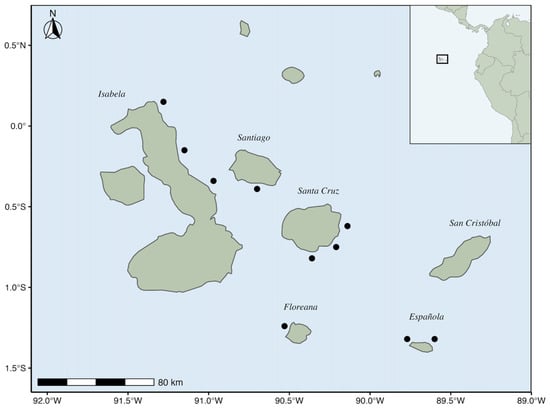
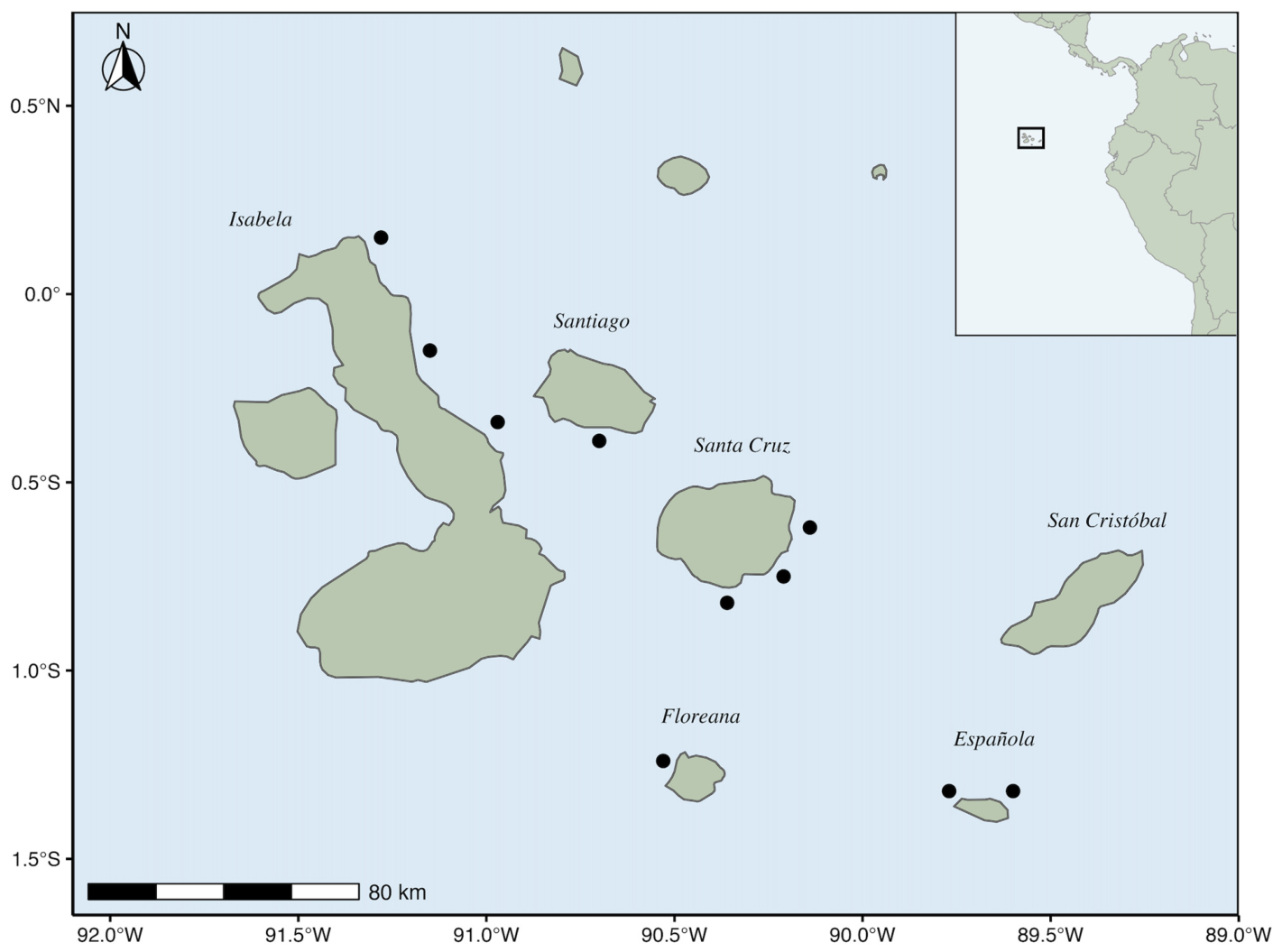
Specimens were obtained through the fishing industry from nine fishing sites offshore from five islands in the Galápagos Archipelago (Figure 1). Captured specimens from islands with multiple fishing sites were pooled for those islands and we did not undertake any within-island analysis. Sampling times were conducted during November and December 2024, which coincided with the permitted Galápagos spiny lobster fishing season (1 September–31 December). The scope of the sampling sites was limited and reflects locations within the archipelago where specimens could be obtained through the local fishery.
Figure 1.
Location of sampling sites within the Galápagos Archipelago. The black dots represent areas of the commercial fishery offshore from five different islands.
Lobsters and octopus from Isabela Island were sampled by fishing crews, and body weights and lengths were recorded at sea. Lobsters from Santa Cruz, Floreana, and Santiago Islands were sampled at the Puerto Ayora fishing port, while frozen individuals from Española were obtained from a local fisherman at San Cristóbal (Table 1). For lobsters, carapace length was recorded, and a pereiopod (walking leg) sample was collected for mercury analysis. Leg samples from Española lobsters were obtained from frozen specimens, whereas all other lobsters were sampled fresh but were frozen prior to dissection. Octopus obtained from the San Cristóbal fish market were captured near Española Island. These individuals were weighed at the local fish market, and an arm sample was collected for mercury analysis. The selection of a specific pereiopod from the lobsters and arm from octopus individuals was not standardized. Due to the octopus from Española being already eviscerated (internal organs removed) prior to weighing, recorded body weights likely underestimated total body mass.
Table 1.
Collection details for lobster and octopus samples obtained from fishing grounds in the Galápagos Archipelago during November and December 2024. Red and green refer to the lobster species Panulirus penicillatus and Panulirus gracilis, respectively. Octopus is Octopus oculifer.
Dissection of lobster and octopus muscle tissue was undertaken at Puerto Ayora, Santa Cruz. Muscle tissue was dissected, placed in small open zip-lock bags, and dried at <60 °C using an Elite Gourmet digital food dryer (Maxi-Matic, City of Industry, CA, USA) for approximately 12–48 h depending on the mass of the tissue and visible dryness [26]. The wet and dry tissue masses were not used to derive moisture correction factors for wet-weight conversions. The moisture content derived from the specimens were much lower than published values and were considered unreliable. This may have been due to the variable handling and storage histories in the field, including the freezing and storing process. These processes may reduce muscle water holding capacity resulting in water loss [27,28].
Back in the laboratory, dried muscle samples were chopped using a scalpel blade and analyzed using a DMA-80 evo direct mercury analyzer, Milestone (Sorisole, Italy). Tissue masses analyzed ranged from 0.030 to 0.046 g. Duplicate mercury measurements were conducted for 15% of octopus samples and 14% of lobster samples. The mean absolute difference in mercury concentration between duplicate measurements was 0.03 mg kg−1 for both octopus and lobster samples.
Mercury recovery was assessed using the certified reference materials DOLT-5 (dogfish liver) and TORT-3 (lobster hepatopancreas) obtained from the National Research Council of Canada (NRC Canada). Certified mercury concentrations were 0.44 ± 0.18 mg kg−1 for DOLT-5 and 0.292 ± 0.022 mg kg−1 for TORT-3. Duplicate reference material samples were analyzed using the DMA-80, typically at the beginning of each analytical run and after every 10–19 tissue samples. Measured mercury concentrations were generally within the certified ranges for both reference materials. Mercury recoveries ranged from 93.0 to 107.5% (n = 23) for TORT-3 and 82.5–89.0% (n = 10) for DOLT-5. One TORT-3 measurement from a duplicate analysis was excluded due to an anomalously high value, possibly contamination or a mistake in recording weight. All our measurements were total mercury.
To facilitate comparisons with published food-safety guidelines and studies reporting mercury concentrations on a wet-weight basis, mercury concentrations in lobster and octopus muscle tissue measured in dry-weight (DW) were converted to estimated wet-weight (WW) concentrations using published moisture contents. For octopus, a moisture content of 76.8% was used for arm muscle, as reported for Octopus vulgaris by [29]. For lobsters, moisture content values were obtained from Panulirus ornatus in the South Pacific [30]. As this species undertakes spawning migrations, the mean moisture content of abdominal (tail) muscle from pre-emigration males (75.0%) and females (75.4%) was used, resulting in an average moisture content of 75.2%. Dry-weight mercury concentrations were converted to wet-weight concentrations using previously published equations [19,31]. The following equation was used to convert dry-weight mercury concentrations to wet-weight concentrations.
Hg (mg kg−1 WW) = Hg (mg kg−1 DW) × (100 − moisture content [%])/100
Statistical Analysis
Linear models were used to examine differences in mercury concentrations in lobsters and octopus. Mercury concentrations were natural log-transformed prior to analysis to improve residual normality and homogeneity of variance. Separate models were specified a priori for each study objective. Biologically relevant interactions were evaluated and removed where there was little evidence that they improved the model, although all principal main effects were retained. Sample sizes, exclusions, and the final number of individuals included in each analysis are summarized in Supplementary Table S1. Full model specifications, including candidate and final model formulas, reference levels, and interactions evaluated, are provided in Supplementary Table S2.
Mercury concentrations between red and green lobsters were modelled using:
where carapace length was included as a continuous covariate and species as fixed effect, with green lobsters used as the reference level. A species × length interaction was evaluated to determine if the relationship between length and mercury concentration differed according to species. However, the interaction was removed, and the final additive model assumes a common slope for the relationship between length and mercury concentration for both species. Due to the very small sample size of green lobsters, both island and sex were poorly represented thus preventing their effects being able to be separated from species and therefore were also not included in the model.
ln(Hg) = β0 + β1 (Length) + β2 (Species) + ε
Mercury concentrations in red lobsters were modelled using
where carapace length was a continuous covariate and both island and sex were used as fixed effects. Floreana and females were used as reference levels for island and sex, respectively. A carapace length × sex interaction was initially evaluated but was not retained as there was little evidence that the relationship between carapace length and mercury concentrations differed based on sex. An island × sex interaction was not fitted as there were no females in the San Cristóbal sample.
ln(Hg) = β0 + β1 (Length) + β2 (Island) + β3 (Sex) + ε
Octopus mercury concentrations were modelled using:
where island was used as a fixed effect. Body weight was not used as octopus captured near Española were eviscerated before weighing, resulting in an underestimation of body mass compared to the sample of octopus obtained from Isabela. However, a sensitivity analysis using natural log-transformed body weight as a continuous covariate was performed to assess whether the recorded body weights altered the estimated island effect.
ln(Hg) = β0 + β1 (Island) + ε
Type II analyses of variance were used to evaluate model terms. Pairwise comparisons among factor levels were conducted using estimated marginal means with a Tukey adjustment for multiple comparisons. Body size was represented by carapace length in lobsters and body weight in octopus. Lobster carapace length was analyzed on its original scale, whereas octopus body weight was natural log-transformed when included as a covariate in the sensitivity model.
Model assumptions were evaluated using residual diagnostic plots (residuals versus fitted values, normal Q-Q, Scale-Location, and residuals versus leverage) along with Cook’s distance to identify influential observations. Observations that were greater than 4/n were identified, and sensitivity analyses were conducted to assess their influence on the model conclusions. Shapiro–Wilk tests for normality and Levene’s and non-constant variance tests for homogeneity of variance, were used to supplement interpretation of residual plots. HC3 heteroscedasticity-robust inference was also conducted as a sensitivity analysis when heteroscedasticity was observed in model diagnostics.
Descriptive statistics are presented as means ± standard deviations (SDs), together with minimum and maximum values where appropriate. For dry-weight concentrations, medians and interquartile range are also presented. Estimated marginal means (EMMs) are presented with 95% confidence intervals (CIs). Because mercury concentrations were analyzed on the natural-log scale, EMMs and their 95% confidence intervals were back transformed to the original measurement scale (mg kg−1 dry weight) using the exponential function to facilitate biological interpretation. These back-transformed EMMs represent model-adjusted geometric means not arithmetic means on the original scale. The descriptive statistics in Table 2 are unadjusted descriptive statistics.
Table 2.
Summary of body size and total mercury concentrations in red lobster (Panulirus penicilla tus), green lobster (Panulirus gracilis), and octopus (Octopus oculifer) collected from the Galápagos Archipelago. Values are unadjusted arithmetic means ± SD along with ranges; medians and interquartile ranges (IQRs) are also presented for dry-weight mercury concentrations. Lobster body size is reported as carapace length and octopus body size as body weight. DW = dry weight; WW = wet weight.
All statistical analyses were conducted in R version 4.3.3 [32]. Linear models and graphs for model diagnostics were fitted using the base stats package. Type II analyses of variance formal tests of normality and homogeneity of variance were performed using the car package (version 3.1-3) [33], and estimated marginal means and Tukey-adjusted pairwise comparisons were calculated using the emmeans package (version 1.8.5) [34]. Heteroscedasticity-robust sensitivity analyses were performed using the sandwich (version 3.1-1) [35,36] and lmtest (version 0.9-40) [37] packages. Data were manipulated using dplyr (version 1.1.4) [38]. Statistical figures were produced using ggplot2 (version 3.5.2) [39]. The study-area map was prepared using sf (version 1.0-21) [40], ggspatial (version 1.1.9) [41], rnaturalearth (version 1.1.0) [42], rnaturalearthdata (version 1.0.0) [43], and cowplot (version 1.2.0) [44].
3. Results
3.1. Lobsters
A total of 91 lobsters (77 red and 14 green) were collected from fishing grounds around five islands in the Galápagos Archipelago during November and December 2024 (Table 1). Carapace length ranged from 88 to 205 mm for red lobsters and 120–215 mm for green lobsters. Green lobsters were larger on average in the sampled individuals than red lobsters, with mean carapace lengths of 163.0 mm and 129.7 mm, respectively. Male red lobsters were also larger on average than females, with mean carapace lengths of 146.5 mm and 113.8 mm, respectively (Table 2).
Mercury concentrations (dry weight, DW) in green lobsters ranged from 0.12 to 1.26 mg kg−1 DW (0.35 ± 0.32 mg kg−1), while concentrations in red lobsters ranged from 0.16 to 1.12 mg kg−1 DW (0.42 ± 0.19 mg kg−1). When converted to wet-weight (WW) concentrations, green lobster mercury concentrations ranged from 0.03 to 0.31 mg kg−1 WW (0.09 ± 0.08 mg kg−1), while red lobster concentrations ranged from 0.04 to 0.28 mg kg−1 WW (0.11 ± 0.05 mg kg−1) (Table 2).
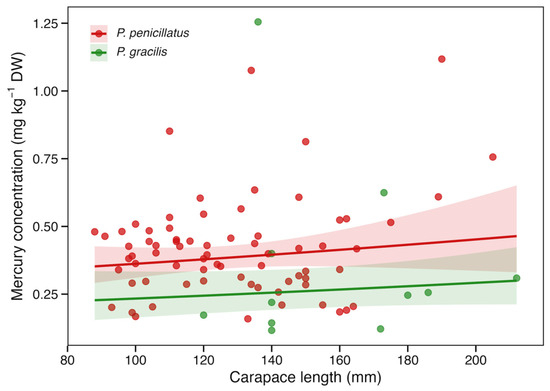
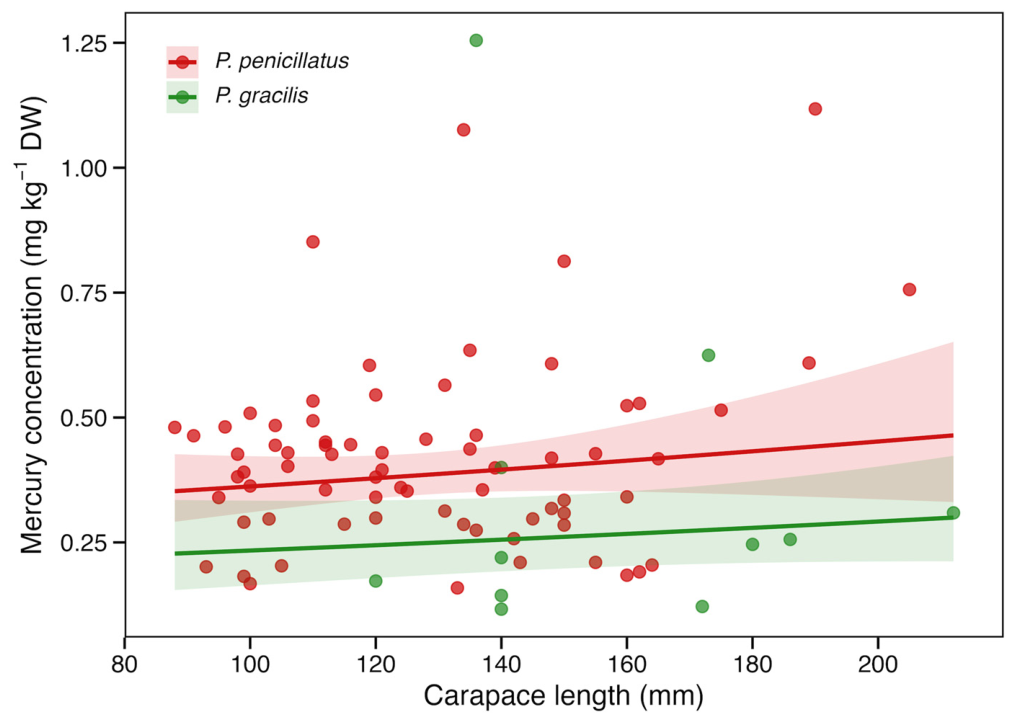
The estimated difference in the length–mercury relationship between species was small and imprecise (length × species: β = 0.0009, 95% CI: −0.0104 to 0.0121, p = 0.879). The interaction was therefore removed, and the final model assumed a common slope for species (Figure 2). After accounting for body length, the back-transformed model-adjusted EMMs (geometric means) indicated that mercury concentrations were 55% higher in red lobsters (0.389 mg kg−1 DW, 95% CI: 0.349–0.434) than in green lobsters (0.251 mg kg−1 DW, 95% CI: 0.187–0.337). The species model explained 6.3% of variation in mercury concentrations (adjusted R2 = 0.063; F2, 80 = 3.78, p = 0.027). The primary model provided evidence of a species effect (F1, 80 = 7.52, p < 0.008), although there was little evidence of association between body length and mercury concentration (F1, 80 = 1.31, p = 0.256). Removal of the most influential observation from the analysis did not alter our overall conclusions of the primary analysis (Supplementary Table S3). In addition, a subsequent heteroscedasticity-robust sensitivity analysis provided weak evidence for a species effect (F1, 80 = 2.80, p = 0.098), revealing that species differences were sensitive to heteroscedasticity (Supplementary Table S3). As a result, the species comparison should be interpreted cautiously and considered preliminary.
Figure 2.
Relationship between carapace length and mercury concentration in red (Panulirus penicillatus) and green (Panulirus gracilis) lobsters from fishing regions in the Galápagos Archipelago. Points represent individual observations. Curves show model-predicted mercury concentrations from the final species model, back-transformed from the natural-log scale; shaded areas represent 95% confidence intervals. The final model assumes a common slope across species because the carapace length × species interaction was not retained. DW = dry weight.
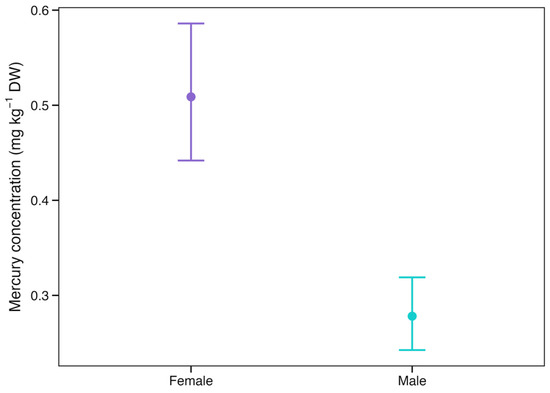
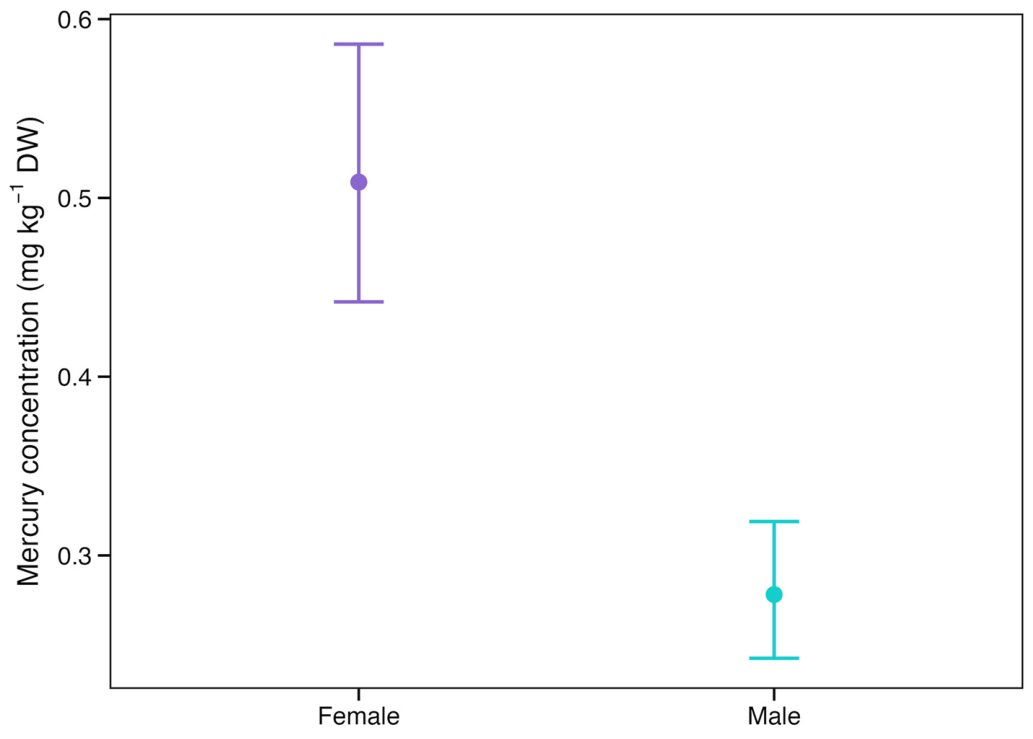
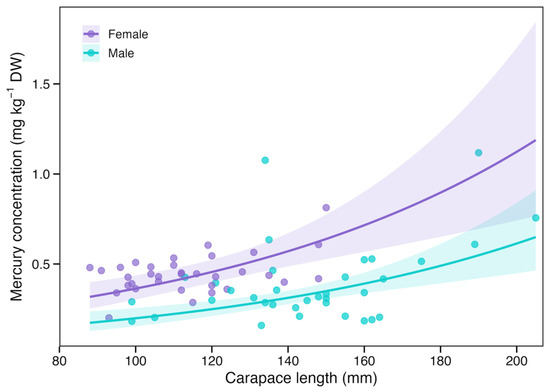
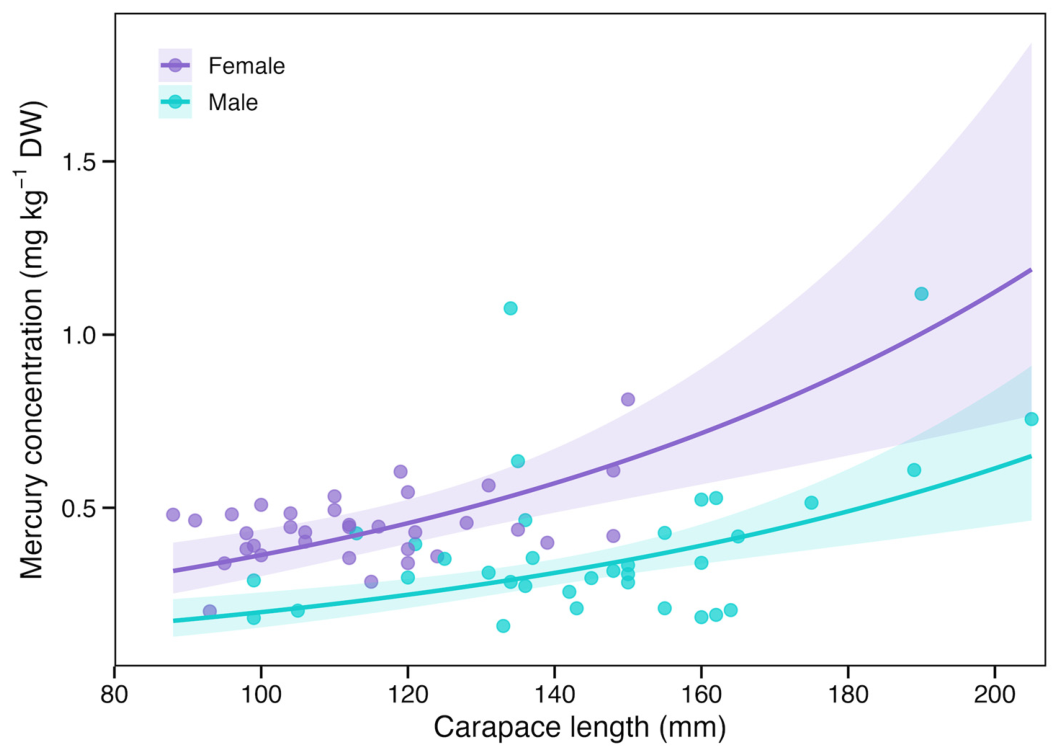
In red lobsters, there was little evidence that the relationship between carapace length and mercury concentration differed between sexes (F1, 62 = 0.44, p = 0.509) and therefore this interaction was removed from the model. In the final model, mercury concentrations increased with body length and differed by sex and among islands, explaining 32.4% of the variation (adjusted R2 = 0.324; F5, 63 = 7.51, p < 0.001). After accounting for carapace length and island, estimated marginal mean concentrations were 0.509 mg kg −1 DW (95% CI: 0.442–0.586) in females and 0.278 mg kg−1 DW (95% CI: 0.242–0.319) in males (Figure 3). The ratio of females to males was 1.83 (95% CI 1.47–2.27) which corresponds to an 83% higher concentration in females; the sex effect was supported by the model (F1, 63 = 30.71, p < 0.001). The final red lobster model assumed a common carapace-length effect across sexes (Figure 4). Full model output and term-specific Type II results are provided in Supplementary Table S3.
Figure 3.
Estimated marginal means (±95% confidence intervals) of mercury concentrations in female and male red lobsters (Panulirus penicillatus) from fishing regions in the Galápagos Archipelago. Estimates are adjusted for variation in carapace length and island based on the fitted linear model and are back-transformed from the natural-log scale to the original dry-weight scale. DW = dry weight.
Figure 4.
Relationship between carapace length and mercury concentration in female and male red lobsters (Panulirus penicillatus) from fishing regions in the Galápagos Archipelago. Points represent individual observations. Curves show model-predicted mercury concentrations from the final model, adjusted for island and back-transformed from the natural-log scale; shaded areas represent 95% confidence intervals. The final model assumes a common slope across sexes because the carapace length × sex interaction was not retained. DW = dry weight.
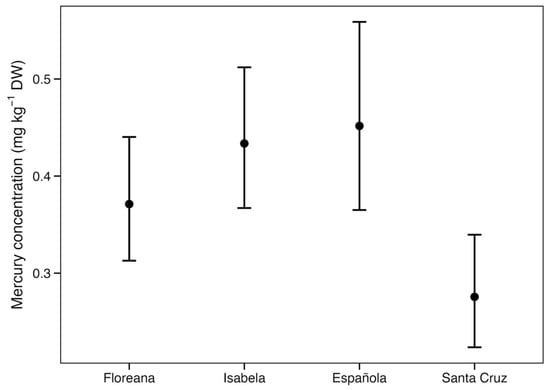
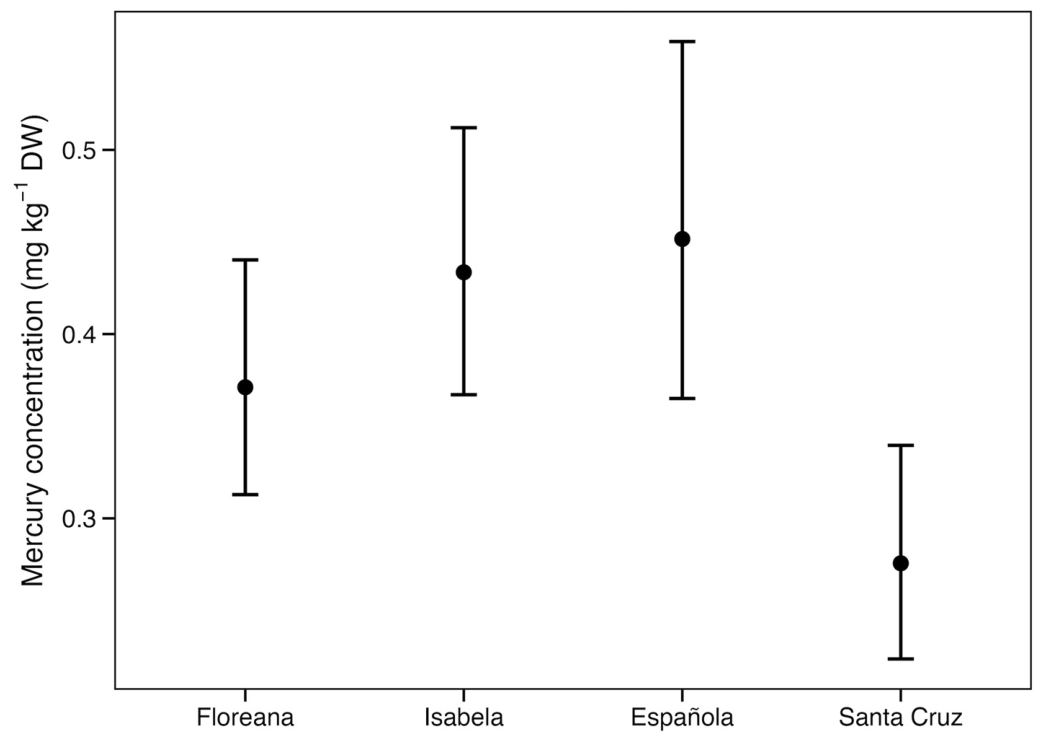
Mercury concentrations differed among island locations and after accounting for carapace length and sex, the model-adjusted mercury concentrations were highest in Española, followed by Isabela, Floreana, and Santa Cruz. However, this ranking of estimated marginal means was not due to differences between all island pairs. Following Tukey adjustments, model-adjusted mercury concentrations were approximately 64% higher in Española than Santa Cruz (ratio = 1.64, 95% CI: 1.10–2.44, p = 0.009) and 57% higher in Isabela than Santa Cruz (ratio = 1.57, 95% CI: 1.08–2.29, p = 0.012). The remaining pairwise comparisons provided little evidence of any differences among islands (Figure 5). Sensitivity analyses, which excluded an influential observation, and an HC3 heteroscedasticity-robust analysis did not alter our overall conclusions about the effects of body length, sex and island (see Supplementary Table S3).
Figure 5.
Estimated marginal means (±95% confidence intervals) of mercury concentrations in red lobsters (Panulirus penicillatus) from four islands in the Galápagos Archipelago. Estimates are adjusted for variation in carapace length and sex based on the fitted linear model and are back-transformed from the natural-log scale to the original dry-weight scale. DW = dry weight.
3.2. Octopus
Total of 27 Octopus oculifer were obtained from fishing grounds around two islands during November and December 2024 (Table 1). Whole-body weights of octopus from Isabela ranged from 0.58 to 1.35 kg (mean ± SD: 0.93 ± 0.20 kg). Body weights could not be compared directly between islands because octopus obtained from Española had been cleaned prior to weighing, whereas those from Isabela were weighed whole. Mercury concentrations in octopus ranged from 0.11 to 1.71 mg kg−1 DW (mean ± SD: 0.30 ± 0.30 mg kg−1; median (IQR): 0.24 mg kg−1 (0.18–0.32). Converted wet-weight mercury concentrations ranged from 0.03 to 0.40 mg kg−1 WW (0.07 ± 0.07 mg kg−1) (Table 2).
The primary analysis which included all observations provided little evidence of a difference in mercury concentrations between islands (adjusted R2 = −0.024; F1, 25 = 0.39, p = 0.536). Model estimated mercury concentrations were 0.263 mg kg−1 DW (95% CI: 0.191–0.361) for Isabela and 0.230 mg kg−1 DW (95% CI: 0.169–0.313) for Española, corresponding to an Isabela–Española ratio of 1.14 (95% CI: 0.74–1.78, p = 0.536). One observation from Española was identified as influential (1.71 mg kg−1 DW) but was retained in the primary analysis as DMA 80 replicates produced consistent values.
Sensitivity analyses revealed that our conclusions regarding the island effect depended on model specifications. When the influential observation was removed in the model analysis, evidence for an island effect increased slightly, although evidence remained limited (adjusted R2 = 0.102; F1, 24 = 3.85, p = 0.061). Conversely, when the sensitivity model included log-transformed body weight the evidence for an island effect was much stronger (F1, 23 = 5.76, p = 0.025), whereas evidence for an association between body weight and mercury concentration was much weaker (F1, 23 = 3.21, p = 0.086). However, body weight was not directly comparable between islands and therefore this weight-adjusted model was retained only as a sensitivity analysis. Overall evidence for an island effect in octopus mercury concentrations should be treated cautiously (Supplementary Table S3).
4. Discussion
4.1. Lobsters
Mercury levels in marine organisms of the Galápagos Archipelago continue to be of concern due to the potential of some organisms having high levels in their tissues [16,19]. The Galápagos lobster fishery is the most consistent for both landings and revenue with annual values reported to exceed $2 M USD [45]. It was thus useful to explore mercury levels in both lobster species in different fishing locations across the archipelago. Our study examined differences in mercury concentrations between lobster species, and associations with sex and location within red lobsters. While our measurements were total mercury, previous work with Panulirus has found mercury in muscle to be predominantly methylmercury [46].
Several previous studies on spiny lobsters Panulirus and Palinurus spp., (Table 3) have been from surveys of marine organisms assessing mercury concentrations in a variety of species, with a few studies focused on lobsters with larger sample sizes. The mercury levels obtained from the Galápagos in this study fit within the values of other studies. The Galápagos WW values were similar to published results for spiny lobster values in the USA [47], Dominica in the Caribbean [48] and the Oman Sea [49]. Studies with lower mean mercury values include Italy [50], Iran in the Persian Gulf [51], and Grenada in the Caribbean [48]. Regions in the world that found higher levels of mercury in spiny lobsters include Tyrrhenian Sea in the Mediterranean [52] and San Diego, USA [46].
Table 3.
Summary of levels of mercury in different species of spiny lobster expressed as mg kg−1 wet weight.
The lower mercury concentrations observed in the Galápagos lobsters were somewhat surprising given the elevated levels previously reported in fish [16], seabirds [17], sea lions [18] and especially in the crab Grapsus grapsus in the Galápagos Archipelago [19]. Lobster mercury concentration generally fell within the overall range reported for G. grapsus across the archipelago. However, crab mercury concentrations vary considerably among locations and reached much higher levels at some sites. In particular, crabs from South Plaza and San Cristóbal exhibited very high levels of mercury compared to those observed in lobsters [19].
The high level of mercury in Galápagos crabs is still unknown but it may be related to diet with crabs on some islands scavenging on carcasses of higher trophic level reptiles, birds and mammals. In contrast, the lobsters inhabit deeper water and likely feed lower down the food chain feeding on crustaceans, echinoids, algae, gastropods and sometimes fish [53,54,55,56]. We currently do not know the source of mercury in the Galápagos islands despite studies continuing to find elevated levels in a variety of organisms. The source of the mercury requires further research but may be related to natural sources such as volcanism or deep-sea hydrothermal vents [10,11] or possible anthropogenic sources via atmospheric or oceanic currents [20,21].
4.2. Factors Potentially Influencing Mercury Levels
There are several factors that might be underestimating mercury in Galápagos lobsters. Our study measured mercury concentrations in leg muscle rather than tail muscle, where higher concentrations have previously been recorded. In the American lobster Homarus americanus it was found that mercury in the large claw (mean 0.087 mg kg−1 WW) was significantly lower than mercury in tail muscle (mean 0.11 mg kg−1 WW) [57]. Moreover, the Norway lobster Nephrops norvegicus, in Italian Mediterranean waters had leg muscle mercury values (mean 0.148 mg kg−1 WW) that were significantly lower than tail muscle (mean 0.296 mg kg−1 WW) [52]. If mercury concentration was being estimated by legs alone in N. norvegicus the value would have been only half of the actual mercury in the tail. However, comparable tissue-specific data are not available for either of P. penicillatus or P. gracilis. Because the magnitude of the difference between the tissues varies among current studies, we cannot reliably extrapolate our leg muscle to tail muscle. This uncertainty is particularly important when concentrations are close to regulatory limits. Future studies regarding these species should address this by evaluating both tissues from the same individuals.
Similarly, the wet weight concentrations in our study were estimated using moisture content values reported for lobsters and octopus in the literature. This introduces some uncertainty because moisture content in lobsters has been shown to vary according to moult cycle or nutritional state [58,59]. Although this does not affect our measured dry-weight mercury concentrations, it may affect estimated wet-weight concentrations and, subsequently, the interpretation in relation to regulatory limits based on wet-weights. Future work should incorporate direct moisture content of individuals if possible.
Our analysis was also undertaken on frozen, thawed and dried lobster leg muscle. Interestingly, reported mercury concentrations (also measured using a DMA 80) in boiled muscle of Norway Lobster Nephrops norvegicus from Italian waters were significantly higher than those in fresh muscle [60,61], suggesting that tissue processing could have an impact on measured mercury concentrations, although the mechanism responsible for this observation remains uncertain and evidence is limited to relatively few studies. Our samples were not boiled, and it is not known whether boiling of tissue in Panulirus spp. or O. oculifer would show a similar response. A comparison of differently processed tissue from the same individuals of these Galapagos species would be helpful in determining any difference in concentrations.
The model-adjusted mercury concentrations in red lobsters indicates geographic variation similar to that previously observed in the crab Grapsus grapsus [19]. Considerable variation was found in G. grapsus across the archipelago from very low to concerningly high levels. However, to date the source of the mercury or the factors responsible for the variation in levels in crabs is still unknown [19].
Red lobsters P. penicillatus had higher mercury concentrations than green lobsters P. gracilis. However, this species comparison should be considered exploratory due to the small and spatially unbalanced green lobster sample, which prevented potential effects of species from being separated due to location, body size and sex. In addition, evidence for a species effect was weaker after applying the heteroscedasticity sensitivity analysis. The observed difference could potentially reflect differences in diet, habitat use and potentially niche partitioning. Niche separation has been shown to occur between co-occurring species of Panulirus [62]. Red lobsters are reported to be habitat specialists, preferring clear water and coral and rock substrate. In contrast, green lobsters are known to inhabit turbid waters, showing an ontogenetic shift in habitat with a preference for rock and gravel-sand substrate. In the Galápagos Islands P. gracilis is found under flat rocks or in cracks between rocks in water deeper than 5 m while P. penicilatus is found in shallow water less than 5 m [63]. P. penicillatus is also the most widely distributed of all spiny lobster species and is found throughout the Indo-Pacific, Red Sea and eastern tropical Pacific Islands [64]. However, our findings regarding green lobsters should be interpreted cautiously and are specific to the populations in this study rather than the broader populations of green lobsters. Increased targeted sampling of green lobsters of both sexes across islands would provide a more robust species comparison.
The general increase in mercury with size of both male and female red lobsters could be due to several factors. Spiny lobsters are known to be relatively long lived. Caribbean spiny lobster Panulirus argus is known to live for 20 years [65] while the California spiny lobster P. interruptus has been suggested to live for up to 50 years [46], providing considerable opportunity for bioaccumulation of mercury in tissues. Age-related bioaccumulation could then contribute to the increasing trend of increasing mercury with size. However, ontogenetic differences in habitat and diet may also influence mercury accumulation. Furthermore, it has been shown with lobsters that size is not necessarily a good proxy for age, as size can be related to environmental or density-dependent factors rather than chronological age [65,66].
The documentation of sex differences in lobster muscle mercury is limited. No sex differences were found in mercury levels in the lobster Homarus americanus in Maine [57]. A comparable study was undertaken on the spiny lobster P. interruptus in San Diego Bay California [46]. This study examined sex differences in mercury concentration with increasing size. Levels of mercury in P. interruptus males were found to be significantly higher than females of a similar size. This contrasts with our results, where mercury concentrations in female red lobsters P. penicillatus from the Galápagos were higher than in males. We currently do not have an explanation for sex-specific differences in mercury accumulation or why two closely related species show such opposite trends. However, the San Diego study included generally smaller individuals and in a more enclosed bay area, which is likely subject to greater anthropogenic pollution compared to the Galápagos Archipelago. The reasons for these contrasting patterns in sex-specific differences (or lack thereof) in mercury accumulation are currently not known. Contributing factors could be differences in diet, habitat, or physiological differences associated with reproductive investment. This is an area that warrants further research.
4.3. Octopus
In contrast to spiny lobsters, mercury concentration has been examined in numerous octopus species from around the world. The mercury concentrations for O. oculifer in our study were relatively low and fell within the range reported for octopus species in Europe and Africa [50,67,68,69], but were higher than values for O. hubbsorum from six locations on the Mexican Pacific coast, which had very low mercury levels (maximum mean of 0.006 mg kg−1 WW) [70]. The percentage of mercury in Octopus muscle which is methylmercury has been found to be in the range of 70–99% [68]. Cephalopods generally are known to concentrate cadmium [71]. In contrast, mercury levels in octopus and cephalopods are generally much lower than many species of predatory fish [47,48], probably related to the shorter life-spans and faster growth rates of cephalopods relative to many longer-living fish. Furthermore, mercury may be processed within the digestive gland of cephalopods, potentially limiting accumulation in muscle tissue [72]. Therefore, it is not surprising that relatively low levels of mercury were found in Galápagos octopus.
Interestingly, the mercury value from one individual from the fishing grounds around Española exhibited a markedly elevated mercury concentration (1.71 mg kg−1 DW) substantially higher than all other observations examined. This represented an order of magnitude difference in mercury level from the lowest level recorded in O. oculifer caught at Española. We believe this high value to be a genuine biological observation, as replicate analyses produced consistent results, indicating no evidence of analytical error or contamination. The reason for this high level is unclear but may reflect differences in age, feeding history, or exposure to prey with elevated levels of mercury. However, there was little evidence for differences in mercury concentrations between Isabela and Española octopus, although conclusions regarding any island effect should be interpreted with care as results were sensitive to the influential observation and model specifications, and sampling was limited to only 27 individuals.
4.4. Considerations to Human Health
Previous work on the crab Grapsus grapsus found that in some regions of the Galápagos Archipelago, these crabs have concerningly high levels of mercury that could be a concern if consumed by humans and especially children or pregnant women [19]. Government agencies have set thresholds for allowable mercury in seafood and fish tissue. The EU maximum levels are 0.5 mg kg−1 WW for total mercury in crustaceans and 0.3 mg kg−1 WW for cephalopods in the EU [73,74]—https://eur-lex.europa.eu/eli/reg/2023/915/oj/eng (accessed on 22 September 2026), while the US EPA fish-tissue criterion is 0.3 mg kg−1 WW for methylmercury [75,76,77].
All estimated wet-weight mercury concentrations in both lobster species were below the EU maximum level of 0.50 mg kg−1 WW for total mercury in crustaceans. However, one of the green lobsters had an estimated total mercury concentration greater than US EPA value of 0.3 mg kg−1 WW, whereas none of the red lobsters exceeded this value. However, direct comparison with the EPA criterion should be viewed cautiously as the US EPA level is a fish-tissue benchmark for methylmercury, whereas total mercury was analyzed in this study. More extensive research with a larger sample and additional island locations is needed. This study also only analyzed leg muscle tissue, and it is possible levels could be higher in tail muscle, which is the most consumed tissue in lobsters.
Mean estimated wet-weight mercury concentrations in octopus were below the EU maximum level of 0.3 mg kg−1 WW for cephalopods, indicating relatively low levels of mercury. However, one individual from Española exceeded this level, with an estimated concentration of 0.40 mg kg−1 WW.
Interpretation of octopus mercury concentrations is limited by the relatively small sample sizes and number of locations. More sampling across the archipelago is needed for a better assessment of mercury concentrations in Galápagos octopus. In addition, wet-weight concentrations were estimated based on moisture content values from the literature and not measured directly in the sampled individuals. Combining this limitation with the use of leg tissue rather than tail tissue in lobsters introduces a certain degree of uncertainty when comparing our values with wet-weight regulatory thresholds.
5. Conclusions
Mercury levels found in this preliminary study in both red and green lobsters (P. penicillatus and P. gracilis respectively) and the Galápagos octopus, O. oculifer were within the range reported elsewhere in the world. Our study was limited by not directly measuring methylmercury, although previous mercury concentrations in Panulirus muscle appear to be predominantly methylmercury. Lobster mercury concentrations were associated with length, sex and location in red lobsters, while the exploratory species comparison suggested that red lobsters may have higher concentrations than green lobsters, this result was limited by our small and spatially unbalanced sample of green lobsters, which precluded the separation of species from potential location and sex effects. Furthermore, there was little evidence of a difference in mercury concentrations in octopus between the two islands sampled. These results contrast with previous work on the crab G. grapsus [19], which also showed considerable variability but much higher concentrations at some sites. Estimated wet-weight total mercury concentrations were below the EU maximum level for crustaceans in all lobsters, although one octopus exceeded the EU threshold for cephalopods.
Supplementary Materials
The following supporting information can be downloaded at https://www.mdpi.com/article/10.3390/hydrobiology5040035/s1, Table S1. Sample tracking for the mercury analyses of Galápagos spiny lobsters and octopus; Table S2: Model specifications used for mercury analyses; Table S3: Complete statistical results, diagnostics, and sensitivity analyses.
Author Contributions
Conceptualization, G.D.J., C.H.J. and M.S.-C.; methodology, G.D.J. and C.H.J.; validation, G.D.J. and C.H.J.; formal analysis, C.H.J.; investigation, G.D.J., C.H.J. and M.S.-C.; resources, G.D.J., C.H.J., E.E. and M.S.-C.; data curation, C.H.J.; writing—original draft preparation, G.D.J. and C.H.J.; writing—review and editing, G.D.J., C.H.J., E.E. and M.S.-C.; visualization, G.D.J. and C.H.J.; supervision, G.D.J.; project administration, G.D.J. All authors have read and agreed to the published version of the manuscript.
Funding
This research received no external funding.
Institutional Review Board Statement
Not applicable.
Informed Consent Statement
Not applicable.
Data Availability Statement
The original contributions presented in this study are included in the article/Supplementary Materials. Further inquiries can be directed to the corresponding author.
Acknowledgments
We would like to thank the staff of the Galápagos National Park who helped to facilitate this research and issued the necessary permit, the Agency for the Biosecurity of the Galápagos Islands who facilitated the transferring samples between islands and carrying out necessary inspections, and local fishermen who assisted with providing the samples to enable this study. The Galápagos Science Center, Loma Linda Academy and the Origins Museum of Nature all helped to facilitate this research project.
Conflicts of Interest
The authors declare no conflicts of interest.
References
- Al-Sulaiti, M.M.; Soubra, L.; Al-Ghouti, M.A. The causes and effects of mercury and methylmercury contamination in the marine environment: A review. Curr. Pollut. Rep. 2022, 8, 249–272. [Google Scholar] [CrossRef] [Scilit]
- Elsayed, H.; Yigiterhan, O.; Al-Ansari, E.M.; Al-Ashwel, A.A.; Elezz, A.A.; Al-Maslamani, I.A. Methylmercury bioaccumulation among different food chain levels in the EEZ of Qatar (Arabian Gulf). Reg. Stud. Mar. Sci. 2020, 37, 101334. [Google Scholar] [CrossRef] [Scilit]
- Thiagarajan, C.; Devarajan, Y. The urgent challenge of ocean pollution: Impacts on marine biodiversity and human health. Reg. Stud. Mar. Sci. 2025, 81, 103995. [Google Scholar] [CrossRef] [Scilit]
- Krabbenhoft, D.P. Methylmercury contamination of aquatic ecosystems: A widespread problem with many challenges for the chemical sciences. In Proceedings of the Water and Sustainable Development Opportunities for the Chemical Sciences—A Workshop Report to the Chemical Sciences Roundtable; National Academies Press: Washington, DC, USA, 2004; pp. 19–26. [Google Scholar]
- World Health Organization. 10 Chemicals of Public Health Concern. Available online: https://www.who.int/news-room/photo-story/detail/10-chemicals-of-public-health-concern (accessed on 5 September 2026).
- Authman, M.; Zaki, M.S.; Khallaf, E.A.; Abbas, H.H. Use of fish as bio-indicator of the effects of heavy metals pollution. J. Aquac. Res. Dev. 2015, 6, 1000328. [Google Scholar] [CrossRef] [Scilit]
- Evers, D.C.; Ackerman, J.T.; Åkerblom, S.; Bally, D.; Basu, N.; Bishop, K.; Bodin, N.; Braaten, H.F.V.; Burton, M.E.; Bustamante, P. Global mercury concentrations in biota: Their use as a basis for a global biomonitoring framework. Ecotoxicology 2024, 33, 325–396. [Google Scholar] [CrossRef] [Scilit] [PubMed]
- Hong, Y.-S.; Kim, Y.-M.; Lee, K.-E. Methylmercury exposure and health effects. J. Prev. Med. Public Health 2012, 45, 353. [Google Scholar] [CrossRef] [Scilit] [PubMed]
- Basu, N.; Bastiansz, A.; Dórea, J.G.; Fujimura, M.; Horvat, M.; Shroff, E.; Weihe, P.; Zastenskaya, I. Our evolved understanding of the human health risks of mercury. Ambio 2023, 52, 877–896. [Google Scholar] [CrossRef] [Scilit] [PubMed]
- Kushner, D.; Lopez, T.M.; Wallace, K.L.; Damby, D.E.; Kern, C.; Cameron, C.E. Estimates of volcanic mercury emissions from Redoubt Volcano, Augustine Volcano, and Mount Spurr eruption ash. Front. Earth Sci. 2023, 11, 1054521. [Google Scholar] [CrossRef] [Scilit]
- Torres-Rodriguez, N.; Yuan, J.; Petersen, S.; Dufour, A.; González-Santana, D.; Chavagnac, V.; Planquette, H.; Horvat, M.; Amouroux, D.; Cathalot, C. Mercury fluxes from hydrothermal venting at mid-ocean ridges constrained by measurements. Nat. Geosci. 2024, 17, 51–57. [Google Scholar] [CrossRef] [Scilit]
- Liu, M.; Zhang, Q.; Maavara, T.; Liu, S.; Wang, X.; Raymond, P.A. Rivers as the largest source of mercury to coastal oceans worldwide. Nat. Geosci. 2021, 14, 672–677. [Google Scholar] [CrossRef] [Scilit]
- Qiu, X.; Liu, M.; Zhang, Y.; Zhang, Q.; Lin, H.; Cai, X.; Li, J.; Dai, R.; Zheng, S.; Wang, J. Declines in anthropogenic mercury emissions in the Global North and China offset by the Global South. Nat. Commun. 2025, 16, 1179. [Google Scholar] [CrossRef] [Scilit] [PubMed]
- Wei, X.; Zhang, P.; Chen, L.; Cao, M.; Zhang, W.; Zhang, X.; Zhu, X.; Wang, S.; Liang, Y. Historical artisanal gold mining poses long-term risk of mercury to river ecosystems: A case study in Tongguan area of northwestern China. Environ. Pollut. 2025, 385, 127156. [Google Scholar] [CrossRef] [Scilit] [PubMed]
- Bai, Z.; Zhang, Y.; Cheng, L.; Zhou, X.; Wang, M. Nanoplastics pose a greater effect than microplastics in enhancing mercury toxicity to marine copepods. Chemosphere 2023, 325, 138371. [Google Scholar] [CrossRef] [Scilit] [PubMed]
- Franco-Fuentes, E.; Moity, N.; Ramírez-González, J.; Andrade-Vera, S.; Hardisson, A.; Paz, S.; Rubio, C.; Martín, V.; Gutiérrez, Á.J. Mercury in fish tissues from the Galapagos marine reserve: Toxic risk and health implications. J. Food Compos. Anal. 2023, 115, 104969. [Google Scholar] [CrossRef] [Scilit]
- Zarn, A.M.; Valle, C.A.; Brasso, R.; Fetzner, W.D.; Emslie, S.D. Stable isotope and mercury analyses of the Galápagos Islands seabird community. Mar. Ornithol. 2020, 48, 71–80. [Google Scholar] [CrossRef] [Scilit]
- Calle, P.; Alava, J.J.; Tirape, A.; Domínguez, G.A.; Fair, P.; Alvarado, O.; Freire, M.; Torres, J.; Ruiz, O.; Garcés, D. Total Mercury and Stable Isotopes (Δ13c and Δ15n) in Pups of Endangered Galapagos Pinnipeds as Tracers of Trophic Transfer: An Ecotoxicological Risk Assessment. SSRN 2022, 4217668. [Google Scholar] [CrossRef] [Scilit]
- Jackson, G.D.; Jackson, C.H.; Brandao, M.; Jackson, A.K.; Espinoza, E.; Soria-Carvajal, M. Mercury Levels in the Crab Grapsus grapsus across the Galápagos Archipelago. Fishes 2024, 9, 233. [Google Scholar] [CrossRef] [Scilit]
- Obrist, D.; Kirk, J.L.; Zhang, L.; Sunderland, E.M.; Jiskra, M.; Selin, N.E. A review of global environmental mercury processes in response to human and natural perturbations: Changes of emissions, climate, and land use. Ambio 2018, 47, 116–140. [Google Scholar] [CrossRef] [Scilit] [PubMed]
- Outridge, P.M.; Mason, R.; Wang, F.; Guerrero, S.; Heimburger-Boavida, L. Updated global and oceanic mercury budgets for the United Nations Global Mercury Assessment 2018. Environ. Sci. Technol. 2018, 52, 11466–11477. [Google Scholar] [CrossRef] [Scilit] [PubMed]
- Szuwalski, C.S.; Castrejon, M.; Ovando, D.; Chasco, B. An integrated stock assessment for red spiny lobster (Panulirus penicillatus) from the Galapagos Marine Reserve. Fish. Res. 2016, 177, 82–94. [Google Scholar] [CrossRef] [Scilit]
- Riofrío-Lazo, M.; Reck, G.; Páez-Rosas, D.; Zetina-Rejón, M.J.; Del Monte-Luna, P.; Reyes, H.; Murillo-Posada, J.C.; Hernández-Padilla, J.C.; Arreguín-Sánchez, F. Food web modeling of the southeastern Galapagos shelf ecosystem. Ecol. Indic. 2021, 132, 108270. [Google Scholar] [CrossRef] [Scilit]
- Teschima, M.M.; Ströher, P.R.; Firkowski, C.R.; Pie, M.R.; Freire, A.S. Large-scale connectivity of Grapsus grapsus (Decapoda) in the Southwestern Atlantic oceanic islands: Integrating genetic and morphometric data. Mar. Ecol. 2016, 37, 1360–1372. [Google Scholar] [CrossRef] [Scilit]
- Valdez-Cibrián, A.; Díaz-Santana-Iturrios, M.; Landa-Jaime, V.; Michel-Morfín, J.E. First detection of an ocellate octopus in the Revillagigedos ecoregion, a biodiversity hotspot located in the Tropical East Pacific Province. ZooKeys 2020, 986, 81. [Google Scholar] [CrossRef] [Scilit] [PubMed]
- Biffi, D.; López-Mobilia, A.; Kelez, S.; Williams, D.A.; Chumchal, M.M.; Weinburgh, M. Mislabelling and high mercury content hampers the efforts of market-based seafood initiatives in Peru. Sci. Rep. 2020, 10, 20390. [Google Scholar] [CrossRef] [Scilit] [PubMed]
- Deng, Q.; Wang, Y.; Sun, L.; Li, J.; Fang, Z.; Gooneratne, R. Migration of water in Litopenaeus vannamei muscle following freezing and thawing. J. Food Sci. 2018, 83, 1810–1815. [Google Scholar] [CrossRef] [Scilit] [PubMed]
- Ji, W.; Bao, Y.; Wang, K.; Yin, L.; Zhou, P. Protein changes in shrimp (Metapenaeus ensis) frozen stored at different temperatures and the relation to water-holding capacity. Int. J. Food Sci. Technol. 2021, 56, 3924–3937. [Google Scholar] [CrossRef] [Scilit]
- Sieiro, P.; Otero, J.; Aubourg, S.P. Biochemical composition and energy strategy along the reproductive cycle of female Octopus vulgaris in Galician waters (NW Spain). Front. Physiol. 2020, 11, 760. [Google Scholar] [CrossRef] [Scilit] [PubMed]
- Trendall, J.T.; Prescott, J. Severe physiological stress associated with the annual breeding emigration of Panulirus ornatus in the Torres Strait. Mar. Ecol. Prog. Ser. 1989, 58, 29–39. [Google Scholar] [CrossRef] [Scilit]
- McCormick, A.; Robertson, M.D.; Brasso, R.; Midway, S.R. Mercury concentrations in store-bought shrimp. Food Sci. Nutr. 2020, 8, 3731–3737. [Google Scholar] [CrossRef] [Scilit] [PubMed]
- R Core Team. A Language and Environment for Statistical Computing; R Foundation for Statistical Computing: Vienna, Austria, 2024. [Google Scholar]
- Fox, J.; Weisberg, S. An R Companion to Applied Regression, 3rd ed.; Sage College Publishing: Thousand Oaks, CA, USA, 2019; p. 608. [Google Scholar]
- Lenth, R. Emmeans: Estimated Marginal Means, Aka Least-Squares Means, R package version 1.8.5; R Foundation for Statistical Computing: Vienna, Austria, 2023.
- Zeileis, A. Econometric Computing with HC and HAC Covariance Matrix Estimators. J. Stat. Softw. 2004, 11, 1–17. [Google Scholar] [CrossRef] [Scilit]
- Zeileis, A. Object-oriented computation of sandwich estimators. J. Stat. Softw. 2006, 16, 1–16. [Google Scholar] [CrossRef] [Scilit]
- Zeileis, A.; Hothorn, T. Diagnostic checking in regression relationships. R News 2002, 2, 7–10. [Google Scholar]
- Wickham, H.; François, R.; Henry, L.; Müller, K.; Vaughan, D. dplyr: A Grammar of Data Manipulation, R package version 1.1.4; R Foundation for Statistical Computing: Vienna, Austria, 2023.
- Wickham, H. Data analysis. In ggplot2: Elegant Graphics for Data Analysis; Springer: New York, NY, USA, 2016. [Google Scholar]
- Pebesma, E. Simple features for R: Standardized support for spatial vector data. R J. 2018, 10, 439–446. [Google Scholar] [CrossRef] [Scilit]
- Dunnington, D. ggspatial: Spatial Data Framework for ggplot2, R package version 1.1.9; The R Foundation: Vienna, Austria, 2023.
- Massicotte, P.; South, A. Rnaturalearth: World Map Data from Natural Earth, R package version 1.1.0; The R Foundation: Vienna, Austria, 2025.
- South, A.; Michael, S.; Massicotte, P. Rnaturalearthdata: World Vector Map Data from Natural Earth used in ’rnaturalearth’, R package version 1.0.0; The R Foundation: Vienna, Austria, 2024.
- Wilke, C.O. Cowplot: Streamlined Plot Theme and Plot Annotations for’ggplot2’, R package version 1.2.0; The R Foundation: Vienna, Austria, 2025.
- Viteri Mejía, C.; Rodríguez, G.; Tanner, M.K.; Ramírez-González, J.; Moity, N.; Andrade, S.; José Barragán Paladines, M.; Cáceres, R.; Castrejón, M.; Pittman, J. Fishing during the “new normality”: Social and economic changes in Galapagos small-scale fisheries due to the COVID-19 pandemic. Marit. Stud. 2022, 21, 193–208. [Google Scholar] [CrossRef] [Scilit] [PubMed]
- Loflen, C.L.; Buck, T.; Bonnema, A.; Heim, W.A. Pollutant bioaccumulation in the California spiny lobster (Panulirus interruptus) in San Diego Bay, California, and potential human health implications. Mar. Pollut. Bull. 2018, 128, 585–592. [Google Scholar] [CrossRef] [Scilit] [PubMed]
- Groth, E., III. Ranking the contributions of commercial fish and shellfish varieties to mercury exposure in the United States: Implications for risk communication. Environ. Res. 2010, 110, 226–236. [Google Scholar] [CrossRef] [Scilit] [PubMed]
- Christian, L.D.; Burton, M.E.; Mohammed, A.; Nelson, W.; Shah, T.A.; Bertide-Josiah, L.; Yurek, H.G.; Evers, D.C. An evaluation of fish and invertebrate mercury concentrations in the Caribbean Region. Ecotoxicology 2024, 33, 397–414. [Google Scholar] [CrossRef] [Scilit] [PubMed]
- Mahdi Abkener, A. Assessment of heavy metals pollution in muscle of sole (Cynoglossus arel), spiny lobster (Panulirus homarus) and sediments in the northern coasts of the Oman Sea during pre and post monsoon. Iran. J. Fish. Sci. 2020, 19, 1638–1656. [Google Scholar]
- Plessi, M.; Bertelli, D.; Monzani, A. Mercury and selenium content in selected seafood. J. Food Compos. Anal. 2001, 14, 461–467. [Google Scholar] [CrossRef] [Scilit]
- Raissy, M.; Ansari, M.; Rahimi, E. Mercury, arsenic, cadmium and lead in lobster (Panulirus homarus) from the Persian Gulf. Toxicol. Ind. Health 2011, 27, 655–659. [Google Scholar] [CrossRef] [Scilit] [PubMed]
- Di Lena, G.; Casini, I.; Caproni, R.; Orban, E. Total mercury levels in crustacean species from Italian fishery. Food Addit. Contam. Part B 2018, 11, 175–182. [Google Scholar] [CrossRef] [Scilit] [PubMed]
- Díaz-Arredondo, M.; Guzmán-de-Próo, S. Feeding habits of the spiny lobster (Panulirus interruptus Randall, 1840) in Bahia Tortugas, Baja California Sur. Cienc. Mar. 1995, 21, 439–462. [Google Scholar] [CrossRef] [Scilit][Green Version]
- Castañeda-Fernández-de-Lara, V.; Serviere-Zaragoza, E.; Hernández-Vázquez, S.; Butler, M.J., IV. Feeding ecology of juvenile spiny lobster, Panulirus interruptus, on the Pacific coast of Baja California Sur, Mexico. N. Z. J. Mar. Freshw. Res. 2005, 39, 425–435. [Google Scholar] [CrossRef] [Scilit][Green Version]
- Sardenne, F.; Bodin, N.; Barret, L.; Blamey, L.; Govinden, R.; Gabriel, K.; Mangroo, R.; Munaron, J.-M.; Le Loc’h, F.; Bideau, A. Diet of spiny lobsters from Mahé Island reefs, Seychelles inferred by trophic tracers. Reg. Stud. Mar. Sci. 2021, 42, 101640. [Google Scholar] [CrossRef] [Scilit]
- Góes, C.A.; Lins-Oliveira, J.E. Natural diet of the spiny lobster, Panulirus echinatus Smith, 1869 (Crustacea: Decapoda: Palinuridae), from São Pedro and São Paulo Archipelago, Brazil. Braz. J. Biol. 2009, 69, 143–148. [Google Scholar] [CrossRef] [Scilit] [PubMed]
- Stoicov, D.; Bonin, C.A.; van Wijnen, A.J.; Lewallen, E.A. Seasonal patterns of mercury bioaccumulation in lobsters (Homarus americanus) from Maine. Acad. Biol. 2025, 3, 1–10. [Google Scholar] [CrossRef] [Scilit] [PubMed]
- Travis, D.F. The molting cycle of the spiny lobster, Panulirus argus Latreille. I. Molting and growth in laboratory-maintained individuals. Biol. Bull. 1954, 107, 433–450. [Google Scholar] [CrossRef] [Scilit]
- Simon, C.J.; Rodemann, T.; Carter, C.G. Near-infrared spectroscopy as a novel non-invasive tool to assess spiny lobster nutritional condition. PLoS ONE 2016, 11, e0159671. [Google Scholar] [CrossRef] [Scilit] [PubMed]
- Perugini, M.; Visciano, P.; Manera, M.; Abete, M.C.; Gavinelli, S.; Amorena, M. Contamination of different portions of raw and boiled specimens of Norway lobster by mercury and selenium. Environ. Sci. Pollut. Res. 2013, 20, 8255–8262. [Google Scholar] [CrossRef] [Scilit] [PubMed]
- Perugini, M.; Zezza, D.; Tulini, S.M.R.; Abete, M.C.; Monaco, G.; Conte, A.; Olivieri, V.; Amorena, M. Effect of cooking on total mercury content in Norway lobster and European hake and public health impact. Mar. Pollut. Bull. 2016, 109, 521–525. [Google Scholar] [CrossRef] [Scilit] [PubMed]
- Briones-Fourzán, P. Differences in life-history and ecological traits between co-occurring Panulirus spiny lobsters (Decapoda, Palinuridae). ZooKeys 2014, 457, 289–311. [Google Scholar] [CrossRef] [Scilit] [PubMed]
- Briones-Fourzán, P.; Lozano-Álvarez, E. Essential habitats for Panulirus spiny lobsters. In Lobsters: Biology, Management, Aquaculture and Fisheries; John Wiley & Sons: Hoboken, NJ, USA, 2013; pp. 186–220. Available online: https://onlinelibrary.wiley.com/doi/abs/10.1002/9781118517444.ch7 (accessed on 22 September 2026).
- Hearn, A.; Murillo, J.C. Life History of the Red Spiny Lobster, Panulirus penicillatus (Decapoda: Palinuridae), in the Galápagos Marine Reserve, Ecuador. Pac. Sci. 2008, 62, 191–204. [Google Scholar] [CrossRef] [Scilit]
- Maxwell, K.E.; Matthews, T.R.; Sheehy, M.R.; Bertelsen, R.D.; Derby, C.D. Neurolipofuscin is a measure of age in Panulirus argus, the Caribbean spiny lobster, in Florida. Biol. Bull. 2007, 213, 55–66. [Google Scholar] [CrossRef] [Scilit] [PubMed]
- Hutchinson, E.; Matthews, T.R.; Ross, E.; Hagedorn, S.; Butler, M.J., IV. Gastric mill ossicles record chronological age in the Caribbean spiny lobster (Panulirus argus). Fish. Res. 2024, 277, 107083. [Google Scholar] [CrossRef] [Scilit]
- Bustamante, P.; Lahaye, V.; Durnez, C.; Churlaud, C.; Caurant, F. Total and organic Hg concentrations in cephalopods from the North Eastern Atlantic waters: Influence of geographical origin and feeding ecology. Sci. Total Environ. 2006, 368, 585–596. [Google Scholar] [CrossRef] [Scilit] [PubMed]
- Raimundo, J.; Vale, C.; Canário, J.; Branco, V.; Moura, I. Relations between mercury, methyl-mercury and selenium in tissues of Octopus vulgaris from the Portuguese Coast. Environ. Pollut. 2010, 158, 2094–2100. [Google Scholar] [CrossRef] [Scilit] [PubMed]
- Roldán-Wong, N.T.; Kidd, K.A.; Marmolejo-Rodríguez, A.J.; Ceballos-Vázquez, B.P.; Shumilin, E.; Arellano-Martínez, M. Bioaccumulation and biomagnification of potentially toxic elements in the octopus Octopus hubbsorum from the Gulf of California. Mar. Pollut. Bull. 2018, 129, 458–468. [Google Scholar] [CrossRef] [Scilit] [PubMed]
- Alba-Preciado, M.A.; Leyva-Morales, J.B.; Granados-Amores, J.; Garcia-Hernandez, J.; Aguilera-Marquez, D.; de Jesús Bastidas-Bastidas, P.; Zamora-Arellano, N.Y.; González-Ramírez, C.A.; Granados-Amores, A.; de Jesús Dueñas-Romero, J. Distribution and health risk assessment of heavy metals in the octopus (Octopus hubbsorum) in the Mexican Pacific. Food Chem. Toxicol. 2025, 200, 115362. [Google Scholar] [CrossRef] [Scilit] [PubMed]
- Bustamante, P.; Caurant, F.; Fowler, S.W.; Miramand, P. Cephalopods as a vector for the transfer of cadmium to top marine predators in the north-east Atlantic Ocean. Sci. Total Environ. 1998, 220, 71–80. [Google Scholar] [CrossRef] [Scilit] [PubMed]
- McArthur, T.; Butler, E.C.; Jackson, G.D. Mercury in the marine food chain in the Southern Ocean at Macquarie Island: An analysis of a top predator, Patagonian toothfish (Dissostichus eleginoides) and a mid-trophic species, the warty squid (Moroteuthis ingens). Polar Biol. 2003, 27, 1–5. [Google Scholar] [CrossRef] [Scilit]
- Pereira, E.; Abreu, S.; Coelho, J.; Lopes, C.; Pardal, M.; Vale, C.; Duarte, A. Seasonal fluctuations of tissue mercury contents in the European shore crab Carcinus maenas from low and high contamination areas (Ria de Aveiro, Portugal). Mar. Pollut. Bull. 2006, 52, 1450–1457. [Google Scholar] [CrossRef] [Scilit] [PubMed]
- Ervik, H.; Lierhagen, S.; Asimakopoulos, A.G. Elemental content of brown crab (Cancer pagurus)–Is it safe for human consumption? A recent case study from Mausund, Norway. Sci. Total Environ. 2020, 716, 135175. [Google Scholar] [CrossRef] [Scilit] [PubMed]
- Borum, D.; Manibusan, M.K.; Schoeny, R.; Winchester, E.L. Water Quality Criterion for the Protection of Human Health: Methylmercury. Available online: https://udspace.udel.edu/items/810b6b9f-aa19-4323-9170-3a5818d3ce70 (accessed on 5 September 2026).
- Taylor, D.L.; Calabrese, N.M. Mercury content of blue crabs (Callinectes sapidus) from southern New England coastal habitats: Contamination in an emergent fishery and risks to human consumers. Mar. Pollut. Bull. 2018, 126, 166–178. [Google Scholar] [CrossRef] [Scilit] [PubMed]
- EPA. National Recommended Water Quality Criteria—Human Health Criteria Table. Available online: https://www.epa.gov/wqc/national-recommended-water-quality-criteria-human-health-criteria-table (accessed on 5 September 2026).

Disclaimer/Publisher’s Note: The statements, opinions and data contained in all publications are solely those of the individual author(s) and contributor(s) and not of MDPI and/or the editor(s). MDPI and/or the editor(s) disclaim responsibility for any injury to people or property resulting from any ideas, methods, instructions or products referred to in the content. |
© 2026 by the authors. Licensee MDPI, Basel, Switzerland. This article is an open access article distributed under the terms and conditions of the Creative Commons Attribution (CC BY) license.