


Abstract
The Atlantic blue crab, Callinectes sapidus Rathbun, 1896, is classified as one of the world’s most invasive and difficult species to control once introduced. This study reports the first confirmed occurrence of this species in Mauritanian waters and assesses the population structure, morphometric features and reproductive condition of the sampled population as evidence of early establishment. Samples were collected monthly in Baie de l’Étoile (Nouadhibou, Mauritania) in 12 sampling campaigns between December 2024 and January 2026 (no surveys in January 2025 or December 2025). In total, 148 specimens of C. sapidus were captured from the shallow waters of the bay’s intertidal and subtidal zones, of which 98 (66.2%) were sexually mature and 50 (33.8%) were immature. Carapace width among captured specimens ranged from 48.5 to 193.4 mm and weight ranged from 10.0 to 255.8 g. The sex ratio did not differ significantly from parity (75 males and 73 females; male: female = 1.03:1; χ2 = 0.027, df = 1, p = 0.870), whereas mature individuals were significantly more frequent than immature ones (χ2 = 15.57, df = 1, p < 0.001). Five of the captured females were ovigerous (June–September). This study provides the first confirmed record of the species along the Mauritanian coast and, based on the presence of multiple size classes in all sampled months and of ovigerous females in summer, indicates an early established (incipient) population, warranting further biological assessment, genetic characterization and regional monitoring to anticipate potential impacts on the local ecosystem.
1. Introduction
The Atlantic blue crab, Callinectes sapidus Rathbun, 1896 (Decapoda: Portunidae), is native to the western Atlantic Ocean, where it occurs from Nova Scotia (Canada) to northern Argentina, including the Gulf of Mexico and the Caribbean Sea [1,2]. It sustains one of the most valuable crustacean fisheries in North America for commercial and recreational use, with yearly landings in the United States around 60,000 tonnes [3]. The Atlantic blue crab has successfully established populations well outside its natural area owing to its wide tolerance to salinity and temperature, fast growth, strong reproductive output and ecological flexibility [1,4,5]. These biological features have rendered it one of the most successful marine invasive decapods worldwide. The species was first recorded outside its native range in France in 1901 [6,7] and has since spread throughout most of the Mediterranean sub-basins, including Italy, Spain, Greece, Türkiye, Algeria, Tunisia, Libya, Egypt, Croatia and Morocco [7,8,9,10,11,12,13,14,15,16,17,18]. The rapid spread of C. sapidus throughout the Mediterranean region has had important ecological and socio-economic consequences, such as competition with native brachyuran crabs, predation on commercially important benthic species, and negative impacts on fishing activities [19,20]. The invasion has only recently been documented along the Atlantic coast of Africa. The first Atlantic records in Morocco were reported from Merja Zerga Lagoon in 2019 and Khnifiss Lagoon in 2020 [21,22,23], while the earliest Moroccan Mediterranean record dates back to Marchica Lagoon in August 2017 [15]. It was subsequently reported from Dakhla Bay (23° N) on the Atlantic coast of the Moroccan Sahara, the southernmost confirmed record along the northwestern African Atlantic coast at that time [24]. Mauritania occupies a biogeographical position of strategic importance between the upwelling system of the Canary Current and the tropical eastern Atlantic and harbours a diverse but still insufficiently documented decapod fauna [25,26]. Baie de l’Étoile (21°02′ N, 17°01′ W), situated near Nouadhibou, is one of the most important coastal ecosystems in the country. It is characterised by seagrass meadows (Zostera noltei and Cymodocea nodosa), maerl beds, sandy and muddy substrates and extensive intertidal mudflats colonised by Spartina maritima [27,28,29]. Despite its recent designation as a protected nature reserve, it is still exposed to increasing anthropogenic pressures from port activities, industrial and artisanal fisheries, wastewater discharge and maritime traffic, which could favour the introduction and establishment of non-indigenous marine species [30].
This study provides the first scientifically documented record of the invasive Atlantic blue crab Callinectes sapidus in Mauritanian coastal waters and assesses whether the species has progressed from initial arrival to an early established (incipient) population. Beyond documenting its occurrence, we characterize the population structure, morphometric features, and reproductive condition of the collected specimens, integrate local ecological knowledge (LEK) reported by artisanal fishers, discuss the most plausible introduction pathways, evaluate the evidence supporting the early establishment of this non-indigenous species along the northwestern African Atlantic coast, and propose priorities for regional monitoring in West Africa.
2. Materials and Methods
2.1. Study Area and Sampling
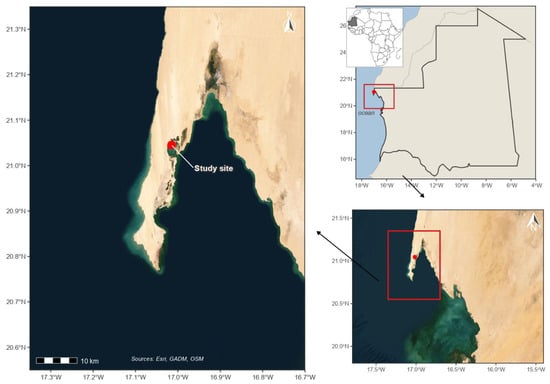
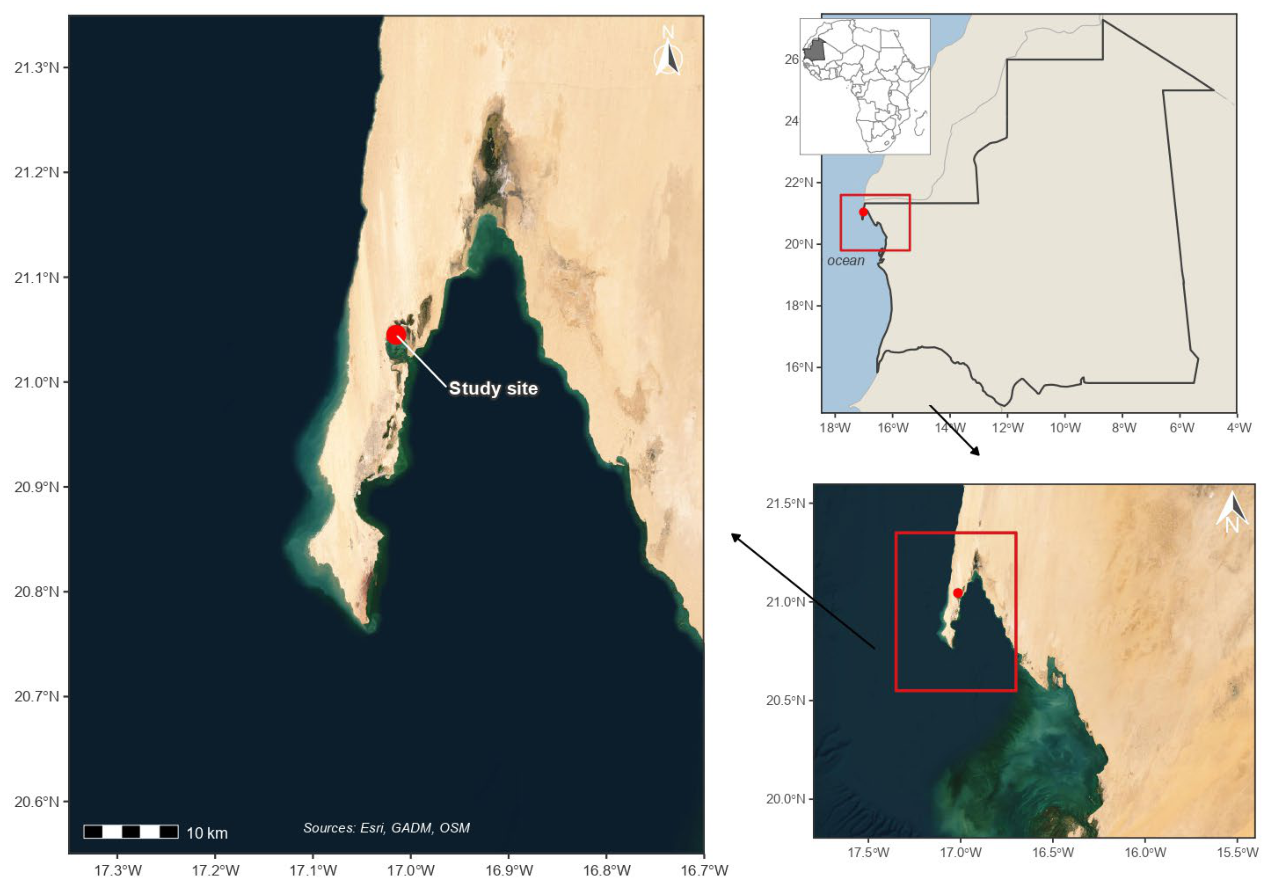
The study was conducted in Baie de l’Étoile (21°02′ N, 17°01′ W) in the northwestern part of Baie du Lévrier, near Nouadhibou and its port (Figure 1). The bay (~12 km2) hosts seagrass beds, maerl beds, sandy or muddy substrates, and intertidal mudflats [27,28,29]. Surface salinity ranges from 30 to 35 psu and temperature seasonally from 16 °C (winter) to 26 °C (summer). Sampling was conducted monthly at five stations (S1–S5) from December 2024 to January 2026 (12 campaigns; no survey in January 2025 or December 2025; the study period spans 14 calendar months, but no surveys were conducted in January 2025 or December 2025, which leaves 12 campaigns and 60 station-level surveys (5 stations × 12 campaigns)). Crabs were collected in the intertidal zone and shallow subtidal fringe (0–1.5 m) at low tide with a hand net (5 mm mesh). Active searches were conducted on foot during low tide, with two passes performed at each station during each sampling campaign. A pass was defined as one complete search of the station transect by the field team, so that each campaign comprised 10 passes (5 stations × 2 passes) and the whole study 120 passes. Each station was surveyed for approximately 30 to 45 min by a three-person field team. This corresponds to a search effort of 1.5–2.25 person-hours per station survey and 90–135 person-hours in total. Transect length varied from approximately 1 to 10 m depending on local conditions. Each station corresponded to a 500 m stretch of shoreline within which the transects were placed. Capture success was low (0–3 individuals per station per survey). This range refers to the number of crabs caught per pass. Catch per unit effort (CPUE) was expressed as the number of crabs caught per pass (0–3 individuals per pass); over the whole study, the 148 specimens correspond to a mean CPUE of 1.23 crabs per pass (148 crabs/120 passes), 2.47 crabs per station survey (148 crabs/60 station-level surveys) and 1.10–1.64 crabs per person-hour (148 crabs/90–135 person-hours).
Figure 1.
Geographic location of the study area in Baie de l’Étoile, Nouadhibou (Mauritania), showing the locality of the first confirmed record of Callinectes sapidus Rathbun, 1896. The map was produced in R version 4.5.1 using the ggplot2 and ggspatial packages.
2.2. Morphological Identification
Specimens were identified according to the diagnostic criteria described by Williams [2]: (1) a wide and dorsoventrally flattened carapace with nine anterolateral teeth, the posterior one being much larger than the rest; (2) fifth pair of pereiopods modified into swimming paddles; (3) male chelipeds bright blue and their dactyli and propodi red; (4) male abdomen T-shaped; and (5) female abdomen broadly U-shaped. According to Williams [2], these diagnostic characters distinguish the invasive species from the native congener Callinectes marginatus (A. Milne-Edwards, 1861), which occurs in the seagrass beds of Baie de l’Étoile [31] and possesses a more triangular carapace, a reduced posterolateral tooth, is usually olive-brown in colour, and lacks blue chelipeds in males. The identification key of Williams [2] was used to identify C. sapidus and to distinguish it from Callinectes amnicola (de Rochebrune, 1883), the other native West African congener.
The sex of each specimen was determined on the basis of the shape of the abdomen or the presence of gonopods (the first and second pleopods modified as copulatory appendages) in males and vulvae in females. Individuals were assigned to maturity categories (mature or immature) based primarily on external abdominal morphology and associated secondary morphological characters, including abdominal width and cheliped development. No numerical size threshold was applied for maturity classification. Because no gonadal or histological examination was performed, these categories are interpreted as maturity classifications rather than direct measurements of gonadal maturity. Female crabs carrying external fertilized eggs on their pleopods were classified as ovigerous. Two maturity categories were defined: immature (I) and mature (M). Carapace width (CW, mm) was measured with a digital caliper (precision 0.01 mm) and total wet weight (W, g) with a precision balance.
2.3. Local Ecological Knowledge (LEK)
Semi-structured interviews were conducted with 160 active artisanal fishers in Nouadhibou (n = 70) and Nouakchott (n = 90) between February and May 2025. Participants were recruited using a convenience sampling approach among active fishers available at the study locations during the survey period. Interviews were conducted individually or in small groups and lasted approximately 10–20 min. Before each interview, the purpose of the study was explained, verbal informed consent was obtained, and responses were recorded anonymously. Fishers were asked to report observations of large swimming crabs and to describe their external characteristics, including colour, carapace morphology, anterolateral teeth and swimming appendages, as well as the approximate date and location of first observations. Because no voucher specimens or photographic documentation were obtained during the interviews, the information was treated as complementary local ecological knowledge and was not considered independent taxonomic confirmation. Standardized colour plates or photographs were not shown to the fishers. The interviewers used only the local vernacular names of the crab (“Dbiya”, “Jenjkh” or “Crab”, depending on the region) and, because these names cover several types of crab, helped the respondents to single out the target species by its colour; respondents then described its external characteristics. Because this approach relies on vernacular names and colour and cannot fully exclude confusion with the native portunids C. marginatus and C. amnicola, the LEK data are treated as complementary evidence only. Although these LEK interviews provided baseline occurrence data, future LEK protocols will incorporate photo-identification verification cards and the active submission of physical specimens or photographs by local fishers, in order to confirm sightings and improve detection records.
2.4. Statistical Analysis
Descriptive statistics are reported as mean ± standard deviation (SD), with the standard error (SE) and the range for the morphometric variables (carapace width and weight). The departure of the overall sex ratio from the expected 1:1 ratio, and of the proportion of mature individuals from parity, was tested with chi-square (χ2) goodness-of-fit tests (df = 1). The association between sex and maturity stage was tested with a χ2 test of independence on the 2 × 2 contingency table (sex × maturity stage), with Yates’ continuity correction reported as a sensitivity check. Because sampling effort was constant among campaigns, the homogeneity of monthly catches over the 12 campaigns was tested with a χ2 goodness-of-fit test against equal expected catches. Differences in carapace width and weight between sexes and between maturity stages were tested with Student’s or Welch’s t-test, or with the Mann–Whitney U test when the assumptions of normality (Shapiro–Wilk test) and homoscedasticity (Levene’s test) were not met. Size classes were defined by carapace width (<80, 80–119.9 and ≥120 mm), and the sex composition and maturity composition among size classes and among months were compared with χ2 tests of independence. The station of capture was not recorded for individual crabs, meaning that comparisons among stations (S1–S5) could not be made. The significance level was set at α = 0.05, and all analyses were performed in R version 4.5.1 (R Foundation for Statistical Computing, Vienna, Austria) using RStudio version 2026.06.0+421 (Posit Software, PBC, Boston, MA, USA).
3. Results
3.1. Temporal Distribution and Population Structure
During 12 monthly campaigns (60 station-level surveys; 120 passes) (December 2024–January 2026), 148 individuals of C. sapidus were collected (Table 1, Figure 2). Catches were recorded throughout the sampling period, including winter and summer surveys, ranging from nine specimens (March–May 2025) to a maximum of 19 in November 2025. Higher catch rates were also recorded in June (17), July (16), and August (12), indicating a continuous presence during the sampling period. Presence was recorded in all sampled months and across seasons. Monthly catches did not differ significantly from a uniform distribution (mean ± SD = 12.3 ± 3.4 crabs per campaign; χ2 = 10.27, df = 11, p = 0.506), and the overall CPUE was 1.23 crabs per pass (Section 2.1).
Table 1.
Monthly distribution of Callinectes sapidus captures in Baie de l’Étoile (Nouadhibou, Mauritania) from December 2024 to January 2026 (no surveys in January 2025 and December 2025).
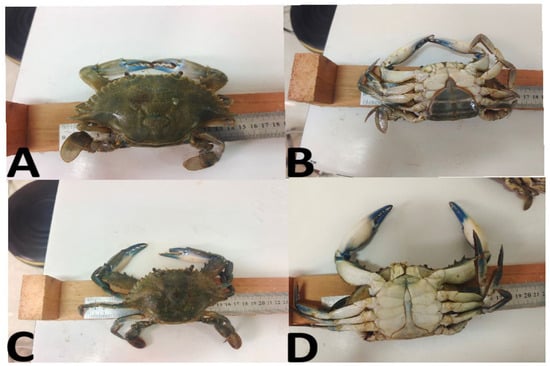
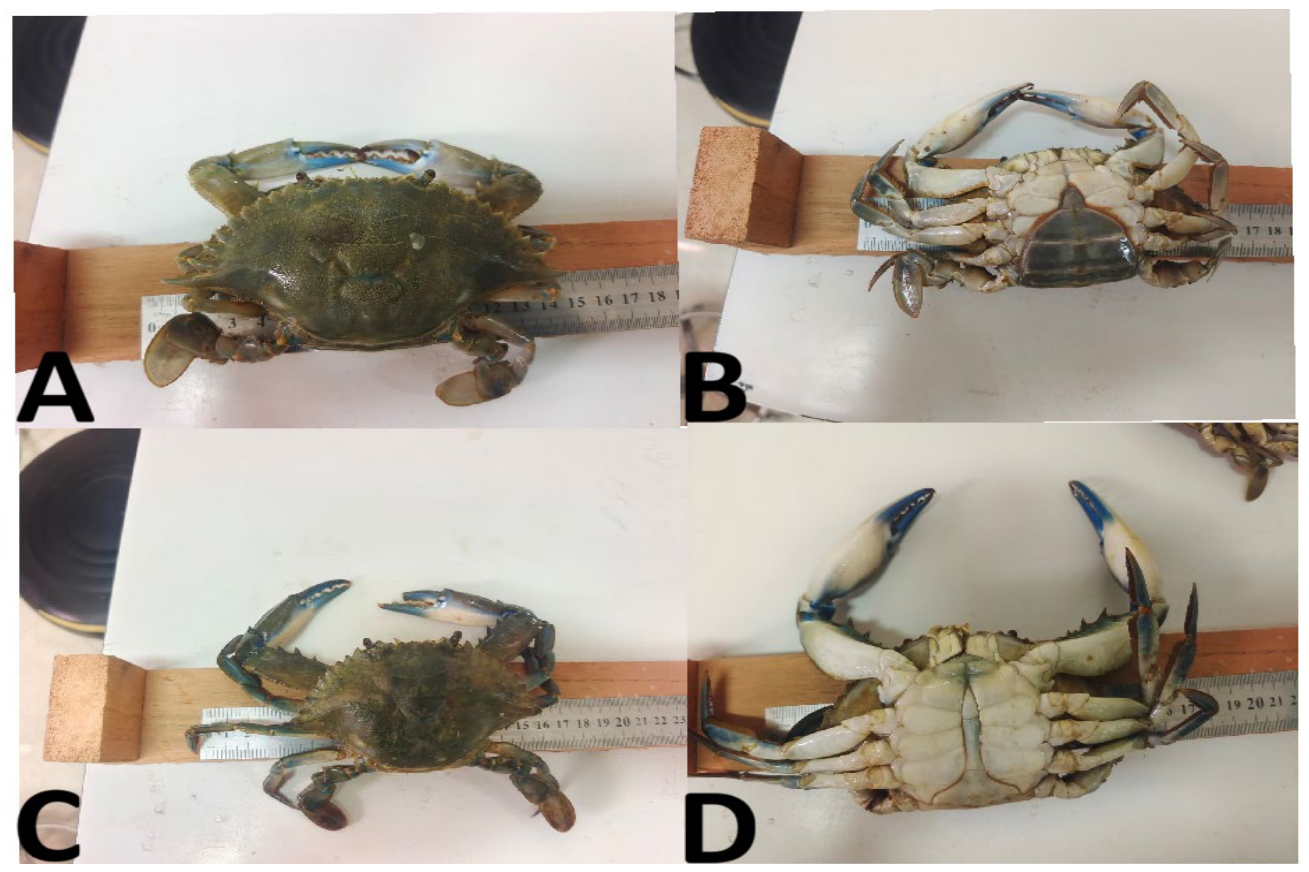
Figure 2.
Callinectes sapidus from Baie de l’Étoile. (A) Mature female, dorsal view, with bluish chelae tipped with reddish-brown teeth; (B) mature female, ventral view, showing broad U-shaped abdomen; (C) adult male, dorsal view, with blue chelipeds; (D) adult male, ventral view, showing narrow T-shaped abdomen and gonopods. Scale bar: graduated ruler in cm.
Among all samples there were 75 males and 73 females (sex ratio male:female = 1.03), which did not differ significantly from parity (χ2 = 0.027, df = 1, p = 0.870). Adults represented 66.2% (98 individuals) and immatures 33.8% (50 individuals); mature individuals were significantly more frequent than immature ones (χ2 = 15.57, df = 1, p < 0.001). The population included 48 mature males, 50 mature females, 27 immature males, and 23 immature females. Mature individuals represented 64.0% of males and 68.5% of females, and maturity stage was independent of sex (χ2 = 0.33, df = 1, p = 0.563; with Yates’ correction, χ2 = 0.16, p = 0.686). Five females (6.8% of females and 10.0% of mature females) were ovigerous; they were recorded in June (2), July, August and September 2025 and measured 117.0–146.2 mm in carapace width (mean 129.0 mm). The year-round occurrence of mature, immature, and ovigerous individuals indicates a continuous presence of multiple size and maturity classes in the bay throughout the study period. Mature individuals were recorded in all 12 campaigns and immature individuals in 11 of them (none in August 2025). The sex composition did not differ among months (χ2 = 8.80, df = 11, p = 0.640), whereas the proportion of mature individuals did (χ2 = 26.45, df = 11, p = 0.006; some expected counts < 5).
Carapace width (CW) averaged 106.0 ± 27.5 mm (mean ± SD; SE = 2.26 mm; range 48.5–193.4 mm) and total weight 88.9 ± 47.8 g (SE = 3.93 g; range 10.0–255.8 g). Males (CW 105.1 ± 28.9 mm, SE = 3.33; weight 96.7 ± 53.1 g, SE = 6.14) and females (CW 106.8 ± 26.2 mm, SE = 3.07; weight 80.8 ± 40.4 g, SE = 4.73) did not differ significantly in CW (Mann–Whitney U = 2791.5, p = 0.836) or in weight (U = 2261.5, p = 0.068). Mature individuals were significantly larger and heavier than immature ones (CW 119.2 ± 21.9 vs. 80.0 ± 16.8 mm, U = 398.5, p < 0.001; weight 113.4 ± 38.2 vs. 40.8 ± 20.1 g, U = 214.0, p < 0.001). Individuals smaller than 80 mm CW (n = 32) were mostly immature (28 of 32), those of 80–119.9 mm (n = 66) were a mixture of immature (22) and mature (44) crabs, and all individuals of 120 mm or more (n = 50) were mature. The sex composition differed among size classes (χ2 = 10.01, df = 2, p = 0.007), males being proportionally more frequent in the smallest and largest classes (21 of 32 and 30 of 50) and females in the intermediate class (42 of 66).
The external diagnostic features of the specimens are shown in Figure 2. The mature female (Figure 2A, dorsal view; Figure 2B, ventral view) has a broad, rounded abdomen (Figure 2B), whereas the adult male (Figure 2C, dorsal view; Figure 2D, ventral view) has a narrow, inverted T-shaped abdomen with gonopods (Figure 2D). Cheliped coloration also differs between the two specimens shown: the fingers of the male are bright blue with a cream-white palm (Figure 2C), whereas those of the female are bluish with reddish-brown to orange-tinted teeth at the tips of the dactyl (Figure 2A).
3.2. Evidence from Local Ecological Knowledge (LEK)
Interviews with artisanal fishers provided complementary occurrence data. Several fishers from Nouadhibou reported observing blue crabs matching C. sapidus near the port and adjacent coastal waters since 2022. Fishers from Nouakchott reported similar observations from 2023 in coastal shallows near the capital. These LEK observations are not scientifically validated first records (no voucher specimens), but they suggest C. sapidus was present in Mauritania before its first scientific confirmation and indicate a gradual, stepwise establishment along the coast. The first fisher observations date from 2022 in Nouadhibou, where the species was confirmed in the present study, and from 2023 in Nouakchott, where scientific confirmation is still awaited.
4. Discussion
Our findings represent the first scientifically verified occurrence of Callinectes sapidus in Mauritania and extend the currently known southern distribution limit of this invasive portunid crab along the Atlantic coast of Africa. Together with the population structure reported above, these results indicate an early established (incipient) population in Mauritania. This new record fills an important biogeographical gap between the Moroccan Atlantic populations and the tropical eastern Atlantic, providing new evidence of the ongoing southward expansion of the species. The closest previously known records were from Dakhla Bay (23° N, 2024) [24], Merja Zerga (34° N, 2019) and Khnifiss (28° N, 2020) [23]. Baie de l’Étoile (21.03° N) is located ~2.7° of latitude south of Dakhla Bay (~317 km in straight-line distance, ~430 km by road/coastal route), thus representing a remarkable southward range extension (Figure 1). Further expansion of the species’ distribution along the West African coast is plausible, given the combination of passive larval transport and anthropogenic vectors documented elsewhere in its invasive range [32,33]. In terms of invasion stages (arrival, establishment, spread), the presence of multiple size and maturity classes throughout the study and of ovigerous females in summer (June–September) places the Mauritanian population beyond the arrival stage, although a self-sustaining, reproducing population has not yet been demonstrated.
Local ecological knowledge (LEK) can provide valuable complementary information on the timing and spatial context of species occurrences, particularly in poorly monitored coastal areas [34]. Reports from fishers suggest that blue crabs may have been present in Nouadhibou since 2022 and in Nouakchott since 2023, i.e., at least one year before the first scientifically confirmed record, although this cannot be verified in the absence of voucher specimens from that period. LEK surveys can sometimes precede scientific surveys, particularly for highly mobile macroinvertebrates in turbid coastal waters [35]. However, without voucher specimens, such information cannot replace taxonomically verified records, but rather complement them, helping to clarify the invasion chronology and prioritize further investigations. The convergence between local ecological knowledge reports and the present scientific observations provides complementary evidence of the possible earlier occurrence of C. sapidus along the Mauritanian coast. If the fishers’ first observations in Nouadhibou in 2022 are correct, two to three years elapsed before our first samples, which would be sufficient for the species to complete more than one generation and is therefore consistent with the multi-cohort structure and the ovigerous females that we recorded.
The structure of the population also suggests that it did not appear instantaneously but developed progressively over time. Immature crabs of 48.5 mm carapace width coexisted with mature individuals of up to 193.4 mm, mature crabs outnumbered immature ones (66.2%), and ovigerous females were recorded in summer (June–September), which implies that several cohorts were present and that at least part of the population had grown and matured in the bay well before our first samples in December 2024. The monthly composition supports this progressive development: immature individuals made up more than half of the catch in February, April, May and June 2025 (6 of 11, 6 of 9, 6 of 9 and 10 of 17, respectively), whereas mature crabs represented at least 70% of the catch in every campaign from July 2025 onwards, and the proportion of mature individuals differed significantly among months (χ2 = 26.45, df = 11, p = 0.006). Such a pattern is consistent with the recruitment of new cohorts in late winter and spring and their growth and maturation during the following months, although a multi-year series is needed to confirm it. A population structure of this kind takes time to build, and it is consistent with the Local Ecological Knowledge records, which place the first observations in Nouadhibou in 2022 and in Nouakchott in 2023. The population structure and the fishers’ reports suggest that C. sapidus was probably present in Mauritanian waters, at low densities and undetected, before the start of our sampling, and that the low abundance typical of the early stages of an invasion may have delayed its scientific detection. Because LEK records cannot be verified without voucher specimens, this interpretation remains a working hypothesis, and archived specimens, historical photographs and targeted surveys in Nouakchott would help to establish the actual date of arrival.
Several non-mutually exclusive introduction pathways may explain the occurrence of C. sapidus in Baie de l’Étoile. Based on the available evidence, natural larval dispersal through the Canary Current and shipping-mediated transport represent the most plausible mechanisms, although population genetic analyses are required to discriminate between these alternative scenarios. The developmental period of C. sapidus larvae (zoae) lasts approximately 31–49 days from hatching to the megalopa stage under laboratory conditions [36]. Given typical Canary Current flow speeds, this duration is compatible with passive larval transport over the ~317 km separating Dakhla and Nouadhibou. Successful dispersal would also depend on oceanographic conditions, larval survival and settlement success, but the largely uninterrupted coastal habitats (seagrass beds, mudflats) along this stretch likely provide stepping-stone habitat facilitating dispersal. Secondly, the Port of Nouadhibou is a major transshipment center in West Africa and thus a potential entry point through ballast water discharge [37,38,39]. It is also possible that the species arrived at Nouadhibou with fouling organisms on the hulls or by intentional aquaculture introduction [14,40]. The genetic origin of the Mauritanian population should be established through mitochondrial COI sequencing to test for the alternative invasion routes.
The incipient invasion by C. sapidus may have important ecological consequences for the estuarine ecosystem of Baie de l’Étoile. This crab is an aggressive and generalist exotic predator that has the potential to disrupt native benthic food webs through both direct and indirect interactions, compete with native brachyuran species, and predate on commercially important bivalve molluscs [41]. In particular, it could affect the native congener C. marginatus, which occurs in the seagrass beds of the bay [31]. The estuary’s seagrass beds support a diverse macrozoobenthic fauna: a recent survey centred mainly on Baie de l’Étoile and the Banc d’Arguin documented 103 macrozoobenthic invertebrate species [31], and the seagrass meadows of the bay remain highly vulnerable to multiple anthropogenic and natural threats [28]. The introduction of a large, highly mobile macropredator with no similar counterparts in the regional biota could affect multiple invertebrate components, potentially triggering a cascade of community-level changes [42,43].
However, the appearance of C. sapidus can also be considered a potential opportunity for the local fishers. In similar cases, such as in Tunisia, Italy, and the northern Adriatic Sea, the invasion by C. sapidus was followed by a rapid response from fishers and fisheries managers to develop an effective fishery for this species [5,13,41,44,45,46,47,48,49]. In Mauritania, a similar multi-tiered approach involving stock assessments, investigations into local life-history traits, and specific fisheries regulations would be required to ensure that the benefits from the new fishery are maximized, without negatively impacting the coastal ecosystem. It is therefore recommended to (i) assess crab populations inside the marine protected area to characterize their spatial distribution and estimate biomass, (ii) conduct a genetic analysis using DNA barcoding to confirm the identification and investigate the invasion pathway, (iii) perform experiments to quantify the crab’s predatory pressure on native bivalves and decapods, and (iv) collaborate with local fishers’ cooperatives and port authorities to implement monitoring and outreach activities [42,50,51].
5. Conclusions and Management Implications
This study documents the first confirmed occurrence of Callinectes sapidus along the Mauritanian coast. Multiple size and maturity classes, ovigerous females in summer, and continuous catches over 12 campaigns place the population beyond the arrival stage, consistent with an early established (incipient) population in Baie de l’Étoile, though this remains provisional given the few ovigerous females recorded (5 of 73), the intertidal-only sampling, and the absence of gonadal histology; multi-year monitoring and genetic analyses are needed to confirm local recruitment. Fishers reported the species from 2022 in Nouadhibou and 2023 in Nouakchott, consistent with the Moroccan south-bound sequence of records [21,22,23,24], though these unvouchered reports remain hypotheses; future LEK surveys should use standardized colour plates and secure vouchers or photographs. Natural larval dispersal by the Canary Current and ballast water or hull fouling at the Port of Nouadhibou are both plausible introduction vectors [1,37,38,39], to be tested with genetic and dispersal-modelling data.
A generalist predator of this kind could affect the seagrass, maerl, bivalve and native-portunid resources of Baie de l’Étoile [28,31,41]. As eradication is rarely feasible once a species is established, management should prioritize early detection, rapid response and impact monitoring [42,43], strengthen ballast water and biofouling control at the ports of Nouadhibou and Nouakchott [50], and consider a regulated, stock-assessment-based fishery [5,13,41,44,45,46,47,48,49]; these measures should be written into the management plan of the Baie de l’Étoile protected area.
We recommend (i) standardized, multi-year surveys with fixed stations, constant effort and CPUE per person-hour, extended to subtidal and estuarine habitats with traps; (ii) extending surveys southward to the Banc d’Arguin, Nouakchott, the Senegal River estuary (including Diawling National Park) and the Saloum Delta; (iii) genetic baselines and environmental DNA assays; (iv) surveillance of ballast water and hull fouling in the main ports; (v) size-at-maturity, fecundity and diet studies with predation experiments; (vi) LEK and citizen-science networks with fishers’ cooperatives; and (vii) a shared regional database linking Morocco, Mauritania, Senegal and The Gambia [42,50,51]. Given the low capture success of the hand-net method used here (0–3 individuals per pass), future monitoring should also use alternative sampling tools, such as baited crab traps, collapsible pots or dedicated catches by local fisheries.
Author Contributions
Conceptualization, D.O. and S.A.E.; methodology, D.O., S.A.E. and A.R.; software, M.R.L. and S.A.E.; validation, A.R. and L.A.; formal analysis, D.O., M.R.L. and S.A.E.; investigation, D.O., K.E.H., M.A. and F.M.T.; resources, S.A.E. and L.A.; data curation, D.O., K.E.H. and M.A.; writing—original draft preparation, D.O. and S.A.E.; writing—review and editing, A.R., M.R.L., K.E.H., M.A., F.M.T. and L.A.; visualization, M.R.L. and S.A.E.; supervision, A.R. and L.A.; project administration, D.O. and S.A.E. All authors have read and agreed to the published version of the manuscript.
Funding
This research received no external funding.
Institutional Review Board Statement
Ethical review and approval were waived for this study because it involved only non-invasive external measurements (carapace width and wet weight) of an invertebrate species (Callinectes sapidus), which is not covered by national or institutional regulations on animal experimentation, and anonymous, voluntary interviews with artisanal fishers in which no personal or sensitive data were collected.
Informed Consent Statement
Verbal informed consent was obtained from all fishers involved in the study. No personally identifying information was recorded, and participation was voluntary and anonymous.
Data Availability Statement
The data presented in this study are available on request from the corresponding authors.
Conflicts of Interest
The authors declare that they have no known competing financial interests or personal relationships that could have appeared to influence the work reported in this paper.
References
- Kennedy, V.S.; Cronin, L.E. (Eds.) The Blue Crab: Callinectes sapidus; Maryland Sea Grant College: College Park, MD, USA, 2007. [Google Scholar]
- Williams, A.B. The swimming crabs of the genus Callinectes (Decapoda: Portunidae). Fish. Bull. 1974, 72, 685–798. [Google Scholar]
- NOAA Fisheries; National Oceanic and Atmospheric Administration. Commercial Fisheries Landings. 2024. Available online: https://www.fisheries.noaa.gov/national/sustainable-fisheries/commercial-fisheries-landings (accessed on 29 September 2026).
- Mancinelli, G.; Chainho, P.; Cilenti, L.; Falcó, S.; Kapiris, K.; Katselis, G.; Ribeiro, F. The Atlantic blue crab Callinectes sapidus in southern European coastal waters: Distribution, impact and prospective invasion management strategies. Mar. Pollut. Bull. 2017, 119, 5–11. [Google Scholar] [CrossRef] [Scilit]
- Azzurro, E.; Bonanomi, S.; Chiappi, M.; De Marco, R.; Luna, G.M.; Cella, M.; Guicciardi, S.; Tiralongo, F.; Bonifazi, A.; Strafella, P. Uncovering unmet demand and key insights for the invasive blue crab (Callinectes sapidus) market before and after the Italian outbreak: Implications for policymakers and industry stakeholders. Mar. Policy 2024, 167, 106295. [Google Scholar] [CrossRef] [Scilit]
- Bouvier, E. Sur un Callinectes sapidus M. Rathbun trouvé à Rochefort [On a Callinectes sapidus M. Rathbun found at Rochefort]. Bull. Du. Muséum Natl. d’Histoire Nat. De Paris 1901, 7, 16–17. [Google Scholar] [CrossRef] [Scilit]
- Kevrekidis, K.; Kevrekidis, T.; Chitinroglou, C.C.; Avramoglou, K.; Keisaris, S.; Fryganiotis, K.; Apostologamvrou, C.; Roditi, K.; Voulgaris, K.; Varkoulis, A.; et al. Reproductive biology of the invasive blue crab Callinectes sapidus in the Thermaikos Gulf (Northwest Aegean Sea, Eastern Mediterranean): Identifying key information for an effective population management policy. J. Mar. Sci. Eng. 2024, 12, 1923. [Google Scholar] [CrossRef] [Scilit]
- Abdel Razek, F.A.; Ismaiel, M.; Ameran, M.A.A. Occurrence of the blue crab Callinectes sapidus Rathbun, 1896, and its fisheries biology in Bardawil Lagoon, Sinai Peninsula, Egypt. Egypt. J. Aquat. Res. 2016, 42, 223–229. [Google Scholar] [CrossRef] [Scilit]
- Benabdi, M.; Belmahi, A.E.; Grimes, S. First record of the Atlantic blue crab Callinectes sapidus Rathbun, 1896 (Decapoda: Brachyura: Portunidae) in Algerian coastal waters (southwestern Mediterranean). BioInvasions Rec. 2019, 8, 119–122. [Google Scholar] [CrossRef] [Scilit]
- Box, A.; Colomar, V.; Sureda, A.; Tejada, S.; Nuñez-Reyes, V.; Cohen-Sanchez, A.; Avila, T.; Forteza, V.; Castello, M.; Valverde, N.; et al. Next step of the colonization of the Balearic Islands (Spain) by invasive Atlantic blue crab, Callinectes sapidus Rathbun, 1896 (Crustacea: Decapoda: Portunidae). BioInvasions Rec. 2020, 9, 259–265. [Google Scholar] [CrossRef] [Scilit]
- Chemello, G.; Giannico, E.; Zarantoniello, M.; Trotta, E.; Ciaralli, L.; Matiddi, M.; Silvestri, C.; Di Renzo, L.; Manfra, L.; Libralato, G.; et al. Histological-based characterization of ovarian developmental stages in blue crab (Callinectes sapidus) within the spawning season in the central western Adriatic Sea. Tissue Cell 2026, 98, 103118. [Google Scholar] [CrossRef] [Scilit]
- Corsini-Foka, M.; Abdulghani, A.; Al Mabruk, S.; Abdulrraziq, A.; Ibrahim, S.; Scannella, D.; Zava, B.; Deidun, A.; Gianguzza, P. Invasive portunid crabs in Libyan waters: First record of the Atlantic blue crab Callinectes sapidus Rathbun, 1896 and range expansion of the swimming blue crab Portunus segnis (Forskål, 1775). BioInvasions Rec. 2021, 10, 885–893. [Google Scholar] [CrossRef] [Scilit]
- Ennouri, R.; Zarrouk, H.; Fatnassi, M.; Mili, S. Development of the fishing and commercialization of the blue crabs in Bizerta and Ghar EL Melh lagoons: A case study of promotion opportunities of blue growth in Tunisia. J. Aquac. Mar. Biol. 2021, 10, 66–74. [Google Scholar] [CrossRef] [Scilit]
- Morais, P.; Gaspar, M.; Garel, E.; Baptista, V.; Cruz, J.; Cerveira, I.; Leitão, F.; Teodósio, M.A. The Atlantic blue crab Callinectes sapidus Rathbun, 1896 expands its non-native distribution into the Ria Formosa lagoon and the Guadiana estuary (SW-Iberian Peninsula, Europe). BioInvasions Rec. 2019, 8, 123–133. [Google Scholar] [CrossRef] [Scilit]
- Chartosia, N.; Anastasiadis, D.; Bazairi, H.; Crocetta, F.; Deidun, A.; Despalatović, M.; Di Martino, V.; Dimitriou, N.; Dragičević, B.; Dulčić, J.; et al. New Mediterranean biodiversity records (July 2018). Mediterr. Mar. Sci. 2018, 19, 398–415. [Google Scholar] [CrossRef] [Scilit]
- Ragkousis, M.; Abdelali, N.; Azzurro, E.; Badreddine, A.; Bariche, M.; Bitar, G.; Crocetta, F.; Denitto, F.; Digenis, M.; El Zrelli, R.B.; et al. New alien Mediterranean biodiversity records (October 2020). Mediterr. Mar. Sci. 2020, 21, 631–652. [Google Scholar] [CrossRef] [Scilit]
- Stasolla, G.; Innocenti, G. New records of the invasive crabs Callinectes sapidus Rathbun, 1896 and Percnon gibbesi (H. Milne Edwards, 1853) along the Italian coasts. BioInvasions Rec. 2014, 3, 39–43. [Google Scholar] [CrossRef] [Scilit]
- Taybi, A.F.; Mabrouki, Y. The American blue crab Callinectes sapidus Rathbun, 1896 (Crustacea: Decapoda: Portunidae) is rapidly expanding through the Mediterranean coast of Morocco. Thalassas 2020, 36, 267–271. [Google Scholar] [CrossRef] [Scilit]
- Cannarozzi, L.; Paoli, C.; Vassallo, P.; Cilenti, L.; Bevilacqua, S.; Lago, N.; Scirocco, T.; Rigo, I. Donor-side and user-side evaluation of the Atlantic blue crab invasion on a Mediterranean lagoon. Mar. Pollut. Bull. 2023, 189, 114758. [Google Scholar] [CrossRef] [Scilit]
- Gavioli, A.; Mancinelli, G.; Turolla, E.; Lanzoni, M.; Paesanti, V.; Soana, E.; Eggleston, D.B.; Christian, R.R.; Castaldelli, G. Impacts of the invasive blue crab Callinectes sapidus on small-scale fisheries in a Mediterranean lagoon using fishery landing data. Sci. Total Environ. 2025, 974, 179236. [Google Scholar] [CrossRef] [Scilit]
- Chaouti, A.; Belattmania, Z.; Nadri, A.; Serrão, E.A.; Encarnação, J.; Teodósio, M.A.; Reani, A.; Sabour, B. The invasive Atlantic blue crab Callinectes sapidus Rathbun, 1896 expands its distributional range southward to Atlantic African shores: First records along the Atlantic coast of Morocco. BioInvasions Rec. 2022, 11, 227–237. [Google Scholar] [CrossRef] [Scilit]
- Chairi, H.; González-Ortegón, E. Additional records of the blue crab Callinectes sapidus Rathbun, 1896 (Crustacea: Decapoda: Portunidae) in Moroccan Atlantic coastal waters. BioInvasions Rec. 2022, 11, 776–784. [Google Scholar] [CrossRef] [Scilit]
- Oussellam, M.; Benhoussa, A.; Pariselle, A.; Rahmouni, I.; Salmi, M.; Agnèse, J.F.; Selfati, M.; El Ouamari, N.; Bazairi, H. First and southern-most records of the American blue crab Callinectes sapidus Rathbun, 1896 (Decapoda, Portunidae) on the African Atlantic coast. BioInvasions Rec. 2023, 12, 403–416. [Google Scholar] [CrossRef] [Scilit]
- Mabrouki, Y.; Gourari, K.; Parenteau-Mauffette, É.; Sbaa, M.; Bouzrouk, A.; Taybi, A.F. The blue crab Callinectes sapidus Rathbun, 1896 extends its southbound invasion along the Atlantic coast of North Africa: First occurrence in the Atlantic Sahara shores of Morocco. Thalassas 2025, 41, 12. [Google Scholar] [CrossRef] [Scilit]
- de Matos-Pita, S.S.; Castillo, S.; Ramil, F. Contribution to the knowledge of the deep brachyuran fauna (Crustacea: Decapoda) in waters off Mauritania (NW Africa). J. Mar. Biol. Assoc. U. K. 2017, 97, 1273–1305. [Google Scholar] [CrossRef] [Scilit]
- de Matos-Pita, S.S.; Ramil, F.; Ramos, A. Marine lobsters and lithodids (Crustacea: Decapoda) from Mauritanian deep-waters (NW Africa). Reg. Stud. Mar. Sci. 2018, 23, 32–38. [Google Scholar] [CrossRef] [Scilit]
- Ly, A. Fonctionnement Écologique et Évolution du Contexte Socio-Économique de la Baie de l’Étoile: Une Contribution à l’Aménagement du Littoral Mauritanien et au Développement d’un Réseau d’Aires Marines Protégées en Afrique de l’Ouest [Ecological Functioning and Evolution of the Socio-Economic Context of Baie de l’Étoile]. Ph.D. Thesis, Muséum National d’Histoire Naturelle, Paris, France, 2009. [Google Scholar]
- GRID-Arendal. Meadows of Knowledge: Putting West Africa on the Global Seagrass Map; ResilienSEA (GRID-Arendal/RAMPAO/WIACO): Arendal, Norway, 2022; ISBN 978-82-7701-210-0. Available online: https://www.grida.no/publications/866 (accessed on 29 September 2026).
- Cremer, H.A.; Kupriyanova, E.; Knorrn, A.H.; Moctar, S.M.M.; Freiwald, A.; Tilic, E. Macroid formation in Salmacina stellaebayensis n. sp. from Mauritania’s Baie de l’Étoile with new insights on mitogenome evolution in Serpulidae (Annelida). Ecol. Evol. 2026, 16, e73016. [Google Scholar] [CrossRef] [Scilit]
- Elmamy, C.A.A.; Abdellahi, B.M.L.; Er-Raioui, H.; Dartige, A.; Zamel, M.L.; Deida, P.M.V. Hydrocarbon pollution in Atlantic coast of Mauritania (Levrier Bay Zone): Call for sustainable management. Mar. Pollut. Bull. 2021, 166, 112040. [Google Scholar] [CrossRef] [Scilit]
- Knorrn, A.H.; Sonnewald, M.; Moctar, S.M.M.; Dia, M.; Beibou, E.; Freiwald, A. Annotated checklist of the invertebrate macrozoobenthos from Mauritanian marine shallow-water habitats. ZooKeys 2026, 1277, 1–55. [Google Scholar] [CrossRef] [Scilit]
- Ruiz, G.M.; Fofonoff, P.W.; Carlton, J.T.; Wonham, M.J.; Hines, A.H. Invasion of coastal marine communities in North America: Apparent patterns, processes, and biases. Annu. Rev. Ecol. Syst. 2000, 31, 481–531. [Google Scholar] [CrossRef] [Scilit]
- Vasconcelos, P.; Carvalho, A.N.; Piló, D.; Pereira, F.; Encarnação, J.; Gaspar, M.B.; Teodósio, M.A. Recent and consecutive records of the Atlantic blue crab (Callinectes sapidus Rathbun, 1896): Rapid westward expansion and confirmed establishment along the southern coast of Portugal. Thalassas 2019, 35, 485–494. [Google Scholar] [CrossRef] [Scilit]
- Silvano, R.A.M.; Valbo-Jørgensen, J. Beyond fishermen’s tales: Contributions of fishers’ local ecological knowledge to fish ecology and fisheries management. Environ. Dev. Sustain. 2008, 10, 657–675. [Google Scholar] [CrossRef] [Scilit]
- Lodge, D.M.; Williams, S.; MacIsaac, H.J.; Hayes, K.R.; Leung, B.; Reichard, S.; Mack, R.N.; Moyle, P.B.; Smith, M.; Andow, D.A.; et al. Biological invasions: Recommendations for U.S. policy and management. Ecol. Appl. 2006, 16, 2035–2054. [Google Scholar] [CrossRef] [Scilit]
- Costlow, J.D.; Bookhout, C.G. The larval development of Callinectes sapidus Rathbun reared in the laboratory. Biol. Bull. 1959, 116, 373–396. [Google Scholar] [CrossRef] [Scilit]
- Carlton, J.T.; Geller, J.B. Ecological roulette: The global transport of nonindigenous marine organisms. Science 1993, 261, 78–82. [Google Scholar] [CrossRef] [Scilit]
- Carney, K.J.; Minton, M.S.; Holzer, K.K.; Miller, A.W.; McCann, L.D.; Ruiz, G.M. Evaluating the combined effects of ballast water management and trade dynamics on transfers of marine organisms by ships. PLoS ONE 2017, 12, e0172468. [Google Scholar] [CrossRef] [Scilit]
- Nehring, S. Invasion history and success of the American blue crab Callinectes sapidus in European and adjacent waters. In The Wrong Place—Alien Marine Crustaceans: Distribution, Biology and Impacts; Galil, B.S., Clark, P.F., Carlton, J.T., Eds.; Springer: Dordrecht, The Netherlands, 2011; pp. 607–624. [Google Scholar] [CrossRef] [Scilit]
- Cardeccia, A.; Marchini, A.; Occhipinti-Ambrogi, A.; Galil, B.; Gollasch, S.; Minchin, D.; Narščius, A.; Olenin, S.; Ojaveer, H. Assessing biological invasions in European seas: Biological traits of the most widespread non-indigenous species. Estuar. Coast. Shelf Sci. 2018, 201, 17–28. [Google Scholar] [CrossRef] [Scilit]
- Chiesa, S.; Petochi, T.; Boscolo Brusà, R.; Raicevich, S.; Cacciatore, F.; Franceschini, G.; Antonini, C.; Vallini, C.; Bernarello, V.; Oselladore, F.; et al. Impacts of the blue crab invasion on Manila clam aquaculture in Po Delta coastal lagoons (Northern Adriatic Sea, Italy). Estuar. Coast. Shelf Sci. 2025, 312, 109037. [Google Scholar] [CrossRef] [Scilit]
- Galil, B.S.; Marchini, A.; Occhipinti-Ambrogi, A. East is east and West is west? Management of marine bioinvasions in the Mediterranean Sea. Estuar. Coast. Shelf Sci. 2018, 201, 7–16. [Google Scholar] [CrossRef] [Scilit]
- Katsanevakis, S.; Wallentinus, I.; Zenetos, A.; Leppäkoski, E.; Çinar, M.E.; Oztürk, B.; Grabowski, M.; Golani, D.; Cardoso, A.C. Impacts of invasive alien marine species on ecosystem services and biodiversity: A pan-European review. Aquat. Invasions 2014, 9, 391–423. [Google Scholar] [CrossRef] [Scilit]
- Bacher, S.; Blackburn, T.M.; Essl, F.; Genovesi, P.; Heikkilä, J.; Jeschke, J.M.; Jones, G.; Keller, R.; Kenis, M.; Kueffer, C.; et al. Socio-economic impact classification of alien taxa (SEICAT). Methods Ecol. Evol. 2018, 9, 159–168. [Google Scholar] [CrossRef] [Scilit]
- Bonanomi, S.; Libralato, S.; Malvarosa, L.; Czechowska, K.M.; Sandalli, G.; Cariani, A.; Ferrari, A.; Azzurro, E.; Scarcella, G. Applying a regional certification scheme for aquatic invasive species fishery: The case of blue crab (Callinectes sapidus) in the northern Adriatic Sea. Mar. Policy 2025, 181, 106858. [Google Scholar] [CrossRef] [Scilit]
- Della Ceca, E.; Corsetti, S.; Sagratini, G.; Vittori, S.; Borsetta, G. From invasive to innovative: A review of socio-economic and ecological pathways for the sustainable management of the blue crab (Callinectes sapidus) and its recorded sightings in the Mediterranean. Sci 2026, 8, 48. [Google Scholar] [CrossRef] [Scilit]
- Mancinelli, G.; Chainho, P.; Cilenti, L.; Falcó, S.; Kapiris, K.; Katselis, G.; Ribeiro, F. On the Atlantic blue crab (Callinectes sapidus Rathbun 1896) in southern European coastal waters: Time to turn a threat into a resource? Fish. Res. 2017, 194, 1–8. [Google Scholar] [CrossRef] [Scilit]
- Nardelli, L.; Fucilli, V.; Pinto, H.; Elston, J.N.; Carignani, A.; Petrontino, A.; Bozzo, F.; Frem, M. Socio-economic impacts of the recent bio-invasion of Callinectes sapidus on small-scale artisanal fishing in southern Italy and Portugal. Front. Mar. Sci. 2024, 11, 1466132. [Google Scholar] [CrossRef] [Scilit]
- Oussellam, M.; Selfati, M.; Ouamari, N.E.; Bazairi, H. Using the new SEICAT methodology to study the socio-economic impacts of the American blue crab Callinectes sapidus from Marchica lagoon, Morocco. AACL Bioflux 2021, 14, 3231–3241. [Google Scholar]
- Bailey, S.A.; Deneau, M.G.; Jean, L.; Wiley, C.J.; Leung, B.; MacIsaac, H.J. Evaluating efficacy of an environmental policy to prevent biological invasions. Environ. Sci. Technol. 2011, 45, 2554–2561. [Google Scholar] [CrossRef] [Scilit]
- Cerri, J.; Chiesa, S.; Bolognini, L.; Mancinelli, G.; Grati, F.; Dragičević, B.; Dulčić, J.; Azzurro, E. Using online questionnaires to assess marine bio-invasions: A demonstration with recreational fishers and the Atlantic blue crab Callinectes sapidus (Rathbun, 1896) along three Mediterranean countries. Mar. Pollut. Bull. 2020, 156, 111209. [Google Scholar] [CrossRef] [Scilit]

Disclaimer/Publisher’s Note: The statements, opinions and data contained in all publications are solely those of the individual author(s) and contributor(s) and not of MDPI and/or the editor(s). MDPI and/or the editor(s) disclaim responsibility for any injury to people or property resulting from any ideas, methods, instructions or products referred to in the content. |
© 2026 by the authors. Licensee MDPI, Basel, Switzerland. This article is an open access article distributed under the terms and conditions of the Creative Commons Attribution (CC BY) license.