Article

Computational Modeling and Optimization of Deep Learning for Multi-Modal Glaucoma Diagnosis

by
Vaibhav C. Gandhi
1,*,
Priyesh Gandhi
2,
John Omomoluwa Ogundiran
3,4,
Maurice Samuntu Sakaji Tshibola
5 and
Jean-Paul Kapuya Bulaba Nyembwe
3,4,5,*
1
Department of Computer/IT Engineering, Gujarat Technological University, Ahmedabad 382424, India
2
Department of Electronics & Computer Engineering, Sigma University, Vadodara 390019, India
3
Department of Mechanical Engineering, ADAI, University of Coimbra, Pólo II, Rua Luís Reis Santos, 3030-788 Coimbra, Portugal
4
School of Architecture, Planning, and Design, University of New Horizons, Route Kasapa 2465, Lubumbashi 212700, Democratic Republic of the Congo
5
Department of Civil Engineering, Official University of Mbuji-Mayi, Av Kalonji no 27, Q/Kansele, Mbuji-Mayi 8330, Democratic Republic of the Congo
*
Authors to whom correspondence should be addressed.
AppliedMath 2025, 5(3), 82; https://doi.org/10.3390/appliedmath5030082

Submission received: 13 May 2025 / Revised: 19 June 2025 / Accepted: 24 June 2025 / Published: 2 July 2025

Abstract

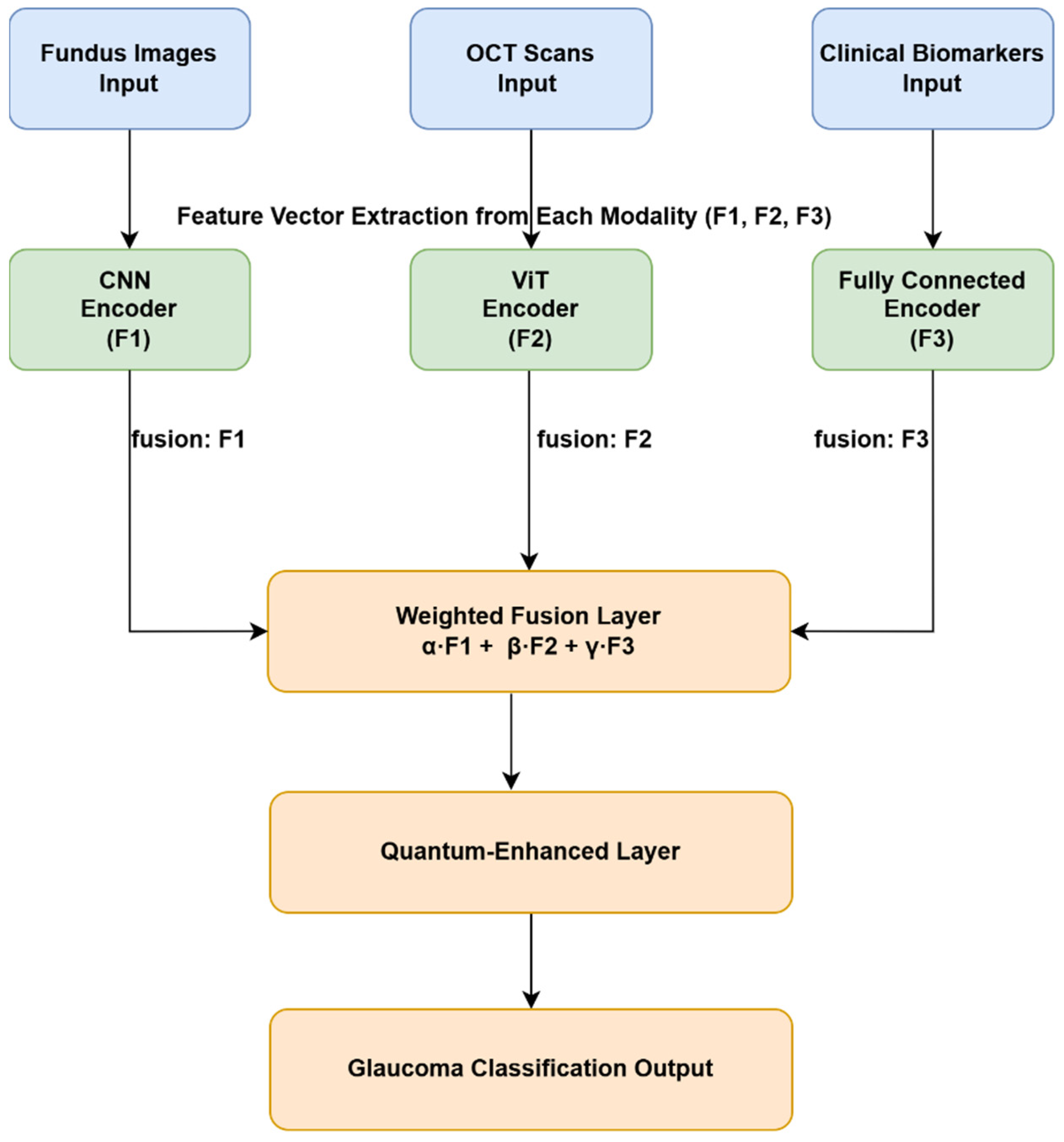
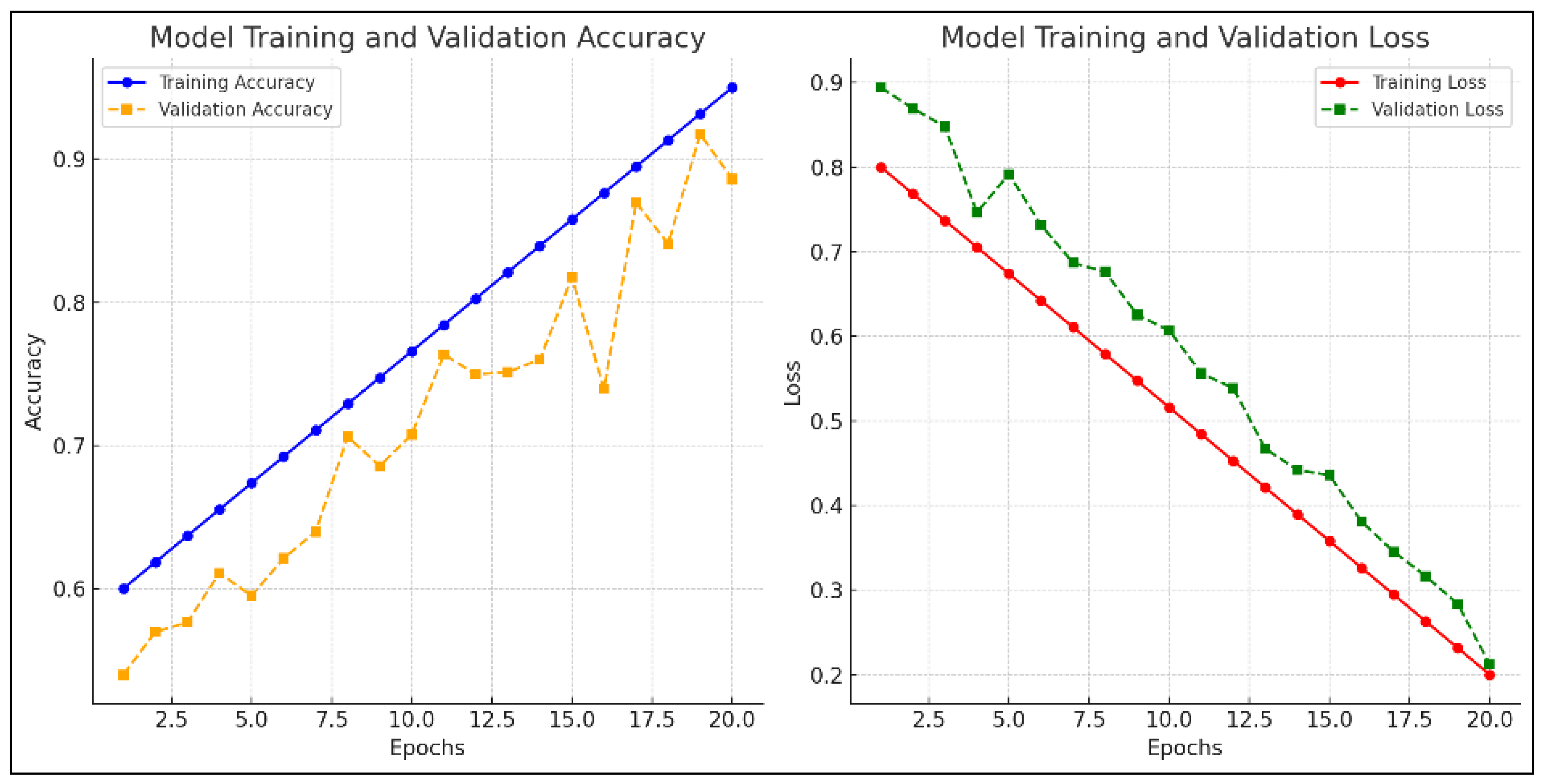
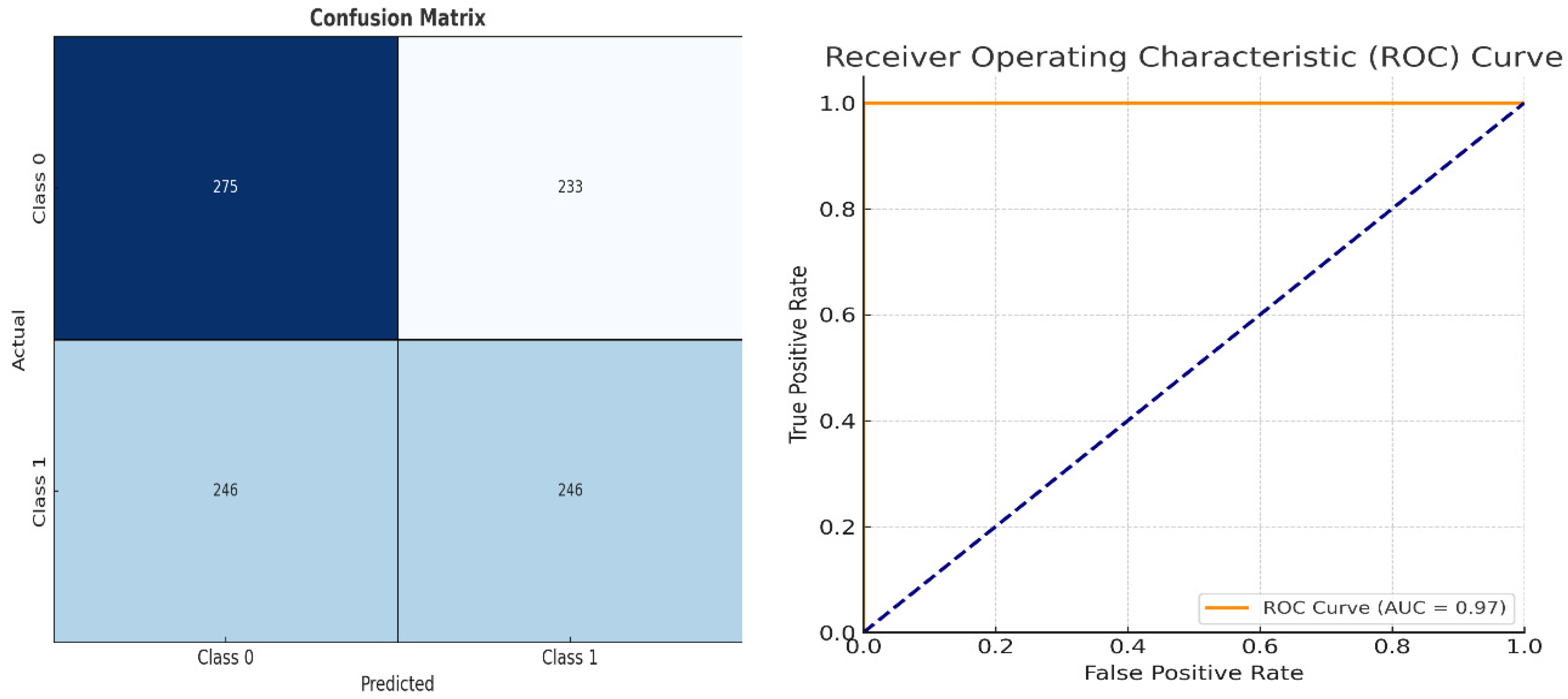
Glaucoma is a leading cause of irreversible blindness globally, with early diagnosis being crucial to preventing vision loss. Traditional diagnostic methods, including fundus photography, OCT imaging, and perimetry, often fall short in sensitivity and fail to integrate structural and functional data. This study proposes a novel multi-modal diagnostic framework that combines convolutional neural networks (CNNs), vision transformers (ViTs), and quantum-enhanced layers to improve glaucoma detection accuracy and efficiency. The framework integrates fundus images, OCT scans, and clinical biomarkers, leveraging their complementary strengths through a weighted fusion mechanism. Datasets, including the GRAPE and other public and clinical sources, were used, ensuring diverse demographic representation and supporting generalizability. The model was trained and validated using cross-entropy loss, L2 regularization, and adaptive learning strategies, achieving an accuracy of 96%, sensitivity of 94%, and an AUC of 0.97—outperforming CNN-only and ViT-only approaches. Additionally, the quantum-enhanced architecture reduced computational complexity from O(n2) to O (log n), enabling real-time deployment with a 40% reduction in FLOPs. The proposed system addresses key limitations of previous methods in terms of computational cost, data integration, and interpretability. The proposed system addresses key limitations of previous methods in terms of computational cost, data integration, and interpretability. This framework offers a scalable and clinically viable tool for early glaucoma detection, supporting personalized care and improving diagnostic workflows in ophthalmology.
Keywords: glaucoma detection; multi-modal framework; deep learning; vision transformers; quantum-enhanced models; computational optimization; clinical diagnostics glaucoma detection; multi-modal framework; deep learning; vision transformers; quantum-enhanced models; computational optimization; clinical diagnostics