


Abstract
In many immune-mediated kidney diseases, tissue injury is driven by dysregulated B-cell immunity, with autoantibodies and complement acting as key effectors at the glomerulus. Corticosteroids and conventional immunosuppressants control these diseases only in part, and they do so at the price of cumulative toxicity and frequent relapse. Anti-CD20 antibodies deplete circulating B cells but spare plasmablasts and CD19+ plasma cells that sustain autoantibody production, leaving a residual autoreactive compartment that may contribute to refractory disease and relapse. Anti-CD19 chimeric antigen receptor (CAR) T cells target a broader spectrum of B-cell populations, and early clinical studies suggest that this deeper depletion extends into secondary lymphoid tissues. The clinical evidence, however, is uneven. It is strongest in systemic lupus erythematosus and refractory lupus nephritis, where case series and early-phase trials report clinical and serological remission together with discontinuation of immunosuppression and treatment-free remission. In multiple myeloma and immunoglobulin light-chain (AL) amyloidosis with renal involvement, anti-B-cell maturation antigen (anti-BCMA) CAR-T products are increasingly used in real-world cohorts of patients with reduced estimated glomerular filtration rate (eGFR) or on dialysis, while bispecific T-cell engagers such as teclistamab offer an off-the-shelf alternative. The toxicity of these agents concerns the nephrologist directly. Cytokine release syndrome, immune effector cell-associated neurotoxicity syndrome, tumor lysis syndrome, and the immune effector cell-associated hemophagocytic lymphohistiocytosis-like syndrome (IEC-HS) (IEC-HS) can each involve the kidney, as can the newly defined local immune effector cell-associated toxicity syndrome (LICATS). This review explores the immunological basis of CAR-T constructs, the evidence by disease, the renal toxicity profile, and the criteria for candidate selection and nephrological monitoring.
1. Introduction
In immune-mediated kidney diseases, tissue damage is driven by a complex interaction between innate and adaptive immunity [1]. Contributing to this process, in varying proportions, are the innate component of the immune system, with neutrophils and macrophages alongside complement [2,3], and the adaptive component with T and B lymphocytes [4,5]. B lymphocytes produce autoantibodies that form circulating immune complexes with soluble antigens, which in turn are destined to deposit in the glomerulus, as in the case of systemic lupus erythematosus (SLE) with anti-double-stranded DNA (anti-dsDNA). In other scenarios, the antibody reacts directly with glomerular antigens and generates immune complexes “in situ”, as occurs with anti-M-type phospholipase A2 receptor (PLA2R) antibodies in primary membranous nephropathy [5]. When this aberrant activity of B lymphocytes evolves into single clonal proliferation, a monoclonal component can become harmful to the kidney. This is the case of monoclonal gammopathies of renal significance (MGRS). In these manifestations, the B-cell or plasma cell clone, by definition, does not satisfy the criteria for multiple myeloma or another hematological malignancy, despite secreting an immunoglobulin capable of damaging the kidney. The same damage from a monoclonal component appears in fully expressed plasma cell dyscrasias, such as multiple myeloma and AL amyloidosis [6,7]. ANCA-associated vasculitis follows a distinct mechanism: the damage is predominantly pauci-immune, and ANCAs activate neutrophils, the origin of the vascular and glomerular lesions.
The standard of care relies on corticosteroids and conventional immunosuppressants, but these treatments often show inconsistent efficacy and carry cumulative toxicity, with a heightened risk of infection [8]. Even anti-CD20 B-cell depleting therapies, such as rituximab, fail to fully eliminate the autoreactive B-cell compartment. For example, in the randomized Lupus Nephritis Assessment with Rituximab (LUNAR) trial of proliferative lupus nephritis, adding rituximab to mycophenolate and corticosteroids did not meet the primary endpoint despite numerical improvements in several secondary outcomes [9]. Similarly, in ANCA-associated vasculitis, maintenance therapy with rituximab does not fully prevent relapses, and serious adverse events still occur [10]. These findings have prompted interest in cellular immunotherapy, and in chimeric antigen receptor (CAR) T cellsin particular, first developed in onco-hematology against well-defined antigens [11].
Anti-CD19 CAR-T cells achieve broader depletion of B-cell populations than anti-CD20 therapies, as CD19 is expressed across a wider range of B-cell maturation stages, including early pre-B cells, plasmablasts, and CD19+ plasma cells, cell types not targeted by rituximab [12,13]. Serial lymph node biopsies in patients with SLE and systemic sclerosis have demonstrated complete B-cell depletion even in secondary lymphoid tissues [13]. After B-cell aplasia resolves, the compartment is repopulated from naïve progenitors, a process some describe as an “immunological reset.” Its durability as genuine immune tolerance, rather than prolonged immune reconstitution, remains unproven [14]. Standardized criteria for selecting candidates for this therapy are still lacking [15]. These unresolved issues have been addressed at the level of expert consensus and research prioritization rather than formal guideline recommendations. The Kidney Disease: Improving Global Outcomes (KDIGO) Controversies Conference on therapies targeting B cells in immune-mediated kidney diseases convened experts in June 2025 to review the available evidence across glomerular diseases and define key research needs. The report supports a relatively advanced evidence base for B-cell-targeted biologics in lupus nephritis and ANCA-associated vasculitis, while emphasizing that cell-therapy approaches remain early-stage, particularly outside lupus nephritis. For membranous nephropathy, established anti-CD20 therapy remains first-line for many patients, whereas deeper B-cell depletion strategies, including cell-based approaches, are still investigational. The report also calls for validated biomarkers to guide patient selection and monitoring and to define the appropriate depth of B-cell depletion for each disease, weighing potential benefits against risks such as cytokine release syndrome (CRS) and other serious toxicities [16]. This review will examine the immunological basis and clinical data for CAR-T cell therapies in immune-mediated kidney diseases, with particular attention to renal toxicities and the potential of next-generation cellular platforms.
This narrative review draws on a search of PubMed/MEDLINE covering publications through July 2026, in which the terms chimeric antigen receptor, CAR-T, CAR-natural killer (CAR-NK), bispecific T-cell engager, and teclistamab were combined with lupus nephritis, systemic lupus erythematosus, membranous nephropathy, podocytopathy, anti-nephrin, ANCA-associated vasculitis, monoclonal gammopathy of renal significance, multiple myeloma, AL amyloidosis, acute kidney injury, and dialysis. The reference lists of the retrieved articles, the ClinicalTrials.gov registry, and the consensus documents of KDIGO, European Society for Blood and Marrow Transplantation (EBMT)and American Society for Transplantation and Cellular Therapy (ASTCT) were screened for additional sources. Priority was given to primary clinical reports, early-phase trials, real-world cohorts, regulatory documents, and consensus statements published in English, and preclinical work was retained where it supplied the mechanistic basis of a clinical application. A total of 109 references were included in the final narrative synthesis.
2. Biological Principles of CAR-T Cells
CAR-T cells are autologous T lymphocytes reprogrammed to express a synthetic receptor that recognizes surface antigens without major histocompatibility complex (MHC) restriction [17]. Manufacturing follows mandatory steps: leukapheresis, transduction with lentiviral or retroviral vectors, expansion, quality control, and cryopreservation. Prior to reinfusion, the patient receives lymphodepleting chemotherapy, usually with infusion of fludarabine and cyclophosphamide, which creates the homeostatic space necessary for the expansion and persistence of the CAR-T [17].
CAR-T cells have evolved through successive generations of increasing signalling complexity. The first chimeric antigen receptor constructs emerged in the late 1980s [18]. Subsequently, first-generation CARs incorporated a single intracellular signalling domain, CD3ζ. Second-generation CARs added a costimulatory domain, most commonly CD28 or 4-1BB, alongside CD3ζ, resulting in improved expansion and in vivo persistence [19]. Third-generation CARs combine two costimulatory domains with CD3ζ, further enhancing T-cell proliferation and survival [20]. Fourth-generation CARs, known as TRUCKs (T cells Redirected for Universal Cytokine Killing), are engineered to express pro-inflammatory or immunomodulatory cytokines such as interleukin (IL)-12, IL-15, or IL-18 upon activation, thereby remodelling the local immune microenvironment and recruiting host innate immune cells [21]. The most recent iterations aim to overcome the constraints linked to the use of autologous cells. Off-the-shelf allogeneic CAR-T cells, obtained from healthy donors or induced pluripotent stem cells, require genomic editing of the T-cell receptor (TCR) and class I human leukocyte antigen (HLA) molecules. Removal of the TCR lowers the risk of Graft-versus-Host Disease (GvHD); modifying class I HLA mitigates host T-lymphocyte-mediated rejection, although susceptibility to lysis by Natural Killer (NK) cells persists [22]. In vivo generation of CAR-T cells using lipid nanoparticles (LNPs) targeted to CD8+ T lymphocytes, in preclinical models, showed deep B-cell depletion and the reconstitution of naïve cells without preemptive chemotherapy-induced lymphodepletion [23]; an initial use in humans has been reported in refractory SLE [24]. Finally, SUPRA-CAR (Split, Universal, and Programmable) modular systems allow for the reprogramming of antigenic specificity and activation through bipartite soluble adapters [25].
In autoimmune diseases, the efficacy and safety of these platforms remain under clinical evaluation. Translating CAR-T cells from onco-hematology to renal immunopathology requires specific revisions, because the immunological and inflammatory microenvironment of autoimmune nephropathies differs from that of hematological malignancies [26].
3. CAR-T Cells as a Treatment for Immune-Mediated Renal and Systemic Diseases
3.1. Lupus Nephritis and SLE
SLE is characterized by the production of anti-nuclear autoantibodies, primarily anti-dsDNA, and by the intrarenal deposition of immune complexes with complement activation. The occurrence of lupus nephritis increases morbidity and mortality [27]. Belimumab, anifrolumab, and next-generation calcineurin inhibitors such as voclosporin have expanded the available therapeutic options. However, none of these treatments fully eliminates the autoreactive B-cell compartment, and refractory cases and relapses remain possible [28].
The first reported use of anti-CD19 CAR-T cells in lupus nephritis was in 2021, when Mougiakakos et al. described a 20-year-old female with class IIIA lupus nephritis and nephrotic syndrome who achieved rapid clinical and serological remission, including anti-dsDNA seroconversion and normalization of serum complement, following CAR-T cell infusion [29]. Shortly thereafter, Mackensen et al. treated five patients with active, refractory SLE, achieving DORIS (Definition of Remission in SLE) remission and enabling discontinuation of immunosuppression within three months [30]. Subsequent evidence from larger cohorts further supported these findings. Müller et al. treated 15 patients with severe autoimmune disease, 8 of whom had SLE. All eight reached DORIS remission at six months, with seroconversion of anti-dsDNA and disappearance of proteinuria sustained thereafter. The three patients with idiopathic inflammatory myositis reached an ACR-EULAR (American College of Rheumatology and European League Against Rheumatism) major clinical response, and the four with systemic sclerosis showed reduced skin and lung disease severity. All 15 discontinued glucocorticoids and every other immunosuppressant over a median follow-up of 15 months [12]. Sequential lymph node biopsies by Tur et al. provided the histological correlation and showed that deep B-cell depletion extends to secondary lymphoid tissues, which may contribute to the maintenance of remission even after the return of peripheral B lymphocytes [13].
In the paediatric field, Krickau et al. followed a 15-year-old female adolescent with rapidly progressive lupus nephritis who was already on hemodialysis. In this case, after anti-CD19 CAR-T cell therapy, renal function recovered sufficiently to allow discontinuation of renal replacement therapy in this single case [31]. Also in the paediatric population, Mao et al. employed a dual-target bicistronic anti-CD19/CD22 CAR-T construct in a single case of childhood refractory lupus nephritis [32].
A second approach has targeted the autoreactive plasma cell directly. Hu et al. gave anti-BCMA (B-cell maturation antigen) CAR-T cells to 7 patients with refractory lupus nephritis: the SLEDAI-2K (Systemic Lupus Erythematosus Disease Activity Index 2000) fell from a median of 18 to 0, complete DORIS remission was reached in 5 out of 7 patients, and the only safety signal was a single grade 1 CRS [33]. A dual-target anti-BCMA/CD19 CAR-T construct was then tested by Wang et al. in a single-arm, open-label, multicentre phase 1 study of 13 patients with SLE, enrolled on the basis of biopsy-confirmed class III–V lupus nephritis. Two patients had concomitant lymphoma, and one was underdosed because of insufficient lymphocyte counts. The mean SLEDAI-2K went from 10.6 to 2.7 at three months; all autoantibodies including those attributed to long-lived plasma cells became undetectable by three months, and complement normalised. Renal function improved in 10 patients with lupus nephritis within 90 days, B cells recovered fully within 2 to 6 months, and symptom- and medication-free remission was maintained with follow-up extending to 46 months. CRS was mild [34]. Extended follow-up of the same trial has since been reported separately. Among 12 evaluable patients followed for a median of 30 months, 10 reached stringent complete remission, defined as medication-free DORIS remission with complete serological normalisation and complete renal response. Of the 10 patients with lupus nephritis, 9 achieved a complete renal response with stable estimated glomerular filtration rate (eGFR) and resolution of proteinuria, and repeat biopsies at approximately one year in 9 patients showed resolution of cellular crescents and of mesangial and endothelial proliferation, with clearance of immune-complex deposits on immunofluorescence. One patient retained proteinuria attributable to chronic damage rather than to active disease, which illustrates the difficulty of interpreting residual proteinuria after deep B-cell depletion [35]. Feng et al. chose instead to co-infuse two separate products, anti-CD19 and anti-BCMA CAR-T cells, in 15 patients with severe refractory SLE: Lupus Low Disease Activity State (LLDAS) and DORIS remission within 12 weeks in 80% of cases, grade 1 CRS in 86.7%, and cytopenias among the commonest adverse events [36]. Finally, the phase 1/2a CASTLE basket trial evaluated the autologous anti-CD19 product zorpocabtagene autoleucel across several systemic autoimmune diseases, SLE included, with grade 1 CRS in 70.8% of cases and no neurotoxicity [37]. Even in SLE, where the data are most consistent, the evidence consists of single-arm studies without a comparator arm and of series that each enrolled fewer than 30 patients, so that estimates of efficacy and of the durability of treatment-free remission remain provisional.
In refractory SLE, two questions remain open: the duration of the response and long-term safety, along with the positioning of the therapy relative to bispecific T-cell engagers (Section 3.6) [14]. An initial Chinese series explored off-the-shelf allogeneic anti-CD19 CAR-NK cells in SLE [38], and a recent systematic review aggregated the evidence on CAR cellular therapies in refractory SLE [39].
3.2. Membranous Nephropathy
Membranous nephropathy (MN) is among the leading causes of nephrotic syndrome in adults. In the primary form (pMN), the targets are autoantibodies against podocyte antigens: PLA2R in 70–80% of cases, and thrombospondin type-1 domain-containing 7A protein (THSD7A) in 2–5% [40,41]. Immune complexes deposit in the subepithelial space and activate complement in situ, leading to podocyte injury. Corticosteroids, alkylating agents such as cyclophosphamide, calcineurin inhibitors, and anti-CD20 therapies have improved the prognosis. However, some patients remain refractory or relapse after drug discontinuation [42].
The rationale for investigating anti-CD19 CAR-T cell therapy in pMN lies in its potential to deplete the CD19+/CD20− plasmablasts and early plasma cells that may secrete anti-PLA2R, populations that lie beyond rituximab’s reach and may sustain antibody positivity in tissue and circulation [43]. This rationale is biologically coherent, yet no clinical results in pMN appear to have been published to date. Two early studies, both registered trials that are still recruiting or have not yet reported, are probing feasibility, one with anti-CD19 CAR-T cells in refractory pMN [44], the other with the CAR-T construct IM19 in immunoglobulin A (IgA) nephropathyand in medium-to-high-risk pMN [45].
CAAR (Chimeric AutoAntibody Receptor) cells offer a more selective approach. They display the target autoantigen on their surface and target only the B and plasma cell clones producing the pathogenic autoantibody, without affecting the rest of the B compartment and without global aplasia. Similarly, Seifert et al. showed that NK cells armed with immunogenic fragments of PLA2R1 and THSD7A selectively eliminate cells secreting the respective autoantibodies without touching non-autoreactive populations [46]. Before clinical use, however, this approach must undergo validation.
3.3. Podocytopathies and Anti-Nephrin Variants
Minimal change disease (MCD) and primary focal segmental glomerulosclerosis (FSGS) are the podocytopathies that most frequently cause nephrotic syndrome, the former primarily in children, the latter in adults. For a long time, both were attributed to a primary T-lymphocyte dysregulation involving circulating permeability factors [47,48]. Molecular nephrology has partially redefined this interpretation. The finding of anti-nephrin autoantibodies in a significant proportion of active MCD, and to a lesser extent in primary FSGS, together with the reproduction of podocyte injury in mice immunized with the nephrin antigen, has outlined a subtype of antibody-mediated podocytopathy [49]. The hypothesis of T-cell dysregulation with circulating permeability factors retains a role in a subset of MCD and FSGS cases, especially in forms seronegative for anti-nephrin.
Deep B-cell depletion thus finds a rationale primarily in anti-nephrin-seropositive variants, whereas in seronegative forms, the benefit remains to be demonstrated. For this population, clinical trials or structured case series on CAR-T cells are lacking so far [15]. A recent review outlines the possible role of B-cell depletion strategies, including antigen-specific ones, in anti-nephrin podocytopathies [50].
3.4. ANCA-Associated Vasculitis
ANCA-associated vasculitis (AAV) includes granulomatosis with polyangiitis (GPA), microscopic polyangiitis (MPA), and eosinophilic granulomatosis with polyangiitis (EGPA), which are unified by heterogeneous organ involvement and renal involvement. B lymphocytes sustain the synthesis of autoantibodies against neutrophil cytoplasmic granules (ANCA) and the consequent inflammatory amplification. Compared to SLE, however, the T component and the microbicidal activation of neutrophils also weigh heavily in vascular and parenchymal injury, especially in phenotypes with granulomatous features [51].
In a mouse model of AAV, anti-CD19 CAR-T cells were associated with durable B-cell depletion, a decrease in antibody, and reduced histological damage from crescentic glomerulonephritis [52]. In humans, the literature is currently limited to single case reports, from which no estimate of efficacy or safety in AAV can be derived. Minopoulou et al. reported clinical remission and a marked reduction in proteinase 3 (PR3)-ANCA in a refractory PR3-ANCA-positive GPA [53]. Uhlmann et al. reported a clinical response to anti-CD19 CAR-T cells in a single case of GPA resistant to conventional therapies [54]. In a single case of refractory MPA, Schultze-Florey et al. observed a reduction in anti- myeloperoxidase (MPO) titers and improvement in proteinuria [55]. Prospective studies are needed before any conclusion on safety, tolerability, or efficacy can be drawn in severe AAV resistant to the standard of care. A dedicated review has recently systematized the rationale and evidence for anti-CD19 CAR-T cells in AAV [56].
3.5. Monoclonal Gammopathies of Renal Significance and AL Amyloidosis
In plasma cell dyscrasias, CAR-T cells pose clinical and management problems that closely concern the nephrologist. The KarMMa and CARTITUDE-1 trials demonstrated the efficacy of idecabtagene vicleucel (ide-cel) and ciltacabtagene autoleucel (cilta-cel). Both drugs were directed against BCMA and approved in relapsed or refractory multiple myeloma (MM) [57,58]. However, the two registration studies excluded patients with impaired renal function (in KarMMa, creatinine clearance below 45 mL/min) and those on renal replacement therapy, although acute or chronic kidney injury ranks among the most frequent organ complications of MM, such as in cast nephropathy.
AL amyloidosis is more insidious due to the frequent multi-organ involvement, particularly cardiac and renal. Preliminary data, so far limited to case reports, suggest that forms associated with myeloma may be treatable with anti-BCMA CAR-T cells. In two patients with concurrent myeloma and severe cardiac or renal dysfunction, ide-cel or cilta-cel led to minimal residual disease negativity (MRD-negativity), with toxicity manageable through rigorous CRS prophylaxis and surveillance of hemodynamic and cardio-renal stability [59]. A recent review summarizes the emerging evidence for anti-BCMA therapies in isolated AL, without overt MM, and recommends stringent selection criteria, such as excluding patients with severe autonomic dysfunction or irreversible end-stage organ damage [60].
For MGRS, dedicated trials are still lacking, and no published clinical experience with CAR-T cells appears to be available, so that the use of these products in MGRS remains a hypothesis. The pathophysiological rationale is that the selective elimination of the B or plasma cell clone responsible for the nephrotoxic light chain could remove the cause of glomerular or tubular damage before progression to chronic kidney disease (CKD); this rationale awaits clinical testing.
3.6. Beyond Autologous CAR-T Cells: Off-the-Shelf Platforms and Bispecific T-Cell Engagers
Bispecific T-cell engagers (TCEs) are currently the most mature off-the-shelf alternative to CAR-T cells. They avoid the manufacturing times of the autologous product and spare the patient leukapheresis and chemotherapy-induced lymphodepletion; they can also be discontinued if acute toxicity arises. However, the short circulating half-life necessitates repeated or prolonged administration, and the optimal duration of treatment and the risk of relapse after discontinuation remain to be defined. When to prefer a TCE over a CAR-T cell, and with what timing, is still a matter of discussion [14].
Teclistamab, an anti-BCMA/CD3 bispecific approved in multiple myeloma, has recently also been used in severe and refractory autoimmune diseases, with early clinical signals that derive from single cases and small uncontrolled series. Alexander et al. documented a complete and sustained treatment-free remission in a single patient with severe refractory SLE after a short course of teclistamab [61]. Hagen et al. treated four patients with different systemic diseases (systemic sclerosis, primary Sjögren’s syndrome, idiopathic inflammatory myopathy, rheumatoid arthritis), with clinical improvement and toxicity limited to grade 1–2 CRS [62]. In the series by Bucci et al., 10 patients with six different autoimmune diseases showed deep and simultaneous depletion of B lymphocytes and plasma cells, with clinical benefit in most of the cohort [63]. The evidence has since widened while retaining the same observational character. A multicenter case series reported responses to teclistamab across several refractory autoimmune diseases [64], and both blinatumomab and teclistamab showed activity in severe treatment-resistant connective tissue disease, reducing target cells in tissue and lowering autoantibody titers [65]. The mechanisms and prospects of bispecific T-cell engagers in autoimmunity have been reviewed in detail [66]. None of these reports included a control group, and the dose, schedule, and duration of TCE treatment in autoimmunity remain undefined.
3.7. Limitations of the Available Evidence
Table 1 also displays the limits of the current evidence. Outside SLE, every entry consists of a case report, a case series, or a registered trial without published results, and even in SLE the largest experiences are single-arm studies of fewer than 30 patients, conducted in a small number of highly specialised centres and, for the anti-BCMA and dual-target constructs, almost exclusively in China. No randomised comparison with standard immunosuppression or with anti-CD20 therapy appears to have been reported in any renal indication. Efficacy endpoints differ from study to study (DORIS remission, LLDAS, change in SLEDAI-2K, renal response), which limits comparison across reports, and follow-up seldom exceeds three years. Publication bias is likely, since single cases with a favourable course are more readily reported than treatment failures, and the retrospective real-world cohorts in plasma cell dyscrasias carry the selection and confounding inherent to that design (Section 4.3). The enrolment of patients with refractory disease and preserved organ function further restricts the generalisability of the findings to the broader nephrological population, in which advanced CKD and dialysis dependence are common.
Table 1.
Studies on cellular therapies (CAR-T and bispecific T-cell engagers) in immune-mediated diseases with renal relevance.
4. The Kidney in the CAR-T Cell-Treated Patient
The most frequent adverse events of CAR-T cells are CRS and immune effector cell-associated neurotoxicity syndrome (ICANS). Prolonged cytopenias, infections, hypogammaglobulinemia, and hemophagocytic lymphohistiocytosis-like (HLH-like) conditions appear with more variable incidence [72]. In autoimmune diseases, overall toxicity has so far appeared milder than in onco-hematology, although this comparison rests on small series. In the cohort by Müller et al., only grade 1 CRS was observed in 10 out of 15 patients, a single grade 2, and a single grade 1 ICANS, all resolving without sequelae [12].
4.1. Systemic Toxicity Syndromes with Renal Impact: CRS, ICANS, TLS, IEC-HS
CRS is an acute systemic inflammation characterized by high fever, hypotension, and hypoxia, up to multi-organ dysfunction. It typically occurs within a few days of infusion and is driven by increased serum concentrations of pro-inflammatory cytokines such as IL-6, interferon (IFN)-γ, tumor necrosis factor (TNF)-α [73]. It is regarded as one of the principal mechanisms associated with acute kidney injury (AKI) after infusion. The prevailing interpretation, inferred largely from the clinical course and from the pathophysiology of other inflammatory states, is that systemic vasodilation and increased capillary permeability reduce effective blood volume and cause a pre-renal AKI from hypoperfusion, which, if prolonged, may evolve toward acute tubular necrosis (ATN) [74]. More broadly, cytokine-driven endothelial activation and disruption of vascular barrier integrity are recognized mechanisms of vascular leakage and tissue injury across severe inflammatory conditions [75]. This network-based view is consistent with the broader concept that inflammatory pathology emerges from interactions among cytokine signaling, intracellular regulatory pathways, and inflammasome activity rather than from the action of individual mediators alone [76]. Histological confirmation is available in a minority of cases, and concurrent nephrotoxins, sepsis, and cytokine-mediated tubular injury may contribute in proportions that have not been quantified.
Immune Effector Cell-Associated Neurotoxicity Syndrome (ICANS). ICANS covers a broad neurological spectrum, from encephalopathy to seizures, focal deficits to altered consciousness, up to fatal cerebral edema in the most severe forms [77]. The proposed mechanism involves an endothelial hyperactivation that compromises the blood–brain barrier and allows pro-inflammatory cytokines such as IFN-γ, IL-6, IL-1, and granulocyte-macrophage colony-stimulating factor (GM-CSF)to enter the central nervous system [78]. The delayed neurotoxicity of the anti-BCMA construct cilta-cel warrants attention, presenting with parkinsonian-like movement disorders and neurocognitive deficits via a mechanism that is not fully understood; hypotheses include the expression of BCMA in the central nervous system, particularly in the basal ganglia [79]; however, this remains an unconfirmed hypothesis.
Tumor Lysis Syndrome (TLS). More frequent in hematological malignancies with a high proliferative fraction, TLS results from the rapid and massive destruction of neoplastic cells, releasing potassium, phosphate, and nucleic acids into the circulation [80]. AKI is attributed mainly to the precipitation of uric acid and calcium phosphate crystals in the tubules with obstruction of their lumen, with a possible contribution from renal vasoconstriction; the relative weight of these pathways has been inferred from TLS in other settings and has not been studied directly after CAR-T infusion [80]. Zhang et al., in 105 patients with relapsed/refractory multiple myeloma on anti-BCMA immunotherapy, recorded TLS in 17.1% (18 patients) at a median of 8 days post-infusion. The entire TLS sub-cohort had concomitant CRS, which was grade 3–4 in 72.2% of cases, an aggressive phenotype associated with worse progression-free survival and overall survival [81]. The risk of AKI during TLS or CRS increases when a recent or concurrent nephrotoxic insult is superimposed, such as iodinated contrast media or nephrotoxic antimicrobials [82].
Immune Effector Cell-Associated Hemophagocytic Lymphohistiocytosis-Like Syndrome (IEC-HS). The post-CAR-T HLH-like form, codified as IEC-HS in the ASTCT consensus, is characterized by uncontrolled macrophage hyperactivation, which is thought to be sustained by a transactivation loop between T lymphocytes and macrophages with the protracted release of IFN-γ, IL-18, and IL-6; it typically emerges as CRS is resolving [83]. Renal involvement in IEC-HS has been described mainly as part of multi-organ dysfunction, and its specific mechanisms remain to be defined. Distinguishing it from severe CRS is difficult, because high fever, deep cytopenias, coagulopathy, hyperferritinemia, and multi-organ dysfunction overlap [84]. A very high ferritin level, marked hypofibrinogenemia, hepatosplenomegaly, and the finding of bone marrow hemophagocytosis on biopsy point toward IEC-HS. Treatment is based on high-dose corticosteroids and early administration of anakinra (anti-IL-1), with further immunosuppressive lines in refractory forms [85].
Local Immune Effector Cell-Associated Toxicity Syndrome (LICATS). Beyond the systemic syndromes, a local and self-limited toxicity specific to the autoimmune setting has been described. LICATS consists of transient, organ-specific inflammation that arises during B-cell aplasia and is confined to organs already affected by the underlying autoimmune disease; it is distinct from CRS and does not represent a disease flare [86]. In an observational cohort of 39 patients, LICATS affected 30 (77%), with the skin and the kidneys among the most involved organs; renal manifestations included a rise in serum creatinine or proteinuria, and nearly all events were mild (grade 1–2) and resolved without sequelae [86]. Its recognition is relevant to nephrological monitoring, since LICATS should not by itself prompt reintroduction of immunosuppression.
4.2. Acute Kidney Injury Associated with CAR-T Cells: Epidemiology and Mechanisms
Post-CAR-T AKI is reported with a frequency ranging between 5% and 33%. Much of this variability comes from how AKI is defined; the underlying malignancy and the CAR-T construct also contribute [87]. The damage is multifactorial and, in most reported series, appears to primarily reflect the systemic manifestations of CRS and TLS, with possible additional contributions from sepsis, nephrotoxic drugs and, less often, direct immune-mediated glomerular injury [74,88]. In addition to pre-renal forms and acute tubular necrosis, individual case reports describe a collapsing glomerulopathy close to the infusion, whose immunopathological mechanisms remain unclear [89]. Lymphodepletion with fludarabine and cyclophosphamide is not inherently nephrotoxic. However, fludarabine requires dosage adjustment in renal impairment, where reduced clearance favors its accumulation and can accentuate systemic toxicity [90,91].
The risk of AKI increases with reduced baseline eGFR, advanced age, preexisting CKD, poor performance status, and advanced neoplastic disease [88,91]. In 111 patients with relapsed/refractory multiple myeloma, AKI occurred in 12.1% within 30 days of infusion, with baseline tumor burden as an independent risk factor; short-term renal prognosis nevertheless remained good, with complete resolution in 84.6% of cases (11 out of 13 patients) within one month [92]. In the single-center analysis by Boardman et al., involving 399 patients with non-Hodgkin lymphoma treated with anti-CD19 constructs, AKI of any grade affected 10% of patients and KDIGO grade ≥ 2 affected 5%. Pre-renal etiology also prevailed in this cohort (72%), and the primary prognostic finding is the link between post-infusion AKI and reduced overall survival [93]. More recent series confirm the picture: a prospective study documented a transient increase in proteinuria after infusion, with AKI in 19% of patients [94]; a retrospective analysis reaffirmed the weight of renal comorbidities and electrolyte disorders among the factors associated with AKI [95].
4.3. Anti-CD19 and Anti-BCMA CAR-T Cells in Patients with Impaired Renal Function or on Dialysis
The underrepresentation of patients with impaired renal function in registration trials has been partially filled by real-world studies in severe or end-stage renal failure. Sidana et al. evaluated ide-cel in cohorts with MM and reduced renal function, with results and tolerability in line with controls with preserved renal function [67]. Independently of renal function, product choice also matters: in the real-world comparison by Atanackovic et al., involving 39 patients with MM, cilta-cel was more effective hematologically, at the cost of more infections and atypical neurotoxicities [68]. Pak et al. treated two patients on chronic hemodialysis with cilta-cel, both with a hematological response and without CRS or ICANS [69]; Swamy et al. reported five dialysis-dependent patients with MM [70]. The feasibility of anti-CD19 CAR-T cells even with impaired renal function had already been shown by Wood et al. in B-cell-mediated lymphoproliferative malignancies [71]. To these are added larger real-world studies: in the US Multiple Myeloma Immunotherapy Research Consortium (USMIRC). multicenter study on 223 patients, anti-BCMA therapy maintained comparable efficacy in the presence of baseline renal impairment with a creatinine clearance below 45 mL/min, despite higher neurotoxicity and infections [96]; a propensity-matched database analysis extended the observation to patients with severe renal dysfunction or who were dialysis-dependent [97]. These findings should be read with the limitations of retrospective and real-world evidence in mind. Patients with renal impairment who reached infusion had already passed the selection of the treating centre, so that referral and survivorship bias are likely; renal function was defined with heterogeneous thresholds and estimating equations; dialysis-dependent patients remain few; outcome ascertainment, toxicity grading, and follow-up duration varied among centres; and propensity matching can balance only the covariates that were measured. Comparable efficacy in these cohorts therefore indicates feasibility in selected patients and does not establish equivalence with the trial population.
4.4. Delayed Toxicity: Cytopenias, Infections, and Secondary Malignancies
Immune Effector Cell-Associated Hematotoxicity (ICAHT) usually manifests as prolonged cytopenia in the weeks or months after infusion. The consensus classification of the EHA (European Hematology Association)/EBMT distinguishes early ICAHT, within the first 30 days, from delayed ICAHT, beyond the 30th day; this temporal threshold guides hematological monitoring and antimicrobial prophylaxis [98]. Infections are favored by prolonged lymphopenia, persistent B-cell aplasia, and hypogammaglobulinemia.
In the long term, between 2023 and 2024, suspicion of secondary T-cell malignancies after anti-CD19 and anti-BCMA CAR-T cell therapies emerged. The US Food and Drug Administration (FDA) responded with a boxed warning extended to the entire class of commercial products [99]. The analysis by Elsallab et al. on the FAERS (FDA Adverse Event Reporting System) database places secondary malignancies at 4.3% of adverse event reports (536 cases out of 12,394 reports), with an excess of T-cell lymphoproliferative disorders and myeloid malignancies [100]. In immune-mediated patients, who are young and have a long life expectancy, this risk necessitates dedicated pre-treatment counseling and prolonged clinical-laboratory surveillance [14]. At the European regulatory level, the European Medicines Agency (EMA) evaluated 38 suspected cases of T-cell malignancy following CAR-T therapy, with a reporting rate on the order of one case per 1000 treated patients [101].
4.5. Candidate Selection, Management, and Prevention of AKI
Faced with the rapid spread of these therapies, the EBMT formalized indications for autoimmune diseases in a position statement dedicated to Practice Harmonization, which sets candidate selection criteria, center requirements, and the follow-up structure [102]. These recommendations currently guide prescriptive appropriateness in onco-hematology as well as in multi-organ autoimmune diseases [103].
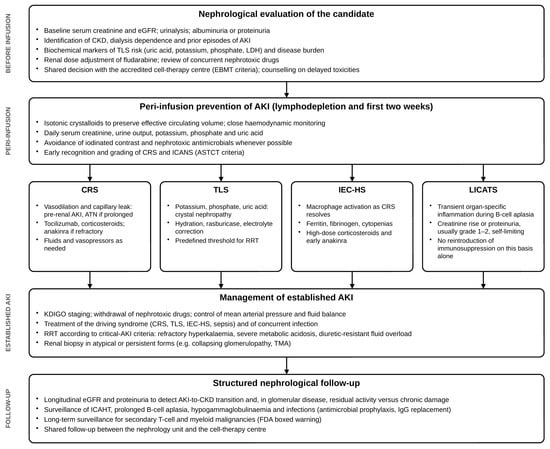
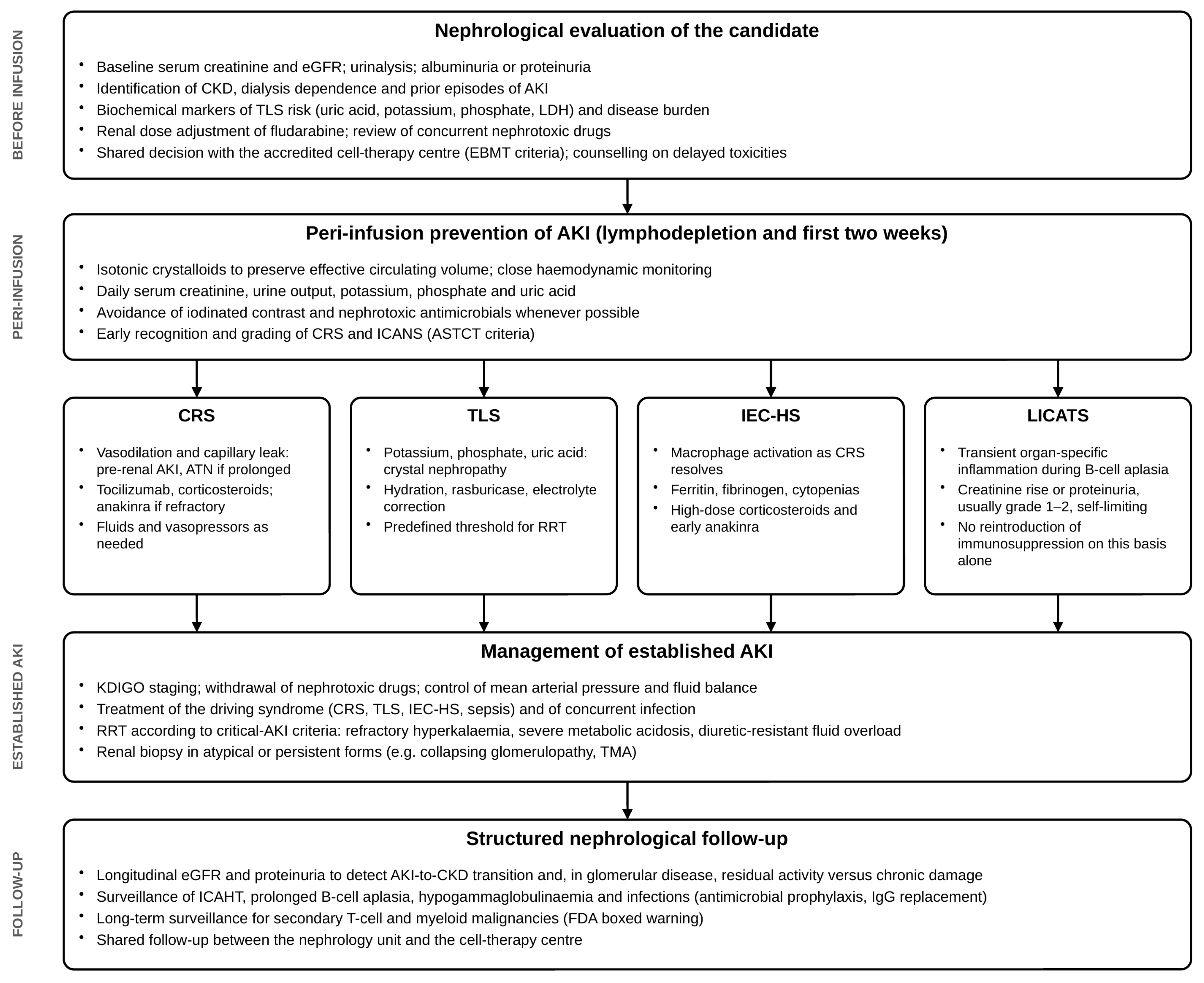
Prior to treatment, the candidate must be evaluated from a nephrological standpoint: baseline renal function, screening for microalbuminuria or proteinuria, and biochemical markers of TLS risk [104,105]. During and after infusion, it is important to preserve volemia with intravenous hydration using isotonic crystalloids and close hemodynamic monitoring, which is associated with a lower risk of severe AKI [104]. Early recognition of CRS and timely treatment with tocilizumab and corticosteroids reduce capillary leak and limit renal damage [104]; in refractory forms, anakinra (anti-IL-1) represents an additional option [106]. The sequence of nephrological evaluation, peri-infusion prevention, syndrome-specific management, and follow-up is summarized in Figure 1.
Figure 1.
Nephrological pathway of the patient treated with CAR-T cells. The diagram follows the clinical course in five steps. Abbreviations: AKI, acute kidney injury; ASTCT, American Society for Transplantation and Cellular Therapy; ATN, acute tubular necrosis; CKD, chronic kidney disease; CRS, cytokine release syndrome; EBMT, European Society for Blood and Marrow Transplantation; eGFR, estimated glomerular filtration rate; FDA, Food and Drug Administration; ICAHT, immune effector cell-associated hematotoxicity; ICANS, immune effector cell-associated neurotoxicity syndrome; IEC-HS, immune effector cell-associated hemophagocytic lymphohistiocytosis-like syndrome; IgG, immunoglobulin G; KDIGO, Kidney Disease: Improving Global Outcomes; LDH, lactate dehydrogenase; LICATS, local immune effector cell-associated toxicity syndrome; RRT, renal replacement therapy; TLS, tumor lysis syndrome; TMA, thrombotic microangiopathy.
Once AKI is established, supportive care includes the discontinuation of nephrotoxic drugs, control of mean arterial pressure, and management of fluid balance [105]. Recourse to renal replacement therapy follows the criteria for critical AKI: refractory hyperkalemia, severe metabolic acidosis, and fluid overload non-responsive to diuretics [105]. In the case series by Gutgarts et al., 14 out of 46 patients (30%) developed AKI of any grade within 100 days; among patients alive at 30 days, almost all (10 out of 11, 91%) returned to baseline values [107]. Advanced stages, KDIGO grades 2 and 3, conversely remain independently associated with longer hospital stays, greater use of intensive care, and reduced overall survival [93]. Therefore, a prolonged and well-structured nephrological follow-up is needed, capable of detecting in a timely manner any progression of AKI CKD [108] Table 2.
Table 2.
Management of AKI related to CAR-T therapy.
5. Conclusions
For immune-mediated renal and systemic disease, CAR-T cells are a promising option, but the evidence remains uneven and, in most indications, preliminary. It is strongest in SLE and refractory lupus nephritis, where single-arm early-phase trials and structured series now converge, although without any randomised comparison [12,30,37]. In AAV, it is limited to single case reports [53,54,55]; in membranous nephropathy, direct clinical data are lacking despite a coherent rationale [46], and in MGRS, no clinical experience appears to have been published. The largest body of data concerns plasma cell dyscrasias with renal involvement, where retrospective real-world studies suggest that anti-BCMA CAR-T cells can be delivered to selected patients with low eGFR or on dialysis, with the selection and ascertainment biases inherent to that design [67,70,71].
The optimal positioning of autologous CAR-T cells relative to alternative platforms remains undefined. Bispecific T-cell engagers such as teclistamab [63] already offer an off-the-shelf route, so far on the basis of case series alone, while allogeneic products and in vivo engineering [23] may overcome the manufacturing constraints of the autologous product; the place of each in the treatment sequence is unresolved. These options must all be weighed against the FDA boxed warning on secondary T-cell malignancies [99,100]. In a young autoimmune population with a long life expectancy, this signal warrants careful clinical and ethical counseling before treatment.
Prospective, multicenter data in patients with established kidney disease, who were excluded from the registration trials, are now needed. Selection criteria and monitoring protocols should derive from such studies rather than be extrapolated from onco-hematology [109]. This will require close and continuous communication between nephrology units and the accredited cell-therapy centers that deliver the product [14,104].
Author Contributions
Conceptualization, L.V., G.G. and D.S.; methodology, L.V. and G.G.; literature search and screening, L.L.C., F.C., C.C. and S.C.; writing—original draft preparation, L.V., G.G., A.C., L.L.C., F.C. and C.C.; writing—review and editing, L.S., C.S., L.M., S.C., W.M., L.M. and D.S.; tables and figures, L.L.C., L.M. and C.C.; supervision, D.S. and L.S.; project administration, L.V. and G.G. All authors have read and agreed to the published version of the manuscript.
Funding
This research received no external funding.
Institutional Review Board Statement
Not applicable. This article is a narrative review of the published literature and did not involve any new studies on human participants or animals performed by the authors.
Informed Consent Statement
Not applicable.
Data Availability Statement
No new data were created or analysed in this study. All data discussed are available in the cited publications.
Acknowledgments
During the preparation of this manuscript, Nature Research Assistant (Beta, Springer Nature, London, UK) and Claude Opus 5 (Anthropic, San Francisco, CA, USA) were used to assist with language editing and readability improvements. The authors reviewed and edited all output and take full responsibility for the content of the publication.
Conflicts of Interest
The authors declare no conflicts of interest.
Abbreviations
The following abbreviations are used in this manuscript:
| AAV | ANCA-associated vasculitis |
| ACR-EULAR | American College of Rheumatology and European League Against Rheumatism |
| AKI | acute kidney injury |
| ANCA | anti-neutrophil cytoplasmic antibody |
| ASTCT | American Society for Transplantation and Cellular Therapy |
| ATN | acute tubular necrosis |
| BCMA | B-cell maturation antigen |
| CAAR | Chimeric AutoAntibody Receptor |
| CAR | chimeric antigen receptor |
| CKD | chronic kidney disease |
| cilta-cel | ciltacabtagene autoleucel |
| CMV | cytomegalovirus |
| CRS | cytokine release syndrome |
| DORIS | Definition of Remission in SLE |
| EBMT | European Society for Blood and Marrow Transplantation |
| eGFR | estimated glomerular filtration rate |
| EGPA | eosinophilic granulomatosis with polyangiitis |
| EHA | European Hematology Association |
| EMA | European Medicines Agency |
| FAERS | FDA Adverse Event Reporting System |
| FDA | Food and Drug Administration |
| FSGS | focal segmental glomerulosclerosis |
| GM-CSF | granulocyte-macrophage colony-stimulating factor |
| GPA | granulomatosis with polyangiitis |
| GvHD | Graft-versus-Host Disease |
| HLA | human leukocyte antigen |
| HLH | hemophagocytic lymphohistiocytosis |
| ICAHT | Immune Effector Cell-Associated Hematotoxicity |
| ICANS | Immune Effector Cell-Associated Neurotoxicity Syndrome |
| ide-cel | idecabtagene vicleucel |
| IEC-HS | Immune Effector Cell-Associated Hemophagocytic Lymphohistiocytosis-Like Syndrome |
| IFN | interferon |
| IgA | immunoglobulin A |
| IL | interleukin |
| KDIGO | Kidney Disease: Improving Global Outcomes |
| LDH | lactate dehydrogenase |
| LICATS | Local Immune Effector Cell-Associated Toxicity Syndrome |
| LLDAS | Lupus Low Disease Activity State |
| LN | lupus nephritis |
| LNP | lipid nanoparticle |
| MCD | minimal change disease |
| MGRS | monoclonal gammopathies of renal significance |
| MHC | major histocompatibility complex |
| MM | multiple myeloma |
| MN | membranous nephropathy |
| MPA | microscopic polyangiitis |
| MPO | myeloperoxidase |
| MRD | minimal residual disease |
| NK | natural killer (cells) |
| PLA2R | M-type phospholipase A2 receptor |
| pMN | primary membranous nephropathy |
| PR3 | proteinase 3 |
| RA | rheumatoid arthritis |
| RRT | renal replacement therapy |
| SLE | systemic lupus erythematosus |
| SLEDAI-2K | Systemic Lupus Erythematosus Disease Activity Index 2000 |
| SSc | systemic sclerosis |
| TCE | (bispecific) T-cell engager |
| TCR | T-cell receptor |
| THSD7A | thrombospondin type-1 domain-containing 7A protein |
| TLS | tumor lysis syndrome |
| TMA | thrombotic microangiopathy |
| TNF | tumor necrosis factor |
| TRUCKs | T cells Redirected for Universal Cytokine Killing |
References
- Meng, X.M.; Wang, L.; Nikolic-Paterson, D.J.; Lan, H.Y. Innate immune cells in acute and chronic kidney disease. Nat. Rev. Nephrol. 2025, 21, 464–482. [Google Scholar] [CrossRef] [Scilit]
- Ricklin, D.; Reis, E.S.; Lambris, J.D. Complement in disease: A defence system turning offensive. Nat. Rev. Nephrol. 2016, 12, 383–401. [Google Scholar] [CrossRef] [Scilit]
- Gembillo, G.; Siligato, R.; Cernaro, V.; Santoro, D. Complement Inhibition Therapy and Dialytic Strategies in Paroxysmal Nocturnal Hemoglobinuria: The Nephrologist’s Opinion. J. Clin. Med. 2020, 9, 1261. [Google Scholar] [CrossRef] [Scilit] [PubMed] [PubMed Central]
- Chang, J.; Eggenhuizen, P.; O’Sullivan, K.M.; Holdsworth, S.R.; Kitching, A.R. CD8+ T cells effect glomerular injury in experimental anti-myeloperoxidase GN. J. Am. Soc. Nephrol. 2017, 28, 47–55. [Google Scholar] [CrossRef] [Scilit]
- Schrezenmeier, E.; Jayne, D.; Dörner, T. Targeting B cells and plasma cells in glomerular diseases: Translational perspectives. J. Am. Soc. Nephrol. 2018, 29, 741–758. [Google Scholar] [CrossRef] [Scilit]
- Bridoux, F.; Leung, N.; Nasr, S.H.; Jaccard, A.; Royal, V.; International Kidney and Monoclonal Gammopathy Research Group. Kidney disease in multiple myeloma. Presse Med. 2025, 54, 104264. [Google Scholar] [CrossRef] [Scilit]
- Leung, N.; Bridoux, F.; Nasr, S.H. Monoclonal Gammopathy of Renal Significance. N. Engl. J. Med. 2021, 384, 1931–1941. [Google Scholar] [CrossRef] [Scilit]
- Kidney Disease: Improving Global Outcomes (KDIGO) Glomerular Diseases Work Group. KDIGO 2021 Clinical Practice Guideline for the Management of Glomerular Diseases. Kidney Int. 2021, 100, S1–S276. [CrossRef] [Scilit]
- Rovin, B.H.; Furie, R.; Latinis, K.; Looney, R.J.; Fervenza, F.C.; Sanchez-Guerrero, J.; Maciuca, R.; Zhang, D.; Garg, J.P.; Brunetta, P.; et al. Efficacy and safety of rituximab in patients with active proliferative lupus nephritis: The Lupus Nephritis Assessment with Rituximab study. Arthritis Rheum. 2012, 64, 1215–1226. [Google Scholar] [CrossRef] [Scilit]
- Gialouri, C.G.; Chalkia, A.; Koutsianas, C.; Chavatza, K.; Argyriou, E.; Panagiotopoulos, A.; Karamanakos, A.; Dimouli, A.; Tsalapaki, C.; Thomas, K.; et al. Relapses and serious adverse events during rituximab maintenance therapy in ANCA-associated vasculitis: A multicentre retrospective study. Rheumatology 2025, 64, 1989–1998. [Google Scholar] [CrossRef] [Scilit]
- Zhang, X.; Zhu, L.; Zhang, H.; Chen, S.; Xiao, Y. CAR-T Cell Therapy in Hematological Malignancies: Current Opportunities and Challenges. Front. Immunol. 2022, 13, 927153. [Google Scholar] [CrossRef] [Scilit]
- Müller, F.; Taubmann, J.; Bucci, L.; Wilhelm, A.; Bergmann, C.; Völkl, S.; Aigner, M.; Rothe, T.; Minopoulou, I.; Tur, C.; et al. CD19 CAR T-Cell Therapy in Autoimmune Disease—A Case Series with Follow-up. N. Engl. J. Med. 2024, 390, 687–700. [Google Scholar] [CrossRef] [Scilit]
- Tur, C.; Eckstein, M.; Velden, J.; Rauber, S.; Bergmann, C.; Auth, J.; Bucci, L.; Corte, G.; Hagen, M.; Wirsching, A.; et al. CD19-CAR T-cell therapy induces deep tissue depletion of B cells. Ann. Rheum. Dis. 2025, 84, 106–114. [Google Scholar] [CrossRef] [Scilit]
- Mougiakakos, D.; Meyer, E.H.; Schett, G. CAR T cells in autoimmunity: Game changer or stepping stone? Blood 2025, 145, 1841–1849. [Google Scholar] [CrossRef] [Scilit]
- Kaleta, B. CAR-T Cell Therapy for Autoimmune Kidney Diseases: Where Do We Stand Now? Int. J. Mol. Sci. 2025, 26, 10070. [Google Scholar] [CrossRef] [Scilit]
- Floege, J.; Ayoub, I.; Brix, S.R.; Campbell, K.N.; Furie, R.; Nachman, P.H.; Tang, S.C.W.; Tomas, N.M.; Vivarelli, M.; Cheung, M.; et al. For Conference Participants. Targeting B cells in immune-mediated kidney diseases: Conclusions from a Kidney Disease: Improving Global Outcomes (KDIGO) Controversies Conference. Kidney Int. 2026, 110, 548–565. [Google Scholar] [CrossRef] [Scilit]
- Kew, K. What is CAR T-cell therapy? Drug Ther. Bull. 2021, 59, 73–76. [Google Scholar] [CrossRef] [Scilit]
- Gross, G.; Waks, T.; Eshhar, Z. Expression of immunoglobulin-T-cell receptor chimeric molecules as functional receptors with antibody-type specificity. Proc. Natl. Acad. Sci. USA 1989, 86, 10024–10028. [Google Scholar] [CrossRef] [Scilit]
- Sadelain, M.; Brentjens, R.; Rivière, I. The promise and potential pitfalls of chimeric antigen receptors. Curr. Opin. Immunol. 2009, 21, 215–223. [Google Scholar] [CrossRef] [Scilit]
- Sterner, R.C.; Sterner, R.M. CAR-T cell therapy: Current limitations and potential strategies. Blood Cancer J. 2021, 11, 69. [Google Scholar] [CrossRef] [Scilit]
- Chmielewski, M.; Abken, H. TRUCKs: The fourth generation of CARs. Expert Opin. Biol. Ther. 2015, 15, 1145–1154. [Google Scholar] [CrossRef] [Scilit]
- Depil, S.; Duchateau, P.; Grupp, S.A.; Mufti, G.; Poirot, L. ‘Off-the-shelf’ allogeneic CAR T cells: Development and challenges. Nat. Rev. Drug Discov. 2020, 19, 185–199. [Google Scholar] [CrossRef] [Scilit]
- Hunter, T.L.; Bao, Y.; Zhang, Y.; Matsuda, D.; Riener, R.; Wang, A.; Li, J.J.; Soldevila, F.; Chu, D.S.H.; Nguyen, D.P.; et al. In vivo CAR T cell generation to treat cancer and autoimmune disease. Science 2025, 388, 1311–1317. [Google Scholar] [CrossRef] [Scilit]
- Wang, Q.; Xiao, Z.X.; Zheng, X.; Wang, G.; Yang, L.; Shi, L.; Xiang, N.; Wang, X.; Zha, G.-F.; Schett, G.; et al. In vivo CD19 CAR T-cell therapy for refractory systemic lupus erythematosus. N. Engl. J. Med. 2025, 393, 1542–1544. [Google Scholar] [CrossRef] [Scilit]
- Chen, Y.Y. Increasing T Cell Versatility with SUPRA CARs. Cell 2018, 173, 1316–1317. [Google Scholar] [CrossRef] [Scilit]
- Schett, G.; Müller, F.; Taubmann, J.; Mackensen, A.; Wang, W.; Furie, R.A.; Gold, R.; Haghikia, A.; Merkel, P.A.; Caricchio, R.; et al. Advancements and challenges in CAR T cell therapy in autoimmune diseases. Nat. Rev. Rheumatol. 2024, 20, 531–544. [Google Scholar] [CrossRef] [Scilit]
- Fanouriakis, A.; Tziolos, N.; Bertsias, G.; Boumpas, D.T. Update on the diagnosis and management of systemic lupus erythematosus. Ann. Rheum. Dis. 2021, 80, 14–25. [Google Scholar] [CrossRef] [Scilit]
- Houssiau, F.A. How good enough are the new therapies for lupus nephritis? A narrative review and a position paper. Ann. Rheum. Dis. 2026, 85, 227–234. [Google Scholar] [CrossRef] [Scilit]
- Mougiakakos, D.; Krönke, G.; Völkl, S.; Kretschmann, S.; Aigner, M.; Kharboutli, S.; Böltz, S.; Manger, B.; Mackensen, A.; Schett, G. CD19-Targeted CAR T Cells in Refractory Systemic Lupus Erythematosus. N. Engl. J. Med. 2021, 385, 567–569. [Google Scholar] [CrossRef] [Scilit]
- Mackensen, A.; Müller, F.; Mougiakakos, D.; Böltz, S.; Wilhelm, A.; Aigner, M.; Völkl, S.; Simon, D.; Kleyer, A.; Munoz, L.; et al. Anti-CD19 CAR T cell therapy for refractory systemic lupus erythematosus. Nat. Med. 2022, 28, 2124–2132, Erratum in Nat. Med. 2023, 29, 2956. https://doi.org/10.1038/s41591-022-02091-9. [Google Scholar] [CrossRef] [Scilit]
- Krickau, T.; Naumann-Bartsch, N.; Aigner, M.; Kharboutli, S.; Kretschmann, S.; Spörl, S.; Vasova, I.; Völkl, S.; Wölfle, J.; Mackensen, A.; et al. CAR T-cell therapy rescues adolescent with rapidly progressive lupus nephritis from haemodialysis. Lancet 2024, 403, 1627–1630. [Google Scholar] [CrossRef] [Scilit]
- Mao, Y.; Shen, W.; Shen, J.; Zhang, C.; An, K.; Tang, Y.; Qian, J.; Li, B.; Yin, L. Bicistronic-CD19/22 chimeric antigen receptor T-cell therapy for childhood refractory lupus nephritis. Kidney Int. Rep. 2026, 11, 53–61. [Google Scholar] [CrossRef] [Scilit]
- Hu, Z.; Cai, S.; Yu, Y.; Chen, Y.; Wang, B.; Wang, D.; Zeng, R.; He, X.; Shen, G.; Yu, F.; et al. BCMA-targeted CAR T cell therapy can effectively induce disease remission in refractory lupus nephritis. Ann. Rheum. Dis. 2025, 84, 1675–1683. [Google Scholar] [CrossRef] [Scilit]
- Wang, W.; He, S.; Zhang, W.; Zhang, H.; DeStefano, V.M.; Wada, M.; Pinz, K.; Deener, G.; Shah, D.; Hagag, N.; et al. BCMA-CD19 compound CAR T cells for systemic lupus erythematosus: A phase 1 open-label clinical trial. Ann. Rheum. Dis. 2024, 83, 1304–1314. [Google Scholar] [CrossRef] [Scilit]
- Hong, M.; Wang, M.; Zeng, R.; Ding, L.; He, S.; Lan, T.; DeStefano, V.M.; Wada, M.; Pinz, K.; Chow, J.E.; et al. BCMA-CD19 armored compound CAR T cells in systemic lupus erythematosus: Extended follow-up of a phase 1 clinical trial. J. Hematol. Oncol. 2026, 19, 13. [Google Scholar] [CrossRef] [Scilit]
- Feng, J.; Huo, D.; Hong, R.; Jin, X.; Cao, H.; Shao, M.; Wen, R.; Zhang, Q.; Zhang, M.; Fu, S.; et al. Co-infusion of CD19-targeting and BCMA-targeting CAR-T cells for treatment-refractory systemic lupus erythematosus: A phase 1 trial. Nat. Med. 2025, 31, 3725–3736. [Google Scholar] [CrossRef] [Scilit]
- Müller, F.; Hagen, M.; Wirsching, A.; Bucci, L.; Tur, C.; Spoerl, S.; Taubmann, J.; Bozec, A.; Kharboutli, S.; Aigner, M.; et al. CD19 CAR-T cells for treatment-refractory autoimmune diseases: The phase 1/2 CASTLE basket trial. Nat. Med. 2026, 32, 1142–1151. [Google Scholar] [CrossRef] [Scilit]
- Gao, J.; Li, M.; Sun, M.; Yu, Y.; Kong, R.; Xu, X.; Liu, S.; Chen, Q.; Li, X.; Wu, Y.; et al. Efficacy and safety of allogeneic CD19 CAR NK-cell therapy in systemic lupus erythematosus: A case series in China. Lancet 2026, 406, 2968–2979. [Google Scholar] [CrossRef] [Scilit]
- Li, S.G.; Yu, R.; Zhang, L.; Zhang, J.; Zou, Y.; Li, J.; Long, T.; Zhang, Y.; Pan, J. CAR-based cellular therapy for refractory systemic lupus erythematosus: An overlap-controlled systematic review. Front. Immunol. 2026, 17, 1879668. [Google Scholar] [CrossRef] [Scilit]
- Beck, L.H., Jr.; Bonegio, R.G.; Lambeau, G.; Beck, D.M.; Powell, D.W.; Cummins, T.D.; Klein, J.B.; Salant, D.J. M-type phospholipase A2 receptor as target antigen in idiopathic membranous nephropathy. N. Engl. J. Med. 2009, 361, 11–21. [Google Scholar] [CrossRef] [Scilit]
- Tomas, N.M.; Beck, L.H., Jr.; Meyer-Schwesinger, C.; Seitz-Polski, B.; Ma, H.; Zahner, G.; Dolla, G.; Hoxha, E.; Helmchen, U.; Dabert-Gay, A.S.; et al. Thrombospondin type-1 domain-containing 7A in idiopathic membranous nephropathy. N. Engl. J. Med. 2014, 370, 2277–2287. [Google Scholar] [CrossRef] [Scilit]
- Alsharhan, L.; Beck, L.H., Jr. Membranous Nephropathy: Core Curriculum 2021. Am. J. Kidney Dis. 2021, 77, 440–453. [Google Scholar] [CrossRef] [Scilit]
- Rezvani, A.R.; Maloney, D.G. Rituximab resistance. Best Pract. Res. Clin. Haematol. 2011, 24, 203–216. [Google Scholar] [CrossRef] [Scilit]
- ClinicalTrials.gov. Safety and Efficacy of CD19 Chimeric Antigen Receptor T-Cell Immunotherapy (CAR-T) in the Treatment of Refractory Membranous Nephropathy. Identifier: NCT07266181. The First Affiliated Hospital of Air Force Medical University (Xijing Hospital). Available online: https://clinicaltrials.gov/study/NCT07266181 (accessed on 5 July 2026).
- ClinicalTrials.gov. Safety and Efficacy of IM19 CAR-T Cell Therapy in Patients with IgA Nephropathy or Primary Membranous Nephropathy. Identifier: NCT06690359; Beijing Immunochina Medical Science & Technology Co., Ltd. Available online: https://clinicaltrials.gov/study/NCT06690359 (accessed on 5 July 2026).
- Seifert, L.; Riecken, K.; Zahner, G.; Hambach, J.; Hagenstein, J.; Dubberke, G.; Huber, T.B.; Koch-Nolte, F.; Fehse, B.; Tomas, N.M. An antigen-specific chimeric autoantibody receptor (CAAR) NK cell strategy for the elimination of anti-PLA2R1 and anti-THSD7A antibody-secreting cells. Kidney Int. 2024, 105, 886–889. [Google Scholar] [CrossRef] [Scilit]
- Vivarelli, M.; Massella, L.; Ruggiero, B.; Emma, F. Minimal Change Disease. Clin. J. Am. Soc. Nephrol. 2017, 12, 332–345. [Google Scholar] [CrossRef] [Scilit]
- Altintas, M.M.; Agarwal, S.; Sudhini, Y.; Zhu, K.; Wei, C.; Reiser, J. Pathogenesis of Focal Segmental Glomerulosclerosis and Related Disorders. Annu. Rev. Pathol. 2025, 20, 329–353. [Google Scholar] [CrossRef] [Scilit]
- Hengel, F.E.; Dehde, S.; Lassé, M.; Zahner, G.; Seifert, L.; Schnarre, A.; Kretz, O.; Demir, F.; Pinnschmidt, H.O.; Grahammer, F.; et al. Autoantibodies targeting nephrin in podocytopathies. N. Engl. J. Med. 2024, 391, 422–433. [Google Scholar] [CrossRef] [Scilit]
- Liaukouskaya, N.; Hengel, F.E.; Mühlig, A.; Tomas, N.M.; Huber, T.B. A new hope for treating podocytopathies: Emerging role of anti-nephrin antibody. Clin. J. Am. Soc. Nephrol. 2026, 21, 1628–1637. [Google Scholar] [CrossRef] [Scilit]
- Gapud, E.J.; Seo, P.; Antiochos, B. ANCA-Associated Vasculitis Pathogenesis: A Commentary. Curr. Rheumatol. Rep. 2017, 19, 15. [Google Scholar] [CrossRef] [Scilit]
- Lodka, D.; Zschummel, M.; Bunse, M.; Rousselle, A.; Sonnemann, J.; Kettritz, R.; Höpken, U.E.; Schreiber, A. CD19-targeting CAR T cells protect from ANCA-induced acute kidney injury. Ann. Rheum. Dis. 2024, 83, 499–507. [Google Scholar] [CrossRef] [Scilit]
- Minopoulou, I.; Wilhelm, A.; Albach, F.; Kleyer, A.; Wiebe, E.; Schallenberg, S.; Fleischmann, A.; Frick, M.; Damm, F.; Gogolok, J.; et al. Anti-CD19 CAR T cell therapy induces antibody seroconversion and complete B cell depletion in the bone marrow of a therapy-refractory patient with ANCA-associated vasculitis. Ann. Rheum. Dis. 2025, 84, e4–e7. [Google Scholar] [CrossRef] [Scilit]
- Uhlmann, L.; Pierer, M.; Krasselt, M.; Franke, G.; Zeidler, R.; Sabri, O.; Denecke, T.; Sack, U.; Köhl, U.; Boldt, A.; et al. Effective use of anti-CD19 chimeric antigen receptor T cells in a case of treatment-resistant granulomatosis with polyangiitis. Ann. Rheum. Dis. 2025, 84, 1280–1283. [Google Scholar] [CrossRef] [Scilit]
- Schultze-Florey, C.R.; Gödecke, V.; Knoll, L.; Aleksandrova, K.; Arseniev, L.; Leise, J.; Klöß, S.; Stoyanov, K.; Jauregui, R.G.; Bräsen, J.H.; et al. Point-of-Care Anti-CD19-CAR T-cell Therapy Induces Renal Remission in Refractory Myeloperoxidase-Antineutrophil Cytoplasmic Autoantibody-Associated Vasculitis. Kidney Int. Rep. 2025, 10, 2491–2493. [Google Scholar] [CrossRef] [Scilit]
- Lodka, D.; Schreiber, A. CAR-T cells targeting CD19 for the treatment of ANCA vasculitis. Clin. Kidney J. 2025, 18, ii35–ii46. [Google Scholar] [CrossRef] [Scilit]
- Munshi, N.C.; Anderson, L.D., Jr.; Shah, N.; Madduri, D.; Berdeja, J.; Lonial, S.; Raje, N.; Lin, Y.; Siegel, D.; Oriol, A.; et al. Idecabtagene Vicleucel in Relapsed and Refractory Multiple Myeloma. N. Engl. J. Med. 2021, 384, 705–716. [Google Scholar] [CrossRef] [Scilit]
- Martin, T.; Usmani, S.Z.; Berdeja, J.G.; Agha, M.; Cohen, A.D.; Hari, P.; Avigan, D.; Deol, A.; Htut, M.; Lesokhin, A.; et al. Ciltacabtagene Autoleucel, an Anti-B-cell Maturation Antigen Chimeric Antigen Receptor T-Cell Therapy, for Relapsed/Refractory Multiple Myeloma: CARTITUDE-1 2-Year Follow-Up. J. Clin. Oncol. 2023, 41, 1265–1274. [Google Scholar] [CrossRef] [Scilit]
- Das, S.; Ailawadhi, S.; Sher, T.; Roy, V.; Fernandez, A.; Parrondo, R.D. Anti-B Cell Maturation Antigen Chimeric Antigen Receptor T Cell Therapy for the Treatment of AL Amyloidosis and Concurrent Relapsed/Refractory Multiple Myeloma: Preliminary Efficacy and Safety. Curr. Oncol. 2023, 30, 9627–9633. [Google Scholar] [CrossRef] [Scilit]
- Lewis, E.; Jimenez-Zepeda, V.H. BCMA CAR-T: From Multiple Myeloma to Light-Chain Amyloidosis. Curr. Oncol. 2025, 32, 418. [Google Scholar] [CrossRef] [Scilit]
- Alexander, T.; Krönke, J.; Cheng, Q.; Keller, U.; Krönke, G. Teclistamab-Induced Remission in Refractory Systemic Lupus Erythematosus. N. Engl. J. Med. 2024, 391, 864–866. [Google Scholar] [CrossRef] [Scilit]
- Hagen, M.; Bucci, L.; Böltz, S.; Nothling, D.M.; Rothe, T.; Anoshkin, K.; Raimondo, M.G.; Tur, C.; Wirsching, A.; d’Aurizio, R.; et al. BCMA-Targeted T-Cell-Engager Therapy for Autoimmune Disease. N. Engl. J. Med. 2024, 391, 867–869. [Google Scholar] [CrossRef] [Scilit]
- Bucci, L.; Hagen, M.; Rothe, T.; Raimondo, M.G.; Fagni, F.; Tur, C.; Wirsching, A.; Atzinger, A.; Pecher, A.C.; Krickau, T.; et al. BCMA T-Cell Engager Therapy in Patients with Refractory Autoimmune Disease. N. Engl. J. Med. 2025, 393, 1544–1547. [Google Scholar] [CrossRef] [Scilit]
- Albach, F.N.; Phithak, E.; Biesen, R.; Kleyer, A.; Siegert, E.; Minopoulou, I.; Algharably, E.; Casteleyn, V.; Beenken, A.E.; Schneider, U.; et al. Teclistamab for treatment-refractory autoimmune diseases: A multicentre case series. Ann. Rheum. Dis. 2026, 1–12. [Google Scholar] [CrossRef] [Scilit]
- Duesing, C.; Györfi, A.-H.; Stütz, A.N.; Lahu, L.-M.; Deicher, F.S.; Li, Y.-N.; Bruch, P.-M.; Matei, A.-E.; Micu, A.; Filla, T.; et al. Bispecific T cell engagers for treatment-refractory autoimmune connective tissue diseases. Nat. Med. 2026, 32, 1530–1542. [Google Scholar] [CrossRef] [Scilit]
- Larue, M.; Bitoun, S.; Zuber, J.; Michel, M.; Talbot, A. Bispecific T-cell engagers in autoimmune diseases: Mechanisms of action, clinical evidence, challenges, and therapeutic perspectives. Autoimmun. Rev. 2026, 25, 104060. [Google Scholar] [CrossRef] [Scilit]
- Sidana, S.; Peres, L.C.; Hashmi, H.; Hosoya, H.; Ferreri, C.; Khouri, J.; Dima, D.; Atrash, S.; Voorhees, P.; Simmons, G.; et al. Idecabtagene vicleucel chimeric antigen receptor T-cell therapy for relapsed/refractory multiple myeloma with renal impairment. Haematologica 2024, 109, 777–786. [Google Scholar] [CrossRef] [Scilit]
- Atanackovic, D.; Luetkens, T.; Schneider, D.; Hu, P.; Wang, X.; Shetty, A.C.; Tallon, L.; Patel, I.; Singh, R.; Gebru, E.; et al. Immune correlates of anti-BCMA CAR-T products idecabtagene vicleucel and ciltacabtagene autoleucel in a real-world cohort of patients with multiple myeloma. Nat. Commun. 2025, 16, 6154. [Google Scholar] [CrossRef] [Scilit]
- Pak, W.L.W.; Brumwell, N.A.; Kabel, C.C.; Maloy, M.A.; Park, J.H.; Mailankody, S.; Hassoun, H.; Korde, N.; Lahoud, O.B.; Landgren, O.; et al. Chimeric Antigen Receptor (CAR) T-Cell Therapy Use in Patients with Multiple Myeloma and Kidney Failure on Maintenance Hemodialysis: A Report of 2 Cases. Kidney Med. 2024, 6, 100856. [Google Scholar] [CrossRef] [Scilit]
- Swamy, V.; Kelly, K.; Koyner, J.L.; Derman, B.A.; Bonilla, M. Chimeric Antigen Receptor T-Cell Therapy in Dialysis-Dependent Patients with Multiple Myeloma: Insights From a 5-Case Series. Kidney Med. 2025, 7, 101141. [Google Scholar] [CrossRef] [Scilit]
- Wood, A.C.; Perez, A.P.; Arciola, B.; Patel, K.; Johnson, G.; DiMaggio, E.; Bachmeier, C.A.; Reid, K.; Carallo, S.; Vargas, M.H.; et al. Outcomes of CD19-Targeted Chimeric Antigen Receptor T Cell Therapy for Patients with Reduced Renal Function Including Dialysis. Transpl. Cell Ther. 2022, 28, 829.e1–829.e8. [Google Scholar] [CrossRef] [Scilit]
- Chohan, K.L.; Siegler, E.L.; Kenderian, S.S. CAR-T Cell Therapy: The Efficacy and Toxicity Balance. Curr. Hematol. Malig. Rep. 2023, 18, 9–18. [Google Scholar] [CrossRef] [Scilit]
- Fitzgerald, J.C.; Weiss, S.L.; Maude, S.L.; Barrett, D.M.; Lacey, S.F.; Melenhorst, J.J.; Shaw, P.; Berg, R.A.; June, C.H.; Porter, D.L.; et al. Cytokine Release Syndrome After Chimeric Antigen Receptor T Cell Therapy for Acute Lymphoblastic Leukemia. Crit. Care Med. 2017, 45, e124–e131. [Google Scholar] [CrossRef] [Scilit]
- Yang, Y.; Luo, K.; Xu, G. Acute kidney injury following chimeric antigen receptor T-cell therapy: Epidemiology, mechanism and prognosis. Clin. Immunol. 2024, 266, 110311. [Google Scholar] [CrossRef] [Scilit]
- Azadi, A. Endothelial Dysfunction and Immune Dysregulation in Hantavirus Infection: Mechanisms of Vascular Leakage and Disease Severity. Nexus Pathophysiol. Ther. 2026, 1, 002. [Google Scholar] [CrossRef]
- Kordkatouli, M.; Dulskas, A.; Sateei, A. Targeting Inflammatory Pathways: Are We Entering a New Era of Mechanism-Driven Therapeutics? Nexus Pathophysiol. Ther. 2026, 1, 005. [Google Scholar] [CrossRef]
- Rubin, D.B.; Al Jarrah, A.; Li, K.; LaRose, S.; Monk, A.D.; Ali, A.B.; Spendley, L.N.; Nikiforow, S.; Jacobson, C.; Vaitkevicius, H. Clinical Predictors of Neurotoxicity After Chimeric Antigen Receptor T-Cell Therapy. JAMA Neurol. 2020, 77, 1536–1542. [Google Scholar] [CrossRef] [Scilit]
- Gust, J.; Hay, K.A.; Hanafi, L.A.; Li, D.; Myerson, D.; Gonzalez-Cuyar, L.F.; Yeung, C.; Liles, W.C.; Wurfel, M.; Lopez, J.A.; et al. Endothelial Activation and Blood-Brain Barrier Disruption in Neurotoxicity after Adoptive Immunotherapy with CD19 CAR-T Cells. Cancer Discov. 2017, 7, 1404–1419. [Google Scholar] [CrossRef] [Scilit]
- Van Oekelen, O.; Aleman, A.; Upadhyaya, B.; Schnakenberg, S.; Madduri, D.; Gavane, S.; Teruya-Feldstein, J.; Crary, J.F.; Fowkes, M.E.; Stacy, C.B.; et al. Neurocognitive and hypokinetic movement disorder with features of parkinsonism after BCMA-targeting CAR-T cell therapy. Nat. Med. 2021, 27, 2099–2103. [Google Scholar] [CrossRef] [Scilit]
- Howard, S.C.; Jones, D.P.; Pui, C.H. The tumor lysis syndrome. N. Engl. J. Med. 2011, 364, 1844–1854. [Google Scholar] [CrossRef] [Scilit]
- Zhang, Q.; Zu, C.; Jing, R.; Feng, Y.; Zhang, Y.; Zhang, M.; Lv, Y.; Cui, J.; Zhou, L.; Meng, Y.; et al. Incidence, clinical characteristics and prognosis of tumor lysis syndrome following B-cell maturation antigen-targeted chimeric antigen receptor-T cell therapy in relapsed/refractory multiple myeloma. Front. Immunol. 2023, 14, 1125357. [Google Scholar] [CrossRef] [Scilit]
- Farooqui, N.; Sy-Go, J.P.T.; Miao, J.; Mehta, R.; Vaughan, L.E.; Bennani, N.N.; Wang, Y.; Bansal, R.; Hathcock, M.A.; Hayman, S.R.; et al. Incidence and Risk Factors for Acute Kidney Injury After Chimeric Antigen Receptor T-Cell Therapy. Mayo Clin. Proc. 2022, 97, 1294–1304. [Google Scholar] [CrossRef] [Scilit]
- Hines, M.R.; Knight, T.E.; McNerney, K.O.; Leick, M.B.; Jain, T.; Ahmed, S.; Frigault, M.J.; Hill, J.A.; Jain, M.D.; Johnson, W.T.; et al. Immune Effector Cell-Associated Hemophagocytic Lymphohistiocytosis-Like Syndrome. Transpl. Cell Ther. 2023, 29, 438.e1–438.e16, Erratum in Transpl. Cell Ther. 2026, 32, 765–766. https://doi.org/10.1016/j.jtct.2025.09.016. [Google Scholar] [CrossRef] [Scilit]
- Neelapu, S.S.; Tummala, S.; Kebriaei, P.; Wierda, W.; Gutierrez, C.; Locke, F.L.; Komanduri, K.V.; Lin, Y.; Jain, N.; Daver, N.; et al. Chimeric antigen receptor T-cell therapy—Assessment and management of toxicities. Nat. Rev. Clin. Oncol. 2018, 15, 47–62. [Google Scholar] [CrossRef] [Scilit]
- Wu, Y.; Sun, X.; Kang, K.; Yang, Y.; Li, H.; Zhao, A.; Niu, T. Hemophagocytic lymphohistiocytosis: Current treatment advances, emerging targeted therapy and underlying mechanisms. J. Hematol. Oncol. 2024, 17, 106. [Google Scholar] [CrossRef] [Scilit]
- Hagen, M.; Müller, F.; Wirsching, A.; Kharboutli, S.; Spoerl, S.; Düsing, C.; Krickau, T.; Metzler, M.; Völkl, S.; Aigner, M.; et al. Local immune effector cell-associated toxicity syndrome in CAR T-cell treated patients with autoimmune disease: An observational study. Lancet Rheumatol. 2025, 7, e424–e433. [Google Scholar] [CrossRef] [Scilit]
- Rousseau, A.; Zafrani, L. Acute kidney injury after CAR-T cell infusion. Bull. Cancer 2024, 111, 748–753. [Google Scholar] [CrossRef] [Scilit]
- Russo, E.; Gambella, M.; Raiola, A.M.; Beltrametti, E.; Zanetti, V.; Chirco, G.; Viazzi, F.; Angelucci, E.; Esposito, P. Acute kidney injury in hematological patients treated with CAR-T cells: Risk factors, clinical presentation and impact on outcomes. Sci. Rep. 2024, 14, 26886. [Google Scholar] [CrossRef] [Scilit]
- Acharya, R.; Horn, B.; Zeng, X.; Upadhyay, K. Collapsing Focal Segmental Glomerulosclerosis and Acute Kidney Injury Associated with Chimeric Antigen Receptor T-Cell (CAR-T) Therapy: A Case Report. Kidney Med. 2021, 3, 1086–1090. [Google Scholar] [CrossRef] [Scilit]
- Lukenbill, J.; Kalaycio, M. Fludarabine: A review of the clear benefits and potential harms. Leuk. Res. 2013, 37, 986–994. [Google Scholar] [CrossRef] [Scilit]
- Kanbay, M.; Mizrak, B.; Alper, E.N.; Copur, S.; Ortiz, A. Acute kidney injury following CAR-T cell therapy: A nephrologist’s perspective. Clin. Kidney J. 2024, 18, sfae359. [Google Scholar] [CrossRef] [Scilit]
- Chen, Z.; Chen, Y.; Liu, J.; Sun, Y.; Zhang, X.; Shao, L.; Wang, D.; Wang, X.; Chen, W.; Sang, W.; et al. Nephrotoxicity of CAR-T therapy in patients with relapsed and refractory multiple myeloma. Int. Urol. Nephrol. 2025, 57, 3439–3449. [Google Scholar] [CrossRef] [Scilit]
- Boardman, A.P.; Gutgarts, V.; Flynn, J.; Devlin, S.M.; Goldman, A.; Tomas, A.A.; Fein, J.A.; Slingerland, J.B.; Parascondola, A.; Lin, R.J.; et al. Predictors and implications of renal injury after CD19 chimeric antigen receptor T-cell therapy. Haematologica 2025, 110, 651–664. [Google Scholar] [CrossRef] [Scilit]
- Moncho-Francés, F.; Hernani, R.; Juan-García, I.; Benzaquén, A.; Solís-Salguero, M.A.; Pérez-Martínez, A.; Navarro-González, J.F.; Piñana, J.L.; Hernández-Boluda, J.C.; Terol Casterá, M.J.; et al. Prospective evaluation of CAR-T cell therapy-related proteinuria and kidney dysfunction. Clin. Kidney J. 2025, 18, sfaf270. [Google Scholar] [CrossRef] [Scilit]
- AlShammari, O.A.; Alwadi, M.; Abuqurayn, I.; Alshehri, H.; AlMadi, E.; AlBtoosh, B.; AlMatham, K.I.; Alrowaie, F. Acute kidney injury and electrolyte disorders following chimeric antigen receptor T-cell (CAR T-cell) therapy in adults with hematologic malignancies: A retrospective study. Cureus 2026, 18, e101460. [Google Scholar] [CrossRef] [Scilit]
- Habib, A.; Ahmed, N.; Khan, A.M.; Chang, D.; Paul, B.; Shaikh, H.; Strouse, C.; Struble, E.; Vegel, A.; Mahmoudjafari, Z.; et al. BCMA-directed CAR T-cell therapy in patients with relapsed/refractory multiple myeloma and renal impairment. Curr. Oncol. 2026, 33, 80. [Google Scholar] [CrossRef] [Scilit]
- Parekh, D.; Mazzoni, S.; Valent, J.; Williams, L.; Khouri, J.; Basali, D.; Arora, K.; Mathur, S.; Jaberi, M.; Anwer, F. Outcomes of CAR-T in relapsed/refractory myeloma with severe renal dysfunction: A propensity-matched analysis. Transpl. Cell. Ther. 2026, 32, S424. [Google Scholar] [CrossRef] [Scilit]
- Rejeski, K.; Subklewe, M.; Aljurf, M.; Bachy, E.; Balduzzi, A.; Barba, P.; Bruno, B.; Benjamin, R.; Carrabba, M.G.; Chabannon, C.; et al. Immune effector cell-associated hematotoxicity: EHA/EBMT consensus grading and best practice recommendations. Blood 2023, 142, 865–877. [Google Scholar] [CrossRef] [Scilit]
- Verdun, N.; Marks, P. Secondary Cancers after Chimeric Antigen Receptor T-Cell Therapy. N. Engl. J. Med. 2024, 390, 584–586. [Google Scholar] [CrossRef] [Scilit]
- Elsallab, M.; Ellithi, M.; Lunning, M.A.; D’Angelo, C.; Ma, J.; Perales, M.A.; Frigault, M.; Maus, M.V. Second primary malignancies after commercial CAR T-cell therapy: Analysis of the FDA Adverse Events Reporting System. Blood 2024, 143, 2099–2105. [Google Scholar] [CrossRef] [Scilit]
- Berg, P.; Bakker, C.; Sander, M.; Lundstrøm, N.H.; Erneholm, K.; Tshinanu, F.M.; Kholmanshikh, O.; Van Nuffel, F.; Müller, S.; Ruppert-Seipp, G.; et al. Secondary malignancy of T-cell origin after CAR T-cell therapy: EMA’s conclusions from the evaluation of 38 suspected cases. Gene Ther. 2026, 33, 260. [Google Scholar] [CrossRef] [Scilit]
- Greco, R.; Alexander, T.; Del Papa, N.; Müller, F.; Saccardi, R.; Sanchez-Guijo, F.; Schett, G.; Sharrack, B.; Snowden, J.A.; Tarte, K.; et al. Innovative cellular therapies for autoimmune diseases: Expert-based position statement and clinical practice recommendations from the EBMT practice harmonization and guidelines committee. eClinicalMedicine 2024, 69, 102476. [Google Scholar] [CrossRef] [Scilit]
- Greco, R.; Ruggeri, A.; McLornan, D.P.; Snowden, J.A.; Alexander, T.; Angelucci, E.; Averbuch, D.; Bazarbachi, A.; Hazenberg, M.D.; Kalwak, K.; et al. Indications for haematopoietic cell transplantation and CAR-T for haematological diseases, solid tumours and immune disorders: 2025 EBMT practice recommendations. Bone Marrow Transplant. 2025, 60, 1499–1525. [Google Scholar] [CrossRef] [Scilit]
- León-Román, J.; Esteves, A.; Iacoboni, G.; Soler, M.J. A current update of the development of Chimeric Antigen Receptor T-cell therapy and kidney disease. Curr. Opin. Nephrol. Hypertens. 2025, 34, 389–396. [Google Scholar] [CrossRef] [Scilit]
- Kanduri, S.R.; Cheungpasitporn, W.; Thongprayoon, C.; Petnak, T.; Lin, Y.; Kovvuru, K.; Manohar, S.; Kashani, K.; Herrmann, S.M. Systematic review of risk factors and incidence of acute kidney injury among patients treated with CAR-T cell therapies. Kidney Int. Rep. 2021, 6, 1416–1422. [Google Scholar] [CrossRef] [Scilit]
- Jain, M.D.; Smith, M.; Shah, N.N. How I treat refractory CRS and ICANS after CAR T-cell therapy. Blood 2023, 141, 2430–2442. [Google Scholar] [CrossRef] [Scilit]
- Gutgarts, V.; Jain, T.; Zheng, J.; Maloy, M.A.; Ruiz, J.D.; Pennisi, M.; Jaimes, E.A.; Perales, M.A.; Sathick, J. Acute Kidney Injury after CAR-T Cell Therapy: Low Incidence and Rapid Recovery. Biol. Blood Marrow Transplant. 2020, 26, 1071–1076. [Google Scholar] [CrossRef] [Scilit]
- Vincendeau, M.; Joseph, A.; Thieblemont, C.; Rabian, F.; Harel, S.; Valade, S.; Zafrani, L. Acute kidney injury after CAR-T cell therapy: Exploring clinical patterns, management, and outcomes. Clin. Kidney J. 2024, 17, sfae123. [Google Scholar] [CrossRef] [Scilit]
- Gembillo, G.; Siligato, R.; Santoro, D. Personalized Medicine in Kidney Disease. J. Pers. Med. 2023, 13, 1501. [Google Scholar] [CrossRef] [Scilit] [PubMed] [PubMed Central]

Disclaimer/Publisher’s Note: The statements, opinions and data contained in all publications are solely those of the individual author(s) and contributor(s) and not of MDPI and/or the editor(s). MDPI and/or the editor(s) disclaim responsibility for any injury to people or property resulting from any ideas, methods, instructions or products referred to in the content. |
© 2026 by the authors. Licensee MDPI, Basel, Switzerland. This article is an open access article distributed under the terms and conditions of the Creative Commons Attribution (CC BY) license.