


Abstract
Derivatives of 2-amino-4H-chromene possess diverse pharmacological activities. However, traditional multicomponent synthesis suffers from toxic solvents, long reaction times, and difficulties in balancing catalytic activity and selectivity, which violates green chemistry requirements. Inspired by the nanoconfinement effect in enzymatic catalysis, this work uses graphene oxide (GO) as a two-dimensional scaffold to graft creatine (CR) and construct bifunctional catalytic sites. Thermal regulation of GO interlayer spacing yields an interlayer-confined flow membrane reactor for the three-component condensation of benzaldehyde, malononitrile and dimedone. A near-quantitative conversion of 99.0 ± 1.7% (mean ± SD, n = 3) was achieved within 18 s at room temperature. This nanoconfined membrane catalyst overcomes the defects of classic catalytic systems and provides a novel, practical route for continuous, green and high-yield synthesis of 2-amino-4H-chromene derivatives.
1. Introduction
2-Amino-4H-chromene derivatives constitute a significant class of heterocyclic compounds that are extensively found in natural products and bioactive pharmaceutical agents. Pharmacological studies have demonstrated their diverse biological activities, including antibacterial [1], antiviral [2], anti-inflammatory [3], and antitumor [4] activities. Consequently, the development of efficient and environmentally friendly synthetic methodologies for constructing this core scaffold holds considerable importance in both medicinal chemistry and green synthesis. Multicomponent reactions (MCRs) have been widely recognized as an effective approach to this end, due to their high atom economy, operational simplicity, and ability to assemble complex molecular architectures in a single step [5]. In particular, the three-component reaction involving benzaldehyde, malononitrile, and dimedone has emerged as the predominant synthetic route for 2-amino-4H-chromene derivatives, benefiting from cheap starting materials, simple operation and convenient post-modification of products [6].
Traditional homogeneous and heterogeneous catalysts restrict the practical application of such MCRs, including complex reaction paths, undesired byproduct generation, and difficulty balancing catalytic activity and selectivity [7,8]. Although a variety of catalysts have been developed—such as GO-based functional materials [9,10], magnetic nanocomposites [11,12], and ionic liquids [13]—these approaches often depend on the use of toxic or costly organic solvents, suffer from prolonged reaction times, low product yields, and cumbersome post-treatment processes. These limitations not only impede the improvement of synthetic efficiency but also conflict with the fundamental principles of green chemistry [14]. Therefore, it is urgent to develop a novel green synthetic strategy to achieve efficient catalysis under mild conditions without hazardous solvents.
To address this unmet need, recent research has drawn inspiration from the confinement effect of natural enzymatic catalysis, focusing on reaction modulation within nanoscale confined spaces [15]. Spatial confinement can raise local reactant concentration, stabilize labile intermediates and reduce activation energy, thus inhibiting side reactions. This strategy simultaneously accelerates reaction kinetics and improves selectivity under mild conditions, offering a new avenue for constructing high-performance green MCR catalysts [16,17,18,19,20,21].
Inspired by this nanoconfinement strategy, GO was chosen as the two-dimensional confinement scaffold in this study. Its abundant surface functional groups and tunable interlayer spacing provide an ideal platform for engineering nanoconfined catalytic environments [22,23]. CR served as the catalytic moiety, with coexisting carboxyl and guanidyl groups enabling synergistic reactant activation. By grafting CR molecules onto the GO sheets and precisely regulating the interlayer dimensions via thermal treatment, an interlayer-confined flow membrane reactor was successfully fabricated. The membrane reactor was employed for the target three-component condensation, affording a near-quantitative conversion of 99.0 ± 1.7% (mean ± SD, n = 3) within 18 s at room temperature. Distinct from previously reported catalysts, the layered confined structure integrates substrate enrichment, intermediate stabilization and dual-site synergistic catalysis into one system. This work demonstrates excellent catalytic activity and promising potential for green synthesis, presenting an innovative strategy for eco-friendly, continuous, and highly efficient synthesis of 2-amino-4H-chromene derivatives.
2. Materials and Methods
2.1. General
All chemicals were used as received without further purification. Single-layer graphene oxide (GO, lateral size > 500 nm) was purchased from XFNANO Materials Tech Co., Ltd., Nanjing, Jiangsu, China. Creatine (CR, 99%), benzaldehyde (99%) and 4-nitrobenzaldehyde (98%) were obtained from Sigma-Aldrich Trading Co., Ltd., Shanghai, China. 1-(3-Dimethylaminopropyl)-3-ethylcarbodiimide hydrochloride (EDC, 98%) was supplied by TCI Shanghai Chemical Industry Development Co., Ltd., Shanghai, China. N-Hydroxysuccinimide (NHS, 98%) was purchased from Shanghai Aladdin Biochemical Technology Co., Ltd., Shanghai, China. Sodium hydroxide standard solution (0.05 mol/L) and hydrochloric acid standard solution (0.05 mol/L) were obtained from Hunan BKMAM Holding Co., Ltd., Changde, Hunan, China. 4-Methylbenzaldehyde (98%), 4-chlorobenzaldehyde (98%), malononitrile (99%) and dimedone (99%) were obtained from Beijing InnoChem Science & Technology Co., Ltd., Beijing, China.
2.2. Synthesis of GO-CR Nanosheets
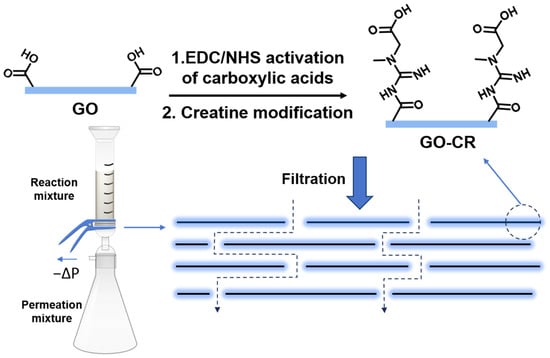
The synthesis was carried out via a carbodiimide-mediated coupling reaction (Scheme 1). In this protocol, 1-(3-dimethylaminopropyl)-3-ethylcarbodiimide (EDC) and N-hydroxysuccinimide (NHS) were employed as carboxyl-activating agents to enable stable covalent grafting between the carboxyl groups of GO and the amino groups of CR.
Scheme 1.
Scheme diagram of GO-CR Synthesis and Membrane Fabrication.
First, 50 mg of GO powder was dispersed in 25 mL of deionized water using a bath sonicator for 30 min. Subsequently, 400 µL (2.26 mmol) of EDC and 310 mg (2.7 mmol) of NHS were added to the GO suspension. The mixture was stirred at 400 rpm at room temperature for 1.5 h.
After activation, 289.3 mg of CR powder was divided into several portions and gradually added to the above activated GO mixture. The reaction was allowed to proceed under continuous stirring (400 rpm) at room temperature for 12 h.
The resulting mixture was transferred to a dialysis bag (MWCO: 8000 Da) and dialyzed against deionized water for 3 days, with the water being replaced every 6 h. After purification, the GO-CR dispersion was sonicated to ensure uniformity. This procedure yielded an aqueous stock dispersion with a concentration of approximately 0.75 mg mL−1 (based on the initial mass of GO). A portion of the dispersion was dried to obtain GO-CR powder, which was stored in a sealed vial for subsequent use in bulk reaction comparisons.
2.3. Preparation of GO-CR Membranes
The GO-CR membranes were fabricated via a vacuum-assisted filtration method. Specifically, an aqueous GO-CR dispersion was diluted with deionized water to a target concentration and subjected to ultrasonication to achieve a homogenized suspension. The resulting dispersion was then vacuum-filtered through a nylon membrane support (diameter: 47 mm, pore size: 0.22 μm). The obtained wet film was air-dried at room temperature for 12 h, denoted as GO-CR-RT (diameter: ~40 mm). The thickness of the membrane was precisely controlled by varying the volume of the filtered dispersion. In this study, two distinct membrane thicknesses were fabricated by adjusting the quantity of the GO-CR dispersion used, designated as 6-GO-CR-RT and 8-GO-CR-RT, respectively.
To investigate the effect of confinement size, the as-prepared GO-CR membranes were subjected to a thermal annealing process in an oven at 100 °C for 12 h. The resulting thermally annealed membranes are correspondingly denoted as 6-GO-CR-100 and 8-GO-CR-100. Both types of membranes were subsequently used in the following reaction experiments.
2.4. GO-CR Powder for Conventional Bulk Reactions
GO-CR powder (4 mg; this amount exceeds that used in the corresponding membrane reaction) was added to a 20 mL glass vial containing a solution of malononitrile (0.13 mmol), dimedone (0.13 mmol), and benzaldehyde (0.13 mmol) in ethanol (2 mL). The mixture was stirred at room temperature for the prescribed time. After the reaction, the catalyst was separated by filtration. The filtrate was concentrated under reduced pressure, and the crude product was dissolved in DMSO-d6 for proton nuclear magnetic resonance (1H NMR) analysis for conversion determination. Reactions performed with different solvents or catalysts followed an analogous procedure.
2.5. GO-CR Membranes for Confinement Reactions
Prior to use, the membrane surface was purged with N2 to remove any loosely adhered particulate contaminants. The GO-CR membrane (40 mm in diameter) was cut to an appropriate size and securely mounted in a microfiltration cell. The cell defined a central reaction zone with an inner diameter of 15 mm, corresponding to approximately one-eighth of the total membrane mass, and was sealed to form a filtration unit at room temperature. An ethanol solution containing malononitrile (0.13 mmol), dimedone (0.13 mmol), and benzaldehyde (0.13 mmol) was introduced into the upper measuring cylinder, which was then covered with aluminum foil. The reaction solution was driven through the two-dimensional nanochannels of the membrane under a constant pressure difference of 0.09 MPa (0.9 atm), enabling the reaction to proceed within the confined interlayer galleries. After the mixture had completely permeated the membrane, the cell was rinsed with fresh ethanol to recover any retained product. The combined permeate and rinse solution was collected, and ethanol was removed by rotary evaporation. The resulting residue was dissolved in DMSO-d6 for 1H NMR analysis to determine product composition and calculate conversion.
The 1H NMR data of the product described in this study are consistent with the corresponding 1H NMR spectrum previously reported in the literature [24] (Supporting Information, Figures S1–S11):
Dimedone: 1H NMR (400 MHz, DMSO-d6) δ 10.95 (s, 1H), 5.19 (s, 1H), 2.12 (s, 5H), 0.99 (s, 6H).
Benzaldehyde: 1H NMR (400 MHz, DMSO-d6) δ 10.01 (s, 1H), 7.98–7.87 (m, 2H), 7.74–7.65 (m, 1H), 7.58 (t, J = 7.5 Hz, 2H).
Malononitrile: 1H NMR (400 MHz, DMSO-d6) δ 4.44 (s, 2H).
2-Amino-4-(phenyl)-7,7-dimethyl-5-oxo-5,6,7,8-tetrahydro-4H-chromene-3-carbonitrile: 1H NMR (400 MHz, DMSO-d6) δ 7.28 (t, J = 7.4 Hz, 2H), 7.22–7.10 (m, 3H), 6.98 (s, 2H), 4.17 (s, 1H), 2.52 (s, 2H), 2.25 (d, J = 16.1 Hz, 1H), 2.10 (d, J = 16.1 Hz, 1H), 1.04 (s, 3H), 0.96 (s, 3H). 13C NMR (101 MHz, DMSO-d6) δ 195.68, 162.51, 158.52, 144.74, 128.34, 127.16, 126.58, 119.72, 112.77, 58.38, 50.00, 38.35, 35.60, 31.80, 28.40, 26.82.
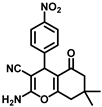
2-Amino-4-(4-nitrophenyl)-7,7-dimethyl-5-oxo-5,6,7,8-tetrahydro-4H-chromene-3-carbonitrile: 1H NMR (400 MHz, DMSO-d6) δ 8.17 (d, J = 8.5 Hz, 2H), 7.48–7.40 (m, 2H), 7.16 (s, 2H), 4.37 (s, 1H), 2.54 (s, 2H), 2.26 (d, J = 16.1 Hz, 1H), 2.11 (d, J = 16.1 Hz, 1H), 1.04 (d, J = 2.3 Hz, 3H), 0.96 (s, 3H). 13C NMR (101 MHz, DMSO-d6) δ 195.64, 163.06, 158.57, 152.25, 146.25, 128.59, 123.63, 119.27, 111.72, 56.99, 49.85, 35.64, 31.79, 28.23, 26.92.
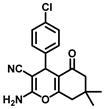
2-Amino-4-(4-chlorophenyl)-7,7-dimethyl-5-oxo-5,6,7,8-tetrahydro-4H-chromene-3-carbonitrile: 1H NMR (400 MHz, DMSO-d6) δ 7.37–7.31 (m, 2H), 7.20–7.13 (m, 2H), 7.04 (s, 2H), 4.19 (s, 1H), 2.47 (s, 2H), 2.24 (d, J = 16.1 Hz, 1H), 2.10 (d, J = 16.1 Hz, 1H), 1.03 (s, 3H), 0.94 (s, 3H). 13C NMR (101 MHz, DMSO-d6) δ 195.61, 162.57, 158.49, 143.71, 131.09, 129.09, 128.25, 119.50, 112.33, 57.79, 49.93, 39.66, 35.10, 31.76, 28.28, 26.84.
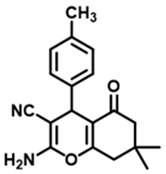
2-Amino-4-(p-tolyl)-7,7-dimethyl-5-oxo-5,6,7,8-tetrahydro-4H-chromene-3-carbonitrile: 1H NMR (400 MHz, DMSO-d6) δ 7.15–6.98 (m, 4H), 6.95 (s, 2H), 4.12 (s, 1H), 2.43–2.38 (m, 2H), 2.23 (d, J = 8.7 Hz, 4H), 2.09 (d, J = 16.1 Hz, 1H), 1.03 (s, 3H), 0.95 (s, 3H). 13C NMR (101 MHz, DMSO-d6) δ 195.59, 162.26, 158.43, 141.80, 135.60, 128.86, 127.06, 119.72, 112.89, 58.49, 50.00, 39.68, 35.18, 31.76, 28.40, 26.76, 20.57.
2.6. Calculation of the Reaction Time of the Confinement Reactions
The reaction time under confinement was estimated based on the permeation retention time of the solution through the GO-CR membrane, calculated according to the method reported by Pang et al. [16].
The retention time tR was obtained using the formula:
where VM is the geometric volume of the membrane; k is the slope of the reactant flow volume versus time; A is the channel cross-sectional area of microfiltration devices (A = π/4 × 152 = 176.7 mm2); h is the thickness of the membrane, which was determined by SEM. tR represents the time required for the reaction solution to fill the geometric volume of the GO-CR membrane. Because the GO-CR nanosheets occupy a portion of this volume, the effective volume accessible to the reaction solution is smaller than VM, and the actual reaction time within the confined space is shorter than the calculated retention time tR. Because the exact accessible interlayer volume is difficult to determine precisely, and the reaction ceases once the solution exits the membrane, tR serves as a practical approximation of the confined reaction time for comparison with the bulk reaction time.
2.7. Calculation of Conversions from Crude-Sample 1H NMR Spectra
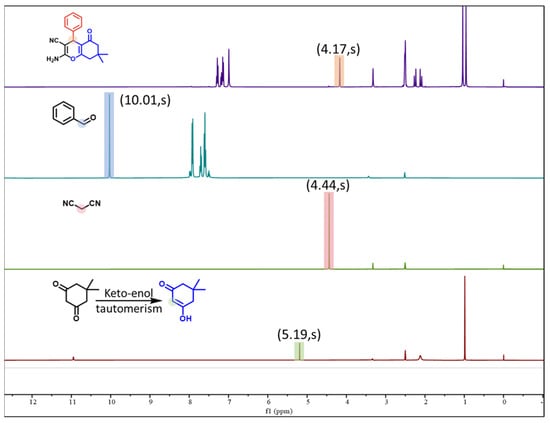
Conversions were determined by relative quantitative 1H-NMR analysis of crude reaction mixtures. Ethanol was removed from the reaction solution by rotary evaporation, and the residue was dissolved in DMSO-d6 for NMR measurement. Benzaldehyde, malononitrile, dimedone, and the target product each exhibit characteristic diagnostic proton signals (Figure 1). For both bulk and confined reactions, conversions were calculated from the integral ratio of the proton signals of the product versus unreacted dimedone. The conversion of dimedone was used as the standard to evaluate and compare all reactions.
Figure 1.
1H NMR spectra of the reactant and product, highlighting characteristic proton signals for structural verification.
2.8. Calculation of Turnover Number (TON) and Turnover Frequency (TOF)
The TON and TOF were calculated according to IUPAC definitions [25,26]. The number of active sites was determined based on the total basicity obtained from Boehm titration (Section 3.1.3), as the basic sites serve as the limiting component in the acid–base bifunctional catalysis (TB < TA).
For the bulk reaction:
where mmol. Conversion was determined by 1H NMR spectroscopy, , and is the reaction time.
For the confined reaction, the retention time was calculated from the membrane volume and permeate flow rate (see Section 2.6), and the substrate amount within the membrane was calculated as , where c = 0.065 M. TON and TOF were obtained using the same equations as above.
3. Results
3.1. Characterization of GO-CR Membranes
X-ray photoelectron spectroscopy (XPS) measurements were performed on a Thermo ESCALAB 250Xi spectrometer equipped with a monochromatic Al Kα radiation source under ultra-high vacuum. Data were processed with CasaXPS software. Fourier-transform infrared (FTIR) spectra were recorded on a Bruker INVENIO S spectrometer using the attenuated total reflection (ATR) mode. X-ray diffraction (XRD) was performed on a Bruker D8 Focus diffractometer using Cu Kα radiation (λ = 1.5406 Å). Morphological analysis was conducted using a Hitachi S 4800 field emission scanning electron microscope (SEM). 1H NMR spectra of all concentrated post-reaction samples were acquired on a Bruker Avance 400 MHz spectrometer using DMSO-d6 as the solvent.
3.1.1. Spectral Analysis
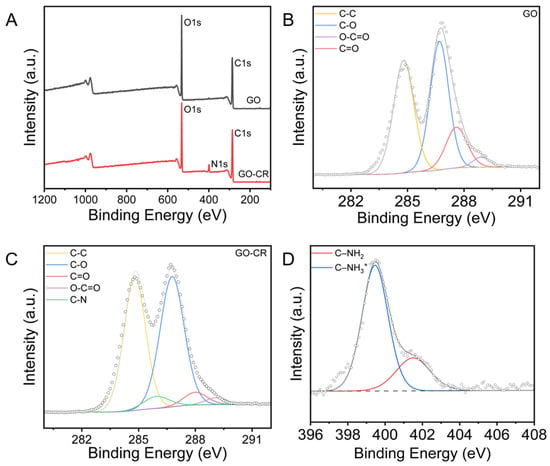
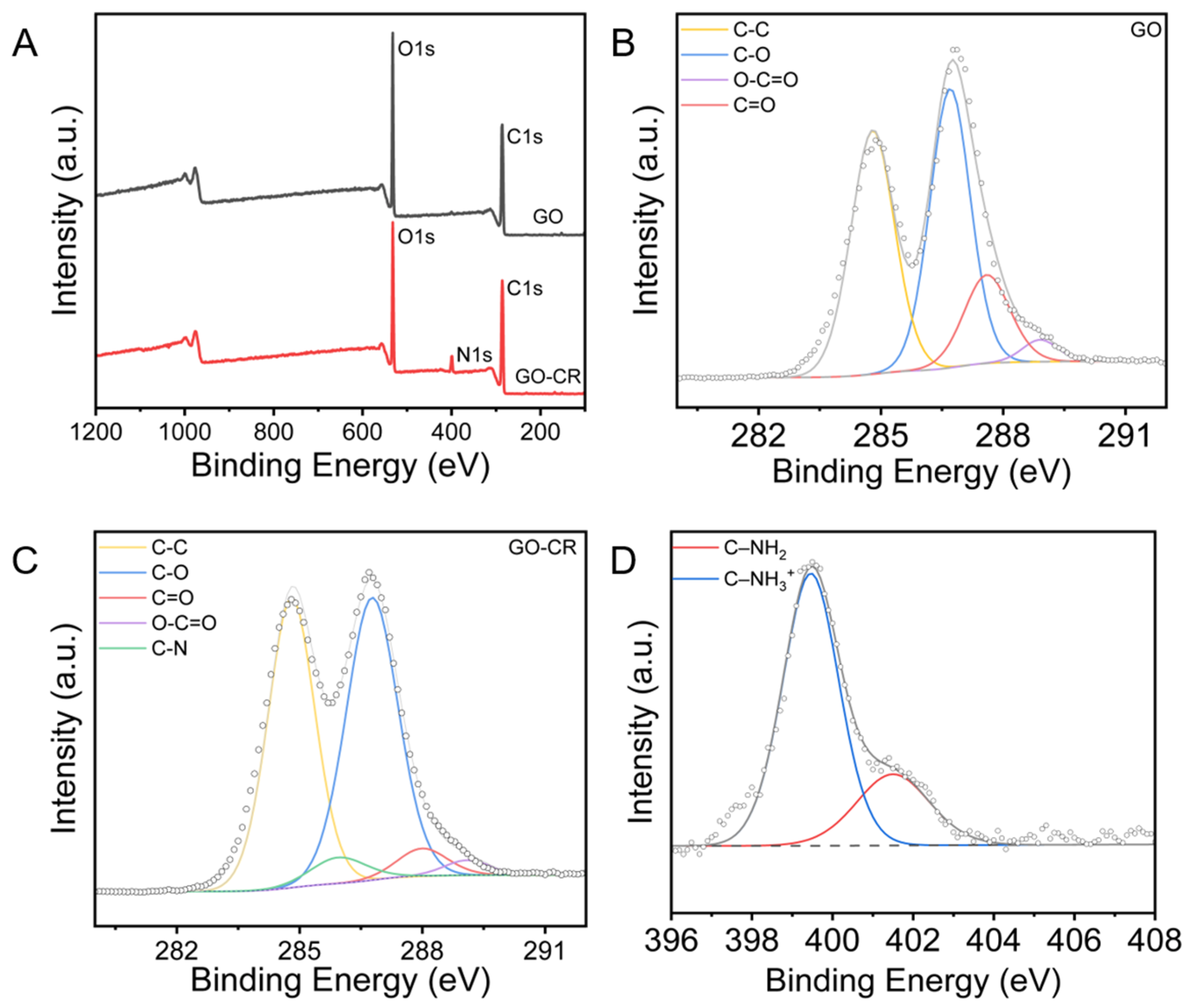
XPS was employed to analyze the surface chemical compositions of pristine GO and GO-CR membranes. As illustrated in Figure 2, the atomic nitrogen content of the GO-CR membrane increased to 4.73% after CR modification, confirming the successful grafting of CR molecules onto GO. The high-resolution C 1s spectrum of pristine GO was deconvoluted into four characteristic peaks assigned to C–C (~284.8 eV), C–O (~286.7 eV), C=O (~287.6 eV), and O–C=O (~288.9 eV). After CR functionalization, the relative proportion of the C–C component rose from 39.8% to 42.7%. Furthermore, a new peak appeared at approximately 285.9 eV, which was attributed to C–N bonds with a relative area ratio of 4.5%. Concurrently, the relative intensity of the O–C=O component decreased significantly, demonstrating that surface carboxyl groups of GO were consumed during the amidation reaction. Additionally, the N 1s spectrum of GO-CR was deconvoluted into two peaks centered at 399.5 eV and 401.5 eV, assigned to guanidinium and amino nitrogen groups of CR (tertiary and primary amines, respectively). These findings are consistent with the molecular structure of CR [27], further verifying that CR molecules are covalently immobilized on the GO surface with intact chemical skeletons.
Figure 2.
(A) XPS full spectra of GO (black line) and GO-CR (red line). High-resolution C 1s XPS spectra of (B) GO membrane and (C) GO-CR membrane. (D) High-resolution N 1s XPS spectrum of the GO-CR membrane.
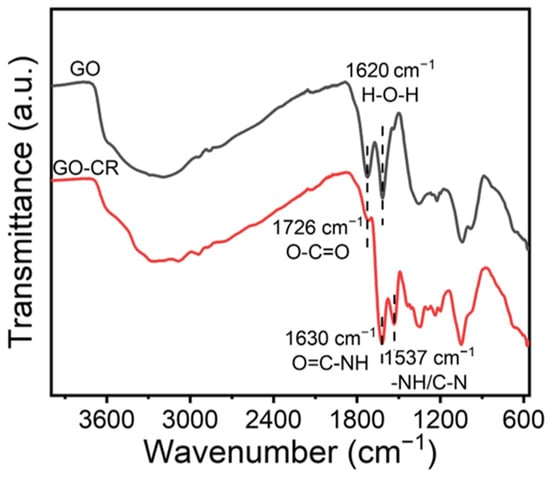
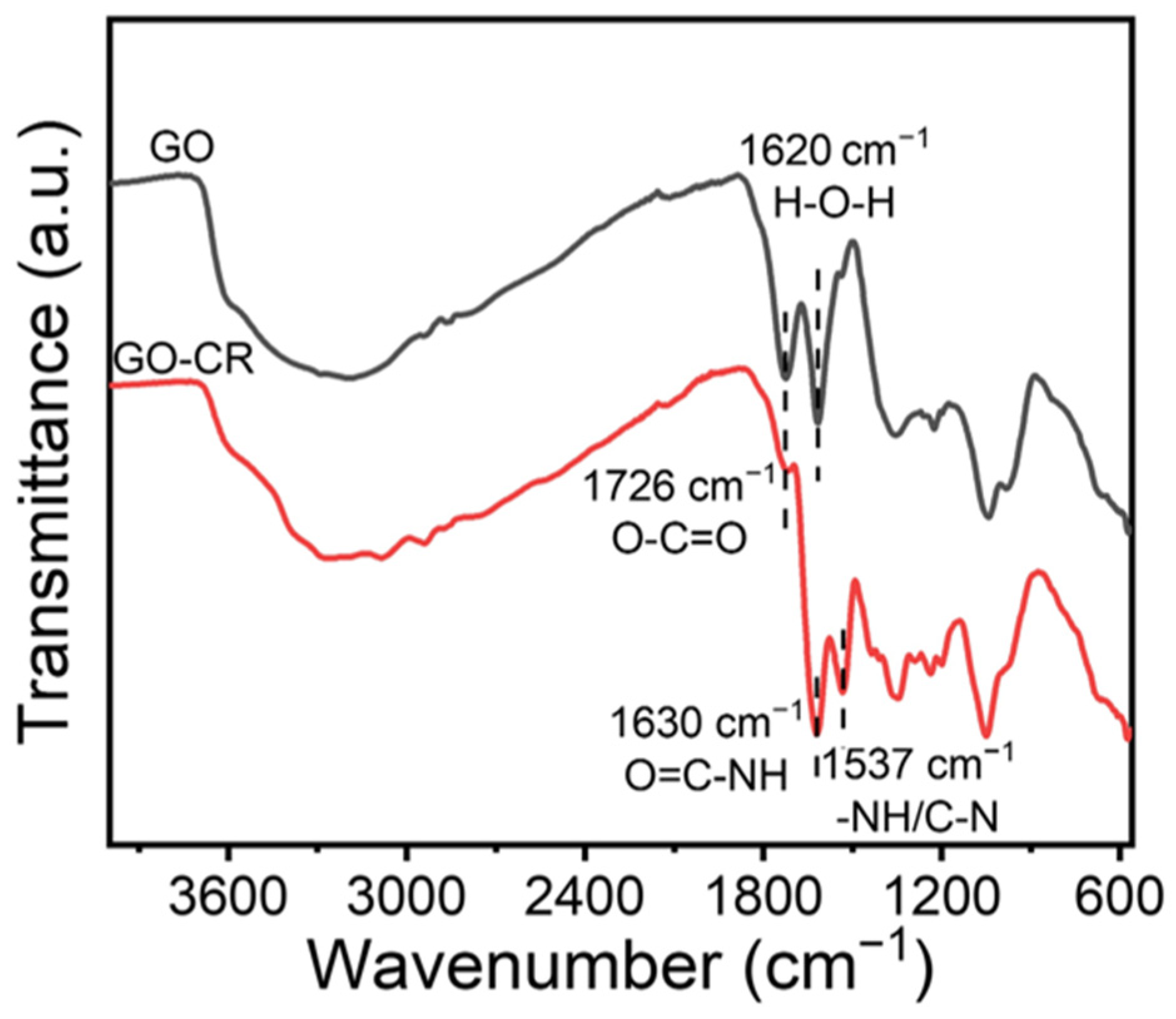
The FTIR spectral analysis is presented in Figure 3. The pristine GO displays a prominent absorption peak at 1726 cm−1, which is attributed to the stretching vibration of the carbonyl (C=O) group within the carboxyl (-COOH) functionalities [28]. Following modification with CR, a marked reduction in the intensity of this peak is observed, suggesting substantial consumption of the carboxyl groups on the GO surface via an amidation reaction with the amino groups of CR. Concurrently, the GO-CR composite film exhibits two novel characteristic absorption bands at 1630 cm−1 and 1537 cm−1, corresponding respectively to the amide I band (C=O stretching vibration) and the amide II band (coupled N–H bending and C–N stretching vibrations) [29]. These spectral features serve as definitive evidence of amide bond formation, thereby confirming the covalent grafting of CR onto GO through amide linkages.
Figure 3.
FTIR spectra of GO (black line) and GO-CR (red line).
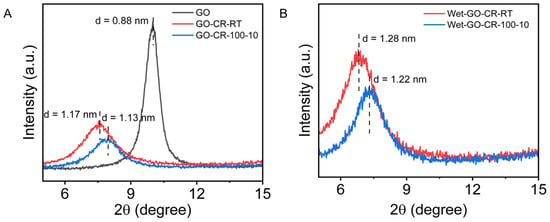
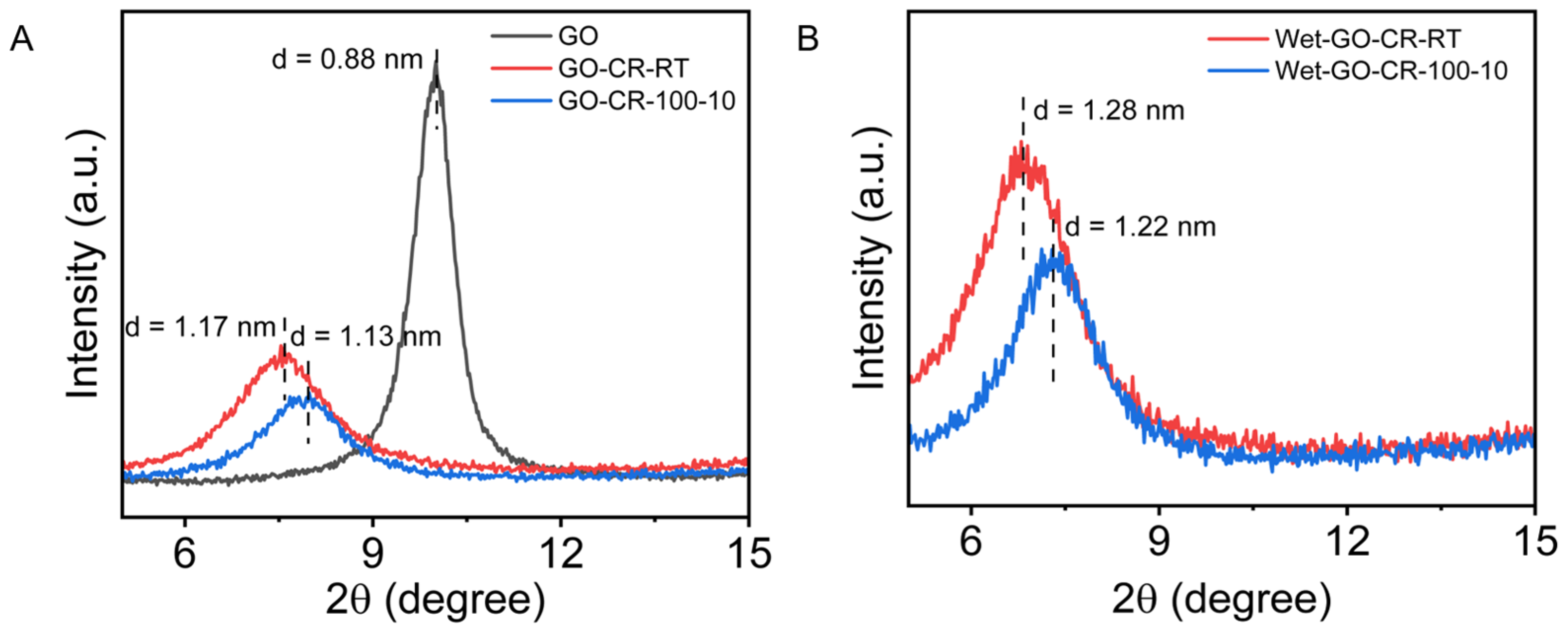
XRD patterns were used to determine the interlayer spacing (d-spacing) of the prepared membranes. The dry pristine GO membrane exhibited a d-spacing of 0.88 nm (Figure 4A). After CR modification, the d-spacing of the dry GO-CR-RT membrane increased to 1.17 nm (Figure 4A), and solvent swelling under wet conditions further expanded to 1.28 nm (Figure 4B). In contrast, for the GO-CR-100 membrane prepared by thermal treatment at 100 °C, the d-spacing of the dry state decreased to 1.13 nm (Figure 4A), while the wet state reached 1.22 nm due to the solvent swelling effect (Figure 4B). The effective interlayer catalytic space was calculated by subtracting the thickness of a single graphene layer (0.34 nm) from the measured d-spacing [30].
Figure 4.
(A) XRD spectra of GO, GO-CR-RT and GO-CR-100 membranes. (B) XRD patterns measured for the GO-CR-RT and GO-CR-100 membranes in the wet state.
3.1.2. Morphological Characteristics of GO-CR Membranes
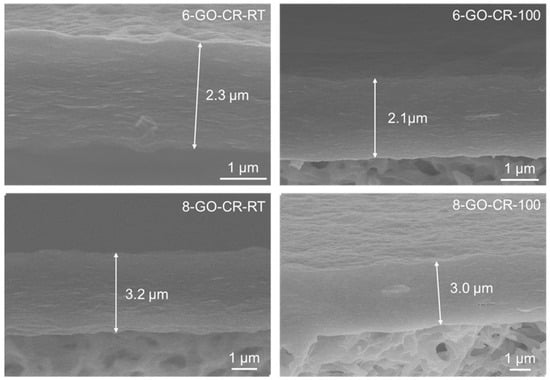
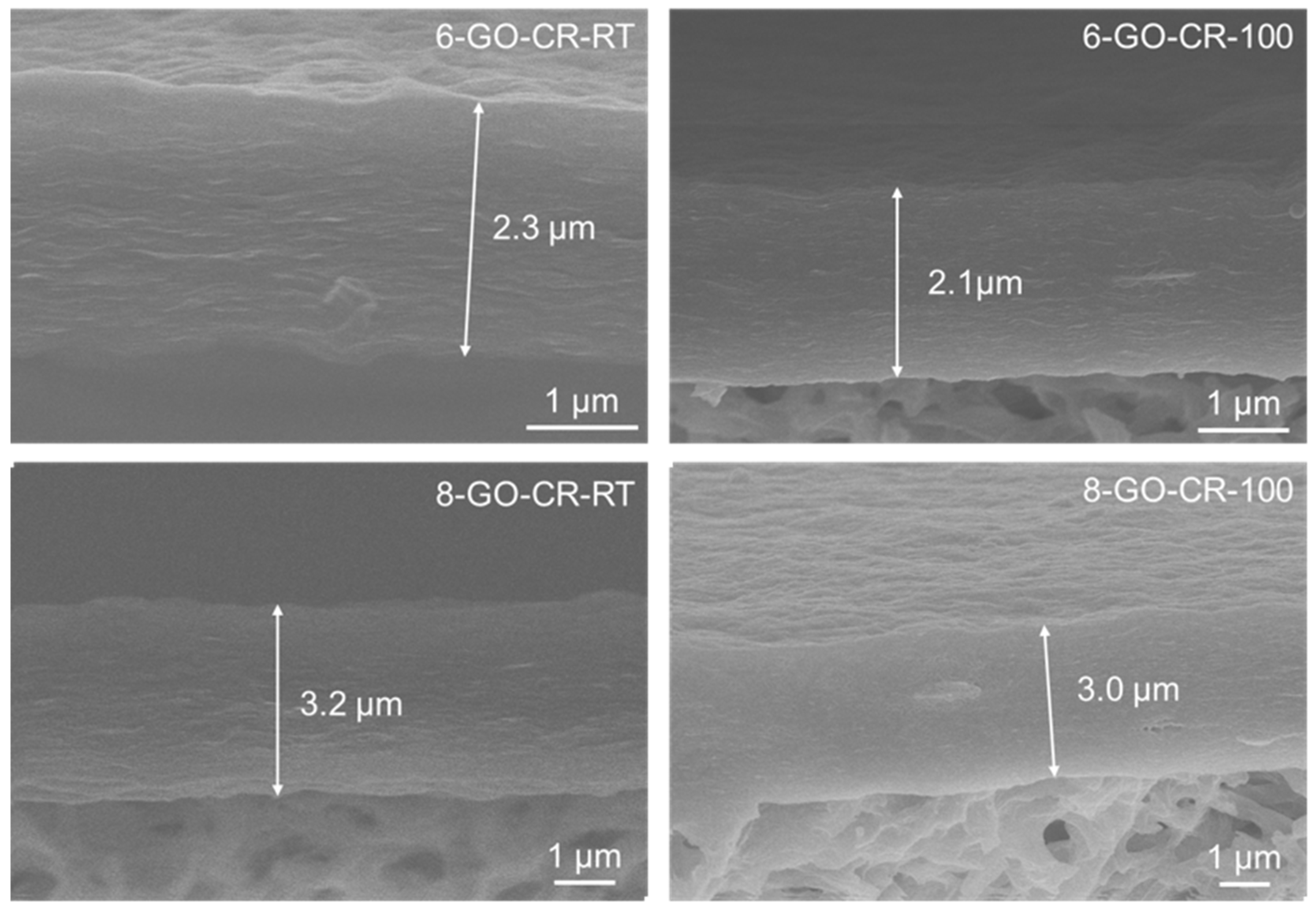
The cross-sectional observations obtained via SEM are presented in Figure 5. Following functionalization with CR, the GO-CR film preserves its intact two-dimensional layered morphology, suggesting that the amide grafting reaction does not compromise the fundamental microstructure. Notable variations in the thickness of GO-CR films were observed under different preparation conditions: the 6-GO-CR-RT and 8-GO-CR-RT films, dried at ambient temperature, exhibited thicknesses of 2.3 μm and 3.2 μm, respectively; conversely, the 6-GO-CR-100 and 8-GO-CR-100 films, subjected to thermal treatment at 100 °C, showed a slight reduction in thickness to 2.1 μm and 3.0 μm, respectively. This thermal treatment induced a more compact interlayer arrangement. The measured film thicknesses serve as critical parameters for determining the residence time of reactants in subsequent confined flow reactions.
Figure 5.
Cross-sectional SEM images of various GO-CR membranes, exhibiting a closely packed multilayer structure.
3.1.3. Surface Acidity and Basicity
The total acidity (TA) and total basicity (TB) of GO-CR were determined by the Boehm titration method [31]. For TA measurement, 100 mg of the sample was dispersed in 50 mL of 0.05 M NaOH solution and shaken at 25 °C for 48 h. After filtration, a 20 mL aliquot of the filtrate was treated with an excess of 0.05 M HCl and then back-titrated with 0.05 M NaOH. For TB measurement, 100 mg of the sample was dispersed in 50 mL of 0.05 M HCl solution and shaken at 25 °C for 48 h. After solid–liquid separation, a 20 mL aliquot of the filtrate was then mixed with an excess of 0.05 M NaOH, followed by back-titration with 0.05 M HCl. Parallel blank experiments were carried out under identical conditions without adding samples. The obtained TA and TB values of GO-CR were 4.01 mmol/g and 1.34 mmol/g, respectively.
3.2. Comparison of Confined Catalysis and Traditional Bulk Catalysis Effects
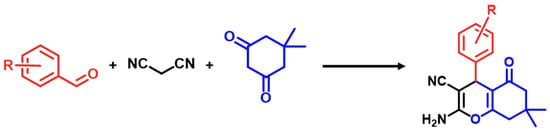
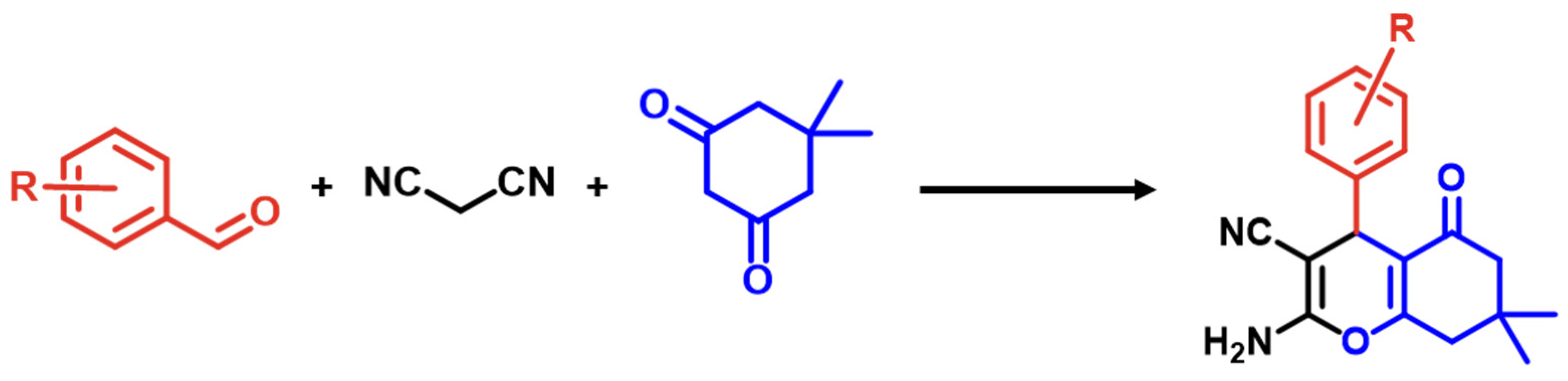
To evaluate catalyst performance and optimize reaction parameters, the three-component condensation of benzaldehyde, malononitrile, and dimedone was initially employed as a model reaction (Scheme 2). Under conventional bulk reaction conditions, the effects of catalyst type, solvent, and reaction time on the conversion of dimedone were systematically investigated, with the results summarized in Table 1. The data indicate that the GO-CR composite catalyst exhibits slightly higher activity than GO or CR alone under identical bulk conditions, achieving a maximum conversion of 87% in ethanol at room temperature within 24 h. Therefore, these conditions were established as the optimal parameters for the bulk reaction.
Scheme 2.
Scheme diagram of the three-component reaction of benzaldehyde, malononitrile, and dimedone under the confined catalysis of GO-CR.
Table 1.
Comparison of the synthetic conditions for the target 2-amino-4-aryl-7,7-dimethyl-5-oxo-5,6,7,8-tetrahydro-4H-chromene-3-carbonitrile under various conditions via a three-component reaction of aldehydes, malononitrile, and dimedone in the bulk reaction.
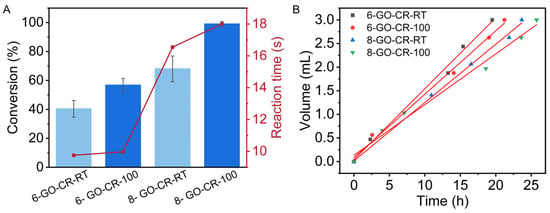
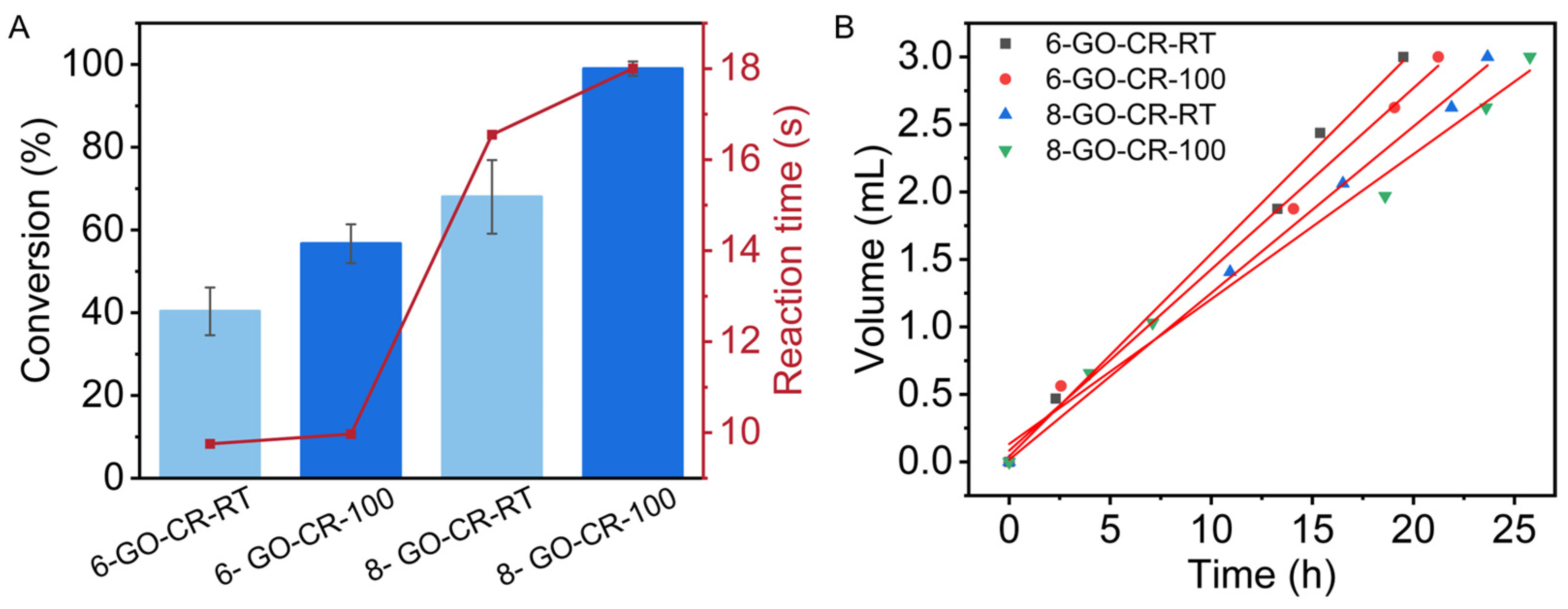
To optimize the conditions for confined-flow reactions, four types of GO-CR membranes (6-GO-CR-RT, 6-GO-CR-100, 8-GO-CR-RT, and 8-GO-CR-100) were fabricated by adjusting the amount of GO-CR dispersion and the drying method. Driven by a pressure difference, the reaction mixture permeates through the membrane and reacts within two-dimensional nanochannels. As shown in Figure 6A, the conversion of dimedone increased with extended residence time of the reactants within the membrane. When the residence time was less than 10 s, the conversion rate remained low, likely due to premature elution of reactants from the confined channels by solvent flow before the reaction could complete. When the residence time reached approximately 18 s, the conversion reached near-quantitative levels (99.0 ± 1.7%, mean ± SD, n = 3), attributed to sufficient contact time between the reactants and the catalytic sites within the channels. Based on these results, the optimal confined reaction conditions were determined to be ethanol as the solvent and the 8-GO-CR-100 membrane as the confined reactor. Under the optimized conditions described above, the volume of permeate shows a good linear relationship with time (Figure 6B), indicating that the reaction mixture can permeate steadily through the membrane.
Figure 6.
(A) Comparison of conversion–time profiles for the model three-component reaction catalyzed by different GO-CR confinement membranes. The corresponding raw experimental data are provided in the Supporting Information (Figures S19–S22, Table S1). (B) Flow curves of the reaction solution containing malononitrile, dimedone and benzaldehyde in ethanol.
To quantitatively compare the catalytic efficiency, TON and TOF were calculated based on the total basic sites (TB = 1.34 μmol/mg) determined by Boehm titration. Since TB < TA, the basic sites serve as the limiting component in the acid–base bifunctional catalysis and were used as the basis for active site counting. For the bulk reaction (), a TON of 21.1 and a TOF of 0.88 h−1 were obtained. For the confined reaction (), the TON and TOF were determined to be 0.023 and 4.52 h−1, respectively. Notably, the confined-flow membrane reactor exhibited a TOF approximately 5.1-fold higher than that of the bulk reaction, demonstrating the significantly enhanced catalytic efficiency under nanoconfinement. The key catalytic data are summarized in Table 2, with detailed calculation parameters provided in Table S2 in the Supporting Information.
Table 2.
TON and TOF for Bulk and Confined reactions.
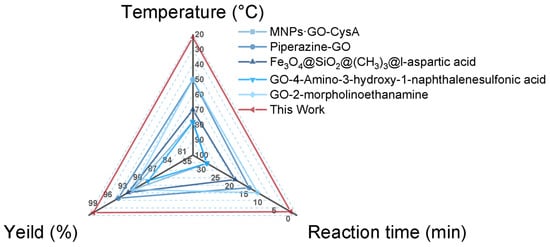
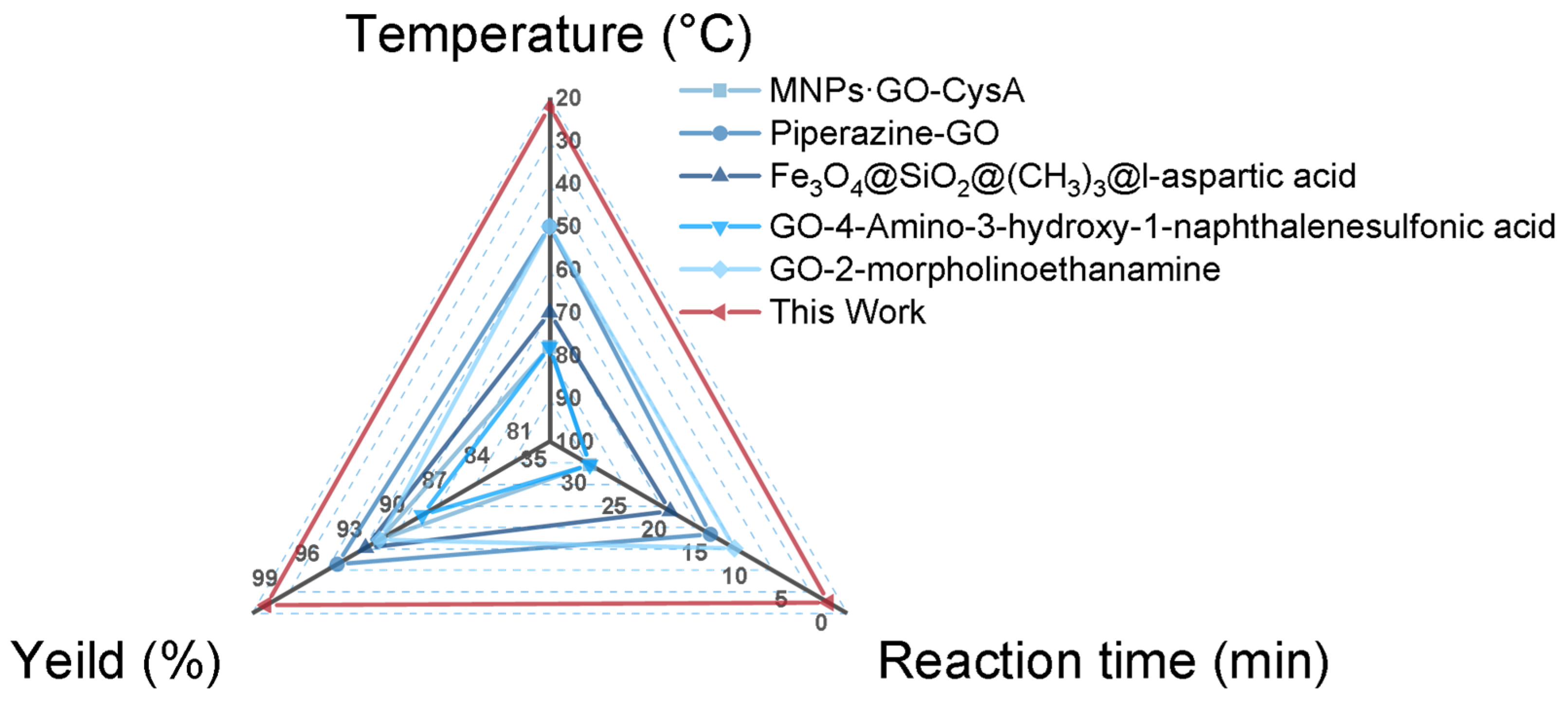
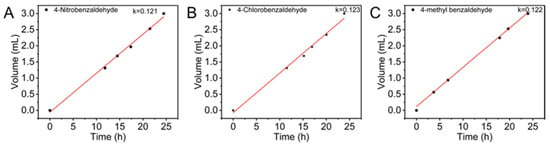
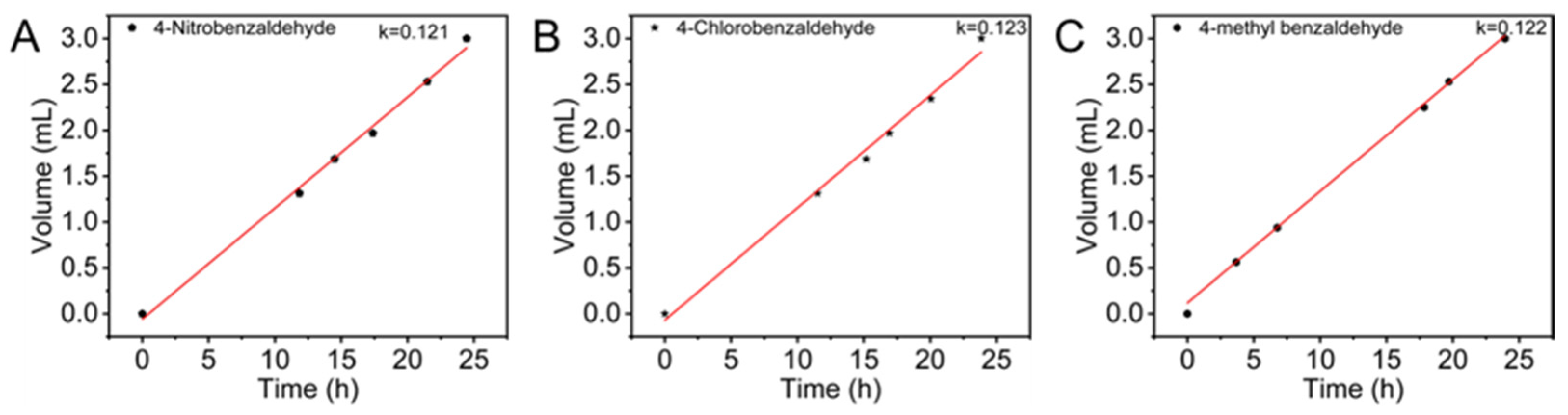
Compared with previously reported conventional bulk reactions and the bulk reaction optimized in this study [9,11,32,33,34], the GO-CR membrane-confined reactor significantly reduced the reaction time under mild conditions while achieving excellent conversion (Figure 7). To further expand the substrate scope, malononitrile and dimedone were reacted with various substituted aromatic aldehydes. The results showed that the confined-flow reaction achieved conversions comparable to those of the corresponding bulk reactions within a significantly shorter time (Table 3). Furthermore, the permeation volume maintained a good linear relationship with time throughout the reactions of each substrate (Figure 8), further confirming the stability of this confined-flow system.
Figure 7.
A comparison of the catalytic performance (temperature, time and conversion) of the 8-GO-CR-100 membrane with that of other reported catalytic systems.
Table 3.
Comparison of confined and bulk reactions of malononitrile, dimedone and various substituted aromatic aldehydes.
Figure 8.
Flow curves for the reactions of dimedone and malononitrile with (A) 4-nitrobenzaldehyde, (B) 4-chlorobenzaldehyde, or (C) 4-methoxybenzaldehyde in ethanol.
4. Discussion
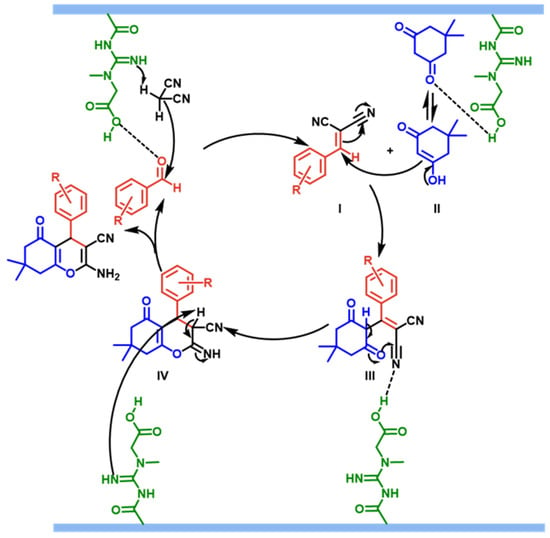
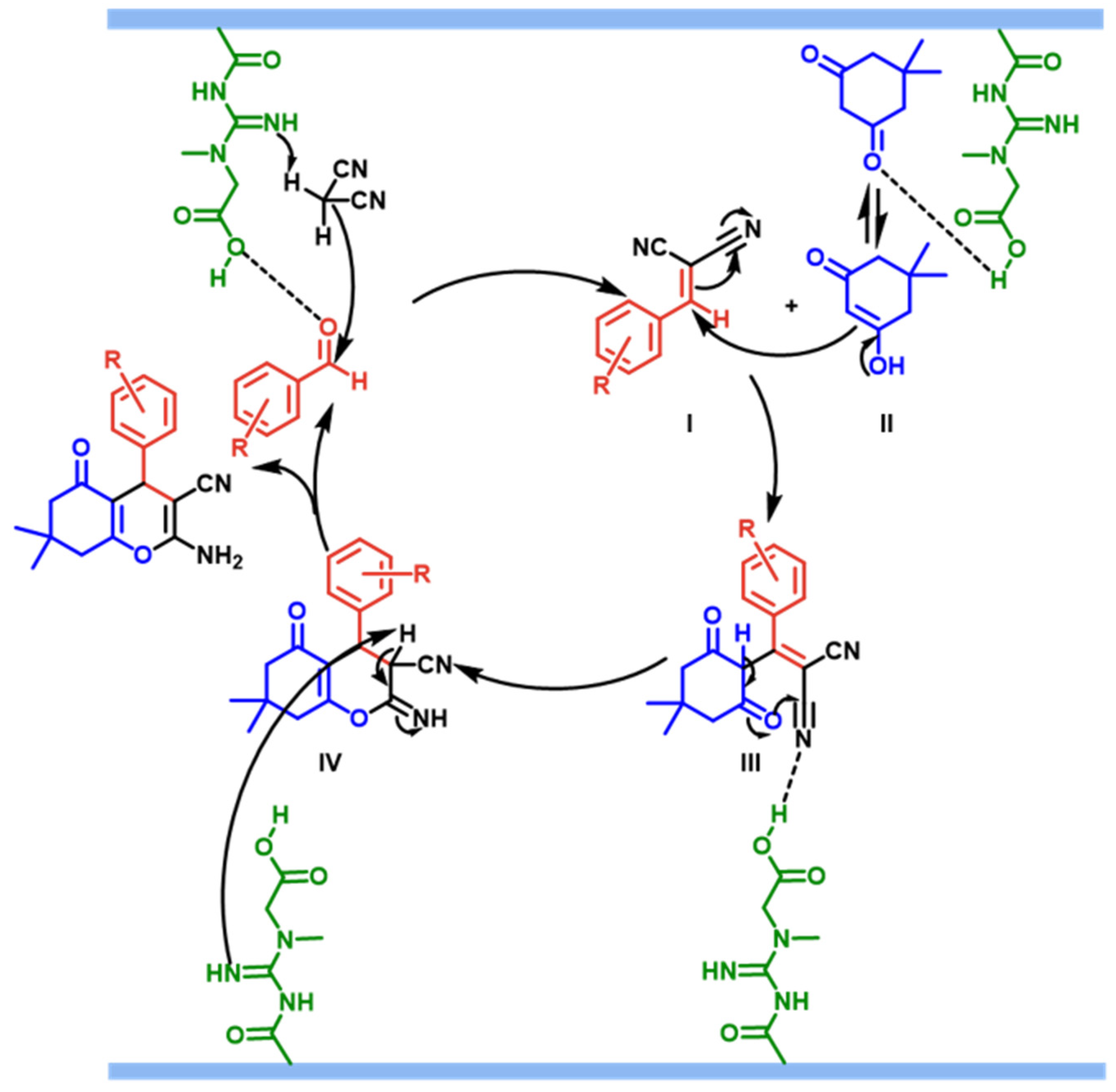
Based on the characterization results and catalytic performance data obtained in this study, combined with the previous literature reports [35], a plausible mechanism for the synthesis of 2-amino-4H-chromene derivatives is proposed as follows (Scheme 3). On the GO-CR catalyst, experimentally quantified acidic carboxyl sites are proposed to protonate the carbonyl oxygen of aromatic aldehydes, increasing the electrophilicity of the carbonyl carbon. Concurrently, guanidyl groups (basic sites) deprotonate the α-hydrogen of malononitrile to generate carbanions. These two intermediates undergo Knoevenagel condensation followed by dehydration to form Intermediate I. Subsequently, acidic sites promote the enolization of dimedone to form Intermediate II, which then attacks the β-carbon of Intermediate I via Michael addition to yield Intermediate III. Through hydrogen-bonding interactions, acidic sites enhance the electrophilicity of the cyano carbon in Intermediate III and induce intramolecular cyclization, leading to the formation of Intermediate IV bearing a tetrahydropyran ring. Finally, base-assisted deprotonation, followed by elimination and dehydrogenative aromatization, affords the target product. The two-dimensional confinement effect of the GO-CR membrane not only enriches reactants within the nanochannels but also stabilizes the conformations of key intermediates. It should be noted that the proposed pathway represents a reasonable hypothesis consistent with our experimental observations and literature precedents, rather than a rigorously proven kinetic model. Further in situ spectroscopic investigations are warranted in future work to directly verify the transient intermediate species and the detailed stepwise conversion processes.
Scheme 3.
Scheme illustration of the proposed reaction mechanism.
5. Conclusions
In summary, this work develops a flow reaction strategy based on GO-CR nanomembranes for efficient, continuous synthesis of 2-amino-4H-chromene derivatives. The GO-CR membrane offers a confined two-dimensional nano-reaction space and cooperative acid–base bifunctional sites, which effectively catalyze the tandem reaction. In contrast to conventional bulk reactions, this flow synthesis system operates efficiently at room temperature. Preorganization and confinement effects within the nanochannels remarkably enhance the frequency of effective molecular collisions, shortening the reaction time to approximately 18 s and affording a near-quantitative conversion (99.0 ± 1.7%, mean ± SD, n = 3). Moreover, products are eluted with the solvent, simplifying subsequent separation processes. While the current device is demonstrated at a proof-of-concept scale, its throughput can be scaled up by enlarging the membrane module or operating in recirculation mode. This work provides an efficient approach for the green and rapid synthesis of 2-amino-4H-chromene derivatives, and highlights the considerable application potential of functionalized nanomembrane reactors in fine organic synthesis.
Supplementary Materials
The following supporting information can be downloaded at https://www.mdpi.com/article/10.3390/appliedchem6030066/s1, Figures provided in the supporting information correspond to the 1H NMR spectra displayed in the main manuscript.
Author Contributions
Conceptualization, X.C. and H.S.; investigation, X.C. and H.S.; writing—original draft preparation, X.C. and H.S.; writing—review and editing, Y.L., X.Z. and K.S.; funding acquisition, K.S. All authors have read and agreed to the published version of the manuscript.
Funding
This research was funded by the Ministry of Science and Technology of the People’s Republic of China (MOST), grant number 2022YFA1503000.
Institutional Review Board Statement
Not applicable.
Informed Consent Statement
Not applicable.
Data Availability Statement
All original data generated in this study are included in the main text and Supplementary Materials. Requests for additional data can be directed to the corresponding authors.
Conflicts of Interest
The authors declare no conflicts of interest.
Abbreviations
The following abbreviations are used in this manuscript:
| GO | Graphene oxide |
| CR | Creatine |
| GO-CR | Creatine-functionalized graphene oxide |
| MCRs | Multicomponent reactions |
| EDC | 1-(3-Dimethylaminopropyl)-3-ethylcarbodiimide |
| NHS | N-Hydroxysuccinimide |
| TON | Turnover number |
| TOF | Turnover frequency |
| XPS | X-ray photoelectron spectroscopy |
| FTIR | Fourier transform infrared |
| XRD | X-ray diffraction |
| SEM | Scanning electron microscope |
| NMR | Nuclear magnetic resonance |
| TA | Total acidity |
| TB | Total basicity |
References
- Kumar, D.; Reddy, V.B.; Sharad, S.; Dube, U.; Kapur, S. A facile one-pot green synthesis and antibacterial activity of 2-amino-4H-pyrans and 2-amino-5-oxo-5,6,7,8-tetrahydro-4H-chromenes. Eur. J. Med. Chem. 2009, 44, 3805–3809. [Google Scholar] [CrossRef] [Scilit] [PubMed]
- Nongthombam, G.S.; Barman, D.; Iyer, P.K. Through-Space Charge-Transfer-Based Aggregation-Induced Emission and Thermally Activated Delayed Fluorescence in Fused 2H-Chromene Coumarin Congener Generating ROS for Antiviral (SARS-CoV-2) Approach. ACS Appl. Bio Mater. 2024, 7, 1899–1909. [Google Scholar] [CrossRef] [Scilit] [PubMed]
- Chung, S.-T.; Huang, W.-H.; Huang, C.-K.; Liu, F.-C.; Huang, R.-Y.; Wu, C.-C.; Lee, A.-R. Synthesis and anti-inflammatory activities of 4H-chromene and chromeno [2,3-b]pyridine derivatives. Res. Chem. Intermed. 2016, 42, 1195–1215. [Google Scholar] [CrossRef] [Scilit]
- Kemnitzer, W.; Drewe, J.; Jiang, S.; Zhang, H.; Wang, Y.; Zhao, J.; Jia, S.; Herich, J.; Labreque, D.; Storer, R.; et al. Discovery of 4-Aryl-4H-chromenes as a New Series of Apoptosis Inducers Using a Cell- and Caspase-based High-Throughput Screening Assay. 1. Structure−Activity Relationships of the 4-Aryl Group. J. Med. Chem. 2004, 47, 6299–6310. [Google Scholar] [CrossRef] [Scilit] [PubMed]
- Dömling, A.; Wang, W.; Wang, K. Chemistry and Biology Of Multicomponent Reactions. Chem. Rev. 2012, 112, 3083–3135. [Google Scholar] [CrossRef] [Scilit] [PubMed]
- Agarwal, S.; Sethiya, A.; Soni, J.; Sahiba, N.; Teli, P. An overview of recent advances in the catalytic synthesis of substituted pyrans. Appl. Organomet. Chem. 2022, 36, e6604. [Google Scholar] [CrossRef] [Scilit]
- Rodrigues, M.O.; Eberlin, M.N.; Neto, B.A.D. How and Why to Investigate Multicomponent Reactions Mechanisms? A Critical Review. Chem. Rec. 2021, 21, 2762–2781. [Google Scholar] [CrossRef] [Scilit] [PubMed]
- Yu, Y.; Zhang, L.; Wang, Y. Theoretical investigation on the reaction mechanism and origin of stereoselectivity of a three-component coupling reaction under organocatalysis. Mol. Catal. 2025, 573, 114819. [Google Scholar] [CrossRef] [Scilit]
- Amiri-Zirtol, L.; Ahooie, T.S.; Riazimontazer, E.; Amrollahi, M.A.; Mirjalili, B.-F. Graphene oxide immobilized 2-morpholinoethanamine as a versatile acid–base catalyst for synthesis of some heterocyclic compounds and molecular docking study. Sci. Rep. 2023, 13, 17966. [Google Scholar] [CrossRef] [Scilit] [PubMed]
- Amiri-Zirtol, L.; Khabnadideh, S. GO Treated with Aminoethyl-Piperazine as a Reusable and Eco-friendly Organocatalyst for Synthesis of Some Xanthen and Pyran Derivatives. ChemistrySelect 2023, 8, e202204007. [Google Scholar] [CrossRef] [Scilit]
- Amiri-Zirtol, L.; Mostashfi, H.; Sabet, R.; Karimi, Z.; Ranjbar-Karimi, R. l-Aspartic acid-functionalized magnetic nanoparticles: As a new magnetically reusable bifunctional acid–base catalysts for the synthesis of benzo[b]pyran and pyrano [3,2–c] chromene derivatives. Sci. Rep. 2025, 15, 248. [Google Scholar] [CrossRef] [Scilit] [PubMed]
- Khaleghiabbasabadi, M.; Azarifar, D.; Taghavian, H.; Hematian, H.; Silvestri, D.; Rezek, B.; Bahrami, B.; Khodabakhshi, S. Asparagine-modified magnetic graphene oxide as efficient green nanocatalyst for synthesis of chromenes and pyrano pyrazoles derivatives. Sci. Rep. 2025, 15, 17252. [Google Scholar] [CrossRef] [Scilit] [PubMed]
- Zolfigol, M.A.; Khazaei, A.; Moosavi-Zare, A.R.; Afsar, J.; Khakyzadeh, V.; Khaledian, O. Knoevenagel-Michael-cyclocondensation Tandem Reaction of Malononitrile, Various Aldehydes and Dimedone Catalyzed by Sulfonic Acid Functionalized Pyridinium Chloride as a New Ionic Liquid and Catalyst. J. Chin. Chem. Soc. 2015, 62, 398–403. [Google Scholar] [CrossRef] [Scilit]
- Cioc, R.C.; Ruijter, E.; Orru, R.V.A. Multicomponent reactions: Advanced tools for sustainable organic synthesis. Green Chem. 2014, 16, 2958–2975. [Google Scholar] [CrossRef] [Scilit]
- Grommet, A.B.; Feller, M.; Klajn, R. Chemical reactivity under nanoconfinement. Nat. Nanotechnol. 2020, 15, 256–271. [Google Scholar] [CrossRef] [Scilit] [PubMed]
- Pang, S.; Peng, D.; Hao, Y.; Song, B.; Zhang, X.; Jiang, L. Regulating interlayer spacing of aminated graphene oxide membranes for efficient flow reactions. Matter 2023, 6, 1173–1187. [Google Scholar] [CrossRef] [Scilit]
- Fu, J.; Li, X.; He, G.; Jin, J.; Pang, S.; Zhang, Y.; Jing, X.; Peng, D.; Zhang, X.; Jiang, L. Membrane nanoreactors for mild and high-efficiency synthesis of β-blockers. Matter 2025, 8, 102243. [Google Scholar] [CrossRef] [Scilit]
- Li, X.; Pang, S.; Zhang, Y.; Fu, J.; He, G.; Song, B.; Peng, D.; Zhang, X.; Jiang, L. Efficient Flow Synthesis of Aspirin within 2D Sub-Nanoconfined Laminar Annealed Graphene Oxide Membranes. Adv. Mater. 2024, 36, 2310954. [Google Scholar] [CrossRef] [Scilit] [PubMed]
- Fu, J.; Pang, S.; Zhang, Y.; Li, X.; Song, B.; Peng, D.; Zhang, X.; Jiang, L. 2D Graphene Oxide Membrane Nanoreactors for Rapid Directional Flow Ring-Opening Reactions with Dominant Same-Configuration Products. Adv. Sci. 2024, 11, 2308388. [Google Scholar] [CrossRef] [Scilit] [PubMed]
- Shi, H.; Yang, X.; Cui, X.; Xiao, H.; Pang, S.; Li, X.; Long, Y.; Zhang, X.; Song, K.; Jiang, L. Binary solvent-mediated modulation of two-dimensional nanoconfined catalytic behaviors. Nanoscale 2026, 18, 1411–1419. [Google Scholar] [CrossRef] [Scilit] [PubMed]
- Zhang, X.; Jiang, L. Bioinspired Superwetting Interfacial Nanomaterials and Beyond: Bionic Ultralow-Energy-Consumption Processes. ACS Nano 2026, 20, 8082–8101. [Google Scholar] [CrossRef] [Scilit] [PubMed]
- Guo, S.; Garaj, S.; Bianco, A.; Ménard-Moyon, C. Controlling covalent chemistry on graphene oxide. Nat. Rev. Phys. 2022, 4, 247–262. [Google Scholar] [CrossRef] [Scilit]
- Lin, T.; Wen, X.; Ren, X.; Quintano, V.; Andreeva, D.V.; Novoselov, K.S.; Joshi, R. Recent Advances in Graphene-Based Membranes with Nanochannels and Nanopores. Small Struct. 2024, 6, 2400320. [Google Scholar] [CrossRef] [Scilit]
- Gao, S.; Tsai, C.H.; Tseng, C.; Yao, C.-F. Fluoride ion catalyzed multicomponent reactions for efficient synthesis of 4H-chromene and N-arylquinoline derivatives in aqueous media. Tetrahedron 2008, 64, 9143–9149. [Google Scholar] [CrossRef] [Scilit]
- Braslavsky, S.; Braun, A.; Cassano, A.; Emeline, A.; Litter, M.; Palmisano, L.; Parmon, V.; Serpone, N. Glossary of terms used in photocatalysis and radiation catalysis (IUPAC Recommendations 2011). Pure Appl. Chem. 2011, 83, 931–1014. [Google Scholar] [CrossRef] [Scilit]
- Burwell, R.L., Jr. Manual of Symbols and Terminology for Physicochemical Quantities and Units—Appendix II. Definitions, Terminology and Symbols in Colloid and Surface Chemistry. Part II: Heterogeneous Catalysis. Pure Appl. Chem. 1976, 46, 71–90. [Google Scholar] [CrossRef]
- Ederer, J.; Janoš, P.; Ecorchard, P.; Tolasz, J.; Štengl, V.; Beneš, H.; Perchacz, M.; Pop-Georgievski, O. Determination of amino groups on functionalized graphene oxide for polyurethane nanomaterials: XPS quantitation vs. functional speciation. RSC Adv. 2017, 7, 12464–12473. [Google Scholar] [CrossRef] [Scilit]
- Szabó, T.; Berkesi, O.; Dékány, I. DRIFT study of deuterium-exchanged graphite oxide. Carbon 2005, 43, 3186–3189. [Google Scholar] [CrossRef] [Scilit]
- Jiang, B.; Yang, K.; Zhao, Q.; Wu, Q.; Liang, Z.; Zhang, L.; Peng, X.; Zhang, Y. Hydrophilic immobilized trypsin reactor with magnetic graphene oxide as support for high efficient proteome digestion. J. Chromatogr. A 2012, 1254, 8–13. [Google Scholar] [CrossRef] [Scilit] [PubMed]
- Al-Jishi, R.; Dresselhaus, G. Lattice-dynamical model for graphite. Phys. Rev. B 1982, 26, 4514–4522. [Google Scholar] [CrossRef] [Scilit]
- Boehm, H.P. Some aspects of the surface chemistry of carbon blacks and other carbons. Carbon 1994, 32, 759–769. [Google Scholar] [CrossRef] [Scilit]
- Khazaee, A.; Jahanshahi, R.; Sobhani, S.; Skibsted, J.; Sansano, J.M. Immobilized piperazine on the surface of graphene oxide as a heterogeneous bifunctional acid–base catalyst for the multicomponent synthesis of 2-amino-3-cyano-4H-chromenes. Green Chem. 2020, 22, 4604–4616. [Google Scholar] [CrossRef] [Scilit]
- Matloubi Moghaddam, F.; Eslami, M.; Hoda, G. Cysteic acid grafted to magnetic graphene oxide as a promising recoverable solid acid catalyst for the synthesis of diverse 4H-chromene. Sci. Rep. 2020, 10, 20968. [Google Scholar] [CrossRef] [Scilit] [PubMed]
- Gharghish, S.; Dekamin, M.G.; Banakar, S.H. Functionalized graphene oxide by 4-amino-3-hydroxy-1-naphthalenesulfonic acid as a heterogeneous nanocatalyst for the one-pot synthesis of tetraketone and tetrahydrobenzo[b]pyran derivatives under green conditions. Nanoscale Adv. 2024, 6, 3911–3922. [Google Scholar] [CrossRef] [Scilit] [PubMed]
- Eivazzadeh-Keihan, R.; Bahrami, S.; Ghafori Gorab, M.; Sadat, Z.; Maleki, A. Functionalization of magnetic nanoparticles by creatine as a novel and efficient catalyst for the green synthesis of 2-amino-4H-chromene derivatives. Sci. Rep. 2022, 12, 10664. [Google Scholar] [CrossRef] [Scilit] [PubMed]

Disclaimer/Publisher’s Note: The statements, opinions and data contained in all publications are solely those of the individual author(s) and contributor(s) and not of MDPI and/or the editor(s). MDPI and/or the editor(s) disclaim responsibility for any injury to people or property resulting from any ideas, methods, instructions or products referred to in the content. |
© 2026 by the authors. Licensee MDPI, Basel, Switzerland. This article is an open access article distributed under the terms and conditions of the Creative Commons Attribution (CC BY) license.