


Abstract
The style of a beer is determined by the combination of malts and hops, and the type of yeast used. The incorporation of date fruits into the fermentation process with non-conventional yeasts such as Lachancea spp. results in effective fermentation, influencing the kinetic parameters of yeast growth and prompting different physicochemical properties in the resulting beverage. The brewing process for a sour beer with Lachancea spp. yeast was optimized using a central composite rotational design and response surface methodology, and the growth kinetics were calculated. The optimal conditions required 500 g of dates, incorporated 59.46 h after starting the fermentation process. The results revealed a total phenolic content of 254.81 mg GAE/g, and the amount of titratable acidity was 2.66%. Under favorable operating conditions, the growth kinetic parameters of Lachancea spp. yeast revealed a rate of 0.78 μ.h−1 and a growth constant of 3.29 k (g/h). The addition of dates 60 h into fermentation with Lachancea spp. allows for technical control of acidity and efficient fermentation kinetics for the creation of sour craft beers.
1. Introduction
Beer is one of the most popular and widely consumed alcoholic beverages in the world. The main basic ingredients for making beer are water, malt, hops and yeast. Beer has different nutrients, such as vitamins, minerals, carbohydrates, amino acids and bioactive compounds that are beneficial to the health of the consumer; however, these nutrients may differ depending on the basic components and adjuncts added in the brewing of the beer [1]. According to the Beer Judge Certification Program (BJCP), sour beers include the Berliner Weisse, Flanders Red Ale, Oud Bruin, Lambic, Gueuze, Fruit Lambic, and Gose styles, which differ primarily in their malt proportions, types of microorganisms used for the fermentation process, and hop varieties [2]. Every process of making beer depends on fermentation, and to achieve this, it is essential to choose the appropriate type of yeast. Yeasts are also commonly used in many modern biotechnological applications, including the production of recombinant essential nutrients and metabolites, as well as in vivo biotransformations [3].
The yeast Saccharomyces cerevisiae is recognized as the main relevant fermentative yeast species, and microorganisms of the Lactobacillus genus are typically used to obtain lactic acid. However, in recent years, attention has shifted to other yeast genera (Lachancea thermotolerans, Issatchenkia orientalis, Metschnikowia pulcherrima, Torulaspora delbrueckii, Pichia kluyvery, and Hanseniaspora uvarum, among others) in order to obtain different sensory properties [4]. Lachancea spp. are yeasts capable of a fermentation that simultaneously generates ethanol and lactic acid under ale fermentation conditions [5]. Successful fermentation depends on the fermentation rate, generation time, kinetic growth constant and the deceleration phase, which influence the metabolism and viability of the yeast in relation to the components of the must [6].
The date is an important fruit in arid regions, harvested from the date palm of the genus Phoenix dactylifera L., and recognized for its abundant macronutrients and high sugar content of 81.4% (mainly glucose and fructose), along with its lipids (0.25–0.51%), protein (2.19–3.12%), moisture (14.8–20.5%), bioactive compounds (e.g., polyphenols, anthocyanins, sterols and carotenoids) and other microelements. These bioactive compounds have antioxidant and anti-inflammatory properties, and thus contribute significantly to the improvement of human health [7]. The use of dates in fermented beverages is a growing practice focused on taking advantage of their high natural sugar content and nutritional value. All the benefits and characteristics mentioned above about the date fruit make it a suitable substrate for the fermentation process. The production of sour beer using mixed cultures can achieve complex profiles through changes in physicochemical properties and kinetic parameters, often enriched in secondary fermentation with fruits or extracts such as dates. The addition of fruits, typically during maturation, intensifies the sensory profile and increases the levels of bioactive compounds, especially with the use of fermented dates [8]. Therefore, the aim of this work was to obtain the optimal conditions using response surface methodology and evaluate the effects of date extract on the growth kinetic parameters of Lachancea spp. yeast under the optimal conditions for obtaining a sour beer.
2. Materials and Methods
2.1. Medjool Date Extract Phoenix dactylifera L.
The dates used in this study were of the Medjool variety, acquired in the state of Baja California, Mexico, due to their local availability, at the post-harvest ripening stage (tamar). The dates were washed and disinfected with 5% sodium hypochlorite. They were then pitted and ground to obtain an extract with a moisture of 26%, 71 °Brix, and a pH of 6.2. Finally, the extract was stored in vacuum-sealed polyethylene bags and kept at 4 °C until further use.
2.2. Fermentation
2.2.1. Yeast
Lallemand (Montreal, QC, Canada) brand WildBrewTM Philly Sour yeast was used; this is a unique species of the Lachancea spp. genus, selected from nature by the University of the Sciences in Philadelphia, PA, in the United States (patent pending N° PCT/US20 18/043 148). WildBrewTM Philly Sour produces lactic acid in addition to ethanol in the same fermentation process.
2.2.2. Preparation of the Wort
First, the base malt and wheat were ground. The wort was prepared using a 1:1 malt/wheat ratio (500 g of each grain); to produce a final volume of 3.5 L of beer for each treatment, the volume of water used was 5 L, following the experimental design (Table 1). For mashing, water was heated to 65 °C, both malts were added, and the mixture was stirred manually for 60 min. The mixture was then filtered to obtain the wort and boiled for 60 min; 10 g of German Melon hops were added 5 min before the end of the boil. We aimed for an IBU between 3 and 8 because sour beers typically have low IBUs, as hop bitterness can interfere with the acidity and yeast fermentation kinetics. Finally, the wort was cooled to 25 °C and aerated as it was transferred to the glass laboratory fermenter. It was inoculated with Lachancea spp. yeast (1.0 g/L) of the Lallemand brand) and fermented at 25 °C for 10 days. Medjool date extract (Phoenix dactylifera) was added according to the timing specified in the experimental design (Table 1). Once fermentation was complete, samples were refrigerated (4–8 °C) for further analysis.
Table 1.
Experimental central composite rotatable design with two independent variables for the production of the fermented beverage.
2.2.3. Inoculum Activation
In accord with the instructions on the Lallemand WildBrewMT Philly Sour Yeast sachet, the yeast activation was carried out at 1.0 g/L in the must, and the mixture was then incubated under aerobic conditions at 35 °C for 2 h. The resulting biomass was then placed into the laboratory glass fermenter to start the fermentation process. All treatments were fermented at 25 °C for 10 days, during which time the date extract was added according to the statistical optimization design.
2.3. Optimization of the Fermentation Process
A response surface design was used to analyze the effect of the addition of the date fruit, in an attempt to obtain the desirable quality attributes, on the physicochemical properties of the fermented beverage. First, preliminary tests were performed with date extract diluted in the wort to approximate the minimum and maximum amount of date fruit to be used, by measuring wort gravities (original gravity (OG) and present gravity (PG)), using a high precision densitometer (Brewmaster, Concord, CA, USA) calibrated at 20 °C, with a scale of 1.000 to 1.200 kg/m3. The optimization was carried out using a central composite rotatable design (CCRD) composed of two factors: fermentation time and date fruit concentration. The design comprised 13 experiments with 5 central points (Table 1), employing Design-Expert 11 software (version 7.1.5, Stat-Ease, Inc., Minneapolis, MN, USA) adjusted to a second order polynomial model (Equation (1)).
where X1 is the date fruit concentration and X2 is the aggregation time in the fermentation process. The response variables were titratable acidity and total phenols. The titratable acidity variable was chosen to produce a beer with low acidity (sour) and an easy drinking profile. Preserving a high total phenol content can promote multiple functional properties and benefits for the consumer.
2.4. Physicochemical Parameters
The pH was determined using a Mettler Toledo pH meter (Columbus, OH, USA). Firstly, the samples were placed in a beaker and treated in a digital ultrasonic bath (Scientific CS-UB 32, Victorville, CA, USA) for 30 min to remove carbon dioxide and obtain accurate pH readings. The titratable lactic acidity of the fermented samples was determined by potentiometric titration; 10 mL of sample was added to 50 mL of distilled water and titrated with 0.005 M NaOH; the volume of NaOH needed to reach a pH of 8.2 was recorded. The percentage of titratable acidity was calculated according to Equation (2). Color measurements were performed in the CIELAB (L*, a*, b*) space using a D65 illuminant and 45°/0° geometry. The color of the samples was measured using a Digital Colorimeter Ls172 (Shenzhen Linshang Technology Co., Ltd. Shenzhen, China), and triplicate measurements of L*, a* and b* were recorded for each sample. The parameter L* represents lightness or opacity, a* represents redness/greenness, and b* represents yellowness/blueness. The samples were of unfiltered beer. Total acid was expressed in terms of titratable acidity percentage. The equivalent weight of lactic acid (90.08 g/mol) is 0.009 g/meq. All physicochemical determinations were based on the methodology described by the A.O.A.C. Method, 2000 [9]. The Balling equation (Equation (3)) [10] was used to determine alcohol content. Physicochemical parameters were determined for the optimization process, optimal treatment, and control.
where n are the mL of NaOH used; V: volume of sample used.
where OG and PG are the original and present (apparent) gravities, respectively, multiplied by 1000, and f is a “mandatory” factor that varies from 0.125 to 0.135 since (OG–PG) varies from 6.9 to 100.7.
2.5. Total Phenols
Total phenols contents were evaluated using the colorimetric method of Singleton et al. [11] with the Folin–Ciocalteu reagent. A 50 µL aliquot of the final product was added to 250 µL of the diluted Folin–Ciocalteu reagent (10% v/v). Then, 750 µL of aqueous Na2CO3 (20% w/v) was added for 1 min, and the volume was adjusted with water to 5 mL. Controls included all reaction reagents except the sample. After 2 h of incubation at 25 °C, absorbance at 760 nm was measured in a spectrophotometer (DR6000TM UV-VIS Spectrophotometer, Hach, Ames, IA, USA) and controls and a calibration curve for gallic acid were used as comparisons. Data are reported using the averages of three replicate analyses for the measurement of total phenols as gallic acid equivalents (mg GAE/g).
2.6. Kinetic Parameters
Once the favorable operating conditions for obtaining the fermented beverage were obtained, the kinetic parameters of yeast growth were calculated using the method described by González-Salitre et al. [6]. The inoculum was standardized to an OD600 of 0.1. Samples were taken every 12 h for 140 h. Biomass quantification was performed in technical duplicate, i.e., three independent experiments, each measured twice. The exponential phase for calculating μmax was determined using two time points. The speed, generation time, kinetic growth constant and fermentation deceleration zone were calculated to establish the differences in the metabolism of each yeast of the Lachancea spp. The specific growth rate constant (μ) was calculated according to Equation (4). Equations (5) and (6) were used to determine the generation time (g) and the growth rate constant (K). The initial (N0) and final (Nx) biomass concentrations correspond to the selected time intervals within the logarithmic phase of growth, which were t0 and tx, respectively.
2.7. Statistical Analysis
The results were analyzed with one-way analysis of variance (ANOVA), using Origin software (Version 8.0, Origin Inc., Las Vegas, NV, USA) with a 95% confidence level. The Tukey test was used to compare means (p ≤ 0.05). All determinations were performed in triplicate.
3. Results
3.1. Optimization of the Fermentation Process
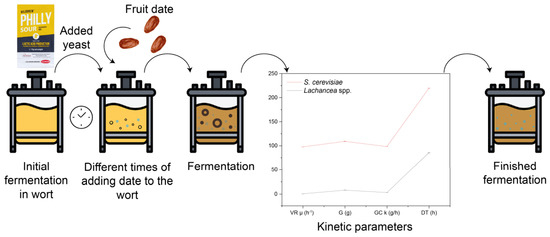
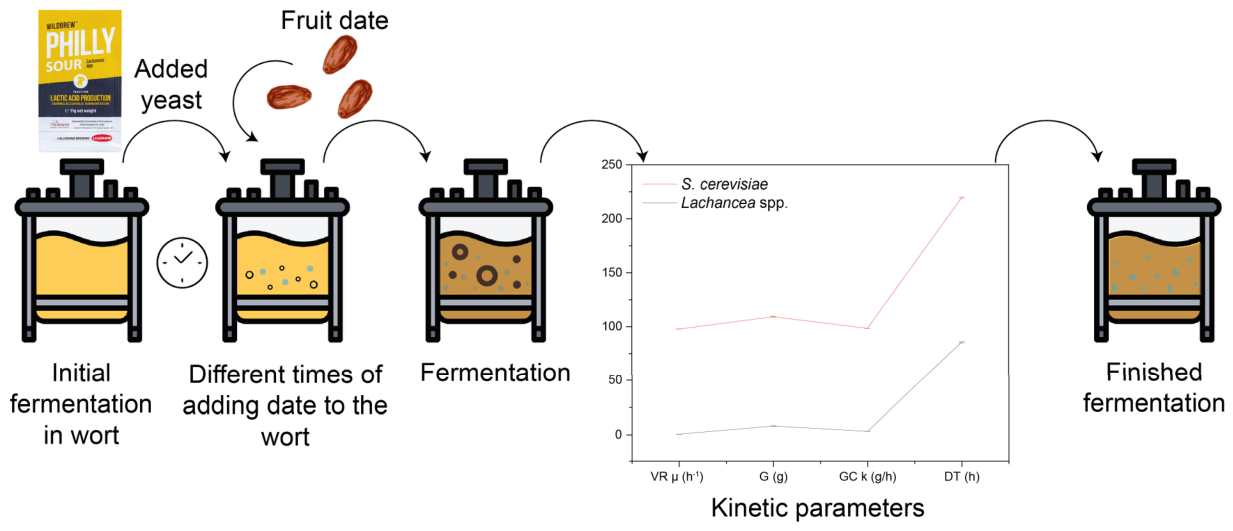
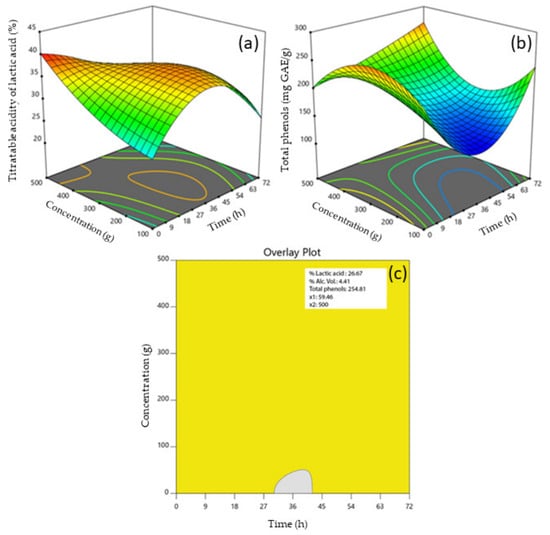
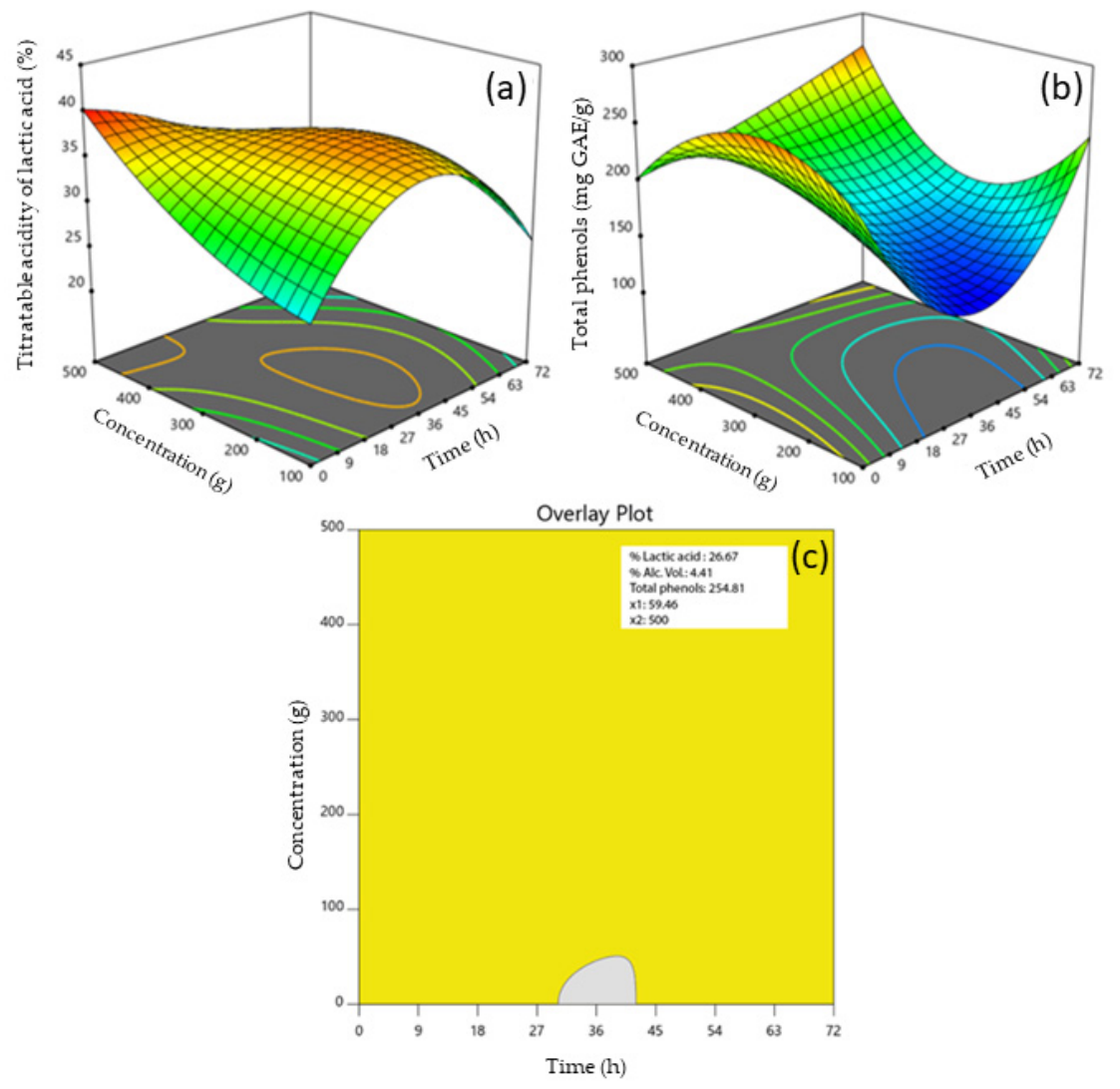
The optimization was carried out to determine the best conditions for brewing a sour beer (i.e., date fruit concentration and fermentation time) within a fermentation process using the yeast Lachancea spp. (Figure 1). The response variables were titratable acidity and total phenols. For titratable acidity, the values without preference were used; with respect to total phenols, the highest values were selected using the Design-Expert 11 software program, version 7.1.5. Figure 2a–c show the response surface graphs of the optimization, specifically, (a) titratable acidity, (b) total phenols and (c) optimal zone, according to the experimental design (Table 1). In the regression model, the process and response variables were used in the experimental design, and the data were fitted to the quadratic model. The ANOVA results with a 95% confidence interval are shown in Table 2. The coefficient of determination (R2) values were acceptable, with values of 0.9560 and 0.9734 for the dependent variables of titratable acidity and total phenols, respectively. Regarding the R2 and adjusted R2, the values were close, and the values of the quadratic model were reliable. However, despite having a high R2, the quadratic model is statistically inadequate for the description of the actual relationship within the data. A highly significant lack of fit (p < 0.0001) indicates that the model does not capture the true curvature or underlying structure of the response. The complete quadratic multiple regression analysis of the second-order polynomial model for the two-factor system was conducted; these results agree with the design and quadratic models in the research reported by Hernández-Bautista et al. [12] and Fonseca-Florido et al. [13].
Figure 1.
Illustrative representation of fermentation.
Figure 2.
Physicochemical properties and bioactive compounds after fermentation, in the production of sour-style beer, with different concentrations and addition times of date extract during the fermentation process: (a) Titratable acidity of lactic acid (%); (b) Total phenols (mg GAE/g); and (c) Favorable operating conditions.
Table 2.
Analysis of variance, showing the dependent variables for the production of the fermented beverage.
The favorable operating conditions, as predicted by the design of the experiments to obtain high phenol content and low titratable acidity production in the brewing process, were constituted by the following: 500 g of dates (date extract), incorporated 59.46 h (60 h) after the start of the fermentation process (Figure 2c). The Lachancea spp. by this point have generally passed their exponential growth phase and entered the stationary phase. At this point, the population is at its maximum, with its enzymatic and metabolic activity at its peak, before the accumulation of ethanol and the scarcity of nutrients decrease its viability. Under these favorable operating conditions, a total phenol content of 254.81 mg GAE/g was achieved, while a titratable acidity of 2.67% was obtained. To corroborate the predicted results of the optimization process, the optimal treatment was experimentally validated, obtaining the following values: 262.24 mg GAE/g and 2.59% titratable acidity; this experimentally demonstrated the results obtained and predicted by the Design-Expert 11 program. In Figure 2a,b of the response surface graphs, a quadratic behavior was observed in both responses with respect to the concentration of date incorporated at different fermentation times. The highest titratable acidity occurred at the beginning of the fermentation, from 0–18 h, and increased as a larger amount of date was incorporated, increasing the quantity from 100 to 500 g (Figure 2a), while the lowest concentration occurred from 54 to 72 h subsequent to date incorporation; this latter behavior is attributed to the yeast, with respect to the relevant nutrients and the viability of the microorganism. In Figure 2b, increases in bioactive compounds were observed when incorporating 300 and 500 g of dates at times of 9 and 63–72 h, respectively. In addition, in the range of 100 to 250 g of dates, and with an incorporation time of 27 to 54 h, the lowest amounts of total phenols were present.
Similar results as to those determined for lactic acid production in this work were reported by Mahanta et al. [14], who developed a co-fermentation process using a co-culture with Saccharomyces pastorianus and Lactobacillus plantarum through an optimization process; it was estimated that a lactic acid production of 3 mg/mL could be obtained using 3.61% total inoculum and 69.69% LAB, 0.08 g/L hops, with additional dextrose of 37.14%. The use of substrates from fruit extracts or other organic by-products has been shown to have significant effects on fermentation processes. A study conducted by Chacón-Figueroa et al. [15] with coffee bagasse extracts produced a stout-style beer, under optimal extraction conditions, with an alcohol content of 30%, a temperature of 30 °C, 17.5 mL of solvent per gram of dry sample and 30 min of sonication time; under these conditions, they obtained a total phenol content of 115.42 ± 1.04 mg GAE/g. These results are similar to those reported in this research, serving as a point of comparison for the use of date extract.
This optimization process for the production of a sour beer by Lachancea spp. using Medjool dates in the tamar stage as a substrate meets the BJCP requirements for brewing within the standard parameters of this fermented beverage, obtaining as well the basic physicochemical properties. The use of an optimization strategy using response surface methodology proved to be an efficient statistical technique for obtaining the optimal production parameters. The Lachancea spp. yeast presented an increase in bioactive compounds when using the Medjool date as a substrate. Therefore, the date components proved to be a favorable substrate for the fermentation process, contributing to the synthesis of bioactive compounds from the Lachancea spp. yeast, and might serve as an alternative for the generation of functional beverages. Dates are an alternative to refined fermentable sugars used as a raw material; this substitution results in an economical alternative, since the dates do not require any special treatment, such as acid hydrolysis, steam explosion or enzymatic treatment, to release sugars in fermentable form. The use of dates in the tamar stage provides a margin of added value through bioprocess technologies, considering their biochemical components and their quality as a substrate for solid-state fermentation by microorganisms, which can increase the added value of the products and establish this technique for the generation of fermented functional foods or beverages [16]. According to Baliga et al. [17], dates contain considerable amounts of bioactive compounds, of which anthocyanins, phenolics, sterols, carotenoids, procyanidins and flavonoids have been identified; these are compounds that are known to have multiple beneficial effects, with demonstrated in vitro beneficial biological activities for health.
3.2. Physicochemical Parameters
Table 3 presents the physicochemical parameters. The treatments showed changes in pH, with values as low as 2.6; treatments 7 and 10 were more acidic when adding the date extract at the initial fermentation time. However, treatments 11 and 12, despite having a pH of 2.6, were the least acidic compared to the others. The percentage of titratable acidity was obtained, with values ranging between 2.20 ± 1.04 and 4.04 ± 0.86, with treatment 7 having the lowest amount of acidity; this can be compared to treatment 12, which had the highest amount of titratable acidity. Alcohol volume percentage in all treatments ranged between 4.3 ± 0.06 and 5.2 ± 0.07, with treatment 9 having the highest alcohol percentage content. Finally, the total phenol content was measured, with values ranging from 126.02 ± 0.52 to 289.50 ± 0.45 mg GAE/g, showing high levels of compounds in the final fermentation products of each treatment; treatment 10 had the highest level of phenolic compounds. The color was affected by the amount of date added, as determined by the treatment, presenting values of a* (red/green coordinates) of 6.12 ± 0.56–10.96 ± 0.12, b* (yellow/blue coordinates) of 19.16 ± 0.21–45.94 ± 0.74 and L* (Brightness) of 36.25 ± 0.25–60.54 ± 0.31. The color variation is caused by the addition of the date extract at different amounts and times during the fermentation and is also enhanced by the acidic environment created by the yeast. These results are similar to those reported by Mahanta et al. [14], who reported pH values of 3.9, lactic acid content of 3.1 mg/mL and %Alc. Vol. of 5.5 under the optimal conditions associated with Belgian-style sour-beer production using Saccharomyces pastorianus and Lactobacillus plantarum as fermentative microorganisms.
Table 3.
Values for the physicochemical parameters of the fermented beverage for the optimization process.
The physicochemical properties obtained in this work meet the desirable or required characteristics within the established criteria (OG, 1.028 to 1.074; PG, 1.002 to 1.016; and %Alc. Vol., 2.8 to 7.0) as defined by the BJCP (sour beers) [2], and are therefore in accordance with those established for obtaining this type of fermented beverage, which is a sour-beer style. Other research seeking to generate this type of beer has adopted the use of microbial consortia (Lactobacillus plantarum/S. cerevisiae; S. cerevisiae/Saprochaete suaveolens; and Hanseniaspora guilliermondii/Hanseniaspora opuntiae/S. cerevisiae) to create distinctive flavor profiles, aromas and possible health benefits, as well as other alternatives to S. cerevisiae (Torulaspora delbrueckii, Lactobacillus acetotolerans, Lactobacillus kefiri/sunkii/parabuchneri/otakiensis, Pediococcus damnosus, Lactobacillus lindneri, Lactobacillus brevis, and Lactobacillus casei/paracasei/zeae, among others) [18,19,20]. The bright brown color obtained in beer is attributed to the main carotenoid pigments present in dates at the tamar stage, namely, lutein and β-carotene, as well as the type of malt and the fermentation process [21,22,23]. The high values presented for titratable acidity and pH for the yeast Lachancea spp. were shown to produce greater titratable acidity and a decrease in pH due to the addition of dates and malts in the production of the wort for the fermentation process. According to works in the literature, some microorganisms such as L. brevis are capable of producing 0.2–0.7 g/L of acetic acid, while the detectability threshold in beer is approximately 0.2 g/L. This effect can be attributed to the proportions of metabolites, which depend on the composition of the medium; if it is high in glucose/maltose/galactose, the amounts of acetic acid/ethanol and CO2 demonstrate increases in these evaluated parameters [24]. However, there are still important factors to control, such as the exothermic reactions caused by yeast activity when the date substrate is incorporated, and constant moderate agitation should be maintained during the fermentation of the must, in order to control the quality and sensory attributes of the beer, these being directly proportional to the kinetic growth reactions of the yeast.
3.3. Kinetic Parameters
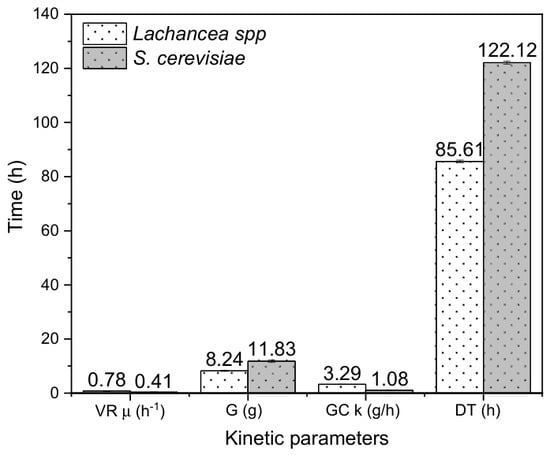
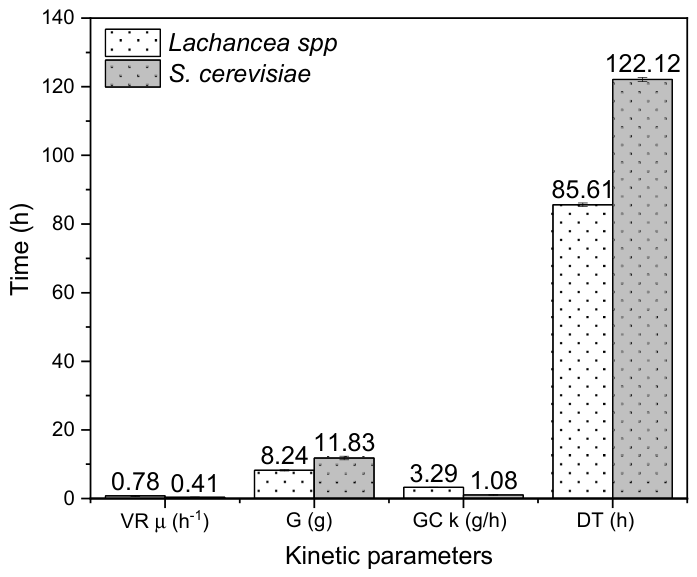
Figure 3 shows the values obtained for the kinetic parameters. In this section, Saccharomyces cerevisiae yeast was included as a control model for comparison with the kinetic parameters of wort growth under favorable operating conditions. The yeast Lachancea spp. showed significant differences (p ≤ 0.05), in all the kinetic parameters of fermentation, with respect to the control with the yeast S. cerevisiae. Saccharomyces cerevisiae is the most widely used microorganism in beer production worldwide, due to its adaptability, survivability, and resilience. It is capable of adapting to different fermentation conditions and producing a variety of compounds from its anaerobic metabolism by implementing glycolysis, in which glucose is phosphorylated and broken down into two triose phosphate compounds to produce ATP and ethanol, as well as carbon dioxide, in addition to secondary metabolites such as esters and higher alcohols, providing flavor and aroma to fermented beverages [25]. It is also the main organism used in fundamental research and in comparison, with other fermentative microorganisms. Due to its desirable physiological properties and its consolidated manipulation methods, S. cerevisiae will undoubtedly remain the ideal organism for numerous applications [26]. The control yeast S. cerevisiae showed a lower speed (μ), 0.41 ± 0.03, compared to Lachancea spp. However, regarding generations (g) and the deceleration time, the yeast S. cerevisiae presented the highest values, 11.83 ± 0.52 and 122.12 ± 0.59, respectively, when compared to Lachancea spp. Therefore, the constant (K) was lower in S. cerevisiae than in the yeast Lachancea spp. Regarding the end of the logarithmic phase and the beginning of the stationary phase, it was achieved more effectively in the yeast S. cerevisiae than in the yeast Lachancea spp., due to its growth rate being effected by the date substrate. Unlike S. cerevisiae, which directs carbon flow almost exclusively toward ethanol and utilizes the Crabtree effect, Lachancea spp. divert some of the sugars (glucose/fructose) toward lactic acid production. This alters the stoichiometric relationship between sugar consumption and release, complicating the use of loss of mass as the sole kinetic indicator [27].
Figure 3.
Kinetic parameters of Lachancea spp. under optimal fermentation conditions and control S. cerevisiae; Velocity rate (VR μ (h−1)), Generations (G (g)), Growth constant (GC k (g/h)) and Deceleration time (DT (h)).
The trials within this research work demonstrate the effect of the date fruit on the fermentation rate of the yeast Lachancea spp. The fastest fermentation kinetic rates were presented with the control yeast S. cerevisiae, with respect to the yeast Lachancea spp. These results are attributed to the physicochemical changes produced in the fermentation process and enzymatic activity, as well as the incorporation of the date fruit as a source of nutrients [6]. Porter et al. [28] demonstrated that yeast species such as Lachancea and its subspecies, such as L. thermotolerans, L. fermentati and L. lanzarotensis, presented oenological potential, determining that for these three sub-species of Lachancea, this is mainly due to the expression of the enzymes β-glucosidase/β-xylosidase during the must fermentation process. Therefore, in this work we attribute the different behaviors of the fermentation kinetics (Figure 3) to the production of β-glucosidase/β-xylosidase, but with different substrate specificities compared to the control, according to the statistical design. Consequently, differences were observed with respect to the physicochemical parameters.
The high substrate contents of fermentable sugars and its low pH can have repressive effects on the activity of the enzyme β-glucosidase in yeasts during wine production [29]. Enzyme activity begins in the early stages of fermentation and is linked to the exponential phase of growth or high metabolic activity of the yeasts, after which time, the decrease in the deceleration of the yeast Lachancea spp. with respect to the control is understandable. The subsequent decrease in activity could potentially be due to the inhibition of enzymatic expression or activity by inhibitory compounds, such as increased levels of ethanol and acids. The strong association between the enzymes and the cell wall suggests that the enzyme plays a role in the structure and maintenance of the cell wall [29,30]. β-Glucosidases have been implicated in cell wall β-1,6-glucan biosynthesis in S. cerevisiae, and intracellular enzymes have been shown to be capable of hydrolyzing natural glucosides (e.g., nerol, α-terpineol and geraniol) [28,31,32]. Previous studies show that Lachancea spp. exhibit better constitutive expression of β-glucosidase activity during fermentation in the medium, compared to S. cerevisiae [5], suggesting a compound or cumulative effect of both Lachancea spp. and S. cerevisiae, and highlighting the advantage of inoculating with Lachancea spp. However, studies are still required on the behavior of enzymes in relation to the type of substrate, temperature and fermentation time required to obtain the desirable physicochemical properties, according to the style of beer to be produced.
4. Conclusions
This study shows that response surface methodology is a practical tool for exploring and identifying favorable brewing conditions for Medjool date fruit addition, even though the quadratic model does not fully describe the experimental variability. Kinetic parameters confirm that yeasts of different genera respond differently to the date-based substrate and wort composition. Under the conditions investigated, Lachancea spp. appear to be a viable alternative for brewing sour beers, and for developing unconventional styles, beyond traditional S. cerevisiae strains.
Author Contributions
U.A.B.-C., L.G.-S. and D.C.-G.: Writing—review and editing, Writing—original draft, Supervision, Validation, Methodology, Investigation, Formal analysis, Data curation. R.T.-R., M.T.B.-C. and J.G.J.-D.: Software, Methodology. D.D.-H. and H.L.L.: Visualization, Conceptualization, Data curation. All authors have read and agreed to the published version of the manuscript.
Funding
This research received no external funding.
Institutional Review Board Statement
Not applicable.
Informed Consent Statement
Not applicable.
Data Availability Statement
The original contributions presented in this study are included in the article. Further inquiries can be directed to the corresponding author.
Acknowledgments
The authors thank the students of the agricultural biotechnology engineering educational program ICA-UABC; the authors also thank José Daniel Salazar-Martínez, Alondra Castro-Villavicencio and Andrea Silva-Gómez for their support of this work in the bioassays. Also, special thanks are accorded to the Cerveceria GYPU, Progreso de Obregon Hidalgo, México, for their openness to scientific collaboration in the development and innovation of functional beverages.
Conflicts of Interest
Author Lourdes González-Salitre was employed by the company Cervecería GYPU. The remaining authors declare that the research was conducted in the absence of any commercial or financial relationships that could be construed as a potential conflict of interest.
References
- González-Salitre, L.; González-Olivares, L.G.; Basilio-Cortes, U.A. Humulus lupulus L. a potential precursor to human health: High hops craft beer. Food Chem. 2023, 405, 134959. [Google Scholar] [CrossRef] [Scilit] [PubMed]
- BJCP (Beer Judge Certification Program). Style Guidelines. 2021. Available online: https://www.bjcp.org/bjcp-style-guidelines (accessed on 26 January 2026).
- Ramanan, M.; Fox, G.P.; Marco, M.L. Beer for live microbe delivery. J. Funct. Foods 2024, 113, 105987. [Google Scholar] [CrossRef] [Scilit]
- Benito, Á.; Calderón, F.; Benito, S. The influence of non-Saccharomyces species on wine fermentation quality parameters. Fermentation 2019, 5, 54. [Google Scholar] [CrossRef] [Scilit]
- Porter, T.J.; Divol, B.; Setati, M.E. Investigating the biochemical and fermentation attributes of Lachancea species and strains: Deciphering the potential contribution to wine chemical composition. Int. J. Food Microbiol. 2019, 290, 273–287. [Google Scholar] [CrossRef] [Scilit]
- González-Salitre, L.; Basilio-Cortés, U.A.; Rodríguez-Serrano, G.M.; Contreras-López, E.; Cardelle-Cobas, A.; González-Olivares, L.G. Physicochemical and microbiological parameters during the manufacturing of a beer-type fermented beverage using selenized Saccharomyces boulardii. Heliyon 2023, 9, e21190. [Google Scholar] [CrossRef] [Scilit]
- Muñoz-Bas, C.; Muñoz-Tebar, N.; Candela-Salvador, L.; Pérez-Alvarez, J.A.; Lorenzo, J.M.; Viuda-Martos, M. Quality characteristics of fresh date palm fruits of “Medjoul” and “Confitera” cv. from the Southeast Spain (Elche Palm Grove). Foods 2023, 12, 2659. [Google Scholar] [CrossRef] [Scilit]
- Rambabu, K.; Bharath, G.; Hai, A.; Banat, F.; Hasan, S.W.; Taher, H.; Mohd Zaid, H.F. Nutritional Quality and Physico-Chemical Characteristics of Selected Date Fruit Varieties of the United Arab Emirates. Processes 2020, 8, 256. [Google Scholar] [CrossRef] [Scilit]
- A.O.A.C. Official Methods of Analysis, 17th ed.; Association of Official Analytical Chemists: Washington, DC, USA, 2000. [Google Scholar]
- Cutaia, A.J.; Reid, A.J.; Speers, R.A. Examination of the relationships between original, real and apparent extracts, and alcohol in pilot plant and commercially produced beers. J. Inst. Brew. 2009, 115, 318–327. [Google Scholar] [CrossRef] [Scilit]
- Singleton, V.L.; Orthofer, R.; Lamuela-Raventós, R.M. Analysis of total phenols and other oxidation substrates and antioxidants by means of folin-ciocalteu reagent. In Methods in Enzymology; Academic Press: Cambridge, MA, USA, 1999; Volume 299, pp. 152–178. [Google Scholar] [CrossRef] [Scilit]
- Hernandez-Bautista, M.; Falfán-Córtes, R.N.; Gómez-Aldapa, C.A.; Castro-Rosas, J.; Salgado-Delgado, R.; Palma-Rodríguez, H.M.; Vargas-Torres, A. Microencapsulation of Hibiscus sabdariffa extract in taro starch: Determination of optimal conditions of bioactive compound retention using response surface methodology. Int. J. Biol. Macromol. 2024, 282, 137145. [Google Scholar] [CrossRef] [Scilit]
- Fonseca-Florido, H.A.; Vázquez-García, H.G.; Méndez-Montealvo, G.; Basilio-Cortés, U.A.; Navarro-Cortés, R.; Rodríguez-Marín, M.L.; Gómez-Aldapa, C.A. Effect of acid hydrolysis and OSA esterification of waxy cassava starch on emulsifying properties in Pickering-type emulsions. LWT 2018, 91, 258–264. [Google Scholar] [CrossRef] [Scilit]
- Mahanta, S.; Sivakumar, P.S.; Parhi, P.; Mohapatra, R.K.; Dey, G.; Panda, S.H.; Panda, S.K. Sour beer production in India using a coculture of Saccharomyces pastorianus and Lactobacillus plantarum: Optimization, microbiological, and biochemical profiling. Braz. J. Microbiol. 2022, 53, 947–958. [Google Scholar] [CrossRef] [Scilit]
- Chacón-Figueroa, I.H.; Medrano-Ruiz, L.G.; Moreno-Vásquez, M.D.J.; Ovando-Martínez, M.; Gámez-Meza, N.; Del-Toro-Sánchez, C.L.; Dórame-Miranda, R.F. Use of Coffee Bean Bagasse Extracts in the Brewing of Craft Beers: Optimization and Antioxidant Capacity. Molecules 2022, 27, 7755. [Google Scholar] [CrossRef] [Scilit]
- Chandrasekaran, M.; Bahkali, A.H. Valorization of date palm (Phoenix dactylifera) fruit processing by-products and wastes using bioprocess technology—Review. Saudi J. Biol. Sci. 2013, 20, 105–120. [Google Scholar] [CrossRef] [Scilit]
- Baliga, M.S.; Baliga, B.R.V.; Kandathil, S.M.; Bhat, H.P.; Vayalil, P.K. A review of the chemistry and pharmacology of the date fruits (Phoenix dactylifera L.). Food Res. Int. 2011, 44, 1812–1822. [Google Scholar] [CrossRef] [Scilit]
- Williamson, C.; Kennedy, K.; Bhattacharya, S.; Patel, S.; Perry, J.; Bolton, J.; Chan, L.L.Y. A novel image-based method for simultaneous counting of Lactobacillus and Saccharomyces in mixed culture fermentation. J. Ind. Microbiol. Biotechnol. 2023, 50, kuad007. [Google Scholar] [CrossRef] [Scilit]
- Kayadelen, F.; Agirman, B.; Jolly, N.P.; Erten, H. The influence of Torulaspora delbrueckii on beer fermentation. FEMS Yeast Res. 2023, 23, foad006. [Google Scholar] [CrossRef] [Scilit]
- Bourbon-Melo, N.; Palma, M.; Rocha, M.P.; Ferreira, A.; Bronze, M.R.; Elias, H.; Sá-Correia, I. Use of Hanseniaspora guilliermondii and Hanseniaspora opuntiae to enhance the aromatic profile of beer in mixed-culture fermentation with Saccharomyces cerevisiae. Food Microbiol. 2021, 95, 103678. [Google Scholar] [CrossRef] [Scilit]
- Messadi, N.; Mechmeche, M.; Setti, K.; Tizemmour, Z.; Hamdi, M.; Kachouri, F. Consumer perception of a new non-dairy functional beverage optimized made from lactic acid bacteria fermented date fruit extract. Int. J. Gastron. Food Sci. 2023, 34, 100831. [Google Scholar] [CrossRef] [Scilit]
- Carvalho, D.O.; Guido, L.F. A review on the fate of phenolic compounds during malting and brewing: Technological strategies and beer styles. Food Chem. 2022, 372, 131093. [Google Scholar] [CrossRef] [Scilit] [PubMed]
- Boudries, H.; Kefalas, P.; Hornero-Méndez, D. Carotenoid composition of Algerian date varieties (Phoenix dactylifera) at different edible maturation stages. Food Chem. 2007, 101, 1372–1377. [Google Scholar] [CrossRef] [Scilit]
- Ciosek, A.; Fulara, K.; Hrabia, O.; Satora, P.; Poreda, A. Chemical composition of sour beer resulting from supplementation the fermentation medium with magnesium and zinc ions. Biomolecules 2020, 10, 1599. [Google Scholar] [CrossRef] [Scilit] [PubMed]
- Kurtzman, C.P.; Fell, J.W.; Boekhout, T. (Eds.) The Yeasts; Elsevier: Amsterdam, The Netherlands, 2010; Volume 2354, ISBN 978-0-444-52149-1. [Google Scholar]
- Oliver, S.G. From genomes to systems: The path with yeast. Philos. Trans. R. Soc. B Biol. Sci. 2006, 361, 477–482. [Google Scholar] [CrossRef] [Scilit]
- Vicente, J.; Vladic, L.; Navascués, E.; Brezina, S.; Santos, A.; Calderón, F.; Benito, S. A comparative study of Lachancea thermotolerans fermentative performance under standardized wine production conditions. Food Chem. X 2024, 21, 101214. [Google Scholar] [CrossRef] [Scilit]
- Porter, T.J.; Divol, B.; Setati, M.E. Lachancea yeast species: Origin, biochemical characteristics and oenological significance. Food Res. Int. 2019, 119, 378–389. [Google Scholar] [CrossRef] [Scilit]
- Rosi, I.; Vinella, M.; Domizio, P. Characterization of β-glucosidase activity in yeasts of oenological origin. J. Appl. Bacteriol. 1994, 77, 519–527. [Google Scholar] [CrossRef] [Scilit]
- Abeijon, C.; Chen, L.Y. The role of glucosidase I (Cwh41p) in the biosynthesis of cell wall β-1, 6-glucan is indirect. Mol. Biol. Cell 1998, 9, 2729–2738. [Google Scholar] [CrossRef] [Scilit] [PubMed]
- Cordero-Bueso, G.; Esteve-Zarzoso, B.; Cabellos, J.M.; Gil-Díaz, M.; Arroyo, T. Biotechnological potential of non-Saccharomyces yeasts isolated during spontaneous fermentations of Malvar (Vitis vinifera cv. L.). Eur. Food Res. Technol. 2013, 236, 193–207. [Google Scholar] [CrossRef] [Scilit]
- Hinojosa-Avila, C.R.; García-Gamboa, R.; Chedraui-Urrea, J.J.; García-Cayuela, T. Exploring the potential of probiotic-enriched beer: Microorganisms, fermentation strategies, sensory attributes, and health implications. Food Res. Int. 2023, 175, 113717. [Google Scholar] [CrossRef] [Scilit]

Disclaimer/Publisher’s Note: The statements, opinions and data contained in all publications are solely those of the individual author(s) and contributor(s) and not of MDPI and/or the editor(s). MDPI and/or the editor(s) disclaim responsibility for any injury to people or property resulting from any ideas, methods, instructions or products referred to in the content. |
© 2026 by the authors. Licensee MDPI, Basel, Switzerland. This article is an open access article distributed under the terms and conditions of the Creative Commons Attribution (CC BY) license.