


Abstract
Asian redtail catfish (Hemibagrus nemurus) is an indigenous freshwater species cultured in Magelang, Central Java, Indonesia, with considerable potential to bolster sustainable aquaculture and regional food security. However, its commercial production remains constrained by relatively slow growth. This study investigated the effects of dietary supplementation with the indigenous probiotic Bacillus subtilis UBA1, isolated from the intestinal tract of H. nemurus (12.22 ± 0.64 cm; 30.34 ± 3.03 g), combined with molasses as a prebiotic substrate, on growth performance (weight gain/WG, specific growth rate/SGR, feed intake/FI, feed conversion ratio/FCR, feed efficiency/FE, survival rate/SR), somatic liver index (HSI), nutrient utilization (final body protein/FP, protein retention/PR, final body lipid/FL, lipid retention/LR), intestinal histomorphology (villus height/VH, villus width/VW, villus surface area/VSA), microbiota relative abundance and diversity, and blood biochemical profiles (glucose/GLU, hemoglobin/Hb, high-density lipoprotein/HDL, triglycerides/TG). This study applied a completely randomized design, with different bacterial suspensions for further incorporation in diets (20 mL·kg−1 diet), namely 0 CFU·mL−1 (P1), 1 × 10⁶ CFU·mL−1 (P2), 1 × 10⁸ CFU·mL−1 (P3), and 1 × 10¹⁰ CFU·mL−1 (P4). Each treatment was performed in triplicate. All parameters, except microbiota relative abundance and diversity, were statistically analyzed using a one-way analysis of variance and Duncan’s multiple range test at a 95% confidence level. Supplementing B. subtilis UBA1 in diets affected WG, FCR, and FE, which were connected to elevated FP and PR. Microbiota analysis was exploratory and limited to P1 and P3 due to PCR constraints; thus, changes in the microbial composition of P3 cannot be directly linked to the optimal growth response observed in P2. B. subtilis UBA1 had no harmful effect on physiological processes under low HSI and glucose levels, and a high Hb level, compared to P1 treatment. Overall, this study provides scientific evidence supporting the use of the indigenous probiotic B. subtilis UBA1 at 106–108 CFU·mL−1 suspension as a functional feed additive to improve growth performance and physiological health in locally cultured Asian redtail catfish.
1. Introduction
The Asian redtail catfish (Hemibagrus nemurus), locally known as beong or baung, is an indigenous freshwater species widely distributed across Sumatra, Java, and Kalimantan, Indonesia [1]. In recent years, this species has emerged as a promising candidate for freshwater aquaculture in Magelang, Central Java, where it was previously harvested exclusively from the Progo River [2,3]. Beyond conserving indigenous fish resources, H. nemurus has considerable potential to support regional aquaculture development and contribute to food security by providing a sustainable source of high-quality animal protein. However, commercial production of this species remains constrained by its relatively slow growth rate, averaging only 1.19% day−1 under lowland culture conditions [4].
In addition to slow growth, the survival rate of cultured H. nemurus remains relatively low, averaging approximately 50% [5]. This poor production performance has been attributed primarily to the species’ limited ability to efficiently digest and utilize formulated diets commonly used in aquaculture [6]. Consequently, a substantial proportion of dietary nutrients is allocated to maintaining essential physiological functions rather than somatic growth, resulting in suboptimal production performance [7]. Poor nutrient utilization has also been associated with increased aggressive behavior and cannibalism among juveniles, with mortality reaching up to 50% of the cultured population [8]. Therefore, improving digestive efficiency and nutrient utilization represents a key strategy for enhancing both growth performance and survival in cultured H. nemurus.
Probiotic supplementation has gained increasing attention as an environmentally sustainable nutritional strategy for improving fish health and aquaculture productivity. Probiotics are defined as live microorganisms that, when administered in adequate amounts, confer health benefits on the host by enhancing intestinal microbial balance, digestive processes, nutrient utilization, and immune function [9]. Candidate probiotic strains are generally selected based on their ability to produce extracellular digestive enzymes, tolerate acidic conditions and bile salts, survive feed processing, and inhibit pathogenic microorganisms [10,11,12]. These characteristics enable probiotics to colonize the gastrointestinal tract and improve digestive efficiency, thereby promoting fish growth and overall health.
Previous studies have demonstrated that dietary supplementation with commercial probiotics significantly improves the growth performance of H. nemurus, with the optimal response achieved at inclusion levels of 8–10 mL·kg−1 diet [6,13]. In addition to improving growth, probiotic supplementation has been shown to increase the abundance of beneficial intestinal bacteria, thereby enhancing digestive efficiency and maintaining intestinal microbial homeostasis [14]. Improved gut microbial balance also contributes to greater resilience against environmental stressors, leading to lower mortality and enhanced tolerance to adverse culture conditions [15,16]. In addition to survival, physiological stress in fish can be evaluated through liver condition and blood biochemical parameters, which are widely recognized as reliable indicators of metabolic status and overall health [17].
Despite these promising outcomes, the efficacy of commercial probiotics may be limited because many products are developed from bacterial strains isolated from fish species other than the target host. Host-derived (indigenous) probiotics are considered more effective because they are better adapted to the species’ intestinal environment, resulting in improved colonization rate up to 1.5 folds, compared to commercial probiotics (1.5 × 10⁴ CFU·mL−1 vs. 1 × 10⁴ CFU·mL−1) [18], persistence rate up to 87% [19], and probiotic functionality, specifically in weight gain (up to 30 g vs. 20 g) and specific growth rate (up to 1.2%.day−1 vs. 0.8%.day−1) [20]. In a previous in vitro study, Bacillus subtilis UBA1 was isolated from the intestinal tract of H. nemurus and identified as a promising indigenous probiotic candidate. This strain survived under acidic conditions (pH 2) and exhibited moderate-to-strong antagonistic activity against the important fish pathogens Edwardsiella tarda and Aeromonas hydrophila [21]. However, the in vivo efficacy of B. subtilis UBA1 in improving digestive function, intestinal microbiota, physiological health, and growth performance of H. nemurus has not yet been investigated.
The effectiveness of B. subtilis UBA1 may be further enhanced by combining it with molasses, a low-cost carbon source recognized as a potential prebiotic in aquaculture. Dietary supplementation with molasses at 10–20 mL·kg−1 diet has been reported to stimulate the proliferation of beneficial intestinal bacteria while suppressing pathogenic microorganisms in African catfish (Clarias gariepinus) [22] and Nile tilapia (Oreochromis niloticus) [23]. These beneficial effects are attributed primarily to the presence of fructooligosaccharides (FOSs), which serve as fermentable substrates that selectively stimulate beneficial gut microorganisms and support probiotic viability [24,25]. Consequently, dietary supplementation with molasses may enhance the establishment and functionality of the host-derived probiotic B. subtilis UBA1 within the intestinal tract by providing fermentable substrates that support beneficial microbial activity.
In this synbiotic system, B. subtilis UBA1 is expected to colonize the intestine more effectively, while molasses provides fermentable nutrients that support both the supplemented probiotic and the resident beneficial microbiota [26]. Enhanced microbial activity may subsequently improve digestive efficiency, nutrient utilization, and intestinal microbial balance, which can ultimately promote fish growth while alleviating physiological stress. However, no previous study has evaluated the combined effects of the indigenous probiotic B. subtilis UBA1 and molasses on growth performance, digestive enzyme activity, intestinal bacterial communities, liver health, oxidative stress biomarkers, and blood biochemical responses in H. nemurus. Therefore, the present study aimed to evaluate the effects of dietary supplementation with the indigenous probiotic Bacillus subtilis UBA1, administered with different levels of molasses, on growth performance, digestive enzyme activity, intestinal microbiota, liver health, oxidative stress biomarkers, and blood biochemical responses in cultured Asian redtail catfish (H. nemurus).
2. Materials and Methods
2.1. Experimental Site
The feeding trial was conducted at the Sawangan Fish Seed Center (Balai Benih Ikan Sawangan, Depok, Indonesia), Magelang, Central Java, Indonesia, where fish rearing and dietary treatments were performed. Proximate analyses of the experimental diets and fish whole-body composition, and physiological stress evaluations were carried out at the Animal Nutrition Laboratory, Universitas Tidar. Analyses of intestinal bacterial abundance and diversity were conducted at the Microbiology Laboratory, Universitas Tidar, Kota Magelang, Indonesia.
2.2. Experimental Design
The experiment was arranged in a completely randomized design. Treatments in this study were composed of different bacterial suspensions that were incorporated into diets at 20 mL·kg−1 basal diet, namely 0 CFU·mL−1 (P1), 1 × 10⁶ CFU·mL−1 (P2), 1 × 10⁸ CFU·mL−1 (P3), and 1 × 10¹⁰ CFU·mL−1 (P4). Each treatment was performed in triplicate, yielding a total of 12 experimental units.
2.3. Fish and Rearing Conditions
Twelve hapas (2.0 × 1.0 × 1.0 m3) were installed in an earthen pond (20.0 × 10.0 × 2.0 m3), with each hapa representing one experimental unit. The hapas were randomly assigned to the four dietary treatments in triplicates. Juvenile Asian redtail catfish (12.22 ± 0.64 cm; 30.34 ± 3.03 g) as fish samples in this study were obtained from the Sawangan Fish Seed Center. Each hapa was stocked with 10 fish [27]. Prior to stocking, all fish were individually weighed to determine their initial body weight. Then, three fish were randomly taken for initial whole-body proximate composition analysis (crude protein and crude lipid), while other fish were evenly stocked to each hapa. Before the feeding trial for 64 days, all fish were fasted for 24 h to standardize their physiological condition. Fish were subsequently fed the experimental diets for 64 days. All diets were fed to apparent satiation twice daily at 08:00 and 16:00 (GMT + 7). Diet consumption was recorded throughout the experimental period to determine feed intake. Water quality was monitored throughout the experiment and maintained within the following ranges: temperature, 27–32.4 °C; pH, 7.0–8.8; dissolved oxygen, 6.2–8.7 mg·L−1; and total ammonia, 0.0–0.25 mg·L−1, following the minimum recommended culture conditions for Asian redtail catfish [28].
2.4. Diet Preparation and Probiotic Supplementation
A commercial diet (HI PRO-VITE 781; PT. Central Proteina Prima, Inc., Jakarta, Indonesia) was used as the basal diet. To prepare the bacterial suspension prior to its incorporation into the diet, the indigenous probiotic Bacillus subtilis UBA1 was cultured in Tryptic Soy Broth (TSB) and adjusted to several concentrations, based on the treatments applied, which were 1 × 10⁶ CFU·mL−1, 1 × 10⁸ CFU·mL−1, and 1 × 10¹⁰ CFU·mL−1 [6]. Then, each bacterial suspension was incorporated into the basal diet with molasses as the prebiotic source and a coating agent, except the P1 treatment, which was used as the control treatment (0 CFU·mL−1 suspension). The probiotic suspension and molasses were applied to the basal diet of P2, P3, and P4 treatments by spraying at a similar dosage of 20 mL·kg−1 basal diet. After supplementation, the diets were thoroughly mixed, air-dried under sterile conditions, and stored in sterile airtight containers at approximately 25 °C until use. Fish were fed the experimental diets for 64 days. The nutrient profiles of each treatment diet were validated before the diets were fed to the fish, following the national standard of nutrient requirement for catfish culture in Indonesia [29], as presented in Table 1.
Table 1.
Nutrient profiles of indigenous probiotic-supplemented diets.
2.5. Final Sampling
At the end of the 64-day feeding trial, fish were fasted for 24 h prior to sampling. All fish from each hapa were counted and weighed to determine the final biomass and survival rate level. To determine other parameters besides fish biomass and survival rate, eight fish were randomly collected from each experimental unit (hapa) for laboratory analyses. Of these six fish, four fish were used for final whole-body proximate composition analysis (protein-lipid analyses), whereas the remaining four fish were sampled for liver, blood, and intestinal tissues to evaluate their somatic liver weight, blood biochemical profiles, and intestinal histomorphology. For intestinal bacterial abundance and diversity, the last two fish from each experimental unit (hapa) were collected and prepared by dissecting the fish to obtain the intestine sample before being preserved in a freezer (−80 °C).
2.6. Parameters
2.6.1. Growth Performance and Somatic Liver Index
Growth performance was evaluated based on weight gain (WG), specific growth rate (SGR), feed intake (FI), feed conversion ratio (FCR), feed efficiency (FE), and survival rate (SR). All growth performance indices were calculated using standard aquaculture equations. Meanwhile, liver health was evaluated using the hepatosomatic index (HSI), as described by [17].
2.6.2. Nutrient Utilization
The nutrient utilization evaluated in this study was composed of final body protein level (FP), protein retention (PR), final body lipid level (FL), and lipid retention (LR). These parameters were determined using proximate analysis methods, specifically Kjeldahl method and Soxhlet method for fish body protein and lipid analysis, respectively.
2.6.3. Intestinal Histomorphology
For intestinal histomorphology analysis, intestinal tissues were fixed and processed using standard histological procedures with hematoxylin–eosin (HE) staining method. Histological sections were examined under a light microscope at 400× magnification to measure villus width (VW), villus height (VH), and villus surface area (VSA), which were used as indicators of intestinal development and absorptive capacity.
2.6.4. Intestinal Bacterial Relative Abundance and Alpha-Diversity Indices
Intestinal bacterial abundance and diversity were determined using samples collected from the intestine. These analyses were performed in Integrated Genome Factory, PT Integra Biotek Indonesia, Yogyakarta, Indonesia. Total bacterial abundance and bacterial diversity conditions were analyzed using the Polymerase Chain Reaction (PCR) method to characterize the composition of the intestinal bacterial community via metabarcoding 16s rRNA genes (V1–V9 regions) detection. Before detection, DNA samples from each intestine were extracted using the ZymoBIOMICS DNA Miniprep Kit (ZymoResearch Corp., Irvine, CA, USA). Prior to the extraction process, samples were chopped finely using a scalpel blade, and the bead beating step was performed for 5 min with 30 s incubation on ice within a 1 min interval.
After the extraction process, the DNA extract concentration from each sample was assessed by Qubit Fluorometer 4.0 with Equalbit 1x dsDNA HS Assay Kit (Vazyme International LLC., Nanjing, China). Furthermore, the full-length 16S rRNA gene (~1500 bp) was amplified once using KOD One PCR Master Mix (Toyobo Co., Ltd., Osaka, Japan). The reaction mixture consisted of 11.5 μL DNA extract, 12.5 μL master mix, and 0.75 μL each of forward primer (AGRGTTYGATYMTGGCTCAG) and reverse primer (RGYTACCTTGTTACGACTT) [30]. Before amplification process, sample was once again re-assessed by Qubit Fluorometer 4.0 with Equalbit 1x dsDNA HS Assay Kit (Vazyme International LLC., Nanjing, China) to meet the amplification standard protocol from the facility. Amplification was performed on an Opentrons Flex 2 Thermal Cycler using the following program: Initial denaturation at 95 °C for 2 min; 35 cycles of denaturation at 95 °C for 30 s, annealing at 58 °C for 30 s, and extension at 72 °C for 90 s; followed by a final extension at 72 °C for 5 min. PCR products were quantified once again using Qubit Fluorometer 4.0 with Equalbit 1x dsDNA HS Assay Kit, then purified using VAHTS DNA Clean Beads (Vazyme International LLC., Nanjing, China) at a 1:1 ratio and eluted in 20 μL to obtain clean amplicons.
Sequencing libraries were prepared using the Ligation Sequencing Amplicon Native Barcoding Kit 96 V14 (SQK-NBD114-96; Oxford NanoPore Technologies plc., Oxford, UK) with modified incubation steps for end-prep, barcode ligation, and adapter ligation. Libraries were sequenced on an Oxford Nanopore PromethION platform. Basecalling was performed using Dorado v7.11.2 with the dna_r10.4.1_e8.2_400bps_sup@v5.2.0 model, applying a minimum Q score threshold of 10 and trimming of adapters and barcodes. Raw nanopore reads were evaluated using NanoPlot to inspect read length distributions, quality scores, and overall sequencing performance. Taxonomic assignment was conducted using the EPI2ME wf-16S v1.6.1 workflow, which employs Kraken2 against the ncbi_16s_18s_28s_ITS database. To ensure accurate targeting of full-length 16S rRNA amplicons, reads were filtered to 1300–1600 bp length to target the 16S rRNA amplicons only. Classified reads were exported for downstream ecological analysis. Relative abundance tables were generated at phylum, family, genus, and species levels, and visualized as stacked bar plots. Alpha-diversity indices were computed using standard ecological analysis packages, providing quantitative measures of richness and diversity within each sample.
2.6.5. Blood Biochemical Analysis
Blood samples were collected from the caudal vein and preserved in different microtubes in line with different experimental units. These blood samples were then taken and dropped in H101 Hemoglobin Analyzer (Changsha Sinocare Inc., Changsha, China) to obtain hemoglobin level (Hb). Blood samples were also inserted into GlucoDr. Auto A Test Kit (Allmedicus Co., Ltd., Anyang-si, Republic of Korea) to obtain glucose level (GLU). Meanwhile, blood plasma biochemical parameters, including high-density lipoprotein (HDL) and triglycerides (TGs) were analyzed by inserting the blood samples into the Nesco Lipid Test Panel Monitoring System BL-101 (PT. Djuniar Djuniar, Jakarta, Indonesia). All blood biochemical parameters were presented in mg·dL−1 unit, except glucose level in g·dL−1. Blood glucose and hemoglobin levels were validated within 56–85 mg·dL−1 and 5–10.5 g·dL−1 [31]. The plasma triglyceride and high-density lipoprotein contents of fish samples were validated, following the standard range protocol from the kits and [32], namely within 60–200 mg·dL−1 and 40–100 mg·dL−1, respectively.
2.7. Statistical Analysis
All quantitative data were tested for normality and homogeneity of variance before statistical analysis. Data on growth performance, nutrient utilization (FP, PR, FL, LR), intestinal histomorphology (VW, VH, VSA), liver health indicators (HSIs), and blood biochemical parameters (Hb, GLU, HDL, TG) were analyzed using one-way analysis of variance (one-way ANOVA) to evaluate the main effects of dietary probiotic supplementation. When significant differences were detected (p < 0.05), treatment means were compared using Duncan’s multiple range test (DMRT), which was appropriate for designs with ≥3 treatments and ≥3 replicates per treatment. Statistical analyses were performed using Microsoft Excel 2021 (Microsoft Corp., Redmond, WA, USA) and IBM SPSS Statistics version 16.0 (IBM Corp., New York, NY, USA). Data on intestinal bacterial relative abundance and alpha-diversity conditions were analyzed descriptively among treatments, if all samples successfully passed the standard range protocol for qubit concentration, as performed in the Integrated Genome Factory, PT Integra Biotek Indonesia, Yogyakarta, Indonesia.
3. Results
3.1. Growth Performance and Somatic Liver Index
In this study, growth performance parameters were composed of eight gain (WG), specific growth rate (SGR), feed intake (FI), feed conversion ratio (FCR), feed efficiency (FE), and survival rate (SR). Meanwhile, somatic liver index to determine relative liver health was measured from the hepatosomatic index (HSI). All of these data were obtained from feeding the fish with indigenous probiotic-supplemented diets (P2, P3, and P4 treatments) and control diet (P1 treatment) for 64 days, tabulated, analyzed, then presented in Table 2.
Table 2.
Growth performance and somatic liver index of Asian redtail catfish.
In growth performance, WG indicates a significant difference among treatments, with the P2 treatment showing the highest value (p < 0.05). Meanwhile, after P2 treatment, feeding indigenous probiotic above 1 × 10⁶ CFU·mL−1 suspension (P2) caused a lower level in WG. Similarly, this condition is also presented in FE, yet the P3 and P4 treatments present the same value with the P1 treatment (p > 0.05). In contrast, FCR value in P2 treatment obtained the lowest value compared to other treatments (p < 0.05). Furthermore, other growth performance parameters, such as SGR, SR, and FI, showed insignificant differences among treatments. However, HSI values in all treatments were significantly different, with P4 treatment obtaining the highest value among other treatments (p < 0.05).
3.2. Nutrient Utilization
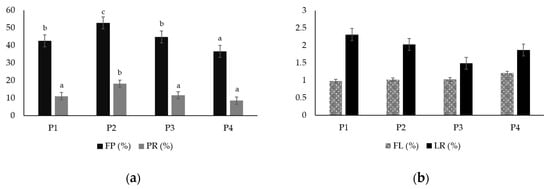
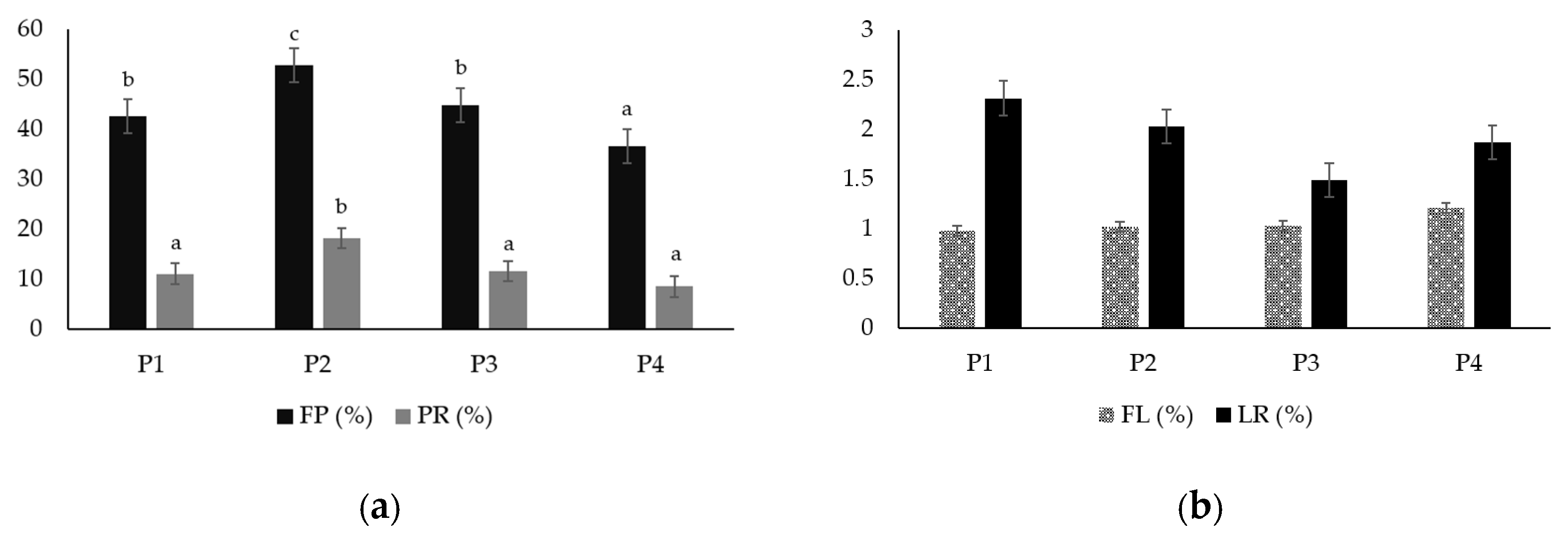
Nutrient utilization parameters, including final body protein level (FP), protein retention (PR), final body lipid level (FL), and lipid retention (LR), are presented in Figure 1a,b. These values were obtained from three randomly sampled fish in each experimental unit (hapa) after being reared for 64 days and fed with indigenous probiotic-supplemented diets.
Figure 1.
Nutrient utilization in Asian redtail catfish after being fed with indigenous probiotic B. subtilis UBA1 diets for 64 days: (a) Final body protein (FP) and protein retention (PR); (b) final body lipid (FL) and lipid retention (LR). All values are presented as average ± standard deviation. Different letters above bars indicate significant differences among treatments (p < 0.05; DMRT). P1 = 0 CFU·mL−1 suspension; P2 = 1 × 10⁶ CFU·mL−1 suspension; P3 = 1 × 10⁸ CFU·mL−1 suspension; P4 = 1 × 10¹⁰ CFU·mL−1 suspension.
In Figure 1a, FP and PR were significantly different among treatments (p < 0.05). The highest FP and PR are both presented in the P2 treatment. As shown in WG and FE (Table 1), the P2 treatment performed the best compared to other treatments. Moreover, this condition also indicates that applying indigenous probiotic B. subtilis UBA1 at more than 1 × 10⁶ CFU·mL−1 suspension in 20 mL·kg−1 basal diet could decrease protein utilization in Asian redtail catfish, following decreasing trends in final body protein and protein retention levels. However, feeding indigenous probiotic-supplemented diets had no significant effect on lipid utilization levels due to insignificant different values in both final body lipid and lipid retention levels (Figure 1b; p > 0.05).
3.3. Intestinal Histomorphology
Intestinal histomorphology parameters, namely villus width (VW), villus height (VH), and villus surface area (VSA), were measured to determine the intestinal development and absorptive capacity in Asian redtail catfish after feeding with indigenous probiotic-supplemented diets for 64 days. These three parameters are tabulated and presented in Table 3.
Table 3.
Intestinal histomorphology of Asian redtail catfish.
After feeding with indigenous probiotic-supplemented diets, all histomorphological parameters indicate significant differences, except VW value (p > 0.05). The highest VH value was obtained from the P2 treatment, while the P3 treatment showed the second highest VH value, although it presented insignificant differences with P1 and P4 treatments (p > 0.05). In contrast, the P3 treatment obtained the highest VSA value, followed by the P2 treatment, though it showed an insignificant difference with P1 and P4 treatment.
3.4. Intestinal Bacterial Relative Abundance and Alpha-Diversity Indices
3.4.1. Intestinal Bacterial Relative Abundance
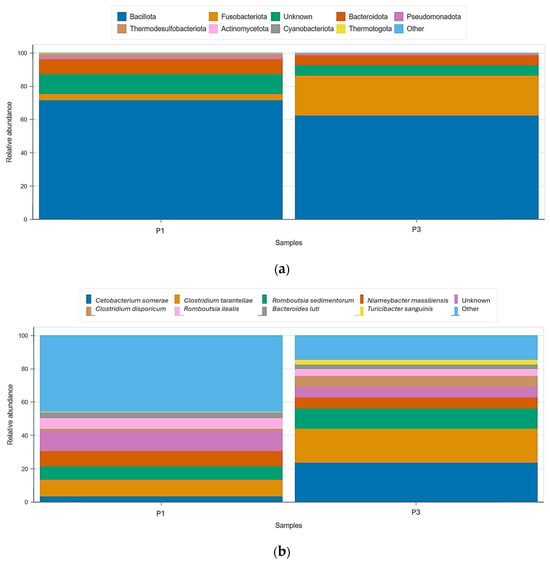
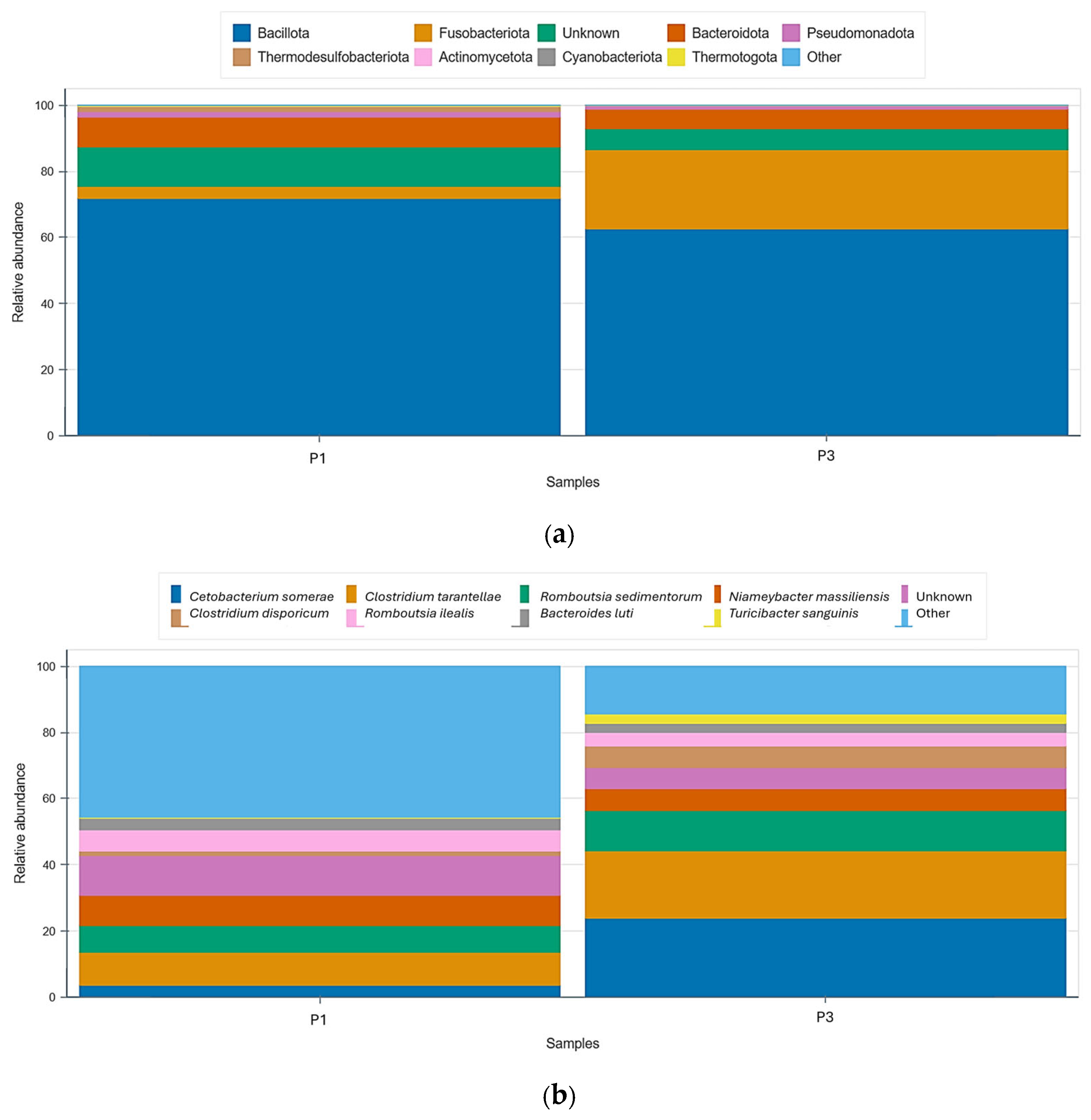
The relative abundance of bacterial community in the intestinal tract of Asian redtail catfish is presented from all treatments. As the 16S rRNA sequencing was conducted only on samples that successfully passed all pre-sequencing quality control steps, only P1 and P3 treatments produced amplicons with sufficient concentration and integrity for downstream processing. In contrast, P2 and P1 (treatment-level sample) failed the PCR quality control standard and could not proceed to purification or sequencing, according to the standard workflow. As a result, metabarcoding analysis was performed exclusively on P1 and P3. The relative abundance was compared between phylum and species levels in percentage unit (%; Figure 2a,b).
Figure 2.
Bacterial relative abundance in the digestive tract of Asian redtail catfish after being fed a diet containing indigenous probiotic B. subtilis UBA1 at 1 × 10⁸ CFU·mL−1 suspension (P3) and without indigenous probiotic (0 CFU·mL−1; P1) for 64 days: (a) Relative abundance in phylum level; (b) relative abundance in species level.
The bacterial community in the digestive tract of Asian redtail catfish differed between treatments, with distinct shifts in the dominant phyla (Figure 2a). Although the overall phylum composition was broadly similar, the relative contributions of major taxa varied between treatments. In both treatments, the community was primarily composed of Bacillota (Firmicutes) and Fusobacteriota, accompanied by minor proportions of Bacteroidota and other low-abundance phyla. At the species level (Figure 2b), the microbiome profiles of P1 and P3 treatments showed clear differences in the abundance of several key taxa. There were three most prominent species detected across treatments, namely Cetobacterium somerae (23.92% in P3 vs. 3.65% in P1), Clostridium tarantellae (20.28% in P3 vs. 9.98% in P1), and Romboutsia sedimentorum (12.17% in P3 vs. 8.06% in P1). Other bacteria, such as Clostridium disporicum, Clostridium tarantellae, Romboutsia ilealis, Bacteroides luti, Niameybacter massiliensis, and Turicibacter sanguinis, were also detected, with values between 2 and 6.5% in P3 treatment, and lower in P1 treatment. However, B. subtilis UBA1 remained undetected.
3.4.2. Bacterial Alpha-Diversity Indices
In Table 4, the alpha-diversity indices of the bacterial community in both P1 and P3 treatments were compared descriptively with several parameters, namely the Berger–Parker index, effective number of species, Fisher’s alpha, inverse Simpson’s index, Pielou’s evenness, Richness, Shannon diversity index, and Simpson’s index.
Table 4.
Alpha-diversity indices of bacterial community in digestive tract of Asian redtail catfish.
Alpha-diversity indices revealed clear differences in community structure between the P1 and P3 treatments. Shannon diversity (P1 = 2.88; P3 = 2.55) and Fisher’s alpha (P1 = 24.71; P3 = 16.47) were both higher in P1, as the bacterial community in this treatment had a more heterogeneous and a more balanced distribution of taxa. Consistently, Pielou’s evenness was substantially higher in P1 (0.75) than in P3 (0.51). In contrast, taxonomic richness was higher in P3 (152 taxa) than in P1 (47 taxa). This difference corresponds with the much deeper sequencing depth observed in P3 (272,404 reads) relative to P1 (16,020 reads). The Berger–Parker dominance index was also higher in P3 (0.24) than in P1 (0.13). Simpson’s and inverse Simpson’s indices showed only minor differences between treatments, reflecting broadly similar levels of dominant-taxa diversity.
3.5. Blood Biochemical Analysis
Biochemical parameters of blood samples were obtained from three randomly selected fish in each experimental unit. Biochemical parameters were composed of hemoglobin level (Hb), glucose level (GLU), high-density lipoprotein (HDL), and triglycerides (TGs). These parameters were all still within the standard range, as mentioned in [31,32]. All blood biochemical levels are presented in Table 5.
Table 5.
Blood biochemical levels of Asian redtail catfish.
Applying indigenous probiotic B. subtilis UBA1 as a dietary supplement affected the blood glucose and hemoglobin levels, as presented by the significant difference in both parameters (p < 0.05). Indigenous probiotics B. subtilis UBA1 could decrease blood glucose level and enhance hemoglobin level, following a decreasing trend in P2, P3, and P4 treatments and an increasing trend in these three treatments. Meanwhile, indigenous probiotic B. subtilis UBA1 had no effect on other biochemical profiles, namely high-density lipoprotein and triglycerides levels, besides showing an unstable trend in both parameters.
4. Discussion
The results of this study show a pattern consistent with [33], who reported that supplementation with Bacillus sp. produced the highest absolute weight gain at a suspension dosage of 108 CFU·mL−1 in 20 mL·kg−1 basal diet, whereas a higher dosage (1010 CFU·mL−1) did not yield additional improvement. In the present study, the P2 treatment generated the greatest weight gain (WG), which indicates that dietary supplementation of Bacillus subtilis UBA1 at 1 × 10⁶ CFU·mL−1 suspension effectively enhanced growth via intestinal microflora balance, improved gut condition, and increased nutrient metabolic efficiency [34]. This positive response was accompanied by feed conversion ratio (FCR) reduction and feed efficiency (FE) elevation in P2 treatment. These improvements are closely related to increased protease and amylase activity commonly secreted by Bacillus probiotics, which enhance feed digestion within the gastrointestinal tract and consequently reduce FCR in various cultured fish species [35]. The highest FE in P2, together with its lowest FCR, confirms that a density of 106 CFU·mL−1 suspension represents the optimal dosage of B. subtilis UBA1 for improving feed utilization in Asian redtail catfish. According to [36], B. subtilis can modulate the intestinal microbiota by suppressing pathogenic bacteria and increasing beneficial populations, thereby improving epithelial integrity and expanding the absorptive surface area of the intestine.
However, probiotic supplementation must be provided at an optimal level. This was evident from the declining trends in WG, FCR, and FE observed in the P3 and P4 treatments. According to [37], overly high probiotic concentrations may trigger competition among microorganisms within the fish gut, ultimately disrupting digestive processes and reducing immune resilience. Reference [38] similarly reported that excessive bacterial loads can disturb the balance of the intestinal microbiota community, thereby diminishing overall digestive efficiency. Reference [39] also demonstrated in Nile tilapia that feed utilization efficiency does not always increase linearly with higher doses of B. subtilis and FOS, as probiotic stimulation exceeds the optimal threshold and no longer elicits beneficial responses. These findings collectively indicate that probiotic dosages beyond the optimal range may impair gut function.
Although the differences were not statistically significant, the trend of the highest specific growth rate (SGR) in the P2 treatment indicates a positive physiological response of Asian redtail catfish to probiotic supplementation at 106 CFU·mL−1 suspension in 20 mL·kg−1 basal diet. Similarly, B. subtilis FZU103 has been reported to significantly enhance SGR in largemouth bass (Micropterus salmoides), associated with the remodeling of intestinal bacterial composition, increased intestinal amylase activity, and improved hepatic energy metabolism [34]. Similar findings were reported by [40]; in their study, supplementation with Bacillus subtilis natto (BSN) increased digestive enzyme activity and improved gut microbiota composition in red sea bream (Pagrus major).
The feed intake (FI) values among treatments indicate that the probiotic successfully improved feed utilization efficiency without requiring a feed consumption increase, which is advantageous from a production cost perspective. Reference [41] observed a similar pattern in grass carp (Ctenopharyngodon idella) following dietary supplementation of B. subtilis at 1010 CFU g−1. Furthermore, probiotic bacteria of the genus Bacillus are known to produce various extracellular digestive enzymes, including protease, amylase, and lipase, which enhance nutrient degradation and feed utilization efficiency in fish [42]. This mechanism allows fish to achieve targeted growth with lower feed requirements, thereby reducing the overall feed cost in probiotic-supplemented diet treatments. The uniform survival rate (SR) across treatments indicates that indigenous probiotic B. subtilis UBA1 may produce antimicrobial compounds, besides proving that B. subtilis UBA1 was safely used at all tested densities and did not exert any negative effects on the survival of Asian redtail catfish.
Although P4 treatment exhibited the highest hepatosomatic index (HSI) value, this relative physiological response had no relation to superior growth performance. In fact, P4 showed lower WG, reduced FE, and higher FCR than the optimal value observed in P2 treatment. These results suggest that the elevated HSI in P4 treatment does not reflect improved nutrient utilization or growth, and may instead indicate a physiological adjustment unrelated to growth performance outcomes. These results were slightly similar to those of [43], who reported a slightly decreasing trend in HSI value when climbing perch (Anabas testudineus) were fed with different commercial probiotic bacteria in diets, including B. subtilis at 1 × 10⁹ CFU g−1, in addition to presenting increased HSI value when fish were fed B. subtilis up to 3 × 10⁹ CFU g−1, without vitamins and enzyme administration.
Positive results in WG, FCR, and FE were also found in protein retention (PR) and final body protein (FP) of Asian redtail catfish after they were fed with indigenous probiotic-supplemented diets. As the highest PR and FP were also obtained from the P2 treatment, applying indigenous probiotic B. subtilis UBA1 in 20 mL·kg−1 basal diet at 1 × 10⁶ CFU·mL−1 suspension could provide degraded protein or amino acid, as B. subtilis possessed proteolytic activity, producing protease that could regulate protein hydrolysis into amino acid or peptides, which thus could be absorbed and transported easily around the body, resulting in high amounts of retained protein in the body [44,45,46]. However, supplementing indigenous probiotic B. subtilis UBA1 above 1 × 10⁶ CFU·mL−1 suspension in 20 mL·kg−1 basal diet indicates a decreasing trend, which means B. subtilis UBA1 at a high concentration caused another negative effect on protein utilization as it jeopardized the protein digestive process. Nevertheless, the P3 treatment remained similar to the P1 treatment, meaning that supplementing B. subtilis UBA1 at 1 × 10⁸ CFU·mL−1 suspension in 20 mL·kg−1 basal diet was still tolerable, with the second highest levels of PR and FP found in Asian redtail catfish. Regardless of a remarkable condition with regard to FP and PR levels, dietary supplementation of indigenous probiotic B. subtilis UBA1 had no effect on final body lipid (FL) and lipid retention (LR), although a decreasing trend was shown. These results are similar to those of [35], who reported that B. subtilis-supplemented diets up to 1010 CFU·mL−1 suspension produced lower muscle lipid content in striped catfish (Pangasianodon hypopthalmus), yet showed a significant difference. Moreover, [47] also showed similar results in body lipid content when striped catfish were fed with heat-inactivated B. subtilis in quantities of up to 2 g kg−1. Thereby, B. subtilis UBA1 is confirmed only to assist in the protein digestion process, not in the lipid digestion process, although it presents lipolytic activity in some other subspecies and is supplemented in the diets of dark barbel catfish (Pelteobagrus fulvidraco) [45].
In intestinal histomorphology, both P2 and P3 treatments showed the best results in villus height (VH) and villus surface area (VSA) levels by showing the largest VH and VSA values, respectively. This condition confirms that B. subtilis UBA1 could modify or enlarge the villus area as a digestive site and an absorptive site in the intestine, as also reported in the previous study using B. subtilis and Lactobacillus spp. [35]. Enlargement occurred as B. subtilis UBA1 may trigger progressive intestinal microbiota attachment to the villi, causing villi enlargements, specifically with regard to the height and surface area [48]. Due to showing good results in histomorphology and growth performance, specifically in a more functionally meaningful indicator of absorptive capacity than villus height alone, the P2 and P3 treatments should have been compared with the P1 treatment as a control treatment for further description of the microbial community in the digestive tract. Yet, during the pre-sequencing quality control step, only P1 and P3 treatments produced amplicons with sufficient concentration and integrity for downstream processing. Therefore, determinations of the relative abundance percentage were only discovered between no dietary supplementation (P1 treatment) and dietary supplementation of indigenous bacteria B. subtilis UBA1 (P3 treatment).
In terms of phylum level, Bacillota dominated the community with the percentages in both treatments reaching up to 60–80% (Figure 2a). Although B. subtilis UBA1 is included in Bacillota phylum, the P3 treatment possessed a slightly lower percentage of Bacillota phylum than the P1 treatment, in contrast with the Fusobacteriota phylum. This condition indicates that B. subtilis UBA1 could only enhance some of the bacteria from similar phylum, but could maximally enhance the proliferation of other phylum like Fusobacteriota. Therefore, B. subtilis UBA1 remained undetected or was possibly detected at a low level. These results were similar to those of a previous study that applied local probiotic bacteria in Nile tilapia, called Priestia megaterium PMUG01 (106 CFU·g−1 diet) and Lysinibacillus fusiformis LFUG (106 CFU·g−1 diet), which showed no detection of both bacteria and presented non-different species abundance in response to the control treatment [49]. Nevertheless, Bacillus subtilis UBA1 have not been detected in the gut microbiota and direct evidence of their colonization is lacking. The proposed mechanisms, like competitive adhesion, bacteriocin activity, and modulation of opportunistic taxa, remain speculative and are inferred from known Bacillus functions rather than demonstrated colonization in fish digestive tract. Also, no 16S sequencing of the probiotic suspension or CFU verification from gut contents was performed, preventing confirmation of strain identity post-administration or evidence of colonization.
At the species level, the most dominant bacterial species found in P3 treatments were Cetobacterium somerae, Clostridium tarantellae, and Romboutsia sedimentorum. Cetobacterium somerae could possibly become a probiotic candidate by producing intestinal acetic acid, inducing the production of trypsin, chymotrypsin, lipase, and amylase, as reported in zebra fish (Danio rerio; [50]) and grass carp (Ctenopharyngodon idella; [51]). In addition, Cetobacterium somerae was highly abundant in P3 treatment, which may be related to improved digestion and absorption processes in the intestine, resulting in better growth performance, feed utilization, and nutrient absorption (Table 2; Figure 1a). Moreover, Romboutsia sedimentorum are also potential probiotic bacteria that could be beneficial for fish, related to carbohydrate degradation and absorption in the digestive system [48,52,53]. Other bacteria, such as Clostridium disporicum and Clostridium tarantellae were reported as pathogenic bacteria, which may disrupt digestive processes at an abundant level [54,55]. Meanwhile, Romboutsia ilealis, Bacteroides luti, Niameybacter massiliensis, and Turicibacter sanguinis were identified as indigenous microbial communities found in Asian redtail catfish that could become probiotic assistant candidates once the probiotic was administered to the fish.
The sequencing output showed markedly different read depths between treatments (P1: 16,020 reads; P3: 272,404 reads). Despite this limitation, the general patterns of community structure were still informative, as the 16S rRNA metabarcoding data (P1 and P3) were generated and processed by an external sequencing facility using the in-house bioinformatics pipeline. The P1 treatment exhibited higher diversity and greater evenness, whereas the P3 treatment showed higher richness and greater dominance of specific taxa. These results mean that dietary supplementation of B. subtilis UBA1 could cause species-specific dominance beneficial for the digestive system. For example, Cetobacterium somerae dominated the microbial community in P3 treatment, which may have resulted in good digestive performance, related to high protein absorption in terms of the protein retention level (Figure 1a) and growth performance (Table 1), although those parameters showed the highest values in P2 treatment. However, the microbial diversity composition of P2 treatment was thought to be similar with slightly different percentage abundance levels, specifically in the abundance of probiotic and pathogenic bacteria. Also, the present study suggests that dietary supplementation of B. subtilis UBA1 above 106–108 CFU·mL−1 causes more pathogenic bacteria attachment, which disrupts the digestive system process. Moreover, P3 treatment may possess a higher abundance, following a slightly higher richness level. This condition means that B. subtilis UBA1 bacteria have been proven to provide a favorable niche for other bacteria by occupying the adhesion or attachment site in villus, producing bacteriocins, and suppressing opportunistic and pathogenic bacteria in the digestive system [56].
The blood biochemical responses observed in this study align closely with the growth performance patterns. For P2 treatment, a significantly lower glucose level was reported compared to that reported for the P1 treatment, which was indicative of physiological stress reduction and stable metabolic regulation. Consistently, a lower glucose level is commonly associated with improved nutrient assimilation following protein retention improvement in P2 treatment. Hemoglobin concentration also showed the highest level in P2 treatment, suggesting improved oxygen-carrying capacity that may support higher metabolic activity and tissue growth, further confirming WG, FE, and FCR values (Table 1). Decreased glucose level and increased hemoglobin level after fish were fed with B. subtilis-supplemented diets were similarly reported in rainbow trout (Oncorhynchus mykiss; [57]) and Nile tilapia [35]. Regarding triglyceride levels, although an insignificant difference was shown, promising results were found for P2 treatment, indicating that dietary supplementation of B. subtilis UBA at moderate level (106 CFU·mL−1) appears sufficient to enhance protein anabolism rather than lipid catabolism. This interpretation is supported by the higher protein retention in P2 treatment (Figure 1a), suggesting that dietary protein was more efficiently directed toward somatic growth rather than maintenance or detoxification processes. In addition, a lower HSI in P2 and P3 treatments generally reflects a healthier metabolic state, where the liver is not overloaded with glycogen or lipid deposition [44], as presented in P1 treatment. This is consistent with the stable HDL levels across treatments. Overall, the P2 treatment represents the optimal probiotic dose, lowering the glucose level, elevating the Hb level, efficient protein utilization (higher protein retention), and superior growth performance (higher WG and FE, lower FCR), without imposing hepatic stress (lower HSI).
5. Conclusions
Supplementation with Bacillus subtilis UBA1 at 106–108 CFU·mL−1 improved growth performance, feed conversion, and protein utilization in Asian redtail catfish. These improvements were accompanied by favorable physiological responses, including stable hepatic activity which reduced stress by decreasing blood glucose level index and lipid transport regulation. Although microbiota analysis was limited to a descriptive comparison between P1 and P3, the bacterial groups enriched in P3 are taxa commonly associated with improved digestive function and nutrient absorption in teleosts. Such taxa may contribute indirectly to better intestinal condition and nutrient utilization, although direct colonization of B. subtilis UBA1 was undetected in gut samples and remains speculative. Furthermore, this study also presents a limitation regarding the 16S rRNA analysis that was performed by an external facility without rarefaction to equal sequencing depth, so microbiota comparisons are exploratory and should be interpreted cautiously in the future. In addition, other discoveries, like direct enumeration or qPCR detection of the probiotic strain, SCFA profiling, enzyme activity profiling, and controlled colonization models, including germ-free or antibiotic-cleared fish will strengthen causal inference and clarify the functional role of B. subtilis UBA1 in gut ecology and host physiology.
Author Contributions
Conceptualization, T.M., S.S.Q.T. and M.A.; methodology, T.M., S.S.Q.T., M.A., A.H.C.H. and L.L.W.; software, T.M., S.S.Q.T. and M.A.; validation, S.S.Q.T., A.H.C.H. and L.L.W.; formal analysis, T.M., S.S.Q.T. and M.A.; investigation, T.M., A.E.N.H., B.F.U.P., Y.R.F., F.H.R., A.M.Y., M.A.N.F., A.R. and D.K.; resources, T.M., S.S.Q.T., M.A., A.H.C.H. and L.L.W.; data curation, T.M., M.A., S.S.Q.T., A.H.C.H. and L.L.W.; writing—original draft preparation, T.M., S.S.Q.T. and M.A.; writing—review and editing, A.H.C.H. and L.L.W.; visualization, T.M., S.S.Q.T. and M.A.; supervision, S.S.Q.T., A.H.C.H. and L.L.W.; project administration, T.M.; funding acquisition, T.M. All authors have read and agreed to the published version of the manuscript.
Funding
This research was funded by the Ministry of Higher Education, Science, and Technology of the Republic of Indonesia, under the Regular Fundamental Research (Penelitian Fundamental Regular, PFR) Grant Program in 2025, following the contract number: 118/C3/DT.05.00/PL/2025.
Institutional Review Board Statement
This research was done under the approval of Balai Budidaya Ikan Air Payau dan Laut Kelas A, Dinas Kelautan dan Perikanan, Pemerintah Provinsi Jawa Tengah (approval number: B/400.14.5.4/5/2025; approval date: 3 July 2025).
Informed Consent Statement
Not applicable.
Data Availability Statement
The data presented in this study are available from the corresponding author upon reasonable request. The data are not publicly available because they form part of an ongoing research project.
Acknowledgments
The authors would like to thank the Ministry of Higher Education, Science, and Technology of the Republic of Indonesia for funding this project and the Sawangan Fish Seed Center (BBI Sawangan), Magelang, Indonesia, for providing the experimental facilities and fish used in this study.
Conflicts of Interest
The authors declare no conflicts of interest. The funders had no role in the design of the study; in the collection, analyses, or interpretation of data; in the writing of the manuscript; or in the decision to publish the results.
Abbreviations
The following abbreviations are used in this manuscript:
| ALT | Alanine Aminotransferase |
| AST | Aspartate Aminotransferase |
| CFU | Colony-Forming Unit |
| DMRT | Duncan’s Multiple Range Test |
| FI | Feed Intake |
| FCR | Feed Conversion Ratio |
| FOS | Fructooligosaccharides |
| HDL | High-Density Lipoprotein |
| HSI | Hepatosomatic Index |
| LDL | Low-Density Lipoprotein |
| LR | Lipid Retention |
| MDA | Malondialdehyde |
| PCR | Polymerase Chain Reaction |
| PR | Protein Retention |
| SGR | Specific Growth Rate |
| SOD | Superoxide Dismutase |
| SR | Survival Rate |
| TSA | Tryptic Soy Agar |
| TSB | Tryptic Soy Broth |
| TG | Triglycerides |
| VSA | Villus Surface Area |
| VH | Villus Height |
| VW | Villus Width |
| WG | Weight Gain |
References
- Kusdiarti, K.; Subagja, J.; Arifin, O.Z.; Dewi, R.S.P.S. Rekayasa lingkungan pemeliharaan benih ikan baung (Hemibagrus nemurus) untuk meningkatkan pertumbuhan dan sintasan. J. Akuakultur Rawa Indones. 2020, 8, 141–149. [Google Scholar] [CrossRef] [Scilit]
- Mujtahidah, T.; Siswanto, U.; Hidayati, S.; Jailani, A.Q. Identification of the Distribution of Asian Redtail Catfish (Hemibagrus nemurus) Based on Geographical Information Systems (GIS) in the Progo River, Magelang, Central Java. J. Aquac. Sci. 2021, 6, 12–23. [Google Scholar] [CrossRef] [Scilit]
- Yuanawati, D.; Farizky, H.; Santanumurti, M.; Jamal, M.; Sani, L.; Madduppa, H.; Sari, P. The newest COI molecular detection of Asian redtail catfish Hemibagrus nemurus (Valenciennes, 1840) in Progo River, Magelang, Central Java, Indonesia. J. Adv. Veter-Anim. Res. 2022, 9, 591–600. [Google Scholar] [CrossRef] [Scilit] [PubMed]
- Subagja, J.; Prakoso, V.A.; Arifin, O.Z.; Suparyanto, Y.; Suhud, E.H. Pertumbuhan benih ikan baung (Hemibagrus nemurus) hasil domestikasi pada lokasi dengan ketinggian berbeda. Media Akuakultur 2018, 13, 59–65. [Google Scholar] [CrossRef] [Scilit]
- Radona, D.; Subagja, J.; Prakoso, V.A.; Kusmini, I.I.; Kristanto, A.H. Biologi reproduksi dan tingkat keberhasilan pemijahan Ikan baung Hemibagrus nemurus (Valenciennes, 1840) populasi Cirata dengan inkubasi suhu berbeda. J. Ris. Akuakultur 2018, 13, 131–136. [Google Scholar] [CrossRef] [Scilit]
- Warastuti, S.; Setiawan, A.; Sarmila, S. Optimization of probiotic addition in feed on growth of baung fish (Hemibagrus nemurus). J. Aquac. Sci. 2021, 6, 58–67. [Google Scholar] [CrossRef] [Scilit]
- Mai, K.; Xue, M.; He, G.; Xie, S.Q.; Kaushik, S.J. Protein and amino acids. In Fish Nutrition, 4th ed.; Hardy, R.W., Kaushik, S.J., Eds.; Academic Press: Waltham, MA, USA, 2022; pp. 181–272. [Google Scholar]
- Heltonika, B.; Karsih, O.R. Pemeliharaan benih ikan baung (Hemibagrus nemurus) dengan teknologi fotoperiod. Berk. Perikan. Terubuk 2017, 45, 125–137. [Google Scholar]
- Reda, R.M.; Selim, K.M.; El-Sayed, H.M.; El-Hady, M.A. In vitro selection and identification of potential probiotics isolated from the gastrointestinal tract of Nile Tilapia, Oreochromis niloticus. Probiotics Antimicrob. Proteins 2017, 10, 692–703. [Google Scholar] [CrossRef] [Scilit] [PubMed]
- Kang, M.; Su, X.; Yun, L.; Shen, Y.; Feng, J.; Yang, G.; Meng, X.; Zhang, J.; Chang, X. Evaluation of probiotic characteristics and whole genome analysis of Bacillus velezensis R-71003 isolated from the intestine of common carp (Cyprinus carpio L.) for its use as a probiotic in aquaculture. Aquac. Rep. 2022, 25, 101254. [Google Scholar] [CrossRef] [Scilit]
- Zhang, Y.; Wu, Z.; Yu, M.; Zhang, D.; Wang, Q.; Lin, L.; Wang, G.; Elsadek, M.M.; Yao, Q.; Chen, Y.; et al. Evaluating the probiotic potential and adhesion characteristics of Bacillus spp. isolated from the intestine of Rhynchocypris lagowskii Dybowski. Aquac. Int. 2022, 30, 747–772. [Google Scholar] [CrossRef] [Scilit]
- Feroza, B.V.; Mulyadi, M.; Pamukas, N.A. Pengaruh interval waktu berbeda pemberian probiotik terhadap pertumbuhan dan kelulushidupan ikan baung (Hemibagrus nemurus) sistem bioflok. J. Akuakultur Sebatin 2021, 2, 1–10. [Google Scholar]
- Yosmaniar Taufik, I.; Setijaningsih, L.; Widyastuti, Y.R. Performance growth and survival of Hemibagrus nemurus with probiotic application on aquaponics. IOP Conf. Ser. Earth Environ. Sci. 2022, 1119, 012070. [Google Scholar] [CrossRef] [Scilit]
- El-Saadony, M.T.; Alagawany, M.; Patra, A.K.; Kar, I.; Tiwari, R.; Dawood, M.A.; Dhama, K.; Abdel-Latif, H.M. The functionality of probiotics in aquaculture: An overview. Fish Shellfish Immunol. 2021, 117, 36–52. [Google Scholar] [CrossRef] [Scilit] [PubMed]
- Vulla, K.E.; Mmanda, F.P.; Nyangoko, B.P.; Makule, E.E. Unlocking potential benefits on applications of probiotics in inland aquaculture Industry: A review. Aquac. Fish Fish. 2024, 4, e70027. [Google Scholar] [CrossRef] [Scilit]
- Thy, H.T.T.; Tri, N.N.; Quy, O.M.; Fotedar, R.; Kannika, K.; Unajak, S.; Areechon, N. Effects of the dietary supplementation of mixed probiotic spores of Bacillus amyloliquefaciens 54A, and Bacillus pumilus 47B on growth, innate immunity and stres responses of striped catfish (Pangasianodon hypophthalmus). Fish Shellfish. Immunol. 2017, 60, 391–399. [Google Scholar] [CrossRef] [Scilit] [PubMed]
- Tartila, S.S.Q.; Jusadi, D.; Setiawati, M.; Fauzi, I.A. Evaluation of dietary supplementation with cinnamon products on growth, blood composition, liver structure, and meat quality of striped catfish (Pangasianodon hypophthalmus). Aquac. Int. 2021, 29, 2243–2257. [Google Scholar] [CrossRef] [Scilit]
- Ntakirutimana, R.; Rahiman, K.M.; Farhath, A.A.; Hershey, R.; Lovejan, M.; Jijina, M.; Fariq, F.; Ashin, M.J.; Varsha, C.; Nandhakumar, K.; et al. Host-derived probiotics outperform commercial formulations in improving growth, gut health and disease resistance in red tilapia. Sci. Rep. 2026; in press. [CrossRef] [Scilit] [PubMed]
- Ridha, M.T.; Azad, I.S. Effect of autochthonous and commercial probiotic bacteria on growth, persistence, immunity and disease resistance in juvenile and adult Nile tilapia Oreochromis niloticus. Aquac. Res. 2016, 47, 2757–2767. [Google Scholar] [CrossRef] [Scilit]
- Reda, R.M.; El-Hady, M.A.; Selim, K.M.; El-Sayed, H.M. Comparative study of three predominant gut Bacillus strains and a commercial B. amyloliquefaciens as probiotics on the performance of Clarias gariepinus. Fish Shellfish. Immunol. 2018, 80, 416–425. [Google Scholar] [CrossRef] [Scilit] [PubMed]
- Ma’arif, N.I.; Armando, E.; Wulan, R.; Tartila, S.S.Q. Antibacterial Activity Test and Molecular Identification of Probiotic Candidate Bacillus subtilis UBA1 from the Digestive Tract of Asian Redtail Catfish (Hemibagrus nemurus) Based on 16S rRNA Gene. 2025; Unpublished Work.
- Zaid, A.A.; Olasunkanmi, A.O.; Ajoke, B.R. Inclusion effect of graded levels of molasses in the diet of Clarias gariepinus juvenile. Int. J. Fish. Aquac. 2013, 5, 172–176. [Google Scholar]
- Rusdani, M.M.; Amir, S.; Waspodo, S.; Abidin, Z. Pengaruh pemberian probiotik Bacillus spp. melalui pakan terhadap kelangsungan hidup dan laju pertumbuhan ikan nila (Oreochromis niloticus). J. Biol. Trop. 2016, 16, 34–40. [Google Scholar] [CrossRef] [Scilit]
- Sueree, L.; Jongrungruangchok, S. Prebiotic properties of sugar cane molasses on Lactobacillus acidophilus. Thai J. Pharm. Sci. 2018, 42, 18–21. [Google Scholar]
- El-Sayed, M.I.; Aly, E.; El-Deeb, A.M. Improving the physicochemical and antioxidative properties of fermented goat milk using carob molasses and some probiotic strains. Food Sci. Biotechnol. 2023, 33, 657–666. [Google Scholar] [CrossRef] [Scilit] [PubMed]
- Amenyogbe, E.; Droepenu, E.K.; Ayisi, C.L.; Boamah, G.A.; Duker, R.Q.; Abarike, E.D.; Huang, J.-S. Impact of probiotics, prebiotics, and synbiotics on digestive enzymes, oxidative stres, and antioxidant defense in fish farming: Current insights and future perspectives. Front. Mar. Sci. 2024, 11, 1368436. [Google Scholar] [CrossRef] [Scilit]
- Faizati, W.; Hastuti, S.; Nugroho, R.A.; Yuniarti, T.; Basuki, F.; Nurhayati, D. The effects of stocking density on growth and survival rate of beong (Hemibagrus nemurus). Sains Akuakultur Trop. 2021, 5, 136–146. [Google Scholar] [CrossRef] [Scilit]
- Suharman, I.; Siagian, D.R.; Aryani, N.; Halil, F.; Subiantoro, Y. Effectiveness of adding monosodium glutamate to an artificial feed on the growth and survival of Asian Redtail Catfish (Hemibagrus nemurus). BIO Web Conf. 2023, 74, 01001. [Google Scholar] [CrossRef] [Scilit]
- SNI 7548:2018; Pakan Buatan Bagian 12: Ikan Patin (Pangasius spp.). Indonesian National Standardization Bureau (SNI): Jakarta, Indonesia, 2024.
- PacBio. Amplification of Bacterial Full-Length 16S Gene with Barcoded Primers. Pacific Biosciences of California, Inc. 2026. Available online: https://www.pacb.com/wp-content/uploads/Procedure-checklist-Amplification-of-bacterial-full-length-16S-rRNA-gene-with-barcoded-primers.pdf (accessed on 3 February 2026).
- Pamukas, N.A.; Tang, U.M.; Mulyadi, M. Hematology of Asian redtail catfish (Hemibagrus nemurus) in different stocking densities using an aquaponic recirculation system. AACL Bioflux 2021, 14, 1534–1547. [Google Scholar]
- Deng, J.; Zhang, X.; Sun, Y.; Zhang, L.; Mi, H. Optimal dietary lipid requirement for juvenile Asian red-tailed catfish (Hemibagrus wyckioides). Aquac. Rep. 2021, 20, 100666. [Google Scholar] [CrossRef] [Scilit]
- Syakir, M.S.; Mulyani, Y.; Rostika, R.; Haetami, K.; Davinci, L.; dan Karsih, O.R. Effects of Bacillus sp. probiotics on growth and survival of Carassius auratus in urban fish farming. Asian J. Aquat. Sci. 2025, 8, 214–222. [Google Scholar]
- Chen, X.; Zheng, H.; Liang, W.; Kuang, Y.; Shi, X.; Fan, J.; dan Deng, J. Bacillus subtilis FZU103 promotes growth in Micropterus salmoides, accompanied by modulation of gut microbiota, enhanced liver antioxidants and digestive enzyme activity. Microorganisms 2025, 14, 93. [Google Scholar] [CrossRef] [Scilit] [PubMed]
- Yu, H.; Nazir, S.; Ijaz, F.; Zahid, M.U.; Mushtaq, M.; Khan, M.; Rahman, A.; Rahman, M.A.U. Dietary supplementation of Bacillus subtilis as probiotic influenced the growth performance, hematological parameters, immune function, antioxidant status, and digestive enzyme activity of nile tilapia fingerlings (Oreochromis niloticus). Animals 2025, 15, 1256. [Google Scholar] [CrossRef] [Scilit] [PubMed]
- Hua, M.; Wang, J.; Li, Y.; He, Y.; Luo, Z.; Li, D.; Sun, M.; Miao, X.; Niu, H.; Pan, T.; et al. Gut-centric multi-system regulation by Bacillus subtilis and Bacillus natto: A review of their probiotic functions in nutrition, immunity, and metabolism. Nutrients 2026, 18, 802. [Google Scholar] [CrossRef] [Scilit] [PubMed]
- Liaqat, R.; Fatima, S.; Komal, W.; Minahal, Q.; Kanwal, Z.; Suleman, M.; dan Carter, C.G. Effects of Bacillus subtilis as a single strain probiotic on growth, disease resistance and immune response of striped catfish (Pangasius hypophthalmus). PLoS ONE 2024, 19, e0294949. [Google Scholar] [CrossRef] [PubMed]
- Colli, S.; Sari, E.P.; Malik, A.A.; dan Yani, F.I. Respon pertumbuhan dan sintasan ikan nila (Oreochromis niloticus) terhadap pakan berprobiotik ketan hitam. Sinergi 2026, 1, 588–598. [Google Scholar]
- Ringø, E.; Van Doan, H.; Lee, S.H.; Soltani, M.; Hoseinifar, S.H.; Harikrishnan, R.; dan Song, S.K. Probiotics, lactic acid bacteria and bacilli: Interesting supplementation for aquaculture. J. Appl. Microbiol. 2020, 129, 116–136. [Google Scholar] [CrossRef] [Scilit] [PubMed]
- Panase, A.; Thirabunyanon, M.; Promya, J.; dan Chitmanat, C. Influences of Bacillus subtilis and fructooligosaccharide on growth performances, immune responses, and disease resistance of Nile tilapia, Oreochromis niloticus. Front. Veter-Sci. 2023, 9, 1094681. [Google Scholar] [CrossRef] [Scilit] [PubMed]
- Zhang, Y.; Ishikawa, M.; Koshio, S.; Yokoyama, S.; Dossou, S.; Wang, W.; dan Zhang, X. Effects of dietary supplementation with Bacillus subtilis natto on growth, digestive enzyme activity, immune response, and intestinal microorganisms of red sea bream, Pagrus major. Fishes 2024, 9, 446. [Google Scholar] [CrossRef] [Scilit]
- Zhu, W.; Yi, Y.; Zou, Z.; Li, H.; Liang, T.; Shi, Q.; dan Su, J. Effects of dietary supplementation with three different probiotics on growth performance, antioxidant capacity, and intestinal microbiota in grass carp (Ctenopharyngodon idella). Microorganisms 2025, 13, 1222. [Google Scholar] [CrossRef] [Scilit] [PubMed]
- Wang, R.; Guo, Z.; Tang, Y.; Kuang, J.; Duan, Y.; Lin, H.; dan Huang, J. Effects on development and microbial community of shrimp Litopenaeus vannamei larvae with probiotics treatment. Amb Express 2020, 10, 109. [Google Scholar] [CrossRef] [Scilit] [PubMed]
- Shahriar, F.; Ibnasina, A.H.E.A.; Uddin, N.; Munny, F.J.; Hussain, A.; Jang, W.J.; Lee, J.M.; Lee, E.-W.; Hasan, T.; Kawsar, A. Effects of Commercial Probiotics on the Growth, Hematology, Immunity, and Resistance to Aeromonas hydrophila Challenge in Climbing Perch, Anabas testudineus. Aquac. Res. 2024, 2024, 3901035. [Google Scholar] [CrossRef] [Scilit]
- Li, Y.; Yang, Y.; Song, L.; Wang, J.; Hu, Y.; Yang, Q.; Cheng, P.; Li, J. Effects of dietary supplementation of Lactobacillus plantarum and Bacillus subtilis on growth performance, survival, immune response, antioxidant capacity and digestive enzyme activity in olive flounder (Paralichthys olivaceus). Aquac. Fish. 2021, 6, 283–288. [Google Scholar] [CrossRef] [Scilit]
- Hou, T.; Tang, Z.; Wang, Z.; Li, C. Evaluation of the potential probiotic Bacillus subtilis isolated from darkbarbel catfish (Pelteobagrus fulvidraco) on growth performance, serum immunity, and disease resistance of Aeromonas hydrophila. J. Fish Biol. 2024, 106, 114–124. [Google Scholar] [CrossRef] [Scilit] [PubMed]
- Shawky, A.; El-Razek, I.M.A.; El-Halawany, R.S.; Zaineldin, A.I.; Amer, A.A.; Gewaily, M.S.; Dawood, M.A. Dietary effect of heat-inactivated Bacillus subtilis on the growth performance, blood biochemistry, immunity, and antioxidative response of striped catfish (Pangasianodon hypophthalmus). Aquaculture 2023, 575, 739751. [Google Scholar] [CrossRef] [Scilit]
- Ferdouz, F.; Fariha, F.; Jahan, N.; Shahriar, S.I.M.; Hossain, M.K. Influence of Multistrain Probiotics on Growth, Hematology, Gut and Liver Morphometry, and GH and IGFs Genes Expression in Rohu (Labeo Rohita) Fry. Aquac. Res. 2025, 2025, 5892568. [Google Scholar] [CrossRef] [Scilit]
- Rwezawula, P.; Nakavuma, J.; Agoe, C.; Mwanja, W.W.; Namulawa, V.; Ajore, E.; Lota, B.; Norouzitallab, P.; Baruah, K.; Bossier, P.; et al. Local probiotic bacteria positively influence production parameters and resistance against Providencia infections in Nile tilapia (Oreochromis niloticus). Aquac. Rep. 2025, 45, 103259. [Google Scholar] [CrossRef] [Scilit]
- Gao, Y.; Tan, R.; Wang, Z.; Qiang, L.; Yao, H. The effects of Bacillus subtilis on the immunity, mucosal tissue morphology, immune-related gene transcriptions, and intestinal microbiota in flounder (Paralichthys olivaceus) with two feeding methods: Continuous versus discontinuous feeding. Vet. Immunol. Immunopathol. 2024, 271, 110742. [Google Scholar] [CrossRef] [Scilit] [PubMed]
- Wang, A.; Zhang, Z.; Ding, Q.; Yang, Y.; Bindelle, J.; Ran, C.; Zhou, Z. Intestinal Cetobacterium and acetate modify glucose homeostasis viaparasympathetic activation in zebrafish. Gut Microbes 2021, 13, 1–15. [Google Scholar] [CrossRef] [Scilit] [PubMed]
- Chen, Y.; Jiang, W.; Wu, P.; Liu, Y.; Ma, Y.; Ren, H.; Jin, X.; Jiang, J.; Zhang, R.; Li, H.; et al. Probiotic efficacy of Cetobacterium somerae (CGMCC No. 28843): Promoting intestinal digestion, absorption, and structural integrity in juvenile grass carp (Ctenopharyngodon idella). J. Anim. Sci. Biotechnol. 2025, 16, 103. [Google Scholar] [CrossRef] [Scilit] [PubMed]
- Fan, Z.; Ke, X.; Jiang, L.; Zhang, Z.; Yi, M.; Liu, Z.; Cao, J.; Lu, M.; Wang, M. Genomic and biochemical analysis reveals fermented product of a putative novel Romboutsia species involves the glycometabolism of tilapia. Aquaculture 2023, 581, 740483. [Google Scholar] [CrossRef] [Scilit]
- Plassart, C.; Mauvais, F.; Heurté, J.; Sautereau, J.; Legeay, C.; Bouvet, P. First case of intra-abdominal infection with Clostridium disporicum. Anaerobe 2013, 19, 77–78. [Google Scholar] [CrossRef] [Scilit] [PubMed]
- Bano, L.; Kiel, M.; Sales, G.; Doxey, A.G.; Mansfield, M.J.; Wami, H.T.; Montecucco, C. Genome Sequence of the Fish Brain Bacterium Clostridium tarantellae. Microbiol. Resour. Announc. 2020, 9, e01575-19. [Google Scholar] [CrossRef] [Scilit] [PubMed]
- Akinsemolu, A.A.; Onyeaka, H.; Odeon, S.; Adebanjo, I. Exploring Bacillus subtilis: Ecology, biotechnological applications, and future prospects. J. Basic Microbiol. 2024, 64, e202300614. [Google Scholar] [CrossRef] [Scilit] [PubMed]
- Neissi, A.; Zahed, H.M.; Roshan, R. Probiotic performance of B. subtilis MS. 45 improves aquaculture of rainbow trout Oncorhynchus mykiss during acute hypoxia stress. Sci. Rep. 2024, 14, 3720. [Google Scholar] [CrossRef] [Scilit] [PubMed]

Disclaimer/Publisher’s Note: The statements, opinions and data contained in all publications are solely those of the individual author(s) and contributor(s) and not of MDPI and/or the editor(s). MDPI and/or the editor(s) disclaim responsibility for any injury to people or property resulting from any ideas, methods, instructions or products referred to in the content. |
© 2026 by the authors. Licensee MDPI, Basel, Switzerland. This article is an open access article distributed under the terms and conditions of the Creative Commons Attribution (CC BY) license.