


Abstract
Ensuring effective cleaning and disinfection (C/D) of operating room (OR) surfaces is essential for patient safety, yet available monitoring methods vary in performance and interpretation. This study aimed to assess changes associated with a multimodal intervention on C/D quality, compare the performance of four monitoring methods, and identify predictors of post-cleaning outcomes. A quasi-experimental pre–post study was conducted during 40 surgical procedures, totaling 1400 assessments across five high-touch surfaces. Monitoring included visual inspection, adenosine triphosphate (ATP) bioluminescence, microbiological culture (reference method), and a fluorescent marker. Sensitivity, specificity, and accuracy were calculated, and multivariable models were used to evaluate predictors of post-cleaning ATP levels. The methods showed distinct performance profiles: ATP demonstrated high specificity (93.9% and 86.7%) and accuracy (92.0% and 85.0%) but low sensitivity; visual inspection showed intermediate accuracy (62.0% and 44.0%); and the fluorescent marker demonstrated high sensitivity (100% in the first collection) but low specificity. The intervention period was associated with increased cleaning time and reduced post-cleaning ATP levels. Pre-cleaning ATP was the main predictor of post-cleaning ATP (p < 0.001), while surgical duration (p = 0.038) and surface type (p = 0.035) were associated in the second phase. These findings suggest that multimethod monitoring captures complementary dimensions of environmental hygiene and may support continuous quality improvement in surgical settings.
1. Introduction
Healthcare-associated infections (HAIs) remain among the greatest challenges to patient safety, with substantial impacts on morbidity and mortality, length of hospital stay, and healthcare costs. Recent estimates indicate that approximately 7% of hospitalized patients in high-income countries and up to 15% in low- and middle-income countries acquire at least one HAI during hospitalization [1,2]. In Brazil, a multicenter study conducted in 152 hospitals reported an overall prevalence of 10.8%, underscoring the magnitude of the problem at the national level [3]. Key determinants include failures in hand hygiene, inappropriate antimicrobial use, breaches in care practices, and environmental contamination [4].
Cross-contamination through environmental surfaces and fomites represents an important pathway for pathogen transmission in healthcare settings, particularly in critical areas such as operating rooms (ORs). In these environments, the complexity of surgical procedures, patient vulnerability, and intense circulation of staff and equipment increase the likelihood of microbial dissemination, including multidrug-resistant organisms [5,6]. Accordingly, effective cleaning and disinfection (C/D) of environmental surfaces constitute a central component of infection prevention programs, as recommended by international and national organizations such as the World Health Organization (WHO), the Association of periOperative Registered Nurses (AORN), and the Brazilian Health Regulatory Agency (ANVISA). Nevertheless, studies conducted in different healthcare settings indicate that compliance with recommended environmental hygiene practices remains suboptimal, with only 25–50% of surfaces meeting established cleaning criteria in routine assessments [7].
Environmental contamination in operating rooms has been associated with the occurrence of surgical site infections (SSI), one of the most common HAIs in surgical patients. Inadequately cleaned high-touch surfaces located near the surgical field may act as reservoirs for microorganisms, facilitating indirect transmission and maintaining contamination cycles in the surgical environment. Previous studies have demonstrated that pathogens such as Staphylococcus aureus and Acinetobacter spp. can persist on surgical equipment and adjacent surfaces, highlighting the importance of effective environmental hygiene between procedures [8,9,10].
Despite the recognized importance of environmental cleaning, its evaluation in clinical practice frequently relies on visual inspection alone. However, visual assessment has limited ability to detect residual organic matter or microbiological contamination and may not accurately reflect cleaning effectiveness. For this reason, guidelines recommend the use of objective and complementary monitoring methods, including adenosine triphosphate (ATP) bioluminescence, fluorescent markers, and microbiological cultures, to support environmental hygiene auditing and verification processes [7,11].
In Brazil, however, important knowledge gaps remain regarding the systematic evaluation of environmental cleaning effectiveness in operating rooms using these monitoring methods, either individually or in combination. Existing studies are limited and often focus on isolated indicators, making it difficult to compare the relative performance of different monitoring tools or to assess adherence to recommended cleaning practices in real surgical environments [12,13]. This lack of evidence may hinder decision-making by healthcare managers and infection control teams, particularly in resource-constrained contexts where prioritization of monitoring strategies is necessary.
Several strategies have been proposed to improve environmental hygiene practices, including standardized protocols, staff training, audit and feedback systems, and multimethod monitoring approaches that combine process indicators with environmental outcomes. However, there is still limited evidence from real-world surgical settings comparing the performance of different monitoring methods within structured improvement interventions.
Given this context, investigating the quality of surface cleaning and disinfection in operating rooms using objective and complementary methods is essential for identifying critical points in the process and supporting continuous improvement initiatives. Locally generated evidence aligned with national and international recommendations may contribute to strengthening institutional policies and improving environmental hygiene practices in surgical environments.
Therefore, the research question guiding this study was: what changes are observed following a multimodal intervention on objective indicators of surface cleaning and disinfection in operating rooms?
Based on this question, the objective of this study was to evaluate changes associated with a multimodal intervention, combining staff training, process standardization, and modification of disinfectant products, on surface cleaning and disinfection in operating rooms using four monitoring methods: visual inspection, ATP bioluminescence, microbiological culture, and a fluorescent marker.
2. Materials and Methods
This was a quasi-experimental, nonrandomized, single-group pre–post intervention study designed to evaluate changes before and after a multimodal intervention on the cleaning and disinfection (C/D) processes of surfaces in operating rooms (ORs).
The study was conducted in a medium-sized public hospital located in eastern Mato Grosso do Sul, in Brazil’s Central-West region. The institution is a referral center for medium- and high-complexity surgical procedures and has 116 beds. The Surgical Center (SC) includes 10 operating rooms (ORs), a pre-anesthesia room (PAR) with five beds, and a post-anesthesia care unit (PACU) with five beds. The hospital performs approximately 120 surgical procedures per month across multiple specialties.
Eighteen professionals directly involved in the cleaning and disinfection processes of the operating rooms participated in the study, including nurses, nursing technicians, and environmental services staff. Professionals who were on medical leave or vacation during the data collection period were excluded.
Surfaces selected for monitoring were identified through direct observation conducted over one week, considering the frequency of hand contact by healthcare professionals and proximity to the patient. Based on these criteria, five high-touch surfaces were selected by convenience sampling for evaluation: the anesthesia cart (upper tray), the operating table (upper surface of the mattress, middle third), the instrument side table, the electrocautery unit, and a granite countertop located in the operating room.
Effectiveness of cleaning and disinfection (C/D) was assessed using four complementary monitoring methods: visual inspection, ATP bioluminescence, microbiological culture, and a fluorescent marker. In visual inspection, a surface was considered noncompliant if it showed any sign of dust, dirt, grease, stains, scratches, chips, rust, moisture, biological residues such as blood or secretions, or structural damage [14,15].
ATP bioluminescence was performed using a LaborClin sampling template (10 cm × 10 cm Pinhais, PR, Brazil ) applied to the surface to standardize the sampled area. An appropriate swab for the Clean-Trace™ 3M system (3M Science Applied to Life™ Sumaré, SP, Brazil) was used to swab the area uniformly within the template using horizontal and vertical strokes. After sampling, the swab was returned to its tube and agitated for 5–10 s to homogenize the sample with the reagent. The tube was then inserted into the Clean-Trace™ 3M luminometer for measurement, and results were expressed as relative light units (RLU). Values ≤ 250 RLU were considered acceptable [16]. Although the ≤250 RLU threshold is widely used, its applicability may vary according to surface type and clinical context, which should be considered when interpreting ATP results.
For microbiological culture, total aerobic microorganisms were monitored using Rodac Plate® (Biocen fromBrazil Campinas, SP, Brazil) contact plates containing tryptic soy agar. Each plate, containing 15–20 mL of culture medium, was applied to the surface for 10 s and subsequently incubated at 37 °C for 24–48 h. Results were expressed as colony-forming units (CFU) [17] using a Logen LS6000 digital colony counter (Texas Instruments Inc., Dallas, TX, USA) under reflected light. Surfaces presenting fewer than 2.5 CFU/cm2, equivalent to 60 CFU per plate, were considered microbiologically clean [18,19,20].
The fluorescent marker method was performed using Optiglow® SF (Oleak), applied as approximately 3 cm spots on the evaluated surface. After cleaning, inspection was conducted under ultraviolet light. The presence of fluorescent marks indicated inadequate removal of the product and, therefore, a cleaning failure. If all marks were removed, the surface was considered adequately cleaned [21].
The study was conducted between September and November 2023 and comprised three phases.
2.1. Phase I—Situational Assessment
In this phase, the effectiveness of routine surface cleaning and disinfection performed in the operating rooms was evaluated without prior intervention. To minimize the Hawthorne effect, staff were not informed about the study; this approach was approved by the Ethics Committee. Sampling was conducted immediately after the surgical procedure (pre-cleaning) and 10 min after cleaning and disinfection (post-cleaning), with surfaces completely dry to avoid interference from disinfectant residues.
Four monitoring methods were applied: visual inspection, ATP bioluminescence, microbiological culture (CFU counting), and a fluorescent marker. At that time, the unit routinely used sterile gauze pads moistened with 70% alcohol for surface cleaning due to concerns regarding the integrity of certain equipment surfaces.
2.2. Phase II—Multimodal Intervention
Based on the results of Phase I, a multimodal intervention was implemented for the nursing and environmental services teams. The intervention was conducted over a weekend, totaling 6 h of training, delivered in four sessions of 1 h and 30 min each, and involved 18 professionals distributed across daytime (even and odd shifts) and nighttime shifts.
The intervention comprised three main components. First, theoretical and practical training was delivered through lecture-discussion sessions, demonstrations, and practical simulations using fluorescent markers on hands and surfaces to illustrate the importance of proper cleaning techniques. The training covered: (i) principles of environmental hygiene; (ii) correct friction technique; (iii) adequate surface coverage; (iv) disinfectant contact time; and (v) identification of high-touch surfaces.
Second, baseline results obtained in Phase I, including visual inspection and microbiological findings, were presented to participants to raise awareness of current cleaning performance.
Third, cleaning and disinfection procedures were standardized. The disinfectant Peroxy 4D (Sumaré, SP, Brazil), composed of 4.25% hydrogen peroxide and 5.6% quaternary ammonium compounds, was adopted. The product was applied using six sprays onto reusable wipes (70% viscose and 30% polyester; 35 g/m2) until fully moistened without dripping. Surfaces were wiped using moderate pressure and broad strokes. A standardized cleaning sequence was implemented, including a predefined order of surfaces (from less to more contaminated areas) and unidirectional movements to avoid recontamination and ensure full surface coverage. The recommended disinfectant contact time was maintained according to manufacturer instructions before drying.
Cloth use was also standardized: one cloth was used for the operating table, one for the anesthesia cart, and another for the remaining surfaces (granite countertop, instrument side table, and electrocautery unit). Cloths were replaced whenever visibly soiled. In the presence of organic matter, a two-cloth technique was applied, with one cloth used for removal of organic material and another for cleaning and disinfection [15,22,23,24].
The intervention was delivered by the research team, composed of professionals with experience in infection prevention and control. No formal assessment of adherence to the intervention (intervention fidelity) was conducted during the post-intervention phase.
2.3. Phase III—Post-Intervention Monitoring (Short-Term)
This phase began one month after the intervention and aimed to assess the practical adherence of the team to the standardized procedures. Sampling followed the same protocol used in Phase I, without additional training or feedback, in order to evaluate the spontaneous maintenance of the implemented practices.
A total of 40 cleaning and disinfection procedures associated with 40 surgical procedures were evaluated. In each procedure, five predefined high-touch surfaces were assessed both before and after cleaning and disinfection. All four monitoring methods were applied: visual inspection, ATP bioluminescence, microbiological culture, and fluorescent marker.
In each phase (Phase I and Phase III), 40 surgical procedures were evaluated, resulting in 200 surfaces per phase (five surfaces per procedure). Each surface was assessed before and after cleaning, generating paired measurements for each method. Across the four monitoring methods, this resulted in a total of 700 assessments per phase, totaling 1400 assessments across the study.
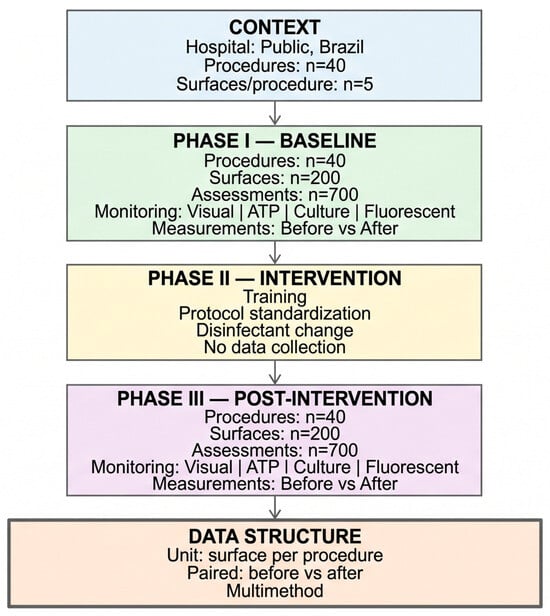
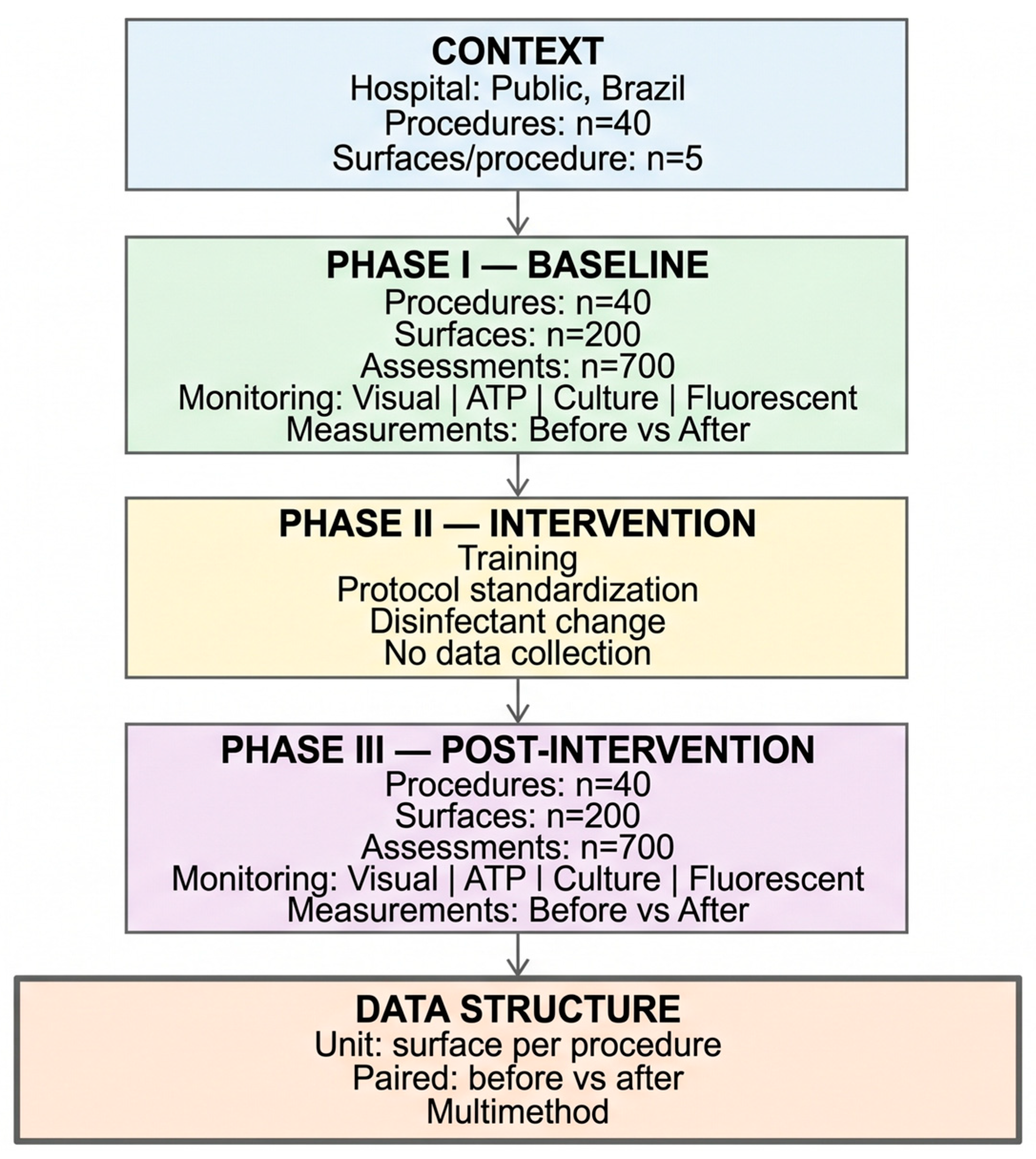
The unit of analysis in this study was the surface per procedure. Measurements were structured as repeated observations within procedures, with paired data (pre- and post-cleaning) for each surface. The study design and data structure are illustrated in Figure 1.
Figure 1.
Study design of the quasi-experimental pre–post multimodal intervention in operating room surface cleaning.
Sampling occurred at two time points: immediately after the end of the surgical procedure (pre-cleaning and disinfection [pre-C/D]) and after cleaning and disinfection, before the start of the next surgical procedure. The following monitoring methods were applied sequentially: visual inspection, ATP bioluminescence, microbiological culture, and fluorescent marker.
Data were organized in Microsoft Excel and analyzed using Epi Info™ version 7.2.4 and BioEstat version 5.3. Descriptive and inferential statistical analyses were performed with a significance level of 5%.
Continuous variables were expressed as median and interquartile range or mean and standard deviation, and categorical variables as absolute and relative frequencies. As most variables showed non-normal distributions according to the Lilliefors test, nonparametric tests were used. The Mann–Whitney test was applied for comparisons between independent groups, and the Wilcoxon signed-rank test was used for paired comparisons between pre- and post-cleaning measurements.
Given the paired structure of the data (pre- and post-cleaning measurements for the same surfaces), analyses were conducted at the surface level. Although measurements were clustered within procedures, this potential dependency was considered a limitation of the study. No formal correction for multiple comparisons was applied. Therefore, results should be interpreted with caution due to the increased risk of type I error.
Multiple linear regression models were used to evaluate the association between cleaning and disinfection outcomes, expressed by ATP and colony-forming unit (CFU) values, and independent variables such as surgical duration, surface type, time dedicated to cleaning and disinfection, and number of people present in the operating room. Model assumptions, including linearity, homoscedasticity, and absence of multicollinearity, were assessed prior to analysis. The performance of the monitoring methods was evaluated by calculating sensitivity, specificity, and accuracy, using microbiological culture as the reference (gold standard) method. Confidence intervals (95%) were calculated for diagnostic performance measures.
The study was approved by the Research Ethics Committee of the Federal University of Mato Grosso do Sul (CAAE: 67932423.1.0000.0021), in accordance with Resolution No. 466/2012 of the Brazilian National Health Council. Participation of professionals was voluntary and occurred after signing the informed consent form, ensuring confidentiality and anonymity of the collected information.
3. Results
Following the multimodal intervention, in Table 1 the mean time devoted to cleaning increased significantly (13.5 to 21.9 min; p = 0.002). On visual inspection, failure rates remained high on the granite countertop and the instrument side table (90–100%), with a slight reduction on the anesthesia cart (25% to 20%) and an increase on the mattress (35% to 45%).
Table 1.
Number and percentage of dirty surfaces by surface type and C/D monitoring method, before and after the multimodal intervention, in the first and second data collections. Public Hospital, Central-West Brazil, 2024.
By ATP bioluminescence, the electrocautery unit was the most critical surface before cleaning (45%), decreasing to 30%; there was improvement on the instrument side table (15% to 5%) and worsening on the granite countertop (15% to 20%). On microbiological culture, failure rates were low (0–10%): no growth on the instrument side table and the mattress after the intervention, with a residual 5% on the anesthesia cart and the electrocautery unit. The fluorescent marker revealed limitations in physical removal, with increased failures on the granite countertop (60% to 90%) and the instrument side table (50% to 70%), persistently high levels on the anesthesia cart (75%), and rates greater than 65% on the mattress and the electrocautery unit.
Overall, mean ATP levels decreased after C/D (1st collection: 109.3 to 95.7; p = 0.002; 2nd collection: 224.3 to 124.9; p = 0.021). By surgery type, declines were observed in clean surgeries in both collections (117.0 to 86.2; p = 0.001 and 171.0 to 122.0; p = 0.036) and a marked reduction in potentially contaminated procedures in the 2nd collection (1237.4 to 180.8; p = 0.018). With respect to the number of people present in the operating room, reductions occurred with 7–8 persons in the 1st collection (208.0 to 51.8; p = 0.002) and with 3–4 (310.3 to 179.6; p = 0.008) and 5–6 persons in the 2nd collection (255.1 to 101.4; p = 0.009); an increase was recorded with 5–6 persons in the 1st collection (92.8 to 112.4; p = 0.013). Regarding surgical duration, reductions were observed for procedures ≤ 30 min in the 1st collection (69.4 to 23.52; p < 0.001) and >60 min in the 2nd collection (324.4 to 213.1; p = 0.030). For C/D time, decreases were seen at 11–20 min (119.6 to 94.9; p < 0.001) and >30 min (128.4 to 48.2; p = 0.006) in the 1st collection, and at ≤10 min in the 2nd collection (211.6 to 116.6; p = 0.023). Among surfaces, notable reductions were found for the granite countertop (110.8 to 46.4; p = 0.020) and the electrocautery unit (262.3 to 207.0; p = 0.021) in the 1st collection (Table 2).
Table 2.
Mean and standard deviation of ATP (RLU) values by study variables, before and after the first and second data collections. Public Hospital, Central-West Brazil, 2024.
In the 1st collection, statistically significant reductions in mean colony-forming unit (CFU) values were observed in rooms with 5–6 people (5.2 to 3.5; p = 0.010), in surgeries lasting ≤30 min (4.2 to 1.2; p = 0.003), and on the electrocautery surface (6.9 to 2.5; p = 0.022). In the 2nd collection, a significant reduction occurred when C/D time was >30 min (3.7 to 1.1; p = 0.042) and on the granite countertop (11.7 to 3.2; p = 0.003). In the other stratifications and for the set of surfaces (“all”), no statistically significant differences were observed between pre- and post-cleaning measurements(Table 3).
Table 3.
Mean and standard deviation of colony-forming unit (CFU) values by study variables, before and after the first and second data collections. Public Hospital, Central-West Brazil, 2024.
According to the multiple linear regression analysis (Table 4), in the first collection, pre–cleaning and disinfection (pre-C/D) ATP levels were significant predictors of post-C/D ATP (the dependent variable). In the second collection, in addition to initial ATP, surgical duration and surface type were also significantly associated with the outcome. By contrast, no statistically significant associations were observed between the variables studied and post-C/D colony-forming unit (CFU) values in either collection.
Table 4.
Multiple linear regression of ATP and CFU values after C/D (dependent variables) in relation to independent variables, first and second data collections. Public Hospital, Central-West Brazil, 2024.
As shown in Table 5, the ATP detection method had the best performance for evaluating surface C/D, with accuracy of 92.0% in the first collection and 85.0% in the second, as well as high specificity in both phases (93.9% and 86.7%, respectively). The fluorescent marker demonstrated high sensitivity in the first collection (100%) but low specificity (39.8%) and reduced overall accuracy (41.0%), with performance worsening in the second collection, when accuracy fell to 26.0%. Visual inspection showed intermediate performance, inferior to the other methods, with accuracy of 62.0% in the first collection and 44.0% in the second.
Table 5.
Classification of dirty and clean surfaces after C/D by microbiological culture (gold standard) and other methods. Public Hospital, Central-West Brazil, 2024.
4. Discussion
The findings of this study indicate that the multimodal intervention was associated with changes in several indicators of the cleaning and disinfection (C/D) process in operating rooms. Following the intervention, an increase in the time dedicated to C/D and reductions in ATP levels after cleaning were observed in both data collections. These patterns suggest that the combined implementation of training, process standardization, and modification of disinfectant products may be linked to improved removal of organic residues from critical surfaces. However, given the quasi-experimental single-group pre–post design, these findings should be interpreted as associations, and the observed changes cannot be attributed exclusively to the intervention.
Multivariable analysis further highlighted the importance of contextual and baseline factors influencing cleaning outcomes. Pre-cleaning ATP levels were consistently associated with post-cleaning ATP values, indicating that the initial organic load plays a central role in determining the final condition of surfaces. In the second data collection, surgical duration and surface type also remained independently associated with post-cleaning ATP levels. These findings are consistent with previous evidence suggesting that longer procedures and frequently handled or structurally complex surfaces tend to accumulate higher levels of organic material and may require more rigorous cleaning approaches.
The comparison across monitoring methods provides important insights into the multidimensional nature of environmental hygiene assessment. ATP bioluminescence demonstrated high specificity but very low sensitivity when microbiological culture was used as a reference standard. This pattern likely reflects the low prevalence of culture-positive samples observed in the present study, as well as the conceptual differences between the methods. While ATP detects organic residues regardless of microbial viability, microbiological culture identifies viable microorganisms. In low-contamination contexts, sensitivity estimates may become unstable, and accuracy may be disproportionately influenced by specificity. Similar discrepancies between ATP results and microbiological cultures have been described in previous studies and are generally interpreted as evidence that these methods capture complementary rather than equivalent dimensions of surface contamination [25,26].
In contrast, the fluorescent marker showed high sensitivity for identifying failures in friction and surface coverage, but low specificity and overall accuracy when compared with microbiological culture. This finding suggests that the mechanical component of cleaning may remain inconsistent even when reductions in organic residues are observed. The increase in failure rates detected by the fluorescent marker in the second data collection may be related to variations in cleaning practices or differences in measurement sensitivity, in which greater emphasis on chemical disinfection could have been accompanied by less consistent mechanical friction. This interpretation is aligned with previous studies highlighting the importance of adequate friction and coverage as critical components of effective environmental cleaning [27,28].
An additional finding was the lower level of baseline contamination observed in the second data collection, particularly before cleaning. This pattern may reflect behavioral adaptation among staff following exposure to training and monitoring activities, consistent with the Hawthorne effect. Alternatively, improvements in environmental organization or terminal cleaning routines between procedures may have contributed to maintaining lower levels of contamination prior to routine C/D. Similar behavioral changes have been reported in studies evaluating audit-and-feedback interventions in healthcare settings.
Surface-specific analyses revealed persistent operational challenges. The electrocautery unit, granite countertop, and instrument side table showed higher frequencies of nonconformities across monitoring methods. These surfaces combine frequent handling with structural characteristics that may hinder effective cleaning, such as irregular geometry and hard-to-reach areas. Despite reductions in some indicators, visual inspection failures and fluorescent marker results suggest that mechanical cleaning may remain suboptimal in these contexts. At the same time, microbiological cultures showed low residual positivity (0–10%), reinforcing the notion that different monitoring approaches capture distinct and complementary aspects of environmental hygiene.
Operational factors also appeared to be associated with cleaning performance. Lower ATP levels after cleaning were more frequently observed in situations with reduced room occupancy, suggesting that greater circulation of personnel may contribute to environmental contamination and increase the complexity of cleaning procedures. Similarly, the association between surgical duration and post-cleaning ATP levels indicates that longer procedures may require more structured and rigorous cleaning routines due to the accumulation of organic material and increased manipulation of equipment and surfaces.
Although the time dedicated to C/D increased after the intervention, the findings suggest that longer cleaning duration alone may not ensure effective surface decontamination. The effectiveness of cleaning likely depends on the quality of technique, including appropriate sequence, adequate friction, complete surface coverage, and adherence to disinfectant contact time. Educational strategies that combine training with feedback mechanisms, such as fluorescent markers, have been associated with improvements in adherence to recommended practices and may support sustained improvements in environmental hygiene performance [29,30,31].
Findings related to specific equipment further illustrate operational challenges. The anesthesia cart, characterized by multiple components and irregular surfaces, maintained high failure rates in marker assessments and showed worsening in visual inspection results between data collections. Similar difficulties have been described in complex clinical equipment where structural design may hinder systematic cleaning. The electrocautery unit also remained a critical point in ATP measurements despite reductions after the intervention, suggesting the need for targeted approaches focused on cleaning technique and access to difficult areas.
Taken together, these findings highlight the relevance of adopting multimethod monitoring strategies for environmental hygiene in operating rooms. ATP measurements provide rapid feedback on organic residue removal, fluorescent markers support evaluation of friction technique and coverage, and microbiological cultures allow for periodic verification of microbiological safety. The integration of these complementary approaches may strengthen surveillance systems and support continuous quality improvement in environmental hygiene programs.
From a practical perspective, three main implications emerge. First, multimethod monitoring may be incorporated into routine infection prevention programs, combining rapid screening methods with periodic microbiological verification. Second, environmental hygiene protocols may benefit from prioritizing surfaces with higher risk of contamination or structural complexity, such as electrocautery units, countertops, instrument tables, and anesthesia carts. Third, strategies addressing the pre-cleaning phase, including improved field organization and management of biological residues during procedures, may contribute to more effective subsequent cleaning processes.
Overall, the findings suggest that improvements in environmental hygiene in operating rooms may be associated with the combined use of standardized protocols, staff training, and continuous monitoring using complementary methods. These observations are consistent with previous studies indicating that multimodal strategies, including education, process standardization, and structured auditing, are linked to better environmental hygiene performance [32,33].
Limitations
This study has several limitations that should be considered when interpreting the findings. The quasi-experimental single-group pre–post design without a control group limits causal inference, and the observed changes cannot be attributed exclusively to the intervention. In addition, the single-center design and the use of convenience sampling for surface selection may limit external validity and may not fully represent the complexity of environmental contamination patterns in operating rooms. The relatively short follow-up period, with post-intervention monitoring conducted one month after implementation, also limits conclusions regarding the long-term sustainability of the observed improvements.
Another important limitation relates to the low prevalence of culture-positive samples. Although microbiological culture was used as the reference method, the small number of positive results may have influenced estimates of sensitivity and specificity, particularly for ATP bioluminescence. The absence of sensitivity observed for ATP should be interpreted with caution, as it is strongly influenced by the low prevalence of culture-positive samples, which limits the stability of diagnostic performance estimates. In contexts where microbiological contamination is infrequent, diagnostic performance metrics may become unstable and accuracy may be driven predominantly by specificity rather than by true detection of contamination events.
The intervention should also be interpreted as a multimodal strategy, combining educational activities, changes in disinfectant products, and standardization of cleaning techniques and materials. Because these components were implemented simultaneously, it is not possible to isolate the individual effect of each component.
Finally, the study focused on environmental and process indicators and did not evaluate clinical outcomes such as surgical site infections or other healthcare-associated infections. Therefore, although improvements in environmental hygiene indicators were observed, direct inference about patient safety outcomes cannot be established. Future multicenter studies with longer follow-up periods, inclusion of clinical endpoints, cost-effectiveness analyses, and calibration of ATP thresholds according to surface type and surgical context may provide stronger evidence to guide environmental hygiene practices in operating rooms.
5. Conclusions
The multimodal intervention implemented in this study—combining staff training, process standardization, and modification of cleaning products—was associated with improvements in several indicators of surface cleaning and disinfection in operating rooms. Increased time dedicated to cleaning procedures and reductions in ATP levels after cleaning suggest that structured interventions may contribute to improving the removal of organic residues from critical surfaces. The findings also highlight the complementary nature of environmental monitoring methods. ATP bioluminescence proved useful for rapid assessment of organic residue removal, whereas fluorescent markers provided valuable information on mechanical friction and coverage during the cleaning process, and microbiological cultures allowed for periodic verification of residual contamination. Together, these methods capture different dimensions of environmental hygiene and should be interpreted as complementary rather than interchangeable tools.
Integrating multimethod monitoring strategies with standardized protocols and continuous staff training may strengthen environmental hygiene programs in operating rooms. Targeted attention to critical surfaces, combined with structured feedback mechanisms and ongoing surveillance, may contribute to improving the consistency and sustainability of cleaning and disinfection practices in surgical environments.
Use of Artificial Intelligence: Artificial intelligence tools were used exclusively to support language editing and improve clarity of the English text. These tools did not contribute to data extraction, analysis, interpretation of results, or content generation. The authors take full responsibility for the integrity and accuracy of the manuscript.
Author Contributions
Conceptualization, L.M.C., A.F.L.d.S. and A.M.F.; methodology, L.M.C., A.F.L.d.S. and A.M.F. formal analysis: L.M.C. and A.M.F.; writing—original draft preparation: L.M.C., A.F.L.d.S., L.B.d.O., E.R.J.C., A.L.S.A., A.M.F., H.E.F.C., M.A.R., A.G.d.S.J., A.C.d.M.L. and A.M.F.; writing—review and editing: L.M.C., A.F.L.d.S., L.B.d.O., E.R.J.C., A.L.S.A., B.S.d.S., H.E.F.C., M.A.R., O.M.A.B., A.G.d.S.J. and A.M.F. All authors have read and agreed to the published version of the manuscript.
Funding
This study was supported by the Brazilian Federal Agency for Support and Evaluation of Graduate Education (Coordenação de Aperfeiçoamento de Pessoal de Nível Superior, CAPES; Financial Code 001), by the Universidade Federal de Mato Grosso do Sul (UFMS), and by the Foundation for Supporting the Development of Education, Science, and Technology in the State of Mato Grosso do Sul (FUNDECT).
Institutional Review Board Statement
The study was conducted in accordance with the Declaration of Helsinki and was approved by the Research Ethics Committee of the Federal University of Mato Grosso do Sul (CAAE: 67932423.1.0000.0021; date of approval: 23 April 2023).
Informed Consent Statement
Informed consent was obtained from all subjects involved in the study.
Data Availability Statement
The data that support the findings of this study are available from the corresponding author upon reasonable request. The data are not publicly available due to institutional and privacy restrictions.
Conflicts of Interest
The authors declare no conflicts of interest. The funders had no role in the design of the study; in the collection, analyses, or interpretation of data; in the writing of the manuscript; or in the decision to publish the results.
References
- World Health Organization. Environmental Cleaning and Infection Prevention and Control in Health Care Facilities in Low- and Middle-Income Countries: Trainer’s Guide; WHO: Geneva, Switzerland, 2022; Available online: https://www.who.int/publications/i/item/9789240051041 (accessed on 22 July 2025).
- World Health Organization. The Case for Investment and Action in Infection Prevention and Control; World Health Organization: Geneva, Switzerland, 2025. [Google Scholar] [CrossRef] [Scilit]
- Fortaleza, C.M.C.B.; Padoveze, M.C.; Kiffer, C.R.V.; Barth, A.L.; Carneiro, I.C.R.S.; Giamberardino, H.I.G.; Rodrigues, J.L.N.; Santos Filho, L.; Mello, M.J.G.; Pereira, M.S.; et al. Multi-state survey of healthcare-associated infections in acute care hospitals in Brazil. J. Hosp. Infect. 2017, 96, 139–144. [Google Scholar] [PubMed]
- Lopuzzo, M.; Montagna, M.T.; Triggiano, F.; Caggiano, G. Effectiveness of hydrogen peroxide wipes for surface disinfection in healthcare facilities. Ann. Ig. 2024, 36, 487–497. [Google Scholar] [CrossRef] [Scilit]
- Han, J.H.; Sullivan, N.; Leas, B.F.; Pegues, D.A.; Kaczmarek, J.; Lumscheid, C.A. Cleaning hospital room surfaces to prevent health care–associated infections: A technical brief. Ann. Intern. Med. 2015, 163, 598–607. [Google Scholar] [PubMed]
- Rela, M.; Opel, S.; Williams, S.; Collins, D.P.; Martin, K.; Mughal, N.; Moore, L.S.P. Operating room fomites as potential sources for microbial transmission in burns theatres. Eur. Burn J. 2021, 2, 1–8. [Google Scholar] [CrossRef] [Scilit]
- Association of PeriOperative Registered Nurses. Guidelines for Perioperative Practice: Environmental Cleaning; AORN: Denver, CO, USA, 2020; Available online: https://aornguidelines.org (accessed on 22 July 2025).
- Yezli, S.; Barbut, F.; Otter, J.A. Surface contamination in operating rooms: A risk for transmission of pathogens? Surg. Infect. 2014, 15, 694–699. [Google Scholar] [CrossRef] [Scilit]
- Ibrahimi, O.A.; Sharon, V.; Eisen, D.B. Surgical-site infections and routes of bacterial transfer: Which ones are most plausible? Dermatol. Surg. 2011, 37, 1709–1720. [Google Scholar] [CrossRef] [Scilit]
- Dresch, F.; Rempel, C.; Maciel, M.J. Microbiological analysis of surfaces in a surgical center: Identification and bacterial activity against antibiotics and disinfectant. Cienc. Nat. 2017, 39, 738–747. [Google Scholar] [CrossRef] [Scilit]
- Brasil. Agência Nacional de Vigilância Sanitária. Segurança do Paciente em Serviços de Saúde: Limpeza e Desinfecção de Superfícies; Anvisa: Brasília, Brazil, 2010. Available online: https://www.gov.br/anvisa (accessed on 22 July 2025).
- Nascimento, E.A.S.; Poveda, V.B.; Monteiro, J. Evaluation of different monitoring methods of surface cleanliness in operating rooms. Rev. Bras. Enferm. 2021, 74, e20201263. [Google Scholar]
- Macedo, C.E.; Ferreira, A.M.; Barcelos, L.S.; Alvim, A.L.S.; Carneiro, L.M.; Martins, S.R.; Andrade, D.; Rigotti, M.A.; Gasques, R.P.; Silva Junior, V.A.; et al. Contamination of equipment and surfaces in the operating room anesthesia workspace: A cross-sectional study. Sao Paulo Med. J. 2024, 142, e2023177. [Google Scholar]
- Malik, R.E.; Cooper, R.A.; Griffith, C.J. Use of audit tools to evaluate the efficacy of cleaning systems in hospitals. Am. J. Infect. Control 2003, 31, 181–187. [Google Scholar] [CrossRef] [Scilit]
- Ferreira, A.M.; Andrade, D.; Rigotti, M.A.; Almeida, M.T.G.; Guerra, O.G.; Silva Junior, A.G. Assessment of disinfection of hospital surfaces using different monitoring methods. Rev. Lat. Am. Enferm. 2015, 23, 466–474. [Google Scholar] [CrossRef] [Scilit]
- Boyce, J.M. Modern technologies for improving cleaning and disinfection of environmental surfaces in hospitals. Antimicrob. Resist. Infect. Control 2016, 5, 10. [Google Scholar]
- Cloutman-Green, E.; D’Arcy, N.; Spratt, D.A.; Hartley, J.C.; Klein, N. How clean is clean—Is a new microbiology standard required? Am. J. Infect. Control 2014, 42, 1002–1003. [Google Scholar] [CrossRef] [Scilit]
- Griffith, C.J.; Cooper, R.A.; Gilmore, J.; Davies, C.; Lewis, M. An evaluation of hospital cleaning regimes and standards. J. Hosp. Infect. 2000, 45, 19–28. [Google Scholar] [CrossRef] [Scilit]
- Ewis, T.; Griffith, C.; Gallo, M.; Weinbren, M. A modified ATP benchmark for evaluating the cleaning of some hospital environmental surfaces. J. Hosp. Infect. 2008, 69, 156–163. [Google Scholar] [CrossRef] [Scilit]
- Boyce, J.M.; Havill, N.L.; Havill, H.L.; Mangione, E.; Dumigan, D.G.; Moore, B.A. Comparison of fluorescent marker systems with two quantitative methods of assessing terminal cleaning practices. Infect. Control Hosp. Epidemiol. 2015, 32, 1187–1193. [Google Scholar] [CrossRef] [Scilit] [PubMed]
- Frota, O.P.; Ferreira, A.M.; Rigotti, M.A.; Andrade, D.; Borges, N.M.A.; Ferreira Junior, M.A. Effectiveness of clinical surface cleaning and disinfection: Evaluation methods. Rev. Bras. Enferm. 2020, 73, e20180623. [Google Scholar] [PubMed]
- Sattar, S.A.; Maillard, J.Y. The crucial role of wiping in decontamination of high-touch environmental surfaces: Review of current status and directions for the future. Am. J. Infect. Control 2013, 41, S97–S104. [Google Scholar] [CrossRef] [Scilit] [PubMed]
- Moore, G.; Griffith, C. A laboratory evaluation of decontamination properties of microfibre cloths. J. Hosp. Infect. 2006, 64, 379–385. [Google Scholar] [CrossRef] [Scilit]
- Rigotti, M.A.; Ferreira, A.M.; Nogueira, M.C.L.; Almeida, M.T.G.; Guerra, O.G.; Andrade, D. Evaluation of three surface friction techniques for the removal of organic matter. Texto Contexto Enferm. 2015, 24, 1061–1070. [Google Scholar] [CrossRef] [Scilit]
- Collins, A.S. Preventing health care–associated infections. In Patient Safety and Quality: An Evidence-Based Handbook for Nurses; Hughes, R.G., Ed.; Agency for Healthcare Research and Quality: Rockville, MD, USA, 2008. [Google Scholar]
- Dancer, S.J. Controlling hospital-acquired infection: Focus on the role of the environment and new technologies for decontamination. Clin. Microbiol. Rev. 2014, 27, 665–690. [Google Scholar] [CrossRef] [Scilit]
- Stone, W.; Tolmay, J.; Tucker, K.; Wolfaardt, G.M. Disinfectant, soap or probiotic cleaning? Surface microbiome diversity and biofilm competitive exclusion. Microorganisms 2020, 8, 1726. [Google Scholar] [CrossRef] [Scilit] [PubMed]
- Boyce, J.M. A review of wipes used to disinfect hard surfaces in health care facilities. Am. J. Infect. Control 2021, 49, 104–114. [Google Scholar] [CrossRef] [Scilit]
- Armellino, D.; Goldstein, K.; Thomas, L.; Walsh, T.J.; Petraitis, V. Comparative evaluation of operating room terminal cleaning by two methods: Focused multivector ultraviolet versus manual-chemical disinfection. Am. J. Infect. Control 2020, 48, 147–152. [Google Scholar] [CrossRef] [Scilit]
- Burnham, J.P.; Shives, E.R.; Warren, D.K.; Han, J.H.; Babcock, H.M. Assessment of percent positive agreement between fluorescent marker and ATPase for environmental cleaning monitoring. Am. J. Infect. Control 2020, 48, 454–455. [Google Scholar]
- Fram, D.S.; Medeiros, E.A.; Ribeiro, R.M.; Escudero, D.V.S.; Alves, J.C.D.; Macedo, B.; Ferreira, D.B.; Oliveira, A.H.V.; Santos, R.P.; Matias, L.O.; et al. High-touch surfaces disinfection compliance in a COVID-19 intensive care unit. Am. J. Infect. Control 2023, 51, 469–471. [Google Scholar] [CrossRef] [Scilit]
- Deshpande, A.; Dunn, A.N.; Fox, J.; Cadnum, J.L.; Mana, T.S.C.; Jencson, A.; Fraser, T.G.; Donskey, C.J.; Gordon, S.M. Monitoring the effectiveness of daily cleaning practices in an intensive care unit using an adenosine triphosphate bioluminescence assay. Am. J. Infect. Control 2020, 48, 757–760. [Google Scholar] [CrossRef] [Scilit] [PubMed]
- Pontes, D.O.; Costa, D.M.; Pereira, P.P.S.; Whiteley, G.S.; Glasbey, T.; Tipple, A.F.V. Adenosine triphosphate sampling algorithm for monitoring the cleanliness of surgical instruments. PLoS ONE 2023, 18, e0284967. [Google Scholar] [CrossRef] [Scilit] [PubMed]

Disclaimer/Publisher’s Note: The statements, opinions and data contained in all publications are solely those of the individual author(s) and contributor(s) and not of MDPI and/or the editor(s). MDPI and/or the editor(s) disclaim responsibility for any injury to people or property resulting from any ideas, methods, instructions or products referred to in the content. |
© 2026 by the authors. Licensee MDPI, Basel, Switzerland. This article is an open access article distributed under the terms and conditions of the Creative Commons Attribution (CC BY) license.