


Abstract
Many red algal species described solely from morphology have historically been assigned to inappropriate genera because of superficial morphological similarity. Laurencia chilensis, originally described for specimens from Chile, has long been recognized as the only representative of Laurencia in Chile, but its systematic position is still understudied. We examined morphology of syntype material and specimens collected in the present study and analyzed rbcL sequences from our collections. One syntype specimen (De Toni herbarium no. 63) is here designated as the lectotype of L. chilensis. Laurencia chilensis specimens possess five pericentral cells per axial segment and plate-like spermatangial branches with sterile marginal cells, typical of the tribe Chondrieae. The rbcL sequences we obtained were identical and recovered the Chilean specimens as a strongly supported, distinct lineage from Chondria and other genera within the Chondrieae. Accordingly, we propose Austrochondria chilensis gen. et comb. nov. This study resolves the long-standing taxonomic position of this Chilean endemic and contributes to a more natural classification of the Chondrieae.
1. Introduction
Laurencia J.V.Lamouroux has long been recognized as one of the most taxonomically complex groups in red algae because of its morphological diversity and extensive homoplasy in morphological characters. Species of Laurencia occur frequently in tropical and temperate waters. Laurencia is also well known as a high diversity of halogenated secondary metabolites across a broad geographical distribution [1,2]. Laurencia was originally established to accommodate eight species by Lamouroux [3], and it was later lectotypified with L. obtusa (Hudson) J.V.Lamouroux by Schmitz [4]. Once treated as a broadly circumscribed genus, Laurencia has undergone substantial taxonomic revision over the past three decades through the integration of reproductive morphology and molecular phylogenetic analyses. These studies have substantially revised the boundary of Laurencia, recognizing the Laurencia complex which comprises eight genera: Laurencia sensu stricto, Osmundea Stackhouse, Chondrophycus (J.Tokida & Y.Saito) Garbary & J.T.Harper, Palisada K.W.Nam, Yuzurua (K.W.Nam) Martin-Lescanne, Laurenciella V.Cassano, Gil-Rodríguez, Sentíes, Díaz-Larrea, M.C.Oliveira & M.T.Fujii, Ohelopapa F.Rousseau, Martin-Lescanne, Payri & L.Le Gall, and Corynecladia J.Agardh [5]. Together with Rodriguezella F.Schmitz, these genera belong to the tribe Laurencieae and currently comprise 225 species worldwide [5].
Laurencia is distinguished by thallus with lateral branches of similar morphology, axial cell each with four pericentral cells, outer cortical cells with secondary pit connections, and spermatangial branches arose from trichoblasts arising from pericentral cells, the so-called “trichoblast type”, and arranged cup-shaped spermatangial pits. Additional diagnostic features include conspicuous protruding ostiolated cystocarps and tetrasporangia arranged parallel or at right angle to the axis, arose from specific pericentral cells or randomly [6,7,8,9,10,11,12]. Recent studies integrating detailed morphology with plastid-encoded rbcL sequences have considerably refined the taxonomy of Laurencia and related genera within the family Rhodomelaceae [8,10,12,13,14,15,16]. Nevertheless, many species described before the widespread application of molecular techniques remain of uncertain taxonomic position.
Laurencia chilensis De Toni, Forti & Howe was originally described from southern Chile and has subsequently been regarded as the only valid representative of Laurencia from central Chile to the Beagle Channel and the sub-Antarctic region [17,18,19,20,21]. Despite its broad distribution in Chile, L. chilensis has never been evaluated using molecular data. Consequently, whether L. chilensis truly belongs in Laurencia has remained unresolved.
To clarify the phylogenetic position of L. chilensis, we analyzed plastid rbcL sequences, a molecular marker widely used in the taxonomy of the Rhodomelaceae and other red algae [10,12,22,23]. We also conducted a detailed morphological examination of specimens collected throughout the Chilean coast together with the syntype material used in the original description by De Toni & Forti [17]. Because both molecular phylogeny and vegetative and reproductive evidence demonstrate that L. chilensis does not belong to Laurencia or any other genus of the tribe Laurencieae, we propose a new genus and assign it to the tribe Chondrieae.
2. Materials and Methods
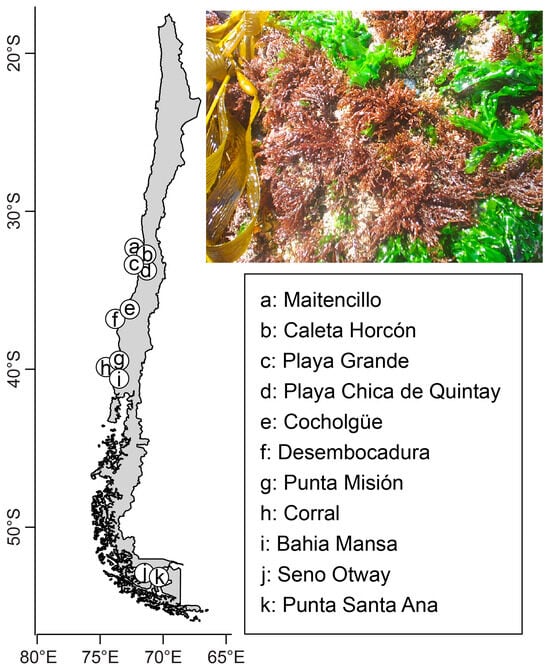
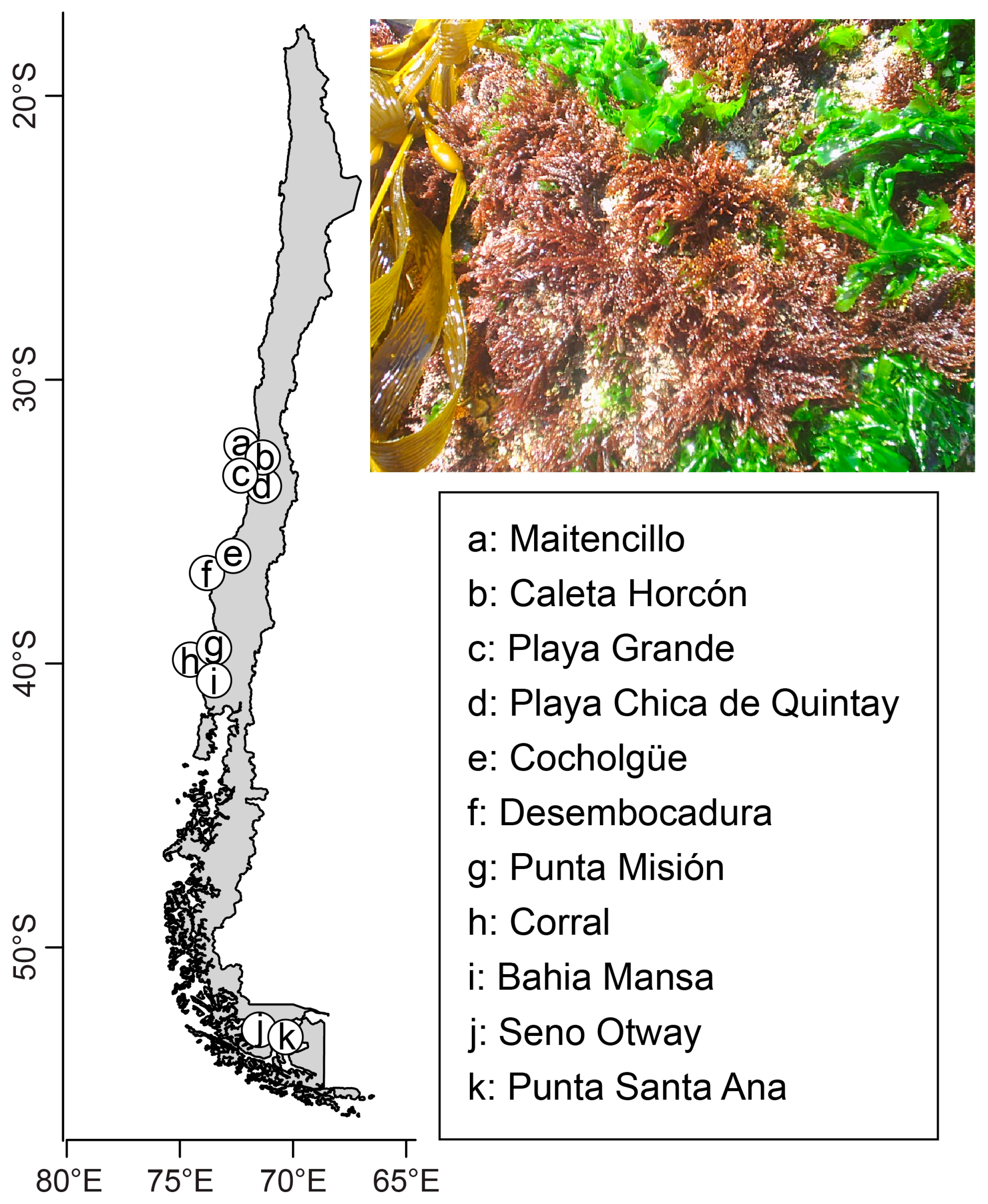
Seventy-five specimens of Laurencia chilensis were collected from intertidal and shallow subtidal rocky shores at 11 localities along the Chilean coast over a period of more than 30 years, extending from Valparaíso in north-central Chile to the Magallanes and Fuegian regions (Figure 1). After detailed morphological observation, the samples were preserved as herbarium vouchers, with subsamples dehydrated in silica gel for molecular analysis. Collection localities, dates, coordinates, and voucher information are provided under “Observed specimens” below. Four specimens (Table S1), representing the north-central and southern parts of the species’ distribution, were selected for molecular analysis. In addition, four syntype specimens deposited in the Natural History Museum, Santiago, Chile (SGO), were examined for morphological observation.
Figure 1.
Geographical distribution of Laurencia chilensis.
Hand sections were prepared from vegetative and reproductive thalli using stainless-steel razor blades. Sections were stained with 0.5% aqueous aniline blue acidified with 1N HCl and examined under a Zeiss Axioskop 2 Zeiss microscope (Zeiss, Göttingen, Germany). Photographs were obtained using a Zeiss Axiocan ERC-5S digital camera (Zeiss, Göttingen, Germany) attached to the microscope and a Zeiss Stemi SV6 stereomicroscope (Zeiss, Göttingen, Germany). Morphological measurements were made using calibrated ocular micrometer. Voucher specimens examined in this study were deposited in the herbaria of the Botanical Institute (SP), São Paulo, Brazil, and the Natural History Museum (SGO), Santiago, Chile. Herbarium abbreviations followed Index Herbariorum (http://sweetgum.nybg.org/ih/; accessed on 10 June 2026).
DNA extraction, PCR amplification, and sequencing were performed as described by Boo et al. [24]. The primers used for amplifying and sequencing were F7, F645, R898, and RrbcS start [22,25]. Sequences of the forward and reverse strands were determined for four newly generated sequences, and the electropherograms were edited using MEGA7 [26] and checked manually. Four newly generated rbcL sequences were deposited in GenBank. None was obtained from the original syntype material (De Toni herbarium nos. 62, 63, 72, 103), which was not suitable for DNA extraction. A total of 56 rbcL sequences, comprising 45 published GenBank sequences from the tribe Chondrieae and seven outgroups in the tribe Laurencieae (Table S1), were aligned using the MUSCLE algorithm implemented in MEGA7 with default parameters and manually adjusted.
Phylogeny of the rbcL dataset was inferred using maximum likelihood (ML) and Bayesian inference (BI). The ML analysis was performed using the IQ-TREE webserver [27] with 1000 ultrafast bootstrap (UFBS) replications [28] and model selection using ModelFinder [29]. The best-fitting model selected under the Bayesian Information Criterion was GTR + I. The BI analysis was performed with MrBayes v.3.2.1 [30] using the Metropolis-coupled Markov Chain Monte Carlo with the GTR + I model. Two million generations of two independent runs were performed with four chains and sampling trees every 100 generations. The burn-in period was identified graphically by tracking the likelihoods at each generation to determine whether they reached a plateau; convergence was additionally assessed from effective sample size (ESS) values (>200) calculated in Tracer v.1.7 [31]. Twenty-five percent of saved trees were removed, and the remaining trees were used to infer Bayesian posterior probabilities (BPP). The rbcL pairwise distances were calculated using uncorrected p-distances in MEGA7.
3. Results
3.1. Molecular Phylogeny
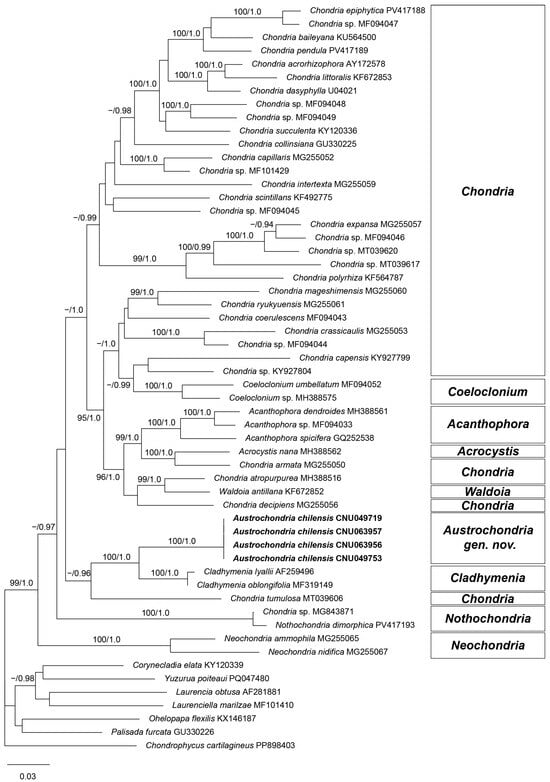
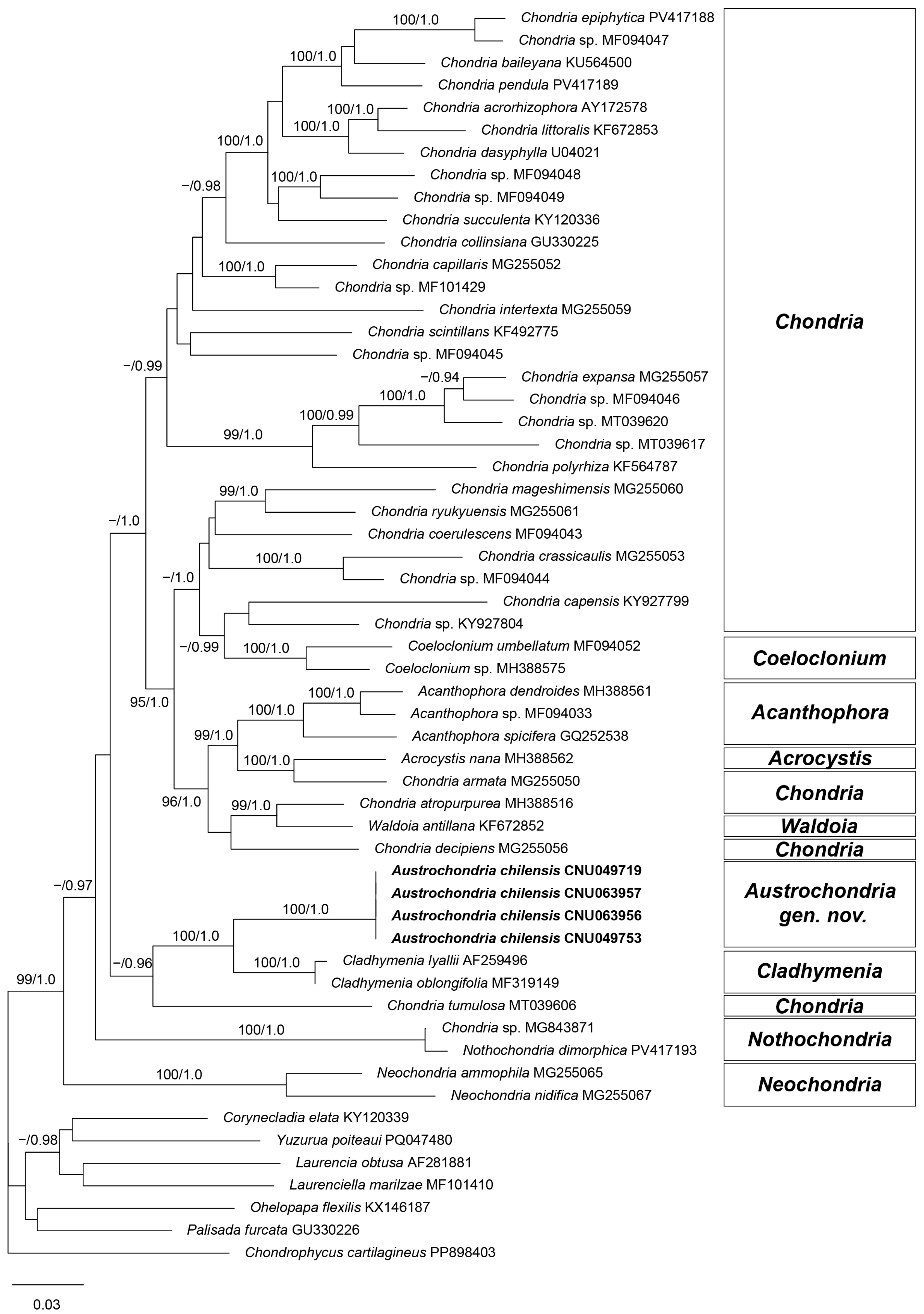
A total of 56 rbcL sequences were analyzed, comprising 49 sequences from the tribe Chondrieae and seven outgroup sequences from the tribe Laurencieae, with a final aligned length of 1119 base pairs (bp). Of these, 453 sites (40.5%) were variable and 408 (36.5%) were parsimony-informative. The four newly generated rbcL sequences of Laurencia chilensis were identical. The maximum likelihood (ML) topology was congruent with the Bayesian inference (BI) tree; therefore, only the ML tree is presented (Figure 2). The tribe Chondrieae was recovered as a strongly supported clade (99% UFBS, 1.0 BPP), comprising the genera Acanthophora J.V.Lamouroux, Acrocystis Zanardini, Chondria C.Agardh, Cladhymenia Harvey, Coeloclonium J. Agardh, Neochondria S.Sutti, M.Tani, Y.Yamagishi, T.Abe & K.Kogame, Nothochondria Belous & Skriptsova, Waldoia W.R.Taylor, and the Chilean specimens of Laurencia chilensis. All recognized genera were recovered with strong support (100% UFBS, 1.0 BPP), except Chondria, which was resolved as polyphyletic. The Chilean specimens formed a fully supported, independent lineage within Chondrieae and were recovered as sister to the clade comprising Cladhymenia lyallii Harvey and C. oblongifolia J.D.Hooker & Harvey. Pairwise rbcL sequence distance between the Chilean lineage and Cladhymenia was 6.3% from C. lyallii and 7.4% from C. oblongifolia.
Figure 2.
Maximum likelihood (ML) phylogeny based on plastid rbcL sequences of the tribe Chondrieae. Support values: Ultrafast bootstrap values (≥50%) and Bayesian posterior probabilities (≥0.90) are shown at branches. Dashes indicate values <50 or <0.90. Bold letters indicate newly generated sequences.
3.2. Taxonomic Treatment
Genus Austrochondria G.H.Boo, M.T.Fujii, M.E.Ramirez & Mansilla, gen. nov.
Diagnosis: Thalli terete near the base and slightly flattened above, soft in texture, fixed to substratum by a discoid holdfast. Axes rarely branched or nearly denuded at the base and densely branched in the upper third of the thalli. Branches alternate or somewhat opposite, with long branches near the base and decreasing gradually towards the apex, thalli being pyramidal in outline. Ultimate branchlets cylindrical with truncated apical portions. Apical cells always in the base of the apical pit. Axial segments with five pericentral cells. Tetrasporangia originated from pericentral cells. Cystocarp pyriform, with attenuated base. Spermatangia arose from pericentral cells at the bottom of the apical pit, on plate-like structures with sterile marginal cells.
Etymology: The generic name reflects its placement within the tribe Chondrieae, which is typified by the genus Chondria; austro from the word ‘austral’, meaning the south or southern hemisphere, where the species occurs.
Type species: Austrochondria chilensis (De Toni, Forti & M.Howe) G.H.Boo, M.T.Fujii, M.E.Ramirez & Mansilla, comb. nov.
Austrochondria chilensis (De Toni, Forti & M.Howe) G.H.Boo, M.T.Fujii, M.E.Ramirez & Mansilla, comb. nov. (Figure 3, Figure 4 and Figure 5).
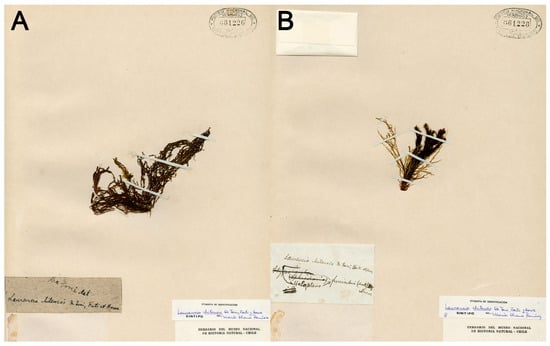
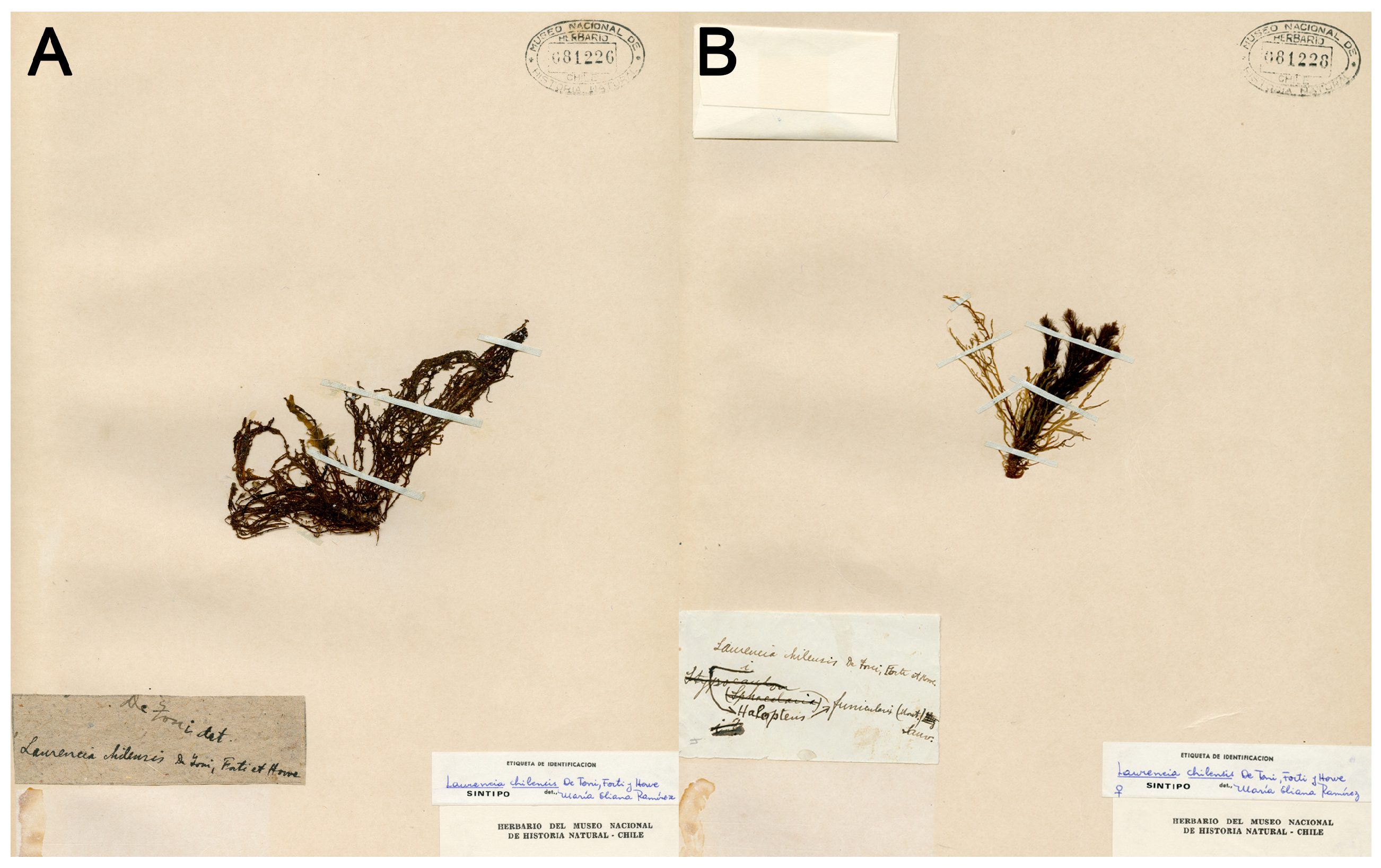
Figure 3.
Syntype specimens of Laurencia chilensis housed at the Natural History Science Museum (SGO), Santiago, Chile: (A) De Toni herbarium no. 63 specimen (SGO 81226), lectotypified here; (B) De Toni herbarium no. 103 (SGO 81228).
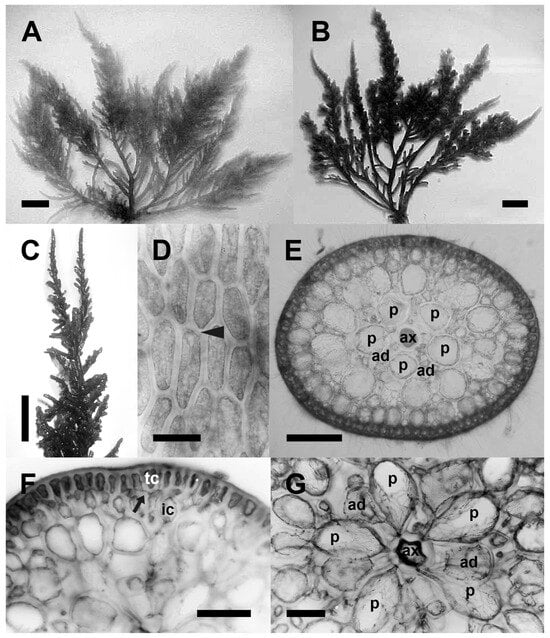
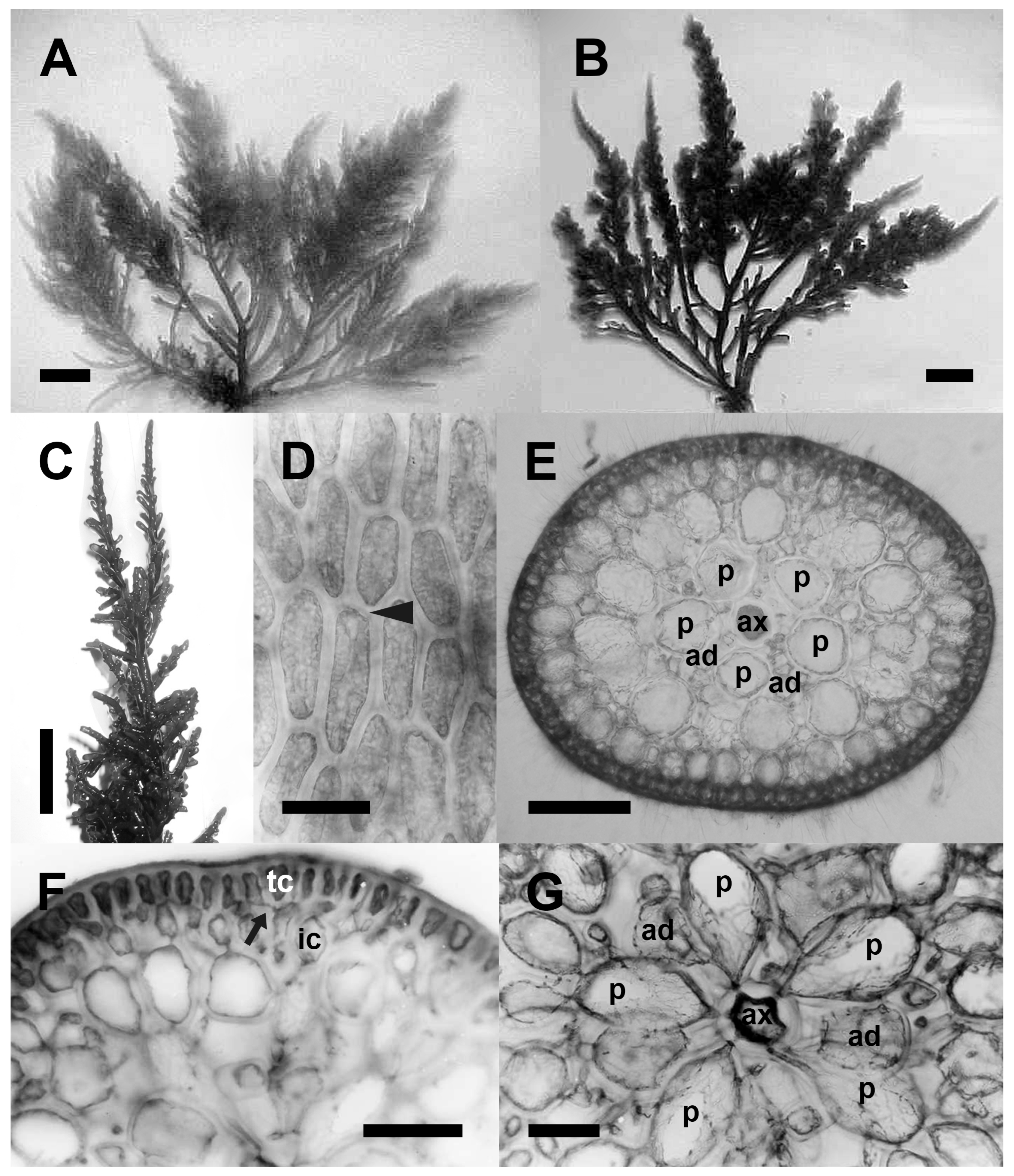
Figure 4.
Habit and vegetative structure of Austrochondria chilensis comb. nov: (A) habit of A. chilensis showing relatively long branches and branchlets; (B) habit of A. chilensis showing a more compact branching pattern; (C) enlargement of branching pattern of thallus; (D) surface view of cortical cells showing pit connections (arrowhead); (E) transverse section of branch showing axial cell (ax) issuing adventitious elongate cells (ad) among five pericentral cells (p); (F) enlargement of cortical layers showing outer cortical cells (tc) and pigmented inner cortical cells (ic) with secondary pit connections (arrow); (G) enlargement of section of branch showing axial cell (ax) issuing adventitious elongate cells (ad) among five pericentral cells (p). Scale bars: (A) 0.5 cm; (B,C) 1 cm; (D,F) 50 μm; (E) 100 μm; (G) 25 μm.
Figure 5.
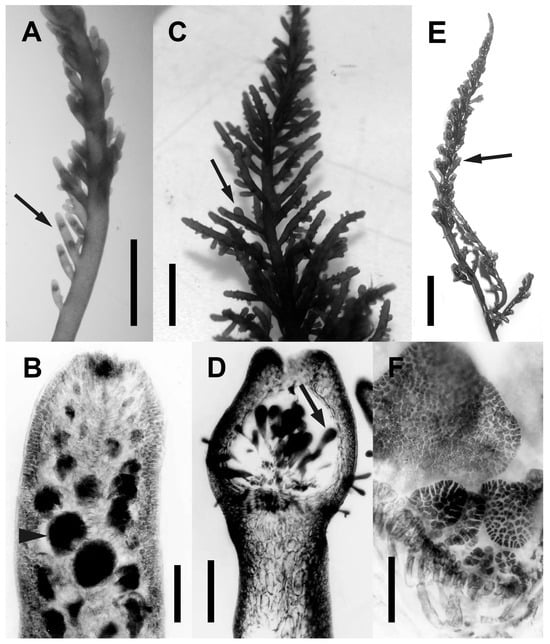
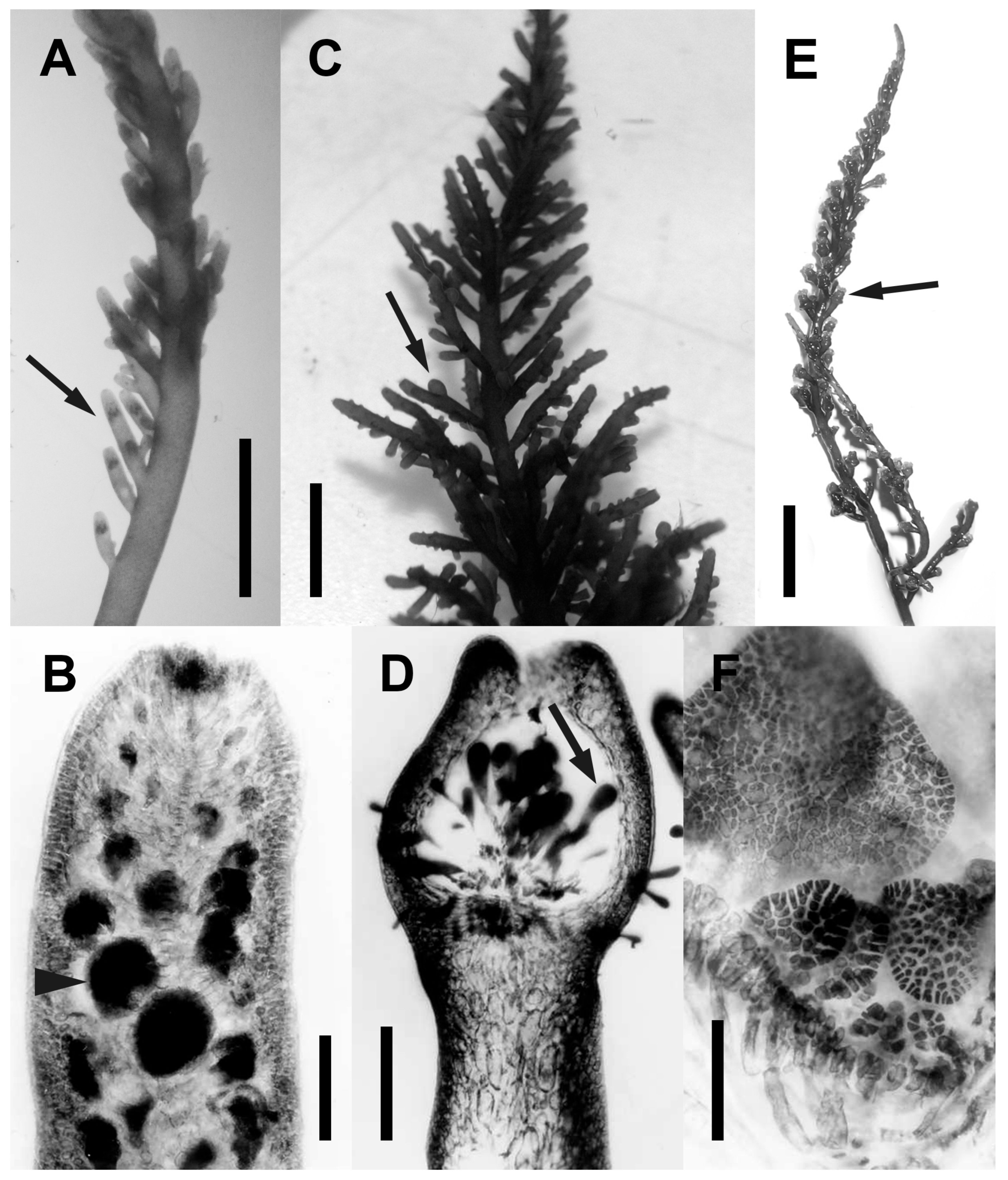
Reproductive structure of Austrochondria chilensis comb. nov: (A) thallus with tetrasporangial branchlets (arrow); (B) longitudinal section of tetrasporangial branchlet showing tetrasporangia (arrowhead); (C) thallus with cystocarps (arrow); (D) longitudinal section of a cystocarp showing carposporangia (arrow); (E) thallus with spermatangial branchlets (arrow); (F) longitudinal section of a branchlet showing spermatangial plates. Scale bars: (A) 0.5 cm; (B) 200 μm; (C,E) 1 cm; (D) 500 μm; (F) 100 μm.
Basionym: Laurencia chilensis De Toni, Forti & M.Howe, 1920 [17]. In the original publication [17], four specimens were used: herbarium nos. 62 (SGO 81221) and 63 (SGO 81226) from southern Chile, no. 72 from Magellan (SGO 81227), and no. 103 (SGO 81228) for which no collection information was provided. We examined these syntype specimens of L. chilensis housed at Natural History Science Museum (SGO), Santiago, Chile (Figure 3), and found that specimen no. 63 specimen from southern Chile closely matches the original description by De Toni & Forti [17]. Accordingly, specimen no. 63 (SGO 81226) is here designated as the lectotype of Laurencia chilensis.
Lectotype: Chile. Southern Chile, De Toni herbarium no. 63 (SGO 81226!) designated here as lectotype, housed at the Natural History Science Museum (SGO), Santiago, Chile.
Habitat: Austrochondria chilensis occurs in the intertidal to shallow subtidal zone exposed to wave action.
Distribution: Austrochondria chilensis is known only for Chilean coast from central Chile Bío Bío Region to Tierra del Fuego and Cabo de Hornos in the Magallanes region [17,18,19,20,21,32].
Observed specimens: Chile. Valparaíso, Maitencillo (32°38′51″ S, 71°26′19″ W), 12 June 2013, col. A. Mansilla and S.M. Boo—5 specimens (CNU063957); Caleta Horcón (32°42′33″ S, 71°29′27″ W), 22 January 1982, col. M.E. Ramírez—10 specimens (SGO 100186); Quintay, Playa Chica (33°12′20″ S, 71°41′54″ W), 8 September 2014, col. A.M. Mora—3 specimens (CNU063956); Concepcion, Desembocadura Rio Bío Bío (36°48′33″ S, 73°10′24″ W), 21 November 1987, col. M.E. Ramírez—10 specimens (SGO 107216); Cocholgüe (36°35′41″ S, 72°58′42″ W), 30 January 2002, col. A. Mansilla—12 specimens (SP365651); Valdivia, Punta Misión (39°52′31″ S, 73°23′43″ W), 1 January 1987, col. G. Rojas—3 specimens (SGO 106164); Huape, Corral (39°54′27″ S, 73°32′21″ W), 15 October 2013, col. A. Mansilla and S.M. Boo—7 specimens (CNU049719); Osorno, Bahia Mansa (40°34′57″ S, 73°43′37″ W), 16 October 2013, col. A. Mansilla and S.M. Boo—12 specimens (CNU049753); Punta Arenas, Seno Otway (52°52′46″ S, 71°07′06″ W), April 2011, col. A. Mansilla—5 specimens (SP513763), 6 May 2026, col. A. Mansilla and M.T. Fujii—3 specimens (SP526.990); Punta Santa Ana (53°11′24″ S, 70°45′54″ W), February 2005, col. A. Mansilla—5 specimens (SP365650).
Vegetative morphology: Plants are erect, with one or multiple axes forming dense tufts up to 15 cm tall and 0.6–1.2 mm in diameter in the middle portion of the main axis, red-purple to brown in color. They are terete near the base and slightly flattened above, soft in texture, adhering well to herbarium paper when dry (Figure 4A–C). Erect plants are attached to substratum by a discoid holdfast, at 0.5 to 1.5 mm in diameter. Axes are rarely branched or nearly denuded at the base and densely branched in the upper third of the plants. Branches are alternate or somewhat opposite, with 2–3 orders, with lower branches longer and decreasing gradually towards the apex, plants being pyramidal in outline (Figure 4C). Ultimate branchlets are cylindrical with truncated apical portions, 1.5–5.0 mm long and 460–680 µm in diameter in the middle portions.
In surface view, cortical cells are regularly arranged in longitudinal rows throughout the axes, with 20–85 µm × 15–45 µm and are connected to each other by longitudinally oriented secondary pit connections (Figure 4D). Small cells may be present between larger elongated cortical cells. In transverse section, axes can be seen to possess one layer of pigmented cortical cells and 2–3 layers of colorless medullary cells (Figure 4E). Cortical cells are radially elongated measuring 17–25 µm × 7–13 µm in the middle portions (Figure 4F). Medullary cells are large, rounded to slightly radially elongated, 44–240 µm × 42–140 µm. Medullary region is loose and intercellular spaces are filled by smaller cells. Each axial segment cut off five pericentral cells, and each of them issues adventitious elongate cells (ad) among pericentral cells (Figure 4G). Lenticular thickenings are absent.
The fresh specimens release yellowish substances and a characteristic strong sweet smell that is useful for identification, similar to those described for Laurencia translucida M.T.Fujii & Cordeiro-Marino and Chondrophycus anabeliae Sentíes. M.T.Fujii, Cassano & Dreckmann.
Reproductive structure: Tetrasporangial branchlets are cylindrical, usually simple, sometimes compound, and measuring 460–680 µm in diameter (Figure 5A). Mature tetrasporangial branches in surface view display a parallel pattern with respect to the fertile branchlets (Figure 5B). In the fertile branches, 1–2 tetrasporangia arise from pericentral cells, and are tetrahedrally divided, slightly elongated, measuring 160–190 µm × 125–170 µm.
Female thalli are characterized by densely grouped branchlets in the distal portions, with branchlets bearing cystocarps subapically inserted (Figure 5C). Cystocarps are protruding, ostiolated, conical to ovate, sessile, 850–1240 µm × 920–1520 µm. Carposporangia are clavate, approximately 70 µm × 21 µm (Figure 5D).
Male branches are clavate, swollen, usually simple, 690–1100 µm in diameter (Figure 5E). Fertile male branches arise from pericentral cell located at the bottom of the apical pit, and develop in the plate-like spermatangia, with sterile marginal cells. In longitudinal section, spermatangial pits are cup-shaped and an axial cell row is discernible at the base (Figure 5F).
4. Discussion
The close morphological and phylogenetic relationship between Chondria and Laurencia has been recognized since the establishment of these genera [3,33,34,35]. Schmitz & Falkenberg [36] and Falkenberg [37] established the modern classification of the Rhodomelaceae, assigning Chondria to the tribe Chondrieae and Laurencia to the tribe Laurencieae. The Chondrieae is characterized by five pericentral cells per axial segment and plate-like spermatangial branches with sterile marginal cells, whereas the Laurencieae typically possesses two or four pericentral cells and spermatangial branches borne on modified trichoblasts in apical depressions or on filaments derived from epidermal cells [38,39]. Nevertheless, subsequent studies have shown that several vegetative and reproductive characters overlap between these two tribes, rendering their boundaries less distinct than previously recognized [38,40,41,42].
The present integrative approach utilizing morphological and genetic data provides a strong support for recognizing Austrochondria chilensis (De Toni, Forti & M.Howe) gen. et comb. nov. The phylogenetic analysis consistently recovered Austrochondria as a distinct lineage within the tribe Chondrieae, sister to Cladhymenia. Moreover, the rbcL pairwise distance between Austrochondria and Cladhymenia (6.3–7.4%) is comparable to the intergeneric divergences observed between other genera of the Chondrieae: Acrocystis and Chondria armata (Kützing) Okamura (6.4%) and Coeloclonium and the Chondria capensis (Harvey) Askenasy group (7.5%). Morphologically, Austrochondria chilensis possesses five pericentral cells per axial segment and plate-like spermatangial branches with sterile marginal cells, two diagnostic characters that clearly support its placement in the tribe Chondrieae [38,39]. Furthermore, specimens collected from north-central Chile to the Magallanes region in the present study agree well with the lectotype specimen from southern Chile, designated here, and the other three specimens used for the original description of De Toni & Forti [17]. In the present study, rbcL sequences were obtained from specimens collected at Huape, Corral, Valdivia (39.9220° S) and Bahía Mansa, Osorno (40.5867° S), located in southern Chile, the type locality of L. chilensis. The two specimens for which we generated rbcL sequences can therefore be regarded as topotype material.
It is also noteworthy that the identity of Chondria secundata (J.Agardh) De Toni from Chile and Peru remains uncertain and requires clarification in relation to Austrochondria. Originally described from southern coast of Peru [43], Chondria secundata was reassessed by Howe [44], who found no specimens from Peru, but examined a single specimen collected from Valparaíso, Chile (Bustos s.n., Herbarium of the New York Botanical Garden) which closely matched Agardh’s original description. Chondria secundata is characterized by flattened thalli [43,44], whereas Austrochondria chilensis possesses thalli that are cylindrical at the base and become slightly compressed above. Because the type specimen of C. secundata was unavailable for examination, its taxonomic identity remains uncertain. Accordingly, rbcL sequences from topotype material are required to determine whether C. secundata should be assigned to Austrochondria or Chondria.
The morphological delimitation of Austrochondria from other genera within the Chondrieae is not always straightforward. Among the currently recognized genera, Chondria is morphologically the most similar to Austrochondria. Chondria, comprising approximately 80 species, exhibits considerable morphological diversity and overlap in many vegetative characters [35,42,45]. Both genera share cylindrical thalli and five pericentral cells per axial segment, but Chondria differs by mostly having up to five tetrasporangia per segment (Table 1). Although molecular phylogenetic analyses have demonstrated that Chondria comprises five groups (Figure 2), Austrochondria is not closely related to any of these lineages. The polyphyly of Chondria suggests that its current circumscription does not accurately reflect its evolutionary relationships. The genus may ultimately be restricted to the clade containing C. capillaris, the generitype. Consequently, comprehensive comparative anatomical studies combined with multigene phylogenetic analyses are necessary to establish a stable generic classification of Chondria.
Table 1.
A comparison of Austochondria and other genera except for parasitic genera in the tribe Chondrieae.
Cladhymenia was recovered as the sister genus of Austrochondria in the rbcL phylogeny. Despite this close phylogenetic relationship, the two genera are readily distinguished by their morphology. Cladhymenia, comprising six species, possesses foliose thalli with a faint midrib, non-stratified parapericentral cells rather than cells arranged in tiers, cell-wall thickenings in pericentral and other internal cells, and branches arising from the basal cells of trichoblasts [49,50]. These morphological differences, together with the level of rbcL sequence divergence observed between the two genera, strongly support the recognition of Austrochondria as a genus distinct from Cladhymenia.
The remaining genera of the Chondrieae are also distinguishable from Austrochondria by combinations of vegetative and reproductive characters. Acanthophora, comprising seven species, is characterized by spirally arranged spine-like branchlets, apices projecting or only shallowly immersed, stalked plate-like spermatangial branches, cystocarps subtended by spine-like branchlets, and up to several tetrasporangia per segment [34,35]. Coeloclonium, comprising four species, possesses highly branched cylindrical thalli with five pericentral cells, each having an inverted L-shaped outline, together with flattened plate-like male capitula bearing vein-like sterile cells and sterile marginal cells [35]. Acrocystis, represented only by A. nana Zanardini, differs in having prostrate rhizomatous axes with erect branches, vesicles composed of three to six cell layers, and up to five tetrasporangia per segment [47,48]. Phylogenetically, Acrocystis is closely related to Chondria armata.
Husseya J.Agardh differs from Austrochondria in producing female and tetrasporangial reproductive structures on short branchlets (2–3 mm long) clustered along the axes, whereas male plants remain unknown [35,53]. Molecular phylogenetic data are not yet available for this genus.
Neochondria, comprising two species, is distinguished by terete axes and stalked cystocarps [42], whereas Austrochondria possesses slightly flattened axes and sessile cystocarps. The presence of five pericentral cells and plate-like spermatangial branches, two diagnostic characters of Neochondria, indicates its assignment to the tribe Chondrieae [42]. This systematic placement is strongly supported by our rbcL phylogeny, which recovered Neochondria as the earliest diverging lineage within Chondrieae (99% UFBS, 1.0 BPP). However, previous rbcL phylogenetic analyses [42,45] recovered Neochondria outside both the tribes Chondrieae and Laurencieae, revealing a conflict between morphology and rbcL phylogeny. This discrepancy may be attributed to differences in outgroup selection: previous studies employed outgroup taxa outside the tribes Chondrieae and Laurencieae [42,45], whereas our analyses used outgroup taxa in Laurencieae, the closest lineage of Chondrieae. The taxonomic position of Neochondria may be further resolved using multigene datasets.
Nothochondria, a monotypic genus recently described from the Okhotsk and Hokkaido [45], differs from Austrochondria by its having less adventitious cells, spirally arranged tetrasporangia, and stalked cystocarps. Nothochondria is distantly related to Austrochondria in the rbcL phylogeny. Waldoia is readily distinguished by its foliose thalli, small trichoblasts surrounding the apical cell, cylindrical tetrasporangial stichidia, and cystocarps with only slightly protuberant ostioles [51,52]. In the rbcL phylogeny, Waldoia forms a strongly supported clade with Chondria atropurpurea, both of which occur in South America [45,51,52].
Austrochondria is readily distinguished from the minute parasitic genera Benzaitenia, Jantinella, and Ululania of the Chondrieae [54,55,56] by its free-living, macrothallic habit, in contrast to their highly reduced, host-dependent thalli. Molecular analyses based on nuclear SSU and LSU rDNA and mitochondrial cox1 have placed Benzaitenia and Ululania within the Chondrieae [57], whereas comparable molecular data, such as rbcL, remain unavailable or very limited for Jantinella. Although these parasitic genera are relevant to the broader evolutionary history of the Chondrieae, they do not represent close morphological alternatives for the generic placement of Austrochondria. Their phylogenetic relationships within the tribe should be examined further using broader multigene or phylogenomic data.
In conclusion, we describe Austrochondria chilensis gen. et comb. nov. to accommodate Laurencia chilensis, which is demonstrated to belong to the tribe Chondrieae based on both molecular phylogenetic and morphological evidence. This taxonomic revision highlights the importance of an integrative taxonomic approach that combines rbcL sequence data with detailed observations of vegetative and reproductive anatomy. Nevertheless, the taxonomy of the Chondrieae remains incompletely resolved, particularly with respect to the subdivision of Chondria into several groups. Broader taxon sampling and analyses using additional molecular markers, including plastid psaA and psbA, and mitochondrial cox1, which provide high phylogenetic resolution above the species level [23], will further improve our understanding of generic relationships and contribute to a more robust classification of the Chondrieae.
Supplementary Materials
The following supporting information can be downloaded at https://www.mdpi.com/article/10.3390/phycology6030099/s1. Table S1: Details of rbcL sequences used in this study with GenBank accession numbers. Bold letters indicate sequences generated in this study.
Author Contributions
Conceptualization, G.H.B., M.T.F., N.N., M.E.R., A.M.M.T. and A.M.; methodology, G.H.B., M.T.F., M.E.R. and A.M.; validation, G.H.B., M.T.F., M.E.R. and A.M.; formal analysis, G.H.B., M.T.F., M.E.R. and A.M.; investigation, G.H.B., M.T.F., M.E.R. and A.M.; resources, A.M., N.N., M.E.R., A.M.M.T., M.T.F. and G.H.B.; writing—original draft preparation, G.H.B., M.T.F., N.N., M.E.R., A.M.M.T., A.M.; writing—review and editing, G.H.B., M.T.F., N.N., M.E.R., A.M.M.T., A.M.; funding acquisition, G.H.B., M.T.F., A.M. All authors have read and agreed to the published version of the manuscript.
Funding
This work was supported by the Fundação de Amparo à Pesquisa do Estado de São Paulo—FAPESP (2025/07487-0 and 2025/07548-9), Conselho Nacional de Desenvolvimento Científico e Tecnológico—CNPq (445412/2024-0), postdoctoral funding from FAPESP (Proc. 2019/16956-2), CNPq for the Productivity Fellowship (311195/2021-0), Funding for Scientific and Technological Development (FONDECYT/National) Program, grants 1180433 and 1140940, and Program for Investigación Asociativa (PIA CCTE AFB170008)—Institute of Ecology and Biodiversity (IEB), and the Regional Innovation System & Education (RISE) program through the Institute for Regional Innovation System & Education in Busan Metropolitan City, funded by the Ministry of Education (MOE) and the Busan Metropolitan City, Republic of Korea (2026-RISE(ANCHOR)-02-001-044).
Institutional Review Board Statement
Not applicable.
Informed Consent Statement
Not applicable.
Data Availability Statement
The original contributions presented in this study are included in the article/Supplementary Materials. Further inquiries can be directed to the corresponding author.
Acknowledgments
We are thankful to Sung Min Boo for providing valuable comments on the manuscript. A.M. acknowledges the Cape Horn International Center (CHIC, ANID BASAL FB210018) and FONDECYT Regular Project No. 1241697 for their support.
Conflicts of Interest
The authors declare no conflicts of interest.
References
- Fujii, M.T.; Cassano, V.; Stein, E.M.; Carvalho, L.R. Overview of the taxonomy and of the major secondary metabolites and their biological activities related to human health of the Laurencia complex (Ceramiales, Rhodophyta) from Brazil. Rev. Bras. Farmacogn. 2011, 21, 268–282. [Google Scholar] [CrossRef] [Scilit]
- Yamagishi, Y.; Kamada, T.; Ishii, T.; Matsuura, H.; Kikuchi, N.; Abe, T.; Suzuki, M. Morphological and chemical diversity within Japanese Laurencia complex (Rhodomelaceae, Ceramiales, Rhodophyta). Chem. Biodivers. 2024, 21, e202400833. [Google Scholar] [CrossRef] [Scilit] [PubMed]
- Lamouroux, J.V.F. Essai sur les genres de la famille des thallassiophytes non articulées. Ann. Mus. Hist. Nat. 1813, 20, 21–47, 115–139, 267–293. [Google Scholar]
- Schmitz, F. Systematische Übersicht der bisher bekannten Gattungen der Florideen. Flora 1889, 72, 435–456. [Google Scholar]
- Guiry, M.D.; Guiry, G.M. AlgaeBase. Available online: http://www.algaebase.org (accessed on 15 July 2026).
- Nam, K.W.; Maggs, C.A.; Garbary, D.J. Resurrection of the genus Osmundea with an emendation of the generic delineation of Laurencia (Ceramiales, Rhodophyta). Phycologia 1994, 33, 384–395. [Google Scholar] [CrossRef] [Scilit]
- Fujii, M.T.; Sentíes, A. Taxonomia do complexo Laurencia (Rhodomelaceae, Rhodophyta) do Brasil, com ênfase nas espécies dos estados de São Paulo e do Espírito Santo. Monogr. Ficol. 2005, 2, 69–112. [Google Scholar]
- Cassano, V.; Metti, Y.; Millar, A.J.K.; Gil-Rodríguez, M.C.; Sentíes, A.; Díaz-Larrea, J.; Fujii, M.T. Redefining the taxonomic status of Laurencia dendroidea (Ceramiales, Rhodophyta) from Brazil and the Canary Islands. Eur. J. Phycol. 2012, 47, 67–81. [Google Scholar] [CrossRef] [Scilit]
- Cassano, V.; Oliveira, M.C.; Gil-Rodríguez, M.C.; Sentíes, A.; Díaz-Larrea, J.; Fujii, M.T. Molecular support for the establishment of the new genus Laurenciella within the Laurencia complex (Ceramiales, Rhodophyta). Bot. Mar. 2012, 55, 349–357. [Google Scholar] [CrossRef] [Scilit]
- Rousseau, F.; Gey, D.; Kurihara, A.; Maggs, C.A.; Martin-Lescanne, J.; Payri, C.; de Reviers, B.; Sherwood, A.R.; Le Gall, L. Molecular phylogenies support taxonomic revision of three species of Laurencia (Rhodomelaceae, Rhodophyta), with the description of a new genus. Eur. J. Taxon. 2017, 269, 1–19. [Google Scholar] [CrossRef] [Scilit][Green Version]
- Metti, Y.; Huisman, J.M.; Millar, A.J.K. Laurencia. In Algae of Australia: Marine Benthic Algae of North-Western Australia, 2. Red Algae; Huisman, J.M., Ed.; Australian Biological Resources Study: Canberra, Australia, 2018; Volume 2, pp. 521–530. [Google Scholar]
- Popolizio, T.R.; Schneider, C.W.; Jongbloed, W.M.; Saunders, G.W.; Lane, C.E. Molecular analysis resolves the taxonomy of the Laurencia complex (Rhodomelaceae, Ceramiales) in Bermuda and uncovers novel species of Chondrophycus and Laurenciella. Cryptogam. Algol. 2022, 43, 1–30. [Google Scholar] [CrossRef] [Scilit]
- Cassano, V.; Díaz-Larrea, J.; Sentíes, A.; Oliveira, M.C.; Gil-Rodríguez, M.C.; Fujii, M.T. Evidence for the conspecificity of Palisada papillosa with P. perforata (Ceramiales, Rhodophyta) from the western and eastern Atlantic Ocean on the basis of morphological and molecular analyses. Phycologia 2009, 48, 86–100. [Google Scholar] [CrossRef] [Scilit]
- Martin-Lescanne, J.; Rousseau, F.; de Reviers, B.; Payri, C.; Couloux, A.; Cruaud, C.; Le Gall, L. Phylogenetic analyses of the Laurencia complex (Rhodomelaceae, Ceramiales) support recognition of five genera: Chondrophycus, Laurencia, Osmundea, Palisada and Yuzurua stat. nov. Eur. J. Phycol. 2010, 45, 51–61. [Google Scholar] [CrossRef] [Scilit]
- Metti, Y.; Millar, A.J.K.; Steinberg, P. A new molecular phylogeny of the Laurencia complex (Rhodophyta, Rhodomelaceae) and a review of key morphological characters result in a new genus, Coronaphycus, and a description of C. novus. J. Phycol. 2015, 51, 929–942. [Google Scholar] [CrossRef] [Scilit] [PubMed]
- Sentíes, A.; Dreckmann, K.M.; Hernández, O.E.; Núñez-Resendiz, M.L.; Le Gall, L.; Cassano, V. Diversity and distribution of Laurencia sensu stricto (Rhodomelaceae, Rhodophyta) from the Mexican Pacific, including L. mutueae sp. nov. Phycol. Res. 2019, 67, 267–278. [Google Scholar] [CrossRef] [Scilit]
- De Toni, G.B.; Forti, A. Contributo alla conoscenza della flora marina del Chili. Atti del Reale Istituto Veneto di Scienze, Lettere ed Arti 1920, 79, 675–705. [Google Scholar]
- Santelices, B. Algas Marinas de Chile; Ediciones Universidad Católica de Chile: Santiago, Chile, 1989. [Google Scholar]
- Ramírez, M.E.; Santelices, B. Catálogo de las Algas Marinas Bentônicas de La Costa Temperada Del Pacífico de Sudamérica; Monografías Biológicas 5; Facultad de Ciencias Biológicas, Pontificia Universidad Católica de Chile: Santiago, Chile, 1991. [Google Scholar]
- Hoffmann, A.; Santelices, B. Flora Marina de Chile Central; Ediciones Universidad Católica de Chile: Santiago, Chile, 1997. [Google Scholar]
- Ramírez, M.E.; Bulboa, C.; Contreras-Porcia, L.; Mora, A.M. Flora Marina Bentónica de Quintay; RIL Editores-Donnebaum: Santiago, Chile, 2018. [Google Scholar]
- Freshwater, D.W.; Rueness, J. Phylogenetic relationships of some European Gelidium (Gelidiales, Rhodophyta) species, based on rbcL nucleotide sequence analysis. Phycologia 1994, 33, 187–194. [Google Scholar] [CrossRef] [Scilit]
- Boo, G.H.; Le Gall, L.; Miller, K.A.; Freshwater, D.W.; Wernberg, T.; Terada, R.; Yoon, K.J.; Boo, S.M. A novel phylogeny of the Gelidiales (Rhodophyta) based on five genes including the nuclear CesA, with descriptions of Orthogonacladia gen. nov. and Orthogonacladiaceae fam. nov. Mol. Phylogenet. Evol. 2016, 101, 359–372. [Google Scholar] [CrossRef] [Scilit] [PubMed]
- Boo, G.H.; Park, J.K.; Boo, S.M. Gelidiophycus (Rhodophyta: Gelidiales): A new genus of marine algae from East Asia. Taxon 2013, 62, 1105–1116. [Google Scholar] [CrossRef] [Scilit]
- Kim, M.S.; Kim, S.Y.; Nelson, W. Symphyocladia lithophila sp. nov. (Rhodomelaceae, Ceramiales), a new Korean red algal species based on morphology and rbcL sequences. Bot. Mar. 2010, 53, 233–241. [Google Scholar] [CrossRef] [Scilit]
- Kumar, S.; Stecher, G.; Tamura, K. MEGA7: Molecular evolutionary genetics analysis version 7.0 for bigger datasets. Mol. Biol. Evol. 2016, 33, 1870–1874. [Google Scholar] [CrossRef] [Scilit] [PubMed]
- Trifinopoulos, J.; Nguyen, L.-T.; von Haeseler, A.; Minh, B.Q. W-IQ-TREE: A fast online phylogenetic tool for maximum likelihood analysis. Nucleic Acids Res. 2016, 44, W232–W235. [Google Scholar] [CrossRef] [Scilit] [PubMed]
- Hoang, D.T.; Chernomor, O.; von Haeseler, A.; Minh, B.Q.; Vinh, L.S. UFBoot2: Improving the ultrafast bootstrap approximation. Mol. Biol. Evol. 2018, 35, 518–522. [Google Scholar] [CrossRef] [Scilit] [PubMed]
- Kalyaanamoorthy, S.; Minh, B.; Wong, T.K.F.; von Haeseler, A.; Jermiin, L.S. ModelFinder: Fast model selection for accurate phylogenetic estimates. Nat. Methods 2017, 14, 587–589. [Google Scholar] [CrossRef] [Scilit] [PubMed]
- Ronquist, F.; Teslenko, M.; van der Mark, P.; Ayres, D.; Darling, A.; Höhna, S.; Larget, B.; Liu, L.; Suchard, M.A.; Huelsenbeck, J.P. MrBayes 3.2: Efficient Bayesian phylogenetic inference and model choice across a large model space. Syst. Biol. 2012, 61, 539–542. [Google Scholar] [CrossRef] [Scilit] [PubMed]
- Rambaut, A.; Drummond, A.J.; Xie, D.; Baele, G.; Suchard, M.A. Posterior summarization in Bayesian phylogenetics using Tracer 1.7. Syst. Biol. 2018, 67, 901–904. [Google Scholar] [CrossRef] [Scilit] [PubMed]
- Papenfuss, G.F. Catalogue and bibliography of Antarctic and Sub-Antarctic benthic marine algae. In Bibliography of the Antarctic Seas; Lee, M.O., Ed.; American Geophysical Union: Washington, DC, USA, 1964; Volume 1, pp. 1–76. [Google Scholar]
- Agardh, C.A. Synopsis Algarum Scandinaviae, Adjecta Dispositione Universali Algarum; Ex Officina Berlingiana: Lund, Sweden, 1817. [Google Scholar]
- Abbott, I.A. Marine Red Algae of the Hawaiian Islands; Bishop Museum Press: Honolulu, HI, USA, 1999. [Google Scholar]
- Womersley, H.B.S. The Marine Benthic Flora of Southern Australia-Part IIID: Ceramiales-Delesseriaceae, Sarcomeniaceae, Rhodomelaceae; Australian Biological Resources Study & State Herbarium of South Australia: Canberra, Australia; Adelaide, Australia, 2003. [Google Scholar]
- Schmitz, F.; Falkenberg, P. Rhodomelaceae. In Die Natürlichen Pflanzenfamilien Nebst Ihren Gattungen und Wichtigeren Arten, Insbesondere den Nutzpflanzen Unter Mitwirkung Zahlreicher Hervorragender Fachgelehrten, Teil 1, Abteilung 2; Engler, A., Prantl, K., Eds.; Verlag von Wilhelm Engelmann: Leipzig, Germany, 1897; pp. 421–480. [Google Scholar]
- Falkenberg, P. Die Rhodomelaceen des Golfes von Neapel und der Angrenzenden Meeres-Abschnitte; Fauna und Flora des Golfes von Neapel, Monographie 26; R. Friedländer & Sohn: Berlin, Germany, 1901. [Google Scholar]
- Hommersand, M.H. The morphology and classification of some Ceramiaceae and Rhodomelaceae. Univ. Calif. Publ. Bot. 1963, 35, 165–366. [Google Scholar]
- Díaz-Tapia, P.; Maggs, C.A.; West, J.A.; Verbruggen, H. Analysis of chloroplast genomes and a supermatrix inform reclassification of the Rhodomelaceae (Rhodophyta). J. Phycol. 2017, 53, 920–937. [Google Scholar] [CrossRef] [Scilit] [PubMed]
- Yamada, Y. Notes on Laurencia, with special reference to the Japanese species. Univ. Calif. Publ. Bot. 1931, 16, 185–310. [Google Scholar]
- Gordon-Mills, E.M.; Womersley, H.B.S. The genus Chondria C. Agardh (Rhodomelaceae, Rhodophyta) in Southern Australia. Aust. J. Bot. 1987, 35, 477–565. [Google Scholar] [CrossRef] [Scilit]
- Sutti, S.; Tani, M.; Yamagishi, Y.; Abe, T.; Miller, K.A.; Kogame, K. Neochondria gen. nov. (Rhodomelaceae, Rhodophyta), a segregate of Chondria, including N. ammophila sp. nov. and N. nidifica comb. nov. Phycologia 2018, 57, 262–272. [Google Scholar] [CrossRef] [Scilit]
- Agardh, J.G. Species Genera et Ordines Algarum, seu Descriptiones Succinctae Specierum, Generum et Ordinum, Quibus Algarum Regnum Constituitur, Volume 2, Part 3 (Fasciculus 1): Species Genera et Ordines Floridearum; C.W.K. Gleerup: Lund, Sweden, 1863. [Google Scholar]
- Howe, M.A. The marine algae of Peru. Mem. Torrey Bot. Club 1914, 15, 1–185. [Google Scholar]
- Belous, O.; Skriptsova, A.V. A revision of the tribe Chondrieae (Ceramiales, Rhodophyta) from the Russian Pacific coast with descriptions of two new species (Chondria pendula sp. nov. and C. epiphytica sp. nov.) and the genus Nothochondria dimorphica gen. et sp. nov. Eur. J. Phycol. 2025, 60, 471–488. [Google Scholar] [CrossRef] [Scilit]
- Zanardini, G. Phycearum indicarum pugillus a Cl. Eduardo Beccari ad Borneum, Sincapoore et Ceylanum annis MDCCCLXV-VI-VII collectarum quas cognitas determinavit, novasque descripsit iconibusque illustrare curavit Joannes Zanardini. Mem. R. Ist. Veneto Sci. Lett. Arti 1872, 17, 129–170. [Google Scholar]
- Norris, R.E. Structure and tetrasporangial reproduction in Acrocystis (Rhodomelaceae, Rhodophyta), newly reported for South Africa. S. Afr. J. Bot. 1988, 54, 633–635. [Google Scholar] [CrossRef] [Scilit]
- Huisman, J.M. Algae of Australia: Marine Benthic Algae of North-Western Australia, 2. Red Algae; Australian Biological Resources Study: Canberra, Australia, 2018. [Google Scholar]
- Saenger, P.; Ducker, S.C.; Rowan, K.S. Two species of Ceramiales from Australia and New Zealand. Phycologia 1971, 10, 105–111. [Google Scholar] [CrossRef] [Scilit]
- Preuss, M.; Zuccarello, G.C. Three new red algal parasites from New Zealand: Cladhymenia oblongifoliaphila sp. nov. (Rhodomelaceae), Phycodrys novae-zelandiaephila sp. nov. (Delesseriaceae) and Judithia parasitica sp. nov. (Kallymeniaceae). Phycologia 2018, 57, 9–19. [Google Scholar] [CrossRef] [Scilit]
- Taylor, W.R. Marine algae from the tropical Atlantic Ocean: V. Algae from the Lesser Antilles. Contr. U. S. Natl. Herb. 1962, 36, 43–62. [Google Scholar]
- Ehrenhaus, C.; Norris, J.; Schmidt, W.E.; Fredericq, S. The enigmatic red algal genus Waldoia W.R. Taylor (Rhodomelaceae; Chondrieae): Molecular systematics elucidate the genus and new species. In Proceedings of the 71st Annual Meeting of the Phycological Society of America, Monterey, CA, USA, 4–8 June 2017; pp. 28–29. [Google Scholar]
- Gordon-Mills, E.M.; Womersley, H.B.S. The morphology and relationships of Husseyella rubra (Harvey) comb. nov. (Rhodomelaceae, Rhodophyta). Phycologia 1984, 23, 147–159. [Google Scholar] [CrossRef] [Scilit]
- Yendo, K. Some new algae from Japan. Nyt Mag. Naturvidensk. 1913, 51, 275–288. [Google Scholar]
- Kylin, H. Californische Rhodophyceen. Acta Univ. Lund. 1941, 37, 1–71. [Google Scholar]
- Apt, K.E.; Schlech, K.E. Ululania stellata gen. et sp. nov. (Rhodomelaceae), a new genus and species of parasitic red algae from Hawaii. Phycologia 1998, 37, 157–161. [Google Scholar] [CrossRef] [Scilit]
- Kurihara, A.; Abe, T.; Tani, M.; Sherwood, A.R. Molecular phylogeny and evolution of red algal parasites: A case study of Benzaitenia, Janczewskia, and Ululania (Ceramiales). J. Phycol. 2010, 46, 580–590. [Google Scholar] [CrossRef] [Scilit]

Disclaimer/Publisher’s Note: The statements, opinions and data contained in all publications are solely those of the individual author(s) and contributor(s) and not of MDPI and/or the editor(s). MDPI and/or the editor(s) disclaim responsibility for any injury to people or property resulting from any ideas, methods, instructions or products referred to in the content. |
© 2026 by the authors. Licensee MDPI, Basel, Switzerland. This article is an open access article distributed under the terms and conditions of the Creative Commons Attribution (CC BY) license.