Article

Successive Land-Based Seedstock Production of Chondracanthus chamissoi Using Reusable Secondary Attachment Discs: Effects of Harvest Strategy


1
Centro de Investigación Marina Quintay (CIMARQ), Facultad de Ciencias de la Vida, Universidad Andres Bello, Quintay 2531015, Chile
2
Instituto Milenio en Socio-Ecología Costera (SECOS), Santiago 8370251, Chile
3
Centro Acuícola Pesquero de Investigación Aplicada (CAPIA), Universidad Santo Tomás, Puerto Montt 5480000, Chile
4
Cape Horn International Center (CHIC), O’Higgins 310, Puerto Williams 6350000, Chile
5
Programa Magister en Recursos Naturales, Facultad de Ciencias de la Vida, Universidad Andres Bello, Santiago 8370251, Chile
*
Author to whom correspondence should be addressed.
Phycology 2026, 6(3), 98; https://doi.org/10.3390/phycology6030098
Submission received: 21 July 2026 / Revised: 31 August 2026 / Accepted: 1 September 2026 / Published: 3 September 2026

Abstract

The cultivation of Chondracanthus chamissoi has advanced in Chile and Peru, but seedstock production still depends on thalli collected from natural beds. This dependence may limit commercial scale-up and increase pressure on natural beds. This study evaluated a land-based system for successive seedstock production using secondary attachment discs (SADs) as reusable vegetative units. Donor thalli were attached to polycarbonate plates in outdoor tanks to induce SAD formation. After SAD establishment, two harvesting strategies were compared: partial harvesting, in which only newly formed thalli were removed while SADs were retained on the plates, and total scraping, in which all biomass, including SADs, was completely removed. Experiments were conducted in independent cultivation tanks (n = 3), and temporal responses were analyzed using repeated-measures analysis of variance (ANOVA). Across the study, the highest values recorded were 131 ± 22 SADs 100 cm−2, 15 thalli SAD−1, a growth rate of 9.93 ± 1.21% d−1, and 44 ± 6.2% plate coverage. The partial harvest strategy maintained production between cycles, yielding 58 ± 20 and 51 ± 23 g plate−1 in the first and second harvests, respectively. Under this strategy, thallus production reached 106 ± 12 and 152 ± 17 thalli g−1 in the first and second cycles. The harvested biomass consisted of numerous small vegetative units suitable for use as seedstock. Based on a conservative production scenario, a projected estimate indicates that this technology could yield approximately 1,200,000 thalli per harvest. Overall, these results support the use of SAD as a practical strategy for the successive production of C. chamissoi seedstock.

1. Introduction

Global seaweed production has increased steadily over recent decades, reaching 37.8 million tons (wet weight) in 2022, of which approximately 95% came from aquaculture [1]. This sector is currently valued at close to USD 16.7 billion and is mainly supported by traditional markets such as human food and hydrocolloid production. An additional growth of USD 11.8 billion has been projected by 2030, associated with emerging markets such as animal feed, functional ingredients, and pharmaceutical compounds [2]. In this context, Chile plays an important role in the trade of algal biomass. However, its participation has historically been based on harvesting from natural beds and exporting raw material with little processing [3]. Even so, there is consensus that the country has favorable conditions for the development of seaweed aquaculture, including an extensive coastline, native species of commercial interest, and established aquaculture experience. These conditions could support a transition from an extractive model to a production model based on cultivation and higher-value products. However, this transition requires overcoming important regulatory and technological limitations, including the limited availability of specialized seaweed hatcheries, efficient seedstock production systems for native species, and stronger technology transfer to local farmers [4].
Among the species with aquaculture potential, the red seaweed Chondracanthus chamissoi stands out. This species is naturally distributed along the western coast of the South Pacific, from Peru to Chile, between 5° S and 41° S, and is used both as raw material for the carrageenan industry and for human consumption [5]. Since the first experimental developments based on thallus fragmentation [6,7], the cultivation of this species has shown significant progress toward commercial scale-up in both Chile and Peru. Current production systems combine vegetative fragmentation with the formation of secondary attachment discs (SADs), using long-line structures [8,9,10]. These advances have involved changes in cultivation strategy and have also improved production. Recently, Arbaiza [11], using a tree-line system, reported a production of 1017 g m−1, the highest record for this species, demonstrating the feasibility of commercial production. However, despite these advances, the production cycle of C. chamissoi still has a critical limitation: the dependence on biomass collected from natural populations to obtain seedstock [9,10,11,12,13]. Previous studies have used initial densities between 9 and 15 g of thalli per linear meter [6,9,10]; in contrast, recent studies have reported substantially higher requirements, ranging from 40 to 80 g m−1, to improve productivity [11]. If aquaculture of this species becomes commercially consolidated, this dependence could lead to increasing pressure on donor populations. It is also widely recognized that this practice can create production problems and may cause important impacts, as documented in other seaweed species. These impacts include reduced genetic variability and increased physiological variation in seedstock, which can affect production performance through changes in traits such as growth rate and agar and carrageenan content [14,15,16]. Although these effects have not been specifically demonstrated for C. chamissoi, they represent potential risks associated with continued dependence on biomass collected from natural populations. Therefore, the development of controlled seedstock production systems is an essential component of successful macroalgal cultivation models implemented internationally [16,17].
For seaweeds with isomorphic life cycles, seedstock production strategies have been based mainly on vegetative propagation, either through direct thallus fragmentation or the use of multicellular propagules, including calluses, basal portions, rhizomes, secondary attachment discs, and other specialized structures able to form new thalli [16,18,19]. These strategies have relevant operational advantages because they allow rapid one-step propagation of uniform material and avoid the complexity associated with managing the complete triphasic life cycle typical of many red algae. Their commercial feasibility has been demonstrated in genera such as Gracilaria, Kappaphycus, and Eucheuma [16,20,21,22]. In C. chamissoi, one of the most promising strategies is the use of SADs as propagation units [8,18,23,24]. SADs are multicellular structures formed when algal thalli contact a suitable substrate, producing a disc-like attachment structure that remains attached, continues to develop, and generates new thalli even after the donor thallus has been removed. These structures can attach to both natural and artificial substrates [24,25]. This process has been described in a limited number of species within the order Gigartinales, including Chondracanthus chamissoi, Chondracanthus squarrulosus, and Solieria filiformis [23,26,27]. The potential use of this strategy for production was demonstrated by Oyarzo [17], who observed that SADs attached to artificial substrates generate new thalli, suggesting their use as a source of inoculum for cultivation systems based on vegetative fragments. This approach would allow seedstock production to be transferred from natural populations to controlled land-based systems, representing a strategic advance for the consolidation of aquaculture of this species. However, relevant questions remain regarding its application in continuous production programs. Since SADs are multicellular structures derived from a parental thallus, they retain its age. It is therefore reasonable to consider that senescence processes could affect regenerative capacity and compromise long-term productivity. This effect has been documented in other commercially important red algae where prolonged clonal propagation has been associated with increased susceptibility to disease, physiological deterioration, and reduced biomass quality [28], as well as a loss of strain vigor [29,30].
In C. chamissoi, however, there is evidence that vegetative propagation is a very important pathway for maintaining natural populations of this species. This occurs through fragmentation and thallus re-attachment by SADs, which take place throughout the year and successively produce new thalli during the active growth seasons of the species [18,23]. Likewise, studies under confined conditions have shown that these mechanisms can be maintained through a continuous formation of new thalli and successive generation of new SADs without apparent interruption [8,19]. These previous findings suggest that this strategy could support a seedstock production system without the need to continuously renew the biomass used to form SADs, although this possibility has not yet been evaluated under long-term production conditions. In this context, the present study evaluated a land-based cultivation prototype based on the use of SADs as productive units for the generation of C. chamissoi thalli during an annual production cycle.

2. Materials and Methods

2.1. Collection and Selection of SAD Donor Algae

Thalli of C. chamissoi were collected from Quetalmahue, Chiloé (41.859133° S; 73.954896° W) and transported (10–14 °C) to the Quintay Marine Research Center (33°11′0″ S; 71°42 0″ W) in central Chile. The collected thalli had a small, thin, highly branched frond morphology and dark red coloration, which are typical characteristics required for the human food market [5]. Epiphyte-free thalli without reproductive structures were selected as thalli without reproductive structures have better survival and growth rates than reproductive thalli [7]. Only complete individuals with uniform color, no signs of necrosis, no changes in color or turgor, not fragmented or incomplete, and without evident epibionts were selected. The thalli were washed with abundant tap water and then with seawater. These algae were used as SAD donor thalli in subsequent experiments.

2.2. Outdoor Cultivation and Experimental Set-Up

Cultivation experiments were conducted in rectangular fiberglass tanks (1.6 m × 1.0 m × 0.6 m). Each tank contained 200 L of filtered seawater (30 μm; sand filter controlled by RUNXIN™ F6B; Wenzhou Runxin Manufacturing Machine Co., Ltd., Wenzhou, China) disinfected by UV irradiation and supplied under continuous flow (18–20 L min−1). Permanent aeration was provided through air bubbling distributed at the bottom of the tanks. Tanks were maintained under outdoor conditions at ambient temperature and with a natural photoperiod. Irradiance was controlled using shading placed above the tanks (60% light reduction). Seawater temperature and photon flux density (PFD; μmol photons m−2 s−1) inside the tanks were recorded daily.

2.2.1. First Seedstock Production Cycle

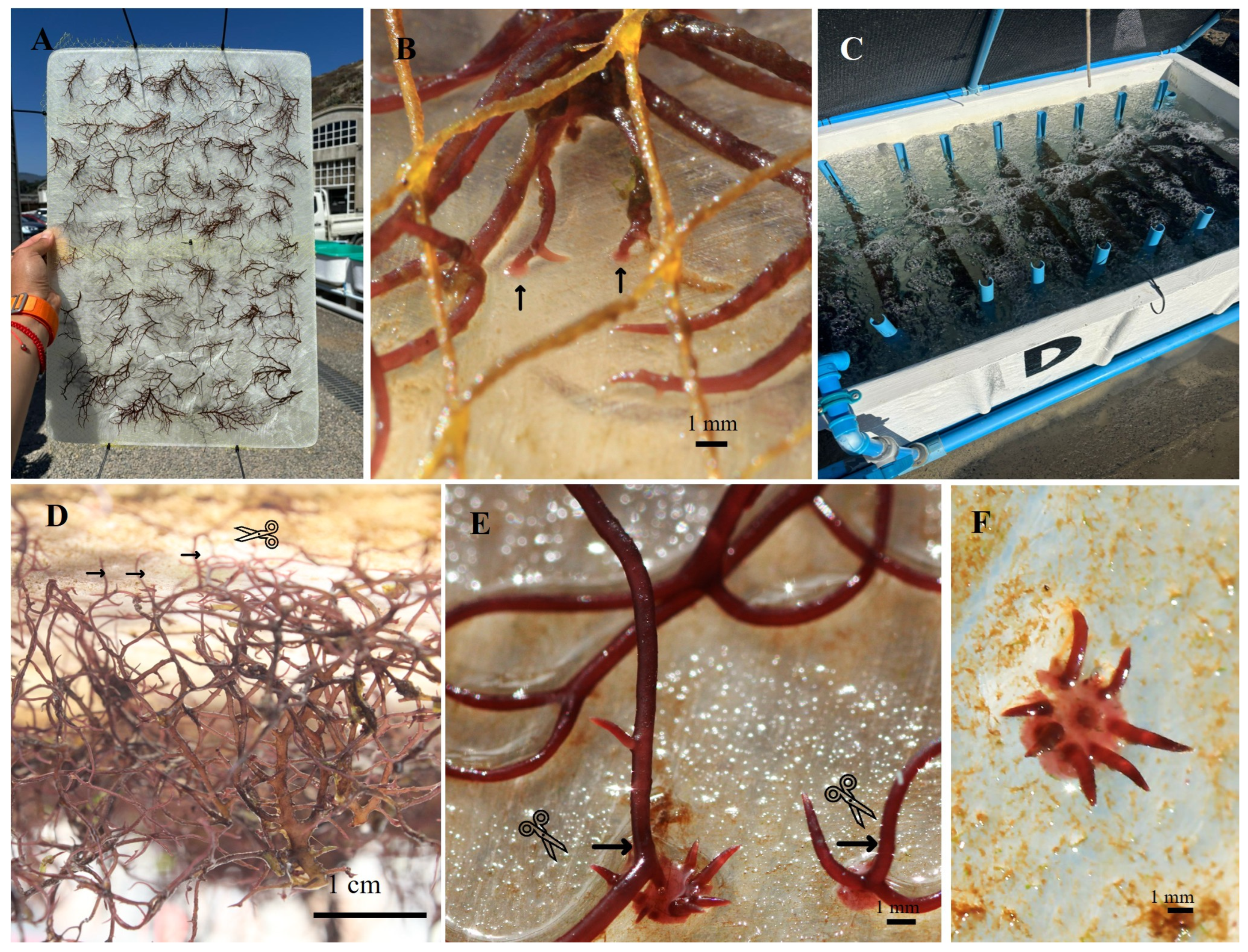
For SAD formation, donor thalli were attached to polycarbonate plates (45 × 60 cm) using 80 g of biomass distributed uniformly as 40 g on each side, allowing more than 90% of the plate surface to be covered. Donor algae were fastened to the plates with a mesh to ensure contact and promote SAD formation (Figure 1A,B). A total of 30 plates were inoculated and distributed homogeneously among three cultivation tanks, with 10 plates per unit. Each cultivation tank was considered an independent experimental replicate (n = 3), whereas the plates were treated as subsamples (Figure 1C). The plates were maintained under these conditions for 45–60 days and were checked and cleaned weekly to prevent the appearance of epibionts. After this period, the mesh was removed from each plate and the donor algae were cut, taking care to leave only the SADs attached to the plate (Figure 1D–F). The plates were then returned to the cultivation tanks and maintained for five months. During this period, the following variables were measured monthly: (i) number of SADs available on the plates; (ii) number of new thalli generated from each SAD; (iii) thallus coverage on the plates (%); and (iv) growth rate of the thalli originating from SADs (% d−1). For this purpose, five plates were randomly selected each month from each tank, and the variables described above were recorded using photographs taken under a stereoscopic microscope (Motic SMZ-143-N2LED; Motic China Group Co., Ltd., Xiamen, China). Images were processed using the Images Plus 3.0 software. For growth rate estimation on each plate, 30 thalli were individually marked and measured for length (mm). Thallus length was selected as the growth indicator because many thalli were small, avoiding potential overestimation associated with fresh weight due to retained surface water. Growth rate was calculated using the following equation:
GR (% d−1) = [(Lt/L0)1/t − 1] × 100%,
where L0 is the initial length and Lt is the length after t days.
After the initial cultivation period, the plates were subjected to two harvesting strategies. In Treatment 1, 15 plates were partially harvested by removing only the newly formed thalli emerging from the SADs, which had reached approximately 1–3 cm in length. Care was taken to preserve the SADs attached to the plates, allowing their continued use during the second production cycle. In Treatment 2, the remaining 15 plates were completely harvested by scraping the plate surfaces with a spatula, thereby removing all biomass present on the substrate, including the SADs. For both treatments, the harvested material was weighed, and the thalli were counted to determine total biomass and thallus production.

2.2.2. Second Seedstock Production Cycle

The plates with SADs (Treatment 1) were returned to the tanks for a second five-month culture period to evaluate the capacity of SADs to produce new thalli successively. In contrast, the plates that had been completely harvested (Treatment 2) were inoculated again with thalli collected from the same natural beds, following the same procedure described above (Section 2.2.1). This treatment therefore involved a complete cycle that included two months for SAD formation and an additional five months of cultivation. During this second cycle, the same variables described in Section 2.2.1 were quantified.

2.3. Data Analysis

For both production cycles, the following variables were recorded: (i) number of SADs available on the plates (N° SADs); (ii) number of new thalli generated from each SAD; (iii) thallus coverage on the plates (%); and (iv) growth rate of thalli originating from SADs (% d−1). These variables were analyzed using repeated-measures analysis of variance (ANOVA), after checking data normality and homogeneity of variance. When differences were detected, Tukey’s post hoc test was used. Normality was assessed with a Shapiro–Wilk test and homoscedasticity with Bartlett’s test. To analyze possible differences in the number of seedstock units according to treatment type, a t-test was performed. The significance level was set at p = 0.05. Statistical analyses were performed using the R software v4.4.1.

3. Results

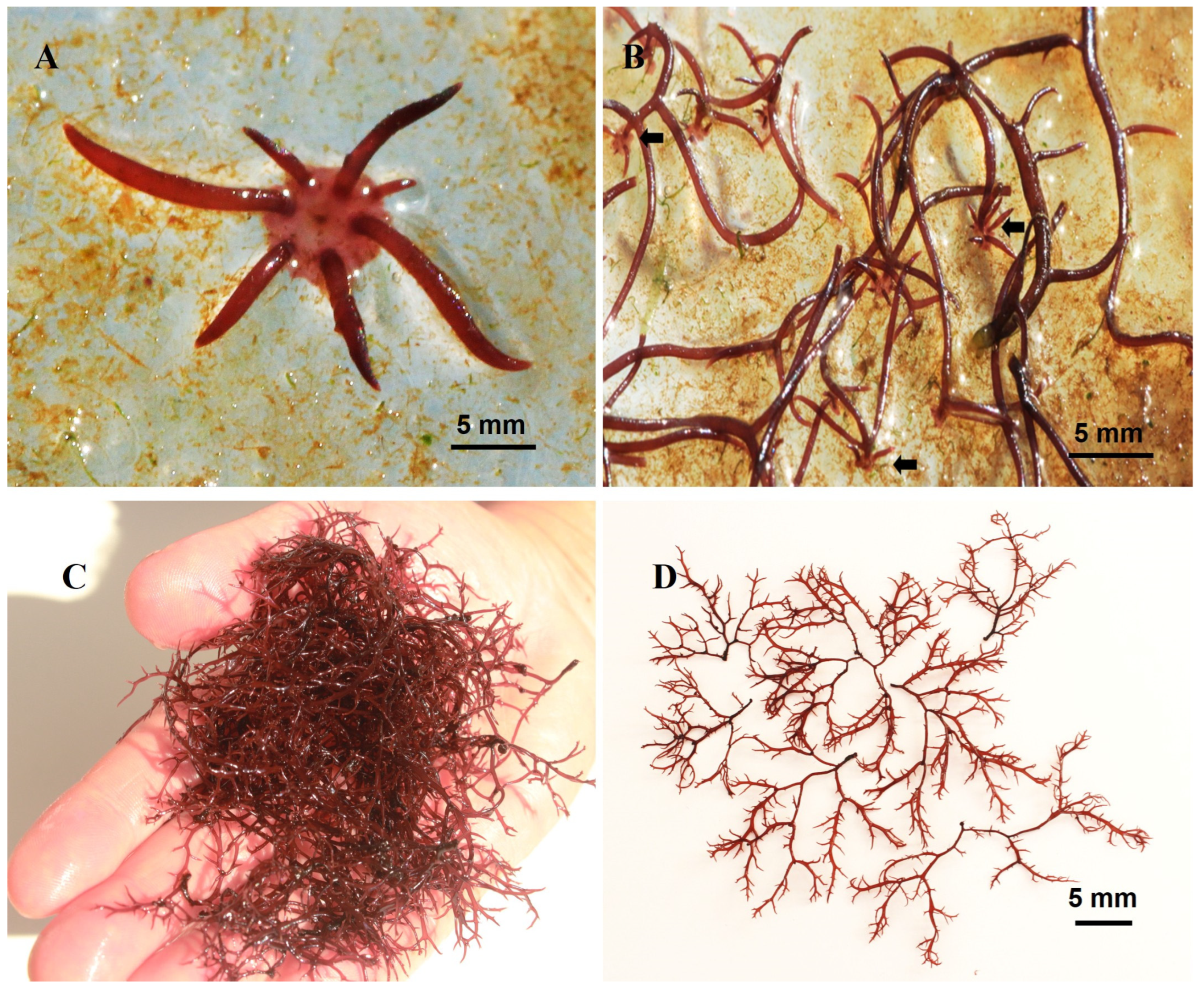
On all plates, the donor algal thalli formed SADs after coming into direct contact with the substrate. This occurred after 10 to 15 days of cultivation, with the formation of new apices along the edge of the ring-shaped disc (Figure 2A). As the thalli grew, they covered the plates because they curved and attached to the substrate, forming new SADs successively (Figure 2B). Harvested plates showed thin and branched thalli with the typical coloration of the species and sizes ranging from 0.5 to 4 cm (Figure 2C,D). During spring and summer, the plates were colonized by microalgae, especially benthic diatoms, as well as by the sporadic appearance of Ulva (Chlorophyta) and Polysiphonia (Rhodophyta) species. These organisms, which were mainly located on the edges of the plates, were removed weekly.
During the experiments, the minimum seawater temperature recorded was 13 ± 1 °C and the maximum was 19 ± 1 °C. Photon flux density showed high variability, with minimum and maximum monthly values of 209 ± 14 and 600 ± 46 μmol photons m−2 s−1, respectively.
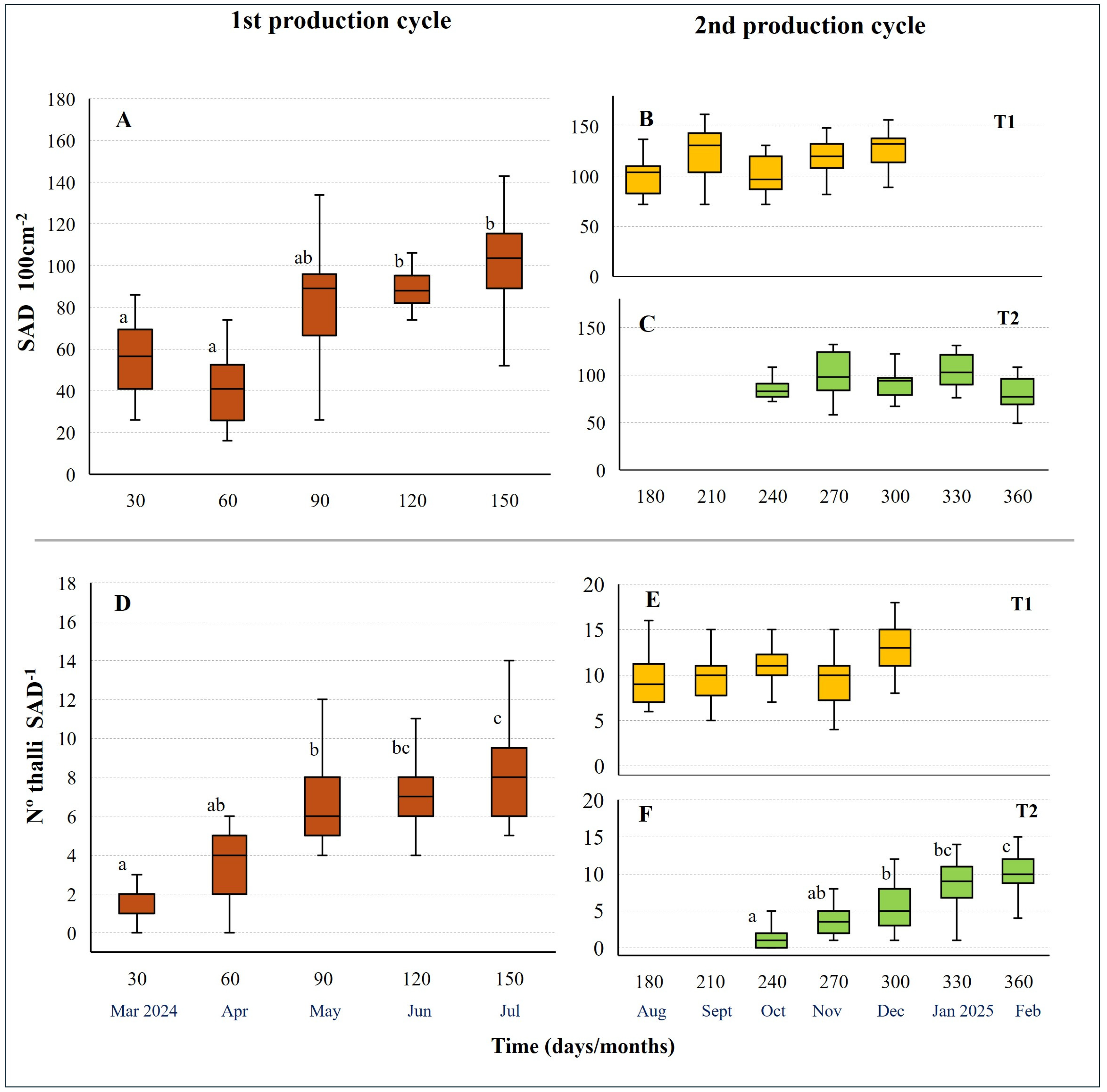
During the first months of cultivation (Figure 3A), the number of SADs increased, reaching 113 ± 23 SADs 100 cm−2 after 150 d. This increase was statistically significant (ANOVA, F(4,8) = 28.48; p < 0.05) and was explained by differences between 30 and 60 d compared with the values reached at 120 and 150 d. From day 90, an increase was observed, but no statistical differences were detected. During the second production cycle, plates from Treatment 1 maintained more than 100 SADs 100 cm−2 (Figure 3B), reaching a maximum of 131 ± 22 SADs 100 cm−2. However, these differences were not significant during this period (ANOVA, F(4,8) = 3.38; p = 0.0987). In Treatment 2, the number of SADs varied between 82 ± 16 and 107 ± 17 SADs 100 cm−2 (Figure 3C), with no significant differences recorded (ANOVA, F(4,8) = 5.39; p = 0.0986).
Regarding the formation of new thalli originating from SADs, the first production cycle (Figure 3D) reached a maximum value of 8 ± 1 thalli SAD−1 after 150 d. Variations were detected throughout the period (ANOVA, F(4,8) = 34.87; p < 0.05), as explained by differences between days 30, 60, and 90 when compared with 150 d. No differences were observed between 120 and 150 d.
During the second culture period, the number of new thalli from Treatment 1 did not show significant variation throughout the experimental period (ANOVA, F(4,8) = 7.07; p = 0.114), ranging from a minimum of 9 to a maximum of 15 thalli SAD−1 (Figure 3E). Treatment 2 reached a maximum value of 10 ± 4 thalli SAD−1 at the end of the culture period (Figure 3F). During this period, an increase in the number of new thalli was observed (ANOVA, F(4,8) = 56.15; p < 0.05), with clear differences between the first three months and the record from the last month of this production cycle. No differences were recorded between the last two months of cultivation.
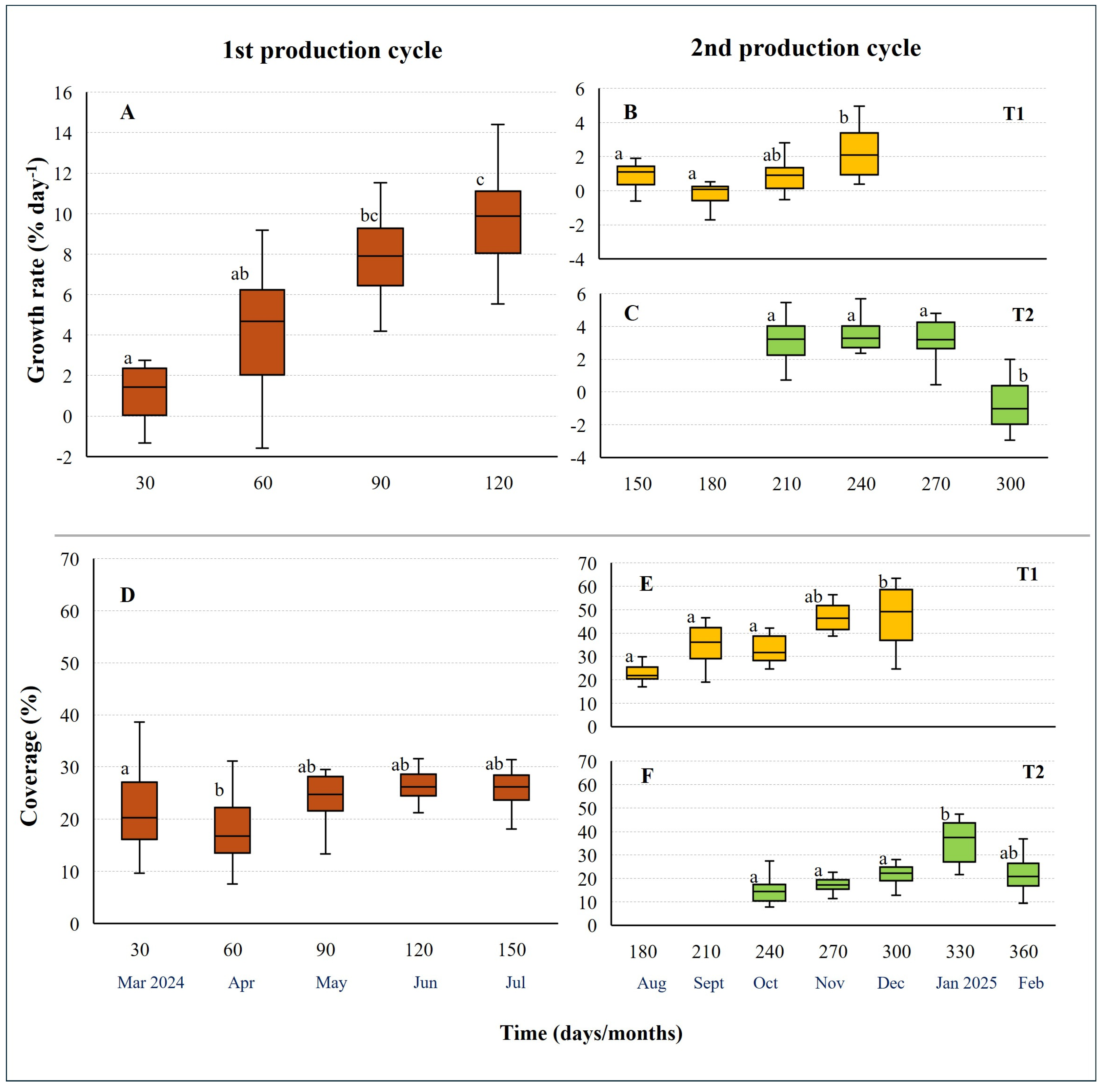
Figure 4A shows that growth rate increased during the first months of cultivation (ANOVA, F(3,6) = 85.72; p < 0.05), reaching 9.93 ± 1.21% d−1 at 150 d. These differences were detected when 30 and 60 d were compared with the growth rate reached from day 120 onward. During the second culture period, in Treatment 1 (Figure 4B), the highest growth rate was 2.32 ± 1.5% d−1 at 270 d of cultivation, showing statistically significant variation (ANOVA, F(3,6) = 9.67; p < 0.05) relative to the previous values recorded. In Treatment 2, the growth rate remained constant during the first three months of cultivation (Figure 4C) and then decreased significantly (ANOVA, F(3,6) = 28.13; p = 0.0024) during the last month of the period. The highest value was 3.72 ± 1.7% d−1 in the second month of cultivation.
Regarding coverage (Figure 4D), this remained stable during the first culture cycle, with a maximum coverage of 26.2 ± 3.1%. Nevertheless, significant differences were observed (ANOVA, F(4,8) = 8.51; p = 0.00293) due to variation between 30 and 60 d. During the second culture period (Figure 4E), differences in coverage were observed (ANOVA, F(4,8) = 9.82; p < 0.05), as explained by differences between 180 and 240 d compared with the highest coverage of 44 ± 6.2% reached at 300 d of cultivation.
In Treatment 2 (Figure 4F), coverage increased significantly (ANOVA, F(4,8) = 25.87; p < 0.05) until the fourth month, when a maximum of 35.48 ± 8.2% was reached before decreasing by the end of the period.
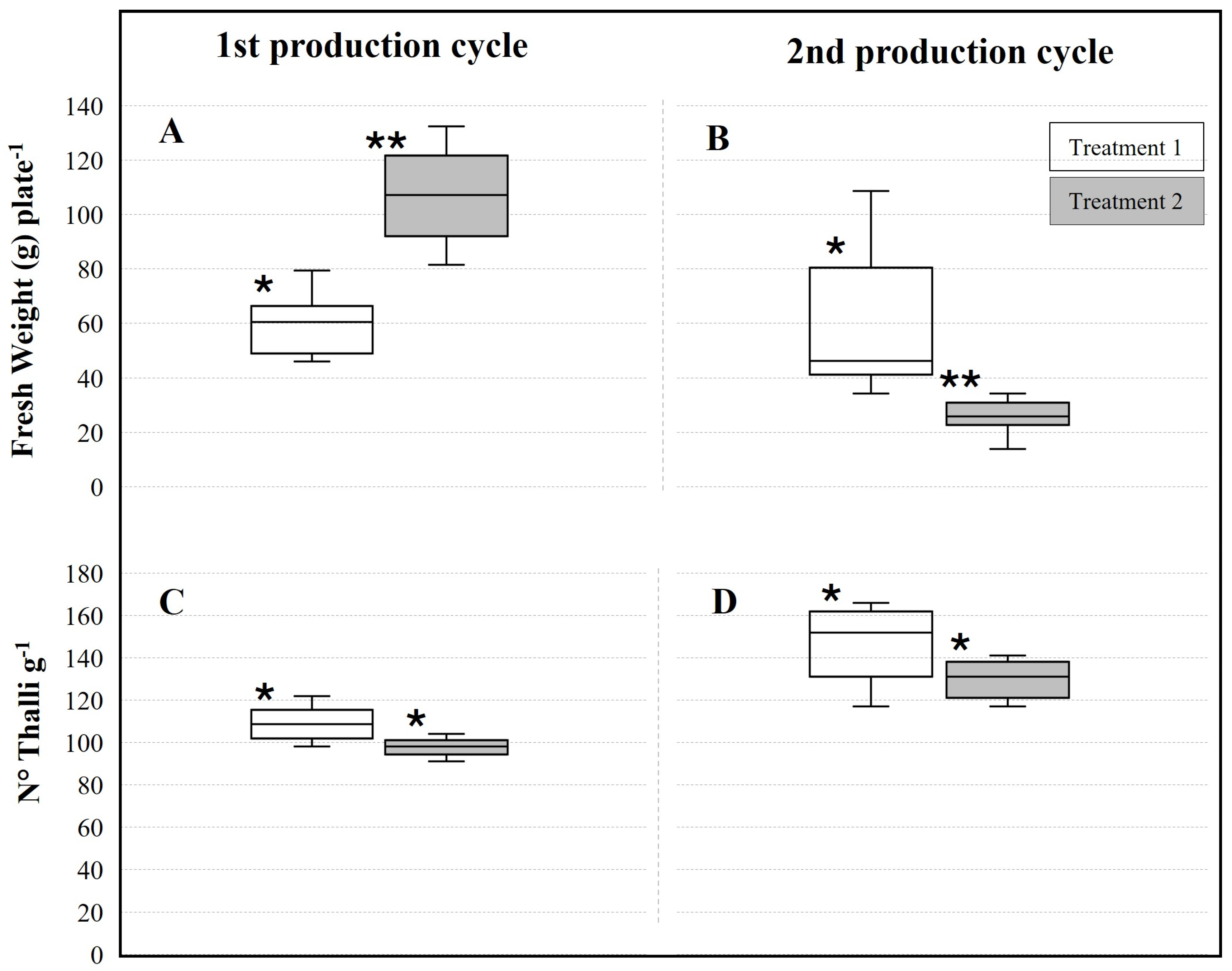
At the end of the first production cycle, thalli biomass from Treatments 1 and 2 differed significantly (t-test, p = 0.0006) (Figure 5A). Treatment 1, in which only the thalli emerging from SADs were harvested while leaving the SADs for cultivation in a new production cycle, reached 58 ± 20 g plate−1. In contrast, Treatment 2, in which all biomass generated on each plate was harvested, reached 107 ± 38 g plate−1. During the second production cycle (Figure 5B), both treatments also showed differences (t-test, p = 0.0007). Treatment 1 remained constant, with biomass production similar to the first period (51 ± 23 g plate−1), whereas Treatment 2 decreased to only 25 ± 6 g plate−1.
Figure 5C shows that, during the first production cycle, there were no differences in the number of thalli per gram of harvested biomass (t-test, p = 0.34), reaching 106 ± 12 and 98 ± 6 thalli g−1 for Treatments 1 and 2, respectively. A similar situation was recorded during the second cycle (t-test, p = 0.17), with production of 152 ± 17 and 131 ± 9 thalli g−1 for Treatments 1 and 2, respectively (Figure 5D).

4. Discussion

The present study demonstrates that secondary attachment discs can be used as productive vegetative units for the successive land-based production of Chondracanthus chamissoi seedstock. It also confirms that the natural capacity of C. chamissoi to reattach and regenerate through SADs [8,18,23,24] can be transferred to a controlled production system, as had already been proposed by several studies [8,9,13]. However, this study shows for the first time that SADs maintained regenerative capacity during a second production cycle when preserved after harvest, supporting use as a reusable seedstock source rather than as a single-use propagule.
There is now broad agreement that the controlled production of high-quality seedstock and propagules is a key step in the transition from extractive wild harvesting to a sustainable aquaculture industry [31], especially when several cases have warned of the rapid decline of natural beds in different seaweeds [20,32,33,34,35]. Controlled production also ensures a constant and predictable supply of seeding material, helping to overcome seasonality and the problems associated with natural recruitment [31]. For this, seedstock production should be incorporated into production cycles to avoid dependence on material collected from natural beds. In this sense, our results help address the availability of thalli used as seedstock, which was already identified [17] as a critical point in the aquaculture development of C. chamissoi and is an increasing concern in several species where seedstock availability can become a bottleneck for the maturation of cultivation technologies [31].
Recent advances reported in different regions for seedstock production have been adapted to the life cycle and specific propagation strategies of each species, using gametes in seaweeds such as Sargassum muticum and Durvillaea potatorum (Heterokontophyta) [36,37], spores in Gelidium elegans (Rhodophyta) and Ulva ohnoi (Chlorophyta) [34,38], and vegetative explants in Gelidium corneum, Gelidium micropterum, and Gracilaria dura (Rhodophyta) [22,33,39]. Other seaweed species such as Kappaphycus alvarezii, and Gracilaria domingensis (Rhodophyta) have been successfully cultured and regenerated into new plantlets in laboratories using direct regeneration, callus culture, and protoplast culture [16]. In this sense, C. chamissoi is the only species for which thalli production using SADs as a propagation strategy has been achieved. However, one of the main concerns regarding asexual vegetative mechanisms is the potential loss of productive capacity due to repeated use of the same parental thallus to obtain clones. This may reduce growth, regeneration capacity, or biomass quality over time, as reported for other commercially cultivated red algae [22,28].
Our results showed that growth rate increased during the first production cycle, reaching 9.93 ± 1.21% d−1. This value is higher than other growth records for thalli of this species [17,19,35] and, from a production perspective, indicates rapid thallus elongation. However, this response was not maintained during the second cycle, which could be interpreted as a loss of regenerative capacity in Treatment 1. Nevertheless, the same pattern was also observed in Treatment 2, suggesting that the lower growth may have been associated with culture conditions during the second cycle. During the study period, temperature varied between 12.5 ± 1 °C and 18.6 ± 1 °C, which are natural conditions for this eurythermal species and help explain its broad distribution [5]. Laboratory and field studies have also shown that this species can grow actively between 10 and 25 °C [35,40,41,42]. During cultivation, irradiance records reached up to 600 ± 46 µmol photons m−2 s−1 inside the tank. Although C. chamissoi has a broad vertical distribution, with natural beds ranging from the intertidal zone to 20 m depth (suggesting high adaptability to different light regimes), high irradiance could negatively affect growth. However, we consider that the increase in light had a different effect, favoring the proliferation of diatoms, Ulva thalli, and filamentous red algae on the edges of the plates, coinciding with the spring and summer months. This can potentially affect culture conditions inside the tank by promoting the growth of other species. Therefore, epiphyte management will be a critical point, and it will be necessary to adjust aspects such as cleaning frequency, light intensity, and the design of plates and tanks to prevent appearance.
Despite the variation in elongation of new thalli, the other variables measured showed that SADs maintained productive capacity during two consecutive culture cycles when preserved on the plates after harvest. Our results showed that Treatment 1, in which only the new emerging thalli were harvested while leaving the SADs attached, maintained more than 100 SADs 100 cm−2 during the second cycle and produced between 9 and 15 thalli per SAD. In addition, harvested biomass was similar between cycles: 58 ± 20 g plate−1 in the first cycle and 51 ± 23 g plate−1 in the second. Plate coverage in Treatment 1 also increased steadily during the study, showing progressive attachment of new thalli to the substrate and evidencing high regenerative capacity, even higher than that reported for shorter culture periods [17]. This indicates that active SADs can generate new thalli and maintain adequate coverage to sustain production. Under the conditions tested, no clear decline in regenerative capacity was observed, suggesting that SADs of C. chamissoi can retain their capacity to generate new thalli after harvest, at least over the time scale evaluated in this study.
The comparison between harvest strategies showed that, in both cases, the thalli obtained in this study had characteristics compatible with young and manageable vegetative material, making them suitable for later use as seedstock. In addition, the number of thalli per gram did not show marked differences between treatments, indicating that both strategies produced useful material. From a production perspective, total biomass removal in Treatment 2 produced a higher initial harvest (107 ± 38 g plate−1) during the first cycle than Treatment 1, in which only the new thalli grown from SADs were harvested (58 ± 20 g plate−1). However, this advantage was not maintained during the second cycle, when Treatment 2 decreased to 25 ± 6 g plate−1, while Treatment 1 remained at 51 ± 23 g plate−1. These results indicate that biomass production in Treatment 1 remained similar between the two evaluated production cycles, whereas Treatment 2 showed a marked decrease during the second cycle. Operationally, this pattern suggests an advantage of preserving the SADs for successive harvests.
Treatment 1 also had other operational advantages, since its shorter duration allowed two thallus harvests in 300 days. Based on the results observed, this could potentially be optimized by shortening both harvests by one month, because no differences were recorded between the last two months of cultivation in either cycle. The situation is different for Treatment 2, which completes two harvests in 360 days because it requires a new collection and seeding of donor algae. This creates uncertainty, as it depends on the availability of high-quality donor algae at different times of the year, which can compromise the culture itself. Therefore, according to the results obtained, scraping the entire plate, as done in Treatment 2, may be useful when a single harvest is required, but it does not appear to be a good strategy for a continuous system. In contrast, partial harvesting in Treatment 1 preserves the SADs and maintains productive capacity over time without the uncertainty associated with external factors.
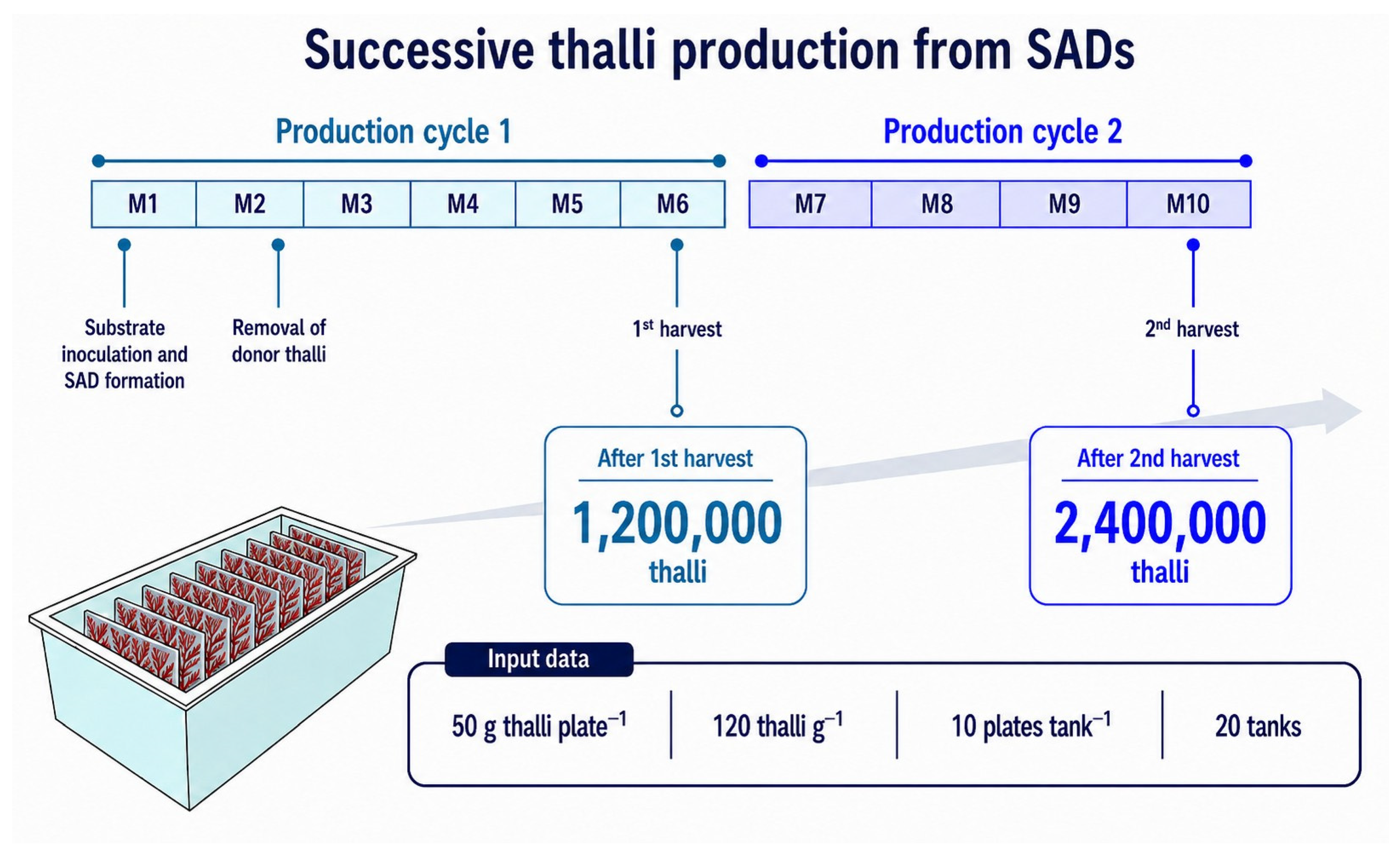
These results support the use of SADs as reusable vegetative units for successive seedstock production in land-based nursery systems. Based on this, it is possible to simulate (Figure 6) a potential model for producing 1,200,000 thalli per harvest, using moderate assumptions of 50 g thalli plate−1 in each harvest and 120 thalli g−1, with 10 plates and 20 cultivation tanks operating simultaneously, without the need to renew donor algae. In operation, this technology could supply farmers using cultivation systems that require thalli as inoculum in suspended or bottom cultures, such as those developed to date [9,10,11,12,13].

5. Conclusions

This study shows that SADs can support successive land-based production of C. chamissoi seedstock under outdoor tank conditions. SADs formed rapidly on artificial substrates, generated new thalli, and retained productive capacity after harvest when the discs were preserved on the plates. Partial harvesting maintained similar biomass production between the two evaluated cycles, suggesting that preservation of SADs is a promising strategy for repeated seedstock production. Although no clear decline in regenerative capacity was observed during the period evaluated, additional production cycles are required to determine whether this capacity can be maintained over longer periods. These results provide a practical basis for the development of land-based seedstock production technologies for C. chamissoi and represent a step toward reducing dependence on natural populations as a source of cultivation material.

Author Contributions

C.B.: writing—review & editing, writing—original draft, visualization, methodology, investigation, funding acquisition; P.A.: methodology, investigation. C.G.: methodology, investigation; L.C.-P.: writing—review & editing, funding acquisition. J.P.R.: writing—review & editing, funding acquisition. D.V.: formal analysis, investigation, original draft. M.Á.: review & editing, funding acquisition. All authors have read and agreed to the published version of the manuscript.

Funding

This research was funded by ANID–Subdirección de Investigación Aplicada–Grant: FONDEF IT23I0015.

Institutional Review Board Statement

Not applicable.

Data Availability Statement

The data that supports the results of the present research study are available when solicited to the corresponding author.

Acknowledgments

This work was supported by FONDEF project IT23I0015. We thank the Marine Research Center of Quintay (CIMARQ) for its support in laboratory activities. The authors declare that ChatGPT (version: 5.6, OpenAI, San Francisco, CA, USA) was used to improve the readability of parts of this manuscript. These sections were then carefully reviewed and re-edited by the authors as required. The authors take full responsibility for the content of this manuscript.

Conflicts of Interest

The authors declare that they have no potential conflicts of interest.

References

  1. FAO. The State of World Fisheries and Aquaculture 2024: Blue Transformation in Action; FAO: Rome, Italy, 2024. [Google Scholar] [CrossRef] [Scilit]
  2. World Bank. Global Seaweed: New and Emerging Markets Report; World Bank: Washington, DC, USA, 2023; Available online: https://www.worldbank.org/en/topic/environment/publication/global-seaweed-new-and-emerging-markets-report-2023 (accessed on 14 May 2026).
  3. Oyarzo-Miranda, C.; Otaíza, R.; Bellorín, A.; Vega, J.; Tala, F.; Lagos, N.; Bulboa, C.; Contreras-Porcia, L. Seaweed restocking along the Chilean coast: History, present, and inspiring recommendations for sustainability. Front. Mar. Sci. 2023, 9, 1062481. [Google Scholar] [CrossRef] [Scilit]
  4. Lovatelli, A.; Aguilar-Manjarrez, J.; Murúa Andrade, P.; Farías Molina, A. Estado y Perspectivas del Cultivo de Macroalgas en América Latina (FAO Actas de Pesca y Acuicultura No. 74); Food and Agriculture Organization of the United Nations: Rome, Italy, 2025. [Google Scholar] [CrossRef] [Scilit]
  5. Bulboa, C.; Massad, I.; Contreras-Porcia, L.; Zapata, J.; Castañeda, F.; Ramírez, M.; Gil-Kodaka, P. Concise review of genus Chondracanthus (Rhodophyta: Gigartinales). J. Appl. Phycol. 2020, 32, 773–785. [Google Scholar] [CrossRef] [Scilit]
  6. Bulboa, C.; Macchiavello, J.; Oliveira, E.; Fonck, E. First attempt to cultivate the carrageenan-producing seaweed Chondracanthus chamissoi (C. Agardh) Kützing (Rhodophyta; Gigartinales) in Northern Chile. Aquac. Res. 2005, 36, 1069–1074. [Google Scholar] [CrossRef] [Scilit]
  7. Bulboa, C.; Macchiavello, J. Cultivo de frondas cistocárpicas, tetraspóricas y vegetativas de Chondracanthus chamissoi (Rhodophyta, Gigartinales) en dos localidades del norte de Chile. Investig. Mar. 2006, 34, 109–112. [Google Scholar] [CrossRef] [Scilit]
  8. Bulboa, C.; Véliz, K.; Sáez, F.; Sepúlveda, C.; Vega, L.; Macchiavello, J. A new method for cultivation of the carragenophyte and edible red seaweed Chondracanthus chamissoi based on secondary attachment disc: Development in outdoor tanks. Aquaculture 2013, 410, 86–94. [Google Scholar] [CrossRef] [Scilit]
  9. Macchiavello, J.; Sepúlveda, C.; Basaure, H.; Sáez, F.; Yañez, D.; Marín, C.; Vega, L. Suspended culture of Chondracanthus chamissoi (Rhodophyta: Gigartinales) in Caleta Hornos (northern Chile) via vegetative propagation with secondary attachment discs. J. Appl. Phycol. 2018, 30, 1149–1155. [Google Scholar] [CrossRef] [Scilit]
  10. Basaure, H.; Macchiavello, J.; Sepúlveda, C.; Sáez, F.; Yañez, D.; Vega, L.; Marín, C. Sea bottom culture of Chondracanthus chamissoi (Rhodophyta: Gigartinales) by vegetative propagation at Puerto Aldea, Tongoy Bay (northern Chile). Aquac. Res. 2021, 52, 2025–2035. [Google Scholar] [CrossRef] [Scilit]
  11. Arbaiza, S.; Castañeda-Franco, M.; Baltazar Guerrero, P.; Bulboa, C. Tree-line system: A sea bottom cultivation technology to improve the biomass production of edible seaweed Chondracanthus chamissoi (Gigartinales, Rhodophyta). J. World Aquac. Soc. 2025, 56, e70007. [Google Scholar] [CrossRef] [Scilit]
  12. Ruiz-Ipanaque, W.; Guerrero, P.; Casteñeda-Franco, M.; Mires-Reyes, A. Capacidad regenerativa post-cosecha de la macroalga roja Chondracanthus chamissoi en dos sistemas de cultivo en la costa centro-sur del Perú. Bol. Investig. Mar. Costeras. 2024, 53, 67–82. [Google Scholar] [CrossRef] [Scilit]
  13. Arbaiza, S.; Avila-Peltroche, J.; Castañeda-Franco, M.; Mires-Reyes, A.; Advíncula, O.; Baltazar, P. Vegetative propagation of the commercial red seaweed Chondracanthus chamissoi in Peru by secondary attachment disc during indoor cultivation. Plants 2023, 12, 1940. [Google Scholar] [CrossRef] [Scilit] [PubMed]
  14. Charrier, B.; Abreu, M.; Araujo, R.; Bruhn, A.; Coates, J.; De Clerck, O.; Katsaros, C.; Robaina, R.; Wichard, T. Furthering knowledge of seaweed growth and development to facilitate sustainable aquaculture. New Phytol. 2017, 216, 967–975. [Google Scholar] [CrossRef] [Scilit] [PubMed]
  15. Kim, J.; Yarish, C.; Hwang, E.; Park, M.; Kim, Y.; Jang, K. Seaweed aquaculture: Cultivation technologies, challenges and its ecosystem services. Algae 2017, 32, 1–13. [Google Scholar] [CrossRef] [Scilit]
  16. Jiksing, C.; Ongkudon, M.; Thien, V.; Rodrigues, K.; Yong, W.; McMarshall, M. Recent advances in seaweed seedling production: A review of eucheumatoids and other valuable seaweeds. Algae 2022, 37, 105–121. [Google Scholar] [CrossRef] [Scilit]
  17. Oyarzo, S.; Ávila, M.; Alvear, P.; Remoncellez, J.; Contreras-Porcia, L.; Bulboa, C. Secondary attachment disc of edible seaweed Chondracanthus chamissoi (Rhodophyta, Gigartinales): Establishment of permanent thalli stock. Aquaculture 2021, 530, 735954. [Google Scholar] [CrossRef] [Scilit]
  18. Macchiavello, J.; Bulboa, C.; Edding, M. Vegetative propagation and spore-based recruitment in the carrageenophyte Chondracanthus chamissoi (Gigartinales, Rhodophyta) in northern Chile. Phycol. Res. 2003, 51, 45–50. [Google Scholar] [CrossRef] [Scilit]
  19. Sáez, F.; Macchiavello, J. Secondary attachment discs: A new alternative for restoring populations of Chondracanthus chamissoi (Gigartinales, Rhodophyta). Lat. Am. J. Aquat. Res. 2018, 46, 140–146. [Google Scholar] [CrossRef] [Scilit]
  20. Saminathan, K.; Ashok, K.; Veeragurunathan, V.; Mantri, V. Seedling production in the industrially important agarophyte Gracilaria dura (Gracilariales, Rhodophyta). J. Appl. Phycol. 2015, 27, 1541–1548. [Google Scholar] [CrossRef] [Scilit]
  21. Hayashi, L.; Cantarino, S.; Critchley, A.T. Challenges to the future domestication of seaweeds as cultivated species: Understanding their physiological processes for large-scale production. In Advances in Botanical Research; Academic Press: Cambridge, MA, USA, 2020; Volume 95, pp. 57–83. [Google Scholar] [CrossRef] [Scilit]
  22. Balar, N.; Depani, P.; Baraiya, M.; Jaiswar, S.; Rathore, M.; Singh, V.; Mantri, V. Scaled-up clonal propagule production in Gracilaria dura (Rhodophyta) for sustainable feedstock production and implications for circular economy. Aquac. Int. 2025, 33, 20. [Google Scholar] [CrossRef] [Scilit]
  23. Fonck, E.; Martínez, R.; Vásquez, J.; Bulboa, C. Factors that affect the re-attachment of Chondracanthus chamissoi (Rhodophyta, Gigartinales) thalli. J. Appl. Phycol. 2008, 20, 311–314. [Google Scholar] [CrossRef] [Scilit]
  24. Sáez, F.; Macchiavello, J.; Fonck, E.; Bulboa, C. The role of the secondary attachment disc in the vegetative propagation of Chondracanthus chamissoi (Gigartinales; Rhodophyta). Aquat. Bot. 2008, 89, 63–65. [Google Scholar] [CrossRef] [Scilit]
  25. Rodríguez, C.; Otaíza, R. Factors affecting morphological transformation and secondary attachment of apexes of Chondracanthus chamissoi (Rhodophyta, Gigartinales). J. Appl. Phycol. 2018, 30, 1157–1166. [Google Scholar] [CrossRef] [Scilit]
  26. Pacheco-Ruíz, I.; Zertuche-González, J.; Espinoza-Avalos, J. The role of secondary attachment discs in the survival of Chondracanthus squarrulosus (Gigartinales, Rhodophyta). Phycologia 2005, 44, 629–631. [Google Scholar] [CrossRef] [Scilit]
  27. Perrone, C.; Cecere, E. Regeneration and mechanisms of secondary attachment in Solieria filiformis (Gigartinales, Rhodophyta). Phycologia 1997, 36, 120–127. [Google Scholar] [CrossRef] [Scilit]
  28. Luhan, M.; Mateo, J.; Sollesta-Pitog, H. Growth and quality of carrageenan from the sporophyte and gametophyte of the commercially important red algae Kappaphycus alvarezii. Philipp. J. Sci. 2022, 151, 129–134. [Google Scholar] [CrossRef] [Scilit]
  29. Hurtado, A.; Neish, I.; Critchley, A. Developments in production technology of Kappaphycus in the Philippines: More than four decades of farming. J. Appl. Phycol. 2015, 27, 1945–1961. [Google Scholar] [CrossRef] [Scilit]
  30. Hurtado, A.; Neish, I.; Critchley, A. Phyconomy: The extensive cultivation of seaweeds, their sustainability and economic value, with particular reference to important lessons to be learned and transferred from the practice of eucheumatoid farming. Phycologia 2019, 58, 472–483. [Google Scholar] [CrossRef] [Scilit]
  31. García-Poza, S.; Leandro, A.; Cotas, C.; Cotas, J.; Marques, J.; Pereira, L.; Gonçalves, A. The evolution road of seaweed aquaculture: Cultivation technologies and the industry 4.0. Int. J. Environ. Res. Public Health 2020, 17, 6528. [Google Scholar] [CrossRef] [Scilit] [PubMed]
  32. López-Campos, M.; Pérez-Lloréns, J.; Barrena, F.; Pérez-González, C.; Hernández, I. Culture of Gracilaria gracilis and Chondracanthus teedei from Vegetative Fragments in the Field and Carpospores in Laboratory. J. Mar. Sci. Eng. 2022, 10, 1041. [Google Scholar] [CrossRef] [Scilit]
  33. Sainz-Villegas, S.; Sánchez-Astráin, B.; Puente, A.; Juanes, J. Characterization of Gelidium corneum’s (Florideophyceae, Rhodophyta) vegetative propagation process under increasing levels of temperature and irradiance. Mar. Environ. Res. 2023, 187, 105966. [Google Scholar] [CrossRef] [Scilit] [PubMed]
  34. Lin, S.; Chen, S.; Huang, P.; Liu, L.; Chiou, Y. Sporelings and growth of the marine red alga, Gelidium elegans (Gelidiaceae), from Northern Taiwan. J. Appl. Phycol. 2024, 36, 3581–3590. [Google Scholar] [CrossRef] [Scilit]
  35. Soto-Deza, N.; Cabanillas-Chirinos, L.; Terrones-Rodríguez, N. Implementation of sustainable methods for the propagation and cultivation of Chondracanthus chamissoi “Yuyo” in la libertad, Peru: A transition from the laboratory to the sea. J. Mar. Sci. Eng. 2025, 13, 1164. [Google Scholar] [CrossRef] [Scilit]
  36. Le, H.; Hughes, A.; Kerrison, P. Early development and substrate twine selection for the cultivation of Sargassum muticum (Yendo) Fensholt under laboratory conditions. J. Appl. Phycol. 2018, 30, 2475–2483. [Google Scholar] [CrossRef] [Scilit] [PubMed]
  37. Visch, W.; Furness, G.; Arioli, T.; Hurd, C.; South, P.; White, W.; Wright, J.T. Hatchery development for aquaculture of the southern bull kelp Durvillaea potatorum (Fucales): Gamete release, fertilisation rate, and juvenile growth. J. Appl. Phycol. 2026, 38, 1411–1424. [Google Scholar] [CrossRef] [Scilit]
  38. Trivedi, K.; Dinesh Kumar, S.; Majumder, A.; Habsi, M.; Suhail Haq, R.; Hariprakash, M.; Logesh, K.; Nakad, J.; Veeragurunathan, V.; Ghosh, A. Process development for scaled-up land-based cultivation of Ulva ohnoi (Hiraoka & S. Shimada) using spores-derived seedlings. Phycol. J. 2026, 2, 1. [Google Scholar] [CrossRef] [Scilit]
  39. Baghel, R.; Sharma, A.; Vas, A.; Reddy, C. Production of quality biomass of Gelidium micropterum Kützing through optimization of nutrients and salinity for sustainable land-based cultivation. J. Appl. Phycol. 2024, 36, 3537–3547. [Google Scholar] [CrossRef] [Scilit]
  40. Bulboa, C.; Macchiavello, J.; Oliveira, E.; Véliz, K. Growth rate differences between four Chilean populations of edible seaweed Chondracanthus chamissoi (Rhodophyta, Gigartinales). Aquac. Res. 2008, 39, 1550–1555. [Google Scholar] [CrossRef] [Scilit]
  41. Avila, M.; Piel, M.; Caceres, J.; Alveal, K. Cultivation of the red alga Chondracanthus chamissoi: Sexual reproduction and seedling production in culture under controlled conditions. J. Appl. Phycol. 2011, 23, 529–536. [Google Scholar] [CrossRef] [Scilit]
  42. Rios-Cruz, L.; Baltazar-Guerrero, P.; Castañeda-Franco, M.; Arbaiza-Quispe, S. Efecto de la irradiancia y temperatura sobre esporofitos de Chondracanthus chamissoi. Rev. Biol. Mar. Oceanogr. 2023, 58, 148–154. [Google Scholar] [CrossRef] [Scilit]
Figure 1. Procedures for seeding and harvesting. (A): Plate inoculated with donor thalli. (B): Detail of early SAD formation on the plates after 10–15 days. (C): Cultivation tank with vertically arranged plates. (D): Plate with donor thalli attached through SADs; arrows indicate the thalli and attachment points that were later cut. (E): Detail of a donor thallus with SADs attached to the substrate before removal. (F): SAD attached to a plate after separation from the donor thallus.
Phycology 06 00098 g001
Figure 2. (A): SAD with seven new thalli formed along the margins after three months of cultivation. (B): Plate coverage by SADs (arrows). (C): Group of thalli harvested from one plate during the first harvest in Treatment 1. (D): Detail of thalli harvested during the second harvest in Treatment 1.
Phycology 06 00098 g002
Figure 3. Successive SAD production cycles in Chondracanthus chamissoi. (A): SAD production during the first cycle. (B,C): SAD production during the second cycle in Treatment 1 (T1) and Treatment 2 (T2), respectively. (D): Number of thalli formed per SAD during the first cycle. (E,F): Number of thalli formed per SAD during the second cycle in T1 and T2, respectively. Letters indicate significant differences within each month (p < 0.05), based on post hoc analysis.
Phycology 06 00098 g003
Figure 4. Successive SAD production cycles in Chondracanthus chamissoi. (A): Growth rate of thalli generated from SADs during the first cycle. (B,C): Growth rate during the second cycle in Treatment 1 (T1) and Treatment 2 (T2), respectively. (D): SAD coverage on the plates during the first cycle. (E,F): SAD coverage during the second cycle in T1 and T2, respectively. Letters indicate significant differences within each month (p < 0.05), based on post hoc analysis.
Phycology 06 00098 g004
Figure 5. (A) Fresh weight harvested in Treatments 1 and 2 during the first production cycle. (B) Fresh weight harvested in Treatments 1 and 2 during the second production cycle. (C,D): Number of thalli per gram of harvested algal biomass in both production cycles for the two harvest treatments. Asterisks indicate significant differences (p < 0.05).
Phycology 06 00098 g005
Figure 6. Illustrative projection of successive thalli production using SADs over two production cycles. The projection is based on the experimental results and conservative assumptions of 50 g of thalli plate−1 per harvest, 120 thalli g−1, 10 plates tank−1, and 20 cultivation tanks operating simultaneously. Under these assumptions, the estimated cumulative production would reach approximately 1,200,000 thalli after the first harvest and 2,400,000 thalli after the second harvest.
Phycology 06 00098 g006
Disclaimer/Publisher’s Note: The statements, opinions and data contained in all publications are solely those of the individual author(s) and contributor(s) and not of MDPI and/or the editor(s). MDPI and/or the editor(s) disclaim responsibility for any injury to people or property resulting from any ideas, methods, instructions or products referred to in the content.