


Simple Summary
The objective of this study was to investigate the potential relationships between three levels of vaginal discharge scores and both vulvovaginal lacerations and non-reproductive health indicators in the early puerperal period. A GLMM was used to assess these associations. Accordingly, vulvovaginal lacerations (p < 0.0001), soft fecal consistency (p < 0.001), ketosis (p < 0.01), low body condition scores (p < 0.01), and multiparous cows (p < 0.0001) were associated with increasing vaginal discharge scores. These findings highlight the relevance of vaginal tears and fecal consistency evaluation, among other indicators, in the uterine health of dairy cows.
Abstract
Several indicators are used in dairy farms to monitor health status during the puerperal period. Uterine disease complex is one of the compromised health issues during this period. This study mainly aims to evaluate the relationship between abnormal vaginal discharge scores (VDS), indicative of uterine health impairment (e.g., metritis), and reproductive and non-reproductive risk factors during the first three weeks postpartum of dairy cows. An ordinal logistic GLMM was used to evaluate the influence of vulvovaginal lacerations, fecal consistency, ketonuria, body condition, parity, day of reproductive evaluation and farm on normal (0–2 points; control group), moderate (3–4), and high (5–9) VDS from 2860 calvings in 14 Danish farms (2023–2025). Vulvar and vaginal lacerations (odds ratio, OR = 2.4 and 17.1, respectively; p < 0.001) and soft feces (OR = 1.7; p < 0.001), ketosis (OR = 1.8; p < 0.001), low body condition score (OR = 1.7; p < 0.01), and multiparous cows (OR = 2.1; p < 0.0001) were associated with moderate and high VDS. These results suggest that vulvovaginal lacerations, even if considered as a potential residual confounder regarding dystocia and other periparturient reproductive abnormalities, and non-reproductive factors, such as fecal consistency, should be included to assess uterine health during postpartum, regarding normal, moderate, and high VDS. A large study involving all relevant reproductive occurrences during puerperium and their impact on further fertility can provide additional information for reproductive herd health management.
1. Introduction
During the first three weeks postpartum of dairy cows, vaginal discharge (VD) is related to physiological or pathological processes of uterine involution (lochia and endometrial regeneration) or metritis, respectively. Physiologically, small amounts of non-purulent dark red or brown to reddish-white uterine secretions, without foul odor, are expelled through the vagina. Bacterial contamination of the reproductive tract is common at this reproductive stage. Depending on bacterial load, energy balance, stress levels, and immune status, progressive, purulent, and abundant secretions can occur as VD in postpartum cows [1]. Dystocia, retained placenta, lameness, metabolic diseases, and parity, among others, have been reported as relevant risk factors of uterine inflammation and infection [2].
Currently, several indicators are evaluated during the early postpartum period of dairy cows as part of a herd health management program. VD from uterine secretions, vulvovaginal lacerations, body condition, ketonemia, and fecal consistency (FC) are the most widely used and low-cost indicators of reproductive, metabolic, and digestive health [2,3,4,5]. Understanding these associations is important because many reproductive and non-reproductive factors are manageable at the herd level. Identifying cows at higher risk could support earlier diagnosis, improved preventive strategies, and better postpartum health management.
Nevertheless, some gaps in the use of these indicators were not fully addressed: (1) The adverse effect of vulvovaginal lacerations, as evidence of a difficult labor at calving, on VD was reported [5,6]. However, the impact of their localization (vulva vs. vaginal vestibule and fornix of vagina) on VD requires deeper evaluation; (2) FC is commonly assessed on dairy farms as an indicator of gut and general health [7]. The bidirectional association of the gut microbiome with reproductive health status has been evaluated [8,9,10,11]. FC scoring is an easy, inexpensive, and rapid technique. Evidence of an association between soft feces and metritis could support its use as a complementary diagnostic indicator of this uterine disorder; (3) Commonly, metritis has only been defined by high vaginal discharge scores (VDS) and treated thereafter [12]. Progressive uterine inflammation and infection are present, and moderate VDS can be affected by the same risk factors.
The main objective of this study is to evaluate the relationships between VDS and vulvovaginal laceration scores (VVLS) as well as non-reproductive health indicators. We hypothesize that the location of vulvovaginal laceration (hypothesis 1) and watery feces (hypothesis 2) can serve as health indicators of VDS, and that these factors can also influence moderate VDS. These hypotheses were stated after data collection, but before data analysis.
2. Materials and Methods
This cross-sectional study was conducted as part of a reproductive health program for dairy cattle herds and was approved under protocol number 39316NON/UTAD (24 July 2025). This was a retrospective observational study based on routine clinical records collected as part of the contracted herd-health service. No procedure was performed on the animals for research purposes. The original clinical examinations formed part of standard veterinary practice under Directive 2010/63/EU.
2.1. Farms and Animal Management
The reproductive and health records of 14 Danish dairy farms were used between December 2023 and July 2025. These farms were selected by convenience from a Danish veterinarian service (Vestjyske Dyrlæge ApS; Nørre Nebel, Denmark) located in the region of the Cimbrian Peninsula.
All cows were housed in free-stall barns and milked twice a day on conventional farms. Animals were fed with TMR (total mixed ration). Basal ingredients included maize silage (up to 60%), grass silage (up to 30%), concentrate (usually grain up to 10%), and minerals. Rapeseed and soy were also periodically incorporated into the total mixed ration.
The mean farm size was 694 (95% CI: 510–789) heifers and cows. An annual culling rate of up to 25% was observed. The annual energy-corrected milk was 12,439 kg (95% CI: 12,060–12,818).
According to the programmed veterinarian visits to farms, each cow was assessed at a single time during the first 21 days after calving. All relevant productive, reproductive, and health parameters were evaluated, and decisions on further procedures were made by agreement between the four veterinarians and producers. Standardization of clinical assessments was achieved through common training within the clinic and use of specific protocols and procedures, including written scoring references. Appropriate treatments were implemented when necessary, and voluntary or involuntary culling, including death and euthanasia, occurred on time, considering production goals and health status. Therefore, the farms were under strict control of an overall health management program.
2.2. Study Design and Definition of Health Indicators
The study protocol and hypothesis were formulated after the clinical data had been collected but before the statistical analysis was undertaken.
A total of 2860 calving records from 2034 animals were used according to the following inclusion criteria: (1) cows calving during this period; (2) submitted to a reproductive examination during the first three weeks; (3) followed up for artificial insemination during the first 6 months after calving; and (4) monitored for pregnancy or culling. Cows that had received anti-inflammatory or antimicrobial treatment before the single postpartum examination could not be identified using the database and were therefore not excluded, as such a treatment is standard practice for sick animals. Calving was considered the unit of the present study. The mean number of calvings per farm was 204 (95% CI: 112–256) during the study period.
Vaginal discharge scores (dependent variable)
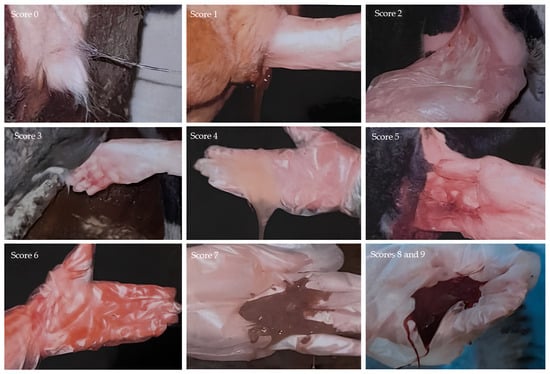
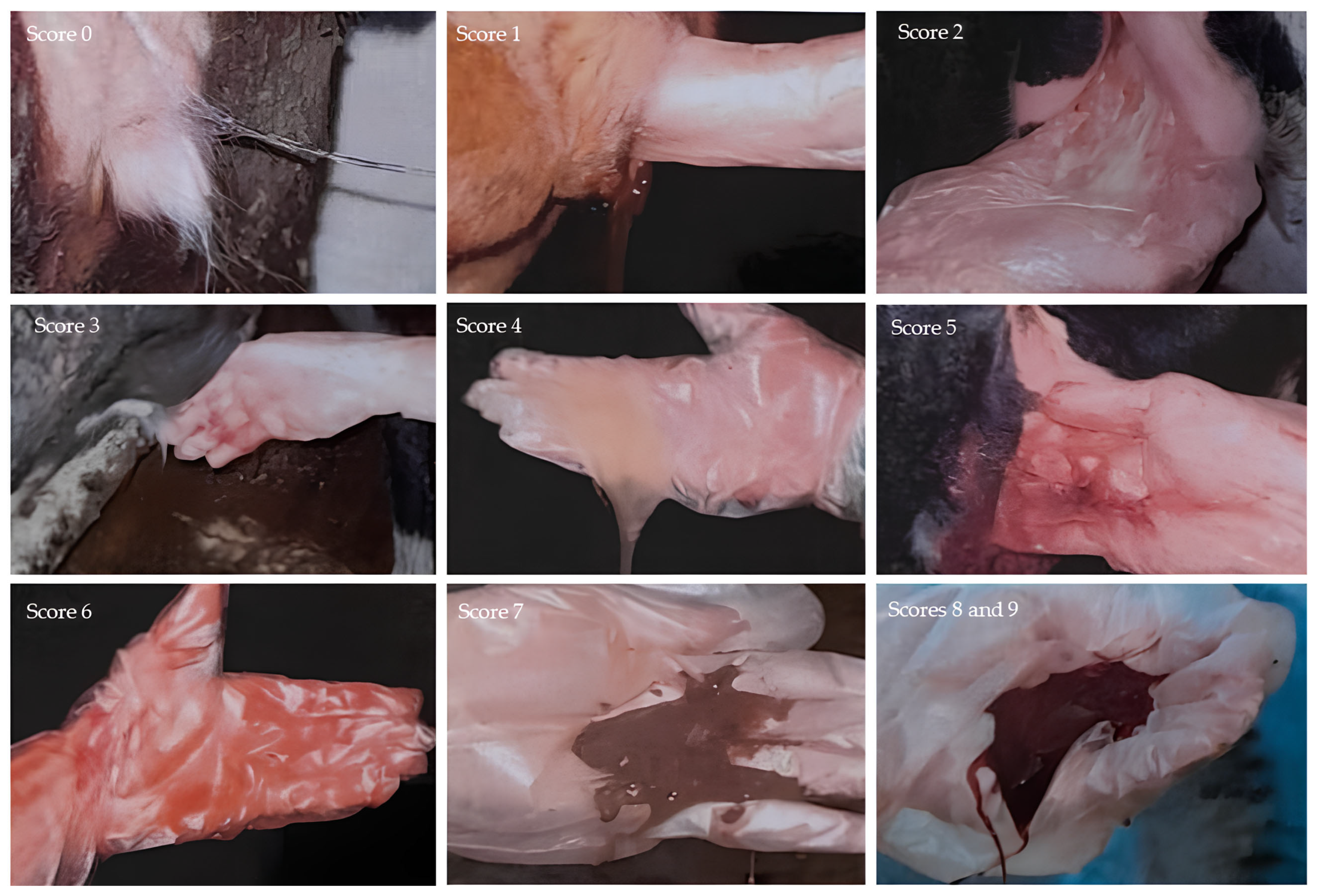
VDS were classified according to Elkjær et al. [13] (Danish system), considering a 10-point scale (from 0 to 9 points). This scale is based on the amount, color, and odor of uterine secretions assessed by expulsion and visualization through uterine retraction during transrectal palpation (Figure 1). These scores are later regrouped as normal and abnormal VDS.
Figure 1.
Ten-point scale of vaginal discharge scores by vaginal palpation in dairy cows used by the Vestjyske Dyrlaeger ApS (courtesy of the veterinary clinic). Score 0—No or small amount of clear or blood-tinged mucus secretion; no smell. Score 1—Small amount of blood mixed with mucus secretion; no smell. Score 2—Small amounts of grayish/bloody mucus secretion; no smell. Score 3—Abundant amounts of yellow/blood-tinged mucus (seromucous) secretions; crusts on the tail; no smell. Score 4—Abundant amounts of gray/gray–yellow/blood-tinged mucus secretions; crusts on the tail; no smell. Score 5—Abundant amount of mucus secretions; varying in mixture/color; abnormal smell. Score 6—Increasing amounts of secretions; varying in mixture/color; abnormal smell. Score 7—Increasing amounts of secretions; beginning of yellow–brown appearance; abnormal smell. Score 8—Abundant amounts of yellow–brown/brown secretions; abnormal smell. Score 9—Abundant amounts of yellow–brown/brown discharge; intense abnormal smell.
Scores 0–2 were classified as normal VDS, i.e., none or small amounts of bloody or gray mucous secretions, without abnormal odor.
Scores 3–4 were classified as moderate VDS, i.e., large amounts of blood, gray and/or yellow seromucous secretion with scabs on the tail, and some purulent content but without abnormal odor. This class identifies cows with abnormal discharge that does not meet the metritis case definition; these cows may reflect delayed involution, mild metritis, subclinical infection, or residual effects of genital-tract trauma.
Scores 5–9 were classified as high VDS, i.e., large amounts of yellow, gray, and/or brown uterine secretions, which are purulent and foul-smelling. According to Elkjær et al. [13], these scores can be considered fully indicative of metritis until day 21 postpartum [14].
Neither category is equivalent to a histologically or bacteriologically confirmed diagnosis of uterine disease, and our study should be read as an analysis of risk factors for abnormal VD—an operational field indicator—rather than for confirmed metritis.
Vulvovaginal laceration scores (VVLS)
The VVLS were based on the number and size of tears in the vulva and vagina and vaginal swelling (Table 1).
Table 1.
Vulvovaginal laceration scores on a Danish 10-point scale.
These scores were posteriorly grouped as absent (score 0), vulvar (scores 1–2), and vaginal (scores ≥ 3; concomitant vulvar tears are frequent). No scores ≥ 7 were observed in the present study.
Fecal consistency scores
Fecal consistency scores (FCS) were categorized as normal (feces remained continuously attached to the rectal glove), too firm/dry (fragmented during fecal expulsion into dry briquettes), and too liquid/loose (poorly cohesive to watery diarrhea). This classification allowed for the distinction between ideal FC and those with less or more water content, in agreement with other scales used for adult dairy cows [15,16].
Body condition score
A 1–5 scale of body condition score (BCS) with 0.25 increments [17] was used. Animals were subsequently grouped and scored into thin (scores 1–2.75), adequate (scores 3–3.75), and fat (scores 4+).
Ketonuria score
Ketostix strips (Bayer Corporation), a semiquantitative colorimetric test, were used to measure acetoacetate in urine [18]. A six-level strip indicates acetoacetate levels of 0, 5, 15, 40, 80, and 160 mg/dL. Ketosis was defined as ≥15 mg/dL acetoacetate [19], and a score of 0–1 (normal) and a score of 2+ (ketosis) was considered.
Parity at calving
The parity ranged from 1 (primiparous) to 10. Cows were grouped into primiparous and multiparous cows.
Additionally, the evaluation day was considered an independent variable and categorized as class D0–4 (first five days postpartum; initial phase; prevails expulsion of the placenta and lochia) and class D5–21 (most active morphological uterine involution and metritis definition) [20]. All 14 farms were considered.
2.3. Statistical Analysis
The Wilcoxon test was used to assess differences in days between the moderate and high VD groups.
Multicollinearity was evaluated using the inflation variance factor. Except for the farm (3.8) and FC (3.6) variables, all the other variables remained <1.2, suggesting the absence of multicollinearity issues in this analysis.
An ordinal logistic GLMM was used. The proportional odds assumption was evaluated by comparing AICc (Akaike Information Criterion corrected) between multinomial logistic (1942.26) and ordinal logistic (1936.18) models. Additionally, the parallel curve dynamics of all variables (without crossing) were observed in the prediction profiler. The prediction profiler Intercept 0 and Intercept 1 corresponded to low vs. [moderate and high] VDS and [low and moderate] vs. high VDS, respectively. The categorical fixed effects were VVLS, BCS, FC, ketones, and evaluation day classes. Animal ID was modeled (nested) within farm (random effect). All variables, except farm and animal ID (nominal variables), were classified as ordinal variables.
A three-level ordinal outcome Yijk ∈ {1 = low, 2 = moderate, 3 = high VDS} was fitted, considering two cumulative logits sharing a common slope vector, according to the following equation:
for , where
- —threshold (Intercept 0): vs. .
- —threshold (Intercept 1): vs. , with .
- –—fixed-effect coefficients (shared across both thresholds), so applies simultaneously to both cumulative logits.
- —random intercept for farm.
- —random intercept for animal nested within farm.
A single OR was determined for each predictor, which was applied to both thresholds (intercept levels) simultaneously, resulting in a similar increase or decrease per unit (threshold).
The significance level was set at α = 0.05. All analyses were performed using JMP® version 19 (SAS Institute Inc., Cary, NC, USA).
3. Results
The mean prevalence of abnormal VDS (score ≥ 3) was 9.4% (269/2860; 95% CI: 8.4–10.5). The prevalence of moderate and high VDS was 6.4% (n = 183/2860; 95% CI: 5.6–7.4) and 3.0% (86/2860; 95% CI: 2.5–3.7), respectively. On average, high VDS was detected earlier (7.6 days; 95% CI: 6.5–8.6) than moderate VDS (11.1 days; 95% CI: 10.4–11.8; p < 0.001).
The distribution of VDS prevalence according to all factors is reported in Table 2.
Table 2.
Descriptive analysis of the prevalence of abnormal vaginal discharge scores (VDS) according to the category of each relevant indicator.
According to GLMM (generalized Chi-square = 4487.65; generalized Chi-square/DF = 1.36), VVLS (p < 0.0001), FCS (p < 0.001), BCS (p < 0.01), ketosis (p < 0.01), and parity classes (p < 0.0001) were associated with VDS (Table 3). The evaluation day remained a non-significant factor (p = 0.35).
Table 3.
Odds ratio (OR) for the main factors affecting VDS, sorted by intercept level.
The farm random effect was non-significant (p = 0.36).
The indicator coding and effect coding for both baseline log-odds, Intercept 0 (Estimate = 2.23; 95% CI = 1.33–3.12; t Ratio = 4.9) and Intercept 1 (Estimate = 3.57; 95% CI = 2.66–4.49; t Ratio = 7.7) were similar and significant (p < 0.0001).
4. Discussion
In dairy cows, metritis is largely defined by the threshold of 21 days postpartum [14]. In these situations, uterine secretions, such as mucus, pus, and even lochia, occur to a greater or lesser extent, depending on the severity of the inflammation and infection, and through the cervical opening [2]. Uterine secretions can be visualized and scored by VD. Using the Denmark 0–9 scale, Elkjær et al. [13] defined metritis as ≥5 points, i.e., the presence of purulent red-brown, abnormal-smelling VD that requires treatment. Using this threshold, these authors found a metritis prevalence of 14.6% (58,063 cases/398,237 lactations) during the first 19 days postpartum. In our study, a 3% prevalence of metritis was observed within the first 21 days postpartum. Similar management was made considering the same threshold. Higher VDS have been associated with pronounced inflammatory status [21]. However, this threshold cannot be considered a strictly fixed clinical value, since uterine inflammation is progressive, depending on severity. Most veterinarians decide to treat animals when fever (>39.5 °C; systemic illness) is also present [22]. When moderate VDS were taken into consideration in our study, the prevalence of abnormal VD reached 9.4%. High VDS were detected earlier (mean = 7.6 days postpartum) than moderate VDS (11.1 days). This is consistent with the occurrence of puerperal metritis, closer to calving, which presents a large amount of purulent (>50% of secretions with fetid odor), as reported on day 7 (21.4% metritis prevalence) or day 7 ± 3 (11.7%) by Molinari et al. [23] and Hamilton et al. [12], respectively.
In the present study, vulvovaginal lacerations were a major factor associated with increasing VDS. The higher OR (17.06) and significance (p < 0.0001) compared with vulvar lacerations (OR = 2.37; p < 0.001) confirmed our first hypothesis. Moreover, moderate to high VDS were more prone to occur (OR = 7.21; p < 0.001) in vaginal rather than vulvar lacerations, consolidating the differences in the location of the tears. These findings were empirically expected, since vaginal lacerations are mainly present when strong dystocia (e.g., feto-maternal disproportion) occurs. The presence of relevant vaginal lacerations presupposes a severe degree of dystocia. Dystocia, as well as stillbirth, twins, and poor hygiene at calving or retained placenta, can improve bacterial load during the first few days postpartum [24], inducing metritis [25]. As a limitation of the present study, it was not possible to obtain accurate systematic records of these factors. So, the VVLS should be considered as a potential residual confounder regarding these unreported occurrences. This aspect limits the ability to distinguish the independent effect of vulvovaginal lacerations from the consequences of difficult calving. The earliest occurrence of high VDS after calving reinforces this concern. Furthermore, vaginal lacerations can independently contribute blood, serum, and inflammatory exudate to the vaginal lumen, and may therefore inflate VDS in the absence of true endometrial infection. The very strong association observed between vaginal lacerations and VDS should be interpreted considering this potential misclassification, particularly for the highest VDS. Nevertheless, this occurrence suggests that VDS alone are insufficient to diagnose metritis when severe genital-tract trauma is present, and the evaluation of uterine contents should also be done in this situation. In addition, the low prevalence of high VDS in the absence of vulvovaginal lacerations (1.6%; see Table 2) in our study underscores their importance as a risk factor, even when only vulvar lacerations occur. The loss or reduction of an effective physical barrier (provided by the coaptation of vulvar lips and vaginal vestibular sphincter) to environmental bacteria likely plays a relevant role. The lesion of the vaginal vestibular sphincter seems to increase this risk.
Systematic scoring of vulvovaginal lacerations at the first postpartum examination is inexpensive, requires no additional equipment, and can be performed as routine. Their strong association with VDS, as well as the biologically plausible mechanism of impaired vulvar/vestibular barrier function that allows for ascending contamination, suggests that VVLS could serve as an early risk marker. This could be used to flag cows for closer surveillance during the first three weeks postpartum, prioritize them for targeted metabolic screening (ketonuria, BCS), and support decisions on prophylactic hygiene management.
Our second hypothesis, linking the FC to the occurrence of abnormal VDS, was also confirmed. Cows with soft feces were more likely to be associated with moderate and high VDS than those with normal feces. Although a cause-and-effect relationship cannot be established due to the limitations of the cross-sectional design, this association supports the evidence that endotoxins enter the bloodstream from a bacterial pool in the uterus. Nonetheless, an inverse pathway is also possible [21]. FC reflects gastrointestinal dysfunction, nutritional disturbances, intestinal microbiota alterations, or systemic inflammatory processes. FC can predict excretion of fecal dry matter or diarrhea (frequency and consistency) in calves [26] and cows [4]. Negative energy balance and rapid dietary transitions alter osmotic load [27] and volatile fatty acid absorption [28]. Osmotic or water secretory/absorption patterns regulate FC. An increase in osmolarity by non-absorbable nutrients or other substances draws and retains water into the gut. On the other hand, the secretory activity of enterocytes is mediated by chloride secretion mechanisms whose cellular and molecular mechanisms can be challenged by toxins or other noxious substances [29]. Despite the influence of nutrition, the infection of bacteria (endotoxins and exotoxins) and other pathogens is primarily linked or not linked with the digestive tract. Recent studies [8,9,21] have demonstrated shared microbial signatures between the gut and reproductive tract in cows with endometritis/metritis, supporting a gut–uterus axis. Furthermore, endotoxemia of uterine, ruminal, or other origin can produce both altered FC and increased uterine inflammatory exudate, consistent with a bidirectional relationship. Metritis [30] and diet transition [31] were associated with systemic inflammation and metabolic changes. Additionally, gut disorders, either infectious (e.g., parasitism; systemic bacterial and viral infections) or non-infectious (e.g., sub-acute ruminal acidosis), induce alterations in FC [7]. Depending on the control and prevalence of each disease, as well as the metabolic and immunological status of the cow, the associations between different diseases and FC can increase significantly. Gram-negative bacteria, a predominant bacterial group involved in cattle infections, produce endotoxins (lipopolysaccharides) [32]. The presence of these endotoxins is frequent during the puerperal period, mainly by translocation from the rumen (microbiota change and ruminitis) and intestines (primary enteritis), uterus (metritis and endometritis), and mammary gland (mastitis) [33]. A high plasma level of endotoxin concentrations, up to 9.14 Endotoxin Units/mL, can be observed in cows with heavy metritis during the puerperal period and in the early postpartum period [34]. Bacteremia can occur concomitantly with endotoxemia when local defenses are overwhelmed [35]. For example, Credille et al. [36] observed a 53% (17/32) prevalence of bacteremia in cows, up to 9 days postpartum, without differences between healthy and acute puerperal metritis groups.
In our study, ketotic cows (score 2–6 for ketonuria) had 78% higher odds (OR = 1.78; p < 0.001) of showing higher VDS categories compared to non-ketotic cows (score 0–1). This association seems to be bidirectional. High serum levels of β-Hydroxybutyrate (BHB) were observed in cows with further puerperal metritis (days 7 and 14 postpartum) than the control group at parturition or days 7 and 14 [37]. On the other hand, cows with metritis were more likely to show high levels of subclinical ketosis (BHB ≥ 1.2 mmol/L) [38]. Changes in metabolic and immunological profiles during the transition period, as well as puerperal diseases, have been reported as a key factor [37,38,39,40,41]. Although urinary acetoacetate is less sensitive than blood BHB for subclinical ketosis and may underestimate the prevalence of hyperketonemia [42], it is a routine method used in farms due to the easy collection of urine samples, avoiding blood vessel puncture. Urine acetoacetate determination can partially influence the prevalence of ketotic cows (8.5%, 244/2860, in our study), mainly for subclinical ketosis. Still, the Ketostix strips remain one of the most validated rapid tests for use in dairy cows [18].
In our study, it was observed that cows with a low BCS (score of 1 to 2.75) had 67% higher odds of developing progressive VDS compared to cows with a normal score (score of 3 to 3.75). Differences in evaluation days and a single evaluation can probably contribute to these results, since BCS loss occurs during early lactation. Melendez et al. [43] suggested BCS variation (losses) as a key indicator, better than measurement at a given postpartum time point. In our study, BCS was measured only once, on different days postpartum, and for a relatively small proportion of cows. These conditions represented a limitation of the study and may introduce some degree of bias. Sun et al. [44] observed that cows that lost >0.5 BCS during the periparturient period (from −21 to 50 days postpartum), but not (p > 0.05) those in the 0.25 < BCS loss ≤ 0.5 group, were more likely (p < 0.05) to develop metritis than those that lost ≤0.25 BCS. Nonetheless, a lower BCS has been reported in cows with metritis compared to healthy dairy cows (e.g., [38]). Increasing serum levels of anti- and pro-inflammatory cytokines (adiponectin, leptin, TNF-alpha, IL-1beta, and IL-6) has been associated with low BCS (score 2 and 2.5) and metritis [41].
In our study, higher VDS were observed in multiparous cows than in primiparous cows. Primiparous cows have been associated with metritis, as reported in larger studies (102,060 Danish dairy cows—U-shaped risk [45]; 28,230 cows—primiparous at risk [46]). It has been suggested previously that a slower return to cyclicity can negatively impact uterine clearance in primiparous cows [47]. However, distinct patterns of postpartum uterine infection between primiparous and multiparous cows may play a major role, suggesting that tolerance and resistance may differ by parity [48]. The weak but positive association (collinearity) observed between parity and VVLS may have contributed to our findings.
Finally, the random effect of farm, which reflects epidemiological and management differences, was not significantly associated with VDS in our study. This finding suggests similar herd health management within farms and animal care provided by the veterinary clinic, and provides more consistency in our analysis. Although the prevalence of metritis is associated with several risk factors linked to animals, pathogens, and the environment, effective herd health management, with an emphasis on proactive disease diagnosis, plays a key role. Because detailed data on housing, calving-pen hygiene, dry-cow nutrition, and calving supervision were not systematically recorded across farms, the farm variable should be interpreted as a composite surrogate.
5. Conclusions
VVLS and non-reproductive indicators can be associated with abnormal VDS. Vulvo-vaginal tears, soft feces, low BCS, ketosis, and parity were associated with both moderate and high VDS. All of these indicators seem valuable for evaluating uterine health in the early postpartum of dairy cows. Together, these indicators can provide additional evidence, compared to VD scoring alone, to characterize the uterine inflammation complex.
Integrating VVLS into standardized herd-health checklists, alongside other non-reproductive indicators, may improve early detection of cows at risk of uterine disease and thereby reduce reliance on reactive antimicrobial treatment. This hypothesis requires prospective validation. A large study involving these indicators, other diseases during the postpartum period, and their relationships with reproductive outcomes can provide more information regarding animal health management and farm sustainability.
Author Contributions
Conceptualization, J.S. and P.L.; methodology, J.S. and P.L.; validation, J.S. and P.L.; formal analysis, J.S. and P.L.; investigation, P.L. and J.S.; resources, P.L. and J.S.; data curation, J.S.; writing—original draft preparation, P.L. and J.S.; writing—review and editing, J.S. and P.L.; visualization, J.S.; supervision, J.S.; project administration, J.S. and P.L.; funding acquisition, J.S. All authors have read and agreed to the published version of the manuscript.
Funding
This research was funded by projects with the grant numbers UIDB/00772/2020 and LA/P/0059/2020, funded by the Portuguese Foundation for Science and Technology (FCT).
Institutional Review Board Statement
The study was approved by the Institutional Review Board of UTAD (protocol no. 39316NON/UTAD on 24 July 2025).
Informed Consent Statement
Informed consent for participation was obtained from all subjects involved in the study.
Data Availability Statement
The data that support the findings of this study are available on request from the corresponding author.
Acknowledgments
This work was derived from the thesis in Veterinary Medicine of the first author at the University of Trás-os-Montes and Alto Douro (UTAD), 5000-801 Vila Real, Portugal. The authors acknowledge Katrine Lawaetz and other veterinarians working at Vestjyske Dyrlæger clinic (Denmark).
Conflicts of Interest
The authors declare no conflicts of interest.
Abbreviations
The following abbreviations are used in this manuscript:
| BHB | β-Hydroxybutyrate |
| VD | Vaginal discharge |
| VDS | Vaginal discharge scores |
| VVLS | Vulvovaginal laceration scores |
| FC | Fecal consistency |
| FCS | Fecal consistency scores |
| BCS | Body condition score |
| OR | Odds ratio |
References
- Galvão, K.N.; Flaminio, M.J.; Brittin, S.B.; Sper, R.; Fraga, M.; Caixeta, L.; Ricci, A.; Guard, C.L.; Butler, W.R.; Gilbert, R.O. Association between uterine disease and indicators of neutrophil and systemic energy status in lactating Holstein cows. J. Dairy Sci. 2010, 93, 2926–2937. [Google Scholar] [CrossRef] [Scilit] [PubMed]
- Várhidi, Z.; Csikó, G.; Bajcsy, Á.C.; Jurkovich, V. Uterine disease in dairy cows: A comprehensive review highlighting new research areas. Vet. Sci. 2024, 11, 66. [Google Scholar] [CrossRef] [Scilit] [PubMed]
- Pérez-Báez, J.; Silva, T.V.; Risco, C.A.; Chebel, R.C.; Cunha, F.; De Vries, A.; Santos, J.E.P.; Lima, F.S.; Pinedo, P.; Schuenemann, G.M.; et al. The economic cost of metritis in dairy herds. J. Dairy Sci. 2021, 104, 3158–3168. [Google Scholar] [CrossRef] [Scilit] [PubMed]
- Petrovski, K.R.; Cusack, P.; Malmo, J.; Cockcroft, P. The value of “cow signs” in the assessment of the quality of nutrition on dairy farms. Animals 2022, 12, 1352. [Google Scholar] [CrossRef] [Scilit] [PubMed]
- Vieira-Neto, A.; Lima, F.S.; Santos, J.E.P.; Mingoti, R.D.; Vasconcellos, G.S.; Risco, C.A.; Galvão, K.N. Vulvovaginal laceration as a risk factor for uterine disease in postpartum dairy cows. J. Dairy Sci. 2016, 99, 4629–4637. [Google Scholar] [CrossRef] [Scilit] [PubMed]
- Marien, H.; Gundling, N.; Hasseler, W.; Feldmann, M.; Herzog, K.; Hoedemaker, M. Do calving-related injuries of the vestibulum vaginae and the vagina affect the reproductive performance in primiparous dairy cows? Vet. Sci. 2023, 10, 43. [Google Scholar] [CrossRef] [Scilit] [PubMed]
- König, F.; Hancock, A.; Wunderlich, C.; Klawitter, M.; Breuer, T.; Simoni, A.; Weimar, K.; Drillich, M.; Iwersen, M. Systematic evaluation of different fresh cow monitoring procedures. Animals 2023, 13, 1231. [Google Scholar] [CrossRef] [Scilit] [PubMed]
- Jeon, S.J.; Cunha, F.; Vieira-Neto, A.; Bicalho, R.C.; Lima, S.; Bicalho, M.L.; Galvão, K.N. Blood as a route of transmission of uterine pathogens from the gut to the uterus in cows. Microbiome 2017, 5, 109. [Google Scholar] [CrossRef] [Scilit] [PubMed]
- Tasara, T.; Meier, A.B.; Wambui, J.; Whiston, R.; Stevens, M.; Chapwanya, A.; Bleul, U. Interrogating the diversity of vaginal, endometrial, and fecal microbiomes in healthy and metritis dairy cattle. Animals 2023, 13, 1221. [Google Scholar] [CrossRef] [Scilit] [PubMed]
- Jones, K.; Cunha, F.; Jeon, S.J.; Pérez-Báez, J.; Casaro, S.; Fan, P.; Liu, T.; Lee, S.; Jeong, K.C.; Yang, Y.; et al. Tracing the source and route of uterine colonization by exploring the genetic relationship of Escherichia coli isolated from the reproductive and gastrointestinal tract of dairy cows. Vet. Microbiol. 2022, 266, 109355. [Google Scholar] [CrossRef] [Scilit] [PubMed]
- Thulasiraman, S.; Gunasekar, M.; Narayansamy, A.; Sampathkumar, K.U.; Kumar, R.; Alam, K. Uterine infections/metritis. In Periparturient Diseases of Cattle; Rana, T., Ed.; Wiley: Hoboken, NJ, USA, 2024. [Google Scholar]
- Hamilton, J.; Jimenez, E.; Zarei, P.; Lection, J.; Sorto, R.; Hovingh, E.; Martinez, M.; Bas, S.; Barragan, A.A. Exploring vaginal discharge scoring to assess clinical metritis severity: Comparison between intrauterine dextrose and systemic antibiotics treatments. Vet. J. 2024, 304, 106103. [Google Scholar] [CrossRef] [Scilit] [PubMed]
- Elkjær, K.; Labouriau, R.; Ancker, M.L.; Gustafsson, H.; Callesen, H. Short communication: Large-scale study on effects of metritis on reproduction in Danish Holstein cows. J. Dairy Sci. 2013, 96, 372–377. [Google Scholar] [CrossRef] [Scilit] [PubMed]
- Sheldon, I.M.; Lewis, G.S.; LeBlanc, S.; Gilbert, R.O. Defining postpartum uterine disease in cattle. Theriogenology 2006, 65, 1516–1530. [Google Scholar] [CrossRef] [Scilit] [PubMed]
- Ireland-Perry, R.L.; Stallings, C.C. Fecal consistency as related to dietary composition in lactating Holstein cows. J. Dairy Sci. 1993, 76, 1074–1082. [Google Scholar] [CrossRef] [Scilit] [PubMed]
- Ortenzi, L.; Violino, S.; Costa, C.; Figorilli, S.; Vasta, S.; Tocci, F.; Moscovini, L.; Basiricò, L.; Evangelista, C.; Bernabucci, U. An innovative technique for faecal score classification based on RGB images and artificial intelligence algorithms. J. Agric. Sci. 2023, 161, 291–296. [Google Scholar] [CrossRef] [Scilit]
- Ferguson, J.D.; Galligan, D.T.; Thomsen, N. Principal descriptors of body condition score in Holstein cows. J. Dairy Sci. 1994, 77, 2695–2703. [Google Scholar] [CrossRef] [Scilit] [PubMed]
- Tatone, E.H.; Gordon, J.L.; Hubbs, J.; LeBlanc, S.J.; DeVries, T.J.; Duffield, T.F. A systematic review and meta-analysis of the diagnostic accuracy of point-of-care tests for the detection of hyperketonemia in dairy cows. Prev. Vet. Med. 2016, 130, 18–32. [Google Scholar] [CrossRef] [Scilit] [PubMed]
- Serrenho, R.C.; Williamson, M.; Berke, O.; LeBlanc, S.J.; DeVries, T.J.; McBride, B.W.; Duffield, T.F. An investigation of blood, milk, and urine test patterns for the diagnosis of ketosis in dairy cows in early lactation. J. Dairy Sci. 2022, 105, 7719–7727. [Google Scholar] [CrossRef] [Scilit] [PubMed]
- Szenci, O. Uterine involution in cows. In Encyclopedia of Livestock Medicine for Large Animal and Poultry Production; Simões, J., Ed.; Springer: Cham, Switzerland, 2025. [Google Scholar]
- Shi, Z.H.; Lan, Y.L.; Qiao, Z.H.; Yan, X.Z.; Wang, Y.Z.; Zhang, B.; Ma, X.Y.; Hassan, F.U.; Wang, W.J.; Deng, T.X. Changes in fecal microbiota of dairy cows with and without endometritis. BMC Vet. Res. 2025, 21, 201. [Google Scholar] [CrossRef] [Scilit] [PubMed]
- Figueiredo, C.C.; Casaro, S.; Cunha, F.; Merenda, V.R.; de Oliveira, E.B.; Pinedo, P.; Santos, J.E.P.; Chebel, R.C.; Schuenemann, G.M.; Bicalho, R.C.; et al. Evaluating differences in milk production, reproductive performance, and survival associated with vaginal discharge characteristics and fever in postpartum dairy cows. J. Dairy Sci. 2024, 107, 6079–6089. [Google Scholar] [CrossRef] [Scilit] [PubMed]
- Molinari, P.C.C.; Dahl, G.E.; Sheldon, I.M.; Bromfield, J.J. Effect of calving season on metritis incidence and bacterial content of the vagina in dairy cows. Theriogenology 2022, 191, 67–76. [Google Scholar] [CrossRef] [Scilit] [PubMed]
- Ismail, N.L.; Adnane, M.; Wagener, K.; Galvão, M.; Chapwanya, A. Roadmap to dystocia management—Guiding obstetric interventions in cattle. Life 2025, 15, 457. [Google Scholar] [CrossRef] [Scilit] [PubMed]
- Silva, J.C.C.; Siqueira, L.C.; Rodrigues, M.X.; Zinicola, M.; Wolkmer, P.; Pomeroy, B.; Bicalho, R.C. Intrauterine infusion of a pathogenic bacterial cocktail is associated with the development of clinical metritis in postpartum multiparous Holstein cows. J. Dairy Sci. 2023, 106, 607–623. [Google Scholar] [CrossRef] [Scilit] [PubMed]
- Renaud, D.L.; Buss, L.; Wilms, J.N.; Steele, M.A. Technical note: Is fecal consistency scoring an accurate measure of fecal dry matter in dairy calves? J. Dairy Sci. 2020, 103, 10709–10714. [Google Scholar] [CrossRef] [Scilit] [PubMed]
- Sundrum, A. Metabolic Disorders in the Transition Period Indicate that the Dairy Cows’ Ability to Adapt is Overstressed. Animals 2015, 5, 978–1020. [Google Scholar] [CrossRef] [Scilit] [PubMed]
- Wang, J.; Jia, Y.; Ou, C.; Zhong, Q.; Li, Q.; Zhou, E.; Yang, Z. Negative energy balance in transition dairy cows: Mechanisms, systemic impacts, and integrated prevention strategies. Anim. Zoonoses 2026. in press. [Google Scholar] [CrossRef] [Scilit]
- Keely, S.J.; Barrett, K.E. Intestinal secretory mechanisms and diarrhea. Am. J. Physiol. Gastrointest. Liver Physiol. 2022, 322, G405–G420. [Google Scholar] [CrossRef] [Scilit] [PubMed]
- Casaro, S.; Prim, J.G.; Gonzalez, T.D.; Bisinotto, R.S.; Chebel, R.C.; Marrero, M.G.; Silva, A.C.M.; Santos, J.E.P.; Nelson, C.D.; Laporta, J.; et al. Unraveling the immune and metabolic changes associated with metritis in dairy cows. J. Dairy Sci. 2023, 106, 9244–9259. [Google Scholar] [CrossRef] [Scilit] [PubMed]
- Chida, S.; Sakamoto, M.; Takino, T.; Kawamoto, S.; Hagiwara, K. Changes in immune system and intestinal bacteria of cows during the transition period. Vet. Anim. Sci. 2021, 14, 100222. [Google Scholar] [CrossRef] [Scilit] [PubMed]
- Andersen, P.H. Bovine endotoxicosis—Some aspects of relevance to production diseases. A review. Acta Vet. Scand. Suppl. 2003, 98, 141–155. [Google Scholar] [PubMed]
- Eckel, E.F.; Ametaj, B.N. Bacterial endotoxins and their role in periparturient diseases of dairy cows: Mucosal vaccine perspectives. Dairy 2020, 1, 61–90. [Google Scholar] [CrossRef] [Scilit]
- Magata, F.; Ishida, Y.; Miyamoto, A.; Furuoka, H.; Inokuma, H.; Shimizu, T. Comparison of bacterial endotoxin lipopolysaccharide concentrations in the blood, ovarian follicular fluid and uterine fluid: A clinical case of bovine metritis. J. Vet. Med. Sci. 2015, 77, 81–84. [Google Scholar] [CrossRef] [Scilit] [PubMed]
- Mateus, L.; Lopes da Costa, L.; Diniz, P.; Ziecik, A.J. Relationship between endotoxin and prostaglandin, PGE2 and PGFM, concentrations and ovarian function in dairy cows with puerperal endometritis. Anim. Reprod. Sci. 2003, 76, 143–154. [Google Scholar] [CrossRef] [Scilit] [PubMed]
- Credille, B.C.; Woolums, A.R.; Giguère, S.; Robertson, T.; Overton, M.W.; Hurley, D.J. Prevalence of bacteremia in dairy cattle with acute puerperal metritis. J. Vet. Intern. Med. 2014, 28, 1606–1612. [Google Scholar] [CrossRef] [Scilit] [PubMed]
- Paiano, R.B.; Birgel, D.B.; Bonilla, J.; Birgel Junior, E.H. Metritis in dairy cows is preceded by alterations in biochemical profile prepartum and at parturition. Res. Vet. Sci. 2021, 135, 167–174. [Google Scholar] [CrossRef] [Scilit] [PubMed]
- Suthar, V.S.; Canelas-Raposo, J.; Deniz, A.; Heuwieser, W. Prevalence of subclinical ketosis and relationships with postpartum diseases in European dairy cows. J. Dairy Sci. 2013, 96, 2925–2938. [Google Scholar] [CrossRef] [Scilit] [PubMed]
- Wankhade, P.R.; Manimaran, A.; Kumaresan, A.; Jeyakumar, S.; Ramesha, K.P.; Sejian, V.; Rajendran, D.; Varghese, M.R. Metabolic and immunological changes in transition dairy cows: A review. Vet. World 2017, 10, 1367–1377. [Google Scholar] [CrossRef] [Scilit] [PubMed]
- Silva, J.C.C.; Caldeira, M.O.; Moraes, J.G.N.; Sellmer Ramos, I.; Gull, T.; Ericsson, A.C.; Poock, S.E.; Spencer, T.E.; Lucy, M.C. Metritis and the uterine disease microbiome are associated with long-term changes in the endometrium of dairy cows. Biol. Reprod. 2024, 111, 332–350. [Google Scholar] [CrossRef] [Scilit] [PubMed]
- Kasimanickam, R.K.; Kasimanickam, V.R.; Olsen, J.R.; Jeffress, E.J.; Moore, D.A.; Kastelic, J.P. Associations among serum pro- and anti-inflammatory cytokines, metabolic mediators, body condition, and uterine disease in postpartum dairy cows. Reprod. Biol. Endocrinol. 2013, 11, 103. [Google Scholar] [CrossRef] [Scilit] [PubMed]
- Enjalbert, F.; Nicot, M.C.; Bayourthe, C.; Moncoulon, R. Ketone bodies in milk and blood of dairy cows: Relationship between concentrations and utilization for detection of subclinical ketosis. J. Dairy Sci. 2001, 84, 583–589. [Google Scholar] [CrossRef] [Scilit] [PubMed]
- Melendez, P.; Bartolome, J.; Gonzalez, G.; Lastra-Duran, G.; Pinedo, P. Body condition score at calving, subclinical ketosis, postpartum body condition score losses, diseases, and fertility in Holstein cows: Modelling confounding associations. Vet. Anim. Sci. 2024, 29, 100493. [Google Scholar] [CrossRef] [Scilit] [PubMed]
- Sun, R.; Jiang, X.; Hao, Y.; Li, Y.; Bai, Y.; Xia, C.; Song, Y. Effect of body condition score loss during the transition period on metabolism, milk yield and health in Holstein cows. J. Vet. Res. 2025, 69, 91–99. [Google Scholar] [CrossRef] [Scilit] [PubMed]
- Bruun, J.; Ersbøll, A.K.; Alban, L. Risk factors for metritis in Danish dairy cows. Prev. Vet. Med. 2002, 54, 179–190. [Google Scholar] [CrossRef] [Scilit] [PubMed]
- Leans, I.J.; LeBlanc, S.J.; Sheedy, D.B.; Duffield, T.; Santos, J.E.P.; Golder, H.M. Associations of parity with health disorders and blood metabolite concentrations in Holstein cows in different production systems. J. Dairy Sci. 2023, 106, 500–518. [Google Scholar] [CrossRef] [Scilit] [PubMed]
- Silva, J.C.C.; Lucy, M.C. Reanalysis of 2 metritis studies demonstrates different patterns of postpartum uterine infection for primiparous versus multiparous cows. JDS Commun. 2025, 6, 362–367. [Google Scholar] [CrossRef] [Scilit] [PubMed]
- López-Helguera, I.; Colazo, M.G.; Garcia-Ispierto, I.; López-Gatius, F. Factors associated with ovarian structures and intrauterine fluid in the postpartum period in dairy cows. J. Dairy Sci. 2016, 99, 3925–3933. [Google Scholar] [CrossRef] [Scilit] [PubMed]

Disclaimer/Publisher’s Note: The statements, opinions and data contained in all publications are solely those of the individual author(s) and contributor(s) and not of MDPI and/or the editor(s). MDPI and/or the editor(s) disclaim responsibility for any injury to people or property resulting from any ideas, methods, instructions or products referred to in the content. |
© 2026 by the authors. Licensee MDPI, Basel, Switzerland. This article is an open access article distributed under the terms and conditions of the Creative Commons Attribution (CC BY) license.