


Simple Summary
Dairy cattle harbor diverse microbial communities that contribute to animal health and physiological function. Although the bovine gastrointestinal microbiome has been extensively studied, considerably less is known about bacterial communities associated with blood and milk, particularly in clinically healthy cows exposed to different environmental conditions. In this study, we characterized and compared blood- and milk-associated bacterial communities from healthy Holstein cows during winter and summer in an intensive commercial dairy production system located in the Comarca Lagunera region of northern Mexico, an area characterized by contrasting seasonal environmental conditions. Significant differences in microbial diversity and bacterial community composition were observed according to both sample type and season. Several bacterial genera previously associated with bovine mastitis or opportunistic infections were detected even in healthy animals, suggesting that these microorganisms may form part of a balanced microbial ecosystem under normal physiological conditions. Overall, our findings indicate that blood- and milk-associated bacterial communities vary according to sample type and seasonal environmental conditions, highlighting the complexity of host-associated microbial ecosystems in dairy cattle.
Abstract
Bovine-associated microbial communities play important roles in animal physiology, immune regulation, and mammary health. However, knowledge regarding bacterial populations associated with blood and milk remains limited in healthy dairy cattle exposed to different environmental conditions. In this study, we characterized and compared blood- and milk-associated bacterial communities from clinically healthy Holstein cows during summer and winter in an intensive commercial dairy production system located in northern Mexico using 16S rRNA metabarcoding. Significant differences in alpha and beta diversity metrics were observed according to sample type and season. Milk samples exhibited higher microbial richness and diversity than blood samples, and comparative analyses revealed significant differences in bacterial community composition between sample types and seasonal sampling periods. Bacterial communities were mainly dominated by Proteobacteria, Firmicutes, Actinobacteriota, and Bacteroidota. Differential abundance analyses identified genera associated with environmental exposure or opportunistic infections, including Staphylococcus, Streptococcus, Corynebacterium, Pseudomonas, and Acinetobacter. Overall, the observed bacterial community patterns varied according to sample type and seasonal environmental conditions, highlighting the complexity of host-associated microbial ecosystems in dairy cattle.
1. Introduction
The bovine microbiota plays a fundamental role in host physiology, immune regulation, metabolic homeostasis, nutrient utilization, and overall animal health. In dairy cattle, microbial communities have been increasingly associated with milk production, reproductive performance, inflammatory responses, susceptibility to disease, and resilience to environmental stressors [1,2,3,4]. Although the gastrointestinal microbiome has historically received most scientific attention, recent advances in sequencing technologies have revealed that multiple bovine body sites harbor diverse microbial communities whose ecological and physiological significance remains poorly understood. Among these body sites, the bovine mammary gland has emerged as a highly dynamic microbial ecosystem. Traditionally, milk was considered a sterile biological fluid; however, numerous studies now demonstrate that clinically healthy udders contain complex bacterial communities composed of environmental, commensal, and microorganisms with opportunistic potential [5,6]. These microbial assemblages may contribute to mammary gland homeostasis, immune modulation, and resistance to microbial invasion, while alterations in community structure have been associated with dysbiosis and mastitis susceptibility [1,7]. Nevertheless, the ecological interpretation of bovine milk microbiota remains controversial due to the low-biomass nature of milk samples and the potential influence of environmental and reagent-derived contamination [8].
Similarly, the detection of bacterial DNA and microbial signatures in blood has gained increasing attention in recent years. Although blood has historically been considered sterile under healthy conditions, several studies have reported the presence of bacterial DNA and microbial signatures in clinically healthy animals [9,10]. These findings have generated considerable debate regarding the origin, viability, ecological relevance, and physiological significance of blood-associated microorganisms, particularly in low-biomass systems where contamination remains a major methodological concern. Nonetheless, emerging evidence suggests that microbial components may circulate through interconnected host pathways involving the gastrointestinal tract, immune cells, bloodstream, and mammary gland, giving rise to hypotheses such as the entero-mammary pathway [6].
Environmental and physiological factors are also increasingly recognized as major drivers of bovine-associated microbial dynamics. In dairy cattle, heat stress has been associated with immunological alterations, metabolic imbalance, oxidative stress, intestinal permeability changes, and decreased milk production [11,12,13]. These physiological disturbances may indirectly influence microbial community structure and stability across multiple host-associated ecosystems. Such effects may be especially relevant in Holstein cattle, a breed originally adapted to temperate climates but frequently raised under contrasting thermal conditions in arid and semi-arid dairy production systems, where chronic heat stress can substantially affect physiological homeostasis, productivity, and animal welfare [13,14]. In addition, increasing evidence indicates that clinically healthy animals may naturally harbor bacterial genera previously reported in bovine mammary microbiota and associated with mastitis or opportunistic infections, including Staphylococcus, Streptococcus, Corynebacterium, and Pseudomonas [1,5]. Under this ecological framework, disease may not depend exclusively on the presence of particular bacterial taxa, but rather on microbial imbalance, host susceptibility, environmental pressures, and dysbiotic transitions affecting the mammary ecosystem.
Despite growing interest in bovine-associated microbiota, studies simultaneously evaluating blood- and milk-associated bacterial communities across contrasting seasonal conditions remain limited, particularly in healthy dairy cattle managed under intensive commercial production systems. Furthermore, relatively little is known about how seasonal environmental conditions shape bacterial community structure across different biological matrices in dairy cows. Therefore, the aim of the present study was to evaluate whether bacterial community diversity, composition, and abundance patterns differed between blood and milk samples collected from clinically healthy Holstein cows during winter and summer in the Comarca Lagunera region of northern Mexico using 16S rRNA metabarcoding. We hypothesized that both sample type and seasonal environmental conditions would be associated with differences in microbial diversity, community composition, and bacterial abundance patterns in blood- and milk-associated bacterial communities.
2. Materials and Methods
2.1. Sample Site
The Comarca Lagunera region is located between the states of Coahuila and Durango in northern Mexico at approximately 1120 m above sea level and is characterized by a semi-arid climate with hot summers, mild winters, low annual precipitation (approximately 200–300 mm), and high evaporative demand. The region is recognized as one of the most important dairy production areas in Mexico and supports numerous intensive Holstein dairy farms, including the farm selected for the present study (25°39′46.9″ N, 103°25′54.2″ W).
2.2. Housing and Animal Management
All animals were maintained in an intensive commercial dairy production system representative of modern dairy farming in northern Mexico. Cows were housed in covered facilities with continuous access to clean drinking water and were managed according to routine veterinary and sanitary programs implemented by the farm. Animals received a standardized total mixed ration formulated according to their production requirements and farm management practices. Preventive healthcare measures, including vaccination and deworming programs, were routinely implemented, and animal health was monitored daily by farm personnel and veterinary staff. During summer, environmental mitigation strategies, including fans and sprinkler systems, were used to reduce thermal load. Milking was performed using an automated rotary milking parlor under standardized hygienic conditions. No antimicrobial treatments were administered during the sampling period.
2.3. Sample Collection
All animal procedures were conducted in accordance with internationally accepted guidelines for the ethical use, care, and welfare of animals in research and were approved by the Ethics Committee of the Faculty of Biological Sciences, Juarez University of the State of Durango (approval number: 0015).
Sampling was conducted on two dates representing contrasting seasonal conditions corresponding to winter and summer conditions in the Comarca Lagunera region of northern Mexico. Winter sampling was performed on 15 February 2024 (mean ambient temperature ≈ 15.5 °C measured in the shade), whereas summer sampling was conducted on 15 August 2024 (mean ambient temperature ≈ 35 °C measured in the shade). Both sampling events were conducted at approximately 10:00 h. Ambient temperature was recorded next to the animals during sampling using a Kestrel 3000 environmental meter (Nielsen-Kellerman, Boothwyn, PA, USA). Winter and summer samples were obtained from different animals because the study was designed as a cross-sectional comparison between two seasonal sampling events rather than a longitudinal follow-up of the same individuals.
For each season, blood and milk samples were collected from seven randomly selected clinically healthy Holstein cows. All animals were multiparous females between 3 and 5 years of age, in their second or later lactation, and showed no visible signs of disease at the time of sampling. Prior to milk collection, the udder surface was aseptically cleaned using cotton soaked in iodine solution. Each teat was individually disinfected, and excess iodine was removed using sterile cotton. Milk samples were obtained by manual milking and pooled from the four mammary quarters into sterile 50 mL Falcon tubes. No foremilk discarding (“forestripping”) was performed prior to milk collection, allowing characterization of the overall milk-associated bacterial community, including microorganisms potentially associated with the teat canal and mammary surface environment. Milk samples were collected directly into sterile tubes, which were opened only during sample collection and immediately sealed afterward under aseptic conditions. Samples were subsequently centrifuged at 4000 rpm for 20 min, and the resulting pellet was recovered using sterile Pasteur pipettes. Approximately 10 drops of the pellet were transferred into BashingBead lysis tubes from the ZymoBIOMICS DNA extraction kit (Zymo Research, Irvine, CA, USA), previously prepared with 750 μL of lysis/stabilization solution. For blood collection, the puncture site was aseptically disinfected with iodine solution, and approximately 5 mL of blood was obtained from the coccygeal vein using sterile syringes. Ten drops of blood were transferred into BashingBead lysis tubes containing 750 μL of lysis/stabilization solution. All lysis tubes containing milk and blood material were mechanically processed using a TerraLyzer (Zymo Research, Irvine, CA, USA) cell disruptor for 30 s to homogenize the sample and preserve the DNA.
2.4. Laboratory Work
All laboratory procedures were conducted at the Laboratory of Microbial Ecology and Conservation Medicine, Faculty of Biological Sciences, Juárez University of the State of Durango (UJED), Gómez Palacio, Durango, Mexico. Bacterial DNA was extracted from milk and blood samples using the ZymoBIOMICS DNA Miniprep Kit (Zymo Research, Irvine, CA, USA) following the manufacturer’s instructions. All extraction procedures were performed under a UV-sterilized laminar flow hood (Thermo Scientific, Marietta, OH, USA) using strict aseptic protocols in order to minimize external contamination during sample processing. DNA quantity and purity were evaluated using an Optizen Nano Q® spectrophotometer (Mecasys Co., Ltd., Daejeon, Republic of Korea). DNA quality was assessed based on the absorbance ratio at 260/280 nm to ensure adequate purity for downstream molecular analyses. High-throughput sequencing of the bacterial 16S rRNA gene was performed by Novogene Corporation, Inc. (Davis, CA, USA). The V3–V4 hypervariable region of the 16S rRNA gene was amplified using the universal primers 341F (CCTAYGGGRBGCASCAG) and 806R (GGACTACNNGGTATCTAAT). PCR amplification reactions were carried out using 15 μL of Phusion® High-Fidelity PCR Master Mix (New England Biolabs, Ipswich, MA, USA), 2 μM of each forward and reverse primer, and approximately 10 ng of template DNA. Thermal cycling conditions consisted of an initial denaturation step at 98 °C for 1 min, followed by 30 cycles of denaturation at 98 °C for 10 s, annealing at 50 °C for 30 s, and extension at 72 °C for 30 s. PCR products were mixed with 1× loading buffer containing SYBRTM Green (Thermo Scientific, Waltham, MA, USA) and visualized by electrophoresis on 2% agarose gels. Amplicons were pooled in equimolar concentrations and purified using a Qiagen Gel Extraction Kit (Qiagen, Hilden, Germany). Sequencing libraries were prepared using the TruSeq® DNA PCR-Free Library Preparation Kit (Illumina, San Diego, CA, USA) according to the manufacturer’s instructions, including the incorporation of index barcodes. Library quality was assessed using a Qubit® 2.0 fluorometer (Thermo Scientific, Waltham, MA, USA) and an Agilent Bioanalyzer 2100 system (Agilent Technologies, Santa Clara, CA, USA). Finally, paired-end sequencing (2 × 250 bp) was performed on an Illumina NovaSeq sequencing system. Each biological sample was processed independently and no technical replicates were included during DNA extraction, library preparation, or sequencing.
2.5. Bioinformatic and Statistical Analyses
Raw paired-end Illumina sequences were processed using the DADA2 pipeline implemented in QIIME2 (version 2023.5) [15]. Quality filtering, denoising, paired-end merging, and chimera removal were performed to generate high-resolution amplicon sequence variants (ASVs) [16]. Sequence processing statistics, including filtering efficiency, merging rates, and non-chimeric sequence retention, were calculated for each sample. Sequencing depth completeness was evaluated using Good’s coverage estimates [17]. Taxonomic classification was conducted using the Greengenes2 reference database [18].
All downstream statistical analyses and visualizations were performed in RStudio version 2024.12.1 [19]. Alpha diversity metrics, including number of ASVs, Shannon index, Pielou’s evenness, and Faith’s phylogenetic diversity, were calculated in QIIME2 and exported for statistical analysis. Alpha diversity metrics were analyzed using two-way ANOVA evaluating the effects of sample type, season, and their interaction. Type III ANOVA tests with Satterthwaite approximation were used to assess statistical significance. Beta diversity analyses were performed using Bray–Curtis dissimilarities. Principal coordinate analysis (PCoA) was used to visualize bacterial community structure. Differences in microbial community composition among sample groups were evaluated using permutational multivariate analysis of variance (PERMANOVA) with 999 permutations. Homogeneity of multivariate dispersions was assessed using betadisper permutation tests.
Relative abundance analyses at the phylum and genus levels were conducted using relative abundance tables generated in RStudio. Taxonomic composition across sample groups was visualized using stacked bar plots representing phylum-level relative abundance profiles. Heatmaps of dominant genera (top 30 most abundant taxa) and differentially abundant genera were generated using the pheatmap package. For heatmap visualization, relative abundance values were standardized by row-wise scaling prior to hierarchical clustering. Clustering was performed using Euclidean distance and complete-linkage methods. Differential abundance analyses at the genus level were conducted using Kruskal–Wallis tests followed by Benjamini–Hochberg false discovery rate (FDR) correction. Genera with significant FDR-adjusted p-values were visualized in a heatmap of the top differentially abundant taxa. Because extraction blanks and PCR negative controls were not included in the experimental design, formal contaminant-removal approaches such as decontam were not applied. Therefore, low-abundance taxa were interpreted conservatively throughout the study.
3. Results
3.1. Sequencing Results
A total of 28 samples were successfully sequenced and processed using the DADA2 pipeline. Across all samples, the mean number of raw input reads ranged from 182,878.1 to 196,211.9 reads per sample group, while the mean number of non-chimeric sequences ranged from 163,218.6 to 170,195.7 reads (Table S1). Sequence quality filtering retained a high proportion of reads, with filtering efficiencies consistently exceeding 97% in all groups. Paired-end merging efficiencies were also high, with mean merged-read percentages ranging from 89.44% to 94.19%. Chimera removal resulted in final non-chimeric retention percentages between 86.75% and 89.71%, indicating overall high-quality sequence processing and effective denoising performance. Good’s coverage estimates were consistently close to 1.0 across all samples and sample groups (0.999–1.000; Table S1), suggesting that sequencing depth was sufficient to capture the vast majority of bacterial diversity present in the samples. The sequencing dataset yielded a total of 20,278 ASVs across all samples.
3.2. Alpha Diversity
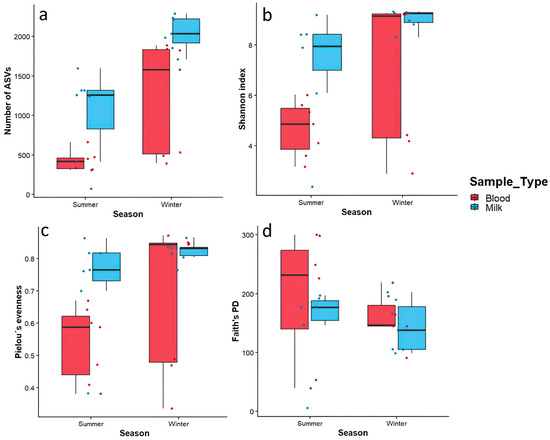
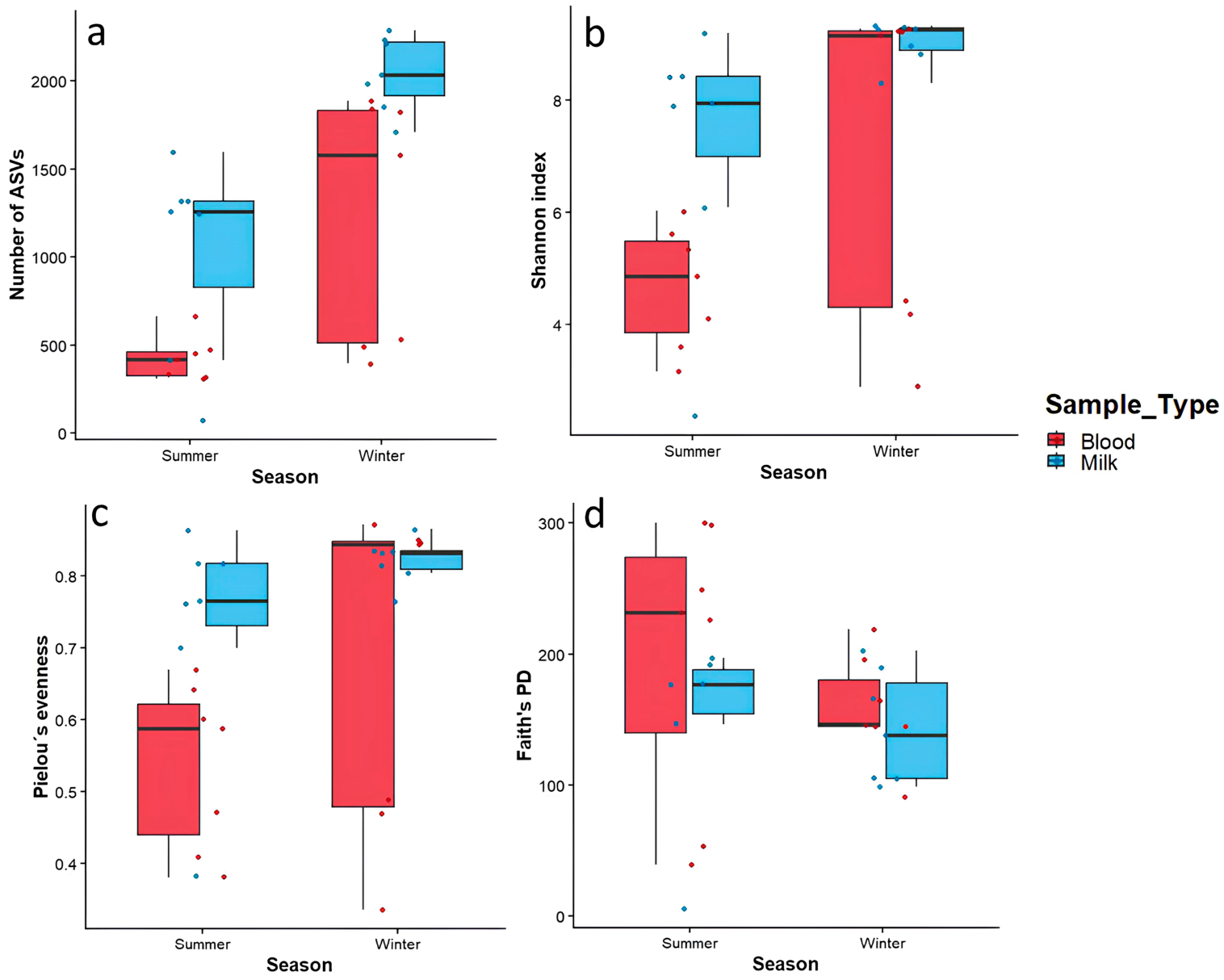
Alpha diversity analyses revealed significant effects of both sample type and season on microbial diversity and richness. The number of ASVs was significantly influenced by both sample type (F = 16.356, p < 0.001) and season (F = 26.214, p < 0.001). Milk samples exhibited markedly higher richness than blood samples, while winter samples showed increased richness relative to summer samples (Figure 1a). No significant interaction between sample type and season was detected for number of ASVs (F = 0.373, p = 0.547). Shannon index differed significantly between blood and milk samples (F = 9.898, p = 0.004), with milk samples exhibiting overall higher diversity values than blood samples (Figure 1b). Season also had a significant effect on Shannon index (F = 7.660, p = 0.011), with winter samples exhibiting higher diversity values compared to summer samples. However, the interaction between sample type and season was not significant (F = 0.072, p = 0.791), indicating that the seasonal effect was consistent across both sample types. Similarly, observed Pielou’s evenness also differed significantly according to sample type (F = 8.696, p = 0.007), with milk-associated bacterial communities showing higher community evenness than blood-associated communities (Figure 1c). Seasonal differences in evenness were marginally significant (F = 3.818, p = 0.062), whereas the interaction term was not significant (F = 0.142, p = 0.710). In contrast, Faith’s phylogenetic diversity did not differ significantly according to sample type (F = 0.094, p = 0.764), season (F = 1.424, p = 0.256), or their interaction (F = 0.362, p = 0.559; Figure 1d).
Figure 1.
Alpha diversity patterns of blood- and milk-associated bacterial communities from Holstein cows collected during summer and winter seasons. (a) Number of ASVs; (b) Shannon index; (c) Pielou’s evenness; and (d) Faith’s phylogenetic diversity. Boxplots represent median values and interquartile ranges, while points correspond to individual samples.
3.3. Beta Diversity
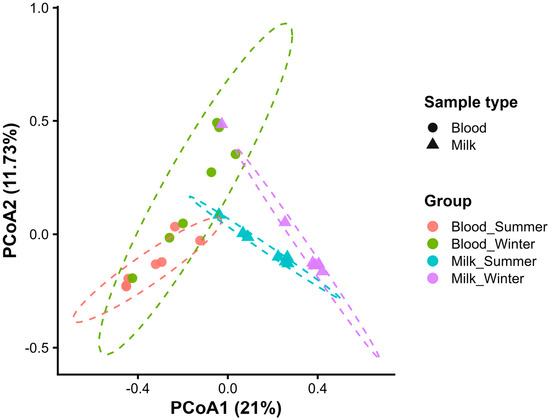
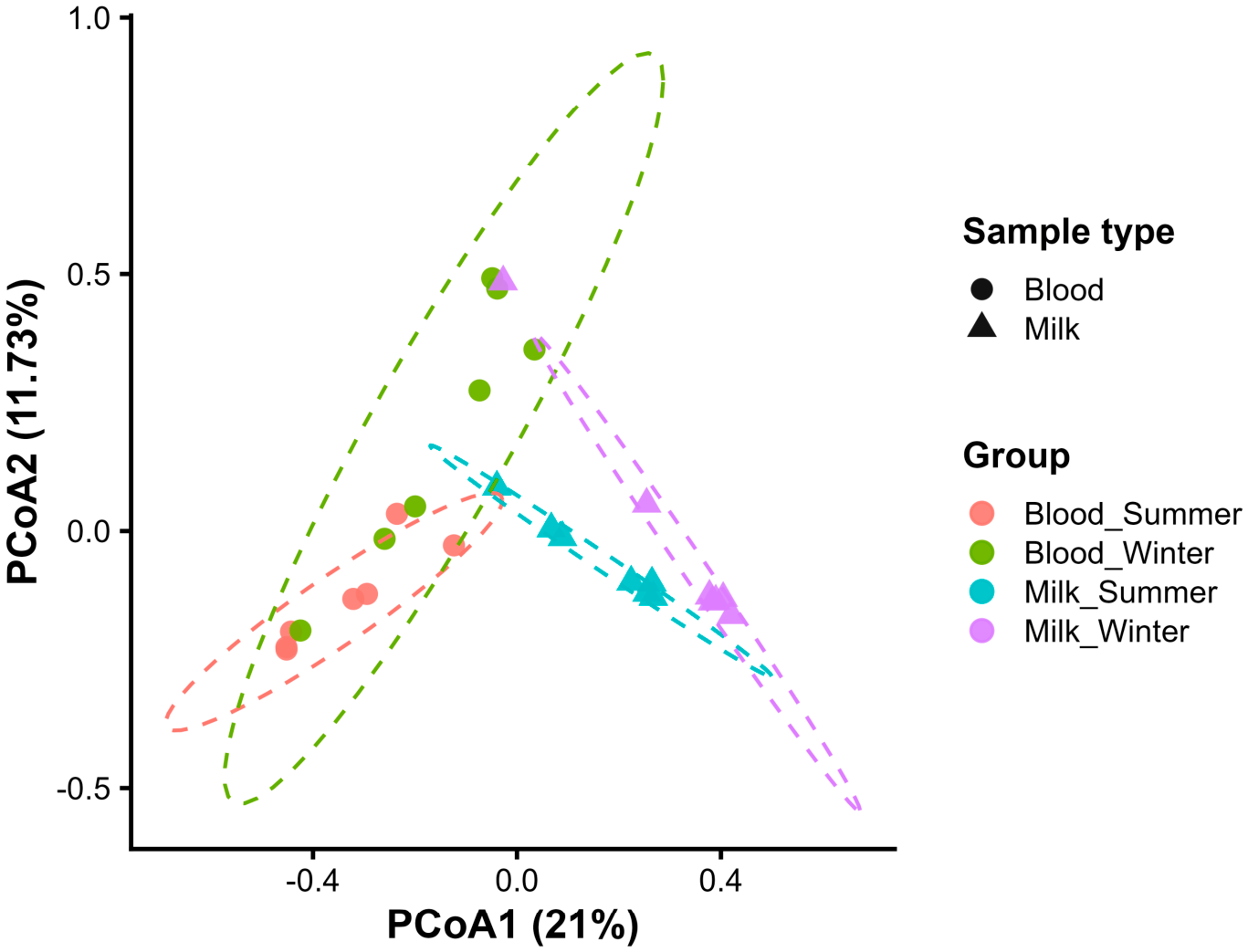
Principal coordinate analysis (PCoA) based on Bray–Curtis dissimilarities revealed distinct ordination patterns according to both sample type and season. The first two axes explained 21.0% and 11.73% of the total variation, respectively (Figure 2). Blood and milk bacterial communities formed distinct ordination patterns, while seasonal structuring was also evident within each sample type.
Figure 2.
Principal coordinate analysis (PCoA) of Bray–Curtis dissimilarities showing bacterial community structure of blood- and milk-associated bacterial communities from Holstein cows collected during summer and winter seasons. Colors indicate sample groups, whereas point shapes represent sample type. Dashed ellipses represent group clustering patterns.
PERMANOVA analysis confirmed that bacterial community composition differed significantly among sample groups (F = 3.626, R2 = 0.312, p = 0.001), with sample type and season collectively explaining approximately 31.2% of the total variation in microbial community structure. Term-wise PERMANOVA analysis further revealed a significant Sample_Type × Season interaction (F = 1.929, R2 = 0.055, p = 0.015), suggesting that seasonal effects on microbiota composition varied according to sample type. To evaluate the homogeneity of multivariate dispersions, a betadisper analysis was performed. No significant differences in dispersion were detected among groups (F = 1.181, p = 0.366), indicating that the observed community differences were not driven by unequal within-group dispersion.
3.4. Taxonomic Composition
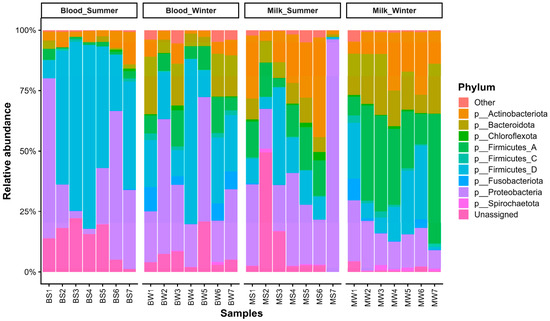
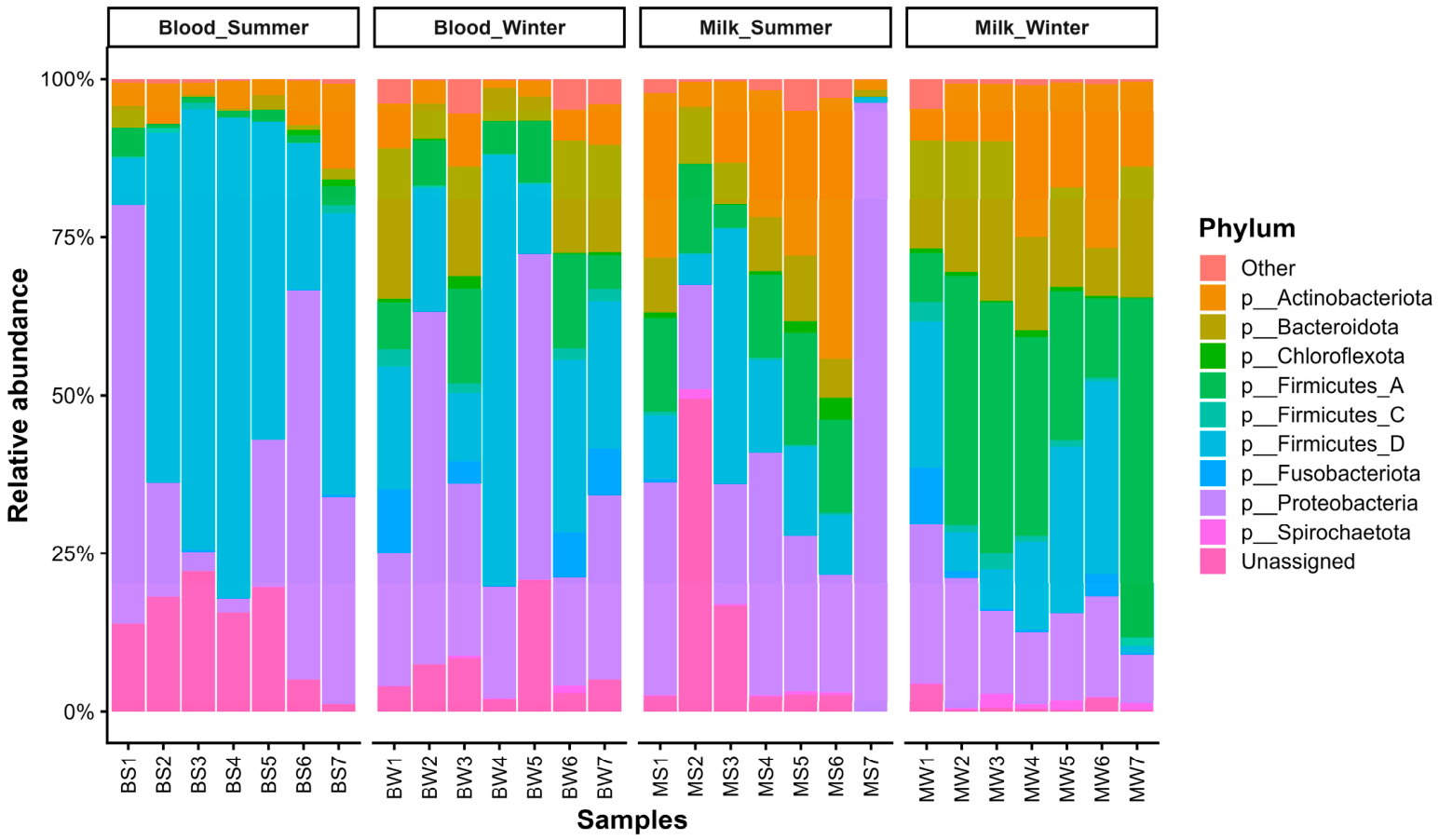
Taxonomic richness across the different sample groups is summarized in Table 1, whereas genus-level relative abundance data for all samples are provided in Table S2. Overall, taxonomic richness increased markedly toward lower taxonomic ranks, with winter milk samples (MW) exhibiting the highest taxonomic richness across most hierarchical levels. Taxonomic profiling further revealed that the blood- and milk-associated microbiota of clinically healthy Holstein cows were dominated by a relatively small number of bacterial phyla, although marked differences in community composition were observed among sample types and seasons (Figure 3).
Table 1.
Taxonomic richness at different hierarchical levels in blood- and milk-associated bacterial communities of clinically healthy Holstein cows during summer and winter seasons. BS = Blood Summer; BW = Blood Winter; MS = Milk Summer; MW = Milk Winter.
Figure 3.
Relative abundance of dominant bacterial phyla detected in blood- and milk-associated bacterial communities from Holstein cows collected during summer and winter seasons. Each stacked bar represents an individual sample, grouped according to sample type and season. Only the most abundant phyla are displayed, whereas less abundant taxa were grouped as “Other”.
Across all samples, the most abundant phyla were Proteobacteria, Firmicutes_D, Firmicutes_A, Actinobacteriota, and Bacteroidota. Blood samples collected during summer were strongly dominated by members of Firmicutes_D, which accounted for approximately 46.6% of the relative abundance, followed by Proteobacteria (29.5%). In contrast, winter blood samples exhibited more heterogeneous taxonomic profiles, characterized by increased relative abundances of Firmicutes_A, Bacteroidota, and Actinobacteriota. Milk-associated microbiota displayed a distinct taxonomic profile relative to blood samples. Summer milk samples showed elevated abundances of Proteobacteria and Firmicutes_D, whereas winter milk samples were characterized by increased relative abundances of Firmicutes_A and Bacteroidota, accompanied by a relative decrease in Proteobacteria. Overall, winter samples tended to exhibit more compositionally heterogeneous microbial communities than summer samples. Although less abundant taxa were also detected, the majority of bacterial sequences were consistently assigned to a limited subset of dominant phyla across all sample groups.
3.5. Dominant Genera
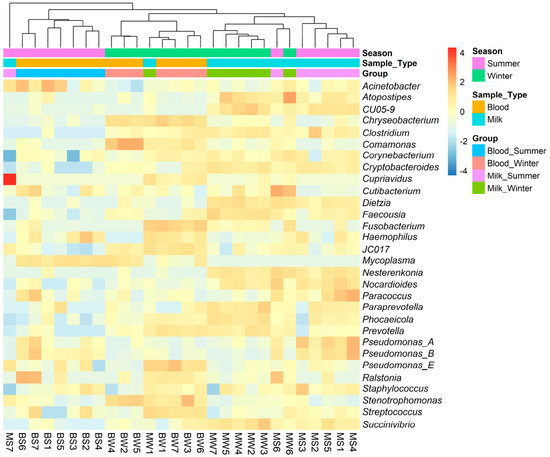
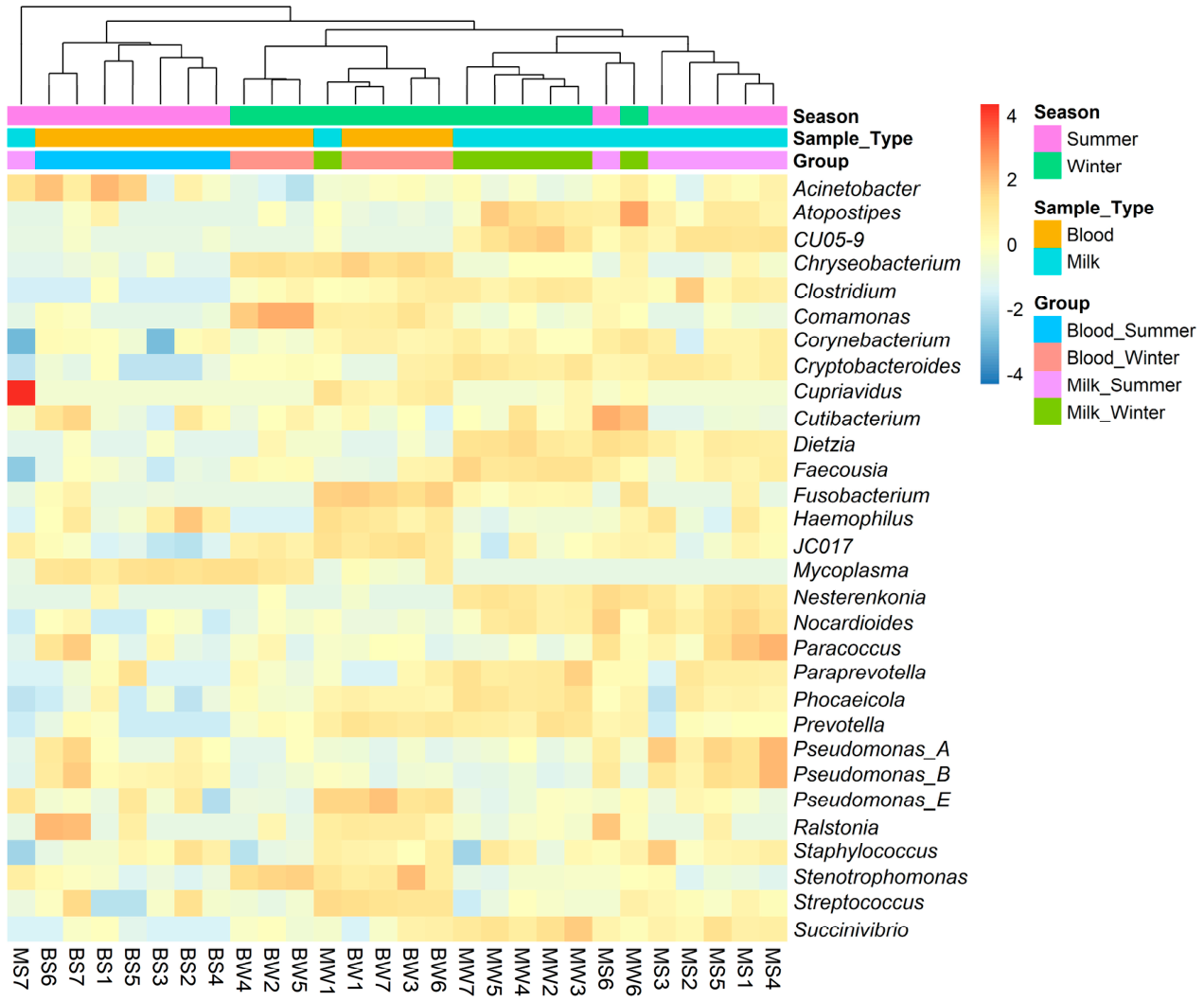
A heatmap based on the 30 most abundant bacterial genera revealed distinct abundance patterns among samples according to both sample type and season (Figure 4). Hierarchical clustering of samples showed partial grouping consistency among categories, supporting the compositional differences previously observed in Bray–Curtis PCoA and PERMANOVA analyses. Several genera were recurrently abundant across multiple samples, including Acinetobacter, Cutibacterium, Corynebacterium, Pseudomonas, Mycoplasma, Staphylococcus, Streptococcus, and Prevotella. However, marked variation in the relative abundance of these taxa was observed among sample groups. Milk-associated bacterial communities, particularly winter milk samples, tended to exhibit greater abundance of several Firmicutes-associated genera and environmentally associated taxa, whereas blood samples showed comparatively distinct abundance patterns dominated by genera such as Mycoplasma, Pseudomonas, and Cutibacterium. In addition, several less abundant but recurrent genera displayed heterogeneous abundance profiles across seasons, contributing to the observed clustering structure. Overall, heatmap analysis highlighted pronounced variation in bacterial community composition among blood- and milk-associated microbiota samples, consistent with the beta diversity patterns observed in Bray–Curtis ordination analyses.
Figure 4.
Heatmap showing the relative abundance patterns of the 30 most abundant bacterial genera detected in blood- and milk-associated bacterial communities from Holstein cows collected during summer and winter seasons. Rows represent bacterial genera and columns correspond to individual samples. Color intensity reflects scaled relative abundance values. Hierarchical clustering was performed using Euclidean distance and complete linkage on row-scaled relative abundance data. Annotation bars indicate season, sample type, and sample groups.
3.6. Differential Abundance
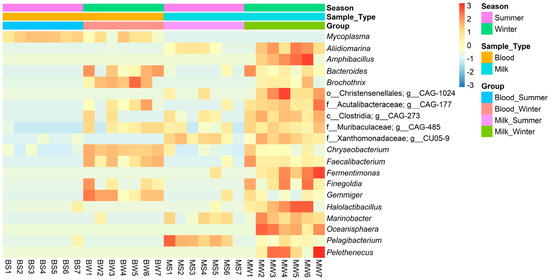
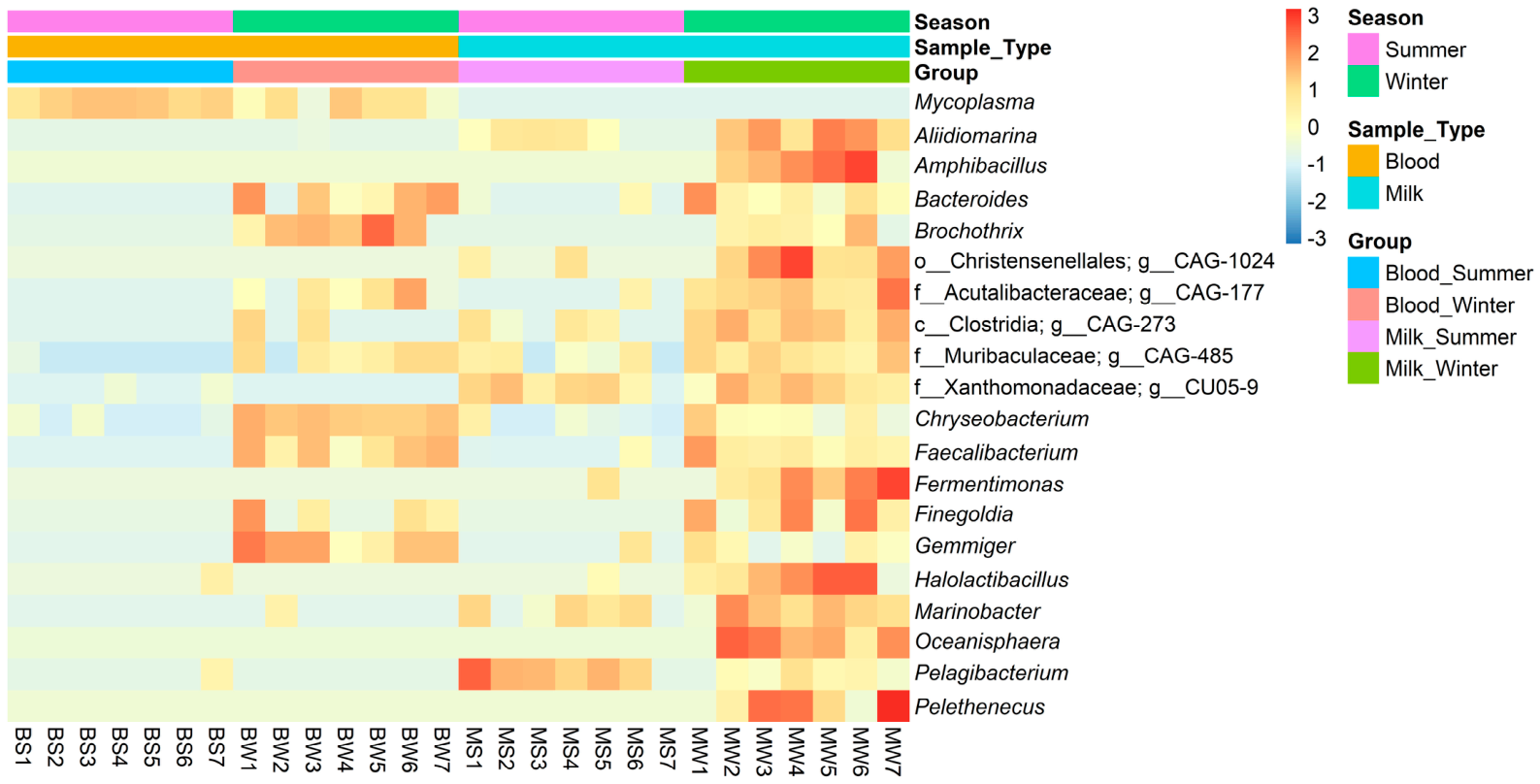
Differential abundance analysis identified 77 bacterial genera with significant differences among sample groups after Kruskal–Wallis testing and Benjamini–Hochberg FDR correction (adjusted p < 0.05; Table S3), 20 of which were selected for visualization in the differential abundance heatmap (Figure 5). Several genera displayed marked variation according to both sample type and season, supporting the compositional patterns previously observed in beta diversity analyses. Among the significantly differential genera, Mycoplasma, Aliidiomarina, Amphibacillus, Bacteroides, Faecalibacterium, Gemmiger, Oceanisphaera, and Halolactibacillus, as well as several incompletely classified or environmentally associated taxa, showed distinct abundance patterns across groups.
Figure 5.
Heatmap showing the relative abundance patterns of the top 20 differentially abundant bacterial genera identified through Kruskal–Wallis testing followed by Benjamini–Hochberg false discovery rate correction. Rows represent bacterial genera and columns correspond to individual samples grouped according to season and sample type. Color intensity reflects scaled relative abundance values. Genera with incomplete taxonomic resolution were annotated using the highest confidently assigned taxonomic level available.
In particular, several Firmicutes- and Bacteroidota-associated genera tended to exhibit higher relative abundances in winter milk samples, whereas blood-associated samples were characterized by distinct abundance patterns involving genera such as Mycoplasma and Pseudomonas. Visualization of the 20 differentially abundant genera highlighted clear compositional differences among sample groups, with multiple taxa showing consistent abundance patterns according to both season and sample type (Figure 5). These patterns were especially evident when comparing summer blood and winter milk samples, which occupied opposite ends of the abundance gradient observed in the heatmap.
4. Discussion
4.1. Overall Microbial Community Patterns
The present study revealed significant differences in bacterial community structure according to sample type and seasonal conditions in clinically healthy Holstein cows from an intensive dairy production system. Significant differences were observed in alpha and beta diversity metrics between blood- and milk-associated bacterial communities, while Bray–Curtis ordination analyses revealed clear compositional shifts according to both sample type and season. These findings support the concept that bovine-associated microbial communities represent dynamic ecological systems shaped by host physiology and environmental conditions rather than static microbial assemblages. Milk samples generally exhibited higher richness and diversity than blood samples, particularly during winter, whereas beta diversity analyses revealed significant compositional differentiation among sample groups. The PERMANOVA results further indicated that the interaction between sample type and season significantly influenced microbial community structure, suggesting that environmental conditions may differentially modulate bacterial assemblages depending on the sample type analyzed. Importantly, the absence of significant differences in multivariate dispersion supports the robustness of the observed ecological separation patterns.
Taxonomic composition and heatmap analyses further demonstrated that microbial communities were not randomly distributed across samples but instead exhibited structured abundance patterns associated with both season and sample type. The composition patterns observed in milk samples were also broadly consistent with previous microbiome studies conducted in dairy cattle from other geographic regions. In the present study, milk-associated communities were primarily dominated by members of the phyla Proteobacteria, Firmicutes, Actinobacteriota, and Bacteroidota, with recurrent and relatively abundant genera including Acinetobacter, Staphylococcus, Streptococcus, Corynebacterium, Prevotella, Ralstonia, and Cutibacterium. Similar bacterial groups have been repeatedly reported in milk from clinically healthy dairy cows using culture-independent sequencing approaches, suggesting the existence of partially conserved microbial assemblages within the bovine mammary ecosystem despite geographic and methodological differences [20,21,22,23,24]. These observations support the concept that bovine milk represents a biologically active and microbially dynamic environment rather than a sterile biological fluid, even in clinically healthy animals. From an applied perspective, understanding the structure of milk-associated bacterial communities is particularly relevant because milk constitutes the primary dairy product consumed by humans and because ecological imbalance within the mammary ecosystem may influence udder health, susceptibility to mastitis, milk quality, and ultimately dairy productivity.
Taken together, these findings align with growing evidence indicating that bovine-associated bacterial communities reflect complex host–microbe interactions influenced by physiology, metabolism, immune status, environmental exposure, and management conditions [1,5,9]. Notably, all animals included in this study were clinically healthy and maintained under intensive commercial dairy management practices, suggesting that the detected bacterial communities likely represent components of a physiological baseline microbial assemblage rather than signatures of overt disease. Recent microbiome studies increasingly report the detection of bacterial DNA signatures in low-biomass biological matrices such as blood and milk, where microbial DNA and viable bacteria have been detected even in healthy individuals [6,10]. In this context, the present findings contribute to the emerging perspective that bovine microbial ecosystems may involve interconnected biological niches whose composition fluctuates according to host condition and environmental pressures.
4.2. Seasonal Variation and Thermal Conditions
Seasonal variation was associated with differences in bacterial community structure detected in both blood and milk samples. Significant effects of season were observed for Shannon diversity and ASV richness, while beta diversity analyses demonstrated marked compositional shifts between summer and winter samples. These findings suggest that environmental conditions may contribute to differences in bovine-associated bacterial communities, even under highly controlled production systems. The climatic conditions of the Comarca Lagunera region likely represent an important ecological driver underlying these microbial differences. Holstein cattle are genetically adapted to temperate and relatively cool climates; therefore, the high summer temperatures commonly recorded in northern Mexico may create environmental conditions distinct from those experienced during winter. During sample collection, winter temperatures were approximately 15 °C, whereas summer temperatures approached 35 °C. These contrasting seasonal thermal conditions may influence host physiology, behavior, feed intake, and metabolic regulation, thereby contributing to shifts in microbial community structure. Previous studies have reported associations between elevated environmental temperatures and alterations in immune function, oxidative balance, ruminal physiology, and systemic inflammatory responses in dairy cattle, all of which may indirectly affect microbial community dynamics [11,12].
Recent evidence further supports the hypothesis that elevated environmental temperatures can directly reshape bovine-associated microbial ecosystems. Ceciliani et al. [25] demonstrated that experimentally induced heat stress significantly altered milk microbiota composition in clinically healthy dairy cows, producing clear shifts in both alpha and beta diversity and modifying the abundance of several bacterial genera, including Streptococcus, Enterococcus, Lactococcus, and Chryseobacterium. Interestingly, the authors also observed that Holstein cows exhibited stronger microbial community alterations under heat-stress conditions than Brown Swiss cows, suggesting breed-associated differences in thermal resilience and microbial stability. Although the present study was not designed to experimentally evaluate heat stress, the compositional differences observed between winter and summer samples are consistent with the hypothesis that seasonal thermal conditions may contribute to microbial community restructuring. The higher microbial diversity observed during winter may reflect environmental and physiological conditions that favor greater ecological complexity and community stability. Conversely, the lower diversity and compositional shifts observed during summer may indicate ecological responses to warmer environmental conditions. Similar observations have been reported in bovine microbiome studies where environmental and host-related factors were associated with microbial restructuring and dysbiosis susceptibility [1,2]. Importantly, the seasonal microbial shifts observed in this study occurred in clinically healthy animals, suggesting that these fluctuations may represent adaptive ecological responses rather than disease-associated alterations. From an ecological perspective, the present findings reinforce the hypothesis that bovine-associated microbial communities are highly responsive to environmental conditions and may serve as sensitive indicators of host physiological status under different climatic scenarios. Collectively, these results support the emerging concept that seasonal environmental variation represents an important ecological factor capable of modulating host-associated microbial ecosystems in dairy cattle.
Beyond its ecological implications, the microbial restructuring associated with seasonal thermal conditions may also have practical relevance for dairy cattle management, animal welfare, and productive performance. Elevated environmental temperatures are widely recognized as an important challenge for dairy cattle, particularly high-producing Holstein cows raised under arid and semi-arid conditions, where warmer climatic conditions may negatively affect feed intake, metabolic stability, immune function, reproductive performance, and milk yield [13,14,26]. In parallel, recent experimental evidence suggests that heat stress can directly influence bovine-associated microbial ecosystems [25]. Within this framework, the higher microbial diversity and community stability observed during winter in the present study may reflect environmental and physiological conditions that favor greater ecological stability, whereas the compositional shifts observed during summer may represent adaptive responses to warmer seasonal conditions. Although the functional implications of these microbial changes remain to be fully elucidated, understanding how environmental conditions shape bovine-associated microbiota may eventually contribute to management strategies aimed at improving animal resilience, welfare, and productive stability under intensive dairy production systems exposed to variable climatic conditions.
4.3. Blood- and Milk-Associated Bacterial Community Differences
The present study revealed clear compositional differences between blood- and milk-associated microbiota, indicating that each sample type harbors potentially distinct bacterial communities with partially overlapping taxonomic composition. Alpha diversity analyses showed that milk samples generally exhibited greater richness and diversity compared with blood samples, while beta diversity analyses demonstrated significant clustering according to sample type. These findings support the concept that host-associated microbial ecosystems are strongly influenced by local physiological conditions, nutrient availability, immune surveillance, and environmental exposure. Milk represents a highly dynamic biological fluid continuously influenced by mammary gland physiology, milking practices, environmental contact, and maternal immune responses [24]. Consequently, the greater microbial diversity observed in milk may reflect the convergence of multiple microbial sources, including teat canal-associated bacteria, environmental microorganisms, skin-associated taxa, and potentially endogenous microbial trafficking pathways [5,6,27]. In contrast, blood-associated bacterial communities displayed comparatively lower diversity and more selective community composition, which is consistent with the low-biomass and highly regulated nature of the circulatory system. Despite these differences between sample types, several bacterial genera were shared between blood and milk samples, including taxa previously associated with bovine mammary microbiota, environmental exposure, and host-associated microbial communities. The recurrent detection of overlapping taxa across sample types may reflect shared environmental exposure, common host-associated sources, or potential microbial trafficking mechanisms previously proposed in the literature. Although the exact mechanisms underlying these patterns remain uncertain, recent studies increasingly suggest that microbial DNA and viable microorganisms may circulate through interconnected host pathways linking the gastrointestinal tract, bloodstream, immune cells, and mammary gland [6,9,27]. Within this ecological framework, the overlap between blood- and milk-associated bacterial communities observed in the present study should not necessarily be interpreted as evidence of pathology, but rather as part of the dynamic microbial interactions occurring under physiological conditions in clinically healthy dairy cattle.
4.4. Healthy Microbial Communities and Ecological Balance
Several bacterial genera detected in this study, including Staphylococcus, Streptococcus, Corynebacterium, Pseudomonas, Acinetobacter, and Mycoplasma, have previously been associated with bovine mastitis, environmental exposure, or opportunistic infections [1,5,6]. However, interpretation of these findings requires caution because many of these taxa have also been consistently reported as components of the normal bovine mammary bacterial community, particularly in clinically healthy animals and low-biomass microbiome studies. Importantly, all animals included in the present study were clinically healthy and maintained under standardized intensive dairy management practices. Therefore, the detected bacterial profiles likely represent physiological or commensal microbial assemblages rather than evidence of active disease. These findings support the growing ecological perspective that healthy bovine-associated microbial communities are not defined by the complete absence of potentially opportunistic microorganisms, but rather by the maintenance of microbial balance, ecological stability, and host–microbe homeostasis. Under this framework, dysbiosis should not be interpreted exclusively through the presence or absence of specific bacterial taxa, but rather as ecological disruption involving alterations in community structure, microbial interactions, host physiology, and environmental pressures. Consequently, the microbial shifts observed during summer may reflect adaptive ecological responses to seasonal thermal conditions rather than direct indicators of pathological conditions.
4.5. Limitations
Several limitations should be considered when interpreting the findings of the present study. First, both blood and milk represent low-biomass biological matrices in which bacterial DNA concentrations are relatively low, increasing susceptibility to environmental, reagent-derived, and laboratory-associated contamination. Because extraction blanks and PCR negative controls were not included in the original experimental design, formal contamination-removal approaches such as decontam could not be reliably applied. Therefore, taxa commonly associated with environmental exposure or reagent contamination were interpreted conservatively throughout the study. Additionally, because foremilk discarding was not performed prior to milk sampling, part of the detected bacterial community may include microorganisms associated with the teat canal and mammary skin environment. Consequently, the milk-associated bacterial community profiles described in this study should be interpreted as representative of the overall milk-associated microbial ecosystem rather than exclusively the intramammary microbiota.
Furthermore, although all animals included in this study were clinically healthy and showed no visible signs of mastitis or other disease, subclinical mastitis was not specifically evaluated through bacteriological culture, somatic cell count, or additional diagnostic tests. Consequently, clinically healthy status should not be interpreted as equivalent to bacteriological sterility, and the potential presence of subclinical intramammary infections could not be completely excluded. Therefore, bacterial taxa detected in milk samples were interpreted within an ecological framework of community composition and host–microbe interactions rather than being considered direct indicators of mastitis or disease. Additionally, reproductive status, detailed nutritional records, and other physiological variables potentially influencing microbial community composition were not systematically recorded and therefore could not be assessed in the present study. These factors may have contributed to part of the observed variation and should be considered in future longitudinal investigations. The relatively small sample size should also be considered when interpreting ecological patterns and extrapolating results to broader dairy populations. Nevertheless, significant differences were detected despite the limited sample size, suggesting that the observed ecological patterns were sufficiently strong to be captured under the present study design.
Another important limitation of the present study involves the use of short 16S rRNA V3–V4 amplicons for taxonomic assignment. Although this approach provides valuable information regarding overall microbial community composition, species-level identification remains limited for several bacterial groups, particularly closely related taxa such as Mycoplasma spp. Consequently, species-level assignments should be considered tentative unless confirmed using targeted molecular approaches such as species-specific PCR, qPCR, culture-based methods, or whole-genome sequencing. Another limitation of the present study is that it was based on DNA detection and did not evaluate bacterial viability, transcriptional activity, metabolite production, or host immune responses. Therefore, longitudinal and multi-omics approaches integrating environmental, physiological, and microbial data will be necessary to better understand the ecological dynamics of bovine-associated microbiota under intensive dairy production systems.
Additionally, environmental conditions were recorded only during the sampling events. Future longitudinal studies incorporating climatic records, temperature–humidity indices, and physiological stress biomarkers would provide a more comprehensive understanding of the relationship between thermal conditions and bovine-associated microbiota dynamics.
5. Conclusions
The present study demonstrated that both season and sample types significantly influenced the bacterial community structure of blood- and milk-associated bacteria in clinically healthy Holstein cows maintained under intensive dairy production conditions. Significant differences in alpha and beta diversity, together with distinct taxonomic and differential abundance patterns, indicate that bovine-associated microbial ecosystems are dynamic and responsive to environmental and host-related factors.
Seasonal variation emerged as an important ecological driver of microbial community composition, with winter samples exhibiting greater diversity and summer samples showing distinct compositional shifts. These patterns suggest that bovine-associated bacteria respond sensitively to changing environmental conditions and host physiological status. Furthermore, the coexistence of bacterial taxa previously associated with mastitis within clinically healthy animals highlights the importance of interpreting milk microorganisms within an ecological framework rather than solely through the presence or absence of specific taxa.
Overall, these findings contribute to a growing understanding of bovine-associated microbiota as interconnected host-associated ecosystems shaped by environmental conditions and microbial interactions. Future studies integrating longitudinal sampling, multi-omics approaches, physiological markers, and environmental variables will be valuable for clarifying the ecological and functional significance of microbiota dynamics and their potential implications for animal welfare, resilience, and productive stability in dairy production systems.
Supplementary Materials
The following supporting information can be downloaded at https://www.mdpi.com/article/10.3390/ruminants6030049/s1. Table S1: Summary of DADA2 denoising statistics and Good’s coverage values for blood- and milk-associated microbiota samples collected from Holstein cows during summer and winter seasons. Table S2: Relative abundance table at the genus level for blood- and milk-associated microbiota from clinically healthy Holstein cows collected during summer and winter seasons. Rows represent bacterial genera identified through 16S rRNA metabarcoding, whereas columns correspond to individual samples from the four sample groups: Blood Summer (BS), Blood Winter (BW), Milk Summer (MS), and Milk Winter (MW). Values represent relative abundances calculated from ASV counts after normalization within each sample. Table S3. Bacterial genera showing significant differential abundance among sample groups according to Kruskal–Wallis tests followed by Benjamini–Hochberg false discovery rate (FDR) correction.
Author Contributions
Conceptualization, C.G.-D.l.P. and A.M.A.-C.; methodology, A.M.A.-C., J.C.O.-C. and A.Z.-L.; resources, C.G.-D.l.P., V.Á.-R. and Q.K.S.-R.; validation, C.G.-D.l.P. and Q.K.S.-R.; formal analysis, A.M.A.-C., S.I.B.-G. and J.L.C.-S.; investigation, J.C.O.-C. and S.I.B.-G.; data curation, J.C.-G., J.V.-A. and I.P.-T.; software, C.G.-D.l.P., J.L.C.-S. and I.P.-T.; writing—original draft preparation, A.M.A.-C. and V.Á.-R.; writing—review and editing, C.G.-D.l.P.; visualization, S.I.B.-G., A.Z.-L. and J.C.-G.; project administration, C.G.-D.l.P. and J.V.-A.; funding acquisition, C.G.-D.l.P. and A.M.A.-C. All authors have read and agreed to the published version of the manuscript.
Funding
This research was funded by SECIHTI (Secretaría de Ciencia, Humanidades, Tecnología e Innovación) through a doctoral scholarship awarded to Alexandra M. Arellano Correa (number 4002569).
Institutional Review Board Statement
All the methods and activities of this study were in strict accordance with accepted guidelines for ethical use, care, and welfare of animals in research at the international level, and approved by the Ethics Committee of the Faculty of Biological Sciences, Juarez University of the State of Durango on 18 September 2023 (ethics code: 0015).
Informed Consent Statement
Not applicable.
Data Availability Statement
The data presented in this study are openly available in NCBI at https://www.ncbi.nlm.nih.gov/search/all/?term=PRJNA1467780 (accessed on 22 June 2026), reference number PRJNA1467780.
Acknowledgments
The authors gratefully acknowledge SECIHTI (Secretaría de Ciencia, Humanidades, Tecnología e Innovación) for the doctoral scholarship granted to Alexandra M. Arellano-Correa. The authors also thank the owners and staff of the dairy production system for their collaboration, authorization, and valuable support during field sampling activities.
Conflicts of Interest
The authors declare no conflicts of interest.
Abbreviations
The following abbreviations are used in this manuscript:
| DNA | Deoxyribonucleic acid |
| rRNA | Ribosomal ribonucleic acid |
| PCR | Polymerase Chain Reaction |
| QIIME2 | Quantitative Insights into Microbial Ecology |
| DADA2 | Divisive Amplicon Denoising Algorithm |
| ASVs | Amplicon sequence variants |
| PERMANOVA | Permutational multivariate analysis of variance |
| PCoA | Principal coordinates analysis |
| FDR | False discovery rate |
References
- Porcellato, D.; Meisal, R.; Bombelli, A.; Narvhus, J.A. A core microbiota dominates a rich microbial diversity in the bovine udder and may indicate presence of dysbiosis. Sci. Rep. 2020, 10, 21608. [Google Scholar] [CrossRef] [Scilit]
- Wang, W.; Ma, S.; Wang, D.; Xu, L.; Zhang, M.; Yan, M.; Ma, K.; Hu, Z.; Shang, Y.; Wei, J.; et al. The effects of milk and posterior intestinal microorganisms on the lactation performance of dual-purpose cattle (Bos taurus) revealed by 16S rRNA sequencing. Microorganisms 2025, 13, 448. [Google Scholar] [CrossRef] [Scilit]
- Zhang, C.; Wang, M.; Liu, H.; Jiang, X.; Chen, X.; Liu, T.; Yin, Q.; Wang, Y.; Deng, L.; Yao, J.; et al. Multi-omics reveals that the host–microbiome metabolism crosstalk of differential rumen bacterial enterotypes can regulate the milk protein synthesis of dairy cows. J. Anim. Sci. Biotechnol. 2023, 14, 63. [Google Scholar] [CrossRef] [Scilit] [PubMed]
- Campbell, B.E.; Hassan, M.M.; Olchowy, T.; Ranjbar, S.; Soust, M.; Ramirez-Garzon, O.; Al Jassim, R.; Moore, R.J.; Alawneh, J.I. Analysis of the microbiota of milk from Holstein–Friesian dairy cows fed a microbial supplement. Animals 2025, 15, 2124. [Google Scholar] [CrossRef] [Scilit] [PubMed]
- Taponen, S.; McGuinness, D.; Hiitiö, H.; Simojoki, H.; Zadoks, R.N.; Pyörälä, S. Bovine milk microbiome: A more complex issue than expected. Vet. Res. 2019, 50, 44. [Google Scholar] [CrossRef] [Scilit] [PubMed]
- Scarsella, E.; Zecconi, A.; Cintio, M.; Stefanon, B. Characterization of microbiome on feces, blood and milk in dairy cows with different milk leucocyte pattern. Animals 2021, 11, 1463. [Google Scholar] [CrossRef] [Scilit] [PubMed]
- Secchi, G.; Bisutti, V.; Toscano, A.; Pegolo, S.; Giannuzzi, D.; Cecchinato, A.; Bittante, G.; Franciosi, E. Changes in the milk and fecal microbiota in Holstein cows with subclinical intramammary infection. J. Dairy Sci. 2025, 108, 10220–10236. [Google Scholar] [CrossRef] [Scilit] [PubMed]
- Dean, C.J.; Deng, Y.; Wehri, T.C.; Pena-Mosca, F.; Ray, T.; Crooker, B.A.; Godden, S.M.; Caixeta, L.S.; Noyes, N.R. The impact of kit, environment, and sampling contamination on the observed microbiome of bovine milk. mSystems 2024, 9, e01158-23. [Google Scholar] [CrossRef] [Scilit] [PubMed]
- Mtshali, K.; Khumalo, Z.T.H.; Kwenda, S.; Arshad, I.; Thekisoe, O.M.M. Exploration and comparison of bacterial communities present in bovine faeces, milk and blood using 16S rRNA metagenomic sequencing. PLoS ONE 2022, 17, e0273799. [Google Scholar] [CrossRef] [Scilit] [PubMed]
- Rainard, P. Mammary microbiota of dairy ruminants: Fact or fiction? Vet. Res. 2017, 48, 25. [Google Scholar] [CrossRef] [Scilit] [PubMed]
- Li, M.; Chen, P.; Liu, C.; Wang, S.; Zhang, H.; Li, J.; Karrow, N.A.; Mao, Y.; Yang, Z. Gut Microbiome and metabolome signatures associated with heat tolerance in dairy cows. Microorganisms 2025, 13, 2829. [Google Scholar] [CrossRef] [Scilit] [PubMed]
- Cartwright, S.L.; Schmied, J.; Karrow, N.; Mallard, B.A. Impact of heat stress on dairy cattle and selection strategies for thermotolerance: A review. Front. Vet. Sci. 2023, 10, 1198697. [Google Scholar] [CrossRef] [Scilit] [PubMed]
- Oliveira, C.P.; Sousa, F.C.d.; Silva, A.L.d.; Schultz, É.B.; Valderrama Londoño, R.I.; Souza, P.A.R.d. Heat stress in dairy cows: Impacts, identification, and mitigation strategies—A review. Animals 2025, 15, 249. [Google Scholar] [CrossRef] [Scilit] [PubMed]
- Bernabucci, U.; Lacetera, N.; Baumgard, L.H.; Rhoads, R.P.; Ronchi, B.; Nardone, A. Metabolic and hormonal acclimation to heat stress in domesticated ruminants. Animal 2010, 4, 1167–1183. [Google Scholar] [CrossRef] [Scilit] [PubMed]
- Bolyen, E.; Rideout, J.R.; Dillon, M.R.; Bokulich, N.A.; Abnet, C.C.; Al-Ghalith, G.A.; Alexander, H.; Alm, E.J.; Arumugam, M.; Asnicar, F.; et al. Reproducible, interactive, scalable and extensible microbiome data science using QIIME 2. Nat. Biotechnol. 2019, 37, 852–857. [Google Scholar] [CrossRef] [Scilit] [PubMed]
- Callahan, B.J.; McMurdie, P.J.; Rosen, M.J.; Han, A.W.; Johnson, A.J.A.; Holmes, S.P. DADA2: High-resolution sample inference from Illumina amplicon data. Nat. Methods 2016, 13, 581–583. [Google Scholar] [CrossRef] [Scilit] [PubMed]
- Good, I.J. The population frequencies of species and the estimation of population parameters. Biometrika 1953, 40, 237–264. [Google Scholar] [CrossRef] [Scilit]
- McDonald, D.; Jiang, Y.; Balaban, M.; Cantrell, K.; Zhu, Q.; Gonzalez, A.; Morton, J.T.; Nicolaou, G.; Parks, D.H.; Karst, S.M.; et al. Greengenes2 unifies microbial data in a single reference tree. Nat. Biotechnol. 2024, 42, 715–718. [Google Scholar] [CrossRef] [Scilit] [PubMed]
- Posit Team. RStudio: Integrated Development Environment for R Ver. 2024.12.1; Posit Software, PBC: Boston, MA, USA, 2024. [Google Scholar]
- Lima, S.F.; Bicalho, M.L.S.; Bicalho, R.C. Evaluation of milk sample fractions for characterization of milk microbiota from healthy and clinical mastitis cows. PLoS ONE 2018, 13, e0193671. [Google Scholar] [CrossRef] [Scilit] [PubMed]
- Oikonomou, G.; Bicalho, M.L.; Meira, E.; Rossi, R.E.; Foditsch, C.; Machado, V.S.; Teixeira, A.G.V.; Santisteban, C.; Schukken, Y.H.; Bicalho, R.C. Microbiota of cow’s milk: Distinguishing healthy, sub-clinically and clinically diseased quarters. PLoS ONE 2014, 9, e85904. [Google Scholar] [CrossRef] [Scilit] [PubMed]
- Williamson, J.R.; Callaway, T.R.; Lourenco, J.M.; Ryman, V.E. Characterization of rumen, fecal, and milk microbiota in lactating dairy cows. Front. Microbiol. 2022, 13, 984119. [Google Scholar] [CrossRef] [Scilit] [PubMed]
- Zhu, C.; Zhao, Y.; Yang, F.; Zhang, Q.; Zhao, X.; Yang, Z.; Dao, X.; Laghi, L. Microbiome and metabolome analyses of milk and feces from dairy cows with healthy, subclinical, and clinical mastitis. Front. Microbiol. 2024, 15, 1374911. [Google Scholar] [CrossRef] [Scilit] [PubMed]
- Szala, Ł.; Staninska-Pięta, J.; Piotrowska-Cyplik, A. Microbiome of bovine milk and factors influencing its composition. Animals 2026, 16, 996. [Google Scholar] [CrossRef] [Scilit] [PubMed]
- Ceciliani, F.; Maggiolino, A.; Biscarini, F.; Dadi, Y.; De Matos, L.; Cremonesi, P.; Landi, V.; De Palo, P.; Lecchi, C. Heat stress has divergent effects on the milk microbiota of holstein and brown swiss cows. J. Dairy Sci. 2024, 107, 11639–11654. [Google Scholar] [CrossRef] [Scilit] [PubMed]
- Polsky, L.; von Keyserlingk, M.A.G. Invited Review: Effects of heat stress on dairy cattle welfare. J. Dairy Sci. 2017, 100, 8645–8657. [Google Scholar] [CrossRef] [Scilit] [PubMed]
- Guo, W.; Liu, S.; Khan, M.Z.; Wang, J.; Chen, T.; Alugongo, G.M.; Li, S.; Cao, Z. Bovine milk microbiota: Key players, origins, and potential contributions to early-life gut development. J. Adv. Res. 2024, 59, 49–64. [Google Scholar] [CrossRef] [Scilit] [PubMed]

Disclaimer/Publisher’s Note: The statements, opinions and data contained in all publications are solely those of the individual author(s) and contributor(s) and not of MDPI and/or the editor(s). MDPI and/or the editor(s) disclaim responsibility for any injury to people or property resulting from any ideas, methods, instructions or products referred to in the content. |
© 2026 by the authors. Licensee MDPI, Basel, Switzerland. This article is an open access article distributed under the terms and conditions of the Creative Commons Attribution (CC BY) license.