


Simple Summary
Identification of polymorphisms within candidate genes associated with productive traits is an important step in discovering new molecular markers. We analyzed the sequence of the MYO16 gene, which represents a promising candidate for meat productivity in sheep. Several missense variants predicted to alter the amino acid sequence of the encoded protein were identified, as well as several noncoding variants associated with predicted allele-specific differences in transcription factor binding motifs for EBF1, CTCF, NRF1, SPI1, NFE2L2, JUN, and GFI1. These findings are based on computational analysis and therefore do not constitute experimental evidence of functional significance. However, they may help prioritize variants for additional investigation, including genotype–phenotype association analysis in sheep. Their relationship with meat productivity traits remains to be evaluated. If such associations are confirmed and shown to be reproducible, these variants may be considered candidate markers for further assessment in sheep breeding.
Abstract
MYO16 has previously been identified as a candidate gene in studies of meat productivity in sheep, but its complete sequence and the potential impact of polymorphisms on the functional properties of the gene in sheep remain understudied. The aim of this study was to analyze genetic variation in the MYO16 gene region in sheep and to identify polymorphisms that, according to bioinformatic prediction, are capable of changing the amino acid sequence of the protein or are associated with allele-specific differences in transcription factor binding motifs potentially significant for gene regulation or protein structure. Whole-genome sequencing was performed for genomic DNA from Manych Merino rams (n = 30) on an Illumina NovaSeq 6000 platform. Variants within the MYO16 region were extracted and annotated. For each variant, ±30 bp reference and alternative sequences were scanned with FIMO using the JASPAR 2020 Vertebrates PWMs to detect allele-specific gain or loss of significant motif hits. TFLink (Mus musculus) was used to retain only TFs with MYO16 listed as a target. In the MYO16 gene region, 10,318 variants were detected. The coding region contained 54 SNPs, including 15 missense variants. In silico TFBS scanning identified 23 variants showing allele-specific gain or loss of significant motif hits, involving motifs for EBF1, CTCF, NRF1, SPI1, NFE2L2, JUN, and GFI1. We examined polymorphism in the ovine MYO16 gene region and identified candidate variants to be tested for association with productivity traits in future genotype–phenotype studies.
Keywords:
MYO16; sheep; polymorphism; transcription factor binding sites; candidate gene; sequencing 1. Introduction
With the growing global demand for livestock products, modern sheep production must enhance animal productivity and improve mutton quality. In particular, the demand for animal-source foods is projected to increase by 60–70% by 2050 [1]. Meeting this growing demand requires intensifying and optimizing breeding programs. The use of molecular genetic markers can substantially improve breeding efficiency by enabling a more accurate assessment of an animal’s genetic potential, including at early postnatal stages. Marker-assisted selection (MAS) enables targeted selection for polymorphisms associated with economically important traits, including meat production. This approach makes selection more controllable and predictable and can significantly accelerate the increase in frequency (and, in some cases, fixation) of favorable alleles in populations [2].
In recent years, a number of sheep productivity genes have been identified that influence growth, muscle and adipose tissue development, and carcass morphology (MSTN, LEP, CAST, FABP4, etc.) [3,4,5]. However, existing markers only capture a portion of the genetic variability that determines productivity. A significant portion of the architecture of economically valuable traits remains unexplained, limiting the practical application of marker-assisted selection. Therefore, the search for and study of new candidate genes is particularly urgent.
One promising candidate for predicting productivity in sheep is the MYO16 (myosin-16) gene. It encodes one of the least studied proteins in the myosin family, characteristic exclusively of vertebrates. It belongs to the non-classical myosins and is involved in the regulation of actin-dependent processes, including cytoskeleton remodeling [6]. The MYO16 gene plays an important role in the development of the nervous system and its normal functioning [7]. It plays a significant role in the neuronal phosphoinositide 3-kinase (PI3K) signaling pathway, mediates actin cytoskeleton remodeling, suppresses actin dynamics in the postsynaptic zone of dendritic spines and is involved in the organization of presynaptic axon terminals [8]. In humans, mutations in the MYO16 gene are associated with the development of neurodegenerative and mental disorders [6].
However, modern research suggests that functional activity of MYO16 may extend beyond the nervous system. For example, according to King S.E. et al. [9], epigenetic changes in adipocytes were detected in the offspring of rats whose ancestors were exposed to DDT and atrazine. These changes included differential methylation of the region associated with the MYO16 gene, as well as several metabolic pathway genes (Ksr2, Negr1, etc.). These changes correlated with inherited phenotypes of obesity or low body weight [9] and confirm that MYO16 may be involved in the regulation of metabolic processes.
According to genome-wide association studies (GWAS) in Nile tilapia (Oreochromis niloticus), significant variants located within the MYO16 gene were associated with a complex of morphological traits, including average daily gain, body weight, head weight, and body length. The authors note that, despite the known role of MYO16 in the development and functioning of the nervous system, the resulting associations may reflect a broader range of its regulatory functions in vertebrates, including indirect involvement in growth and morphogenesis [10]. Although Nile tilapia is taxonomically distinct from sheep, these data are important as further evidence that MYO16 may be associated with phenotypic variation beyond neural traits in vertebrates. However, these data do not directly confirm a similar role in sheep.
Based on the results of a GWAS performed on Holstein cattle, MYO16 was included among the candidate genes associated with the position and length of the teats and potentially involved in the morphogenesis of udder tissues, which is closely related to milk productivity [11]. Interest in MYO16 in sheep breeding is also due to the fact that previous studies have shown an association between the rs416509643 substitution, located near the MYO16 gene, and high productivity class in Karachay sheep, defined on the basis of a composite evaluation including live weight, presence of horns, colour and length of the coat and body size [12]. In addition, MYO16 was included among the candidate genes associated with black wool color in sheep from China [13]. Thus, the study of the MYO16 gene sequence appears to be a promising direction that allows us to come closer to understanding the molecular mechanisms of the formation of phenotypic traits in sheep and to expand the set of markers available for breeding practice.
GWAS results often reveal a large number of associations for single-nucleotide substitutions located in non-coding regions of the genome. Some of these, located in regulatory regions, may directly influence gene expression, but more often, such polymorphisms merely reflect the linkage effect of causal variants. Therefore, a logical step after identifying associations and identifying a candidate gene is to analyze its structure using sequencing methods. A detailed study of a gene’s sequence allows for the identification of variants that potentially influence its expression or the functional properties of the encoded protein [14,15]. A comprehensive study of such variants has potential practical value, as understanding the cause-and-effect relationships in the genotype-phenotype system opens the possibility of more accurate prediction of productive traits.
In this regard, the aim of the study was to investigate the structure of the MYO16 gene in sheep and identify polymorphisms that could potentially influence the level of gene expression or the functional properties of the encoded protein.
2. Materials and Methods
The genetic material was studied at the All-Russian Research Institute of Sheep and Goat Breeding, a branch of the North Caucasus Federal Scientific Agrarian Center and the Genome Center of the North Caucasus Federal University.
The study involved nine-month-old Manych Merino rams (n = 30). All animals were managed under identical farming conditions and received the same feeding regime. Blood samples for DNA extraction were collected by jugular vein puncture using aseptic technique. Blood samples were collected in Vacutainer® tubes with EDTA stabilizer (Becton Dickinson International, Franklin Lakes, NJ, USA). DNA extraction was performed using the MagnoPrime VET kit (NextBio, Moscow, Russia).
DNA sequencing of the samples was performed on a NovaSeq 6000 high-throughput sequencer (Illumina, Inc., San Diego, CA, USA). Two FASTQ files were obtained for each sample, corresponding to the forward and reverse reads. Read quality control was performed using FastQC software (v. 0.12.0) on Illumina’s DRAGEN Bio-IT Platform (v. 4.2.4). The Q30 sequencing value was >90.2%. The average read length was 153 bp and the mean sequencing coverage depth was approximately 54×. Genome assembly was performed using the Ovis aries reference assembly, ARS-UI_Ramb_v2.0 (GCA_016772045.1), from the NCBI (National Center for Biotechnology Information). This resulted in a list of polymorphisms distinguishing the sample genomes from the reference assembly. Variants retained for downstream analysis were additionally filtered using bcftools (v1.13-1) with the criteria QUAL > 30 and INFO/DP > 20. Data on the presence of polymorphisms in the MYO16 gene region on chromosome 10 were extracted from the overall sequencing file. Variant effect annotation was performed using SnpEff v5.3 with the local genome database GCF_016772045.1 specified in the snpEff configuration file; default parameters were used [16]. The evaluation results of the functional effects of missense variants using the SIFT algorithm were obtained using API version Ensembl Variant Effect Predictor v111.0, dbSNP version 150, sift version sift6.2.1, assembly version ARS-UI_Ramb_v2.0; variants with scores ≤ 0.05 were considered predicted to be deleterious, whereas higher values were interpreted as tolerated.
To assess the potential impact of polymorphisms on gene functional activity, we searched for transcription factor binding sites around the identified SNPs. For each variant, reference and alternative 61 bp sequences were generated based on the reference assembly, including the polymorphism site and ±30 bp flanking regions. Motif search was performed using the FIMO program (implemented in MEME Suite v5.1.1) [17]. The JASPAR 2020 Vertebrates TFBS library “https://jaspar.elixir.no (accessed on 23 December 2025) “ was used as a database of position-specific weights (PWM), combined into a single MEME file. The analysis was performed in parallel for the reference and alternative alleles, enabling classification of variants as GAIN or LOSS based on the presence or absence of a significant motif hit in the REF versus ALT sequences under the applied significance threshold (p ≤ 1 × 10⁻⁵). Due to limited information on transcription factor interactions with target genes in sheep, a list of transcription factors with in silico predicted binding sites in the MYO16 gene region was screened for annotated transcription factor–target interactions using the TFLink (Mus musculus) database. Only those factors for which MYO16 was present in the target list were selected for further analysis.
3. Results
The study analyzed the complete sequence of the MYO16 gene. Sequencing revealed a total of 10,318 polymorphisms, including 342 insertions, 542 deletions, and 9434 single-nucleotide polymorphisms (SNPs) (Table 1). Additionally, 697 new, previously undescribed polymorphisms were discovered. The vast majority of identified polymorphisms were located in introns. Coding and untranslated regions (UTR) accounted for less than 0.57% of all detected polymorphisms.
Table 1.
Distribution of polymorphisms by regions of the MYO16 gene.
In the coding region of MYO16, 54 SNPs were identified, fifteen of which were missense variants resulting in amino acid substitutions. The predicted functional significance of these missense variants was assessed using SIFT. To further evaluate the possible functional relevance of exonic polymorphisms, the positions of the corresponding amino acids were compared with the domain architecture of the MYO16 protein product (XP_042110989.1). In the region corresponding to the conserved ANKYR domain (CDD: 440430), which includes four ankyrin repeats, 10 single-nucleotide substitutions were identified, three of which were missense variants (Table 2). Polymorphisms c.317T>C (p.Val106Ala), c.352G>A (p.Asp118Asn) and c.886G>T (p.Ala296Ser) were all predicted to be tolerated according to SIFT. The motor domain coding region of MYSc_Myo16 (CDD: 276844) contains 27 polymorphisms, seven of which are missense variants: c.1397G>A (p.Ser466Asn), c.1601A>G (p.Asn534Ser), c.1646T>A (p.Leu549Gln), c.1825T>C (p.Tyr609His), c.2641G>T (p.Ala881Ser), c.2710G>A (p.Val904Ile) and c.2939C>A (p.Ser980Tyr). According to SIFT, two of these substitutions, p.Ser466Asn and p.Ser980Tyr, were predicted to be deleterious, whereas the remaining variants were classified as tolerated. Seven single-nucleotide substitutions (SNPs) were identified in the MYO16 gene region encoding the C-terminal domain of NYAP_N (CDD: 464717), a neuronal tyrosine-phosphorylated adaptor motif of phosphoinositide 3-kinase. Two of these SNPs, located in exon 32, result in changes in the encoded amino acids: c.4181C>T (p.Ala1394Val) and c.4624G>T (p.Ala1542Ser). According to SIFT, p.Ala1394Val was predicted to be tolerated, whereas no SIFT prediction was available for p.Ala1542Ser. In addition, the variant c.4624G>T had no corresponding dbSNP record.
Table 2.
List of polymorphisms identified in the regions encoding conserved domains of MYO16.
Eleven single-nucleotide substitutions were located outside the regions encoding the described domains (Table 3). Among them are three missense variants: c.1021C>T (p.Pro341Ser), c.3644G>A (p.Arg1215Gln), c.5170G>A (p.Gly1724Ser). According to SIFT p.Arg1215Gln and p.Gly1724Ser were predicted to be deleterious. In addition, two variants annotated as exonic were located within splice regions. In particular, the synonymous substitution c.3267G>A is localized at the border of exon 27 and the adjacent intron, near the acceptor splice site. The missense variant c.5170G>A is located at the border of exon 33 and the adjacent intron, in the region of the donor splice site. Both variants can be classified as potentially significant in terms of the regulation of mRNA maturation processes. Thus, c.5170G>A is of particular interest because it combines a missense substitution predicted to be deleterious with localization in a splice-region context, making it a priority candidate for further investigation.
Table 3.
List of polymorphisms identified in coding regions not overlapping with conserved domains of MYO16.
Twenty-three polymorphisms were identified within the MYO16 gene region that overlap predicted transcription factor binding sites (TFBS). Motif scanning with JASPAR PWMs using FIMO indicated allele-specific gain or loss of motif hits, defined as GAIN when a motif hit was detected for the alternative allele but not for the reference allele, and LOSS when a motif hit detected for the reference allele was not retained for the alternative allele (Table 4). At the nominal significance level, these allele-specific motif changes were observed for motifs of seven transcription factors—EBF1, CTCF, NRF1, SPI1, NFE2L2, JUN, and GFI1. Although these predicted motif alterations did not remain statistically significant after correction for multiple testing, the identified GAIN/LOSS events still highlight candidate regulatory variants in MYO16 that merit further functional evaluation.
Table 4.
Polymorphisms potentially affecting the binding of transcription factors to the MYO16 gene (based on in silico analysis of DNA motifs).
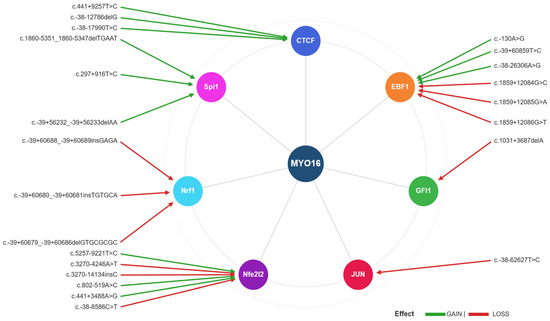
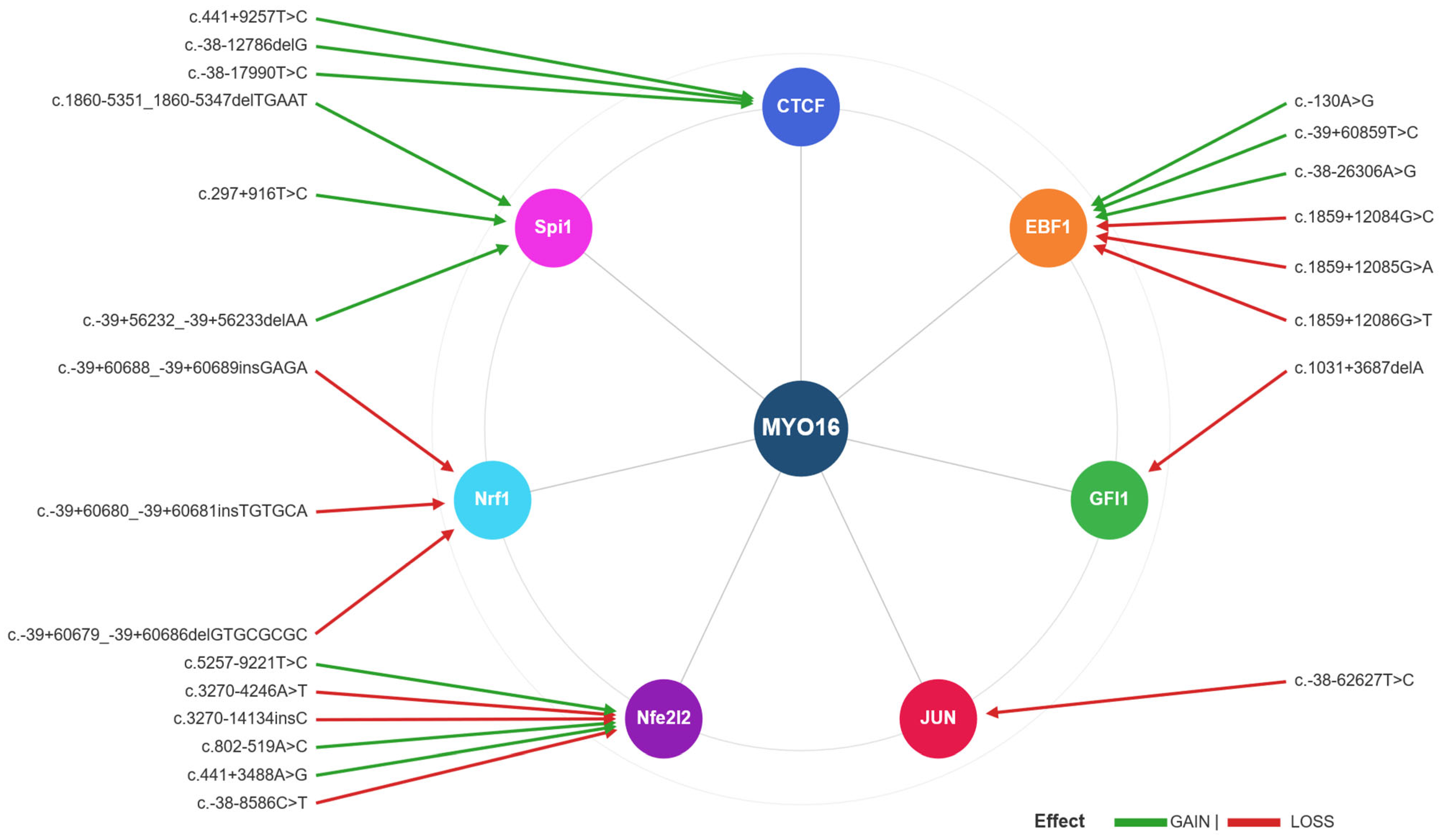
Among the identified MYO16 polymorphisms, both predicted gain (GAIN) and loss (LOSS) of EBF1 motif hits were detected. The variants c.-130A>G, c.-39+60859T>C, and c.-38-26306A>G were predicted to generate new EBF1 motif hits, whereas three substitutions in intron 16—c.1859+12084G>C, c.1859+12085G>A, and c.1859+12086G>T—were predicted to disrupt EBF1 motif hits (Figure 1).
Figure 1.
Predicted effects of polymorphisms in the MYO16 gene on transcription factor binding sites (TFBSs) based on JASPAR motif analysis. Green and red arrows represent the predicted gain (GAIN) and loss (LOSS) of TFBSs, respectively.
Three polymorphisms were identified that were predicted to form new binding sites for the CTCF factor (c.-38-17990T>C, c.-38-12786delG, c.441+9257T>C).
The deletion c.-39+60679_-39+60686delGTGCGCGC and the insertions c.-39+60680_-39+60681insTGTGCA, c.-39+60688_-39+60689insGAGA may be associated with the predicted loss of the Nrf1 factor binding sites. The presence of the polymorphisms c.-39+56232_-39+56233delAA, c.297+916T>C and c.1860-5351_1860-5347delTGAAT was predicted to create new Spi1 motif matches. For the Nfe2l2 (Nrf2), both predicted gain and loss of binding sites were observed. Formation of new sites is predicted for c.441+3488A>G, c.802-519A>C, and c.5257-9221T>C, while loss is observed for c.-38-8586C>T, c.3270-14134insC, and c.3270-4246A>T. The presence of alternative alleles for the c.-38-62627T>C and c.1031+3687delA polymorphisms results in the loss of binding sites for the JUN and GFI1 factors, respectively.
4. Discussion
The data obtained in this study indicate substantial sequence variability in the MYO16 gene region, where 10,318 polymorphisms were identified, including 9434 SNPs, 342 insertions, and 542 deletions. The overwhelming majority of identified polymorphisms are localized in non-coding regions, which is due to the lower level of conservation of these regions and is consistent with general patterns of accumulation of neutral mutations in mammalian genomes [18,19].
Despite the prevalence of polymorphic variants in introns, substitutions located in coding regions are of particular interest, as they are potentially capable of altering the amino acid sequence of the protein or influencing translation and splicing processes. Analysis of the MYO16 gene’s exons revealed the presence of 54 single-nucleotide substitutions, 15 of which are missense variants and can alter the structure and functional properties of the encoded protein. Notably, no insertions or deletions were detected in the exon region. Analysis of the location of exon polymorphisms relative to the encoded functional domains revealed that the greatest number of substitutions are concentrated in the region corresponding to the MYSc_Myo16 motor domain (CDD: 276844). Seven missense variants were identified in this domain; however, according to SIFT, only two of them—c.1397G>A (p.Ser466Asn) and c.2939C>A (p.Ser980Tyr)—were predicted to be deleterious, whereas the remaining substitutions were classified as tolerated. Given the central role of the motor domain in actin binding and ATP hydrolysis, these two variants may be of particular interest for further functional evaluation [20]. Two amino acid substitutions, c.317T>C (p.Val106Ala) and c.352G>A (p.Asp118Asn), were identified within ANK repeat 1. Although ankyrin repeats are involved in protein–protein interactions [21], both variants were predicted to be tolerated by SIFT, suggesting that they are unlikely to have a strong detrimental effect on MYO16 function. Two missense substitutions (c.4181C>T (p.Ala1394Val), c.4624G>T (p.Ala1542Ser)) are localized in the region of the C-terminal domain of NYAP_N (CDD: 464717), which is involved in the phosphoinositide 3-kinase signaling cascade [22]. SIFT predicted p.Ala1394Val to be a valid substitution, while the Ensembl VEP results for p.Ala1542Ser lacked a SIFT annotation. Furthermore, c.4624G>T was absent from SNP databases, indicating that this substitution likely has not been previously detected. Thus, the available in silico data do not support a pronounced deleterious effect of p.Ala1394Val, whereas the biological significance of p.Ala1542Ser remains unclear and warrants further investigation. Missense variants located outside the regions corresponding to conserved domains are also of interest for further research: c.1021C>T (p.Pro341Ser), c.3644G>A (p.Arg1215Gln), and c.5170G>A (p.Gly1724Ser). According to SIFT, the p.Arg1215Gln and p.Gly1724Ser substitutions were predicted to be deleterious. Particular attention should be paid to the c.5170G>A substitution, located at the boundary of exon 33 and the adjacent intron, in the splice donor region. Thus, this variant is noteworthy not only because of its predicted deleterious amino acid substitution but also because of its potential association with pre-mRNA splicing. In the exons of the MYO16 gene, 39 synonymous substitutions have been identified, and modern studies show that such genetic variants are capable of influencing gene expression and the spatial organization of encoded proteins [23,24].
During the study, 23 polymorphisms were identified in non-coding regions of the MYO16 gene that, according to in silico analysis, were predicted to alter transcription factor binding sites. Specifically, these variants were associated with allele-specific gain of predicted TFBS or loss of TFBS present in the reference allele, including motifs for EBF1, CTCF, NRF1, SPI1, NFE2L2, JUN, and GFI1. Factor EBF1 plays an important role in the development of B-lymphocytes and neurons, and is also involved in the transcriptional cascade of adipogenesis [25]. EBF1 knockdown cells were shown to exhibit a significant reduction in insulin-stimulated glucose uptake and lipogenesis. EBF1 positively regulates the PI3K/AKT, MAPK, and STAT1 pathways [26]. The transcription factor CTCF is a key regulator of chromatin spatial architecture and can act as an activator, repressor, and insulator of transcription. It recruits numerous other transcription factors to chromatin, including tissue-specific transcription activators, repressors, cohesin, and RNA polymerase II, and forms chromatin loops, thereby controlling gene expression [27,28]. Nrf1 is an important transcription factor; its expression is ubiquitously detected in various vertebrate tissues. Nrf1 and its isoforms perform important functions in maintaining cellular homeostasis, normal organ development, and growth during life. Dysfunction of Nrf1 leads to the spontaneous development of nonalcoholic steatohepatitis, hepatoma, diabetes, and neurodegenerative diseases in experimental animal models [29]. Transcription factor Spi1(PU.1) is a regulatory protein that plays an important role in blood cell differentiation [30]. Its involvement in metabolic processes has also been established. PU.1 is expressed in adipocytes, and its levels increase in obesity. Knockout of PU.1 in mice is accompanied by improved insulin sensitivity, increased insulin-stimulated glucose uptake, and reduced adipose tissue inflammation [31]. Factor Nfe2l2 is involved in maintaining mitochondrial redox homeostasis [32]. The transcription factor JUN belongs to the AP-1 family and, as part of homo- and heteromeric protein complexes, is involved in the control of cell cycle programs, proliferation, and apoptosis [33]. In mice, downregulation of JUN expression in the epidermis relieves the blockade of cytokine expression, leading to diseases similar to psoriasis and systemic lupus erythematosus [33]. GFI1 is a key regulator of hematopoiesis. Changes in GFI1 expression and function are associated with the development of neutropenia and allergies, autoimmune diseases, and hyperinflammatory reactions [34].
Taken together, the in silico analysis suggests that some polymorphisms in the non-coding MYO16 region may represent candidate regulatory variants, because they are predicted to create or disrupt transcription factor binding sites in an allele-specific manner and thus may be relevant to MYO16 expression. This hypothesis is supported by the fact that introns frequently contain functional cis-regulatory elements, including enhancers, and that tissue-specific enhancers are often located within intronic regions [35,36]. At the same time, these findings should be interpreted with caution, since they are based solely on computational predictions and do not by themselves demonstrate altered transcription factor binding or changes in gene expression in vivo. In addition, the statistical support for these observations was not retained after correction for multiple testing, which further limits the strength of the inference. Therefore, the identified non-coding variants should be regarded primarily as candidates for further functional validation rather than as confirmed regulatory polymorphisms. The relatively small sample size also limits the interpretation of these findings and warrants further validation in larger populations.
The functional role of the MYO16 gene remains incompletely understood. Available data support its importance in nervous system development and function, including participation in actin cytoskeleton remodeling, suppression of actin dynamics in the postsynaptic compartment of dendritic spines, and organization of presynaptic axon terminals [6,7]. At the same time, epigenetic studies and GWAS have linked the MYO16 locus to metabolic processes, growth, and morphogenesis in vertebrates, although the molecular basis of these associations remains unclear [9,10,11]. Against this background, the TFBS predictions obtained in the present study for EBF1, CTCF, NRF1, SPI1, NFE2L2, JUN, and GFI1 may be viewed as consistent with the possibility that MYO16 is regulated in biological contexts extending beyond nervous tissue. Nevertheless, this interpretation should be made with caution, since it is based on in silico predictions and does not by itself demonstrate functional involvement of MYO16 in these processes.
5. Conclusions
The obtained results lay the foundation for future studies of genotype-phenotype associations and may facilitate the development of molecular markers for marker-assisted selection in sheep breeding. Sequence analysis of the MYO16 gene revealed multiple polymorphisms potentially related to its expression and functional properties. Missense variants, particularly those located in conserved domains or predicted as deleterious using SIFT, may affect the structural and functional properties of the encoded protein, while synonymous substitutions also deserve attention due to their potential impact on translation efficiency and protein folding. Furthermore, in silico analysis revealed that several polymorphisms in non-coding regions have the potential to alter binding sites for the transcription factors EBF1, CTCF, NRF1, SPI1, NFE2L2, JUN, and GFI1; however, their putative regulatory significance should be interpreted with caution. Importantly, the identification and annotation of MYO16 polymorphisms are confirmed by direct sequencing and bioinformatics analysis, while conclusions about their functional significance remain preliminary, as they are based on computational predictions and require experimental validation. Further research will focus on assessing the prevalence of priority polymorphisms in a larger sheep population and examining the relationships between their genotypes and phenotypic traits. If reliable and reproducible associations between MYO16 polymorphisms and economically important traits in sheep are confirmed, these variants may be considered as potential markers for further evaluation in breeding programs.
Author Contributions
Conceptualization, A.K. (Alexander Krivoruchko); formal analysis, O.Y. and E.B.; investigation, E.S. and A.K. (Anastasia Kanibolotskaya); writing—original draft preparation, O.Y.; writing—review and editing, A.K. (Alexander Krivoruchko) and O.Y.; visualization, A.S.; supervision, A.S. and E.B. All authors have read and agreed to the published version of the manuscript.
Funding
The research was funded by the Russian Science Foundation (project No. 25-76-10086), https://rscf.ru/project/25-76-10086/ (accessed on 31 March 2026).
Institutional Review Board Statement
The animal study protocol, including blood sampling, was approved by the Institutional Animal Care and Use Committee of All-Russian Research Institute of Sheep and Goat Breeding, Stavropol, Russian Federation (approval protocol number 2021–0047, 10 November 2021).
Informed Consent Statement
Not applicable.
Data Availability Statement
The original contributions presented in this study are included in the article. Further inquiries can be directed to the corresponding author(s).
Acknowledgments
The authors would like to thank all the reviewers who participated in the review.
Conflicts of Interest
There are no conflicts of interest to declare.
Abbreviations
The following abbreviations are used in this manuscript:
| TF | transcription factor |
| HGVS | Human Genome Variation Society |
| GWAS | genome-wide association study |
| NCBI | National Center for Biotechnology Information |
| SNP | single-nucleotide polymorphism |
| TFBS | transcription factor binding site |
| UTR | untranslated region |
| PWM | position weight matrix |
| ID NCBI | identificatory of The National Center for Biotechnology Information |
References
- Makkar, H.P.S. Review: Feed Demand Landscape and Implications of Food-Not Feed Strategy for Food Security and Climate Change. Animal 2018, 12, 1744–1754. [Google Scholar] [CrossRef] [Scilit]
- Sharma, P.; Doultani, S.; Hadiya, K.K.; George, L.; Highland, H. Overview of Marker-Assisted Selection in Animal Breeding. J. Adv. Biol. Biotechnol. 2024, 27, 303–318. [Google Scholar] [CrossRef] [Scilit]
- Zhao, K.; Li, X.; Liu, D.; Wang, L.; Pei, Q.; Han, B.; Zhang, Z.; Tian, D.; Wang, S.; Zhao, J.; et al. Genetic Variations of MSTN and Callipyge in Tibetan Sheep: Implications for Early Growth Traits. Genes 2024, 15, 921. [Google Scholar] [CrossRef] [Scilit] [PubMed]
- Xiang, J.; Li, H.; Guo, Z.; Li, T.; Yamada, T.; Li, X.; Bao, S.; Da, L.; Borjigin, G.; Cang, M.; et al. Effect of FABP4 Gene Polymorphisms on Fatty Acid Composition, Chemical Composition, and Carcass Traits in Sonid Sheep. Animals 2025, 15, 226. [Google Scholar] [CrossRef] [Scilit]
- Guo, X.; Li, T.; Lu, D.; Yamada, T.; Li, X.; Bao, S.; Liu, J.; Borjigin, G.; Cang, M.; Tong, B. Effects of the Expressions and Variants of the CAST Gene on the Fatty Acid Composition of the Longissimus Thoracis Muscle of Grazing Sonid Sheep. Animals 2023, 13, 195. [Google Scholar] [CrossRef] [Scilit] [PubMed]
- Telek, E.; Kengyel, A.; Bugyi, B. Myosin XVI in the Nervous System. Cells 2020, 9, 1903. [Google Scholar] [CrossRef] [Scilit] [PubMed]
- Bugyi, B.; Kengyel, A. Myosin XVI. Adv. Exp. Med. Biol. 2020, 1239, 405–419. [Google Scholar] [CrossRef] [Scilit]
- Telek, E.; Karádi, K.; Kardos, J.; Kengyel, A.; Fekete, Z.; Halász, H.; Nyitrai, M.; Bugyi, B.; Lukács, A. The C-Terminal Tail Extension of Myosin 16 Acts as a Molten Globule, Including Intrinsically Disordered Regions, and Interacts with the N-Terminal Ankyrin. J. Biol. Chem. 2021, 297, 100716. [Google Scholar] [CrossRef] [Scilit]
- King, S.E.; Nilsson, E.; Beck, D.; Skinner, M.K. Adipocyte Epigenetic Alterations and Potential Therapeutic Targets in Transgenerationally Inherited Lean and Obese Phenotypes Following Ancestral Exposures. Adipocyte 2019, 8, 362–378. [Google Scholar] [CrossRef] [Scilit]
- Yoshida, G.M.; Yáñez, J.M. Multi-Trait GWAS Using Imputed High-Density Genotypes from Whole-Genome Sequencing Identifies Genes Associated with Body Traits in Nile Tilapia. BMC Genom. 2021, 22, 57. [Google Scholar] [CrossRef] [Scilit]
- Nazar, M.; Lu, X.; Abdalla, I.M.; Ullah, N.; Fan, Y.; Chen, Z.; Arbab, A.A.I.; Mao, Y.; Yang, Z. Genome-Wide Association Study Candidate Genes on Mammary System-Related Teat-Shape Conformation Traits in Chinese Holstein Cattle. Genes 2021, 12, 2020. [Google Scholar] [CrossRef] [Scilit]
- Krivoruchko, A.; Yatsyk, O.; Kanibolockaya, A.; Kulintsev, V. Genome-Wide Association Study (GWAS) of High Productivity Classes in the Karachaevsky Sheep Breed. J. Cent. Eur. Agric. 2021, 22, 669–677. [Google Scholar] [CrossRef] [Scilit]
- Zhou, W.; Li, X.; Zhang, X.; Zhu, L.; Peng, Y.; Zhang, C.L.; Han, Z.; Yang, R.; Bai, X.; Wang, Q.; et al. Genome-Based Analysis of the Genetic Pattern of Black Sheep in Qira Sheep. BMC Genom. 2025, 26, 114. [Google Scholar] [CrossRef] [Scilit]
- Schaid, D.J.; Chen, W.; Larson, N.B. From Genome-Wide Associations to Candidate Causal Variants by Statistical Fine-Mapping. Nat. Rev. Genet. 2018, 19, 491–504. [Google Scholar] [CrossRef] [Scilit]
- Zhu, Y.; Tazearslan, C.; Suh, Y. Challenges and Progress in Interpretation of Non-Coding Genetic Variants Associated with Human Disease. Exp. Biol. Med. 2017, 242, 1325–1334. [Google Scholar] [CrossRef] [Scilit] [PubMed]
- Cingolani, P.; Platts, A.; Wang, L.L.; Coon, M.; Nguyen, T.; Wang, L.; Land, S.J.; Lu, X.; Ruden, D.M. A Program for Annotating and Predicting the Effects of Single Nucleotide Polymorphisms, SnpEff: SNPs in the Genome of Drosophila Melanogaster Strain W1118; Iso-2; Iso-3. Fly 2012, 6, 80–92. [Google Scholar] [CrossRef] [Scilit] [PubMed]
- Grant, C.E.; Bailey, T.L.; Noble, W.S. FIMO: Scanning for Occurrences of a given Motif. Bioinformatics 2011, 27, 1017–1018. [Google Scholar] [CrossRef] [Scilit] [PubMed]
- Eory, L.; Halligan, D.L.; Keightley, P.D. Distributions of Selectively Constrained Sites and Deleterious Mutation Rates in the Hominid and Murid Genomes. Mol. Biol. Evol. 2010, 27, 177–192. [Google Scholar] [CrossRef] [Scilit]
- Wang, Z.-H.; Zhu, Q.-H.; Li, X.; Zhu, J.-W.; Tian, D.-M.; Zhang, S.-S.; Kang, H.-L.; Li, C.-P.; Dong, L.-L.; Zhao, W.-M.; et al. ISheep: An Integrated Resource for Sheep Genome, Variant and Phenotype. Front. Genet. 2021, 12, 714852. [Google Scholar] [CrossRef] [Scilit]
- Heissler, S.M.; Sellers, J.R. Kinetic Adaptations of Myosins for Their Diverse Cellular Functions. Traffic 2016, 17, 839–859. [Google Scholar] [CrossRef] [Scilit]
- Kumar, A.; Balbach, J. Folding and Stability of Ankyrin Repeats Control Biological Protein Function. Biomolecules 2021, 11, 840. [Google Scholar] [CrossRef] [Scilit] [PubMed]
- Yokoyama, K.; Tezuka, T.; Kotani, M.; Nakazawa, T.; Hoshina, N.; Shimoda, Y.; Kakuta, S.; Sudo, K.; Watanabe, K.; Iwakura, Y.; et al. NYAP: A Phosphoprotein Family That Links PI3K to WAVE1 Signalling in Neurons. EMBO J. 2011, 30, 4739–4754. [Google Scholar] [CrossRef] [Scilit]
- Kimchi-Sarfaty, C.; Oh, J.M.; Kim, I.-W.; Sauna, Z.E.; Calcagno, A.M.; Ambudkar, S.V.; Gottesman, M.M. A “Silent” Polymorphism in the MDR 1 Gene Changes Substrate Specificity. Science 2007, 315, 525–528. [Google Scholar] [CrossRef] [Scilit]
- Walsh, I.M.; Bowman, M.A.; Soto Santarriaga, I.F.; Rodriguez, A.; Clark, P.L. Synonymous Codon Substitutions Perturb Cotranslational Protein Folding in Vivo and Impair Cell Fitness. Proc. Natl. Acad. Sci. USA 2020, 117, 3528–3534. [Google Scholar] [CrossRef] [Scilit]
- Jimenez, M.A.; Åkerblad, P.; Sigvardsson, M.; Rosen, E.D. Critical Role for Ebf1 and Ebf2 in the Adipogenic Transcriptional Cascade. Mol. Cell. Biol. 2007, 27, 743–757. [Google Scholar] [CrossRef] [Scilit]
- Griffin, M.J.; Zhou, Y.; Kang, S.; Zhang, X.; Mikkelsen, T.S.; Rosen, E.D. Early B-Cell Factor-1 (EBF1) Is a Key Regulator of Metabolic and Inflammatory Signaling Pathways in Mature Adipocytes. J. Biol. Chem. 2013, 288, 35925–35939. [Google Scholar] [CrossRef] [Scilit]
- Arzate-Mejía, R.G.; Recillas-Targa, F.; Corces, V.G. Developing in 3D: The Role of CTCF in Cell Differentiation. Development 2018, 145, dev137729. [Google Scholar] [CrossRef] [Scilit]
- Holwerda, S.J.B.; de Laat, W. CTCF: The Protein, the Binding Partners, the Binding Sites and Their Chromatin Loops. Philos. Trans. R. Soc. B Biol. Sci. 2013, 368, 20120369. [Google Scholar] [CrossRef] [Scilit] [PubMed]
- Zhang, Y.; Xiang, Y. Molecular and Cellular Basis for the Unique Functioning of Nrf1, an Indispensable Transcription Factor for Maintaining Cell Homoeostasis and Organ Integrity. Biochem. J. 2016, 473, 961–1000. [Google Scholar] [CrossRef] [Scilit] [PubMed]
- Du, B.; Gao, W.; Qin, Y.; Zhong, J.; Zhang, Z. Study on the Role of Transcription Factor SPI1 in the Development of Glioma. Chin. Neurosurg. J. 2022, 8, 7. [Google Scholar] [CrossRef] [Scilit]
- Lackey, D.E.; Reis, F.C.G.; Isaac, R.; Zapata, R.C.; El Ouarrat, D.; Lee, Y.S.; Bandyopadhyay, G.; Ofrecio, J.M.; Oh, D.Y.; Osborn, O. Adipocyte PU.1 Knockout Promotes Insulin Sensitivity in HFD-Fed Obese Mice. Sci. Rep. 2019, 9, 14779. [Google Scholar] [CrossRef] [Scilit] [PubMed]
- Ryoo, I.; Kwak, M.-K. Regulatory Crosstalk between the Oxidative Stress-Related Transcription Factor Nfe2l2/Nrf2 and Mitochondria. Toxicol. Appl. Pharmacol. 2018, 359, 24–33. [Google Scholar] [CrossRef] [Scilit] [PubMed]
- Schonthaler, H.B.; Guinea-Viniegra, J.; Wagner, E.F. Targeting Inflammation by Modulating the Jun/AP-1 Pathway. Ann. Rheum. Dis. 2011, 70, i109–i112. [Google Scholar] [CrossRef] [Scilit]
- van der Meer, L.T.; Jansen, J.H.; van der Reijden, B.A. Gfi1 and Gfi1b: Key Regulators of Hematopoiesis. Leukemia 2010, 24, 1834–1843. [Google Scholar] [CrossRef] [Scilit]
- Tuvikene, J.; Esvald, E.-E.; Rähni, A.; Uustalu, K.; Zhuravskaya, A.; Avarlaid, A.; Makeyev, E.V.; Timmusk, T. Intronic Enhancer Region Governs Transcript-Specific Bdnf Expression in Rodent Neurons. eLife 2021, 10, e65161. [Google Scholar] [CrossRef] [Scilit]
- Borsari, B.; Villegas-Mirón, P.; Pérez-Lluch, S.; Turpin, I.; Laayouni, H.; Segarra-Casas, A.; Bertranpetit, J.; Guigó, R.; Acosta, S. Enhancers with Tissue-Specific Activity Are Enriched in Intronic Regions. Genome Res. 2021, 31, 1325–1336. [Google Scholar] [CrossRef] [Scilit] [PubMed]

Disclaimer/Publisher’s Note: The statements, opinions and data contained in all publications are solely those of the individual author(s) and contributor(s) and not of MDPI and/or the editor(s). MDPI and/or the editor(s) disclaim responsibility for any injury to people or property resulting from any ideas, methods, instructions or products referred to in the content. |
© 2026 by the authors. Licensee MDPI, Basel, Switzerland. This article is an open access article distributed under the terms and conditions of the Creative Commons Attribution (CC BY) license.