Article

Forage-Free Diets with Reduced Corn Meal for Feedlot Beef Cattle: Impacts on Performance and Metabolic Adaptations

by
Jefferson R. Gandra
1,2,3,4,*,
Cibeli A. Pedrini
2,
Rafael H. T. B. Goes
2,
Carolina M. C. Araújo
2,
Vinicius Almeida
3,
Tiago C. Tavone
3,
Mayana P. S. Costa
4,
Kálita P. Rosa
4 and
Wanderson da S. Lopes
1
1
Instituto de Estudos do trópico Umido, Faculdade de Medicina Veterinária e Zootecnia, Universidade Federal do Sul e Sudeste do Pará, Xinguara 68507-590, Pará, Brazil
2
Faculty of Agricultural Sciences, Federal University of Grande Dourados, Dourados 79804-970, Mato Grosso do Sul, Brazil
3
Postgraduate Program in Sustainable Production and Animal Health, Universidade Estadual de Maringá, Campus de Umuarama, Umuarama 87508-210, Paraná, Brazil
4
Integrated Postgraduate Program in Animal Science in the Tropics, Universidade federal rural do Amazonas, Campus de Parauapebas, Parauapebas 68515-000, Pará, Brazil
*
Author to whom correspondence should be addressed.
Ruminants 2026, 6(2), 23; https://doi.org/10.3390/ruminants6020023
Submission received: 12 February 2026 / Revised: 23 March 2026 / Accepted: 26 March 2026 / Published: 7 April 2026

Simple Summary

This study was conducted with the objective of evaluating the effects of varying levels of ground corn inclusion in forage-free diets supplemented with fermentable fiber sources from fibrous byproducts and their impact on the performance and carcass quality of feedlot beef cattle. The results obtained demonstrate that forage-free diets based on fibrous byproducts can be used as a substitute for high-forage diets for finishing beef cattle, provided that starch levels are included at 25–30% of the diet’s dry matter. In addition, further research is needed to improve the understanding and use of forage-free diets in commercial production.

Abstract

This study evaluated the effects of forage-free diets with reduced starch levels on the productive performance, metabolism, ruminal fermentation, nutrient digestibility, and meat quality of feedlot beef cattle. Two experiments were conducted. In Experiment 1, forty uncastrated Nellore steers were distributed into 20 pens in a completely randomized design, receiving diets with increasing inclusion levels of ground corn in the total diet: C400 (400 g kg−1), C200 (200 g kg−1), C100 (100 g kg−1), and C50 (50 g kg−1), formulated without forage and based on fibrous co-products. Increasing ground corn inclusion promoted linear improvements in final body weight and average daily gain, while dry matter intake and feed efficiency showed quadratic responses. Meat quality parameters were not affected by dietary treatments. In Experiment 2, eight crossbred steers were assigned to a double 4 × 4 Latin square design and fed the same experimental diets. Higher corn inclusion increased starch and fat intake, whereas dry matter, organic matter, and protein intake showed quadratic responses. Apparent total-tract digestibility of dry matter, organic matter, and starch also followed a quadratic pattern. Ruminal fermentation parameters were affected by dietary treatments, with greater ammoniacal nitrogen concentrations at higher corn levels and quadratic responses for propionate, butyrate, and methane production. Nitrogen metabolism indicated increased urinary nitrogen and uric acid excretion with increasing dietary corn inclusion. These results demonstrate that forage-free diets based on citrus pulp and soybean hulls with different levels of ground corn can be effectively used in finishing beef cattle, improving performance without impairing meat quality while modulating ruminal fermentation and nutrient utilization.

1. Introduction

In intensive beef cattle feedlot systems, forage-free diets have attracted increasing interest due to their operational and economic advantages, including simplified feed management, reduced logistical costs, and decreased reliance on high-quality forages, which are often limited or subject to seasonal availability [1]. The removal of forage from the diet increases energy density and optimizes feedlot infrastructure utilization, allowing higher stocking rates and improved operational efficiency [1,2,3]. However, the greater inclusion of starchy ingredients, such as corn meal, may increase the risk of metabolic disorders, highlighting the need for nutritional strategies that maintain rumen health while supporting optimal productive performance [2].
In this context, strategies aimed at the partial or total replacement of corn with alternative energy and/or fiber sources have been evaluated in forage-free diets for feedlot cattle. The progressive substitution of corn with white oat grain in diets containing 85% concentrate resulted in a quadratic response in average daily gain and feed efficiency, with the best performance observed at intermediate replacement levels, between 25% and 75% [3]. Furthermore, the inclusion of white oat grain increased the neutral detergent fiber content of the diet and extended rumination time, contributing to greater ruminal stability even in the absence of forage [3]. Similarly, the use of non-forage fiber sources such as soybean hulls, although contributing to a reduction in dietary starch content, has been associated with lower dry matter intake [4].
Considering these aspects, the partial replacement of ground corn with highly digestible fibrous co-products, such as pelleted citrus pulp and pelleted soybean hulls, has been proposed as a viable strategy in forage-free diets for feedlot cattle. The inclusion of citrus pulp reduces dietary starch concentration and provides high levels of pectin, a rapidly fermentable structural carbohydrate that does not produce lactic acid during ruminal degradation, thereby contributing to a lower risk of acidosis and greater ruminal pH stability [5].
Additionally, soybean hulls contain high levels of highly digestible neutral detergent fiber and low lignin concentrations, promoting ruminal fermentation without excessive accumulation of organic acids and enhancing both fiber degradation and microbial protein synthesis [4,6]. Despite these fermentative benefits, the low physical effectiveness of these fibers, due to their small particle size and rapid passage rate, requires careful diet formulation to ensure adequate ruminal stimulation, maintenance of rumination activity, and proper dry matter intake [4,6].
We hypothesize that reducing ground corn inclusion in forage-free diets, combined with a higher proportion of fermentable non-forage fiber sources, will promote greater ruminal pH stability without compromising intake and digestibility, thereby allowing adequate productive performance and carcass quality in finishing feedlot beef cattle. Therefore, the aim of this study was to evaluate the effects of reducing ground corn inclusion in forage-free diets supplemented with fermentable non-forage fiber sources on ruminal pH stability, feed intake, and nutrient digestibility in feedlot beef cattle. Additionally, the study aimed to assess the impact of these dietary modifications on productive performance and carcass quality, with the goal of identifying effective feeding strategies for feedlot finishing cattle.

2. Materials and Methods

2.1. Experiment 1

2.1.1. Location, Animals and Diet

The study was conducted from October 2022 to February 2023 at the experimental center of MinerCamda Animal Nutrition, Adamantina, SP, Brazil (21°41′07″ S, 51°04′21″ W).
Forty uncastrated male Nellore steers, with a BW ± SD of 392.02 ± 28.74 kg and an age of 18± 2.3 months, were divided into 20 pens (5 m × 12 m) with concrete floors and covered roofs, equipped with drinking facilities (60 L/animal/day.). Subsequently, the animals were placed into 20 pens [2 steers/treatment; five pens/treatment] in a completely randomized design, according to the experimental diets: 1—C400 (inclusion of 400 g kg−1 ground corn in the total diet); 2—C200 (inclusion of 200 g kg−1 ground corn in the total diet); 3—C100 (inclusion of 100 g kg−1 ground corn in the total diet); 4—C50 (inclusion of 50 g kg−1 ground corn in the total diet) (Table 1). The diets were balanced according to BR-CORTE [7] guidelines for a target average daily gain of 1500 g/day and were isonitrogenous.
An adaptation diet was provided to the animals for 14 days. During the first week, the diet was offered at 1.0% of body weight (BW), with daily increments of 0.25% BW. Feed intake was adjusted every three days based on the amount of feed refusals (orts), aiming to maintain refusals below 10% of the feed offered. When refusals exceeded 10%, the feed allowance was reduced by 5% on the subsequent day.
During the 14-day adaptation period, animals were gradually transitioned to their respective experimental diets to allow proper ruminal adaptation and reduce the risk of metabolic disorders. The proportion of concentrate and ground corn in the diet was progressively increased until the animals were fully adapted to the final forage-free diets before the beginning of data collection.

2.1.2. Intake and Performance

The daily intake of dry matter and nutrients was measured by supported feeders. Feed and leftover samples were collected on a weekly basis and stored in the freezer for subsequent analysis. Because two animals were housed per pen, dry matter intake was determined on a pen basis by recording the amount of feed offered and refusals daily, and the pen was considered the experimental unit for intake measurements.
The analysis included measurements of dry matter (DM; method 930.15), organic matter (OM; calculated as DM minus ash), crude protein (CP; method 984.13, N × 6.25), ether extract (EE; method 920.39), and lignin (method 973.18) following the procedures outlined by AOAC [8]. Additionally, the contents of neutral detergent fiber (NDF) and acid detergent fiber (ADF) were measured according to Van Soest et al. [9]. The starch content of the samples was determined using a UV–Vis spectrophotometer (model UV-1800; Shimadzu, Kyoto, Japan) after enzymatic degradation using Amyloglucosidase AMG 300L (Novozymes, Valtran, Mogi das Cruzes, SP, Brazil), as described by Bach Knudsen [10].
The body weight (BW) of steers was recorded every 15 days from day 0 to day 120 of the feedlot period using a digital scale (model RUDD 300; Coimma LTDA, Dracena, SP, Brazil). Daily weight gain was calculated, and average daily gain (ADG) for each animal was estimated using simple polynomial regression models fitted by PROC REG (SAS 9.4; SAS Institute Inc., Cary, NC, USA). Individual growth curves were generated based on the sequential BW measurements of each animal. The slope of each regression equation represented the animal’s total weight gain over the evaluation period, minimizing potential biases related to weighing inconsistencies or variations in the timing of measurements. The arroba (@), a conventional unit used in Brazilian livestock production, was adopted as a measure of carcass weight, where 1 @ corresponds to 15 kg of carcass.

2.1.3. Fecal Starch Measurement

Individual fecal samples (500 g) were collected monthly directly from the rectal ampulla for the determination of fecal starch concentration. Starch content was quantified spectrophotometrically following enzymatic hydrolysis with Amyloglucosidase AMG 300L (Novozymes, Valtran, Mogi das Cruzes, SP, Brazil), according to the methodology described by Bach Knudsen [10].

2.1.4. Slaughter Procedures and Meat Quality Analyses

After 120 days on feed, steers were individually weighed using a mechanical scale. Following a 12 h fasting period (water only), shrunk body weight was recorded. The animals were then transported approximately 120 km to a commercial slaughter facility and processed according to standard procedures. Slaughter procedures followed the Brazilian Federal Inspection Service regulations and animal welfare standards for commercial slaughterhouses.
Carcasses were split longitudinally, identified, weighed, and chilled at 4 °C for 24 h. Samples of the Longissimus thoracis muscle were collected between the 11th and 13th ribs from the left half-carcass. Two steaks (~2.5 cm thick) were obtained from each animal for physicochemical evaluations.
Meat pH was measured in thawed (overnight at 4 °C before laboratory analyses) samples using a portable digital pH meter (Testo 205; Testo, Lenzkirch, Germany). Color parameters (L*, a*, b*) were assessed using a calibrated colorimeter (Chroma Meter CR-400; Konica Minolta, Tokyo, Japan). Water-holding capacity (WHC) was determined by the compression method [11], applying 2250 kg for 5 min on ~2 g samples, and calculated based on weight loss percentage. Cooking loss (CL) was measured as described by Osório et al. [12], by roasting samples at 170 °C until reaching 70 °C internal temperature, with CL expressed as percentage weight loss.
Shear force (SF) was determined on cooked samples. Cylindrical cores were extracted along the muscle fibers and cut transversely using a Warner-Bratzler blade (1 mm; TA-XT Plus, Stable Micro Systems, Godalming, UK). The maximum cutting force was recorded and expressed in kilogram-force (kgf) [13].
Dry matter (DM) was determined after oven drying at 55 °C, with results corrected for total solids. Crude protein (CP) was determined by the Kjeldahl method (AOAC, [8]; method 988.05). Ether extract (EE) was measured via Soxhlet extraction, and ash content was determined by combustion at 600 °C for 16 h [14].

2.1.5. Statistical Analysis

Data were submitted to analysis of variance using SAS (Version 9.1.3; SAS Institute, Cary, NC, USA). Data were tested for homogeneity of variance using Levene’s test (PROC GLM; SAS Institute Inc., Cary, NC, USA) and for normality of residuals using the Shapiro–Wilk test (PROC UNIVARIATE, SAS). Outliers and influential observations were identified based on Cook’s distance (PROC REG, SAS), and data points exceeding the threshold of 4/n were examined and removed when appropriate.
Variables measured at the animal level were analyzed as repeated measures using the PROC MIXED procedure of SAS according to the following model:
Y i j l = μ + A i + T j + D l + ( T j × D l ) + e i j l
where Y i j l = dependent variable, μ = overall mean, A i = random effect of animal (i = 1 to 40), T j = fixed effect of time (j = 1 to 8), D l = fixed effect of diet (l = 1 to 4), T j × D l = interaction between time and diet, and e i j l = residual error. Animal within pen was modeled as a random effect.
Because two animals were housed per pen (20 pens total), dry matter intake (DMI) was determined on a pen basis by recording feed offered and refusals daily for each pen. Therefore, the pen was considered the experimental unit for intake variables. DMI data were analyzed separately using PROC MIXED according to the following model:
Y j k l = μ + P k + T j + D l + ( T j × D l ) + e j k l
where Y j k l = dependent variable (DMI per pen), μ = overall mean, P k = random effect of pen (k = 1 to 20), T j = fixed effect of time (j = 1 to 8), D l = fixed effect of diet (l = 1 to 4), T j × D l = interaction between time and diet, and e j k l = residual error.
Degrees of freedom were adjusted using the DDFM = KR option. Data were also submitted to polynomial regression using PROC REG of SAS, and the significance level was set at p ≤ 0.05.

2.2. Experiment 2

2.2.1. Location, Animals, and Treatments

The experiment was conducted at the Ruminant Nutrition Sector, Animal Nutrition Laboratory, and By-Product Evaluation Laboratory (LAPAC/FINEP) of the Federal University of Grande Dourados (UFGD), Brazil.
Eight crossbred steers (Holstein × Zebu), aged 18 ± 0.3 months, castrated, with an average body weight of approximately 350 ± 8.50 kg, and fitted with permanent ruminal cannulas, were used. The animals were housed in individual covered pens (24 m2; 4 × 6 m) with concrete flooring, each equipped with individual feed troughs and automatic waterers with a supply of 60 L/animal/day. A double 4 × 4 Latin square design was employed, with animals randomly assigned to treatments across five experimental periods. Each period lasted 21 days, including 14 days of dietary adaptation and 7 days of data collection.
Animals were fed one time daily (08:00), based on the previous day’s dry matter intake. Feed offered and refusals (orts) were recorded daily, maintaining a 5–10% surplus to avoid feed restriction. The two dietary components (whole corn and the pellet) were manually mixed in the feed trough and offered as a total mixed ration (TMR) (Table 1). The experimental diets in Trial 2 were the same as in Trial 1.

2.2.2. Nutrient Intake and Apparent Total Digestibility

Dry matter intake (DMI) was determined as the difference between the amount of feed offered and the refusals (orts). In addition, intake was also estimated based on total fecal dry matter (DM) excretion.
Apparent total-tract digestibility was determined through complete fecal collection conducted over three consecutive days (days 14, 15, and 16) for each experimental period. During this phase, animals were monitored individually, and all feces excreted were collected and weighed every 24 h. From the total daily fecal output, a 500 g subsample per animal was taken and immediately stored at −8 °C for subsequent laboratory analyses.
The apparent digestibility coefficient (ADC) of nutrients was calculated based on nutrient intake (NI) and nutrient excretion in feces (NE), both expressed in g/day, using the following equation:
Apparent digestibility coefficient (g kg−1) = (NI − NE)/NI × 1000
where NI = nutrient intake (g/day) and NE = nutrient excretion in feces (g/day).
Nutrient intake and ADC were determined for dry matter (DM), crude protein (CP), and organic matter (OM). Chemical analyses were performed according to standard AOAC procedures for DM (method 930.15), CP (N × 6.25; method 984.13), and ash (method 942.05). Organic matter content was calculated as OM = 100 − ash [8]. Fiber fractions, including neutral detergent fiber (NDF) and acid detergent fiber (ADF), were analyzed according to the procedures described by Van Soest et al. [9]. Starch concentration was determined using the enzymatic colorimetric method described by [10].

2.2.3. Ruminal Fermentation

On day 20 of each experimental period, ruminal fluid was manually collected from each animal to evaluate fermentation parameters, including ruminal pH, ammonia nitrogen (N-NH3), and the concentrations of short-chain fatty acids (SCFAs) and branched-chain fatty acids (BCFAs). Sampling was conducted at five time points: immediately before feeding (0 h) and at 2, 4, 6, and 8 h after feeding. Fluid was obtained from the interface between the solid and liquid rumen contents and filtered through triple-layered gauze to remove particulate matter.
The ruminal pH was measured on-site using a portable digital pH meter (model Meta 210P; Meta Química, São Paulo, Brazil).
For SCFA analysis, 20 mL of ruminal fluid was centrifuged at 1370× g for 5 min. From the resulting supernatant, 1800 µL was mixed with 100 µL of 20% ortho-phosphoric acid and stored at –18 °C until further analysis. Additionally, 1600 µL of supernatant was combined with 400 µL of concentrated formic acid (98–100%) and centrifuged at 7000× g for 15 min at 4 °C.
Quantification of SCFAs and BCFAs was performed, according to Erwin [15], using a gas chromatograph (GC-2010 Plus; Shimadzu, Barueri, Brazil), fitted with an automatic injector (AOC-20i), a Stabilwax-DA™ capillary column (30 m × 0.25 mm i.d., 0.25 µm film thickness; Restek®, Bellefonte, PA, USA), and a flame ionization detector. Samples were acidified with 1 M ortho-phosphoric acid (Merck®, Rahway, NJ, USA; Ref. 100573) and spiked with a mixture of free volatile acids (Supelco®, St. Louis, MO, USA; Ref. 46975). A 1 µL volume of each prepared sample was injected at a split ratio of 40:1, with helium as the carrier gas at a linear velocity of 42 cm/s. The chromatographic program began at 40 °C, increased to 120 °C at 40 °C/min, then to 180 °C at 10 °C/min, and finally to 240 °C at 120 °C/min, where it was held for 3 min. Injector and detector temperatures were set at 250 °C and 300 °C, respectively. Chromatographic data were processed using GCsolution software version 2.42.00 (Shimadzu®, Kyoto, Japan), and compound identification and quantification were based on calibration with the WSFA-2 standard solution (Supelco®, Bellefonte, PA, USA, Ref. 47056) and glacial acetic acid (Sigma-Aldrich®, St. Louis, MO, USA, Ref. 33209).
For N-NH3 determination, 40 mL of ruminal fluid was preserved with 1 mL of a 1:1 hydrochloric acid solution and frozen at –18 °C. Samples were later thawed and centrifuged at 1000× g for 15 min, and ammonia nitrogen concentration was measured by distillation using 2N potassium hydroxide (KOH) as the alkali medium, following the method described by Fenner [16], without prior acid digestion.
Methane production (mM/L) was estimated using the following equation [17]:
CH4 = 0.45(C2) − 0.275(C3) + 0.40(C4)
where C2, C3, and C4 represent acetate, propionate, and butyrate concentrations (mM), respectively.

2.2.4. Microbial Protein Synthesis and Nitrogen Utilization

Urine was sampled on days 17 through 19 for each experimental period by spot collection during spontaneous voiding, precisely 4 h after the animals received their supplement [18]. For metabolite analysis, 10 mL of each sample was immediately diluted with 40 mL of 0.036 N H2SO4, whereas a separate 40 mL aliquot was stabilized with 1 mL of concentrated (36 N) H2SO4 for total urinary nitrogen determination. All aliquots were clearly labeled and stored at −18 °C until analysis.
Allantoin was quantified using a colorimetric method according to the procedure described by references [19,20]. Urinary creatinine was determined by the Jaffé colorimetric method, urea concentration was measured using an enzymatic colorimetric (urease-based) assay, and uric acid was determined by an enzymatic colorimetric method based on uricase. Commercial assay kits (Labtest®, Lagoa Santa, Brazil; Gold Analisa® Diagnóstica Ltd.a., Belo Horizonte, Brazil) were used according to the manufacturers’ instructions.
Daily excretion of purine derivatives (PDs, mmol day−1) was obtained by summing urinary allantoin and uric acid outputs. Microbial purine absorption (Pabs, mmol day−1) was then estimated from PD excretion using the equation proposed by reference [21]:
PD = 0.85 × Pabs + 0.385 × BW0.75
The estimated daily urinary volume (UV, L day−1) was calculated according to the following equation [22]:
U V = 27.36 × B W [ C r e a t i n i n e ]
where BW is the animal’s body weight (kg) and [Creatinine] is the creatinine concentration (mg L−1) in the spot urine sample. The coefficient 27.36 corresponds to the mean daily creatinine output (mg kg BW−1 day−1) reported for crossbred and Zebu steers.
Daily urinary excretion of urea nitrogen (N-urea) and creatinine nitrogen (N-creatinine) was determined by multiplying the concentrations of urea and creatinine in spot urine samples by the estimated 24 h urinary volume. Correction factors of 0.466 and 0.3715 were applied, corresponding to the nitrogen content in urea and creatinine, respectively.
Microbial protein synthesis was estimated by multiplying the daily urinary excretion of purine derivatives by an appropriate stoichiometric factor, as described by [23].
Spot urine samples were used to estimate urinary excretion of purine derivatives and microbial protein synthesis. This approach has been widely adopted in ruminant nutrition studies as a practical alternative to total urine collection, particularly under experimental conditions involving multiple treatments and periods. To minimize variability, urine samples were collected at a consistent time relative to feeding, and creatinine concentration was used to estimate daily urinary volume, following established procedures described in the literature [21,22,23].
Nitrogen balance (NB) was calculated as total nitrogen intake minus the sum of urinary and fecal nitrogen losses. Nitrogen concentrations in urine and feces were quantified by the micro-Kjeldahl method. Retained nitrogen (N-ret) was obtained by subtracting urinary nitrogen from absorbed nitrogen.

2.2.5. Ingestive Behavior and Particle Size Distribution

To evaluate ingestive behavior, steers were monitored for 24 h on day 21 of each experimental period using a digital camera system with infrared night vision (PRO-510 CAM; Swann, Victoria, Melbourne, VIC, Australia). Video recordings were subsequently analyzed using instantaneous scan sampling at 5 min intervals, in which the behavioral status of each animal was recorded throughout the 24 h period. Behaviors were classified as feeding (time spent in front of the feed bunk consuming feed), ruminating (characterized by rhythmic jaw movements in the absence of feed intake), or idleness (periods without feeding or ruminating activity). Chewing time was calculated as the sum of feeding and ruminating durations over the 24 h observation period. Additionally, time spent drinking and the frequency of feeding bouts (number of discrete feeding episodes per day) were recorded [24].
The physical characteristics of diets were evaluated using the Penn State Particle Separator (PSPS, Pennsylvania State University, University Park, PA, USA), following the methodology described by [25]. Approximately 1000 g of each diet sample (as-fed basis) was placed on the top sieve of the PSPS, which consists of three sieves (19 mm, 8 mm, and 1.18 mm) and a bottom pan. The stack was shaken horizontally for 40 movements over 1 min using a consistent and standardized motion. The proportion of material retained in each sieve was expressed as a percentage of the total fresh weight, providing an estimate of the particle size distribution.

2.2.6. Statistical Analysis

Data were submitted to analysis of variance of SAS (Version 9.1.3; SAS Institute, Cary, NC 2004). Data were tested for homogeneity of variance using Levene’s test (PROC GLM; SAS Institute Inc., Cary, NC, USA) and for normality of residuals using the Shapiro–Wilk test (PROC UNIVARIATE, SAS). Outliers and influential observations were identified based on Cook’s distance (PROC REG, SAS), and data points exceeding the threshold of 4/n were examined and removed when appropriate. Data were analyzed using the PROC MIXED procedure of SAS according to the following model:
Y i j l k = μ + S l + A i ( S l ) + P j + D k + ε i j l k
where Y i j l k = dependent variable, μ = overall mean, S l = random effect of square (l = 1 to 2), A i ( S l ) = random effect of animal nested within square (i = 1 to 8), P j = fixed effect of period (j = 1 to 4), D k = fixed effect of diet (k = 1 to 4), and ε i j l k = residual error.
Repeated measures over time (for variables such as pH, N–NH3, and SCFAs) were analyzed using the REPEATED statement, and the best covariance structure was selected based on the lowest Akaike Information Criterion (AIC) value, according to the following model:
Y i j l k y = μ + S l + A i ( S l ) + P j + D k + T y + ( T y × D k ) + ε i j l k y
where Y i j l k y = dependent variable, μ = overall mean, S l = random effect of square (l = 1 to 2), A i ( S l ) = random effect of animal nested within square (i = 1 to 8), P j = fixed effect of period (j = 1 to 4), D k = fixed effect of diet (k = 1 to 4), T y = fixed effect of time (y = 1 to 5), T y × D k = interaction between diet and time, and ε i j l k y = residual error. A first-order autoregressive covariance structure, AR(1), was specified. Polynomial regressions were fitted using PROC REG (SAS 9.4; SAS Institute Inc., Cary, NC, USA), and effects were considered significant at P 0.05 .

3. Results

3.1. Experiment 1

3.1.1. Performance and Meat Quality

Increasing the inclusion level of ground corn in forage-free diets led to clear linear improvements in the productive performance of grazing steers. For each 1% increment in corn inclusion, BWFinal increased by approximately 0.62 kg (p < 0.0001), while ADG improved by 0.041 kg/day (p < 0.0001), indicating a positive association between dietary energy supply and growth rate (Table 2 and Table 8).
Feed efficiency parameters were similarly enhanced. The G:F ratio increased by 0.00146 units per 1% increase in corn inclusion (p < 0.0001), reflecting better conversion of feed into body mass. Concurrently, the DMI:ADG ratio decreased by 0.0709 kg kg−1 for every 1% increase in corn, indicating more efficient feed utilization (p < 0.0001). Carcass conversion (kg DM/@) was significantly reduced by 1.37 kg per 1% corn inclusion (p < 0.0001).
DMI showed a quadratic trend, with the lowest intake observed at 33.89% corn inclusion (p < 0.0001), while DMI/BW reached its minimum at 30.59% (p < 0.0001).
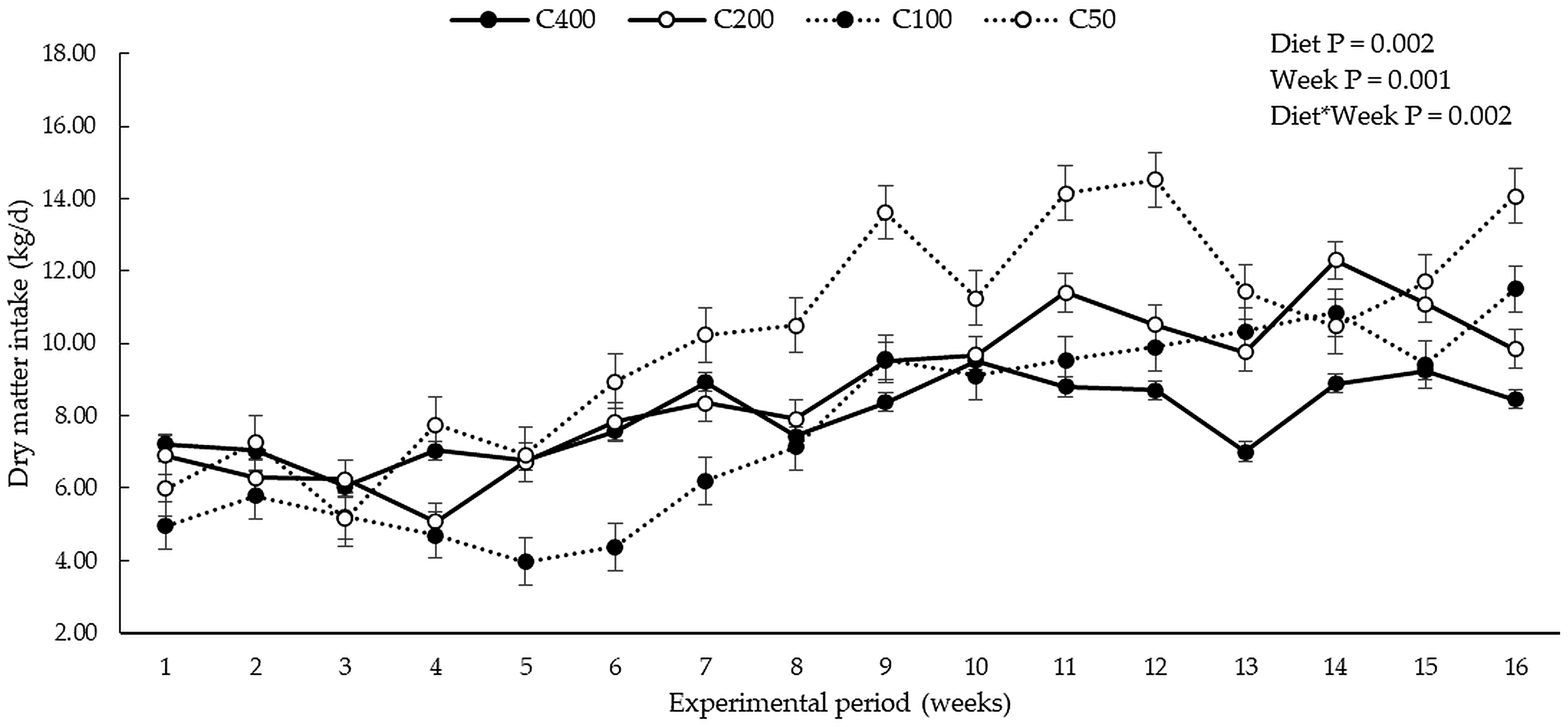
Starting from week 6, steers fed the C50 diet consistently showed the highest dry matter intake (DMI), surpassing 16 kg/day in weeks 11 and 12. In contrast, those receiving the C400 diet maintained the lowest intake levels throughout the trial, with minimal variation over time. Animals in the C100 group demonstrated intermediate intake, generally higher than C400 and C200, particularly between weeks 9 and 14. The C200 group showed a gradual increase in DMI but remained below C100 and C50, though still above C400. Notably, the differences between treatments became increasingly evident after week 8, highlighting clear and consistent intake patterns across diets. These findings are supported by effects of dietary treatment (p = 0.002), experimental week (p = 0.001), and the diet × week interaction (p = 0.002) on DMI (Figure 1).
Carcass traits were also influenced by quadratic effects. HCWfinal peaked at an estimated 27.04% corn inclusion (p = 0.025), and carcass yield (%) was maximized at 25.49% inclusion (p = 0.022). Additionally, fat content increased to 27.54% corn inclusion (p = 0.022) (Table 3 and Table 8).

3.1.2. Fecal Starch Measurement

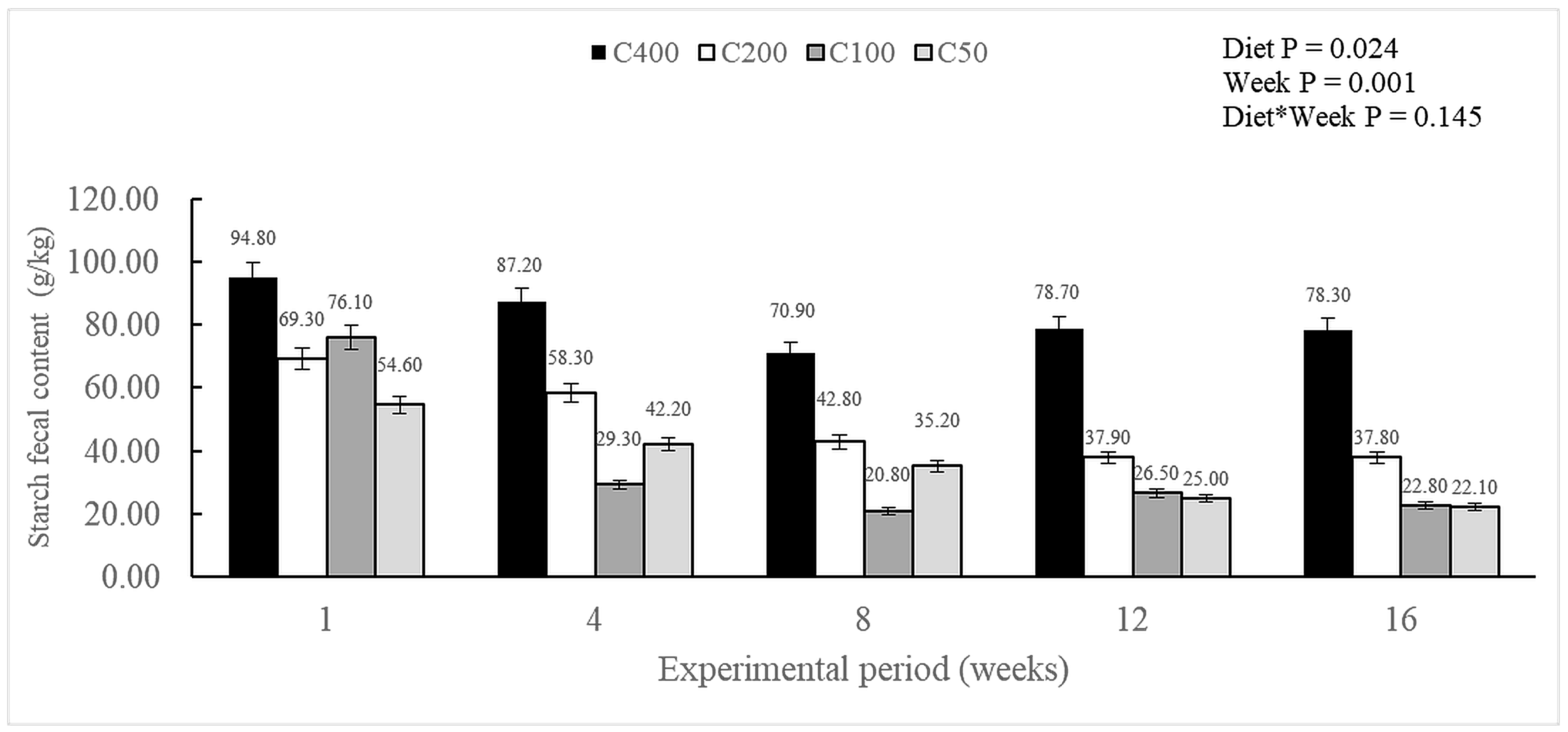
Fecal starch concentrations at week 1 were greatest in the C400 group (94.8 g kg−1), followed by C200 (76.1 g kg−1), C100 (69.3 g kg−1), and C50 (54.6 g kg−1). All treatments saw a decrease in starch excretion as the trial went on. Fecal starch levels dropped significantly by week four, with C400 continuing to have the greatest excretion rate (87.2 g kg−1) and C50 displaying a more moderate value (42.2 g kg−1) (Figure 2).
Over time, this negative tendency persisted. Values at week eight varied between 42.8 g kg−1 (C400) and 20.8 g kg−1 (C100). In comparison to the other groups (C200: 26.5 g kg−1; C50: 25.0 g kg−1), C400 maintained a higher excretion rate at week 12 (78.7 g kg−1). Fecal starch levels leveled off by week 16, with C400 registering 78.3 g kg−1 and C100 and C50 falling to 22.8 and 22.1 g kg−1, respectively. These results are supported by significant effects of diet (p = 0.024) and experimental week (p = 0.001), while the diet × week interaction was not significant (p = 0.145).

3.2. Experiment 2

3.2.1. Dry Matter and Digestibility

A quadratic effect was observed for dry matter intake, with the lowest value occurring at 33.89% ground corn inclusion (p = 0.023). Similarly, organic matter intake followed a quadratic response, reaching its minimum near 33% inclusion (p = 0.032). Crude protein intake also exhibited a quadratic pattern, with the highest intake estimated at 32.5% corn inclusion (p = 0.038) (Table 4 and Table 8).
For each 1% increase in ground corn inclusion in the diet, fat intake decreased by 0.7305 g/day (p < 0.0001), while NDF intake increased by 28.41 g/day (p < 0.0001) and starch intake increased by 51.13 g/day (p < 0.0001).
A quadratic effect was observed for dry matter digestibility, with the highest value occurring at 29.3% ground corn inclusion (p = 0.033). Similarly, organic matter digestibility followed a quadratic response, with the highest value observed at 25.2% inclusion (p = 0.031). Crude protein digestibility also exhibited a quadratic pattern, with the highest value estimated at 31.4% corn inclusion (p = 0.024). Neutral detergent fiber digestibility showed a similar trend, reaching its maximum at 27.4% inclusion (p = 0.025) (Table 3 and Table 7). Additionally, a quadratic effect was observed for starch digestibility, with the highest value estimated at 30.45% ground corn inclusion (p = 0.036).

3.2.2. Ruminal Fermentation

A linear effect was observed for ruminal (N-NH3), which increased by 0.268 mg/dL for each 1% increment in ground corn inclusion (p < 0.0001) (Table 5 and Table 8).
A quadratic effect was observed for propionate concentration, with maximum values estimated at 38.7% ground corn inclusion (p < 0.0001). Similarly, butyrate showed a quadratic response, with maximum values observed at 22.8% inclusion (p < 0.0001). Methane concentration also followed a quadratic pattern, reaching its highest level at 23.0% corn inclusion (p = 0.015).

3.2.3. Nitrogen Utilization and Microbial Protein Synthesis

A linear effect was observed for urinary nitrogen excretion (N-urine), which increased by 0.478 g/day for each 1% increment in ground corn inclusion (p = 0.003). (Table 6 and Table 8).

3.2.4. Particle Separator and Ingestive Behavior

A quadratic effect was observed for the proportion of particles <1.18 mm, with maximum values estimated at 8.87% ground corn inclusion (p = 0.015). Additionally, a linear effect was observed for feeding frequency, which decreased by 2.45 times/day for each 1% increment in ground corn inclusion (p < 0.0001) (Table 7 and Table 8).

4. Discussion

The present study was conducted based on the hypothesis that decreasing the inclusion of ground corn in forage-free diets and increasing fermentable NFF sources such as citrus pulp and soybean hulls would provide better ruminal pH stability without impairing intake, digestibility, or animal performance. The data from both trials strongly support that concept.
Indeed, even when greater amounts of corn were included, animals fed diets with less corn, especially C100 and C50, showed adequate performance and greater DMI, especially during the second part of the feedlot period, in Trial 1. Carcass yield and fatness were maximized at optimal levels (~25–27%) of corn and also demonstrated that the highest energy density did not result in the best carcass performance. Trial 2 supported these responses in the digestive tract: nutrient digestibility displayed a quadratic with the best performance at inclusion levels of 27–32% corn. Moreover, fecal starch excretion decreased progressively with decreasing corn, which suggested enhancement of starch utilization and digestive adjustment.
Overall, these findings demonstrate that a forage-free, well-balanced diet with low starch inclusion is a viable option for the feedlot, benefiting performance and rumen health (Table 8).

4.1. Experiment 1

4.1.1. Performance and Meat Quality

The linear advance of BWFinal and ADG were primarily related to the higher energy density of the diets as a consequence of the incremental concentration of ground corn (C50 through C400). With increased addition of corn (high in starch), rapid fermentable carbohydrates that contribute to a more propionic rumen environment dominated by volatile fatty acids were introduced. In Trial 2 (Table 4), ruminal propionate concentrations showed a quadratic response, with the greatest values occurring at intermediate inclusions, indicating that the conversion rate of fermentable energy to glucogenic substrates may have been enhanced.
This probably resulted in improved systemic energy delivery, which could promote the faster and more effective deposition of tissue. These effects are evident from the significant statistical association (p < 0.0001) between corn inclusion and both BWFinal and ADG (Table 2), indicating that availability of energy remains an important determinant of performance in finishing cattle. Forages-free diets can maintain a high level of productive efficiency when they have a lowered starch content, provided other non-forage fiber sources such as citrus pulp and soybean hulls are used in a targeted manner, without a detrimental effect on rumen function [6].
These results for BWFinal and ADG in our study obtained with higher levels of ground corn were consistent with those demonstrated by [1], since greater final body weight and daily gain were observed in Nellore heifers fed high-concentrate diets formulated with cracked corn instead of corn germ meal. Despite equivalent dry matter intakes among treatments, performance was improved with greater dietary energy density, which corroborates the importance of available starch for growth. These concomitant effects highlight the need not only to satisfy energy needs but also to choose energy-rich feedstuffs that enhance nutrient availability and metabolic efficiency in high-concentrate, forage-free systems.
The greater energy content and starch in the diets could explain the improvements in feed efficiency with increasing corn. Feed efficiency increased with higher corn inclusion levels, with the greatest values observed in the C400 and C200 treatments. This response reflects the greater dietary energy density provided by higher starch inclusion, which improved the efficiency of body weight gain relative to dry matter intake and DMI: ADG got worse, suggesting that more of the dry matter consumed was turned into body mass. This is in harmony with the higher contribution of glucogenic precursors, such as propionate, produced by starch fermentation resulting in a more efficient use of energy [26].
Although the highest corn inclusion (C400) improved average daily gain, the greater fecal starch losses and lower nitrogen use efficiency suggest limitations in ruminal starch utilization under these conditions. It is important to note that all diets were formulated with additives intended to stabilize ruminal fermentation, including monensin, buffering agents, and a probiotic blend containing Bacillus spp., Bifidobacterium spp., Enterococcus spp., Lactobacillus spp., and Saccharomyces spp., according to the guaranteed levels of the mineral premix. These additives were included to help control ruminal pH and support microbial balance. However, considering the very high dietary starch concentration in the C400 treatment, it is possible that the inclusion levels of these additives were insufficient to fully mitigate the ruminal challenges associated with such a high fermentable carbohydrate supply. Consequently, part of the dietary starch may have escaped ruminal digestion, contributing to the increased fecal starch observed in this treatment.
Additionally, the lesser carcass conversion (kg DM/@) indicates that a lesser amount of feed was needed to produce the same quantity of marketable carcass, strengthening the economic and biological advantage of higher dietary energy concentration when rumen health is maintained. These results agree with the concept that through manipulation of the starch-to-fiber ratio in forage-free diets, better performance and efficiency can be achieved in finishing cattle.
The results reported by [3] supported our findings but also indicated that replacing corn with white oat grain in non-forage diets can lead to improved feed efficiency. Although the intakes of dry matter (DM) differed slightly between treatments, animals fed the mixed grain diets showed improved weight gain:feed ratios, suggestive of increased nutrient utilization. These benefits were associated with optimized rumination patterns and enhanced starch digestibility, supporting the idea that modifying grain composition can improve performance and efficiency for high-concentrate systems.
The quadratic nature of DMI is consistent with the complex relationship between dietary energy density and intake regulation; a minimum in dry matter intake was reached at about 33.89% corn inclusion. Regarding control of short-term cattle feed intake, the author of [26] reported that under high-starch conditions, short-term feed intake in cattle is predominantly regulated by post-absorptive mechanisms and that hepatic oxidation of propionate can inhibit intake even when the stomach is empty. This could be the reason why low DMI was noted with corn at the intermediate level in our experiment, wherein starch supply induced satiety via metabolic feedback.
Supporting this, the authors of [27] underlined that during fattening of cattle in feedlots, increases in dietary energy content—mainly through starch—can alter limiting intake factors, from physical to metabolic factors, and generally reduce DMI without a negative impact on performance. The relatively high DMI in C50 animals seems, however, to be a compensatory reaction to a lower diet energy density, which connects with a relationship described for how cattle cope with energy demand when exposed to suboptimal energy provision. The sustained low DMI in the C400 animals emphasizes the metabolic limitation of highly fermentable, high-starch diets, potentially due to increased ruminal propionate and decreased effectiveness of ruminal fiber degradation. Taken together, these findings indicate a fine-tuning of DMI by the interrelationship among the supply of energy, fermentation kinetics, and metabolic sensing in high-concentrate, forage-free diets.
Although dry matter intake remained stable during the 16-week experimental period, prolonged exposure to high intake levels under certain dietary conditions could potentially increase the risk of metabolic disturbances in feedlot cattle. However, the actual risk depends largely on the balance between fermentable carbohydrates, effective fiber, and ruminal buffering capacity within the diet. In the present study, the inclusion of fibrous byproducts and rumen-modulating additives was intended to help maintain ruminal stability. Nevertheless, longer-term studies would be valuable to evaluate whether sustained high intake levels under forage-free feeding strategies could increase the likelihood of ruminal overload or metabolic disorders [26].
Linear and quadratic relationships between corn inclusion and carcass characteristics were found, where hot carcass weight was maximized at 27.04%, carcass yield was highest at 25.49%, and maximum fat deposition occurred at 27.54%. This trend indicates a breakpoint at which energy of starch origin makes support for the synthesis of adipose tissue in the carcass optimal. This response is also closely related to that of total starch digestion (Figure 2), which also exhibited quadratic behavior, increasing linearly with corn inclusion until the intermediate levels. It likely improved the supply of the fermentable substrates in the rumen and enhanced propionate production (a major precursor of glucose for lipogenesis and carcass fat deposition) [28].
These findings indicate that the optimization of starch digestibility and dietary energy utilization is to a certain extent essential for maximizing carcass value and meat quality in forage-free finishing systems. Support for this explanation is drawn from the results of [29] showing that the greater digestibility in Nellore cattle fed a diet without forage was related to better carcass performance and greater tissue fat. The authors stressed that when rumen health is maintained, efficiently digested carbohydrates improve energy utilizability and are then beneficial for lipid deposition. In this regard, overinclusion of starch at levels above the optimal may negate these benefits and inhibit intake regulation or balanced fermentation, highlighting the importance of a targeted approach to diet formulation.

4.1.2. Fecal Starch Measurement

Fecal starch values unequivocally indicate that the greater amounts of corn included in the diet of the cattle (especially in the C400 group) led to higher starch excretion over the entire experimental period. The continuously higher fecal starch content in C400, even after 16 weeks, seems to reflect a digestive constraint in the handling of such high starch supplementation. Insufficient time is available for the rumen microbiota to ferment the amount of starch that is consumed. This may decrease enzymatic digestion of the food in the small intestine and increase nutrient excretion through feces.
These results agree with the lower total tract starch digestibility observed in C400 animals (Table 4) and with the decreased ruminal pH and modified VFA profile (Table 5) indicative of an unfavorable environment for microbial starch degradation. Low pH probably retarded the fibrolytic and amylolytic activity of the microorganisms and thus diminished the fermentation of fiber and starch. Starch digestibility showed a quadratic response to corn inclusion, with the highest value observed at intermediate levels of corn inclusion (C100). This result suggests that moderate starch supply may have favored ruminal fermentation efficiency and starch utilization, whereas both very high and very low corn inclusion levels were associated with slightly lower digestibility [30].
Ruminal pH was not significantly affected by corn inclusion level, suggesting that the dietary formulations were able to maintain ruminal stability despite differences in starch supply and higher propionate levels, which favored better fermentation and energy utilization (Table 5). The results of this study clearly demonstrate that dietary starch can negatively affect nutrient utilization when fed in excess and that enabling starch to be included at a moderate level within the diet can support maximal digestive function.
These findings are consistent with the mechanisms described by the authors of [31], who demonstrated that ruminants have a limited capacity to enzymatically digest starch in the small intestine, particularly when large amounts bypass ruminal fermentation. Excessive starch intake, especially under low-ruminal pH conditions, impairs amylolytic microbial activity and accelerates digesta passage, reducing the extent of fermentation. Consequently, undigested starch is excreted in the feces, reflecting digestive inefficiency. This aligns with the greater fecal starch losses and reduced total tract starch digestibility observed in the C400 group (Table 4), where ruminal pH and VFA profiles (Table 5) indicated a suboptimal fermentation environment.

4.2. Experiment 2

4.2.1. Dry Matter and Digestibility

The quadratic responses for DMI, OMI, and CPI observed in this experiment indicate that there is an optimal level of inclusion of ground corn yielding maximum efficiency of nutrient intake (approximately 32 to 34%). On the one hand, it might have been that diet energy density was inadequate to promote a further increase in intake at lower levels of corn, whereas inclusion of an excessive amount of corn might have limited animal metabolism (low rumen pH and suboptimal fermentation), leading to decreased intake due to metabolic limitations [32].
The intake depression at higher levels of corn also agrees with ruminal dysbiosis associated with rapid starch fermentation evidenced by a reduced ruminal pH and modified VFA profile (Table 5). Furthermore, very palatable diets can have high starch contents and a fast passage rate, which may reduce digestibility and nutrient utilization. Thus, moderate amounts of corn inclusion seem to reconcile palatability, fermentative stability, and nutrient supply, which leads to the best voluntary dry matter intake and digestive function [28,29].
The linear increase in NDF and starch intake as well as the concomitant decrease in dietary fat intake is probably attributable to the change in the nutrient content of the diet resulting from the replacement of fat-rich ingredients (e.g., pulp of citrus) by the starch-rich ground corn. Starch intakes increased linearly as corn inclusion increased, improving the supply of rapidly fermentable carbohydrates.
This alteration also increased NDF intake because of the concomitant provision of non-forage fiber sources, such as soybean hulls. On the other hand, fat decreased with the reduction in citric pulp (a co-product and a fiber with a higher extract) inclusion in the diets. The findings suggest that small changes in levels of corn have marked effects on the carbohydrate and lipid profiles of diets and that these in turn may affect ruminal fermentation characteristics, energy utilization and overall digestive kinetics.
According to [33], peNDF from co-products, such as citrus pulp, markedly changed dietary nutrient composition as well as fecal end-product excretion in feedlot cattle. Diets with increasing levels of citrus pulp inclusion (up to 20.5%) led to a higher extract concentration (2.95%) and a lower starch concentration (34.13%), whereas NDF values remained high (25.2%). Importantly, the differences in diet composition reported above were directly reflected in the fecal samples, as indicated by the higher levels of EE (3.89%) and the lower starch (8.12%) excretion.
These findings parallel those of our study, where linear responses to decreasing citrus pulp and increasing ground corn levels were observed with a reduction in dietary fat and increases in starch and NDF intake. The change in carbohydrate and lipid sources observed in the present and previous experiments indicates that small changes in ingredient ratios can result in different digestive dynamics, ruminal fermentation, and energy utilization.
The quadratic pattern of nutrient digestibility can be directly related to a physiological and behavioral response to different levels of corn inclusion. It can be seen from Table 2 that the C400 animals displayed the highest final body weight (560.4 kg) and average daily gain (1.82 kg/day), and the worst feed efficiency (G:F = 0.216) and the highest DMI:ADG ratio (7.30) indicate that nutrient conversion might be less efficient although DMI was higher.
This inefficiency is confirmed because of the lower amount of ruminal ammonia (N-NH3 = 28.08 mg/dL) and lower compaction of propionate in relation to acetate (Table 5), which both indicate that the microbial synthesis rates and VFA profiles for-energy partition are suboptimal. Moreover, particle size distribution data agree with the higher proportion of fine particles (<1.18 mm = 55.93%) derived from the C400 diet, which might have led to increases in the ruminal fermentation rate and the risk of suffering from acidosis, thus compromising the animals’ microbial efficiency and nutrient digestibility (Table 5).
Although the latter treatment was characterized by higher consumption (Table 2), the reduced digestibility observed in this treatment agrees with the smaller fiber mat and the lower rumination time (Table 6), which in turn reduced the saliva buffering capacity and the rumen pH stability. Therefore, peak digestibility in these treatments (29–31% (ground) corn) may represent an optimal balance between nutrient supply, particle size, and an active ruminal microbial population.

4.2.2. Ruminal Fermentation

The observed linear increase in ruminal N-NH3 with rising ground corn inclusion suggests an imbalance between nitrogen and available fermentable carbohydrates, likely due to excess degradable protein not being efficiently captured by rumen microbes for microbial protein synthesis [34]. The increase in ruminal N-NH3 with higher corn inclusion (Table 5 and Table 8) reflects inefficient nitrogen capture, especially in the C400 group, which may have contributed to the lower feed efficiency (G:F = 0.216) and higher DMI:ADG ratio (7.30) compared to the more balanced C100 and C200 diets (Table 2).
The peak propionate concentration at 38.7% corn inclusion reflects an optimal point for starch fermentation, as propionate is the primary glucogenic VFA produced from ruminal starch degradation. Similarly, the peak butyrate concentration at 22.8% inclusion may indicate enhanced fermentation of structural carbohydrates at moderate starch levels. The highest methane values occurring at 23.0% corn inclusion suggest a fermentation pattern favoring acetate and butyrate production over propionate, which is less hydrogen-generating. The quadratic peak in propionate at 38.7% corn inclusion coincides with better energy efficiency. This is aligned with the improved average daily gain (ADG) in the C200 group (1.73 kg/day), despite a slightly lower final body weight than the C400 group, suggesting a more favorable energy partitioning [35]. The increase in butyrate and methane at moderate inclusion levels (22.8% and 23.0%, respectively) suggests enhanced fermentation but also potential energy loss via methane production.
The different peak responses observed for propionate and butyrate likely reflect shifts in ruminal fermentation pathways as dietary starch availability increases. At moderate corn inclusion levels, fermentation conditions may favor butyrate production through acetyl-CoA pathways, which are commonly associated with bacteria such as Butyrivibrio spp. that utilize structural carbohydrates and intermediate substrates. As corn inclusion increases and more starch becomes available, the rumen environment tends to stimulate amylolytic bacteria, including Prevotella spp. and Selenomonas spp., which produce propionate mainly through the succinate pathway [35].
This shift in microbial activity favors greater propionate production at higher starch levels, while butyrate tends to peak at intermediate levels where both fiber and readily fermentable carbohydrates are available. Because propionate is an important gluconeogenic precursor for the animal, whereas butyrate is primarily used as an energy source by the ruminal epithelium, these distinct peaks likely reflect adaptive changes in microbial populations and substrate use as the balance between starch and fiber changes with increasing corn inclusion [34].

4.2.3. Nitrogen Utilization and Microbial Protein Synthesis

To our knowledge, the use of spot urine sampling combined with creatinine correction represents an accepted and reliable approach for estimating microbial protein synthesis in cattle when total urine collection is not feasible.
Urinary nitrogen (N-urine) excretion linearly increased with the increasing content of ground corn in the diet and, therefore, an imbalance between the supply of N and fermentable carbohydrate remained in the rumen. This response may indicate that the potential for higher corn inclusion to improve diet energy density or the efficiency of rumen microbes in scavenging degradable N was lowered and resulted in increased loss of N in urinary excretion.
This explanation is also strengthened by the results for the variables presented in Table 5, which show that the highest urine nitrogen excretion levels were obtained in animals fed the C400 diet (32.99 g day) and not in those that received higher concentrate levels, for which the results were not found to be significantly different (16.53 and 12.47 g/day) and were extremely inferior. Nitrogen retention did not differ among treatments, supporting the initial assumption that residual degradable nitrogen was not utilized for microbial protein synthesis and was excreted as ammonia and urea.
This inefficiency is also evident in the ruminal N-NH3 concentration (Table 5), which linearly increased with increasing inclusion of corn but did not lead to a corresponding increase in microbial protein synthesis. Taken together, these results suggest a lack of synchronization between energy and nitrogen release in the rumen, particularly for the highest C6 inclusion levels (C400 and C200), leading to suboptimal nitrogen utilization.
Although ground corn is used as an important starch source, it ferments too quickly to lower ruminal pH, inhibit microbial growth and decrease the efficiency of incorporation of nitrogen into microbial biomass, especially in forage-free diets. This probably would have contributed to the higher urinary-N losses in high-starch diets as the imbalance between fermentable energy and N increased [36].

4.2.4. Particle Separator and Ingestive Behavior

The increase in the percentage of fine particles (<1.18 mm) in the feed with low levels of corn inclusion (maximum of 8.87%) is explained by the greater participation of fibrous co-products (citrus pulp and soybean hulls) in the diet. This change in particle size distribution may have favored ruminal chewing and saliva production, stimulating ruminal buffering and more stable fermentation. On the other hand, with increasing inclusion of ground corn, particle size became finer, decreasing the physical stimulation of the chewing activity [37]. This is supported by the linear decrease in feeding frequency (−2.45 times/day per 1% corn supplement), which represents the duration and frequency of feeding periods, and it could exert negative effects on rumen function in high-grain diets.
These changes align with the elevated fecal starch excretion observed in the C400 group throughout the trial (Figure 2), suggesting that faster fermentation and reduced rumination efficiency compromised starch digestibility. Moreover, the highest dry matter intake was observed in the C50 group (10.24 kg/day), likely as a compensatory response to the lower energy density of the diet, while the C400 group, despite having a higher energy density, had the lowest intake (7.94 kg/day) and highest fecal starch output—indicating digestive inefficiency.
Curiously, even with the highest average daily gain (1.82 kg/day) in the C400 group, the higher ratio of DMI to ADG (7.30) and the lower feed efficiency (G:F = 0.216) suggest that the use of nutrients was not optimal. This indicates that even when provided with higher energy inputs, the rumen environment of HC diets would not be conducive to efficient digestion, due, presumably, to poor ruminal function, the rapid rate of starch fermentation and decreased buffering capacity—all properties directly affected by PS and feeding behavior.
The optimal inclusion of 25–30% ground corn observed in the present study suggests that moderate starch supply, when combined with highly digestible fibrous byproducts, can provide an adequate balance between energy availability and ruminal fermentation stability in forage-free diets. In such systems, fibrous byproducts play an important role by partially replacing forage as sources of physically effective fiber and fermentable carbohydrates, helping to maintain rumen function while reducing the reliance on cereal grains.
This balance between starch and digestible fiber may contribute to improved ruminal fermentation patterns by preventing excessive accumulation of rapidly fermentable carbohydrates and maintaining ruminal pH within physiologically acceptable ranges. Consequently, synchronizing starch availability with fiber fermentation may support microbial activity and nutrient utilization while minimizing the risk of metabolic disturbances commonly associated with high-concentrate diets. These results reinforce the concept that forage-free feeding strategies can be nutritionally viable when dietary starch levels are carefully managed in combination with fibrous co-products capable of sustaining ruminal health and fermentation efficiency.
The results of this study demonstrate that the progressive reduction in ground corn inclusion in forage-free diets, combined with highly fermentable fibrous co-products, led to significant changes in the productive performance, nitrogen metabolism, ruminal fermentation, nutrient digestibility, and ingestive behavior of feedlot cattle. Intermediate corn inclusion levels (approximately 25–30%) proved most effective in optimizing starch digestion, reducing fecal and urinary nitrogen losses, improving feed efficiency, and supporting a more stable ruminal fermentation profile, characterized by peaks in propionate and butyrate. In contrast, high-corn diets, while promoting greater average daily gain, showed lower starch utilization and higher metabolic losses, whereas low-corn diets triggered compensatory intake and improved the physical–fermentative balance of the diet.
Although the present study identified 25–30% ground corn inclusion as an optimal range for forage-free diets under the conditions evaluated, these results were obtained using Nellore and Holstein × Zebu crossbred cattle. Therefore, caution should be taken when extrapolating these findings to other beef breeds such as Angus or Simmental. Differences among breeds in feed intake patterns, digestive physiology, and ruminal microbial communities may influence the balance between starch and fiber fermentation. Previous studies have suggested that host genetics can partially shape the rumen microbiome, potentially affecting fermentation efficiency and nutrient utilization. Consequently, additional research evaluating forage-free diets across different cattle breeds and finishing stages would be valuable to confirm the broader applicability of the dietary strategy proposed in this study.
These findings highlight the importance of balancing fermentable energy and physically effective fiber in intensive finishing systems and suggest that future research should explore the synchrony between starch and rumen-degradable protein sources, as well as the combined effects of fermentation-modulating additives and physical processing strategies in forage-free feeding systems.

5. Conclusions

The results from the present study show that forage-free diets based on citrus pulp and soybean hulls can successfully be used in place of high-forage diets for finishing beef cattle, provided that starch levels are properly managed.
The high inclusion of corn (400 g kg−1 DM) improved average daily gain and carcass weight but was linked to high fecal starch losses, poor nitrogen utilization efficiency, and waning rumen fermentation stability. Low inclusion (50–100 g kg−1 DM), however, results in increased feed intake but poor energy utilization, and overconsumption is thus needed so as to balance the diet.
Results across trials indicated an improvement in nutrient digestibility, ruminal fermentation profile, microbial protein synthesis, and nitrogen retention from 250 to 300 g kg−1 of diet DM as the level of corn inclusion. Within this range, the diets struck a balance between energy dilution and rumen health, favorably impacting economic feed efficiency and decreasing nutrient waste. So, for an intensive feeding system without forage, it is important to consider that, to avoid performance losses and ensure efficient digestion and metabolic balance, corn should be included at a proportion of 25–30% DM in the diet.

Author Contributions

Conceptualization: J.R.G., R.H.T.B.G., T.C.T. and V.A.; methodology: J.R.G. and R.H.T.B.G.; software: J.R.G.; formal analysis: J.R.G., C.M.C.A., M.P.S.C., K.P.R. and W.d.S.L.; investigation: J.R.G., C.A.P., R.H.T.B.G., M.P.S.C., K.P.R. and W.d.S.L.; resources: J.R.G.; data curation: J.R.G., T.C.T., V.A. and R.H.T.B.G.; writing—preparation of the original draft: J.R.G., C.A.P., R.H.T.B.G. and C.M.C.A.; writing—revision and editing: J.R.G., C.A.P., R.H.T.B.G. and C.M.C.A.; visualization: J.R.G., C.A.P. and R.H.T.B.G.; supervision: J.R.G., R.H.T.B.G., M.P.S.C., K.P.R. and W.d.S.L.; project administration: J.R.G., M.P.S.C., K.P.R. and W.d.S.L. All authors have read and agreed to the published version of the manuscript.

Funding

This research received no external funding.

Institutional Review Board Statement

The experimental procedures described in this study were reviewed and approved by the Ethics Committee on the Use of Animals of the Universidade Federal da Grande Dourados (UFGD) under protocol number 2022/174, approved on 5 August 2022.

Informed Consent Statement

Not applicable.

Data Availability Statement

The original contributions presented in this study are included in the article. Further inquiries can be directed to the corresponding author(s).

Acknowledgments

The authors would like to express their sincere gratitude to the MinerCamda Animal Nutrition Experimental Center for its essential support in the development of this study. Special thanks are extended to Carlos Alberto Tolentino for his technical assistance and professional collaboration, as well as to the entire Board of Directors of Camda for their institutional support and commitment to research and innovation in animal nutrition.

Conflicts of Interest

The authors declare no conflicts of interest.

References

  1. Cleef, E.H.C.B.V.; Oliveira, P.S.N.D.; Galati, R.L.; Ferreira, D.S.; Santos, V.C.; Homem Junior, A.C.; Pereira Junior, S.A.G.; Pardo, R.M.P.; Ezequiel, J.M.B. High-concentrate diets with fibrous by-products for feedlot Nellore heifers. An. Acad. Bras. Cienc. 2021, 93, e20190731. [Google Scholar] [CrossRef] [PubMed]
  2. Rocha, L.C.; Assunção, A.S.A.; Martins, R.A.; Carvalho, V.V.; Perdigão, A.; Buzalaf, M.A.R.; Adamec, J.; Braga, C.P.; Millen, D.D.; Vieira, J.C.S.; et al. Feedlot diets containing different starch levels and additives change the cecal proteome involved in cattle’s energy metabolism and inflammatory response. Sci. Rep. 2022, 12, 5691. [Google Scholar] [CrossRef] [PubMed]
  3. Pereira, L.B.; Machado, D.S.; Alves Filho, D.C.; Brondani, I.L.; Adams, S.M.; Silva, M.B.; Cocco, J.M.; Maidana, F.M.; Klein, J.L.; Volpatto, R.S. Substitution of corn grain with white oat grain in non-forage diets for feedlot beef cattle. Braz. J. Anim. Sci. 2024, 53, e20230138. [Google Scholar] [CrossRef]
  4. Belli, V.P.; Paris, W.; Maia, F.J.; Kuss, F.; Sanches, A.C.; Andriotti, N.M.; Martins, R.C.C.; Menezes, L.F.G. Forage and non-forage fiber sources in high-concentrate diets for finishing beef steers: Production and behavioral parameters. Cienc. Rural 2025, 55, e20240388. [Google Scholar] [CrossRef]
  5. Sousa, R.T.; Cônsolo, N.R.B.; Ferrari, V.B.; Marques, J.A.; Magalhães, J.D.; Silva, L.F.P. Replacing corn with ground or pelleted citrus pulp in diets of Nellore heifers. Braz. J. Anim. Health Prod. 2020, 21, e210262020. [Google Scholar] [CrossRef]
  6. Löest, C.A.; Titgemeyer, E.C.; Drouillard, J.S.; Blasi, D.A.; Bindel, D.J. Soybean hulls as a primary ingredient in forage-free diets for limit-fed growing cattle. J. Anim. Sci. 2001, 79, 766–774. [Google Scholar] [CrossRef]
  7. Valadares Filho, S.C.; Benedeti, P.B.; Chizzotti, M.L.; Saraiva, D.T.; Silva, F.A.S.; Lopes, S.A.; Moreira, S.S.; Xavier, W.V.; Queiroz, L.A. BR-Corte 5.0: Formulação de Dietas, Predição de Desempenho e Análise Econômica de Zebuínos Puros e Cruzados; BR-Corte: Vicosa, Brazil, 2023; Available online: https://www.brcorte.com.br/ (accessed on 5 October 2022).
  8. AOAC. Official Methods of Analysis, 17th ed.; Association of Official Analytical Chemists: Gaithersburg, MD, USA, 2000.
  9. Van Soest, P.J.; Robertson, J.B.; Lewis, B.A. Methods for dietary fiber, neutral detergent fiber, and non starch polysaccharides in relation to animal nutrition. J. Dairy Sci. 1991, 74, 3583–3597. [Google Scholar] [CrossRef]
  10. Bach Knudsen, K.E. Carbohydrate and lignin contents of plant materials used in animal feeding. Anim. Feed Sci. Technol. 1997, 67, 319–338. [Google Scholar] [CrossRef]
  11. Cañeque, V.; Sañudo, C. Metodología para el Estudio de la Calidad de la Canal y de la Carne en Rumiantes; Instituto Nacional de Investigación y Tecnología Agraria y Alimentaria: Madrid, Spain, 2005; 255p.
  12. Osório, J.C.S.; Osório, M.T.M.; Silva Sobrinho, A. Morphology and Evaluation of Sheep Carcasses. In Sheep Meat Production; Silva Sobrinho, A., Sañudo, C., Osório, J.C.S., Osório, M.T.M., Eds.; Editora Funep: Jaboticabal, Brazil, 2008; p. 228. [Google Scholar]
  13. Alleoni, G.F.; Leme, P.R.; Boin, C.; Nardon, R.F.; Demarchi, J.J.A.A.; Vieira, P.F.; Tedeschi, L.O. Assessment of the chemical and physical composition of rib cuts to estimate the body chemical composition of Nellore steers. R. Bras. Zootec. 1997, 26, 382–390. [Google Scholar]
  14. Bligh, E.G.; Dyer, W.J. A rapid method of total lipid extraction and purification. Can. J. Biochem. Physiol. 1959, 37, 911–917. [Google Scholar] [CrossRef]
  15. Erwin, E.S.; Marco, G.J.; Emery, E.M. Volatile fatty acid analyses of blood and rumen fluid by gas chromatography. J. Dairy Sci. 1961, 44, 1768–1777. [Google Scholar] [CrossRef]
  16. Fenner, H. Method for determining total volatile bases in rumen ingesta. Can. J. Anim. Sci. 1965, 45, 322–325. [Google Scholar]
  17. Moss, A.R.; Jouany, J.P.; Newbold, J. Methane production by ruminants: Its contribution to global warming. Ann. Zootech. 2000, 49, 231–253. [Google Scholar] [CrossRef]
  18. Detmann, E.; Costa e Silva, L.F.; Rocha, G.C.; Palma, M.N.N.; Rodrigues, J.P.P. Métodos para Análise de Alimentos—INCT, 2nd ed.; Suprema Gráfica: Vicosa, Brazil, 2021. [Google Scholar]
  19. Chizzotti, M.L.; Valadares Filho, S.C.; Valadares, R.F.D.; Chizzotti, F.H.M.; Campos, J.M.S.; Marcondes, M.I.; Fonseca, M.A. Intake, digestibility and urinary excretion of urea and purine derivatives in heifers with different body weights. Rev. Bras. Zootec. 2006, 35, 1813–1821. [Google Scholar] [CrossRef]
  20. Fujihara, T.; Ørskov, E.R.; Reeds, P.J.; Kyle, D.J. The effect of protein infusion on urinary excretion of purine derivatives in ruminants nourished by intragastric nutrition. J. Agric. Sci. 1987, 109, 7–12. [Google Scholar] [CrossRef]
  21. Chen, X.B.; Gomes, M.J. Estimation of Microbial Protein Supply to Sheep and Cattle Based on Urinary Excretion of Purine Derivatives—An Overview of the Technical Details; International Feed Research Unit, Rowett Research Institute: Aberdeen, UK, 1992; p. 22. [Google Scholar]
  22. Verbic, J.; Chen, X.B.; Macleod, N.A.; Ørskov, E.R. Excretion of purine derivatives by ruminants. Effect of microbial nucleic acid infusion on purine derivative excretion by steers. J. Agric. Sci. 1990, 114, 243–248. [Google Scholar] [CrossRef]
  23. Rennó, L.N.; Valadares, R.F.D.; Valadares Filho, S.C.; Leão, M.I.; Coelho da Silva, J.F.; Cecon, P.R.; Gonçalves, L.C.; Dias, H.L.C.; Linhares, R.S. Concentração plasmática de ureia e excreções de ureia e creatinina em novilhos. Rev. Bras. Zootec. 2000, 29, 1235–1243. [Google Scholar] [CrossRef]
  24. Gandra, J.R.; Miranda, G.A.; Goes, R.H.T.B.; Takiya, C.S.; Del Valle, T.A.; Oliveira, E.R.; Freitas Junior, J.E.; Gandra, E.R.S.; Araki, H.M.C.; Santos, A.L.A.V. Fibrolytic enzyme supplementation through ruminal bolus on eating behavior, nutrient digestibility and ruminal fermentation in Jersey heifers fed either corn silage- or sugarcane silage-based diets. Anim. Feed Sci. Technol. 2017, 231, 29–37. [Google Scholar] [CrossRef]
  25. Heinrichs, A.J.; Kononoff, P.J. Evaluating Particle Size of Forages and TMRs Using the Penn State Particle Separator; Pennsylvania State University: University Park, TX, USA, 2002. [Google Scholar]
  26. Allen, M.S. Effects of diet on short-term regulation of feed intake by lactating dairy cattle. J. Dairy Sci. 2000, 83, 1598–1624. [Google Scholar] [CrossRef]
  27. Silvestre, A.M.; Cruz, G.D.; Owens, F.N.; Pereira, M.C.S.; Hicks, R.B.; Millen, D.D. DM intake by feedlot beef cattle: Factors that impact intake patterns. Animal 2023, 17, 100734. [Google Scholar] [CrossRef] [PubMed]
  28. Ladeira, M.M.; Schoonmaker, J.P.; Swanson, K.C.; Duckett, S.K.; Gionbelli, M.P.; Rodrigues, L.M.; Teixeira, P.D. Review: Nutrigenomics of marbling and fatty acid profile in ruminant meat. Animal 2018, 12, S282–S294. [Google Scholar] [CrossRef]
  29. Arcanjo, A.H.M.; Ítavo, L.C.V.; Ítavo, C.C.B.F.; Gomes, M.N.B.; Nazário, C.E.D.; Gurgel, A.L.C.; Dias-Silva, T.P.; Santana, J.C.S.; Silva, M.G.P.; Coelho, F.A.; et al. Carcass and meat characteristics of Nellore young bulls fed diet using cottonseed cake as a replacer of the forage fiber source. Sci. Rep. 2024, 14, 8027. [Google Scholar] [CrossRef]
  30. Zinn, R.A.; Barreras, A.; Corona, L.; Owens, F.N.; Ware, R.A. Starch digestion by feedlot cattle: Predictions from analysis of feed and fecal starch and nitrogen. J. Anim. Sci. 2007, 85, 1727–1730. [Google Scholar] [CrossRef] [PubMed]
  31. Owens, F.N.; Zinn, R.A.; Kim, Y.K. Limits to starch digestion in the ruminant small intestine. J. Anim. Sci. 1986, 63, 1634–1648. [Google Scholar] [CrossRef] [PubMed]
  32. Nagaraja, T.G.; Titgemeyer, E.C. Ruminal acidosis in beef cattle: The current microbiological and nutritional outlook. J. Dairy Sci. 2007, 90, E17–E38. [Google Scholar] [CrossRef] [PubMed]
  33. Cunha, G.S.P.; Maia, M.A.; Fernandes, L.M.G.; Geraseev, L.C.; Chaves, A.S. Physically effective fiber changes nutrient levels of total mixed ration and fecal parameters in beef feedlots. Cienc. Rural 2021, 51, e20200663. [Google Scholar] [CrossRef]
  34. Silva, T.I.S.; Goes, R.H.T.B.; Cônsolo, N.R.B.; Gandra, J.R.; Osmari, M.P.; Silva, C.C.; Oliveira, L.E.F.; Souza, T.M.; Barbosa, L.C.G.S.; Anschau, D.G.; et al. Effects of replacing dietary antibiotic supplementation with chitosan levels on rumen metabolism and nitrogen use in finishing steers fed forage-free diets. Trop. Anim. Sci. J. 2024, 47, 225–234. [Google Scholar] [CrossRef]
  35. Arbaoui, A.; Gonzalo, G.; Belanche, A.; de Vega, A. Unmixed diet versus total mixed ration in beef cattle fed high-concentrate diets: Effects on methane emissions, animal performance, and rumen fermentation. Animals 2025, 15, 723. [Google Scholar] [CrossRef]
  36. Silva, P.I.J.L.R.; Silva, Y.R.V.B.; Sousa, D.P.; Paulino, P.V.R.; Possamai, A.J.; Freiria, L.B.; Rolim, H.C.L.; Júnior, W.C.D.; Fonseca, A.S.R.; Costa, A.C.; et al. Effect of dried distillers’ grains on nutrients digestibility and nitrogen metabolism of Nellore cattle fed non-forage diets. Rev. Bras. Zootec. 2024, 53, e0045. [Google Scholar] [CrossRef]
  37. Shipandeni, M.N.T.; Paula, E.M.; Esposito, G.; Faciola, A.P.; Raffrenato, E. Effects of starch sources varying in particle sizes on ruminal fermentation, nutrient flow, starch digestibility, and lactation performance of dairy cows. J. Anim. Sci. 2023, 101, skad147. [Google Scholar] [CrossRef]
Figure 1. Weekly dry matter intake (DMI, kg/day) of steers fed forage-free diets with increasing levels of ground corn over a 16-week period. * Interaction to diet and time.
Ruminants 06 00023 g001
Figure 2. Temporal dynamics of fecal starch excretion (g kg−1) in steers fed forage-free diets with increasing levels of ground corn over a 16-week period. * Interaction to diet and time.
Ruminants 06 00023 g002
Table 1. Ingredients, physical evaluation and nutritional composition of experimental diets.
Ingredients (g kg−1 DM)Experimental Diets 1
C400C200C100C50
Orange citrus pulp280.0370.0420.0445.0
Soybean hulls260.0370.0420.0445.0
Corn meal400.0200.0100.050.0
Controlled release urea20.020.020.020.0
Mineral mix 240.040.040.040.0
Physical evaluation (%)
Particles > 19 mm0000
Particles 19–8 mm415.37617.09696.11643.20
Particles 8–1.18 mm25.2036.9942.1738.80
Particles < 1.18 mm559.43346.31262.91318.80
Nutritional composition (g kg−1 DM)
Dry matter, g kg−1906.63913.67917.10918.81
Organic matter903.65895.42891.23889.14
Crude protein134.52136.58137.37137.77
Ether extract31.5327.0724.8623.76
Neutral detergent fiber241.55308.46339.88355.59
Neutral detergent fiber pe 384.63112.45145.07144.72
Acid detergent fiber200.56265.26296.17311.62
Lignin21.5325.5127.4228.37
Non-fibrous carbohydrate496.05423.30389.11372.02
Starch324.35191.02124.5191.25
Ash96.35104.59108.77110.86
Total digestible nutrients 4713.73666.73644.27633.04
Net energy gain (Mcal/kg DM) 41.631.511.461.43
1 C400 (inclusion of 400 g kg−1 DM of corn meal in the total diet); C200 (inclusion of 200 g kg−1 DM of corn meal in the total diet); C100 (inclusion of 100 g kg−1 DM of corn meal in the total diet); C50 (inclusion of 50 g kg−1 DM of corn meal in the total diet). 2 Composition: Ca 165,00 g kg−1; P 35.00 g kg−1; Na 100.00 g kg−1; Ma 40.00 g kg−1; S 50.00 g kg−1; Buffer 100.00 g kg−1; Co 90.00 mg kg−1; Cu 700.00 mg kg−1; I 90.00 g kg−1; Mn 1800.00 mg kg−1; Se 15.00 mg kg−1; Zn 3000.00 mg kg−1; F 350.00 mg kg−1; Monensin 1250.00 mg kg−1; Bacillus subtilis 3.0 × 10⁹ UFC g−1, Bifidobacterium bifidum 9.0 × 10⁹ UFC/kg, Enterococcus faecium 3.0 × 10⁹ UFC/kg, Lactobacillus acidophilus 3.0 × 10⁹ UFC g kg−1, Lactobacillus buchneri 6.0 × 10⁹ UFC g kg−1, Lactobacillus casei 3.0 × 10⁹ UFC/kg, Lactobacillus lactis 3.0 × 10⁹ UFC g kg−1, Saccharomyces cerevisiae 2.0 × 10⁸ UFC. 3,4 Calculated according to BR-CORTE [7].
Table 2. Productive performance according to forage-free diets.
ItemExperimental Diets 1SEM 2p-Value 3
C400C200C100C50LinearQuad
BWInitial, kg341.60343.80339.60336.405.313--
BWfinal, kg560.40548.40538.40540.805.378<0.00010.485
ADG 4, kg day1.821.731.701.650.035<0.00010.502
DMI 5, kg/day7.948.717.6610.240.200<0.0001<0.0001
DMI/BW, %BW1.882.121.912.620.053<0.0001<0.0001
DMI:ADG7.308.337.9510.690.257<0.00010.011
G:F0.2160.1800.1970.1490.006<0.00010.484
HCWfinal 6, kg294.80301.32287.04282.243.8490.5470.025
Carcass yield, %52.5454.9353.3552.120.4040.4080.022
ADG, kg of carcass1.031.070.9770.9500.0220.0770.410
@/yield7.296.826.626.810.1410.2030.249
Carcass conversion, kg of DM/@ yield139.71170.14158.58202.175.113<0.00010.3854
1 C400 (inclusion of 400 g kg−1 DM of corn meal in the total diet); C200 (inclusion of 200 g kg−1 DM of corn meal in the total diet); C100 (inclusion of 100 g kg−1 DM of corn meal in the total diet); C50 (inclusion of 50 g kg−1 DM of corn meal in the total diet). 2 SEM (standard error of the mean). 3 Probability of linear or quadratic effect (Quad). 4 Average daily gain. 5 Dry matter intake. 6 Hot carcass weight.
Table 3. Meat quality according to forage-free diets.
ItemExperimental Diets 1SEM 2p-Value 3
C400C200C100C50LinearQuad
pH5.545.655.575.590.0290.1580.359
Color
L*40.1338.2237.7439.250.6850.5870.258
a*16.6915.9917.5716.420.3070.2590.598
b*6.826.147.036.470.3460.6980.746
C*18.0417.1418.9617.670.2240.8570.658
ΔE44.0141.9042.3043.060.4150.5880.887
Instrumental
Shear force, kg/cm26.746.635.615.950.5010.0890.458
Cooking losses (%)35.5634.6736.0938.401.0610.4780.654
Water holding capacity (%)78.9677.7078.1178.280.6330.5580.335
Chemical Composition
Moisture, %69.7572.1569.7671.220.4640.3580.741
Crude protein, %24.1326.9123.8425.290.5950.1280.557
Fat, %16.4517.5614.4623.841.7710.2570.022
1 C400 (inclusion of 400 g kg−1 DM of corn meal in the total diet); C200 (inclusion of 200 g kg−1 DM of corn meal in the total diet); C100 (inclusion of 100 g kg−1 DM of corn meal in the total diet); C50 (inclusion of 50 g kg−1 DM of corn meal in the total diet). 2 SEM (standard error of the mean). 3 Probability of linear or quadratic effect (Quad).
Table 4. Dry matter, nutrients intake and digestibility according to forage-free diets.
ItemExperimental Diets 1SEM 2p-Value 3
C400C200C100C50LinearQuad
Intake (kg/d)
Dry matter7.827.768.267.970.3110.5110.023
Organic matter7.066.947.367.080.2770.7110.032
Crude protein1.051.051.131.090.0430.5420.038
Fat0.2460.2100.2050.1890.009<0.00010.244
Neutral detergent fiber1.882.392.802.830.117<0.00010.087
Starch2.531.481.020.730.123<0.00010.554
Intake (%BW)
Dry matter1.831.761.851.790.0520.5470.282
Neutral detergent fiber0.4420.5440.6290.6390.020<0.00010.082
Digestibility (g kg−1)
Dry matter784.40758.22835.09768.2818.7240.2140.033
Organic matter799.49775.14846.64784.5017.4130.2550.031
Crude protein639.28666.12759.05672.7628.5040.2020.024
Fat885.15852.56857.99877.0911.6190.8030.133
Neutral detergent fiber809.25799.80875.97820.9815.2750.4010.025
Starch943.25920.88960.07888.678.0490.0180.036
1 C400 (inclusion of 400 g kg−1 DM of corn meal in the total diet); C200 (inclusion of 200 g kg−1 DM of corn meal in the total diet); C100 (inclusion of 100 g kg−1 DM of corn meal in the total diet); C50 (inclusion of 50 g kg−1 DM of corn meal in the total diet). 2 SEM (standard error of the mean). 3 Probability of linear or quadratic effect (Quad).
Table 5. Ruminal fermentation according to forage-free diets.
ItemExperimental Diets 1SEM 2p-Value 3
C400C200C100C50LinearQuad
pH5.915.935.945.920.0530.8900.846
N-NH3 (mg/dL)28.0826.6226.0418.572.051<0.00010.547
mmol/L
Acetate53.7957.9956.6756.921.2700.4850.444
Propionate19.6918.9321.1218.521.0070.555<0.0001
Butyrate12.2612.2410.8412.910.4690.579<0.0001
Isoburyrate0.5850.4980.6440.4390.0320.0810.129
Valerate1.701.571.491.660.1160.7520.301
Isovalerate1.401.151.811.740.1360.0990.701
Branched-chain fatty acids3.733.223.933.820.2040.5150.578
Total91.2995.6198.2196.222.3860.3000.803
Acetate:propionate2.823.332.983.400.1540.4550.289
Methane 424.1625.9823.7625.290.6500.5590.015
1 C400 (inclusion of 400 g kg−1 DM of corn meal in the total diet); C200 (inclusion of 200 g kg−1 DM of corn meal in the total diet); C100 (inclusion of 100 g kg−1 DM of corn meal in the total diet); C50 (inclusion of 50 g kg−1 DM of corn meal in the total diet). 2 SEM (standard error of the mean). 3 Probability of linear or quadratic effect (Quad). 4 Calculated according to Moss et al. [17].
Table 6. Nitrogen utilization and microbial protein synthesis according to forage-free diets.
ItemExperimental Diets 1SEM 2p-Value 3
C400C200C100C50LinearQuad
g/d
N-intake185.30164.59173.19172.126.8210.3340.199
N-feces55.0237.0468.4442.273.8820.8060.526
N-urine32.9918.5516.5312.472.9230.0030.269
N-absorbed131.79126.66105.00128.968.5650.4850.161
N-retained96.14109.0588.65118.008.2500.3450.464
mmol/d
Alantoine505.88423.35472.69476.4355.1740.9200.635
Uric acid706.00434.22478.18385.1560.7600.0370.369
Total purines1223.57859.63964.00834.70105.6180.1200.456
Purine absorbed1207.55843.01947.41818.79105.5280.1200.456
Microbial synthesis (g/d)
Nitrogen877.94612.91688.81595.3076.7240.1580.358
Crude protein5487.143830.674305.083720.61479.5240.1580.358
1 C400 (inclusion of 400 g kg−1 DM of corn meal in the total diet); C200 (inclusion of 200 g kg−1 DM of corn meal in the total diet); C100 (inclusion of 100 g kg−1 DM of corn meal in the total diet); C50 (inclusion of 50 g kg−1 DM of corn meal in the total diet). 2 SEM (standard error of the mean). 3 Probability of linear or quadratic effect (Quad).
Table 7. Particle separator and ingestive behavior according to forage-free diets.
ItemExperimental Diets 1SEM 2p-Value 3
C400C200C100C50LinearQuad
Particle separator (% fresh matter)
>19 mm0000---
19–8 mm41.5361.7069.6164.323.1780.5870.458
8–1.18 mm2.523.694.213.880.1730.4480.785
<1.18 mm55.9334.6326.2931.883.2020.2990.015
Ingestive behavior (min/d)
Feeding323.20263.17306.60273.3116.9860.5890.257
Chewing424.85393.00426.58384.6116.6470.4890.289
Ruminating101.64129.83119.98111.3010.1020.4470.042
Idleness983.801019.44974.921005.7219.2990.3680.158
Drinking31.3527.5638.5049.665.3400.4690.229
Frequency (times/d)
Feeding16.2012.6013.0012.801.268<0.00010.125
1 C400 (inclusion of 400 g kg−1 DM of corn meal in the total diet); C200 (inclusion of 200 g kg−1 DM of corn meal in the total diet); C100 (inclusion of 100 g kg−1 DM of corn meal in the total diet); C50 (inclusion of 50 g kg−1 DM of corn meal in the total diet). 2 SEM (standard error of the mean). 3 Probability of linear or quadratic effect (Quad).
Table 8. Regression coefficients and optimum inclusion points of ground corn (%) for forage-free diets.
ItemInterceptSDLinear CoefficientLinear SDQuadratic CoefficientQuadratic SDr2Maximum
/Minimum Point (%)
Productive performance
BWFinal, kg535.339139.075810.621910.39376--0.88-
ADG, kg day1.644860.059510.004120.00258--0.74-
DMI, kg/day11.566020.49115−0.204890.058260.003240.001230.5433.89
DMI/BW, %BW2.681100.13301−0.051950.015780.000814030.000334220.5130.59
DMI:ADG9.900240.35978−0.070950.01561--0.52-
G:F0.158350.008320.001460.00036111--0.50-
HCWfinal, kg270.0333312.196282.383681.44676−0.044000.030650.6227.04
Carcass yield, %50.255171.211240.406310.14368−0.008730.008040.6325.49
Carcass conversion, kg of DM/@ yield193.367537.28244−1.371680.31596--0.52-
Meat quality
Fat, %24.715008.69583−0.730471.031520.013290.021850.6327.54
Intake
Dry matter8.221111.02887−0.023560.122050.000327600.002590.4235.96
Organic matter7.293780.91944−0.017690.109070.000290580.002310.4130.44
Crude protein1.135010.14079−0.003730.016700.000039920.000353780.4634.19
Fat0.184170.014190.001530.00061585--0.75-
Neutral detergent fiber3.013940.17462−0.028410.00758--0.65-
Starch0.485020.097430.051130.00423--0.88-
Digestibility (g kg−1)
Dry matter868.4337060.48433−9.968167.174820.197590.151990.7725.22
Organic matter877.6433556.25043−9.270386.672590.183750.141350.6625.23
Crude protein787.7712992.08034−10.0373810.922830.159490.231380.5631.47
Neutral detergent fiber909.9940748.41014−9.210515.742550.167910.121650.5127.43
Starch894.7230525.843153.340663.06559−0.054860.064940.53
Ruminal fermentation
N-NH3 (mg/dL)19.811013.430190.267810.14882--0.71-
Propionate, mmol/L23.658913.17891−0.344110.377090.004450.007990.57
Butyrate, mmol/L10.152261.505960.269580.17864−0.005910.003780.54
Methane, mmol/L22.494432.107750.321720.25003−0.007010.005300.51
Nitrogen utilization, g/d
N-urine11.171074.767010.478320.20682--0.44-
Particle separator (% fresh matter)
<1.18 mm31.733336.74191−0.487050.799740.027450.016940.898.87
Frequency (times/d)
Feeding13.65220.02240−2.447810.00224--0.77-
Disclaimer/Publisher’s Note: The statements, opinions and data contained in all publications are solely those of the individual author(s) and contributor(s) and not of MDPI and/or the editor(s). MDPI and/or the editor(s) disclaim responsibility for any injury to people or property resulting from any ideas, methods, instructions or products referred to in the content.