


Abstract
This paper presents a comprehensive theoretical derivation of a membrane potential formula based on the Association-Induction Hypothesis (AIH), challenging traditional membrane theory and the Goldman–Hodgkin–Katz equation (GHK equation). The study demonstrates that membrane potential is not primarily a result of transmembrane ion transport through channels and pumps, but rather a consequence of the Boltzmann distribution of mobile ions influenced by their adsorption onto cell constituents. By employing a variational principle to minimize the total free energy of the system—consisting of ion mixing entropy, electrostatic energy, and adsorption energy—the authors derive a generalized membrane potential formula. Unlike the GHK equation, this model explicitly incorporates fixed charge density and the specific adsorption affinity of ion species such as and onto carboxyl () groups. The derivation shows that cell potential (so-called membrane potential) can be generated even in the absence of a plasma membrane, suggesting that the transmembrane ion transport mediated by channels and pumps may not be the principal cause of the membrane potential generation but rather that the ion adsorption and desorption must govern the membrane potential generation. Ultimately, this research suggests that the fundamental mechanism of potential generation in biological systems is the equilibrium distribution of ions governed by thermodynamic stability rather than non-equilibrium steady-state flux.
1. Introduction
1.1. Current Physiology
Currently, the prevailing electrophysiological theory is the membrane theory [1,2,3,4,5]. The following four statements (i)∼(iv) are fundamental facets of the membrane theory and mainstream physiologists agree on them: (i) A living cell is covered with a semipermeable lipid bilayer membrane; (ii) The semipermeability of the membrane (selective permeability of the plasma membrane to mobile ions) is due to the proteinaceous ion transporters called ion channels and pumps embedded in the membrane itself; (iii) There exists a concentration disparity between the intracellular mobile ions and the extracellular mobile ions depending on the ionic species; (iv) A nonzero potential called the membrane potential is generated across the plasma membrane due to the occurrence of continuous transmembrane ion transport. Regarding (iv) in particular, Equation (1) is a typical example of a potential formula for a living cell in the case where the mobile ions in this system are , and , and it is called the Goldman–Hodgkin–Katz (GHK) equation [2,4,6,7,8,9,10].
We have focused especially on (iv) and have reinvestigated the validity of the GHK equation over many years. As a matter of fact, the generation mechanism of membrane potential given in (iv) has faced some difficulties, objections and doubts [11,12,13,14,15,16,17,18,19,20,21,22], although not frequently, since it cannot fully explain the actual experimental characteristics of the membrane potential in living cells. For example, Ohki and Aono could not quantitatively reproduce the experimentally measured membrane potential using the GHK equation [11,17]. Chang does not necessarily deny the GHK equation but stated to the effect that the conventional GHK equation cannot quantitatively explain the membrane potential behavior [12]. Cope and Edelmann reject the notion of free ion movement assisted by ion transporters, although it lies at the core of the membrane theory [13,14]. Similarly to Cope and Edelmann, Matveev and Jaeken doubt whether the pump (active ion transporter) can truly function in the living cell [15,16]. Funk and Scholkman state that the origin of the resting potential in living cells is still debated [18]. Hughes argues that, looking back at the historical record from as early as the mid-20th century, the GHK equation did not hold [19]. Green has discussed the GHK equation not from a physiological but from an engineering perspective [20,21,22]. According to him, “while GHK is a mathematically consistent model, it does not account for the physics correctly.” He does not discuss the physiological meaning of the GHK equation; rather, he suggests that the GHK equation is not sufficiently reliable, albeit from an engineering standpoint. Such concerns are not new: as early as the 1960s, Mauro and others questioned the constant-field assumption that underlies the GHK equation derivation [23], noting that the assumed linear potential profile across the membrane is physically unrealistic in the presence of fixed charges. In fact, it is well known that Goldman introduced the constant-field assumption to obtain an analytical solution, and no rigorous derivation of this assumption from first principles was provided [24]. Ling also discussed the historical development of the GHK equation in his book [2], arguing that Hodgkin and Katz found discrepancies between the original formulation and experimental observations and subsequently introduced modifications whose theoretical basis was not fully established. Even the originators of the GHK equation did not provide a fully satisfactory theoretical rationale for all aspects of the equation. Nevertheless, such objections and problems against the membrane theory have been largely ignored because they have been raised by only a small number of researchers outside the mainstream physiological community. The majority of researchers strongly support the membrane theory [2,4,6,7,8,9,10].
The investigation of membrane potential generation was a major topic in electrophysiology in the mid-20th century [1,2,3,4,5]. As noted above, most contemporary physiologists agree that transmembrane ion transport across the plasma membrane is responsible for membrane potential generation. Functional proteins embedded in the plasma membrane, known as ion channels and pumps, selectively transport mobile ions. However, Manoj et al. deny such a mechanism and instead state that charge separation is the fundamental cause of membrane potential [25,26,27,28,29]. Electromagnetism, one of the fundamental principles of physics, indicates that charge separation, as in a capacitor, can generate a nonzero potential. In fact, living cells contain a large number of ions, and charge separation can occur continuously throughout the cell. This is also supported by basic physical chemistry, particularly the law of mass action [30,31], which implies that various substances exist in ionized states. The effect of charge separation on membrane potential generation has also been discussed by other researchers, although they do not necessarily reject the membrane theory [32,33]. Furthermore, even within the prevailing physiological framework, the plasma membrane is often modeled as a capacitor [6,7,8,9,10,32,33] when a living cell is represented as an electrical circuit. Nevertheless, the effect of charge separation is not explicitly included as a cause of membrane potential generation in the membrane theory. Indeed, the widely accepted Goldman–Hodgkin–Katz (GHK) equation does not take into account the influence of charge separation.
The long-dismissed electrophysiological theory known as the Association-Induction Hypothesis (AIH) proposed by the late physiologist Gilbert Ling appears to provide a valid mechanism for membrane potential generation [2,3,4]. AIH proposes that the membrane potential is generated by ion adsorption and desorption. For example, when a cation binds to an anion in an aqueous solution, an electrically neutral species is formed. The environment surrounding corresponds to a zero-potential field. However, once dissociates into and , a nonzero potential field is generated due to “charge separation” between them.
AIH is in good agreement with the thermodynamics of real systems (not the ideal system) and is of course in conflict with the currently dominant membrane theory. Quite interestingly, the thermodynamics of real systems was established more than half a century ago by an American scientist, Gilbert N. Lewis [30]. Nevertheless, current physiology remains far removed from the thermodynamics of real systems. Indeed, thermodynamically impossible cellular descriptions are tolerated in current physiology; for instance, Ling argues that the functioning of sodium pumps would violate the law of conservation of energy, since the living cell does not have enough energy to activate the pumps [3]. We place fundamental importance on the law of conservation of energy. Therefore, we cannot help but doubt the validity of the membrane theory.
1.2. Research Objective
Although most researchers accept the membrane theory, there still appear to be some aspects that are incorrect or insufficient. We theoretically reinvestigate the mechanism of membrane potential generation by employing the AIH. Notably, the AIH makes the following predictions [2,3,4]: (I) Heterogeneous distribution of mobile ions due to their adsorption (or desorption) onto the spatially fixed immobile charges (adsorption sites) is responsible for membrane potential generation; (II) Ion transporters are not required for membrane potential generation, since transmembrane ion transport is not its cause.
Therefore, we derive a potential formula for a cell model system that does not include a plasma membrane, in order to examine whether a nonzero potential can arise even in the absence of a membrane (or in the absence of the ion transporters).
2. Theory
2.1. Cell Model
Previously, we investigated the potential difference between two distinct electrolytic solutions separated by a semipermeable artificial membrane [34,35,36,37]. These two solutions correspond to the intracellular and extracellular phases of a living cell, and the semipermeable membrane corresponds to the plasma membrane. However, it is necessary to investigate the system in the absence of a membrane and in the presence of spatially fixed immobile charges that can serve as adsorption sites for mobile ions.
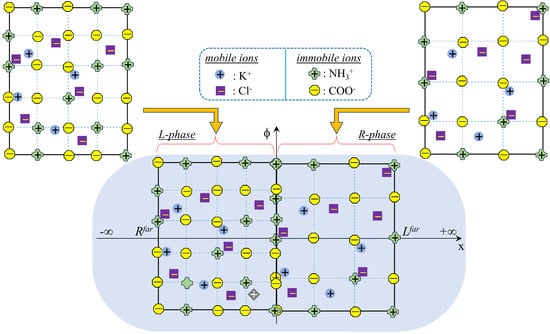
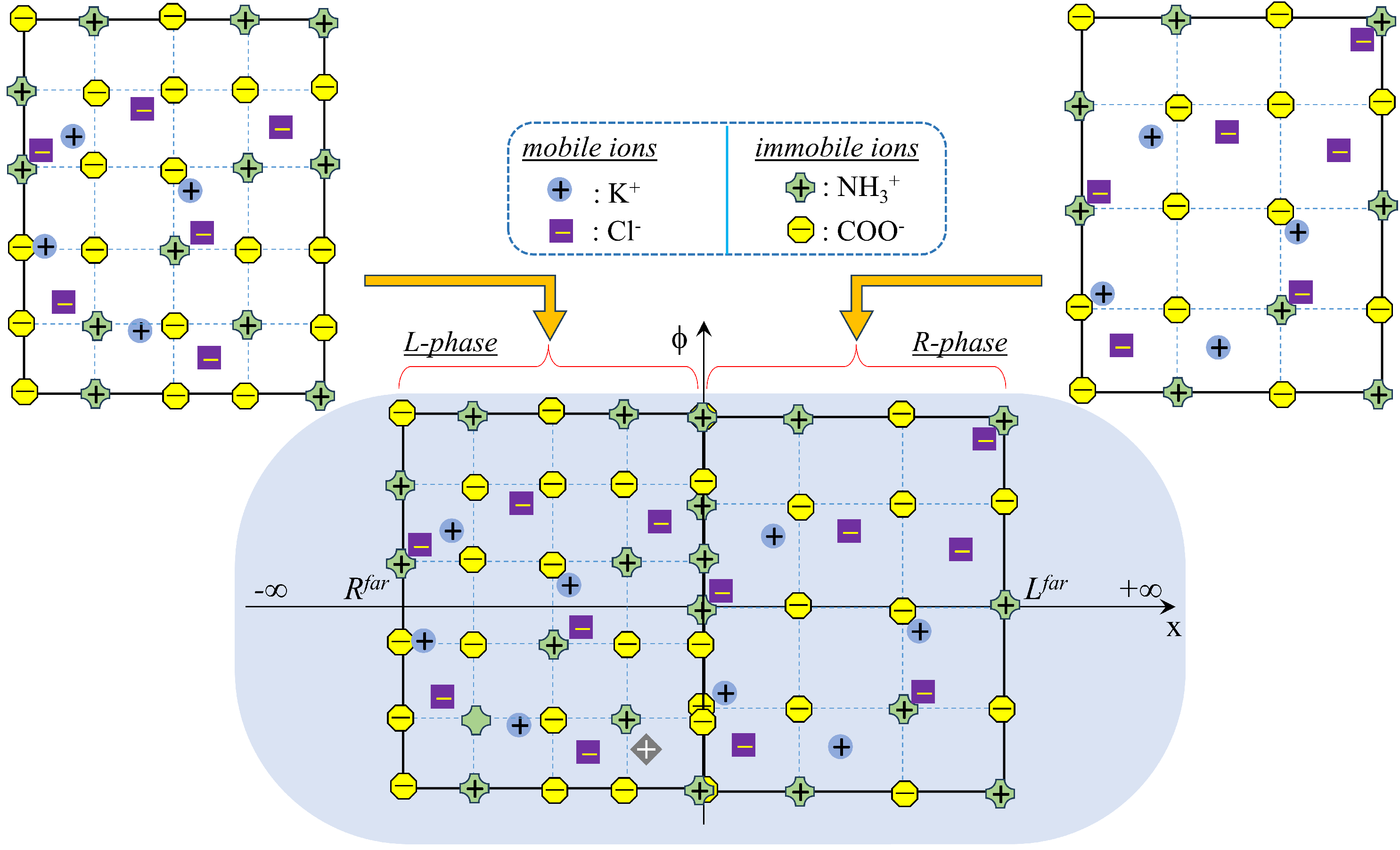
In this work, we theoretically consider an electrolytic solution system consisting of two distinct phases, as illustrated in Figure 1. Both the and contain mobile ions (, ) and immobile ions (, ). The concentration of each ion in the is distinct from that in the . These two phases are in contact with each other at the plane (the coordinate system is given in Figure 1). Mobile ions can move between the and .
Figure 1.
An electrolytic solution system of two distinct phases submerged in an electrolytic solution with a defined coordinate system.
One may wonder whether such an experimental system can be realized. Indeed, this is possible by using gelatin as the and , since gelatin contains a number of immobile positive and negative charges. For example, a high-concentration gelatin aqueous solution and a low-concentration gelatin solution are prepared. Both are solidified and equilibrated in an electrolytic solution. The two gelatin blocks are then brought into contact with each other in the same bathing solution. This corresponds to the situation shown in Figure 1.
2.2. Ion and Charge Distribution
The association–dissociation (adsorption–desorption) between cations and anions is formulated in this section.
Anions can associate with cations. For example, the immobile group can associate with , as expressed by Equation (2). Given that represents the binding constant, Equation (3) is obtained:
can associate with two kinds of cations . Hence, the general expression for the reaction formula, Equation (4), is obtained, where is an immobile cation while is mobile. The binding constant for Equation (4) is expressed as , which is given by Equation (5):
Note.
When associates with , Equation (6) holds.
The binding constant is given by Equation (7). Since the expression “” is somewhat lengthy, we employ the notation “” in its place. That is, the subscript “NH3” of “” is replaced with the subscript “N” by the definition “”.
Immobile can associate with the anions . Hence, Equation (9) is obtained. The binding constant for Equation (9) is denoted , which is given by Equation (10).
Note.
When associates with Equation (11) holds.
The binding constant is given by Equation (12). Since the expression “” is somewhat lengthy, we employ the notation “” in its place. That is, the subscript “COO” of “” is replaced with the subscript “C” by the definition “”.
Note that Equations (6) and (11) are identical. Therefore, Equation (7) = Equation (12), and Equation (14) is derived.
The total concentration of in represented by is given by Equation (15). The total concentration of in represented by is given by Equation (16).
2.3. Free Energy and the Potential Formulas Based on the AIH
In this section, the potential formula in the absence of a membrane and in the presence of spatially fixed immobile charges that act as adsorption sites for mobile ions is derived from a free energy evaluation grounded in the AIH concept.
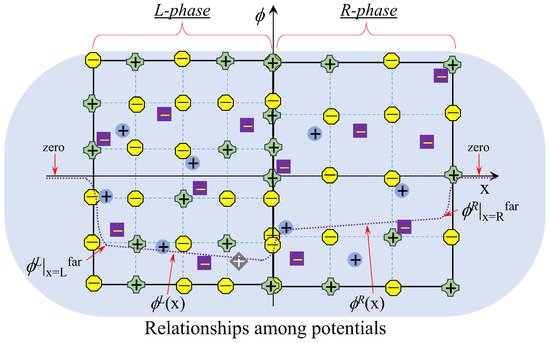
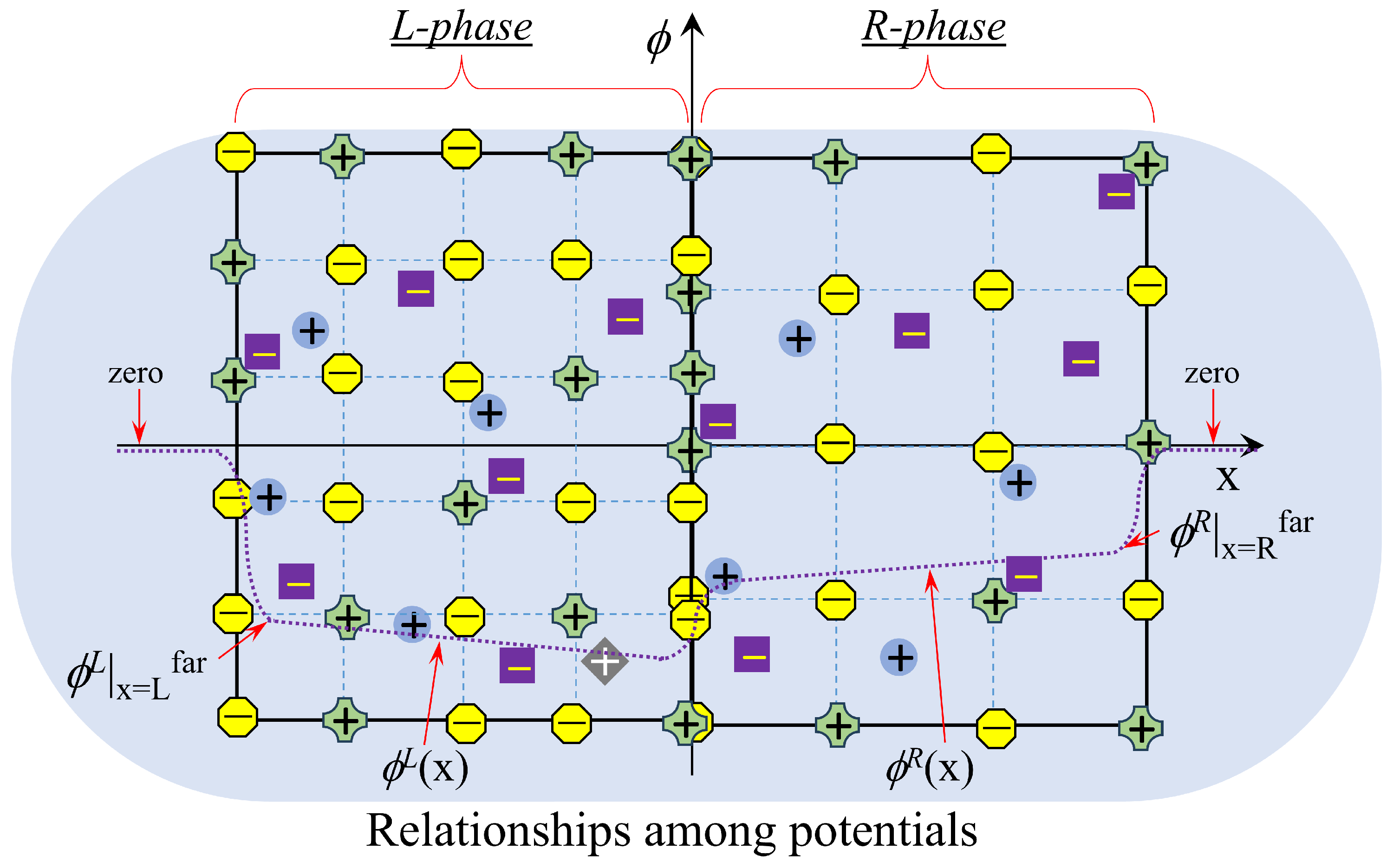
Free energy of the whole system (Figure 2) is given by Equation (17) consisting of electric, entropic and ion adsorption contributions which are represented by , and , respectively [38,39,40,41].
Figure 2.
Definitions of potentials (dotted line represents the expected potential profile.) and represent the potential at the arbitrary point in L-phase and R-phase, respectively. and represent the bulk phase potentials of L-phase and R-phase, respectively whereas they do not represent the bathing solution potential. The bathing solution potential is defined as zero.
The potential of the bathing solution phase is assumed to be constant zero everywhere. Hence, in the bathing solution phase, and Equation (18) is transformed into Equation (19).
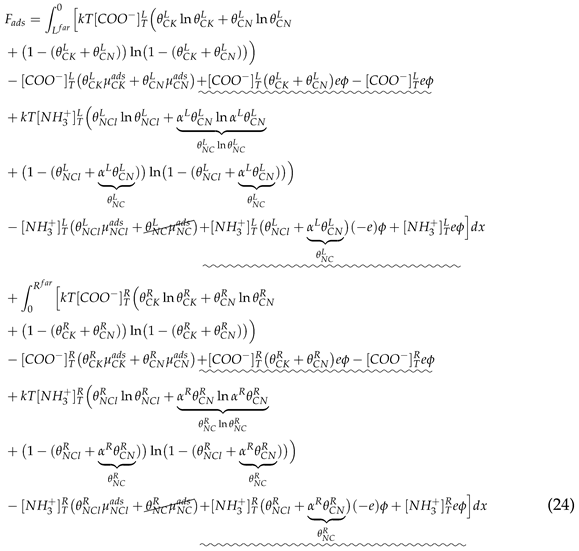
Ion adsorption contribution, , is given by Equation (24) under the definitions of Equations (20) and (21) and the conditions of Equations (22) and (23), where represents the binding energy between and , while represents the binding energy between and . e and represent the elementary charge and potential, respectively [39].
There is a constraint as given below.
Therefore, Equation (23) is derived.
Here, is eliminated using Equation (23), so that does not contain , as given in Equation (24). and are omitted to prevent double-counting of these terms. These terms are already included as and , respectively, in this equation. The terms marked with wavy underlines in Equation (24) are electrical terms. Hence, such -dependent electrical terms should, in principle, be included in and treated within . However, doing so would make the expression for the -dependent electrical terms considerably more complicated and would furthermore make the subsequent discussion much more complex. Therefore, the -dependent electrical contribution in is neglected. Instead, these -dependent electrical terms are treated explicitly within as the terms marked with wavy underlines in Equation (24).
Equation (16) is arranged into Equation (26).
The entropic contribution, , is given by Equation (31) [39,41]. Here, represents the individual ion concentration at a given point x within the system, and represents the ion concentration in the bathing solution. It is assumed that the ion concentration in the bathing solution is constant everywhere. Hence, Equation (31) can be approximated by Equation (32).
given by Equation (32) is a function of , and should be expressed in terms of as expressed by Equation (33) using Equations (27) and (30).
It is necessary to solve Equation (35), where the definition of (Equation (17)) is explicitly provided by Equation (34) for completeness:
Solving these coupled equations rigorously is mathematically intractable. We therefore introduce a simplifying assumption motivated by the AIH framework. Under conditions in which ion adsorption is nearly saturated, () varies negligibly with the bulk ion concentration . This approximation may appear bold at first glance, but it reflects phenomena observed in real systems. For instance, one of the authors of this paper, H.T., previously observed that the degree of adsorption onto an surface remained nearly constant regardless of the concentration when the was submerged in a aqueous solution [42]. According to the AIH, water in living cells is highly structured, and its activity is significantly reduced [2,3,4,43,44,45,46]; consequently, from a thermodynamic perspective, mobile ions preferentially remain in the adsorbed rather than the free state. One may wonder why a constant degree of ion adsorption, corresponding to a constant surface charge density, can still produce different membrane potentials. The reason is that the electric potential is determined not only by the surface charge density itself but also by the screening effect of mobile ions in the surrounding solution. As the concentration of mobile ions changes, the effectiveness of electrostatic screening changes accordingly. Therefore, the potential associated with the same surface charge density can vary with the mobile ion concentration.
Under this near-saturation regime, the entropic contribution to the variation of with respect to and becomes negligible compared with the adsorption and electrical contributions. We therefore adopt the approximation given by Equation (38). We emphasize, however, that Equation (38) is not claimed to be universally valid. The “near-saturation” regime considered here is defined by the conditions and . As noted earlier, one of the authors (H.T.) has previously obtained experimental data indicating that the degree of ion adsorption onto immobile adsorption sites is virtually insensitive to the bulk concentration of the corresponding ion in the free state [42,47]. Since is a function of , Equations (36) and (37) are satisfied within this near-saturation regime; they are not claimed to hold outside it. In this respect, the present approximation is analogous to the GHK equation itself, which, as discussed in Section 1.1, is also known not to apply universally.
Equations (36) and (37) can be expressed equivalently via the chain rule, since depends on only through defined in Equations (27) and (30):
The remaining adsorption variable is treated as a free parameter, constrained by the binding equilibrium between and via Equation (23).
Owing to Equations (39) and (40), Equations (36) and (37) reduce to the simple forms of Equations (41) and (42), respectively.
The potential generated between and is given by Equation (43) from Equation (41) or by Equation (45) from Equation (42).
Of course Equation (47) holds.
Equation (43) can be transformed into Equations (48) and (49). Quite intriguingly, Equation (49) is identical to the Nernst equation broadly used especially in electrochemistry research [7,48].

Similarly, Equation (45) can be transformed into Equations (50) and (51), and Equation (51) is also identical to the Nernst equation [7,48].

The membrane theory states that transmembrane ion transport is responsible for membrane potential generation [1,2,3,4,5]. The GHK equation is a formula for membrane potential that ingeniously incorporates the characteristics of transmembrane ion transport into the equation through the permeability coefficient represented by (see Equation (1)) [2,4,6,7,8,9,10]. The Nernst equation is well known as the formula for electrochemical potential in electrochemical studies [7,48], but it is also known as a simplified form of the GHK equation. For example, if in Equation (1) is by far greater than and , the GHK equation is reduced to the potential formula given by Equation (52), which is the Nernst equation. Therefore, the Nernst equation is regarded as a simplified expression of the GHK equation in physiology. More importantly, the underlying principle of the GHK equation, including the Nernst equation, is that membrane potential generation is caused by transmembrane ion transport.
However, both Equations (49) and (51), which are identical to the Nernst equation, can also be derived in a system in which no membranes are present. Therefore, we can draw an important conclusion: the Goldman–Hodgkin–Katz equation, including the Nernst equation, can be derived without incorporating the effect of transmembrane ion transport. This is consistent with a fundamental idea suggested by the Association–Induction Hypothesis (AIH) [2,3,4], which states that membrane potential is generated by a heterogeneous charge distribution arising from the adsorption of mobile ions onto ion adsorption sites, leading to charge separation, and that transmembrane ion transport is not involved in the generation of membrane potential.
2.4. Deriving a Potential Formula Identical to the GHK Equation
We would like to show that the potential formula identical to the Goldman–Hodgkin–Katz equation is derivable even for the system in the absence of membranes.
of Equation (48) and of Equation (50) (see Equation (53)) are equal to each other according to Equation (47).

From Equation (55), Equations (56) and (57) are derived.
of Equation (48) can be transformed into Equation (58). Equation (58) can be further transformed into Equation (59) using Equations (56) and (57).

Equation (59) is identical to the Goldman–Hodgkin–Katz equation, not only to the Nernst equation, although the system under consideration contains no membrane. Therefore, the conventional notion of membrane potential generation (the membrane theory) must be incorrect, or at least requires revision. We suggest that the Association–Induction Hypothesis is the most promising candidate to revise or replace the membrane theory.
2.5. What Governs the Electrical Characteristics of the Membrane Potential?
Why is the Goldman–Hodgkin–Katz equation, including the Nernst equation, derived even though no membrane is present in the system under consideration? We focus on the potential formula Equation (49), which is identical to the Nernst equation. This equation can be transformed into Equation (60). Equation (60) indicates that K+ is distributed according to the Boltzmann distribution [30,49]. The same is true for Equation (51), from which Equation (61) is derived. Therefore, the Goldman–Hodgkin–Katz equation (including the Nernst equation) is merely a natural consequence of the Boltzmann distribution of mobile ions. In other words, it is simply another expression of the Boltzmann distribution. Accordingly, the GHK equation (and the Nernst equation) has worked well in physiology as long as the distribution of mobile ions obeys the Boltzmann distribution. Consequently, the fact that the GHK equation works well does not necessarily validate the conventional membrane theory, such as the idea that transmembrane ion transport is responsible for the generation of membrane potential.
3. Experimental Confirmation
Since the potential formula (Equation (43) or Equation (45)) is derived theoretically, the experimental system shown in Figure 2 is expected to exhibit a non-zero potential under certain conditions, even in the absence of a membrane. Therefore, we conducted potential measurements as described below to verify this prediction.
3.1. Experimental Procedure
3.1.1. Specimen Preparation
- Gelatin block: Two distinct types of gelatin blocks were prepared. Gelatin powder was dissolved in deionized hot water at a weight ratio of 2:8. This mixture was poured into a mold and allowed to set in a refrigerator. Another gelatin block was prepared in a similar manner at a weight ratio of 4:6. The former one is a 20 wt% gelatin and the latter one is a 40 wt% one. They are denoted by G20 and G40, respectively.
- Ionic solution: 0.01 M KCl and 0.01 M NaCl solutions were prepared by dissolving KCl and NaCl powders, respectively, in deionized water.
- Gelatin blocks in solution: Small pieces of G20 and G40 were immersed in 0.01 M KCl and 0.01 M NaCl solutions. The specimen preparation procedure is described below, using a G20 piece in the 0.01 M KCl solution as a representative example. A small piece of G20 was placed in the 0.01 M KCl solution and left overnight. The bathing solution was then replaced with a freshly prepared 0.01 M KCl solution, and the specimen was left overnight again. This solution exchange process was repeated for five consecutive days. As a result, the G20 specimen equilibrated with the 0.01 M KCl solution was obtained and is denoted as “G20K.” In the same manner, another G20 piece was equilibrated with 0.01 M NaCl to obtain “G20Na.” The G40K and G40Na specimens were prepared following the same protocol.
Throughout this preparation process, the volume of the gelatin specimens changed from their original values; however, this change was not significant.
3.1.2. Potential Measurement
Two pieces of G20K were positioned to reproduce the arrangement illustrated in Figure 2, where they were surrounded by their bathing solution. This system is denoted as G20K−G20K (= “”-“” of Figure 2). For instance, a system composed of G20Na and G40Na is denoted as G20Na−G40Na. In this study, a total of six experimental systems were prepared: G20K−G20K, G20K−G40K, G40K−G40K, G20Na−G20Na, G20Na−G40Na, and G40Na−G40Na.
The electrical potential between the left and right gelatin blocks (e.g., in the G20K−G20K system) was measured using a potentiostat (HSV-110, Hokuto Denko, Tokyo). A pair of Ag/AgCl electrodes was connected to the HSV-110; one electrode was inserted into the right block, while the other was inserted into the left block. The potential detected by the electrode in the right block was defined as the reference (0 mV).
3.2. Experimental Potential Behavior
The experimentally measured potential outcomes are summarized in Table 1. We would like to explain here again the meaning of the notations to ensure the readers of this paper can understand the experimental conditions well. G20K represents the 20 wt% gelatin piece equilibrated in 0.01 M KCl solution, while G40K represents the 40 wt% gelatin piece equilibrated in 0.01 M KCl solution. Similarly, G20Na represents the 20 wt% gelatin piece equilibrated in 0.01 M NaCl solution, while G40Na represents the 40 wt% gelatin piece equilibrated in 0.01 M NaCl solution.
Table 1.
Experimentally measured potential †.
Although most measured potentials appeared virtually zero, we found that G20K−G40K and G20Na−G40Na systems exhibited non-zero potentials through repetitive measurements, while the remaining systems showed negligible potentials. The only difference between G20K and G40K is the gelatin concentration; specifically, the density of their ion adsorption sites ( and ) differs by 20%. The same applies to the relationship between G20Na and G40Na. These results demonstrate that a physical membrane is not essential for the generation of a nonzero “membrane potential,” given that no membrane was employed in our experimental setup. Now, it is possible to forcibly apply the conventional GHK equation to this system despite the absence of a membrane. For example, when the system “G20K-G40K” is employed, the theoretically expected potential is given by Equation (62) where represents the membrane permeability to and and represents the concentration of i of the gelatin j . However, this equation lacks physiological significance because the GHK equation is applicable only to membrane systems.
It should be clarified that we do not claim that the plasma membrane has no influence on the membrane potential. Rather, we emphasize that selective transmembrane ion transport is not the fundamental requirement for membrane potential generation; instead, ion adsorption plays the primary role.
Therefore, while a plasma membrane containing a non-negligible number of ion adsorption sites would indeed contribute to potential generation, this contribution arises from ion adsorption rather than transmembrane ion transport. Namely, an electrically discontinuous structure emerges at the interface between two distinct gelatin phases. The electrical characteristics of such an interface are sensitive to the surrounding electrolyte conditions because of the adsorption of mobile ions. Therefore, a membrane potential that depends on the ion concentration is expected to be generated even in the absence of a membrane.
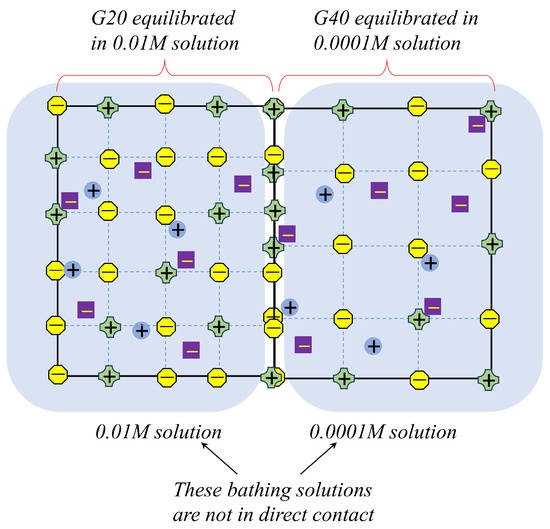
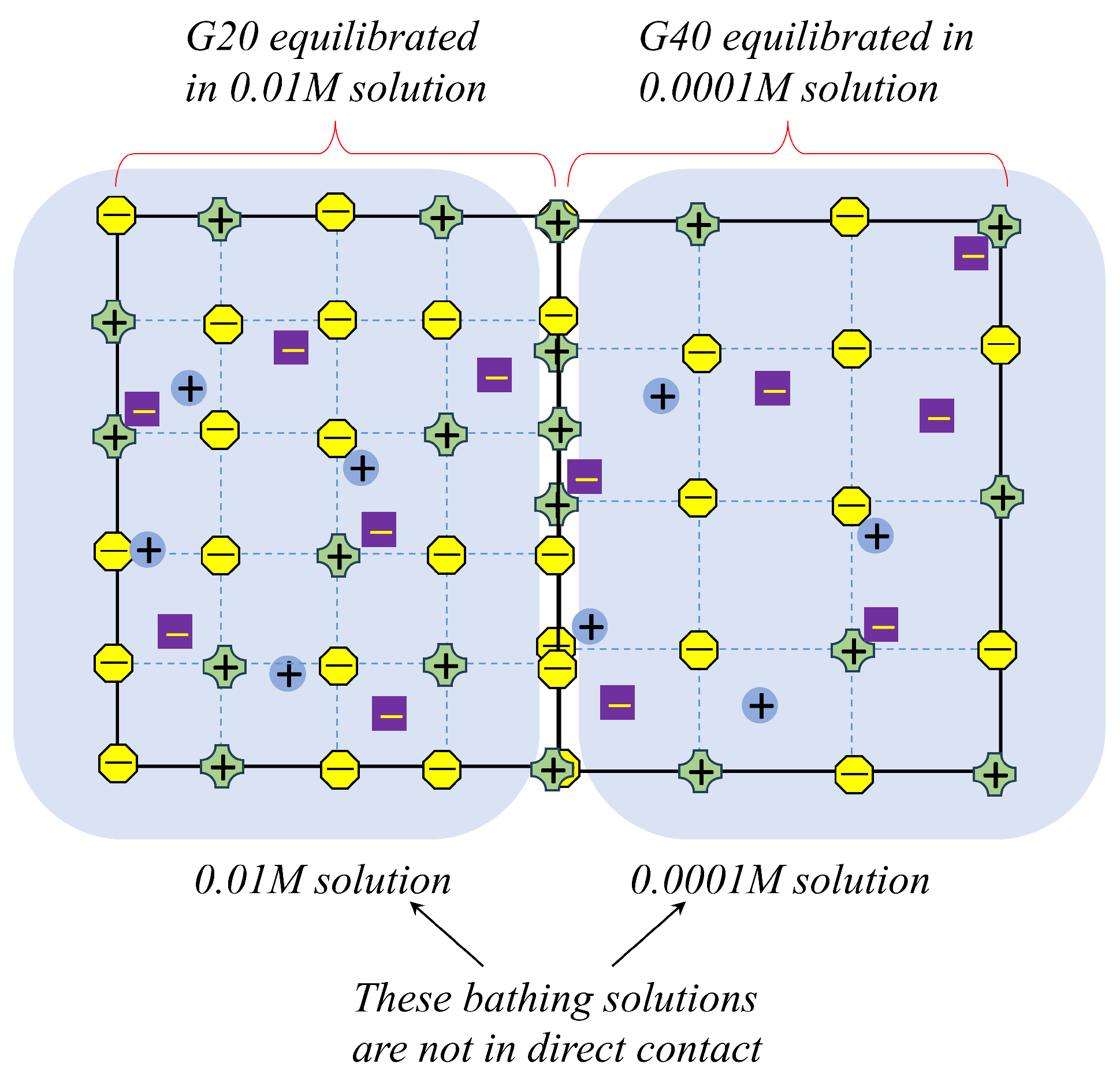
One might argue that the absolute potential values for G20K−G40K and G20Na−G40Na remain small, potentially questioning the reliability of our discussion. However, we found that modifying the electrolytic conditions in our experimental system enhanced the magnitude of the potential. For example, we measured the potential between a G20 block equilibrated in 0.01 M NaCl and a G40 block equilibrated in 0.0001 M NaCl placed in direct contact, as illustrated in Figure 3, while their bathing solutions were not in direct contact. The resulting potential was 17.0 ± 1.6 mV; similar enhancements were observed under other electrolytic conditions, and it is summarized in Table 2. It might still be argued that such a system is not in a state of true equilibrium due to the pre-existing ion concentration gradient between the two gelatin blocks. Nevertheless, the conventional membrane theory fails to explain why a non-zero potential is generated between two gelatin blocks in the total absence of a membrane. But the ion adsorption mechanism can explain it.
Figure 3.
A G20 block equilibrated in 0.01 M NaCl and a G40 block equilibrated in 0.0001 M NaCl are in direct contact, while their bathing solutions are not in direct contact.
Table 2.
Potential between gelatin blocks exposed to different KCl (or NaCl) concentrations †,‡.
It may be natural to wonder what would happen if the ion adsorption sites were eliminated in exactly the same system, with only the ion adsorption sites being removed. We have previously investigated this issue [50]. We prepared an impermeable polypropylene (PP) film with only one surface coated with silver, where the silver could serve as an adsorption site for . Two KCl solutions of different concentrations were separated by this PP film, and the potential difference between the two KCl solutions across the film was measured. We observed that the potential varied in accordance with the concentration of the KCl solution in contact with the silver-coated surface of the PP film, whereas the potential was insensitive to the concentration of the KCl solution in contact with the non-silver-coated PP surface. This result was interpreted as indicating that ion adsorption governs membrane-potential behavior. We also conducted the same experiment using a permeable PP film whose both surfaces were coated with silver. Because this PP film was permeable, the conventional GHK equation predicted a zero potential for this system; however, the measured potential was nonzero. Furthermore, the potential was found to be sensitive to the concentrations of both KCl solutions. This behavior must be attributed to the silver coatings on both surfaces of the PP film.
The discussion presented thus far strongly suggests that ion adsorption, rather than transmembrane ion transport, plays the principal role in membrane potential generation.
4. Comparison of the AIH with the Conventional Ion Transport Mechanism
4.1. On Ion Channels, Pumps, and the Contribution of the Plasma Membrane
A natural reaction from physiologists trained in the conventional membrane-theory tradition is to point to the wealth of experimental evidence in favour of ion channels and pumps—ouabain inhibition of the Na+/K+-ATPase, single-channel patch-clamp recordings, transmembrane current measurements, and so forth. Within the conventional physiological framework, ion channels and pumps are best understood as part of the cellular machinery that maintains, in the long term, the spatial distribution of bound and free ions. The observations are real, reproducible, and not in dispute; however, their scientific interpretation remains open to discussion. Within the AIH framework, one particularly thought-provoking finding is the report by Sachs and Qin [43,51]. They reported that electrical signals obtained by the patch-clamp technique should be interpreted with caution, since replacing the membrane patch with a synthetic rubber still produces discrete current signals that are indistinguishable from those obtained from a biological membrane patch.
Ouabain is believed to inhibit the pumping activity of living cells [2,43,52]. According to the conventional view, the application of ouabain to a living cell should therefore lead to the loss of the ion concentration disparity between the cell interior and exterior. However, Ling experimentally demonstrated that this disparity can be maintained even in the absence of an intact plasma membrane [2,53,54]. The precise role of channel and pump activity in membrane potential generation thus remains an open question.
4.2. Classical Thermodynamic View of the AIH Applied to Cellular Electrical Characteristics
The conventional view of the electrical characteristics of living cells is that they are governed primarily by the plasma membrane and the functional molecules embedded within it, such as ion channels and pumps. However, our theoretical work based on the AIH, together with well-established principles of classical thermodynamics, can derive potential formulas that are identical to the Nernst equation and the GHK equation. It is therefore reasonable to argue that the foundation of these potential formulas lies in the Boltzmann distribution of ions and the law of mass action (or, more specifically, ion adsorption–desorption) [30,31]. Similar analyses of the electrical characteristics of electrolyte solutions are widely employed, particularly in colloid chemistry. In colloid chemistry, the electrical properties of solutions are described using thermodynamic concepts such as the Boltzmann distribution of ions, the law of mass action, the Langmuir isotherm, and related principles. Such theoretical treatments are by no means uncommon. In fact, colloid chemistry has proven to be a highly effective tool for investigating living cells [55,56]. Given this background, one may ask whether it is truly necessary to employ channels and pumps to explain the electrical characteristics of living cells. Alternatively, it may be more straightforward to regard the cell as an inanimate physicochemical system governed by fundamental thermodynamic principles.
5. Conclusions
5.1. Validity of AIH
In this study, we have presented a comprehensive theoretical derivation of the membrane potential based on the Association-Induction Hypothesis (AIH). By applying the variational principle to the total free energy of the system—comprising ion mixing entropy, electrostatic energy, and adsorption energy—we successfully derived a generalized formula for membrane potential. This approach demonstrates that the fundamental mechanism underlying biological potential generation is not the non-equilibrium steady-state flux of ions through transmembrane channels, but rather the thermodynamic equilibrium distribution of ions governed by the Boltzmann distribution. [Note: Although a perfectly defined thermodynamic equilibrium condition may not be practically achievable, we consider that the gelatin-block system used in our experiments is very close to equilibrium because of its high viscosity. The extremely slow diffusion within the gelatin matrix suggests that the ionic distribution remains essentially unchanged over the experimental time scale. Therefore, the system can reasonably be regarded as being in a near-equilibrium (or quasi-steady-state) condition during the measurements.]
Our derivation provides several critical insights that challenge the prevailing membrane theory. First, it explicitly shows that membrane potential can be generated even in the absence of a physical plasma membrane, provided that fixed charge sites and specific ion adsorption are present. This shifts the focus from “membrane permeability” to “adsorption affinity” onto cell constituents such as carboxyl () and amino () groups. Second, the resulting model naturally incorporates the fixed charge density and the ion-specific adsorption constants, offering a unified physical explanation for phenomena that the Goldman–Hodgkin–Katz (GHK) equation fails to address.
Furthermore, the variational approach highlights the inherent coupling between the chemical potential of mobile ions and the energetic state of adsorption sites. Our theoretical results suggest that the AIH framework offers a more robust and physically grounded description of cellular electrophysiology. In conclusion, the membrane potential should be recognized as a manifestation of a microscopic equilibrium state determined by the minimization of total free energy. This consequence encourages a re-evaluation of how we understand ion-protein interactions and the energetic stability of living cells.
5.2. Further Physiological Challenges and Extension to Other Fields
Of course, we have not yet reached a complete theoretical description of the characteristics of membrane potentials. Although we intentionally focused on a membraneless system in the present study in order to clarify the origin of membrane potentials, our theory should be further refined by taking into account both the existence of membranes and changes in ionic activity that may arise from the formation of structured water [2,3,4,43,44,45,46]. Simplifying biological systems to extract the fundamental characteristics of living cells is an appropriate strategy; however, excessive simplification may lead to misleading interpretations. From an electrophysiological perspective, it is necessary to achieve a unified framework that integrates physiology and thermodynamics [2,3,4,55,56,57].
The present work may also lead to important engineering applications, just as previous electrophysiological studies have contributed significantly to the development of fundamental scientific fields such as nonlinear neuroscience and dynamical systems theory [6,58,59,60]. Although the fundamental principles underlying neural activity remain controversial from our perspective and from that of a limited number of research groups [2,3,4,16,18,44,45,46,55,56,57], physiologically motivated theoretical studies of this kind may nevertheless prove useful even for engineering applications, for example, membrane-based separation technologies as described below.
Industrial wastewater cannot be discharged directly into rivers or oceans without appropriate treatment. Contaminants must be removed before disposal. Consequently, water purification using membrane-based separation processes is an important technology. In membrane filtration systems, structural properties such as pore size are critical, while the adsorption characteristics of the membrane material also play an important role. These properties have been extensively investigated and reported in the literature [61,62,63,64]. We believe that incorporating insights from the AIH framework, particularly regarding adsorption phenomena and the formation of structured water, could contribute to further advances in membrane-based water purification technologies. This represents a unification of basic science and applied engineering, analogous to the unification of physiology and thermodynamics discussed above.
Author Contributions
Conceptualization, H.T.; methodology, H.T.; validation, H.T., I.K. and B.D.; investigation, H.T. and B.D.; writing—original draft preparation, H.T.; writing—review and editing, H.T., I.K. and B.D. All authors have read and agreed to the published version of the manuscript.
Funding
This research received no external funding.
Data Availability Statement
The data of this study are available from the corresponding author upon request.
Conflicts of Interest
Author Iori Kojima is employed by company Nagoya Railroad Co., Ltd. (Japan). The remaining authors declare that the research was conducted in the absence of any commercial or financial relationships that could be construed as a potential conflict of interest.
Nomenclature
| binding (association) constants between C and i and between N and j | |
| Subscript C and N represent and , respectively. | |
| Subscript i = (K, N (= )) and j = (, C (= )) | |
| superscript denoting the left or right phase | |
| total concentration of immobile anionic/cationic groups | |
| fraction of sites occupied by cation in phase k | |
| fraction of sites occupied by anion in k-phase | |
| ratio (Equation (23)) | |
| x | spatial coordinate; the L-R interface is at |
| , | electric potential; phase-averaged potential of phase k |
| total, electrostatic, adsorption, and entropic free energies | |
| , | vacuum permittivity, relative permittivity of water |
| k | Boltzmann constant |
| T | absolute temperature |
| e | elementary charge |
| binding free energy for adsorption pair ℓ | |
| local concentration of mobile cation in phase k () | |
| , | potential difference expressed using and , respectively |
References
- Gutmann, F.; Keyzer, H. (Eds.) Modern Bioelectrochemistry; Plenum Press: New York, NY, USA, 1986. [Google Scholar]
- Ling, G.N. A Revolution in the Physiology of the Living Cell; Krieger Pub Co: Malabar, FL, USA, 1992. [Google Scholar]
- Ling, G.N. Debunking the alleged resurrection of the sodium pump hypothesis. Physiol. Chem. Phys. Med. NMR 1997, 29, 123–198. [Google Scholar] [CrossRef] [Scilit] [PubMed]
- Ling, G.N. Life at the Cell and Below-Cell Level: The Hidden History of a Fundamental Revolution in Biology; Pacific Press: New York, NY, USA, 2001. [Google Scholar]
- Schwiening, C.J. A brief historical perspective: Hodgkin and Huxley. J. Physiol. 2012, 590, 2571–2575. [Google Scholar] [CrossRef] [Scilit]
- Cronin, J. Mathematical Aspects of Hodgkin-Huxley Neural Theory; Cambridge University Press: New York, NY, USA, 1987. [Google Scholar]
- Koryta, J.; Dvorak, W.; Kavan, L. Principles of Electrochemistry Second Edition; Wiley: New York, NY, USA, 1993. [Google Scholar]
- Keener, J.; Sneyd, J. Mathematical Physiology: I: Cellular Physiology (Interdisciplinary Applied Mathematics); Springer: Berlin/Heidelberg, Germany, 2008. [Google Scholar]
- Jackson, M.B. Molecular and Cellular Biophysics; Cambridge University Press: Cambridge, UK, 2006. [Google Scholar]
- Ermentrout, G.B.; Terman, D.H. Mathematical Foundations of Neuroscience (Interdisciplinary Applied Mathematics Book 35); Springer: New York, NY, USA, 2010. [Google Scholar]
- Ohki, S.; Aono, O. Membrane Potential of Squid Axons: Effect of Internal and External Ion Concentration. Jpn. J. Physiol. 1979, 29, 373–382. [Google Scholar] [CrossRef] [Scilit] [PubMed]
- Chang, D. Dependence of cellular potential on ionic concentrations. Data supporting a modification of the constant field equation. Biophys. J. 1983, 43, 149–156. [Google Scholar] [CrossRef] [Scilit] [PubMed]
- Cope, F.W. Solid state physical replacement of hodgkin-huxley theory. Phase transformation kinetics of axonal potassium conductance. Physiol. Chem. Phys. 1977, 9, 155–160. [Google Scholar] [PubMed]
- Edelmann, L. Doubts about the sodium-potassium pump are not permissible in modern bioscience. Cell. Mol. Biol. 2005, 51, 725–729. [Google Scholar] [CrossRef]
- Matveev, V. Comparison of fundamental physical properties of the model cells (protocells) and the living cells reveals the need in protophysiology. Int. J. Astrobiol. 2017, 16, 97–104. [Google Scholar] [CrossRef] [Scilit]
- Jaeken, L. The neglected functions of intrinsically disordered proteins and the origin of life. Prog. Biophys. Mol. Biol. 2017, 126, 31–46. [Google Scholar] [CrossRef] [Scilit] [PubMed]
- Tamagawa, H.; Delalande, B. Early confirmative work of the Association-Induction Hypothesis. Mod. Concepts Mater. Sci. 2024, 5, 1–10. [Google Scholar] [CrossRef] [Scilit]
- Funk, R.H.; Scholkmann, F. The significanceof bioelectricity on all levels of organization of an organism. Part 1: From the subcellular level to cells. Prog. Biophys. Mol. Biol. 2023, 177, 185–201. [Google Scholar] [CrossRef] [Scilit] [PubMed]
- Hughes, M.P. The cellular zeta potential: Cell electrophysiology beyondthe membrane. Integr. Biol. 2024, 16, zyae003. [Google Scholar] [CrossRef] [Scilit]
- Green, Y. The Goldman-Hodgkins-Katz Equation, Reverse-Electrodialysis, and Everything in Between. arXiv 2025, arXiv:2411.03342. [Google Scholar]
- Green, Y. Goldman-Hodgkin-Katz equation, reverse electrodialysis, and everything in between. J. Phys. Rev. E 2025, 111, 064408. [Google Scholar] [CrossRef] [Scilit] [PubMed]
- Green, Y. Universal Model for Ion Transport: Bridging The Goldman-Hodgkin-Katz Paradigm with Reverse Electrodialysis. Phys. Rev. Lett. 2025, 134, 228401. [Google Scholar] [CrossRef] [Scilit] [PubMed]
- Mauro, A. Space charge regions in fixed charge membranes and the associated property of capacitance. Biophys. J. 1962, 2, 179–198. [Google Scholar] [CrossRef] [Scilit] [PubMed]
- Alvarez, O.; Latorre, R. The enduring legacy of the “constant-field equation” in membrane ion transport. J. Gen. Physiol. 2017, 149, 919–920. [Google Scholar] [CrossRef] [Scilit] [PubMed]
- Manoj, K.M. Aerobic Respiration: Criticism of the Proton-centric Explanation Involving Rotary Adenosine Triphosphate Synthesis, Chemiosmosis Principle, Proton Pumps and Electron Transport Chain. Biochem. Insights 2018, 11, 1178626418818442. [Google Scholar] [CrossRef] [Scilit] [PubMed]
- Manoj, K.M. Murburn concept: A paradigm shift in cellular metabolism and physiology. BioMol. Concepts 2020, 11, 7–22. [Google Scholar] [CrossRef] [Scilit] [PubMed]
- Manoj, K.M.; Gideon, D.A.; Jaeken, L. Interaction of membrane-embedded cytochrome b-complexes with quinols: Classical Q-cycle and murburn model. Cell Biochem. Funct. 2022, 40, 118–126. [Google Scholar] [CrossRef] [Scilit] [PubMed]
- Manoj, K.M.; Tamagawa, H.; Bazhin, N.; Jaeken, L.; Nirusimhan, V.; Faraci, F.; Gideon, D.A. Murburn model of vision: Precepts and proof of concept. J. Cell. Physiol. 2022, 237, 3338–3355. [Google Scholar] [CrossRef] [Scilit] [PubMed]
- Manoj, K.M.; Jaeken, L. Synthesis of theories on cellular powering, coherence, homeostasis and electro-mechanics: Murburn concept and evolutionary perspectives. J. Cell. Physiol. 2023, 238, 931–953. [Google Scholar] [CrossRef] [Scilit] [PubMed]
- Lewis, G.N.; Randall, M. Thermodynamics; McGraw-Hill series in advanced chemistry; McGraw-Hill Inc.: New York, NY, USA, 1961. [Google Scholar]
- Barrow, G.M. Physical Chemistry; McGraw-Hill Inc.: New York, NY, USA, 1979. [Google Scholar]
- Benarroch, J.M.; Asally, M. The Microbiologist’s Guide to Membrane Potential Dynamics. Trends Microbiol. 2019, 28, 304–314. [Google Scholar] [CrossRef] [Scilit] [PubMed]
- Mostafa, H.I.; Tóth-Boconádi, R.; Dér, L.; Fábián, L.; Taneva, S.G.; Dér, A.; Keszthelyi, L. Nonlinear electric response of the diffuse double layer to an abrupt charge displacement inside a biological membrane. Bioelectrochemistry 2022, 146, 108138. [Google Scholar] [CrossRef] [Scilit] [PubMed]
- Tamagawa, H.; Anh, D.L.; Sasaki, M.; Lin, W.; Delalande, B. Nernst slope and the constant surface charge density behind the ion adsorption-origin membrane potential. Chem. Phys. 2025, 588, 112462. [Google Scholar] [CrossRef] [Scilit]
- Tamagawa, H.; Kojima, I.; Duong, A.L.; Delalande, B. Is There No Need to Consider the Influence of Ion Adsorption and the Hofmeister Effect for the Precise Evaluation of Membrane Potential? Biophysica 2025, 5, 10. [Google Scholar] [CrossRef] [Scilit]
- Tamagawa, H.; Takami, K.; Duong, A.L.; Lin, W.; Sasaki, M.; Delalande, B. Occurrence of ion adsorption and the reduction of water activity are dismissed factors in the generation of membrane potential. Neuroscience 2025, 582, 203–222. [Google Scholar] [CrossRef] [Scilit] [PubMed]
- Duong, A.L.; Kaida, K.; Goto, K.; Kojima, I.; Delalande, B.; Tamagawa, H. The Nernst slope within the Association–Induction Hypothesis framework. Bioelectrochemistry 2026, 170, 109236. [Google Scholar] [CrossRef] [Scilit] [PubMed]
- Sharp, K.A.; Honig, B. Calculating Total Electrostatic Energies with the Nonlinear Poisson-Boltzmann Equation. J. Phys. Chem. 1990, 94, 7486–7692. [Google Scholar] [CrossRef] [Scilit]
- Lyklema, J. Fundamentals of Interface and Colloid Science; Academic Press: London, UK, 1995. [Google Scholar]
- Borukhov, I.; Andelman, D.; Orland, H. Steric Effects in Electrolytes: A Modified Poisson–Boltzmann Equation. arXiv 1998, arXiv:cond-mat/9803258. [Google Scholar]
- Harries, D.; Podgornik, R.; Parsegian, V.A.; Mar-Or, E.; Andelman, D. Ion Induced Lamellar-Lamellar Phase Transition in Charged Surfactant Systems. arXiv 2006, arXiv:cond-mat/0507244. [Google Scholar]
- Tamagawa, H. Mathematical expression of membrane potential based on Ling’s adsorption theory is approximately the same as the Goldman-Hodgkin-Katz equation. J. Biol. Phys. 2018, 45, 13–30. [Google Scholar] [CrossRef] [Scilit] [PubMed]
- Pollack, G.H. Cells, Gels and the Engines of Life: A New, Unifying Approach to Cell Function; Ebner & Sons: Seattle, WA, USA, 2001. [Google Scholar]
- Pollack, G.H. The Fourth Phase of Water: Beyond Solid, Liquid, and Vapor. Edgescience 2013, 16, 14–18. [Google Scholar]
- Pollack, G.H. The Fourth Phase of Water: Beyond Solid, Liquid, and Vapor; Ebner & Sons: Seattle, WA, USA, 2014. [Google Scholar]
- Pollack, G.H. Why Hydrogels Don’t Dribble Water. Gels 2017, 3, 43. [Google Scholar] [CrossRef] [Scilit] [PubMed]
- Tamagawa, H.; Ikeda, K. Another interpretation of Goldman-Hodgkin-Katz equation based on the Ling’s adsorption theory. Eur. Biophys. J. 2018, 47, 869–879. [Google Scholar] [CrossRef] [Scilit] [PubMed]
- Galembeck, F.; Burgo, T.A.L. Chemical Electrostatics New Ideas on Electrostatic Charging: Mechanisms and Consequences; Springer: New York, NY, USA, 2017. [Google Scholar]
- Devoe, H. Thermodynamics and Chemistry; Prentice-Hall, Inc.: Hoboken, NJ, USA, 2015. [Google Scholar]
- Tamagawa, H.; Sasaki, M.; Lin, W.; Delalande, B. Is the membrane permeability the primary property for the membrane potential generation? Mod. Concepts Mater. Sci. 2024, 6. [Google Scholar] [CrossRef] [Scilit]
- Sachs, F.; Qin, F. Gated, ion-selective channels observed with patch pipettes in the absence of membranes: Novel properties of a gigaseal. Biophys. J. 1993, 65, 1101–1107. [Google Scholar] [CrossRef] [Scilit] [PubMed]
- Ogawa, H.; Shinoda, T.; Cornelius, F.; Toyoshima, C. Crystal structure of the sodium-potassium pump (Na+,K+-ATPase) with bound potassium and ouabain. Proc. Natl. Acad. Sci. USA 2009, 106, 13742–13747. [Google Scholar] [CrossRef] [Scilit] [PubMed]
- Ling, G. How does ouabain control the levels of cell K+ AND Na+ by interference with a Na pump or by allosteric control of K+-N+ adsorption on cytoplasmic protein sites? Physiol. Chem. Phys. 1973, 5, 295–311. [Google Scholar] [PubMed]
- Ling, G. Maintenance of low sodium and high potassium levels in resting muscle cells. J. Physiol. 1978, 280, 105–123. [Google Scholar] [CrossRef] [Scilit] [PubMed]
- Bagatolli, L.A.; Stock, R.P. Stock, Lipids, membranes, colloids and cells: A long view. BBA-Biomembranes 2021, 1863, 183684. [Google Scholar] [CrossRef] [Scilit] [PubMed]
- Bagatolli, L.A.; Mangiarotti, A.; Stock, R.P. Stock, Cellular metabolism and colloids: Realistically linking physiology and biological physical chemistry. Prog. Biophys. Mol. Biol. 2021, 162, 79–88. [Google Scholar] [CrossRef] [Scilit] [PubMed]
- Schneider, M.F. Living systems approached from physical principles. Prog. Biophys. Mol. Biol. 2021, 162, 2–25. [Google Scholar] [CrossRef] [Scilit] [PubMed]
- Hirsch, M.W.; Smale, S.; Devaney, R.L. Differential Equations, Dynamical Systems, and an Introduction to Chaos; Elsevier Academic Press: Cambridge, MA, USA, 2004. [Google Scholar]
- Fröhlich, F.; Jezernik, S. Feedback control of Hodgkin–Huxleynerve cell dynamics. Control Eng. Pract. 2005, 13, 1195–1206. [Google Scholar] [CrossRef] [Scilit]
- Cano, G.; Dilao, R. Intermittency in the Hodgkin-Huxley model. J. Comput. Neurosci. 2017, 43, 115–125. [Google Scholar] [CrossRef] [Scilit] [PubMed]
- Onur, A.; Ng, A.; Batchelor, W.; Garnier, G. Multi-Layer Filters: Adsorption and Filtration Mechanisms for Improved Separation. Front. Chem. 2018, 6, 417. [Google Scholar] [CrossRef] [Scilit] [PubMed]
- Quinbo, W.; Qiuling, C. Application of membrane separation technology in water treatment process. IOP Conf. Ser. Earth Environ. Sci. 2020, 508, 12048. [Google Scholar] [CrossRef] [Scilit]
- Aziz, S.; Mazhar, A.R.; Ubaid, A.; Shah, S.M.H.; Riaz, Y.; Talha, T.; Jung, D. A comprehensive review of membrane-based water filtration techniques. Appl. Water Sci. 2024, 14, 169. [Google Scholar] [CrossRef] [Scilit]
- Xue, Q.; Lim, Y.J.; Wang, R. Chemically robust hollow fiber thin-film composite membranes based on polyurea selective layers for nanofiltration under extreme pH conditions. J. Membr. Sci. 2026, 738, 124818. [Google Scholar] [CrossRef] [Scilit]

Disclaimer/Publisher’s Note: The statements, opinions and data contained in all publications are solely those of the individual author(s) and contributor(s) and not of MDPI and/or the editor(s). MDPI and/or the editor(s) disclaim responsibility for any injury to people or property resulting from any ideas, methods, instructions or products referred to in the content. |
© 2026 by the authors. Licensee MDPI, Basel, Switzerland. This article is an open access article distributed under the terms and conditions of the Creative Commons Attribution (CC BY) license.