This is an early access version, the complete PDF, HTML, and XML versions will be available soon.
Article

Uniting Psychometric Modelling and Poisson Distributions: A Metrological Study of Elementary Counting


by
Leslie R. Pendrill
1,* and
William P. Fisher, Jr., Jr.
2,3
1
RISE, Research Institutes of Sweden, Division Measurement Science and Technology, 412 58 Gothenburg, Sweden
2
Living Capital Metrics LLC, Sausalito, CA 94965, USA
3
BEAR Center, Berkeley School of Education, University of California, Berkeley, CA 94965, USA
*
Author to whom correspondence should be addressed.
Foundations 2026, 6(3), 26; https://doi.org/10.3390/foundations6030026

Submission received: 10 April 2026 / Revised: 27 May 2026 / Accepted: 24 June 2026 / Published: 10 July 2026
(This article belongs to the Section Mathematical Sciences)

Abstract

A study of elementary counting (of simple clouds of dots by the Munduruku indigenous
people of Brazil) is reanalysed in order to compare and contrast three kinds of probability
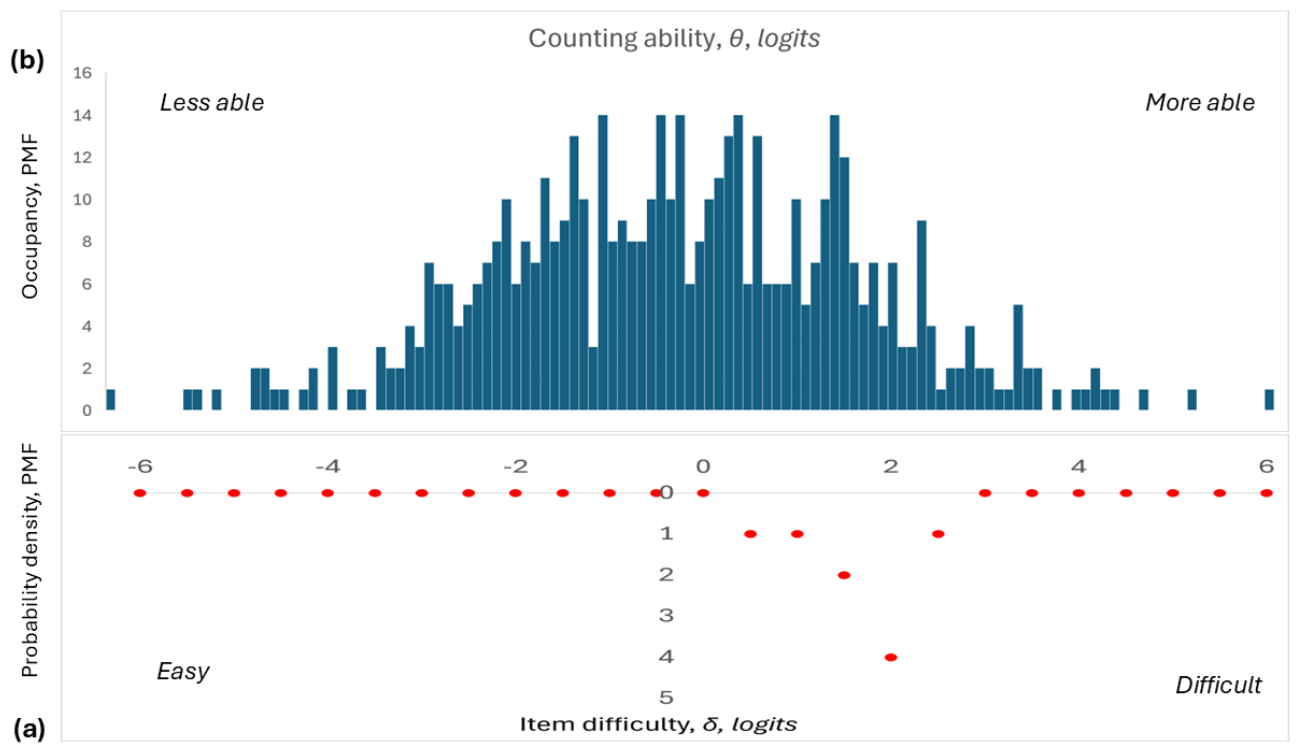
mass functions (PMFs): (i) quantitative response to a discrete range of counts; (ii) the classic
Poisson distribution of miscounts; and (iii) psychometric (Rasch) distributions of counting
task difficulty and person counting ability. This reanalysis highlights how best to handle
PMFs which provide a means of defining—for discrete and qualitative data—the basic
metrics, viz. location and dispersion, of metrology—quality-assured measurement, as
increasingly required since the turn of the millennium in topical and challenging qualityassurance
applications, amongst others, in the human sciences and in Artificial Intelligence.
PMF-based metrics, useful in ’clinical’ and other applications where meaning and value
are sought, complement the traditionally dominating role played by the corresponding
probability density functions (PDF) in ’analytical’, quantitative and continuous Metrology
in Physics. New insights are provided when benchmarking the Rasch Poisson Counts
Model, which has received less attention in modern metrology, against full psychometric
Rasch modelling.
Keywords: quality assurance; metrology; probability mass function; analytical; clinical; ordinal; discrete; Poisson; counting; psychometric quality assurance; metrology; probability mass function; analytical; clinical; ordinal; discrete; Poisson; counting; psychometric